
Proceeding Paper

Simplicity vs. Complexity in Time Series Forecasting: A Comparative Study of iTransformer Variants †

by
Polycarp Shizawaliyi Yakoi
1,*,
Xiangfu Meng
1,
Danladi Suleman
2,
Adeleye Idowu
3,
Victor Adeyi Odeh
4 and
Chunlin Yu
1
1
School of Electronic and Information Engineering, Liaoning Technical University, Huludao 125000, China
2
School of Science, Technology and Engineering, University of the Sunshine Coast, UniSC Moreton Bay, Petrie, QLD 4502, Australia
3
Department of Management Information Systems, Cyprus International University, 99258 Lefkoşa, Turkey
4
School of Information and Communication Engineering, University of Electronic Science and Technology of China, 611731 Chengdu, China
*
Author to whom correspondence should be addressed.
Presented at the 11th International Conference on Time Series and Forecasting, Canaria, Spain, 16–18 July 2025.
Comput. Sci. Math. Forum 2025, 11(1), 27; https://doi.org/10.3390/cmsf2025011027

Published: 22 August 2025
(This article belongs to the Proceedings of The 11th International Conference on Time Series and Forecasting)

Abstract

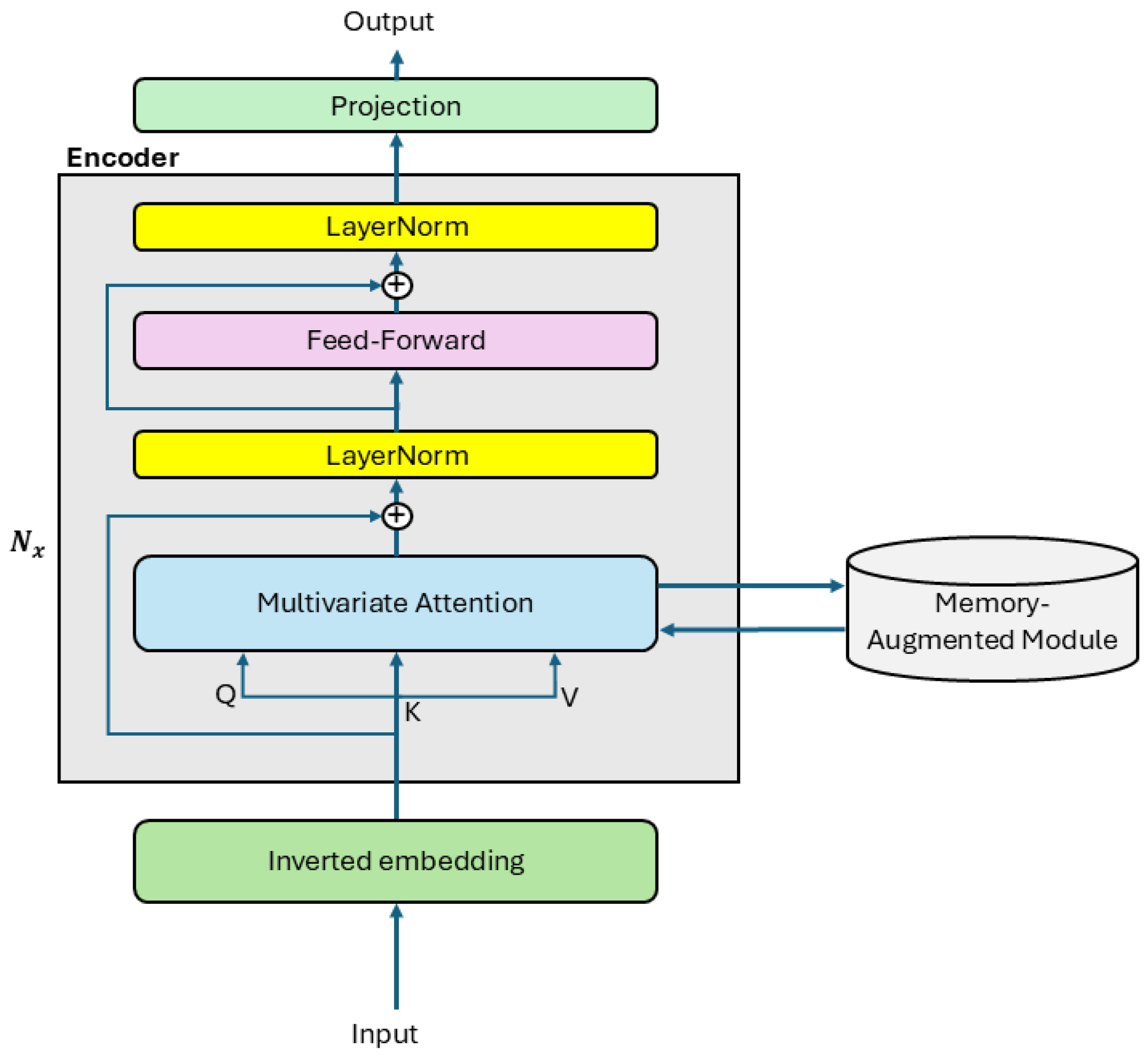
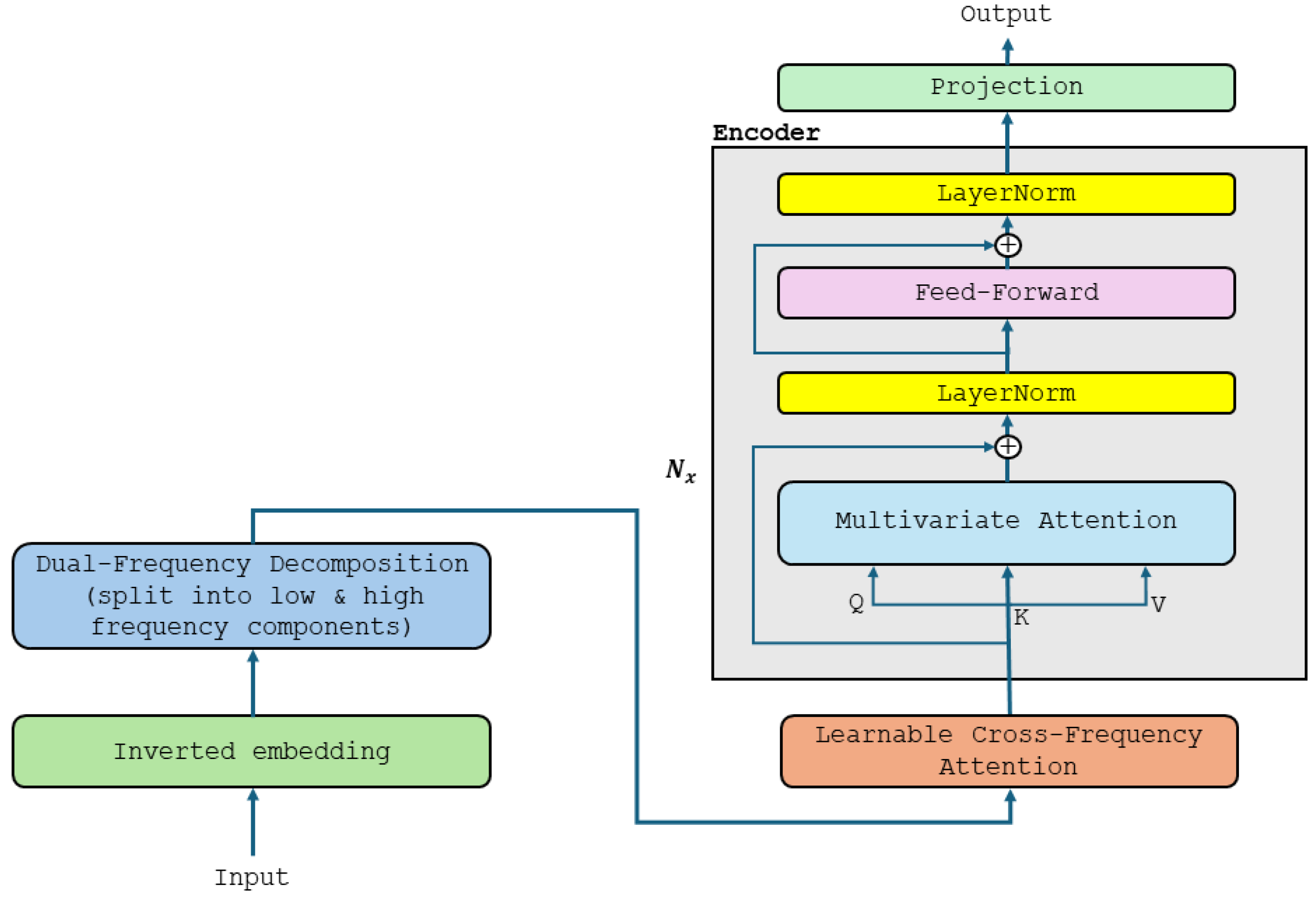
This study re-examines the balance between architectural intricacy and generalization in Transformer models for long-term time series predictions. We perform a systematic comparison involving a lightweight baseline (iTransformer) and two enhanced versions: MiTransformer, which incorporates an external memory component for extending context, and DFiTransformer, which features dual-frequency decomposition along with Learnable Cross-Frequency Attention. All models undergo training using the same protocols across eight standard benchmarks and four forecasting periods. Findings indicate that both MiTransformer and DFiTransformer do not reliably surpass the baseline. In many instances, the increased complexity leads to greater variance and decreased accuracy, especially with unstable or inconsistent datasets. These results imply that architectural minimalism, when effectively refined, can match or surpass the effectiveness of more complex designs—challenging the prevailing trend toward increasingly intricate forecasting architectures.
Keywords: time series forecasting; transformer architectures; model complexity; iTransformer; memory-augmented models; frequency-aware transformers; long-term forecasting; deep learning for time series; inductive bias; forecasting model evaluation time series forecasting; transformer architectures; model complexity; iTransformer; memory-augmented models; frequency-aware transformers; long-term forecasting; deep learning for time series; inductive bias; forecasting model evaluation