1. Introduction
Several factors can result in the decline of an animal species, including factors intrinsic to man, such as predation, stress or food suppression. By monitoring animal behavior it is possible to identify these situations [
1].
To carry out reliable sample surveys with animals, it is necessary to ensure that they are adequately accommodated and subject to controlled environmental conditions [
2]. Therefore, it is important to understand the heat transfer mechanisms of these animals.
Heat can interfere with physiological factors related to animals, such as oxygen consumption, respiration, blood loss and coagulation, among many others [
3].
The energy produced by metabolism is converted into work and heat released into the environment. The heat transfer rate to the environment depends on the temperature difference between the body and the environment.
An animal's metabolic rate can be estimated by measuring the amount of energy released as heat over a given time. Through the technique of direct calorimetry, it is possible to estimate the energy released due to metabolism. The animal is placed in a thermally insulated chamber, and the heat it releases is determined by the increase in temperature of a given body of water [
4].
Based on studies with mammals, Bandall et al. [
5] established a graph containing the trend line of the rate of heat produced (kcal / h) as a function of the animals' body mass (kg). According to the data obtained [
5], a rat produces about 80 kcal/day, and mouse produce approximately 9.5 kcal/day. Values are only approximations, obtained from a trend line, where the heat transfer process or the influence of external factors on the final result are not differentiated.
Bilgili [
6] demonstrated that more than 80% of the heat transfer rate released by the human body corresponds to the sum of the portions of convection and radiation. Bezerra et al. [
7] showed that about 90% of the heat transfer rate in rats corresponds to convection.
In the present study, the heat released by natural and forced convection was analyzed in rats and mice, at different levels of activities.
2. Instrumentation and materials
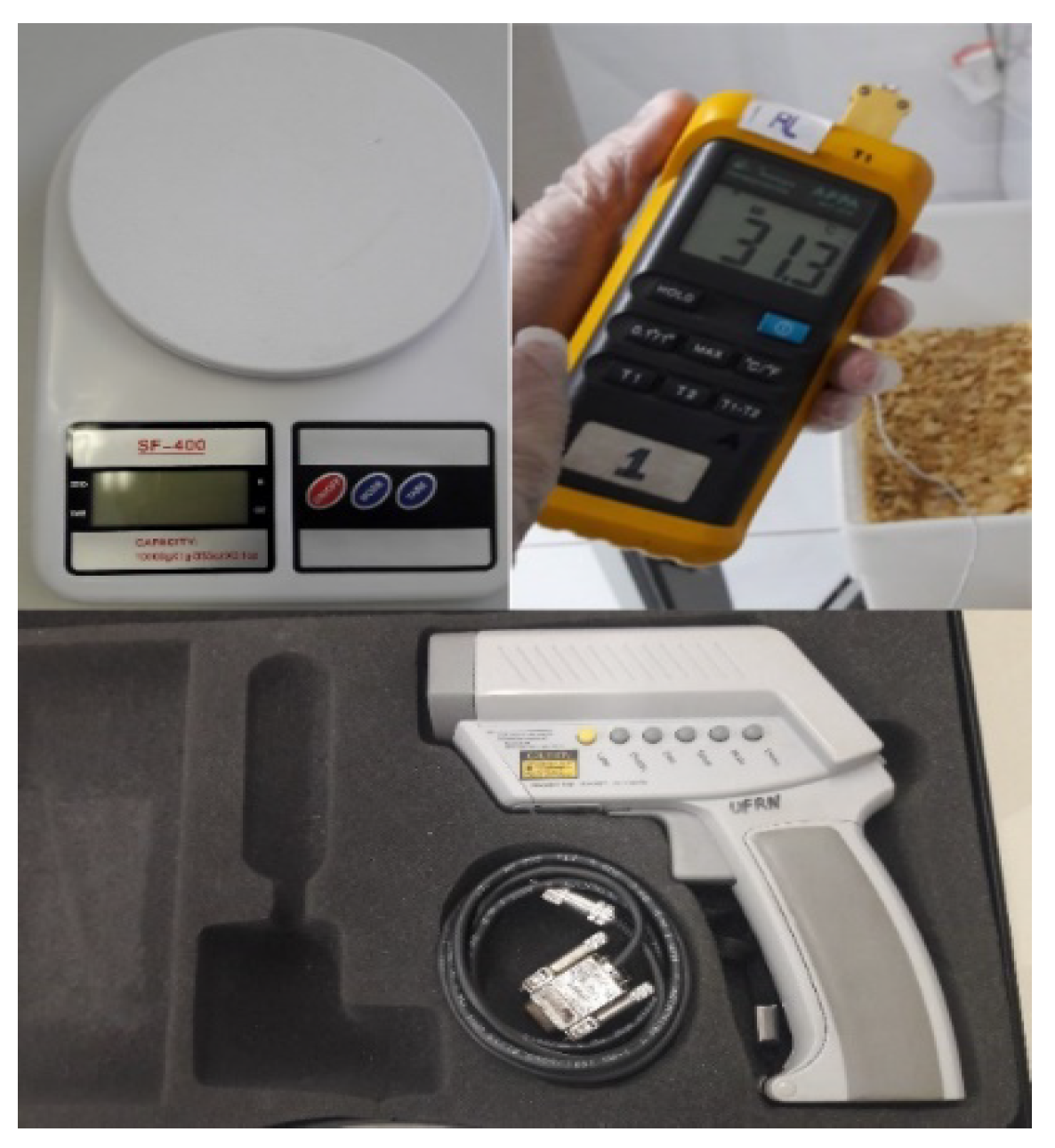
To carry out the experiment, the following instrumentation was used: an optical pyrometer, for remote temperature measurement; a thermocouple, for contact temperature measurement; a scale, for measuring the weight; and a ruler, for estimate the dimensions of the animals.
Minipa's infrared optical digital pyrometer is suitable for taking measurements of objects and surfaces in hard to reach places, as well as places where there is high temperature [
8].
Accuracy is given as ± (% of Reading + Number of Digits) for 23°C±5°C temperature and humidity.
Gloves were used for contact with animals; disposable sneakers for entry into the vivarium; gown and cap, in order to avoid changes in the internal environment.
The
Figure 1 shows the mentioned resources.
3. Procedures
The experiment was carried out in the vivarium of the Museum of Morphological Sciences of the Biosciences Center of the Federal University of Rio Grande do Norte (UFRN). Twenty rats and twelve mice were randomly chosen from a total population of 200 rats and 160 mice, all in perfect health conditions, corresponding to a sampling space of 10% for rats and 7.5% for mice. Small numbers of specimens were considered to avoid stressing the respective populations of the vivarium.
The procedures adopted in the study followed the ethical principles of research using animals. All measurements of variables of interest to the research were non-evasive.
Superficial contact of the thermocouple with the abdominal region of the animals was made to measure the temperature. An optical pyrometer was also used to estimate the temperature at the same point. The emissivity of the equipment was adjusted to 0.98, as suggested by Rodriguez [
4], corresponding to the closest and most coherent value to the skin condition of the animals.
Data related to the maintenance of the vivarium environment for the air conditioning system were: 55% relative humidity, 22 °C ambient temperature and 15 to 20 air changes per hour, with a velocity of 0.25 m / s ventilation, as suggested by Neves et al. [
2].
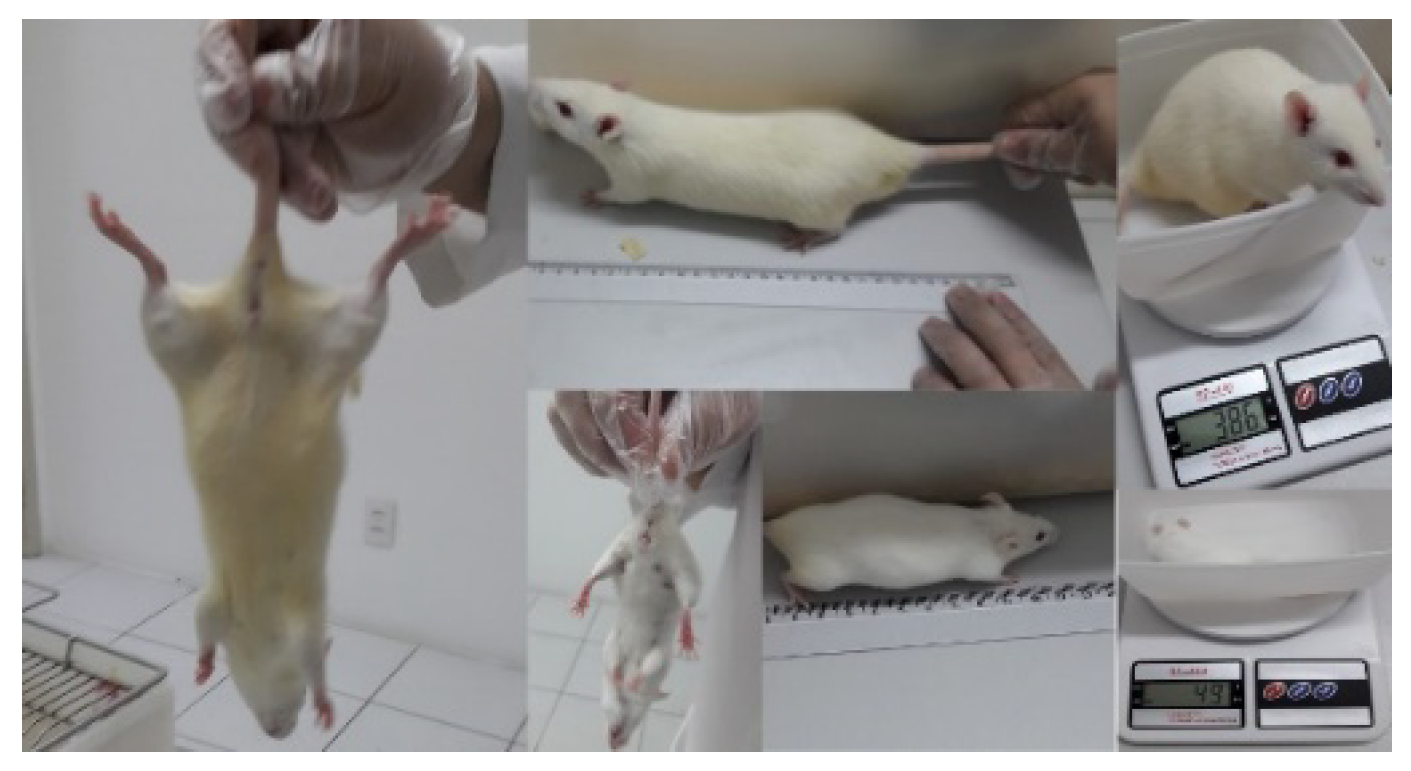
Body length measurements were taken using graduated rulers. To obtain the mass, the animals were placed on the scale [
7]. The
Figure 2 shows the measurement procedure used to estimate the size, weight and temperature of the animals.
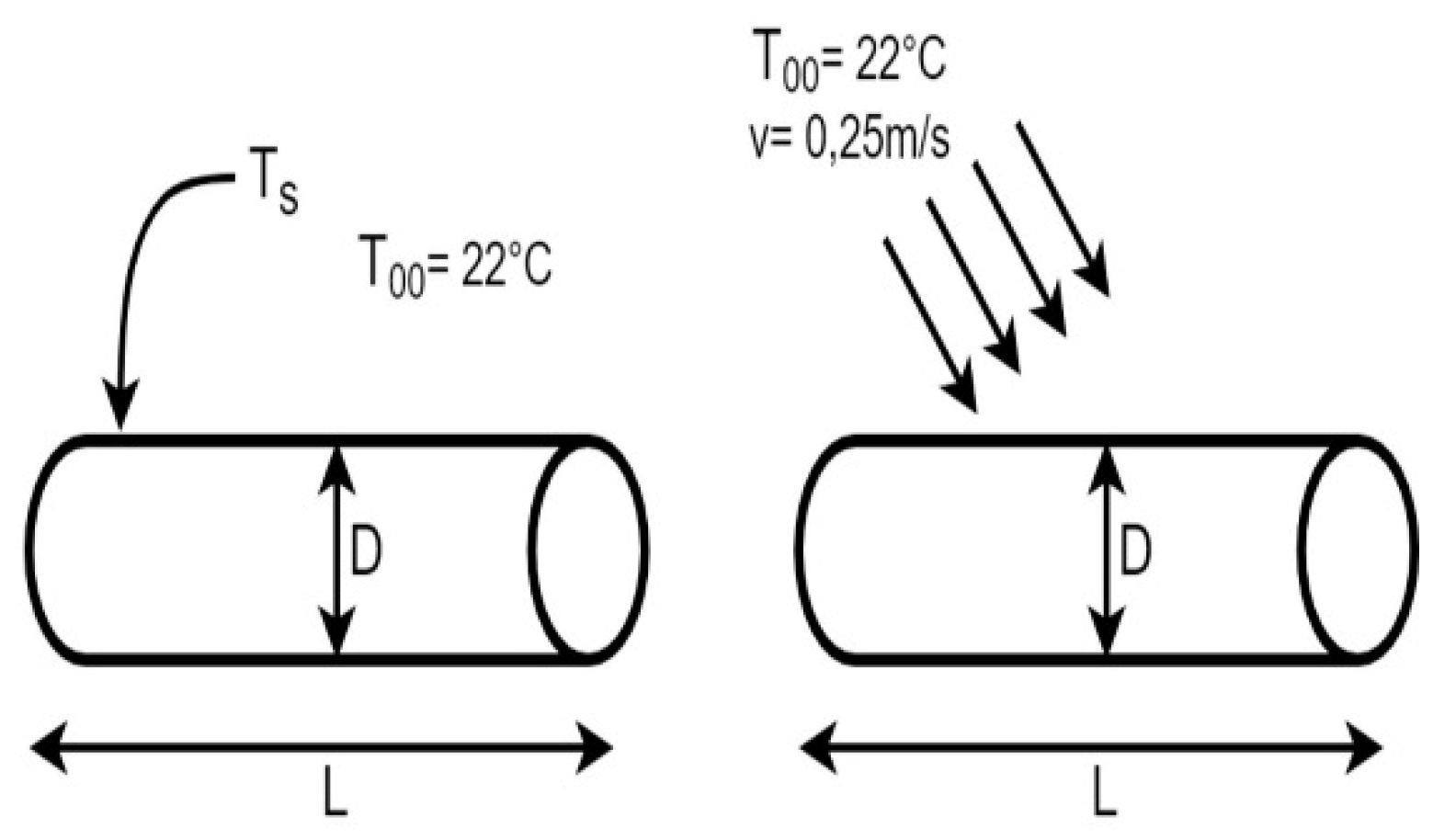
The surface area of each animal (skin) is approximated to the area of a cylinder. Where the diameter “D” corresponds to the largest diameter of the animal's belly, and “L” the length from the head to the beginning of the animal's tail.
Data were recorded and entered into a spreadsheet, where the mean, median and standard deviation were subsequently calculated.
In the thermodynamic analysis of the process, internal body temperature and skin temperature of the animals were considered equal and invariable, since they are small size specimens.
Conduction heat transfer through the skin wall is small, and was disregarded in the analysis.
Ambient air was admitted as the ideal gas and the local pressure was assumed to be equal to the pressure of the Earth's standard atmosphere.
The analyses considered the steady state condition, where conduction, radiation, evaporation and respiration were not considered. The experimental results were compared to results presented in literature.
4. Convective heat transfer
Metabolism is responsible for combining oxygen and food to produce the energy needed for life. The energy resulting from the process is used by animals to perform work, while the portion not converted into work is released to the environment in the form of heat. In the case under study, only the convective process of heat transfer to the environment was considered, as this is the most pronounced mode [
7].
The rate of heat released by rats and mice is the sum of the rates of heat due to convection, radiation, evaporation, respiration and conduction, which in frames of the law of energy conservation (1st Law of Thermodynamics) can be mathematically expressed by eq. (1):
The convection heat rate can be calculated from Eq. (2):
Convective heat transfer from the surface of animals to the environment can be analysed as natural or forced, as shown in
Figure 3.
To estimate the convective heat transfer coefficient, the considerations previously assumed for the analysis of the process were applied.
The heat exchange surface area (area of a cylinder) was obtained from eq. (3):
The properties of the air were obtained from Çengel et al. [
9], considering the average film temperature, determined by means of Eq. (4):
From the film temperature, the other properties of the systems (mice and rats) and of the medium (air) can be estimated. Then, these properties are applied to obtain the Rayleigh Number, given by eq. (5):
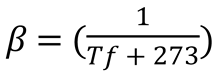
The coefficient of volumetric expansion in eq. (5) is given by eq. (6) [
9]:
The Reynolds number is calculated using the eq. (7):
The Nusselt number for a horizontal cylinder (the approximate geometry of animals) subjected to heat transfer by natural convection, with Ra ≤ 10
12, can be estimated by eq. (8) [
9]:
Among the various options available in the literature to estimate the average Nusselt Number for a cross flow over a cylinder, the relationship proposed by Churchill and Bernstein [
9] is well suited for forced convection, expressed by eq. (9):
Once the Nusselt number has been defined, it is possible to calculate the heat transfer coefficient by convection using the eq. (10):
Finally, the amount of heat transferred by convection can be determined by substituting hconv (eq. 10) in eq. (2).
The convection heat transfer rate, determined based on the experimental data obtained in the present study, can be compared to values provided in the literature. In the graph by Bansal et al. [
5], the rate of heat produced is given in kcal / day, which must be converted into International System (SI) units (i.e., J/s or dW/dt) using eq. (11):
The difference between the values obtained by calculations from the experimental results data and the values found in the literature was determined by eq. (12):
3. Results and discussion
The values obtained experimentally are presented in
Table 1 and
Table 2, respectively for rats and mice.
Where "Number" is the number corresponding to the measured animal, "gender" is the genus of the same animal, "Age" is the date of birth, "Ts" corresponds to the temperature at the surface of the animals, "L" to the body length and "D" to the diameter of the bodies.
The mean values for the measurements presented above are shown in
Table 3, where “Me” is the median, “
” is the mean and “σ” is the standard deviation.
The mean values for rats is higher than for mice, as expected.
It was found that the temperature values were consistent with those predicted by Fish [
10], confirming the validity of the experimental results. In addition, the value adopted for the emissivity coefficient of the animals' skin (adjusted in the optical pyrometer) was shown to be appropriate. However, it is noted that the standard deviations for mouse temperatures were almost three times higher than those obtained for rats, probably due to the higher rate of metabolism.
It is also noted that the mean values were very close to the median, which demonstrates a certain regularity in the results.
The standard deviations determined for the masses of rats were much greater than those of mice. This was probably due to the differences in the ages and masses of the rats and due to the greater uniformity in the masses and ages of the mice. On the other hand, the standard deviation of the temperature for mice was almost triple that for rats, which may have been caused by sample 12, which had a temperature well below the mean, a fact that can be attributed to measurement error.
The average surface area values - an important factor to be considered when estimating the heat transfer rate of the animals - proved to be quite regular.
According to Çengel [
9], to estimate the rate of heat transfer by convection, a mathematical interpolation is made considering the film temperature values of rats and mice, as shown in
Table 4.
To calculate the Reynolds Number from eq. (7), the air velocity at the place of the experiment was considered equal to 0.25 m/s, which corresponds to the average exit velocity of the air conditioning installed at the place [
11].
Considering the natural convection process, where the effects due to ventilation were neglected, the Nusselt numbers obtained from eq. (8) were: 11.37 for rats and 5.243 for mice.
Considering the forced convection process, where the air flow due to the air conditioner fans was considered constant, the Nusselt numbers obtained from eq. (9) were: 221.12 for rats and 117.30 for mice. As expected, the values due to forced convection were much higher than those obtained for natural convection, as shown in
Table 5.
Respectively using eqs. (9) and (2), the heat transfer coefficients and the corresponding heat transfer rates were determined, resulting in the values presented in
Table 6.
From
Table 6, it can be seen that the convective heat released by the rats was greater than that of the mice, a behaviour that was already expected, because of the greater surface area and body mass of rats compared to mice.
The forced convection heat transfer rate was about 8 times higher than the natural one, due to the strong influence of the air flow (at 0.25 m/s and 22 °C) inside the experiment site. Using the graph proposed by Bandal et al. [
5] and considering the mean values of the animals' masses, as shown in
Table 3, the mean heat transfer rate for rats was approximately 80 kcal / day, while for mice it was around 9.5 kcal/day. Converting to Watts, according to eq. (11), the corresponding values are, respectively, 3.88 W and 0.46 W.
The
Table 7 shows the rate values for the cases where convective heat transfer was considered responsible, respectively, for 80% of the total energy released by the animals, according to Bilgili et al. [
6], and 90%, according to Bezerra et al. [
7].
The eq. (12) was used to facilitate the comparison between the results of the experiments and those obtained in the literature. Thus, it was possible to estimate the relative errors of each case, whose results are presented in
Table 7.
The relative error value for calculations concerning rats was only 5%, indicating consistency between the experimental data and those in the literature. For mice, however, the error was approximately 85%, which may have been caused by the great variability of the values obtained in temperature measurements, since the standard deviation was almost 3 times greater than that of rats.
The skin of rats and mice (wool coat) affects the heat transfer process negatively, that is, it presents itself as a small resistance to heat exchange. In this way, rodents that have more hair will have less heat exchanges with the environment.
5. Conclusions
It was possible to carry out an experimental study of heat transfer by convection in rats and mice confined in a vivarium. In addition, it also allowed a comparative analysis between literature data and experimental data.
In both cases considered (free and forced convection), the heat transfer rate by rats was higher than that of mice, a consequence of the larger body area and mass.
When compared to the forced convection results, the values calculated for the heat transfer rates by natural convection were much closer to what was predicted in the literature. Forced convection was about eight times greater than that obtained for natural convection, showing the influence of air velocity inside the vivarium.
For heat transfer calculations, the geometry of rats and mice can be approximated to cylinders if the analysis results show significant deviations.
Data on convection heat transfer coefficients and heat transfer rate are important as these parameters are used in animal studies.
It is suggested for future work to take into account other input parameters, such as: activity level, sample number and temperature variation in the vivarium.