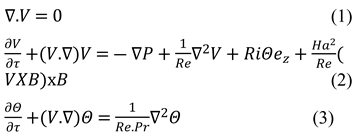
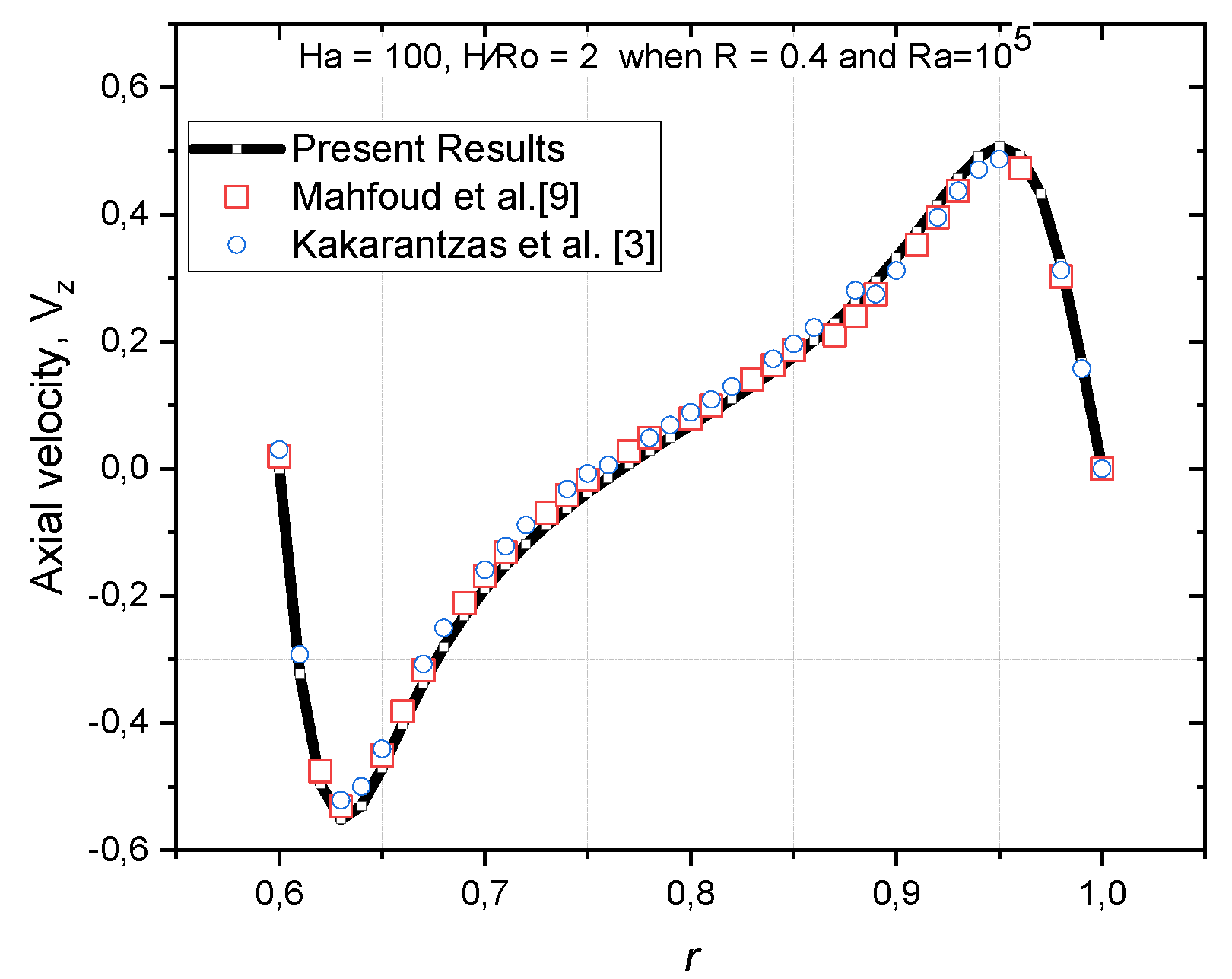
First, the used numerical model has been validated by comparing the present numerical results with the numerical results of Mahfoud et al. [
9] and Kakarantzas et al. [
3] who investigated the flow and heat transfer of liquid metal which rotates in the annular of concentric cylinders under a magnetic field effect.
Figure 2 shows the reproduction of the radial distribution of axial velocity in the middle of the domain, for
Ha = 100 and the aspect ratio
γ= 2.0 when the annular gap is
R =0.4 and the Rayleigh number
Ra=105. Although, there is a good agreement between the compared numerical results.
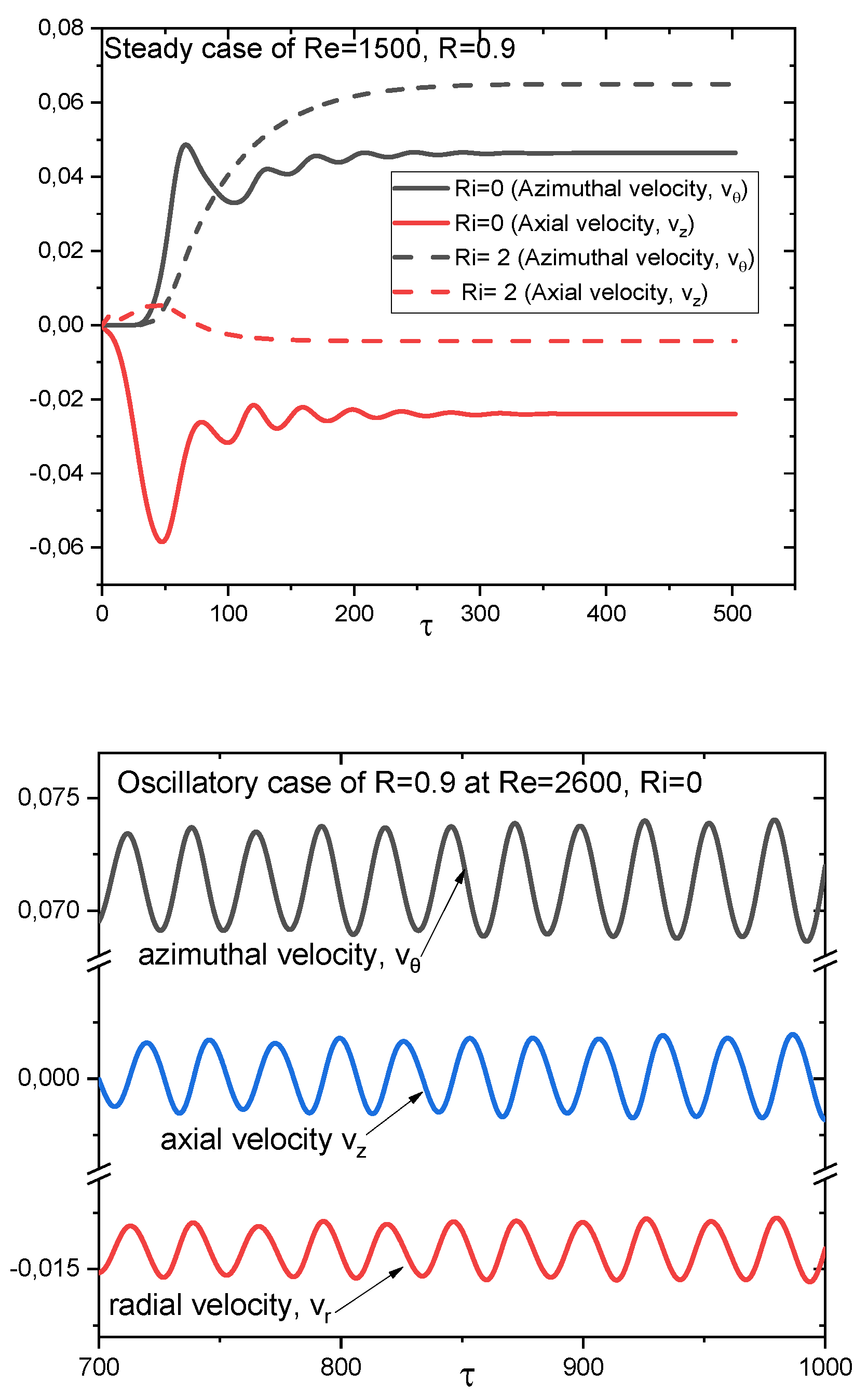
The problem considered could be oscillatory or turbulent; the following section includes the justification. It is known that the typical sequence of evolution of a dynamic system towards chaos for increasing values of the control parameter consists of the following stages: transition to an oscillatory or periodic state; a quasi-periodic regime, and finally chaos (or turbulence). To detect the regime of flow, i.e., transient or steady-state, a series of numerical calculations are performed for each case.
Figure 4 shows the temporal evolutions of axial and azimuthal velocities at the monitoring point (r = 0.5, z= 0.75). These simulations presented steady-state solutions obtained for the various case Re= 1500, R=0.9 and the ranges of controlling parameters: the Richardson number (
Ri =0 and
Ri=2.0) and the Prandtl number (
Pr= 0.032), as shown in
Figure 4(upper). The oscillatory aspect of the temporal evolutions of the axial of axial radial and azimuthal velocities at the same monitoring point (r = 0.5, z= 0.75) is shown in
Figure 4(lower) for Re=2760,
Ri=0. It is seen that the increase of
Re enhances the fluid motion while the evolutions become time- dependent (oscillatory). Therefore, as the Reynolds number is increased, swirl strength increases, and hence the ability of waves to propagate against the flow increases [
22]. The swirling flows will be steady and axisymmetric till the critical Reynolds numbers Re
cr ≈ 2585 when the oscillatory instability begins to set in for
R=0.9 at
γ= 1.5.
4.1. Annular gaps effect
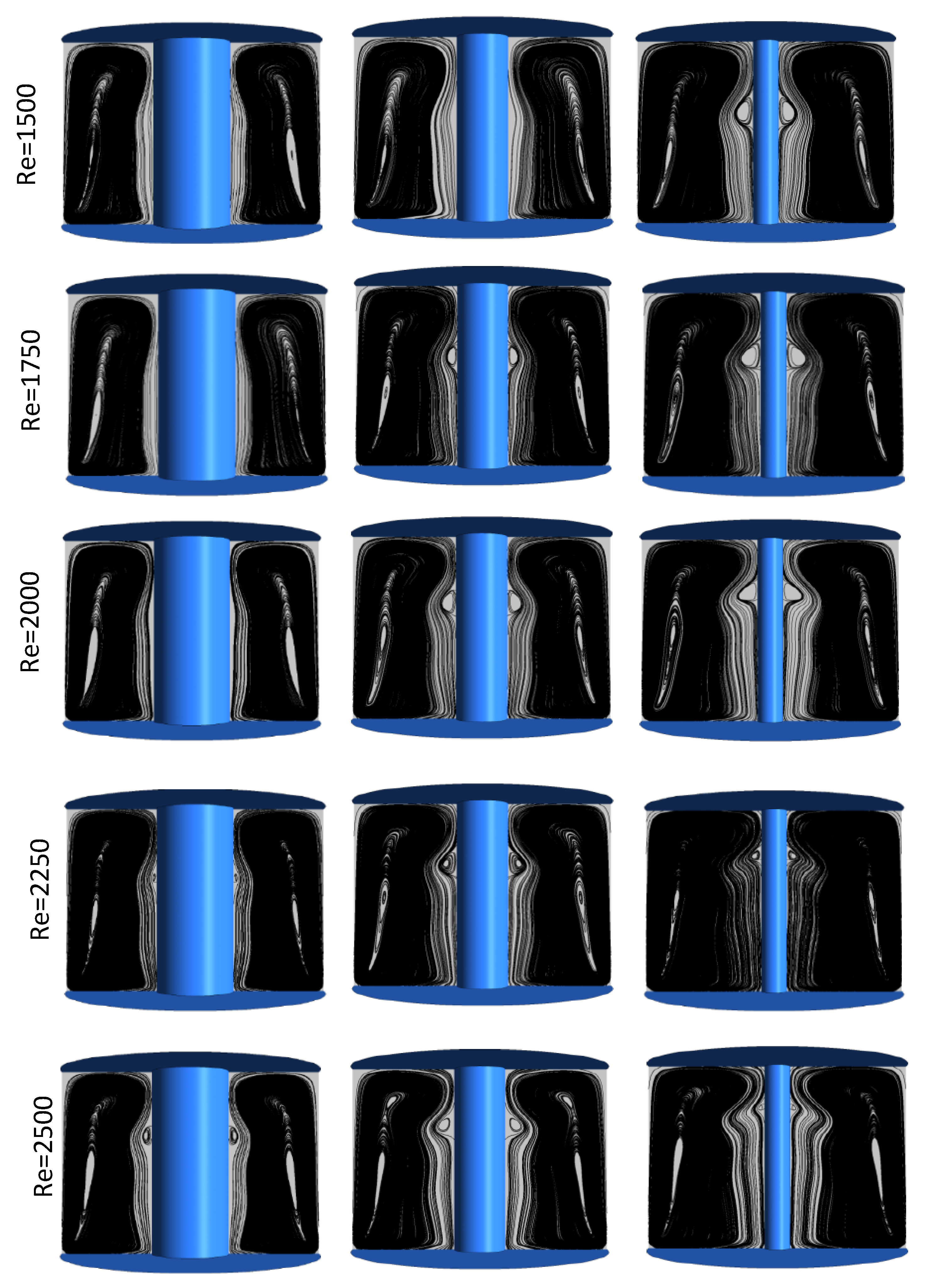
The influence of the annular gaps on the flow pattern, the apparition, and suppression of vortex breakdown is also depicted in
Figure 5 where four Reynolds numbers (Re=1500, 1750, 2000, 2250, and 2500) are compared for one aspect ratio
γ=1.5 and three annular gaps
R=0.7, 0.8, and 0.9, respectively. The first line of
Figure 5 shows the swirling flow in the cases of
R = 0.7, 0.8 and 0.9, they are represented schematically by the streamlines in meridional planes for Re= 1500. When the annular gap is increased (
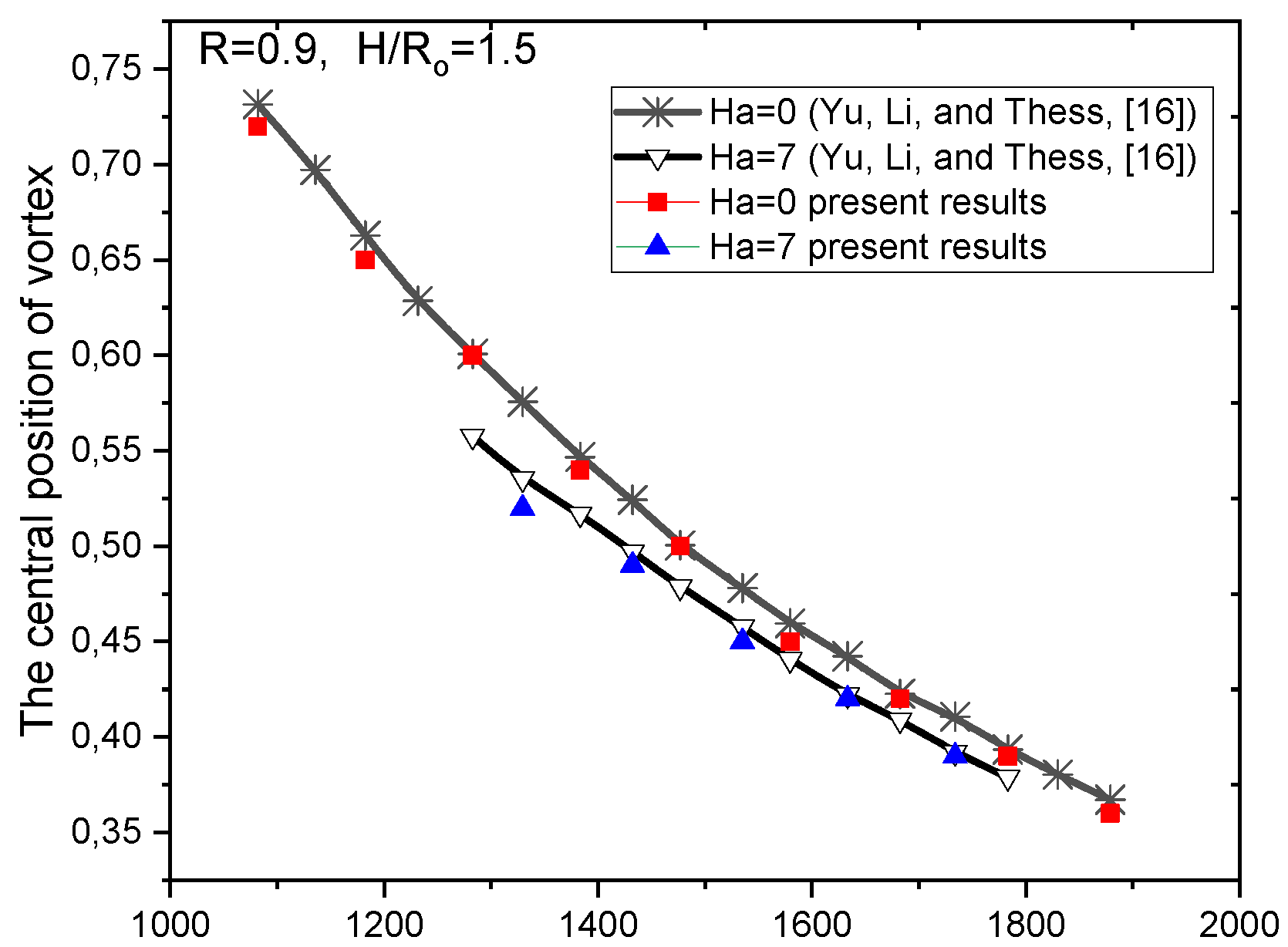
R =0.7, 0.8, and 0.9), the vortex appears at R=0.9 in which, the central position of the vortex on the
z-axis is at
z = 0.91 and on the r-axis is 0.19. The case of Re=1750 is shown in the second line of
Figure 5, in which a small vortex breakdown appears at 0.8. Then the size of the vortex grows very quickly with the increasing annular gap to
R=0.9. The z- dimensionless length is 0.17 when
R=0.8 and 0.21 for
R = 0.9. The size of the breakdown grows with the increase of Reynolds number to Re=2000 in both cases
(R =0.8, 0.9). As clearly shown by the streamlines on the case of Re=2250 that a small vortex appears at
R=0.7, on the other hand, the size of the vortex decreases for
R = 0.9 and remains the same for
R= 0.8. As the Reynolds number, Re of case
R=0.7 increases (Re=2500), the size of the vortex increases and vice versa. The behavior in the case of
R=0.9 is the opposite because the vortex size decreases with the increase of
Re.
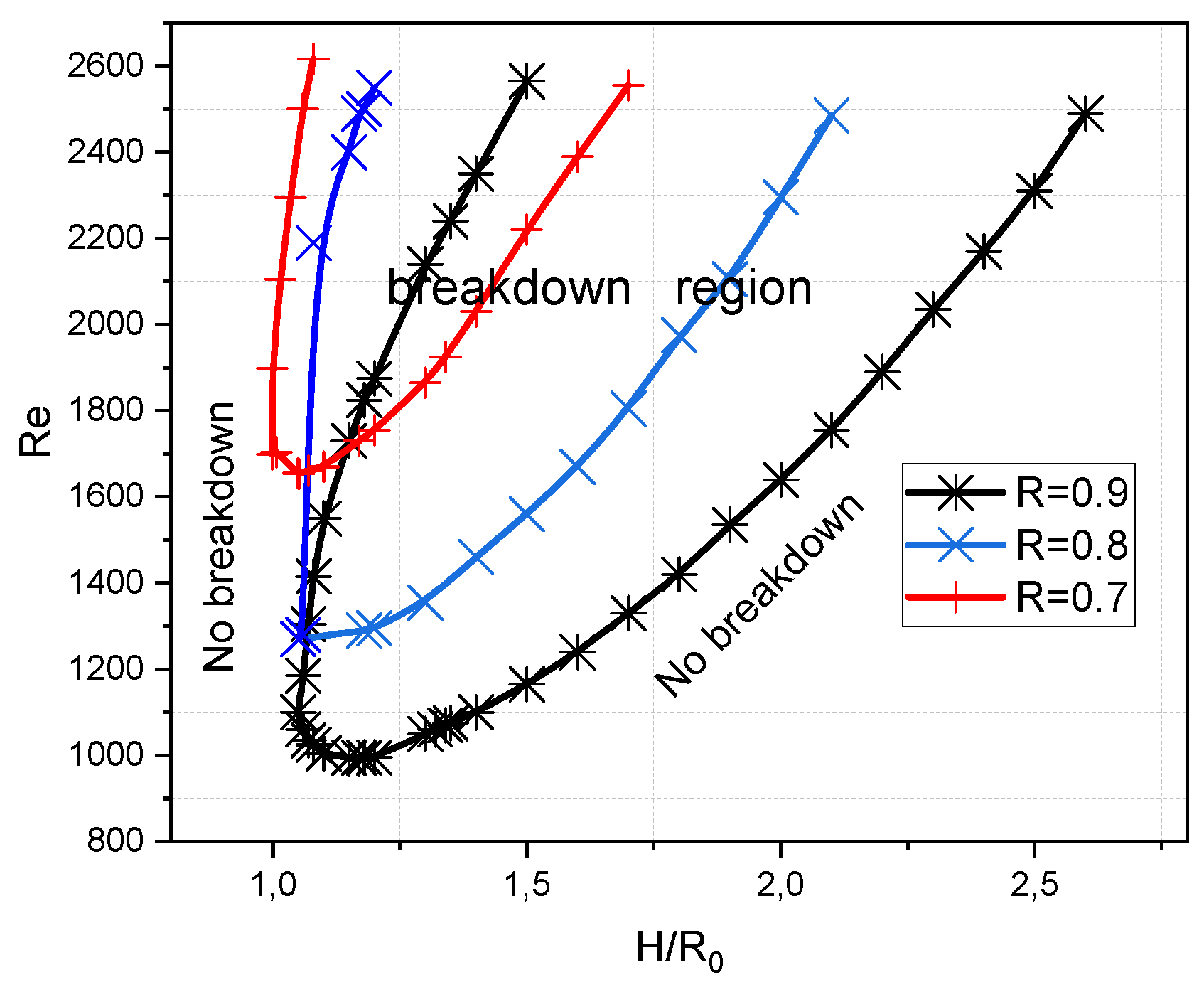
For the hydrodynamic case, the diagram presented in
Figure 6 gives the stability limit in the (
Re,
γ) plane within which a vortex breakdown bubble occurred near to sidewall of the inner cylinder. The influence of the annular gaps on vortex breakdown zones in the
(Re, γ) plane shows how the boundaries of the vortex breakdown shift. Three separate curves represent the limits of three-zone, i.e., the domains with and without vortex breakdowns could be observed. We observe that the decrease of the annular gap causes the decrease in the vortex breakdown zone so that the decrease in the values of the annular gaps causes boundaries to move towards the side of the lower aspect ratio.
4.2. Magnetic field effects on vortex breakdown
This section clarifies the effects of the magnetic field to control the central position of the vortex on the z-axis and r-axis, respectively. The second stage is to identify the most efficient Ha to eliminate the vortex bubble. The swirling flow in the annular gap produced by the rotating bottom disk under an axial magnetic can be divided into three regions, i.e., the core region, the Hartmann layer, and the side layer (Robert layer). The viscous forces can complete with magnetic forces in the Hartmann layer near to walls normal the applied magnetic field.
Thus, when the Hartmann number increases, the Ekman layer is progressively replaced by the Hartmann layer, which is near to walls normal to the magnetic field. These layers are perpendicular to the magnetic field, having a dimensionless thickness δ⊥ ≈ 1/
Ha. Therefore, the intensified magnetic field results in Hartmann layer thickness. Where the walls are electrically insulating, the Hartmann layer near the disk has a similarity solution as in the case of the classical Ekman layer. The order of magnitude of the axial velocity is v
z~
Re/Ha3 [
18], which results in the weakness of the axial velocity. Pao and Long [
23] also that an external magnetic field that intensifies magnetic intensity results in boundary layer thickness and a decrease of the axial flow component.
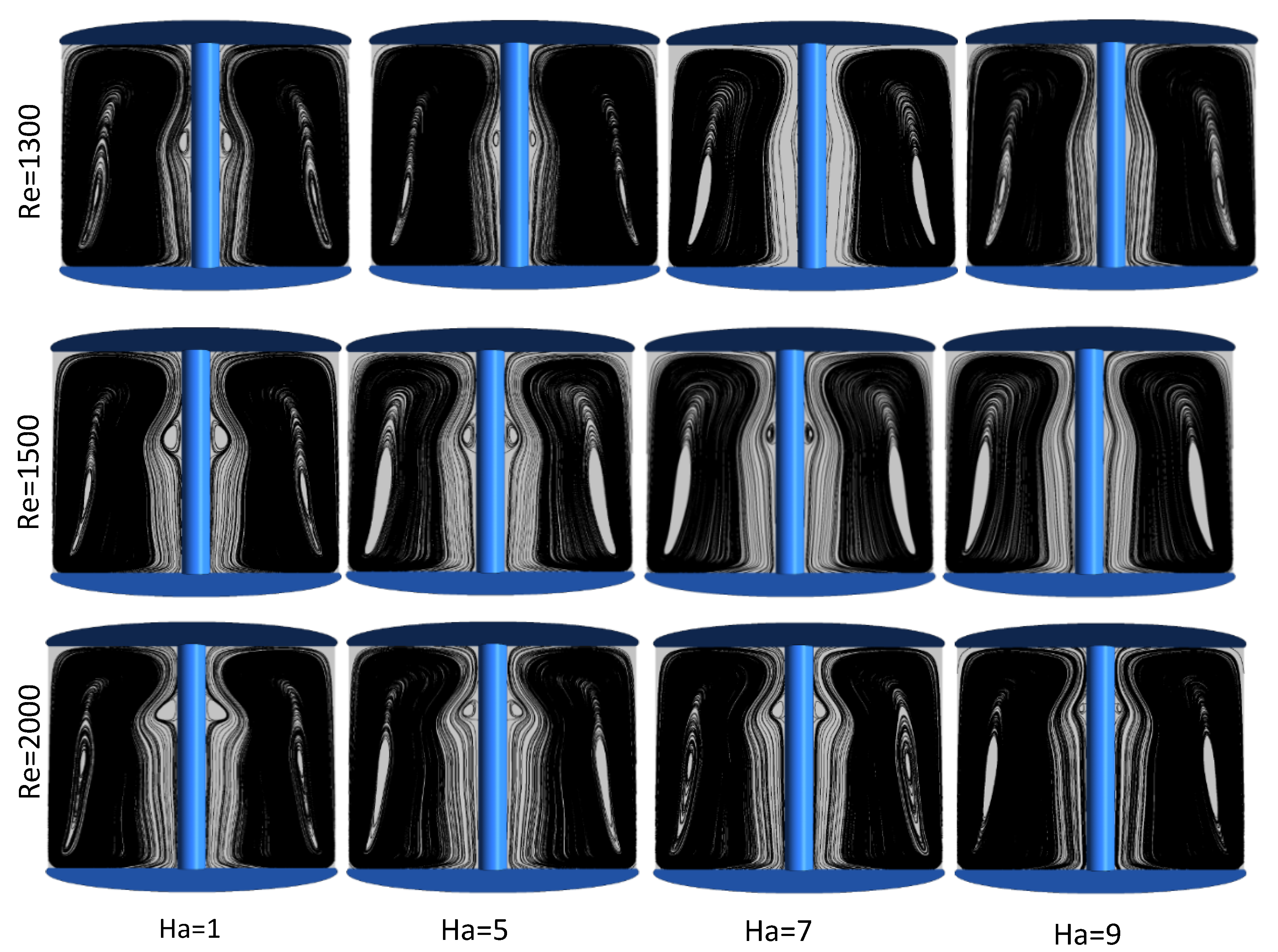
Figure 7 shows streamlines for increasing Hartmann numbers (
Ha=1, 5, 7 and 9) in three case of
Re = 1300 (above),
Re= 1500 (middle), and
Re= 2000 (bellow) when
R=0.9 and
γ=1.5. For Re= 1300, the vortex appears at Ha=1 in which, the central position of the vortex on the
z-axis is at
z ≈ 0.84 and on the r-axis is 0.15. Then the size of the vortex grows with the increasing
Ha to 5. The z- dimensionless length is 0.18 when
Ha=1 and 0.11 for
Ha = 5, and disappears for critical Hartmann number (
Hacr ≈6.5). The case of Re=1500 is shown in the second line of
Figure 7, in which the vortex breakdown size diminishes with increasing Hartmann numbers and finally disappears at Ha=9. For Re=2000, the vortex breakdown size rises with increasing Hartmann numbers and disappears for a value that exceeds
Ha=9.
Figure 7 show that the size of the breakdown grows with increasing Reynolds number. So, the central positions of the vortex on the
z-axis increase with increasing
Re and
Ha, respectively.
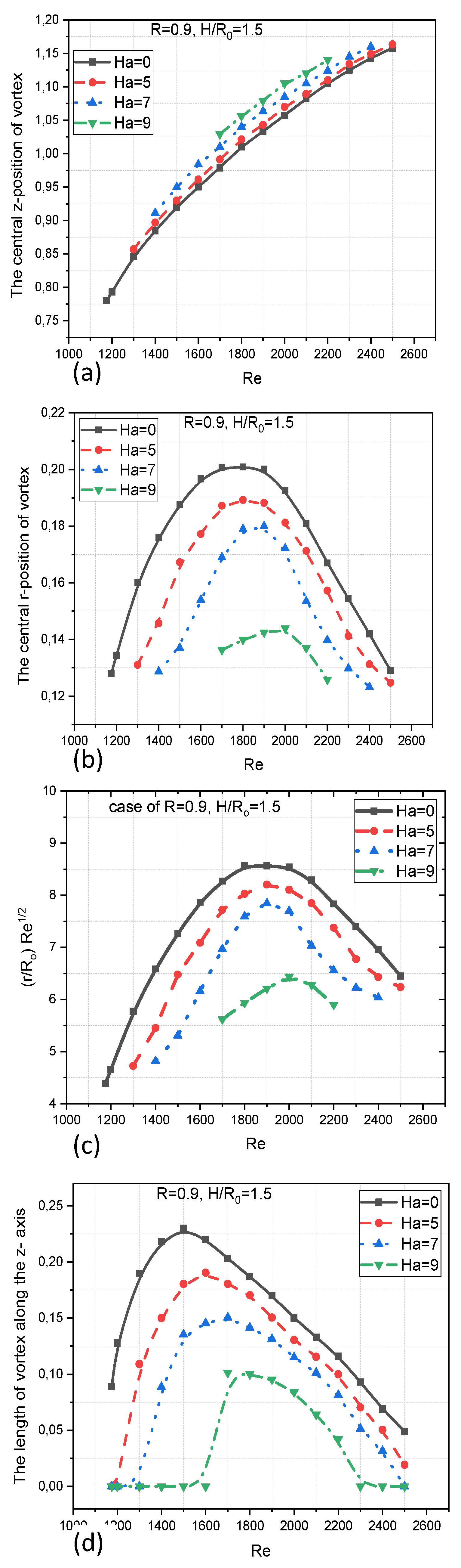
Figure 8a,b shows the effects of the magnetic field on the central position of the vortex on the
z-axis and
r-axis, respectively in the case of
γ=1.5 when the annular gap is
R=0.9. Here, the central position is presented at different Reynolds numbers, which is in the range of 1100 ≤
Re ≤ 2500. Without a magnetic field, a vortex appears at
Re = 1170 and disappears at
Re = 2510. The central position on the
z-axis is at
z = 0.780 when the small vortex appears at
Re = 1175 and rise to
z = 1.157 until
Re = 2500. In
Figure 8a, the central positions of the vortex increase gradually with the increasing Hartmann number at a fixed Reynolds number. The effects of the magnetic field on the central positions of the vortex are much stronger for
Ha=9 since the vortex appears close to
Re = 1690 and disappears at
Re = 2210. The central positions are at
z= 1.029 and 1.14 for
Re = 1700 and
Re=2200, respectively. The results show that when the Hartmann number increase, the vortex breakdown is gradually suppressed by the magnetic field. In
Figure 8b, the central position of the vortex on the r-axis under an axial uniform magnetic field is different from those in the central position on the z-axis. In this case, the distribution of the central position on the
r-axis represents the shape of a semicircle As shown, their positions diminish gradually under the increasing effect of the magnetic field. When the Hartmann number increases, the central positions of the vortex on the
r-axis drop at a fixed Reynolds number. Taking
Re = 1800 for example, the central positions of the vortex are at
r = 0.201, 0.189, 0.179 and 0.139 for
Ha =0, 5, 7 and 9, respectively.
At
Ha=0, 5, and 7 the central positions on the r-axis are divided into two parts, when
Re ≤1800, the r-central position of vortex increase with the increasing
Re, contrarily when
Re ≥ 1800, they decrease with the increasing
Re. Finally, for the case of
R=0.9 at
γ=1.5, the present results show that the increase of the
Ha causes the increase of the z-central position of the vortex, but contrarily causes the decrease of the r-central position of the vortex breakdown. The situation can be interpreted as follows, the peak occurred in the region where the viscous and inertial forces are of the same magnitude. Moreover, Based upon experiments of Escudier [
24], the breakdown region is characterised by a radius
r, the corresponding Reynolds number is then (
r/
R0)
Re1/2. The largest value of this quantity for the case of R=0.9 and
γ=1.5 at Ha=0 is for Re=1800 when
r/Ro ~ 0.202 and (
r/
Ro)
Re1/2 ~ 8.57.
Figure 8c shows the relationships between Reynolds number of base flow and Reynolds number of breakdown region. The rotation rate of the breakdown region increase up to (
r/
Ro)
Re1/2~8.57, 8.02, 7.59, 5.93 for Ha =0, 5, 7 and 9, respectively and drops slowly when the Reynolds number is increased. In
Figure 8d, the dimensionless lengths of the vortex for the case of
R=0.9 at
γ=1.5 are presented when the Reynolds number is in the range of 1100 to 2500 with the increment of 100. In
Ha ≠0, the magnetic field gives a stronger influence on the length especially to the peak value, and this exhibition is more obvious than that in
Ha=0. When
Ha = 5 and
Ha = 7, the lengths are ≈0,19 and 0,15 at the peak, respectively. For
Ha = 7, the vortex appears close to
Re = 1650, reaches the peak, 0.1014, at
Re = 1700 and disappears at
Re =2300.
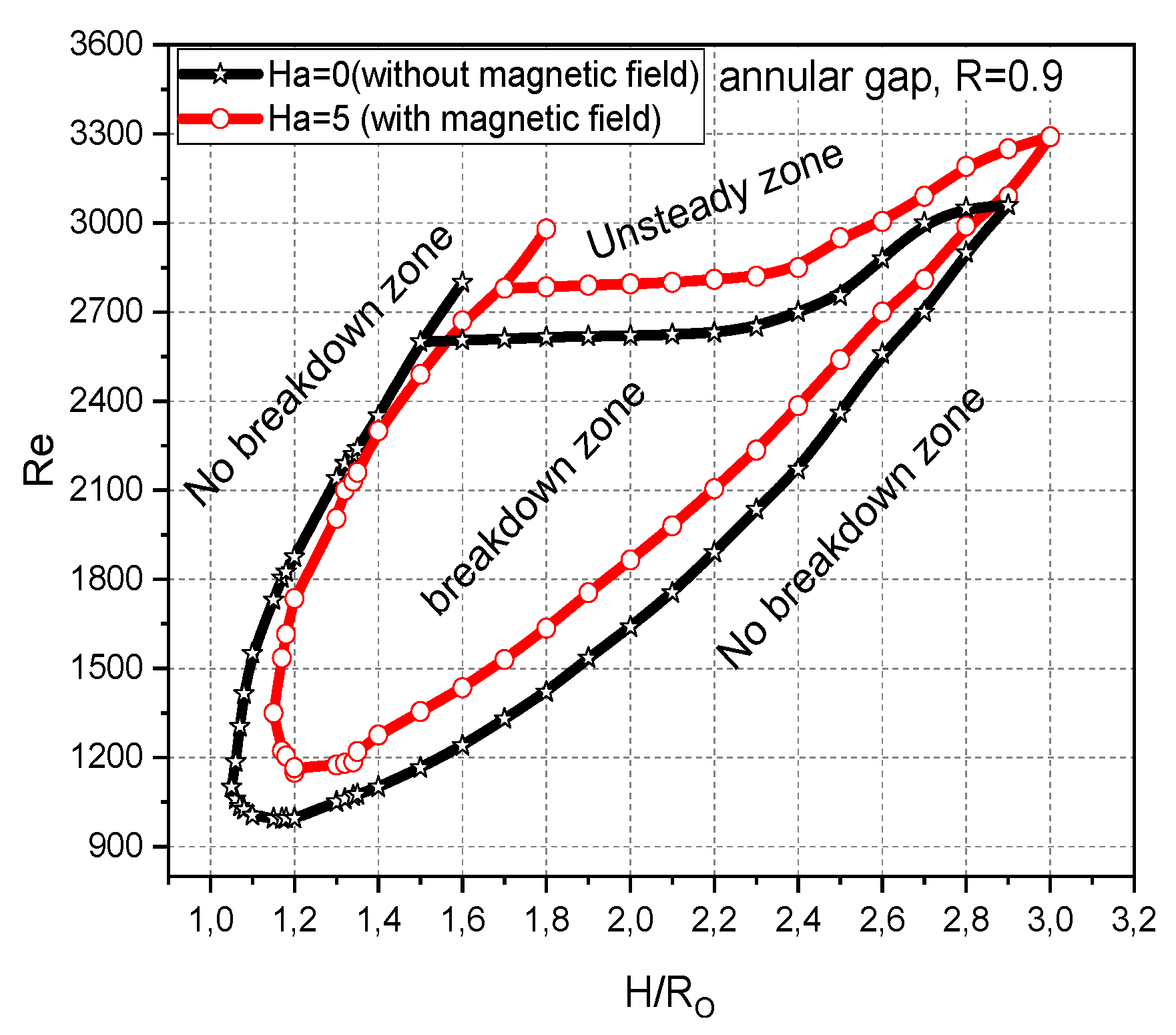
Stability limits for
Ha=0 and 5 at the annular gap
R=0.9 are constructed on (
Re,
γ) plane for two cases as shown in
Figure 9. There, curves represent the boundaries for the vortex zone and no-vortex zone and the limits between steady and unsteady zones. The boundaries shift shows that intensifying magnetic intensity contract the domain limits of the vortex breakdown. To obtain the impact of the Hartmann number on vortex breakdown zones, two selected magnitudes of Hartmann number,
Ha=0 and 5 have been studied. The black curve with start symbols shows the boundaries vortex breakdown at
Ha = 0. For
Ha = 5, the vortex breakdown zone boundaries shown by the curve in red colour with circle symbols shrink and shift upward concerning the
Ha=0 curve. Hence, this makes the increasing effects of the Hartmann number reduces the limits within which a vortex breakdown occurs and raises the transition to an unsteady regime [
25].
4.3. Buoyancy effect on vortex breakdown and the fluid layers
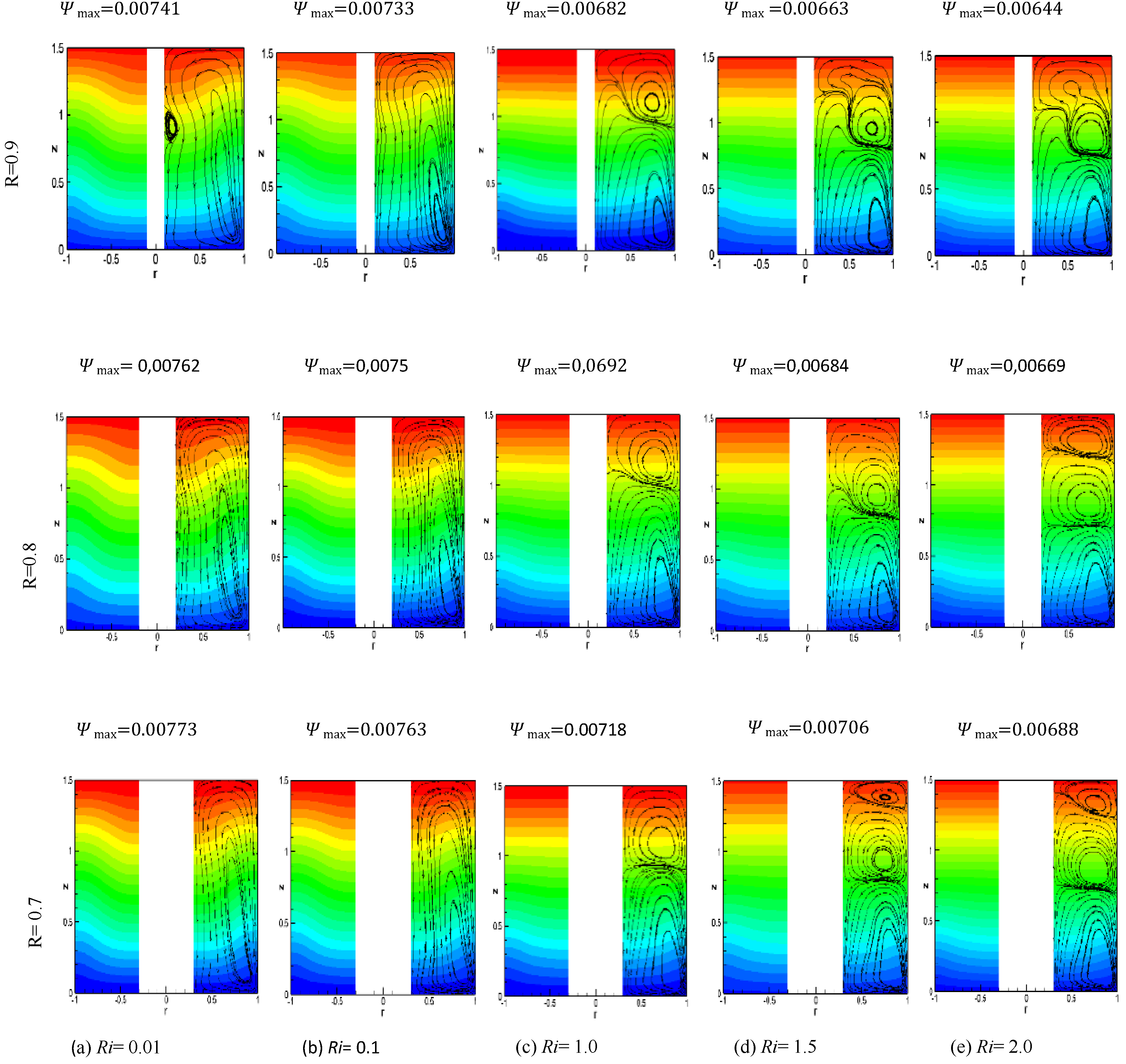
To investigate the effects of thermal gradients on the fluid layers and the control of the vortex breakdown (i.e., location, or suppression of vortex breakdown), three annular gaps are compared (
R=0.7, 0.8, and 0.9), which correspond to
Re =1500 and
γ= 1.5
Figure 10. The case (
Ri =0) corresponds to a decoupling of the velocity and temperature fields, in which forced convection takes place.
The rotation of the bottom gives a centrifugal force to the fluid, and this force drives the fluid radially outward. As the fluid stoped by the outer cylinder sidewall it is turned upward, producing jets. The upward jets and downward flow result in the centrifugal flow structure, with an axial vortex near the inner cylinder axis. This behavior incurs a breakdown, with a single bubble.
Figure 10 presents the superposed streamlines and isotherms in meridional planes for progressively increasing Richardson numbers. The results for R=0.9 show that when the Richardson number, Ri= 0.01 the vortex breakdown remains effective. So, by increasing to Ri =0.1, the vortex breakdown is suppressed. In this case, heat transfer convection is dominant. The maximum value of the stream function decrease with increasing Ri until 0.0064 at Ri =2.0. The streamlines when Ri =1.0 show a new region of counter- flow which grows with increasing Ri and then dominate the entire top section of the annular gap (plot first line of
Figure 10).
The plots in
Figure 10 for case
R=0.8 show the decomposition in the counter-flow region, up to two-layered appear for
Ri = 1.0. The stratified structure with two fluid layers is observed when
Ri = 2.0. Note that, the separated zone is curved and the top layer grows with increasing Richardson. The isotherms plot when
Ri =2.0 shows that conduction mode dominated the heat transfer, especially in the top region. Similarly, the buoyancy acts for case
R=0.7 are stronger than those in cases
R=0.9 and
R=0.8 (plots in third line
Figure 10). When the vertical temperature gradient is small (
Ri=0.1), and the convection mode dominates heat flux, the vortex breakdown in the annular gap does not exist. In the range of
Ri≥1, there is no big difference in the isothermal line distribution, but the maximum value of non-dimensional streamlines (
Ψmax) decreases as the increasing of Richardson number, and are 0.00763 and 0.00688 at
Ri=0.1 and
Ri=2, respectively, that indicates the flow is suppressed by the Buoyancy force. The process of increasing the Richardson number to
Ri=1.0 induces two stratified layers. On the range of
Ri considered, up to three-layered appear for
Ri = 1.5 and
Ri= 2.0 (
Figure 10d-e).
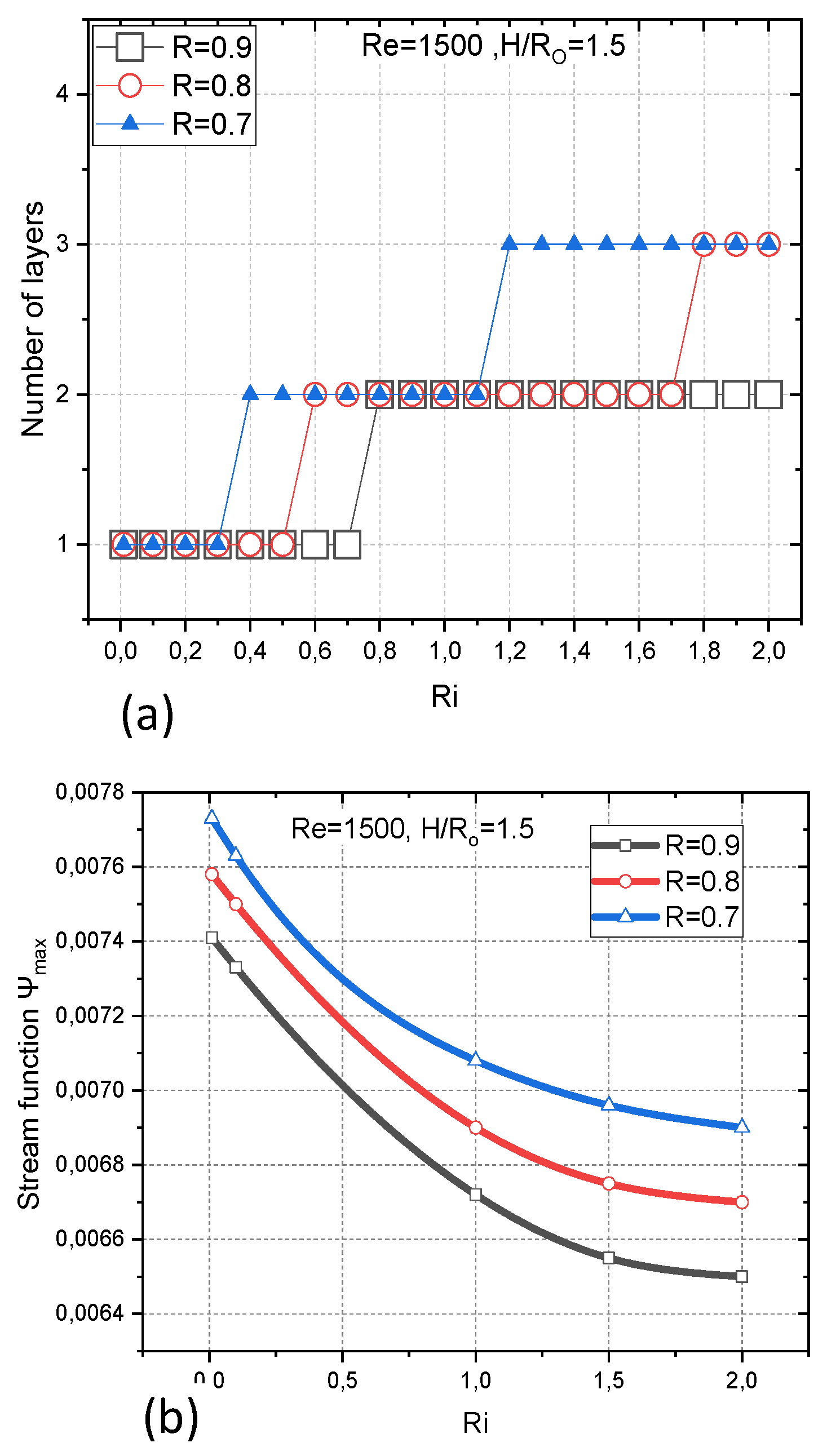
Figure 11a shows the evolution of the number of fluid layers for the case of
Re=1500 and for
R=0.7,
R=0.8, and
R=0.9 cases, which are discussed above. The number of layers is the number of stratified recirculation zones in the meridional flow. For
R=0.9, the flow is characterized by one concentrated vortex when
Ri =0.01, this vortex undergoes breakdown, i.e., a stagnation point followed by a small recirculation zone near the inner cylinder wall. The flow contains a single layer, that occurs for
Ri ≤0.7. It was found also that the number of layers, corresponding to
R=0.9, grows with the increase of Richardson number and leads to a second layer to form beyond
Ri ≥0.8. As to case
R=0.8, a second layer flow structure is observed when
Ri≥0.6. In case
R=0.7, up to three layers appear for
Ri ≥1.2.
Figure 11b compares the maximum hydrodynamic streamlines (
Ψ) for the three annular gaps (
R=0.7,
R=0.8, and
R=0.9, respectively) when
Re=1500 and
γ=1.5. The decreasing of the maximum value of hydrodynamic streamlines (
Ψ) with increasing Ri for all three cases proves that the intensified buoyancy affects the number of recirculation zones formed by swirling flow.
4.4. Heat transfer
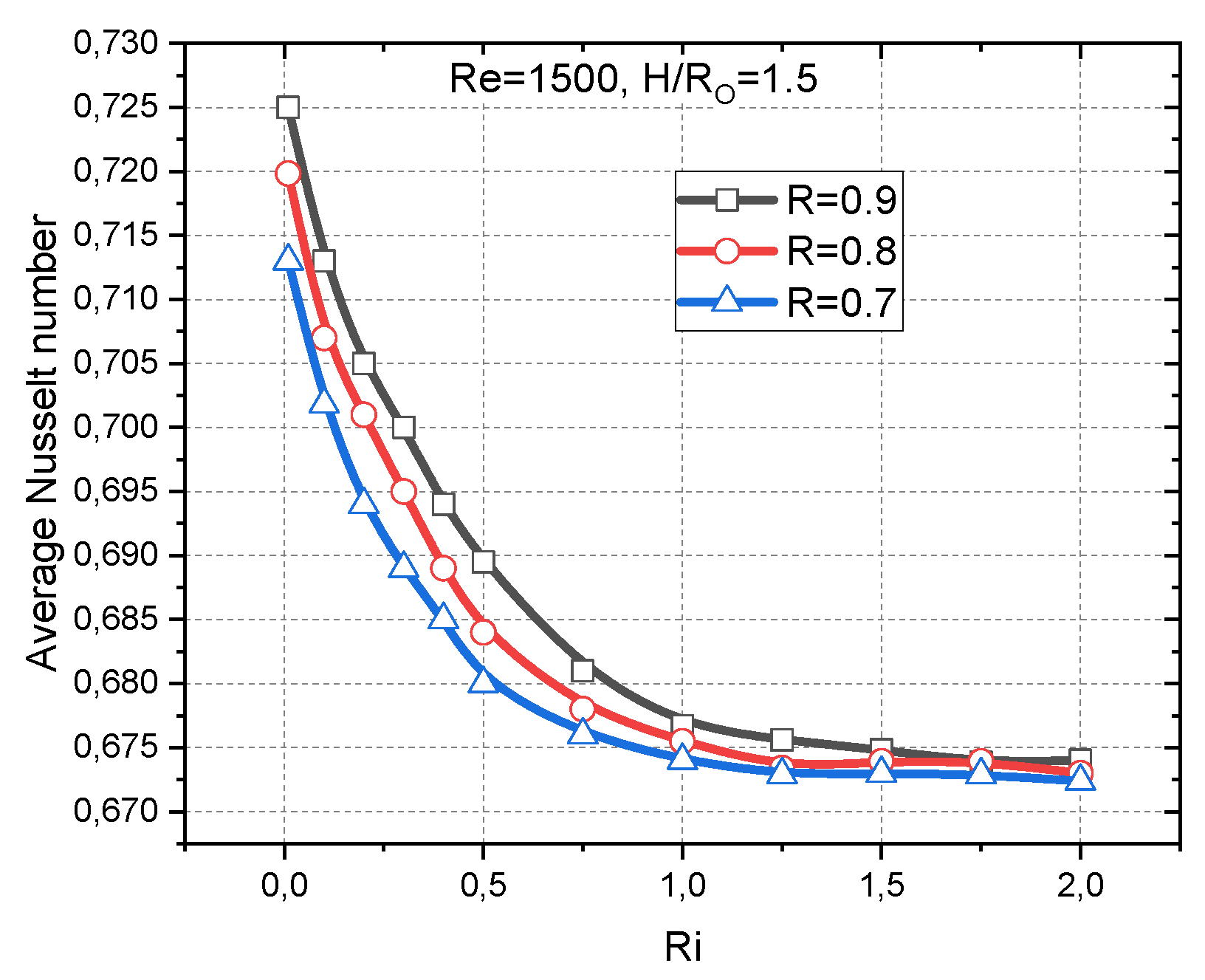
In this section, the relationship between the stratification of fluid and heat transfer will be clarified. However, the Nusselt number is analyzed in the remainder of this section for many parameters. The decreasing of the average Nusselt number with the Richardson number is presented in
Figure 12, where three cases
R=0.7,
R=0.8, and
R=0.9 are compared for Re=1500 and
γ=1.5.
Figure 12 shows that
Nu Monotonically decreases with increasing
Ri and approaches the reciprocal of the aspect ratio, i.e.,
1/H (=0.66 at
γ= 1.5) which means the value of the conduction limit.
In
Figure 12, it is noticed that the maximum value of
Nu is attained when a single layer fluid is established. For mixed convection, the influence of buoyancy force becomes stronger with the rising of the Richardson number, so the concurrence between viscous and buoyancy forces is increasingly important with increasing
Ri. However, the lighter hot fluid close to the top hot disk sits on the top of the heavier cold fluid close to the bottom cold disk. The effects of natural convection continue to exist only near the heated top disk. In this case, the stable stratification of fluid opposes the flow produced by the bottom rotating disk, and so the net advective transport diminishes, and the value of
Nu decreases with increasing
Ri. Also, these fluid layers play the role of thermal insulation, since the number of layers influences the heat transfer. We conclude that the combination of Richardson number and annular gaps control the heat transfer by the presence or absence of fluid layering. Furthermore, it is seen that at a constant value of
Ri the average Nusselt values become progressively grow as the annular gap is increased indicating that advective transport reinforces with increasing
R, as observed from
Figure 12. Consequently annular gap,
R has an important influence on
Nu in this case.
4.5. Magnetic effect on fluid layers
To investigate the effects of the axial magnetic field on the layering (i.e., apparition or suppression), taking, for example, the case of
Re=1500,
γ=1.5 and
Ri =2.0 at three cases mentioned above (i.e., case
R=0.7,
R=0.8, and
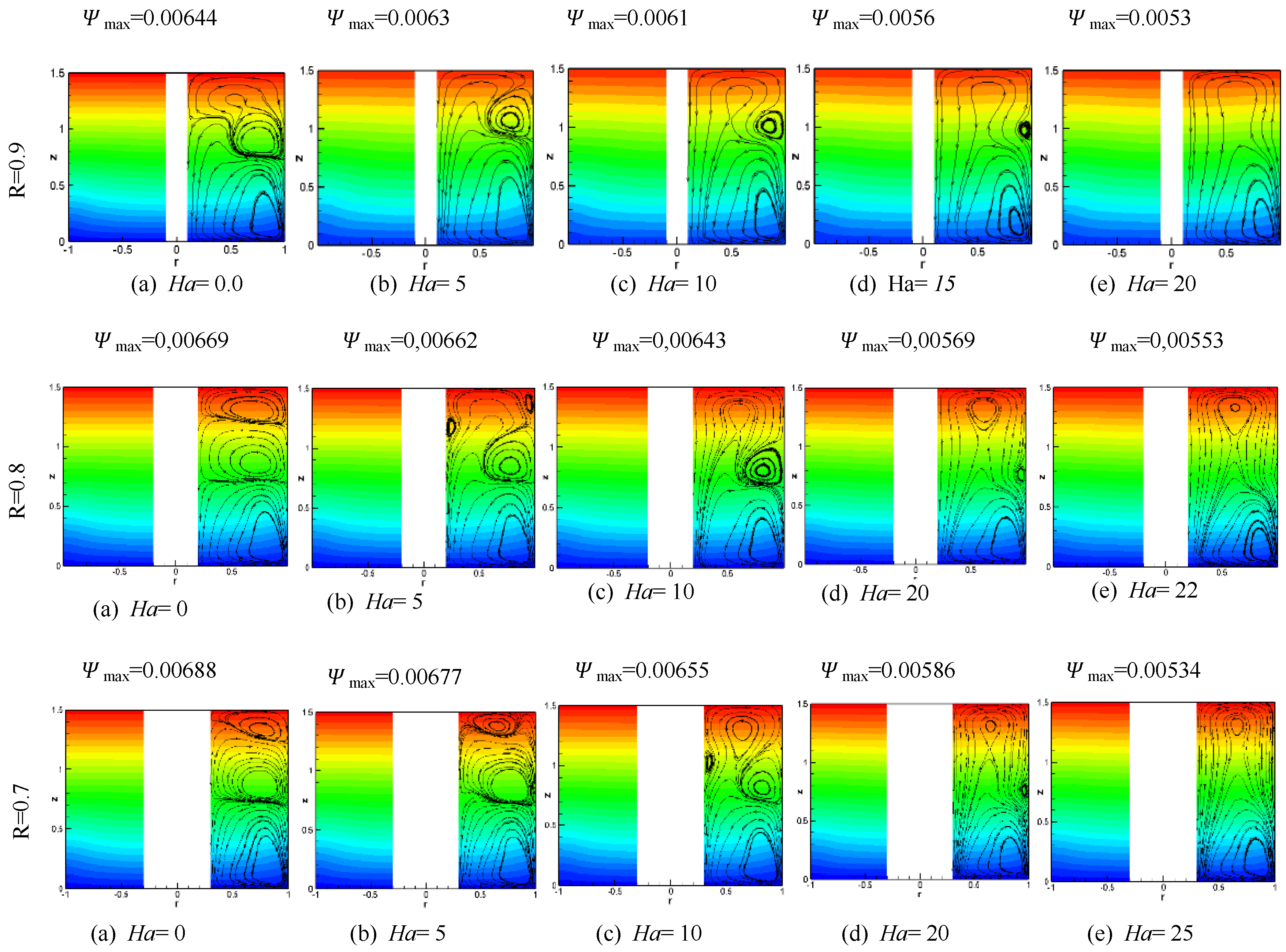
R=0.9). The hydrodynamic streamline plots in the case of
R=0.9 at
Ha=0 show a double layer, in which the bottom layer is the biggest
Figure 13. The magnetic field in the vertical direction has a good suppressive effect on both vortex breakdown and fluid layers in which are shown in this case. As clearly shown by the streamlines on the first line of
Figure 13, the clockwise recirculation top region diminishes in size and moves toward the sidewall when
Ha = 10. On the contrary, the counterclockwise recirculation zone grows in size until it takes the entire top gap of the cylinder. Also, the maximum streamfunction decreases with increasing
Ha and is 0.0064 and 0.0061 for
Ha=0 and
Ha = 10, respectively. The small toroidal vortex decreases in size and then disappears at Ha
cr= 20. The r-central position of the small toroidal region rises with increasing
Ha and, on the contrary, the z- central diminishes slightly. The central positions are at z =1.08, 0.99, and 0.97 for
Ha = 5, 10 and 15, respectively.
As for case
R=0.8 shown in
Figure 13, the streamline plots for
Ha= 0, show three layers, in which the top layer becomes narrow. The streamlines for Ha=5 clearly show the two small toroidal vortices attached to the inner and outer wall, respectively. Another counterclockwise recirculation zone centered at z=0.82 for
Ha=5 and decreases in size further and disappears at
Ha = 22.
The effect of increasing
Ha is distinctly seen in
Figure 13 at case
R=0.7. For
Ha=0 and
Ha=5, three layers are observed, but at
Ha=10 the middle clockwise toroidal vortex divides into two cells and drives to the creation of two layers and stagnation-point [
24] flow near to the inner wall. For
Ha=20 the streamlines show a small toroidal vortex centered at z=075, then decreases in size and disappears at
Hacr=25. For all cases the isotherms plots when
Ri=1.0 show that conduction domine the heat transfer, especially in the top gap.
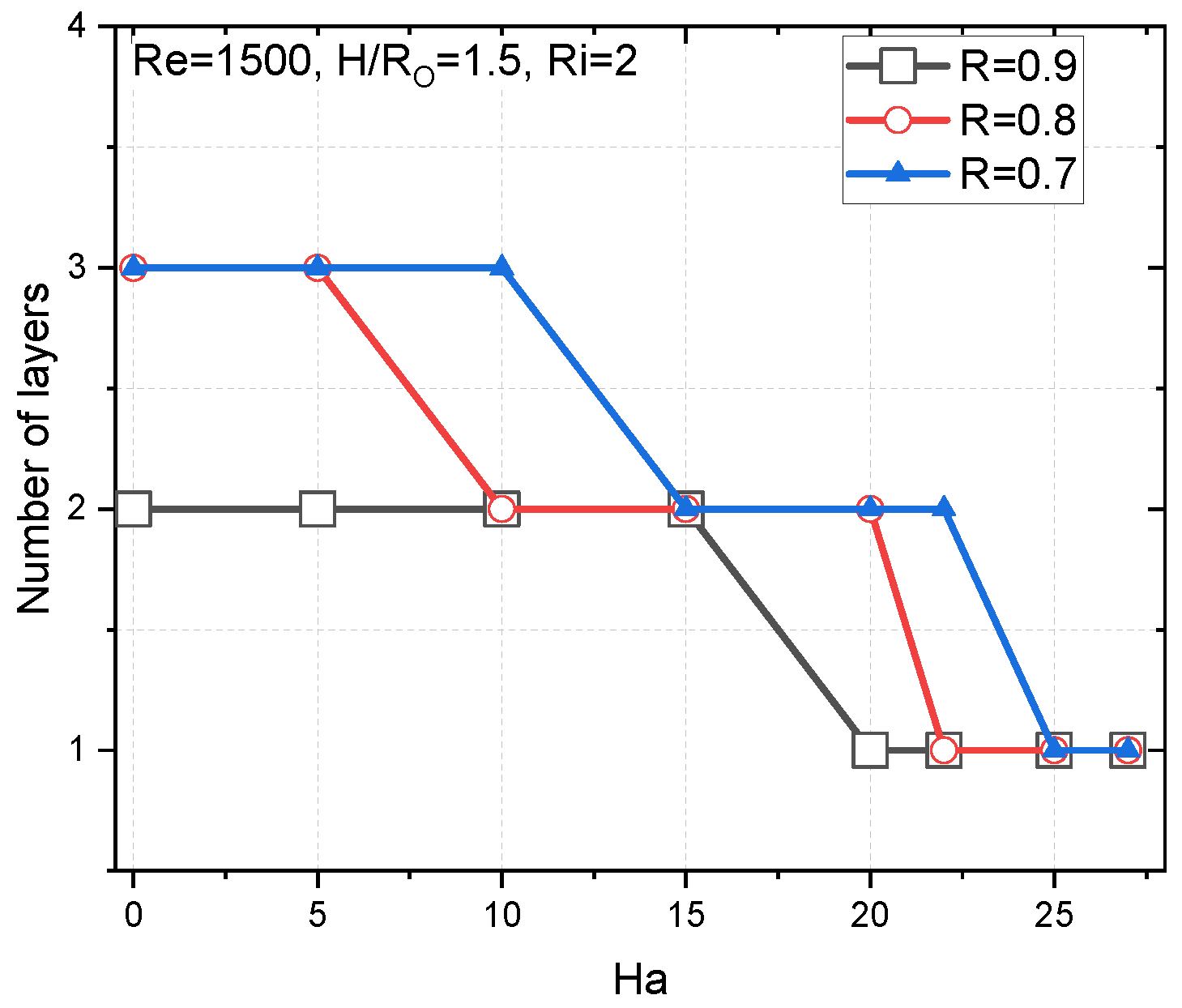
Figure 14 compares the magnetic field effect on the number of fluid layers for three cases (
R=0.7,
R=0.8, and
R=0.9) when
Re=1500 and
Ri=2.0. The decrease in the curves as shown in
Figure 14 indicates that increasing
Ha has an important influence on the number of fluid layers formed. Therefore, the number of fluid layers decreases with increasing
Ha for all three cases. For
Ha=0 we have three layers for case
R=0.7, three layers for
R=0.8, and two layers for
R=0.9.
For Ha=10 and 15, two layers is observed for R=0.8 and R=0.7, respectively. The critical Hartmann numbers, Hacr = 20, 22, and 25 correspondings to a single layer for cases R=0.7, 0.8 and 0.9, respectively. Consequently, the intensified magnetic reduces the number of resulting layers.
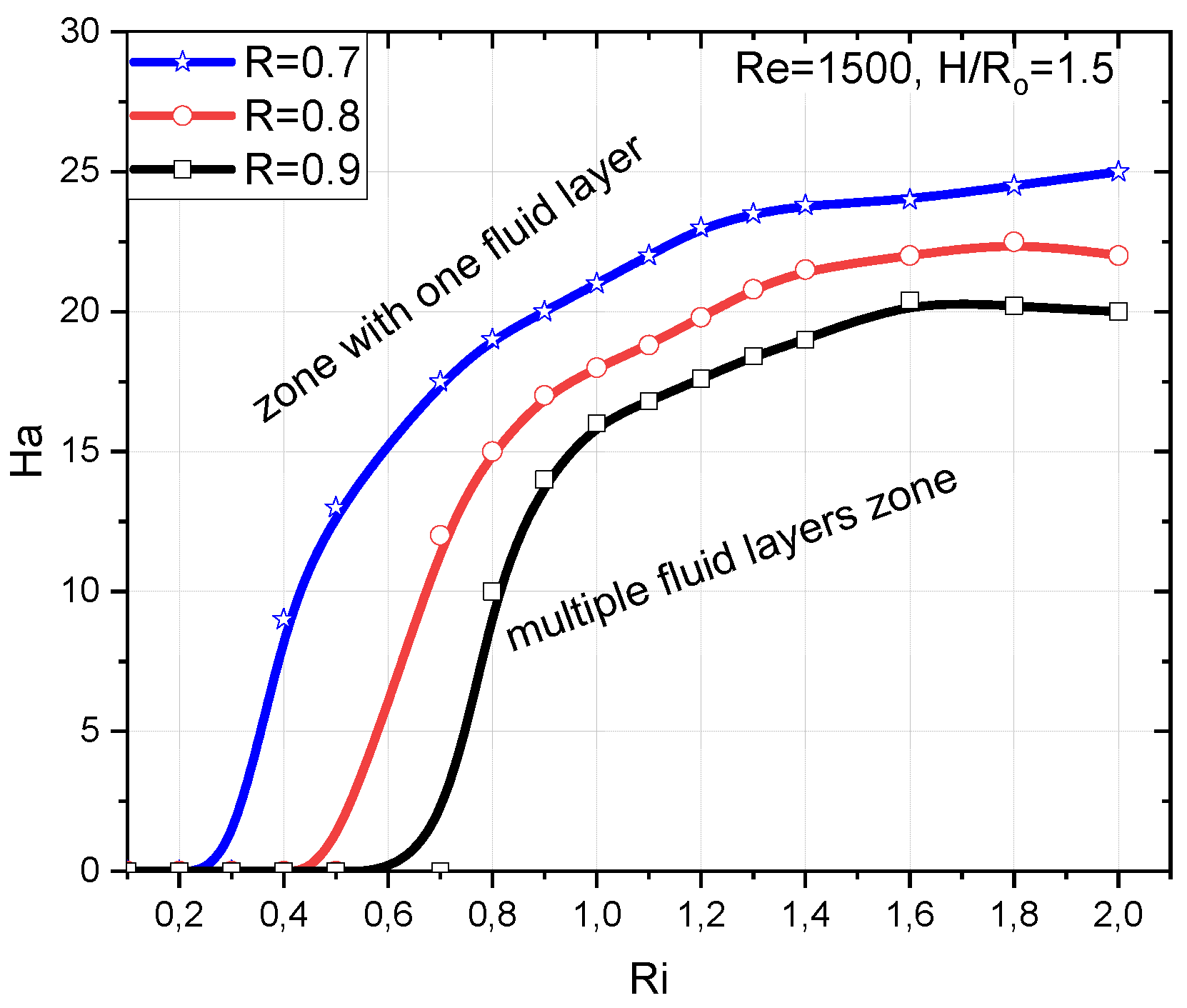
The diagram in the (
Hacr–
Ri) plane for all three cases when Re=1500 and
γ=1.5 presented in
Figure 15 gives the evolution of critical Hartmann number
Hacr versus
Ri. There are three separate curves, represent the limits of two-zone, i.e., the domains with and without stratification fluid layers. The blue curve with star symbols in
Figure 15 represents the boundaries for the case of an annular gap,
R=0.7. The red curve with a circle corresponding to case
R=0.8. For case
R=0.9, the threshold of transition is plotted by the black curve with square symbols. In all cases, we have seen that the increase of the
Ri causes the increase of the
Hacr. Also, increasing
Ha removes the fluid layers at a constant value of
Ri (the layering disappears after the amplitude of
Ha goes beyond a critical value). The critical values (
Hacr) for case
R=0.7 are greater than those obtained in cases 0.8 and 0.9 for a fixed Richardson number.