Next Article in Journal
Stability of conducting fluid flow between coaxial cylinders under thermal gradient and axial magnetic field
Previous Article in Journal
Experimental Determination of Convective Heat Transfer Coefficients of Synthetic Oil Using Wilson Plot Technique
 
 
International Journal of Thermofluid Science and Technology is published by MDPI from Volume 13 Issue 1 (2026). Previous articles were published by another publisher in Open Access under a CC-BY (or CC-BY-NC-ND) licence, and they are hosted by MDPI on mdpi.com as a courtesy and upon agreement with the previous journal publisher.
Article

MHD mixed convection in a partitioned rectangular enclosure

by
Mizanur Rahman
*,
Mohammad Mokaddes Ali
,
Rubel Kazi
and
Md. Rubel Hakim
Department of Mathematics, Mawlana Bhashani Science and Technology University, Tangail-1902, Bangladesh
*
Author to whom correspondence should be addressed.
Int. J. Thermofluid Sci. Technol. 2022, 9(2), 090201; https://doi.org/10.36963/IJTST.2022090201
Submission received: 7 July 2021 / Revised: 2 December 2021 / Accepted: 18 December 2021 / Published: 4 January 2022

Abstract

A numerical study is carried out to explore the influence of external magnetic field on mixed convective heat transfer in a partitioned rectangular cavity with on side moving wall. The vertical walls are isothermally heated while the horizontal walls are thermally insulated. The left vertical wall is moving in + y direction and remaining walls are maintained no-slip condition. A magnetic field of uniform strength is imposed transverse to the temperature gradient. The governing equations are solved utilizing the finite element method for several physical parameters including Richardson number, Hartmann number and Prandtl number. The numerical results are presented graphically using streamlines, isotherms, local and average Nusselt numbers. It is observed that the flow filed is affected significantly for moving wall and the variation in Hartmann and Richardson numbers. The velocity field is found more effective in natural convection regime than forced convection. The results demonstrated that maximum amount of heat transfer is obtained in natural convection domination and higher values of Prandtl number. The enhancement of heat transfer rate is found 14.25% more at higher Prandtl number (Pr =2.56) than lower (Pr =0.71) and it reduction is found 3.03% more at Ha = 50 compared to Ha = 0.

1. Introduction

Mixed convection involves buoyancy driven flow and shear driven flow due to thermal condition and movement of surface, and is encountered in various engineering applications. Such as, heat exchangers, solidification, coating, food processing, cooling of electronic equipment, nuclear reactors, solar collectors, etc. Moreover, magnetic field can be used as active and passive techniques on flow and heater transfer mechanisms. Thus, mixed convection flow in presence of magnetic field is of great importance in engineering areas including electronic package, microelectronic devices, crystal growth in liquid, cooling of nuclear reactors, and solar technologies, etc Several investigators have done a lot of investigation for the past three decades in these issues. Some of them are presented in the literature review.
Rahman et al. [1] performed a numerical study on combined forced and free convection in a rectangular vented cavity with heat conducting cylinder. The finite element method was used to solve the governing equations. In their study, the heat transfer rate and temperature were observed depending on the governing parameters and configuration studied. Sivakumar et al. [2] used finite volume method to examine the effects of size and location of heated portion on mixed convection flow and heat transfer in a lid driven cavity and concluded that heat transfer profile enhances with the reduction in heated portion, and middle as well as top position of the heat source. Similar method was implemented by Esfe et al. [3] to analyze mixed convection in a lid driven square cavity with a rectangular block at its bottom wall and showed that average Nusselt number deceases for increasing Richardson number and diameter of nanoparticles. The problem of mixed convection in a double lid driven cavity filled with nanofluid was numerically studied by Sheremet and Iop [4] using Buongiorno’s mathematical model. They found the flow and heat transfer rate substantially influenced with the governing parameters considered. Chattopadhyay et al. [5] considered sinusoidally heated porous cavity with two vertical moving-walls to investigated mixed convection flow and heat transfer characteristics and found that lower heat transfer in natural convection regime but it increases with the higher amplitude value. Moreover, flow feature also was affected by Darcy number. The finite difference solution of mixed convection in a lid driven cavity with arc-shaped moving wall was studied by Ismael [6] and pointed out that heat transfer enhancement due to arc-shaped moving wall depends on Rayleigh number. Later on, Sivasankaran et al. [7] utilized finite volume method to investigate double-diffusive mixed convection channel flow and heat transfer in a lid driven cavity and showed that phase deviation and amplitude ratio affects the heat and mass transfer for all Richardson number. Oztop et al. [8] implemented similar method to investigate the effect of magnetic field on lid driven mixed convection flow in a square cavity with corner heater. The rate of heat transfer was decreased for increasing Hartmann number and it becomes maximum at high values of Grashof number. The problem of mixed convection in a double lid driven trapezoidal cavity in presence of magnetic field was numerically studied by Khudheyer [9]. They indicated that heat transfer rate is maximum in mixed convection regime while inclined angle was 300 and magnetic field was not considered. Selimefendigil and Chamkha [10] analyzed mixed convection in a corrugated lid driven cavity filled with non- Newtonian power-law fluid. They focused that height value of Hartmann number causes lowest heat transfer and it decreases with increasing Richardson number. Sivasankaran et al. [11] examined heat transfer rate for mixed convection in a lid driven cavity with sinusoidal temperature and highlighted that magnetic field strongly affects the flow and heat transfer rate inside the cavity. Malleswaran and Sivasankaran [12] studied the effect of heater position on mixed convection heat transfer in lid-driven square cavity and found that magnetic field effect on average heat transfer is more effective in the case of vertical heaters than horizontal heaters.
Ali et al. [13] demonstrated the flow and heat transfer behaviors of mixed convection in a hexagonal enclosure in presence of magnetic field effects. Oglakkaya and Boskaya [14] used dual reciprocity boundary element method to investigate unsteady mixed convection in lid-driven cavity with sinusoidal heated wall under the effect of magnetic field. They observed that flow strength and heat transfer rate increase with Rayleigh number but decrease for Hartmann number and undulation number. The problem of mixed convection in a lid driven cavity in presence of inclined magnetic field was numerically investigated by Bakar et al. [15] and noticed that heat transfer rate increases with increasing magnetic field angle and fluid flow retards for magnetic field effect.
The effects of magnetic field and slip in a Jeffrey stagnation point fluid flow forming over deformable sheets was investigated by Turkyilmazoglu [16] and concluded that strong magnetic interaction produces higher skin friction and smaller heat transfer rate. Turkyilmazoglu [17] developed fluid flow behaviour of induced motion due to rotating and stretching sphere in a resting fluid and found Drag is reduce by the mechanism of surface stretching. He also highlighted that when both stretching and rotation are active, more torque is required. Siddiqui and Urkyilmazoglu [18] proposed an idea of permeable chamber to control the secondary vortices appearing in th lid-driven cavity flow using the water based ferrofluids and observed that the number of vortices in the cavity increase with the increase in the Reynolds number and also the suction and injection create resistance in settlement of solid ferroparticles on the bottom.
Later on, they [19] analyzed the thermal transfer in the water-based ferrofluid enclosed porous cavity attached with a novel permeable (suction/injection) chamber using special finite difference scheme. Their results indicated that Nusselt number enhances at the left wall but it is reduced at the right wall when the concentration of the ferroparticles or Lorentz force increased. Sheikholeslami et al. [20] used control volume finite element method to investigate the effect of magnetic source on mixed convection in an enclosure with elliptic hot cylinder. They found that temperature gradient increases with higher volume fraction of Fe3o4 and Rayleigh number but it reduces for Lorentz forces.
Later on, Bhatti et al. [21] used successive local linearization method to analyze swimming of gyrotactic microorganisms in nanofluid flow over a stretched surface in presence of magnetic field and recommended that SLLM is a very stable and flexible method for solving transport phenomena of magnetic materials processing problems. Shahid et al. [22] conducted a similar study by using Darcy Law. They observed that permeability and magnetic field parameters retard the velocity distribution but it boosts with Richardson parameter. The problem of time depended flow of magnetized Carreau nanoliquid conveying microorganisms over a moving wedge in presence of velocity slip and thermal radiation feature was studied by Muhammad et al. [23] using MATLAB based shooting method. Their results indicated that velocity field reduces with increases in porosity parameter, unsteady and velocity slip parameters, and temperature filed declines for increasing unsteady parameter and Prandtl number but it shows opposite trend for Biot number and Radiation parameter. Goodarzi et al. [24] conducted an experimental study to find out the fluid flow characteristics and boiling heat transfer coefficient of grapheme oxide nanoplate lets nano-suspensions in an annular heat exchanger and showed that temperature of the working fluid and boiling heat transfer coefficient of the system increases for increasing heat flux and concentration of GONPs. The problem of ferro- convective flow in an inclined double lid driven enclosure in presence of magnetic field was numerically investigated by Ahmed et al. [25]. The heat generation/ absorption were also considered in their study. They found that average Nusselt number is reduced 4.66% at fixed heat generation parameter (Q = 2) while length of the cavity varied from 0.2 to 0.8 and heat transfer rate minimized with increased Hartmann number from 0 to 50.
Abu-Hamdeh et al. [26] performed a numerical study of mixed convection flow in a partially heated lid driven cavity with one side opening in presence of heat generation. They used finite volume technique to solve their problem and observed that Grashof number and heater length enhance the heat transfer rate but heat transfer rate was decreased for Darcy number. Ntibarufata et al. [27] performed a numerically study of natural convection in two dimensional partitioned enclosures with constant heat flux at the bottom wall. They found that at large heat source and lower Rayleigh number heat transfer become dominated for natural convection. Moreover heat transfer was enhanced with small aspect ratio in their study. The vorticity- stream function based problem of natural convection in an inclined partitioned enclosure was numerically investigated by Ben-Nakhi and Chamkha [28]. They used finite volume method to solve the governing equations and observed that the flow and heat transfer characteristics strongly depended on dimensionless partition height, titled angle and Rayleigh number. Similar problem was investigated [29] by using polynomial differential quadrature (PDQ) method for laterally heated enclosure with an off-centred partition in presence of magnetic field. Their results showed that heat transfer rate depends on the position partition from the hot wall and x-directional magnetic field. It was also noted that Prandtl number has a little effect on the flow and heat transfer rate. The effect of different partition lengths on natural convection in rectangular cavity was numerically simulated by Zemani and Sabeur- Bendehina [30]. Their results indicated that natural convection and heat transfer properties were controlled with the presence partition at the middle of the hot wall of the cavity at Rayleigh number ranging from 106 to 3.77 × 10⁹. Mahapatra et al. [31] analyzed opposing mixed convection in a differentially heated portioned square enclosure. They found that the effect of partition location on heat transfer is pronounced in forced convection regime and opposing mixed convection heat transfer is more than natural convection while partition height exceed 0.3H. Boutra et al. [32] adopted finite volume method with SIMPLER algorithm to investigate mixed convection in a lid driven square cavity with mounted rectangular partition at different location and suggested that the presence of partition plays crucial role on flow field, temperature distribution and heat transfer enhancement. They also noted that Nusselt umber was increasing function of decreasing Richardson number for all values of Bingham number.
Considering the literature survey presented in this paper, it is apparent that magnetohydrodynamic mixed convection is of great interest to the researchers and is applicable in various fields of fluid mechanics. Thus, more analysis is required to conduct in this field of study. Though researchers have accomplished many numerical and experimental studies of mixed and natural convection heat transfer in different geometries in the literature, partitioned enclosure with moving wall is rarely investigated by the researchers based on the presented literature review in this paper. In the present study, authors have considered mixed convection heat transfer in a rectangular partitioned enclosure with vertically moving wall under the effect of magnetic field. To the best of the authors’ knowledge, no work has been done yet relating to this issue. The main objective of this work is to numerically analyze the effect of Hartmann and Prandtl numbers along with different Richardson numbers on the fluid flow in a rectangular partitioned enclosure in order to improve the efficiency of fluid flow and heat transfer characteristics. As the present study offers a variety of improved performances in controlling flow and heat transfer mechanisms, the present investigation would be a great influence in the industrial and engineering applications.

2. Physical model

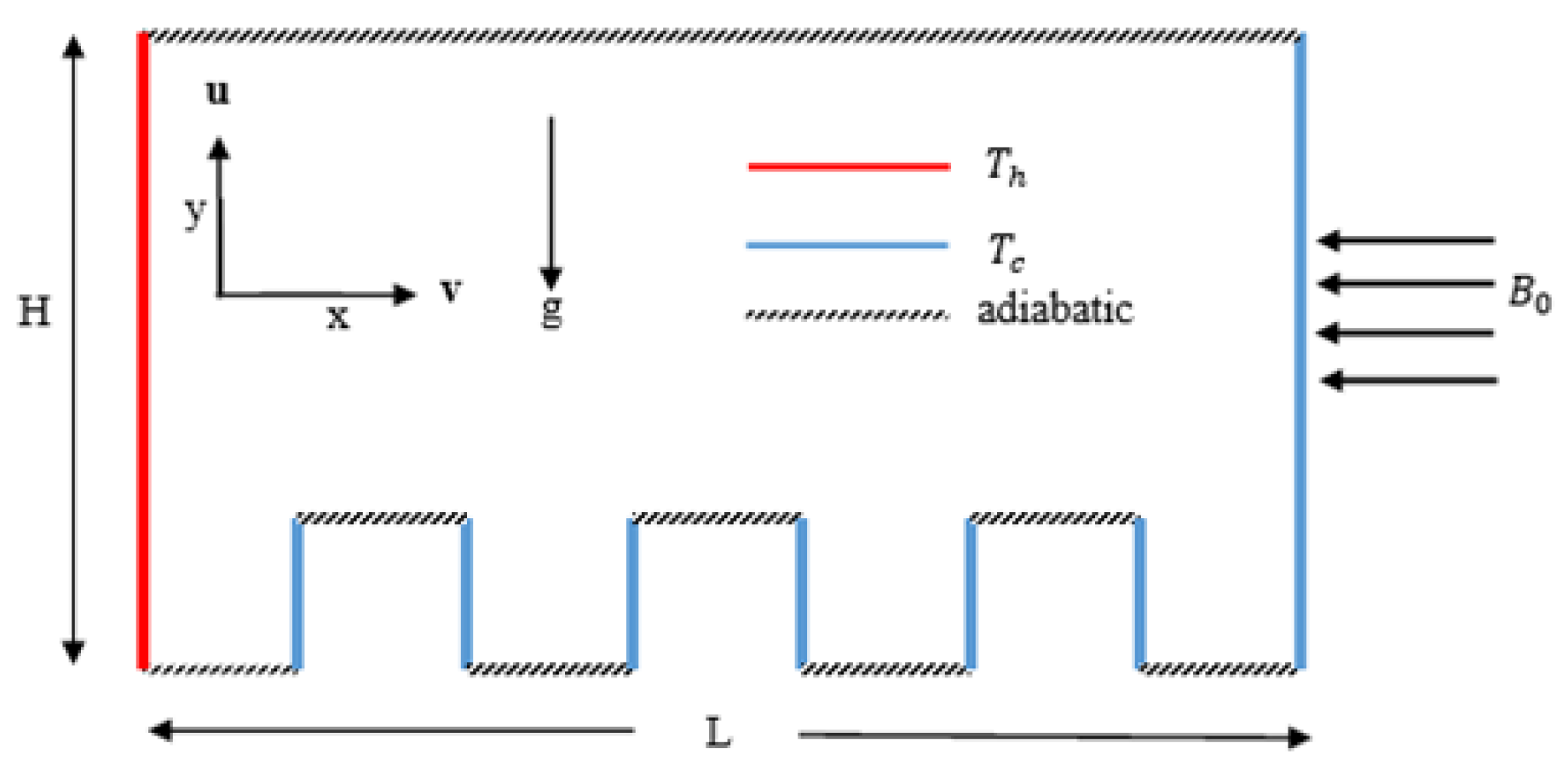
The schematic diagram of the present study is shown in Figure 1. The physical model is developed considering two-dimensional rectangular cavity of length L and height H (= L/2) and three repetitive partitions (cavities) are placed at the bottom wall. The left vertical is heated at temperature T and remaining vertical walls are cooled at temperature Tc while all horizontal walls are adiabatic. Moreover, the left vertical wall is moving at constant velocity U0 and others walls are fixed. A uniform magnetic field and gravitational force acts respectively in a horizontal and vertically downward direction.

3. Mathematical modeling

Based on physical model and Boussinesq approximation, the governing equations for mixed convection flow within differentially heated enclosure can be define as [1,8,9,13,15,25,28,29]:
Ijtst 09 090201 i002
Boundary conditions of the considered geometrical model are:
Ijtst 09 090201 i003
Now, we introduced the non-dimensional quantities into the above governing equations (Equation 1-4) in order to obtain dimensionless governing equations:
Ijtst 09 090201 i004
Therefore, the dimensionless governing equations are
Ijtst 09 090201 i005
Boundary conditions are in dimensionless form as:
Ijtst 09 090201 i006
The heat transfer rate is calculated using local and average Nusselt number at the heated vertical wall of the partition enclosure which are defined as [13,29]:
Ijtst 09 090201 i007
and Hood [34] and Dechaumphai [35]. Subsequently, equations (1) to (4) are transferred into a system of integral equations based on the Galerkin weighted residual technique, and the integration concerned in each term of these equations is employed Gauss quadrature and obtained these equations are amended on boundary conditions. Modified equations are transferred to algebraic equations using the Newton Raphson method, and these equations solved triangular Factorization method are performed. Detailed computational procedure is available in Ref. [36,37]. The convergence of the solution is accepted when there is a relative error in each variable within the successive iterations is recorded below the conversion criteria. Like that
Σ|𝜓ijn−1 − 𝜓ijn−1| ≤ 10−5
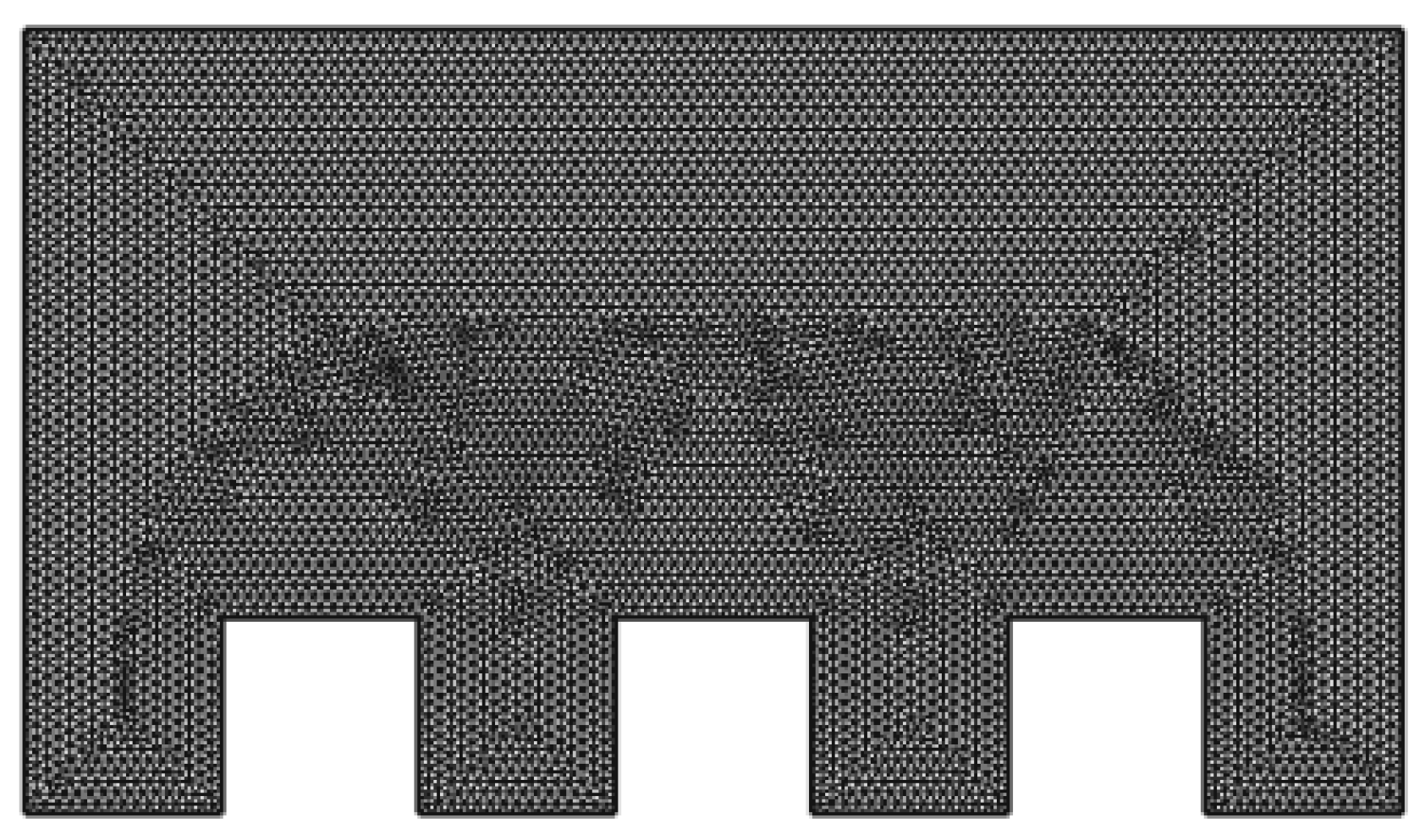
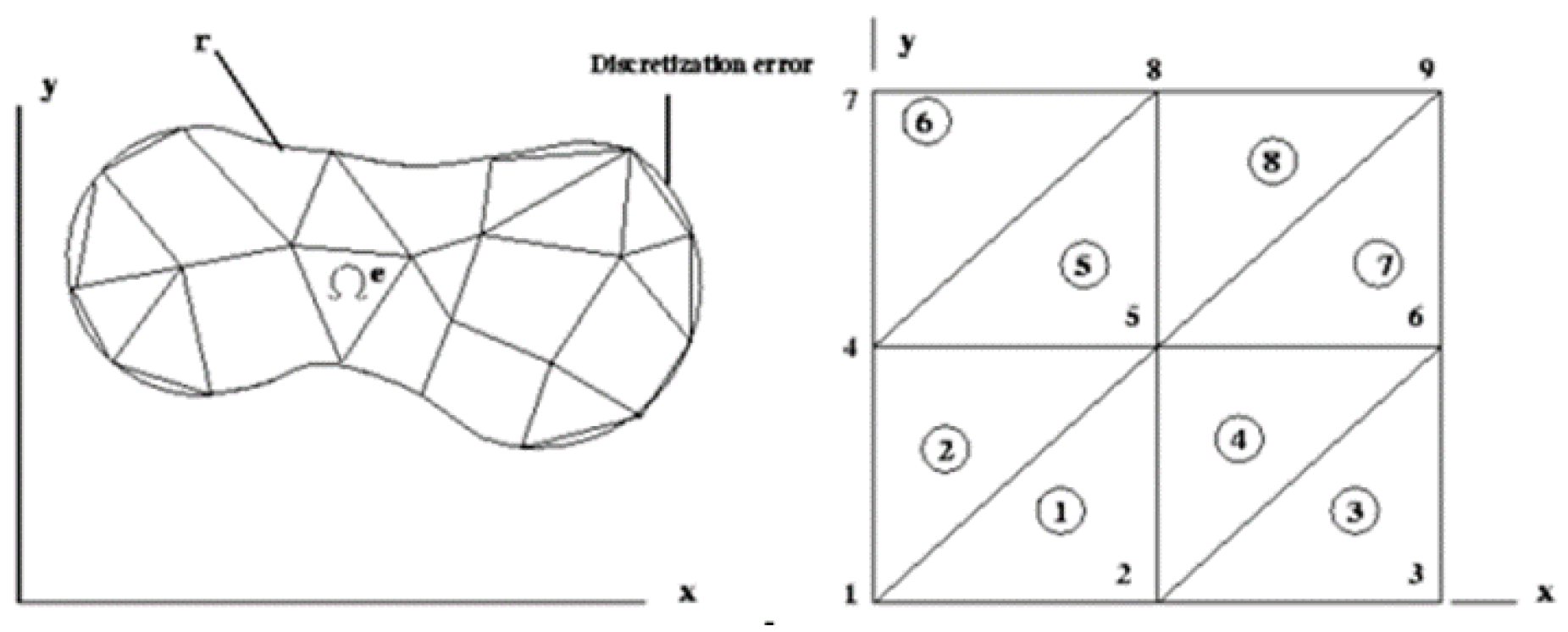
where ψ represents a dependent variable which depends on U,V,P and T; the indexes i, j indicate a grid point. The mesh configuration of the present problem has been given in Figure 2.

3.1. Computational Procedure

The numerical process is performed implementing finite element method. Non- uniform triangular mesh system consisting triangular element of six nodes is used to discretized the solution domain of the present study. The method is well described by Taylor.
Figure 2. (b). Finite element discretization of an element.
Ijtst 09 090201 g002b

3.2. Code Validation

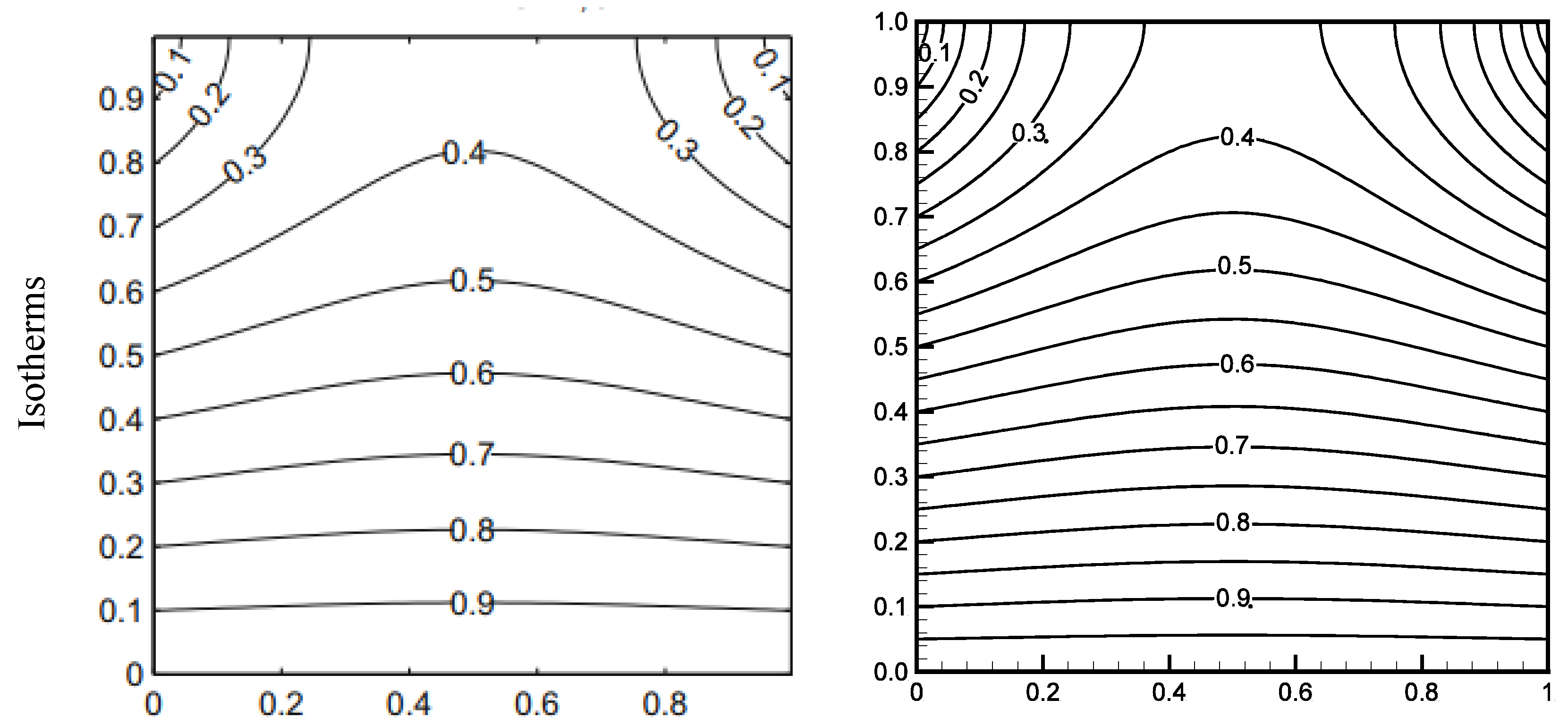
The computational code of numerical procedure is validated comparing results based on present code with the results of Rahman and Alim [38] and Basak et al. [39]. Rahman and Alim [38] examined flow and heat transfer of mixed convection in a lid-driven square cavity under the effect of magnetic field. Basak et al. [39] numerically studied mixed convection flow in a linearly heated lid-driven square cavity saturated by porous medium. We have solved their problems [38,39] using our numerical procedure. The obtained numerical results of average Nusselt number are compared in Table 1, and stream function and temperature are compared in Figure 3. A good agreement is established between present results and results repoted in Ref. [38,39], which demonstrates the veracity of numerical procedure of the investigated study.
Ijtst 09 090201 i008

4. Result and discussion

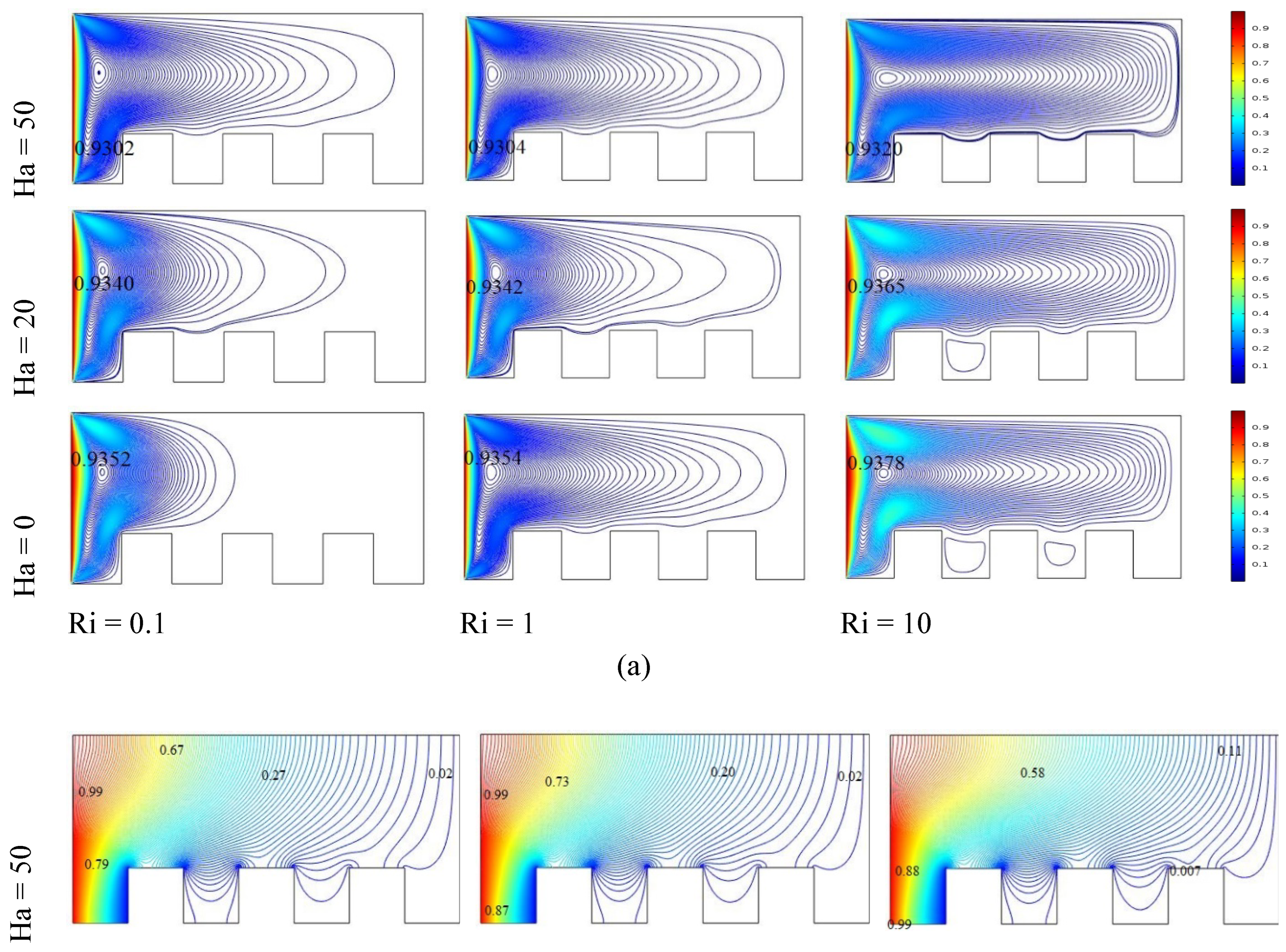
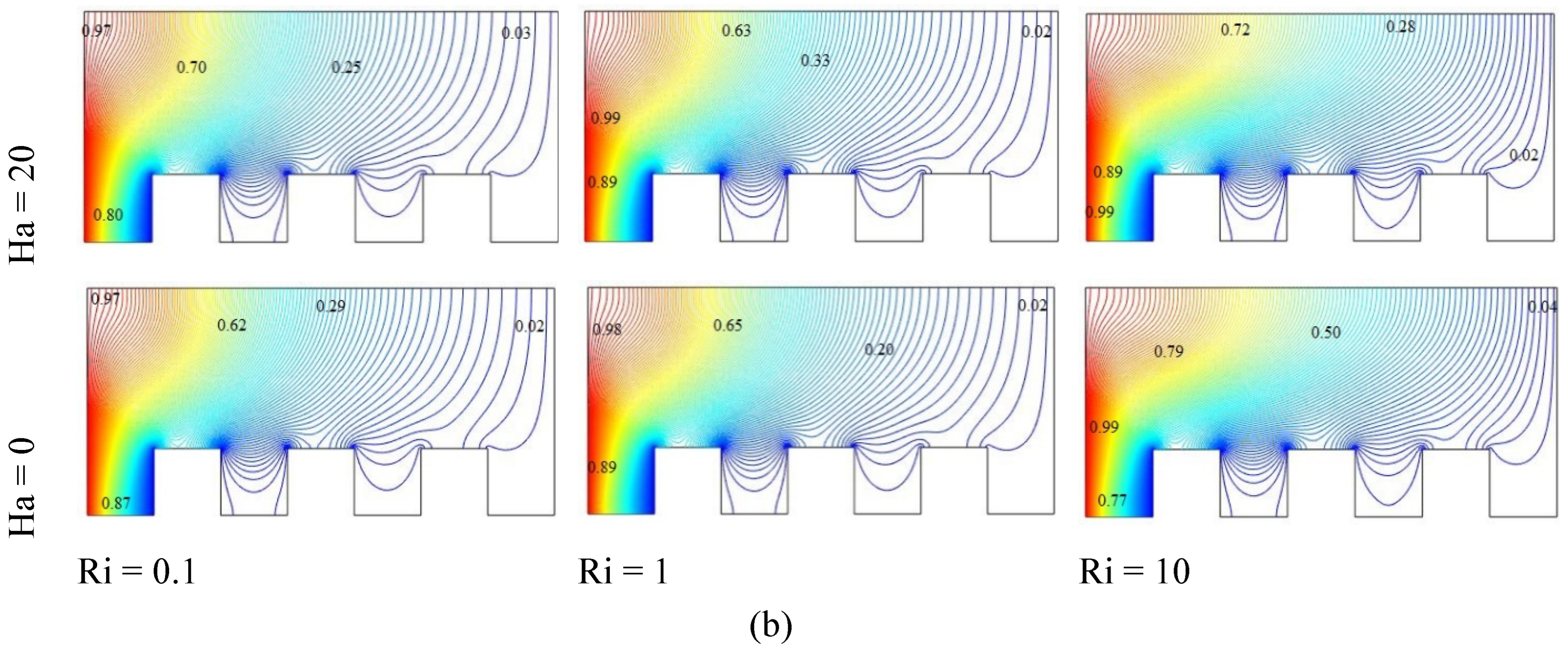
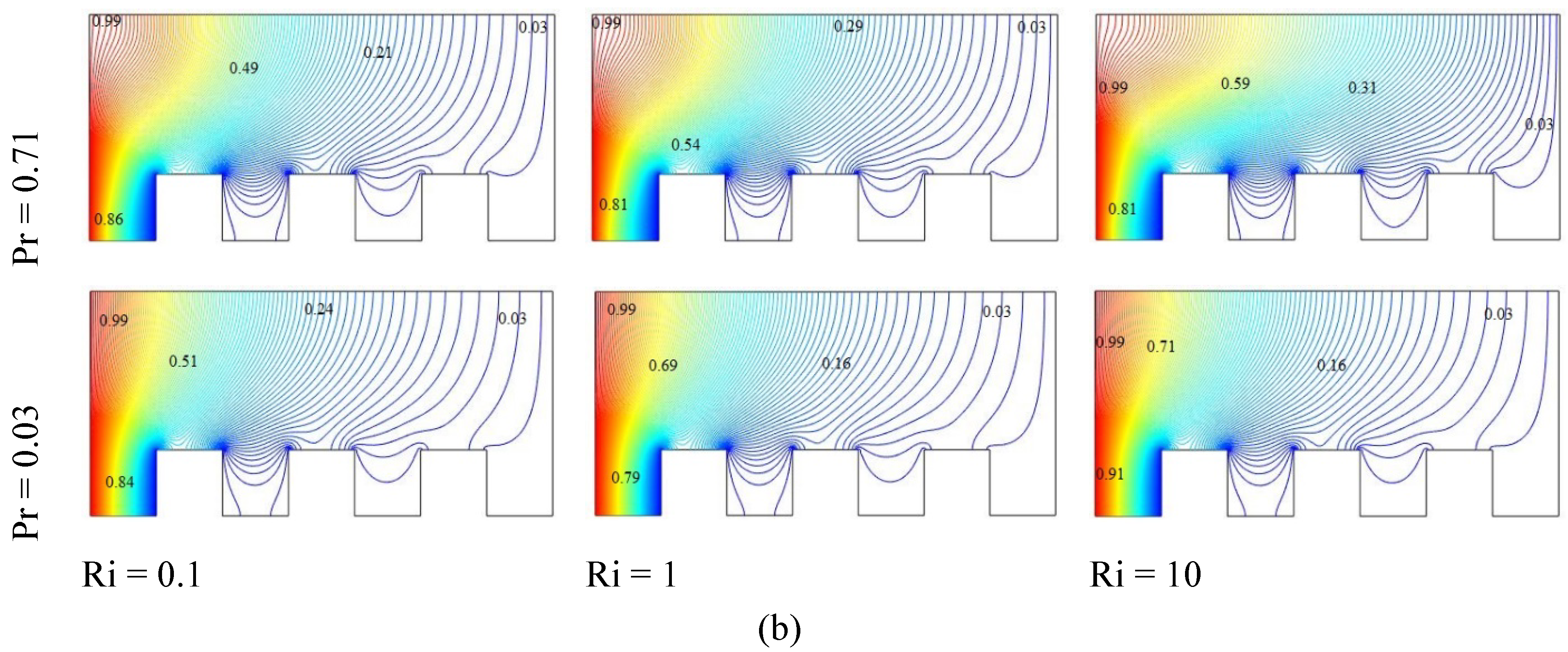
In this section, the numerical results for magneto-hydrodynamic mixed convection heat transfer in a rectangular cavity with three repetitive square partitions at the bottom wall are discussed. The physical phenomena are presented graphically in terms of streamlines, isotherms, local and average Nusselt number for relevant parameters: Prandtl number (Pr = 0.03, 0.71, 2.56), Hartmann number (Ha = 0, 20, 50), Richardson number (Ri = 0.1, 1, 10) and Reynolds number Re = 100. Figure 4 portrays the impact of magnetic field and Richardson number on the flow and temperature fields through streamlines and isotherms while the values of other controlling parameters are kept as Pr = 0.71 and Re = 100. In forced convection regime while the magnetic field is not contributed (Ha = 0) as shown in Figure 4 (a), semi elliptic clockwise streamlines circulations is developed near the left moving-vertical wall due to considered thermal and velocity boundary conditions. When magnetic field effect is applied the flow circulation becomes large in the horizontal direction with lower strength and then at Ha = 50, it becomes larger than at Ha = 20. The reason behind its that magnetic field effect suppresses the fluid motion. In mixed convection dominated region, streamlines are intensified with greater strength. The variation in streamlines is more visible for increasing Hartmann number. At Ri = 10, streamlines are more intensified and gets large shape that occupy the whole cavity. The effect of magnetic field is more noticeable in forced convection regime that natural convection. On the other hand, in Figure 4 (b) isotherms are distributed symmetrically from left o right of the cavity as the right wall was kept heated and left wall was cooled. The gradient of temperature contours slightly decreases with increasing Ha whereas it increases with Ri. Moreover, isotherms are more dense in natural convection dominating regime (Ri = 10) than other cases inside the cavity (Ri = 0.1, 1).
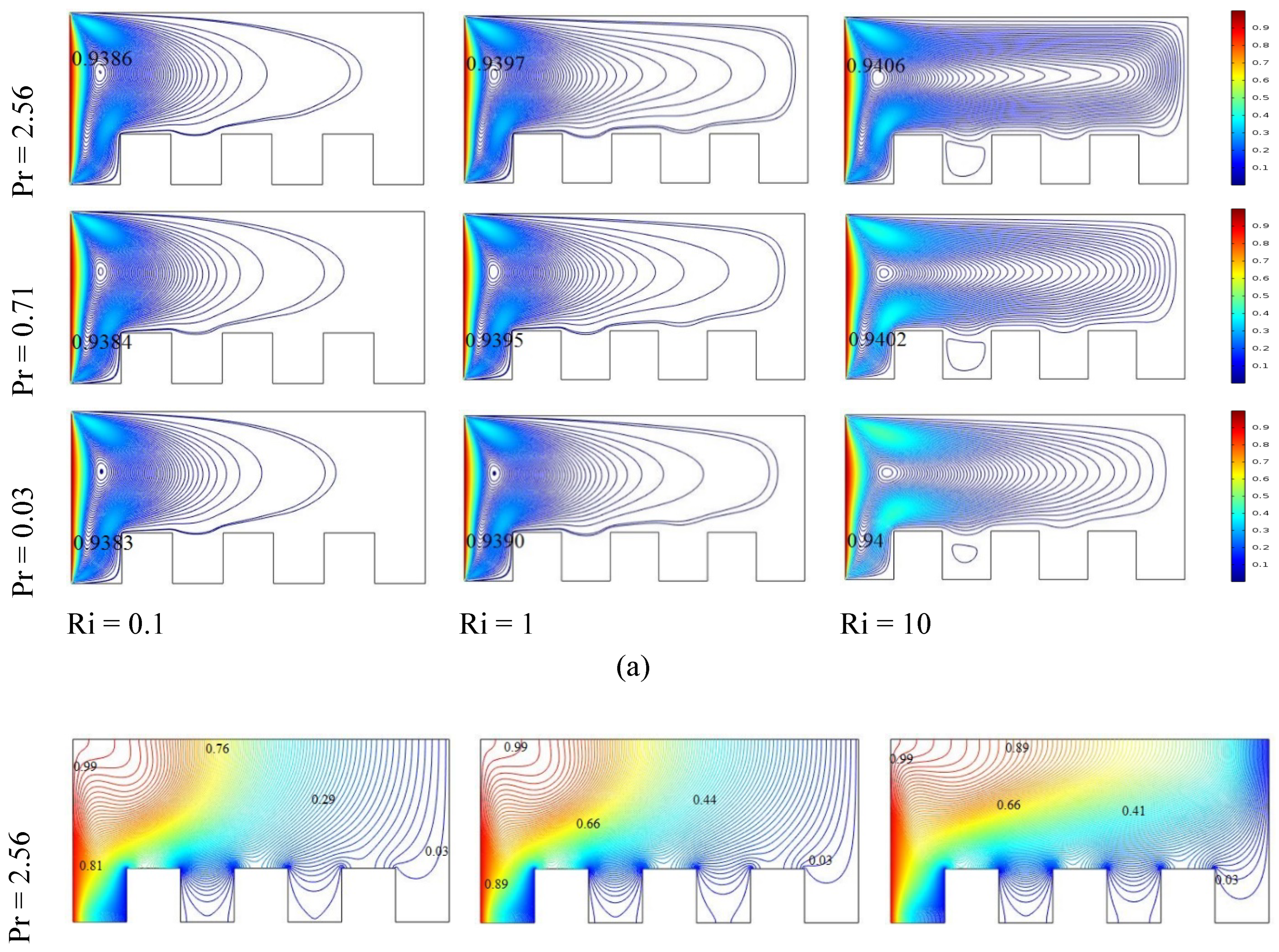
Figure 5 demonstrates streamlines and isotherms for different values of Prandtl number and Richardson number with fixed values of other parameters. In Figure 5(a), lid dominating flow circulation is observed about the right half of the cavity for Pr = 0.71 and Ri = 0.1. In addition, no significant changes are found for varying of Prandtl number (= 0.71- 2.56) at Ri = 0.1 but at Ri = 10 a visible change is found for the same variation of Prandtl number. The streamlines distribution is greatly changed for increase in Richardson number. It is important to note that streamlines are more concentrated with greater Ri (= 10) and spread towards the right wall. On the other hand, Figure 5(b) shows the temperature field for the variation of Pr and Ri. It is clear that distribution of isotherms near the left top corner are modified with higher Prandtl number where as isotherms are almost similar near the bottom of the cavity for each Richardson number. It is also found that intensity of isothermal lines decreases with increasing Pr. The intensity and gradient of isotherm contours increases with increasing Ri which indicates that isotherms are more intensified in natural convection domination at Ri = 10 than forced convection domination at Ri = 0.1.
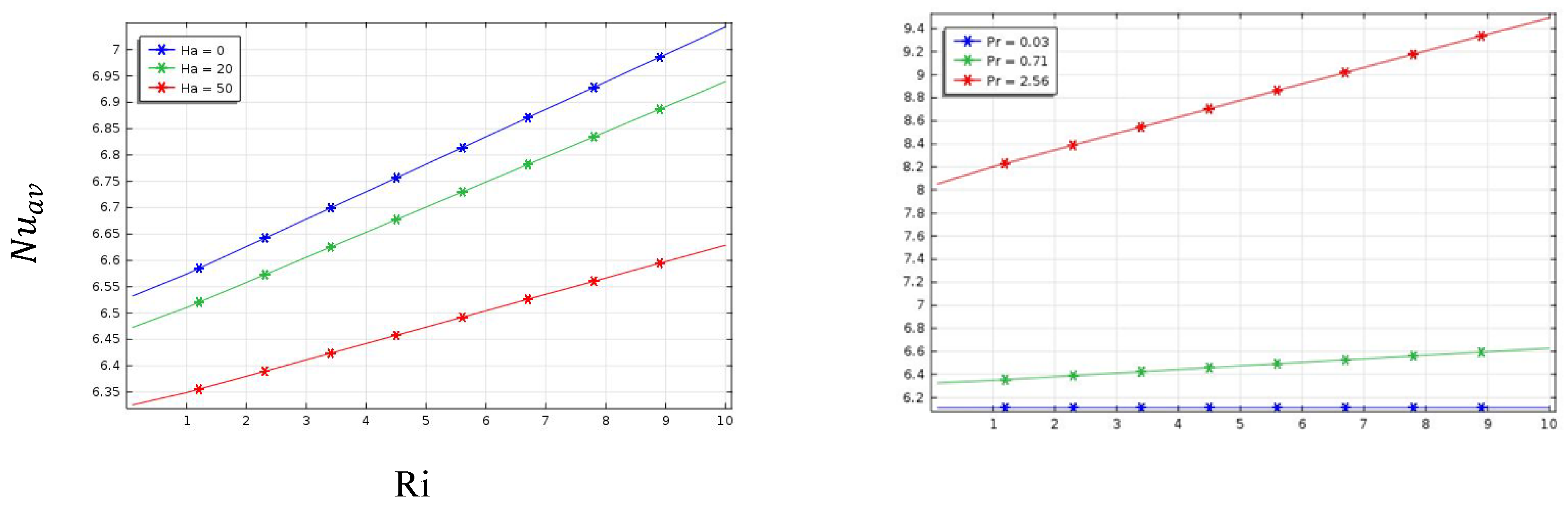
Figure 6 evaluates the influence of magnetic field and Richardson number on heat transfer profiles. The computed average Nusselt number is plotted against Ri. Apparently the average Nusselt number enhances with increasing of Ri and it is consistently higher with higher Ri. The variation in Ha shows a consistent reduction in heat transfer rate as increased Ha produced more heat inside that cavity. The heat transfer rate increases by 7.82% while Richardson number varied from 0.1 to 10 at Ha = 0 and it is 4.79% at Ha = 50. Moreover, it is found that the behavior of local heat transfer profile changes after a distance (Y = 0.25) along Y.

5. Conclusions

A computational study has been conducted utilizing the finite element method to investigate the impact of magnetic field and Prandtl number on mixed convection fluid flow and heat transfer characteristics in a partitioned enclosure. The acquired outcomes reflect the impact of Ha and Pr with the distinctive Ri. In view of the numerical investigation we can deduce that the following epilogue:
The formation of flow circulations inside cavity significantly affected with the impact of magnetic field and Richardson number but insignificant for Prandtl number.
The temperature distribution remains similar due to increase in Ha but remarkable changes are occurred for Richardson number and Prandtl number.
Heat transfer rate is increased for increased Richardson and Prandtl number but decreased for Hartmann number.
The enhancement of heat transfer rate is found 14.25% more at Pr = 2.56 compared to Pr = 0.71.
The reduction of heat transfer is found 3.03% more at Ha = 50 compared to Ha = 0.
Maximum heat transfer is obtained in natural convection dominated region at lower Ha and higher Pr.

Acknowledgments

The authors would like to acknowledge the financial support received from the National Science and Technology (NST) fellowship 2018-19 in physical science (Grant ID -794, BDT-54,000 (USD-637.43)), Bangladesh. Also, I would like to thanks the Department of Mathematics, Mawlana Bhashani Science and Technology University, Santosh, Tangail-1902, Bangladesh, for creating a delightful atmosphere to complete this work.
Ijtst 09 090201 i001

References

  1. Rahman, M.M.; Alim, M.A.; Mamun, M.A.H. Finite element analysis of mixed convection in a rectangular cavity with a heat-conducting horizontal circular cylinder. Nonlinear Anal. Model. Control 2099, 14, 217–247. [Google Scholar] [CrossRef]
  2. Sivakumar, V.; Sivasankaran, S.; Prakash, P.; Lee, J. Effect of heating location and size on mixed convection in lid-driven cavities. Comput. Math. Appl. 2010, 59, 3053–3065. [Google Scholar] [CrossRef]
  3. Esfe, M.H.; Akbari, M.; Karimipour, A. Mixed convection in a lid-driven cavity with an inside hot obstacle filled by an Al 2 O 3–water nanofluid. J. Appl. Mech. Tech. Phys. 2015, 56, 443–453. [Google Scholar] [CrossRef]
  4. Sheremet, M.A.; Pop, I. Mixed convection in a lid-driven square cavity filled by a nanofluid: Buongiorno’s mathematical model. Appl. Math. Comput. 2015, 266, 792–808. [Google Scholar] [CrossRef]
  5. Chattopadhyay, A.; Pandit, S.K.; Sarma, S.S.; Pop, I. Mixed convection in a double lid-driven sinusoidally heated porous cavity. Int. J. Heat Mass Transf. 2016, 93, 361–378. [Google Scholar] [CrossRef]
  6. Ismael, M.A. Numerical solution of mixed convection in a lid-driven cavity with arc-shaped moving wall. Engineering Computations 2017. [Google Scholar] [CrossRef]
  7. Sivasankaran, S.; Ananthan, S.S.; Bhuvaneswari, M.; Hakeem, A.A. Double-diffusive mixed convection in a lid-driven cavity with non-uniform heating on sidewalls. Sādhanā 2017, 42, 1929–1941. [Google Scholar] [CrossRef]
  8. Oztop, H.F.; Al-Salem, K.; Pop, I. MHD mixed convection in a lid-driven cavity with corner heater. Int. J. Heat Mass Transf. 2011, 54, 3494–3504. [Google Scholar] [CrossRef]
  9. Khudheyer, A.F. MHD mixed convection in double lid-driven differentially heated trapezoidal cavity. Int. J. Appl. Or Innov. Eng. Manag. 2015, 4. [Google Scholar]
  10. Selimefendigil, F.; Chamkha, A.J. Magnetohydrodynamics mixed convection in a lid-driven cavity having a corrugated bottom wall and filled with a non-Newtonian power-law fluid under the influence of an inclined magnetic field. J. Therm. Sci. Eng. Appl. 2016, 8. [Google Scholar] [CrossRef]
  11. Sivasankaran, S.; Ananthan, S.S.; Hakeem, A.K.A. Mixed convection in a lid-driven cavity with sinusoidal boundary temperature at the bottom wall in the presence of magnetic field. Sci. Iran. 2016, 23, 1027–1036. [Google Scholar] [CrossRef]
  12. Malleswaran, A.; Sivasankaran, S. A Numerical Simulation on MHD Mixed Convection in a Lid-driven Cavity with Corner Heaters. J. Appl. Fluid Mech. 2016, 9. [Google Scholar] [CrossRef]
  13. Ali, M.M.; Alim, M.A.; Ahmed, S.S. Magnetohydrodynamic mixed convection flow in a hexagonal enclosure. Procedia Eng. 2017, 194, 479–486. [Google Scholar] [CrossRef]
  14. Oğlakkaya, F.S.; Bozkaya, C. Unsteady MHD mixed convection flow in a lid- driven cavity with a heated wavy wall. Int. J. Mech. Sci. 2018, 148, 231–245. [Google Scholar] [CrossRef]
  15. Bakar, N.A.; Roslan, R.; Hashim, I. Mixed convection in lid-driven cavity with inclined magnetic field. Sains Malays. 2019, 48, 451–471. [Google Scholar] [CrossRef]
  16. Turkyilmazoglu, M. Magnetic field and slip effects on the flow and heat transfer of stagnation point Jeffrey fluid over deformable surfaces. Z. Für Naturforschung A 2016, 71, 549–556. [Google Scholar] [CrossRef]
  17. Turkyilmazoglu, M. Latitudinally deforming rotating sphere. Appl. Math. Model. 2019, 71, 1–11. [Google Scholar] [CrossRef]
  18. Siddiqui, A.A.; Turkyilmazoglu, M. Natural convection in the ferrofluid enclosed in a porous and permeable cavity. Int. Commun. Heat Mass Transf. 2020, 113, 104499. [Google Scholar] [CrossRef]
  19. Siddiqui, A.A.; Turkyilmazoglu, M. A new theoretical approach of wall transpiration in the cavity flow of the ferrofluids. Micromachines 2019, 10, 373. [Google Scholar] [CrossRef]
  20. Sheikholeslami, M.; Ellahi, R.; Vafai, K. Study of Fe3O4-water nanofluid with convective heat transfer in the presence of magnetic source. Alex. Eng. J. 2018, 57, 565–575. [Google Scholar] [CrossRef]
  21. Bhatti, M.M.; Shahid, A.; Abbas, T.; Alamri, S.Z.; Ellahi, R. Study of activation energy on the movement of gyrotactic microorganism in a magnetized nanofluids past a porous plate. Processes 2020, 8, 328. [Google Scholar] [CrossRef]
  22. Shahid, A.; Huang, H.; Bhatti, M.M.; Zhang, L.; Ellahi, R. Numerical investigation on the swimming of gyrotactic microorganisms in nanofluids through porous medium over a stretched surface. Mathematics 2020, 8, 380. [Google Scholar] [CrossRef]
  23. Muhammad, T.; Alamri, S.Z.; Waqas, H.; Habib, D.; Ellahi, R. Bioconvection flow of magnetized Carreau nanofluid under the influence of slip over a wedge with motile microorganisms. J. Therm. Anal. Calorim. 2021, 143, 945–957. [Google Scholar] [CrossRef]
  24. Goodarzi, M.; Tlili, I.; Moria, H.; Alkanhal, T.A.; Ellahi, R.; Anqi, A.E.; Safaei, M.R. Boiling heat transfer characteristics of graphene oxide nanoplatelets nano-suspensions of water-perfluorohexane (C6F14) and water-n-pentane. Alex. Eng. J. 2020, 59, 4511–4521. [Google Scholar] [CrossRef]
  25. Ahmed, S.E.; Mansour, M.A.; Alwatban, A.M.; Aly, A.M. Finite element simulation for MHD ferro-convective flow in an inclined double-lid driven L- shaped enclosure with heated corners. Alex. Eng. J. 2020, 59, 217–226. [Google Scholar] [CrossRef]
  26. Abu-Hamdeh, N.H.; Oztop, H.F.; Alnefaie, K.A. A computational study on mixed convection in a porous media filled and partially heated lid-driven cavity with an open side. Alex. Eng. J. 2020, 59, 1735–1750. [Google Scholar] [CrossRef]
  27. Ntibarufata, E.; Hasnaoui, M.; Bilgen, E.; Vasseur, P. Natural convection in partitioned enclosures with localized heating. Int. J. Numer. Methods Heat Fluid Flow 1993. [Google Scholar] [CrossRef]
  28. Ben-Nakhi, A.; Chamkha, A.J. Natural convection in inclined partitioned enclosures. Heat Mass Transf. 2006, 42, 311–321. [Google Scholar] [CrossRef]
  29. Kahveci, K.; Öztuna, S. MHD natural convection flow and heat transfer in a laterally heated partitioned enclosure. Eur. J. Mech. - B/Fluids 2009, 28, 744–752. [Google Scholar] [CrossRef]
  30. Zemani, F.; Sabeur-Bendehina, A. Transient natural convection in partitioned enclosures. Mech. Mech. Eng. 2020, 22, 1015–1030. [Google Scholar] [CrossRef]
  31. Mahapatra, S.K.; Sarkar, A.; Sarkar, A. Numerical simulation of opposing mixed convection in differentially heated square enclosure with partition. Int. J. Therm. Sci. 2020, 46, 970–979. [Google Scholar] [CrossRef]
  32. Boutra, A.; Ragui, K.; Benkahla, Y.K.; Labsi, N. Mixed convection of a bingham fluid in differentially heated square enclosure with partitions. Theor. Found. Chem. Eng. 2018, 52, 286–294. [Google Scholar] [CrossRef]
  33. Nasrin, R. Mixed magneto convection in a lid-driven cavity with a sinusoidal wavy wall and a central heat conducting body. J. Nav. Archit. Mar. Eng. 2011, 8, 13–24. [Google Scholar] [CrossRef]
  34. Taylor, C.; Hood, P. A numerical solution of the Navier-Stokes equations using the finite element technique. Comput. Fluids 1973, 1, 73–100. [Google Scholar] [CrossRef]
  35. Dechaumphai, P. Finite Element Method in Engineering, 2nd ed.; Chulalongkorn University Press: Bangkok, 1999. [Google Scholar]
  36. Ali, M.M.; Alim, M.A.; Akhter, R.; Ahmed, S.S. MHD natural convection flow of CuO/water nanofluid in a differentially heated hexagonal enclosure with a tilted square block. Int. J. Appl. Comput. Math. 2017, 3, 1047–1069. [Google Scholar] [CrossRef]
  37. Ali, M.M.; Akhter, R.; Alim, M.A. MHD natural convection and entropy generation in a grooved enclosure filled with nanofluid using two- component non-homogeneous model. SN Appl. Sci. 2020, 2, 1–25. [Google Scholar] [CrossRef]
  38. Rahman, M.M.; Alim, M.A. MHD mixed convection flow in a vertical lid-driven square enclosure including a heat conducting horizontal circular cylinder with Joule heating. Nonlinear Anal. Model. Control 2010, 15, 199–211. [Google Scholar] [CrossRef]
  39. Basak, T.; Roy, S.; Singh, S.K.; Pop, I. Analysis of mixed convection in a lid- driven porous square cavity with linearly heated side wall (s). Int. J. Heat Mass Transf. 2010, 53, 1819–1840. [Google Scholar] [CrossRef]
Figure 1. Schematic diagram of the problem.
Ijtst 09 090201 g001
Figure 2. (a). Mesh generation inside the computational domain of the partitioned enclosure.
Ijtst 09 090201 g002a
Figure 3. Comparison of stream function (top) and isotherms (bottom) of present study against the study of Basak et al. [34] for Pr = 0.015, Re = 100, Gr = 105 and Da = 10-5.
Ijtst 09 090201 g003
Figure 4. (a) Streamlines and (b) isotherms for different Hartmann numbers and Richardson numbers with Pr = 0.71.
Ijtst 09 090201 g004aIjtst 09 090201 g004b
Figure 5. (a) Streamlines and (b) isotherms for different Prandtl numbers and Richardson numbers with Ha = 20.
Ijtst 09 090201 g005aIjtst 09 090201 g005b
Figure 6. Average Nusselt number for Ha and Pr with different Ri numbers.
Ijtst 09 090201 g006