Effects of Magnetic Field on Blood Flow with Suspended Copper Nanoparticles Through an Artery with Overlapping Stenosis

Abstract
1. Introduction

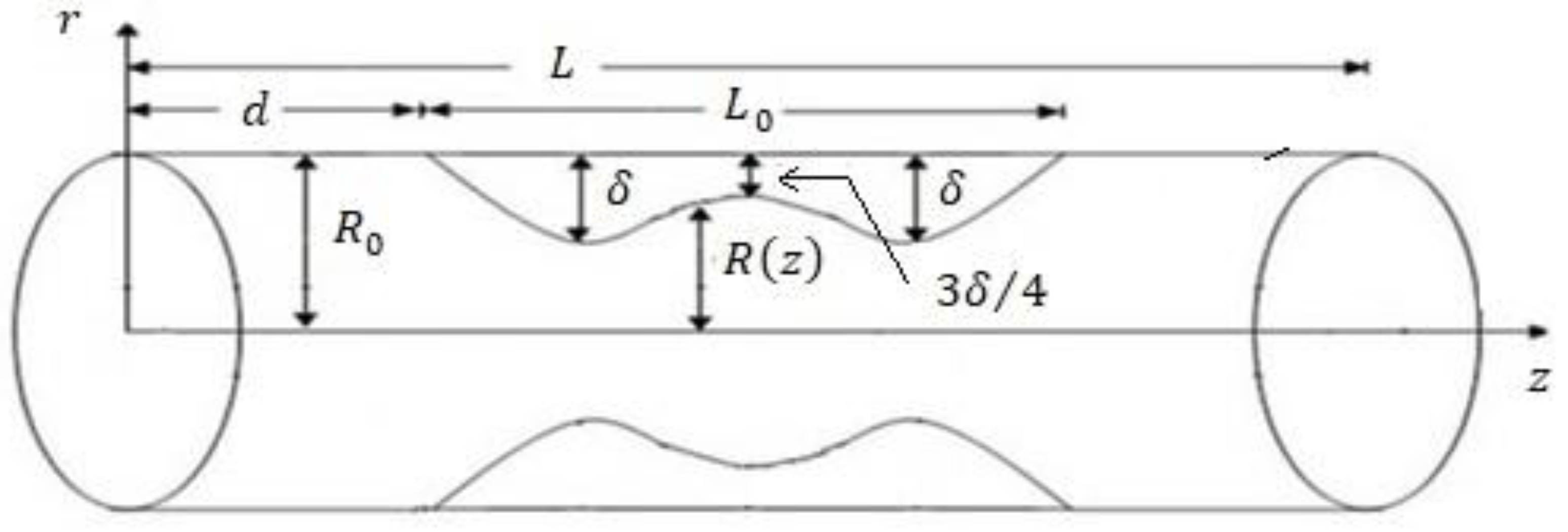
2. Mathematical Formulation and Its Solution

 , and
, and  is the critical height of the stenosis at
  , from the origin.



 condition
 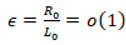 , and after dropping the dashes we get as: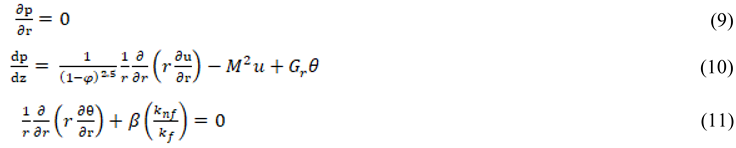

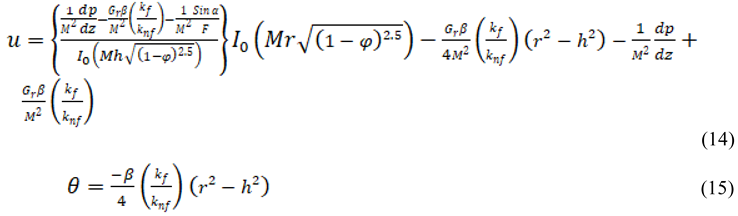
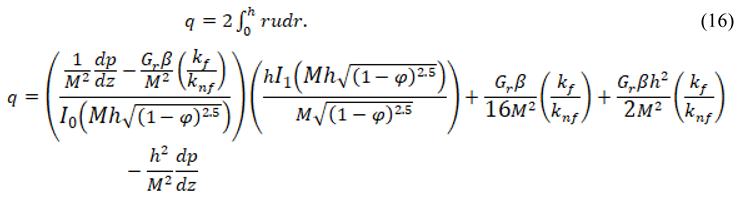





4. Discussion of Outcomes
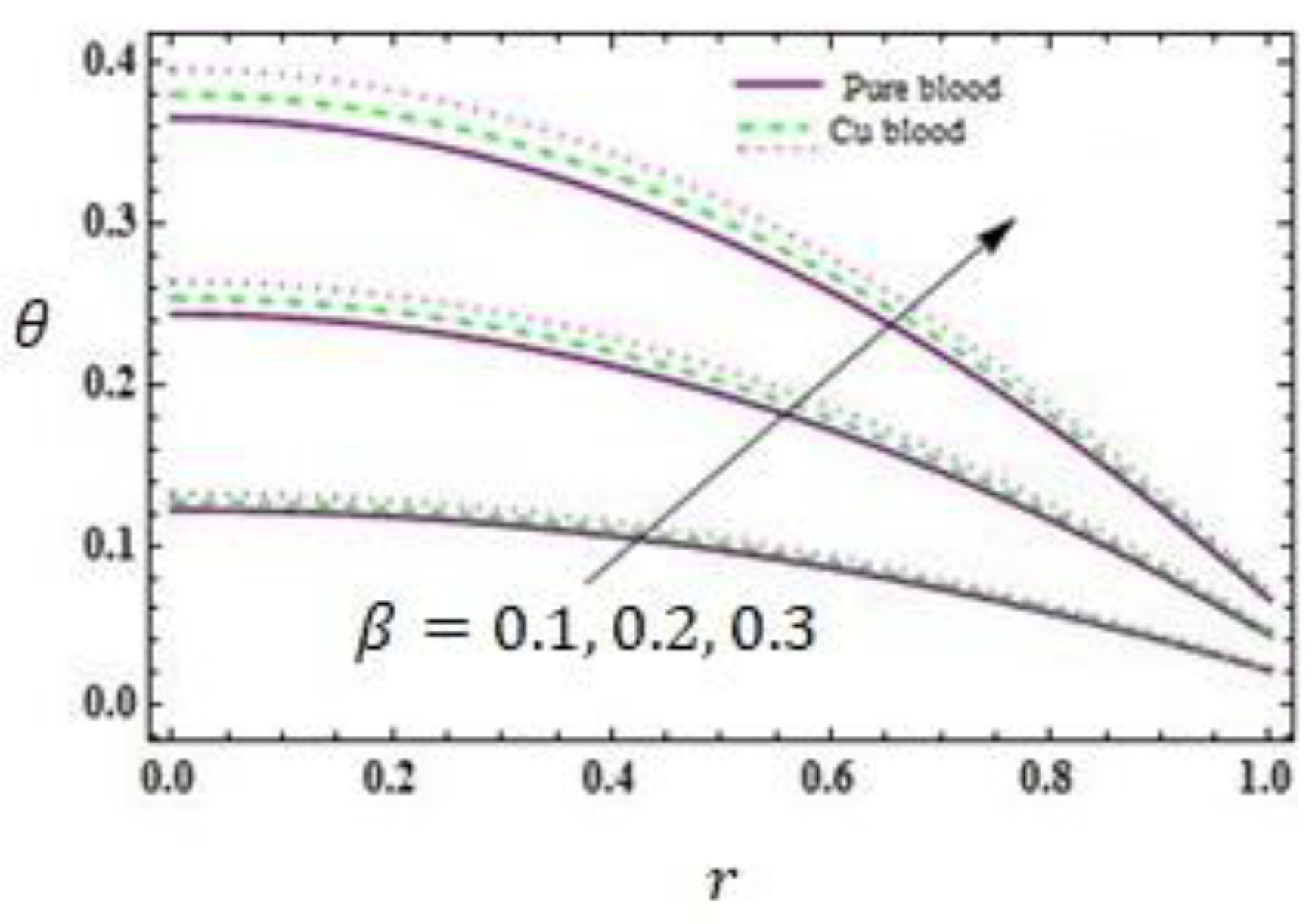
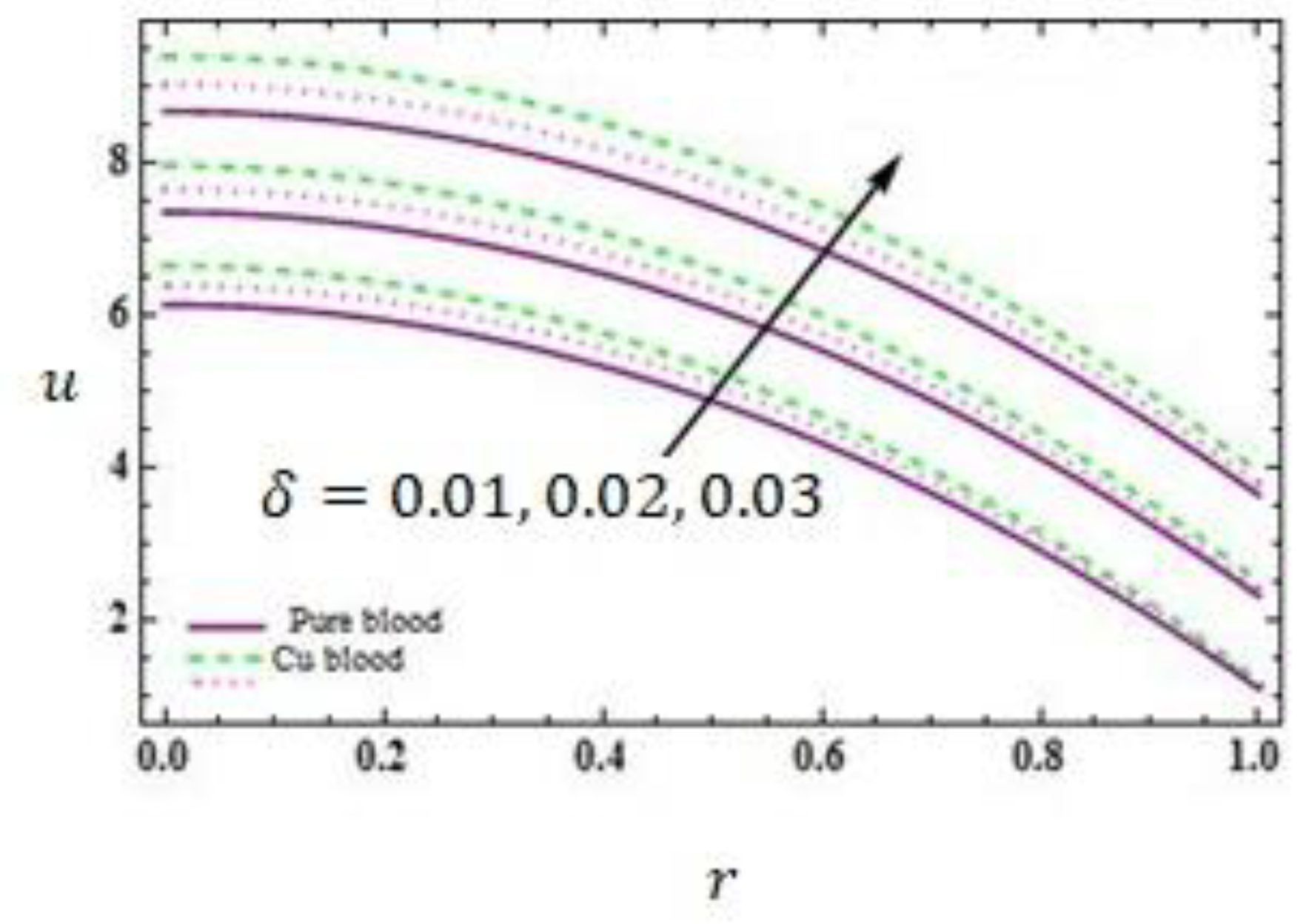
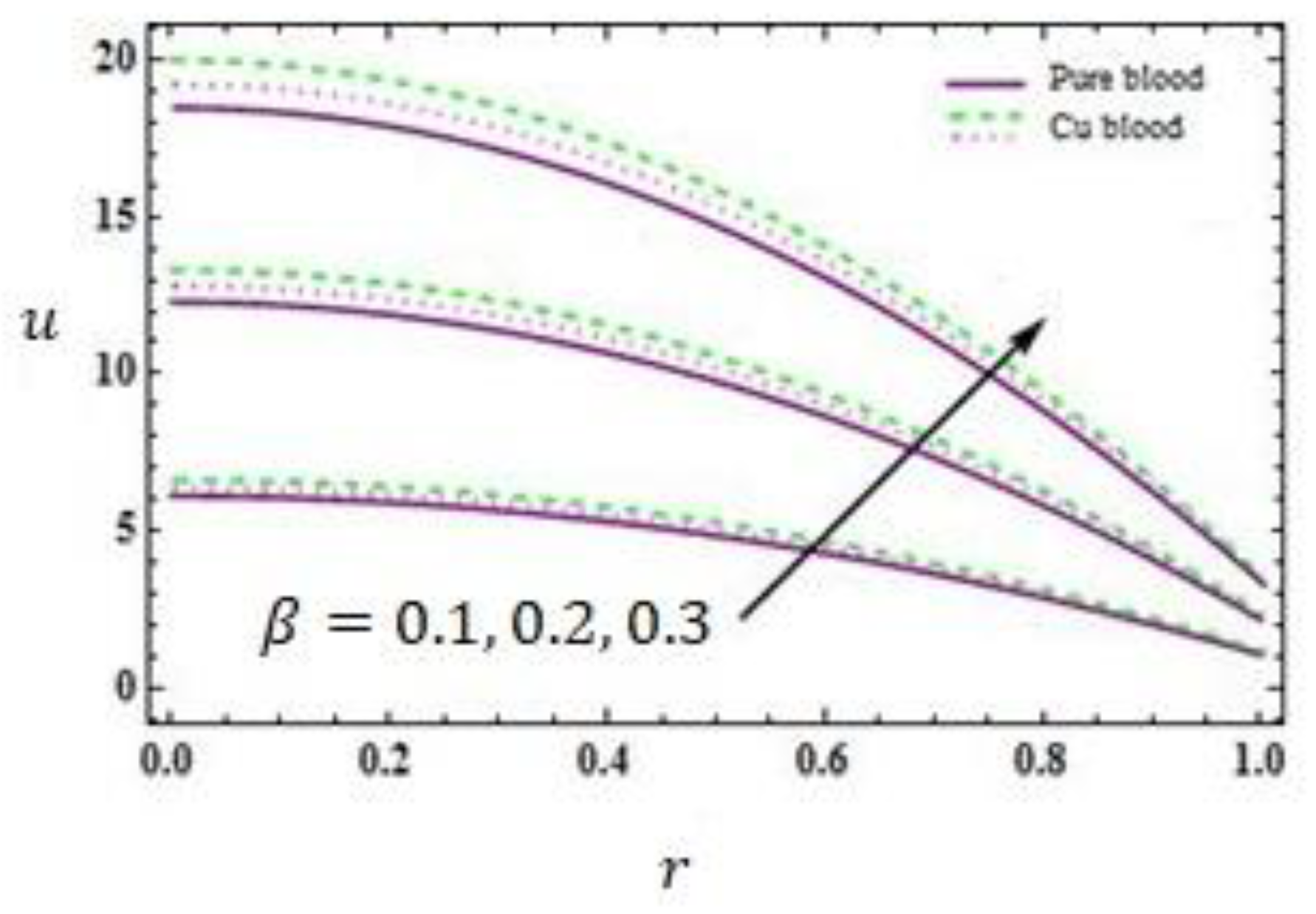
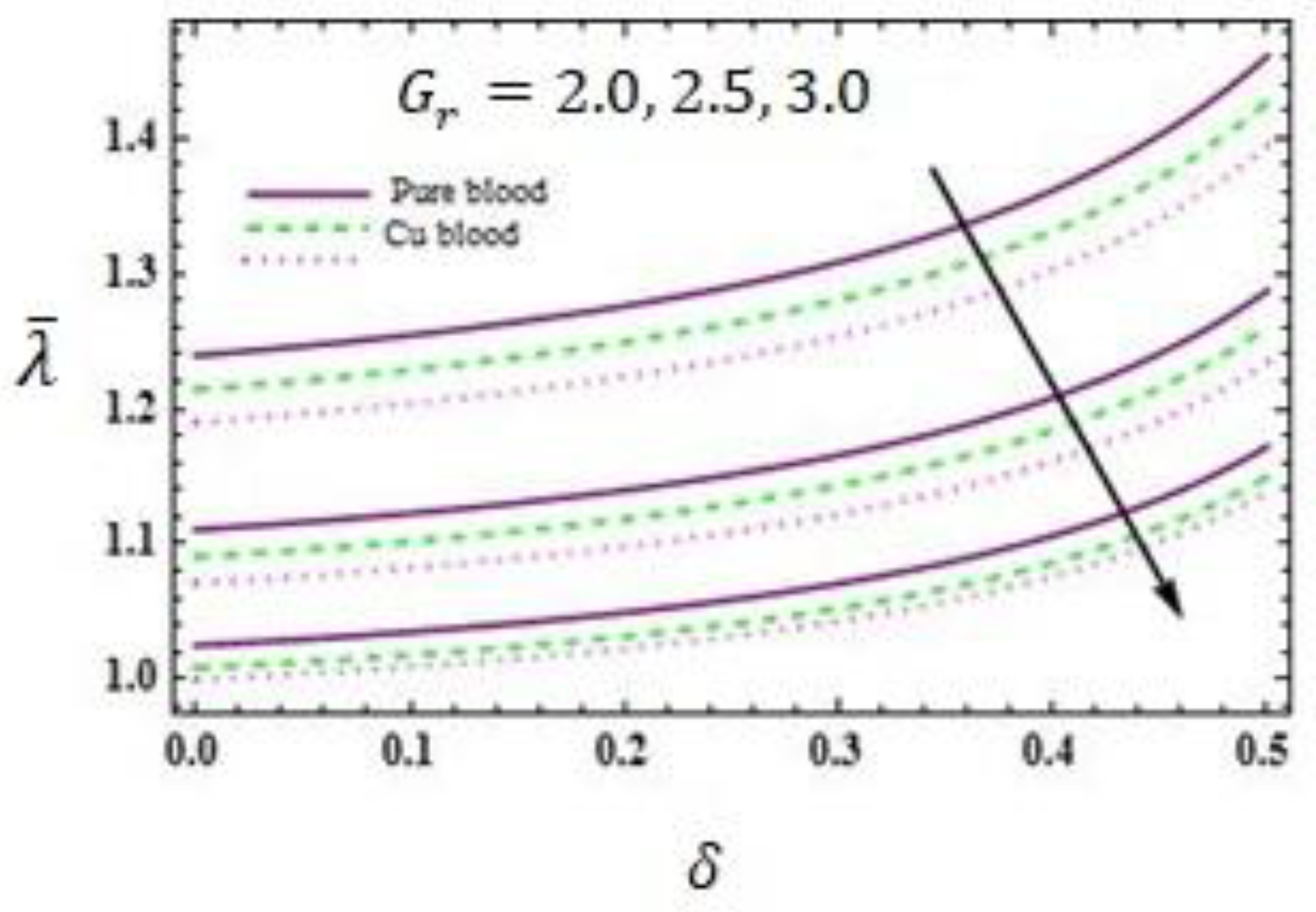
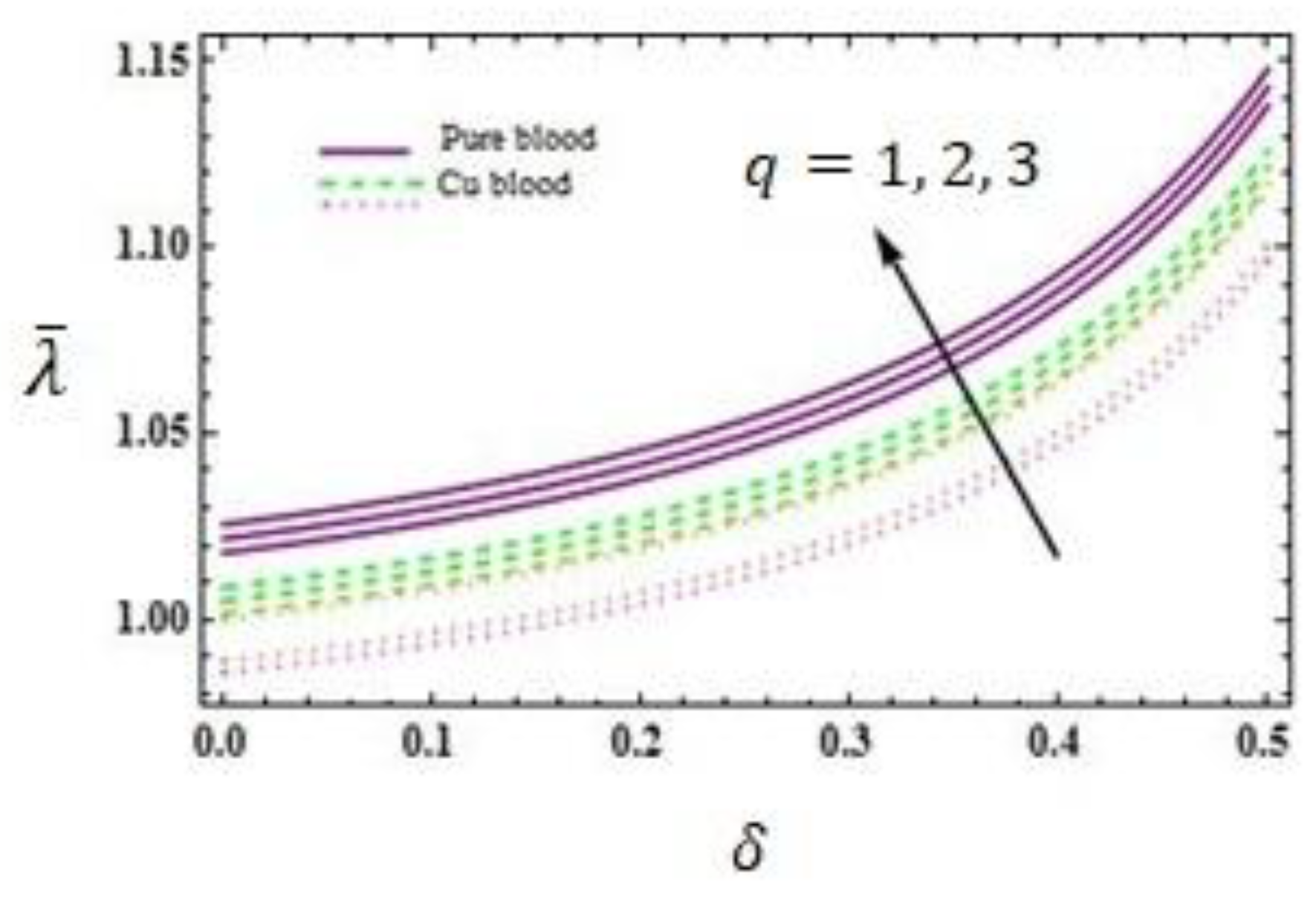
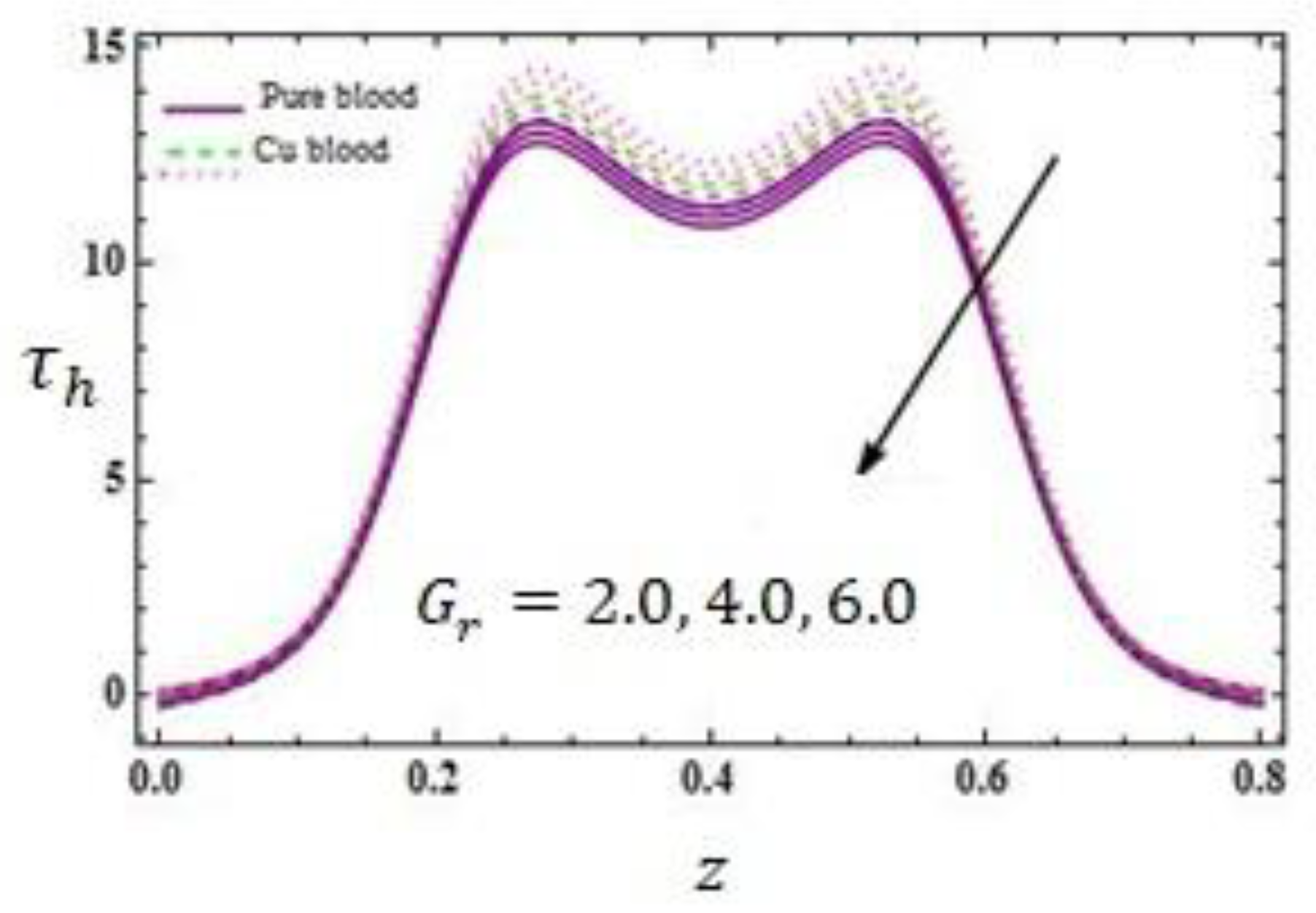
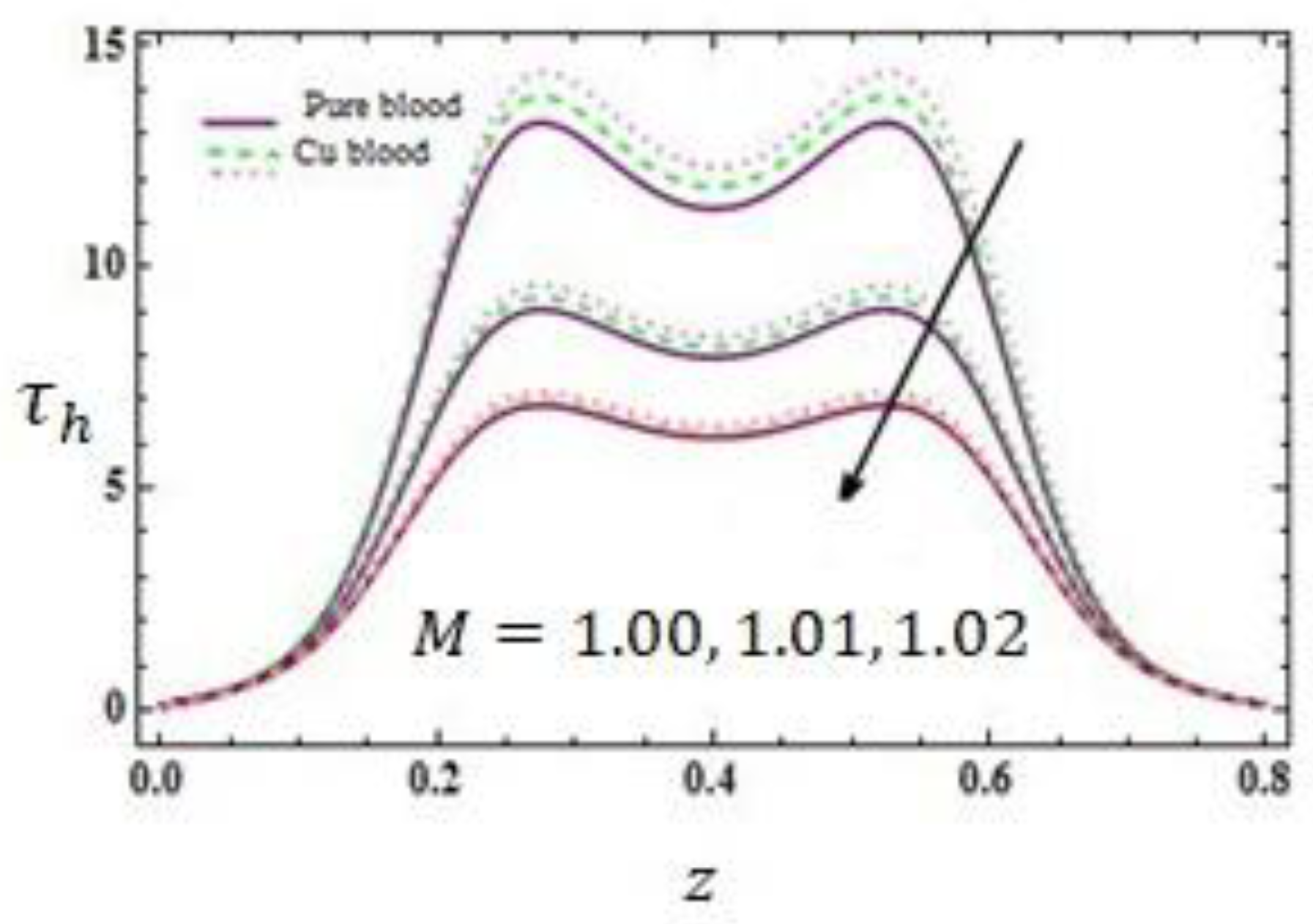
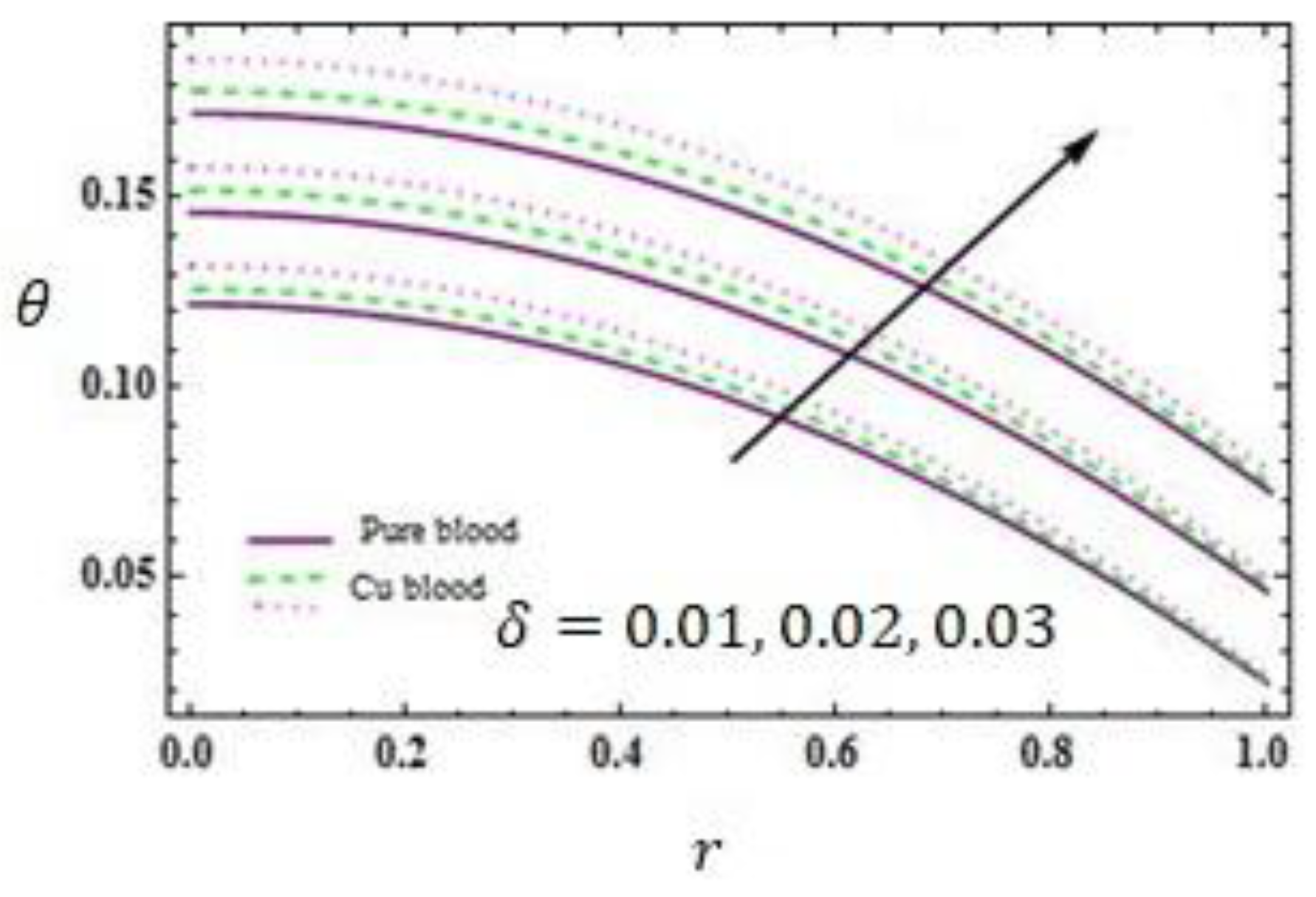
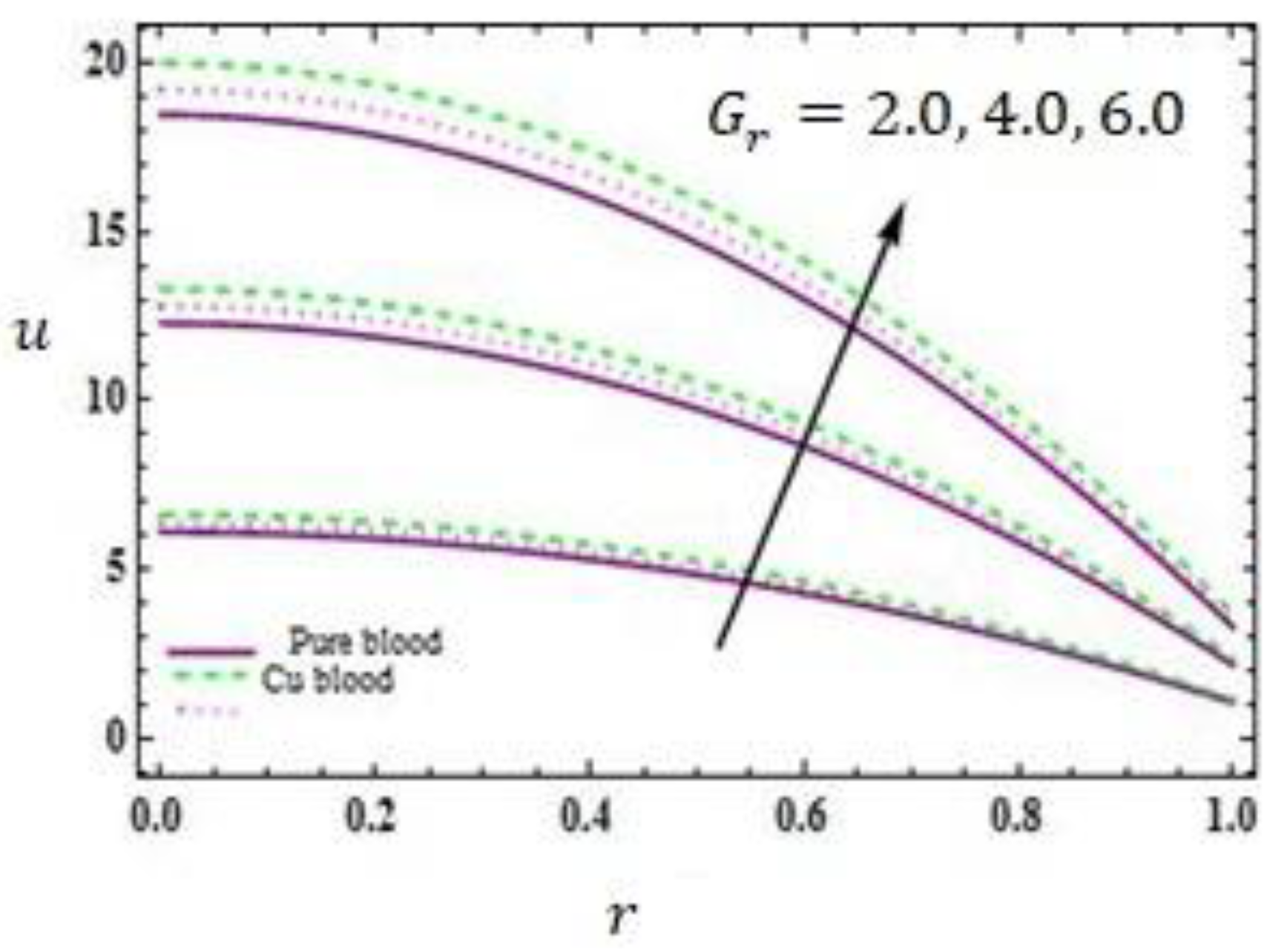
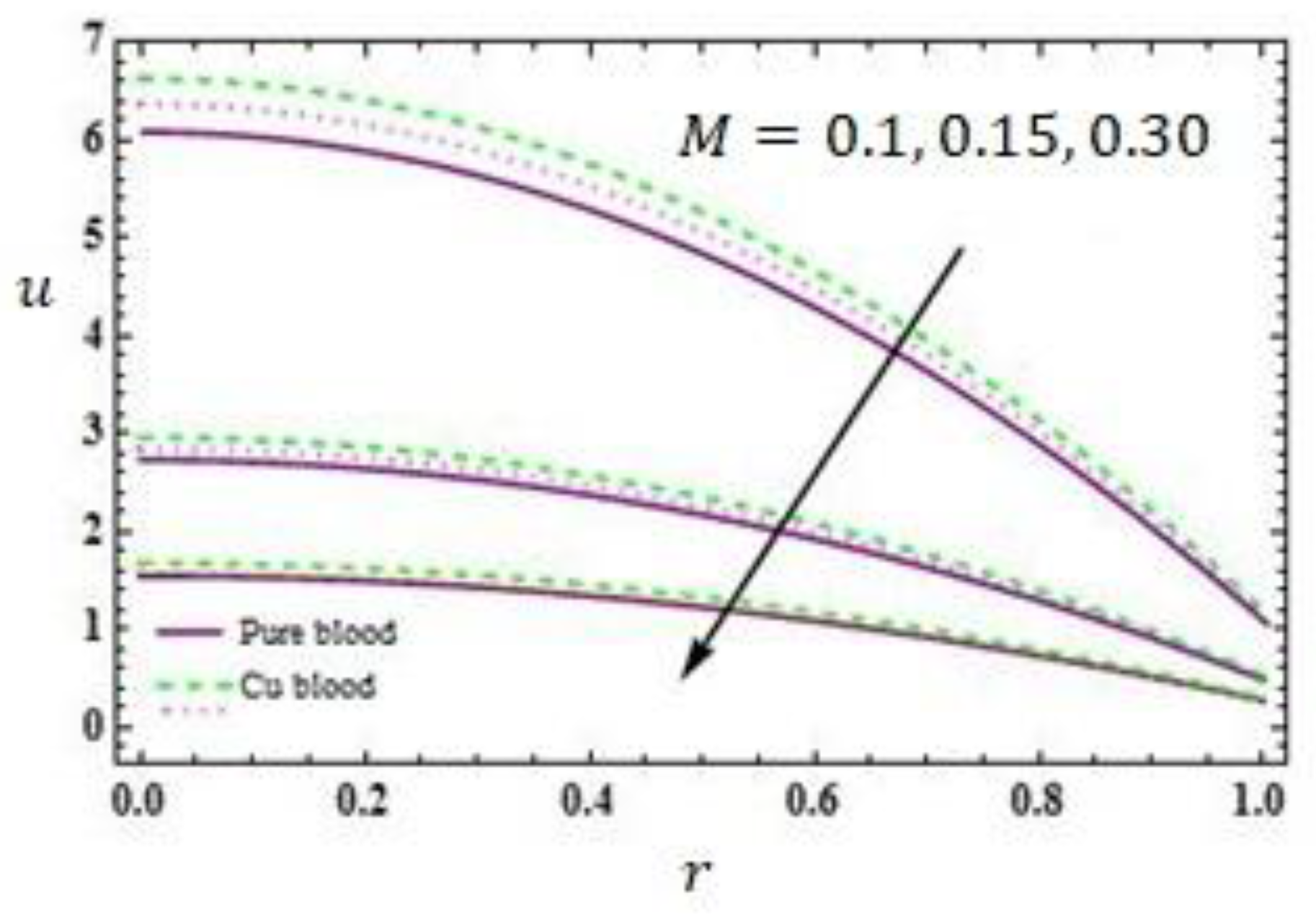
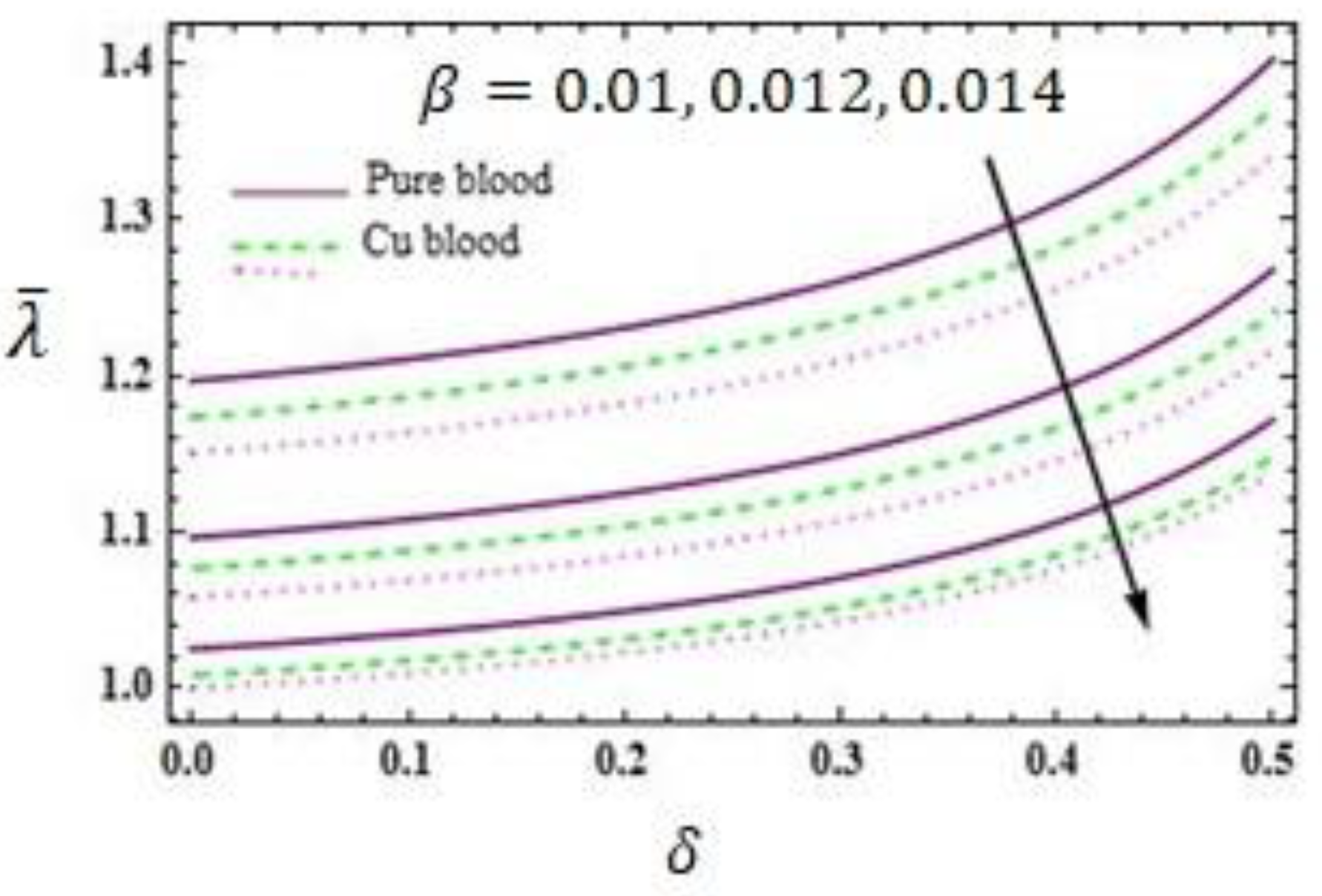
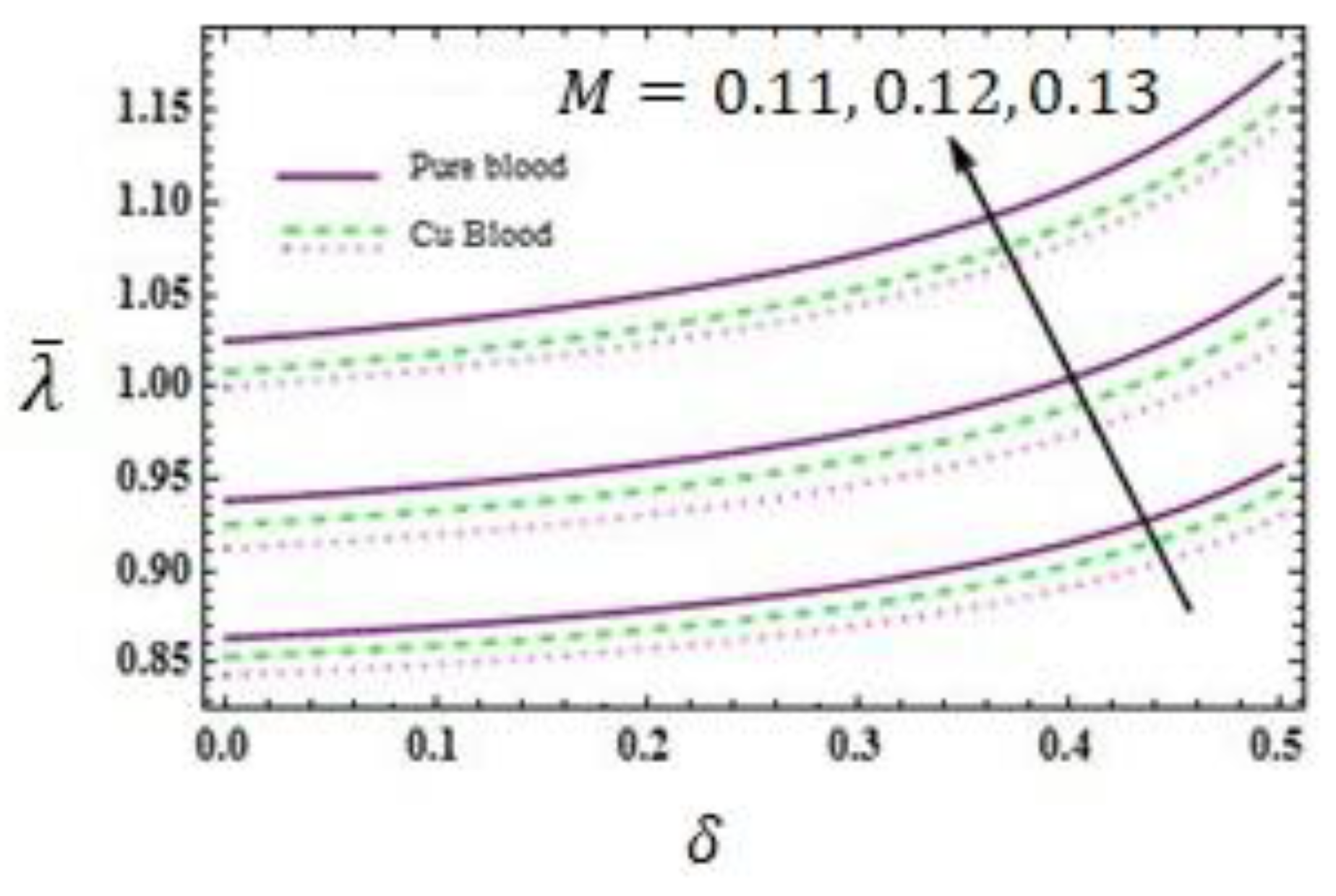
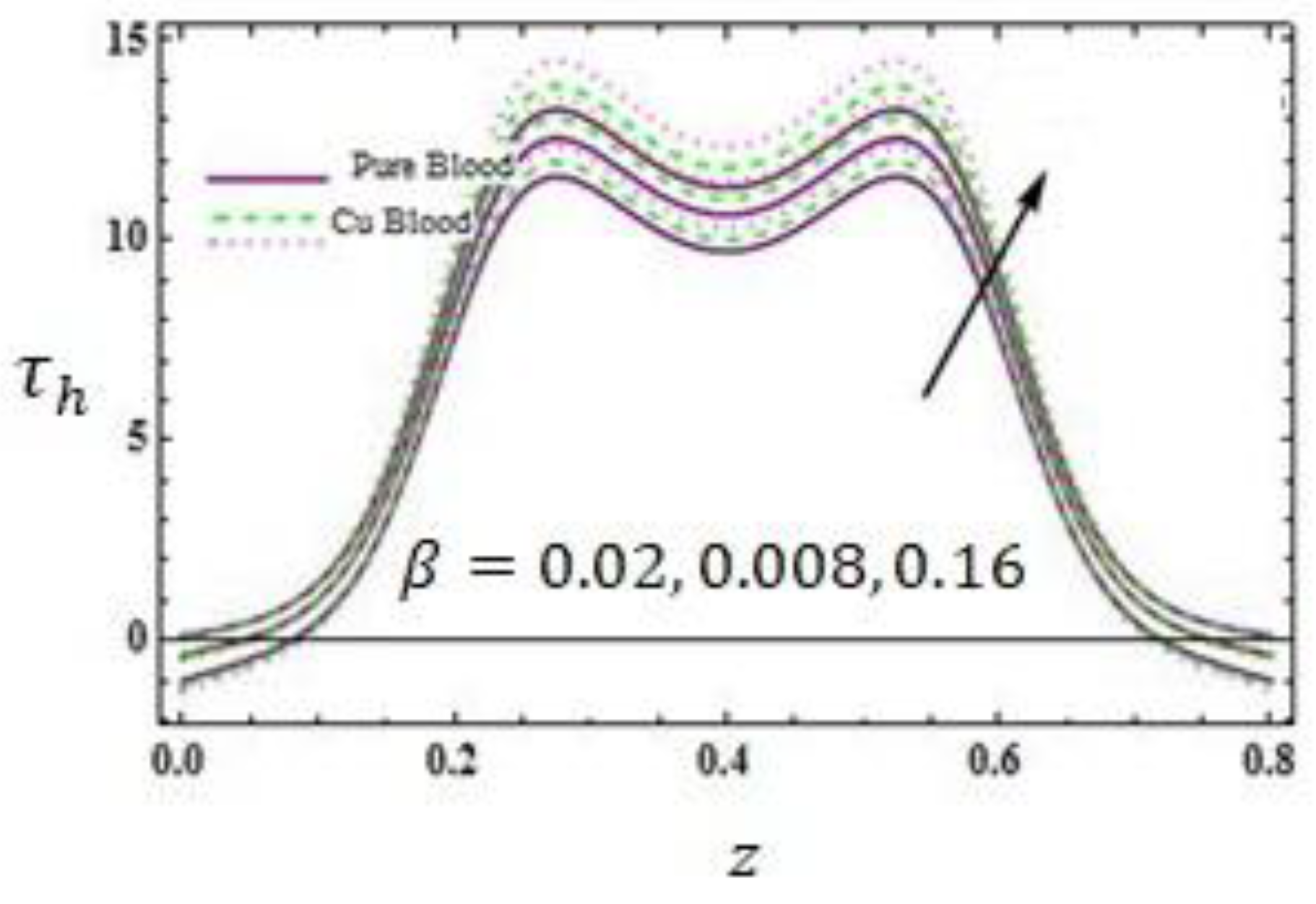
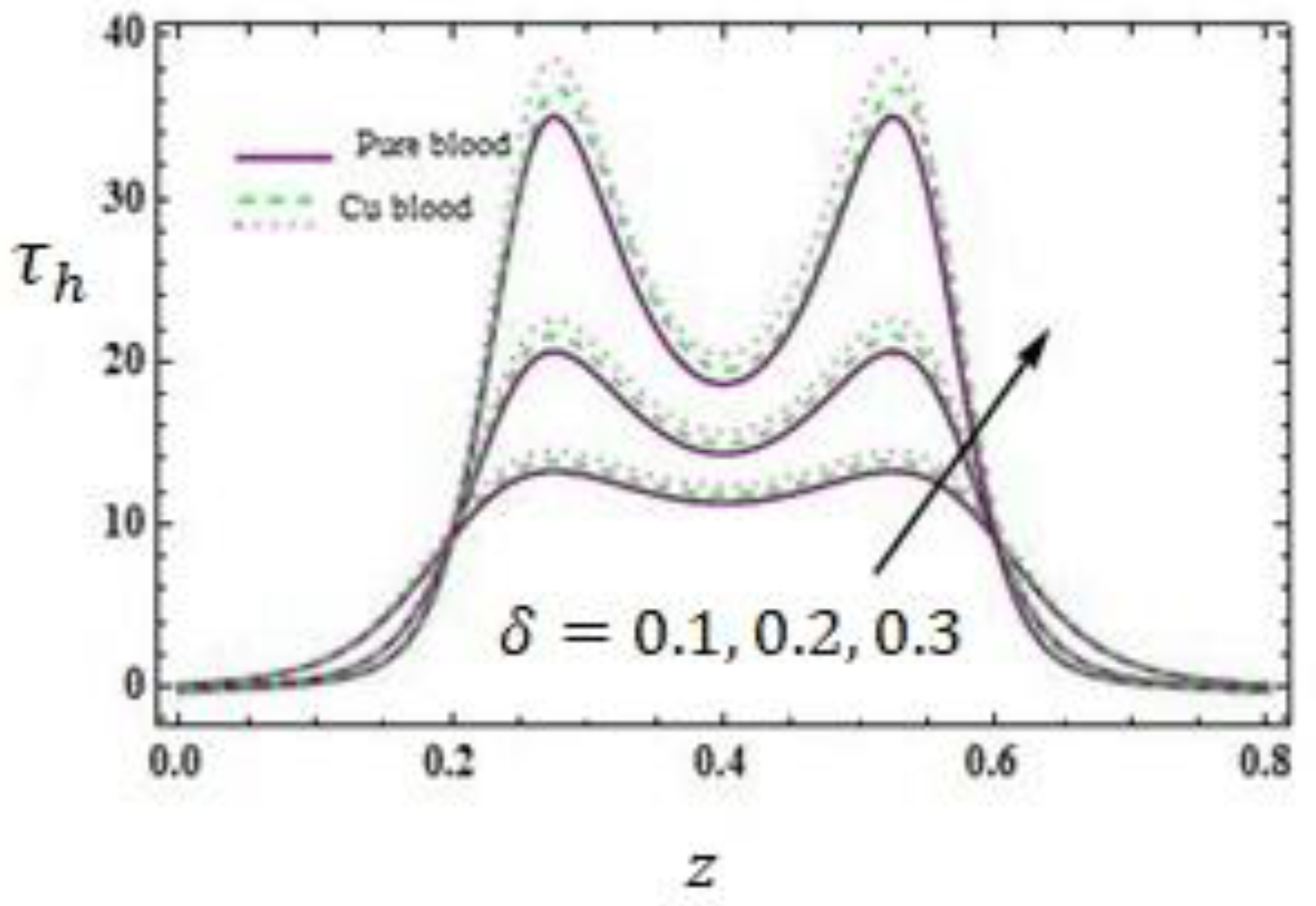
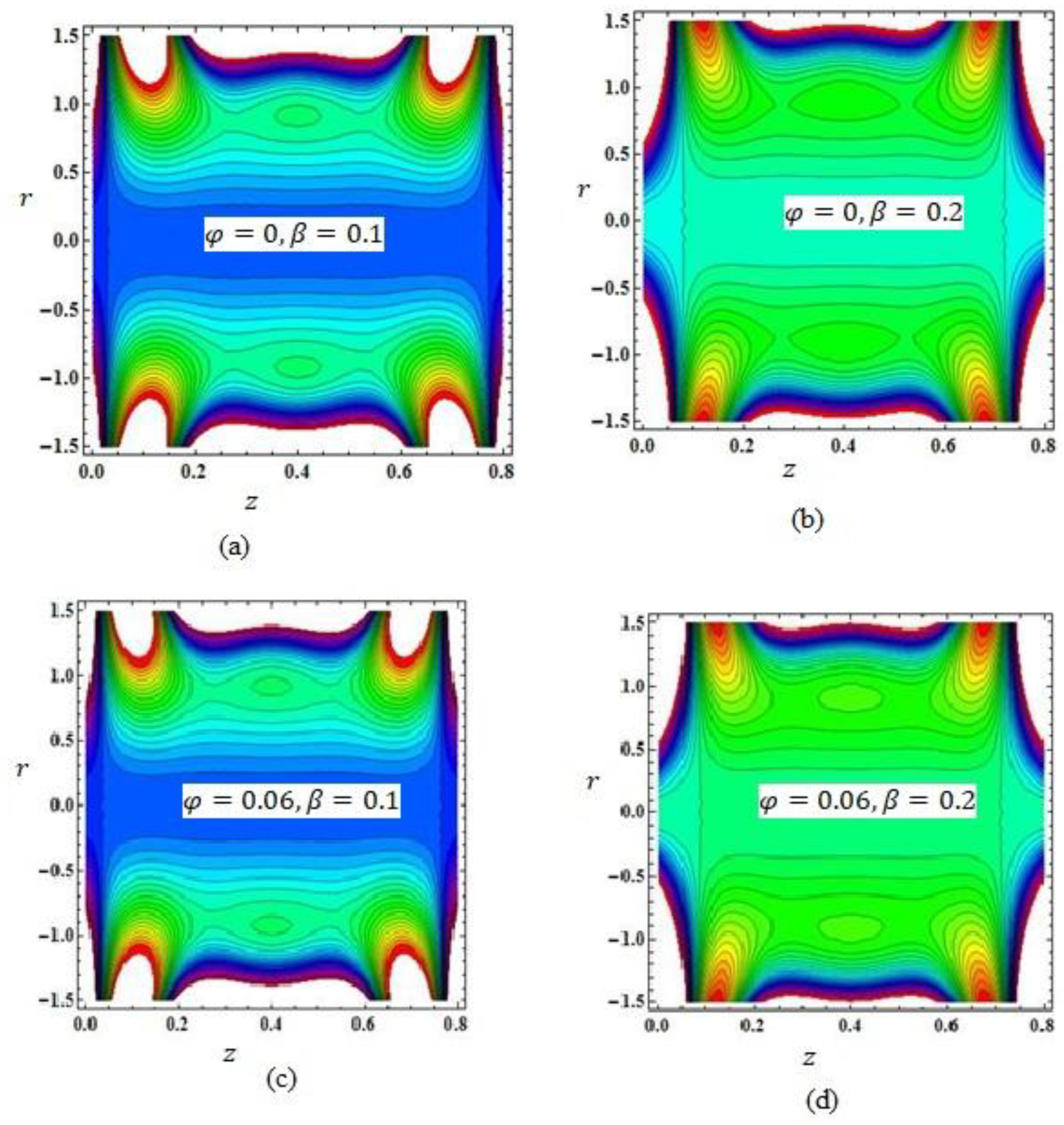
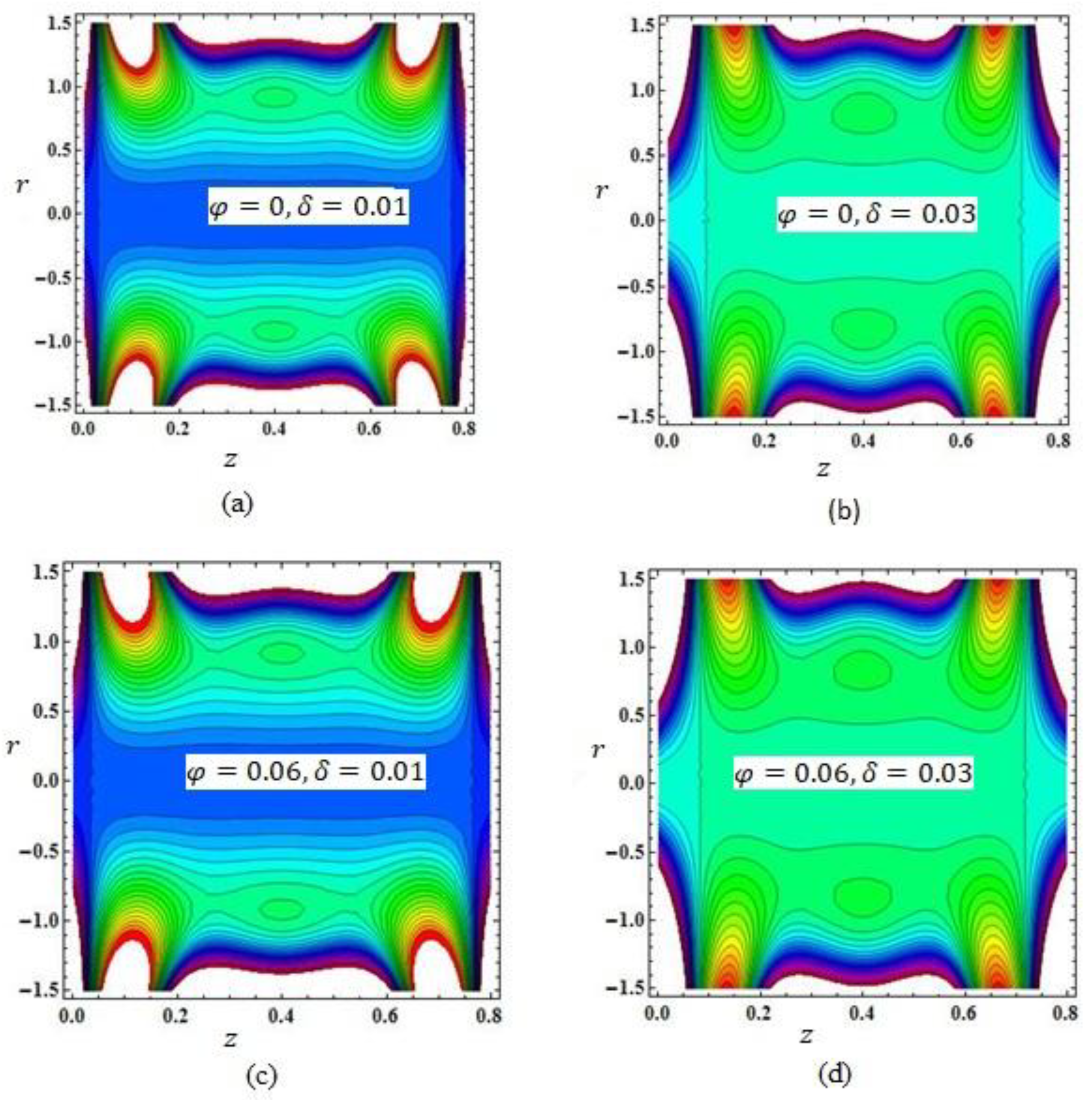
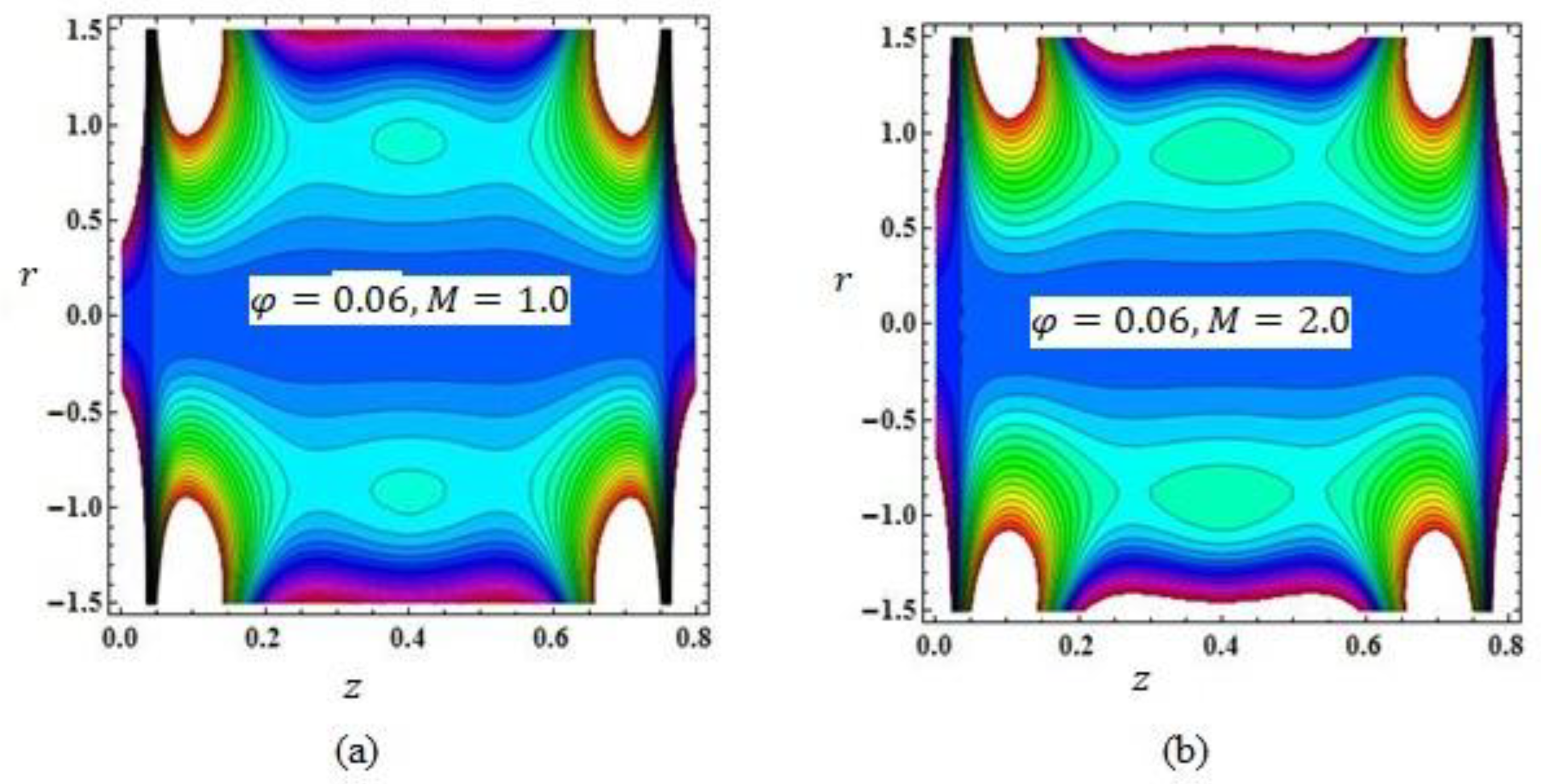
 and wall shear stress (τh) have been carried out by MATHEMATICA software and entire results are presented in Fig. 2, Fig. 3, Fig. 4, Fig. 5, Fig. 6, Fig. 7, Fig. 8, Fig. 9, Fig. 10, Fig. 11 and Fig. 12.
5. Conclusions
- The velocity profile increases with the height of stenosis (δ), heat absorption constant (β), and Grashof number (Gr) but decreases with magnetic field constraint (M).
- The flow resistance
 rises with ascends in δ, M and q but it falls with an increase in β and Gr.
 - The wall shear stress (τh) increases with growth in stenosis height and heat absorption constant and however decreases with growth in Grashof number and magnetic field constant.
- The temperature (θ) rises when the stenosis height and heat absorption constant increase and the temperature is maximum at the center of the tube and least near the walls of the tube.
- The volume of trapped bolus increases for pure blood and copper blood an increase in the heat source constant and stenosis height. However, the size of the trapped bolus is more for pureblood as compared to copper nanoparticle's concentrated blood.
Acknowledgments
References
- Popel, S.; Johnson, P. C. Microcirculation and hemorheology. Annu Rev Fluid Mech. 2005, 37, 43–69. [Google Scholar] [CrossRef]
- Lipowsky, H. H. Microvascular rheology and hemodynamics. Microcirculation 2005, 12, 5–15. [Google Scholar] [CrossRef]
- Freund, J. B. Numerical simulation of flowing blood cells. Annu. Rev. Fluid Mech. 2014, 46, 67–95. [Google Scholar] [CrossRef]
- Sharan, M.; Popel, A. S. A two-phase model for flow of blood in narrow tubes with increased effective viscosity near the wall. Biorheology 2001, 38, 415–28. [Google Scholar] [CrossRef] [PubMed]
- Chien, S.; Usami, S.; Taylor, H. M.; Lundberg, J. L.; Gregersen, M. I. Effects of hematocrit and plasma proteins on human blood rheology at low shear rates. J. Appl. Physiol. 1966, 21, 81–87. [Google Scholar] [CrossRef] [PubMed]
- Zixiang, L.; Yuanzheng, Z.; Rao, R. R.; Clausen, R.; Aidun, K. C. Nanoparticle transport in cellular blood flow. Comp. Fluids 2018, 172, 609–620. [Google Scholar]
- Thurston, G. B. Frequency and shear rate dependence of viscoelasticity of human blood. Biorheology 1973, 10, 375–381. [Google Scholar] [CrossRef]
- Apostolidis, A. Beris, Modeling of the blood rheology in steady-state shear flows. J. Rheol. 2014, 58, 607–633. [Google Scholar] [CrossRef]
- Quemada, D. A non-linear Maxwell model of biofluids: Application to normal human blood. Biorheology 1993, 30, 253–265. [Google Scholar] [CrossRef]
- Williams, M. C.; Rosenblatt, J. S.; Soane, D. S. Theory of blood rheology based on a statistical mechanics treatment of rouleaux, and comparisons with data. Int. J. Polym. Mater. 1993, 21, 57–63. [Google Scholar] [CrossRef]
- Vlastos, G.; Lerche, D.; Koch, B. The superposition of steady on oscillatory shear and its effect on the viscoelasticity of human blood and a blood-like model fluid. Biorheology 1997, 34, 19–36. [Google Scholar]
- Dimakopoulos, Y.; Bogaerds, A.; Anderson, P.; Hulsen, M.; Baaijens, F.P.T. Direct numerical simulation of a 2D idealized aortic heart valve at physiological flow rates. Comp. Meth. Biomech. and Biomed. Eng. 2012, 15(11), 1157–1179. [Google Scholar] [CrossRef] [PubMed]
- Anand, M.; Rajagopal, K. R. A shear-thinning viscoelastic fluid model for describing the flow of blood. Int. J. Cardiovascular Med. Sc. 2004, 4(2), 59–68. [Google Scholar]
- Rajagopal, K. R.; Srinivasa, A. R. A thermodynamic frame work for rate type fluid models. J. Non-Newtonian Fluid Mech. 2000, 80, 207–227. [Google Scholar] [CrossRef]
- Bodnar, T.; Sequeira, A. Numerical study of the significance of the non-Newtonian nature of blood in steady flow through a stenosed vessel. In Advances in mathematical fluid mechanics; Springer, 2010; pp. 83–104. [Google Scholar]
- Chakraborty, D.; Bajajb, M.; Yeob, L.; Friendb, J.; Pasquali, M.; Prakash, J. R. Viscoelastic flow in a two-dimensional collapsible channel. J. Non-Newtonian Fluid Mech. 2010, 165, 1204–1218. [Google Scholar] [CrossRef]
- Rodbard, S. Dynamics of Blood flow in stenotic lesions. American Heart J. 1966, 72(5), 698–704. [Google Scholar] [CrossRef]
- Young, D. F. Effect of time-dependent stenosis on flow through a tube. Trans. ASME J. Engng Ind. 1968, 90, 248–254. [Google Scholar] [CrossRef]
- Misra, J. C.; Patra, M. K.; Misra, S. C. A non-Newtonian fluid model for blood flow through arteries under stenotic conditions. J. Biomech. 1993, 26(9), 1129–1141. [Google Scholar] [CrossRef]
- Chakravarty, S.; Mandal, P. K. Mathematical modeling of blood flow through overlapping arterial stenosis. Math. Comput. Model. 1994, 19, 59–70. [Google Scholar] [CrossRef]
- Ponalagusamy, R. Two-Fluid Model for Blood Flow through tapered arterial stenosis: Effect of Non-zero Couple Stress Boundary Condition at the Interface. Int. J. Appl. Comput. Math. 2017, 3, 807–824. [Google Scholar] [CrossRef]
- RamanaReddy, J. V.; Srikanth, D. Impact of blood vessels wall flexibility on the temperature and concentration dispersion. J. Appl. Comput. Mech. 2020, 6(3), 564–581. [Google Scholar]
- Sahu, M. K.; Sharma, S. K.; Agarwal, A. K. Study of arterial blood flow in a stenosed vessel using non-Newtonian couple stress fluid model. Int. J. Dynamic. Fluids 2010, 6(2), 248–257. [Google Scholar]
- Nadeem, S.; Akbar, N. S.; Hayat, T.; Hendi, A. Power-law fluid model for blood flow through a tapered artery with a stenosis. Appl. Math. Comput. 2011, 217, 7108–7116. [Google Scholar] [CrossRef]
- Dimakopoulos, Y.; Kelesidis, G.; Tsouka, S.; Georgiou, G. C.; Tsamopoulos, J. Hemodynamics in stenotic vessels of small diameter under steady state conditions: Effect of vescoelasticity and migration of red blood cells. Biorheology 2015, 52, 183–210. [Google Scholar] [CrossRef]
- Ismail, Z.; Ilyani, A.; Norzieha, M.; Norsarahaida, A. A power –Law Model of blood through a tapered overlapping stenosed artery. Appl. Math. Comput. 2008, 195(2), 669–680. [Google Scholar] [CrossRef]
- Srivastava, V. P.; Mishra, S. Non-Newtonian arterial blood flow through overlapping stenosis. Appl. Appl. Math. 2010, 5(1), 225–238. [Google Scholar]
- Shit, G. C.; Maiti, S.; Roy, M.; Misra, J. C. Pulsatile flow and heat transfer of blood in an overlapping vibrating atherosclerotic artery: A numerical study. Math. Comput. Simul. 2019, 166(1), 432–450. [Google Scholar] [CrossRef]
- Choi, S. U. S.; Eastman, J. A. Enhancing thermal conductivity of fluids with nanofluids. ASME Fluids Engg. Div. 1995, 231, 99–105. [Google Scholar]
- Buongiorno, J. Convective transport in nanofluids. J. Heat Trans. 2006, 128(3), 240–250. [Google Scholar] [CrossRef]
- Vajravelu, K.; Prasad, K. V.; Lee, J.; Lee, C.; Pop, I.; Gorder, R.A.V. Convective heat transfer in the flow of viscous Ag-blood and Cu-water nanofluids over a stretching surface. Int. J. Therm. Sci. 2011, 50, 843. [Google Scholar] [CrossRef]
- Gudekote, M.; Baliga, D.; Choudhari, R.; Vaidya, H.; Prasad, K. V.; Makinde, O. D. Influence of variable viscosity and wall properties on the peristalsis of Jeffrey fluid in.
- Sankad, G.; Dhange, M. Effect of chemical reactions on the dispersion of a solute in the peristaltic motion of Newtonian fluid with wall properties. Malaysian J. Math. Sci. 2017, 11(3), 347–363. [Google Scholar]
- Nayak, M. K.; Abdu-Hakeem, A. K.; Ganga, B. Influence of non-uniform heat source/sink and variable viscosity on mixed convection flow of third grade nanofluid over an inclined stretched Riga plate. Int. J. Thermofluids. Sci. Tech. 2019, 6(4), 1–28. [Google Scholar] [CrossRef]
- Larimi, M. M.; Ramiar, A.; Ranjbar, A. A. Numerical simulation of magnetic nanoparticles targeting in a bifurcation vessel. J. Magn. Magn. Mater. 2014, 362, 58–71. [Google Scholar] [CrossRef]
- Shaw, S.; Murthy, P. V. S. N.; Sibanda, P. Magnetic drug targeting in a permeable microvessel. Microvasc. Res. 2013, 85, 77–85. [Google Scholar] [CrossRef] [PubMed]
- Rahbari; Fakour, M.; Hamzehnezhad, A.; Vakilabadi, M. A.; Ganji, D. D. Heat transfer and fluid flow of blood with nanoparticles through porous vessels in a magnetic field: A quasi-one-dimensional analytical approach. Math. Biosc. 2017, 283, 38–47. [Google Scholar] [CrossRef]
- Hatami, M.; Hatami, J.; Ganji, D. D. Computer simulation of MHD blood conveying gold nanoparticles as a third grade non-Newtonian nanofluid in a hollow porous vessel. Comput. Meth. Prog. Bio. 2014, 113(2), 632–641. [Google Scholar] [CrossRef]
- Uddin, M. J.; Fazlul-Hoque, A. K.; Rahman, M. M.; Vajravelu, K. Numerical simulation of convective heat transport within the nanofluid filled vertical tube of plain and uneven sidewalls. Int. J. Thermofluids. Sci. Tech. 2019, 6(1), 1–24. [Google Scholar] [CrossRef]
- Nayak, M. K. HHR impact on 3D radiative stretched flow of Cu-H2O nanofluid influenced by the variable magnetic field and convective boundary condition. Int. J. Thermofluids. Sci. Tech. 2019, 6(1), 1–23. [Google Scholar] [CrossRef]
- Islam, T.; Parveen, N.; Fayaz-al-Asad, Md. Hydromagnetic natural convection heat transfer of copper-water nanofluid within a right-angled triangular cavity. Int. J. Thermofluids. Sci. Tech. 2020, 7(3), 1–18. [Google Scholar] [CrossRef]
- Molli, S.; Naikoti, K. MHD Natural convective flow of Cu-water nanofluid over a past infinite vertical plate with the presence of time-dependent boundary condition. Int. J. Thermofluids. Sci. Tech. 2020, 7(3), 1–18. [Google Scholar] [CrossRef]
- Akbar, N. S. Endoscope effects on the peristaltic flow of Cu-water nanofluids. J. Comput. Theor. Nanosci. 2014, 11, 1150–1155. [Google Scholar] [CrossRef]
- Ramana, J. V.; Srikanth, D.; Samir, D.; Das, K. Modelling and simulation of temperature and concentration dispersion in a couple stress nanofluid flow through stenotic tapered arteries. Eur. Phys. J. Plus. 2017, 132(8), 365. [Google Scholar] [CrossRef]
- Nadeem, S.; Ijaz, S. Nanoparticles analysis on the blood flow through a tapered catheterized elastic artery with overlapping stenosis. Eur. Phys. J. Plus. 2014, 129(11), 249. [Google Scholar] [CrossRef]
- Elnaqeeb, T.; Mekheimer, K. S.; Alghamdi, F. Cu-blood flow model through a catheterized mild stenotic artery with a thrombosis. Math. Biosci. 2016, 282, 135–146. [Google Scholar] [CrossRef] [PubMed]
- Akbar, N. S.; Butt, A. W. Magnetic field effects for copper suspended nanofluid venture through a composite stenosed artery with permeable walls. J. Magn. Magn. Mater. 2015, 381, 285–291. [Google Scholar] [CrossRef]
- Akbar, N. S. Metalic nanoparticle analysis for the blood Flow in tapered stenosed arteries: Application in nanomedicines. Int. J. Bio. Math. 2016, 9(1), 1–18. [Google Scholar] [CrossRef]
- Pak, C.; Cho, Y. I. Hydrodynamic and heat transfer study of dispersed fluids with submicron metallic oxide particles. Exp. Heat Transf. 1998, 11(2), 151–170. [Google Scholar] [CrossRef]
- Bureau, M.; Healy, J. C.; Bourgoin, D.; Joly, M.; Biophysique, L. D.; Medecine, F. D.; Salpetriere, P. Rheological hysteresis of blood at low shear rate. Biorheology 1979, 16, 7–100. [Google Scholar]
- McMillan, E.; Strigberger, J.; Utterback, N. G. Rapidly recovered transient flow resistance: A newly discovered properties of blood. AM. J. Physiol. Hear. Circ. Physiol. 1987, 253, 919–926. [Google Scholar] [CrossRef]








| Materials | Copper | Blood |
| Symbols | Cu | - |
| ρ (kg/m3) | 8933 | 1063 |
| Cp (J/kg K) | 385 | 3594 |
| K (W/m K) | 400 | 0.492 |
| y x 10−5(K−1) | 1.67 | 0.18 |
Disclaimer/Publisher’s Note: The statements, opinions and data contained in all publications are solely those of the individual author(s) and contributor(s) and not of MDPI and/or the editor(s). MDPI and/or the editor(s) disclaim responsibility for any injury to people or property resulting from any ideas, methods, instructions or products referred to in the content. |
Copyright © 2022. This article is licensed under a CC BY-NC-ND 4.0.
Share and Cite
Umadevi, C.; Harpriya, G.; Dhange, M.; Nageswari, G. Effects of Magnetic Field on Blood Flow with Suspended Copper Nanoparticles Through an Artery with Overlapping Stenosis. Int. J. Thermofluid Sci. Technol. 2021, 8, 080103. https://doi.org/10.36963/IJTST.2021080103
Umadevi C, Harpriya G, Dhange M, Nageswari G. Effects of Magnetic Field on Blood Flow with Suspended Copper Nanoparticles Through an Artery with Overlapping Stenosis. International Journal of Thermofluid Science and Technology. 2021; 8(1):080103. https://doi.org/10.36963/IJTST.2021080103
Chicago/Turabian StyleUmadevi, C., G. Harpriya, M. Dhange, and G. Nageswari. 2021. "Effects of Magnetic Field on Blood Flow with Suspended Copper Nanoparticles Through an Artery with Overlapping Stenosis" International Journal of Thermofluid Science and Technology 8, no. 1: 080103. https://doi.org/10.36963/IJTST.2021080103
APA StyleUmadevi, C., Harpriya, G., Dhange, M., & Nageswari, G. (2021). Effects of Magnetic Field on Blood Flow with Suspended Copper Nanoparticles Through an Artery with Overlapping Stenosis. International Journal of Thermofluid Science and Technology, 8(1), 080103. https://doi.org/10.36963/IJTST.2021080103