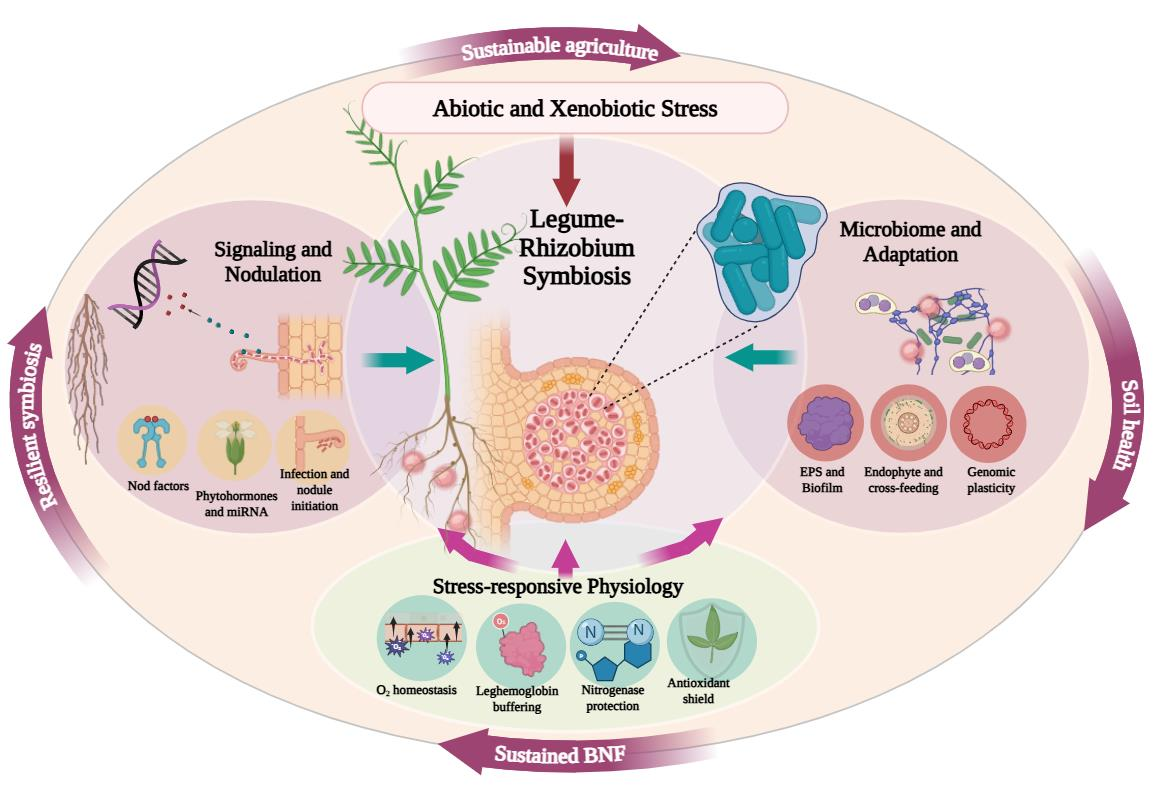

Stress-Responsive Regulatory Networks in Legume–Rhizobium Symbiosis: Implications for Climate-Smart Agriculture

Abstract
1. Introduction
2. Stress Responsive Reprogramming of Symbiotic Signaling Networks
2.1. Environmental Regulation of Nod Factor Signaling and Symbiotic Regulatory Hubs
2.2. Stress-Driven Modulation of Alternative Infection Route

| T3E | Rhizobial Strain | Host Plant | Positive Effect | Negative Effect | Ref. |
|---|---|---|---|---|---|
| Bel2-5 | Bradyrhizobium elkanii USDA61 | nfr1 mutant soybean | Triggers NF-independent nodulation | Restricts nodule formation | [74] |
| Rj4 soybean | |||||
| ErnA | Bradyrhizobium sp. ORS3257 | Aeschynomene indica | Triggers NF-independent nodulation and cell division | [61] | |
| Bradyrhizobium elkanii USDA61 | nfr1 mutant soybean | Positively affects nodulation | [74] | ||
| GunA/GunA2 | B. diazoefficiens USDA110 | Cajanus cajan | Promotes nodulation | [75] | |
| Ensifer fredii HH103 | Soybean cultivars | Promotes nodulation in some cultivars | Negative effects in some soybean interactions | [76] | |
| InnB | Bradyrhizobium elkanii USDA61 | Vigna mungo | Promotes nodulation | [77] | |
| Vigna cv. KPS1 | Restricts nodulation | ||||
| Vigna angularis | [78] | ||||
| Soybean cv. BARC-2 (Rj4) | Promotes nodulation | [74] | |||
| NopAA | Ensifer fredii HH103 | Glycine max | Promotes rhizobial infection | [77] | |
| Vigna unguiculata cv. Red Caloona | Negatively affects symbiosis | ||||
| NopAB | Bradyrhizobium sp. ORS3257 | Vigna mungo | Promotes nodule formation | [61,77] | |
| Vigna unguiculata | |||||
| Aeschynomene indica | Minor positive role | [61] | |||
| NopAO | Bradyrhizobium sp. ORS3257 | Aeschynomene indica | Negatively affects symbiosis | [78] | |
| NopC | Ensifer fredii HH103 | Soybean | Positively affects nodulation | [79] | |
| Vigna unguiculata | |||||
| Lotus japonicus GIFU | Blocks nodulation | ||||
| NopD | Bradyrhizobium sp. XS1105 | Tephrosia vogelii | Suppresses nodule formation | [80] | |
| E. fredii HH103 | Glycine max | Positive regulation in some germplasms | Negative regulation in some germplasms | [81] | |
| NopE | B. diazoefficiens USDA110 | Glycine max | Promotes nodulation | [82] | |
| Macroptilium atropurpureum | |||||
| Vigna radiata cv. KPS1 | |||||
| Vigna radiata cv. KPS2 | Negatively affects nodulation via SA-mediated ETI | ||||
| NopF | Bradyrhizobium elkanii USDA61 | Lotus spp. | Inhibits infection and nodulation | [83] | |
| NopJ | Rhizobium sp. NGR234 | Crotalaria juncea | Minor negative effect on nodulation | [84] | |
| Lablab purpureus | Negative effect on nodulation | [72] | |||
| NopL | E. fredii NGR234 | Phaseolus vulgaris | Inhibits nodule senescence; promotes nodulation | [85] | |
| Flemingia congesta | Promotes nodulation | [86] | |||
| Bradyrhizobium elkanii USDA61 | nfr1 mutant soybean | Positively affects nodulation | [74] | ||
| NopM | Rhizobium sp. NGR234 | Lablab purpureus | Promotes nodulation | [87] | |
| Lotus japonicus | Reduces nodule formation | [88] | |||
| Bradyrhizobium sp. ORS3257 | Aeschynomene indica | Positively promotes nodulation | [61] | ||
| Bradyrhizobium elkanii USDA61 | Lotus spp. | Induces ETI-like response and early nodule senescence | [84] | ||
| NopP | Rhizobium sp. NGR234 | Flemingia congesta | Promotes nodulation | [72] | |
| Tephrosia vogelii | |||||
| Vigna unguiculata | Inhibits nodulation | ||||
| Bradyrhizobium diazoefficiens USDA110 | Soybean carrying GmNNL1 | Inhibits root hair infection | [74] | ||
| Bradyrhizobium diazoefficiens USDA122 | Rj2 soybean | Severely restricts nodulation via ETI-like response | [62] | ||
| E. fredii HH103 | Glycine max | Positive regulation in some germplasms | Negative regulation in some germplasms | [89] | |
| Mesorhizobium amorphae | Robinia pseudoacacia | Promotes nitrogen-fixing activity and nodule biomass | [90] | ||
| NopP2 | B. vignae ORS3257 | Vigna mungo | Promotes nodulation | [77] | |
| Bradyrhizobium elkanii USDA61 | [91] | ||||
| NopT | Rhizobium sp. NGR234 | Phaseolus vulgaris | Positively affects nodulation | [92] | |
| Tephrosia vogelii | |||||
| Crotalaria juncea | Suppresses nodulation | [84] | |||
| Crotalaria pallida | |||||
| Ensifer fredii USDA257 | Glycine max cv. Nenfeng 15 | Impairs nodulation | [93] | ||
| Ensifer fredii HH103 | Soybean germplasms | Positive/neutral effects in some germplasms | Negative effects in others | [94] | |
| Mesorhizobium amphore CCNWGS0123 | Robinia pseudoacacia | Minor positive effect on nodulation | [95] | ||
| Bradyrhizobium sp. ORS3257 | Vigna mungo | Promotes nodule formation | [77] | ||
| Vigna unguiculata | [61] | ||||
| Aeschynomene indica | Lesser positive role | ||||
| NopX | Rhizobium sp. NGR234 | Lablab purpureus | Promotes symbiosis | [72] | |
| Pachyrhizus tuberosus | |||||
| Flemingia congesta |
2.3. Integration of Abiotic Stress Signals with Host Compatibility
3. Genetic and Regulatory Determinants of Rhizobial Stress Adaptation
3.1. Salinity and Drought-Responsive Mechanisms in Rhizobia
| Gene/Molecule | Function in Stress Adaptation | Rhizobia | Evidence | In Vivo/In Vitro | Refs. |
|---|---|---|---|---|---|
| otsA–otsB | Trehalose biosynthesis; protects proteins and membranes during osmotic, salt and desiccation stress; improves nodulation under salinity. | Mesorhizobium sp. CCBAU25338; B. diazoefficiens 110spc4 | Arachis hypogaea; Glycine max | In vivo | [123,124] |
| treY–treZ | Alternative trehalose biosynthetic pathway contributing to osmoprotection and desiccation tolerance. | Mesorhizobium cicero Rch125 | Cicer arietinum | In vivo | [125] |
| treS | Trehalose–maltose interconversion; carbon homeostasis and osmoprotection. | Bradyrhizobium japonicum USDA 110 | Glycine max | In vivo | [126] |
| betS | High-affinity glycine betaine transporter maintaining osmotic balance under salt stress. | Bradyrhizobium japonicum USDA110 | - | In vitro | [127] |
| relA | ppGpp synthesis; stringent response controlling adaptation to nutrient starvation and stress while supporting symbiotic competence. | Rhizobium etli CFN42 | - | In vitro | [128] |
| spoT | Maintains ppGpp homeostasis during nutritional stress. | ||||
| typA (bipA) | Ribosome-associated GTPase regulating stress-responsive translation and efficient nodulation. | Ensifer meliloti 1021 | Medicago truncatula | In vivo | [129] |
| rpoH1 | Heat-shock sigma factor controlling molecular chaperones and oxidative stress genes. | Ensifer meliloti BY294 | Medicago sativa | In field | [130] |
| rpoE2 | Extracytoplasmic sigma factor mediating envelope, osmotic and oxidative stress responses. | Ensifer meliloti Rm1021 | Medicago sativa, Medicago truncatula | In vivo | [131] |
| groEL–groES | Chaperonin complex promoting protein folding under heat and oxidative stress; overexpression improves symbiotic effectiveness. | Ensifer meliloti groESL | Medicago sativa | In vivo | [132] |
| dnaK–dnaJ | Heat-shock chaperones preventing protein aggregation during thermal stress. | Rhizobium tropici CIAT899 | Phaseolus vulgaris | In vivo | [133] |
| clpB | ATP-dependent protein disaggregase required for recovery from heat stress. | Mesorhizobium ciceri LMS-1 | Cicer arietinum | In vivo | [134] |
| katG | Catalase-peroxidase detoxifying hydrogen peroxide generated during infection and stress. | Rhizobium etli | Phaseolus vulgaris | In vivo | [135] |
| katE | Catalase protecting against oxidative damage. | R. leguminosarum | Pisum sativum | In vivo | [136] |
| sodA/sodB | Superoxide dismutases scavenging reactive oxygen species. | Mesorhizobium huakuii 7653R | Astragalus sinicus | In vivo | [137] |
| oxyR | Global oxidative stress regulator activating antioxidant defence genes. | Rhizobium etli | Phaseolus vulgaris | In vivo | [135] |
| exoY, exoA, exoF | Exopolysaccharide biosynthesis essential for biofilm formation, osmoprotection and infection thread development. | Mesorhizobium japonicum R7A | Lotus japonicus | In vivo | [138] |
| ndvA/ndvB | Cyclic β-glucan biosynthesis required for osmotic adaptation and successful infection. | Rhizobium (Ensifer) sp. NGR234 | Leucaena leucocephala, Vigna unguiculata | In vivo | [139] |
| bacA | Membrane protein protecting bacteroids against host NCR peptides and ensuring persistence within nodules. | Rhizobium leguminosarum 3841 | Phaseolus vulgaris | In vivo | [140] |
| fixL–fixJ | Two-component oxygen-sensing system activating microaerobic metabolism and nitrogen fixation genes. | Bradyrhizobium japonicum strains 110spc4, 9043, and 9039K2 | Glycine max | In vivo | [141] |
| fixK | Downstream transcription factor regulating the low-oxygen regulon. | ||||
| nifA | Master activator of nitrogen fixation genes under microaerobic conditions. | Rhizobium leguminosarum UPM791 | Pisum sativum | In vivo | [142] |
| nodD | Flavonoid-responsive regulator initiating nod gene expression under environmental cues. | Rhizobium meliloti MPIK3030 | Medicago sativa | In vivo | [143] |
| nolR | Global repressor modulating nod gene expression to optimize host adaptation. | Ensifer fredii HH103-1 | Vigna unguiculata | In vitro | [144] |
| phoB/phoR | Phosphate-starvation response improving adaptation to phosphorus limitation and influencing symbiosis. | Agrobacterium tumefaciens C58 | - | In vitro | [145] |
| chvG/chvI | Acid-responsive two-component regulatory system maintaining envelope integrity under low pH. | Rhizobium leguminosarum VF39 | Pisum sativum, Vicia nigricans, Lens culinaris | In vivo | [146] |
| actA/actR | Acid tolerance determinants maintaining intracellular pH homeostasis. | Ensifer meliloti WSM419 | - | In vitro | [147] |
3.2. Detoxification and Xenobiotic Resistance Pathways in Rhizobia Under Stress
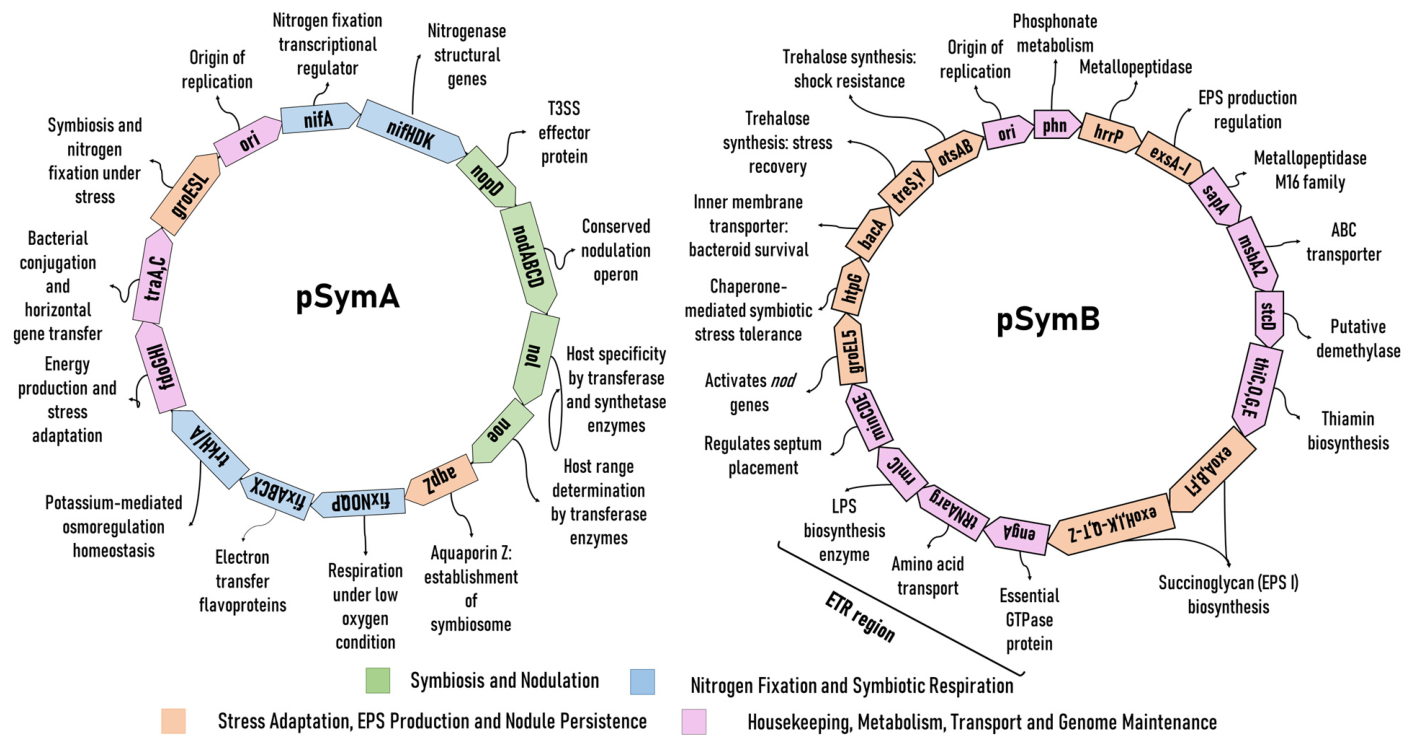
3.3. Genomic Plasticity and Horizontal Gene Transfer in Stress Adaptation
| Stress | Microorganism | Plant Species | Function | Ref. |
|---|---|---|---|---|
| Drought | Glomus intraradices and native rhizobial strains | Genotypes of Phaseolus vulgaris | Positive correlation between mycorrhizal colonization and nodule trehalose content | [196] |
| Ensifer sp. | Acacia senegal | Increased EPS production and protection of Ensifer cell cultures | [197] | |
| Rhizobium tropici and Paenibacillus polymyxa | Phaseolus vulgaris | Upregulation of stress tolerance genes | [198] | |
| Rhizophagus irregularis and Mesorhizobium tianshanense | Glycyrrhiza uralensis | Improved phosphorus nutrition | [199] | |
| Bradyrhizobium liaoningense and Ambispora leptoticha | Glycine max | Improved yield parameters | [200] | |
| Heavy Metal Stress (Ni, Co, Fe, Cr, As) | Rhizobium leguminosarum and Mesorhizobium septentrionale | Lotus corniculatus | Accumulation of phenols and remodeling of apoplast in nodules | [96] |
| Ensifer meliloti | Medicago sativa | Disruption of aqpS arsenite transport/aquaglyceroporin gene | [201] | |
| Bradyrhizobium pachyrhizi and Ochrobactrum anthropic | Pongamia pinnata | Increased nitrogen and leghaemoglobin content; EPS production; metal detoxification through accumulation, precipitation, methylation, and chelation | [150] | |
| Rhizobium selenitireducens and Rhizobium pisi | Macrotyloma uniflorum | Enhanced metal stress tolerance | [156] | |
| Rhizobium sp. | — | Heavy metal tolerance mechanisms | [202] | |
| Rhizobium sp. | — | Metal detoxification and stress adaptation | [157] | |
| Rhizobium HGR-4, HGR-6, HGR-13, and HGR-25 | Macrotyloma uniflorum | Enhanced nitrogen and leghaemoglobin content | [156] | |
| Ensifer meliloti 1021, Rm5038, and Rm5055 | Medicago truncatula | Inhibition of ABA and linalool biosynthesis in roots | [151] | |
| Salinity | Rhizobium azibense | Phaseolus vulgaris (L.) | Increased antioxidant defense enzymes | [115] |
| Rhizobia sp. RhLO1, Glomus sp., Sclerocystis sp., and Acaulospora sp. | Medicago sativa L. | Higher PPO and POX activity | [203] | |
| Native rhizobia | Medicago truncatula and Phaseolus vulgaris | Enhanced trehalose accumulation | [204] | |
| Rhizobium leguminosarum and arbuscular mycorrhizal fungi | Vicia faba | Increased catalase, peroxidase, SOD, and proline accumulation | [205] | |
| Alcaligenes faecalis MH-2, Alcaligenes sp. MH-3, Achromobacter denitrificans MH-6, and Sphingobacterium spiritivorum MH-9 | Cicer arietinum (L.) | Enhanced nutrient absorption and antioxidant responses | [206] | |
| Hydrocarbon Stress | Neorhizobium petrolearium and Rhizobium phenanthrenilyticum | Medicago sativa L. | Degradation of phenanthrene, fluorene, and anthracene | [112] |
| Mesorhizobium cicer sp. LGR33 | Cicer arietinum (L.) | Improved pesticide tolerance and bio-inoculant formulation | [207] | |
| Pesticides | Bradyrhizobium japonicum | Vigna radiata (L.) | Increased nodulation and symbiotic efficiency | [208] |
| Bradyrhizobium sp. | Vigna radiata (L.) | Increased productivity and reduced glyphosate and quizalofop toxicity | [209] | |
| Mesorhizobium ciceri BRM5 | Cicer arietinum (L.) | Enhanced productivity under pesticide stress | [210] |
4. Exopolysaccharides as Structural and Signaling Determinants of Symbiotic Resilience
| Classification | EPS Type/ Example | Major Components/Structure | Primary Functions | Ref. |
|---|---|---|---|---|
| Homopolysaccharides | α-D-Glucans (Dextran, Mutan, Alternan, Reuteran) | Glucose polymers linked by α-glycosidic bonds | Biofilm formation, adhesion, protection from desiccation | [224,225,226] |
| β-D-Glucans (Cellulose, Curdlan, Scleroglucan) | β-linked glucose polymers | Structural support, water retention, biofilm stability | [225,227,228] | |
| Fructans (Levan, Inulin) | Fructose polymers | Osmoprotection, carbon storage, antioxidant and prebiotic activities | [213,226,229] | |
| Polygalactans/Pullulan | Galactose or maltotriose polymers | Film formation, encapsulation, moisture retention | [225,227,230] | |
| Heteropolysaccharides | Xanthan | Glucose, mannose, glucuronic acid | Biofilm formation, viscosity enhancement, emulsification | [225,231,232] |
| Alginate | Mannuronic and guluronic acids | Water retention, metal chelation, biofilm matrix | [225,231,233] | |
| Gellan | Glucose, glucuronic acid, rhamnose | Gel formation and immobilization | [224,234] | |
| Kefiran | Glucose and galactose | Immunomodulatory, antimicrobial and probiotic effects | [235] | |
| Hyaluronic acid | Glucuronic acid and N-acetylglucosamine | Hydration, lubrication, tissue repair | [231,236] | |
| Functional EPS | Constructive EPS | Neutral structural polymers | Biofilm scaffold, water retention, mechanical stability | [227,237,238] |
| Sorptive EPS | Charged polymers | Metal chelation, nutrient adsorption, pollutant binding | [227,237] | |
| Surface-active EPS | Amphiphilic polymers | Adhesion, emulsification, antimicrobial activity | [227] | |
| Redox-active EPS | Electron-transfer capable EPS | Bioremediation, metal reduction, ROS modulation | [227,238] | |
| Informative EPS | Signaling polysaccharides | Cell–cell communication and host recognition | [227,237] | |
| Active EPS | Bioactive polymers | Antioxidant, antimicrobial and immunomodulatory activities | [227,237,238] | |
| Nutritive EPS | Storage polymers | Carbon and energy reserve | [227] | |
| Symbiosis-specific EPS | EPS I (Succinoglycan) | Octasaccharide composed of glucose and galactose with succinyl, acetyl and pyruvyl substitutions | Infection thread development, immune suppression, biofilm formation | [101,102,239,240] |
| EPS II (Galactoglucan) | Glucose–galactose repeating disaccharides | Biofilm formation and surface attachment | [240,241] | |
| Low-molecular-weight EPS | Short oligomers derived from EPS I or EPS II | Mobile signaling molecules | [101,102] | |
| High-molecular-weight EPS | Long-chain extracellular polymers | Biofilm matrix and hydration | [102,240] | |
| Cyclic β-(1→2)-glucans | Cyclic glucose polymers | Osmoregulation and membrane stability | [240] | |
| Capsular polysaccharides (KPS/CPS) | Surface-associated polysaccharides | Protection from environmental stress and phages | [240] |
5. Multi-Microbial Synergy: Rhizobia–Endophyte Interactions
5.1. Metabolic Complementarity and Antioxidant Reinforcement
5.2. Hormonal Modulation Mediated Stress Alleviation
6. Systemic Regulation of Nodulation Under Environmental Stress
6.1. Phytohormonal and Cle-Peptide Mediated Regulation of Stress-Responsive Nodulation
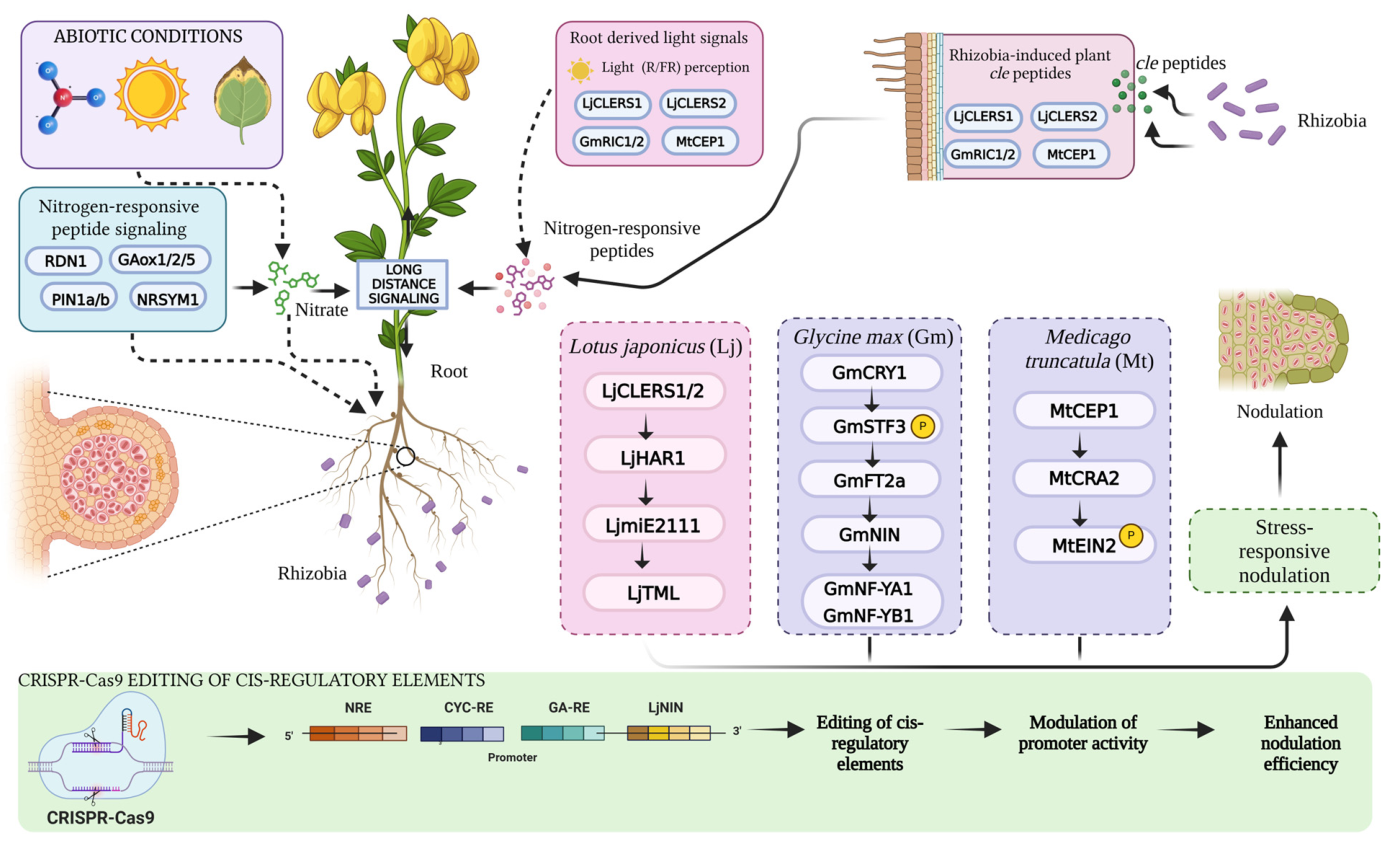
6.2. Regulation of Oxygen and Nitrogenase Protection
6.3. NODULE INCEPTION (NIN) and NIN-like Proteins: Integrating Nitrogen Signaling with Stress-Responsive Nodulation
6.4. Nitric Oxide and Reactive Nitrogen Species in the Regulation of Stress-Responsive Nodulation
7. Translational Frontiers: Engineering Resilient Symbiosis
7.1. Pan-Genomic Identification of Stress-Adaptive Traits
7.2. Synthetic Consortia and Nanomaterial-Assisted Enhancement
| Nanomaterial | Rhizobial Interaction | Stress Type | Mechanism of Action | Outcome | Reference |
|---|---|---|---|---|---|
| Zinc Oxide Nanoparticles (ZnO NPs) | Enhances rhizobial nodulation and nitrogen fixation | Salinity Stress | Modulates antioxidant enzyme activities, reduces reactive oxygen species (ROS) generation | Improved growth and stress tolerance in legumes | [371] |
| FITC-tagged Nano-FeO (nFeO) | Rhizobium with alfalfa (Medicago sativa L.) | Salt stress | Improved Na+/K+ homeostasis, enhanced antioxidant activity, and reduced ROS damage | Enhanced salt tolerance, improved morpho-physiological traits and photosynthetic performance in alfalfa | [372] |
| Chitosan-GSNO Nanoparticles | Facilitates rhizobial attachment and survival | Drought Stress | Induces systemic resistance, enhances antioxidant defense, promotes biofilm formation | Reduced pathogen load, enhanced symbiosis | [373] |
| Silver Nanoparticles (AgNPs) | Stimulates rhizobial activity at low concentrations | Heavy Metal Stress | Chelates toxic metals, modulates microbial metabolism | Enhanced legume growth in contaminated soils | [374] |
| Silicon Nanoparticles (SiNPs) | Improves nodulation efficiency | General Abiotic Stresses | Strengthens cell walls, modulates stress-responsive genes | Increased plant vigor and stress resilience | [375] |
| Iron Oxide Nanoparticles (Fe3O4 NPs) | Boosts rhizobial iron acquisition | Iron-Deficiency Stress | Enhanced nodulation and nitrogen fixation via improved siderophore mediated Fe acquisition and antioxidant buffering. | Enhanced chlorophyll content and nitrogen fixation | [376] |
| Manganese ferrite nanoparticles (MF-NPs) | Bradyrhizobium diazoefficiens and Glycine max L. Merr. | ROS | Regulating the nodulation pathway and increasing the number of nodules in soybean. | Nodule number increased without affecting vegetative growth or activating AON pathway | [377] |
8. Conclusions
9. Future Directions
Author Contributions
Funding
Institutional Review Board Statement
Informed Consent Statement
Data Availability Statement
Acknowledgments
Conflicts of Interest
Abbreviations
| BNF | Biological nitrogen fixation |
| ROS | Reactive oxygen species |
| RNS | Reactive nitrogen species |
| ABA | Abscisic acid |
| ACC | Aminocyclopropane-1-carboxylate |
| AON | Autoregulation of nodulation |
| T3SS | Type III secretion system |
| T3Es | Type III effectors |
| T4SS | Type IV secretion system |
| ETI | Effector-triggered incompatibility |
| EPS | Exopolysaccharide |
| EPR3 | Exopolysaccharide Receptor 3 |
| HGT | Horizontal gene transfer |
| IT | Infection thread |
| NREs | Non-rhizobial endophytes |
| PGPR | Plant growth-promoting rhizobacteria |
References
- Babar, M.M.; Zaidi, N.U.S.S.; Azooz, M.M.; Kazi, A.G. Genetic and molecular responses of legumes in a changing environment. In Legumes Under Environmental Stress: Yield, Improvement and Adaptations; John Wiley & Sons: Hoboken, NJ, USA, 2015; pp. 199–214. [Google Scholar] [CrossRef] [Scilit]
- Ladha, J.K.; Peoples, M.B.; Reddy, P.M.; Biswas, J.C.; Bennett, A.; Jat, M.L.; Krupnik, T.J. Biological nitrogen fixation and prospects for ecological intensification in cereal-based cropping systems. Field Crops Res. 2022, 283, 108541. [Google Scholar] [CrossRef] [Scilit] [PubMed]
- Ma, Y.; Chen, R. Nitrogen and phosphorus signaling and transport during legume–rhizobium symbiosis. Front. Plant Sci. 2021, 12, 683601. [Google Scholar] [CrossRef] [Scilit] [PubMed]
- Yeremko, L.; Czopek, K.; Staniak, M.; Marenych, M.; Hanhur, V. Role of environmental factors in legume-rhizobium symbiosis: A review. Biomolecules 2025, 15, 118. [Google Scholar] [CrossRef] [Scilit] [PubMed]
- Duan, H.X.; Luo, C.L.; Wang, X.; Cheng, Y.S.; Abrar, M.; Batool, A. Responses of legumes to rhizobia and arbuscular mycorrhizal fungi under abiotic stresses: A global meta-analysis. Agronomy 2024, 14, 2597. [Google Scholar] [CrossRef] [Scilit]
- Concha, C.; Doerner, P. The impact of the rhizobia-legume symbiosis on host root system architecture. J. Exp. Bot. 2020, 71, 3902–3921. [Google Scholar] [CrossRef] [Scilit] [PubMed]
- Han, Q.; Yuan, Y.; Zhu, Y.; Hong, Y.; Li, M.; Zhang, Q.; Li, P. Nodulation: Rhizobial signals and regulatory factors. Ind. Crops Prod. 2026, 243, 123075. [Google Scholar] [CrossRef] [Scilit]
- Das, H.; Devi, N.; Venu, N.; Borah, A. Chemical fertilizer and its effects on the soil environment. Res. Rev. Agric. Sci. 2023, 7, 31–51. [Google Scholar]
- Yasir, M.; Hossain, A.; Pratap-Singh, A. Pesticide degradation: Impacts on soil fertility and nutrient cycling. Environments 2025, 12, 272. [Google Scholar] [CrossRef] [Scilit]
- Thiruvengadam, R.; Venkidasamy, B.; Easwaran, M.; Chi, H.Y.; Thiruvengadam, M.; Kim, S.H. Dynamic interplay of reactive oxygen and nitrogen species (ROS and RNS) in plant resilience: Unveiling the signaling pathways and metabolic responses to biotic and abiotic stresses. Plant Cell Rep. 2024, 43, 198. [Google Scholar] [CrossRef] [Scilit] [PubMed]
- Furtak, K.; Wolińska, A. The impact of extreme weather events as a consequence of climate change on the soil moisture and on the quality of the soil environment and agriculture—A review. Catena 2023, 231, 107378. [Google Scholar] [CrossRef] [Scilit]
- Zhang, Y.; Ku, Y.S.; Cheung, T.Y.; Cheng, S.S.; Xin, D.; Gombeau, K.; Cai, Y.; Lam, H.M.; Chan, T.F. Challenges to rhizobial adaptability in a changing climate: Genetic engineering solutions for stress tolerance. Microbiol. Res. 2024, 288, 127886. [Google Scholar] [CrossRef] [Scilit] [PubMed]
- Aloo, B.N.; Dessureault-Rompré, J.; Tripathi, V.; Nyongesa, B.O.; Were, B.A. Signaling and crosstalk of rhizobacterial and plant hormones that mediate abiotic stress tolerance in plants. Front. Microbiol. 2023, 14, 1171104. [Google Scholar] [CrossRef] [Scilit] [PubMed]
- Tian, Y.F.; Luo, Y.; Li, Q.M.; Zhang, Z.Q.; Guo, Y.L.; Yang, W.C. CPOP1 is a key enzyme required for nodule microenvironment control and successful symbiotic nitrogen fixation in Lotus japonicus. J. Integr. Plant Biol. 2025, 67, 3167–3181. [Google Scholar] [CrossRef] [Scilit] [PubMed]
- Buhian, W.P.; Bensmihen, S. Mini-review: Nod factor regulation of phytohormone signaling and homeostasis during rhizobia-legume symbiosis. Front. Plant Sci. 2018, 9, 1247. [Google Scholar] [CrossRef] [Scilit] [PubMed]
- Martínez-Hidalgo, P.; Hirsch, A.M. The nodule microbiome: N2-fixing rhizobia do not live alone. Phytobiomes J. 2017, 1, 70–82. [Google Scholar] [CrossRef] [Scilit]
- Nocelli, N.; Bogino, P.C.; Banchio, E.; Giordano, W. Roles of extracellular polysaccharides and biofilm formation in heavy metal resistance of rhizobia. Materials 2016, 9, 418. [Google Scholar] [CrossRef] [Scilit] [PubMed]
- Oldroyd, G.E.; Murray, J.D.; Poole, P.S.; Downie, J.A. The rules of engagement in the legume-rhizobial symbiosis. Annu. Rev. Genet. 2011, 45, 119–144. [Google Scholar] [CrossRef] [Scilit] [PubMed]
- Ferguson, B.J.; Mens, C.; Hastwell, A.H.; Zhang, M.; Su, H.; Jones, C.H.; Chu, X.; Gresshoff, P.M. Legume nodulation: The host controls the party. Plant Cell Environ. 2019, 42, 41–51. [Google Scholar] [CrossRef] [Scilit] [PubMed]
- Hawkins, J.P.; Oresnik, I.J. The rhizobium-legume symbiosis: Co-opting successful stress management. Front. Plant Sci. 2022, 12, 796045. [Google Scholar] [CrossRef] [Scilit] [PubMed]
- Sindhu, S.; Dahiya, A.; Gera, R.; Sindhu, S.S. Mitigation of abiotic stress in legume-nodulating rhizobia for sustainable crop production. Agric. Res. 2020, 9, 444–459. [Google Scholar] [CrossRef] [Scilit]
- Gao, J.P.; Chiu, C.H.; Oldroyd, G.E. Unlocking the role of NSP1 and NSP2: Nutrient-responsive regulators in nodulation. Trends Plant Sci. 2025, 30, 925–928. [Google Scholar] [CrossRef] [Scilit] [PubMed]
- Oldroyd, G.E.; Leyser, O. A plant’s diet, surviving in a variable nutrient environment. Science 2020, 368, eaba0196. [Google Scholar] [CrossRef] [Scilit] [PubMed]
- Singh, J.; Valdés-López, O.; Schornack, S. Beyond nitrogen: Phosphate controls root nodule symbiosis commitment. Trends Plant Sci. 2026, 31, 787–793. [Google Scholar] [CrossRef] [Scilit] [PubMed]
- Joseph, R.; Apollon, W.; Jean-Baptiste, M.C.; Costa de Oliveira, A. Plant resilience under abiotic stress: All for one or one for all? Plant Soil 2026, 522, 15–52. [Google Scholar] [CrossRef] [Scilit]
- Ma, Y.; Xiao, C.; Liu, J.; Ren, G. Nutrient-dependent regulation of symbiotic nitrogen fixation in legumes. Hortic. Res. 2025, 12, uhae321. [Google Scholar] [CrossRef] [Scilit] [PubMed]
- Okuma, N.; Kawaguchi, M. Systemic optimization of legume nodulation: A shoot-derived regulator, miR2111. Front. Plant Sci. 2021, 12, 682486. [Google Scholar] [CrossRef] [Scilit] [PubMed]
- Suzaki, T.; Valkov, V.T.; Chiurazzi, M. Nutrient Dependent Signaling Pathways Controlling the Symbiotic Nitrogen Fixation Process. Front. Plant Sci. 2021, 12, 744450. [Google Scholar] [CrossRef] [Scilit] [PubMed]
- Li, Y.; Pei, Y.; Shen, Y.; Zhang, R.; Kang, M.; Ma, Y.; Li, D.; Chen, Y. Progress in the self-regulation system in legume nodule development-AON (autoregulation of nodulation). Int. J. Mol. Sci. 2022, 23, 6676. [Google Scholar] [CrossRef] [Scilit] [PubMed]
- Dixon, R.; Kahn, D. Genetic regulation of biological nitrogen fixation. Nat. Rev. Microbiol. 2004, 2, 621–631. [Google Scholar] [CrossRef] [Scilit] [PubMed]
- Wan, L.; He, C.; Xue, C.; Chen, H.; Mao, X.; Peng, Y.; Lian, X.; Wang, X.; Xu, S. Structural basis of NSP1-NSP2 heterodimerization and its regulatory mechanism in legume nodulation. Plant Cell 2026, 38, koag161. [Google Scholar] [CrossRef] [Scilit] [PubMed]
- Armijo-Godoy, G.; Pochet, I.; Kraiser, T.; Medina, M.P.; Gras, D.E.; Zúñiga, A.; González, B.; Gutiérrez, R.A. NSP1 and NLP9 mediate a beneficial, non-canonical interaction between Arabidopsis thaliana and Sinorhizobium meliloti under nitrogen deficiency. J. Exp. Bot. 2026, 77, 4111–4127. [Google Scholar] [CrossRef] [Scilit] [PubMed]
- Rípodas, C.; Clúa, J.; Battaglia, M.; Baudin, M.; Niebel, A.; Zanetti, M.E.; Blanco, F. Transcriptional regulators of legume-rhizobia symbiosis: Nuclear factors Ys and GRAS are two for tango. Plant Signal. Behav. 2014, 9, e28847. [Google Scholar] [CrossRef] [Scilit] [PubMed]
- Gao, J.P.; Xia, C.; Chiu, C.H.; Chen, Q.; Jiang, S.; Wu, X.; Liang, W.; Sun, J.; Jhu, M.Y.; Wen, J.; et al. An NSP2-MYB module orchestrates flavonoid biosynthesis and nodule symbiosis. Curr. Biol. 2026, 36, 940–953.e5. [Google Scholar] [CrossRef] [Scilit] [PubMed]
- He, C.; Gao, H.; Wang, H.; Guo, Y.; He, M.; Peng, Y.; Wang, X. GSK3-mediated stress signaling inhibits legume–rhizobium symbiosis by phosphorylating GmNSP1 in soybean. Mol. Plant 2021, 14, 488–502. [Google Scholar] [CrossRef] [Scilit] [PubMed]
- Oldroyd, G.E. Speak, friend, and enter: Signalling systems that promote beneficial symbiotic associations in plants. Nat. Rev. Microbiol. 2013, 11, 252–263. [Google Scholar] [CrossRef] [Scilit] [PubMed]
- López-García, S.L.; Vázquez, T.E.; Favelukes, G.; Lodeiro, A.R. Rhizobial position as a main determinant in the problem of competition for nodulation in soybean. Environ. Microbiol. 2002, 4, 216–224. [Google Scholar] [CrossRef] [Scilit] [PubMed]
- Yu, X.; Zhu, H. Enacting partner specificity in legume–rhizobia symbioses. Abiotech 2025, 6, 311–327. [Google Scholar] [CrossRef] [Scilit] [PubMed]
- Nitawaki, Y.; Yasukochi, T.; Naono, S.; Yamamoto, A.; Saeki, Y. Effects of NaCl treatment on root nodule formation, isoflavone secretion in soybean, and nodulation gene expression in rhizobia. Microbes Environ. 2024, 39, ME24023. [Google Scholar] [CrossRef] [Scilit] [PubMed]
- Ferguson, S.; Major, A.S.; Sullivan, J.T.; Bourke, S.D.; Kelly, S.J.; Perry, B.J.; Ronson, C.W. Rhizobium leguminosarum bv. trifolii NodD2 enhances competitive nodule colonization in the clover-rhizobium symbiosis. Appl. Environ. Microbiol. 2020, 86, e01268-20. [Google Scholar] [CrossRef] [Scilit] [PubMed]
- Mokdad, A.; Ang, E.; Desciak, M.; Ott, C.; Vilbert, A.; Beddow, O.; Butuc, A.; Larsen, R.W.; Reynolds, M.F. Photoacoustic Calorimetry Studies of O2-Sensing FixL and (R200, I209) Variants from Sinorhizobium meliloti Reveal Conformational Changes Coupled to Ligand Photodissociation from the Heme-PAS Domain. Biochemistry 2023, 63, 116–127. [Google Scholar] [CrossRef] [Scilit] [PubMed]
- Bobik, C.; Meilhoc, E.; Batut, J. FixJ: A major regulator of the oxygen limitation response and late symbiotic functions of Sinorhizobium meliloti. J. Bacteriol. 2006, 188, 4890–4902. [Google Scholar] [CrossRef] [Scilit] [PubMed]
- Bueno, E.; Mesa, S.; Bedmar, E.J.; Richardson, D.J.; Delgado, M.J. Bacterial adaptation of respiration from oxic to microoxic and anoxic conditions: Redox control. Antioxid. Redox Signal. 2012, 16, 819–852. [Google Scholar] [CrossRef] [Scilit] [PubMed]
- Tye, M. Role of FnrN and FixLJ-FixK in Regulating Nitrogen Fixation in the Mesorhizobium ciceri CC1192-Cicer arietinum Symbiosis. Doctoral Dissertation, Murdoch University, Perth, Australia, 2023. [Google Scholar]
- Rutten, P.J.; Steel, H.; Hood, G.A.; Ramachandran, V.K.; McMurtry, L.; Geddes, B.; Papachristodoulou, A.; Poole, P.S. Multiple sensors provide spatiotemporal oxygen regulation of gene expression in a Rhizobium-legume symbiosis. PLoS Genet. 2021, 17, e1009099. [Google Scholar] [CrossRef] [Scilit] [PubMed]
- Wongdee, J.; Piromyou, P.; Songwattana, P.; Greetatorn, T.; Teaumroong, N.; Boonkerd, N.; Giraud, E.; Nouwen, N.; Tittabutr, P. Role of two RpoN in Bradyrhizobium sp. strain DOA9 in symbiosis and free-living growth. Front. Microbiol. 2023, 14, 1131860. [Google Scholar] [CrossRef] [Scilit] [PubMed]
- Tsoy, O.V.; Ravcheev, D.A.; Čuklina, J.; Gelfand, M.S. Nitrogen fixation and molecular oxygen: Comparative genomic reconstruction of transcription regulation in Alphaproteobacteria. Front. Microbiol. 2016, 7, 1343. [Google Scholar] [CrossRef] [Scilit] [PubMed]
- Nett, R.S.; Bender, K.S.; Peters, R.J. Production of the plant hormone gibberellin by rhizobia increases host legume nodule size. ISME J. 2022, 16, 1809–1817. [Google Scholar] [CrossRef] [Scilit] [PubMed]
- Fischer, H.M. Genetic regulation of nitrogen fixation in rhizobia. Microbiol. Rev. 1994, 58, 352–386. [Google Scholar] [CrossRef] [PubMed]
- Ott, T.; van Dongen, J.T.; Gu, C.; Krusell, L.; Desbrosses, G.; Vigeolas, H.; Bock, V.; Czechowski, T.; Geigenberger, P.; Udvardi, M.K. Symbiotic leghemoglobins are crucial for nitrogen fixation in legume root nodules but not for general plant growth and development. Curr. Biol. 2005, 15, 531–535. [Google Scholar] [CrossRef] [Scilit] [PubMed]
- López-Baena, F.J.; Ruiz-Sainz, J.E.; Rodríguez-Carvajal, M.A.; Vinardell, J.M. Bacterial molecular signals in the Sinorhizobium fredii-soybean symbiosis. Int. J. Mol. Sci. 2016, 17, 755. [Google Scholar] [CrossRef] [Scilit] [PubMed]
- Teulet, A.; Camuel, A.; Perret, X.; Giraud, E. The versatile roles of type III secretion systems in rhizobium-legume symbioses. Annu. Rev. Microbiol. 2022, 76, 45–65. [Google Scholar] [CrossRef] [Scilit] [PubMed]
- Viprey, V.; Del Greco, A.; Golinowski, W.; Broughton, W.J.; Perret, X. Symbiotic implications of type III protein secretion machinery in Rhizobium. Mol. Microbiol. 1998, 28, 1381–1389. [Google Scholar] [CrossRef] [Scilit] [PubMed]
- Jiménez-Guerrero, I.; Acosta-Jurado, S.; Navarro-Gómez, P.; Fuentes-Romero, F.; Alías-Villegas, C.; López-Baena, F.J.; Vinardell, J.M. TtsI: Beyond Type III Secretion System Activation in Rhizobia. Appl. Microbiol. 2025, 5, 4. [Google Scholar] [CrossRef] [Scilit]
- Saad, M.M.; Crèvecoeur, M.; Masson-Boivin, C.; Perret, X. The type 3 protein secretion system of Cupriavidus taiwanensis strain LMG19424 compromises symbiosis with Leucaena leucocephala. Appl. Environ. Microbiol. 2012, 78, 7476–7479. [Google Scholar] [CrossRef] [Scilit] [PubMed]
- Amadou, C.; Pascal, G.; Mangenot, S.; Glew, M.; Bontemps, C.; Capela, D.; Carrère, S.; Cruveiller, S.; Dossat, C.; Lajus, A.; et al. Genome sequence of the β-rhizobium Cupriavidus taiwanensis and comparative genomics of rhizobia. Genome Res. 2008, 18, 1472–1483. [Google Scholar] [CrossRef] [Scilit] [PubMed]
- Nelson, M.S.; Sadowsky, M.J. Secretion systems and signal exchange between nitrogen-fixing rhizobia and legumes. Front. Plant Sci. 2015, 6, 491. [Google Scholar] [CrossRef] [Scilit] [PubMed]
- Nishad, R.; Ahmed, T.; Rahman, V.J.; Kareem, A. Modulation of plant defense system in response to microbial interactions. Front. Microbiol. 2020, 11, 1298. [Google Scholar] [CrossRef] [Scilit] [PubMed]
- Okazaki, S.; Kaneko, T.; Sato, S.; Saeki, K. Hijacking of leguminous nodulation signaling by the rhizobial type III secretion system. Proc. Natl. Acad. Sci. USA 2013, 110, 17131–17136. [Google Scholar] [CrossRef] [Scilit] [PubMed]
- Wilkinson, H.; Coppock, A.; Richmond, B.L.; Lagunas, B.; Gifford, M.L. Plant–environment response pathway regulation uncovered by investigating non-typical legume symbiosis and nodulation. Plants 2023, 12, 1964. [Google Scholar] [CrossRef] [Scilit] [PubMed]
- Teulet, A.; Busset, N.; Fardoux, J.; Gully, D.; Chaintreuil, C.; Cartieaux, F.; Jauneau, A.; Comorge, V.; Okazaki, S.; Kaneko, T.; et al. The rhizobial type III effector ErnA confers the ability to form nodules in legumes. Proc. Natl. Acad. Sci. USA 2019, 116, 21758–21768. [Google Scholar] [CrossRef] [Scilit] [PubMed]
- Sugawara, M.; Takahashi, S.; Umehara, Y.; Iwano, H.; Tsurumaru, H.; Odake, H.; Suzuki, Y.; Kondo, H.; Konno, Y.; Yamakawa, T.; et al. Variation in bradyrhizobial NopP effector determines symbiotic incompatibility with Rj2-soybeans via effector-triggered immunity. Nat. Commun. 2018, 9, 3139. [Google Scholar] [CrossRef] [Scilit] [PubMed]
- Basler, M. Type VI secretion system: Secretion by a contractile nanomachine. Philos. Trans. R. Soc. B Biol. Sci. 2015, 370, 20150021. [Google Scholar] [CrossRef] [Scilit] [PubMed]
- De Sousa, B.F.S.; Castellane, T.C.L.; Tighilt, L.; Lemos, E.G.D.M.; Rey, L. Rhizobial exopolysaccharides and type VI secretion systems: A promising way to improve nitrogen acquisition by legumes. Front. Agron. 2021, 3, 661468. [Google Scholar] [CrossRef] [Scilit]
- Gupta, G.; Chauhan, P.S.; Jha, P.N.; Verma, R.K.; Singh, S.; Yadav, V.K.; Sahoo, D.K.; Patel, A. Secretory molecules from secretion systems fine-tune the host-beneficial bacteria (PGPRs) interaction. Front. Microbiol. 2024, 15, 1355750. [Google Scholar] [CrossRef] [Scilit] [PubMed]
- Safronova, V.I.; Guro, P.V.; Sazanova, A.L.; Kuznetsova, I.G.; Belimov, A.A.; Yakubov, V.V.; Chirak, E.R.; Afonin, A.M.; Gogolev, Y.V.; Andronov, E.E.; et al. Rhizobial microsymbionts of Kamchatka Oxytropis species possess genes of the Type III and VI secretion systems, which can affect the development of symbiosis. Mol. Plant-Microbe Interact. 2020, 33, 1232–1241. [Google Scholar] [CrossRef] [Scilit] [PubMed]
- Salinero-Lanzarote, A.; Pacheco-Moreno, A.; Domingo-Serrano, L.; Duran, D.; Ormeno-Orrillo, E.; Martínez-Romero, E.; Albareda, M.; Palacios, J.M.; Rey, L. The Type VI secretion system of Rhizobium etli Mim1 has a positive effect in symbiosis. FEMS Microbiol. Ecol. 2019, 95, fiz054. [Google Scholar] [CrossRef] [Scilit] [PubMed]
- De Sousa, B.F.S.; Domingo-Serrano, L.; Salinero-Lanzarote, A.; Palacios, J.M.; Rey, L. The T6SS-dependent effector Re78 of Rhizobium etli Mim1 benefits bacterial competition. Biology 2023, 12, 678. [Google Scholar] [CrossRef] [Scilit] [PubMed]
- Nguyen, V.S.; Spinelli, S.; Cascales, E.; Roussel, A.; Cambillau, C.; Leone, P. Anchoring the T6SS to the cell wall: Crystal structure of the peptidoglycan binding domain of the TagL accessory protein. PLoS ONE 2021, 16, e0254232. [Google Scholar] [CrossRef] [Scilit] [PubMed]
- Lardi, M.; Liu, Y.; Hug, S.; Bolzan de Campos, S.; Eberl, L.; Pessi, G. Paraburkholderia phymatum STM815 σ54 controls utilization of dicarboxylates, motility, and T6SS-b expression. Nitrogen 2020, 1, 81–98. [Google Scholar] [CrossRef] [Scilit]
- Hug, S.; Heiniger, B.; Bolli, K.; Paszti, S.; Eberl, L.; Ahrens, C.H.; Pessi, G. Paraburkholderia sabiae uses one type VI secretion system (T6SS-1) as a powerful weapon against notorious plant pathogens. Microbiol. Spectr. 2023, 11, e01622-23. [Google Scholar] [CrossRef] [Scilit] [PubMed]
- Jiménez-Guerrero, I.; Medina, C.; Vinardell, J.M.; Ollero, F.J.; López-Baena, F.J. The rhizobial type 3 secretion system: The Dr. Jekyll and Mr. Hyde in the rhizobium-legume symbiosis. Int. J. Mol. Sci. 2022, 23, 11089. [Google Scholar] [CrossRef] [Scilit] [PubMed]
- Fukunaga, S.; Ratu, S.T.N.; Okazaki, S. Regulation of Root Nodule Symbiosis by Soybean Rj Genotypes and Rhizobial Effectors. Microbes Environ. 2025, 40, ME25027. [Google Scholar] [CrossRef] [Scilit] [PubMed]
- Ratu, S.T.N.; Teulet, A.; Miwa, H.; Masuda, S.; Nguyen, H.P.; Yasuda, M.; Sato, S.; Kaneko, T.; Hayashi, M.; Giraud, E.; et al. Rhizobia use a pathogenic-like effector to hijack leguminous nodulation signalling. Sci. Rep. 2021, 11, 2034. [Google Scholar] [CrossRef] [Scilit] [PubMed]
- Alaswad, A.A.; Oehrle, N.W.; Krishnan, H.B. Classical soybean (Glycine max (L.) Merr) symbionts, Sinorhizobium fredii USDA191 and Bradyrhizobium diazoefficiens USDA110, reveal contrasting symbiotic phenotype on pigeon pea (Cajanus cajan (L.) Millsp). Int. J. Mol. Sci. 2019, 20, 1091. [Google Scholar] [CrossRef] [Scilit] [PubMed]
- Wang, T.; Balla, B.; Kovács, S.; Kereszt, A. Varietas delectat: Exploring natural variations in nitrogen-fixing symbiosis research. Front. Plant Sci. 2022, 13, 856187. [Google Scholar] [CrossRef] [Scilit] [PubMed]
- Songwattana, P.; Chaintreuil, C.; Wongdee, J.; Teulet, A.; Mbaye, M.; Piromyou, P.; Gully, D.; Fardoux, J.; Zoumman, A.M.A.; Camuel, A.; et al. Identification of type III effectors modulating the symbiotic properties of Bradyrhizobium vignae strain ORS3257 with various Vigna species. Sci. Rep. 2021, 11, 4874. [Google Scholar] [CrossRef] [Scilit] [PubMed]
- Busset, N.; Gully, D.; Teulet, A.; Fardoux, J.; Camuel, A.; Cornu, D.; Severac, D.; Giraud, E.; Mergaert, P. The type III effectome of the symbiotic Bradyrhizobium vignae strain ORS3257. Biomolecules 2021, 11, 1592. [Google Scholar] [CrossRef] [Scilit] [PubMed]
- Jiménez-Guerrero, I.; Acosta-Jurado, S.; Medina, C.; Ollero, F.J.; Alias-Villegas, C.; Vinardell, J.M.; Pérez-Montaño, F.; López-Baena, F.J. The Sinorhizobium fredii HH103 type III secretion system effector NopC blocks nodulation with Lotus japonicus Gifu. J. Exp. Bot. 2020, 71, 6043–6056. [Google Scholar] [CrossRef] [Scilit] [PubMed]
- Xiang, Q.W.; Bai, J.; Cai, J.; Huang, Q.Y.; Wang, Y.; Liang, Y.; Zhong, Z.; Wagner, C.; Xie, Z.P.; Staehelin, C. NopD of Bradyrhizobium sp. XS1150 possesses SUMO protease activity. Front. Microbiol. 2020, 11, 386. [Google Scholar] [CrossRef] [Scilit] [PubMed]
- Wang, J.; Wang, J.; Ma, C.; Zhou, Z.; Yang, D.; Zheng, J.; Wang, Q.; Li, H.; Zhou, H.; Sun, Z.; et al. QTL mapping and data mining to identify genes associated with the Sinorhizobium fredii HH103 T3SS effector NopD in soybean. Front. Plant Sci. 2020, 11, 453. [Google Scholar] [CrossRef] [Scilit]
- Piromyou, P.; Nguyen, H.P.; Songwattana, P.; Boonchuen, P.; Teamtisong, K.; Tittabutr, P.; Boonkerd, N.; Alisha Tantasawat, P.; Göttfert, M.; Okazaki, S.; et al. The Bradyrhizobium diazoefficiens type III effector NopE modulates the regulation of plant hormones towards nodulation in Vigna radiata. Sci. Rep. 2021, 11, 16604. [Google Scholar] [CrossRef] [Scilit] [PubMed]
- Kusakabe, S.; Higasitani, N.; Kaneko, T.; Yasuda, M.; Miwa, H.; Okazaki, S.; Saeki, K.; Higashitani, A.; Sato, S. Lotus accessions possess multiple checkpoints triggered by different type III secretion system effectors of the wide-host-range symbiont Bradyrhizobium elkanii USDA61. Microbes Environ. 2020, 35, ME19141. [Google Scholar] [CrossRef] [Scilit] [PubMed]
- Kambara, K.; Ardissone, S.; Kobayashi, H.; Saad, M.M.; Schumpp, O.; Broughton, W.J.; Deakin, W.J. Rhizobia utilize pathogen-like effector proteins during symbiosis. Mol. Microbiol. 2009, 71, 92–106. [Google Scholar] [CrossRef] [Scilit] [PubMed]
- Bartsev, A.V.; Deakin, W.J.; Boukli, N.M.; McAlvin, C.B.; Stacey, G.; Malnoë, P.; Broughton, W.J.; Staehelin, C. NopL, an effector protein of Rhizobium sp. NGR234, thwarts activation of plant defense reactions. Plant Physiol. 2004, 134, 871–879. [Google Scholar] [CrossRef] [Scilit] [PubMed]
- Zhang, L.; Chen, X.J.; Lu, H.B.; Xie, Z.P.; Staehelin, C. Functional analysis of the type 3 effector nodulation outer protein L (NopL) from Rhizobium sp. NGR234: Symbiotic effects, phosphorylation, and interference with mitogen-activated protein kinase signaling. J. Biol. Chem. 2011, 286, 32178–32187. [Google Scholar] [CrossRef] [Scilit] [PubMed]
- Xin, D.W.; Liao, S.; Xie, Z.P.; Hann, D.R.; Steinle, L.; Boller, T.; Staehelin, C. Functional analysis of NopM, a novel E3 ubiquitin ligase (NEL) domain effector of Rhizobium sp. strain NGR234. PLoS Pathog. 2012, 8, e1002707. [Google Scholar] [CrossRef] [Scilit] [PubMed]
- Xu, C.C.; Zhang, D.; Hann, D.R.; Xie, Z.P.; Staehelin, C. Biochemical properties and in planta effects of NopM, a rhizobial E3 ubiquitin ligase. J. Biol. Chem. 2018, 293, 15304–15315. [Google Scholar] [CrossRef] [Scilit] [PubMed]
- Wang, J.; Wang, J.; Liu, C.; Ma, C.; Li, C.; Zhang, Y.; Qi, Z.; Zhu, R.; Shi, Y.; Zou, J.; et al. Identification of soybean genes whose expression is affected by the Ensifer fredii HH103 effector protein NopP. Int. J. Mol. Sci. 2018, 19, 3438. [Google Scholar] [CrossRef] [Scilit] [PubMed]
- Liu, D.; Luo, Y.; Zheng, X.; Wang, X.; Chou, M.; Wei, G. TRAPPC13 is a novel target of Mesorhizobium amorphae type III secretion system effector NopP. Mol. Plant-Microbe Interact. 2021, 34, 511–523. [Google Scholar] [CrossRef] [Scilit] [PubMed]
- Nguyen, H.P.; Ratu, S.T.; Yasuda, M.; Teaumroong, N.; Okazaki, S. Identification of Bradyrhizobium elkanii USDA61 type III effectors determining symbiosis with Vigna mungo. Genes 2020, 11, 474. [Google Scholar] [CrossRef] [Scilit] [PubMed]
- Dai, W.J.; Zeng, Y.; Xie, Z.P.; Staehelin, C. Symbiosis-promoting and deleterious effects of NopT, a novel type 3 effector of Rhizobium sp. strain NGR234. J. Bacteriol. 2008, 190, 5101–5110. [Google Scholar] [CrossRef] [Scilit] [PubMed]
- Khan, A.; Wadood, S.F.; Chen, M.; Wang, Y.; Xie, Z.P.; Staehelin, C. Effector-triggered inhibition of nodulation: A rhizobial effector protease targets soybean kinase GmPBS1-1. Plant Physiol. 2022, 189, 2382–2395. [Google Scholar] [CrossRef] [Scilit] [PubMed]
- Liu, Y.; Sun, M.; Chen, Q.; Xin, D.; Sun, X. Mapping quantitative trait loci related to nodule number in soybean (Glycine max (L.) Merr.) in response to the Sinorhizobium (Ensifer) fredii HH103 NopT type III effector. J. Plant Interact. 2021, 16, 126–135. [Google Scholar] [CrossRef] [Scilit]
- Luo, Y.; Liu, D.; Jiao, S.; Liu, S.; Wang, X.; Shen, X.; Wei, G. Identification of Robinia pseudoacacia target proteins responsive to Mesorhizobium amphore CCNWGS0123 effector protein NopT. J. Exp. Bot. 2020, 71, 7347–7363. [Google Scholar] [CrossRef] [Scilit] [PubMed]
- Singh, S.; Katzer, K.; Lambert, J.; Cerri, M.; Parniske, M. CYCLOPS, a DNA-binding transcriptional activator, orchestrates symbiotic root nodule development. Cell Host Microbe 2014, 15, 139–152. [Google Scholar] [CrossRef] [Scilit] [PubMed]
- Wong, J.E.; Nadzieja, M.; Madsen, L.H.; Bücherl, C.A.; Dam, S.; Sandal, N.N.; Couto, D.; Derbyshire, P.; Uldum-Berentsen, M.; Schroeder, S.; et al. A Lotus japonicus cytoplasmic kinase connects Nod factor perception by the NFR5 LysM receptor to nodulation. Proc. Natl. Acad. Sci. USA 2019, 116, 14339–14348. [Google Scholar] [CrossRef] [Scilit] [PubMed]
- Fonouni-Farde, C.; Tan, S.; Baudin, M.; Brault, M.; Wen, J.; Mysore, K.S.; Niebel, A.; Frugier, F.; Diet, A. DELLA-mediated gibberellin signalling regulates nod factor signalling and rhizobial infection. Nat. Commun. 2016, 7, 12636. [Google Scholar] [CrossRef] [Scilit] [PubMed]
- Walker, L.; Lagunas, B.; Gifford, M.L. Determinants of host range specificity in legume-rhizobia symbiosis. Front. Microbiol. 2020, 11, 585749. [Google Scholar] [CrossRef] [Scilit] [PubMed]
- Muszyński, A.; Heiss, C.; Hjuler, C.T.; Sullivan, J.T.; Kelly, S.J.; Thygesen, M.B.; Stougaard, J.; Azadi, P.; Carlson, R.W.; Ronson, C.W. Structures of exopolysaccharides involved in receptor-mediated perception of Mesorhizobium loti by Lotus japonicus. J. Biol. Chem. 2016, 291, 20946–20961. [Google Scholar] [CrossRef] [Scilit] [PubMed]
- Kawaharada, Y.; Nielsen, M.W.; Kelly, S.; James, E.K.; Andersen, K.R.; Rasmussen, S.R.; Füchtbauer, W.; Madsen, L.H.; Heckmann, A.B.; Radutoiu, S.; et al. Differential regulation of the Epr3 receptor coordinates membrane-restricted rhizobial colonization of root nodule primordia. Nat. Commun. 2017, 8, 14534. [Google Scholar] [CrossRef] [Scilit] [PubMed]
- Kawaharada, Y.; Kelly, S.; Nielsen, M.W.; Hjuler, C.T.; Gysel, K.; Muszyński, A.; Carlson, R.W.; Thygesen, M.B.; Sandal, N.; Asmussen, M.H.; et al. Receptor-mediated exopolysaccharide perception controls bacterial infection. Nature 2015, 523, 308–312. [Google Scholar] [CrossRef] [Scilit] [PubMed]
- Wong, J.E.; Gysel, K.; Birkefeldt, T.G.; Vinther, M.; Muszyński, A.; Azadi, P.; Laursen, N.S.; Sullivan, J.T.; Ronson, C.W.; Stougaard, J.; et al. Structural signatures in EPR3 define a unique class of plant carbohydrate receptors. Nat. Commun. 2020, 11, 3797. [Google Scholar] [CrossRef] [Scilit] [PubMed]
- Acosta-Jurado, S.; Fuentes-Romero, F.; Ruiz-Sainz, J.E.; Janczarek, M.; Vinardell, J.M. Rhizobial exopolysaccharides: Genetic regulation of their synthesis and relevance in symbiosis with legumes. Int. J. Mol. Sci. 2021, 22, 6233. [Google Scholar] [CrossRef] [Scilit] [PubMed]
- Ding, Y.; Kalo, P.; Yendrek, C.; Sun, J.; Liang, Y.; Marsh, J.F.; Harris, J.M.; Oldroyd, G.E. Abscisic acid coordinates nod factor and cytokinin signaling during the regulation of nodulation in Medicago truncatula. Plant Cell 2008, 20, 2681–2695. [Google Scholar] [CrossRef] [Scilit] [PubMed]
- Ali, S.; Moon, Y.-S. Molecular Mechanisms of Plant Stress Tolerance: From Stress Perception to Phytohormonal Crosstalk and Transcriptional Regulation. Curr. Issues Mol. Biol. 2026, 48, 474. [Google Scholar] [CrossRef] [Scilit] [PubMed]
- Zhu, J.K. Plant salt tolerance. Trends Plant Sci. 2001, 6, 66–71. [Google Scholar] [CrossRef] [Scilit] [PubMed]
- Gopalakrishnan, S.; Sathya, A.; Vijayabharathi, R.; Varshney, R.K.; Gowda, C.L.; Krishnamurthy, L. Plant growth promoting rhizobia: Challenges and opportunities. 3 Biotech 2015, 5, 355–377. [Google Scholar] [CrossRef] [Scilit] [PubMed]
- Gouffi, K.; Pica, N.; Pichereau, V.; Blanco, C. Disaccharides as a new class of nonaccumulated osmoprotectants for Sinorhizobium meliloti. Appl. Environ. Microbiol. 1999, 65, 1491–1500. [Google Scholar] [CrossRef] [Scilit] [PubMed]
- Muntyan, V.S.; Roumiantseva, M.L. Molecular phylogenetic analysis of salt-tolerance-related genes in root-nodule bacteria species Sinorhizobium meliloti. Agronomy 2022, 12, 1968. [Google Scholar] [CrossRef] [Scilit]
- Yurgel, S.N.; Rice, J.; Mulder, M.; Kahn, M.L.; Belova, V.S.; Roumiantseva, M.L. Truncated betB2-144 plays a critical role in Sinorhizobium meliloti Rm2011 osmoprotection and glycine-betaine catabolism. Eur. J. Soil Biol. 2013, 54, 48–55. [Google Scholar] [CrossRef] [Scilit]
- Wang, M.; Tang, N.Y.; Xie, S.; Watt, R.M. Functional characterization of small alarmone synthetase and small alarmone hydrolase proteins from Treponema denticola. Microbiol. Spectr. 2023, 11, e05100-22. [Google Scholar] [CrossRef] [Scilit] [PubMed]
- Wippel, K.; Long, S.R. Symbiotic performance of Sinorhizobium meliloti lacking ppGpp depends on the Medicago host species. Mol. Plant-Microbe Interact. 2019, 32, 717–728. [Google Scholar] [CrossRef] [Scilit] [PubMed]
- Pérez-Giménez, J.; Iturralde, E.T.; Torres Tejerizo, G.; Quelas, J.I.; Krol, E.; Borassi, C.; Becker, A.; Estevez, J.M.; Lodeiro, A.R. A stringent-response-defective Bradyrhizobium diazoefficiens strain does not activate the type 3 secretion system, elicits an early plant defense response, and circumvents NH4NO3-induced inhibition of nodulation. Appl. Environ. Microbiol. 2021, 87, e02989-20. [Google Scholar] [CrossRef] [Scilit] [PubMed]
- Ilyas, N.; Mumtaz, K.; Akhtar, N.; Yasmin, H.; Sayyed, R.Z.; Khan, W.; Enshasy, H.A.E.; Dailin, D.J.; Elsayed, E.A.; Ali, Z. Exopolysaccharides producing bacteria for the amelioration of drought stress in wheat. Sustainability 2020, 12, 8876. [Google Scholar] [CrossRef] [Scilit]
- Shahid, M.; Altaf, M.; Danish, M. The halotolerant exopolysaccharide-producing Rhizobium azibense increases the salt tolerance mechanism in Phaseolus vulgaris (L.) by improving growth, ion homeostasis, and antioxidant defensive enzymes. Chemosphere 2024, 360, 142431. [Google Scholar] [CrossRef] [Scilit] [PubMed]
- Goyal, R.K.; Habtewold, J.Z. Evaluation of legume–rhizobial symbiotic interactions beyond nitrogen fixation that help the host survival and diversification in hostile environments. Microorganisms 2023, 11, 1454. [Google Scholar] [CrossRef] [Scilit] [PubMed]
- Rubia, M.I.; Larrainzar, E.; Arrese-Igor, C. Drought stress modifies the Source-Sink dynamics of Nitrogen-Fixing soybean plants prioritizing roots and nodules. Physiol. Plant. 2025, 177, e70276. [Google Scholar] [CrossRef] [Scilit] [PubMed]
- Álvarez-Aragón, R.; Palacios, J.M.; Ramírez-Parra, E. Rhizobial symbiosis promotes drought tolerance in Vicia sativa and Pisum sativum. Environ. Exp. Bot. 2023, 208, 105268. [Google Scholar] [CrossRef] [Scilit]
- Yadav, A.; Ansari, W.A.; Singh, A.L.; Singh, M. Transcriptional response of otsA, P5CR, glgX, nodC, and molecular chaperone genes under the PEG-induced drought stress in Mesorhizobium ciceri Ca181. Biocatal. Agric. Biotechnol. 2020, 23, 101459. [Google Scholar] [CrossRef] [Scilit]
- Amine-Khodja, I.R.; Boscari, A.; Riah, N.; Kechid, M.; Maougal, R.T.; Belbekri, N.; Djekoun, A. Impact of two strains of Rhizobium leguminosarum on the adaptation to terminal water deficit of two cultivars Vicia faba. Plants 2022, 11, 515. [Google Scholar] [CrossRef] [Scilit] [PubMed]
- Veremeichik, G.N.; Shkryl, Y.N.; Rusapetova, T.V.; Silantieva, S.A.; Grigorchuk, V.P.; Velansky, P.V.; Brodovskaya, E.V.; Konnova, Y.A.; Khopta, A.A.; Bulgakov, D.V.; et al. Overexpression of the A4-rol B gene from the pRiA4 of Rhizobium rhizogenes modulates hormones homeostasis and leads to an increase of flavonoid accumulation and drought tolerance in Arabidopsis thaliana transgenic plants. Planta 2022, 256, 8. [Google Scholar] [CrossRef] [Scilit] [PubMed]
- Jing, J.; Yang, P.; Wang, Y.; Qu, Q.; An, J.; Fu, B.; Hu, X.; Zhou, Y.; Hu, T.; Cao, Y. Identification of competing endogenous RNAs (ceRNAs) network associated with drought tolerance in Medicago truncatula with rhizobium symbiosis. Int. J. Mol. Sci. 2022, 23, 14237. [Google Scholar] [CrossRef] [Scilit] [PubMed]
- Liu, J.; Wang, D.; Tong, R.; Ye, S.; Zhao, Y.; Wu, J.; Gan, Y. Engineered rhizobia with trehalose-producing genes enhance peanut growth under salinity stress. Agronomy 2025, 15, 974. [Google Scholar] [CrossRef] [Scilit]
- Ledermann, R.; Emmenegger, B.; Couzigou, J.M.; Zamboni, N.; Kiefer, P.; Vorholt, J.A.; Fischer, H.M. Bradyrhizobium diazoefficiens requires chemical chaperones to cope with osmotic stress during soybean infection. mBio 2021, 12, e00390-21. [Google Scholar] [CrossRef] [Scilit] [PubMed]
- Moussaid, S.; Dominguez-Ferreras, A.; Munoz, S.; Aurag, J.; Berraho, E.B.; Sanjuan, J. Increased trehalose biosynthesis improves Mesorhizobium ciceri growth and symbiosis establishment in saline conditions. Symbiosis 2015, 67, 103–111. [Google Scholar] [CrossRef] [Scilit]
- Sugawara, M.; Cytryn, E.J.; Sadowsky, M.J. Functional role of Bradyrhizobium japonicum trehalose biosynthesis and metabolism genes during physiological stress and nodulation. Appl. Environ. Microbiol. 2010, 76, 1071–1081. [Google Scholar] [CrossRef] [Scilit] [PubMed]
- Boscari, A.; Mandon, K.; Poggi, M.C.; Le Rudulier, D. Functional expression of Sinorhizobium meliloti BetS, a high-affinity betaine transporter, in Bradyrhizobium japonicum USDA110. Appl. Environ. Microbiol. 2004, 70, 5916–5922. [Google Scholar] [CrossRef] [Scilit]
- Vercruysse, M.; Fauvart, M.; Jans, A.; Beullens, S.; Braeken, K.; Cloots, L.; Engelen, K.; Marchal, K.; Michiels, J. Stress response regulators identified through genome-wide transcriptome analysis of the (p) ppGpp-dependent response in Rhizobium etli. Genome Biol. 2011, 12, R17. [Google Scholar] [CrossRef] [Scilit] [PubMed]
- Kiss, E.; Huguet, T.; Poinsot, V.; Batut, J. The typA gene is required for stress adaptation as well as for symbiosis of Sinorhizobium meliloti 1021 with certain Medicago truncatula lines. Mol. Plant-Microbe Interact. 2004, 17, 235–244. [Google Scholar] [CrossRef] [Scilit] [PubMed]
- Martinez-Salazar, J.M.; Sandoval-Calderon, M.; Guo, X.; Castillo-Ramirez, S.; Reyes, A.; Loza, M.G.; Ramirez-Romero, M.A. The Rhizobium etli RpoH1 and RpoH2 sigma factors are involved in different stress responses. Microbiology 2009, 155, 386–397. [Google Scholar] [CrossRef] [Scilit] [PubMed]
- Sauviac, L.; Philippe, H.; Phok, K.; Bruand, C. An extracytoplasmic function sigma factor acts as a general stress response regulator in Sinorhizobium meliloti. J. Bacteriol. 2007, 189, 4204–4216. [Google Scholar] [CrossRef] [Scilit] [PubMed]
- Ogawa, J.; Long, S.R. The Rhizobium meliloti groELc locus is required for regulation of early nod genes by the transcription activator NodD. Genes Dev. 1995, 9, 714–729. [Google Scholar] [CrossRef] [Scilit]
- Nogales, J.; Campos, R.; BenAbdelkhalek, H.; Olivares, J.; Lluch, C.; Sanjuan, J. Rhizobium tropici genes involved in free-living salt tolerance are required for the establishment of efficient nitrogen-fixing symbiosis with Phaseolus vulgaris. Mol. Plant-Microbe Interact. 2002, 15, 225–232. [Google Scholar] [CrossRef] [Scilit] [PubMed]
- Brígido, C.; Robledo, M.; Menéndez, E.; Mateos, P.F.; Oliveira, S. A ClpB chaperone knockout mutant of Mesorhizobium ciceri shows a delay in the root nodulation of chickpea plants. Mol. Plant-Microbe Interact. 2012, 25, 1594–1604. [Google Scholar] [CrossRef] [Scilit] [PubMed]
- del Carmen Vargas, M.; Encarnacion, S.; Davalos, A.; Reyes-Pérez, A.; Mora, Y.; García-de Los Santos, A.; Brom, S.; Mora, J. Only one catalase, katG, is detectable in Rhizobium etli, and is encoded along with the regulator OxyR on a plasmid replicon. Microbiology 2003, 149, 1165–1176. [Google Scholar] [CrossRef] [Scilit] [PubMed]
- Hu, A.; Chen, X.; Luo, S.; Zou, Q.; Xie, J.; He, D.; Li, X.; Cheng, G. Rhizobium leguminosarum glutathione peroxidase is essential for oxidative stress resistance and efficient nodulation. Front. Microbiol. 2021, 12, 627562. [Google Scholar] [CrossRef] [Scilit] [PubMed]
- Si, Z.; Wang, Y.; Shen, M.; Yu, Y.; Wei, F.; Lu, Y.; Long, X.; Yi, Y.; Lin, H.; Li, Y. An integrated Msr-antioxidase-host gene circuit maintains redox homeostasis in legume-rhizobium symbiosis. Front. Plant Sci. 2026, 17, 1811549. [Google Scholar] [CrossRef] [Scilit] [PubMed]
- Wightman, T.; Muszyński, A.; Kelly, S.J.; Sullivan, J.T.; Smart, C.J.; Stougaard, J.; Ferguson, S.; Azadi, P.; Ronson, C.W. Rhizobial secretion of truncated exopolysaccharides severely impairs the Mesorhizobium-Lotus symbiosis. Mol. Plant-Microbe Interact. 2024, 37, 662–675. [Google Scholar] [CrossRef] [Scilit] [PubMed]
- Gay-Fraret, J.; Ardissone, S.; Kambara, K.; Broughton, W.J.; Deakin, W.J.; Le Quéré, A. Cyclic-β-glucans of Rhizobium (Sinorhizobium) sp. strain NGR234 are required for hypo-osmotic adaptation, motility, and efficient symbiosis with host plants. FEMS Microbiol. Lett. 2012, 333, 28–36. [Google Scholar] [CrossRef] [Scilit] [PubMed]
- Karunakaran, R.; Haag, A.F.; East, A.K.; Ramachandran, V.K.; Prell, J.; James, E.K.; Scocchi, M.; Ferguson, G.P.; Poole, P.S. BacA is essential for bacteroid development in nodules of galegoid, but not phaseoloid, legumes. J. Bacteriol. 2010, 192, 2920–2928. [Google Scholar] [CrossRef] [Scilit] [PubMed]
- Mesa, S.; Hauser, F.; Friberg, M.; Malaguti, E.; Fischer, H.M.; Hennecke, H. Comprehensive assessment of the regulons controlled by the FixLJ-FixK2-FixK1 cascade in Bradyrhizobium japonicum. J. Bacteriol. 2008, 190, 6568–6579. [Google Scholar] [CrossRef] [Scilit] [PubMed]
- Martínez, M.; Palacios, J.M.; Imperial, J.; Ruiz-Argüeso, T. Symbiotic autoregulation of nifA expression in Rhizobium leguminosarum bv. viciae. J. Bacteriol. 2004, 186, 6586–6594. [Google Scholar] [CrossRef] [Scilit] [PubMed]
- Horvath, B.; Bachem, C.W.; Schell, J.; Kondorosi, A. Host-specific regulation of nodulation genes in Rhizobium is mediated by a plant-signal, interacting with the nodD gene product. EMBO J. 1987, 6, 841–848. [Google Scholar] [CrossRef] [Scilit] [PubMed]
- Vinardell, J.; Ollero, F.J.; Hidalgo, Á.; López-Baena, F.J.; Medina, C.; Ivanov-Vangelov, K.; Parada, M.; Madinabeitia, N.; del Rosario Espuny, M.; Bellogín, R.A.; et al. NolR regulates diverse symbiotic signals of Sinorhizobium fredii HH103. Mol. Plant-Microbe Interact. 2004, 17, 676–685. [Google Scholar] [CrossRef] [Scilit] [PubMed]
- Xu, J.; Kim, J.; Danhorn, T.; Merritt, P.M.; Fuqua, C. Phosphorus limitation increases attachment in Agrobacterium tumefaciens and reveals a conditional functional redundancy in adhesin biosynthesis. Res. Microbiol. 2012, 163, 674–684. [Google Scholar] [CrossRef] [Scilit] [PubMed]
- Vanderlinde, E.M.; Yost, C.K. Mutation of the sensor kinase chvG in Rhizobium leguminosarum negatively impacts cellular metabolism, outer membrane stability, and symbiosis. J. Bacteriol. 2012, 194, 768–777. [Google Scholar] [CrossRef] [Scilit] [PubMed]
- Tiwari, R.P.; Reeve, W.G.; Dilworth, M.J.; Glenn, A.R. Acid tolerance in Rhizobium meliloti strain WSM419 involves a two-component sensor-regulator system. Microbiology 1996, 142, 1693–1704. [Google Scholar] [CrossRef] [Scilit] [PubMed]
- Pajuelo, E.; Rodríguez-Llorente, I.D.; Lafuente, A.; Caviedes, M.Á. Legume–rhizobium symbioses as a tool for bioremediation of heavy metal polluted soils. In Biomanagement of Metal-Contaminated Soils; Springer: Dordrecht, The Netherlands, 2011; pp. 95–123. [Google Scholar] [CrossRef] [Scilit]
- Atieno, M.O.; Lesueur, D. Opportunities for improved legume inoculants: Enhanced stress tolerance of rhizobia and benefits to agroecosystems. Symbiosis 2019, 77, 191–205. [Google Scholar] [CrossRef] [Scilit]
- Shen, T.; Jin, R.; Yan, J.; Cheng, X.; Zeng, L.; Chen, Q.; Gu, Y.; Zou, L.; Zhao, K.; Xiang, Q.; et al. Study on diversity, nitrogen-fixing capacity, and heavy metal tolerance of culturable Pongamia pinnata rhizobia in the vanadium-titanium magnetite tailings. Front. Microbiol. 2023, 14, 1078333. [Google Scholar] [CrossRef] [Scilit] [PubMed]
- Ye, L.; Yang, P.; Zeng, Y.; Li, C.; Jian, N.; Wang, R.; Huang, S.; Yang, R.; Wei, L.; Zhao, H.; et al. Rhizobium symbiosis modulates the accumulation of arsenic in Medicago truncatula via nitrogen and NRT3. 1-like genes regulated by ABA and linalool. J. Hazard. Mater. 2021, 415, 125611. [Google Scholar] [CrossRef] [Scilit] [PubMed]
- Quiñones, M.A.; Ruiz-Díez, B.; Fajardo, S.; López-Berdonces, M.A.; Higueras, P.L.; Fernández-Pascual, M. Lupinus albus plants acquire mercury tolerance when inoculated with an Hg-resistant Bradyrhizobium strain. Plant Physiol. Biochem. 2013, 73, 168–175. [Google Scholar] [CrossRef] [Scilit] [PubMed]
- Han, X.; Shi, Q.; He, Z.; Song, W.; Chen, Q.; Qi, Z. Transcriptome-wide N6-methyladenosine (m6A) methylation in soybean under Meloidogyne incognita infection. Abiotech 2022, 3, 197–211. [Google Scholar] [CrossRef] [Scilit] [PubMed]
- Wu, C.; Chen, Y.; Qian, Z.; Chen, H.; Li, W.; Li, Q.; Xue, S. The effect of extracellular polymeric substances (EPS) of iron-oxidizing bacteria (Ochrobactrum EEELCW01) on mineral transformation and arsenic (As) fate. J. Environ. Sci. 2023, 130, 187–196. [Google Scholar] [CrossRef] [Scilit] [PubMed]
- Sujkowska-Rybkowska, M.; Kasowska, D.; Gediga, K.; Banasiewicz, J.; Stępkowski, T. Lotus corniculatus-rhizobia symbiosis under Ni, Co and Cr stress on ultramafic soil. Plant Soil 2020, 451, 459–484. [Google Scholar] [CrossRef] [Scilit]
- Edulamudi, P.; Antony Masilamani, A.J.; Vanga, U.R.; Divi, V.R.S.G.; Konada, V.M. Nickel tolerance and biosorption potential of rhizobia associated with horse gram [Macrotyloma uniflorum (Lam.) Verdc.]. Int. J. Phytoremediation 2021, 23, 1184–1190. [Google Scholar] [CrossRef] [Scilit] [PubMed]
- Lebrazi, S.; Benbrahim, K.F. Environmental stress conditions affecting the N2 fixing Rhizobium-legume symbiosis and adaptation mechanisms. Afr. J. Microbiol. Res. 2014, 8, 4053–4061. [Google Scholar]
- Joshi, S.; Gangola, S.; Bhandari, G.; Bhandari, N.S.; Nainwal, D.; Rani, A.; Malik, S.; Slama, P. Rhizospheric bacteria: The key to sustainable heavy metal detoxification strategies. Front. Microbiol. 2023, 14, 1229828. [Google Scholar] [CrossRef] [Scilit] [PubMed]
- Oleńska, E.; Małek, W.; Swiecicka, I.; Wójcik, M.; Thijs, S.; Vangronsveld, J. Bacteria under metal stress-molecular mechanisms of metal tolerance. Int. J. Mol. Sci. 2025, 26, 5716. [Google Scholar] [CrossRef] [Scilit] [PubMed]
- Klonowska, A.; Moulin, L.; Ardley, J.K.; Braun, F.; Gollagher, M.M.; Zandberg, J.D.; Marinova, D.V.; Huntemann, M.; Reddy, T.B.K.; Varghese, N.J.; et al. Novel heavy metal resistance gene clusters are present in the genome of Cupriavidus neocaledonicus STM 6070, a new species of Mimosa pudica microsymbiont isolated from heavy-metal-rich mining site soil. BMC Genom. 2020, 21, 214. [Google Scholar] [CrossRef] [Scilit] [PubMed]
- Sahoo, H.; Kisku, K.; Varadwaj, K.S.; Acharya, P.; Naik, U.C. Mechanism of Cr (VI) reduction by an indigenous Rhizobium pusense CR02 isolated from chromite mining quarry water (CMQW) at Sukinda Valley, India. Environ. Sci. Pollut. Res. 2023, 30, 3490–3511. [Google Scholar] [CrossRef] [Scilit] [PubMed]
- Lu, M.; Jiao, S.; Gao, E.; Song, X.; Li, Z.; Hao, X.; Rensing, C.; Wei, G. Transcriptome response to heavy metals in Sinorhizobium meliloti CCNWSX0020 reveals new metal resistance determinants that also promote bioremediation by Medicago lupulina in metal-contaminated soil. Appl. Environ. Microbiol. 2017, 83, e01244-17. [Google Scholar] [CrossRef] [Scilit] [PubMed]
- Lu, M.; Li, Z.; Liang, J.; Wei, Y.; Rensing, C.; Wei, G. Zinc resistance mechanisms of P1B-type ATPases in Sinorhizobium meliloti CCNWSX0020. Sci. Rep. 2016, 6, 29355. [Google Scholar] [CrossRef] [Scilit] [PubMed]
- Sujkowska-Rybkowska, M.; Ważny, R. Metal resistant rhizobia and ultrastructure of Anthyllis vulneraria nodules from zinc and lead contaminated tailing in Poland. Int. J. Phytoremediation 2018, 20, 709–720. [Google Scholar] [CrossRef] [Scilit] [PubMed]
- Pathak, V.M.; Verma, V.K.; Rawat, B.S.; Kaur, B.; Babu, N.; Sharma, A.; Dewali, S.; Yadav, M.; Kumari, R.; Singh, S.; et al. Current status of pesticide effects on environment, human health and it’s eco-friendly management as bioremediation: A comprehensive review. Front. Microbiol. 2022, 13, 962619. [Google Scholar] [CrossRef] [Scilit] [PubMed]
- Chen, W.; Gao, Y.; Shi, G.; Li, J.; Fan, G.; Yang, C.; Wang, B.; Tong, F.; Li, Y. Enhanced degradation of fomesafen by a rhizobial strain Sinorhizobium sp. W16 in symbiotic association with soybean. Appl. Soil Ecol. 2023, 187, 104847. [Google Scholar] [CrossRef] [Scilit]
- Ahemad, M.; Khan, M.S. Ecological assessment of biotoxicity of pesticides towards plant growth promoting activities of pea (Pisum sativum)-specific Rhizobium sp. strain MRP1. Emir. J. Food Agric. (EJFA) 2012, 24, 334. [Google Scholar]
- Suhail, F.M.; Hussein, Z.A. Efficiency testing of some local bacterial isolates on biodegradation for gas oil in contaminated soil extract. IOP Conf. Ser. Earth Environ. Sci. 2023, 1214, 012001. [Google Scholar] [CrossRef] [Scilit]
- Fagorzi, C.; Checcucci, A.; DiCenzo, G.C.; Debiec-Andrzejewska, K.; Dziewit, L.; Pini, F.; Mengoni, A. Harnessing rhizobia to improve heavy-metal phytoremediation by legumes. Genes 2018, 9, 542. [Google Scholar] [CrossRef] [Scilit] [PubMed]
- Sui, X.; Wang, X.; Yu, L.; Ji, H. Genomics for the characterization of the mechanisms of microbial strains in degrading petroleum pollutants. Environ. Sci. Pollut. Res. 2023, 30, 21608–21618. [Google Scholar] [CrossRef] [Scilit] [PubMed]
- Golubev, S.; Rasterkovskaya, M.; Sungurtseva, I.; Burov, A.; Muratova, A. Phenanthrene-Degrading and Nickel-Resistant Neorhizobium Strain Isolated from Hydrocarbon-Contaminated Rhizosphere of Medicago sativa L. Microorganisms 2024, 12, 1586. [Google Scholar] [CrossRef] [Scilit] [PubMed]
- Huang, X.; Shi, J.; Cui, C.; Yin, H.; Zhang, R.; Ma, X.; Zhang, X. Biodegradation of phenanthrene by Rhizobium petrolearium SL-1. J. Appl. Microbiol. 2016, 121, 1616–1626. [Google Scholar] [CrossRef] [Scilit] [PubMed]
- Srivastava, S.; Sharma, S. Insight into exopolysaccharide-mediated stress tolerance in plants: A feasible approach towards the development of next-generation bioformulations. J. Soil Sci. Plant Nutr. 2023, 23, 22–33. [Google Scholar] [CrossRef] [Scilit]
- Renganathan, P.; Gaysina, L.A.; García Gutiérrez, C.; Rueda Puente, E.O.; Sainz-Hernández, J.C. Harnessing engineered microbial consortia for xenobiotic bioremediation: Integrating multi-omics and AI for next-generation wastewater treatment. J. Xenobiotics 2025, 15, 133. [Google Scholar] [CrossRef] [Scilit] [PubMed]
- Wang, Z.; Zhao, S.; Chen, G.; Sun, S.; Liu, Y.; Chen, H.; Meng, L.; Han, Z.; Zheng, D. Biodegradation of high-molecular-weight polycyclic aromatic hydrocarbons by a novel species of the genus Devosia isolated from the deep-sea region of the Kermadec Trench. Front. Microbiol. 2025, 16, 1584496. [Google Scholar] [CrossRef] [Scilit] [PubMed]
- Poole, P.; Ramachandran, V.; Terpolilli, J. Rhizobia: From saprophytes to endosymbionts. Nat. Rev. Microbiol. 2018, 16, 291–303. [Google Scholar] [CrossRef] [Scilit] [PubMed]
- Sullivan, J.T.; Trzebiatowski, J.R.; Cruickshank, R.W.; Gouzy, J.; Brown, S.D.; Elliot, R.M.; Fleetwood, D.J.; McCallum, N.G.; Rossbach, U.; Stuart, G.S.; et al. Comparative sequence analysis of the symbiosis island of Mesorhizobium loti strain R7A. J. Bacteriol. 2002, 184, 3086–3095. [Google Scholar] [CrossRef] [Scilit] [PubMed]
- Kaneko, T.; Nakamura, Y.; Sato, S.; Minamisawa, K.; Uchiumi, T.; Sasamoto, S.; Watanabe, A.; Idesawa, K.; Iriguchi, M.; Kawashima, K.; et al. Complete genomic sequence of nitrogen-fixing symbiotic bacterium Bradyrhizobium japonicum USDA110. DNA Res. 2002, 9, 189–197. [Google Scholar] [CrossRef] [Scilit] [PubMed]
- Haskett, T.L.; Terpolilli, J.J.; Bekuma, A.; O’Hara, G.W.; Sullivan, J.T.; Wang, P.; Ronson, C.W.; Ramsay, J.P. Assembly and transfer of tripartite integrative and conjugative genetic elements. Proc. Natl. Acad. Sci. USA 2016, 113, 12268–12273. [Google Scholar] [CrossRef] [Scilit] [PubMed]
- Weisberg, A.J.; Rahman, A.; Backus, D.; Tyavanagimatt, P.; Chang, J.H.; Sachs, J.L. Pangenome evolution reconciles robustness and instability of rhizobial symbiosis. mBio 2022, 13, e00074-22. [Google Scholar] [CrossRef] [Scilit] [PubMed]
- Colombi, E.; Perry, B.J.; Sullivan, J.T.; Bekuma, A.A.; Terpolilli, J.J.; Ronson, C.W.; Ramsay, J.P. Comparative analysis of integrative and conjugative mobile genetic elements in the genus Mesorhizobium. Microb. Genom. 2021, 7, 000657. [Google Scholar] [CrossRef] [Scilit] [PubMed]
- Lagares, A.; Sanjuán, J.; Pistorio, M. The plasmid mobilome of the model plant-symbiont Sinorhizobium meliloti: Coming up with new questions and answers. Microbiol. Spectr. 2014, 2. [Google Scholar] [CrossRef] [Scilit] [PubMed]
- Zahran, H.H. Plasmids impact on rhizobia-legumes symbiosis in diverse environments. Symbiosis 2017, 73, 75–91. [Google Scholar] [CrossRef] [Scilit]
- Wang, X.; Liu, D.; Luo, Y.; Zhao, L.; Liu, Z.; Chou, M.; Wang, E.; Wei, G. Comparative analysis of rhizobial chromosomes and plasmids to estimate their evolutionary relationships. Plasmid 2018, 96, 13–24. [Google Scholar] [CrossRef] [Scilit] [PubMed]
- Liu, S.; Jiao, J.; Tian, C.F. Adaptive evolution of rhizobial symbiosis beyond horizontal gene transfer: From genome innovation to regulation reconstruction. Genes 2023, 14, 274. [Google Scholar] [CrossRef] [Scilit] [PubMed]
- Kehlet-Delgado, H.; Montoya, A.P.; Jensen, K.T.; Wendlandt, C.E.; Dexheimer, C.; Roberts, M.; Torres Martínez, L.; Friesen, M.L.; Griffitts, J.S.; Porter, S.S. The evolutionary genomics of adaptation to stress in wild rhizobium bacteria. Proc. Natl. Acad. Sci. USA 2024, 121, e2311127121. [Google Scholar] [CrossRef] [Scilit] [PubMed]
- Mouhib, S.; Ait Si Mhand, K.; Fernández-Cadena, J.C.; Hijri, M. Rhizobium moroccans sp. nov., a Plant-Associated Bacterium from the Desert Medicinal Plant Peganum harmala, Reveals Genomic Adaptation to Arid Environments. Microorganisms 2026, 14, 866. [Google Scholar] [CrossRef] [Scilit] [PubMed]
- Berais-Rubio, A.; Morel Revetria, M.A.; Giménez, M.; Signorelli, S.; Monza, J. Competitiveness and symbiotic efficiency in alfalfa of Rhizobium favelukesii ORY1 strain in which homologous genes of peptidases HrrP and SapA that negatively affect symbiosis were identified. Front. Agron. 2023, 4, 1092169. [Google Scholar] [CrossRef] [Scilit]
- Ghaly, T.M.; Gillings, M.R.; Rajabal, V.; Paulsen, I.T.; Tetu, S.G. Horizontal gene transfer in plant microbiomes: Integrons as hotspots for cross-species gene exchange. Front. Microbiol. 2024, 15, 1338026. [Google Scholar] [CrossRef] [Scilit] [PubMed]
- Lin, Z.; Ruan, C.; Xia, R.; Liao, J.; Zhu, L.; Wang, D.; Alvarez, P.J.; Yu, P. Bacterium-phage interactions enhance biofilm resilience during membrane filtration biofouling under oxidative and hydraulic stresses. Environ. Sci. Technol. 2025, 59, 8614–8628. [Google Scholar] [CrossRef] [Scilit] [PubMed]
- Fulaz, S.; Vitale, S.; Quinn, L.; Casey, E. Nanoparticle-biofilm interactions: The role of the EPS matrix. Trends Microbiol. 2019, 27, 915–926. [Google Scholar] [CrossRef] [Scilit] [PubMed]
- Finan, T.M.; Weidner, S.; Wong, K.; Buhrmester, J.; Chain, P.; Vorhölter, F.J.; Hernandez-Lucas, I.; Becker, A.; Cowie, A.; Gouzy, J.; et al. The complete sequence of the 1,683-kb pSymB megaplasmid from the N2-fixing endosymbiont Sinorhizobium meliloti. Proc. Natl. Acad. Sci. USA 2001, 98, 9889–9894. [Google Scholar] [CrossRef] [Scilit] [PubMed]
- Barnett, M.J.; Fisher, R.F.; Jones, T.; Komp, C.; Abola, A.P.; Barloy-Hubler, F.; Bowser, L.; Capela, D.; Galibert, F.; Gouzy, J.; et al. Nucleotide sequence and predicted functions of the entire Sinorhizobium meliloti pSymA megaplasmid. Proc. Natl. Acad. Sci. USA 2001, 98, 9883–9888. [Google Scholar] [CrossRef] [Scilit] [PubMed]
- Liu, X.; Dong, H.; Wang, H.; Ren, X.; Yang, X.; Li, T.; Fu, G.; Xia, M.; Fang, H.; Du, G.; et al. Recent Advances in Genetic Engineering Strategies of Sinorhizobium meliloti. ACS Synth. Biol. 2024, 13, 3497–3506. [Google Scholar] [CrossRef] [Scilit] [PubMed]
- Kearsley, J.V.; Geddes, B.A.; DiCenzo, G.C.; Zamani, M.; Finan, T.M. A minimized symbiotic gene set from the 1.68 Mb pSymB chromid of Sinorhizobium meliloti reveals auxiliary symbiotic loci. BMC Biol. 2025, 23, 204. [Google Scholar] [CrossRef] [Scilit]
- Ballesteros-Almanza, L.; Altamirano-Hernandez, J.; Pena-Cabriales, J.J.; Santoyo, G.; Sanchez-Yanez, J.M.; Valencia-Cantero, E.; Macias-Rodriguez, L.; Lopez-Bucio, J.; Cardenas-Navarro, R.; Farias-Rodriguez, R. Effect of co-inoculation with mycorrhiza and rhizobia on the nodule trehalose content of different bean genotypes. Open Microbiol. J. 2010, 4, 83. [Google Scholar] [CrossRef] [Scilit]
- Räsänen, L.A.; Sprent, J.I.; Lindström, K. Symbiotic properties of sinorhizobia isolated from Acacia and Prosopis nodules in Sudan and Senegal. Plant Soil 2001, 235, 193–210. [Google Scholar] [CrossRef] [Scilit]
- Figueiredo, M.V.; Burity, H.A.; Martínez, C.R.; Chanway, C.P. Alleviation of drought stress in the common bean (Phaseolus vulgaris L.) by co-inoculation with Paenibacillus polymyxa and Rhizobium tropici. Appl. Soil Ecol. 2008, 40, 182–188. [Google Scholar] [CrossRef] [Scilit]
- Hao, Z.; Xie, W.; Jiang, X.; Wu, Z.; Zhang, X.; Chen, B. Arbuscular mycorrhizal fungus improves rhizobium–glycyrrhiza seedling symbiosis under drought stress. Agronomy 2019, 9, 572. [Google Scholar] [CrossRef] [Scilit]
- Ashwin, R.; Bagyaraj, D.J.; Raju, B.M. Dual inoculation with Bradyrhizobium liaoningense and Ambispora leptoticha improves drought stress tolerance and productivity in soybean cultivars, MAUS 2 and DSR 12. Biologia 2023, 78, 331–348. [Google Scholar] [CrossRef] [Scilit]
- Panigrahi, D.P.; Randhawa, G.S. A novel method to alleviate arsenic toxicity in alfalfa plants using a deletion mutant strain of Sinorhizobium meliloti. Plant Soil 2010, 336, 459–467. [Google Scholar] [CrossRef] [Scilit]
- Mandal, S.M.; Gouri, S.S.; De, D.; Das, B.K.; Mondal, K.C.; Pati, B.R. Effect of arsenic on nodulation and nitrogen fixation of blackgram (Vigna mungo). Indian J. Microbiol. 2011, 51, 44–47. [Google Scholar] [CrossRef] [Scilit] [PubMed]
- Ben-Laouane, R.; Meddich, A.; Bechtaoui, N.; Oufdou, K.; Wahbi, S. Effects of arbuscular mycorrhizal fungi and rhizobia symbiosis on the tolerance of Medicago sativa to salt stress. Gesunde Pflanz. 2019, 71, 135–146. [Google Scholar] [CrossRef] [Scilit]
- Lopez, M.; Tejera, N.A.; Iribarne, C.; Lluch, C.; Herrera-Cervera, J.A. Trehalose and trehalase in root nodules of Medicago truncatula and Phaseolus vulgaris in response to salt stress. Physiol. Plant. 2008, 134, 575–582. [Google Scholar] [CrossRef] [Scilit] [PubMed]
- Hussain, A.; Faizan, S.; Kumari, R.; Pandey, E. Morphological and biochemical responses of Vicia faba (faba beans) grown on fly ash amended soil in the presence of Rhizobium leguminosarum and arbuscular mycorrhizal fungus. Environ. Sci. Pollut. Res. 2024, 31, 44361–44373. [Google Scholar] [CrossRef] [Scilit] [PubMed]
- Ali, M.H.; Khan, M.I.; Amjad, F.; Khan, N.; Seleiman, M.F. Improved chickpea growth, physiology, nutrient assimilation and rhizoremediation of hydrocarbons by bacterial consortia. BMC Plant Biol. 2024, 24, 984. [Google Scholar] [CrossRef] [Scilit] [PubMed]
- Mansotra, P.; Sharma, P.; Sirari, A.; Aggarwal, N. Ecological performance of multifunctional pesticide tolerant strains of Mesorhizobium sp. in chickpea with recommended pendimethalin, ready-mix of pendimethalin and imazethpyr, carbendazim and chlorpyrifos application. Arch. Microbiol. 2022, 204, 117. [Google Scholar] [CrossRef] [Scilit] [PubMed]
- Shahid, M.; Khan, M.S. Fungicide tolerant Bradyrhizobium japonicum mitigate toxicity and enhance greengram production under hexaconazole stress. J. Environ. Sci. 2019, 78, 92–108. [Google Scholar] [CrossRef] [Scilit] [PubMed]
- Shahid, M.; Khan, M.S. Assessment of glyphosate and quizalofop mediated toxicity to greengram [Vigna radiata (L.) Wilczek], stress abatement and growth promotion by herbicide tolerant Bradyrhizobium and Pseudomonas species. Int. J. Curr. Microbiol. Appl. Sci. 2017, 6, 3001–3016. [Google Scholar] [CrossRef] [Scilit]
- Shahid, M.; Khan, M.S.; Syed, A.; Marraiki, N.; Elgorban, A.M. Mesorhizobium ciceri as biological tool for improving physiological, biochemical and antioxidant state of Cicer aritienum (L.) under fungicide stress. Sci. Rep. 2021, 11, 9655. [Google Scholar] [CrossRef] [Scilit] [PubMed]
- Ghosh, P.K.; Maiti, T.K. Structure of extracellular polysaccharides (EPS) produced by rhizobia and their functions in legume–bacteria symbiosis—A review. Achiev. Life Sci. 2016, 10, 136–143. [Google Scholar] [CrossRef] [Scilit]
- Yadav, M.K.; Song, J.H.; Vasquez, R.; Lee, J.S.; Kim, I.H.; Kang, D.K. Methods for detection, extraction, purification, and characterization of exopolysaccharides of lactic acid bacteria—A systematic review. Foods 2024, 13, 3687. [Google Scholar] [CrossRef] [Scilit] [PubMed]
- Freitas, F.; Alves, V.D.; Reis, M.A. Advances in bacterial exopolysaccharides: From production to biotechnological applications. Trends Biotechnol. 2011, 29, 388–398. [Google Scholar] [CrossRef] [Scilit] [PubMed]
- Palhares Farias, T.; de Melo Castro, E.; Marucci Pereira Tangerina, M.; Quintino da Rocha, C.; Brito Bezerra, C.W.; de Souza Moreira, F.M. Rhizobia exopolysaccharides: Promising biopolymers for use in the formulation of plant inoculants. Braz. J. Microbiol. 2022, 53, 1843–1856. [Google Scholar] [CrossRef] [Scilit] [PubMed]
- Christophe, G.; Hou, X.; Petit, E.; Traikia, M.; Le Cerf, D.; Rihouey, C.; Gardarin, C.; Delattre, C.; Michaud, P.; Pierre, G.; et al. Description of the Wild Strain Rhizobium rosettiformans DSM26376, Reclassified under Peteryoungia rosettiformans comb. nov., for Producing Glucuronan. Polymers 2023, 15, 2177. [Google Scholar] [CrossRef] [Scilit] [PubMed]
- Madras, S. Unlocking novel hydrocolloids: Purification and characterization of exopolysaccharides from rhizobia. Eur. J. Mol. Clin. Med. 2024, 11, 14142. [Google Scholar] [CrossRef] [Scilit]
- Janczarek, M.; Rachwał, K.; Marzec, A.; Grządziel, J.; Palusińska-Szysz, M. Signal molecules and cell-surface components involved in early stages of the legume–rhizobium interactions. Appl. Soil Ecol. 2015, 85, 94–113. [Google Scholar] [CrossRef] [Scilit]
- Tsyganova, A.V.; Brewin, N.J.; Tsyganov, V.E. Structure and development of the legume-rhizobial symbiotic interface in infection threads. Cells 2021, 10, 1050. [Google Scholar] [CrossRef] [Scilit] [PubMed]
- Zgadzaj, R.; James, E.K.; Kelly, S.; Kawaharada, Y.; de Jonge, N.; Jensen, D.B.; Madsen, L.H.; Radutoiu, S. A legume genetic framework controls infection of nodules by symbiotic and endophytic bacteria. PLoS Genet. 2015, 11, e1005280. [Google Scholar] [CrossRef] [Scilit] [PubMed]
- Kantsurova, E.S.; Bovin, A.D.; Dymo, A.M.; Komolkina, N.A.; Shalyakina, A.A.; Salnikova, E.A.; Pavlova, O.A.; Yuzikhin, O.S.; Vishnevskaya, N.A.; Dolgikh, E.A. Influence of enhanced synthesis of exopolysaccharides in Rhizobium ruizarguesonis and overproduction of plant receptor to these compounds on colonizing activity of rhizobia in legume and non-legume plants and plant resistance to phytopathogenic fungi. Curr. Microbiol. 2024, 81, 416. [Google Scholar] [CrossRef] [Scilit] [PubMed]
- Kelly, S.; Hansen, S.B.; Rübsam, H.; Saake, P.; Pedersen, E.B.; Gysel, K.; Madland, E.; Wu, S.; Wawra, S.; Reid, D.; et al. A glycan receptor kinase facilitates intracellular accommodation of arbuscular mycorrhiza and symbiotic rhizobia in the legume Lotus japonicus. PLoS Biol. 2023, 21, e3002127. [Google Scholar] [CrossRef] [Scilit] [PubMed]
- Dupin, S.; Klein, J.; Rutten, L.; Huisman, R.; Geurts, R. Pseudogenization of the rhizobium-responsive EXOPOLYSACCHARIDE RECEPTOR in Parasponia is a rare event in nodulating plants. BMC Plant Biol. 2022, 22, 225. [Google Scholar] [CrossRef] [Scilit] [PubMed]
- Rachwał, K.; Boguszewska, A.; Kopcińska, J.; Karaś, M.; Tchórzewski, M.; Janczarek, M. The regulatory protein RosR affects Rhizobium leguminosarum bv. trifolii protein profiles, cell surface properties, and symbiosis with clover. Front. Microbiol. 2016, 7, 1302. [Google Scholar] [CrossRef] [Scilit] [PubMed]
- Angelin, J.; Kavitha, M. Exopolysaccharides from probiotic bacteria and their health potential. Int. J. Biol. Macromol. 2020, 162, 853–865. [Google Scholar] [CrossRef] [Scilit] [PubMed]
- Schmid, J.; Sieber, V.; Rehm, B. Bacterial exopolysaccharides: Biosynthesis pathways and engineering strategies. Front. Microbiol. 2015, 6, 496. [Google Scholar] [CrossRef] [Scilit] [PubMed]
- Mouro, C.; Gomes, A.P.; Gouveia, I.C. Microbial exopolysaccharides: Structure, diversity, applications, and future frontiers in sustainable functional materials. Polysaccharides 2024, 5, 241–287. [Google Scholar] [CrossRef] [Scilit]
- Kaur, N.; Dey, P. Bacterial exopolysaccharides as emerging bioactive macromolecules: From fundamentals to applications. Res. Microbiol. 2023, 174, 104024. [Google Scholar] [CrossRef] [Scilit] [PubMed]
- Römling, U.; Galperin, M.Y. Bacterial cellulose biosynthesis: Diversity of operons, subunits, products, and functions. Trends Microbiol. 2015, 23, 545–557. [Google Scholar] [CrossRef] [Scilit] [PubMed]
- Srikanth, R.; Reddy, C.H.S.; Siddartha, G.; Ramaiah, M.J.; Uppuluri, K.B. Review on production, characterization and applications of microbial levan. Carbohydr. Polym. 2015, 120, 102–114. [Google Scholar] [CrossRef] [Scilit] [PubMed]
- Naessens, M.; Cerdobbel, A.N.; Soetaert, W.; Vandamme, E.J. Leuconostoc dextransucrase and dextran: Production, properties and applications. J. Chem. Technol. Biotechnol. Int. Res. Process Environ. Clean Technol. 2005, 80, 845–860. [Google Scholar] [CrossRef] [Scilit]
- Netrusov, A.I.; Liyaskina, E.V.; Kurgaeva, I.V.; Liyaskina, A.U.; Yang, G.; Revin, V.V. Exopolysaccharides producing bacteria: A review. Microorganisms 2023, 11, 1541. [Google Scholar] [CrossRef] [Scilit] [PubMed]
- Garcıa-Ochoa, F.; Santos, V.E.; Casas, J.A.; Gómez, E. Xanthan gum: Production, recovery, and properties. Biotechnol. Adv. 2000, 18, 549–579. [Google Scholar] [CrossRef] [Scilit] [PubMed]
- Hay, I.D.; Rehman, Z.U.; Moradali, M.F.; Wang, Y.; Rehm, B.H. Microbial alginate production, modification and its applications. Microb. Biotechnol. 2013, 6, 637–650. [Google Scholar] [CrossRef] [Scilit] [PubMed]
- Bajaj, I.B.; Survase, S.A.; Saudagar, P.S.; Singhal, R.S. Gellan gum: Fermentative production, downstream processing and applications. Food Technol. Biotechnol. 2007, 45, 341–354. [Google Scholar]
- Prado, M.R.; Blandón, L.M.; Vandenberghe, L.P.; Rodrigues, C.; Castro, G.R.; Thomaz-Soccol, V.; Soccol, C.R. Milk kefir: Composition, microbial cultures, biological activities, and related products. Front. Microbiol. 2015, 6, 1177. [Google Scholar] [CrossRef] [Scilit] [PubMed]
- Necas, J.B.L.B.P.; Bartosikova, L.; Brauner, P.; Kolar, J.J.V.M. Hyaluronic acid (hyaluronan): A review. Vet. Med. 2008, 53, 397–411. [Google Scholar] [CrossRef] [Scilit]
- Flemming, H.C.; Wingender, J. The biofilm matrix. Nat. Rev. Microbiol. 2010, 8, 623–633. [Google Scholar] [CrossRef] [Scilit] [PubMed]
- Flemming, H.C.; Wingender, J.; Szewzyk, U.; Steinberg, P.; Rice, S.A.; Kjelleberg, S. Biofilms: An emergent form of bacterial life. Nat. Rev. Microbiol. 2016, 14, 563–575. [Google Scholar] [CrossRef] [Scilit] [PubMed]
- Jones, K.M.; Kobayashi, H.; Davies, B.W.; Taga, M.E.; Walker, G.C. How rhizobial symbionts invade plants: The Sinorhizobium–Medicago model. Nat. Rev. Microbiol. 2007, 5, 619–633. [Google Scholar] [CrossRef] [Scilit] [PubMed]
- Downie, J.A. The roles of extracellular proteins, polysaccharides and signals in the interactions of rhizobia with legume roots. FEMS Microbiol. Rev. 2010, 34, 150–170. [Google Scholar] [CrossRef] [Scilit] [PubMed]
- Pellock, B.J.; Cheng, H.P.; Walker, G.C. Alfalfa root nodule invasion efficiency is dependent on Sinorhizobium meliloti polysaccharides. J. Bacteriol. 2000, 182, 4310–4318. [Google Scholar] [CrossRef] [Scilit] [PubMed]
- Hansen, B.L.; Pessotti, R.D.C.; Fischer, M.S.; Collins, A.; El-Hifnawi, L.; Liu, M.D.; Traxler, M.F. Cooperation, competition, and specialized metabolism in a simplified root nodule microbiome. mBio 2020, 11, e01917-20. [Google Scholar] [CrossRef] [Scilit] [PubMed]
- Fritts, R.K.; McCully, A.L.; McKinlay, J.B. Extracellular metabolism sets the table for microbial cross-feeding. Microbiol. Mol. Biol. Rev. 2021, 85, e00135-20. [Google Scholar] [CrossRef] [Scilit] [PubMed]
- Silva, V.M.A.; Bandeira, L.L.; de Sousa, J.B.; dos Santos, F.D.; Cavalcante, F.G.; Júnior, P.F.; Martins, C.M.; Martins, S.C.S. Microbial cross-feeding and its effects on cowpea (Vigna unguiculata) plant growth promotion. Rev. Gestão Soc. Ambient. 2023, 17, e04126. [Google Scholar] [CrossRef] [Scilit]
- Ben-Laouane, R.; Ait-El-Mokhtar, M.; Meddich, A.; Baslam, M. Nodule–Microbiome Dynamics: Deciphering the Complexities of Nodule Symbiosis and the Root Microbiome. Int. J. Mol. Sci. 2026, 27, 1487. [Google Scholar] [CrossRef] [Scilit] [PubMed]
- Mushtaq, S.; Shafiq, M.; Tariq, M.R.; Sami, A.; Nawaz-ul-Rehman, M.S.; Bhatti, M.H.T.; Haider, M.S.; Sadiq, S.; Abbas, M.T.; Hussain, M.; et al. Interaction between bacterial endophytes and host plants. Front. Plant Sci. 2023, 13, 1092105. [Google Scholar] [CrossRef] [Scilit] [PubMed]
- da Silva, H.A.P.; Caetano, V.S.; Pessôa, D.D.V.; Pacheco, R.S.; Meneses, C.H.S.; Simões-Araújo, J.L. Unraveling the drought-responsive transcriptomes in nodules of two common bean genotypes during biological nitrogen fixation. Front. Plant Sci. 2024, 15, 1345379. [Google Scholar] [CrossRef] [Scilit] [PubMed]
- Biełło, K.A.; Lucena, C.; López-Tenllado, F.J.; Hidalgo-Carrillo, J.; Rodríguez-Caballero, G.; Cabello, P.; Sáez, L.P.; Luque-Almagro, V.; Roldán, M.D.; Moreno-Vivián, C.; et al. Holistic view of biological nitrogen fixation and phosphorus mobilization in Azotobacter chroococcum NCIMB 8003. Front. Microbiol. 2023, 14, 1129721. [Google Scholar] [CrossRef] [Scilit] [PubMed]
- Wang, T.; Guo, J.; Peng, Y.; Lyu, X.; Liu, B.; Sun, S.; Wang, X. Light-induced mobile factors from shoots regulate rhizobium-triggered soybean root nodulation. Science 2021, 374, 65–71. [Google Scholar] [CrossRef] [Scilit] [PubMed]
- Kaur, G.; Sanwal, S.K.; Sehrawat, N.; Kumar, A.; Kumar, N.; Mann, A.; Dasila, H.; Maithani, D.; Jangra, S.; Perveen, K.; et al. Maintaining nitrogen balance under salt stress through enhanced nodule function and antioxidative defense in chickpea. Sci. Rep. 2025, 15, 35718. [Google Scholar] [CrossRef] [Scilit] [PubMed]
- Orozco-Mosqueda, M.D.C.; Santoyo, G.; Glick, B.R. Recent advances in the bacterial phytohormone modulation of plant growth. Plants 2023, 12, 606. [Google Scholar] [CrossRef] [Scilit] [PubMed]
- Hawxhurst, C.J.; Micciulla, J.L.; Bridges, C.M.; Shor, M.; Gage, D.J.; Shor, L.M. Soil protists can actively redistribute beneficial bacteria along Medicago truncatula roots. Appl. Environ. Microbiol. 2023, 89, e01819-22. [Google Scholar] [CrossRef] [Scilit] [PubMed]
- Ferguson, B.J.; Mathesius, U. Phytohormone regulation of legume-rhizobia interactions. J. Chem. Ecol. 2014, 40, 770–790. [Google Scholar] [CrossRef] [Scilit] [PubMed]
- Oldroyd, G.E.; Engstrom, E.M.; Long, S.R. Ethylene inhibits the nod factor signal transduction pathway of Medicago truncatula. Plant Cell 2001, 13, 1835–1849. [Google Scholar] [CrossRef] [Scilit] [PubMed]
- Heckmann, A.B.; Sandal, N.; Bek, A.S.; Madsen, L.H.; Jurkiewicz, A.; Nielsen, M.W.; Tirichine, L.; Stougaard, J. Cytokinin induction of root nodule primordia in Lotus japonicus is regulated by a mechanism operating in the root cortex. Mol. Plant-Microbe Interact. 2011, 24, 1385–1395. [Google Scholar] [CrossRef] [Scilit] [PubMed]
- Larrainzar, E.; Riely, B.K.; Kim, S.C.; Carrasquilla-Garcia, N.; Yu, H.J.; Hwang, H.J.; Oh, M.; Kim, G.B.; Surendrarao, A.K.; Chasman, D.; et al. Deep sequencing of the Medicago truncatula root transcriptome reveals a massive and early interaction between nodulation factor and ethylene signals. Plant Physiol. 2015, 169, 233–265. [Google Scholar] [CrossRef] [Scilit] [PubMed]
- van Zeijl, A.; den Camp, R.H.O.; Deinum, E.E.; Charnikhova, T.; Franssen, H.; den Camp, H.J.O.; Bouwmeester, H.; Kohlen, W.; Bisseling, T.; Geurts, R. Rhizobium lipo-chitooligosaccharide signaling triggers accumulation of cytokinins in Medicago truncatula roots. Mol. Plant 2015, 8, 1213–1226. [Google Scholar] [CrossRef] [Scilit] [PubMed]
- Lopez-Gomez, M.; Sandal, N.; Stougaard, J.; Boller, T. Interplay of flg22-induced defence responses and nodulation in Lotus japonicus. J. Exp. Bot. 2012, 63, 393–401. [Google Scholar] [CrossRef] [Scilit] [PubMed]
- Pattyn, J.; Vaughan-Hirsch, J.; Van de Poel, B. The regulation of ethylene biosynthesis: A complex multilevel control circuitry. New Phytol. 2021, 229, 770–782. [Google Scholar] [CrossRef] [Scilit] [PubMed]
- Chae, H.S.; Kieber, J.J. Eto Brute? Role of ACS turnover in regulating ethylene biosynthesis. Trends Plant Sci. 2005, 10, 291–296. [Google Scholar] [CrossRef] [Scilit] [PubMed]
- Ju, C.; Chang, C. Mechanistic insights in ethylene perception and signal transduction. Plant Physiol. 2015, 169, 85–95. [Google Scholar] [CrossRef] [Scilit] [PubMed]
- Ju, C.; Yoon, G.M.; Shemansky, J.M.; Lin, D.Y.; Ying, Z.I.; Chang, J.; Garrett, W.M.; Kessenbrock, M.; Groth, G.; Tucker, M.L.; et al. CTR1 phosphorylates the central regulator EIN2 to control ethylene hormone signaling from the ER membrane to the nucleus in Arabidopsis. Proc. Natl. Acad. Sci. USA 2012, 109, 19486–19491. [Google Scholar] [CrossRef] [Scilit] [PubMed]
- Foo, E.; McAdam, E.L.; Weller, J.L.; Reid, J.B. Interactions between ethylene, gibberellins, and brassinosteroids in the development of rhizobial and mycorrhizal symbioses of pea. J. Exp. Bot. 2016, 67, 2413–2424. [Google Scholar] [CrossRef] [Scilit] [PubMed]
- Glick, B.R.; Cheng, Z.; Czarny, J.; Duan, J. Promotion of plant growth by ACC deaminase-producing soil bacteria. In New Perspectives and Approaches in Plant Growth-Promoting Rhizobacteria Research; Springer: Dordrecht, The Netherlands, 2007; pp. 329–339. [Google Scholar] [CrossRef] [Scilit]
- Shahid, M.; Singh, U.B.; Khan, M.S.; Singh, P.; Kumar, R.; Singh, R.N.; Kumar, A.; Singh, H.V. Bacterial ACC deaminase: Insights into enzymology, biochemistry, genetics, and potential role in amelioration of environmental stress in crop plants. Front. Microbiol. 2023, 14, 1132770. [Google Scholar] [CrossRef] [Scilit] [PubMed]
- Glick, B.R. Plant growth-promoting bacteria: Mechanisms and applications. Scientifica 2012, 2012, 963401. [Google Scholar] [CrossRef] [Scilit] [PubMed]
- Lin, J.; Frank, M.; Reid, D. No home without hormones: How plant hormones control legume nodule organogenesis. Plant Commun. 2020, 1, 100104. [Google Scholar] [CrossRef] [Scilit] [PubMed]
- de Souza, T.A.F.; Martins, L.M.V.; Hungria, M.; Fernandes-Júnior, P.I. Survey of scientific production on bio-inputs in Northern and Northeastern Brazil (2010–2025): A focus on plant growth-promoting microorganisms in legumes and grasses. Braz. J. Microbiol. 2026, 57, 117. [Google Scholar] [CrossRef] [Scilit] [PubMed]
- Mwenda, G.M.; Hill, Y.J.; O’Hara, G.W.; Reeve, W.G.; Howieson, J.G.; Terpolilli, J.J. Competition in the Phaseolus vulgaris-Rhizobium symbiosis and the role of resident soil rhizobia in determining the outcomes of inoculation. Plant Soil 2023, 487, 61–77. [Google Scholar] [CrossRef] [Scilit] [PubMed]
- Kaschuk, G.; Auler, A.C.; Vieira, C.E.; Dakora, F.D.; Jaiswal, S.K.; Da Cruz, S.P. Coinoculation impact on plant growth promotion: A review and meta-analysis on coinoculation of rhizobia and plant growth-promoting bacilli in grain legumes. Braz. J. Microbiol. 2022, 53, 2027–2037. [Google Scholar] [CrossRef] [Scilit] [PubMed]
- Barbosa, J.Z.; Hungria, M.; da Silva Sena, J.V.; Poggere, G.; dos Reis, A.R.; Corrêa, R.S. Meta-analysis reveals benefits of co-inoculation of soybean with Azospirillum brasilense and Bradyrhizobium spp. in Brazil. Appl. Soil Ecol. 2021, 163, 103913. [Google Scholar] [CrossRef] [Scilit]
- Galindo, F.S.; Pagliari, P.H.; da Silva, E.C.; Silva, V.M.; Fernandes, G.C.; Rodrigues, W.L.; Céu, E.G.O.; de Lima, B.H.; Jalal, A.; Muraoka, T.; et al. Co-inoculation with Azospirillum brasilense and Bradyrhizobium sp. enhances nitrogen uptake and yield in field-grown cowpea and did not change N-fertilizer recovery. Plants 2022, 11, 1847. [Google Scholar] [CrossRef] [Scilit] [PubMed]
- de Almeida Leite, R.; Martins, L.C.; Ferreira, L.V.D.S.F.; Barbosa, E.S.; Alves, B.J.R.; Zilli, J.E.; Araújo, A.P.; da Conceição Jesus, E. Co-inoculation of Rhizobium and Bradyrhizobium promotes growth and yield of common beans. Appl. Soil Ecol. 2022, 172, 104356. [Google Scholar] [CrossRef] [Scilit]
- Debnath, S.; Sorongpong, S.; Das, N.; Choure, K.; Agnihotri, V.K.; Pandey, P. Sustainable lentil intensification in rice-fallow systems through bioaugmentation with atypical rhizobia and endophytes modulates rhizosphere and nodule microbiome dynamics. BMC Plant Biol. 2025, 25, 1237. [Google Scholar] [CrossRef] [Scilit] [PubMed]
- Nadeem, S.M.; Ahmad, M.; Zahir, Z.A.; Kharal, M.A. Role of phytohormones in stress tolerance of plants. In Plant, Soil and Microbes; Springer International Publishing: Cham, Switzerland, 2016; Volume 2: Mechanisms and Molecular Interactions; pp. 385–421. [Google Scholar] [CrossRef] [Scilit]
- Neshat, M.; Abbasi, A.; Hosseinzadeh, A.; Sarikhani, M.R.; Dadashi Chavan, D.; Rasoulnia, A. Plant growth promoting bacteria (PGPR) induce antioxidant tolerance against salinity stress through biochemical and physiological mechanisms. Physiol. Mol. Biol. Plants 2022, 28, 347–361. [Google Scholar] [CrossRef] [Scilit] [PubMed]
- Renoud, S.; Abrouk, D.; Prigent-Combaret, C.; Wisniewski-Dyé, F.; Legendre, L.; Moënne-Loccoz, Y.; Muller, D. Effect of inoculation level on the impact of the PGPR Azospirillum lipoferum CRT1 on selected microbial functional groups in the rhizosphere of field maize. Microorganisms 2022, 10, 325. [Google Scholar] [CrossRef] [Scilit] [PubMed]
- Etesami, H. Root nodules of legumes: A suitable ecological niche for isolating non-rhizobial bacteria with biotechnological potential in agriculture. Curr. Res. Biotechnol. 2022, 4, 78–86. [Google Scholar] [CrossRef] [Scilit]
- Kirolinko, C.; Yacullo, M.; Blanco, F.; Zanetti, M.E. Hormone-modulated transcription factors orchestrating the root nodule symbiosis. Front. Plant Sci. 2026, 17, 1811506. [Google Scholar] [CrossRef] [Scilit] [PubMed]
- Checcucci, A.; Azzarello, E.; Bazzicalupo, M.; De Carlo, A.; Emiliani, G.; Mancuso, S.; Spini, G.; Viti, C.; Mengoni, A. Role and regulation of ACC deaminase gene in Sinorhizobium meliloti: Is it a symbiotic, rhizospheric or endophytic gene? Front. Genet. 2017, 8, 6. [Google Scholar] [CrossRef] [Scilit] [PubMed]
- Chaudhuri, A.; Halder, K.; Abdin, M.Z.; Majee, M.; Datta, A. Abiotic stress tolerance in plants: Brassinosteroids navigate competently. Int. J. Mol. Sci. 2022, 23, 14577. [Google Scholar] [CrossRef] [Scilit] [PubMed]
- Wang, X.; Teng, Y.; Zhang, N.; Christie, P.; Li, Z.; Luo, Y.; Wang, J. Rhizobial symbiosis alleviates polychlorinated biphenyls-induced systematic oxidative stress via brassinosteroids signaling in alfalfa. Sci. Total Environ. 2017, 592, 68–77. [Google Scholar] [CrossRef] [Scilit] [PubMed]
- Kohlen, W.; Ng, J.L.P.; Deinum, E.E.; Mathesius, U. Auxin transport, metabolism, and signalling during nodule initiation: Indeterminate and determinate nodules. J. Exp. Bot. 2018, 69, 229–244. [Google Scholar] [CrossRef] [Scilit] [PubMed]
- Gupta, K.; Mishra, S.K.; Gupta, S.; Pandey, S.; Panigrahi, J.; Wani, S.H. Functional role of miRNAs: Key players in soybean improvement. Phyton 2021, 90, 1339. [Google Scholar] [CrossRef] [Scilit]
- Kassaw, T.; Nowak, S.; Schnabel, E.; Frugoli, J. ROOT DETERMINED NODULATION1 is required for M. truncatula CLE12, but not CLE13, peptide signaling through the SUNN receptor kinase. Plant Physiol. 2017, 174, 2445–2456. [Google Scholar] [CrossRef] [Scilit] [PubMed]
- Valmas, M.I.; Sexauer, M.; Markmann, K.; Tsikou, D. Plants recruit peptides and micro RNAs to regulate nutrient acquisition from soil and symbiosis. Plants 2023, 12, 187. [Google Scholar] [CrossRef] [Scilit] [PubMed]
- Schulz-Bohm, K.; Martín-Sánchez, L.; Garbeva, P. Microbial volatiles: Small molecules with an important role in intra-and inter-kingdom interactions. Front. Microbiol. 2017, 8, 2484. [Google Scholar] [CrossRef] [Scilit] [PubMed]
- Soto, M.J.; López-Lara, I.M.; Geiger, O.; Romero-Puertas, M.C.; Van Dillewijn, P. Rhizobial volatiles: Potential new players in the complex interkingdom signaling with legumes. Front. Plant Sci. 2021, 12, 698912. [Google Scholar] [CrossRef] [Scilit] [PubMed]
- Jain, D.; Jones, L.; Roy, S. Gene editing to improve legume-rhizobia symbiosis in a changing climate. Curr. Opin. Plant Biol. 2023, 71, 102324. [Google Scholar] [CrossRef] [Scilit] [PubMed]
- Appleby, C.A. The origin and functions of haemoglobin in plants. Sci. Prog. 1992, 76, 365–398. [Google Scholar]
- Layzell, D.B.; Hunt, S. Oxygen and the regulation of nitrogen fixation in legume nodules. Physiol. Plant. 1990, 80, 322–327. [Google Scholar] [CrossRef] [Scilit]
- Minchin, F.R. Regulation of oxygen diffusion in legume nodules. Soil Biol. Biochem. 1997, 29, 881–888. [Google Scholar] [CrossRef] [Scilit]
- Kuzma, M.M.; Hunt, S.; Layzell, D.B. Role of oxygen in the limitation and inhibition of nitrogenase activity and respiration rate in individual soybean nodules. Plant Physiol. 1993, 101, 161–169. [Google Scholar] [CrossRef] [Scilit] [PubMed]
- Bergersen, F.J.; Turner, G.L. Properties of terminal oxidase systems of bacteroids from root nodules of soybean and cowpea and of N2-fixing bacteria grown in continuous culture. Microbiology 1980, 118, 235–252. [Google Scholar] [CrossRef] [Scilit]
- Kuzma, M.M.; Winter, H.; Storer, P.; Oresnik, I.; Atkins, C.A.; Layzell, D.B. The site of oxygen limitation in soybean nodules. Plant Physiol. 1999, 119, 399–408. [Google Scholar] [CrossRef] [Scilit] [PubMed]
- Ledermann, R.; Schulte, C.C.; Poole, P.S. How rhizobia adapt to the nodule environment. J. Bacteriol. 2021, 203, e00539-20. [Google Scholar] [CrossRef] [Scilit] [PubMed]
- Lannetta, P.P.M.; James, E.K.; Sprent, J.I.; Minchin, F.R. Time-course of changes involved in the operation of the oxygen diffusion barrier in white lupin nodules. J. Exp. Bot. 1995, 46, 565–575. [Google Scholar] [CrossRef] [Scilit]
- Hirsch, A.M.; Lum, M.R.; Downie, J.A. What makes the rhizobia-legume symbiosis so special? Plant Physiol. 2001, 127, 1484–1492. [Google Scholar] [CrossRef]
- Preisig, O.; Zufferey, R.; Thöny-Meyer, L.; Appleby, C.A.; Hennecke, H. A high-affinity cbb3-type cytochrome oxidase terminates the symbiosis-specific respiratory chain of Bradyrhizobium japonicum. J. Bacteriol. 1996, 178, 1532–1538. [Google Scholar] [CrossRef] [Scilit] [PubMed]
- Preisig, O.; Anthamatten, D.; Hennecke, H. Genes for a microaerobically induced oxidase complex in Bradyrhizobium japonicum are essential for a nitrogen-fixing endosymbiosis. Proc. Natl. Acad. Sci. USA 1993, 90, 3309–3313. [Google Scholar] [CrossRef] [Scilit] [PubMed]
- Zufferey, R.; Preisig, O.; Hennecke, H.; Thöny-Meyer, L. Assembly and Function of the Cytochrome cbb Oxidase Subunits in Bradyrhizobium japonicum (∗). J. Biol. Chem. 1996, 271, 9114–9119. [Google Scholar] [CrossRef] [Scilit] [PubMed]
- Soupène, E.; Foussard, M.; Boistard, P.; Truchet, G.; Batut, J. Oxygen as a key developmental regulator of Rhizobium meliloti N2-fixation gene expression within the alfalfa root nodule. Proc. Natl. Acad. Sci. USA 1995, 92, 3759–3763. [Google Scholar] [CrossRef] [Scilit] [PubMed]
- Appleby, C.A. Leghemoglobin and Rhizobium respiration. Annu. Rev. Plant Physiol. 1984, 35, 443–478. [Google Scholar] [CrossRef]
- Becana, M.; Dalton, D.A.; Moran, J.F.; Iturbe-Ormaetxe, I.; Matamoros, M.A.; Rubio, M.C. Reactive oxygen species and antioxidants in legume nodules. Physiol. Plant. 2000, 109, 372–381. [Google Scholar] [CrossRef] [Scilit]
- Cannea, F.B.; Padiglia, A. Antioxidant defense systems in plants: Mechanisms, regulation, and biotechnological strategies for enhanced oxidative stress tolerance. Life 2025, 15, 1293. [Google Scholar] [CrossRef] [Scilit] [PubMed]
- Nosaki, S.; Noda, M.; Onoda, H.; Ito, M.; Suzaki, T. The root nodule symbiosis regulator NIN exhibits broad DNA binding specificity conferred by an NLP-inherited motif. Sci. Adv. 2026, 12, eaeb8825. [Google Scholar] [CrossRef] [Scilit] [PubMed]
- Liu, C.W.; Breakspear, A.; Guan, D.; Cerri, M.R.; Jackson, K.; Jiang, S.; Robson, F.; Radhakrishnan, G.V.; Roy, S.; Bone, C.; et al. NIN acts as a network hub controlling a growth module required for rhizobial infection. Plant Physiol. 2019, 179, 1704–1722. [Google Scholar] [CrossRef] [Scilit] [PubMed]
- Schauser, L.; Roussis, A.; Stiller, J.; Stougaard, J. A plant regulator controlling development of symbiotic root nodules. Nature 1999, 402, 191–195. [Google Scholar] [CrossRef] [Scilit] [PubMed]
- Liu, J.; Bisseling, T. Evolution of NIN and NIN-like genes in relation to nodule symbiosis. Genes 2020, 11, 777. [Google Scholar] [CrossRef] [Scilit] [PubMed]
- Kaló, P.; Gleason, C.; Edwards, A.; Marsh, J.; Mitra, R.M.; Hirsch, S.; Jakab, J.; Sims, S.; Long, S.R.; Rogers, J.; et al. Nodulation signaling in legumes requires NSP2, a member of the GRAS family of transcriptional regulators. Science 2005, 308, 1786–1789. [Google Scholar] [CrossRef] [Scilit] [PubMed]
- Smit, P.; Raedts, J.; Portyanko, V.; Debellé, F.; Gough, C.; Bisseling, T.; Geurts, R. NSP1 of the GRAS protein family is essential for rhizobial Nod factor-induced transcription. Science 2005, 308, 1789–1791. [Google Scholar] [CrossRef] [Scilit] [PubMed]
- Yano, K.; Yoshida, S.; Müller, J.; Singh, S.; Banba, M.; Vickers, K.; Markmann, K.; White, C.; Schuller, B.; Sato, S.; et al. CYCLOPS, a mediator of symbiotic intracellular accommodation. Proc. Natl. Acad. Sci. USA 2008, 105, 20540–20545. [Google Scholar] [CrossRef] [Scilit] [PubMed]
- Shen, L.; Feng, J. NIN-at the heart of NItrogen-fixing Nodule symbiosis. Front Plant Sci. 2024, 14, 1284720. [Google Scholar] [CrossRef] [Scilit] [PubMed]
- Okamoto, S.; Ohnishi, E.; Sato, S.; Takahashi, H.; Nakazono, M.; Tabata, S.; Kawaguchi, M. Nod factor/nitrate-induced CLE genes that drive HAR1-mediated systemic regulation of nodulation. Plant Cell Physiol. 2009, 50, 67–77. [Google Scholar] [CrossRef] [Scilit] [PubMed]
- Magori, S.; Kawaguchi, M. Long-distance control of nodulation: Molecules and models. Mol. Cells 2009, 27, 129–134. [Google Scholar] [CrossRef] [Scilit]
- Soyano, T.; Hirakawa, H.; Sato, S.; Hayashi, M.; Kawaguchi, M. NODULE INCEPTION creates a long-distance negative feedback loop involved in homeostatic regulation of nodule organ production. Proc. Natl. Acad. Sci. USA 2014, 111, 14607–14612. [Google Scholar] [CrossRef] [Scilit] [PubMed]
- Konishi, M.; Yanagisawa, S. Arabidopsis NIN-like transcription factors have a central role in nitrate signalling. Nat. Commun. 2013, 4, 1617. [Google Scholar] [CrossRef] [Scilit] [PubMed]
- Konishi, M.; Yanagisawa, S. An NLP-binding site in the 3′flanking region of the nitrate reductase gene confers nitrate-inducible expression in Arabidopsis thaliana (L.) Heynh. Soil Sci. Plant Nutr. 2013, 59, 612–620. [Google Scholar] [CrossRef] [Scilit]
- Chardin, C.; Girin, T.; Roudier, F.; Meyer, C.; Krapp, A. The plant RWP-RK transcription factors: Key regulators of nitrogen responses and of gametophyte development. J. Exp. Bot. 2014, 65, 5577–5587. [Google Scholar] [CrossRef] [Scilit] [PubMed]
- Nishida, H.; Tanaka, S.; Handa, Y.; Ito, M.; Sakamoto, Y.; Matsunaga, S.; Betsuyaku, S.; Miura, K.; Soyano, T.; Kawaguchi, M.; et al. A NIN-LIKE PROTEIN mediates nitrate-induced control of root nodule symbiosis in Lotus japonicus. Nat. Commun. 2018, 9, 499. [Google Scholar] [CrossRef] [Scilit] [PubMed]
- Lin, J.S.; Li, X.; Luo, Z.; Mysore, K.S.; Wen, J.; Xie, F. NIN interacts with NLPs to mediate nitrate inhibition of nodulation in Medicago truncatula. Nat. Plants 2018, 4, 942–952. [Google Scholar] [CrossRef] [Scilit] [PubMed]
- O’Brien, J.A.; Vega, A.; Bouguyon, E.; Krouk, G.; Gojon, A.; Coruzzi, G.; Gutiérrez, R.A. Nitrate transport, sensing, and responses in plants. Mol. Plant 2016, 9, 837–856. [Google Scholar] [CrossRef] [Scilit] [PubMed]
- Liu, K.H.; Niu, Y.; Konishi, M.; Wu, Y.; Du, H.; Sun Chung, H.; Li, L.; Boudsocq, M.; McCormack, M.; Maekawa, S.; et al. Discovery of nitrate–CPK–NLP signalling in central nutrient–growth networks. Nature 2017, 545, 311–316. [Google Scholar] [CrossRef] [Scilit] [PubMed]
- Zhao, L.; Liu, F.; Crawford, N.M.; Wang, Y. Molecular regulation of nitrate responses in plants. Int. J. Mol. Sci. 2018, 19, 2039. [Google Scholar] [CrossRef] [Scilit] [PubMed]
- Sámano, M.L.; Nanjareddy, K.; Arthikala, M.K. NIN-like proteins (NLPs) as crucial nitrate sensors: An overview of their roles in nitrogen signaling, symbiosis, abiotic stress, and beyond. Physiol. Mol. Biol. Plants 2024, 30, 1209–1223. [Google Scholar] [CrossRef] [Scilit] [PubMed]
- Jindal, A.; Seth, C.S. Nitric oxide mediated post-translational modifications and its significance in plants under abiotic stress. In Nitric Oxide in Developing Plant Stress Resilience; Academic Press: Cambridge, MA, USA, 2023; pp. 233–250. [Google Scholar]
- Vyas, V.; Alneghery, L.M.; Al-zharani, M.; Nasr, F.A.; Majhi, P.K.; Choudhary, S.; Singh, S.; Barasarathi, J.; Sayyed, R. Legume-symbiosome signal exchange driving nodulation and nitrogen fixation. Symbiosis 2026, 99, 99–120. [Google Scholar] [CrossRef] [Scilit]
- Sofi, I.I.; Zargar, S.A.; Verma, S. Nod, nif, and fix Genes. In Advances in Plant Nitrogen Metabolism; CRC Press: Boca Raton, FL, USA, 2022; pp. 155–169. [Google Scholar]
- Besson, S.; Almeida, M.G.; Silveira, C.M. Nitrite reduction in bacteria: A comprehensive view of nitrite reductases. Coord. Chem. Rev. 2022, 464, 214560. [Google Scholar] [CrossRef] [Scilit]
- Farnese, F.S.; Menezes-Silva, P.E.; Gusman, G.S.; Oliveira, J.A. When bad guys become good ones: The key role of reactive oxygen species and nitric oxide in the plant responses to abiotic stress. Front. Plant Sci. 2016, 7, 471. [Google Scholar] [CrossRef] [Scilit] [PubMed]
- Mur, L.A.; Prats, E.; Pierre, S.; Hall, M.A.; Hebelstrup, K.H. Integrating nitric oxide into salicylic acid and jasmonic acid/ethylene plant defense pathways. Front. Plant Sci. 2013, 4, 215. [Google Scholar] [CrossRef] [Scilit] [PubMed]
- del Río, L.A. Plant peroxisomes and their metabolism of ROS, RNS, and RSS. Prog. Bot. 2020, 82, 171–209. [Google Scholar] [CrossRef] [Scilit]
- Astier, J.; Gross, I.; Durner, J. Nitric oxide production in plants: An update. J. Exp. Bot. 2018, 69, 3401–3411. [Google Scholar] [CrossRef] [Scilit] [PubMed]
- Igamberdiev, A.U.; Hill, R.D. Nitrate, NO and haemoglobin in plant adaptation to hypoxia: An alternative to classic fermentation pathways. J. Exp. Bot. 2004, 55, 2473–2482. [Google Scholar] [CrossRef] [Scilit] [PubMed]
- Thalineau, E.; Truong, H.N.; Berger, A.; Fournier, C.; Boscari, A.; Wendehenne, D.; Jeandroz, S. Cross-regulation between N metabolism and nitric oxide (NO) signaling during plant immunity. Front. Plant Sci. 2016, 7, 472. [Google Scholar] [CrossRef] [Scilit] [PubMed]
- Berger, A.; Guinand, S.; Boscari, A.; Puppo, A.; Brouquisse, R. Medicago truncatula Phytoglobin 1.1 controls symbiotic nodulation and nitrogen fixation via the regulation of nitric oxide concentration. New Phytol. 2020, 227, 84–98. [Google Scholar] [CrossRef] [Scilit] [PubMed]
- Horchani, F.; Prévot, M.; Boscari, A.; Evangelisti, E.; Meilhoc, E.; Bruand, C.; Raymond, P.; Boncompagni, E.; Aschi-Smiti, S.; Puppo, A.; et al. Both plant and bacterial nitrate reductases contribute to nitric oxide production in Medicago truncatula nitrogen-fixing nodules. Plant Physiol. 2011, 155, 1023–1036. [Google Scholar] [CrossRef] [Scilit] [PubMed]
- Guerrero-Castro, J.; Lozano, L.; Sohlenkamp, C. Dissecting the acid stress response of Rhizobium tropici CIAT 899. Front. Microbiol. 2018, 9, 846. [Google Scholar] [CrossRef] [Scilit] [PubMed]
- Dunn, M.F.; Becerra-Rivera, V.A. The biosynthesis and functions of polyamines in the interaction of plant growth-promoting rhizobacteria with plants. Plants 2023, 12, 2671. [Google Scholar] [CrossRef] [Scilit] [PubMed]
- Jawaharraj, K.; Peta, V.; Dhiman, S.S.; Gnimpieba, E.Z.; Gadhamshetty, V. Transcriptome-wide marker gene expression analysis of stress-responsive sulfate-reducing bacteria. Sci. Rep. 2023, 13, 16181. [Google Scholar] [CrossRef] [Scilit] [PubMed]
- Sharma, K.; Sharma, M.; Thakur, N.; Ullah, H.; Hassan, S.H.; Zheng, Y.; Li, X.; Sakran, M.; Salama, E.S.S. Enhancement of environmental microplastics (MPs) degradation via bacteria under stress conditions: Key enzymes, pathways, and mechanisms. World J. Microbiol. Biotechnol. 2025, 41, 318. [Google Scholar] [CrossRef] [Scilit] [PubMed]
- Shumilina, J.; Soboleva, A.; Abakumov, E.; Shtark, O.Y.; Zhukov, V.A.; Frolov, A. Signaling in legume-rhizobia symbiosis. Int. J. Mol. Sci. 2023, 24, 17397. [Google Scholar] [CrossRef] [Scilit] [PubMed]
- Senizza, B.; Araniti, F.; Lewin, S.; Wende, S.; Kolb, S.; Lucini, L. A multi-omics approach to unravel the interaction between heat and drought stress in the Arabidopsis thaliana holobiont. Front. Plant Sci. 2024, 15, 1484251. [Google Scholar] [CrossRef] [Scilit] [PubMed]
- Song, X.P.; Yan, M.X.; Liang, Q.; Zhang, X.Q.; Li, C.N.; Malviya, M.K.; Sharma, A.; Khan, Q.; Guo, D.J.; Li, Y.X.; et al. Recent advances in employing plant rhizobacteria for environmental stress mitigation in plants. Plant Stress 2025, 17, 100947. [Google Scholar] [CrossRef] [Scilit]
- Abulfaraj, A.A.; Jalal, R.S. Use of plant growth-promoting bacteria to enhance salinity stress in soybean (Glycine max L.) plants. Saudi J. Biol. Sci. 2021, 28, 3823–3834. [Google Scholar] [CrossRef] [Scilit] [PubMed]
- Vanlauwe, B.; Hungria, M.; Kanampiu, F.; Giller, K.E. The role of legumes in the sustainable intensification of African smallholder agriculture: Lessons learnt and challenges for the future. Agric. Ecosyst. Environ. 2019, 284, 106583. [Google Scholar] [CrossRef] [Scilit] [PubMed]
- Albdaiwi, R.N.; Khyami-Horani, H.; Ayad, J.Y.; Alananbeh, K.M.; Al-Sayaydeh, R. Isolation and characterization of halotolerant plant growth promoting rhizobacteria from durum wheat (Triticum turgidum subsp. durum) cultivated in saline areas of the dead sea region. Front. Microbiol. 2019, 10, 1639. [Google Scholar] [CrossRef] [Scilit] [PubMed]
- Abbaszadeh-Dahaji, P.; Atajan, F.A.; Omidvari, M.; Tahan, V.; Kariman, K. Mitigation of copper stress in maize (Zea mays) and sunflower (Helianthus annuus) plants by copper-resistant Pseudomonas strains. Curr. Microbiol. 2021, 78, 1335–1343. [Google Scholar] [CrossRef] [Scilit] [PubMed]
- Singh, P.; Choudhary, K.K.; Chaudhary, N.; Gupta, S.; Sahu, M.; Tejaswini, B.; Sarkar, S. Salt stress resilience in plants mediated through osmolyte accumulation and its crosstalk mechanism with phytohormones. Front. Plant Sci. 2022, 13, 1006617. [Google Scholar] [CrossRef] [Scilit] [PubMed]
- Manfredini, A.; Malusà, E.; Costa, C.; Pallottino, F.; Mocali, S.; Pinzari, F.; Canfora, L. Current methods, common practices, and perspectives in tracking and monitoring bioinoculants in soil. Front. Microbiol. 2021, 12, 698491. [Google Scholar] [CrossRef] [Scilit] [PubMed]
- Zhou, X.; El-Sappah, A.H.; Khaskhoussi, A.; Huang, Q.; Atif, A.M.; Elhamid, M.A.A.; Ihtisham, M.; El-Maati, M.F.A.; Soaud, S.A.; Tahri, W. Nanoparticles: A promising tool against environmental stress in plants. Front. Plant Sci. 2025, 15, 1509047. [Google Scholar] [CrossRef] [Scilit] [PubMed]
- Krutyakov, Y.A.; Mukhina, M.T.; Shapoval, O.A.; Zargar, M. Effect of foliar treatment with aqueous dispersions of silver nanoparticles on legume-rhizobium symbiosis and yield of soybean (Glycine max L. Merr.). Agronomy 2022, 12, 1473. [Google Scholar] [CrossRef] [Scilit]
- Kalwani, M.; Chakdar, H.; Srivastava, A.; Pabbi, S.; Shukla, P. Effects of nanofertilizers on soil and plant-associated microbial communities: Emerging trends and perspectives. Chemosphere 2022, 287, 132107. [Google Scholar] [CrossRef] [Scilit] [PubMed]
- Al-Dossary, O.; Alnaddaf, L.M.; Al-Khayri, J.M. Crop management to enhance plant resilience to abiotic stress using nanotechnology: Towards more efficient and sustainable agriculture. Front. Plant Sci. 2025, 16, 1626624. [Google Scholar] [CrossRef] [Scilit] [PubMed]
- Abd-Alla, M.H.; Hassan, E.A.; Khalaf, D.M.; Mohammed, E.A.; Bashandy, S.R. Harnessing silicon and nanosilicon formulations with Rhizobium/Bradyrhizobium for the sustainable enhancement of biological nitrogen fixation in legumes and climate change mitigation. Int. J. Mol. Sci. 2026, 27, 2031. [Google Scholar] [CrossRef] [Scilit] [PubMed]
- Shahroz, M.; Ashiq, M.; Infal, M.; Riaz, A.; Chaudhry, Z.; Hassan, M.N.; Rana, B.A.; Arif, A.; Aslam, R.; Ulah, Q. Nanoparticles mediated modulation of nitrogen fixation in legumes: A biochemical perspective. Glob. Acad. J. Agric. Biosci. 2024, 6, 119–133. [Google Scholar] [CrossRef] [Scilit]
- Abdelkhalek, A.; Yassin, Y.; Abdel-Megeed, A.; Abd-Elsalam, K.A.; Moawad, H.; Behiry, S.I. Rhizobium leguminosarum bv. viciae-mediated silver nanoparticles for controlling Bean Yellow Mosaic Virus (BYMV) infection in faba bean plants. Plants 2022, 12, 45. [Google Scholar] [CrossRef] [Scilit] [PubMed]
- Govea-Alcaide, E.; DeSouza, A.; Gómez-Padilla, E.; Masunaga, S.H.; Effenberger, F.B.; Rossi, L.M.; López-Sánchez, R.; Jardim, R.D.F. Impacts of Rhizobium inoculation and Fe3O4 nanoparticles on common beans plants: A magnetic study of absorption, translocation, and accumulation processes. J. Nanoparticle Res. 2024, 26, 226. [Google Scholar] [CrossRef] [Scilit]
- Kumari, A.; Singh, J.; Yadav, S.K. Harnessing nanobiotechnology for sustainable agriculture: From plant nanobionics to AI-driven precision farming. Biosci. Nanotechnol. 2026, 2, 3. [Google Scholar] [CrossRef] [Scilit]
- Abdel Latef, A.A.H.; Srivastava, A.K.; El-sadek, M.S.A.; Kordrostami, M.; Tran, L.S.P. Titanium dioxide nanoparticles improve growth and enhance tolerance of broad bean plants under saline soil conditions. Land Degrad. Dev. 2018, 29, 1065–1073. [Google Scholar] [CrossRef] [Scilit]
- Tian, H.; Kah, M.; Kariman, K. Are nanoparticles a threat to mycorrhizal and rhizobial symbioses? A critical review. Front. Microbiol. 2019, 10, 1660. [Google Scholar] [CrossRef] [Scilit] [PubMed]
- Zaman, W.; Ayaz, A.; Park, S. Nanomaterials in agriculture: A pathway to enhanced plant growth and abiotic stress resistance. Plants 2025, 14, 716. [Google Scholar] [CrossRef] [Scilit] [PubMed]
- Chauhan, R.; Gupta, S.; Pandey, S.; Tomar, A. Harnessing the potential of plant growth-promoting rhizospheric microbes to enhance crop resilience and productivity under biotic and abiotic stress. Proc. Indian Natl. Sci. Acad. 2026, 1–13. [Google Scholar] [CrossRef] [Scilit]
- Jagadeesh Chandra Bose, K.; Kaur, S.; Sharma, S.; Sarwan, J.; Uddin, N. Methods from the Field of synthetic biology that aim to improve plant growth and resistance to stress through the use of genetic engineering. In Metabolomics, Proteomics and Gene Editing Approaches in Biofertilizer Industry: Volume II; Springer Nature: Singapore, 2024; pp. 99–121. [Google Scholar] [CrossRef] [Scilit]
- Chauhan, P.K.; Upadhyay, S.K.; Tripathi, M.; Singh, R.; Krishna, D.; Singh, S.K.; Dwivedi, P. Understanding the salinity stress on plant and developing sustainable management strategies mediated salt-tolerant plant growth-promoting rhizobacteria and CRISPR/Cas9. Biotechnol. Genet. Eng. Rev. 2023, 39, 311–347. [Google Scholar] [CrossRef] [Scilit] [PubMed]
- Han, S.W.; Yoshikuni, Y. Microbiome engineering for sustainable agriculture: Using synthetic biology to enhance nitrogen metabolism in plant-associated microbes. Curr. Opin. Microbiol. 2022, 68, 102172. [Google Scholar] [CrossRef] [Scilit] [PubMed]
- Nguyen, H.T.; Nguyen, P.T.; Pham, M.N.; Nguyen, T.T. Microbial exopolysaccharides as bioprotective polymers for plant resilience in climate-stressed agroecosystems. Agric. Nat. Resour. 2025, 59, 590515. [Google Scholar] [CrossRef] [Scilit]
- Munshi, A.; Sharma, V. Safety and ethics in biotechnology and bioengineering: What to follow and what not to. In Omics Technologies and Bio-Engineering; Academic Press: Cambridge, MA, USA, 2018; pp. 577–590. [Google Scholar] [CrossRef] [Scilit]
- Darsan Singh, J.K.; Mat Jalaluddin, N.S.; Sanan-Mishra, N.; Harikrishna, J.A. Genetic modification in Malaysia and India: Current regulatory framework and the special case of non-transformative RNAi in agriculture. Plant Cell Rep. 2019, 38, 1449–1463. [Google Scholar] [CrossRef] [Scilit] [PubMed]
- Wesseler, J.; Kleter, G.; Meulenbroek, M.; Purnhagen, K.P. EU regulation of genetically modified microorganisms in light of new policy developments: Possible implications for EU bioeconomy investments. Appl. Econ. Perspect. Policy 2023, 45, 839–859. [Google Scholar] [CrossRef] [Scilit]
- Singh, A.; Rajput, V.D.; Lalotra, S.; Agrawal, S.; Ghazaryan, K.; Singh, J.; Minkina, T.; Rajput, P.; Mandzhieva, S.; Alexiou, A. Zinc oxide nanoparticles influence on plant tolerance to salinity stress: Insights into physiological, biochemical, and molecular responses. Environ. Geochem. Health 2024, 46, 148. [Google Scholar] [CrossRef] [Scilit] [PubMed]
- Kareem, H.A.; Li, Y.; Saleem, S.; Mustafa, A.; Azeem, M.; Wang, Q.; Li, S.; Chen, Y.; Shen, X. Eco-safe potential of FITC-tagged nFeO in enhancing alfalfa-rhizobia symbiosis and salt stress tolerance via physicochemical and ultrastructural modifications. Ecotoxicol. Environ. Saf. 2025, 295, 118158. [Google Scholar] [CrossRef] [Scilit] [PubMed]
- Steven, S.; Islam, M.S.; Ghimire, A.; Methela, N.J.; Kwon, E.H.; Yun, B.W.; Lee, I.J.; Kim, S.H.; Kim, Y. Chitosan-GSNO nanoparticles and silicon priming enhance the germination and seedling growth of soybean (Glycine max L.). Plants 2024, 13, 1290. [Google Scholar] [CrossRef] [Scilit] [PubMed]
- Abasi, F.; Raja, N.I.; Mashwani, Z.U.R.; Amjad, M.S.; Ehsan, M.; Mustafa, N.; Haroon, M.; Proćków, J. Biogenic silver nanoparticles as a stress alleviator in plants: A mechanistic overview. Molecules 2022, 27, 3378. [Google Scholar] [CrossRef] [Scilit] [PubMed]
- Khursheed, S.; Bashir Surma, S.; Rahman Mohammad Al Tawaha, A.; Shah, M.D.; Padder, B.A.; Afroza, B.; Rashid, R.; Al-Tawaha, A.R. Silicon’s defensive role against biotic and abiotic stress: A review. Phosphorus Sulfur Silicon Relat. Elem. 2025, 200, 325–344. [Google Scholar] [CrossRef] [Scilit]
- De Souza-Torres, A.; Govea-Alcaide, E.; Gomez-Padilla, E.; Masunaga, S.H.; Effenberger, F.B.; Rossi, L.M.; Lopez-Sanchez, R.; Jardim, R.F. Fe3O4 nanoparticles and Rhizobium inoculation enhance nodulation, nitrogen fixation and growth of common bean plants grown in soil. Rhizosphere 2021, 17, 100275. [Google Scholar] [CrossRef] [Scilit]
- Ma, J.; Zhou, Y.; Li, J.; Song, Z.; Han, H. Novel approach to enhance Bradyrhizobium diazoefficiens nodulation through continuous induction of ROS by manganese ferrite nanomaterials in soybean. J. Nanobiotechnol. 2022, 20, 168. [Google Scholar] [CrossRef] [Scilit] [PubMed]
- Herridge, D.F.; Peoples, M.B.; Boddey, R.M. Global inputs of biological nitrogen fixation in agricultural systems. Plant Soil 2008, 311, 1–18. [Google Scholar] [CrossRef] [Scilit]
- Masson-Boivin, C.; Sachs, J.L. Symbiotic nitrogen fixation by rhizobia—The roots of a success story. Curr. Opin. Plant Biol. 2018, 44, 7–15. [Google Scholar] [CrossRef] [Scilit] [PubMed]
- Wang, X.; Yang, J.G.; Chen, L.; Wang, J.L.; Cheng, Q.; Dixon, R.; Wang, Y.P. Using synthetic biology to distinguish and overcome regulatory and functional barriers related to nitrogen fixation. PLoS ONE 2013, 8, e68677. [Google Scholar] [CrossRef] [Scilit] [PubMed]
- Karnwal, A.; Dohroo, A.; Malik, T. Unveiling the potential of bioinoculants and nanoparticles in sustainable agriculture for enhanced plant growth and food security. BioMed Res. Int. 2023, 2023, 6911851. [Google Scholar] [CrossRef] [Scilit] [PubMed]
- Balla, A.; Silini, A.; Cherif-Silini, H.; Chenari Bouket, A.; Alenezi, F.N.; Belbahri, L. Recent advances in encapsulation techniques of plant growth-promoting microorganisms and their prospects in the sustainable agriculture. Appl. Sci. 2022, 12, 9020. [Google Scholar] [CrossRef] [Scilit]
- Cembrowska-Lech, D.; Krzemińska, A.; Miller, T.; Nowakowska, A.; Adamski, C.; Radaczyńska, M.; Mikiciuk, G.; Mikiciuk, M. An integrated multi-omics and artificial intelligence framework for advance plant phenotyping in horticulture. Biology 2023, 12, 1298. [Google Scholar] [CrossRef] [Scilit] [PubMed]
- Kimotho, R.N.; Maina, S. Unraveling plant-microbe interactions: Can integrated omics approaches offer concrete answers? J. Exp. Bot. 2024, 75, 1289–1313. [Google Scholar] [CrossRef] [Scilit] [PubMed]
- Singh, K.N.; Kumar, D.; Shamim, M.; Kumar, M. Biosafety for sustainable agriculture. In Biotechnology for Sustainable Agriculture; Woodhead Publishing: Cambridge, UK, 2018; pp. 305–333. [Google Scholar] [CrossRef] [Scilit]
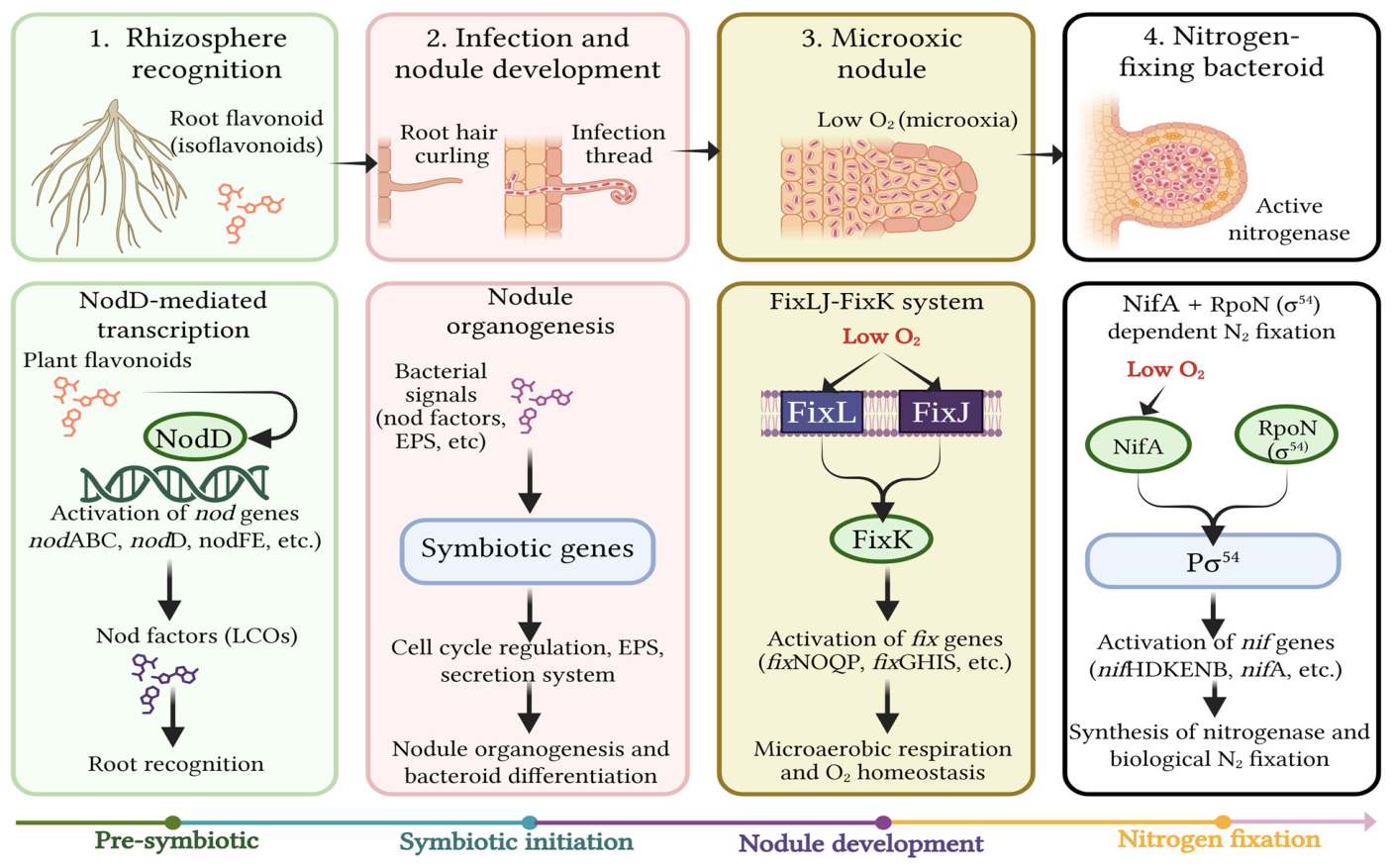
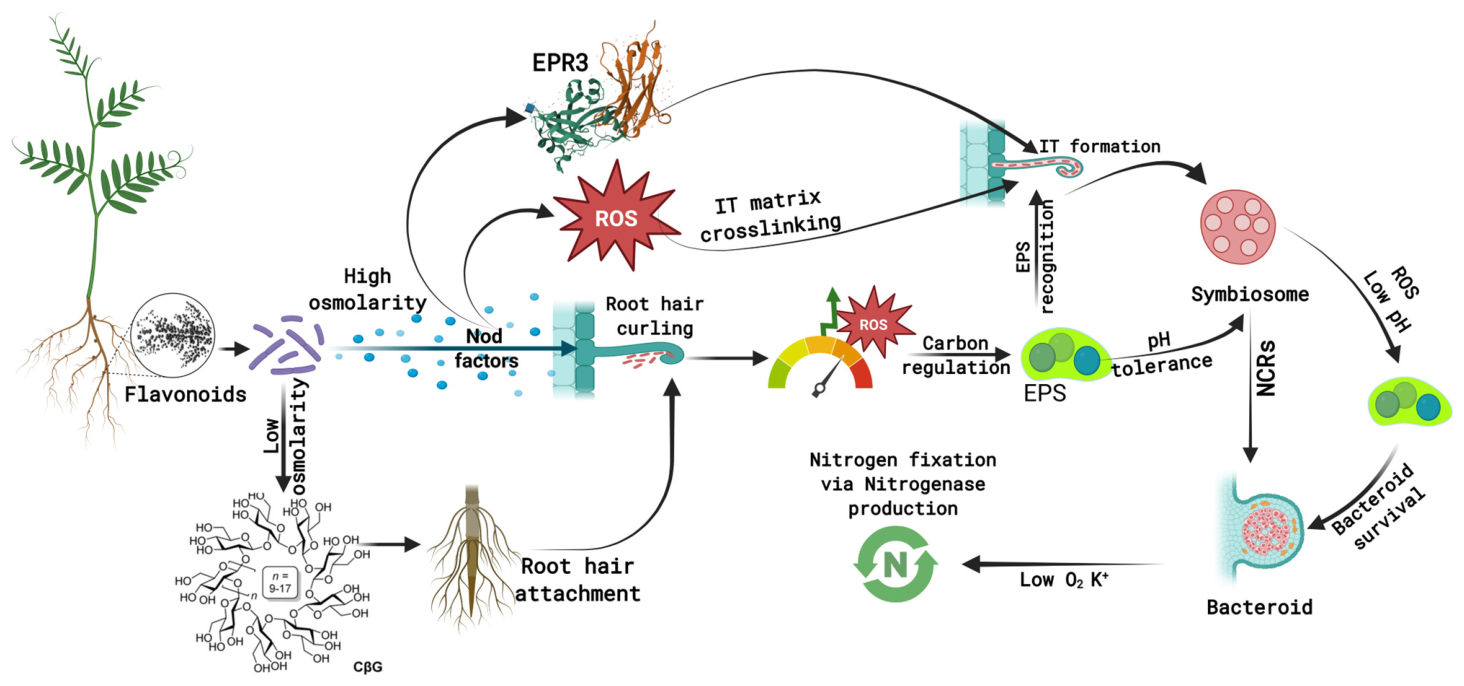
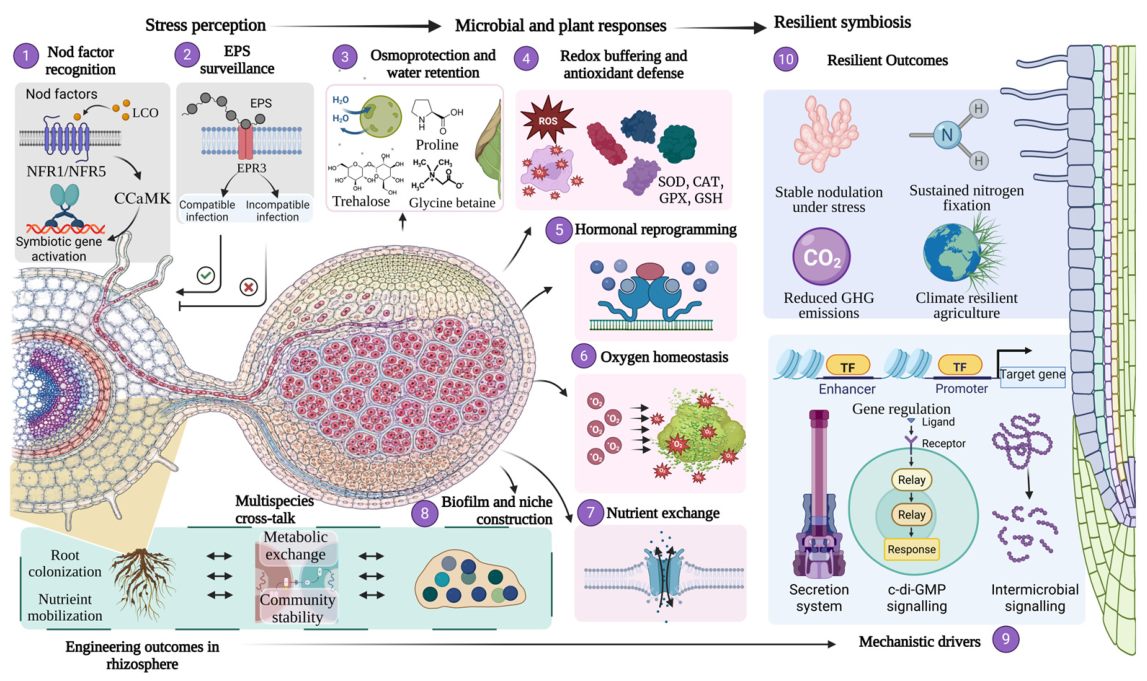
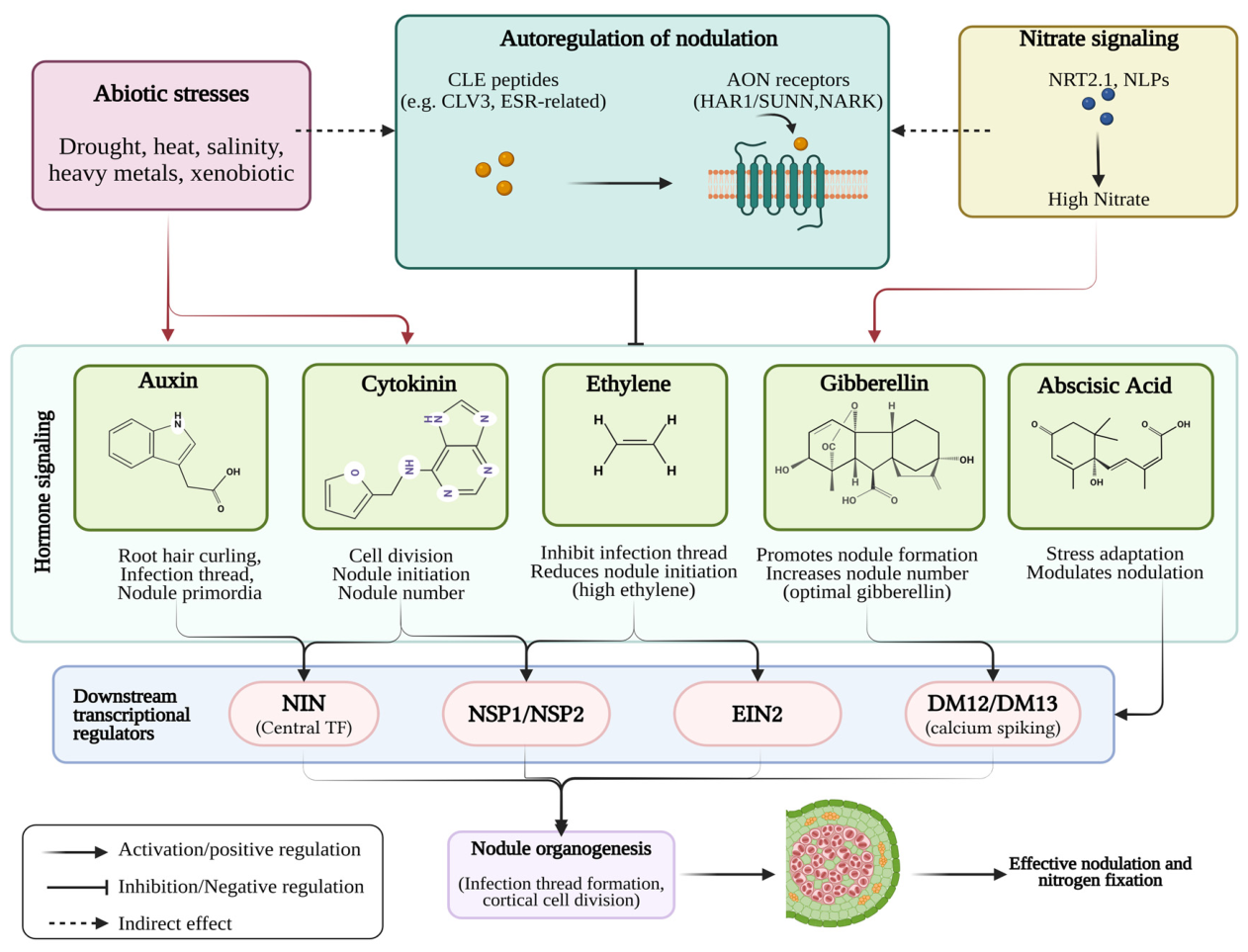
Disclaimer/Publisher’s Note: The statements, opinions and data contained in all publications are solely those of the individual author(s) and contributor(s) and not of MDPI and/or the editor(s). MDPI and/or the editor(s) disclaim responsibility for any injury to people or property resulting from any ideas, methods, instructions or products referred to in the content. |
© 2026 by the authors. Licensee MDPI, Basel, Switzerland. This article is an open access article distributed under the terms and conditions of the Creative Commons Attribution (CC BY) license.
Share and Cite
Langthasa, M.; Das, S.; Saikia, D.; Pandey, P. Stress-Responsive Regulatory Networks in Legume–Rhizobium Symbiosis: Implications for Climate-Smart Agriculture. Bacteria 2026, 5, 41. https://doi.org/10.3390/bacteria5030041
Langthasa M, Das S, Saikia D, Pandey P. Stress-Responsive Regulatory Networks in Legume–Rhizobium Symbiosis: Implications for Climate-Smart Agriculture. Bacteria. 2026; 5(3):41. https://doi.org/10.3390/bacteria5030041
Chicago/Turabian StyleLangthasa, Mrinalini, Sandeep Das, Deeplina Saikia, and Piyush Pandey. 2026. "Stress-Responsive Regulatory Networks in Legume–Rhizobium Symbiosis: Implications for Climate-Smart Agriculture" Bacteria 5, no. 3: 41. https://doi.org/10.3390/bacteria5030041
APA StyleLangthasa, M., Das, S., Saikia, D., & Pandey, P. (2026). Stress-Responsive Regulatory Networks in Legume–Rhizobium Symbiosis: Implications for Climate-Smart Agriculture. Bacteria, 5(3), 41. https://doi.org/10.3390/bacteria5030041