
Review

Targeting Drug-Resistant Pseudomonas aeruginosa: Emerging Roles of Plant-Derived Bioactive Compounds

Shaanxi Key Laboratory of Research and Utilization of Resource Plants on the Loess Plateau, College of Life Sciences, Yan’an University, Yan’an 716000, China
*
Authors to whom correspondence should be addressed.
These authors contributed equally to this work.
Bacteria 2026, 5(2), 35; https://doi.org/10.3390/bacteria5020035
Submission received: 1 May 2026 / Revised: 7 June 2026 / Accepted: 12 June 2026 / Published: 14 June 2026

Abstract

Pseudomonas aeruginosa, an opportunistic pathogen, is a major threat to hospital infection control and global public health due to its strong environmental adaptability, complex virulence systems, efficient biofilm formation capability, and widespread multidrug resistance. Traditional single-target antibiotics are often inadequate for clinical treatment. The research into Plant-Derived Bioactive Compounds for combating P. aeruginosa infections is reviewed, highlighting their advantages (many of which are extensively studied in Traditional Chinese Medicine) over conventional antibiotics. The antimicrobial mechanisms of these compounds include the inhibition of bacterial quorum sensing (QS) systems to suppress virulence factor expression rather than direct anti-bactericidal effects, delaying the development of resistance. The abundant natural medicinal plants and their diverse chemical structures provide ample material for active compound screening to identify unique chemical compositions with specific binding to pathogen targets. Plant-Derived Bioactive Compounds exhibit excellent safety profiles, targeting bacterial-specific pathways or host immune regulation, resulting in minimal off-target toxicity. Plant-Derived Bioactive Compounds exert anti-P. aeruginosa effects via inhibition of QS systems to reduce pathogenicity by disrupting intercellular signaling, suppressing biofilm formation/maturity to overcome biofilm-associated resistance, directly interacting with bacterial structure. Plant-Derived Bioactive Compounds are promising treatments for drug-resistant P. aeruginosa infections, providing lead compounds for novel anti-infective drug development.

1. Introduction

P. aeruginosa is one of the most difficult pathogens to treat in modern clinical practice, especially in healthcare settings. It causes high morbidity and mortality in immunocompromised patients, cystic fibrosis patients, and severe burn patients [1,2,3,4]. Clinical treatment of infections caused by this bacterium is increasingly challenging, mainly due to its strong biofilm-forming ability and significant multidrug resistance (MDR). Biofilm formation is a key virulence feature of P. aeruginosa: the bacterium wraps itself in extracellular polymeric substances (EPS) and adheres to medical device surfaces or human tissues (such as the lungs of cystic fibrosis patients) to form highly structured microcolonies [5,6,7]. Biofilm-related infections show extremely high resistance to conventional antibiotics such as carbapenems, aminoglycosides, and fluoroquinolones. Typical biofilm-associated infections, including chronic lung infections and catheter-related bloodstream infections in cystic fibrosis patients, have a clinical clearance rate of less than 20%, and conventional anti-infective regimens cannot effectively remove bacteria wrapped in biofilms [8,9]. Therefore, the World Health Organization has listed multidrug-resistant P. aeruginosa (especially carbapenem-resistant strains) as a high-priority pathogen in urgent need of new therapeutic strategies (updated in 2024) [10,11].
The core mechanism behind the clinical dilemma of P. aeruginosa infection lies in its unique quorum sensing (QS)–virulence–biofilm synergistic regulatory network. P. aeruginosa realizes density-dependent gene expression regulation through three cascaded QS systems: Las, Rhl, and Pqs. These QS systems regulate the production of virulence factors such as elastase, pyocyanin, hydrogen cyanide, and rhamnolipids, mediating tissue damage and immune escape [12,13,14,15,16]. Notably, QS signals promote biofilm maturation, while dense biofilms hinder signal molecule diffusion and promote QS signal accumulation [17,18]. This positive feedback loop makes biofilm-embedded bacteria 10–1000 times more resistant to antibiotics than planktonic bacteria, forming a tough therapeutic barrier [5,19,20].
Conventional anti-infective strategies have fundamental limitations in treating P. aeruginosa infections. Traditional antibiotics exert direct bactericidal effects by targeting core life processes such as cell wall synthesis, protein translation, and nucleic acid replication. Although effective against planktonic bacteria, this single-target mode exerts strong selective pressure and accelerates the rapid evolution of drug resistance [21,22,23]. In addition, the extracellular matrix barrier of biofilms prevents most traditional drugs from penetrating into the interior of bacteria [24,25], leading to a clinical dose–response paradox: increasing antibiotic doses significantly raises toxic side effects but fails to bring substantial clinical efficacy improvement. Combination therapy can delay the emergence of resistance to a certain extent, but cannot fundamentally stop the development of drug resistance [26,27,28].
In this context, single active ingredients isolated from medicinal plants, including many with a long history of use in Traditional Chinese Medicine, show unique mechanistic advantages. Different from the direct bactericidal effect of traditional antibiotics, Plant-Derived Bioactive Compounds mainly regulate bacterial virulence through multi-target regulation. At sub-inhibitory concentrations, they can interfere with QS signaling, disperse mature biofilms, and simultaneously regulate host immunity to protect tissue integrity [29,30]. Representative compounds such as bakuchiol, resveratrol, paeonol, and berberine have shown strong anti-QS and anti-biofilm effects on multidrug-resistant P. aeruginosa, with good safety and low resistance induction potential [31,32,33,34]. This paper systematically reviews the research progress of Plant-Derived Bioactive Compounds against P. aeruginosa infection, focusing on their core advantages (many of which are historically significant in Traditional Chinese Medicine) and their mechanisms of action in inhibiting QS, clearing biofilms and regulating virulence factors. The current research limitations and future development directions are also discussed, aiming to provide theoretical references for the development of new therapeutic strategies for drug-resistant bacterial infections. However, poor solubility and low in vivo bioavailability greatly limit the in vivo application of most anti-QS Plant-Derived Bioactive Compounds. Emerging nanocarrier technologies, including polymeric micelles and lysozyme-responsive chitosan microgels, effectively improve drug delivery efficiency and realize targeted release at infected tissues, providing a feasible strategy to bridge the gap between in vitro activity and in vivo efficacy [35,36].

2. Advantages of Plant-Derived Bioactive Compounds in Treating Pseudomonas aeruginosa Infection

The effects of traditional antibiotics on P. aeruginosa infections are limited due to their tendency to rapidly induce drug resistance and their poor efficacy against bacteria within biofilms. Therefore, novel alternatives are urgently needed. Plant-Derived Bioactive Compounds represent a promising breakthrough for addressing this challenge. The advantages of Plant-Derived Bioactive Compounds include a unique antibacterial mechanism distinct from conventional resistance pathways, extensive natural sources, distinctive structural features, and markedly superior safety profiles compared with conventional antibiotics.

2.1. Unique Antibacterial Mechanisms

Conventional antibiotics directly inhibit or kill pathogens by acting on the life-support systems essential for bacterial growth. Thus, traditional antibiotics exert intense selective pressure, leading to the emergence of drug-resistant mutant strains [37,38,39]. The significant advantage of Plant-Derived Bioactive Compounds lies in their ability to simultaneously act on multiple critical bacterial pathways [40,41]. Many Plant-Derived Bioactive Compounds do not directly inhibit bacterial growth [42]; instead, they target the pathogenic regulatory system of bacteria, called the QS system [43].
A recent study demonstrated that 100 μg/mL bakuchiol does not inhibit the growth of P. aeruginosa, but reduces pqsA gene expression levels by over 50% and significantly suppresses the production of various virulence factors such as pyocyanin, elastase, hydrogen cyanide, and lectin [31]. This mode of action does not interfere with fundamental bacterial metabolism and theoretically does not induce drug resistance. Thus, bakuchiol can mitigate the antibiotic resistance crisis associated with conventional antibiotics. Similarly, monomers such as resveratrol (32–128 μg/mL) [44] and paeonol [45] also impair bacterial biofilm formation, virulence factor secretion, and motility by disrupting the QS system without inhibiting growth. Flavonols, catechins, and magnolol inhibit the P. aeruginosa QS system [46,47,48]. These multi-target, non-lethal mechanisms of action endow Plant-Derived Bioactive Compounds with unique strategic value as anti-infective therapies.

2.2. Diversity of Natural Sources and Structural Specificity

The advantages of these compounds lie not only in their unique antibacterial mechanisms but also in the diversity of their natural sources and structural specificity. China possesses approximately 12,000 medicinal plant species, and is one of the richest global medicinal plant resources. Each medicinal herb is a complex chemical library, containing hundreds to thousands of secondary metabolites [49]. For example, dozens of flavonoid monomers, including baicalin, baicalein, baicalinogen, and pterisoid A, have been isolated from Scutellaria baicalensis [50]. Psoralea corylifolia contains multiple active components, including psoralen, isopsoralen, psoralen A, and psoralen B [51]. This rich chemical diversity provides an abundant source of active compounds to screen for anti-P. aeruginosa activity.
As natural products validated through long-term human practice, Plant-Derived Bioactive Compounds exhibit significantly higher drug development potential compared to randomly screened synthetic compound libraries [52]. Natural products evolved through natural selection and typically possess unique skeletal structures and functional groups that facilitate specific binding to target proteins, thereby achieving higher success rates for antimicrobial screening [30]. P. aeruginosa, a refractory Gram-negative bacterium, employs an outer membrane barrier and multidrug efflux pump system that impedes the entry of synthetic compounds into the bacterial cell [53,54]. The structural characteristics of Plant-Derived Bioactive Compounds confer distinct advantages in targeting this pathogen. Most Plant-Derived Bioactive Compounds have molecular weights of 200–500 Da, appropriate lipophilicity (logP 1–3), and phenolic hydroxyl groups, enabling effective penetration of bacterial outer membranes and specific interactions with key proteins in the QS system (e.g., PqsR, LasR, RhlR) [55,56]. For example, the flavonoid monomer baicalin binds to the LasR ligand-binding domain, competing with 3-oxo-C12-HSL, a natural signaling molecule [32,57]. The alkaloid berberine directly acts on LasR and RhlR receptors, inhibiting biofilm formation and virulence factor expression [58,59]. Thus, Plant-Derived Bioactive Compounds represent a crucial natural resource pool for anti-P. aeruginosa drug development. Plant-Derived Bioactive Compounds provide superior structural foundations for developing novel anti-infective drug design compared to artificial de novo synthesis.

2.3. Significant Safety Characteristics

The toxic side effects of traditional antibiotics are a long-standing clinical challenge [60]. Aminoglycosides such as gentamicin and amikacin exhibit nephrotoxicity and ototoxicity [61,62,63]. Quinolones like levofloxacin and ciprofloxacin induce central nervous system excitation, prolonged QT interval (a measure on an electrocardiogram, ECG), and cartilage damage in juvenile animals [61,62,63,64]. Most β-lactams have relatively good safety profiles, but broad-spectrum agents such as cefepime may cause neurotoxicity [64,65]. Such adverse reactions are often associated with the non-selectivity of antibiotic targets. Plant-Derived Bioactive Compounds exhibit more targeted mechanisms of action, with multidimensional safety advantages.
Plant-Derived Bioactive Compounds exhibit higher target specificity than traditional antibiotics. Most Plant-Derived Bioactive Compounds do not directly kill bacteria. Instead, Plant-Derived Bioactive Compounds regulate bacterial virulence-related systems and cause less interference with host cells. For example, psoralen primarily acts on QS receptors, such as PqsR and LasR in P. aeruginosa, reducing pathogenicity through anti-virulence mechanisms and theoretically minimizing off-target toxicity [31,66]. Psoralen mitigates issues caused by broad-spectrum antibiotics such as gut microbiota disruption, diarrhea, and Clostridioides difficile secondary infections [67,68]. In addition, some Plant-Derived Bioactive Compounds exhibit dual antibacterial and host-protective effects. For example, paeonol exhibits antibacterial activity and suppresses NF-κB pathway-mediated inflammatory responses [33,69,70]. Berberine inhibits QS, thereby reducing the production of virulence factors such as pyocyanin. In plant and human cell infection models, berberine significantly mitigates tissue necrosis and cellular damage [71].
In summary, Plant-Derived Bioactive Compounds possess three core advantages over conventional antibiotics: delayed drug resistance through anti-virulence mechanisms, abundant sources with diverse structural profiles (many of which are found in Traditional Chinese Medicine), and superior safety compared to conventional antibiotics.

3. Mechanism of Action of Plant-Derived Bioactive Compounds in Treating P. aeruginosa Infection

Plant-Derived Bioactive Compounds represent a promising therapeutic and adjunctive approach to treating chronic P. aeruginosa infections. Plant-Derived Bioactive Compounds exert anti-infection effects against P. aeruginosa primarily through the following three core mechanisms: targeting QS, targeting biofilm development, and direct antibacterial activity.

3.1. Targeting QS: Attenuation of Virulence Factors

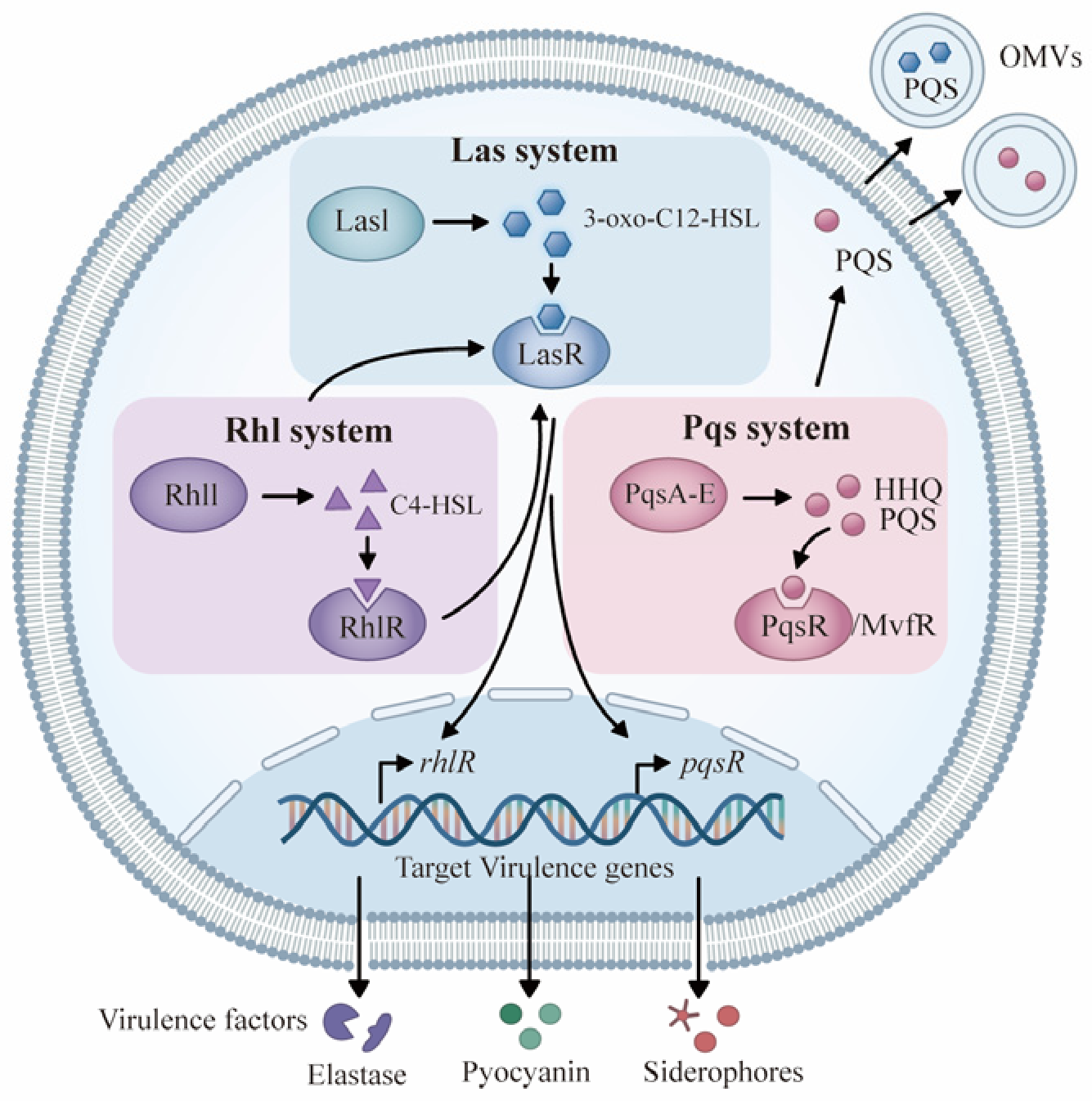
The QS system of P. aeruginosa consists of three interwoven signaling pathways, including the Las, Rhl, and Pqs systems, that form a stringent time-dose regulatory network [12,13,14]. As shown in Figure 1, the Las system resides at the apex of the regulatory cascade. LasI synthase produces 3-oxo-C12-HSL, which is recognized by the cytoplasmic receptor LasR and regulates the expression of numerous virulence determinants. In the Rhl system, RhlI synthase produces C4-HSL, which activates the receptor RhlR. The Pqs system utilizes para-aminobenzoic acid via the pqsA-E enzyme system to synthesize 2-heptyl-3-hydroxy-4(1H)-quinolone (PQS) and its precursor 2-heptyl-4-quinolone (HHQ). PQS and HHQ act on the transcriptional regulator PqsR (MvfR), and participate in remote signaling transmission via iron chelation and outer membrane vesicles. This hierarchical structure creates multiple intervention nodes. Different herbal compounds can modulate pathogenicity by targeting the distinct nodes (Table 1).

3.1.1. Targeting the Las and Rhl Systems

The classic N-acyl homoserine lactone-dependent QS pathways in P. aeruginosa are the las and Rhl systems, encoded and regulated by the lasI/lasR and rhlI/rhlR gene clusters, respectively. Multiple Plant-Derived Bioactive Compounds can intervene in the Las and Rhl systems by inhibiting signal synthesis enzymes, receptor proteins, and their encoding genes.
Carvacrol is a monoterpenol phenolic compound in the essential oils of Lamiaceae plants, including Origanum vulgare L., Thymus mongolicus (Ronniger) Ronniger, and Satureja montana. Carvacrol stably binds to LasI/LasR proteins, blocking QS signaling and reducing the pathogenicity of P. aeruginosa [72,73]. Baicalein, the primary flavonoid component of baicalin, downregulates the transcription of lasI/lasR and rhlI/rhlR at sub-inhibitory concentrations, decreasing the expression of the signaling molecules 3-oxo-C12-HSL and C4-HSL by 63.2% and 58.7%, respectively. Baicalein also reduces the synthesis of virulence factors such as LasA, pyocyanin, and LasB, which is inhibited by 94.17% [32,74]. Baicalin also exhibits multi-target inhibitory effects on the Las and Rhl systems, reducing the expression of 3-oxo-C12-HSL and C4-HSL. Baicalin significantly attenuates the pathogenicity of P. aeruginosa, prolonging the median lethal time in C. elegans from 24 h to 96 h and enhancing bacterial clearance efficiency in murine peritoneal implantation infection models [46]. Similarly, resveratrol and other Plant-Derived Bioactive Compounds, including cassia bark aldehyde (cinnamaldehyde) and andrographolide derivatives, significantly inhibit the expression of LasI and RhlI and the production of virulence factors such as pyocyanin and proteases, without affecting bacterial growth; thus, these Plant-Derived Bioactive Compounds exert anti-virulence effects rather than direct bactericidal effects [45,75,76,77]. Luteolin, which is extracted from honeysuckle, chrysanthemum, and perilla, also primarily targets the Las and Rhl systems to elicit anti-P. aeruginosa infection effects. Molecular docking analysis shows that luteolin has a higher binding affinity for the LasR regulatory protein than the natural signaling molecule 3-oxo-C12-HSL [78].

3.1.2. Targeting the Pqs System

The Pqs system is a unique QS system in P. aeruginosa. This system employs PQS and its precursor HHQ as signaling molecules. The Pqs system is co-regulated by the transcriptional regulatory protein PqsR (MvfR) and synthetase pqsA. The Pqs system forms a complex regulatory network with the Las and Rhl systems, and plays a critical role in the synthesis of virulence factors such as pyocyanin and hydrogen cyanide. Plant-Derived Bioactive Compounds exert anti-infective effects by inhibiting the Pqs system.
The terpenoid phenolic monomer bakuchiol exhibits antagonistic effects against PqsR (MvfR) with an IC50 of 43.64 μg/mL. Bakuchiol inhibits the expression of the pqsABCDE operon via hydrophobic interactions with PqsR to reduce the production of pyocyanin, lectin, and elastase [30]. Juglone, a naphthoquinone compound extracted from walnuts (Juglans regia) [80], selectively binds to the active site of PqsR by forming hydrogen bonds with key amino acids, including Gln194, Leu208, and Ile236, to inhibit PqsR function. The combination of colistin and juglone can eliminate biofilms in wild-type P. aeruginosa and isolates from cystic fibrosis patients. Juglone significantly enhances the efficacy of colistin and alleviates inflammatory responses in wound infection models [80]. Berberine, a natural isoquinoline alkaloid, specifically targets PqsR, the transcriptional regulatory factor of the PQS QS system in P. aeruginosa. Berberine directly binds to the Ile236 site, inhibiting this pathway in a dose-dependent manner to suppress PQS signaling, pyocyanine, biofilm formation, and bacterial motility without affecting bacterial growth [71]. Vanillin is also a PqsR inhibitor, which suppresses the Pqs system by binding to PqsR. Although vanillin primarily inhibits the PQS system, it also exhibits minor effects on the other two QS pathways [81].

3.1.3. Multi-Target Inhibitory Effects of QS Network

Some Plant-Derived Bioactive Compounds can simultaneously inhibit multiple QS systems, including Las, Rhl, and Pqs, to block the virulence regulation network of P. aeruginosa. Psoralen, a furanocoumarin derived from Psoralea corylifolia, inhibits LasI-dependent 3-oxo-C12-HSL synthesis, competes with LasR and RhlR for DNA binding, and disrupts PqsR-mediated transcriptional activation. At 50 μg/mL, psoralen has no direct bactericidal activity but broadly inhibits extracellular proteases, pyocyanin production, biofilm formation, and cell motility [82]. Catechin also demonstrates multi-target inhibitory effects on the QS network. When combined with gallic acid, catechin significantly downregulates the expression of lasI, lasR, rhlI, rhlR, pqsA, and pqsR genes. In addition, molecular docking studies indicate that catechin forms hydrogen bonds with the residues Thr-115 and Ser-129 in the ligand-binding domain of LasR [44,83,87]. Quercetin, a natural flavonoid, significantly reduces LasB activity by targeting the Las system. Quercetin achieves inhibition rates of up to 85% by downregulating QS-related genes and decreasing 3-oxo-C12-HSL and C4-HSL synthesis [84]. Isoliquiritigenin, a charonoid compound derived from Glycyrrhiza uralensis, also exhibits broad-spectrum QS inhibitory activity. Isoliquiritigenin reduces the reporter gene activity of LasR, RhlR, and PqsR. Molecular docking confirmed the strong receptor affinity potential of isoliquiritigenin for LasR (−5.81 kcal/mol) and PqsR (−5.56 kcal/mol) [85]. Curcumin reduces the production of AI-2 and 3-oxo-C12-HSL by inhibiting LuxS (S-ribosylhomocysteine synthase), affecting QS in P. aeruginosa [86]. Paeonol inhibits the expression of LasI/LasR and RhlI/RhlR by regulating 3-oxo-C12-HSL and C4-HSL. The most pronounced inhibitory effect of paeonol on the PQS system is observed at a concentration of 128 μg/mL [33,69].
In conclusion, Plant-Derived Bioactive Compounds (including many individual components from Traditional Chinese Medicine) demonstrate diverse mechanisms of action by targeting different levels of the P. aeruginosa QS system.

3.2. Targeting Biofilm Development: From Adhesion to Dispersion

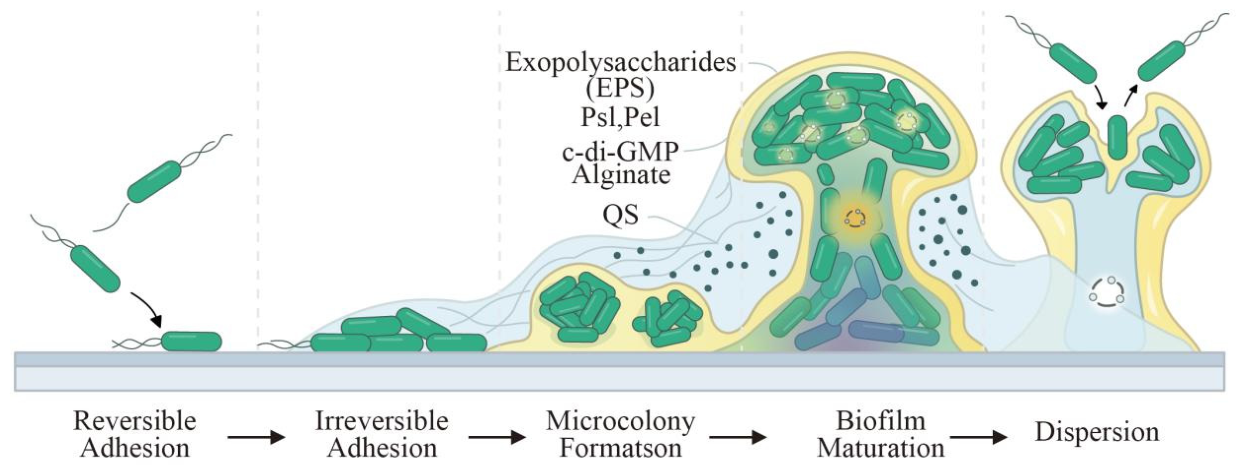
Biofilm formation is the primary survival strategy of P. aeruginosa in clinical environments, accounting for over 80% of chronic bacterial infections [88]. The biofilm life cycle includes five distinct stages (Figure 2): (i) initial reversible attachment to biological or abiotic surfaces; (ii) irreversible adhesion mediated by surface adhesins and extracellular matrix components; (iii) microbial colony formation and early biofilm maturation; (iv) development of mature biofilm structures with water channels and metabolic heterogeneity; and (v) dispersion of planktonic cells to colonize new host surfaces [18,89]. Plant-Derived Bioactive Compounds can interfere with biofilm formation and maintenance by targeting critical nodes at these different biofilm formation stages.

3.2.1. Inhibition of Initial Adhesion

Initial surface attachment is a critical starting step in biofilm formation and is the step most amenable to intervention. During the initial adhesion stage, bacteria utilize structures such as flagella and pili to recognize and adhere to biological or abiotic surfaces. These structures can be blocked with relatively low concentrations of inhibitors.
Baicalin and baicalein can significantly inhibit the initial adhesion of P. aeruginosa. Treatment with 128 μg/mL baicalin for 2 h suppresses the adhesion of PAO1 on abiotic surfaces, reducing biofilm biomass by 35.7% after 1 day and 53.0% after 5 days. Baicalin reduces bacterial adhesion by interfering with flagellar and type IV pili functions. Electron microscopy indicates that baicalin significantly decreases the multilayer cell cluster structure of biofilms, leading to more dispersed bacterial distribution [32]. At concentrations between 64–256 μg/mL, baicalein exhibits dose-time-dependent inhibitory effects on biofilm formation; at 256 μg/mL, baicalein significantly reduces microcolony aggregation and multilayer cell cluster structure and inhibits the swarming and flagellar motility of P. aeruginosa [46,90].Epigallocatechin gallate, the primary catechin component in green tea, significantly inhibits biofilm formation during the early adhesion stages, inhibiting swarming by 35.71% [83]. Carvacrol and thymol exhibit excellent anti-biofilm activity. Carvacrol inhibits swarming by 74–88% at 3 days and by 91–100% at 10 days. Thymol inhibits swarming by 70–77% at 3 days and 80% at 10 days, with complete inhibition on PVC surfaces [91].

3.2.2. Interference with Quorum Sensing and c-di-GMP Signaling

After initial adhesion is completed, the maturation and development of biofilms are regulated by the QS system and the cyclic di-GMP (c-di-GMP) signaling network. C-di-GMP is a crucial second messenger for bacteria, and high concentrations of c-di-GMP promote biofilm formation and extracellular matrix synthesis; low concentrations of c-di-GMP enhance bacterial motility and dispersion. Notably, the QS system and c-di-GMP network exhibit extensive cross-regulation. QS activation increases c-di-GMP levels in mature biofilms, and elevated c-di-GMP enhances QS signal accumulation by restricting diffusion. Thus, the enhanced c-di-GMP and the QS system form a positive feedback loop that drives biofilm maturation [92].
Multiple Plant-Derived Bioactive Compounds exert inhibitory effects by targeting this cross-regulatory network. Cryptomerine inhibits biofilm maturation by suppressing QS pathway signaling and transcription of related genes [93,94]. Vanillin and its derivative, MMP (4-(E)-(4-hydroxy-2-methylphenylimino)methyl-2-methoxyphenol), also inhibit biofilm formation by inhibiting QS systems [95]. Berberine, an alkaloid QS inhibitor, suppresses the expression of QS-regulated genes such as agrA, significantly enhancing biofilm clearance when used synergistically with antibiotics. Matrine, another alkaloid QS inhibitor, reduces the formation of biofilm-resistant P. aeruginosa biofilms by inhibiting the activity of AI-2 QS signaling molecules and downregulating key genes, including luxS and pfS [96].
In the c-di-GMP signaling pathway, myricetin, a flavonol compound found in Morella rubra Lour. and Juglans regia L., targets the FimX protein-mediated c-di-GMP signaling pathway, reducing c-di-GMP synthesis by 23–57% and inhibiting the QS-regulated pel and psl operons, decreasing biofilm biomass under both static and flow conditions [97].

3.2.3. Disruption of Mature Biofilm Structure

Established biofilm poses the greatest clinical challenge due to its extreme antibiotic resistance. Mature biofilms consist of bacterial cells and EPSs. EPSs consist of polysaccharides (Pel, Psl, alginate), proteins, and extracellular DNA (eDNA), which form a protective barrier that impedes antibiotic penetration. Plant-Derived Bioactive Compounds can disrupt these protective structures through matrix degradation and bacterial lysis within the biofilm.
Baicalin and baicalein both exhibit significant dispersing effects on mature biofilms, but through distinct mechanisms. Baicalin (128 μg/mL) degrades mature biofilms by reducing extracellular polysaccharide matrices, leading to a more dispersed bacterial distribution [32]. Baicalein (256 μg/mL) significantly decreases multilayered cell cluster structures, promoting bacterial resuspension and enhancing antibiotic susceptibility. Co-administration of baicalinide and tobramycin significantly reduces bacterial load in murine peritoneal implants and enhances bacterial clearance by modulating Th1-type immune responses [46]. Eugenol exerts multi-level effects on mature biofilm structures. Eugenol compromises matrix integrity by inhibiting alginic acid biosynthesis, competitively inhibits polysaccharide biosynthetic enzymes, and directly binds extracellular DNA to reduce viscoelasticity and facilitate mechanical detachment [98]. The latest study by Shen et al. [99] conducted the first systematic evaluation of the anti-fouling activity of sanguisorrhizin, a key component from Chinese Dragon’s Blood against isolated P. aeruginosa strains from wound sites. Key findings include a minimum inhibitory concentration (MIC) ≥ 1024 μg/mL for sanguisorrhizin with negligible direct bactericidal activity against P. aeruginosa, inhibition of biofilm formation at 128 μg/mL (1/8 MIC) (p < 0.05), and clearance of mature biofilms in 24 h (p < 0.05). The mRNA levels of key genes involved in biofilm matrix synthesis (pslA, pelA, algD, algU) were significantly downregulated after sanguisorrhizin treatment. Berberine does not have direct bactericidal activity against planktonic P. aeruginosa, but reduces the expression of alginate synthesis genes algD, algR, and algG when combined with azithromycin by over 50%, leading to decreased biofilm matrix formation during the maturation phase and enhanced antibiotic permeability [100].

3.2.4. Inducing Biofilm Dispersion

The final stage of biofilm targeting is active dispersion, changing attached antibiotic-resistant bacteria into planktonic, antibiotic-sensitive bacteria. This resensitization strategy is particularly valuable for treating established biofilm infections. The core mechanism of active dispersion involves inducing mature biofilm bacteria to transition from a fixed phenotype to a planktonic phenotype, achieving active biofilm dispersion while avoiding the development of bacterial resistance [101].
Echinacoside, which is isolated from Cistanche deserticola and Cistanche tubulosa, is one of the most effective Plant-Derived Bioactive Compounds in dispersing biofilms. Echinacoside directly binds to and inhibits the bisguanosylate cyclase SiaD, significantly reducing intracellular c-di-GMP concentrations in bacteria. This Plant-Derived Bioactive Compounds disperses mature biofilms in over 80% of bacterial strains in in vitro experiments. In animal lung infection models, echinacoside enhances the therapeutic efficacy of antibiotics such as tobramycin, exhibiting high clinical translation potential [102]. Chlorogenic acid and its metabolite quinic acid, found in Traditional Chinese Medicines such as honeysuckle and Eucommia ulmoides, inhibit the synthesis of extracellular polysaccharides (Pel/Psl) by upregulating the global regulatory factor RsmA, downregulating c-di-GMP synthase, and upregulating its phosphodiesterase expression [46,103]. These effects cause mature biofilm dispersion of clinically drug-resistant P. aeruginosa, with dispersion rates of 60–75% [104].

3.3. Targeting the Bacteria: Direct Antibacterial Activity

Most Plant-Derived Bioactive Compounds exert antibacterial effects by inhibiting QS systems and resistant biofilms. However, Plant-Derived Bioactive Compounds can also directly target bacterial growth and survival. This therapeutic mechanism is analogous to conventional antibiotics.
Berberine exhibits potent broad-spectrum antibacterial and anti-inflammatory properties, and the plant phenolic compound ferulic acid exerts antioxidant and free radical scavenging activities [105]. Chen et al. [106] covalently conjugated ferulic acid and berberine with metal–organic frameworks to elicit synergistic antibacterial effects against P. aeruginosa through ROS scavenging; this formulation accelerated wound healing with a bacteriostatic efficacy exceeding 90%. Four Plant-Derived Bioactive Compounds with antibacterial activities have been extracted from Clinopodium chinense, a plant species belonging to the genus Clinopodium in the Lamiaceae family. These include clinochinsaponin A, clinoposaponin D, naringenin, narirutin. Three of the four monomers (except for clinochinsaponin A) exhibited direct bacteriostatic effects against P. aeruginosa [107]. Three newly extracted flavonol monomers—kushenmin Q, kushenmin R, and kushenmin S—from the traditional Chinese herb Sophora flavescens Ait [108],—along with sophoflavanone C, sophoflavanone D, sophoflavanone E, and a novel flavanonol, sophoflavanone F, isolated by Gao et al. from the ethanol extract of its root bark—all exhibit antibacterial activity against P. aeruginosa [109]. Tang et al. utilized comprehensive spectroscopic techniques to synthesize and characterize a series of quercetagetin derivatives; abundant monomeric components exhibiting antibacterial activity against P. aeruginosa were identified [110]. Hedychium flavum Roxb is a medicinal, edible, and ornamental plant widely cultivated in China, India, and Southeast Asia. The rhizome of Hedychium flavum Roxb is used for food seasoning and Traditional Chinese Medicine treatment of various diseases. The rhizome contains 13 phenolic monomer components capable of inhibiting the activity of copper-induced pathogens, and the essential oil derived from this component exhibited a MIC of 3.12 mg/mL against P. aeruginosa [111]. Perilla frutescens is an annual erect herb of the Lamiaceae family, genus Perilla. The Plant-Derived Bioactive Compounds rosmarinic acid extracted from the fruits of this species is used as a bioreducing agent to synthesize silver nanoparticles. Rosmarinic acid exhibits antibacterial activity against P. aeruginosa [112]. Madecassic acid is a natural triterpenic acid compound isolated and purified from the traditional Chinese herb Centella asiatica (L.) Urban. Madecassic acid inhibits eight pathogenic bacteria, with an MIC of 125 μg/mL against P. aeruginosa [113]. Xuebijing injection is a brownish-yellow, clear liquid injection prepared by extracting traditional Chinese medicinal materials such as safflower, red peony root, ligusticum chuanxiong, salvia miltiorrhiza, and angelica sinensis. A major component of Xuebijing injection is safflower yellow pigment A, a monomer derived from Chinese herbs. This Plant-Derived Bioactive Compound prolongs the lifespan of infected C. elegans by inhibiting the colonization and accumulation of P. aeruginosa in the intestinal lumen [114]. Several epimedium flavonoids display concentration-dependent pharmacological features: low concentration inhibits QS without bactericidal effect, whereas high concentration produces obvious direct antibacterial activity [115].

4. Conclusions

The escalating crisis of MDR- P. aeruginosa poses a formidable and growing challenge to global public health. This comprehensive review underscores the immense therapeutic potential of bioactive natural compounds, particularly those derived from traditional medicinal plants, as a novel arsenal against this insidious pathogen. Unlike conventional monotherapeutic antibiotics, these compounds demonstrate strategic advantages through their multifaceted and multi-targeted approach.
Specifically, we have elucidated their diverse mechanisms, ranging from direct bactericidal or bacteriostatic effects to sophisticated modulations of bacterial virulence factors such as QS and biofilm formation, both critical for MDR- P. aeruginosa pathogenesis. Therefore, these plant-derived bioactive compounds can directly antagonize pathogenic bacteria and provide a more holistic strategy for infection prevention and control, boasting broad application prospects.
Despite their evident promise, the journey from traditional use to mainstream clinical application is replete with challenges. These include issues related to compound bioavailability, stability, potential toxicity, and the inherent complexity of establishing standardized extraction and purification protocols for pharmaceutical-grade development. Furthermore, rigorous in vivo studies and well-designed clinical trials are critically lacking to validate efficacy and safety in human subjects.
Future research must therefore prioritize a deeper elucidation of their precise molecular mechanisms using advanced ‘omics’ technologies, pharmacokinetic and pharmacodynamic profiling, and the application of cutting-edge computational tools for lead optimization. Developing robust delivery systems to enhance bioavailability and targeted action will also be paramount. Only through such systematic, interdisciplinary efforts, coupled with robust clinical translation, can we overcome the existing hurdles. In conclusion, bioactive natural compounds represent a fertile, yet underexplored, frontier in the battle against drug-resistant P. aeruginosa. Their strategic integration into our therapeutic arsenal holds the profound potential to transform our approach to this formidable pathogen, offering hope for a future where life-threatening infections can once again be effectively managed.

Author Contributions

J.L. and J.C. conceptualized the article and critically revised the work. J.F., D.L. and P.F. performed the literature search and wrote the manuscript. J.F., D.L. and W.X. prepared the figures and tables. All authors have read and agreed to the published version of the manuscript.

Funding

This work was supported by the National Natural Science Foundation of China (32360015 and 32560048), the Scientific Research Plan Project for Youth Innovation Teams in the Shaanxi Provincial Education Department (25JP198), the Qinchuang Yuan “Scientist + Engineer” Team Construction Project of Shaanxi Province (2023KXJ-019), the Regional Development Talent Project of the “Special Support Plan” of Shaanxi Province (2020-44), and the Youth Innovation Team of Shaanxi Universities (2022-943).

Institutional Review Board Statement

Not applicable.

Informed Consent Statement

Not applicable.

Data Availability Statement

No new data were created or analyzed in this study. Therefore, data sharing is not applicable to this article.

Conflicts of Interest

The authors declare no conflicts of interest.

Abbreviations

The following abbreviations are used in this manuscript:
MDRMultidrug resistance
QSQuorum sensing
EPSExtracellular polymeric substance
PQSPseudomonas quinolone signal
HHQ2-heptyl-4-quinolone
c-di-GMPCyclic diguanylate monophosphate
MICMinimum inhibitory concentration

References

  1. Li, Y.; Liu, X.; Yao, H.; Zhao, X.; Chi, L.; Jin, C.Y.; Qin, S. The evolution of carbapenem-resistant Pseudomonas aeruginosa in the COVID-19 era: A global perspective and regional insights. Int. J. Antimicrob. Agents 2025, 65, 107466. [Google Scholar] [CrossRef] [PubMed]
  2. Moradali, M.F.; Ghods, S.; Rehm, B.H. Pseudomonas aeruginosa Lifestyle: A Paradigm for Adaptation, Survival, and Persistence. Front. Cell. Infect. Microbiol. 2017, 7, 39. [Google Scholar] [CrossRef] [PubMed]
  3. Bassetti, M.; Vena, A.; Giacobbe, D.R. Clinical trials that could change the management of severe multidrug-resistant Gram-negative infections. Curr. Opin. Infect. Dis. 2025, 38, 616–623. [Google Scholar] [CrossRef] [PubMed]
  4. Gellatly, S.L.; Hancock, R.E. Pseudomonas aeruginosa: New insights into pathogenesis and host defenses. Pathog. Dis. 2013, 67, 159–173. [Google Scholar] [CrossRef] [PubMed]
  5. Flemming, H.C.; Wingender, J.; Szewzyk, U.; Steinberg, P.; Rice, S.A.; Kjelleberg, S. Biofilms: An emergent form of bacterial life. Nat. Rev. Microbiol. 2016, 14, 563–575. [Google Scholar] [CrossRef] [PubMed]
  6. Hall, C.W.; Mah, T.F. Molecular mechanisms of biofilm-based antibiotic resistance and tolerance in pathogenic bacteria. FEMS Microbiol. Rev. 2017, 41, 276–301. [Google Scholar] [CrossRef] [PubMed]
  7. Donlan, R.M. Biofilms: Microbial life on surfaces. Emerg. Infect. Dis. 2002, 8, 881–890. [Google Scholar] [CrossRef] [PubMed]
  8. Høiby, N.; Moser, C.; Ciofu, O. Pseudomonas aeruginosa in the Frontline of the Greatest Challenge of Biofilm Infection-Its Tolerance to Antibiotics. Microorganisms 2024, 12, 2115. [Google Scholar] [CrossRef] [PubMed]
  9. Patra, S.; Saha, S.; Singh, R.; Tomar, N.; Gulati, P. Biofilm battleground: Unveiling the hidden challenges, current approaches and future perspectives in combating biofilm associated bacterial infections. Microb. Pathog. 2025, 198, 107155. [Google Scholar] [CrossRef] [PubMed]
  10. Tacconelli, E.; Carrara, E.; Savoldi, A.; Harbarth, S.; Mendelson, M.; Monnet, D.L.; Pulcini, C.; Kahlmeter, G.; Kluytmans, J.; Carmeli, Y.; et al. Discovery, research, and development of new antibiotics: The WHO priority list of antibiotic-resistant bacteria and tuberculosis. Lancet Infect. Dis. 2018, 18, 318–327. [Google Scholar] [CrossRef] [PubMed]
  11. Antimicrobial Resistance Collaborators. Global burden of bacterial antimicrobial resistance in 2019: A systematic analysis. Lancet 2022, 399, 629–655. [Google Scholar] [CrossRef] [PubMed]
  12. Schuster, M.; Lostroh, C.P.; Ogi, T.; Greenberg, E.P. Identification, timing, and signal specificity of Pseudomonas aeruginosa quorum-controlled genes: A transcriptome analysis. J. Bacteriol. 2003, 185, 2066–2079. [Google Scholar] [CrossRef] [PubMed]
  13. Williams, P.; Cámara, M. Quorum sensing and environmental adaptation in Pseudomonas aeruginosa: A tale of regulatory networks and multifunctional signal molecules. Curr. Opin. Microbiol. 2009, 12, 182–191. [Google Scholar] [CrossRef] [PubMed]
  14. Lee, J.; Zhang, L. The hierarchy quorum sensing network in Pseudomonas aeruginosa. Protein Cell 2015, 6, 26–41. [Google Scholar] [CrossRef] [PubMed]
  15. Papenfort, K.; Bassler, B.L. Quorum sensing signal-response systems in Gram-negative bacteria. Nat. Rev. Microbiol. 2016, 14, 576–588. [Google Scholar] [CrossRef] [PubMed]
  16. Liu, D.; Li, Z.; Cheng, J.; Xiao, W.; Zheng, Y.; Liu, G.; Zeng, J.; Li, S.; Wang, Z.; Wang, Y.; et al. α-Mangostin attenuates Pseudomonas aeruginosa virulence by targeting PqsR and inhibiting PQS-mediated quorum sensing. Virulence 2026, 17, 2679324. [Google Scholar] [CrossRef] [PubMed]
  17. Mukherjee, S.; Bassler, B.L. Bacterial quorum sensing in complex and dynamically changing environments. Nat. Rev. Microbiol. 2019, 17, 371–382. [Google Scholar] [CrossRef] [PubMed]
  18. O’Toole, G.; Kaplan, H.B.; Kolter, R. Biofilm formation as microbial development. Annu. Rev. Microbiol. 2000, 54, 49–79. [Google Scholar] [CrossRef] [PubMed]
  19. Stewart, P.S. Prospects for Anti-Biofilm Pharmaceuticals. Pharmaceuticals 2015, 8, 504–511. [Google Scholar] [CrossRef] [PubMed]
  20. Mah, T.F.; O’Toole, G.A. Mechanisms of biofilm resistance to antimicrobial agents. Trends Microbiol. 2001, 9, 34–39. [Google Scholar] [CrossRef] [PubMed]
  21. Lewis, K. The Science of Antibiotic Discovery. Cell 2020, 181, 29–45. [Google Scholar] [CrossRef] [PubMed]
  22. Blair, J.M.; Webber, M.A.; Baylay, A.J.; Ogbolu, D.O.; Piddock, L.J. Molecular mechanisms of antibiotic resistance. Nat. Rev. Microbiol. 2015, 13, 42–51. [Google Scholar] [CrossRef] [PubMed]
  23. Davies, J.; Davies, D. Origins and evolution of antibiotic resistance. Microbiol. Mol. Biol. Rev. MMBR 2010, 74, 417–433. [Google Scholar] [CrossRef] [PubMed]
  24. Letizia, M.; Diggle, S.P.; Whiteley, M. Pseudomonas aeruginosa: Ecology, evolution, pathogenesis and antimicrobial susceptibility. Nat. Rev. Microbiol. 2025, 23, 701–717. [Google Scholar] [CrossRef] [PubMed]
  25. Van Acker, H.; Coenye, T. The Role of Efflux and Physiological Adaptation in Biofilm Tolerance and Resistance. J. Biol. Chem. 2016, 291, 12565–12572. [Google Scholar] [CrossRef] [PubMed]
  26. Piddock, L.J. The crisis of no new antibiotics—What is the way forward? Lancet Infect. Dis. 2012, 12, 249–253. [Google Scholar] [CrossRef] [PubMed]
  27. Lam, A.K.; Panlilio, H.; Pusavat, J.; Wouters, C.L.; Moen, E.L.; Rice, C.V. Overcoming Multidrug Resistance and Biofilms of Pseudomonas aeruginosa with a Single Dual-Function Potentiator of β-Lactams. ACS Infect. Dis. 2020, 6, 1085–1097. [Google Scholar] [CrossRef] [PubMed]
  28. Boucher, H.W.; Talbot, G.H.; Bradley, J.S.; Edwards, J.E.; Gilbert, D.; Rice, L.B.; Scheld, M.; Spellberg, B.; Bartlett, J. Bad bugs, no drugs: No ESKAPE! An update from the Infectious Diseases Society of America. Clin. Infect. Dis. Off. Publ. Infect. Dis. Soc. Am. 2009, 48, 1–12. [Google Scholar] [CrossRef] [PubMed]
  29. Newman, D.J.; Cragg, G.M. Natural Products as Sources of New Drugs over the Nearly Four Decades from 01/1981 to 09/2019. J. Nat. Prod. 2020, 83, 770–803. [Google Scholar] [CrossRef] [PubMed]
  30. Atanasov, A.G.; Zotchev, S.B.; Dirsch, V.M.; Supuran, C.T. Natural products in drug discovery: Advances and opportunities. Nat. Rev. Drug Discov. 2021, 20, 200–216. [Google Scholar] [CrossRef] [PubMed]
  31. Zeng, J.; Ma, X.; Zheng, Y.; Liu, D.; Ning, W.; Xiao, W.; Mao, Q.; Bai, Z.; Mao, R.; Cheng, J.; et al. Traditional Chinese Medicine Monomer Bakuchiol Attenuates the Pathogenicity of Pseudomonas aeruginosa via Targeting PqsR. Int. J. Mol. Sci. 2024, 26, 243. [Google Scholar] [CrossRef] [PubMed]
  32. Luo, J.; Kong, J.L.; Dong, B.Y.; Huang, H.; Wang, K.; Wu, L.H.; Hou, C.C.; Liang, Y.; Li, B.; Chen, Y.Q. Baicalein attenuates the quorum sensing-controlled virulence factors of Pseudomonas aeruginosa and relieves the inflammatory response in P. aeruginosa-infected macrophages by downregulating the MAPK and NFκB signal-transduction pathways. Drug Des. Dev. Ther. 2016, 10, 183–203. [Google Scholar] [CrossRef]
  33. Tang, H.; Yang, D.; Zhu, L.; Shi, F.; Ye, G.; Guo, H.; Deng, H.; Zhao, L.; Xu, Z.; Li, Y. Paeonol Interferes with Quorum-Sensing in Pseudomonas aeruginosa and Modulates Inflammatory Responses In Vitro and In Vivo. Front. Immunol. 2022, 13, 896874. [Google Scholar] [CrossRef] [PubMed]
  34. Lima, E.M.F.; de Almeida, F.A.; Pinto, U.M. Exploring the antivirulence potential of phenolic compounds to inhibit quorum sensing in Pseudomonas aeruginosa. World J. Microbiol. Biotechnol. 2025, 41, 32. [Google Scholar] [CrossRef] [PubMed]
  35. Li, X.; Hetjens, L.; Wolter, N.; Li, H.; Shi, X.; Pich, A. Charge-reversible and biodegradable chitosan-based microgels for lysozyme-triggered release of vancomycin. J. Adv. Res. 2023, 43, 87–96. [Google Scholar] [CrossRef] [PubMed]
  36. Lu, Y.; Gao, Y.; Yang, H.; Hu, Y.; Li, X. Nanomedicine-boosting icaritin-based immunotherapy of advanced hepatocellular carcinoma. Mil. Med. Res. 2022, 9, 69. [Google Scholar] [CrossRef] [PubMed]
  37. Zhang, T.; Wang, J.; Feng, Q.; Xu, X.; Zhu, W.; Mao, S.; Liu, J. Age- and diet-driven assembly of the gut antibiotic resistome in humans and food-producing animals. Gut Microbes 2026, 18, 2610052. [Google Scholar] [CrossRef] [PubMed]
  38. Zhang, W.; Jiang, Z.; Mi, K. The Antibiotic-Resistant Protein MfpA Modulates Host Cell Apoptosis and Promotes Mycobacterial Survival by Targeting Mitochondria and Regulating the NF-κB Signaling Pathway. Cells 2025, 14, 867. [Google Scholar] [CrossRef] [PubMed]
  39. Elanany, A.A.; Khalifa, A.G.; Attia, A.S. Antivirulence drugs against Acinetobacter baumannii: Where do they stand? World J. Microbiol. Biotechnol. 2025, 41, 424. [Google Scholar] [CrossRef] [PubMed]
  40. Meng, X.; Cao, Y.; Shen, Q.; Zhu, H.; Zhang, J.; Dong, M. Anti-angiogenesis effect of Baiying Juhua Decoction on the non-small cell lung cancer: Integrating pharmacology, multi-machine learning and experimental investigation. Bioresour. Bioprocess. 2026, 13, 5. [Google Scholar] [CrossRef] [PubMed]
  41. Shen, Y.; Chen, L.; Wang, M.; Lin, D.; Liang, Z.; Song, P.; Yuan, Q.; Tang, H.; Li, W.; Duan, K.; et al. Flagellar Hooks and Hook Protein FlgE Participate in Host Microbe Interactions at Immunological Level. Sci. Rep. 2017, 7, 1433. [Google Scholar] [CrossRef] [PubMed]
  42. Peng, B.; Li, Y.; Yin, J.; Ding, W.; Fazuo, W.; Xiao, Z.; Yin, H. A bibliometric analysis on discovering anti-quorum sensing agents against clinically relevant pathogens: Current status, development, and future directions. Front. Microbiol. 2023, 14, 1297843. [Google Scholar] [CrossRef] [PubMed]
  43. LaSarre, B.; Federle, M.J. Exploiting quorum sensing to confuse bacterial pathogens. Microbiol. Mol. Biol. Rev. MMBR 2013, 77, 73–111. [Google Scholar] [CrossRef] [PubMed]
  44. Vandeputte, O.M.; Kiendrebeogo, M.; Rajaonson, S.; Diallo, B.; Mol, A.; El Jaziri, M.; Baucher, M. Identification of catechin as one of the flavonoids from Combretum albiflorum bark extract that reduces the production of quorum-sensing-controlled virulence factors in Pseudomonas aeruginosa PAO1. Appl. Environ. Microbiol. 2010, 76, 243–253. [Google Scholar] [CrossRef] [PubMed]
  45. Rajkumari, J.; Borkotoky, S.; Murali, A.; Suchiang, K.; Mohanty, S.K.; Busi, S. Cinnamic acid attenuates quorum sensing associated virulence factors and biofilm formation in Pseudomonas aeruginosa PAO1. Biotechnol. Lett. 2018, 40, 1087–1100. [Google Scholar] [CrossRef] [PubMed]
  46. Luo, J.; Dong, B.; Wang, K.; Cai, S.; Liu, T.; Cheng, X.; Lei, D.; Chen, Y.; Li, Y.; Kong, J.; et al. Baicalin inhibits biofilm formation, attenuates the quorum sensing-controlled virulence and enhances Pseudomonas aeruginosa clearance in a mouse peritoneal implant infection model. PLoS ONE 2017, 12, e0176883. [Google Scholar] [CrossRef] [PubMed]
  47. Ouyang, J.; Sun, F.; Feng, W.; Sun, Y.; Qiu, X.; Xiong, L.; Liu, Y.; Chen, Y. Quercetin is an effective inhibitor of quorum sensing, biofilm formation and virulence factors in Pseudomonas aeruginosa. J. Appl. Microbiol. 2016, 120, 966–974. [Google Scholar] [CrossRef] [PubMed]
  48. Chakraborty, P.; Dastidar, D.G.; Paul, P.; Dutta, S.; Basu, D.; Sharma, S.R.; Basu, S.; Sarker, R.K.; Sen, A.; Sarkar, A.; et al. Inhibition of biofilm formation of Pseudomonas aeruginosa by caffeine: A potential approach for sustainable management of biofilm. Arch. Microbiol. 2020, 202, 623–635. [Google Scholar] [CrossRef] [PubMed]
  49. Ye, Q.M.; Ji, X.; Wang, B.; Yu, M.; Cai, J.; Zeng, W.; Chen, W.; Han, F.; Huang, G.; Zheng, C. Construction and Screening of Fractional Library of Salviae Miltiorrhizae Radix et Rhizoma for the Rapid Identification of Active Compounds against Prostate Cancer. J. Oncol. 2022, 2022, 9955834. [Google Scholar] [CrossRef] [PubMed]
  50. Ha, R.; Cho, W.K.; Kim, E.; Jang, S.J.; Kim, J.D.; Yi, C.G.; Moh, S.H. Exploring the Benefits of Herbal Medicine Composite 5 (HRMC5) for Skin Health Enhancement. Curr. Issues Mol. Biol. 2024, 46, 12133–12151. [Google Scholar] [CrossRef] [PubMed]
  51. Li, S.; Han, Q.; Qiao, C.; Song, J.; Cheng, C.L.; Xu, H. Chemical markers for the quality control of herbal medicines: An overview. Chin. Med. 2008, 3, 7. [Google Scholar] [CrossRef] [PubMed]
  52. Low, Z.; Lani, R.; Tiong, V.; Poh, C.; AbuBakar, S.; Hassandarvish, P. COVID-19 Therapeutic Potential of Natural Products. Int. J. Mol. Sci. 2023, 24, 9589. [Google Scholar] [CrossRef] [PubMed]
  53. Imai, Y.; Son, S.; Sasaki, M.; Liang, L.; Gates, M.F.; Ghiglieri, M.; Shimosato, T.; Honrao, C.; Ma, X.; Guo, J.J.; et al. A novel homoarginine-containing cyclic peptide pioamide with selective antipseudomonal activity isolated from the nematode symbiont Photorhabdus khanii. Appl. Environ. Microbiol. 2025, 91, e0112325. [Google Scholar] [CrossRef] [PubMed]
  54. Kimishima, A.; Honsho, M.; Terai, J.; Wasuwanich, P.; Honma, S.; Matsui, H.; Hanaki, H.; Asami, Y. Efflux pump inhibitor, phenylalanine-arginine beta-naphthylamide analog potentiates the activity of 5-O-mycaminosyltylonolide for multi-drug resistant Pseudomonas aeruginosa. J. Antibiot. 2024, 77, 331–333. [Google Scholar] [CrossRef] [PubMed]
  55. Boakye, A.; Seidu, M.P.; Adomako, A.; Laryea, M.K.; Borquaye, L.S. Marine-Derived Furanones Targeting Quorum-Sensing Receptors in Pseudomonas aeruginosa: Molecular Insights and Potential Mechanisms of Inhibition. Bioinform. Biol. Insights 2024, 18, 11779322241275843. [Google Scholar] [CrossRef] [PubMed]
  56. Arami, N.; Tajani, A.S.; Hashemi, M.; Rezaei, T.; Ghodsi, R.; Soheili, V.; Bazzaz, B.S.F. Targeted inhibition of PqsR in Pseudomonas aeruginosa PAO1 quorum-sensing network by chalcones as promising antibacterial compounds. Mol. Biol. Rep. 2025, 52, 175. [Google Scholar] [CrossRef] [PubMed]
  57. Paczkowski, J.E.; Mukherjee, S.; McCready, A.R.; Cong, J.P.; Aquino, C.J.; Kim, H.; Henke, B.R.; Smith, C.D.; Bassler, B.L. Flavonoids Suppress Pseudomonas aeruginosa Virulence through Allosteric Inhibition of Quorum-sensing Receptors. J. Biol. Chem. 2017, 292, 4064–4076. [Google Scholar] [CrossRef] [PubMed]
  58. Aswathanarayan, J.B.; Vittal, R.R. Inhibition of biofilm formation and quorum sensing mediated phenotypes by berberine in Pseudomonas aeruginosa and Salmonella typhimurium. RSC Adv. 2018, 8, 36133–36141. [Google Scholar] [CrossRef] [PubMed]
  59. Li, Q.; Mao, S.; Wang, H.; Ye, X. The Molecular Architecture of Pseudomonas aeruginosa Quorum-Sensing Inhibitors. Mar. Drugs 2022, 20, 488. [Google Scholar] [CrossRef] [PubMed]
  60. Ventura, F.; Greub, G.; Liles, W.C.; Jacob, S.T. Proposed Framework for Conducting Clinically Relevant Translational Biomarker Research for the Diagnosis, Prognosis and Management of Sepsis. Diagnostics 2024, 14, 300. [Google Scholar] [CrossRef] [PubMed]
  61. Wu, Y.; Zhang, J.; Liu, Q.; Miao, Z.; Chai, R.; Chen, W. Development of Chinese herbal medicine for sensorineural hearing loss. Acta Pharm. Sin. B 2024, 14, 455–467. [Google Scholar] [CrossRef] [PubMed]
  62. Breglio, A.M.; Rusheen, A.E.; Shide, E.D.; Fernandez, K.A.; Spielbauer, K.K.; McLachlin, K.M.; Hall, M.D.; Amable, L.; Cunningham, L.L. Cisplatin is retained in the cochlea indefinitely following chemotherapy. Nat. Commun. 2017, 8, 1654. [Google Scholar] [CrossRef] [PubMed]
  63. Castañeda, R.; Natarajan, S.; Jeong, S.Y.; Hong, B.N.; Kang, T.H. Traditional oriental medicine for sensorineural hearing loss: Can ethnopharmacology contribute to potential drug discovery? J. Ethnopharmacol. 2019, 231, 409–428. [Google Scholar] [CrossRef] [PubMed]
  64. Soriano-Cuesta, M.C.; López-Olivencia, M.; Candel, F.J.; García-Plaza, S. Therapeutic approach in the critically ill patient with suspected multidrug resistance. Rev. Esp. De Quimioter. 2025, 38, 63–69. [Google Scholar] [CrossRef] [PubMed]
  65. Chaftari, A.M.; Hachem, R.; Malek, A.E.; Mulanovich, V.E.; Szvalb, A.D.; Jiang, Y.; Yuan, Y.; Ali, S.; Deeba, R.; Chaftari, P.; et al. A Prospective Randomized Study Comparing Ceftolozane/Tazobactam to Standard of Care in the Management of Neutropenia and Fever in Patients with Hematological Malignancies. Open Forum Infect. Dis. 2022, 9, ofac079. [Google Scholar] [CrossRef] [PubMed]
  66. Alasiri, A.; Soltane, R.; Taha, M.N.; Abd El-Aleam, R.H.; Alshehri, F.; Sayed, A.M. Bakuchiol inhibits Pseudomonas aeruginosa’s quorum sensing-dependent biofilm formation by selectively inhibiting its transcriptional activator protein LasR. Int. J. Biol. Macromol. 2024, 255, 128025. [Google Scholar] [CrossRef] [PubMed]
  67. Cao, X.; Landick, R.; Campbell, E.A. A roadmap for designing narrow-spectrum antibiotics targeting bacterial pathogens. Microb. Cell 2022, 9, 136–138. [Google Scholar] [CrossRef] [PubMed]
  68. Barbachyn, M.R. Identification of a 1,2,4-Oxadiazole with Potent and Specific Activity against Clostridioides difficile, the Causative Bacterium of C. difficile Infection, an Urgent Public Health Threat. J. Med. Chem. 2023, 66, 13888–13890. [Google Scholar] [CrossRef] [PubMed]
  69. Yang, D.; Hao, S.; Zhao, L.; Shi, F.; Ye, G.; Zou, Y.; Song, X.; Li, L.; Yin, Z.; He, X.; et al. Paeonol Attenuates Quorum-Sensing Regulated Virulence and Biofilm Formation in Pseudomonas aeruginosa. Front. Microbiol. 2021, 12, 692474. [Google Scholar] [CrossRef] [PubMed]
  70. Zhang, L.; Ma, C.; Gu, R.; Zhang, M.; Wang, X.; Yang, L.; Liu, Y.; Zhou, Y.; He, S.; Zhu, D. Paeonol regulates hypoxia-induced proliferation of pulmonary artery smooth muscle cells via EKR 1/2 signalling. Eur. J. Pharmacol. 2018, 834, 257–265. [Google Scholar] [CrossRef] [PubMed]
  71. Ning, W.; Wang, Z.; Wang, Y.; Liu, G.; Zeng, J.; Wang, Y.; Mao, R.; Cao, D.; Cheng, J.; Lin, J. Berberine: A Natural pqs System Inhibitor in Pseudomonas aeruginosa for Foodborne Infection Control. J. Agric. Food Chem. 2026, 74, 10977–10988. [Google Scholar] [CrossRef] [PubMed]
  72. Datta, S.; Singh, V.; Nag, S.; Roy, D.N. Carvacrol, a monoterpenoid, binds quorum sensing proteins (LasI and LasR) and swarming motility protein BswR of Pseudomonas aeruginosa, resulting in loss of pathogenicity: An in silico approach. Can. J. Microbiol. 2025, 71, 1–15. [Google Scholar] [CrossRef] [PubMed]
  73. Tapia-Rodriguez, M.R.; Bernal-Mercado, A.T.; Gutierrez-Pacheco, M.M.; Vazquez-Armenta, F.J.; Hernandez-Mendoza, A.; Gonzalez-Aguilar, G.A.; Martinez-Tellez, M.A.; Nazzaro, F.; Ayala-Zavala, J.F. Virulence of Pseudomonas aeruginosa exposed to carvacrol: Alterations of the Quorum sensing at enzymatic and gene levels. J. Cell Commun. Signal. 2019, 13, 531–537. [Google Scholar] [CrossRef] [PubMed]
  74. Liu, Z.; Yang, Y.; Xie, X.; Li, R.; You, J.; Zhao, X.; Wang, Y.; Guo, J. Development and Characterization of LasR Immobilized Monolithic Column for Screening Active Ingredients as Quorum Sensing Inhibitors Against P. aeruginosa in Natural Products. Drug Des. Dev. Ther. 2025, 19, 2051–2064. [Google Scholar] [CrossRef] [PubMed]
  75. Ren, Z.; Chen, Z.; Xie, Y.; Coghi, P. Andrographolide and Its Derivatives: A Comprehensive Review of Anti-Infective Properties and Clinical Potential. Molecules 2025, 30, 4273. [Google Scholar] [CrossRef] [PubMed]
  76. Wang, Z.; Yu, P.; Zhang, G.; Xu, L.; Wang, D.; Wang, L.; Zeng, X.; Wang, Y. Design, synthesis and antibacterial activity of novel andrographolide derivatives. Bioorg. Med. Chem. 2010, 18, 4269–4274. [Google Scholar] [CrossRef] [PubMed]
  77. Yakobi, S.H.; Nwodo, U.U. Structure-based screening and molecular dynamics of phytophytochemicals against Pseudomonas aeruginosa quorum sensing systems. J. Genet. Eng. Biotechnol. 2025, 23, 100603. [Google Scholar] [CrossRef] [PubMed]
  78. Geng, Y.F.; Yang, C.; Zhang, Y.; Tao, S.N.; Mei, J.; Zhang, X.C.; Sun, Y.J.; Zhao, B.T. An innovative role for luteolin as a natural quorum sensing inhibitor in Pseudomonas aeruginosa. Life Sci. 2021, 274, 119325. [Google Scholar] [CrossRef] [PubMed]
  79. Chen, N.X. Study on Resveratrol Interfering with Quorum Sensing to Inhibit Pseudomonas aeruginosa Infection. Master’s Thesis, Jilin University, Changchun, China, 2024. [Google Scholar] [CrossRef] [PubMed]
  80. Ma, Y.; Tang, W.S.; Liu, S.Y.; Khoo, B.L.; Chua, S.L. Juglone as a Natural Quorum Sensing Inhibitor against Pseudomonas aeruginosa pqs-Mediated Virulence and Biofilms. ACS Pharmacol. Transl. Sci. 2024, 7, 533–543. [Google Scholar] [CrossRef] [PubMed]
  81. Mok, N.; Chan, S.Y.; Liu, S.Y.; Chua, S.L. Vanillin inhibits PqsR-mediated virulence in Pseudomonas aeruginosa. Food Funct. 2020, 11, 6496–6508. [Google Scholar] [CrossRef] [PubMed]
  82. Wen, F.; Wu, Y.; Yuan, Y.; Yang, X.; Ran, Q.; Gan, X.; Guo, Y.; Wang, X.; Chu, Y.; Zhao, K. Discovery of psoralen as a quorum sensing inhibitor suppresses Pseudomonas aeruginosa virulence. Appl. Microbiol. Biotechnol. 2024, 108, 222. [Google Scholar] [CrossRef] [PubMed]
  83. Hao, S.; Yang, D.; Zhao, L.; Shi, F.; Ye, G.; Fu, H.; Lin, J.; Guo, H.; He, R.; Li, J.; et al. EGCG-Mediated Potential Inhibition of Biofilm Development and Quorum Sensing in Pseudomonas aeruginosa. Int. J. Mol. Sci. 2021, 22, 4946. [Google Scholar] [CrossRef] [PubMed]
  84. Ren, Y.; Zhu, R.; You, X.; Li, D.; Guo, M.; Fei, B.; Liu, Y.; Yang, X.; Liu, X.; Li, Y. Quercetin: A promising virulence inhibitor of Pseudomonas aeruginosa LasB in vitro. Appl. Microbiol. Biotechnol. 2024, 108, 57. [Google Scholar] [CrossRef] [PubMed]
  85. Song, W.; Tian, Z.; Wang, Y.; Yin, Y.; Zhang, H.; Xu, C.; Shen, L. Isoliquiritigenin targets las, rhl, and Pqs quorum sensing systems to mitigate the virulence and infection of Pseudomonas aeruginosa. BMC Microbiol. 2025, 25, 580. [Google Scholar] [CrossRef] [PubMed]
  86. Fernandes, S.; Borges, A.; Gomes, I.B.; Sousa, S.F.; Simões, M. Curcumin and 10-undecenoic acid as natural quorum sensing inhibitors of LuxS/AI-2 of Bacillus subtilis and LasI/LasR of Pseudomonas aeruginosa. Food Res. Int. 2023, 165, 112519. [Google Scholar] [CrossRef] [PubMed]
  87. Shariati, A.; Noei, M.; Askarinia, M.; Khoshbayan, A.; Farahani, A.; Chegini, Z. Inhibitory effect of natural compounds on quorum sensing system in Pseudomonas aeruginosa: A helpful promise for managing biofilm community. Front. Pharmacol. 2024, 15, 1350391. [Google Scholar] [CrossRef] [PubMed]
  88. Jamal, M.; Ahmad, W.; Andleeb, S.; Jalil, F.; Imran, M.; Nawaz, M.A.; Hussain, T.; Ali, M.; Rafiq, M.; Kamil, M.A. Bacterial biofilm and associated infections. J. Chin. Med. Assoc. JCMA 2018, 81, 7–11. [Google Scholar] [CrossRef] [PubMed]
  89. Domouchtsidou, A.; Ioannou, P.; Lianou, A.; Tsante, K.A.; Tsakri, D.; Bonova, E.; Baliou, S.; Fortis, S.P.; Chaldoupis, A.E.; Samonis, G.; et al. Biofilms in clinical infection: Pathophysiology, diagnosis, and the evolving therapeutic landscape. J. Clin. Microbiol. 2026, 64, e0104225. [Google Scholar] [CrossRef] [PubMed]
  90. Liu, X.W.; Ren, Y.Y.; Li, Y.F.; Lu, R.C.; You, X.J.; Guo, X.L.; Li, Y.W. Analysis of molecular mechanisms of baicalin in inhibiting Pseudomonas aeruginosa biofilm based on RNA-seq technique. J. Chin. Nosocomiol. 2024, 34, 2561–2568. [Google Scholar]
  91. Walczak, M.; Michalska-Sionkowska, M.; Olkiewicz, D.; Tarnawska, P.; Warżyńska, O. Potential of Carvacrol and Thymol in Reducing Biofilm Formation on Technical Surfaces. Molecules 2021, 26, 2723. [Google Scholar] [CrossRef] [PubMed]
  92. Chriki, R. Synthesis of the RNA CrcZ During Anaerobiosis and Impact of the CrcZ Levels on Anoxic Biofilm Formation and Antibiotic Susceptibility of Pseudomonas aeruginosa. Master’s Thesis, University of Vienna, Wien, Austria, 2020. [Google Scholar]
  93. Sui, B.; Li, X.; Wang, L.; Xu, Y.; Hou, Y.; Khan, M.S.I.; Li, N.; Tan, D. Intra-strain and inter-strain heterogeneity shape phage-host interactions and phenotypic adaptation in Pseudomonas aeruginosa. Appl. Environ. Microbiol. 2026, 92, e0005026. [Google Scholar] [CrossRef] [PubMed]
  94. Guan, M.; Zhu, D.; Wei, J.; He, Z.; Xiong, L.T.; Zeng, Y.; Song, G.; Deng, X.; Cui, Z.N. Design and Synthesis of Aryl Amide Derivatives Containing Thiazole as Type III Secretion System Inhibitors Against Pseudomonas aeruginosa. J. Agric. Food Chem. 2024, 72, 17210–17218. [Google Scholar] [CrossRef] [PubMed]
  95. Shastry, R.P.; Ghate, S.D.; Sukesh Kumar, B.; Srinath, B.S.; Kumar, V. Vanillin derivative inhibits quorum sensing and biofilm formation in Pseudomonas aeruginosa: A study in a Caenorhabditis elegans infection model. Nat. Prod. Res. 2022, 36, 1610–1615. [Google Scholar] [CrossRef] [PubMed]
  96. Zhang, M.; Han, W.; Gu, J.; Qiu, C.; Jiang, Q.; Dong, J.; Lei, L.; Li, F. Recent advances on the regulation of bacterial biofilm formation by herbal medicines. Front. Microbiol. 2022, 13, 1039297. [Google Scholar] [CrossRef] [PubMed]
  97. Zeng, D.; Jiao, F.; Yang, Y.; Dou, S.; Yu, J.; Yu, X.; Zhou, Y.; Xue, J.; Li, X.; Duan, H.; et al. Myricetin Potentiates Antibiotics Against Resistant Pseudomonas aeruginosa by Disrupting Biofilm Formation and Inhibiting Motility Through FimX-Mediated c-di-GMP Signaling Interference. Biology 2025, 14, 859. [Google Scholar] [CrossRef] [PubMed]
  98. Ghosh, S.; Sett, U.; Pal, A.; Nandy, S.; Nandi, S.; Chakrabarty, S.; Das, A.; Bandopadhyay, P.; Basu, T. Antibiofilm potential of nanonized eugenol against Pseudomonas aeruginosa. J. Appl. Microbiol. 2024, 135, lxad305. [Google Scholar] [CrossRef] [PubMed]
  99. Shen, Y.; Gu, Z.; Li, Y.; Zhou, H.; Zhu, S.; Sheng, L.; Qiang, X.; Zheng, X. Anti-Virulence Efficacy of Chinese Dragon’s Blood Against Pseudomonas aeruginosa Isolated from Wound Infections. Infect. Drug Resist. 2025, 18, 3157–3167. [Google Scholar] [CrossRef] [PubMed]
  100. Zhao, Z.; Guo, M.; Xu, X.; Hu, Y.; Liu, D.; Wang, C.; Liu, X.; Li, Y. In Vitro Synergistic Inhibitory Activity of Natural Alkaloid Berberine Combined with Azithromycin Against Alginate Production by Pseudomonas aeruginosa PAO1. Oxidative Med. Cell. Longev. 2022, 2022, 3858500. [Google Scholar] [CrossRef] [PubMed]
  101. David, A.; Tahrioui, A.; Tareau, A.S.; Forge, A.; Gonzalez, M.; Bouffartigues, E.; Lesouhaitier, O.; Chevalier, S. Pseudomonas aeruginosa Biofilm Lifecycle: Involvement of Mechanical Constraints and Timeline of Matrix Production. Antibiotics 2024, 13, 688. [Google Scholar] [CrossRef] [PubMed]
  102. Cai, Y.M.; Hong, F.; De Craemer, A.; Malone, J.G.; Crabbé, A.; Coenye, T. Echinacoside reduces intracellular c-di-GMP levels and potentiates tobramycin activity against Pseudomonas aeruginosa biofilm aggregates. npj Biofilms Microbiomes 2025, 11, 40. [Google Scholar] [CrossRef] [PubMed]
  103. Kali, A.; Bhuvaneshwar, D.; Charles, P.M.; Seetha, K.S. Antibacterial synergy of curcumin with antibiotics against biofilm producing clinical bacterial isolates. J. Basic Clin. Pharm. 2016, 7, 93–96. [Google Scholar] [CrossRef] [PubMed]
  104. Wang, L.; Cao, X.; Pei, H.; Liu, P.; Song, Y.; Wu, Y. Anti-Biofilm Activity of Chlorogenic Acid Against Pseudomonas Using Quorum Sensing System. Foods 2023, 12, 3601. [Google Scholar] [CrossRef] [PubMed]
  105. Li, D.; Rui, Y.X.; Guo, S.D.; Luan, F.; Liu, R.; Zeng, N. Ferulic acid: A review of its pharmacology, pharmacokinetics and derivatives. Life Sci. 2021, 284, 119921. [Google Scholar] [CrossRef] [PubMed]
  106. Chen, C.; Zhang, N.; Amona, F.M.; Han, X.; Tang, Q.; Geng, L.; Liao, G.; Zhang, J.; Li, T. Bridging traditional Chinese medicine theory with advanced MOFs delivery for synergistic drug-resistant infected-chronic wound therapy. Mater. Today Bio 2026, 37, 102861. [Google Scholar] [CrossRef] [PubMed]
  107. Hu, X.H.; Zhao, D.Y.; Hu, J.; Zang, X.Y.; Chen, W.S.; Xie, B.B.; Yuan, W.P. Clinochinsaponin A, a triterpenoid saponin from the aerial parts of Clinopodium chinense. Nat. Prod. Res. 2026. Online ahead of print. [Google Scholar] [CrossRef] [PubMed]
  108. Wang, S.H.; Zhao, X.Y.; Chen, Z.K.; Gao, Y.; Li, X.M.; Gao, Y.J.; Jia, J.M.; Wang, A.H. Isolation and antibacterial activity of three new flavonol compounds from Sophora flavescens. Nat. Prod. Res. 2026. Online ahead of print. [Google Scholar] [CrossRef] [PubMed]
  109. Gao, Y.; Li, X.M.; Cao, F.F.; Long, G.Q.; Jia, J.M.; Wang, A.H. Four new flavonoids from Sophora flavescens and their antibacterial activities. Nat. Prod. Res. 2024, 40, 1878–1884. [Google Scholar] [CrossRef] [PubMed]
  110. Tang, Y.; Liu, W.; Li, K.; Yang, Y.; He, Z.; Zeng, J.; Cheng, P. Synthesis and antibacterial activities of quercetagetin derivatives. Nat. Prod. Res. 2025. Online ahead of print. [Google Scholar] [CrossRef] [PubMed]
  111. Tian, M.; Wu, X.; Lu, T.; Zhao, X.; Wei, F.; Deng, G.; Zhou, Y. Phytochemical Analysis, Antioxidant, Antibacterial, Cytotoxic, and Enzyme Inhibitory Activities of Hedychium flavum Rhizome. Front. Pharmacol. 2020, 11, 572659. [Google Scholar] [CrossRef] [PubMed]
  112. Netala, V.R.; Hou, T.; Sana, S.S.; Li, H.; Zhang, Z. Rosmarinic Acid-Rich Perilla frutescens Extract-Derived Silver Nanoparticles: A Green Synthesis Approach for Multifunctional Biomedical Applications including Antibacterial, Antioxidant, and Anticancer Activities. Molecules 2024, 29, 1250. [Google Scholar] [CrossRef] [PubMed]
  113. Wei, C.; Cui, P.; Liu, X. Antibacterial Activity and Mechanism of Madecassic Acid Against Staphylococcus aureus. Molecules 2023, 28, 1895. [Google Scholar] [CrossRef] [PubMed]
  114. Zhang, F.; Zhai, J.; Weng, N.; Gao, J.; Yin, J.; Chen, W. A Comprehensive Review of the Main Lignan Components of Schisandra chinensis (North Wu Wei Zi) and Schisandra sphenanthera (South Wu Wei Zi) and the Lignan-Induced Drug-Drug Interactions Based on the Inhibition of Cytochrome P450 and P-Glycoprotein Activities. Front. Pharmacol. 2022, 13, 816036. [Google Scholar] [CrossRef] [PubMed]
  115. Lu, Y.; Luo, Q.; Jia, X.; Tam, J.P.; Yang, H.; Shen, Y.; Li, X. Multidisciplinary strategies to enhance therapeutic effects of flavonoids from Epimedii Folium: Integration of herbal medicine, enzyme engineering, and nanotechnology. J. Pharm. Anal. 2023, 13, 239–254. [Google Scholar] [CrossRef] [PubMed]
Figure 1. The QS regulatory network in P. aeruginosa. The three core QS systems (Las, Rhl, and Pqs) operate hierarchically. At the top, the Las system (LasI/3-oxo-C12-HSL/LasR) activates the Rhl system (RhlI/C4-HSL/RhlR) and the Pqs system (PqsA-E/HHQ-PQS/PqsR [MvfR]). PQS signals can be packaged into outer membrane vesicles (OMVs) for intercellular communication. Activated QS receptors (LasR, RhlR, PqsR) induce the expression of target virulence genes, leading to the production of virulence factors, including elastase, pyocyanin, and siderophores. (This figure is an original schematic created by the authors to illustrate the consensus QS regulatory network, based on established literature).
Bacteria 05 00035 g001
Figure 2. Steps in the biofilm formation of P. aeruginosa. The formation of biofilm includes five sequential stages: reversible adhesion of planktonic bacteria to surfaces, irreversible adhesion mediated by surface structures and extracellular matrix, microcolony formation, biofilm maturation driven by QS extracellular polymeric substances (EPS), including Psl, Pel, and alginate, and dispersion of planktonic cells to colonize new sites. (This figure is an original schematic created by the authors to illustrate the consensus QS regulatory network, based on established literature).
Bacteria 05 00035 g002
Table 1. Plant-Derived Bioactive Compounds targeting the QS system of P. aeruginosa.
Plant-Derived Bioactive CompoundsSource PlantChemical CategoryTargeted QS SystemMechanism of ActionPrimarily Inhibited Virulence FactorsReferences
CarvacrolOriganum vulgare L., Thymus mongolicus (Ronniger) Ronniger, and Satureja montana. monoterpenolic phenolsLas/Rhl systeminhibition of LasR/RhlRpyocyanin, elastase, protease[72,73]
Baicalin/BaicaleinScutellaria baicalensisflavonoidLas/Rhl systemnoncompetitive LasR inhibition, Tyr56/Arg61/Thr75elastase
mature biofilm
[74]
AndrographolideAndrographis paniculataditerpenoid lactoneLas/Rhl systeminhibition of LasR/RhlRpyocyanin and protease[75,76]
CinnamaldehydeCinnamomum cassiaaldehydesLas/Rhl systeminhibition of LasR/RhlRelastase, pyocyanin, protease, rhamnolipid[77]
LuteolinLonicera japonicaflavonoidLas/Rhl systemRhlR restrain
d c-di-GMP signal interference
rhamnolipid
exotoxin, elastase
biofilm
[78]
ResveratrolGrape,
Polygonum cuspidatum
Non-flavonoid polyphenolsLas/Rhl systeminhibition of LasR/RhlR
downregulation of c T3SS effector proteins
c T3SS, biofilm[79]
BakuchiolCullen corylifolium (Linnaeus) Medikusterpenoid phenolPqs systemPqsR restrainpyocyanin, elastase, hydrogen cyanide, lectin[31]
JugloneJuglans regia L.QuinonesPqs systemPqsR inhibition, Gln194, Leu208, and Ile236pyocyanin, biofilm[80]
BerberineCoptis chinensisalkaloidsPqs systemPqsR inhibition,
Ile236
pyocyanin, biofilm, bacterial motility[71]
Vanillinfragrant herbphenolic compoundsPqs systemPqsR restrainpyocyanin, swarming motility[81]
PsoralenCullen corylifolium (Linnaeus) MedikusfurocoumarinLas/Rhl/Pqs
(multi-target)
LasI restrain
inhibition of LasR/RhlR DNA binding, inhibition of PqsR
elastase, hydrogen cyanide, pyocyanin[82]
CatechinteaflavonoidLas/Rhl/Pqs
(multi-target)
lasI, lasR, rhlI, rhlR, pqsA, pqsRelastase, hydrogen cyanide, pyocyanin, rhamnolipid[44,83]
QuercetinOnion, Apple, TeaflavonolQS broad spectrumInhibition of a DGCs (WspR, SadC)
activation b PDEs
d c-di-GMP,
Pel/Psl polysaccharides
biofilm,
[84]
IsoliquiritigeninGlycyrrhiza uralensis Fisch.chalconeLas/Rhl/Pqs
(Multi-target)
multireceptor inhibitionLasB elastase,
biofilm, pyocyanin, rhamnolipid
[85]
CurcuminCurcuma longacurcuminoidsAI-2 systemLuxS restrainAI-2, biofilm[86]
PaeonolPaeonia suffruticosaphenolsLas/Rhl/Pqs
(Multi-target)
multireceptor inhibitionLasB elastase,
biofilm
[69]
a DGCs, diguanylate cyclase; b PDEs, phosphodiesterase; c T3SS, type III secretory system; d c-di-GMP, cyclic diguanylate monophosphate.
Disclaimer/Publisher’s Note: The statements, opinions and data contained in all publications are solely those of the individual author(s) and contributor(s) and not of MDPI and/or the editor(s). MDPI and/or the editor(s) disclaim responsibility for any injury to people or property resulting from any ideas, methods, instructions or products referred to in the content.