Perspective

A Pan-Cancer Preclinical Validation Framework for Organoid-Based Drug Sensitivity Testing

1
Department of Biological Repositories, Zhongnan Hospital of Wuhan University, Wuhan 430071, China
2
Human Genetic Resources Preservation Center, Zhongnan Hospital of Wuhan University, Wuhan 430071, China
3
Dean Office, Zhongnan Hospital of Wuhan University, Wuhan 430071, China
4
Laboratory of Precision Medicine, Zhongnan Hospital of Wuhan University, Wuhan 430071, China
5
Department of Urology, Hubei Key Laboratory of Urological Diseases, Zhongnan Hospital of Wuhan University, Wuhan 430071, China
6
Brain Glioma Center & Department of Neurosurgery, Zhongnan Hospital of Wuhan University, Wuhan 430071, China
7
Center for Quantitative Biology, School of Life Sciences, Peking University, Beijing 100871, China
8
Department of Laboratory Medicine, Zhongnan Hospital of Wuhan University, Wuhan 430071, China
*
Authors to whom correspondence should be addressed.
These authors contributed equally to this work.
Organoids 2026, 5(2), 19; https://doi.org/10.3390/organoids5020019
Submission received: 24 April 2026 / Revised: 4 June 2026 / Accepted: 10 June 2026 / Published: 12 June 2026

Abstract

Patient-derived organoids (PDOs) provide ex vivo functional models that capture tumor drug-response patterns across multiple cancer types. Organoid drug sensitivity testing (ODST) has accumulated supportive evidence in single-tumor studies, yet it lacks a pan-cancer biostatistical framework that can support multi-cancer clinical decision-making. This article presents a pan-cancer ODST validation framework that integrates evidence synthesis, regulatory mapping, and adaptive trial design. The framework specifies analytical-performance standards, a three-stage validation architecture, and an explicit cross-tumor portability coefficient that quantifies the transferability of validated evidence among cancer types. Implementation barriers, including heterogeneous tissue-collection standards, variable establishment success, immunotherapy modeling limitations, and regulatory misalignment, are identified, and corresponding mitigation strategies are described. The framework supports a structured pathway from analytical validity to clinical utility for ODST across solid-tumor indications.

1. Introduction

The central goal of precision oncology is the rational selection of optimal therapy for each individual patient. Despite the routine integration of genomic profiling into oncology workflows, treatment selection remains largely guided by population-level empirical evidence rather than by patient-specific functional response [1,2]. Globally, bladder, lung, ovarian, and gastric cancers together account for a substantial share of an estimated 20 million new cancer cases and 9.7 million cancer-related deaths reported worldwide in 2022 [1]. Despite this burden, first-line platinum-based chemotherapy regimens in these indications achieve objective response rates of only approximately 40% to 60%, underscoring the structural and pressing clinical need for a more accurate, patient-specific functional biomarker.
The discordance between molecular profile and therapeutic outcome is partly attributable to mechanisms that genomic profiling cannot resolve. Tumors carrying identical driver mutations frequently show divergent responses to the same agent, owing to clonal architecture, microenvironmental heterogeneity, and non-genetic adaptive states [2,3]. Patient-derived organoids (PDOs) address this functional gap by preserving the genetic, transcriptomic, and phenotypic features of the parental tumor in three-dimensional culture [3,4]. Over the past decade, evidence of clinical correlation has accumulated across colorectal, gastric, pancreatic, breast, lung, genitourinary, gynecological, and central nervous system malignancies [5,6,7,8,9,10,11,12,13,14,15,16,17], positioning PDO-based ODST as a candidate pan-cancer functional biomarker platform.
The current evidence base, however, remains fragmented. Data are dispersed across heterogeneous platforms with limited interoperability, validation protocols are inconsistent, and clinical-grade evidence sufficient to support regulatory approval and reimbursement is not yet available [18,19]. This article proposes a pan-cancer validation framework that addresses analytical performance requirements, multi-tumor validation trial architecture, and operational implementation for clinical-grade ODST.

2. Research Status

2.1. Scope and Selection of Cited Evidence

The evidence base summarized below is presented as a structured narrative synthesis rather than a systematic review or meta-analysis. Its purpose is to motivate and frame the validation framework developed in Section 3 and Section 4 by characterizing the current state of organoid–patient paired predictive evidence across solid tumor types. We did not pre-register a review protocol, conduct a PRISMA-compliant multi-database search with documented yield-and-screen counts, or perform a formal risk-of-bias assessment; the framework’s contribution lies in validation architecture, not in formal evidence synthesis.
To make the basis for study selection auditable, we applied the following inclusion criteria to studies cited as representative evidence of ODST clinical correlation or clinically relevant ex vivo pharmacological profiling in patient-derived organoid platforms:
(i)
Peer-reviewed primary research published in English for the past ten years;
(ii)
Reporting patient-derived organoids with either direct organoid-to-patient drug-response concordance or clinically relevant ex vivo pharmacological profiling in disease-specific patient-derived organoid biobanks;
(iii)
Providing either a quantitative concordance metric (sensitivity, specificity, positive predictive value, negative predictive value, area under the ROC curve, or accuracy), an explicit qualitative predictive statement against clinical outcome, or clinically interpretable ex vivo drug-response evidence linked to tumor genotype, histology, or therapeutic class;
(iv)
Representing a solid-tumor indication relevant to the framework’s pan-cancer scope.

2.2. Tumor-Type-Specific Evidence and Cross-Cutting Observations

In metastatic gastrointestinal cancer, PDO drug responses predicted clinical outcome with 100% sensitivity, 93% specificity, 88% positive predictive value, and 100% negative predictive value in a 71-patient cohort [5]. A subsequent metastatic colorectal cancer study showed that PDO responses were associated with irinotecan efficacy in 31 patients [6]. In locally advanced rectal cancer, rectal cancer organoid responses matched patient chemoradiation responses with 84.43% accuracy, 78.01% sensitivity, and 91.97% specificity in an 80-patient cohort [7]. In head and neck squamous cell carcinoma, HNSCC-derived organoids recapitulated disease features and enabled ex vivo drug screening, but paired clinical-outcome evidence remained limited [8]. In breast cancer, organoid biobanking captured subtype heterogeneity and supported patient-specific in vitro drug-response assessment, while paired clinical-response evidence remained limited [9]. In pancreatic ductal adenocarcinoma, PDO pharmacotyping signatures separated chemotherapy responders from non-responders and supported the feasibility of prospective therapeutic selection [10]. In gastric cancer, organoid biobanking captured molecular and histological heterogeneity and enabled subtype-stratified therapeutic screening [11]. In lung cancer, organoid models derived from multiple histological subtypes preserved histological and genomic features and showed genotype-concordant ex vivo responses to targeted agents [12]. In bladder cancer, patient-derived organoid models captured tumor evolution and ex vivo drug-response patterns, supporting their use as proof-of-concept models for functional response assessment [13]. In gynecological malignancies, organoid models have provided early evidence for drug-sensitivity assessment, although clinical-correlation data remain limited [14]. In ovarian cancer, organoid platforms captured intra- and inter-patient heterogeneity and supported ex vivo drug screening [15]. In central nervous system malignancy, patient-derived glioblastoma organoids recapitulated inter- and intratumoral heterogeneity [16]. In childhood kidney cancers, organoid biobanking captured disease and tissue heterogeneity in rare-tumor contexts [17].

2.3. Biological Convergence and Methodological Gaps

Across diverse organ systems, these studies collectively support the biological rationale for PDO-based drug response testing: three-dimensional patient-derived tumor cultures can preserve pharmacological response determinants that are not fully captured by genomic profiling alone [5,6,7,8,9,10,11,12,13,14,15,16,17]. Aggregate analyses have supported the overall promise of organoid-based predictive biomarkers while also emphasizing heterogeneity in study design, endpoints, and tumor-type coverage [18,19].
A recurrent methodological pattern is nevertheless apparent. Most published studies emphasize predictive association rather than clinical utility, often without standardized clinical-outcome correlation, blinded assessment, or harmonized observation periods [3,18]. These limitations constrain the interpretability and comparability of cross-tumor evidence and motivate the framework presented in Section 3.
Technical standardization presents additional complexities across tumor types. Organoid establishment success is highest in gastrointestinal cancers, with reported rates of 70% to 90%; however, ranges have been identified between 30% and 50% in central nervous system tumors and pancreatic adenocarcinoma [3]. Drug exposure protocols must be calibrated to therapeutically relevant concentrations for each agent class, since the pharmacokinetic profiles of small-molecule inhibitors, cytotoxic agents, and antibody-drug conjugates differ substantially. This challenge is most pronounced for immune checkpoint inhibitors, which depend on tumor–immune microenvironmental interactions that current organoid frameworks do not fully reproduce.
The biology of the tumor microenvironment further constrains pan-cancer ODST design. Solid tumors differ in intratumoral hypoxia [20], in the composition of cancer-associated stroma [21,22], and in the density and phenotype of infiltrating immune cells [23]. Co-culture systems incorporating immune and stromal compartments [23] indicate the future direction of platform extension but do not yet meet the analytical reproducibility required for clinical-grade benchmarking. A pan-cancer validation framework should, therefore, specify tumor-specific microenvironmental boundary conditions and define when standard epithelial organoids are insufficient for a given therapeutic class. Recent technical advances, including high-dimensional imaging readouts of drug-induced phenotypes [24], engineered organoid platforms [25], and patient-derived models of viral oncogenesis [26], suggest that the major translational bottleneck is shifting from biological feasibility toward reproducible, validated, and scalable implementation [27,28,29].

3. Framework Development: Multi-Tumor Evidence Synthesis, Regulatory Mapping and Validation Architecture Design

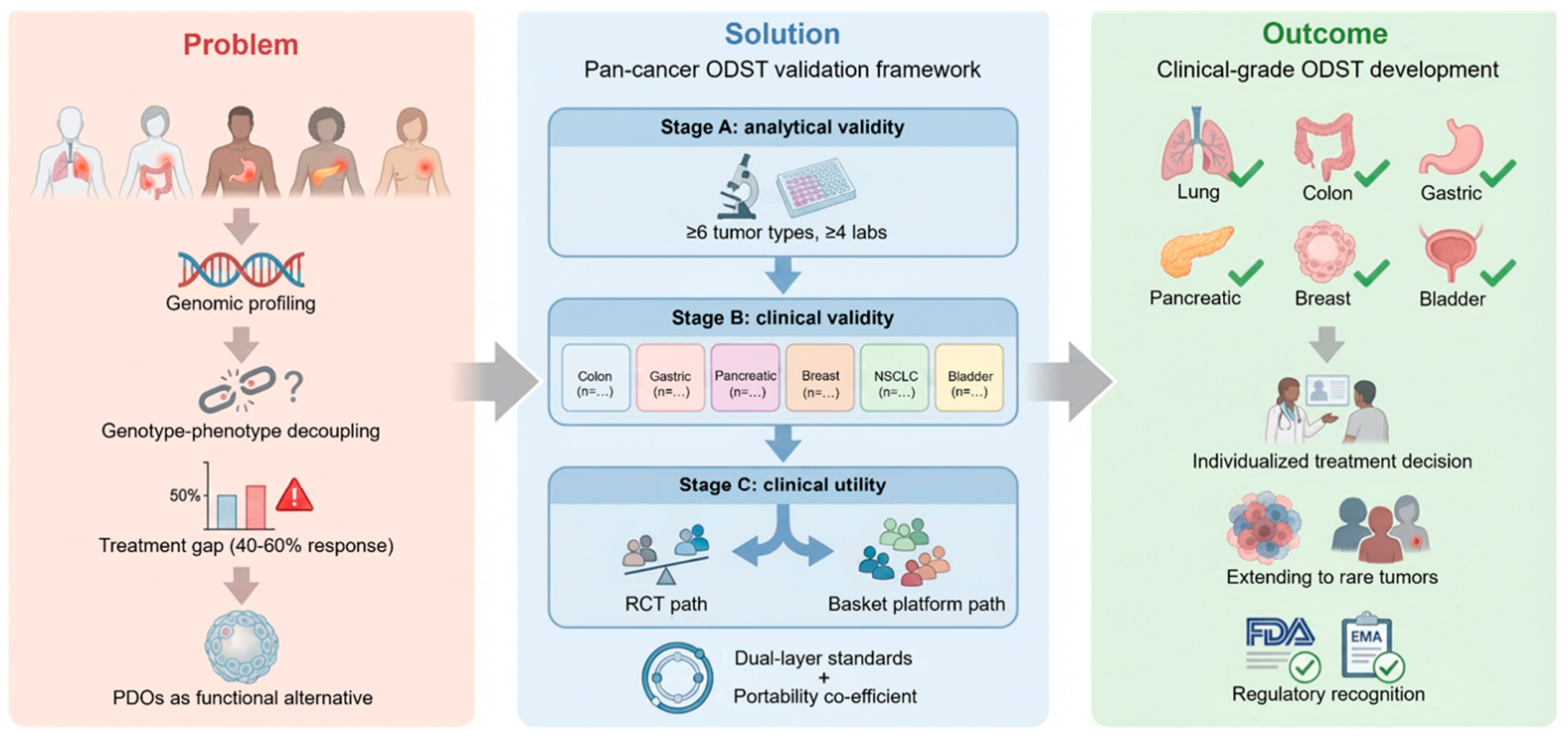
The proposed pan-cancer clinical validation framework integrates four evidence-informed components rather than presenting a formally validated regulatory standard. The first component is a structured narrative synthesis of cross-tumor evidence, drawing on direct patient–organoid predictive studies and clinically relevant ex vivo pharmacology studies summarized in Section 2.2 and Table 1, together with the contextual platform and microenvironmental literature cited therein. The selection criteria and the qualitative (non-meta-analytic) nature of this synthesis are stated in Section 2.1. The second component involves matrix mapping of regulatory documents, comprising the FDA Biomarker Qualification Program guidance, the EMA reflection paper and guidance documents relevant to companion diagnostics and clinical evaluation, and the ICH E16 biomarker qualification guidance; all web-based regulatory documents were accessed in October 2024. The third component integrates published position statements from medical oncology, molecular pathology, biostatistics, and translational research; we do not claim that a formal Delphi or consensus exercise was performed. The fourth component is stratified sample-size and statistical-power modeling for priority tumor indications, using tumor-specific baseline response rates and expected ODST-guided response improvements. The framework is summarized in Figure 1.
Tumor-specific clinical validity studies are reported in accordance with the REMARK recommendations [30]. The framework requires pre-specification of the primary hypothesis, stratified reporting of biomarker performance, and complete reporting of analysis-population exclusions. The design of Stage C draws on the next-generation cancer organoid literature [28], the master protocol design framework [31], the platform-trial operational framework [32], the methodology for adaptive confirmatory trials [33], and the ACE statement for adaptive design reporting [34].
The validation tier architecture extends conventional assay-validation logic, which often applies uniform analytical thresholds, by adding tumor-specific calibration and an evidence-portability assessment. First, cancer-specific tier calibration supplements platform-wide analytical thresholds with tumor-type-specific clinical-performance expectations informed by baseline response rate, clinical heterogeneity, and feasibility constraints. Second, a cross-tumor portability layer formalizes the conditions under which validated evidence in one tumor type may inform validation in another. The cross-tumor portability coefficient ranges from 0 to 1, with higher values indicating greater transferability. A high coefficient would not eliminate the need for indication-specific evidence, but may justify a reduced or more focused evidence package when extension to a biologically and technically related indication is considered. This coefficient is intended to provide an explicit and auditable framework for inter-tumor evidence transfer, rather than relying on implicit and unstandardized cross-indication inference.
Drug-response endpoints in the framework move beyond simple viability-based readouts. Drug-induced phenotypic landscapes generated from high-content imaging provide more granular response information than viability assays alone [24]. The framework, therefore, specifies a phenotypic readout depth parameter (Table 2) that includes minimum (viability plus apoptosis) and target (multiplexed phenotypic profiling, including proliferation, apoptosis, and quiescence/senescence markers) thresholds. This phenotypic depth is essential for detecting drug-tolerant persister states, which are otherwise misclassified as treatment response by viability-only assays.

4. Pan-Cancer Minimum Analytical Standards, Three-Stage Trial Design and Implementation Barrier Analysis

4.1. Pan-Cancer Minimum Analytical Standards

The first output of the framework is a set of pan-cancer minimum analytical performance standards for clinical-grade ODST, as summarized in Table 2. Organoid establishment success must reach at least 60%, with a target of 80%, as platform-wide thresholds, calibrated by independent thresholds for tumor types with intrinsic establishment difficulty such as pancreatic adenocarcinoma and glioblastoma [3,10,35]. Testing turnaround time must not exceed 21 days from biopsy receipt to report delivery, with 14 days as a target and a 10-day expedited pathway for clinical emergencies [5,10,35]. Intra-assay and inter-assay coefficients of variation are capped at 20% and 25%, respectively, with targets of 15% and 20%, consistent with the FDA Bioanalytical Method Validation Guidance and the CLSI EP05-A3 precision-evaluation guideline (both accessed October 2024). Inter-laboratory concordance must reach at least 80%, with a target of 90%, evaluated by blinded proficiency panels covering at least five tumor types simultaneously. Drug sensitivity and specificity thresholds are calibrated to the clinical response criteria for each tumor type, with platform-wide minima of 75% and 70% and targets of 85% and 80%, respectively. The cross-tumor portability coefficient is set at a minimum of 0.70 and a target of 0.85.

4.2. Three-Stage Validation Trial Design

The second output is a three-stage pan-cancer validation trial architecture combining shared platform validation with tumor-specific efficacy demonstration.
Stage A is a pan-cancer analytical validity study conducted before any clinical investigation. The objective is to define precision, accuracy, and reproducibility on a common technical platform. The study is proposed as a multi-center, multi-tumor, multi-laboratory design, with at least 30 organoid lines per tumor type, at least 6 tumor types, and at least 4 laboratories as pragmatic starting benchmarks for reproducibility assessment. The primary endpoint is an inter-laboratory concordance rate of at least 80%, with mandatory stratified reporting by tumor type. Aggregate-only reporting is not acceptable because it obscures clinically meaningful tumor-specific performance variation.
Stage B comprises tumor-specific clinical validity studies in a retrospective–prospective hybrid design, with reporting in accordance with REMARK [30]. Tumor-specific calibration of baseline response rates and anticipated treatment effects is required. Six priority tumor types form the initial validation cohort: colorectal, gastric, pancreatic, breast, non-small-cell lung, and bladder cancer. Statistical parameters are summarized in Table 3.
In second-line colorectal cancer with a baseline response rate of 20%, an ODST-guided improvement to 40% requires 83 patients per arm, yielding a target enrollment of approximately 208 patients after correction for a 20% organoid-establishment failure rate. In first-line gastric cancer with a baseline response rate of 45%, an improvement to 65% requires 98 patients per arm, or approximately 245 patients in total. Pancreatic cancer represents the most demanding case: a baseline response rate of 25% with anticipated improvement to 45% requires 90 patients per arm, but a 40% establishment failure rate [10,35] increases the enrollment target to approximately 300 patients. All Stage B sample-size calculations follow the framework articulated by Yusuf, Collins, and Peto [36], using a two-sided alpha of 0.05 and 80% power, applied tumor-specifically through the following:
n per   arm = 2 ( Z α / 2 + Z β ) 2 p ¯ ( 1 p ¯ ) p 1 p 2 2
where
  • n per   arm is the required sample size per study arm;
  • Z α / 2 is the standard normal critical value at a two-sided significance level α ( Z 0.025 = 1.96 for α = 0.05 );
  • Z β I s the standard normal critical value at statistical power 1 β ( Z 0.20 = 0.84 for 80% power);
  • p 1 is the baseline (control) response rate for the indication;
  • p 2 is the expected response rate under ODST-guided treatment;
  • p ¯ = ( p 1 + p 2 ) / 2 is the arithmetic mean of p 1 and p 2 ;
  • α is the two-sided type I error (set at 0.05);
  • 1 β is the statistical power (set at 0.80).
The pooled-variance normal approximation shown here is used for analytical transparency. Equivalent calculations used the unpooled-variance form yield per arm with sample sizes within ±5 of the values reported in Table 3, which does not affect operational planning conclusions.
Stage C uses a differentiated design strategy based on Stage B evidence maturity. Tumor types achieving an AUC of 0.80 or greater in Stage B proceed to independent tumor-specific randomized controlled trials comparing ODST-guided treatment selection with standard-of-care; here, tumor-appropriate progression-free survival is the primary endpoint with enrollment targets of 200 to 400 patients per indication. Tumor types with Stage B AUCs between 0.70 and 0.79 enter a pan-cancer Bayesian adaptive basket platform trial, with master-protocol architecture [31] and platform-trial design principles [32]. The basket platform trial uses a shared control arm that significantly reduces total enrollment while preserving inferential integrity through Bayesian hierarchical modeling. The primary endpoint is objective response rate, which is uniformly comparable across tumors. Adaptive design follows [33] and is reported as per the ACE checklist [34]. One pre-specified interim analysis is performed at 50% enrollment for independent RCTs, controlling type I errors under an O’Brien–Fleming boundary. In the basket platform trial, Bayesian posterior updating should be paired with pre-specified operating-characteristic simulations to evaluate false-positive risks and decision thresholds. Stage C parameters are summarized in Table 4.

4.3. Implementation Barriers and Mitigation Strategies

The third output is a structured analysis of implementation barriers and mitigation strategies, as summarized in Table 5. The most consequential barriers fall into five categories: heterogeneous tissue-collection standards across tumor types; limited capacity to model immunotherapy response [23,37]; mismatch between 14- and 21-day turnaround and urgent treatment decisions [3,35]; variable organoid establishment rates; and the cost of cross-institutional technical standardization. A regulatory concern also requires explicit attention: current FDA and EMA companion-diagnostic pathways tie approval to specific drug-indication pairs, whereas the predictive value of ODST is multi-agent and multi-indication. The framework, therefore, proposes a “platform technology designation plus indication-by-indication extension” strategy, conceptually modeled on regulatory pathways used for comprehensive genomic profiling and liquid-biopsy technologies.

5. Discussion

5.1. Three Principal Arguments for Pan-Cancer ODST Validation

Three converging arguments support a pan-cancer rather than an indication-by-indication approach to ODST validation. The first is technical leverage: if a multi-cancer platform achieves robust analytical validation, cross-tumor modularity may reduce selected components of the per-indication evidence burden [3,27]. The second is ecosystem efficiency: a multi-cancer framework may be operationally more scalable for pharmaceutical, diagnostic, and payer stakeholders than isolated tumor-specific tools [31,32]. The third is clinical breadth: rare cancers, treatment-refractory states, and underrepresented histologies, often excluded from indication-specific platforms, may particularly benefit from a multi-cancer architecture, as illustrated by the childhood kidney cancer biobank [17].

5.2. Generalization Versus Specification Trade-Off

The principal methodological tension in the framework lies in balancing generalization and specification. Excessive generalization can produce aggregate performance metrics that misrepresent tumor-specific performance and create unsupported expectations of cross-tumor portability. Excessive specification, conversely, can weaken the scalability and evidence-synthesis advantages that justify a pan-cancer strategy. The proposed dual-layer architecture, which combines shared inter-tumor benchmarks with tumor-specific calibration, is intended to balance these competing requirements. The cross-tumor portability coefficient is proposed as a quantitative metric for defining the level of evidence transfer that may be defensible between two indications, replacing implicit cross-tumor inference with an explicit and auditable framework.

5.3. Immunotherapy and Microenvironment Boundary Conditions

Immune checkpoint inhibitor efficacy depends on tumor–host interactions that exceed what epithelial-only organoid cultures can represent [20,23]. Cancer-associated fibroblast biology [21,22] and intratumoral hypoxia [20] further shape therapeutic outcomes in many solid tumors and are incompletely represented in current organoid systems. The boundary conditions of ODST predictive validity, therefore, must be communicated transparently to clinicians, regulators, and payers. Within the present framework, the clinically defensible claim space of ODST should be restricted primarily to cytotoxic chemotherapy and small-molecule-targeted agents, with explicit acknowledgement that standard organoid platforms do not yet reliably predict immunotherapy responses [23,37]. Co-culture systems incorporating cancer-associated fibroblasts, endothelial cells, and autologous immune cells represent a logical second-generation extension of ODST [21,23,25]. These models should be evaluated against the analytical-performance benchmarks in Table 2 only after inter-laboratory reproducibility reaches platform-level thresholds. Endpoints based on multiplexed phenotypic profiling [24], rather than viability alone, should be incorporated into the phenotypic readout depth parameter in Table 2 to detect drug-tolerant persister populations and quiescent resistance states.

5.4. Biostatistical Discipline and Regulatory Implications

Rigorous biostatistical discipline is central to any credible pan-cancer ODST validation strategy. Large, simple, and adequately powered randomized trials are generally more reliable than complex underpowered designs [36]. This principle is particularly important for pan-cancer ODST, where multiple tumor types and endpoints can easily inflate analytical complexity. The framework, therefore, recommends a single pre-specified primary endpoint for each Stage C tumor-specific trial, pre-registration of subgroup analyses before trial initiation, one interim analysis per trial under O’Brien–Fleming boundary control when a frequentist design is used, and prospective commitment to reporting negative results. From a regulatory perspective, conventional companion-diagnostic pathways inadequately accommodate platform-level functional biomarkers. In the proposed architecture, Stage A is designed to establish platform-level analytical validity, Stages B and C are designed to evaluate indication-specific clinical validity and utility, and the cross-tumor portability coefficient is used to support quantitative evidentiary transfer for indication extensions. This logic is conceptually analogous to pathways used for comprehensive genomic profiling and liquid-biopsy technologies [27,28].

6. Conclusions

ODST represents a functional biomarker paradigm with credible but still incompletely validated pan-cancer potential. Biological evidence spanning colorectal, gastric, pancreatic, breast, lung, bladder, gynecological, and central nervous system malignancies [5,6,7,8,9,10,11,12,13,14,15,16,17] supports a consistent principle: patient-derived three-dimensional tumor cultures can recapitulate determinants of pharmacological responses that are not fully accessible to genomic profiling alone. The translational question is, therefore, shifting from biological plausibility toward clinical-grade demonstration that is operationally scalable, statistically credible, and analytically rigorous.
The framework advanced in this article specifies analytical platform validation, tumor-specific clinical validity, and randomized clinical-utility demonstration in a three-stage architecture. Its principal conceptual contributions are the cross-tumor portability coefficient, the dual-layer performance-standard architecture, and the differentiated Stage C design strategy that routes tumor types to independent RCTs or Bayesian basket platform trials according to evidence maturity. Critical success factors include multi-tumor multi-center research consortia, prospective standardization of pan-cancer organoid biobanks [17,28], early regulatory engagement, transparent communication of immunotherapy prediction limitations, and institutional commitment to negative-result publication [18]. It was realized that precision oncology aspiration depends on validation processes that are rigorous, transparent, and statistically disciplined; the framework presented here is a structured contribution toward that goal.

Author Contributions

Y.X. and K.Q. conceived and supervised the study. J.S., Z.X. and G.W. performed the literature search, data curation, and drafted the manuscript. J.S., C.X., S.T., G.L., F.C. and L.J. contributed to the literature screening, data interpretation, and critical revision of the manuscript. Y.X. and K.Q. revised the manuscript and approved the final version for submission. All authors have read and agreed to the published version of the manuscript.

Funding

This study is supported by the Research Fund of Hubei Provincial Science and Technology Plan Project (2025CFC012) and Zhongnan Hospital of Wuhan University (CXPY202555). The funders played no role in the study design, data collection and analysis, decision to publish, or preparation of the manuscript.

Data Availability Statement

Not applicable.

Acknowledgments

The authors thank Yuruo Chen for their assistance with figure editing.

Conflicts of Interest

The authors declared that this work was conducted in the absence of any commercial or financial relationships that could be construed as potential conflicts of interest.

Abbreviations

ACEAdaptive designs of CONSORT extension
AUCArea under the (receiver operating characteristic) curve
CNSCentral nervous system
CONSORTConsolidated Standards of Reporting Trials
CVCoefficient of variation
DxDiagnostic(s)
EGFREpidermal growth factor receptor
EMAEuropean Medicines Agency
FDAFood and Drug Administration
GIGastrointestinal
HTAHealth technology assessment
ICHInternational Council for Harmonisation
NSCLCNon-small-cell lung cancer
ODSTOrganoid drug sensitivity testing
PDOPatient-derived organoid
PFSProgression-free survival
PMAPremarket approval
RCTRandomized controlled trial
REMARKReporting Recommendations for Tumor Marker Prognostic Studies
ROCReceiver operating characteristic
SOPStandard operating procedure

References

  1. Bray, F.; Laversanne, M.; Sung, H.; Ferlay, J.; Siegel, R.L.; Soerjomataram, I.; Jemal, A. Global cancer statistics 2022: GLOBOCAN estimates of incidence and mortality worldwide for 36 cancers in 185 countries. CA A Cancer J. Clin. 2024, 74, 229–263. [Google Scholar] [CrossRef]
  2. Garnett, M.J.; Edelman, E.J.; Heidorn, S.J.; Greenman, C.D.; Dastur, A.; Lau, K.W.; Greninger, P.; Thompson, I.R.; Luo, X.; Soares, J.; et al. Systematic identification of genomic markers of drug sensitivity in cancer cells. Nature 2012, 483, 570–575. [Google Scholar] [CrossRef]
  3. Drost, J.; Clevers, H. Organoids in cancer research. Nat. Rev. Cancer 2018, 18, 407–418. [Google Scholar] [CrossRef]
  4. Tuveson, D.A.; Clevers, H. Cancer modeling meets human organoid technology. Science 2019, 364, 952–955. [Google Scholar] [CrossRef] [PubMed]
  5. Vlachogiannis, G.; Hedayat, S.; Vatsiou, A.; Jamin, Y.; Fernández-Mateos, J.; Khan, K.; Lampis, A.; Eason, K.; Huntingford, I.; Burke, R.; et al. Patient-derived organoids model treatment response of metastatic gastrointestinal cancers. Science 2018, 359, 920–926. [Google Scholar] [CrossRef]
  6. Ooft, S.N.; Weeber, F.; Dijkstra, K.K.; McLean, C.M.; Kaing, S.; Van Werkhoven, E.; Schipper, L.; Hoes, L.; Vis, D.J.; Van De Haar, J.; et al. Patient-derived organoids can predict response to chemotherapy in metastatic colorectal cancer patients. Sci. Transl. Med. 2019, 11, eaay2574. [Google Scholar] [CrossRef] [PubMed]
  7. Yao, Y.; Xu, X.; Yang, L.; Zhu, J.; Wan, J.; Shen, L.; Xia, F.; Fu, G.; Deng, Y.; Pan, M.; et al. Patient-derived organoids predict chemoradiation responses of locally advanced rectal cancer. Cell Stem Cell 2020, 26, 17–26. [Google Scholar] [CrossRef]
  8. Driehuis, E.; Kolders, S.; Spelier, S.; Lõhmussaar, K.; Willems, S.M.; Devriese, L.A.; de Bree, R.; de Ruiter, E.J.; Korving, J.; Begthel, H.; et al. Oral mucosal organoids as a potential platform for personalized cancer therapy. Cancer Discov. 2019, 9, 852–871. [Google Scholar] [CrossRef]
  9. Sachs, N.; de Ligt, J.; Kopper, O.; Gogola, E.; Bounova, G.; Weeber, F.; Balgobind, A.V.; Wind, K.; Gracanin, A.; Begthel, H.; et al. A living biobank of breast cancer organoids captures disease heterogeneity. Cell 2018, 172, 373–386. [Google Scholar] [CrossRef] [PubMed]
  10. Tiriac, H.; Belleau, P.; Engle, D.D.; Plenker, D.; Deschenes, A.; Somerville, T.D.D.; Froeling, F.E.M.; Burkhart, R.A.; Denroche, R.E.; Jang, G.H.; et al. Organoid profiling identifies common responders to chemotherapy in pancreatic cancer. Cancer Discov. 2018, 8, 1112–1129. [Google Scholar] [CrossRef]
  11. Yan, H.H.N.; Siu, H.C.; Law, S.; Ho, S.L.; Yue, S.S.K.; Tsui, W.Y.; Chan, D.; Chan, A.S.; Ma, S.; Lam, K.O.; et al. A comprehensive human gastric cancer organoid biobank captures tumor subtype heterogeneity and enables therapeutic screening. Cell Stem Cell 2018, 23, 882–897. [Google Scholar] [CrossRef] [PubMed]
  12. Kim, M.; Mun, H.; Sung, C.O.; Cho, E.J.; Jeon, H.-J.; Chun, S.-M.; Jung, D.J.; Shin, T.H.; Jeong, G.S.; Kim, D.K.; et al. Patient-derived lung cancer organoids as in vitro cancer models for therapeutic screening. Nat. Commun. 2019, 10, 3991. [Google Scholar] [CrossRef] [PubMed]
  13. Lee, S.H.; Hu, W.; Matulay, J.T.; Silva, M.V.; Owczarek, T.B.; Kim, K.; Chua, C.W.; Barlow, L.M.J.; Kandoth, C.; Williams, A.B.; et al. Tumor evolution and drug response in patient-derived organoid models of bladder cancer. Cell 2018, 173, 515–528.e17. [Google Scholar] [CrossRef]
  14. Boretto, M.; Maenhoudt, N.; Luo, X.; Hennes, A.; Boeckx, B.; Bui, B.; Heremans, R.; Perneel, L.; Kobayashi, H.; Van Zundert, I.; et al. Patient-derived organoids from endometrial disease capture clinical heterogeneity and are amenable to drug screening. Nat. Cell Biol. 2019, 21, 1041–1051. [Google Scholar] [CrossRef] [PubMed]
  15. Kopper, O.; de Witte, C.J.; Lõhmussaar, K.; Valle-Inclan, J.E.; Hami, N.; Kester, L.; Balgobind, A.V.; Korving, J.; Proost, N.; Begthel, H.; et al. An organoid platform for ovarian cancer captures intra- and interpatient heterogeneity. Nat. Med. 2019, 25, 838–849. [Google Scholar] [CrossRef]
  16. Jacob, F.; Salinas, R.D.; Zhang, D.Y.; Nguyen, P.T.T.; Schnoll, J.G.; Wong, S.Z.H.; Thokala, R.; Sheikh, S.; Saxena, D.; Prokop, S.; et al. A patient-derived glioblastoma organoid model and biobank recapitulates inter- and intra-tumoral heterogeneity. Cell 2020, 180, 188–204. [Google Scholar] [CrossRef]
  17. Calandrini, C.; Schutgens, F.; Oka, R.; Margaritis, T.; Candelli, T.; Mathijsen, L.; Ammerlaan, C.; van Ineveld, R.L.; Derakhshan, S.; de Haan, S.; et al. An organoid biobank for childhood kidney cancers that captures disease and tissue heterogeneity. Nat. Commun. 2020, 11, 1310. [Google Scholar] [CrossRef]
  18. Wensink, G.E.; Elias, S.G.; Mullenders, J.; Koopman, M.; Boj, S.F.; Kranenburg, O.W.; Roodhart, J.M.L. Patient-derived organoids as a predictive biomarker for treatment response in cancer patients. npj Precis. Oncol. 2021, 5, 30. [Google Scholar] [CrossRef]
  19. Lau, H.C.H.; Kranenburg, O.; Xiao, H.; Yu, J. Organoid models of gastrointestinal cancers in basic and translational research. Nat. Rev. Gastroenterol. Hepatol. 2020, 17, 203–222. [Google Scholar] [CrossRef]
  20. Harris, A.L. Hypoxia—A key regulatory factor in tumour growth. Nat. Rev. Cancer 2002, 2, 38–47. [Google Scholar] [CrossRef]
  21. Sahai, E.; Astsaturov, I.; Cukierman, E.; DeNardo, D.G.; Egeblad, M.; Evans, R.M.; Fearon, D.; Greten, F.R.; Hingorani, S.R.; Hunter, T.; et al. A framework for advancing our understanding of cancer-associated fibroblasts. Nat. Rev. Cancer 2020, 20, 174–186. [Google Scholar] [CrossRef]
  22. Biffi, G.; Tuveson, D.A. Diversity and biology of cancer-associated fibroblasts. Physiol. Rev. 2021, 101, 147–176. [Google Scholar] [CrossRef]
  23. Neal, J.T.; Li, X.; Zhu, J.; Giangarra, V.; Grzeskowiak, C.L.; Ju, J.; Liu, I.H.; Chiou, S.-H.; Salahudeen, A.A.; Smith, A.R.; et al. Organoid modeling of the tumor immune microenvironment. Cell 2018, 175, 1972–1988. [Google Scholar] [CrossRef] [PubMed]
  24. Betge, J.; Rindtorff, N.; Sauer, J.; Rauscher, B.; Dingert, C.; Gaitantzi, H.; Herweck, F.; Srour-Mhanna, K.; Miersch, T.; Valentini, E.; et al. The drug-induced phenotypic landscape of colorectal cancer organoids. Nat. Commun. 2022, 13, 3135. [Google Scholar] [CrossRef]
  25. Hofer, M.; Lutolf, M.P. Engineering organoids. Nat. Rev. Mater. 2021, 6, 402–420. [Google Scholar] [CrossRef]
  26. Lõhmussaar, K.; Oka, R.; Valle-Inclan, J.E.; Smits, M.H.; Wardak, H.; Korving, J.; Begthel, H.; Proost, N.; van de Ven, M.; Kranenburg, O.W.; et al. Patient-derived organoids model cervical tissue dynamics and viral oncogenesis in cervical cancer. Cell Stem Cell 2021, 28, 1380–1396.e6. [Google Scholar] [CrossRef] [PubMed]
  27. Clevers, H. Modeling development and disease with organoids. Cell 2016, 165, 1586–1597. [Google Scholar] [CrossRef] [PubMed]
  28. LeSavage, B.L.; Suhar, R.A.; Broguiere, N.; Lutolf, M.P.; Heilshorn, S.C. Next-generation cancer organoids. Nat. Mater. 2022, 21, 143–159. [Google Scholar] [CrossRef]
  29. Schutgens, F.; Clevers, H. Human organoids: Tools for understanding biology and treating diseases. Annu. Rev. Pathol. 2020, 15, 211–234. [Google Scholar] [CrossRef]
  30. McShane, L.M.; Altman, D.G.; Sauerbrei, W.; Taube, S.E.; Gion, M.; Clark, G.M. Reporting recommendations for tumor marker prognostic studies (REMARK). J. Natl. Cancer Inst. 2005, 97, 1180–1184. [Google Scholar] [CrossRef]
  31. Woodcock, J.; LaVange, L.M. Master protocols to study multiple therapies, multiple diseases, or both. N. Engl. J. Med. 2017, 377, 62–70. [Google Scholar] [CrossRef] [PubMed]
  32. Park, J.J.H.; Detry, M.A.; Murthy, S.; Guyatt, G.; Mills, E.J. How to use and interpret the results of a platform trial: Users’ guide to the medical literature. JAMA 2022, 327, 67–74. [Google Scholar] [CrossRef]
  33. Bretz, F.; Koenig, F.; Brannath, W.; Glimm, E.; Posch, M. Adaptive designs for confirmatory clinical trials: Revisited and extended. Stat. Med. 2009, 28, 1181–1217. [Google Scholar] [CrossRef] [PubMed]
  34. Dimairo, M.; Pallmann, P.; Wason, J.; Todd, S.; Jaki, T.; A Julious, S.; Mander, A.P.; Weir, C.J.; Koenig, F.; Walton, M.K.; et al. The Adaptive designs CONSORT Extension (ACE) statement: A checklist with explanation and elaboration guideline for reporting randomised trials that use an adaptive design. BMJ 2020, 369, m115. [Google Scholar] [CrossRef]
  35. Driehuis, E.; van Hoeck, A.; Moore, K.; Kolders, S.; Francies, H.E.; Gulersonmez, M.C.; Stigter, E.C.A.; Burgering, B.; Geurts, V.; Gracanin, A.; et al. Pancreatic cancer organoids recapitulate disease and allow personalized drug screening. Proc. Natl. Acad. Sci. USA 2019, 116, 26580–26590. [Google Scholar] [CrossRef] [PubMed]
  36. Yusuf, S.; Collins, R.; Peto, R. Why do we need some large, simple randomized trials? Stat. Med. 1984, 3, 409–422. [Google Scholar] [CrossRef]
  37. Bellmunt, J.; De Wit, R.; Vaughn, D.J.; Fradet, Y.; Lee, J.-L.; Fong, L.; Vogelzang, N.J.; Climent, M.A.; Petrylak, D.P.; Choueiri, T.K.; et al. Pembrolizumab as second-line therapy for advanced urothelial carcinoma. N. Engl. J. Med. 2017, 376, 1015–1026. [Google Scholar] [CrossRef]
Figure 1. A pan-cancer clinical validation framework for organoid drug sensitivity testing (ODST). Despite widespread adoption of genomic profiling, genotype–phenotype discordance contributes to heterogeneous and incompletely predictable treatment responses across major solid tumors, highlighting the need for functional pharmacological approaches. Patient-derived organoids (PDOs) address this gap. The proposed pan-cancer ODST validation framework comprises three sequential stages: Stage A establishes analytical validity across at least 6 tumor types and at least 4 independent laboratories; Stage B evaluates clinical validity in six priority indications (colorectal, gastric, pancreatic, breast, NSCLC, and bladder cancers); Stage C assesses clinical utility through either randomized controlled trials or Bayesian adaptive basket platform trials, unified by a dual-layer performance standard and a cross-tumor portability coefficient. Successful validation is projected to enable individualized treatment decisions, extension to rare tumor types, and regulatory recognition by both the FDA and the EMA.
Organoids 05 00019 g001
Table 1. Summary of representative ODST clinical-correlation and clinically relevant ex vivo pharmacology studies across major tumor types.
StudyCancer TypenDesignReported MetricKey Limitations
Vlachogiannis et al. (2018) [5]Metastatic GI (CRC, gastroesophageal)71ProspectiveSens 100%, Spec 93%, PPV 88%, NPV 100% for response to targeted/chemo agentsSingle-center design; no RCT; mixed regimens
Ooft et al. (2019) [6]Metastatic colorectal29ProspectivePredictive for irinotecan-based therapy; non-predictive for 5-FU + oxaliplatinSmall n; regimen-dependent performance
Yao et al. (2020) [7]Locally advanced rectal (neoadjuvant CRT)80ProspectiveAccuracy 84.43%, Sens 78.01%, Spec 91.97%Single tumor stage; chemoradiation only
Driehuis et al. (2019) [8]Head and neck squamous cell31Retrospective/ex vivoEstablished HNSCC organoid biobank with ex vivo drug screening; paired clinical outcome data limitedBiobank study; not a powered predictive cohort
Sachs et al. (2018) [9]Breast (mixed subtypes)>100 organoid linesRetrospective/ex vivoRecapitulated subtype heterogeneity; ex vivo drug response reported; paired clinical correlation limited to case-level observationsBiobank study; not a paired predictive cohort
Tiriac et al. (2018) [10]Pancreatic ductal adenocarcinoma138RetrospectivePharmacotyping signatures separated clinical responders from non-responders for chemotherapyFew metastatic cases; classifier-based, no single AUC reported in source
Yan et al. (2018) [11]Gastric34Retrospective/ex vivoSubtype-stratified ex vivo drug response; paired patient-outcome correlation limitedSingle-center; biobank-style design
Kim et al. (2019) [12]Non-small-cell lung36Retrospective/ex vivoMutation-concordant ex vivo response (e.g., EGFR-mutant lines responsive to EGFR-TKIs); paired patient-outcome data limitedNSCLC subtype heterogeneity; not a powered predictive cohort
Lee et al. (2018) [13]Bladder (urothelial)24RetrospectiveCaptured intra-patient tumor evolution and ex vivo drug-response patternsProof-of-concept; outcome correlation not the primary endpoint
Note. AUC, area under the receiver operating characteristic curve; CRC, colorectal cancer; CRT, chemoradiotherapy; EGFR, epidermal growth factor receptor; GI, gastrointestinal; HNSCC, head and neck squamous cell carcinoma; NPV, negative predictive value; NSCLC, non-small-cell lung cancer; ODST, organoid drug-sensitivity testing; PPV, positive predictive value; RCT, randomized controlled trial; Sens, sensitivity; Spec, specificity.
Table 2. Pan-cancer minimum analytical standards for clinical-grade ODST.
ParameterMinimum ThresholdTargetCancer-Specific Notes
Organoid establishment success rate≥60%≥80%Independent thresholds may apply for pancreatic, CNS, and sarcoma indications
Testing turnaround time≤21 days≤14 daysExpedited ≤ 10-day pathway for urgent clinical scenarios
Intra-assay CV≤20%≤15%Uniform cross-tumor standard
Inter-assay CV≤25%≤20%Uniform cross-tumor standard
Inter-laboratory concordance≥80%≥90%Proficiency panel must cover ≥ 5 tumor types simultaneously
Drug sensitivity (sensitivity)≥75%≥85%Referenced to clinical response standard for each tumor type
Drug sensitivity (specificity)≥70%≥80%Referenced to clinical non-response standard for each tumor type
Cross-tumor portability coefficient≥0.70≥0.85Novel metric quantifying inter-tumor platform transferability
Phenotypic readout depthViability + apoptosisMultiplexed phenotypic profiling (proliferation, apoptosis, quiescence, senescence)Required to detect drug-tolerant persister states
Note. CNS, central nervous system; CV, coefficient of variation; ODST, organoid drug-sensitivity testing. The thresholds in Table 2 are proposed by the authors as a working consensus framework for pan-cancer ODST analytical performance; they are not extracted from any existing regulatory document, professional-society guideline, or published meta-analysis. They were derived with reference to (i) reported organoid-establishment success ranges in published biobank studies [3,9,10,11,12,13,14,15,16,17,35]; (ii) general analytical-performance benchmarks customary for clinical molecular and cellular assays (e.g., intra-assay CV ≤ 20% as a common laboratory expectation); and (iii) operational feasibility for clinical-grade turnaround times. The Stage A multi-laboratory study described in Section 4.2 is explicitly designed to provide the empirical calibration required before any of these values should be regarded as binding.
Table 3. Key statistical parameters for priority tumor types in Stage B.
Tumor TypeBaseline Response RateExpected ODST-Guided ImprovementRequired n per ArmTotal Enrollment Target (Adjusted for Failure Rate)
Colorectal cancer (2nd line)20%40%83208 (20% failure)
Gastric cancer (1st line)45%65%98245 (20% failure)
Pancreatic cancer (1st line)25%45%90300 (40% failure)
Breast cancer (advanced)35%55%98245 (20% failure)
NSCLC (2nd line)20%40%83237 (30% failure)
Bladder cancer (1st line)45%65%98245 (20% failure)
Note. Sample sizes were calculated using a two-sided alpha of 0.05 and 80% power according to the formula in Section 4.2. NSCLC, non-small-cell lung cancer; ODST, organoid drug sensitivity testing.
Table 4. Stage C pan-cancer validation design parameters.
Design ElementIndependent RCT
(Mature Evidence Tumor Types)
Basket Platform Trial
(Emerging Evidence Tumor Types)
Trial architectureTumor-specific two-arm RCTBayesian adaptive multi-tumor platform
Control armStandard-of-care (tumor-type-specific)Shared control arm (reduces patient volume requirement)
Primary endpointPFS at 6 months (defined independently per tumor type)Objective response rate (uniform, cross-tumor comparable)
Sample size range200–400 patients per tumor type300–600 patients across the entire platform
Interim analysisOne pre-specified analysis at 50% enrollmentBayesian posterior updating with pre-specified operating-characteristic simulations
Regulatory pathwayCompanion Dx PMA/510(k) per indicationPlatform technology designation + indication-by-indication extension
Note. Dx, diagnostic; PFS, progression-free survival; PMA, premarket approval; RCT, randomized controlled trial.
Table 5. Pan-cancer ODST implementation barriers and mitigation strategies.
BarrierImpact LevelAffected Tumor TypesMitigation Strategy
Heterogeneous tissue collection standardsHighAll tumor typesEstablish unified multi-tumor biospecimen collection SOP
Inability to model immunotherapy responseHighLung, bladder, head and neck, and othersImmune co-culture organoid models (near-term); restrict validated claims to chemotherapy and targeted therapy
14- to 21-day turnaround vs. clinical urgencyHighPancreatic cancer and other urgent-enrollment settingsAllow parallel initiation of first-cycle treatment; develop rapid phenotypic prediction algorithms
Wide inter-tumor variation in establishment success ratesHighPancreatic, CNS, sarcomaCancer-specific failure rate correction factors; separate eligibility criteria for very-low-success tumor types
Cross-institutional technical standardization costsHighAll tumor typesCentralized reference laboratory network; develop commercial standardized assay kits
Complex multi-cancer reimbursement pathwaysHighAll tumor typesAdvance reimbursement for highest-evidence tumor type first; establish cross-tumor HTA framework
Regulatory classification consistency across indicationsModerateLead indication vs. extension indicationsPlatform technology designation + phased indication approval strategy
Cross-tumor data integration and privacy protectionModerateMulti-center multi-tumor studiesFederated learning architecture; unified data standards and inter-institutional sharing agreements
Variability in patient consent requirementsLowSpecific tumor typesModular consent template with core standard clauses plus tumor-specific appendices
Note. CNS, central nervous system; HTA, health technology assessment; ODST, organoid drug sensitivity testing; SOP, standard operating procedure.
Disclaimer/Publisher’s Note: The statements, opinions and data contained in all publications are solely those of the individual author(s) and contributor(s) and not of MDPI and/or the editor(s). MDPI and/or the editor(s) disclaim responsibility for any injury to people or property resulting from any ideas, methods, instructions or products referred to in the content.