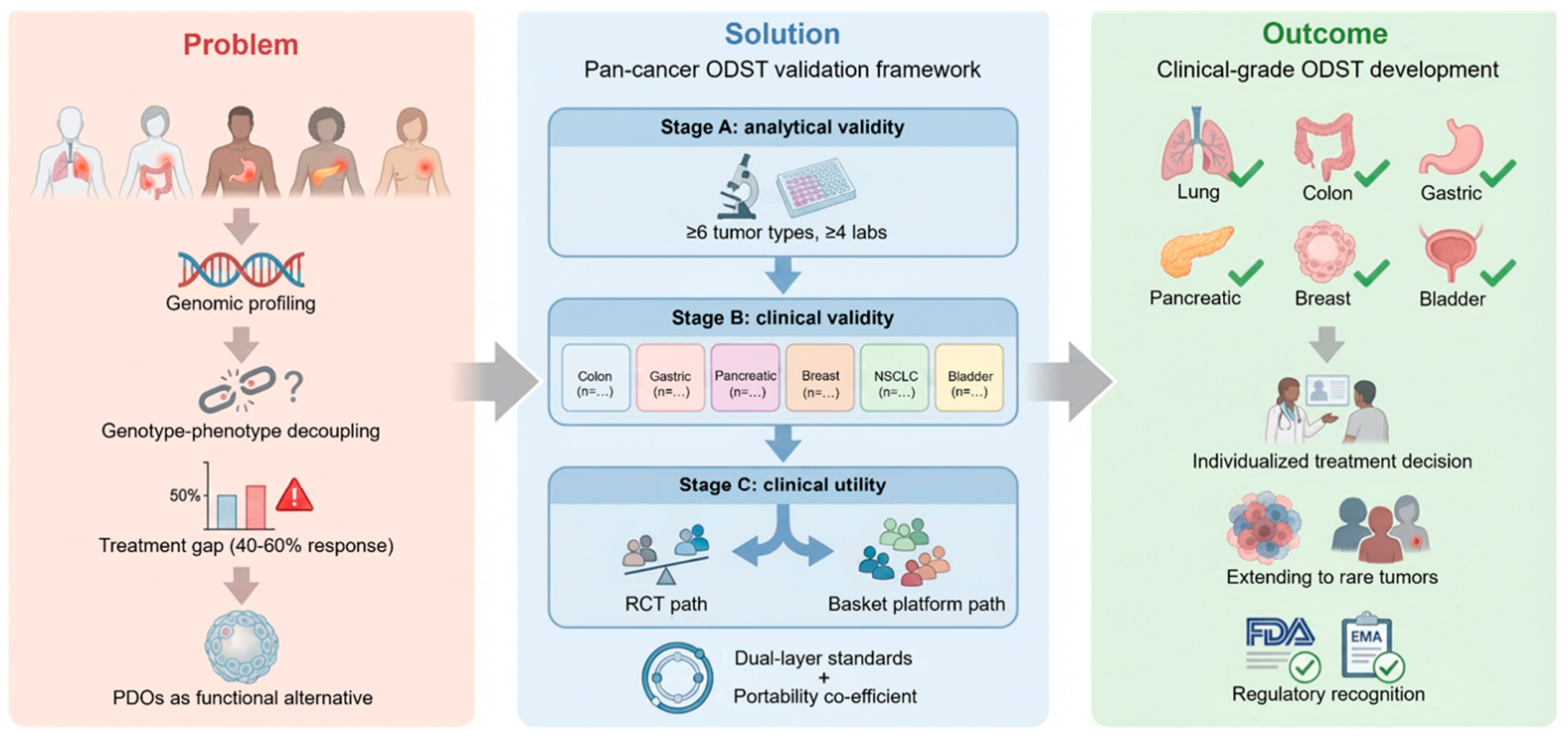


A Pan-Cancer Preclinical Validation Framework for Organoid-Based Drug Sensitivity Testing

 , , , , and
Abstract
1. Introduction
2. Research Status
2.1. Scope and Selection of Cited Evidence
- (i)
- Peer-reviewed primary research published in English for the past ten years;
- (ii)
- Reporting patient-derived organoids with either direct organoid-to-patient drug-response concordance or clinically relevant ex vivo pharmacological profiling in disease-specific patient-derived organoid biobanks;
- (iii)
- Providing either a quantitative concordance metric (sensitivity, specificity, positive predictive value, negative predictive value, area under the ROC curve, or accuracy), an explicit qualitative predictive statement against clinical outcome, or clinically interpretable ex vivo drug-response evidence linked to tumor genotype, histology, or therapeutic class;
- (iv)
- Representing a solid-tumor indication relevant to the framework’s pan-cancer scope.
2.2. Tumor-Type-Specific Evidence and Cross-Cutting Observations
2.3. Biological Convergence and Methodological Gaps
3. Framework Development: Multi-Tumor Evidence Synthesis, Regulatory Mapping and Validation Architecture Design
4. Pan-Cancer Minimum Analytical Standards, Three-Stage Trial Design and Implementation Barrier Analysis
4.1. Pan-Cancer Minimum Analytical Standards
4.2. Three-Stage Validation Trial Design
- is the required sample size per study arm;
- is the standard normal critical value at a two-sided significance level ( for );
- I s the standard normal critical value at statistical power ( for 80% power);
- is the baseline (control) response rate for the indication;
- is the expected response rate under ODST-guided treatment;
- is the arithmetic mean of and ;
- is the two-sided type I error (set at 0.05);
- is the statistical power (set at 0.80).
4.3. Implementation Barriers and Mitigation Strategies
5. Discussion
5.1. Three Principal Arguments for Pan-Cancer ODST Validation
5.2. Generalization Versus Specification Trade-Off
5.3. Immunotherapy and Microenvironment Boundary Conditions
5.4. Biostatistical Discipline and Regulatory Implications
6. Conclusions
Author Contributions
Funding
Data Availability Statement
Acknowledgments
Conflicts of Interest
Abbreviations
| ACE | Adaptive designs of CONSORT extension |
| AUC | Area under the (receiver operating characteristic) curve |
| CNS | Central nervous system |
| CONSORT | Consolidated Standards of Reporting Trials |
| CV | Coefficient of variation |
| Dx | Diagnostic(s) |
| EGFR | Epidermal growth factor receptor |
| EMA | European Medicines Agency |
| FDA | Food and Drug Administration |
| GI | Gastrointestinal |
| HTA | Health technology assessment |
| ICH | International Council for Harmonisation |
| NSCLC | Non-small-cell lung cancer |
| ODST | Organoid drug sensitivity testing |
| PDO | Patient-derived organoid |
| PFS | Progression-free survival |
| PMA | Premarket approval |
| RCT | Randomized controlled trial |
| REMARK | Reporting Recommendations for Tumor Marker Prognostic Studies |
| ROC | Receiver operating characteristic |
| SOP | Standard operating procedure |
References
- Bray, F.; Laversanne, M.; Sung, H.; Ferlay, J.; Siegel, R.L.; Soerjomataram, I.; Jemal, A. Global cancer statistics 2022: GLOBOCAN estimates of incidence and mortality worldwide for 36 cancers in 185 countries. CA A Cancer J. Clin. 2024, 74, 229–263. [Google Scholar] [CrossRef] [Scilit]
- Garnett, M.J.; Edelman, E.J.; Heidorn, S.J.; Greenman, C.D.; Dastur, A.; Lau, K.W.; Greninger, P.; Thompson, I.R.; Luo, X.; Soares, J.; et al. Systematic identification of genomic markers of drug sensitivity in cancer cells. Nature 2012, 483, 570–575. [Google Scholar] [CrossRef] [Scilit]
- Drost, J.; Clevers, H. Organoids in cancer research. Nat. Rev. Cancer 2018, 18, 407–418. [Google Scholar] [CrossRef] [Scilit]
- Tuveson, D.A.; Clevers, H. Cancer modeling meets human organoid technology. Science 2019, 364, 952–955. [Google Scholar] [CrossRef] [Scilit] [PubMed]
- Vlachogiannis, G.; Hedayat, S.; Vatsiou, A.; Jamin, Y.; Fernández-Mateos, J.; Khan, K.; Lampis, A.; Eason, K.; Huntingford, I.; Burke, R.; et al. Patient-derived organoids model treatment response of metastatic gastrointestinal cancers. Science 2018, 359, 920–926. [Google Scholar] [CrossRef] [Scilit]
- Ooft, S.N.; Weeber, F.; Dijkstra, K.K.; McLean, C.M.; Kaing, S.; Van Werkhoven, E.; Schipper, L.; Hoes, L.; Vis, D.J.; Van De Haar, J.; et al. Patient-derived organoids can predict response to chemotherapy in metastatic colorectal cancer patients. Sci. Transl. Med. 2019, 11, eaay2574. [Google Scholar] [CrossRef] [Scilit] [PubMed]
- Yao, Y.; Xu, X.; Yang, L.; Zhu, J.; Wan, J.; Shen, L.; Xia, F.; Fu, G.; Deng, Y.; Pan, M.; et al. Patient-derived organoids predict chemoradiation responses of locally advanced rectal cancer. Cell Stem Cell 2020, 26, 17–26. [Google Scholar] [CrossRef] [Scilit]
- Driehuis, E.; Kolders, S.; Spelier, S.; Lõhmussaar, K.; Willems, S.M.; Devriese, L.A.; de Bree, R.; de Ruiter, E.J.; Korving, J.; Begthel, H.; et al. Oral mucosal organoids as a potential platform for personalized cancer therapy. Cancer Discov. 2019, 9, 852–871. [Google Scholar] [CrossRef] [Scilit]
- Sachs, N.; de Ligt, J.; Kopper, O.; Gogola, E.; Bounova, G.; Weeber, F.; Balgobind, A.V.; Wind, K.; Gracanin, A.; Begthel, H.; et al. A living biobank of breast cancer organoids captures disease heterogeneity. Cell 2018, 172, 373–386. [Google Scholar] [CrossRef] [Scilit] [PubMed]
- Tiriac, H.; Belleau, P.; Engle, D.D.; Plenker, D.; Deschenes, A.; Somerville, T.D.D.; Froeling, F.E.M.; Burkhart, R.A.; Denroche, R.E.; Jang, G.H.; et al. Organoid profiling identifies common responders to chemotherapy in pancreatic cancer. Cancer Discov. 2018, 8, 1112–1129. [Google Scholar] [CrossRef] [Scilit]
- Yan, H.H.N.; Siu, H.C.; Law, S.; Ho, S.L.; Yue, S.S.K.; Tsui, W.Y.; Chan, D.; Chan, A.S.; Ma, S.; Lam, K.O.; et al. A comprehensive human gastric cancer organoid biobank captures tumor subtype heterogeneity and enables therapeutic screening. Cell Stem Cell 2018, 23, 882–897. [Google Scholar] [CrossRef] [Scilit] [PubMed]
- Kim, M.; Mun, H.; Sung, C.O.; Cho, E.J.; Jeon, H.-J.; Chun, S.-M.; Jung, D.J.; Shin, T.H.; Jeong, G.S.; Kim, D.K.; et al. Patient-derived lung cancer organoids as in vitro cancer models for therapeutic screening. Nat. Commun. 2019, 10, 3991. [Google Scholar] [CrossRef] [Scilit] [PubMed]
- Lee, S.H.; Hu, W.; Matulay, J.T.; Silva, M.V.; Owczarek, T.B.; Kim, K.; Chua, C.W.; Barlow, L.M.J.; Kandoth, C.; Williams, A.B.; et al. Tumor evolution and drug response in patient-derived organoid models of bladder cancer. Cell 2018, 173, 515–528.e17. [Google Scholar] [CrossRef] [Scilit]
- Boretto, M.; Maenhoudt, N.; Luo, X.; Hennes, A.; Boeckx, B.; Bui, B.; Heremans, R.; Perneel, L.; Kobayashi, H.; Van Zundert, I.; et al. Patient-derived organoids from endometrial disease capture clinical heterogeneity and are amenable to drug screening. Nat. Cell Biol. 2019, 21, 1041–1051. [Google Scholar] [CrossRef] [Scilit] [PubMed]
- Kopper, O.; de Witte, C.J.; Lõhmussaar, K.; Valle-Inclan, J.E.; Hami, N.; Kester, L.; Balgobind, A.V.; Korving, J.; Proost, N.; Begthel, H.; et al. An organoid platform for ovarian cancer captures intra- and interpatient heterogeneity. Nat. Med. 2019, 25, 838–849. [Google Scholar] [CrossRef] [Scilit]
- Jacob, F.; Salinas, R.D.; Zhang, D.Y.; Nguyen, P.T.T.; Schnoll, J.G.; Wong, S.Z.H.; Thokala, R.; Sheikh, S.; Saxena, D.; Prokop, S.; et al. A patient-derived glioblastoma organoid model and biobank recapitulates inter- and intra-tumoral heterogeneity. Cell 2020, 180, 188–204. [Google Scholar] [CrossRef] [Scilit]
- Calandrini, C.; Schutgens, F.; Oka, R.; Margaritis, T.; Candelli, T.; Mathijsen, L.; Ammerlaan, C.; van Ineveld, R.L.; Derakhshan, S.; de Haan, S.; et al. An organoid biobank for childhood kidney cancers that captures disease and tissue heterogeneity. Nat. Commun. 2020, 11, 1310. [Google Scholar] [CrossRef] [Scilit]
- Wensink, G.E.; Elias, S.G.; Mullenders, J.; Koopman, M.; Boj, S.F.; Kranenburg, O.W.; Roodhart, J.M.L. Patient-derived organoids as a predictive biomarker for treatment response in cancer patients. npj Precis. Oncol. 2021, 5, 30. [Google Scholar] [CrossRef] [Scilit]
- Lau, H.C.H.; Kranenburg, O.; Xiao, H.; Yu, J. Organoid models of gastrointestinal cancers in basic and translational research. Nat. Rev. Gastroenterol. Hepatol. 2020, 17, 203–222. [Google Scholar] [CrossRef] [Scilit]
- Harris, A.L. Hypoxia—A key regulatory factor in tumour growth. Nat. Rev. Cancer 2002, 2, 38–47. [Google Scholar] [CrossRef] [Scilit]
- Sahai, E.; Astsaturov, I.; Cukierman, E.; DeNardo, D.G.; Egeblad, M.; Evans, R.M.; Fearon, D.; Greten, F.R.; Hingorani, S.R.; Hunter, T.; et al. A framework for advancing our understanding of cancer-associated fibroblasts. Nat. Rev. Cancer 2020, 20, 174–186. [Google Scholar] [CrossRef] [Scilit]
- Biffi, G.; Tuveson, D.A. Diversity and biology of cancer-associated fibroblasts. Physiol. Rev. 2021, 101, 147–176. [Google Scholar] [CrossRef] [Scilit]
- Neal, J.T.; Li, X.; Zhu, J.; Giangarra, V.; Grzeskowiak, C.L.; Ju, J.; Liu, I.H.; Chiou, S.-H.; Salahudeen, A.A.; Smith, A.R.; et al. Organoid modeling of the tumor immune microenvironment. Cell 2018, 175, 1972–1988. [Google Scholar] [CrossRef] [Scilit] [PubMed]
- Betge, J.; Rindtorff, N.; Sauer, J.; Rauscher, B.; Dingert, C.; Gaitantzi, H.; Herweck, F.; Srour-Mhanna, K.; Miersch, T.; Valentini, E.; et al. The drug-induced phenotypic landscape of colorectal cancer organoids. Nat. Commun. 2022, 13, 3135. [Google Scholar] [CrossRef] [Scilit]
- Hofer, M.; Lutolf, M.P. Engineering organoids. Nat. Rev. Mater. 2021, 6, 402–420. [Google Scholar] [CrossRef] [Scilit]
- Lõhmussaar, K.; Oka, R.; Valle-Inclan, J.E.; Smits, M.H.; Wardak, H.; Korving, J.; Begthel, H.; Proost, N.; van de Ven, M.; Kranenburg, O.W.; et al. Patient-derived organoids model cervical tissue dynamics and viral oncogenesis in cervical cancer. Cell Stem Cell 2021, 28, 1380–1396.e6. [Google Scholar] [CrossRef] [Scilit] [PubMed]
- Clevers, H. Modeling development and disease with organoids. Cell 2016, 165, 1586–1597. [Google Scholar] [CrossRef] [Scilit] [PubMed]
- LeSavage, B.L.; Suhar, R.A.; Broguiere, N.; Lutolf, M.P.; Heilshorn, S.C. Next-generation cancer organoids. Nat. Mater. 2022, 21, 143–159. [Google Scholar] [CrossRef] [Scilit]
- Schutgens, F.; Clevers, H. Human organoids: Tools for understanding biology and treating diseases. Annu. Rev. Pathol. 2020, 15, 211–234. [Google Scholar] [CrossRef] [Scilit]
- McShane, L.M.; Altman, D.G.; Sauerbrei, W.; Taube, S.E.; Gion, M.; Clark, G.M. Reporting recommendations for tumor marker prognostic studies (REMARK). J. Natl. Cancer Inst. 2005, 97, 1180–1184. [Google Scholar] [CrossRef] [Scilit]
- Woodcock, J.; LaVange, L.M. Master protocols to study multiple therapies, multiple diseases, or both. N. Engl. J. Med. 2017, 377, 62–70. [Google Scholar] [CrossRef] [Scilit] [PubMed]
- Park, J.J.H.; Detry, M.A.; Murthy, S.; Guyatt, G.; Mills, E.J. How to use and interpret the results of a platform trial: Users’ guide to the medical literature. JAMA 2022, 327, 67–74. [Google Scholar] [CrossRef] [Scilit]
- Bretz, F.; Koenig, F.; Brannath, W.; Glimm, E.; Posch, M. Adaptive designs for confirmatory clinical trials: Revisited and extended. Stat. Med. 2009, 28, 1181–1217. [Google Scholar] [CrossRef] [Scilit] [PubMed]
- Dimairo, M.; Pallmann, P.; Wason, J.; Todd, S.; Jaki, T.; A Julious, S.; Mander, A.P.; Weir, C.J.; Koenig, F.; Walton, M.K.; et al. The Adaptive designs CONSORT Extension (ACE) statement: A checklist with explanation and elaboration guideline for reporting randomised trials that use an adaptive design. BMJ 2020, 369, m115. [Google Scholar] [CrossRef] [Scilit]
- Driehuis, E.; van Hoeck, A.; Moore, K.; Kolders, S.; Francies, H.E.; Gulersonmez, M.C.; Stigter, E.C.A.; Burgering, B.; Geurts, V.; Gracanin, A.; et al. Pancreatic cancer organoids recapitulate disease and allow personalized drug screening. Proc. Natl. Acad. Sci. USA 2019, 116, 26580–26590. [Google Scholar] [CrossRef] [Scilit] [PubMed]
- Yusuf, S.; Collins, R.; Peto, R. Why do we need some large, simple randomized trials? Stat. Med. 1984, 3, 409–422. [Google Scholar] [CrossRef] [Scilit]
- Bellmunt, J.; De Wit, R.; Vaughn, D.J.; Fradet, Y.; Lee, J.-L.; Fong, L.; Vogelzang, N.J.; Climent, M.A.; Petrylak, D.P.; Choueiri, T.K.; et al. Pembrolizumab as second-line therapy for advanced urothelial carcinoma. N. Engl. J. Med. 2017, 376, 1015–1026. [Google Scholar] [CrossRef] [Scilit]


| Study | Cancer Type | n | Design | Reported Metric | Key Limitations |
|---|---|---|---|---|---|
| Vlachogiannis et al. (2018) [5] | Metastatic GI (CRC, gastroesophageal) | 71 | Prospective | Sens 100%, Spec 93%, PPV 88%, NPV 100% for response to targeted/chemo agents | Single-center design; no RCT; mixed regimens |
| Ooft et al. (2019) [6] | Metastatic colorectal | 29 | Prospective | Predictive for irinotecan-based therapy; non-predictive for 5-FU + oxaliplatin | Small n; regimen-dependent performance |
| Yao et al. (2020) [7] | Locally advanced rectal (neoadjuvant CRT) | 80 | Prospective | Accuracy 84.43%, Sens 78.01%, Spec 91.97% | Single tumor stage; chemoradiation only |
| Driehuis et al. (2019) [8] | Head and neck squamous cell | 31 | Retrospective/ex vivo | Established HNSCC organoid biobank with ex vivo drug screening; paired clinical outcome data limited | Biobank study; not a powered predictive cohort |
| Sachs et al. (2018) [9] | Breast (mixed subtypes) | >100 organoid lines | Retrospective/ex vivo | Recapitulated subtype heterogeneity; ex vivo drug response reported; paired clinical correlation limited to case-level observations | Biobank study; not a paired predictive cohort |
| Tiriac et al. (2018) [10] | Pancreatic ductal adenocarcinoma | 138 | Retrospective | Pharmacotyping signatures separated clinical responders from non-responders for chemotherapy | Few metastatic cases; classifier-based, no single AUC reported in source |
| Yan et al. (2018) [11] | Gastric | 34 | Retrospective/ex vivo | Subtype-stratified ex vivo drug response; paired patient-outcome correlation limited | Single-center; biobank-style design |
| Kim et al. (2019) [12] | Non-small-cell lung | 36 | Retrospective/ex vivo | Mutation-concordant ex vivo response (e.g., EGFR-mutant lines responsive to EGFR-TKIs); paired patient-outcome data limited | NSCLC subtype heterogeneity; not a powered predictive cohort |
| Lee et al. (2018) [13] | Bladder (urothelial) | 24 | Retrospective | Captured intra-patient tumor evolution and ex vivo drug-response patterns | Proof-of-concept; outcome correlation not the primary endpoint |
| Parameter | Minimum Threshold | Target | Cancer-Specific Notes |
|---|---|---|---|
| Organoid establishment success rate | ≥60% | ≥80% | Independent thresholds may apply for pancreatic, CNS, and sarcoma indications |
| Testing turnaround time | ≤21 days | ≤14 days | Expedited ≤ 10-day pathway for urgent clinical scenarios |
| Intra-assay CV | ≤20% | ≤15% | Uniform cross-tumor standard |
| Inter-assay CV | ≤25% | ≤20% | Uniform cross-tumor standard |
| Inter-laboratory concordance | ≥80% | ≥90% | Proficiency panel must cover ≥ 5 tumor types simultaneously |
| Drug sensitivity (sensitivity) | ≥75% | ≥85% | Referenced to clinical response standard for each tumor type |
| Drug sensitivity (specificity) | ≥70% | ≥80% | Referenced to clinical non-response standard for each tumor type |
| Cross-tumor portability coefficient | ≥0.70 | ≥0.85 | Novel metric quantifying inter-tumor platform transferability |
| Phenotypic readout depth | Viability + apoptosis | Multiplexed phenotypic profiling (proliferation, apoptosis, quiescence, senescence) | Required to detect drug-tolerant persister states |
| Tumor Type | Baseline Response Rate | Expected ODST-Guided Improvement | Required n per Arm | Total Enrollment Target (Adjusted for Failure Rate) |
|---|---|---|---|---|
| Colorectal cancer (2nd line) | 20% | 40% | 83 | 208 (20% failure) |
| Gastric cancer (1st line) | 45% | 65% | 98 | 245 (20% failure) |
| Pancreatic cancer (1st line) | 25% | 45% | 90 | 300 (40% failure) |
| Breast cancer (advanced) | 35% | 55% | 98 | 245 (20% failure) |
| NSCLC (2nd line) | 20% | 40% | 83 | 237 (30% failure) |
| Bladder cancer (1st line) | 45% | 65% | 98 | 245 (20% failure) |
| Design Element | Independent RCT (Mature Evidence Tumor Types) | Basket Platform Trial (Emerging Evidence Tumor Types) |
|---|---|---|
| Trial architecture | Tumor-specific two-arm RCT | Bayesian adaptive multi-tumor platform |
| Control arm | Standard-of-care (tumor-type-specific) | Shared control arm (reduces patient volume requirement) |
| Primary endpoint | PFS at 6 months (defined independently per tumor type) | Objective response rate (uniform, cross-tumor comparable) |
| Sample size range | 200–400 patients per tumor type | 300–600 patients across the entire platform |
| Interim analysis | One pre-specified analysis at 50% enrollment | Bayesian posterior updating with pre-specified operating-characteristic simulations |
| Regulatory pathway | Companion Dx PMA/510(k) per indication | Platform technology designation + indication-by-indication extension |
| Barrier | Impact Level | Affected Tumor Types | Mitigation Strategy |
|---|---|---|---|
| Heterogeneous tissue collection standards | High | All tumor types | Establish unified multi-tumor biospecimen collection SOP |
| Inability to model immunotherapy response | High | Lung, bladder, head and neck, and others | Immune co-culture organoid models (near-term); restrict validated claims to chemotherapy and targeted therapy |
| 14- to 21-day turnaround vs. clinical urgency | High | Pancreatic cancer and other urgent-enrollment settings | Allow parallel initiation of first-cycle treatment; develop rapid phenotypic prediction algorithms |
| Wide inter-tumor variation in establishment success rates | High | Pancreatic, CNS, sarcoma | Cancer-specific failure rate correction factors; separate eligibility criteria for very-low-success tumor types |
| Cross-institutional technical standardization costs | High | All tumor types | Centralized reference laboratory network; develop commercial standardized assay kits |
| Complex multi-cancer reimbursement pathways | High | All tumor types | Advance reimbursement for highest-evidence tumor type first; establish cross-tumor HTA framework |
| Regulatory classification consistency across indications | Moderate | Lead indication vs. extension indications | Platform technology designation + phased indication approval strategy |
| Cross-tumor data integration and privacy protection | Moderate | Multi-center multi-tumor studies | Federated learning architecture; unified data standards and inter-institutional sharing agreements |
| Variability in patient consent requirements | Low | Specific tumor types | Modular consent template with core standard clauses plus tumor-specific appendices |
Disclaimer/Publisher’s Note: The statements, opinions and data contained in all publications are solely those of the individual author(s) and contributor(s) and not of MDPI and/or the editor(s). MDPI and/or the editor(s) disclaim responsibility for any injury to people or property resulting from any ideas, methods, instructions or products referred to in the content. |
© 2026 by the authors. Licensee MDPI, Basel, Switzerland. This article is an open access article distributed under the terms and conditions of the Creative Commons Attribution (CC BY) license.
Share and Cite
Shang, J.; Xia, C.; Xu, Z.; Tu, S.; Li, G.; Chen, F.; Ju, L.; Wang, G.; Xiao, Y.; Qian, K. A Pan-Cancer Preclinical Validation Framework for Organoid-Based Drug Sensitivity Testing. Organoids 2026, 5, 19. https://doi.org/10.3390/organoids5020019
Shang J, Xia C, Xu Z, Tu S, Li G, Chen F, Ju L, Wang G, Xiao Y, Qian K. A Pan-Cancer Preclinical Validation Framework for Organoid-Based Drug Sensitivity Testing. Organoids. 2026; 5(2):19. https://doi.org/10.3390/organoids5020019
Chicago/Turabian StyleShang, Jia, Caixia Xia, Zilin Xu, Sheng Tu, Gang Li, Fangjin Chen, Lingao Ju, Gang Wang, Yu Xiao, and Kaiyu Qian. 2026. "A Pan-Cancer Preclinical Validation Framework for Organoid-Based Drug Sensitivity Testing" Organoids 5, no. 2: 19. https://doi.org/10.3390/organoids5020019
APA StyleShang, J., Xia, C., Xu, Z., Tu, S., Li, G., Chen, F., Ju, L., Wang, G., Xiao, Y., & Qian, K. (2026). A Pan-Cancer Preclinical Validation Framework for Organoid-Based Drug Sensitivity Testing. Organoids, 5(2), 19. https://doi.org/10.3390/organoids5020019