Article

Evaluation of a Bacillus-Based Direct-Fed Microbial on Broiler Performance and House Fly (Musca domestica) Control


by
Emily J. Jiral
1,
Isabella Villarreal
1,
Amber E. MacInnis
2,
Hector Leyva-Jimenez
3,
Brian P. Dirks
3,
Jeffery K. Tomberlin
2 and
Gregory S. Archer
2,*
1
Department of Poultry Science, Texas A&M University, College Station, TX 77843, USA
2
Department of Entomology, Texas A&M University, College Station, TX 77843, USA
3
United Animal Health, 322 S Main Street, Sheridan, IN 46069, USA
*
Author to whom correspondence should be addressed.
Poultry 2026, 5(4), 50; https://doi.org/10.3390/poultry5040050
Submission received: 20 May 2026 / Revised: 1 July 2026 / Accepted: 7 July 2026 / Published: 17 July 2026

Abstract

This study evaluated the effects of a Bacillus-based direct-fed microbial on broiler performance, excreta properties, and the impact on the survival of house fly larvae. A completely randomized design was used comprising two dietary treatments: (1) basal standard broiler diet (CON) and (2) CON + Amnil® at 500 PPM (AMN). Each treatment consisted of 48 replicate cage pens, each containing six male chicks, and were raised until 23 d of age. The average body weight (BW), feed consumption (FC), and feed conversion ratio (FCR) were measured weekly. On d21, blood was collected via the brachial vein for the measurement of corticosterone (CORT) concentrations and heterophil/lymphocyte ratio (H/L). Poultry excreta was collected three times on d14, d18, and d23. Excreta properties were evaluated using proximate analysis. For fly assessment, two assays were conducted: (1) oviposition and (2) fly larval development. For oviposition, adult house flies were provided with a choice between excreta from chicks fed with and without Amnil. For fly larval development, 100 fly larvae (<12 h old) were fed either control excreta or excreta from birds fed Amnil. The data were subjected to ANOVA to determine the treatment differences. BW was higher (p = 0.05) in the AMN group on d 14, but no other differences were found at any other time points. Additionally, BW-adjusted feed conversion ratio was improved (p = 0.046) in the AMN group. Excreta from the AMN group had lower (p < 0.05) moisture, pH, Zinc, Neutral Detergent Fiber, and Acid Detergent Fiber on d18 and lower (p < 0.05) pH and Zn on d 23. No statistical differences (p > 0.05) were observed in the CORT and H/L ratios. There were no differences (p > 0.05) between treatments for preference in oviposition. However, flies showed a significant preference for colonizing bird excreta at d23 than at d14 or d18, regardless of Amnil use. For the development experiment, a reduction (p < 0.001) of 32.2% in resulting pupal survival was observed when excreta from birds fed AMN compared to the control. In conclusion, AMN supplementation improved cumulative FCR and modified the properties of excreta, resulting in the disturbance of normal oviposition and reduction in the survival of fly larvae compared to the CON group.

1. Introduction

Direct-fed microbials (DFMs), which are derivatives of various microbiota, are feed additives used to improve growth performance, gut health, and immune function in broilers [1]. DFMs have been found to produce an array of extracellular enzymes that increase the degradation of complex feed molecules and increase the absorption of nutrients, such as low-quality proteins and fats, present in the diet in the gastrointestinal tract of poultry [2]. DFMs are also known to inhibit the growth of certain bacteria in poultry, such as Escherichia coli and Salmonella, which are considered food-borne pathogens [2]. DFMs have also been found to alter the fecal microbiome of poultry. DFMs can increase bacterial diversity to promote a more favorable bacterial metabolic load, which increases broiler feed utilization [2]. However, there is a lack of information evaluating the potential role of DFM in the internal and external environments of birds, considering the production of noxious gases, excreta management, and pest control.
The house fly, Musca domestica, L. (Diptera: Muscidae), is a constant health issue in livestock production, especially poultry [3]. Many commercial poultry production facilities house numerous birds, leading to copious amounts of excreta being available for house fly colonization and production [4]. Larvae present in the waste can be consumed by chickens, resulting in inadequate nutrition [3] and illness due to pathogens [5]. Larvae that survive to the adult stage disperse from livestock facilities and enter homes, where they become a nuisance [5]. They are also known to serve as vectors for numerous pathogens of humans and other vertebrate species, which increases their recognition as pests [6].
Traditional commercial broiler houses are intensive systems that house a large number of broilers on absorbent materials, such as wood shavings, which eventually become a mixture of shavings, excreta, and feathers. Traditionally, laying hens have been raised in suspended wire cages, where excreta drops onto a concrete floor [4]. However, cage-free laying hen systems have become more popular and typically include aviaries, which are open floor areas with nesting boxes where hens can move freely [4]. During the cleanout of any of the different poultry housing systems, the manure is typically moved to an outside, covered location for eventual removal from the farm to be used as fertilizer or compost [4]. The breeding of flies (Diptera) in poultry houses depends on the level of dryness of the excreta [7]. Caged layers usually show an increase in fly population compared to broiler houses because of the accumulated excreta on the slats under the cages. Broiler house litter is typically drier than layer house litter because the type of flooring absorbs the excreta [7]. Typically, flies lay eggs on poultry excreta because excreta contains roughly 60–80% moisture [8]. To reduce the fly population, producers need to keep excreta as dry as possible, with moisture levels of approximately 30% [7,8]. This goal is achieved by frequently removing excreta or litter from poultry houses and keeping it in a covered location away from the houses or by ensuring that there are no water leaks in the barns or in the water lines [7,8]. In 2019, the economic impact of flies on both broilers and layers was calculated to be approximately 27.67 million USD, mostly due to expenses for pesticides to control house flies [4].
Ideal conditions for house fly breeding consist of poor hygiene and hot and humid environments, making manure from livestock farms suitable for breeding [9]. Poultry excreta contains a lower carbon-to-nitrogen ratio and increased amounts of volatiles that are essential for larval growth and development [9]. Moisture, pH, and microbial communities are important substrates for oviposition and larval development [10]. Although there is no research in poultry, lowering the pH and bacterial concentration in calf bedding material reduced larval house fly survival [11]. In poultry, lowering the pH of the gastrointestinal tract increases protein digestion and reduces bacterial communities [12]. The presence of pathogenic bacteria results in nutrient fermentation, which leads to high fecal moisture content and loss of vital nutrients [12]. DFMs have been proven to facilitate the degradation of low-quality proteins and fats that would otherwise not be digested in the diet and decrease moisture levels within the excreta [2]. Litter moisture from fecal matter has been decreased by DFMs, indicating a proper digestion process [13]. DFMs are also known to lower pH through acid fermentation and decrease the pathogenic bacterial load within the gut and excreta [1,14]. Because of the gastrointestinal influence of DFMs on poultry, it can be hypothesized that DFMs would have a negative impact on the ideal breeding conditions and colonization of flies that poultry excreta usually present to house flies. Therefore, the present study was conducted to determine whether a commercially available Bacillus-based DFM would decrease fly colonization and survivorship on excreta from broilers fed a diet containing the DFM.

2. Materials and Methods

Broilers were managed according to the Guide for the Care and Use of Agricultural Animals in Research and Teaching [15]. All the experimental methods were approved by the Texas A&M Institutional Animal Care and Use Committee (AUP # #2023-0293).

2.1. Experimental Design and Animal Husbandry

A total of 576 Cobb male (Cobb-Vantress, Timpson, TX, USA), day of hatch chicks averaging 43 g in weight were used in this study. A complete randomized block (cage level in the battery) design was utilized, consisting of two treatments with 48 replicate cage pens per treatment and six birds per pen. Broilers were reared in four stainless steel battery brooders in two environmentally controlled rearing rooms at the Texas A&M University Poultry Science Research Center for 23 d. Broilers were raised in 96 (60.96 × 30.48 × 40.64 cm) battery cages, each cage pen containing a water line with two nipples per pen and a stainless-steel trough feeder. The battery cages were four cages tall and three cages wide and were double-sided. Each cage contained wire flooring with a stainless-steel tray below the wiring to collect feces. Fecal trays were cleaned every week after excreta were collected to assess the survival of house flies. Feed and water were offered ad libitum throughout the experiment. The temperature was set to 35 °C and gradually reduced to 23.3 °C by the end of the trial based on the birds’ comfort. The lighting program was 20 h of light from d 0–7 and decreased to 18 h from d 8–23.

2.2. Experimental Diets and Ingredients

The treatments consisted of a commercial basal diet (Table 1) used as a control (CON) or the CON diet supplemented with DFM (Amnil®, United Animal Health, Sheridan, IN, USA) (AMN) at a rate of 500 ppm (7.4 × 10⁴ cfu/g feed). Amnil is a DFM that contains multiple strains of Bacillus subtilis and Bacillus licheniformis. The basal diet was sent to Midwest Laboratories (Omaha, NE, USA) for proximate analysis (Table 2). Reported methods for analysis are as follows: Moisture (AOAC 930.15), Dry Matter (AOAC 930.15), Crude Protein (AOAC 990.03), Crude Fat (AOAC 2003.05), Acid Detergent Fiber (ADF; ANKOM Tech), Ash (AOAC 942.05), Calcium (AOAC 985.01), and Sodium (AOAC 985.01). There was only one feeding phase (Starter d 0–23) and food was offered as crumbles. All the feeds were manufactured by the Texas A&M feed mill (College Station, TX, USA).

2.3. Growth Parameters

Growth and production variables were measured on days 7, 14, and 21. Body weight (BW) and feed consumption (FC) of birds were measured for each pen, and the mortality-corrected feed conversion ratio (FCR) was calculated. BW, FC, and FCR were then calculated as an average per bird. The feed was weighed prior to being added to the trough feeders in each pen, and the residual feed was weighed back. The feed conversion ratio was calculated by dividing the total feed intake per pen by the total body weight gain per pen and correcting for mortality. To eliminate the confounding effect of BW variation on feed efficiency, the cumulative FCR (0–21) was also adjusted for a common BW of 888.9 (average BW of the CON). Mortality was recorded daily, and BW was registered.

2.4. Stress Parameters

Blood (3 mL) was collected from one bird per pen on d 21 (n = 96) from the brachial wing vein. Once blood was collected, a small drop of blood from each sampled bird was smeared on a glass microscope slide (VWR, 48300-026, VWR International, Radnor, PA, USA) for heterophil-to-lymphocyte (H/L) ratio analysis. Blood smear slides were stored in a slide container for later on-site analysis. The remaining blood was injected into a blood gel and lithium heparin vacutainer (BD 367961, BD, Franklin Lakes, NJ, USA) for corticosterone (CORT) analysis. Once all the blood samples had been collected, samples were then spun down using a centrifuge (Eppendorf, 5804, Eppendorf North America, Hauppauge, NY, USA) at 4000 rpm for 15 min to separate plasma and blood cells. Each plasma sample was then poured into a 2 mL microcentrifuge tube (VWR, 20170-355, VWR International, Radnor, PA, USA) and stored at −19 °C for later on-site analysis. Corticosterone concentrations in each sample were analyzed using a commercially available ELISA kit (Enzo, ADI-901-097, Farmingdale, NY, USA).

2.5. Excreta Properties

Excreta samples collected were a composite of a level tray under 2 pens (n = 48) that was thoroughly mixed and homogenized with 1 lb of homogenized excreta and then collected per tray. Excreta were the combined solid and liquid waste products eliminated by birds, consisting primarily of feces and uric acid-rich urine excreted together via the cloaca. To ensure there were enough excreta samples for fly evaluation at three time points, samples for excreta properties were only collected on days 18 and 23. These excreta samples were then frozen and sent to Midwest Laboratories (Omaha, NE, USA) to be evaluated through proximate analysis. Dry matter (AOAC 930.15), pH (EPA 9045C), P (AOAC 985.01), K (AOAC 985.01), S (AOAC 985.01), Zn (AOAC 985.01), acid detergent fiber (ADF; ANKOM Tech), and neutral detergent fiber (NDF; ANKOM Tech/AOAC 2001.11) were measured and analyzed. All the results were reported on a dry-matter basis.

2.6. Fly Control Assessment

Poultry excreta was collected on d 14, 18, and 23 and was less than 24 h old at the time of collection for each time point. Excreta were stored in a freezer at −20 °C. Approximately 12 h prior to use, the excreta were removed from the freezer and allowed to thaw and reach room temperature. After thawing, the excreta were stored at 4 °C until fly feeding. Excreta were collected from birds fed with diets with or without Amnil.

2.6.1. House Fly Colony

House flies used in the fly control assessment portion of this trial came from a colony maintained at the Forensic Laboratory of Investigative Entomological Sciences (F.L.I.E.S.) Facility of Texas A&M University. This colony originated from adults collected from the Texas A&M Poultry Science Research Center and was maintained in a 30 × 30 × 30 cm cage at approximately 25 °C on a 14:10 L:D cycle. Flies were provided water in addition to a 2:1 sugar:milk powder mixture (Great Value® Brand, Wal-Mart® Stores, Inc., Bentonville, AR, USA) ad libitum. Water was provided ad libitum in a 236 mL jar, with a paper towel as a wick.

2.6.2. House Fly Oviposition Preference Experiment

To determine the impact of Amnil in poultry excreta on the oviposition choice of adult house flies, containers (473 mL plastic cup containing 100 g excreta assigned to the previous treatments defined) were randomly assigned in a mesh red pop-up tent (81 cm × 81 cm × 136 cm), which contained approximately 200 (50:50 ♂:♀) 7–9 d old adult house flies reared according to the previous section. Excreta preparation was similar to the above description, with excreta in place of Gainesville in the black cloth bag. Water was provided as previously described. After 24 h, the treatments were removed, and the egg masses were collected using a fine-tip paint brush, placed in a weigh boat, and weighed on an Ohaus Adventurer™ Pro (Ohaus, Parsippany, NJ, USA) scale to calculate the egg mass weight, which was used to estimate the total number of eggs. This experiment was performed with three cage replicates.

2.6.3. House Fly Development Experiment

To collect eggs, approximately 100 g of the Gainesville diet (50% wheat bran, 30% alfalfa meal, and 20% corn meal) [16] at 70% moisture was placed inside a black piece of T-shirt cloth, balled up, and secured with a rubber band. This was placed inside a 473 mL plastic deli container (Uline, Pleasant Prairie, WI, USA) with a damp paper towel loosely covering the Gainesville ball. The cup was placed inside a 30 × 30 × 30 cm cage (BioQuip Products, Rancho Dominquez, CA, USA) for 8 h, which housed gravid adult flies. The cup with the Kimwipe® was removed from the cage, the cloth was unfolded, and the eggs were collected using a paintbrush. The eggs were transferred to a 100 mm Petri dish containing a piece of moistened filter paper. The Petri dish was placed inside a plastic food container (16.1 × 17.7 × 10.5 cm) and stored in a Percival Scientific Incubator (Perry, IA, USA) at 26 °C, 60% RH, and 16L:8D (light:dark) until larval eclosion (<1 h old), when they were transferred to the appropriate treatment.
The methods involved feeding 100 first-instar house flies either control excreta or excreta containing Amnil. Briefly, house fly larvae were given 18 g of excreta in 500 mL plastic cups every other day until mature third instars were recorded. Each treatment was replicated five times in four trials. Each trial was performed using a separate fly generation. The replicates were housed in an incubator, as previously described. The pupae were observed every 24 h. Once pupae were observed in a replicate, a breathable mesh lid was placed on top of the container until adult emergence. Emerging adult flies were removed and counted each day. Observations were continued until three consecutive days of no adult emergence.

2.7. Statistical Analysis

2.7.1. Poultry Analysis

One-way ANOVA was used to determine the effects of treatment on BW, FC, FCR, mortality, CORT concentration, and H/L ratio. Prior to analysis, the assumptions of normality and homogeneity of variance were tested using the Shapiro–Wilk test and Levene’s test, respectively, and were satisfied. When the ANOVA indicated a significant effect, Tukey’s post hoc test was used for separation of means. All the analyses were performed using Minitab 22 (Minitab, LLC, State College, PA, USA). Data are expressed as mean ± SEM, and p ≤ 0.05 was used to determine significant differences.

2.7.2. House Fly Analysis

The statistics were run in RStudio (R v.4.2.1). A residuals vs. fitted plot and a Q-Q plot were used to check for homogeneity and normality. An ART ANOVA was used to determine the significance of the treatments related to oviposition preference. Tukey’s separation of means test was used with an alpha of 0.05. A linear mixed model (lme4 package) with trial as a random factor and treatment and time as fixed factors was used to examine the generated development and survivorship data. Separation of means was accomplished using emmeans and Tukey correction (p< 0.05).

3. Results

3.1. Growth Parameters

The results for body weight, feed consumption, FCR, and mortality are presented in Table 3. AMN had higher BW on d 14, but no other differences (p > 0.05) in body weight were observed at any other time point. FC from d 14–21 was lower (p = 0.045) in AMN birds, but no other differences (p > 0.05) were found at any other phase for FC. After 7 days on treatment, the birds in AMN showed a higher (p < 0.05) FCR compared to the CON group, but no other differences (p > 0.05) were found between the treatment groups at any other phases for FCR. However, cumulatively, the body weight adjusted FCR improved (p = 0.046) by 2.5% in the AMN treatment. No treatment differences were observed in mortality (p > 0.05).

3.2. Stress Parameters

The total plasma CORT concentrations and H/L ratios are shown in Table 4. No differences (p > 0.05) were observed between treatments in either CORT concentration or H/L ratio at the end of the study.

3.3. Excreta Properties

The excreta properties results are presented in Table 5. Excreta from the AMN group had lower (p < 0.05) moisture content, pH, Zn, NDF, and ADF at 18 d and lower (p < 0.05) pH and Zn at 23 d.

3.4. Fly Control Assessment

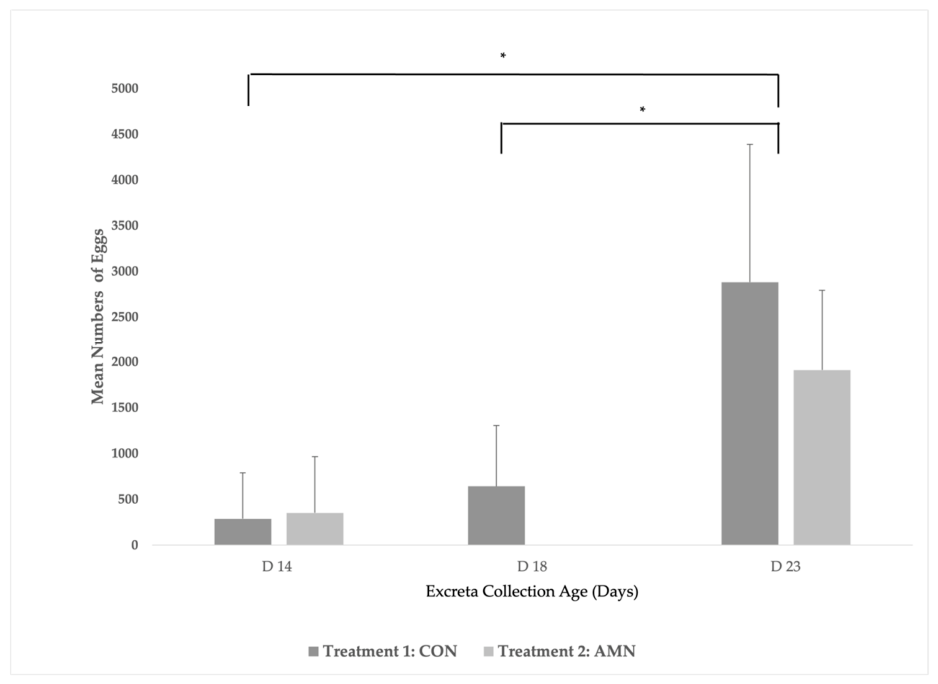
The results of the oviposition assay are shown in Figure 1. No significant differences (p > 0.05) were observed between the treatments, regardless of the date of collection for the oviposition assay. However, significant differences in oviposition were observed across days, with up to three times more eggs deposited on the excreta collected on day 23.
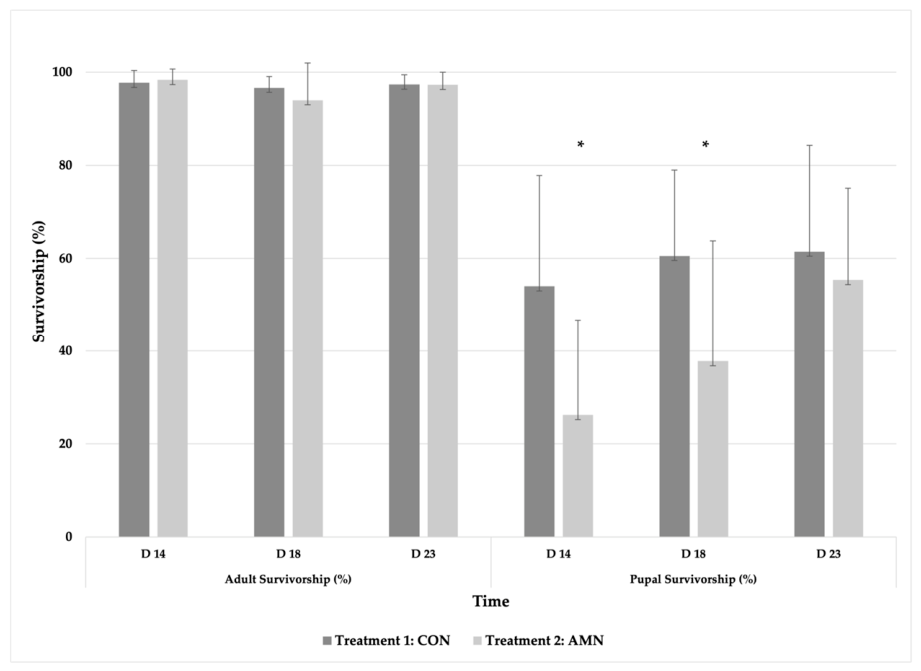
The results of the development assay are shown in Figure 2. A significant difference (p < 0.05) was observed in the survival rate to the pupal stage. In the first two time points, survival to the pupal stage was decreased in the AMN treatment (26.22 ± 20.49; 37.78 ± 25.99%). Survival from the pupal to adult stage was not affected at any of the time points tested (p > 0.05).

4. Discussion

Many studies have examined the utilization of DFMs in commercial broilers and their effects on gut health and performance [1,2,14,17]. Direct-fed microbials have been proven to be efficient in increasing growth parameters, such as BW gain, lowering FCR, and being an adequate alternative to antibiotics [1,2,17,18]. These improvements have been attributed to the production of extracellular enzymes that increase digestibility and absorption of nutrients, including low-quality proteins and fats [2]. Improvements in intestinal morphology and microbial balance that support efficient nutrient absorption have also been observed in Bacillus-based DFMs [17]. In the current study, BW was only higher in AMN broilers on d 14, and body weight-adjusted FCR improved in the AMN group by 2.5%. However, not all the studies report consistent benefits to performance, as Waititu et al. found that a Bacillus-based DFM failed to improve growth performance when supplemented to the broiler diet, despite increasing apparent metabolizable energy, dry matter, and fat retention [19]. This suggests improvements in nutrient retention do not always translate directly into improved performance, and that basal diet composition may also play a role, as Waititu et al. [19] utilized a wheat-based diet that contains higher amounts of non-starch polysaccharides than the corn-soybean meal-based diet used in the current study.
Corticosterone and heterophil/lymphocyte ratios are typical stress measurements when studying stress parameters in broilers [20]. Glucocorticoids can influence the H/L ratio, so when broilers experience stressors, these glucocorticoids can alter the heterophil-to-lymphocyte ratio [20]. DFMs are thought to influence the hypothalamic–pituitary–adrenal (HPA) axis indirectly through the gut–brain axis, where gut microbiota and their metabolites modulate corticosterone secretion by influencing the central nervous system [21]. DFMs reduce intestinal permeability and translocation of microbiota that would otherwise trigger systemic stress and inflammatory responses, leading to elevated corticosterone [21]. In the current study, corticosterone measurements and H/L ratios on d 21 indicated no differences between the two treatments. In the controlled, low-challenge environment used in this study, baseline corticosterone and H/L ratio may have been at homeostatic levels, leaving little room for AMN supplementation to demonstrate measurable stress mitigation. Additionally, the cage-housing system utilized in this study may have limited environmental variability relative to floor-pen housing. Together, this could explain why the findings in the current study do not align with other studies reporting reduced stress and improved welfare with DFM supplementation in poultry [22,23]. In a study conducted on Pekin ducks, corticosterone levels and H/L ratios were lower in ducks supplemented with a Bacillus-based DFM, indicating that DFM supplementation can mitigate stress under different conditions [24].
Amnil clearly impacted the development of house fly immatures in poultry excreta. Interestingly, fly oviposition preference was not observed across treatments within the day of collection but across the days of collection, which is most likely due to the moisture differences recorded, with older excreta having a greater moisture content. Indeed, flies depend on these secretions within feces for nutrition and adequate places to lay eggs [8]. Moisture, pH, and microbial communities are important substrates in oviposition and larval development [10]. In this study, excreta from broilers fed Amnil had a decrease in moisture content, pH, zinc, ADF, and NDF within the day; however, moisture content on d 23 was greater than that for other treatments (i.e., excreta collected earlier). Each of these changes is consistent with a distinct aspect of how DFMs are thought to alter nutrient utilization. The decrease in ADF and NDF likely reflects the DFMs’ ability to improve enzyme activity, including cellulases that improve fiber digestion, resulting in less undigested fiber reaching the excreta [2]. The reduction in pH is consistent with the relationship between gastrointestinal pH and digestive efficiency, as a pH reduction in the gastrointestinal tract increases protein digestion and limits proliferation of pathogenic bacteria [12]. Pathogenic bacteria lead to nutrient fermentation and result in high fecal moisture content and the loss of vital nutrients [12]. A reduction in pathogenic load following AMN supplementation with reduced fermentable substrates from more complete protein and fat digestion could explain the lower moisture levels in excreta observed in the AMN treatment [2]. The decrease in zinc is particularly notable, as Bacillus species are known to produce phytase that liberates phytate-bound minerals from plant-based feedstuffs, and microbial phytase has been shown to increase zinc bioavailability and reduce zinc excretion in broilers [25,26]. These changes indicate improved nutrient utilization and excreta quality. This could result in reduced ammonia and a less favorable environment for harmful microbes and flies to thrive. In the current study, survival to the pupal stage decreased by approximately 50% during the first two time points. Survival from the pupal to the adult stage was not affected, indicating that if the larvae survived to the pupal stage, they were most likely to emerge as adults. House fly larvae development is dependent on moisture levels, bacterial composition, nutritional value, and pH [10]. Therefore, a Bacillus-driven shift in the excreta microbial community, pH, and moisture level could reduce the nutritional resources available and create a less favorable environment for developing larvae [1,2,13,14]. There were no differences in oviposition, indicating that the female flies still laid eggs, but the AMN group decreased the survival rate to the adult stage. There was an increase in oviposition on day 23 excreta compared to the other time points, indicating that flies preferred to lay eggs on excreta from older broilers. House flies have highly sophisticated sensory systems, with olfactory cues being the most important for female house flies to select oviposition sites, as well as moisture and excreta-oriented volatiles that create suitable proxies for larval food [9]. This attraction to older broiler excreta is potentially due to the increase in moisture and pH levels in excreta as broilers age [27]. This increase in moisture and pH would be expected to elevate ammonia and microbial-derived volatiles, strengthening the olfactory cues flies use to identify favorable oviposition sites [9,27]. This could explain why oviposition was not affected by AMN supplementation while larval survival was, since oviposition site selection and larval survival are controlled by separate systems; with female flies responding to olfactory cues for egg laying and larval survival depending on the nutritional and microbial conditions of the substrate they are laid on. Bacillus-based DFMs have also been shown to reduce nitrogen and hydrogen sulfide emissions [28]. The reduction in these foul odors could reduce the attractiveness of feces to flies.

5. Conclusions

Poultry farms always employ strategies to mitigate flies, partly to reduce the risk of spreading diseases. In this study, the DFM treatment decreased the moisture, pH, and acid detergent fiber content of excreta. The DFM also decreased the house fly population by decreasing the survival rate of larvae to the pupal stage. These findings support the hypothesis that a DFM can impact the survival of house fly larvae. Given that there is limited research on how DFMs can impact house fly populations in poultry, this study provides foundational evidence for DFMs as a potential for supporting growth performance and fly management. Future research should include further investigation in commercial-scale settings.

Author Contributions

Conceptualization, H.L.-J. and G.S.A.; methodology, G.S.A., I.V., E.J.J., A.E.M. and J.K.T.; statistical analysis, G.S.A. and J.K.T.; animal care, I.V. and E.J.J.; writing—original draft preparation, E.J.J.; review and editing, G.S.A., H.L.-J., B.P.D. and J.K.T. All authors have read and agreed to the published version of the manuscript.

Funding

Funding for this project was provided by United Animal Health (322 S Main Street, Sheridan, IN 46069, USA), internal ID trial number 25-P016.

Institutional Review Board Statement

Broilers were managed according to the Guide for the Care and Use of Agricultural Animals in Research and Teaching (FASS, 2010) guidelines. All the experimental methods were approved by the Texas A&M Institutional Animal Care and Use Committee (AUP # #2023-0293, approved on 10 August 2023).

Informed Consent Statement

Not applicable.

Data Availability Statement

The datasets presented in this article are not readily available due to privacy. Requests to access the datasets should be directed to authors.

Acknowledgments

We would like to thank James Riggs, a graduate student at Texas A&M University in the Department of Entomology, for his work in the fly portion of this experiment. We would also like to thank the undergraduate students who helped with bird care and data collection.

Conflicts of Interest

The authors declare that this study received funding from United Animal Health. The funder had the following involvement with the study: design of the study, in the review and editing of the manuscript, and in the decision to publish the results, but had no role in data collection or analysis or interpretation of the results. Author Hector Leyva-Jimenez, Brian P. Dirks are employed by the company United Animal Health. The remaining authors declare that the research was conducted in the absence of any commercial or financial relationships that could be construed as a potential conflict of interest.

References

  1. Salim, H.M.; Kang, H.K.; Akter, N.; Kim, D.W.; Kim, M.J.; Na, J.C.; Jong, H.B.; Choi, H.C.; Suh, O.S.; Kim, W.K. Supplementation of direct-fed microbials as an alternative to antibiotics on growth performance, immune response, cecal microbial population, and ileal morphology of broiler chickens. Poult. Sci. 2013, 92, 2084–2090. [Google Scholar] [CrossRef] [PubMed]
  2. De Souza, O.F.; Vecchi, B.; Gumina, E.; Matté, F.; Gazoni, F.L.; Hernandez-Velasco, X.; Hall, J.W.; Stefanello, C.; Layton, S. Development and evaluation of a commercial direct-fed microbial (Zymospore®) on fecal microbiome and growth performance of broiler chickens under experimental challenge conditions. Animals 2022, 12, 1436. [Google Scholar] [CrossRef] [PubMed]
  3. Geden, C.J.; Nayduch, D.; Scott, J.G.; Burgess, E.R.; Gerry, A.C.; Kaufman, P.E.; Thomson, J.; Pickens, V.; Machtinger, E.T. House fly (Diptera: Muscidae): Biology, pest status, current management prospects, and research needs. J. Integr. Pest Manag. 2021, 12, 39. [Google Scholar] [CrossRef]
  4. Machtinger, E.T.; Gerry, A.C.; Murillo, A.C.; Talley, J.L. Filth fly impacts to animal production in the United States and associated research and extension needs. J. Integr. Pest Manag. 2021, 12, 41. [Google Scholar] [CrossRef]
  5. Malik, A.; Singh, N.; Satya, S. House fly (Musca domestica): A review of control strategies for a challenging pest. J. Environ. Sci. Health Part B 2007, 42, 453–469. [Google Scholar] [CrossRef] [PubMed]
  6. Iqbal, W.; Malik, M.F.; Sarwar, M.K.; Azam, I.; Iram, N.; Rashda, A. Role of house fly (Musca domestica, Diprera; Muscidae) as a disease vector; a review. J. Entomol. Zool. Stud. 2014, 2, 159–163. [Google Scholar]
  7. Axtell, R.C. Fly management in poultry production: Cultural, biological, and chemical. Poult. Sci. 1986, 65, 657–667. [Google Scholar] [CrossRef]
  8. Berry, J.G. Fly Control in the Poultry House. The Poultry Site. 2005. Available online: https://www.thepoultrysite.com/articles/fly-control-in-the-poultry-house (accessed on 10 March 2026).
  9. Shah, R.M.; Azhar, F.; Shad, S.A.; Walker, W.B., III; Azeem, M.; Binyameen, M. Effects of different animal manures on attraction and reproductive behaviors of common house fly, Musca domestica L. Parasitol. Res. 2016, 115, 3585–3598. [Google Scholar] [CrossRef] [PubMed]
  10. Machtinger, E.T.; Geden, C.J.; Hogsette, J.A.; Leppla, N.C. Development and oviposition preference of house flies and stable flies (Diptera: Muscidae) in six substrates from Florida equine facilities. J. Med. Entomol. 2014, 51, 144–1150. [Google Scholar] [CrossRef] [PubMed][Green Version]
  11. Calvo, M.S.; Gerry, A.C.; McGarvey, J.A.; Armitage, T.L.; Mitloehner, F.M. Acidification of calf bedding reduces fly development and bacterial abundance. J. Dairy Sci. 2010, 93, 1059–1064. [Google Scholar] [CrossRef] [PubMed]
  12. Ndelekwute, E.K.; Unah, U.L.; Udoh, U.H. Effect of dietary organic acids on nutrient digestibility, faecal moisture, digesta pH and viscosity of broiler chickens. MOJ Anat. Physiol. 2019, 6, 40–43. [Google Scholar] [CrossRef]
  13. Nusairat, B.; Odetallah, N.; Wang, J.J. Live performance and microbial load modulation of broilers fed a direct-fed microbials (DFM) and xylanase combination. Vet. Sci. 2022, 9, 142. [Google Scholar] [CrossRef] [PubMed]
  14. Jha, R.; Das, R.; Oak, S.; Mishra, P. Probiotics (direct-fed microbials) in poultry nutrition and their effects on nutrient utilization, growth and laying performance, and gut health: A systematic review. Animals 2020, 10, 1863. [Google Scholar] [CrossRef] [PubMed]
  15. McGlone, J.; Ford, S.; Mitloehner, F.; Grandin, T.; Ruegg, P.; Stull, C.; Lewis, G.; Swanson, J.; Underwood, W.; Mench, J.; et al. Guide for the Care and Use of Agricultural Animmals in Research and Teaching; Federation of Animal Science Societies FASS: Champaign, IL, USA, 2010; Available online: https://www.fass.org/images/science-policy/Ag_Guide_3rd_ed.pdf (accessed on 25 March 2026).
  16. Hogsette, J.A. New diets for production of house flies and stable flies (Diptera: Muscidae) in the laboratory. J. Econ. Entomol. 1992, 85, 2291–2294. [Google Scholar] [CrossRef] [PubMed]
  17. Latorre, J.D.; Hernandez-Velasco, X.; Vicente, J.L.; Wolfenden, R.; Hargis, B.M.; Tellez, G. Effects of the inclusion of a Bacillus direct-fed microbial on performance parameters, bone quality, recovered gut microflora, and intestinal morphology in broilers consuming a grower diet containing corn distillers dried grains with solubles. Poult. Sci. 2017, 96, 2728–2735. [Google Scholar] [CrossRef] [PubMed]
  18. Nusairat, B.; Wang, J.J. Xylanase and direct-fed microbials (DFM) potential for improvement of live performance, energy digestibility, and reduction of environmental microbial load of broilers. Front. Vet. Sci. 2020, 7, 606415. [Google Scholar] [CrossRef] [PubMed]
  19. Waititu, S.M.; Yitbarek, A.; Matini, E.; Echeverry, H.; Kiarie, E.; Rodriguez-Lecompte, J.C.; Nyachoti, C.M. Effect of supplementing direct-fed microbials on broiler performance, nutrient digestibilities, and immune responses. Poult. Sci. 2014, 93, 625–635. [Google Scholar] [CrossRef] [PubMed]
  20. Scanes, C.G. Biology of stress in poultry with emphasis on glucocorticoids and the heterophil to lymphocyte ratio. Poult. Sci. 2016, 95, 2208–2215. [Google Scholar] [CrossRef] [PubMed]
  21. Beldowska, A.; Barszcz, M.; Dunislawska, A. State of the art in research on the gut-liver and gut-brain axis in poultry. J. Anim. Sci. Biotechnol. 2023, 14, 37. [Google Scholar] [CrossRef] [PubMed]
  22. Sarsour, A.H.; Koltes, D.A.; Kim, E.J.; Persia, M.E. Effects of a direct fed microbial (DFM) on broiler chickens exposed to acute and chronic cyclic heat stress in two consecutive experiments. Poult. Sci. 2022, 101, 101705. [Google Scholar] [CrossRef] [PubMed]
  23. Nungsih, N.; Respati, A.N.; Astuti, D.; Triswanto, T.; Purnamayanti, L.; Yano, A.A.; Putra, R.P.; Jayanegara, A.; Ratriyanto, A.; Irawan, A. Efficacy of Bacillus subtilis to replace in-feed antibiotics of broiler chickens under necrotic enteritis-challenged experiments: A systemic review and meta-analysis. Poult. Sci. 2023, 102, 102923. [Google Scholar] [CrossRef] [PubMed]
  24. Rocha, J.J.; Leyva-Jimenez, H.; Burden, Y.; Dirks, B.; Archer, G.S. The effect of dietary supplementation of a Bacillus-based direct fed-microbial on Pekin duck performance and welfare. J. Appl. Poult. Res. 2024, 33, 100453. [Google Scholar] [CrossRef]
  25. Madhvi, M.; Shah, H. Phytase from Bacillus subtilis BGS3: Purification, characterization, and evaluation of its potential to enhance nutritional availability in food and feed. Biosci. Biotechnol. Res. Asia 2025, 22, 4. [Google Scholar] [CrossRef]
  26. Khaksar, V.; Hervo, F.; Même, N.; Monteiro, A.R.; Narcy, A. Effects of dietary calcium and microbial phytase on the bioavailability of two sources of zinc in broilers. Br. Poult. Sci. 2025, 66, 107–115. [Google Scholar] [CrossRef] [PubMed]
  27. do Amaral Vercellino, R.; de Alencar Nääs, I.; Jorge de Moura, D.; de Souza Granja Barros, J.; Duarte de Silva Lima, N. A multifactorial way to assess litter stability and ammonia risk in broiler production: Effects across age (7–39 days) and thermal environments. Ital. J. Anim. Sci. 2025, 24, 2520–2530. [Google Scholar] [CrossRef]
  28. Leyva-Jimenez, H.; Shen, S.; McCormick, K.; Martin, M.; Liu, P.; Haag, D.; Galbraith, E.; Blair, M. Applied research note: Evaluation of a Bacillus-based direct-fed microbial as a strategy to reduce hydrogen sulfide emissions from poultry excreta using a practical monitoring method. J. Appl. Poult. Res. 2022, 31, 100231. [Google Scholar] [CrossRef]
Figure 1. Number of house fly eggs deposited on each treatment from excreta collected from broilers at 14, 18, and 23 days of age. Asterisks indicate significant differences (p < 0.05). Bars represent mean ± SEM.
Poultry 05 00050 g001
Figure 2. House fly immature survivorship to pupal and adult stages for larvae fed excreta with and without Amnil. Asterisks indicate significant treatment effects at a given time point (p < 0.05). Bars represent mean ± SD.
Poultry 05 00050 g002
Table 1. Basal diet composition.
Ingredient (%)Starter 0–23 d
Yellow Corn48.65
DDGS 15.00
Soybean Oil3.50
Soybean Meal39.07
Vitamin premix 20.25
Trace Mineral premix 30.05
Limestone1.38
Mono-Dical Phosphate1.55
Salt (NaCl)0.26
L-Lysine HCL0.04
DL-Methionine0.25
Calculated nutrients (%)
ME (kcal/kg)3000
Crude Protein24.3
Crude Fat6.0
Crude fiber3.4
Calcium0.9
Available P0.45
Digestible Lysine1.22
Digestible Methionine + Cysteine0.91
Digestible Threonine0.80
Digestible Arginine1.48
Sodium0.16
1 DDGS, distillers dried grains with solubles. 2 Vitamin premix added at this rate yields per kg of diet: 11,023 IU vitamin A, 46 IU vitamin E, 3858 IU vitamin D3, 1.47 mg menadione, 2.94 mg thiamine, 5.85 mg riboflavin, 45.93 mg niacin, 20.21 mg d-pantothenic acid, 7.17 mg pyridoxine, 0.55 mg biotin, 1.75 mg folic acid, 0.017 mg vitamin B12, 130.6 mg choline. 3 Mineral premix added at this rate yields per kg of feed: 7 mg copper, 0.4 mg iodine, 60 mg iron, 60 mg manganese, 60 mg zinc.
Table 2. Proximate analysis of basal diet 1.
StarterUnits
Moisture12.61%
Dry Matter87.39%
Protein (Crude)21.1%
Fat (Crude)5.67%
Fiber (Acid Detergent)1.2%
Ash6.27%
Calcium (total)1.38%
Sodium (total)0.10%
1 Proximate analyses completed by Midwest Laboratories.
Table 3. Performance results of broilers fed Bacillus-based DFM supplementation 1,2.
VariableTreatmentp-ValueSEM
BW (g)CONAMN
D 043.843.70.100.70
D 7191.2191.70.901.9
D 14467.6 b484.9 a0.050.36
D 21888.9902.80.367.5
FC (g/b/d)
D 0–721.922.60.170.24
D 7–1446.948.50.180.59
D 0–1434.435.50.090.33
D 14–21103.2 a100.7 b0.0450.61
D 0–2157.157.20.810.26
FCR
D 0–71.045 b1.079 a0.010.007
D 7–141.2151.1650.150.017
D 0–141.1491.1310.310.009
D 14–211.7371.8070.500.051
D 0–211.4321.4210.620.011
D 0–21 A 31.432 a1.396 b0.050.012
Mortality (%)
D 0–70.00.00.0
D 7–141.040.350.310.34
D 0–141.040.350.310.34
D 14–210.340.350.990.73
D 0–211.390.700.410.80
1 CON, control; AMN, CON + 500 ppm of Amnil. 2 FC, feed consumption; FCR, feed conversion ratio. 3 Body weight adjusted FCR to 888.9 g. a,b means with different superscripts within a row differ (p < 0.05).
Table 4. Total plasma corticosterone concentrations and H/L ratio of broilers fed Bacillus-based DFM supplementation 1 on Day 21.
TreatmentCorticosterone Concentrations (pg/mL)Heterophil/Lymphocyte Ratio
CON18350.40
AMN16510.43
p-Value0.680.14
SEM2990.01
1 CON, control; AMN, CON + 500 ppm of Amnil.
Table 5. Proximate analysis results for excreta day 18 and 23 1.
Day 18Day 23
VariableCONAMNSEMp-ValueCONAMNSEMp-Value
Dry Matter %26.48 b29.42 a0.940.04522.8324.370.830.213
pH5.92 a5.41 b0.04<0.0016.06 a5.70 b0.05<0.001
P %3.413.280.060.1593.543.320.070.052
K %4.083.920.060.1123.953.820.080.279
S %0.550.560.010.3790.570.580.010.654
Zn ppm391.04 a336.53 b6.88<0.001390.90 a335.89 b9.810.001
ADF %11.65 a10.84 b0.210.02111.0711.340.340.600
NDF %25.36 a23.07 b0.460.00326.2825.650.490.386
1 CON, control; AMN, CON + 500 ppm of Amnil; all the results expressed on a dry matter basis. a,b means with different superscripts within a row differ (p < 0.05).
Disclaimer/Publisher’s Note: The statements, opinions and data contained in all publications are solely those of the individual author(s) and contributor(s) and not of MDPI and/or the editor(s). MDPI and/or the editor(s) disclaim responsibility for any injury to people or property resulting from any ideas, methods, instructions or products referred to in the content.