Article

Comparative Evaluation of Rice Hulls, Lentil Hulls, and Wood Shavings as Insoluble Fiber Sources in Broiler Chicken Starter Diets

by
R. M. S. Dilshan B. Kulathunga
,
W. Nipuna U. Perera
* and
Janak K. Vidanarachchi
Department of Animal Science, Faculty of Agriculture, University of Peradeniya, Peradeniya 20400, Sri Lanka
*
Author to whom correspondence should be addressed.
Poultry 2026, 5(4), 49; https://doi.org/10.3390/poultry5040049
Submission received: 13 March 2026 / Revised: 7 May 2026 / Accepted: 14 May 2026 / Published: 10 July 2026
(This article belongs to the Collection Poultry Nutrition)

Abstract

A 21-day experiment evaluated the effect of different insoluble fiber (IF) sources on growth performance, nutrient and energy utilization, and foregut organ development of broiler chicken starters fed mash diets. Four dietary treatments were developed: a control (a commercial broiler chicken starter diet) and three experimental diets prepared by diluting the control diet (60 g/kg [w/w]) with three IF sources (rice hulls [RH], lentil hulls [LH], and wood shavings [WS]). A total of 120, one-day-old broiler chicks (6 birds/cage; 5 cages/treatment) were used in a completely randomized design. Compared with birds fed the control diet, those fed IF-containing diets showed lower WG and FI (p < 0.001). Feed per gain (F/G; p < 0.05; d1-21) was lowest in the control; however, after correcting for IF inclusion, F/G was not affected by dietary treatments (p > 0.05). The effects of IF on foregut development were source-dependent. Feeding RH and WS improved crop development (p < 0.05) compared to the control. Incorporating RH resulted in higher gizzard growth (p < 0.05) compared to the control and LH diets. Birds fed RH and LH had lower (p < 0.05) gizzard pH compared to those fed WS. Despite being considered a nutrient diluent, tested IF did not impair (p > 0.05) the energy utilization or nutrient digestibility.

1. Introduction

With the evolution of intensive commercial feeding practices, the roles of certain parts of the digestive tract of chickens have been neglected. Current broiler chicken feeding practices that focus on achieving high intakes of digestible nutrients have resulted in reduced functional stimulation in the gizzard and a diminished role of the crop as a storage organ. Re-establishment of their innate feeding behavior [1] and ancestral roles of the foregut of broiler chickens, such as longer feed retention in the crop and grinding activity in the gizzard, seems to be successful in achieving performance progress and promoting overall gut health [2].
Inclusion of insoluble fiber (IF) sources [3], coarse cereal particles [4,5,6], or whole grains [7] in the poultry diets has been associated with enhanced gizzard function and reduced gizzard pH, which can act as a barrier to ingested pathogens and limit their passage into the intestinal tract [8,9]. Among these strategies, the dietary inclusion of IF sources appears particularly advantageous for broader adoption, as it requires minimal processing and limited technical input and can be readily implemented across diverse poultry production systems.
The benefits of a well-developed gizzard on feed efficiency and nutrient utilization are well documented [9,10]. The gizzard can modulate the rate of starch passage to the lower gastrointestinal tract, thereby preventing starch overload and aiding efficient starch digestion. Accordingly, a positive association between gizzard weight and starch digestibility has been consistently reported [10]. As the main energy-yielding nutrient, improved starch digestibility can enhance energy utilization and positively contribute to the performance of broiler chickens [6,11]. Moreover, larger gizzards and the consequent increase in gastric reflux between the gizzard and proventriculus provide more time for gastric enzyme and protease activities in the foregut, aiding protein digestion [9]. Lower gizzard pH also enhances pepsin activity [12], facilitating initial protein hydrolysis.
Rodrigues and Choct [2] highlighted that a primary objective of feed additives used to replace antibiotic growth promoters (e.g., organic acids, prebiotics, and probiotics) is to lower gastrointestinal pH and thereby support a healthy gut environment. Due to the close functional interaction between the proventriculus and the gizzard, the efficiency of pepsin and hydrochloric acid activity is influenced by gizzard function, particularly contraction intensity and digesta retention time. The low pH generated in the stomach contributes to gut health through its antimicrobial effects, indicating that gizzard function plays an important role in regulating the foregut environment [9]. In this context, improving foregut function through dietary strategies may be a practical way to support gut health while reducing reliance on feed additives [2].
The IF was historically known as a nutrient diluent with little or no effect on nutrient utilization [13]. However, recent findings contradict this belief by recognizing the role of IF in improving gut health, enhancing nutrient digestion, and modulating the behavior of animals [14,15]. Consequently, it is now recommended to include moderate amounts of coarse IF, such as wood shavings (WS) [14,16] and oat hulls [17], at levels between 2 and 3% in modern low-fiber broiler chicken diets [18].
Insoluble fiber can differ in structure, solubility, water-holding capacity, viscosity, bulking capacity, and other physicochemical properties [19], which may influence its functional effects within the gastrointestinal tract. In the present study, three locally available and low-cost fiber sources, rice hulls (RH), lentil hulls (LH), and WS, were selected. Among them, RH are characterized by a high lignin and silica content and a rigid structure [20], whereas WS represents a highly lignified, structurally coarse material with very low fermentability, primarily contributing to physical bulk [21]. In contrast, LH are rich in IF and polyphenolic compounds and have been associated with potential prebiotic and antioxidant properties [22]. Despite substantial research on lentil-based ingredients as protein substitutes for soybean meal, limited information is available on the use of LH specifically as an IF source in broiler nutrition [23]. Conversely, more conventional IF sources, such as WS [14,16] and RH [17,24,25], have been investigated more extensively in broiler diets. According to the authors’ knowledge, no study has comparatively evaluated RH, LH, and WS as IF sources under identical inclusion levels and dietary dilution conditions in mash broiler starter diets.
Accordingly, the objective of this study was to evaluate the effects of different IF sources, RH, LH, and WS, in which comparative evaluation under identical inclusion level and mash diet conditions remains limited, in terms of growth performance, foregut development, and the utilization of energy and nutrients in broiler chicken starter diets. It was hypothesized that different IF sources would differentially influence the development of the foregut, leading to variations in nutrient utilization and growth performance in broiler starters.

2. Materials and Methods

2.1. Diets

The IF sources (RH, LH, and WS) were cleaned and ground in a hammer mill and passed through a 1.0 mm screen to achieve the desired particle size. A control diet of commercial broiler chicken starter diet (mash) and three experimental diets containing RH, LH, and WS (60 g/kg feed) were used in the experiment. The experimental diets were formulated using a dilution approach, and therefore, they were not iso-nutrient or iso-energy across treatments. The inclusion level of 60 g/kg of feed was selected based on previous studies [16,26] evaluating the effects of IF on gastrointestinal development and nutrient utilization in broilers. Representative diet samples were collected for the analysis of dry matter (DM), gross energy (GE), nitrogen (N), acid-insoluble ash (AIA), crude fiber (CF), and crude fat (EE).

2.2. Birds and Housing

The experimental procedures were approved by the Ethical Review Committee, Faculty of Agriculture, University of Peradeniya, Sri Lanka (ECC/2023/E/065). A total of 120, one-day-old Cobb-500 broiler chicks were obtained from Central Poultry Research Station, Karandagolla, Sri Lanka. Birds were individually weighed and randomly allocated to 20 cages measuring 0.9144 × 0.6096 × 0.7620 m, with a floor area of 0.6967 m2, with six birds per cage, ensuring similar average body weight across cages. Fresh and clean water was provided ad libitum to the birds through 1 L drinkers at a ratio of one drinker per six birds per cage. The temperature was maintained at 32 °C during the first week, with a 60 W bulb per cage, and gradually decreased to approximately 26 °C by the end of the third week of the experiment. During the first week, light was provided for 24 h, after which a 6 h dark period was maintained as a single block until the end of the experimental period. Ventilation was allowed through the wire-meshed side walls of the poultry experimental unit. Each of the four dietary treatments was randomly assigned to five cages and was offered ad libitum. The birds were continued on experimental diets until day 21. Excreta were collected from day 17 to day 21 to determine the apparent metabolizable energy (AME).

2.3. Growth Performance

Body weights (BW) and feed intake (FI) were recorded on a cage basis at weekly intervals. Mortality was calculated as a percentage of birds per replicate, and then an average value of mortality (%) per treatment was calculated. The weight of dead birds was recorded, and feed per gain (F/G) values were corrected for the BW of birds that died during the experiment. Fiber-corrected F/G were also calculated by subtracting the amount of RH, LH, and WS from the total FI [5,14,16].

2.4. Energy and Nutrient Utilization

2.4.1. Nitrogen-Corrected Apparent Metabolizable Energy (AMEn)

The AMEn was determined using the total excreta collection method. The FI and total excreta output of each cage were measured from day 17 to 21 post-hatch. A subsample of excreta was collected from each cage daily from d 17 to 21 post-hatch, and all subsamples were pooled to obtain a representative sample for analysis. These samples were dried at 60 °C in a drying oven (Model DX 600, Yamato, Tokyo, Japan) until they reached a constant weight, then ground to pass through a 1.0 mm sieve using a grinder (Model ZM 200, Ultra Centrifugal Mill, RETSCH GmbH, Haan, Germany). The ground samples were stored in airtight Ziplock bags at −18 °C pending analyses. The excreta samples were analyzed for DM, GE, and N.

2.4.2. Coefficient of Apparent Ileal Digestibility of Nutrients (CAID)

On day 22, all broiler chickens in each cage were humanely slaughtered by a deep horizontal ventral neck cut across the front and both sides of the throat, just below the jawbone. This procedure reliably severs both common carotid arteries and external jugular veins and is recognized as a humane method of slaughter [27]. Digesta were collected from the lower half of the ileum by gently flushing with distilled water as described by [28]. The digesta from birds within a cage were pooled and stored at −18 °C. Then, the samples were dried at 60 °C in a drying oven (Model DX600, Yamato Scientific, Japan) until a constant weight and ground in the same manner as the excreta. The ileum samples were analyzed for DM, AIA, N, and fat. Apparent ileal digestibility coefficients (CAID) were calculated using AIA as the internal marker.

2.5. Gizzard pH

The gizzards of two birds from each replicate cage, euthanized for ileal digesta collection, were used. The pH was measured using a calibrated digital pH meter (pH/Temperature Tester, Model HI98128, Hanna Instruments, Shanghai, China) by inserting the probe directly into three different parts (proximal, middle, and distal) of the gizzard from each bird. Readings were recorded after the stabilization of the value, and the average of the three readings was considered the final pH value.

2.6. Measurements on Foregut Development

The digestive tract, from the crop to the gizzard of two birds from each replicate cage, euthanized for ileal digesta collection, was carefully excised, and adherent fat was removed. The digesta of the crop, proventriculus, and gizzard were removed by washing them away to ensure uniformity in recording the empty weights of those organs in individual birds. The relative weights of these organs were determined and reported as g/kg of BW.

2.7. Chemical Analysis

Dry matter content was determined following standard procedures outlined in Method 934.01 [29]. The nitrogen content was measured using the Kjeldahl method (Method 955.04) [29]. The gross energy contents of diets and excreta were determined using an IKA bomb calorimeter system, C7000 with Cooler C7002 (IKA®-Werke GmbH & Co., Staufen, Germany) standardized with benzoic acid. Crude fat content was assessed using the gravimetric method (Method 954.02) [30], while CF content was analyzed using the fritted glass crucible method (Method 978.10) [30].

2.8. Calculations

The AME of the diets was calculated using the following formula:
AMEdiet (MJ/kg) = [(FI × GEdiet) − (Excreta output × GEexcreta)]/FI
Correction for zero N retention was made using the factor of 36.54 kJ per g N retained in the body [31]. The following formula was used for AMEn calculation.
AMEndiet (MJ/kg) = [AMEdiet − (36.54 × N retention)]/1000
The apparent ileal digestibility coefficient of nutrients was calculated from the dietary ratio of nutrients to AIA relative to the corresponding ratio in the ileal digesta.
CAID of nutrient = [(Nutrient⁄AIA)diet − (Nutrient⁄AIA)illealdigesta]/(Nutrient⁄AIA)diet
The F/G of birds fed IF-diluted diets was adjusted by subtracting the amount of IF from the total FI.
Fiber-corrected F/G = (Total FI−IF intake)/WG

2.9. Statistical Analysis

Data were tested for normality using the Shapiro–Wilk test and for homogeneity of variance using Levene’s test. These data were then analyzed as a one-way ANOVA arrangement of treatments using the General Linear Model procedure of SAS Studio (SAS OnDemand for Academics, Enterprise Edition, version 3.82; SAS Institute Inc., Cary, NC, USA). Cages served as experimental units. The significant difference between the means was separated by the Least Significant Difference test. Significance was declared at p < 0.05.

3. Results

3.1. Feed Evaluation

Table 1 presents the proximate analysis results for the three IF sources used in the experiment. The results showed that WS had the highest CF content among the three sources. The proximate composition of the experimental diets (Table 2) showed that, due to the dilution approach used in their formulation, the diets were not iso-nitrogenous or iso-energetic. Consequently, although IF sources were included at comparable levels, the analyzed CF content varied among diets, primarily reflecting differences in the IF content of the respective fiber sources.

3.2. Growth Performance

Table 3 shows the influence of dietary inclusion of IF on WG, FI, and F/G of 21-day-old broiler starters. Compared with the control, birds fed IF-containing diets showed lower (p < 0.001) WG (reduced by 10.46, 11.16, and 12.47% for RH, LH, and WS, respectively) and FI (reduced by 10.41, 10.41, and 10.62% for RH, LH, and WS, respectively), and consequently higher F/G (increased by 7.4, 8.0, and 10.4 points for RH, LH, and WS, respectively).
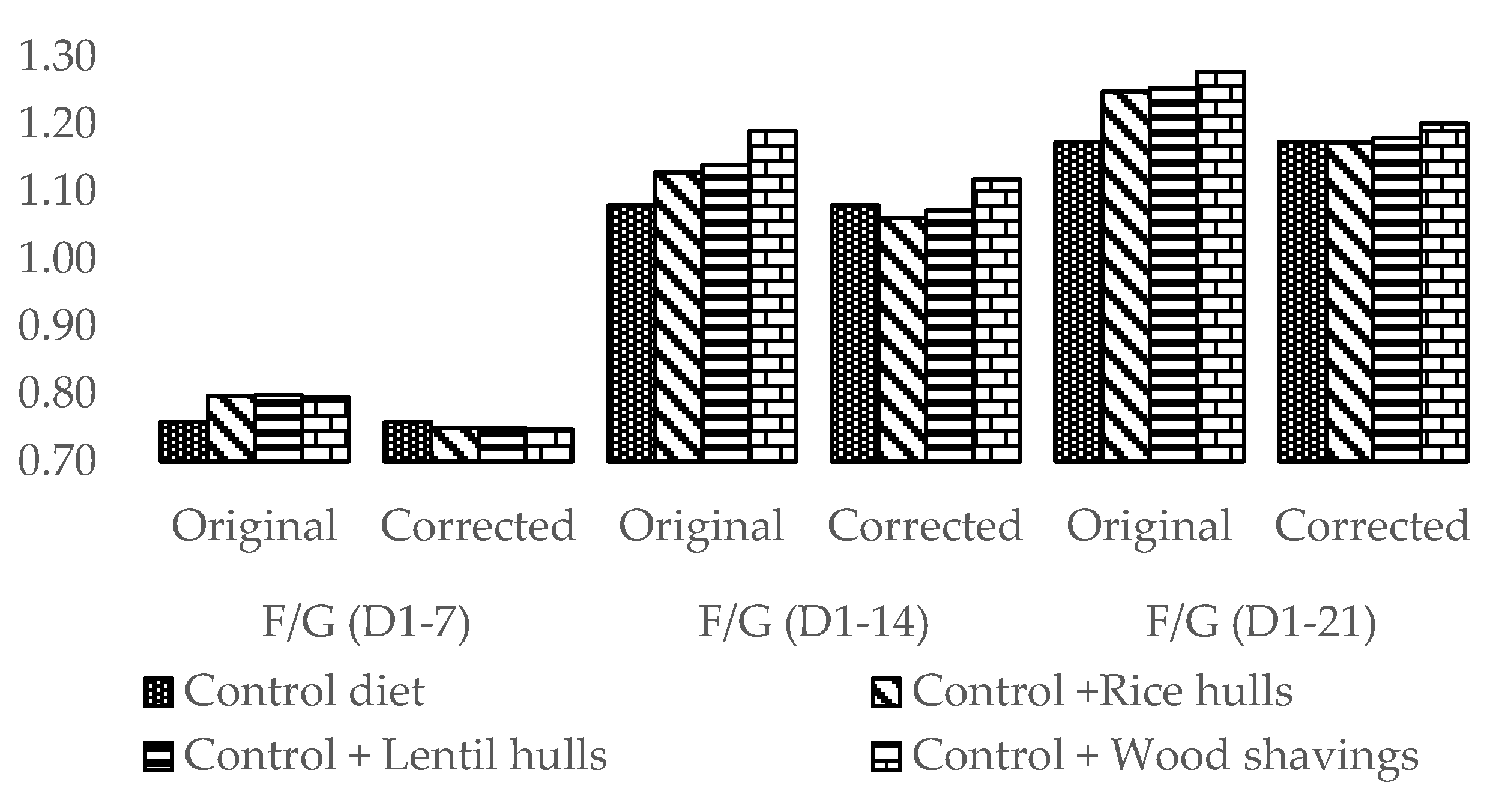
As IF contributes little to digestible nutrients or energy, the F/G of birds fed IF-containing diets was corrected by subtracting the weight of added IF from total FI [5,14,16]. Table 4 and Figure 1 show the effects of dietary IF supplementation on original and fiber-corrected F/G of broiler starters. No significant differences in either original or fiber-corrected F/G values were observed among treatments up to 7 d (p > 0.05). At 14 d, the IF source significantly affected both original and fiber-corrected F/G (p < 0.05), whereas the control diet had lower original F/G than the LH and WS diets, whilst the RH diet had lower fiber-corrected F/G than WS. By 21 d, all IF-supplemented diets showed higher original F/G than the control, but fiber-corrected F/G did not differ among treatments.

3.3. Energy and Nutrient Utilization

Table 5 shows the results of the influence of dietary inclusion of IF on the energy utilization of 21-day-old broiler starters, which indicate that the energy utilization of birds remained unaffected by the dietary inclusion of different IF sources. The influence of dietary inclusion of IF on the CAID of DM, protein, and fat of 21-day-old broiler chicken starter diets is shown in Table 5. Even though IF is considered a nutrient diluent that can impair nutrient digestibility in poultry, the current findings show no impact of feeding RH, LH, or WS on the CAID of DM, protein, and fat compared with the control diet.

3.4. Foregut Development and Gizzard pH

The relative weights of the crop, proventriculus, gizzard, and gizzard pH of broiler chicken starter diets fed different IF sources are shown in Table 6. The relative weights of the crop and gizzard were significantly influenced by the IF inclusion in the diet (p < 0.05), while the development of the proventriculus remained unaffected (p > 0.05). Compared to the control diet, RH and WS diets promoted crop development (p < 0.05).
Compared with the control and LH diets, birds fed the RH diet showed a higher gizzard weight. Gizzard pH differed among treatments, with birds fed the WS diet showing a higher value than those fed the RH and LH diets. The control diet showed intermediate values, indicating no significant difference from the IF-supplemented diets.

4. Discussion

Considering the proximate compositions of the fiber sources, the highest CF content in the WS can be primarily attributed to the high concentrations of lignin and cellulose typically found in timber-derived materials [32]. The current findings are in agreement with Röhe and Zentek [21], who reported variable CF levels among fiber sources that arise as by-products of different industrial processes. These variations can be attributed to differences in IF content, and CF is only an indicative measure that does not fully capture total dietary fiber or its internal fractions [15].
The lower WG and FI of birds fed diets with IF, irrespective of the source, than birds fed with the control diet, may be attributed to the lower palatability of the IF-included diets. Jiménez-Moreno et al. [33] suggested that the inclusion of IF can reduce FI in broiler chicken starter diets due to the resulting texture and mouthfeel of the feed. On the other hand, the current finding contradicts those of Amerah et al. [16], Shakouri et al. [34], and Svihus and Hetland [35], who reported increased FI when diets were diluted with cellulose, consistent with the concept that broilers adjust FI to meet energy requirements [1]. However, the present findings align with Classen [36], indicating that FI regulation is complex and influenced by multiple factors beyond dietary energy concentration, including the physicochemical characteristics of the IF source [24].
In this regard, the effects of IF on digesta passage rate may be particularly relevant. Passage rate is influenced by particle size, whereas finer particles accelerate digesta flow and may increase FI, and coarser particles tend to accumulate in the gizzard, reduce passage rate, and consequently lower FI [3,16]. Notably, studies reporting higher FI [16,34,35] have typically used finely ground cellulose in powder form.
Most dietary IF passes through the chicken gut largely undigested [14,15]. Given the inclusion level of IF in the current study (60 g/kg diet) in the experimental diets, it was speculated that 6% of the diet passed through the gut undigested, while ~94% of the commercial feed was digested. Accordingly, correcting FI to obtain a fiber-corrected F/G value provides an additional approach to interpreting feed efficiency by accounting for the bulk contribution of the added indigestible fraction, thereby offering an alternative perspective for comparison [5,14,16]. It should be noted that this correction does not imply that IF is nutritionally inert; rather, it is intended as an interpretative adjustment to help distinguish the physical dilution effect of added IF from the utilization of the remaining commercial diet. From a practical standpoint, F/G is a key economic indicator, particularly in commercial poultry production. Hence, the current results on fiber-corrected F/G may indicate that a 60 g/kg inclusion of tested IF does not necessarily increase feed cost per unit of gain, despite a reduction in growth rate.
Based on fiber-corrected values, 14-day-old birds fed RH diets showed lower F/G than birds fed WS diets, whereas by 21 d, F/G was unaffected by dietary treatment. This is consistent with Abdollahi et al. [5], who reported similar fiber-corrected F/G values when comparing lignocellulose, oat hulls, and WS in broiler starter diets. However, these results contrast with those of Amerah et al. [16] and Hetland et al. [14], who observed improved fiber-corrected gain-to-feed ratios when wheat-based diets were diluted with oat hulls and WS, respectively. The discrepancy may primarily be due to differences in feed form: mash in the present study and Abdollahi et al. [5], versus pellets in Hetland et al. [14] and Amerah et al. [16].
As indicated by the proximate composition of the experimental diets, incorporating IF increased dietary fiber content. While this contributes to the DM and GE content of the diets, a greater proportion remains undigested in the digesta due to the limited capacity of broiler chickens to hydrolyze and utilize dietary fiber [5]. Nevertheless, the expected nutrient dilution due to increased gut fill by IF [14,33] was not observed in the current study. These findings are consistent with Kakhki et al. [17], who reported no differences in AME among diets containing oat hulls, beet pulp, or RH, at 3% inclusion level in broiler diets at 22 d of age, and with Amerah et al. [16], who observed that AMEn was not affected by the inclusion of cellulose or WS at a 6% inclusion level in broilers at 21 d of age. Amerah et al. [16] also applied a correction for AMEn when IF was included and reported higher AMEn in response to feeding cellulose and WS. In contrast, Jimenez-Moreno et al. [37,38] reported increases in AMEn following the addition of IF sources, with the magnitude of the effect being fiber-type dependent. Abdollahi et al. [5], however, reported lower AME in response to oat hulls and WS inclusion, suggesting that such discrepancies may arise from differences in fiber type and particle size, the fiber concentration in the control diet, and variations in control diet formulation (e.g., use of fillers in the diet substituted with fiber sources). Overall, the results of the current study showed that the inclusion of the tested IF sources at 60 g/kg diet did not compromise energy or nutrient utilization.
Improved gut motility and microbial fermentation, mainly by providing fermentable substrates in a diet such as IF, can promote crop development [37]. The gizzard is the main organ responsible for the mechanical digestion of feeds within the poultry gastrointestinal tract [9], whereas the dietary inclusion of IF stimulates gizzard development for extensive mechanical processing and an extended retention period of digesta [5,16]. During sampling, large amounts of IF were also observed to accumulate in the gizzard. Amerah et al. [16] reported that the inclusion of WS increased the relative weight of the gizzard when fed to broiler starters at an inclusion level similar to the current study.
Larger gizzards and increased gastric reflux between the gizzard and proventriculus cause the gizzard pH to drop and promote gastric enzyme and protease activities, aiding protein digestion. Moreover, a lower pH in the gastrointestinal tract helps maintain a healthy digestive environment [8,9]. Lower pH can be achieved in the foregut by promoting prolonged retention in the gizzard [12]. Nevertheless, without significant development in the gizzard, the birds fed LH also showed a lower gizzard pH value, and even with a higher relative weight of the gizzard, WS-fed birds showed a higher gizzard pH. While the relationship between gizzard development and gizzard pH is well established in the literature [9,10], exploring other factors that may contribute to a lower gizzard pH is recommended.
Despite the proposed role of lower gizzard pH in enhancing protein digestibility [6] and lower gizzard pH in birds fed RH and LH diets compared with those fed WS, the current findings showed no effect of IF inclusion on the CAID of protein. Adibmoradi et al. [24], who compared RH and barley hulls at 0.75 and 1.5% inclusion levels replacing wheat, reported improved CP digestibility, although no effects on gizzard weight were observed, and gizzard pH was not recorded. In contrast, Kakhki et al. [17], who evaluated alternative fibrous ingredients to oat hulls, found no effects of fiber source (oat hulls, beet pulp, or RH) on protein digestibility or AME at 22 days of age, along with no prominent effect on gizzard development or pH changes. Overall, the discrepancies between the present findings and previous studies suggest that mechanisms beyond those associated with gizzard development and acidification may influence nutrient utilization in broiler starters fed IF-incorporated mash diets.
Although the current design had some limitations, the results nevertheless have implications for understanding the effect of the tested IF on the growth performance, nutrient digestibility, and foregut development of broiler starters. First, the relatively short experimental duration (21 days) was selected to capture early physiological and developmental responses to IF, which are most pronounced during the starter phase [25]. However, caution is warranted when extrapolating these findings to later growth stages. Second, the use of mash diets was intentional to preserve feed structure and better reflect the physical effects of IF, although this may limit direct comparison with pelleted feeding systems. Previous studies have evaluated IF using dietary dilution [38,39,40], replacement of inert fillers, or substitution of nutrient-dense ingredients such as wheat [17]. In the present study, a dilution approach was adopted to reflect the functional role of IF when added as a nutrient diluent and to enhance the practical relevance of the findings under applied feeding conditions. Accordingly, diets were not formulated to be iso-nutrient or iso-energetic across treatments. As highlighted by Tejeda and Kim [15], responses to dietary fiber are influenced by formulation strategy, which should be considered when interpreting the present results. Overall, the findings support the view that IF functions not merely as a nutrient diluent, but as a functional dietary component capable of modulating digestive tract development, nutrient utilization, and growth performance in broiler starters, with particular relevance to production systems in developing countries where agro-industrial by-products remain underutilized.


5. Conclusions

Despite being considered a nutrient diluent, tested IF did not impair the energy, protein, and fat utilization in 21-day-old broiler starters fed mash diets. Lack of impact of IF supplementation on corrected F/G, taken together with energy and nutrient utilization results, suggests that the apparent increase in original F/G with IF inclusion can be due to the indigestible fiber fraction. The fiber-corrected F/G results suggest that including 60 g/kg of the tested IF does not necessarily increase feed cost per unit of gain, despite a reduced growth rate. The effects of IF on foregut development differed by source. Therefore, improving feed structure through strategic manipulation of IF sources may address concerns about suboptimal upper-gut function associated with highly processed diets. However, the absence of a clear relationship between gizzard development, gizzard pH, and nutrient or energy utilization indicates that enhanced gizzard function does not necessarily translate into improved digestibility. Further studies focusing on IF by type, particle size, inclusion levels, and digestive mechanisms, such as enzyme activity, digesta kinetics, and microbial interactions, are therefore warranted to better elucidate the functional role of IF beyond its effects on foregut development.

Author Contributions

Conceptualization, W.N.U.P. and J.K.V.; methodology, W.N.U.P. and R.M.S.D.B.K.; software, R.M.S.D.B.K.; validation, R.M.S.D.B.K., W.N.U.P., and J.K.V.; formal analysis, R.M.S.D.B.K.; investigation, R.M.S.D.B.K.; resources, W.N.U.P.; data curation, W.N.U.P.; writing—original draft preparation, R.M.S.D.B.K.; writing—review and editing, W.N.U.P. and J.K.V.; visualization, W.N.U.P., R.M.S.D.B.K., and J.K.V.; supervision, W.N.U.P.; project administration, W.N.U.P.; funding acquisition, W.N.U.P. All authors have read and agreed to the published version of the manuscript.

Funding

This research was funded by the University of Peradeniya, Sri Lanka through University Research Grant URG/2021/48/Ag.

Institutional Review Board Statement

The animal study protocol was approved by the Ethical Review Committee of the Faculty of Agriculture, University of Peradeniya, Sri Lanka (ECC/2023/E/065 and date of approval: 3 July 2024).

Informed Consent Statement

Not applicable.

Data Availability Statement

The original contributions presented in this study are included in the article. Further inquiries can be directed to the corresponding author.

Acknowledgments

The authors wish to thank the academic and technical staff and students of the Department of Animal Science, Faculty of Agriculture, University of Peradeniya, Sri Lanka for their support in conducting the field experiment.

Conflicts of Interest

The authors declare no conflicts of interest. The funders had no role in the design of the study; in the collection, analyses, or interpretation of data; in the writing of the manuscript; or in the decision to publish the results.

Abbreviations

The following abbreviations are used in this manuscript:
AIAAcid Insoluble Ash
AMEApparent Metabolizable Energy
AMEnNitrogen-Corrected Apparent Metabolizable Energy
ANOVAAnalysis of Variance
BWBody Weight
CAIDCoefficient of Apparent Ileal Digestibility
CFCrude Fiber
DMDry Matter
EEEther Extract
F/GFeed per Gain
FIFeed Intake
GEGross Energy
IFInsoluble Fiber
LHLentil Hulls
NNitrogen
RHRice Hulls
WSWood Shavings

References

  1. Ferket, P.R.; Gernat, A.G. Factors that affect feed intake of meat birds: A review. Int. J. Poult. Sci. 2006, 5, 905–911. [Google Scholar] [CrossRef]
  2. Rodrigues, I.; Choct, M. The foregut and its manipulation via feeding practices in the chicken. Poult. Sci. 2018, 97, 3188–3206. [Google Scholar] [CrossRef]
  3. Hetland, H.; Choct, M.; Svihus, B. Role of insoluble non-starch polysaccharides in poultry nutrition. Worlds Poult. Sci. J. 2004, 60, 415–422. [Google Scholar] [CrossRef]
  4. Amerah, A.M.; Ravindran, V.; Lentle, R.G.; Thomas, D.G. Feed particle size: Implications on the digestion and performance of poultry. Worlds Poult. Sci. J. 2007, 63, 439–455. [Google Scholar] [CrossRef]
  5. Abdollahi, M.R.; Zaefarian, F.; Hunt, H.; Anwar, M.N.; Thomas, D.G.; Ravindran, V. Wheat particle size, insoluble fibre sources and whole wheat feeding influence gizzard musculature and nutrient utilisation to different extents in broiler chickens. J. Anim. Physiol. Anim. Nutr. 2019, 103, 146–161. [Google Scholar]
  6. Perera, W.N.U.; Abdollahi, M.R.; Zaefarian, F.; Wester, T.J.; Ravindran, V. The interactive influence of barley particle size and enzyme supplementation on growth performance, nutrient utilization, and intestinal morphometry of broiler starters. Poult. Sci. 2020, 99, 4466–4478. [Google Scholar] [CrossRef] [PubMed]
  7. Singh, Y.; Amerah, A.M.; Ravindran, V. Whole grain feeding: Methodologies and effects on performance, digestive tract development and nutrient utilisation of poultry. Anim. Feed Sci. Technol. 2014, 190, 1–18. [Google Scholar] [CrossRef]
  8. Engberg, R.M.; Hedemann, M.S.; Steenfeldt, S.; Jensen, B.B. Influence of Whole Wheat and Xylanase on Broiler Performance and Microbial Composition and Activity in the Digestive Tract. Poult. Sci. 2004, 83, 925–938. [Google Scholar] [CrossRef] [PubMed]
  9. Svihus, B. The gizzard: Function, influence of diet structure and effects on nutrient availability. Worlds Poult. Sci. J. 2011, 67, 207–224. [Google Scholar] [CrossRef]
  10. Svihus, B. Limitations to wheat starch digestion in growing broiler chickens: A brief review. Anim. Prod. Sci. 2011, 51, 583–589. [Google Scholar] [CrossRef]
  11. Perera, W.N.U.; Abdollahi, M.R.; Zaefarian, F.; Wester, T.J.; Ravindran, G.; Ravindran, V. Influence of inclusion level of barley in wheat-based diets and supplementation of carbohydrase on growth performance, nutrient utilisation and gut morphometry in broiler starters. Br. Poult. Sci. 2019, 60, 736–748. [Google Scholar] [CrossRef] [PubMed]
  12. Gabriel, I.; Mallet, S.; Leconte, M. Differences in the digestive tract characteristics of broiler chickens fed on complete pelleted diet or on whole wheat added to pelleted protein concentrate. Br. Poult. Sci. 2003, 44, 283–290. [Google Scholar] [CrossRef] [PubMed]
  13. Carré, B. Predicting the dietary energy value of poultry feeds. In Feedstuff Evaluation; Wiseman, J., Cole, D.J.A., Eds.; Butterworths: London, UK, 1990; pp. 283–300. [Google Scholar]
  14. Hetland, H.; Svihus, B.; Krogdahl, Å. Effects of oat hulls and wood shavings on digestion in broilers and layers fed diets based on whole or ground wheat. Br. Poult. Sci. 2003, 44, 275–282. [Google Scholar] [CrossRef] [PubMed]
  15. Tejeda, O.J.; Kim, W.K. Role of dietary fiber in poultry nutrition. Animals 2021, 11, 461. [Google Scholar] [CrossRef]
  16. Amerah, A.M.; Ravindran, V.; Lentle, R.G. Influence of insoluble fibre and whole wheat inclusion on the performance, digestive tract development and ileal microbiota profile of broiler chickens. Br. Poult. Sci. 2009, 50, 366–375. [Google Scholar] [CrossRef] [PubMed]
  17. Kakhki, R.A.M.; Navarro-Villa, A.; de Los Mozos, J.; de Vries, S.; García-Ruiz, A.I. Evaluation of fibrous feed ingredient alternatives to oat hulls as a source of feed structure in broiler diets. Poult. Sci. 2024, 103, 104297. [Google Scholar] [CrossRef]
  18. Mateos, G.G.; Jiménez-Moreno, E.; Serrano, M.P.; Lázaro, R.P. Poultry response to high levels of dietary fiber sources varying in physical and chemical characteristics. J. Appl. Poult. Res. 2012, 21, 156–174. [Google Scholar] [CrossRef]
  19. Jha, R.; Mishra, P. Dietary fiber in poultry nutrition and their effects on nutrient utilization, performance, gut health, and the environment: A review. J. Anim. Sci. Biotechnol. 2021, 12, 51. [Google Scholar] [CrossRef] [PubMed]
  20. Mansaray, K.G.; Ghaly, A.E. Physical and thermochemical properties of rice husk. Energy Sources 1997, 19, 989–1004. [Google Scholar] [CrossRef]
  21. Röhe, I.; Zentek, J. Lignocellulose as an insoluble fiber source in poultry nutrition: A review. J. Anim. Sci. Biotechnol. 2021, 12, 82. [Google Scholar] [CrossRef] [PubMed]
  22. Bautista-Expósito, S.; Vandenberg, A.; Dueñas, M.; Peñas, E.; Frias, J.; Martínez-Villaluenga, C. Selection of enzymatic treatments for upcycling lentil hulls into ingredients rich in oligosaccharides and free phenolics. Molecules 2022, 27, 8458. [Google Scholar] [CrossRef] [PubMed]
  23. Pugliese, G.; Losacco, C.; Roselli, V.; Laudadio, V.; Piemontese, L.; Naz, S.; Abdelrahman, S.; Tufarelli, V. Lentil (Lens culinaris) and its by-products inclusion in livestock nutrition: Present insights and emerging trends in rabbit and poultry systems. J. Appl. Anim. Res. 2024, 52, 2362254. [Google Scholar] [CrossRef]
  24. Adibmoradi, M.; Navidshad, B.; Faseleh Jahromi, M. The effect of moderate levels of finely ground insoluble fibre on small intestine morphology, nutrient digestibility and performance of broiler chickens. Ital. J. Anim. Sci. 2016, 15, 310–317. [Google Scholar] [CrossRef]
  25. Kardel, A.A.; Kazemifard, M.; Rezaei, M.; Teimouri Yansari, A. Broiler responses to dietary fibre sources at different ages: Effects on growth performance, nutrient digestibility, blood parameters and intestinal morphology. Vet. Med. Sci. 2025, 11, e70471. [Google Scholar] [CrossRef] [PubMed]
  26. Tejeda, O.J.; Kim, W.K. The effects of cellulose and soybean hulls as sources of dietary fiber on the growth performance, organ growth, gut histomorphology, and nutrient digestibility of broiler chickens. Poult. Sci. 2020, 99, 6828–6836. [Google Scholar] [CrossRef] [PubMed]
  27. Humane Slaughter Association. Performing an Effective Manual Neck Cut. Available online: https://www.hsa.org.uk/electrical-waterbath-stunning-of-poultry-bleeding/performing-an-effective-manual-neck-cut (accessed on 2 February 2024).
  28. Ravindran, V.; Hew, L.I.; Ravindran, G.; Bryden, W.L. Apparent ileal digestibility of amino acids in dietary ingredients for broiler chickens. Anim. Sci. 2005, 81, 85–97. [Google Scholar] [CrossRef]
  29. AOAC. Official Methods of Analysis, 20th ed.; Association of Official Analytical Chemists: Washington, DC, USA, 2016. [Google Scholar]
  30. AOAC. Official Methods of Analysis, 18th ed.; Association of Official Analytical Chemists: Gaithersburg, MD, USA, 2005. [Google Scholar]
  31. Hill, F.W.; Anderson, D.L. Comparison of metabolizable energy and productive energy determinations with growing chicks. J. Nutr. 1958, 64, 587–603. [Google Scholar] [CrossRef] [PubMed]
  32. Španić, N.; Jambreković, V.; Klarić, M. Basic chemical composition of wood as a parameter in raw material selection for biocomposite production. ASIC Cellul. Chem. Technol. 2018, 52, 163–169. [Google Scholar]
  33. Jiménez-Moreno, E.; de Coca-Sinova, A.; González-Alvarado, J.M.; Mateos, G.G. Inclusion of insoluble fiber sources in mash or pellet diets for young broilers. 1. Effects on growth performance and water intake. Poult. Sci. 2016, 95, 41–52. [Google Scholar] [CrossRef] [PubMed]
  34. Shakouri, M.D.; Kermanshahi, H.; Mohsenzadeh, M. Effect of different non starch polysaccharides in semi purified diets on performance and intestinal microflora of young broiler chickens. Int. J. Poult. Sci. 2006, 5, 557–561. [Google Scholar] [CrossRef]
  35. Svihus, B.; Hetland, H. Ileal starch digestibility in growing broiler chickens fed on a wheat-based diet is improved by mash feeding, dilution with cellulose or whole wheat inclusion. Br. Poult. Sci. 2001, 42, 633–637. [Google Scholar] [CrossRef] [PubMed]
  36. Classen, H.L. Diet energy and feed intake in chickens. Anim. Feed Sci. Technol. 2017, 233, 13–21. [Google Scholar] [CrossRef]
  37. Classen, H.L.; Apajalahti, J.; Svihus, B.; Choct, M. The role of the crop in poultry production. Worlds Poult. Sci. J. 2016, 72, 459–472. [Google Scholar] [CrossRef]
  38. Jimenez-Moreno, E.; Gonzalez-Alvarado, J.M.; Gonzalez-Serrano, A.; Lazaro, R.; Mateos, G.G. Effects of dietary fiber and fat on performance and digestive traits of broilers from one to twenty-one days of age. Poult. Sci. 2009, 88, 2562–2574. [Google Scholar] [CrossRef] [PubMed]
  39. Jimenez-Moreno, E.; Gonzalez-Alvarado, J.M.; Gonzalez-Sanchez, D.; Lazaro, R.; Mateos, G.G. Effects of type and particle size of dietary fibre on growth performance and digestive traits of broilers from 1 to 21 days of age. Poult. Sci. 2010, 89, 2197–2212. [Google Scholar] [CrossRef] [PubMed]
  40. Naeem, M.; Burton, E.; Scholey, D.; Alkhtib, A.; Broadberry, S. Efficacy of oat hulls varying in particle size in mitigating performance deterioration in broilers fed low-density crude protein diets. Poult. Sci. 2023, 102, 102979. [Google Scholar] [CrossRef] [PubMed]
Figure 1. Comparison of original feed/gain (F/G; g feed/g gain) with fiber-corrected F/G values in response to dietary inclusion of insoluble fiber in broiler chicken starter diets.
Poultry 05 00049 g001
Table 1. Comparison of the proximate composition of the three insoluble fiber sources (dry matter basis.
Insoluble Fiber SourceDry Matter (%)Crude Protein (%)Crude Fiber (%)
Rice hulls 96.6511.4728.27
Lentil hulls95.5713.1844.82
Wood shavings97.295.1672.79
Each value represents the mean of two replicates.
Table 2. Dry matter (DM; %), crude protein (CP; %, as received basis), ether extract (EE; %, as received basis), crude fiber (CF; %, as received basis), and gross energy (GE; MJ/kg as received basis) of experimental diets.
DietsDM (%)CP (%)EE (%)CF (%)GE (MJ/kg)
Control diet96.5122.447.7982.72317.51
Control + Rice hulls 97.1320.977.1105.17317.54
Control + Lentil hulls 96.0721.396.5043.98017.34
Control + Wood shavings97.1121.325.8566.61517.74
Each value represents the mean of two replicates.
Table 3. Influence of dietary inclusion of insoluble fiber on weight gain (WG, g), feed intake (FI, g), and feed per gain (F/G, g/g) of 21-day-old broiler chicken starter diets 1.
DietsWGFIF/G
Control diet1146 a1402 a1.174 b
Control + Rice hulls 1024 b1256 b1.248 a
Control + Lentil hulls 1018 b1256 b1.254 a
Control + Wood shavings1003 b1253 b1.278 a
SEM 213.113.20.0119
p Value0.00010.00010.0001
Means in a column not sharing common letters (a,b) are different (p < 0.05). 1 Each value represents the mean of five replicates (six birds per replicate). 2 Pooled standard error of the mean.
Table 4. Influence of dietary inclusion of insoluble fiber on feed/gain (F/G; g feed/g gain) of broiler chicken starter diets and comparison with fiber-corrected values 1.
DietsF/G (D1-7)F/G (D1-14)F/G (D1-21)
OriginalCorrected 2OriginalCorrected 2OriginalCorrected 2
Control diet0.75840.75821.079 c1.079 ab1.174 b1.174
Control + Rice hulls 0.79740.74961.129 bc1.061 b1.248 a1.173
Control + Lentil hulls 0.79820.75021.140 ab1.072 ab1.254 a1.179
Control + Wood shavings0.79480.74721.190 a1.118 a1.278 a1.201
SEM 30.010000.009440.01330.01290.01190.0114
p Value 0.33700.85180.00030.03270.00010.2998
Means in a column not sharing common letters (a,b,c) are different (p < 0.05). 1 Each value represents the mean of five replicates (six birds per replicate). 2 Data were corrected by subtracting the amount of added insoluble fiber from the total feed intake. 3 Pooled standard error of the mean.
Table 5. Influence of dietary inclusion of insoluble fiber on Apparent Metabolizable Energy (AME; MJ/kg), nitrogen-corrected AME (AMEn; MJ/kg), Coefficient of Apparent Ileal Digestibility (CAID) of dry matter (DM) protein and fat of 21-day-old broiler chicken starter diets.
DietAME 1AMEn 1CAID of DM 2CAID of Protein 2CAID of Fat 2
Control diet15.2714.240.81060.73470.9983
Control + Rice hulls 14.6813.740.77360.82200.9984
Control + Lentil hulls 14.8313.840.79160.78670.9987
Control + Wood shavings15.0714.100.79310.86570.9990
SEM 30.2080.1890.089720.043370.00025
p Value 0.23480.27080.31700.22820.2389
1 Each value represents the mean of 5 replicates (6 birds per replicate). 2 Each value represents the mean of 3 replicates (6 birds per replicate). 3 Pooled standard error of the mean.
Table 6. Influence of dietary inclusion of insoluble fiber on relative organ weights of the crop (g/kg), proventriculus (g/kg), gizzard (g/kg), and gizzard pH of 21-day-old broiler chicken starter diets 1.
DietRelative Weight of Bodyweight (g/Kg)Gizzard pH
CropProventriculusGizzard
Control diet2.220 b3.22412.23 b3.063 ab
Control + Rice hulls 3.246 a3.32714.58 a2.966 b
Control + Lentil hulls 2.899 ab3.05812.26 b2.986 b
Control + Wood shavings3.261 a3.18213.97 ab3.252 a
SEM 20.20420.16280.4610.0647
p Value 0.00270.70740.00100.0084
a,b Means in a column not sharing common letters are different (p < 0.05). 1 Each value represents the mean of 5 replicates (6 birds per replicate). 2 Pooled standard error of the mean.
Disclaimer/Publisher’s Note: The statements, opinions and data contained in all publications are solely those of the individual author(s) and contributor(s) and not of MDPI and/or the editor(s). MDPI and/or the editor(s) disclaim responsibility for any injury to people or property resulting from any ideas, methods, instructions or products referred to in the content.