
Article

Pharmacokinetics of Granulated Compound Containing Meloxicam in Broilers
by
Mayra Carraro Di Gregorio
1,
Isabelle Lara Lima Gonçalves
2,
Leandro Augusto Calixto
3,
Marcos Ferrante
4,
Bruna Christina Fernandes Soares
4,
Cristiane Soares da Silva Araújo
1,
André Tadeu Gotardo
1 and
Silvana Lima Górniak
1,*
1
School of Veterinary Medicine and Animal Science, University of São Paulo, São Paulo 05508-900, Brazil
2
School of Animal Science and Food Engineering, University of São Paulo, Pirassununga 13635-900, Brazil
3
Institute of Environmental, Chemical and Pharmaceutical Sciences, Federal University of São Paulo, Diadema 09972-270, Brazil
4
Department of Veterinary Sciences, Federal University of Lavras, Lavras 37200-900, Brazil
*
Author to whom correspondence should be addressed.
Poultry 2026, 5(2), 29; https://doi.org/10.3390/poultry5020029
Submission received: 24 February 2026 / Revised: 15 March 2026 / Accepted: 26 March 2026 / Published: 9 April 2026

Abstract

The global restriction of antimicrobial growth promoters has intensified the search for alternative strategies to sustain poultry health and productivity. One proposed mechanism underlying the historical efficacy of antibiotic performance enhancers is the modulation of intestinal inflammation. In this context, meloxicam (MLX), a preferential COX-2 inhibitor and non-steroidal anti-inflammatory drug, has emerged as a potential candidate for investigation. However, pharmacokinetic data in broiler chickens remain limited, particularly for practical oral formulations intended for production systems. This study aimed to characterize the pharmacokinetic profile of a novel granulated MLX formulation in male Cobb 500 broiler chickens following single-dose administration. Seventy-two 21-day-old broilers received MLX granulate (19.24% m/m) via oral gavage at 3.6 mg/kg body weight. Plasma samples were collected over 48 h post administration. MLX concentrations were quantified using validated high-performance liquid chromatography, and pharmacokinetic parameters were estimated using nonlinear mixed-effects modelling (NLME). Mean pharmacokinetic parameters included AUC0–∞ of 79.97 μg·h/mL, Cmax of 14.43 μg/mL, and Tmax of 1 h, indicating rapid absorption and substantial systemic exposure. These findings provide novel insights into MLX disposition from the granulated formulation in broilers and provide pharmacokinetic information to support future investigations evaluating its potential biological effects in poultry production systems.

1. Introduction

The use of antimicrobial growth promoters (AGPs) in animal production has recently been linked to the possibility of selecting and transmitting multidrug-resistant bacterial strains. This has led to the progressive banning of these compounds in most countries [1,2]. Such a move could have a significant economic impact, particularly in developing countries [3]. As a result, considerable efforts have been made to advance studies on alternative compounds to AGPs with the objective of maintaining production efficiency. Numerous research groups have focused on identifying alternatives to antibiotic growth promoters (AGPs), particularly in poultry production, as broiler meat represents one of the primary sources of animal protein worldwide and is essential to meeting the growing global demand for high-quality protein [4]. The most widely recommended alternatives so far include probiotics, prebiotics, symbiotics, phytochemicals, enzymes, organic acids, metals, and various combinations thereof [5]. However, none of these supplements have fully replicated the performance benefits provided by AGPs [6].
In fact, AGPs have been successfully used in poultry production for a long time; however, their exact mechanism remains unclear. One theory suggests they inhibit bacterial adhesion, toxin release, and immune response, reducing local inflammation and improving nutrient absorption. Another hypothesis proposes that AGPs protect nutrients from bacterial degradation, leading to improved nutrient uptake and performance. This raises the question of whether non-steroidal anti-inflammatory drugs (NSAIDs) could have a similar effect [7]. A well-supported theory, described by Niewold [8] and further supported by our research group [9,10], argues that AGPs primarily inhibit intestinal inflammation rather than directly reducing infections, leading to improved nutrient uptake and performance.
Non-steroidal anti-inflammatory drugs (NSAIDs) act by inhibiting the cyclooxygenase (COX) enzyme, which catalyzes the conversion of arachidonic acid to prostanoids, including prostaglandins (PGs) and thromboxanes (TXs), which contribute to inflammatory processes [11,12]. Two main isoforms of COX have been described: COX-1, a constitutively expressed enzyme associated with normal physiological function, and COX-2, whose expression is induced by various stimuli, including inflammatory cytokines [13]. Non-steroidal anti-inflammatory drugs such as meloxicam (MLX) exhibit a preferential action on COX-2 enzymes and are therefore well tolerated with regard to unwanted effects on the gastro-intestinal tract of animals [14,15].
Meloxicam (MLX) has been widely prescribed off-label for laying hens in backyard and small commercial operations due to its anti-inflammatory and analgesic properties. It is commonly used to manage lameness, improve mobility, and reduce inflammation in colibacillosis and other systemic infections [16,17]. Its pharmacokinetics are well documented in laying hens due to food safety concerns and the possibility that humans might consume products containing NSAID residues [18,19,20,21]. In contrast, because NSAIDs do not have a well-defined clinical application in broiler chickens, there is very limited knowledge regarding the pharmacology of MLX in this poultry type.
Although the pharmacokinetics of MLX have been extensively described in laying hens, experimental data in broiler chickens remain extremely limited. To date, only a single study published in 2003 [22] has reported the use of broilers; however, neither the strain nor the age of the animals was specified. This lack of essential methodological detail restricts proper characterization of the experimental model and substantially limits the interpretation and extrapolation of the findings to contemporary commercial broiler production systems.
Given this gap, pharmacokinetic studies conducted in target species—namely, meat-type chickens—are essential to accurately characterize the disposition of meloxicam in broilers. To reach this goal, the high-performance liquid chromatography (HPLC) analytical method was validated, and the pharmacokinetic modelling of the split samples was conducted using nonlinear mixed-effects modelling (NLME).

2. Materials and Methods

2.1. Animals, Feeding and Housing

This was a single-dose pharmacokinetic study without a separate untreated control group, as each animal served as its own pharmacokinetic observation point. Control plasma samples from untreated birds were used only for analytical validation and matrix calibration. The experimental unit was the individual bird.
Seventy-two one-day-old male Cobb 500 broilers, vaccinated against Marek’s disease and Gumboro, were obtained from the Granja São José Hatchery located in Amparo, São Paulo, Brazil and used in the study. The animals were housed in a rearing facility until 21 days of age. They were placed in cages measuring 100 cm in length, 34 cm in width, and 24 cm in height, equipped with trough-type feeders, nipple drinkers, and heating lamps. Each cage housed three broilers and was assigned a sequential number. Two cages (n = 6 broilers) were allocated for each time point (12 time points) and designated for gavage and blood sampling. The sample size was based on previous pharmacokinetic studies in poultry, which demonstrated that six animals per time point provide reliable estimation of pharmacokinetic parameters [22]. No formal priori power calculation was performed and no predefined inclusion or exclusion criteria were applied. No animals or data points were excluded from the analysis.
The feeding program was divided into two phases: pre-starter (day 1–10) and starter (day 11–21). The feed, composed of maize and soybean, was formulated according to the recommendations of Rostagno [23] and was provided uniformly to all animals. Feed and water were available ad libitum. Mean, maximum, and minimum temperatures, and relative humidity, were recorded on a daily basis using digital thermo-hygrometers. Environmental conditions, diet, and housing were standardized for all birds. Sampling order and cage location were kept consistent to minimize confounding factors.
Birds were monitored daily for health and welfare. No analgesia was required due to the minimally invasive nature of the procedures. Humane endpoints were predefined as severe distress, inability to feed, or severe clinical deterioration; none were reached. The study was conducted in accordance with the principles of animal welfare and ethical standards for the use of animals in research.

2.2. Drug Preparation and Administration

The drug was administered via gavage to 21-day-old broilers with an average body weight (BW) of 1.02 kg (range 0.814–1.296 kg). The required amount of MLX granules (19.24% m/m) was provided to achieve a target dosage of 3.6 mg/kg of BW. For this purpose, a 288 mL solution of 2.5% starch was prepared, to which 5.39 g of granules containing 19.24% MLX were added, resulting in a final concentration of 3.6 mg/mL. The solution was administered following a four-hour fasting period, at a dosage of 1 mL/kg of BW, equivalent to 3.6 mg/kg of BW. Investigators were not blinded during dosing and sampling; however, laboratory analysis and pharmacokinetic modelling were performed using coded samples.

2.3. Blood Sampling and Processing

Each broiler was used for a single blood collection. Blood samples were collected at 12 distinct time points (n = 6 per time point): 0, 15, 40 min and 1, 1.5, 2, 4, 6, 8, 12, 24 and 48 h following the administration of MLX. Blood was collected from the brachial vein and immediately transferred to heparinized tubes. After each collection, the blood was centrifuged for 10 min at 2400× g. The resulting plasma was then aliquoted into 0.5 mL portions and stored at −20 °C until analysis by HPLC.

2.4. Quantification of MLX in Plasma

Chromatographic separation was performed using a Shimadzu HPLC-UV system, with data processing carried out using LC Solution software, version 1.23SP4. A Discovery® C18 (5 μm, 150 × 4.6 mm column, Supelco—Bellefonte, PA, USA) was utilized. Analyte detection under ultraviolet light was conducted at a wavelength of 360 nm, with an injection volume of 20 µL. The mobile phase consisted of ultrapurified water containing 1% acetic acid and HPLC-grade acetonitrile (60:40, v/v), operated in isocratic mode at a flow rate of 1 mL/min. The retention time for MLX was approximately 7.6 min, with a total run time of 8.0 min [24].
The liquid–liquid extraction technique was employed to isolate MLX from plasma samples. A 100 µL plasma sample was acidified with 30 µL of 1N HCl and extracted with 1 mL of diethyl ether, followed by vortex mixing. After the phase separation, the upper organic layer was collected and transferred to a microtube. An additional 1 mL aliquot of diethyl ether was added, vortexed, and centrifuged at 4000 rpm for 5 min. This second organic phase was combined with the first in the same microtube. The organic solvent was evaporated at room temperature under an exhaust hood, and the residue was reconstituted in 200 µL of a diluent composed of water and acetonitrile (50:50, v/v) with 1% (v/v) acetic acid. The resulting solution was transferred to an HPLC vial for subsequent analysis [25].

2.5. HPLC Method Validation

The analytical method for the determination of MLX in broiler plasma was validated by assessing the following parameters: linearity, selectivity, precision, accuracy and limit of quantification (LOQ). The evaluation of the figures of merit was conducted in accordance with RDC 27/2012, which establishes guidelines for the validation of bioanalytical methods [26]. Broiler plasma samples from birds that did not receive MLX were used as blanks to construct matrix-matched calibration curves for the analytes. The homoscedasticity of variances was confirmed using the Levene test, and linear least squares regression was applied for calibration.
Linearity was assessed by constructing a calibration curve with nine concentration points (0.92; 1.38; 1.84; 2.30; 2.76; 3.22; 3.68; 6.90 and 13.80 µg/mL), each analyzed in triplicate, to determine the correlation coefficient (r). Accuracy was evaluated by calculating the relative error of the values obtained from fortified samples with known concentrations.

2.6. Pharmacokinetics Analysis

Each bird contributed a single plasma concentration measurement at a predefined time point, yielding a sparse sampling design (n = 72).
Initially, pharmacokinetic outcomes derived from non-compartmental analysis (NCA) included maximum observed plasma concentration (Cmax), time to reach the maximum concentration (Tmax), area under the curve from 0 to the last time measured time point (AUC0–tlast), area under the curve from 0 to infinity (AUC0–∞), half-life (T½), elimination rate constant (Kel), apparent clearance (CL/F), and apparent volume of distribution (V/F). Population pharmacokinetic modeling outcomes included the typical value for the absorption constant (θ Ka), volume of distribution (V), clearance (CL); inter-individual variability in Ka (ω2 ka:), inter-individual variability in V (ω2 V), inter-individual variability in CL (ω2 CL); residual variability of the proportional error model (b). The primary outcome for pharmacokinetic modelling was the plasma meloxicam concentration–time profile.
An initial non-compartmental analysis (NCA) was performed using PKanalix 2024R1 (Lixoft® SAS, Antony, France, a Simulations Plus company) to obtain preliminary estimates of exposure and to support structural model selection. Subsequently, population pharmacokinetic modeling was conducted using Monolix 2024R1 (Lixoft® SAS, a Simulations Plus company).
Data were analyzed using a nonlinear mixed-effects framework, allowing simultaneous estimation of fixed effects (typical population parameters) and random effects, including inter-individual variability and residual unexplained variability. Model parameters were assumed to follow log-normal distributions.
Population parameters were estimated using the stochastic approximation expectation–maximization (SAEM) algorithm. Model selection was based on statistical and graphical criteria, including the Akaike Information Criterion (AIC), Bayesian Information Criterion (BIC), goodness-of-fit plots (observed vs. population and individual predictions), conditional weighted residuals, and visual predictive checks (VPC). Model assumptions were further evaluated through residual diagnostics, goodness-of-fit plots and simulation-based diagnostics. No major violations were identified.
Several structural models were evaluated, including one- and two-compartment models with first-order absorption and linear elimination. Different residual error models (additive, proportional, and combined) were tested. The final model was selected according to parameter precision, biological plausibility, and overall goodness-of-fit.
The following equation was applied to these data:
C c t = D · k a V · C L . 1 e C l . t . e k a . t
In this equation, Cc(t) represents the drug concentration in the compartment at time t, D is the administered dose, ka is the first-order absorption rate constant, V is the compartment volume, CL is the clearance, and e is the base of the natural logarithm. This equation characterizes the temporal variation in drug concentration within the compartment, incorporating both extravascular absorption and linear elimination. The concentration is influenced by the administered dose, absorption and elimination rate constants, and the compartment volume.

3. Results

The administration of a single dose of MLX to the broilers did not result in any adverse effects. All the birds maintained stable vital signs throughout the observation period, and no signs of toxicity or negative reactions were observed following the drug administration.

3.1. Analytical Validation

The method was selective, with no interfering peaks detected near the MLX retention time (~7.6 min). The LOQ was 0.92 µg/mL, and linearity was observed within the concentration range of 0.92 to 13.8 µg/mL, with a correlation coefficient (r2) of 0.9860. Precision was evaluated for low, medium and high concentrations (1.38, 3.22 and 13.8 µg/mL, respectively), with the percent relative standard deviation (RSD) calculated for each (12.76%, 4.11% and 5.37%, respectively). Accuracy was also evaluated at these concentrations, yielding relative errors of -3.04%, 3.17%, and 2.78%, respectively. Both precision and accuracy were within acceptable limits (<15%), indicating the method’s suitability for application in pharmacokinetic studies [26].

3.2. Non-Compartmental Analysis

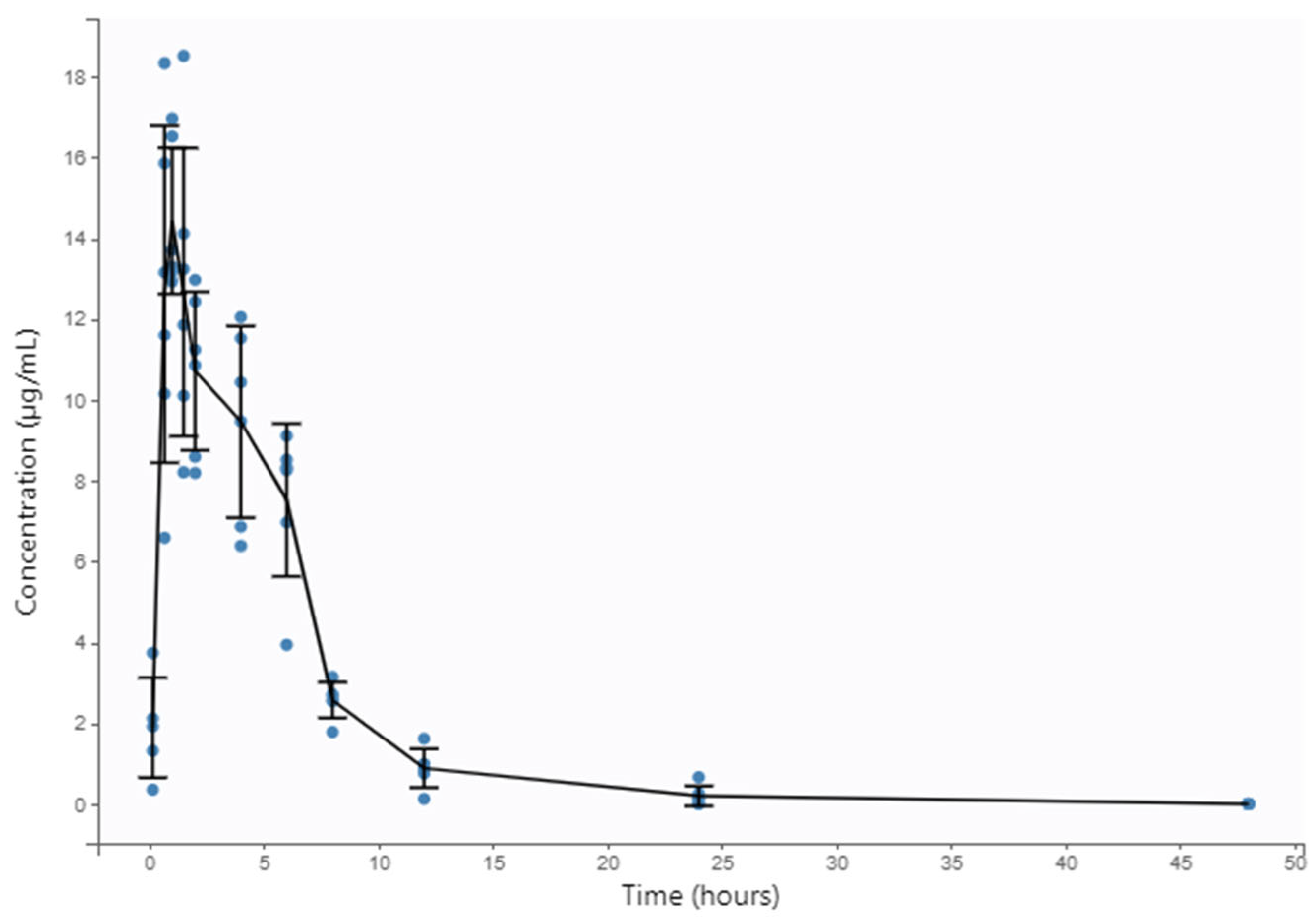
The 3.6 mg/kg oral dose of MLX in broilers resulted in a peak plasma concentration of 14.43 μg/mL ± 1.81 μg/mL one hour after drug administration, followed by a rapid decline, likely due to drug distribution, and a prolonged elimination phase (Figure 1). Pharmacokinetic parameters are presented in Table 1. No detectable levels of MLX were found in any of the six samples analyzed 48 h post-gavage (LOQ = 0.92 µg/mL).

3.3. Pharmacokinetic Modelling

The model that best described the kinetic data of meloxicam via gavage in broilers was a one-compartment model with extravascular administration, first-order absorption, no latency time, linear elimination and proportional error. Pharmacokinetic parameters for the population model are presented in Table 2. The table presents the typical population estimates (θ) for the fixed-effect parameters and the associated inter-individual variability (ω2). The magnitude of the pharmacokinetic effects is expressed by the typical parameter estimates, with 95% confidence intervals reported to reflect estimation precision.
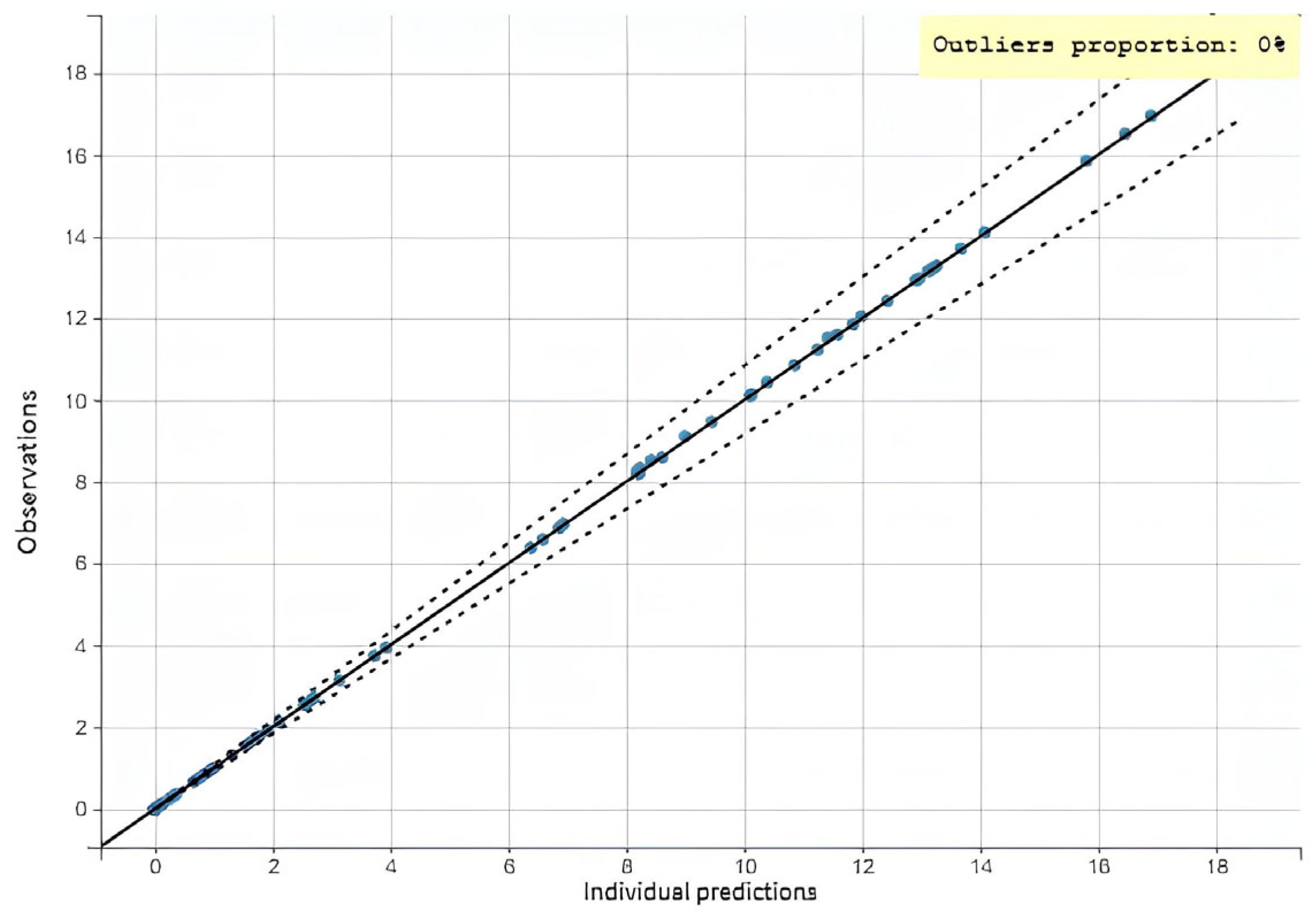
The basic goodness-of-fit (GOF) plot demonstrated adequate agreement between observed plasma concentrations from the in vivo study and individual model predictions (Figure 2). All observed data points fall within the 95% confidence interval (dashed lines), and no outliers were identified (0%). No systematic bias was detected, and no outliers were identified. All data were retained in the final analysis.
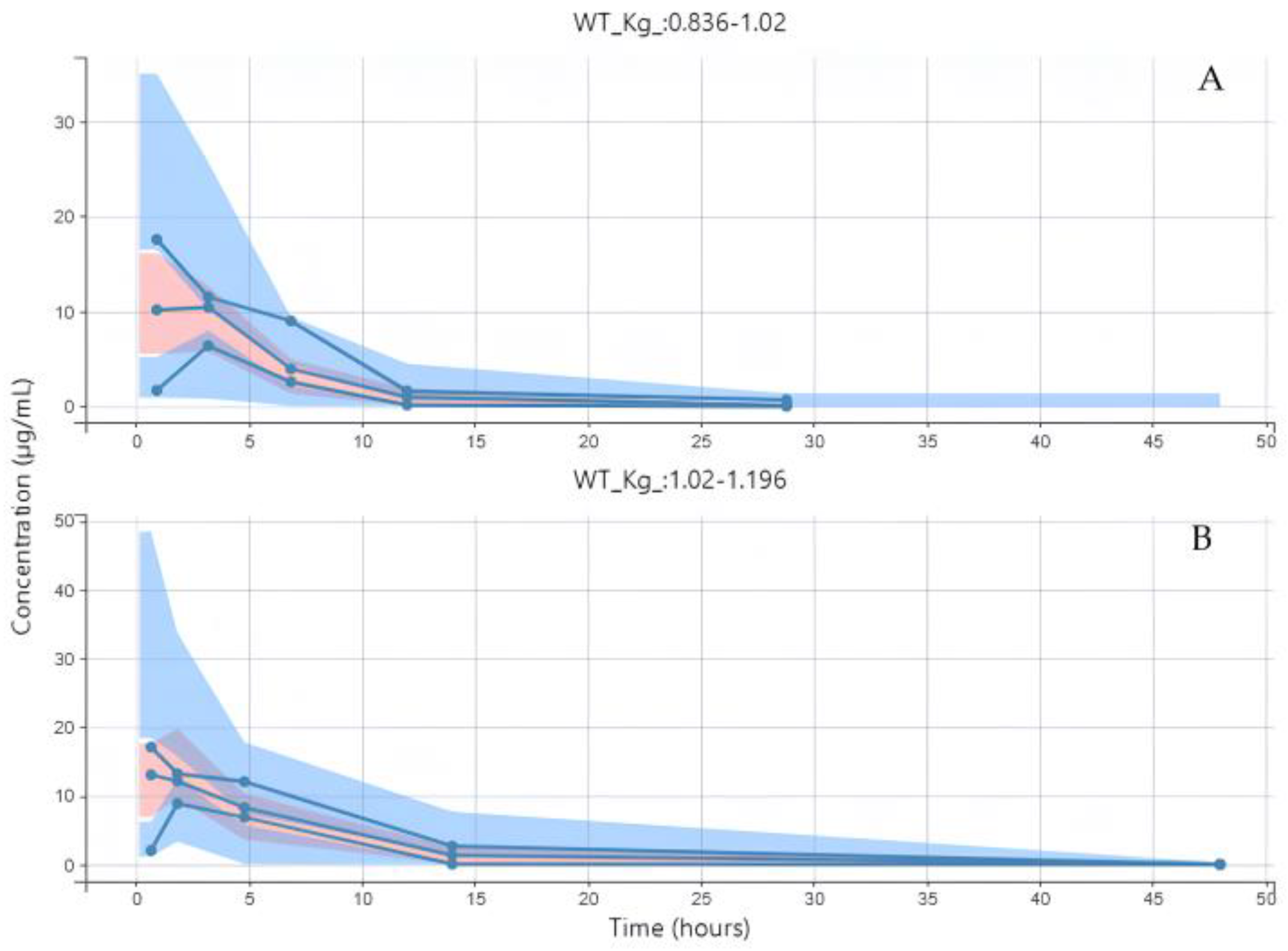
The visual predictive check (VPC) plots indicate that the median, as well as the 5th and 95th percentiles (blue bands) of the observed concentrations were accurately predicted by the corresponding 95% confidence intervals (Figure 3).
The graphical analysis, combined with evaluation of the model’s numerical aspects, confirms its accuracy in predicting the kinetic behavior of MLX in broilers following gavage administration. The model was further employed to simulate a virtual population of 100 animals in 50 replicates using Monte Carlo simulation. Following the administration of a single dose of MLX granules (19.24% m/m) at 3.6 mg/kg, the mean maximum concentration (Cmax) of MLX was 15 μg/mL, observed one-hour post administration.
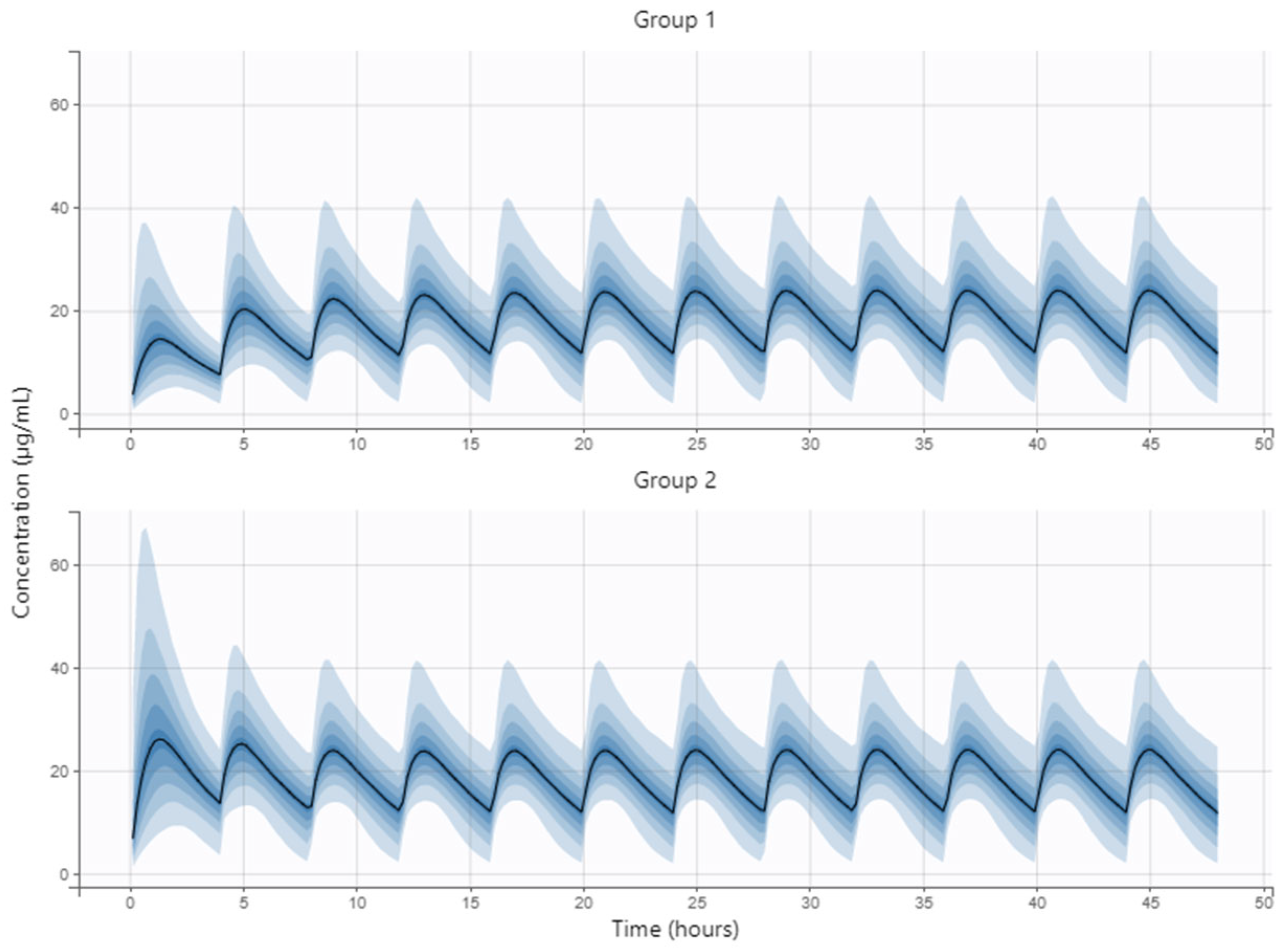
The kinetic behavior of the population was subsequently analyzed when MLX granules (19.24% m/m) were administered at a dose of 3.6 mg/kg every four hours (Group 1—Figure 4). It took approximately 13 h to reach the steady-state phase, with an average Cmax of 20 ug/mL observed during this phase. To reduce the time required to reach steady-state, a loading dose of MLX granules (19.24% m/m) at 6.6 mg/kg was simulated at time 0, followed by repeat dosing at 3.6 mg/kg every four hours (Group 2—Figure 4).
The target concentration of 25 μg/mL was selected for illustrative purposes, approximating the mean peak steady-state concentration predicted under the simulated dosing regimen. Considering a target concentration of 25 μg/mL and a volume of distribution (V) of 0.265 L, the loading dose was estimated using the formula L = Ctarget × V, where L represents the loading dose, Ctarget is the target concentration, and V is the volume of distribution [27]. This calculated dose allowed the system to reach the desired concentration from the first administration, reducing the time required to achieve steady state by six hours. Future studies will be necessary to determine biologically relevant target concentrations associated with potential effects in poultry production systems.

4. Discussion

The broader research line of our group investigates whether modulation of inflammatory responses may contribute to improved productive performance in broilers. With the aim of evaluating whether anti-inflammatory substances may exert performance-enhancing effects, our research group has investigated several of these compounds in broiler chickens, including acetylsalicylic acid and sodium salicylate [9,10], as well as ibuprofen and meloxicam [28]. However, it is well recognized that such compounds can induce adverse and toxic effects in birds, including gastrointestinal disturbances, nephrotoxicity, and hepatotoxicity [29]. Considering the absence of undesirable effects observed to date, meloxicam appears to exhibit the most favorable safety profile among the NSAIDs evaluated in broilers, both in our own [9,10,28] and in previously published reports [30,31,32,33,34,35]. Nevertheless, before evaluating long-term supplementation strategies, it is essential to characterize the pharmacokinetic profile of the compound in the target species. Therefore, the present study represents an initial step aimed at establishing the pharmacokinetic parameters of meloxicam following oral administration in broilers. If such biological effects are confirmed in future studies, economic feasibility analyses will be required to determine whether the potential performance benefits could offset the additional costs associated with the use of such compounds in commercial production.
The target dose of 3.6 mg/kg body weight was selected based on previous dose-ranging and performance-oriented experiments conducted by our group in broiler chickens. Thus, Almeida et al. [28] evaluated continuous supplementation of meloxicam at doses of 0.1, 0.2, and 0.4 mg/kg in broilers, demonstrating that these doses were well tolerated but produced limited effects on productive performance. Subsequent studies explored higher doses (0.4, 1.2, and 3.6 mg/kg), which were also found to be safe and showed greater potential for improving performance parameters under experimental conditions (unpublished data). Importantly, no adverse effects on growth, behavior, or organ integrity were observed, supporting the biological plausibility and safety of this target dose. Based on these findings, the dose of 3.6 mg/kg BW was selected for pharmacokinetic characterization in the present study in order to generate data relevant for future performance-oriented investigations.
The present study evaluated the pharmacokinetics of meloxicam following single-dose administration. Single-dose pharmacokinetic studies represent a fundamental first step in characterizing drug disposition, including absorption, distribution, metabolism, and elimination. Objectives included validation of the analytical method used for plasma drug quantification, measurement of plasma concentrations at multiple time points, estimation of pharmacokinetic parameters, and development of a population pharmacokinetic model. These data are essential to support subsequent studies involving repeated administration, steady-state exposure, and evaluation of potential drug accumulation.
A marked variability in plasma concentrations was observed among animals during the absorption phase of the drug (Figure 1), a pattern not evident during the elimination phase. This suggests that the elimination half-life was likely consistent across individuals, while absorption differed between animals. Although differences in body weight (ranging from 0.814 to 1.296 kg) were initially considered as a potential source of variability, and this factor could directly impact drug absorption [36,37], we believe this factor alone is unlikely to explain the magnitude of variation observed, especially given that the dose was adjusted according to body weight. Alternatively, other factors such as inter-individual variability in intestinal permeability [38], differences in the disintegration or dissolution of the granulated formulation [39], and subtle inconsistencies in the gavage administration technique [40] may have contributed to the observed variability in early plasma concentrations and should not be ruled out.
A relevant pharmacokinetic comparison can be made between the present study and the findings of [41], who evaluated meloxicam disposition in two laying hen breeds (Wyandotte and White Leghorn). Marked differences were observed between the studies. In our study, Cobb broilers receiving 3.6 mg/kg showed faster absorption (Tmax = 1 h), higher peak plasma concentrations (Cmax = 14.43 µg/mL), and greater systemic exposure (AUC0–∞ = 79.97 μg·h/mL) compared to laying hens treated with 1 mg/kg. Wyandotte hens exhibited a longer elimination half-life (T½ = 5.53 h) and mean residence time (MRT0–∞ = 9.45 h), whereas White Leghorns showed faster elimination (T½ = 2.79 h) and lower overall exposure (AUC0–∞ = 37.92 μg·h/mL).
These pharmacokinetic differences are likely underpinned by physiological and metabolic variations between broilers and layers, largely resulting from genetic selection for distinct production purposes (growth vs. egg laying). After hatching, broilers and layers differ markedly in growth rate, feed intake, muscle and adipose tissue development, and nutrient utilization efficiency. Broilers exhibit higher daily feed intake, faster weight gain, and reach market weight in fewer days. They also exhibit differences in protein turnover and nutrient partitioning compared to layers. In contrast, layers tend to have a larger and more muscular gizzard and longer intestines relative to body weight, which may improve feed breakdown and intestinal absorptive capacity. Broilers, on the other hand, display shorter digesta retention times in the crop and gizzard, potentially reducing nutrient digestibility [42,43].
Understanding the pharmacokinetic behavior of drugs used in animal production is essential not only for optimizing therapeutic efficacy but also for defining appropriate withdrawal periods and ensuring food safety. The present findings highlight the importance of considering such physiological and pharmacokinetic parameters when administering meloxicam in poultry, regardless of production category.
Building upon these pharmacokinetic findings, a Monte Carlo simulation was performed to explore the impact of dosing strategies on meloxicam exposure in broilers. The simulation confirmed the predictive performance of the population pharmacokinetic model and demonstrated that repeated administration of 3.6 mg/kg every four hours resulted in steady-state concentrations at approximately 13 h. Incorporating a 6.6 mg/kg loading dose reduced this period by six hours, demonstrating the influence of front-loaded exposure on the time to steady state. These results highlight the usefulness of model-based simulations for exploring potential dosing strategies for meloxicam in broiler chickens and support the data-driven exploration of dosing strategies in food-producing animals, particularly in relation to exposure assessment, residue monitoring, and withdrawal period determination.
This study has some limitations that should be acknowledged when interpreting the results. Although the sparse sampling design may introduce a certain degree of imprecision in the estimation of individual parameters, this approach is commonly applied in avian pharmacokinetic studies for ethical and practical reasons and was supported in the present study by consistent model performance and appropriate goodness-of-fit diagnostics. In addition, each bird contributed a single plasma sample, which may increase variability and limit individual-level characterization. Nevertheless, the population modeling strategy enabled robust estimation of the typical parameters and inter-individual variability. The study was conducted in healthy broiler chickens under controlled experimental conditions and, therefore, the results may not fully reflect drug disposition in commercial production systems or in birds exposed to physiological or pathological challenges. Furthermore, only a single dose and route of administration were evaluated, restricting direct extrapolation to alternative dosing regimens. Despite these considerations, the inter-individual variability observed provides valuable insight into the biological variability of meloxicam disposition in broiler chickens.
Although the present study provides important information regarding the pharmacokinetic profile of meloxicam in broilers, further studies are required to evaluate repeated-dose administration, potential drug accumulation, steady-state exposure, and tissue residue depletion. Such investigations will be essential for assessing food safety aspects and the potential practical application of this compound in poultry production systems. Furthermore, caution is warranted when extrapolating these results to other poultry categories or avian species, as physiological differences related to genetics, growth rate, metabolic activity, and body composition may substantially influence drug disposition. Therefore, the pharmacokinetic parameters described here are specific to broiler chickens under the evaluated conditions and should not be directly generalized to laying hens, other poultry strains, or different avian species without further investigation. In addition, economic feasibility, consumer acceptance, and environmental aspects should be considered in future studies when evaluating the potential use of anti-inflammatory compounds in poultry production.

5. Conclusions

In conclusion, this study provides relevant pharmacokinetic data on meloxicam in broiler chickens, supporting the biological rationale of the selected dose in future investigations evaluating its potential effects on productive performance. Furthermore, considerable inter-individual variability in drug absorption was observed. The pharmacokinetic differences identified between broiler chickens and laying hens further emphasize the impact of breed-specific physiology on drug disposition. These findings highlight the importance of considering both individual factors and breed-related characteristics when establishing meloxicam administration protocols in poultry.

Author Contributions

Conceptualization, M.C.D.G. and S.L.G.; methodology, M.C.D.G., S.L.G., C.S.d.S.A., A.T.G. and M.F.; software, M.F., B.C.F.S. and I.L.L.G.; validation, L.A.C.; formal analysis, M.C.D.G., I.L.L.G., B.C.F.S., L.A.C., S.L.G. and A.T.G.; investigation, M.C.D.G., I.L.L.G., B.C.F.S. and L.A.C.; resources, M.C.D.G., C.S.d.S.A., A.T.G. and S.L.G.; data curation, I.L.L.G., B.C.F.S. and L.A.C.; writing—original draft preparation, M.C.D.G., I.L.L.G., B.C.F.S. and S.L.G.; writing—review and editing, M.C.D.G., I.L.L.G., B.C.F.S., C.S.d.S.A., A.T.G., M.F. and S.L.G.; visualization, I.L.L.G. and B.C.F.S.; supervision, S.L.G.; project administration, M.C.D.G. and S.L.G.; funding acquisition, S.L.G. All authors have read and agreed to the published version of the manuscript.

Funding

This research was supported by the Fundação de Amparo à Pesquisa do Estado de São Paulo (FAPESP, grant numbers 2018/19474-6 and 2019/07151-0) and by the Conselho Nacional de Desenvolvimento Científico e Tecnológico (CNPq, process number 154318/2023-0). The APC was funded by Fundação de Amparo à Pesquisa do Estado de São Paulo (FAPESP 2026/06352-6).

Institutional Review Board Statement

This study was conducted at the School of Veterinary Medicine and Animal Sciences, University of São Paulo (FMVZ-USP). All procedures were approved by the FMVZ-USP Animal Ethics Committee (protocol number 8676210217, approved on 8 July 2020). All animal handling, housing, and experimental procedures were carried out by trained personnel under veterinary supervision and in full accordance with institutional, national, and international guidelines for animal welfare.

Informed Consent Statement

Not applicable.

Data Availability Statement

The raw data supporting the conclusions of this study are publicly available in the Zenodo repository: https://doi.org/10.5281/zenodo.18759702 (accessed on 25 March 2026).

Acknowledgments

We thank Leonila Ester R. Raspantini, Elaine Cristina L. Martinelli, Estevão Belloni, Marco Antonio F. dos Santos, Adilson Baladore, and Paulo Cesar F. Raspantini for their valuable assistance with the study.

Conflicts of Interest

The authors declare no conflicts of interest. The authors also declare that the research was conducted in the absence of any commercial or financial relationships that could be construed as potential conflicts of interest.

Abbreviations

The following abbreviations are used in this manuscript:
APEsAntibiotic Performance Enhancers
MLXMeloxicam
NSAID/NSAIDsNon-Steroidal Anti-Inflammatory Drug(s)
HPLCHigh-Performance Liquid Chromatography
HPLC-UVHigh-Performance Liquid Chromatography with Ultraviolet Detection
AUCArea Under the Curve
CmaxMaximum Plasma Concentration
TmaxTime to Reach Maximum Concentration
NLMENonlinear Mixed-Effects Modeling
AGPsAntimicrobial Growth Promoters
COXCyclooxygenase
PGsProstaglandins
TXsThromboxanes
BWBody Weight
LOQLimit of Quantification
RDCBrazilian Health Regulatory Resolution (RDC 27/2012)
NCANon-Compartmental Analysis
PKPharmacokinetics
SAEMStochastic Approximation Expectation–Maximization
AICAkaike Information Criterion
BICBayesian Information Criterion
GOFGoodness of Fit
VPCVisual Predictive Check
WTBody Weight (used in modeling context)
VVolume of Distribution
CL/ClClearance
KaAbsorption Rate Constant
KelElimination Rate Constant
Elimination Half-Life
MRTMean Residence Time
RSDRelative Standard Deviation
r/r2Correlation Coefficient
θ (theta)Fixed Effect Parameter (Typical Population Value)
ω (omega)Inter-individual Variability (Random Effects)
η (eta)Random Effect Representing Individual Deviation

References

  1. Abreu, R.; Semedo-Lemsaddek, T.; Cunha, E.; Tavares, L.; Oliveira, M. Antimicrobial Drug Resistance in Poultry Production: Current Status and Innovative Strategies for Bacterial Control. Microorganisms 2023, 11, 953. [Google Scholar] [CrossRef]
  2. Chatterjee, R.N.; Paul, S.S.; Rama Rao, S.V. Global use of antimicrobials in food animals, emergence of antimicrobial resistance and way forward: An overview. Indian J. Anim. Health 2019, 58, 19–32. [Google Scholar] [CrossRef]
  3. Laxminarayan, R.; Van Boeckel, T.; Teillant, A. The economic costs of withdrawing antimicrobial growth promoters from livestock. In OECD Food, Agriculture and Fisheries Papers; OECD Publishing: Paris, France, 2015. [Google Scholar] [CrossRef]
  4. Sethiya, N.K. Review on Natural Growth Promoters Available for Improving Gut Health of Poultry: An alternative to antibiotic growth promoters. Asian J. Poult. Sci. 2016, 10, 1–29. [Google Scholar] [CrossRef]
  5. Redondo, L.M.; Fernandez-Miyakawa, M.E. Use of antimicrobial alternatives in broilers and their impacts on health and productive performance. CABI Rev. 2021, 16, 1–14. [Google Scholar] [CrossRef]
  6. Polycarpo, G.D.; Andretta, I.; Kipper, M.; Cruz-Polycarpo, V.C.; Dadalt, J.C.; Rodrigues, P.H.; Albuquerque, R.D. Meta-analytic study of organic acids as an alternative performance-enhancing feed additive to antibiotics for broiler chickens. Poult. Sci. 2017, 96, 3645–3653. [Google Scholar] [CrossRef] [PubMed]
  7. Plata, G.; Baxter, N.T.; Susanti, D.; Volland-Munson, A.; Gangaiah, D.; Nagireddy, A.; Mane, S.P.; Balakuntla, J.; Hawkins, T.B.; Kumar Mahajan, A. Growth promotion and antibiotic induced metabolic shifts in the chicken gut microbiome. Commun. Biol. 2022, 5, 293. [Google Scholar] [CrossRef]
  8. Niewold, T.A. The nonantibiotic anti-inflammatory effect of growth promoters, the Real Mode of Action? A Hypothesis. Poult. Sci. 2007, 86, 605–609. [Google Scholar] [CrossRef]
  9. Almeida, E.R.M.; Górniak, S.L.; Di Gregorio, M.C.; Araújo, C.S.S.; Andréo-Filho, N.; Momo, C.; Hueza, I.M. Safety and growth-promoting potential of repeated administration of sodium salicylate to broilers. Animal-Open Space 2022, 1, 100026. [Google Scholar] [CrossRef]
  10. Di Gregorio, M.C.; Almeida, E.R.M.; Momo, C.; Araújo, C.S.S.; Hueza, I.M.; Andréo-Filho, N.; Raspantini, L.E.R.; Gotardo, A.T.; Górniak, S.L. Sodium salicylate as feed additive in broilers: Absence of toxicopathological findings. Animals 2023, 13, 1430. [Google Scholar] [CrossRef]
  11. Osafo, N.; Agyare, C.; Obiri, D.D.; Antwi, A.O. Mechanism of action of Nonsteroidal Anti-Inflammatory Drugs. In Nonsteroidal Anti-Inflammatory Drugs; InTech: London, UK, 2017; pp. 120–121. [Google Scholar] [CrossRef]
  12. Shao, H.T.; Yang, F.; Chen, J.C.; Zhang, M.; Song, Z.W.; Yang, F. Pharmacokinetics of meloxicam in laying hens after single intravenous, oral, and intramuscular administration. J. Vet. Pharmacol. Ther. 2022, 45, 488–494. [Google Scholar] [CrossRef] [PubMed]
  13. Stiller, C.; Hjemdahl, P. Lessons from 20 years with COX-2 inhibitors: Importance of Dose–Response Considerations and Fair Play in Comparative Trials. J. Intern. Med. 2022, 292, 557–574. [Google Scholar] [CrossRef] [PubMed]
  14. Hawkey, C.; Kahan, A.; Steinbrück, K.; Alegre, C.; Baumelou, E.; Begaud, B.; Dequeker, J.; Isomäki, H.; Littlejohn, G.; Mau, J.; et al. Gastrointestinal tolerability of meloxicam compared to diclofenac in osteoarthritis patients. Rheumatology 1998, 37, 937–945. [Google Scholar] [CrossRef] [PubMed]
  15. Kloepping, C. Meloxicam: An update on its use in the perioperative period. Int. J. Anesthesiol. Res. 2021, 9, 611–618. [Google Scholar] [CrossRef]
  16. Landman, W.J.M.; Matthijs, M.G.R.; van Eck, J.H.H. Effect of anti-inflammatory drugs on colibacillosis lesions in broilers after Infectious Bronchitis Virus and subsequent Escherichia Coli infection. Vet. Q. 2012, 32, 25–29. [Google Scholar] [CrossRef][Green Version]
  17. Shao, H.T.; Gao, L.; Li, H.T.; Zhang, M.; Chen, J.C.; Duan, M.H.; Li, Z.E.; Dai, Y.; Li, X.P.; Yang, F. Egg residue and depletion of meloxicam in Jing Hong laying hens following multiple oral doses. Poult. Sci. 2023, 102, 102761. [Google Scholar] [CrossRef]
  18. Gates, B.J.; Nguyen, T.T.; Setter, S.M.; Davies, N.M. Meloxicam: A reappraisal of pharmacokinetics, efficacy and safety. Expert Opin. Pharmacother. 2005, 6, 2117–2140. [Google Scholar] [CrossRef] [PubMed]
  19. Goetting, V.; Lee, K.A.; Tell, L.A. Pharmacokinetics of veterinary drugs in laying hens and residues in eggs: A Review of the Literature. J. Vet. Pharmacol. Ther. 2011, 34, 521–556. [Google Scholar] [CrossRef] [PubMed]
  20. Souza, M.J.; Bailey, J.; White, M.; Gordon, K.; Gerhardt, L.; Cox, S.K. Pharmacokinetics and egg residues of meloxicam after multiple day oral dosing in domestic chickens. J. Avian Med. Surg. 2018, 32, 8–12. [Google Scholar] [CrossRef]
  21. Souza, M.J.; Bergman, J.B.; White, M.S.; Gordon, K.I.; Gerhardt, L.E.; Cox, S.K. Pharmacokinetics and egg residues after oral administration of a single dose of meloxicam in domestic chickens (Gallus domesticus). Am. J. Vet. Res. 2017, 78, 965–968. [Google Scholar] [CrossRef]
  22. Baert, K.; De Backer, P. Comparative pharmacokinetics of three non-steroidal anti-inflammatory drugs in five bird species. Comp. Biochem. Physiol. C 2003, 134, 25–33. [Google Scholar] [CrossRef]
  23. Rostagno, H.S.; Albino, L.F.T.; Hannas, M.I.; Donzele, J.L.; Sakomura, N.K.; Perazzo, F.G.; Saraiva, A.; Teixeira, M.V.; Rodríguez, P.B.; Oliveira, R.D.; et al. Tabelas Brasileiras para Aves e Suínos: Composição de Alimentos e Exigências Nutricionais, 4th ed.; UFV: Viçosa, Brazil, 2017; 488p. [Google Scholar]
  24. Morrison, J.; Greenacre, C.B.; George, R.; Cox, S.; Martín-Jiménez, T. Pharmacokinetics of a single dose of oral and intramuscular meloxicam in African penguins (Spheniscus demersus). J. Avian Med. Surg. 2018, 32, 102–108. [Google Scholar] [CrossRef] [PubMed]
  25. Molter, C.M.; Cole, G.A.; Gagnon, D.J.; Hazarika, S.; Paul-Murphy, J.R. Pharmacokinetics of meloxicam after intravenous, intramuscular, and oral administration of a single dose to Hispaniolan Amazon parrots (Amazona ventralis). Am. J. Vet. Res. 2013, 74, 375–380. [Google Scholar] [CrossRef]
  26. Agência Nacional de Vigilância Sanitária. Resolução da Diretoria Colegiada—RDC nº 27; ANVISA: Brasília, Brazil, 2012. [Google Scholar]
  27. Mould, D.; Upton, R. Basic concepts in population modeling, Simulation, and Model-Based Drug Development—Part 2: Introduction to Pharmacokinetic Modeling Methods. CPT Pharmacometr. Syst. Pharmacol. 2013, 2, 1–14. [Google Scholar] [CrossRef] [PubMed]
  28. Almeida, E.R.M.; Górniak, S.L.; Araújo, C.S.S.; Gregorio, M.C.; Andréo-Filho, N.; Momo, C.; Hueza, I.M. Evaluation of possible adverse effects in broiler chickens supplemented with ibuprofen or meloxicam. Arq. Bras. Med. Vet. Zootec. 2025, 77, e13433. [Google Scholar] [CrossRef]
  29. Baert, K.; De Backer, P. Disposition of sodium salicylate, flunixin and meloxicam after intravenous administration in broiler chickens. J. Vet. Pharmacol. Ther. 2002, 25, 449–453. [Google Scholar] [CrossRef]
  30. Akter, R.; Sarker, M. Effect of diclofenac sodium in broilers. Bangladesh J. Vet. Med. 2015, 13, 19–24. [Google Scholar] [CrossRef]
  31. Ghodasara, P.D.; Pandey, S.; Khorajiya, J.H.; Prajapati, K.S.; Ghodasara, D.J.; Joshi, B.P. Toxicopathological studies of meloxicam, ibuprofen and diclofenac sodium in broiler chicks. Indian J. Vet. Pathol. 2014, 38, 250. [Google Scholar] [CrossRef]
  32. Modi, C.M.; Mody, S.K.; Patel, H.B.; Dudhatra, G.B.; Kumar, A.; Avale, M. Toxicopathological overview of analgesic and anti-inflammatory drugs in animals. J. Appl. Pharm. Sci. 2012, 2, 149–157. [Google Scholar]
  33. Ramzan, M.; Ashraf, M.; Mahmood, K.T. Toxicity of flunixin meglumine in broiler chickens. J. Pharm. Sci. Res. 2012, 4, 1748–1754. [Google Scholar]
  34. Shafi, M.; Garg, U.K.; Saqib, N.; Baba, O.K.; Farid, B.D.; Wali, A. Haemato-Biochemical Studies on Diclofenac, Ibuprofen and Nimesulide Induced Toxicity in Broilers. Nat. Environ. Pollut. Technol. 2012, 11, 649–652. [Google Scholar]
  35. Sun, C.; Zhu, T.; Zhu, Y.; Li, B.; Zhang, J.; Liu, Y.; Juan, C.; Yang, S.; Zhao, Z.; Wan, R.; et al. Hepatotoxic mechanism of diclofenac sodium on broiler chicken revealed by iTRAQ-based proteomics analysis. J. Vet. Sci. 2022, 23, e56. [Google Scholar] [CrossRef]
  36. Antonissen, G.; Devreese, M.; De Baere, S.; Hellebuyck, T.; Van de Maele, I.; Rouffaer, L.; Stemkens, H.J.J.; De Backer, P.; Martel, A.; Croubels, S. Comparative pharmacokinetics and allometric scaling of carboplatin in different avian species. PLoS ONE 2015, 10, e0134177. [Google Scholar] [CrossRef]
  37. Boonstra, J.L.; Cox, S.K.; Martin-Jimenez, T. Pharmacokinetics of meloxicam after intramuscular and oral administration of a single dose to American flamingos (Phoenicopterus ruber). Am. J. Vet. Res. 2017, 78, 267–273. [Google Scholar] [CrossRef]
  38. Azman, M.; Sabri, A.H.; Anjani, Q.K.; Mustaffa, M.F.; Hamid, K.A. Intestinal absorption study: Challenges and absorption enhancement strategies in improving oral drug delivery. Pharmaceuticals 2022, 15, 975. [Google Scholar] [CrossRef] [PubMed]
  39. Heimbach, T.; Lakshminarayana, S.B.; Hu, W.; He, H. Practical anticipation of human efficacious doses using in vitro and in vivo data. AAPS J. 2009, 11, 602–614. [Google Scholar] [CrossRef]
  40. Turner, P.V.; Pekow, C.; Vasbinder, M.A.; Brabb, T. Administration of substances to laboratory animals: Equipment Considerations, Vehicle Selection, and Solute Preparation. J. Am. Assoc. Lab. Anim. Sci. 2011, 50, 614–627. [Google Scholar] [PubMed]
  41. Souza, M.J.; Gerhardt, L.E.; Shannon, L.; Fortner, C.; Davis, R.; Condon, M.; Bergman, J.B.; Cox, S.K. Breed differences in the pharmacokinetics of orally administered meloxicam in domestic chickens (Gallus domesticus). J. Am. Vet. Med. Assoc. 2021, 259, 84–87. [Google Scholar] [CrossRef] [PubMed]
  42. Buzała, M.; Janicki, B.; Czarnecki, R. Consequences of different growth rates in broiler breeder and layer hens on embryogenesis, metabolism and metabolic rate: A review. Poult. Sci. 2015, 94, 728–733. [Google Scholar] [CrossRef]
  43. Buzała, M.; Janicki, B. Review: Effects of different growth rates in broiler breeder and layer hens on productive traits. Poult. Sci. 2016, 95, 2151–2159. [Google Scholar] [CrossRef]
Figure 1. The average concentration of meloxicam at a 3.6 mg/kg oral gavage dose (n = 72) is plotted over time on an arithmetic scale. Each data point represents an individual observed plasma concentration. The black line indicating the mean, and error bars represent the standard error of the mean (SEM) for six birds at each time point.
Poultry 05 00029 g001
Figure 2. Graph of the goodness-of-fit (GOF) for the final model. The solid line represents the linear regression between the plasma concentration observed in the in vivo study and the concentration estimated by the model. The dashed lines indicate the 95% confidence interval, and the blue dots represent the observed data.
Poultry 05 00029 g002
Figure 3. Visual Predictive Check (VPC) plot. The blue solid lines indicate the 5th, 50th and 95th percentiles of the observed data. The blue and pink areas represent the 95% confidence intervals of the corresponding percentiles as predicted by the model. The plots were separated by the median weight (WT) of the birds: Panel (A) shows the VPC of chickens weighing between 0.836 and 1.02 kg, while Panel (B) shows the VPC of chickens weighing between 1.02 and 1.196 kg.
Poultry 05 00029 g003
Figure 4. Monte Carlo simulation of MLX pharmacokinetics in a virtual population of 100 chickens in 50 replicates. The shaded areas in different colors represent percentile intervals, and the black line indicates the median (typical value) of the model predictions. Group 1: administration of MLX granules (19.24% m/m) at a dose of 3.6 mg/kg every four hours. Group 2: administration of a loading dose of 6.6 mg/kg at time 0, followed by administration at a dose of 3.6 mg/kg every four hours.
Poultry 05 00029 g004
Table 1. Pharmacokinetic parameters of meloxicam after single-dose oral gavage administration (3.6 mg/kg) in broiler chickens (total n = 72). Parameters were derived from non-compartmental analysis (NCA) under a sparse sampling design, with six animals allocated to each predefined sampling time and each bird contributing a single plasma concentration measurement.
ParameterUnitMean Population EstimateSERSE (%)95% CI
AUC0–∞μg·h/mL79.974.78670.41–89.53
AUC0–tlastμg·h/mL78.984.52669.94–88.02
CL/FL/h0.0540.00590.0443–0.0637
Cmaxµg/mL14.430.87612.69–16.17
T½h3.551.38390.79–6.31
Tmaxh10.15150.7–1.3
Kelh−10.20.042210.116–0.284
V/FL0.280.092330.095–0.465
AUC0–∞: Area under the curve from 0 to infinity; AUC0–tlast: Area under the curve from 0 to the last time measured time point; CL/F: Apparent clearance; Cmax: Maximum observed plasma concentration; T½: Half-life; Kel: Elimination rate constant; Tmax: Time to reach the maximum concentration; V/F: Apparent volume of distribution; SE: Standard error; RSE: Relative standard error; CI: Confidence intervals.
Table 2. Population pharmacokinetic parameters estimated by nonlinear mixed-effects modeling (Monolix 2024R1) after single-dose oral gavage administration of meloxicam (3.6 mg/kg) in broiler chickens (total n = 72). Data were generated under a sparse sampling design (six birds per time point).
ParameterUnitEstimateSERSE (%)95% CI
θ Ka/h0.7450.18224.430.47–1.18
θ VL0.0960.03334.740.051–0.18
θ CLL/h0.0480.0037.330.042–0.056
ω2 ka/h0.6970.14620.970.47–1.04
ω2 VL0.8020.20625.720.5–1.3
ω2 CLL/h0.2970.07726.210.18–0.48
b 0.051
θ Ka: Typical value for the absorption constant; V: Volume of distribution; CL: Clearance; ω2 ka: Inter-individual variability in Ka; ω2 V: Inter-individual variability in V; ω2 CL: Inter-individual variability in CL; b: Residual variability of the proportional error model; SE: Standard error; RSE: Relative standard error; CI: Confidence intervals.
Disclaimer/Publisher’s Note: The statements, opinions and data contained in all publications are solely those of the individual author(s) and contributor(s) and not of MDPI and/or the editor(s). MDPI and/or the editor(s) disclaim responsibility for any injury to people or property resulting from any ideas, methods, instructions or products referred to in the content.