
Lonicera japonica Flos as a Natural Anticoccidial Agent Against Eimeria tenella: In Vivo Efficacy and Compositional Insights

 , , , , and
Abstract
1. Introduction
2. Materials and Methods
2.1. Oocyst Preparation
2.2. Lonicera japonica Flos Powder Preparation
2.3. Ethics of Animal Experimentation
2.4. In Vivo Experimental Design
2.5. Chemical Characterization
2.6. Statistical Analysis
3. Results
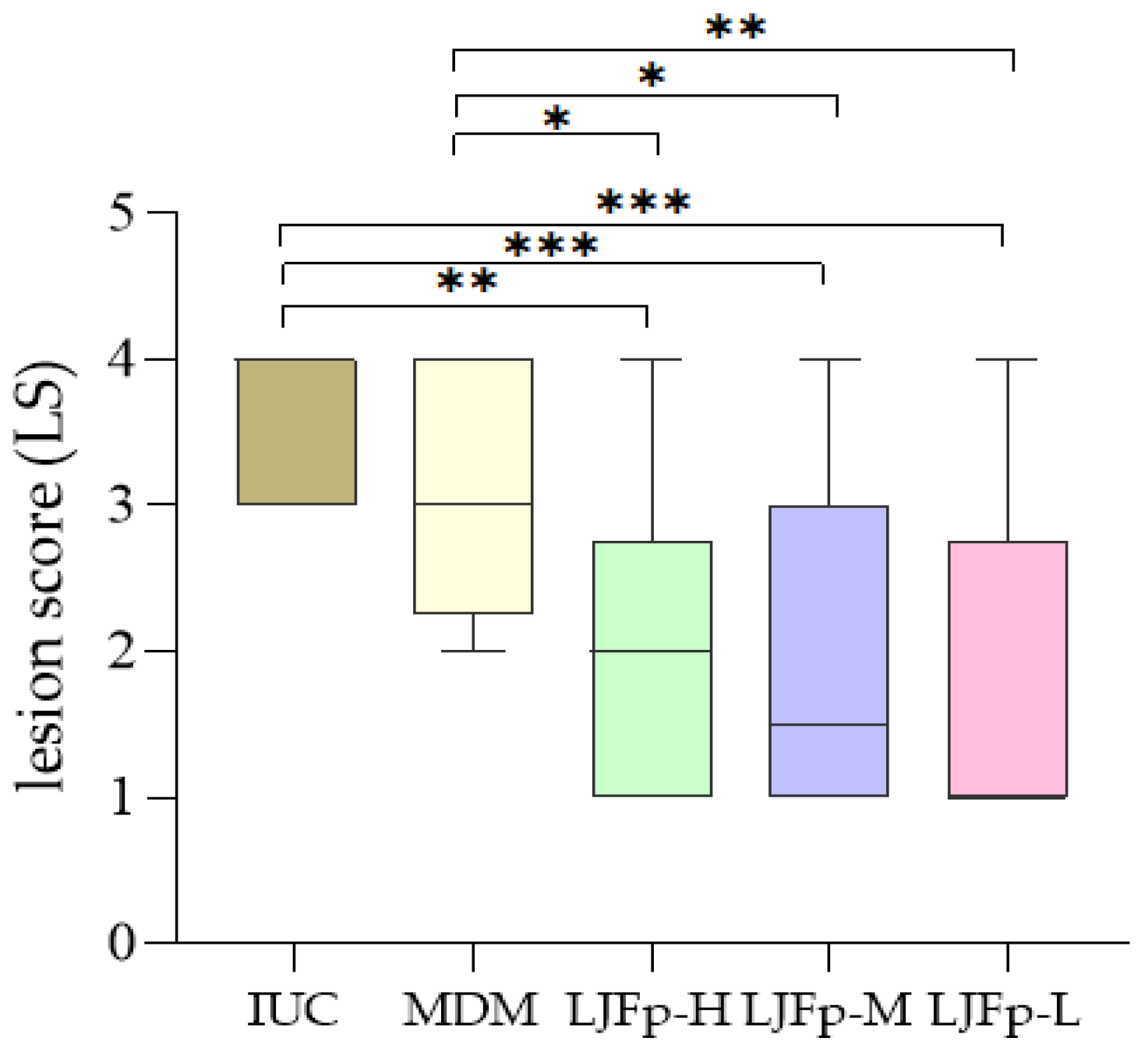
3.1. Cecal Lesions
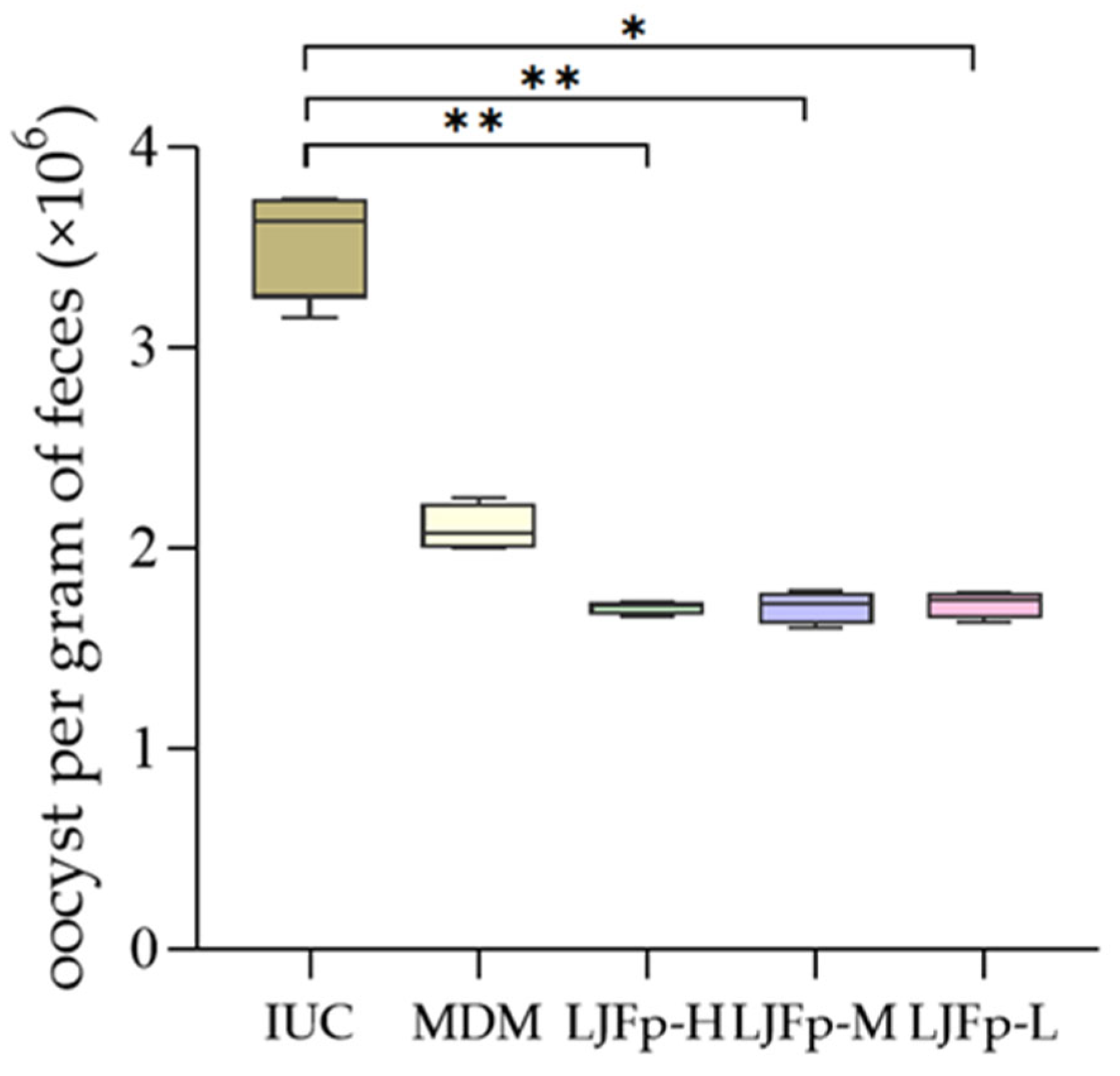
3.2. Oocyst Shedding
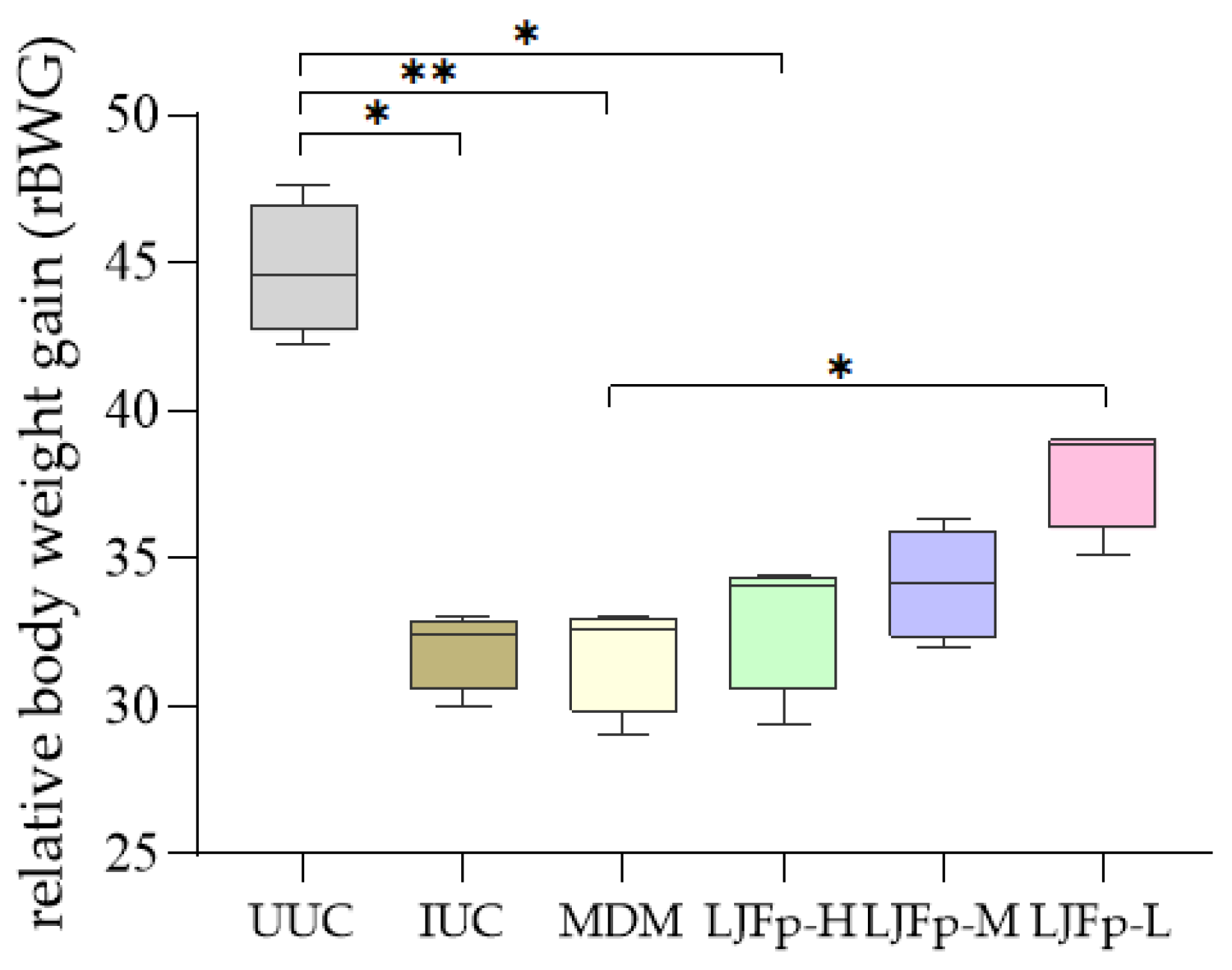
3.3. Growth Performance
3.4. Anticoccidial Index
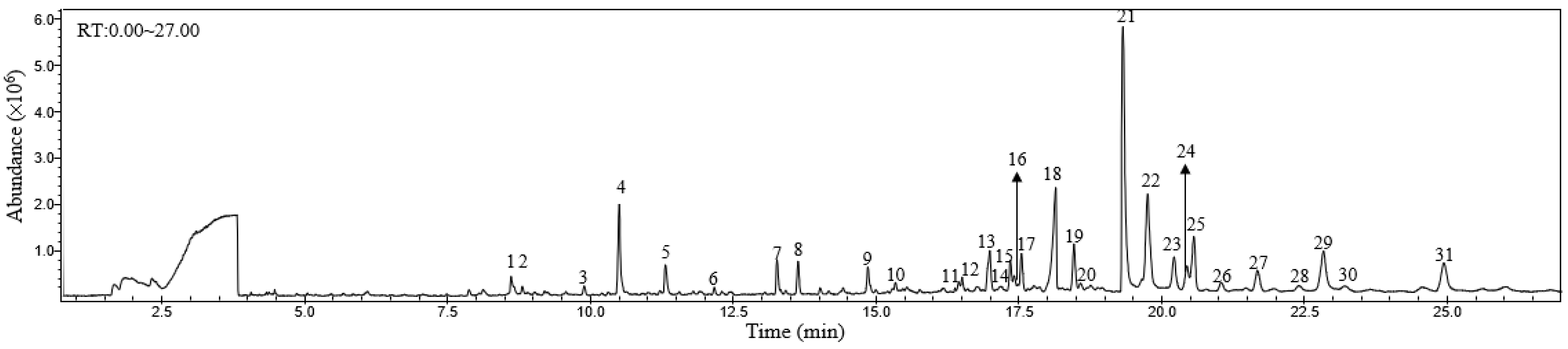
3.5. Compositional Analysis
4. Discussion
5. Conclusions
Author Contributions
Funding
Institutional Review Board Statement
Informed Consent Statement
Data Availability Statement
Acknowledgments
Conflicts of Interest
References
- Fatemi, A.; Razavi, S.M.; Asasi, K.; Goudarzi, M.T. Effects of Artemisia annua extracts on sporulation of Eimeria oocysts. Parasitol. Res. 2015, 114, 1207–1211. [Google Scholar] [CrossRef] [PubMed]
- Blake, D.P.; Knox, J.; Dehaeck, B.; Huntington, B.; Rathinam, T.; Ravipati, V.; Ayoade, S.; Gilbert, W.; Adebambo, A.O.; Jatau, I.D.; et al. Re-calculating the cost of coccidiosis in chickens. Vet. Res. 2020, 51, 115. [Google Scholar] [CrossRef] [PubMed]
- Muthamilselvan, T.; Kuo, T.F.; Wu, Y.C.; Yang, W.C. Herbal Remedies for Coccidiosis Control: A Review of Plants, Compounds, and Anticoccidial Actions. eCAM 2016, 2016, 2657981. [Google Scholar] [CrossRef] [PubMed]
- Mathis, G.F.; Lumpkins, B.; Cervantes, H.M.; Fitz-Coy, S.H.; Jenkins, M.C.; Jones, M.K.; Price, K.R.; Dalloul, R.A.J.P.S. Coccidiosis In Poultry: Disease Mechanisms, Control Strategies, and Future Directions. Poult. Sci. 2024, 104, 104663. [Google Scholar] [CrossRef]
- Swayne, D.E.; Boulianne, M.; Logue, C.M.; McDougald, L.R.; Nair, V.; Suarez, D.L. Protozoal Infections. In Diseases of Poultry, 14th ed.; Hector, M., Cervantes, L.R.M., Jenkins, M.C., Eds.; John Wiley & Sons: Hoboken, NJ, USA, 2020; pp. 1193–1212. [Google Scholar]
- Lien, Y.Y.; Shyur, L.F.; Cheng, Y.B.; Chang, M.T.; Chang, C.T.; Chen, Y.H.; Lai, G.H.; Liao, H.Y.; Cheng, M.C. Trifolium pratense as a novel phytogenic supplement, is an anticoccidial agent in chickens. Poult. Sci. 2024, 103, 104064. [Google Scholar] [CrossRef]
- Lopez-Osorio, S.; Chaparro-Gutierrez, J.J.; Gomez-Osorio, L.M. Overview of Poultry Eimeria Life Cycle and Host-Parasite Interactions. Front. Vet. Sci. 2020, 7, 384. [Google Scholar] [CrossRef]
- Mesa-Pineda, C.; Navarro-Ruíz, J.L.; López-Osorio, S.; Chaparro-Gutiérrez, J.J.; Gómez-Osorio, L.M. Chicken coccidiosis: From the parasite lifecycle to control of the disease. Front. Vet. Sci. 2021, 8, 787653. [Google Scholar] [CrossRef]
- Hoan, T.; Legharia, J. Molecular Identification of Eimeria species Infection in Chickens in Surrounding Areas of the Red River Delta in Vietnam. Int. J. Livest. Res. 2014, 4, 9–18. [Google Scholar] [CrossRef]
- Mesa, C.; Gómez-Osorio, L.M.; López-Osorio, S.; Williams, S.M.; Chaparro-Gutiérrez, J.J. Survey of coccidia on commercial broiler farms in Colombia: Frequency of Eimeria species, anticoccidial sensitivity, and histopathology. Poult. Sci. 2021, 100, 101239. [Google Scholar] [CrossRef]
- Gyorke, A.; Pop, L.; Cozma, V. Prevalence and distribution of Eimeria species in broiler chicken farms of different capacities. Parasite 2013, 20, 50. [Google Scholar] [CrossRef]
- Mariam, A.N.; Suleiman, A.I.; Ovaino, A.S.; Onyaweyo, A.S.; Aboyi, O.S.; Ameh, A.V.; Victoria, P.A. Prevalence of Avian Coccidiosis and Identification of Eimeria spp in Local Broilers and Chickens in Lafia Modern Market, Nassarawa State, Nigeria. EAS J. Parasitol. Infect. Dis. 2023, 5, 23–25. [Google Scholar] [CrossRef]
- El-Shall, N.A.; Abd El-Hack, M.E.; Albaqami, N.M.; Khafaga, A.F.; Taha, A.E.; Swelum, A.A.; El-Saadony, M.T.; Salem, H.M.; El-Tahan, A.M.; AbuQamar, S.F.; et al. Phytochemical control of poultry coccidiosis: A review. Poult. Sci. 2022, 101, 101542. [Google Scholar] [CrossRef] [PubMed]
- Castanon, J.I. History of the use of antibiotic as growth promoters in European poultry feeds. Poult. Sci. 2007, 86, 2466–2471. [Google Scholar] [CrossRef] [PubMed]
- Yang, W.C.; Yang, C.Y.; Liang, Y.C.; Yang, C.W.; Li, W.Q.; Chung, C.Y.; Yang, M.T.; Kuo, T.F.; Lin, C.F.; Liang, C.L.; et al. Anti-coccidial properties and mechanisms of an edible herb, Bidens pilosa, and its active compounds for coccidiosis. Sci. Rep. 2019, 9, 2896. [Google Scholar] [CrossRef] [PubMed]
- Peek, H. Resistance to Anticoccidial Drugs Alternative Strategies to Control Coccidiosis in Broilers; Utrecht University: Utrecht, The Netherlands, 2010; pp. 105–125. [Google Scholar]
- Sharma, U.N.S.; Fernando, D.D.; Wijesundara, K.K.; Manawadu, A.; Pathirana, I.; Rajapakse, R. Anticoccidial effects of Phyllanthus emblica (Indian gooseberry) extracts: Potential for controlling avian coccidiosis. Vet. Parasitol. Reg. Stud. Rep. 2021, 25, 100592. [Google Scholar] [CrossRef]
- Shang, X.; Pan, H.; Li, M.; Miao, X.; Ding, H. Lonicera japonica Thunb.: Ethnopharmacology, phytochemistry and pharmacology of an important traditional Chinese medicine. J. Ethnopharmacol. 2011, 138, 1–21. [Google Scholar] [CrossRef]
- Yang, X.; Yan, D. Function, mechanism of action, metabolism, and commercial application of Lonicera japonica: A review. Food Sci. Hum. Wellness. 2025, 14, 9250051. [Google Scholar] [CrossRef]
- Yeh, Y.C.; Doan, L.H.; Huang, Z.Y.; Chu, L.W.; Shi, T.H.; Lee, Y.R.; Wu, C.T.; Lin, C.H.; Chiang, S.T.; Liu, H.K.; et al. Honeysuckle (Lonicera japonica) and huangqi (Astragalus membranaceus) suppress SARS-CoV-2 entry and COVID-19 related cytokine storm in vitro. Front. Pharmacol. 2021, 12, 765553. [Google Scholar] [CrossRef]
- Molan, A.L.; Liu, Z.; De, S. Effect of pine bark (Pinus radiata) extracts on sporulation of coccidian oocysts. Folia. Parasit. 2009, 56, 1–5. [Google Scholar] [CrossRef]
- Haug, A.; Williams, R.B.; Larsen, S. Counting coccidial oocysts in chicken faeces: A comparative study of a standard McMaster technique and a new rapid method. Vet. Parasitol. 2006, 136, 233–242. [Google Scholar] [CrossRef]
- Percie du Sert, N.; Hurst, V.; Ahluwalia, A.; Alam, S.; Avey, M.T.; Baker, M.; Browne, W.J.; Clark, A.; Cuthill, I.C.; Dirnagl, U. The ARRIVE guidelines 2.0: Updated guidelines for reporting animal research. PLoS Biol. 2020, 40, 1769–1777. [Google Scholar] [CrossRef]
- Johnson, J.; Reid, W.M. Anticoccidial drugs: Lesion scoring techniques in battery and floor-pen experiments with chickens. Exp. Parasitol. 1970, 28, 30–36. [Google Scholar] [CrossRef] [PubMed]
- McManus, E.C.; Campbell, W.C.; Cuckler, A.C. Development of resistance to quinoline coccidiostats under field and laboratory conditions. J. Parasitol. 1968, 54, 1190–1193. [Google Scholar] [CrossRef] [PubMed]
- The NIST Mass Spectral Library (NIST/EPA/NIH EI MS Library, 2017 Release). Software/Data Version; NIST Standard Reference Database, Number 69, August 2017; National Institute of Standards and Technology: Gaithersburg, MD, USA, 2017. Available online: http://webbook.nist.gov (accessed on 2 February 2026).
- Cheikh-Ali, Z.; Adiko, M.; Bouttier, S.; Bories, C.; Okpekon, T.; Poupon, E.; Champy, P. Composition, and antimicrobial and remarkable antiprotozoal activities of the essential oil of rhizomes of Aframomum sceptrum K. Schum. (Zingiberaceae). Chem. Biodivers. 2011, 8, 658–667. [Google Scholar] [CrossRef]
- Moreno, É.M.; Leal, S.M.; Stashenko, E.E.; García, L.T. Induction of programmed cell death in Trypanosoma cruzi by Lippia alba essential oils and their major and synergistic terpenes (citral, limonene and caryophyllene oxide). BMC Complement. Altern. Med. 2018, 18, 225. [Google Scholar] [CrossRef]
- Peek, H.W.; Landman, W.J. Coccidiosis in poultry: Anticoccidial products, vaccines and other prevention strategies. Vet. Q. 2011, 31, 143–161. [Google Scholar] [CrossRef]
- Peek, H.W.; Landman, W.J. Higher incidence of Eimeria spp. field isolates sensitive for diclazuril and monensin associated with the use of live coccidiosis vaccination with paracoxTM-5 in broiler farms. Avian Dis. 2006, 50, 434–439. [Google Scholar] [CrossRef]
- Lautié, E.; Russo, O.; Ducrot, P.; Boutin, J.A. Unraveling plant natural chemical diversity for drug discovery purposes. Front. Pharmacol. 2020, 11, 397. [Google Scholar] [CrossRef]
- Long, P.L.; Millard, B.J.; Joyner, L.P.; Norton, C.C. A guide to laboratory techniques used in the study and diagnosis of avian coccidiosis. Folia Vet. Lat. 1976, 6, 201–217. [Google Scholar]
- Molan, A.-L.; Faraj, A.M. Effect of selenium-rich green tea extract on the course of sporulation of Eimeria oocysts. IOSR J. Dent. Med. Sci. 2015, 14, 68–74. [Google Scholar]
- Naidoo, V.; McGaw, L.J.; Bisschop, S.; Duncan, N.; Eloff, J.N. The value of plant extracts with antioxidant activity in attenuating coccidiosis in broiler chickens. Vet. Parasitol. 2008, 153, 214–219. [Google Scholar] [CrossRef] [PubMed]
- Pop, L.M.; Varga, E.; Coroian, M.; Nedisan, M.E.; Mircean, V.; Dumitrache, M.O.; Farczadi, L.; Fulop, I.; Croitoru, M.D.; Fazakas, M.; et al. Efficacy of a commercial herbal formula in chicken experimental coccidiosis. Parasit. Vectors 2019, 12, 343. [Google Scholar] [CrossRef] [PubMed]
- Hauck, R.; Eckert, J.; Hunter, C. Meta-analysis of the use of Eimeria lesion scores and oocyst counts in floor-pen studies. Avian Dis. 2022, 66, 381–388. [Google Scholar] [CrossRef] [PubMed]
- Yang, W.C.; Tien, Y.J.; Chung, C.Y.; Chen, Y.C.; Chiou, W.H.; Hsu, S.Y.; Liu, H.Y.; Liang, C.L.; Chang, C.L. Effect of Bidens pilosa on infection and drug resistance of Eimeria in chickens. Res. Vet. Sci. 2015, 98, 74–81. [Google Scholar] [CrossRef]
- Alagbe, E.; Jaynes, P.; Park, C.; Adeola, O. Increasing digesta viscosity altered nutrient transporter gene expression and decreased nutrient utilisation in eimeria-challenged birds. Br. Poult. Sci. 2024, 65, 769–780. [Google Scholar] [CrossRef]
- Kasem, S.M.; Helal, I.B.; Mira, N.M.; Amer, S. Evaluating the in vitro efficiency of Rosmarinus officinalis extracts, formalin and sodium hypochlorite on sporulation of Eimeria tenella oocysts. Jokull J. 2019, 69, 36–54. [Google Scholar]
- Lee, B.H.; Kim, W.H.; Jeong, J.; Yoo, J.; Kwon, Y.-K.; Jung, B.Y.; Kwon, J.H.; Lillehoj, H.S.; Min, W. Prevalence and cross-immunity of Eimeria species on Korean chicken farms. J. Vet. Med. Sci. 2010, 72, 985–989. [Google Scholar]
- Zhang, J.J.; Wang, L.X.; Ruan, W.K.; An, J. Investigation into the prevalence of coccidiosis and maduramycin drug resistance in chickens in China. Vet. Parasitol. 2013, 191, 29–34. [Google Scholar] [CrossRef]
- McGahon, J.; Woods, S.; D’Elia, R.; Roberts, C.W. Non-ionic surfactant vesicles exert anti-inflammatory effects through inhibition of NFκB. J. Inflamm. 2024, 21, 49. [Google Scholar] [CrossRef]
- Gordillo Jaramillo, F.X.; Kim, D.H.; Lee, S.H.; Kwon, S.K.; Jha, R.; Lee, K.W. Role of oregano and Citrus species-based essential oil preparation for the control of coccidiosis in broiler chickens. J. Anim. Sci. Biotechnol. 2021, 12, 47. [Google Scholar] [CrossRef]
- Vukovic, N.; Kacaniova, M.; Hleba, L.; Sukdolak, S. Chemical composition of the essential oils from the flower, leaf and stem of Lonicera japonica. Nat. Prod. Commun. 2012, 7, 641–644. [Google Scholar] [CrossRef] [PubMed]
- Fan, W.; Cao, K.; Wang, D.; Ma, L. Caryophyllene oxide from bioassay-guided fractionation of Toona sinensis essential oil shows insecticidal activity against poultry red mite (Dermanyssus gallinae). Vet. Parasitol. 2025, 336, 110442. [Google Scholar] [CrossRef] [PubMed]
- Geng, T.; Ruan, X.; Xie, Y.; Shen, B.; Fang, R.; Zhao, J.; Zhou, Y. Anticoccidial activity of a botanical natural product based on eucalyptus, apigenin and eugenol against Eimeria tenella in broiler chickens. Parasit. Vectors 2024, 17, 327. [Google Scholar] [CrossRef] [PubMed]
- Geng, T.; Peng, X.; Wu, L.; Shen, B.; Fang, R.; Zhao, J.; Zhou, Y. Anticoccidial activity of essential oils containing eugenol against Eimeria tenella in broiler chickens. Anim. Dis. 2024, 4, 12. [Google Scholar] [CrossRef]
- Hou, Y.; Han, B.; Lin, Z.; Liu, Q.; Liu, Z.; Si, H.; Hu, D. Effects of Six Natural Compounds and Their Derivatives on the Control of Coccidiosis in Chickens. Microorganisms 2024, 12, 601. [Google Scholar] [CrossRef]
- Wang, X.; Hu, Y.; Zhu, X.; Cai, L.; Farooq, M.Z.; Yan, X. Bacteroides-derived isovaleric acid enhances mucosal immunity by facilitating intestinal IgA response in broilers. J. Anim. Sci. Biotechnol. 2023, 14, 4. [Google Scholar] [CrossRef]
- Yang, W.-Y.; Lee, Y.; Lu, H.; Chou, C.-H.; Wang, C. Analysis of gut microbiota and the effect of lauric acid against necrotic enteritis in Clostridium perfringens and Eimeria side-by-side challenge model. PLoS ONE 2019, 14, e0205784. [Google Scholar] [CrossRef]
- Mathis, G.; Dam, J.v.; Corujo Fernandez, A.; Hofacre, C. Effect of an organic acids and medium-chain fatty acids containing product in feed on the course of artificial Necrotic Enteritis infection in broiler chickens. In Proceedings of the 15th European Symposium on poultry nutrition, Balatonfüred, Hungary, 25–29 September, 2005. [Google Scholar]
- Yang, Y.; Zhang, Z.; Li, S.; Ye, X.; Li, X.; He, K. Synergy effects of herb extracts: Pharmacokinetics and pharmacodynamic basis. Fitoterapia 2014, 92, 133–147. [Google Scholar] [CrossRef]
- Quiroz-Castaneda, R.E.; Dantan-Gonzalez, E. Control of avian coccidiosis: Future and present natural alternatives. Biomed. Res. Int. 2015, 2015, 430610. [Google Scholar] [CrossRef]



| Group | Survival Rate | RWG | Lesion Score | Oocyst Index | ACI 1 | Interpretation |
|---|---|---|---|---|---|---|
| IUC | 100 | 67.53 | 3.56 | 100 | 91.93 | ineffective |
| MDM | 100 | 61 | 3 | 60.1 | 106.96 | ineffective |
| LJFp-H | 100 | 71.78 | 2.22 | 48.6 | 130.14 | partial |
| LJFp-M | 100 | 77.04 | 1.78 | 48.225 | 139.95 | moderate |
| LJFp-L | 100 | 81.54 | 1.56 | 49.475 | 146.15 | moderate |
| Major Class | Peak No a | Compound Name | Retention Time | Intensity | Rel. Int. (%) b | Subclass | Reference |
|---|---|---|---|---|---|---|---|
| Essential Oils | 19 | Trans-Farnesol (E,E-Farnesol) | 18.5 | 1.00 | 17.18 | Sesquiterpenes | [19] |
| 29 | Nerolidol | 22.8 | 0.98 | 16.84 | [19] | ||
| 4 | Caryophyllene oxide | 10.0 | 2.00 | 34.36 | |||
| 9 | β-Caryophyllene | 14.8 | 0.61 | 10.48 | [27] | ||
| 16 | Spathulenol | 17.4 | 0.40 | 6.87 | [19] | ||
| 22 | Linalool | 8.0 | 2.20 | 37.80 | Monoterpenes | [19] | |
| 6 | α-Terpineol | 12.2 | 0.20 | 3.44 | |||
| 3 | Linalool oxide | 9.5 | 0.21 | 3.61 | [18] | ||
| 8 | Benzyl alcohol | 13.7 | 0.80 | 13.75 | Aromatic compounds | ||
| 25 | Benzaldehyde | 20.6 | 1.21 | 20.79 | [18] | ||
| 12 | Eugenol | 16.6 | 0.38 | 6.53 | |||
| 1 | 3-Hexenyl benzoate | 8.6 | 0.41 | 7.04 | Esters | [18] | |
| 13 | Methyl palmitate | 16.8 | 0.92 | 15.81 | [18] | ||
| 15 | Ethyl palmitate | 17.3 | 0.79 | 13.57 | |||
| 20 | Dihydroactinidiolide | 18.7 | 0.22 | 3.78 | Terpenoid degradation product | ||
| Organic Acids | 5 | Isovaleric acid | 11.5 | 0.70 | 12.03 | Short-chain organic acids | [18] |
| 7 | Tiglic acid | 13.3 | 0.82 | 14.09 | [28] | ||
| 23 | Lauric acid | 20.3 | 0.81 | 13.92 | Saturated fatty acids | ||
| 31 | Myristic acid | 25.0 | 0.70 | 12.03 | [18] | ||
| 30 | Palmitic acid | 30.3 | 0.20 | 3.44 | [19] | ||
| 21 | Linoleic acid | 19.3 | 5.82 | 100.00 | Unsaturated fatty acids and their derivatives | [18,28] | |
| 27 | α-Linolenic acid | 21.7 | 0.58 | 9.97 | |||
| 26 | Ethyl α-linolenate | 21.2 | 0.21 | 3.61 | |||
| 28 | α-Linolenic acid | 22.3 | 0.21 | 3.61 | [19] | ||
| 24 | Methyl α-linolenate | 22.4 | 0.60 | 10.31 | [19] | ||
| Other Compounds | 18 | Glycerol 1-palmitate | 18.3 | 2.30 | 39.52 | Fatty acid esters | |
| 17 | 5-Hydroxymethylfurfural | 17.7 | 0.90 | 15.46 | Carbohydrate degradation products | ||
| 11 | 5-Methyluracil | 16.3 | 0.30 | 5.15 | Pyrimidine derivatives | ||
Disclaimer/Publisher’s Note: The statements, opinions and data contained in all publications are solely those of the individual author(s) and contributor(s) and not of MDPI and/or the editor(s). MDPI and/or the editor(s) disclaim responsibility for any injury to people or property resulting from any ideas, methods, instructions or products referred to in the content. |
© 2026 by the authors. Licensee MDPI, Basel, Switzerland. This article is an open access article distributed under the terms and conditions of the Creative Commons Attribution (CC BY) license.
Share and Cite
Chung, H.-H.; Cheng, M.-C.; Chen, Y.-M.; Shen, K.-P.; Lien, Y.-Y.; Sheu, S.-C.; Lee, M.-S.; Tongkamsai, S.; Su, H.; Tsai, Y.-L. Lonicera japonica Flos as a Natural Anticoccidial Agent Against Eimeria tenella: In Vivo Efficacy and Compositional Insights. Poultry 2026, 5, 28. https://doi.org/10.3390/poultry5020028
Chung H-H, Cheng M-C, Chen Y-M, Shen K-P, Lien Y-Y, Sheu S-C, Lee M-S, Tongkamsai S, Su H, Tsai Y-L. Lonicera japonica Flos as a Natural Anticoccidial Agent Against Eimeria tenella: In Vivo Efficacy and Compositional Insights. Poultry. 2026; 5(2):28. https://doi.org/10.3390/poultry5020028
Chicago/Turabian StyleChung, Hsyang-Hsun, Ming-Chu Cheng, Ya-Mei Chen, Kuo-Ping Shen, Yi-Yang Lien, Shyang-Chwen Sheu, Meng-Shiou Lee, Suttitas Tongkamsai, Hung Su, and Yi-Lun Tsai. 2026. "Lonicera japonica Flos as a Natural Anticoccidial Agent Against Eimeria tenella: In Vivo Efficacy and Compositional Insights" Poultry 5, no. 2: 28. https://doi.org/10.3390/poultry5020028
APA StyleChung, H.-H., Cheng, M.-C., Chen, Y.-M., Shen, K.-P., Lien, Y.-Y., Sheu, S.-C., Lee, M.-S., Tongkamsai, S., Su, H., & Tsai, Y.-L. (2026). Lonicera japonica Flos as a Natural Anticoccidial Agent Against Eimeria tenella: In Vivo Efficacy and Compositional Insights. Poultry, 5(2), 28. https://doi.org/10.3390/poultry5020028