1. Introduction
The distribution of FinTech in the financial industry is driven by several factors, including its customer-centric approach, speed, and efficiency. Global corporate studies have shown that FinTech remains significant and is evolving in the financial sector despite fluctuations in investment cycles. FinTech remains relevant in the market, and this context reinforces the need for policies [
1].
Such traits of FinTech solutions are due to Application Programming Interfaces APIs, FinTechs’ work, and partnerships with traditional financial institutions [
2]. The smaller the economy, the greater the impact of FinTech on a country’s financial stability [
3]. The ecosystem emerges more as a system of innovators, which has a transformative impact on society [
4]. Such is the case in Latvia, which has over 100 FinTechs in operation [
5]. A Europe-wide benchmarking study conducted by McKinsey & Company revealed that the performance of FinTech across Europe varies significantly. It demonstrated that the United Kingdom and Sweden are the leaders, while Slovakia and Romania are in the lower group for Fintech incorporation, and Latvia is listed in the middle of the third group [
6].
The primary research question for this study is as follows: What roles do stakeholders in the FinTech ecosystem play in the diffusion, integration, alignment, and scaling of FinTech innovation in Latvia?
To answer this question, this study aims to achieve three objectives:
Identify the roles played by different FinTech stakeholders and their impact on the diffusion of innovation introduced by FinTech and their scaling.
Study the relationships that exist in the FinTech ecosystem in terms of trust, coordination, barriers, and collaboration between stakeholders.
Examine the value chain and operations made by FinTech stakeholders and how these link to FinTech growth/scalability and compliance.
This study contributes to the literature by applying a novel triangulated analytical approach (Innovation Diffusion Theory, the De Meyer Innovation Ecosystem model, and value chain analysis) to the empirical material and evidence from multiple stakeholders in a FinTech ecosystem for a mid-level economy in terms of maturity in the FinTech sector. Previous contributions address gaps by applying these theories separately, but not in a fully developed or integrated system applied to more mature FinTech ecosystems.
Roger’s Innovation Diffusion Theory is a foundational lens through which to analyse the growth and innovation of the FinTech sector. Prior studies have utilised this theory to determine the adoption of digital banking [
2] and investigate how the innovation of FinTech businesses affects the value chain activities of micro and small enterprises (MSEs) [
7].
The second analytical lens of this study is the De Meyer Innovation Ecosystem model, which conceptualises the roles of stakeholders and their evolution from niche innovators to keystone players to orchestrators within the ecosystem’s development, co-creating value through critical enablers such as human capital, infrastructure, and regulatory coordination [
8].
Value chain analysis is another lens through which to analyse FinTech’s contribution to the financial industry, particularly through its disruptive role and structural impact. One example is that FinTech enhances risk assessment, reduces costs, and streamlines various operations, ultimately leading to increased financial inclusion [
9]. Also, in FinTech-driven ecosystems, supply chains tend to improve models’ financial efficiency, which aligns with platform-based models [
10].
Despite the global expansion of research on FinTech, the collective theoretical application of these three theories remains underexplored in small-market ecosystems, such as Latvia. Smaller countries offer a unique innovation environment compared to large economies due to their compact regulatory systems, limited talent pools, and export-oriented business models. Although these theories have been analysed separately in the past [
2,
8,
9,
11], they have not been examined using a single analytical approach.
The remainder of the paper follows the following structure:
Section 2 presents the literature framework,
Section 3 describes the methodology,
Section 4 presents the findings and analysis,
Section 5 discusses the results, and
Section 6 presents the conclusions and contributions.
2. Literature Framework
Literature Framework. An iterative approach was used in this study, utilising keyword searches to identify the relevant academic literature. These searches were conducted on Google Scholar, Scopus, and Web of Science, using keywords related to FinTech, ecosystem, innovation diffusion, and value chain. The selected literature was screened to determine its relevance to the research question and the analytical lenses/theories. Articles from peer-reviewed journals and conference proceedings were prioritised.
Additionally, we included some seminal theoretical sources and high-quality corporate and industry reports as references by both industry and academia. Any duplicates, non-scholarly sources, or off-topic, unrelated sources were excluded. Moreover, the screening and selection of the literature were limited to English-language data only. Empirical work on FinTech was mostly performed from 2018 onwards, and older data was mainly used as the foundation of theoretical work. The most influential prior studies were identified by their citation counts, which complemented the present work analysing current development. To identify practical and relevant references, the authors applied citation chaining.
The three theoretical business models, IDT, De Meyer’s ecosystem framework, and value chain analysis, have not been studied together before, but have been studied separately and independently in the FinTech literature [
2,
8,
9]. Therefore, this study addresses this gap and utilises the Latvian FinTech Ecosystem as the anchor for the empirical analysis.
Innovation diffusion refers to the acceptance and eventual spread or diffusion of new products or services, ideas, or technologies [
12]. Rogers’ 1962 Innovation Diffusion Theory (IDT) suggests that five key attributes are involved in innovation diffusion: relative advantage, compatibility, complexity, trialability, and observability [
13]. These are used to evaluate the acceptance and adoption of new technologies [
14].
IDT has been used in prior studies to evaluate FinTech Innovation, for instance, for m-wallets [
15,
16], near-field communication (NFC) payments [
17,
18], mobile ticketing services [
19], Open Data [
20], commerce and payments [
21], and digital banking [
2].
In a volatile business environment, stakeholder collaboration is more important than competition [
22], in terms of shared resources, knowledge spillovers, government support, local endowment, and network externalities [
23]. Therefore, this ecosystem is used as the framework for elaborating, promoting, and persuading stakeholders to collaborate [
24], resulting in the creation of innovative capabilities [
25] and attaining a complex value proposition [
26] due to their diversity [
27] that eventually benefits the public [
28] and attracts new entrants [
29].
Tansley [
30] coined the term Innovation Ecosystem. This was extended by Moore [
31], who explored the competing players’ framework, and by Basole & Karla [
32], who identified its connectedness to co-development, solving complex problems, and knowledge sharing for sustainable development [
33] from a global perspective [
25].
De Meyer’s Innovation Ecosystem has been utilised several times to explore the maturity of the FinTech Ecosystem and stakeholders, as well as the roles of different players [
1,
3,
34]. Through this lens, the De Meyer Innovation Ecosystem framework is valid and relevant for understanding the growth and evolution of FinTech, as well as its interactions with other stakeholders within an ecosystem.
Finally, the third lens is the value chain framework. Value chain refers to how businesses create, deliver, and capture value [
35]. The value delivered by FinTech is a modular and network-based rather than a firm-centric model, unlike traditional businesses [
36,
37]. For instance, by emphasising and creating value for partial processes, traditional methods are improved or replaced; FinTech creates value in onboarding (sign-up), compliance, payments, and scoring (credit) [
38,
39].
The value chain framework consists of three concepts: value proposition, value creation, and value capture [
40,
41]. Value proposition refers to the innovative products and services offered by companies that align with customers’ needs [
41]. Value creation refers to how a company delivers its value propositions, for example, through the use of technology, people, and partnerships [
40,
42]. Value Capture refers to how businesses earn revenues and profit. For example, financial capture could be profit margins or data monetisation [
43].
Therefore, Value Chain Theory, as the third lens, studies how and where Fintech contributes functionally to the financial services sector in a small market like Latvia, adding operational value.
3. Methodology
An empirical, qualitative, multiple-case study approach was employed in this study, as Fintech is an emerging topic that requires in-depth data for inductive exploratory research. This study explores the innovations of the FinTech sector in a small country like Latvia, its collaboration within the ecosystem with its stakeholders, and its role in the value chain of financial services. This study employs semi-structured interviews with open-ended questions, grounded in a triangulated framework comprising IDT, De Meyer’s Innovation Ecosystem framework, and Value Chain Theory. In this study, empirical findings are the result of qualitative interview coding; information is derived and structured according to the three analytical lenses mentioned.
The interviewees were FinTech leaders from the most successful Latvian FinTech subsectors, including lending, payment, and Information Technology–Data–Know Your Customer IT-Data-KYC [
5], regulators, traditional financial institutions, and associations for multi-case design [
44].
Table A1 in
Appendix C provides a summary of the interviewees’ profiles, including the category of stakeholders they belong to, their role, range of experience, mode of interview, and the duration of the interviews.
The authors employed a flexible and multimodal approach to collect data through interviews conducted from May to August 2025. The FinTech Latvian Association FLA facilitated the recruitment of participants/interviewees. The Managing Director of FLA introduced the researchers/authors to potential interviewees identified by the authors among the stakeholders. The reason for using this channel was to ensure timely responses and serious commitments from the participants, as the researcher knew some of these potential interviewees, while others were new contacts. Of the selected 15 FinTech stakeholders, 11 responded, yielding a 73% response rate. Additionally, all 8 of the other stakeholders responded, achieving a 100% response rate. Survey participants were given the choice to select three possible formats for the interviews, ensuring comfort, flexibility, and preference: face-to-face interviews, Zoom interviews, or completing a written questionnaire or survey.
All responses were anonymised for Qualitative Content Analysis (QCA). The questionnaires were designed to facilitate semi-structured interviews, incorporating all three theories within the triangulated theoretical framework: IDT [
13], De Meyer’s Innovation Ecosystem [
45], and Value Chain Theory [
35,
40]. There were 15 questions related to these theoretical frameworks, with 5 questions for each theory to explore key components (see
Appendix A). IDT questions were based on the following five attributes: relative advantage, complexity, compatibility, trialability, and observability. Innovation Ecosystem questions related to stakeholders’ roles as orchestrators, enablers, or integrators. Value chain questions emphasised the FinTech companies’ value proposition, value creation, and value capture. Also, there were two opening and three closing questions. The main questionnaire was created for FinTech firms, and a slightly modified version was administered to non-FinTech stakeholders, ensuring a theoretical context and allowing for cross-case analysis within the framework. In addition to the survey questions in
Appendix A,
Appendix D contains a detailed explanation of the interview process, including the recruitment process, the procedure for contact, the interview script, and whether it was one-to-one, specifying the mode (Zoom, in-person interviews, or written responses with the questionnaire).
A combined inductive and deductive coding approach was used to analyse the qualitative data gathered throughout the interviews. Based on the aforementioned academic theories, deductive codes were utilised. To capture recurring patterns in interview responses and stakeholders’ insights, inductive codes were derived from the collected interview data.
With transparent and systematic coding, the QCA was conducted, resulting in the integration of evolving insights based on the theories [
46,
47]. As mentioned, initial codes were the result of recurring ideas; for example, one of the IDT attributes was relative advantage. Excerpts from the interview transcripts were labelled with initial codes, which were further grouped into sub-themes to avoid conceptual overlap. Furthermore, these sub-themes were grouped into grand themes, ensuring that all themes aligned with the theoretical lenses. The representation of the coding derived from raw excerpts during the interview to the initial codes, sub-themes, and grand themes is shown in
Appendix B (
Figure A3).
In total, 177 codes were identified or generated inductively from the responses of FinTech leaders, and 183 codes were obtained from non-FinTech stakeholders. These initial codes were recurring themes, concepts, or ideas, grouped into 78 and 81 sub-themes, respectively, and then into 41 and 42 grand themes, as shown in
Table 1. The details of the coding procedure and how themes were developed are described in the next section, Findings and Analysis.
Basic rules concerning the participants involved were adhered to for this research. Interviewees were informed about the purpose and context of the study. Their participation was voluntary, and they could withdraw their participation at any time. Everyone provided their informed decision, either verbally or in writing via email to the primary author of this research. The details of all interviewees, including their names, titles, and the names of their companies or institutions, were kept confidential to protect their privacy. All interviews were recorded and stored safely; only the researchers have access to them. All interviews were recorded (those on Zoom and face-to-face were recorded only after permission was granted by the participants). The identities of the participants were kept anonymous throughout to ensure confidentiality. Direct quotations are anonymised; any quotations containing identifiable information would require approval for inclusion in the study.
4. Findings and Analysis
In this section, the authors present the findings that were reached through the Qualitative Content Analysis QCA performed on the data retrieved from the interviews. The analysis is based on the staged coding process as described in the Methodology, where excerpts from the interview transcripts were coded systematically and then grouped into sub-themes, which were further grouped and consolidated into grand themes. These themes were identified under the three analytical lenses: Innovation Diffusion Theory (IDT), De Meyer’s Innovation Ecosystem framework, and Value Chain Theory. There are three tables in this section, which contain analytically interpreted results of the qualitative coding, followed by the synthesised coded themes. These were further compared across the stakeholder groups and further interpreted in light of the three lenses. Visual representations of the underlying coding structure and the development of the themes are shown as figures in
Appendix B.
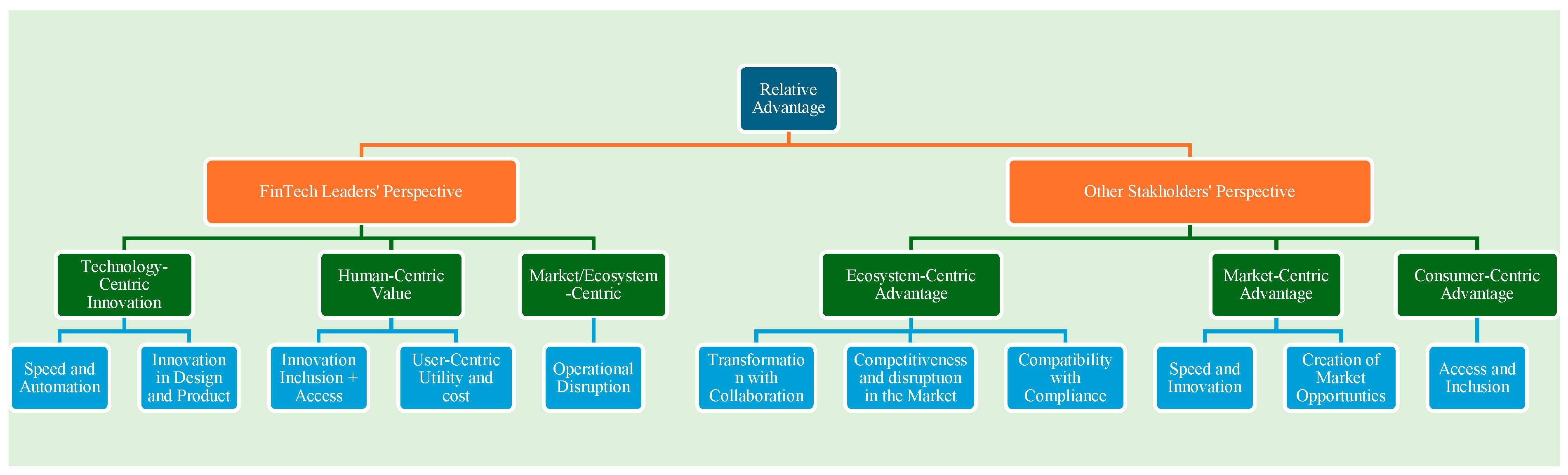
Coding method and development of themes: Qualitative Content Analysis was conducted using a stage-based coding flow for all questions across the three lenses employed in the framework, ensuring themes were generated transparently. Firstly, all interviews and written responses were carefully analysed and reviewed to determine their meaning and relevance to the theoretical framework, specifically regarding the IDT attribute (relative advantage). Secondly, these excerpts are then labelled with the initial code that was derived from recurring ideas and keywords (for instance, Instant Settlement, Time-to-Service: Faster Solution, Automation, AI-Generated Product Description, Faster Cross-Border Opportunities, Digital Money/Crypto, Compliance-Integrated Design, Easy Access, No Pre-Conditions, Serve Underserved, End-User Empowerment, Flexible and Lower Commission). Thirdly, these initial codes were clustered into sub-themes if they were conceptually related (for instance, Speed and Automation, Innovation in Design and Product, Innovation Inclusion + Access, User-Centric Utility and Cost, and Operational Disruption). Fourthly, consolidated grand themes were generated from the sub-themes (Technology-Centric Innovation, Human-Centric Value, and Market/Ecosystem-Centric Advantage).
Figure A3 shows the coding flow illustration for IDT (relative advantage). The same strategy or procedure was followed for all the questions in the questionnaire related to the triangulated framework. Further details on how the excerpts are converted into initial codes for the sub-themes and grand themes are provided in
Appendix E, with coding details presented in
Table A2 and
Table A3 for excerpts from FinTech and non-FinTech stakeholders, respectively.
In total, 177 initial codes were identified from the responses of FinTech leaders in the interviews, and 183 responses were derived from non-FinTech leaders. These initial codes were then grouped into 78 and 81 sub-themes, respectively, and 41 and 42 grand themes. This distribution of codes, sub-themes, and grand themes is summarised in
Table 1, along with their distribution across stakeholder groups. The abovementioned codes formed the analytical basis for the findings, which are presented in the following subsections.
4.1. Innovation Diffusion Theory (IDT)
Table 2 and
Figure A1,
Figure A2,
Figure A3,
Figure A5 and
Figure A6 in
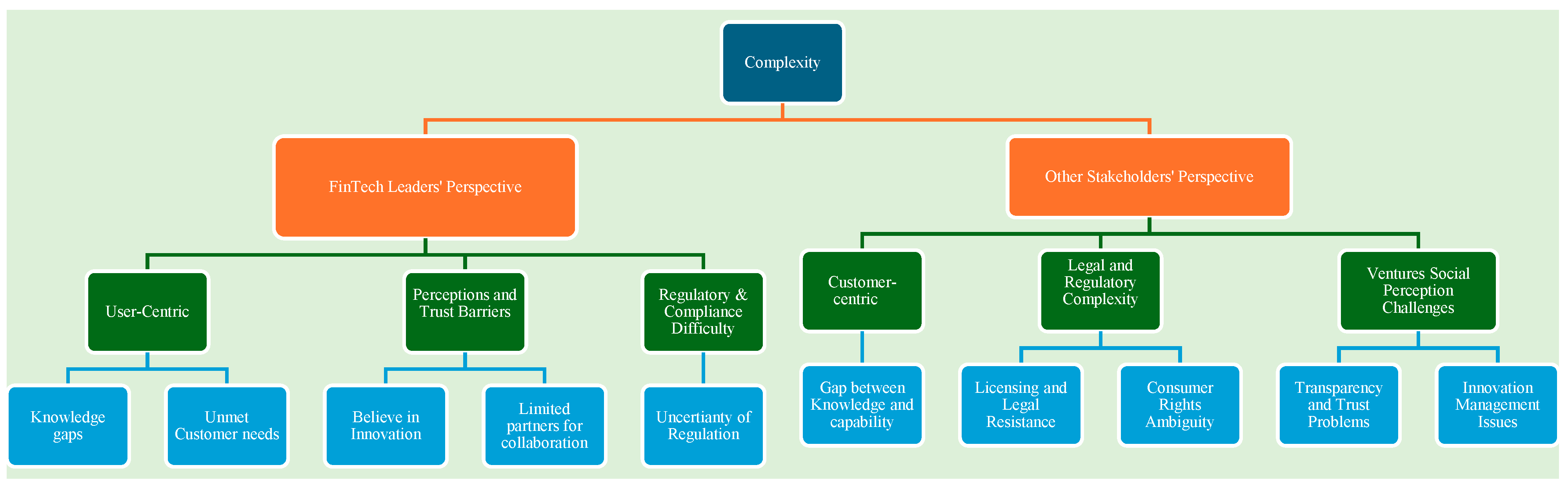
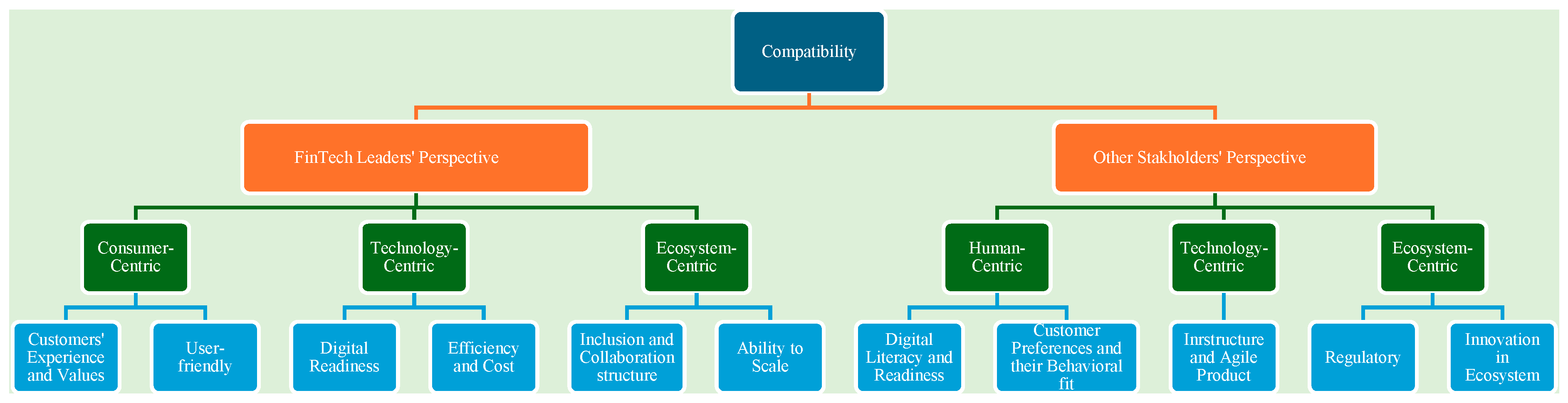
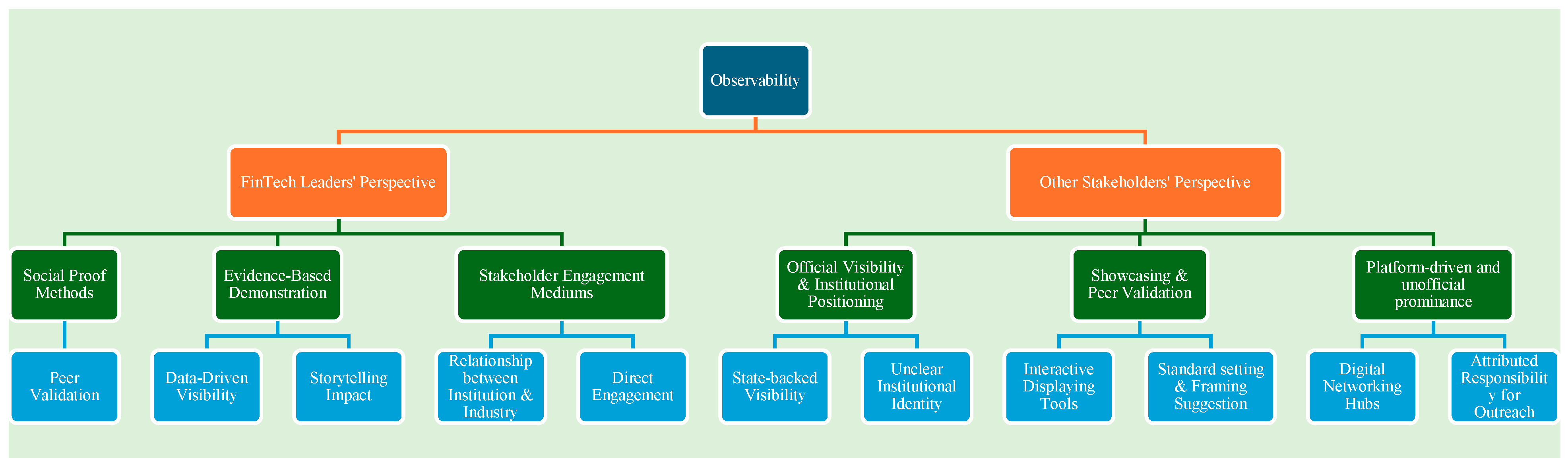
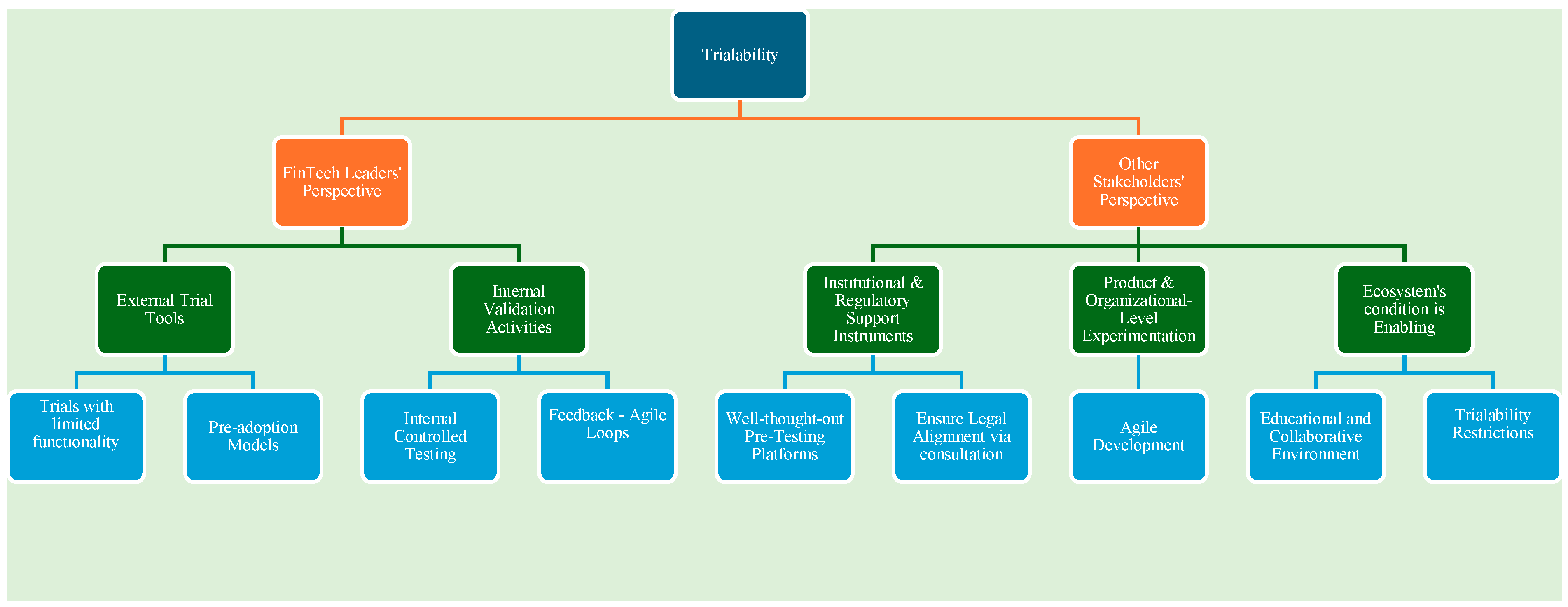
Appendix B illustrate the findings on how FinTech Innovation is diffusing according to Roger’s five attributes of IDT within the Latvian FinTech Ecosystem, as perceived by FinTech Stakeholders. The Latvian FinTech sector exhibits a relative advantage through speed, customer-centricity, and automation, supported by technology, including white-label and new B2B business models. FinTech must align with users’ digital expectations, market scalability, and continuous KYC improvement. However, complexity increases due to limited collaboration, lack of trust, and regulatory ambiguity. Trialability can be achieved through both top-down processes, such as regulations implemented via innovation hubs and sandboxes, and bottom-up processes, including internal testing and freemium models. Observability is established through visibility from the regulator and associations, as well as users’ testimonials and published success stories. Therefore, these approaches ensure that FinTech innovation diffusion aligns with Roger’s five attributes; however, they are limited by the complexity of compliance and uneven infrastructure.
The key findings from the coded interviews are presented in
Table 2, which compares how IDT attributes are perceived by FinTech and non-FinTech stakeholders in the FinTech sector. The results showed that relative advantage and compatibility are crucial factors supporting FinTech’s diffusion, whereas complexity remains the most significant barrier, primarily due to uncertainty regarding regulatory and compliance requirements. Trialability and observability also play a vital role in the adoption of FinTech by reducing uncertainty and building confidence.
4.2. De Meyer’s Implications for Innovation Ecosystems in the FinTech Sector
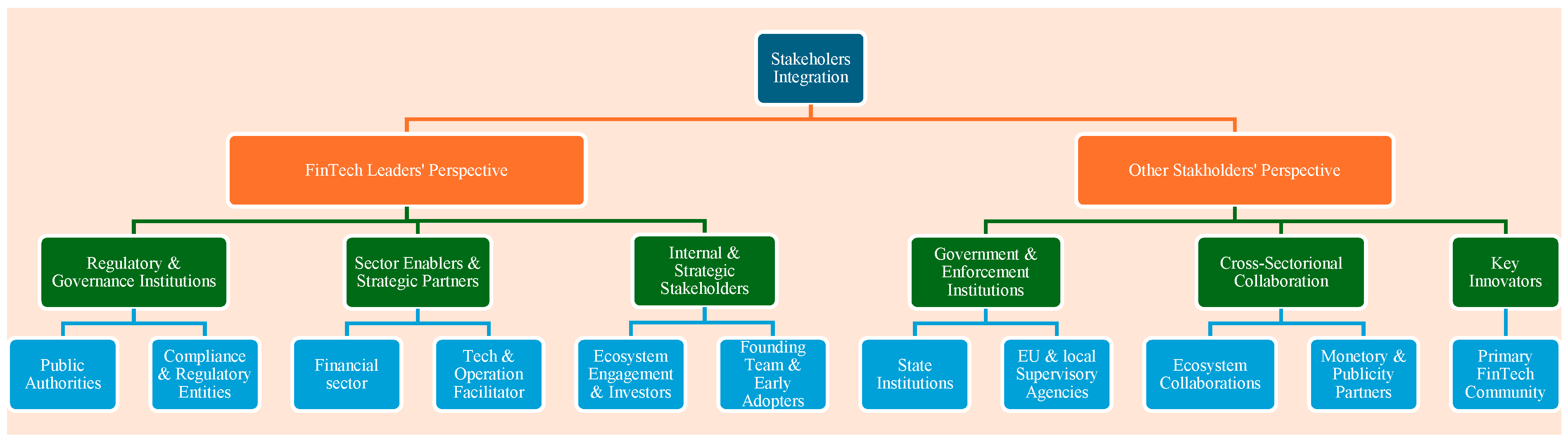
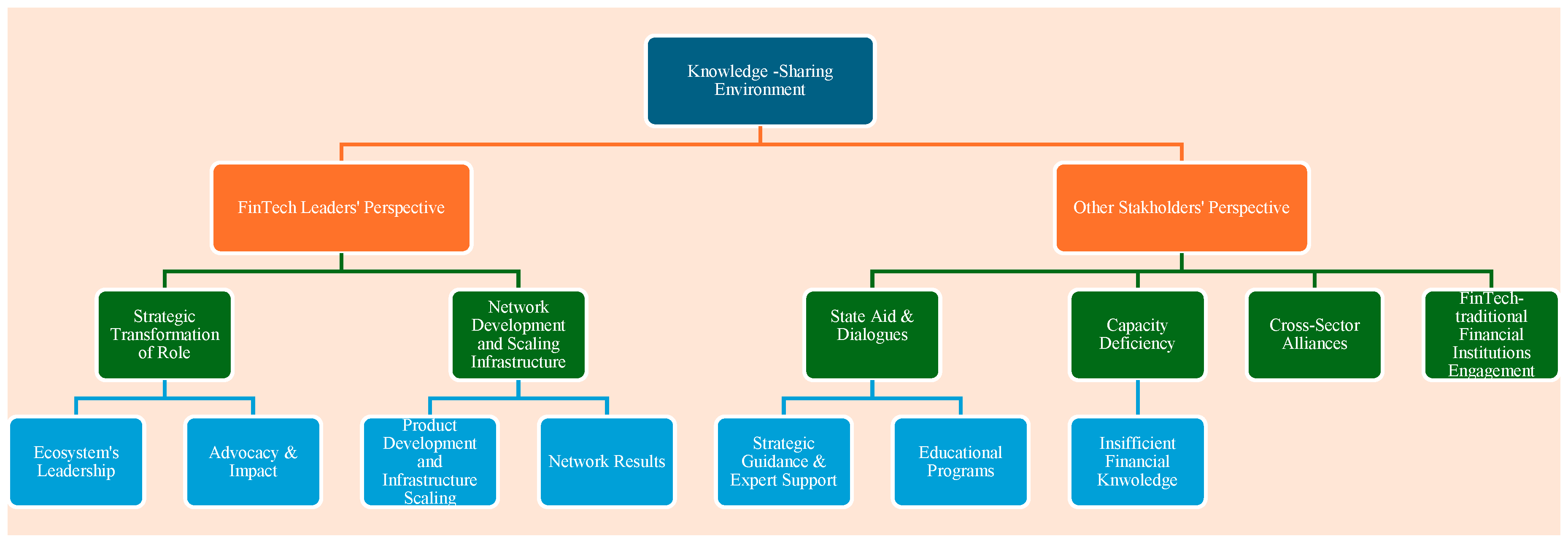
Table 3 and
Figure A4,
Figure A7,
Figure A8,
Figure A9 and
Figure A12 in
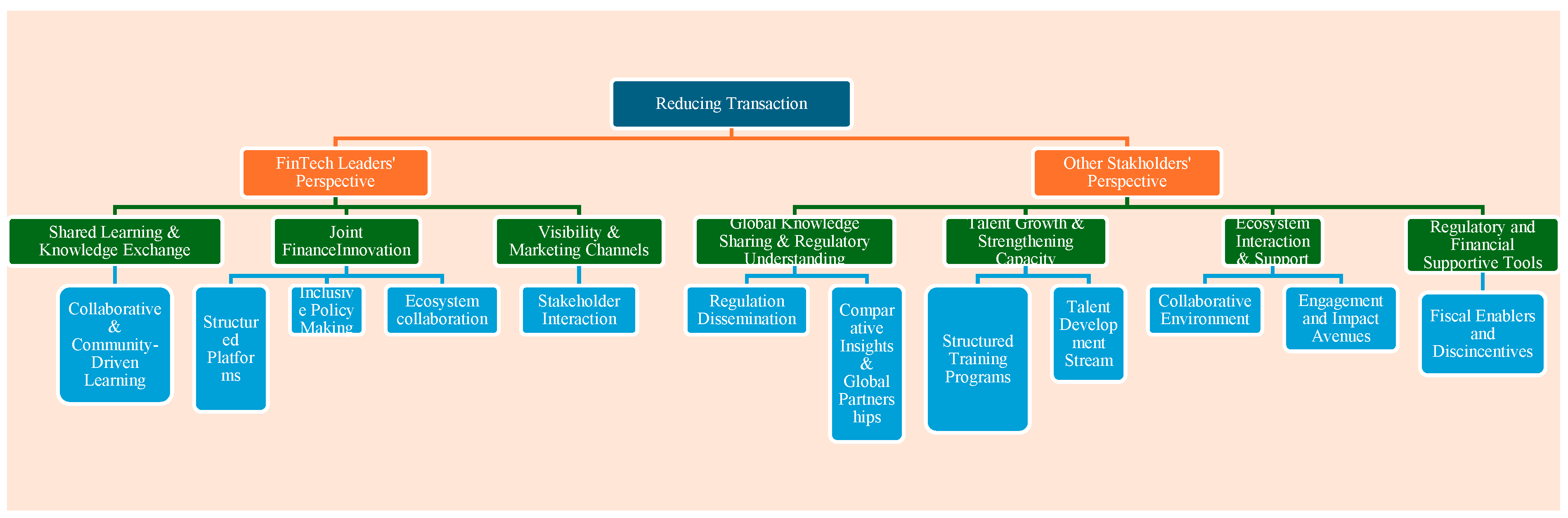
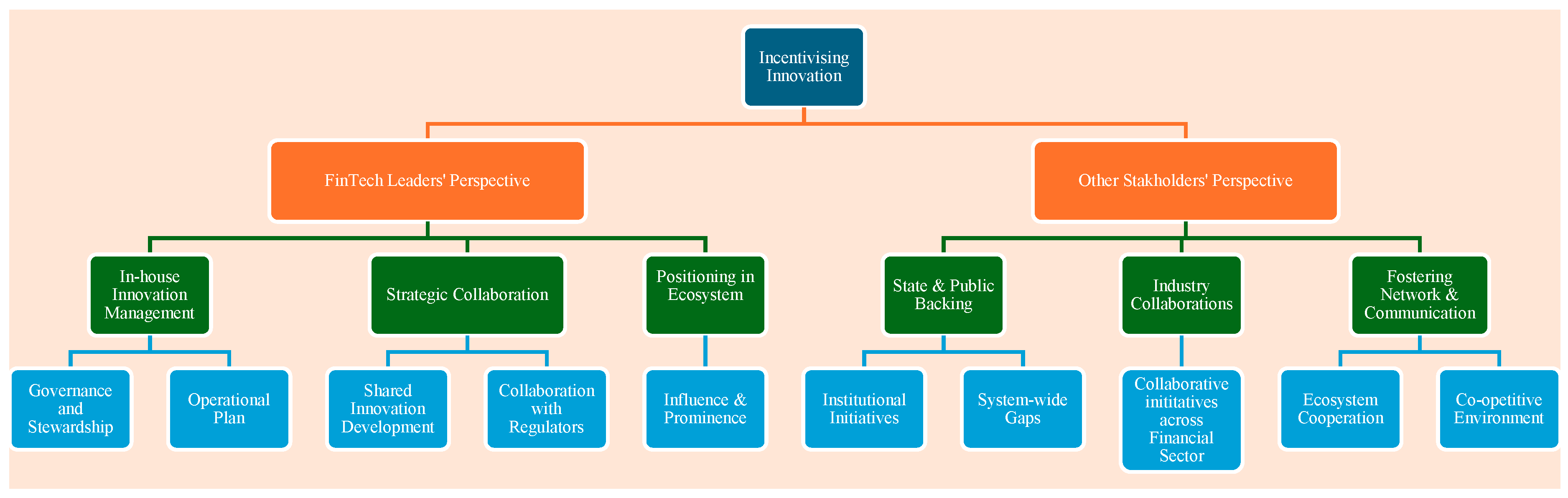
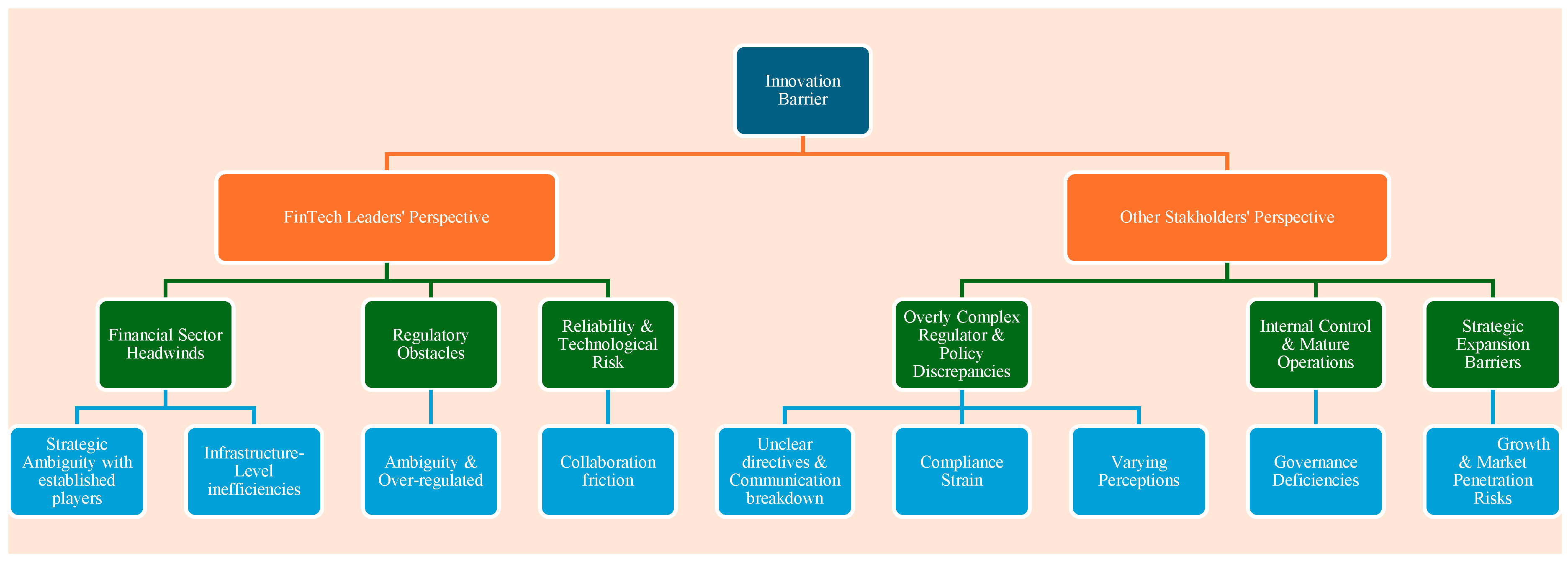
Appendix B present the findings on how the Latvian FinTech Ecosystem’s stakeholders collaborate, interact, and co-create, as outlined in De Meyer’s innovation orchestration model. The results show that the Latvian FinTech Ecosystem is still developing an organised stakeholder orchestration. Regulators remain the primary players, and collaboration among associations, banks, and investors remains mainly transactional. The primary barriers are ambiguous regulations and low trust, which hinder scaling and drive up integration costs. Regulator incentives remain slow and rigid; therefore, Latvian FinTechs rely on their own capabilities. According to the ecosystem’s leaders, clear communication, trained human capital, and shared Anti-Money Laundering (AML)/KYC measures may help reduce transactional costs. In Latvia, informal knowledge sharing occurs; it is mostly partner-driven and occurs within a limited loop of institutional feedback. Hence, overall, the Latvian FinTech Ecosystem tends to be more reactive than proactive, thereby underscoring the need for agile, structured co-creation policy instruments.
The findings related to the ecosystem are shown in
Table 3, based on the codes derived from the interviews. The results showed that, while regulators play a dominant role in shaping the ecosystem, collaborators, among other stakeholders, such as FinTechs, banks, and associations, are largely transactional and limited. As such, the FinTech ecosystem tends to be more reactive than proactive due to its regulatory ambiguity, high integration cost, and low trust, which limits innovation, scaling, and co-creation.
4.3. Value Chain Theory Implications/Mapping in the FinTech Sector
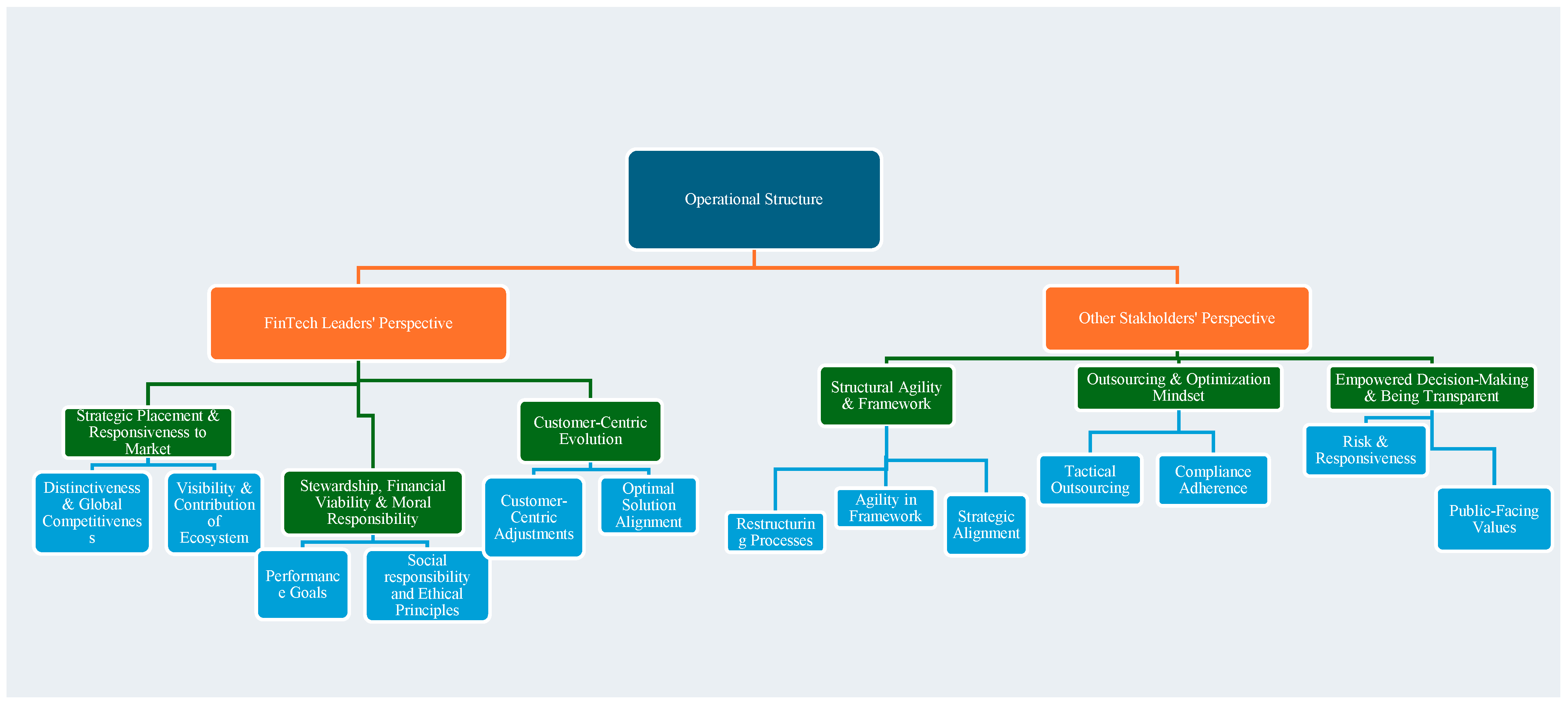
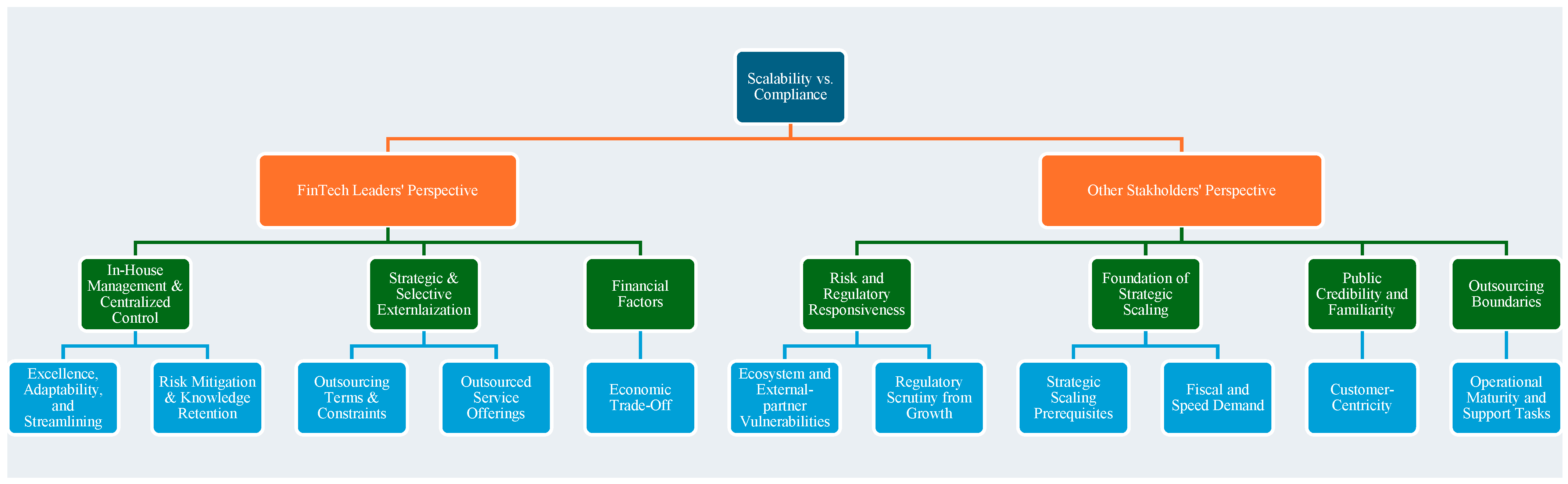
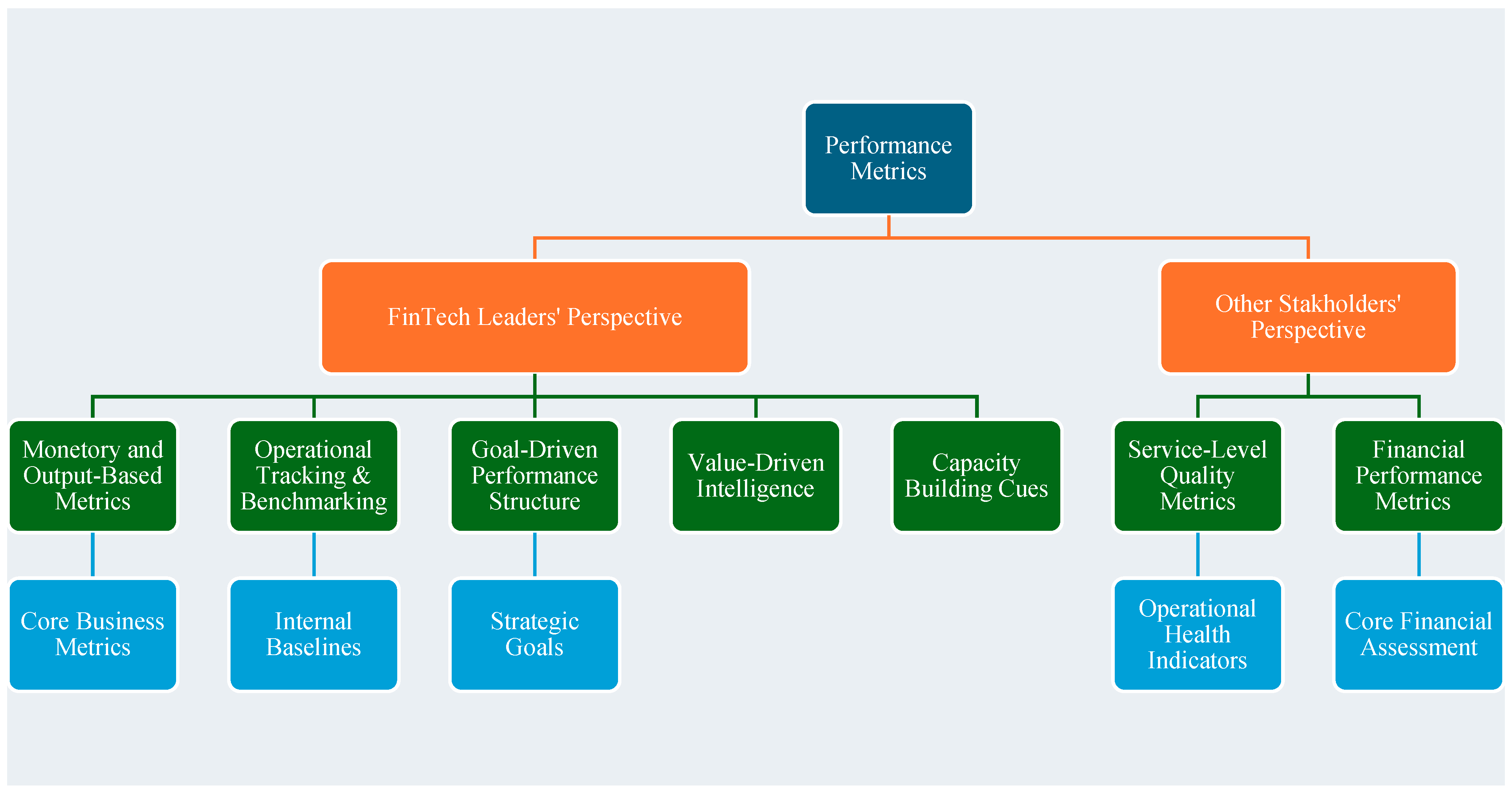
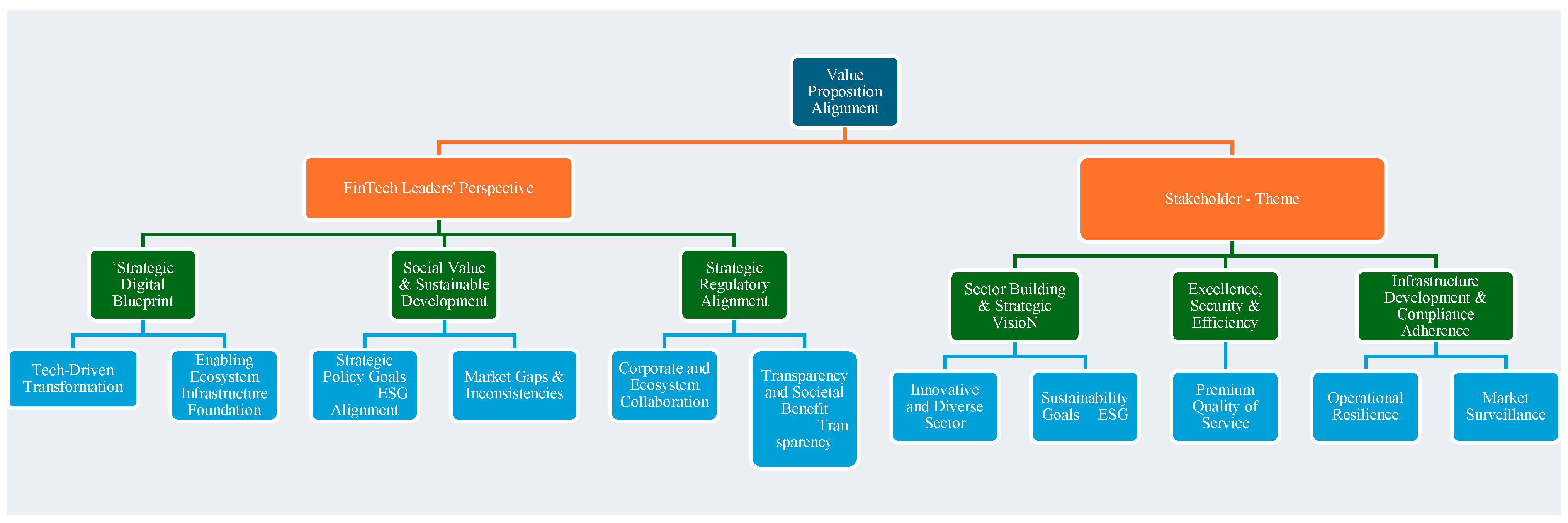
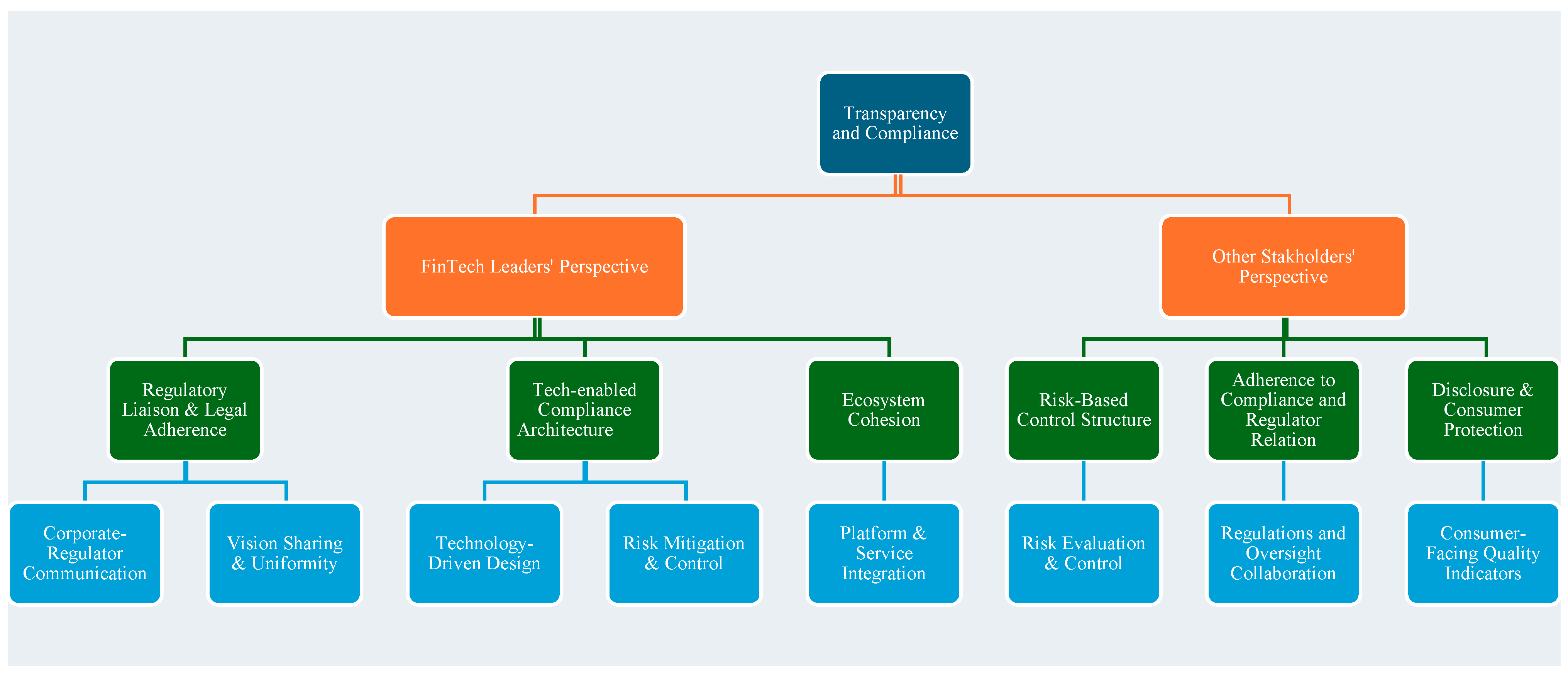
The summary in
Table 4 and
Figure A10,
Figure A11,
Figure A13,
Figure A14 and
Figure A15 in
Appendix B illustrates how Latvian FinTechs and traditional financial institutions restructure and adapt their value chains to achieve innovation while remaining compliant and scalable. FinTechs continue to maintain their customer-centric approach by diversifying their platforms, upholding ethical operations, and pursuing both profitability and inclusion. A selective outsourcing strategy, combined with in-house control, enables FinTech to achieve scalability. Automation, adaptive governance, and internal audits are used to integrate compliance and achieve transparency. FinTechs use Key Performance Indicators (KPIs), Service-Level Agreements (SLAs), and the volume of client acquisition to track performance, which together signal their maturity level and generate trust. Lastly, Latvian FinTechs embed ESG goals, implement digital strategies, and collaborate with policymakers to align with their value propositions. This way, Latvian FinTechs remain resilient and align with the European Union’s (EU’s) financial innovation goals.
The main findings obtained from the coded interview data on the FinTech value chain are summarised in
Table 4. The results showed that FinTech stakeholders tend to keep core operations in-house to maintain control and ensure compliance is not compromised. However, FinTech stakeholders also outsource non-core activities to help them scale and focus on their core business. Lastly, FinTech tends to emphasise trust, transparency, and different performance metrics to ensure sustainable growth, trust, and alignment with regulators and their ecosystem partners.
5. Discussion
In this section, the research questions are answered based on the findings.
The research question was as follows: What roles do stakeholders in the FinTech Ecosystem play in the diffusion, integration, alignment, and scaling of FinTech innovation in Latvia?
From De Meyer’s Lens of Innovation Ecosystem:
According to the findings, the role of each stakeholder differs based on their institutional position. FinTech stakeholders are the primary drivers of innovation diffusion and scalability, achieved through speed, digital capabilities, and synchronised, embedded modularity. On the other hand, non-FinTech stakeholders employ different tools for innovation diffusion, including requirements for compliance, trust expectations, and institutional coordination. In general, it was observed that innovation diffusion and scaling are enabled by (selective) collaboration and partnering in the private sector. However, diffusion and scaling are constrained by uneven infrastructure, regulatory complexity, and institutional unreadiness.
Therefore, the outcomes of this study indicate that ecosystem orchestration in the FinTech ecosystem is more institutionally constrained than market-driven, particularly in small, highly regulated markets.
From the Lens of Value Chain Theory:
The Latvian FinTech Ecosystem’s stakeholders focus on the diffusion of innovation from the perspectives of flexibility, speed, and digital-first capabilities. However, this is restricted due to a complex regulatory framework, uneven infrastructure, and institutional unreadiness. FinTech emphasised agile, modular product designs and embedded compliance, whereas non-FinTech stakeholders focused on consumer trust and compliance integration. Collaboration is strong except with regulators. The FinTech value chain maintains its core operations in-house and selectively outsources specific tasks. Innovative strength and strategic partnerships contribute to the scaling of FinTech.
Thus, the findings of this study suggest that FinTech achieves scaling through partner integration and selective outsourcing, rather than completely externalising core functions.
From Rogers’ Lens of Innovation Diffusion Theory IDT:
Both FinTech and non-FinTech leaders agree that flexibility, speed, and customer-centric service are the relative advantages of FinTech services over traditional financial solutions, modular designs, and API infrastructures. However, not all FinTech solutions are replacements; rather, they are supplements to conventional financial services. This viewpoint aligns with Roger’s concept of relative advantage [
13], Sharma et al.’s study [
48] on the adoption of FinTech solutions, and Lee & Shin’s opinion on efficient solutions to remain competitive [
39]. Overall, the results show that the perceived relative advantage, an attribute of IDT, is the primary driver of innovation adoption, prioritising competitiveness and efficiency. Moreover, the Latvian FinTech sector plays a supplementary role in the traditional financial industry rather than substituting it completely.
FinTechs meet the digital expectations of tech-savvy and younger users, as well as niche B2B markets, with strong compatibility; however, such systems are weak in Latvia due to the gap that exists between local consumer demand and innovative design, aligning with the findings of Sun et al. [
49]. Success stories, events, and testimonials enhance trust in FinTech, as stated by Zolkepli et al. [
50]. As such, customers adopt user-friendly FinTech solutions. Complexity results from regulatory and compliance ambiguity, as well as associated costs. Demo or risk-free accounts, in addition to sandbox demos, increase FinTech adoption, lower perceived risk, and enhance trust and reputation, as stated by Sharma [
48] and Thakur et al. [
51]. The evidence from the Latvian FinTech sector suggests that perceived complexity is driven by institutional conditions rather than technology, despite high levels of observability and trialability. Institutional conditions depend on the cost and ambiguity of compliance.
Henceforth, the findings suggest that institutional readiness plays an important role alongside FinTech innovation attributes in the regulated market.
Private FinTech stakeholders synchronise their processes, collaborate with BaaS providers, payment processors, and card issuers, and engage in joint development Sprints and APIs. However, regulators tend to be reactive, extending guidance rather than providing structured facilitation with policy tools, contrary to the conclusions of Williamson et al. [
45] and Fenwick et al. [
52]. Fintech partners with global networks to reduce operational costs and the burden of scaling. High compliance costs, the lack of a sandbox, and ambiguity in regulations are key barriers to aligning with Adner’s [
53] interdependence barrier.
This finding is contrary to the academic literature on the orchestration expectations of the ecosystem, which assumes that regulators usually act as proactive facilitators.
There is a partial knowledge-sharing ecosystem in Latvia, which is unstructured and misaligned with the framework presented by Sangwa et al. [
54]. However, the regional policies could enable FinTech to earn trust and integration.
FinTechs customise functions by reorganising compliance, partner integration, and product development, and have transitioned from single-service models to a full-stack ecosystem. Banks also integrate APIs for alternative credit scoring. Most FinTechs consider that internal capabilities are vital, but external capabilities can also be leveraged through partnerships, which help scale and mitigate risks, aligning with the findings of Williamson & De Meyer [
45] and Jangid et al. [
55]. This is consistent with arguments in the value chain leadership that scaling is the result of partner integration and selective outsourcing. However, Latvian FinTech ensures that it does not lose control in-house and preserves core compliance, allowing it to manage regulatory exposure wisely. FinTech carefully scales, observing core functions in-house, to ensure it stays aligned with regulations. Regulators have stressed the importance of transparency and consumer protection for lasting viability. Financial innovation helps fulfil ESG goals [
56], while AI solutions enable businesses to innovate more efficiently if they follow the rules [
57].
Throughout the analysis, FinTech leaders displayed a strong relative advantage provided by FinTechs. Nonetheless, FinTech adoption barriers remain due to regulatory complexity and uneven readiness across businesses. FinTech has well-developed observability and trialability, with strong collaboration in the private sector. Based on these results, the authors conclude that advanced innovation diffusion and ecosystem growth rely heavily on institutional readiness, infrastructure capacity, and agile policy measures.
6. Conclusions and Contribution
The key goal was to understand how FinTechs and non-FinTech stakeholders perceive, develop, and scale their innovations. To explore this question, the authors developed a triangulated analytical framework using Rogers’ IDT, Williamson’s, and De Meyer’s Innovation Ecosystem and Value Chain Theory.
6.1. Conclusions
- a.
FinTech innovation in the Latvian market is driven by automation, speed, and modularity; however, uneven institutional readiness and complexity of compliance are the biggest barriers.
- b.
As compared to regulatory facilitation, collaboration in the private sector is stronger. As a result, regulations create friction for integration and interpretation.
- c.
Partner integration with selective outsourcing can help FinTech scale innovations. However, FinTech often keeps governance and core compliance matters in-house to manage regulatory exposure.
- d.
A knowledge-sharing mechanism, combined with the infrastructure of AML/KYC, helps FinTech improve trust and reduce transaction costs, resulting in a progressively developing ecosystem.
6.2. Contribution of This Study
- a.
This is the first study, to the best of the authors’ knowledge, that combines IDT, De Meyer’s Ecosystem Framework, and Value Chain and Business Models theory into a single triangulated analytical framework.
- b.
This framework can be replicated in small, highly regulated markets to analyse innovation in FinTech and other sectors undergoing technology convergence, such as health tech.
- c.
The questionnaire used to interview FinTech Ecosystem leaders can be adapted and reused for further studies, such as cross-sector or cross-country studies.
6.3. Limitation
This research has limitations: it is confined to one country (Latvia). Furthermore, a comparative study of the EU FinTech Ecosystem should be conducted to gain more insights. A longitudinal study should also be conducted to understand how the roles of regulators evolve. Moreover, further study is needed on how ESG elements are integrated into FinTech business models.
Author Contributions
Conceptualisation, Z.S., C.A.R.; methodology, Z.S.; software, Z.S.; validation, Z.S.; formal analysis, Z.S.; investigation, Z.S.; resources Z.S.; data curation, Z.S.; writing—original draft preparation, Z.S.; writing—review and editing, Z.S.; visualisation, Z.S.; supervision, C.A.R.; funding acquisition, Z.S. and C.A.R. All authors have read and agreed to the published version of the manuscript.
Funding
This research was funded by project No. 5.2.1.1.i.0/1/23/I/CFLA/001 “Knowledge and Research Capacity Strengthening of Anti-Money Laundering, Financial Sector Technology and Analysis”.
Institutional Review Board Statement
Ethical review and approval were waived for this study due to the Latvian Law on Scientific Activity (Zinātniskās darbības likums, Law No. 107337) which defines the principles of scientific research and the responsibilities of researchers, including scientific integrity, objectivity, and responsible conduct of research, and does not establish a mandatory requirement for ethics committee approval for low-risk, non-biomedical research of this nature.
Informed Consent Statement
Informed consent was obtained from all subjects involved in the study.
Data Availability Statement
The datasets are available upon request.
Acknowledgments
The authors would like to thank RTU Riga Business School for its support in the writing of this paper.
Conflicts of Interest
The authors declare no conflicts of interest. The funders had no role in the design of the study; in the collection, analyses, or interpretation of data; in the writing of the manuscript; or in the decision to publish the results.
Abbreviations
The following abbreviations are used in this manuscript:
| IDT | Innovation Diffusion Theory |
| ESG | Environmental, Social, and Governance |
| API | Application Programming Interface |
| MSE | Micro and Small Enterprises |
| NFC | Near-field Communication |
| IT-Data-KYC | Information Technology–Data–Know Your Customer |
| QCA | Qualitative Content Analysis |
| B2B | Business-to-Business |
| AML | Anti-Money Laundering |
| KPI | Key Performance Indicator |
| SLA | Service Level Agreement |
| EU | European Union |
Appendix A. Stakeholder Questionnaire—FinTechs BOD
I appreciate your willingness to participate in this research. This questionnaire is part of a study exploring stakeholder perspectives on Latvia’s FinTech ecosystem. Please answer as thoroughly as you feel comfortable.
What is your professional background, and how did you become a board member of this FinTech?
How do you relate to the mission and vision of your FinTech company?
What innovations does your firm offer that improve on traditional financial services?
How do your products or platforms align with customer values and market needs? (Fit between the innovation and the target users’ lifestyles or expectations)
What are the paramount usability or adoption challenges you’ve (or your users have) encountered?
How do you allow customers to test or pilot your products before full use?
What mechanisms help demonstrate the impact of your offerings (e.g., case studies, testimonials)?
Who are the most critical partners in your business ecosystem (e.g., enablers, regulators, adopters)?
What barriers have you encountered in navigating ecosystem relationships (e.g., with regulators or banks)?
How do you foster trust, co-creation, or collaborative development with other ecosystem players? (Mutual development of innovation with partners)
How does your firm contribute to or benefit from knowledge-sharing environments (events, consortia)?
How has your role evolved—from a niche innovator to a keystone or Orchestrator (if applicable)? (Lifecycle progression within the ecosystem)
How has your value proposition evolved since the company’s inception?
What operational functions are handled in-house vs. outsourced, and why? (Internal capability vs. third-party reliance)
How do you structure your company to ensure scalability while staying compliant?
Do you track specific KPIs to evaluate business model performance?
How does your business model align with national or EU-level goals for FinTech?
What advice would you give to future FinTech board members or founders entering this space?
Can you share an anecdote or memorable board discussion about innovation or transformation?
How do you see your firm’s role evolving within the Latvian FinTech landscape in the next 5 years?
Appendix B. Emerging Concepts from the QCA of the Interviews
Figures in
Appendix B are organised by analytical lens and thematic grouping; figure numbering follows the order of first citation in the main text.
Figure A1.
Rogers’ Innovation Diffusion Theory for Complexity—developed by the author based on interviews, 2025.
Figure A1.
Rogers’ Innovation Diffusion Theory for Complexity—developed by the author based on interviews, 2025.
Figure A2.
Rogers’ Innovation Diffusion Theory for Compatibility—developed by the author based on interviews, 2025.
Figure A2.
Rogers’ Innovation Diffusion Theory for Compatibility—developed by the author based on interviews, 2025.
Figure A3.
Rogers’ Innovation Diffusion Theory for Relative Advantage—developed by the author based on interviews, 2025.
Figure A3.
Rogers’ Innovation Diffusion Theory for Relative Advantage—developed by the author based on interviews, 2025.
Figure A4.
De Meyer’s Innovation Ecosystem for Stakeholder Integration—developed by the author based on interviews, 2025.
Figure A4.
De Meyer’s Innovation Ecosystem for Stakeholder Integration—developed by the author based on interviews, 2025.
Figure A5.
Rogers’ Innovation Diffusion Theory for Observability—developed by the author based on interviews, 2025.
Figure A5.
Rogers’ Innovation Diffusion Theory for Observability—developed by the author based on interviews, 2025.
Figure A6.
Roger’s Innovation Diffusion Theory for Trialability—developed by the author based on interviews, 2025.
Figure A6.
Roger’s Innovation Diffusion Theory for Trialability—developed by the author based on interviews, 2025.
Figure A7.
De Meyer’s Innovation Ecosystem for Reducing Transactions—developed by the author based on interviews, 2025.
Figure A7.
De Meyer’s Innovation Ecosystem for Reducing Transactions—developed by the author based on interviews, 2025.
Figure A8.
De Meyer’s Innovation Ecosystem for Incentivising Innovation—developed by the author based on interviews, 2025.
Figure A8.
De Meyer’s Innovation Ecosystem for Incentivising Innovation—developed by the author based on interviews, 2025.
Figure A9.
De Meyer’s Innovation Ecosystem for Barriers to Innovation—developed by the author based on interviews, 2025.
Figure A9.
De Meyer’s Innovation Ecosystem for Barriers to Innovation—developed by the author based on interviews, 2025.
Figure A10.
Value Chain Contribution to Operational Structure—developed by the author based on interviews, 2025.
Figure A10.
Value Chain Contribution to Operational Structure—developed by the author based on interviews, 2025.
Figure A11.
Value Chain Contribution to Scalability vs. Compliance—developed by the author based on interviews, 2025.
Figure A11.
Value Chain Contribution to Scalability vs. Compliance—developed by the author based on interviews, 2025.
Figure A12.
De Meyer’s Innovation Ecosystem for a Knowledge-Sharing Environment—developed by the author based on interviews, 2025.
Figure A12.
De Meyer’s Innovation Ecosystem for a Knowledge-Sharing Environment—developed by the author based on interviews, 2025.
Figure A13.
Value Chain Contribution to Performance Metrics—developed by the author based on interviews, 2025.
Figure A13.
Value Chain Contribution to Performance Metrics—developed by the author based on interviews, 2025.
Figure A14.
Value Chain Contribution to Value Proposition Alignment—developed by the author based on interviews, 2025.
Figure A14.
Value Chain Contribution to Value Proposition Alignment—developed by the author based on interviews, 2025.
Figure A15.
Value Chain Contribution to Transparency and Compliance—developed by the author based on interviews, 2025.
Figure A15.
Value Chain Contribution to Transparency and Compliance—developed by the author based on interviews, 2025.
Appendix C. Profile of the Interviewees
Table A1.
Profile of the interviewees, including stakeholder category, role, experience, interview mode, duration, and timing—developed by the authors based on interviews, 2025.
Table A1.
Profile of the interviewees, including stakeholder category, role, experience, interview mode, duration, and timing—developed by the authors based on interviews, 2025.
| Interview ID | Role Type | Years of Experience | Mode | Duration | Month/Year |
|---|
| FinTech 1 | Functional lead | 29 years | Zoom | around 40 min | June 2025 |
| FinTech 2 | Executive leadership | 14 years | Written | N/A | June 2025 |
| FinTech 3 | Executive leadership | 16 years | Written | N/A | June 2025 |
| FinTech 4 | Executive leadership | 22 years | Zoom | around 1 h | May 2025 |
| FinTech 5 | Senior Management | 19 years | Zoom | around 50 h | June 2025 |
| FinTech 6 | Executive leadership | 15 years | Written | N/A | May 2025 |
| FinTech 7 | Executive leadership | 26 years | Written | N/A | May 2025 |
| FinTech 8 | Executive leadership | 26 years | Written | N/A | May 2025 |
| FinTech 9 | Executive leadership | 19 years | Written | N/A | June 2025 |
| FinTech 10 | Functional lead | 16 years | Face-to-Face | around 1 h | May 2025 |
| FinTech 11 | Executive leadership | 14 years | Written | N/A | May 2025 |
| Regulator 1 | Senior management | 19 years | Zoom | around 1 h | June 2025 |
| Regulator 2 | Senior management | 21 years | Written | N/A | May 2025 |
| Regulator 3 | Senior management | 28 years | Zoom | around 1 h | May 2025 |
| Regulator 4 | Senior management | 11 years | Written | N/A | August 2025 |
| Commercial Bank 1 | Senior management | 26 years | Zoom | around 80 min | May 2025 |
| Commercial Bank 2 | Board-level governance | 18 years | Zoom | around 75 min | May 2025 |
| Association 1 | Executive leadership | 36 years | Face-to-Face | around 1 h | May 2025 |
| Association 2 | Executive leadership | 24 years | Zoom | around 1 h | May 2025 |
Appendix D. Interview Script
Contact and Recruitment Procedure: Purposive sampling was employed to recruit participants across various stakeholder groups. The stakeholder group included FinTechs from the three most successful subsectors of the FinTech sector, based on their financial performance from 2016 to 2022, traditional financial institutions (Commercial Banks), regulators, and associations. The Managing Director of the FinTech Latvian Association put the researcher or authors in contact with potential participants, some of whom were known to the authors, while others were new contacts. The introduction and initial communication were made via official emails by both authors and the Managing Director. The authors provided the initial guidelines and the questionnaire in advance. Additionally, participants could choose from three modes of response to prioritise their availability and flexibility: one-to-one interviews (either via Zoom or face-to-face) or written responses, which could be submitted as an attachment to the email.
Consent, Anonymity, and the Data: Once the initial contact was made, the authors then introduced themselves to and informed the participants of the purpose and context of the research. The information was provided to stakeholders to ensure they understood that the process was voluntary and that they reserved the right to skip questions or withdraw from the study at any point. All participants provided consent for both participating in the study and for a one-to-one interview, either verbally or in writing via email. Therefore, video recordings or audio recordings were used only when permission was granted. All responses were handled carefully to maintain confidentiality, and all the collected data were anonymised to maintain the confidentiality of the participants.
Additionally, no information, such as names, titles, or organisations, was used, and this was kept confidential throughout the research. If any direct quotation was necessary, it could not be shared without the prior approval of the participant. However, all recordings, their transcripts, and the written material are maintained and stored securely and are accessible only to the authors.
Interview Structure and modification in questions: Data were collected using a semi-structured questionnaire. The questionnaire was based on the triangulated theoretical frameworks of Rogers’ Innovation Diffusion Theory (IDT), De Meyer’s Innovation Ecosystems Framework, and the Value Chain Theory. The survey began with two introductory questions that asked participants about their role in their organisation and about the key developments in the Latvian FinTech Ecosystem. The introductory questions were followed by questions related to the three lenses. Five attributes of IDT were addressed in the IDT section (relative advantage, complexity, compatibility, observability, and trialability). De Meyer’s Innovation Ecosystem examined how stakeholders interact and collaborate, the level of trust among them, and information such as who serves as the orchestrator, integrator, and enabler, as well as the key enablers and factors that act as barriers to diffusion and innovation scaling. Lastly, the value chain addressed value proposition, value creation, and how FinTech captures value by reshaping financial services, as well as the resulting constraints when scaling. Finally, the questionnaire concluded with three closing questions regarding their recommendations for new startups, recommendations on strengthening the FinTech Ecosystem, potential regulatory improvements, and any advice they wished to offer. The version of the questionnaire was slightly modified for non-FinTech stakeholders to ensure consistency, while simultaneously enabling comparison across cases.
Further information: In parallel to face-to-face or Zoom interviews, authors took notes as a backup. The written responses were also treated as qualitative data, equivalent to the one-to-one interviews, which were analysed using a Qualitative Content Analysis approach, similar to the analysis of the interview transcripts.
Appendix E
Coding Flow from Raw Responses to Themes: The first step was to identify responses to the questions from both the interview transcripts and the written responses. This was performed manually as the interviews were semi-structured and did not necessarily follow the same sequence. Excerpts answering specific questions were then identified and condensed into several keywords or labels, and they were named as the initial codes. The initial codes were then further grouped into sub-themes and aggregated into grand themes under the relevant theoretical lens. This process followed a structured flow: Identifying relevant excerpts from interviews (raw data), condensing meaning, generating initial keywords, grouping into sub-themes, aggregating into grand themes, and mapping to the theoretical lens.
For instance, one excerpt is taken from IDT on relative advantage below:
“Basically, we’re taking the payment product and building the innovations on top of it, Mhmm. On top of it. One of our flagship products is our tipping solution. This way, you can pay the bill and leave the tip. And we do this tip, so the tip goes to the staff member’s bank account, right, directly from the card machine. Mhmm. That’s basically the innovation of it, it’s built up on the IT on a back end that we are delivering directly from the machine to the staff, not through the business account, but, like, directly to the staff.”
The initial codes identified were as follows: Innovative Product, Reduce Intermediaries/Disintermediation, Enhance Transparency, Lower Commission, Digital Solution, Cashless, Online Platforms/Apps, and Time-to-Service: Faster Solution. Similarly, all excerpts answering these questions were analysed to identify the initial codes. Then, these codes were grouped into sub-themes and subsequently into grand themes. Below,
Table A2. is an example of the complete code derived from the initial code and the grand code for IDT relative advantage.
Table A2.
Coding structure from initial codes to sub-themes and grand themes for IDT relative advantage from FinTech leaders perspective—developed by the authors based on interview data, 2025.
Table A2.
Coding structure from initial codes to sub-themes and grand themes for IDT relative advantage from FinTech leaders perspective—developed by the authors based on interview data, 2025.
| Grand Theme | Sub-Theme | Initial Codes |
|---|
| Technology-Centric Innovation | Speed and Automation | Instant Settlement |
| Time-to-Service: Faster Solution |
| Automation |
| AI-Generated Product Description |
| Faster Cross-Border Opportunities |
| Innovation in Design and Product | Innovative Product |
| Digital Solution |
| Digital Money/Crypto |
| Compliance-Integrated Design |
| Easy Access |
| No Pre-Conditions |
| Human-Centric Value | Innovation Inclusion + Access | Serve Underserved |
| End-User Empowerment |
| Flexible |
| Lower Commission |
| Cashless |
| User-Centric Utility and Cost | Online Platforms/Apps |
| Customised Solution |
| Enhances Transparency |
| Transparency + Disintermediation |
| Reduce Intermediaries/Disintermediation |
| Supplement to Banking Solutions |
| Market/Ecosystem-Centric Advantage | Operational Disruption | White-label Strategy |
| B2B Growth Model |
| PaaS |
This table is illustrated in
Figure A1. It is worth noting that the excerpts from the FinTech interviews were analysed separately from those of the non-FinTech interviews to compare viewpoints and triangulate frameworks from FinTech and non-FinTech stakeholders. The grand themes for the initial codes derived from non-FinTech stakeholders from the Latvian FinTech sector for IDT—relative advantage are given as follows in
Table A3.
Table A3.
Coding structure of initial codes, sub-themes, and grand themes for IDT relative advantage from non-FinTech stakeholders perspective—developed by the authors based on interview data, 2025.
Table A3.
Coding structure of initial codes, sub-themes, and grand themes for IDT relative advantage from non-FinTech stakeholders perspective—developed by the authors based on interview data, 2025.
| Grand Theme | Sub-Theme | Codess |
|---|
| Ecosystem-Centric Advantage | Transformation with Collaboration | Complements Banking Solutions |
| | | Collaborators |
| | Competitiveness and disruption in the Market | Push Traditional Service Providers to Perform Better + Disruptors |
| | | Competitors |
| | Compatibility with Compliance | Compliance |
| | | Balance the Legal Needs |
| Market-Centric Advantage | Speed and Innovation | Faster Innovation |
| | | Faster Response + Adaptable to Market Needs |
| | Creation of Market Opportunities | More Opportunities in the Market |
| | | Reduce Cost |
| | | Customised Products/Flexible Offerings |
| Consumer-Centric Advantage | Access and Inclusion | Underserved/Financial Inclusion |
| | | Easy/Convenient Solutions |
References
- Kálmán, J. The Role of Regulatory Sandboxes in FinTech Innovation: A Comparative Case Study of the UK, Singapore, and Hungary. FinTech 2025, 4, 26. [Google Scholar] [CrossRef]
- Shaikh, I.M.; Amin, H. Influence of Innovation Diffusion Factors on Non-Users’ Adoption of Digital Banking Services in the Banking 4.0 Era. Inf. Discov. Deliv. 2025, 53, 12–21. [Google Scholar] [CrossRef]
- Koranteng, B.; You, K. Fintech and Financial Stability: Evidence from Spatial Analysis for 25 Countries. J. Int. Financ. Mark. Inst. Money 2024, 93, 102002. [Google Scholar] [CrossRef]
- Yáñez-Valdés, C.; Guerrero, M. Assessing the Organizational and Ecosystem Factors Driving the Impact of Transformative FinTech Platforms in Emerging Economies. Int. J. Inf. Manag. 2023, 73, 102689. [Google Scholar] [CrossRef]
- Siddiqui, Z.; Rivera, C.A. Mapping Fintech landscape in Latvia: Taxonomy-based classification and economic impact analysis. Pol. J. Manag. Stud. 2024, 30, 304–319. [Google Scholar] [CrossRef]
- McKinsey & Company. Europe’s Fintech Opportunity (Full Report); McKinsey & Company: New York, NY, USA, 2022; p. 27. [Google Scholar]
- Chen, S.; Guo, Q. Fintech and MSEs Innovation: An Empirical Analysis. arXiv 2024, arXiv:2407.17293. [Google Scholar] [CrossRef]
- Takahashi, C.K.; Figueiredo, J.C.B.D.; Scornavacca, E. Investigating the Diffusion of Innovation: A Comprehensive Study of Successive Diffusion Processes through Analysis of Search Trends, Patent Records, and Academic Publications. Technol. Forecast. Soc. Change 2024, 198, 122991. [Google Scholar] [CrossRef]
- Cornelli, G.; Frost, J.; Gambacorta, L.; Jagtiani, J. The Impact of Fintech Lending on Credit Access for U.S. Small Businesses. J. Financ. Stab. 2024, 73, 101290. [Google Scholar] [CrossRef]
- Guan, Y.; Sun, N.; Wu, S.J.; Sun, Y. Supply Chain Finance, Fintech Development, and Financing Efficiency of SMEs in China. Adm. Sci. 2025, 15, 86. [Google Scholar] [CrossRef]
- Rupeika-Apoga, R.; Wendt, S. FinTech in Latvia: Status Quo, Current Developments, and Challenges Ahead. Risks 2021, 9, 181. [Google Scholar] [CrossRef]
- Kapoor, K.K.; Dwivedi, Y.K.; Williams, M.D. Rogers’ Innovation Adoption Attributes: A Systematic Review and Synthesis of Existing Research. Inf. Syst. Manag. 2014, 31, 74–91. [Google Scholar] [CrossRef]
- Rogers, E.M. Diffusion of Innovations, 5th ed.; Free Press: London, UK, 2003. [Google Scholar]
- Tarhini, A.; Arachchilage, N.A.G.; Masa’deh, R.; Abbasi, M.S. A Critical Review of Theories and Models of Technology Adoption and Acceptance in Information System Research. Int. J. Technol. Diffus. 2015, 6, 58–77. [Google Scholar] [CrossRef]
- Kaur, P.; Dhir, A.; Bodhi, R.; Singh, T.; Almotairi, M. Why Do People Use and Recommend M-Wallets? J. Retail. Consum. Serv. 2020, 56, 102091. [Google Scholar] [CrossRef]
- Kapoor, K.K.; Dwivedi, Y.K.; Williams, M.D. Examining the Role of Three Sets of Innovation Attributes for Determining Adoption of the Interbank Mobile Payment Service. Inf. Syst. Front. 2015, 17, 1039–1056. [Google Scholar] [CrossRef]
- Tsai, J.-P.; Ho, C.-F. Does Design Matter? Affordance Perspective on Smartphone Usage. Ind. Manag. Data Syst. 2013, 113, 1248–1269. [Google Scholar] [CrossRef]
- Zhang, X. Frugal Innovation and the Digital Divide: Developing an Extended Model of the Diffusion of Innovations. Int. J. Innov. Stud. 2018, 2, 53–64. [Google Scholar] [CrossRef]
- Kapoor, K.K.; Dwivedi, Y.K.; Williams, M.D. Empirical Examination of the Role of Three Sets of Innovation Attributes for Determining Adoption of IRCTC Mobile Ticketing Service. Inf. Syst. Manag. 2015, 32, 153–173. [Google Scholar] [CrossRef][Green Version]
- Weerakkody, V.; Irani, Z.; Kapoor, K.; Sivarajah, U.; Dwivedi, Y.K. Open Data and Its Usability: An Empirical View from the Citizen’s Perspective. Inf. Syst. Front. 2017, 19, 285–300. [Google Scholar] [CrossRef]
- Sikandar, H.; Vaicondam, Y.; Khan, N.; Qureshi, M.I.; Ullah, A. Scientific Mapping of Industry 4.0 Research: A Bibliometric Analysis. Int. J. Interact. Mob. Technol. 2021, 15, 129–147. [Google Scholar] [CrossRef]
- MINÀ, A.; Dagnino, G.B. Competition and Cooperation in Entrepreneurial Ecosystems: A Lifecycle Analysis of a Canadian ICT Ecosystem. In Innovation, Alliances, and Networks in High-Tech Environments; Routledge: London, UK, 2015; pp. 65–81. [Google Scholar]
- Audretsch, D.B.; Cunningham, J.A.; Kuratko, D.F.; Lehmann, E.E.; Menter, M. Entrepreneurial Ecosystems: Economic, Technological, and Societal Impacts. J. Technol. Transf. 2019, 44, 313–325. [Google Scholar] [CrossRef] [PubMed]
- Colombo, M.G.; Dagnino, G.B.; Lehmann, E.E.; Salmador, M. The Governance of Entrepreneurial Ecosystems. Small Bus. Econ. 2019, 52, 419–428. [Google Scholar] [CrossRef]
- Reynolds, E.B.; Uygun, Y. Strengthening Advanced Manufacturing Innovation Ecosystems: The Case of Massachusetts. Technol. Forecast. Soc. Change 2018, 136, 178–191. [Google Scholar] [CrossRef]
- Talmar, M.; Walrave, B.; Podoynitsyna, K.S.; Holmström, J.; Romme, A.G.L. Mapping, Analyzing and Designing Innovation Ecosystems: The Ecosystem Pie Model. Long Range Plan. 2020, 53, 101850. [Google Scholar] [CrossRef]
- Etzkowitz, H.; Leydesdorff, L. The Dynamics of Innovation: From National Systems and “Mode 2” to a Triple Helix of University–Industry–Government Relations. Res. Policy 2000, 29, 109–123. [Google Scholar] [CrossRef]
- Cunningham, J.A.; Menter, M.; O’Kane, C. Value Creation in the Quadruple Helix: A Micro Level Conceptual Model of Principal Investigators as Value Creators. R D Manag. 2018, 48, 136–147. [Google Scholar] [CrossRef]
- Ritala, P.; Agouridas, V.; Assimakopoulos, D.; Gies, O. Value Creation and Capture Mechanisms in Innovation Ecosystems: A Comparative Case Study. Int. J. Technol. Manag. 2013, 63, 244–267. [Google Scholar] [CrossRef]
- Tansley, A.G. The Use and Abuse of Vegetational Concepts and Terms. Ecology 1935, 16, 284–307. [Google Scholar] [CrossRef]
- Moore, J. Predators and Prey: A New Ecology of Competition. Harv. Bus. Rev. 1999, 71, 75–86. [Google Scholar]
- Basole, R.C.; Karla, J. On the Evolution of Mobile Platform Ecosystem Structure and Strategy. Bus. Inf. Syst. Eng. 2011, 3, 313–322. [Google Scholar] [CrossRef]
- Granstrand, O.; Holgersson, M. Innovation Ecosystems: A Conceptual Review and a New Definition. Technovation 2020, 90–91, 102098. [Google Scholar] [CrossRef]
- Stefanelli, V.; Manta, F. Digital Financial Services and Open Banking Innovation: Are Banks Becoming ‘Invisible’? Glob. Bus. Rev. 2023, 09721509231151491. [Google Scholar] [CrossRef]
- Teece, D.J. Business Models, Business Strategy and Innovation. Long Range Plan. 2010, 43, 172–194. [Google Scholar] [CrossRef]
- Zott, C.; Amit, R. Business Model Design: An Activity System Perspective. Long Range Plan. 2010, 43, 216–226. [Google Scholar] [CrossRef]
- Adner, R. Ecosystem as Structure: An Actionable Construct for Strategy. J. Manag. 2017, 43, 39–58. [Google Scholar] [CrossRef]
- Gomber, P.; Kauffman, R.J.; Parker, C.; Weber, B.W. On the Fintech Revolution: Interpreting the Forces of Innovation, Disruption, and Transformation in Financial Services. J. Manag. Inf. Syst. 2018, 35, 220–265. [Google Scholar] [CrossRef]
- Lee, I.; Shin, Y.J. Fintech: Ecosystem, Business Models, Investment Decisions, and Challenges. Bus. Horiz. 2018, 61, 35–46. [Google Scholar] [CrossRef]
- Clauss, T. Measuring Business Model Innovation: Conceptualization, Scale Development, and Proof of Performance. R D Manag. 2017, 47, 385–403. [Google Scholar] [CrossRef]
- Morris, M.; Schindehutte, M.; Allen, J. The Entrepreneur’s Business Model: Toward a Unified Perspective. J. Bus. Res. 2005, 58, 726–735. [Google Scholar] [CrossRef]
- Johnson, M.W.; Christensen, C.M.; Kagermann, H. Reinventing Your Business Model. Harv. Bus. Rev. 2008, 87, 52–60. [Google Scholar]
- Osterwalder, A.; Pigneur, Y. Business Model Generation: A Handbook for Visionaries, Game Changers, and Challengers; Wiley & Sons: New York, NY, USA, 2013. [Google Scholar]
- Yin, R.K. Case Study Research and Applications: Design and Methods, 6th ed.; Sage Publication: Thousand Oaks, CA, USA, 2018. [Google Scholar]
- Williamson, P.J.; De Meyer, A. Ecosystem Advantage: How to Successfully Harness the Power of Partners. Calif. Manag. Rev. 2012, 55, 24–46. [Google Scholar] [CrossRef]
- Mayring, P. Qualitative Content Analysis. In The Routledge Handbook of Research Methods in Applied Linguistics; Routledge: Oxfordshire, UK, 2000. [Google Scholar]
- Schreier, M. Qualitative Content Analysis in Practice; SAGE Publications Ltd.: London, UK, 2012; Volume 1. [Google Scholar]
- Sharma, V.; Rupeika-Apoga, R.; Singh, T.; Gupta, M. Sustainable Investments in the Blue Economy: Leveraging Fintech and Adoption Theories. J. Risk Financ. Manag. 2025, 18, 368. [Google Scholar] [CrossRef]
- Sun, H.; Fang, Y.; Zou, H. Choosing a Fit Technology: Understanding Mindfulness in Technology Adoption and Continuance. J. Assoc. Inf. Syst. 2016, 17, 377–412. [Google Scholar] [CrossRef]
- Zolkepli, I.A.; Kamarulzaman, Y. Social Media Adoption: The Role of Media Needs and Innovation Characteristics. Comput. Hum. Behav. 2015, 43, 189–209. [Google Scholar] [CrossRef]
- Thakur, R.; Srivastava, M. Adoption Readiness, Personal Innovativeness, Perceived Risk and Usage Intention across Customer Groups for Mobile Payment Services in India. Internet Res. 2014, 24, 369–392. [Google Scholar] [CrossRef]
- Fenwick, M.; Vermeulen, E.P.M.; Corrales, M. Business and Regulatory Responses to Artificial Intelligence: Dynamic Regulation, Innovation Ecosystems and the Strategic Management of Disruptive Technology. In Robotics, AI and the Future of Law; Corrales, M., Fenwick, M., Forgó, N., Eds.; Perspectives in Law, Business and Innovation; Springer: Singapore, 2018; pp. 81–103. [Google Scholar]
- Adner, R. Match Your Innovation Strategy to Your Innovation Ecosystem. HBR Spotlight 2006, 84, 98–107. [Google Scholar]
- Sangwa, S.; Ndahimana, S.; Dusengumuremyi, F. Diffusion of Innovation vs. Dependence Theory: FinTech Inclusion in the AfCFTA Era. SSRN J. 2025, 1, 45–107. [Google Scholar] [CrossRef]
- Jangid, H.; Bal, D.P.; Rao, N.V.M. Role of FinTech and Technological Innovation towards Energy, Growth, and Environment Nexus in G20 Economies. Sci. Rep. 2025, 15, 20057. [Google Scholar] [CrossRef]
- Yong, J.Y.; Yusliza, M.; Ramayah, T.; Chiappetta Jabbour, C.J.; Sehnem, S.; Mani, V. Pathways towards Sustainability in Manufacturing Organizations: Empirical Evidence on the Role of Green Human Resource Management. Bus. Strategy Environ. 2020, 29, 212–228. [Google Scholar] [CrossRef]
- Kouam, A.W.F. The Impact of Artificial Intelligence on Fintech Innovation and Financial Inclusion: A Global Perspective. Res. Sq. 2024, preprint. [Google Scholar] [CrossRef]
Table 1.
QCA Coding summary—by authors.
Table 1.
QCA Coding summary—by authors.
| | Non-Fintech Stakeholders’ Initial Codes | FinTech Initial Codes | Non-Fintech Stakeholders Sub-Theme | FinTech Sub-Theme | Non-Fintech Stakeholder Grand Theme | FinTech Grand Theme |
|---|
| Total codes | 183 | 177 | 81 | 78 | 42 | 41 |
| Max | 21 | 25 | 12 | 9 | 4 | 4 |
| Min | 4 | 4 | 2 | 4 | 2 | 2 |
| Average | 12 | 12 | 5 | 5 | 3 | 3 |
Table 2.
Findings based on interviews on IDT—by authors.
Table 2.
Findings based on interviews on IDT—by authors.
| IDT Attribute + Coding Source Appendix B | FinTech Key Responses | Non-FinTech Key Responses |
|---|
| Relative Advantage Figure A3 | Technology-centric reasons: speed, automation, and product innovativeness.
Human-centric reasons: FinTech solutions serve underserved customers, increase end-user empowerment, provide digital platforms for accessibility, reduce costs through intermediary reduction, and supplement bank services.
Market-centric reasons: operational disruption occurs for white-label strategies and new B2B models such as Platform as a Service (PaaS). | Ecosystem-centric advantage: transformation within collaboration.
Market-centric advantage: speed and innovation.
Consumer-centric advantage: access and inclusion.
Compliance with regulations is identified as a major concern, causing tension between regulators and FinTechs. |
| Compatibility Figure A2 | Technology-centric reasons: FinTech services complement the digital readiness of its audience, requiring automated solutions and digital onboarding.
Human-centric reasons: FinTech services are customised to meet customers’ needs (individual and business; banked or unbanked).
Market-centric reasons: FinTech services fulfil the need for scalability for businesses. | Human-centric reasons: the Latvian market is prepared for digitalised financial services, but digital disparity persists across regions.
Technology-centric reasons: banks develop iterative and agile digital products to improve competitiveness.
Regulatory reasons: FinTechs must educate the public and businesses on innovation and digital security. |
Complexity
Figure A1 | Technology-centric reasons: users prefer hybrid solutions combining new and familiar methods.
Human-centric reasons: tech-knowledge gaps among demographic groups create demand for simpler solutions.
Market-centric reasons: limited trust and regulatory uncertainty hinder collaboration. | Technology-centric reasons: strict regulations and licencing are justified for consumer protection.
Human-centric reasons: lack of transparency leads to deficit trust and risk aversion.
Market-centric reasons: negative social responsibility perceptions reinforce risk aversion. |
Trialability
Figure A6 | Technology-centric reasons: FinTech develops services in agile form based on user feedback to meet market needs.
Human-centric reasons: users test services internally and externally via freemium and pre-adoption models.
Market-centric reasons: bottom-up trialability reduces risk and increases adaptability. | Technology-centric reasons: sandboxes and innovation hubs enable pilot testing.
Human-centric reasons: regulators use experiments to educate and increase readiness.
Market-centric reasons: trialability is seen as a top-down mechanism, contrasting the FinTech approach. |
Observability
Figure A5 | Technology-centric reasons: sandbox initiatives enhance visibility and trust.
Human-centric reasons: FinTech users are often unaware of the term “FinTech” despite using innovative services.
Market-centric reasons: FinTechs publish reports and share success stories to build relationships with businesses and regulators. | Technology-centric reasons: licenced public registries and documentation provide visibility.
Human-centric reasons: associations and events give FinTechs exposure.
Market-centric reasons: cross-stakeholder collaboration increases observability and credibility. |
Table 3.
Findings based on interviews on De Meyer’s Ecosystem—by authors.
Table 3.
Findings based on interviews on De Meyer’s Ecosystem—by authors.
| Ecosystem Component Coding Source Appendix B | FinTech Key Responses | Non-FinTech Key Responses |
|---|
Stakeholder Integration
Figure A4 | Regulators are the most fundamental stakeholders for the guideline structures and compliance testing.
In infrastructure development, traditional banks are perceived as both competitors and partners.
Friction exists for interpretation and compliance.
Investors, boards, and associations facilitate ecosystem growth.
Sustained FinTechs act as orchestrators via partnerships and co-creation. | Regulators are crucial in both working groups and coordination at the EU level.
Although the banks and associations support FinTech integration, they remain transactional.
Slow collaboration is due to stricter bank rules.
Integration among stakeholders is limited to shallow operational links.
Focus on compliance is greater than co-creation. |
Innovation Barrier
Figure A9 | Unclear relationships between FinTech and traditional businesses limit scaling.
Ambiguous regulations and high integration costs result in slow innovation.
Regulatory ambiguity limits cross-border growth.
A lack of trust influences FinTech partnerships and reputation.
Burden of compliance hinders new FinTech market entrants. | Uncertain and varying rules and their communication are highlighted by regulators.
The risk-averse approach of regulators creates friction.
Compliance is perceived as expensive, time-consuming, and overwhelming.
The need for specialised compliance staff in FinTech increases costs.
Regulatory ambiguity is the prime barrier. |
Incentivizing Innovation
Figure A8 | Most functions are maintained in-house to maintain speed and compliance.
External partnerships are restricted due to low trust in regulation.
Regulatory support exists; nevertheless, it is slow and inflexible.
Industry recognition encourages continuity.
Mature FinTechs switch from niche innovators to the leaders of the ecosystem. | Collaborations are not enough to incentivise innovation.
Sandboxes tend to be more reactive than collaborative.
Supervisory focus confines co-creation.
Regulatory instruments are also reactive, not proactive.
There is a need for deeper industry partnerships. |
Reducing Transaction Cost
Figure A7 | Shared systems are essential with banks and regulators to improve and synchronise AML/KYC functions.
Repetition and blurred rules waste resources.
FinTechs create joint templates and checklists to shorten onboarding processes.
Cross-institution co-operation helps reduce duplication.
Efficiency leads to cost reduction. | To reduce errors, clear rules, improved infrastructure, and staff training are essential.
There should be emphasis on clarity over cutting costs.
For smooth implementation, hiring expert staff is fundamental.
Tax breaks support low-cost models.
Policy simplification is reviewed often at the institutional level. |
Knowledge-Sharing Environment
Figure A12 | Knowledge exchange is largely informal and partner-driven; therefore, it has limited impact.
Systematic learning and institutional follow-up are limited.
Though events increase visibility, they do not increase infrastructure capacity.
Gaps exist in consistent learning platforms for FinTech.
Co-learning is essential with regulators. | Forums and working groups provide feedback and updates.
Institutions conduct training in-house.
Sector-specific education programmes are unavailable despite public education programmes.
The sharing of policy-driven knowledge is mostly top-down.
Iterative feedback loops are limited. |
Table 4.
Findings based on interviews on Value Chain Theory—by authors.
Table 4.
Findings based on interviews on Value Chain Theory—by authors.
| Value Chain Component Coding Source Appendix B | FinTech Key Responses | Non-FinTech Key Responses |
|---|
Operational Structure
Figure A10 | Expand and diversify platforms for both global and local operations.
Trust and visibility are built using awards and recognition.
The main aim is to increase profits and scalability, along with reducing costs.
Respect community-centric and ethical stewardship.
Emphasis on agility, which is customer-centric. | Adopting agile methods and AI tools to align with FinTech models.
Outsource non-core functions to FinTechs to remain efficient and reliant.
Cultural change in regard to customer focus.
Faster adoption is possible with reduced bureaucracy.
Encourage collaborative agility. |
Scalability vs. Compliance
Figure A11 | Core operations in-house to maintain control and efficiency.
Outsource specific tasks (like legal documentation) whilst preserving integrity.
Restrict over-dependence on third parties to restrict regulatory exposure.
Selective outsourcing maintains responsiveness.
Compliance rooted in growth strategies. | Unease regarding third-party risk and negative reputational exposure.
Regulators tightly supervise FinTech growth to ensure user protection.
FinTech maturity enhances trust and alignment.
Outsourcing is overseen for systemic risk.
Balance is needed to ensure innovation and security. |
Transparency and Compliance
Figure A15 | Compliance is a fundamental characteristic of FinTech products.
FinTechs use automation and architecture to internalise regulatory demands.
Adaptive governance supported by internal audits and ecosystem co-operation.
Automation and AI enrich the efficiency of oversight.
Transparency enhances the trust of regulators in FinTech. | AI is designed for risk assessment and oversight of the broader governance framework.
Associations have inconsistent levels of compliance.
Emphasis on consumer protection and risk evaluation.
Mutual responsibility across institutions.
Culture of “doing things right”, i.e., risk-averse environment. |
Performance Metrics
Figure A13 | Track volume and revenue regularly to evaluate health.
Non-financial metrics (for instance, testing, client acquisition) are linked to infrastructure needs and behaviour.
Strategic goals are data-driven and adaptable.
KPIs apprise partnership feasibility and trust.
Metrics indicate sustainability and maturity. | For partnership and governance, KPIs and SLAs are used.
Performance transparency builds trust.
Metrics demonstrate sustainability to partners and associations.
Indicators help evaluate the health of the ecosystem.
It is encouraged to have shared benchmarking. |
Value Proposition Alignment
Figure A14 | For modularity and quick market response, digital strategies are embedded in core models.
Cloud-based structures, which are scalable, align with ESG goals.
Co-operation with policymakers guarantees recognition along with compliance.
Alignment supports scalability and resilience.
Flexibility persists as a core differentiator. | For Digital Euro development and Open Finance, operational infrastructure is prioritised.
Stability aligns with policy and ESG frameworks.
Social fit and regulatory trust are vital for scaling.
FinTechs are presumed to be partners in the implementation of the policy.
Market access barriers lead to misalignment. |
| Disclaimer/Publisher’s Note: The statements, opinions and data contained in all publications are solely those of the individual author(s) and contributor(s) and not of MDPI and/or the editor(s). MDPI and/or the editor(s) disclaim responsibility for any injury to people or property resulting from any ideas, methods, instructions or products referred to in the content. |