1. Introduction
Fennel seeds (
Foeniculum vulgare) are obtained from the perennial herb belonging to the family
Apiaceae. It is a significant source of bioactive compounds, primarily including anethole, fenchone, and quercetin. Numerous studies have extensively documented their antioxidant, anti-inflammatory, and antimicrobial properties, highlighting their considerable potential to promote human health [
1,
2]. The presence of phenolic acids, flavonoids, and essential oils makes fennel seeds a promising candidate for the development of functional foods and nutraceuticals [
2]. Given these attributes, the efficient processing of fennel seeds into powder with maximal retention of bioactive compounds is of both industrial and scientific significance.
The efficiency of extracting bioactive compounds is highly dependent on the preprocessing methods employed, particularly grinding technique and solvent system. Grinding is a critical preprocessing step that governs particle size, surface area, and the thermal stability of the resulting powder [
3,
4]. Normal grinding, performed at room temperature (~25 °C), is associated with moderate thermal generation within the grinding chamber, which can cause degradation of heat-sensitive compounds, thereby limiting extraction efficiency and antioxidant potential. In contrast, cryogenic grinding conducted at sub-zero temperatures using liquid nitrogen minimises heat generation and preserves thermally labile bioactive compounds [
5].
Cryogenic grinding is a process where seeds and plant materials are ground at extremely low temperatures, typically using liquid nitrogen, to embrittle the material and facilitate size reduction. This method is particularly valuable for seeds and botanicals rich in heat-sensitive bioactive compounds, as it minimises thermal degradation, oxidation, and volatilisation that occur during conventional grinding. It has been successfully applied to improve powder quality and bioactive preservation in several spices, including cardamom, clove, cinnamon, and black pepper [
6,
7,
8]. Noreen et al. (2023) [
9] demonstrated that reducing grinding temperature in flaxseed and fennel seeds led to significantly higher retention of total phenolics, flavonoids, and DPPH scavenging activity compared to normal grinding. Furthermore, particle size plays an important role in bioactive extraction. A reduced particle size increases the surface area exposed to the solvent, which improves the extraction yield of bioactive compounds [
10]. However, the relationship is non-linear; excessively fine particles can undergo agglomeration or adsorption, reducing mass transfer efficiency. Moreover, organic solvents, such as ethanol and methanol, are widely employed for extracting bioactive compounds owing to their polar nature and ability to dissolve a broad range of polyphenolic constituents, although each possesses distinct extraction efficiencies depending on the solubility of target compounds and their interaction with the plant matrix. While prior studies have individually evaluated cryogenic grinding effects on fennel seed phenolics and DPPH scavenging activity [
9], solvent-based extraction from fennel [
1,
2], and particle size effects in other matrices [
10], no study has systematically characterised the combined and interactive effects of all three variables: grinding method, solvent type, and particle size, on fennel seed bioactive recovery within a unified optimisation framework. Existing optimisation studies on spice powders have also largely employed simple factorial designs without coupling extraction optimisation to high-resolution compound-level phytochemical profiling.
Therefore, this study addresses this gap by simultaneously evaluating the interactive effects of grinding method, solvent type, and particle size on the antioxidant activity, total phenolic content, and total flavonoid content of fennel seed extracts, using an I-optimal RSM design with a quartic model to capture the non-linear response surface. The study further employs HRLC-MS analysis to establish the process–structure–bioactivity relationship by linking grinding-induced structural changes at the phytochemical level to the measured bioactivity outcomes. The findings provide a systematic optimisation framework for fennel seed bioactive extraction that integrates preprocessing conditions, extraction parameters, and compound-level phytochemical characterisation, with direct relevance for the functional food and nutraceutical sectors.
2. Materials and Methods
2.1. Materials
Fennel seeds of the AF-2 variety were procured from NRCSS Ajmer, Rajasthan, India and all immature seeds and foreign matter were removed manually by hands after the procurement of the samples. The obtained fennel seeds were stored in the air-tight polythene bags at 2 °C in the refrigerator. All chemicals and reagents used in this study were of analytical and HPLC grade. Folin–Ciocalteu reagent, gallic acid, aluminium chloride (AlCl3), quercetin, sodium carbonate (Na2CO3), sodium nitrite (NaNO2), sodium hydroxide (NaOH), 2,2-diphenyl-1-picrylhydrazyl (DPPH), and ascorbic acid were procured from Sigma-Aldrich (Spruce Street, St. Louis, MO, USA) and Sisco Research Laboratories Pvt. Ltd. (Taloja, Maharashtra, India). Methanol and ethanol (analytical grade) were obtained from HiMedia Laboratories Pvt. Ltd. (Vadhani Ind. Est., Mumbai, India). Acetonitrile and water (LC–MS grade) were obtained from Thermo Fisher Scientific (Powai, Mumbai, India), for HR-LCMS analysis.
2.2. Grinding of Fennel Seeds
Normal and cryogenic grinding were employed to obtain fennel seed powder. In normal grinding, fennel seeds were ground at room temperature (25 °C) using a hammer mill (Onyx Industries Pvt. Ltd., Jodhpur, Rajasthan, India), whereas for cryogenic grinding, fennel seeds were first pre-cooled with liquid nitrogen (LN
2). It was achieved by pouring LN
2 from a Dewar flask using a hook handle onto the feed hopper of the hammer mill containing the fennel seeds, which reduced the seed temperature to approximately −50 °C to −120 °C for 10 to 15 s. A continuous flow of LN
2 into the grinding mill (Onyx Industries Pvt. Ltd., Jodhpur, Rajasthan, India) was maintained to create a cold and inert environment during the whole grinding process. The sudden decrease in the fennel seed’s temperature from room temperature to sub-zero levels rendered the fennel seeds brittle, which is related to the reduced thermal damage of the bioactive compounds and the yielding of a better-quality powder [
11].
Fractionation of normal and cryogenically ground fennel seed samples was performed using a sieve shaker to separate the powder into different particle sizes. A set of sieves with mesh sizes corresponding to the desired particle size, ranging from 200 µm to 600 µm, was used to segregate the ground material into different fractions. Each fraction was then collected separately for further analysis.
2.3. Extraction of Bioactive Compounds
After the separation of the powder at different particle sizes, methanolic and ethanolic extracts were prepared at 200 μm, 300 μm, 400 μm, 500 μm, and 600 μm, respectively, using the cold extraction method at room temperature. Cold maceration was selected over thermally assisted techniques—including Soxhlet, microwave-assisted, and ultrasound-assisted extraction—to avoid introducing exogenous heat that would confound the thermal preservation achieved by cryogenic grinding and cause degradation of the heat-sensitive phenolics and volatile terpenoids specifically targeted in this study. Additionally, it is an easy and cost-effective method. A total of 2 g of fennel seed powder from each particle size fraction was macerated in 20 mL of 80% methanol or ethanol for 24 h in the refrigerator at 4 °C in the dark, with the sample-to-solvent ratio being 1:10 (w/v). The solutions were then centrifuged for 15 min at 9000× g at 4 °C. The collected supernatant was filtered using Whatman No. 1 filter paper for spectrophotometric analyses; prior to HRLC-MS analysis, an additional filtration step through a 0.22 µm PVDF syringe filter was performed to remove residual fine particles and protect the chromatographic column. Filtered extracts were stored at 4 °C and analysed within 24 h.
2.4. Antioxidant Activity
The DPPH scavenging activity of the fennel seed powder extracts was evaluated using the method described by Baba et al. (2018) [
12] with slight modifications. In brief, 1 mL aliquot of the extract was mixed with 1 mL of 0.1 mM methanolic DPPH solution in a 5 mL Eppendorf tube, and the mixture was vortexed and incubated at room temperature for 30 min in the dark. The absorbance was then measured at 517 nm using a spectrophotometer (UV-1900i, Shimadzu, Kyoto, Japan). The results were reported as antioxidant activity % using Equation (1).
where A
control is the absorbance of the control sample (distilled water), and A
sample is the absorbance of the fennel seed powder extract.
2.5. Total Phenolic Content
The total phenolic content was estimated using the method described by Waterhouse (2003) [
13], with slight modifications. In brief, 100 μL of fennel seed extract was mixed with 200 μL of the Folin–Ciocalteu reagent, followed by adding 2 mL of distilled water. After 3 min of incubation,1 mL of sodium carbonate was added to the solution, mixed well and kept at room temperature in the dark for 1 h. Absorbance was measured at 765 nm using a spectrophotometer (UV-1900i, Shimadzu, Kyoto, Japan). The results were expressed as mg GAE/g sample, determined using a gallic acid calibration curve represented by Equation (2).
where
A represents the absorbance,
x represents the concentration of gallic acid (mg/mL), and R
2 is the coefficient of determination, indicating a positive linear relationship for the tested concentration range of the gallic acid.
2.6. Total Flavonoid Content
The total flavonoid content was estimated as per the method of Sharanagat et al. (2019) [
14] with slight modifications. To do so, 250 µL of the fennel seed powder extract was added to 1 mL of distilled water, followed by the addition of 75 µL of 5% sodium nitrate. The mixture was shaken well and allowed to stand for 5 min. Subsequently, 75 µL of 10% aluminium chloride was added, and the solution was left undisturbed for 6 min. Afterwards, 500 µL of 1 N sodium hydroxide and 2.5 mL of distilled water were added. The solution was incubated in the dark at room temperature for 30 min, and the absorbance was measured at 415 nm using a spectrophotometer (UV-1900i, Shimadzu, Kyoto, Japan). The flavonoid content was expressed as mg Quercetin equivalent per gram of sample using the quercetin calibration curve as represented by Equation (3).
where
A represents the absorbance and
x represents the concentration of quercetin (mg/mL), and R
2 is the coefficient of determination, indicating a positive linear relationship for the tested concentration range of quercetin.
2.7. RSM Design and Optimisation
A custom optimal design with I-optimality and a quartic model was applied using response surface methodology. The three independent variables were grinding type (normal or cryogenic), solvent type (ethanolic or methanolic), and particle size (200, 300, 400, 500, and 600 µm). The design comprised 35 experimental runs: five independently prepared replicate runs at the centre of the particle size range (PS = 400 µm) for each of the four grinding–solvent combinations (20 centre-point runs in total), and 15 additional model points distributed across the remaining particle size levels (200, 300, 500, and 600 µm) to support model coefficient estimation and lack-of-fit assessment. The replicate runs represent independently prepared extracts from a single seed batch and therefore constitute technical replicates. The response variables were antioxidant activity, total phenolic content, and total flavonoid content. After executing the experimental runs, the data were log transformed for antioxidant activity and total flavonoid content, whereas inverse square transformation of data was carried out for total phenolic content to fit the models efficiently. Further regression analysis was carried out by studying the polynomial equations obtained and interpreting the models generated by RSM in the Design Expert software, Version 13 (Minneapolis, MN, USA).
2.8. HRLC-MS Analysis of Fennel Seed Powder
High-resolution liquid chromatography–mass spectrometry (HRLC–MS) analysis was conducted using a Q-TOF mass spectrometer (G6550A, Agilent Technologies, Santa Clara, CA, USA), paired with an HPLC system comprising a binary pump (G4220B, Agilent Technologies, Santa Clara, CA, USA), a high-performance autosampler (G4226A), and a thermostatted column compartment (G1316C). Chromatographic separation was performed on a Kinetex Biphenyl column (100 × 2.1 mm, 2.6 µm particle size, 100 Å pore size; Phenomenex, Torrance, CA, USA) equipped with a SecurityGuard ULTRA biphenyl pre-column (Phenomenex, Torrance, CA, USA). The biphenyl stationary phase was selected for its π–π interactions with aromatic ring systems, providing effective retention and selectivity for the flavonoids and phenolic constituents targeted in this study. The mobile phase consisted of 0.1% formic acid in water (component A) and acetonitrile (component B) delivered at 0.300 mL/min. The gradient programme was as follows: 95% A/5% B held to 1 min; linear ramp to 100% B at 25 min; held at 100% B until 30 min; returned to 95% A/5% B at 31 min; re-equilibrated to 35 min. The injection volume was 5 µL and the column temperature was maintained at 40 °C.
Mass spectrometric detection was performed using a dual AJS electrospray ionisation (ESI) source in positive ion mode. Data acquisition was performed in auto MS/MS mode over a mass range of m/z 120–1200. The source parameters were gas temperature 250 °C, gas flow rate 13 L/min, nebuliser pressure 35 psi, sheath gas temperature 300 °C, sheath gas flow 11 L/min, fragmentor voltage 175 V, nozzle voltage 1000 V, and capillary voltage 3500 V. Data acquisition and processing were performed using MassHunter software (version 12.1, Agilent Technologies, Santa Clara, CA, USA).
Compound annotation was carried out by searching the acquired MS and MS/MS spectra against the METLIN metabolomics database (Scripps Research Institute, La Jolla, CA, USA), the most widely used high-resolution MS library for metabolite annotation, using a precursor ion mass tolerance of ≤5 ppm and a minimum MS/MS spectral cosine similarity score of ≥70%. Isotope pattern fit was applied as an additional supporting criterion. As no authentic reference standards were employed for confirmation, all compound annotations reported in this study are assigned MSI Level 2 (putatively annotated); all references to compound identification in this manuscript should be understood in this context. Annotations of biologically unexpected compounds—including ganoderic acid F and dihydrocapsaicin—should be treated as tentative low-confidence matches requiring verification with authentic standards.
2.9. Statistical Analysis
Response surface methodology and analysis of variance were employed to analyse the experimental data and assess the significance of the model and interaction effects of various variables. The optimisation of the variables was conducted using Design Expert software, Version 13 (Minnesota, USA), allowing for a systematic assessment of the independent variables, including grinding type, solvent type, and particle size, on the response variables, including antioxidant activity, total phenolic content, and total flavonoid content. RSM was utilised to identify the optimal conditions for maximising bioactive compound recovery from fennel seed extracts. All analytical measurements—antioxidant activity, total phenolic content, and total flavonoid content—were performed in triplicate for each experimental run, and the mean values are reported in
Table 1.
4. Discussion
The present study systematically evaluated the influence of grinding method, solvent type, and particle size on the extraction efficiency of bioactive compounds from fennel seeds (
Foeniculum vulgare). The results demonstrate that cryogenic grinding, particularly when combined with methanol extraction and a particle size of 200 µm, significantly enhances the yield of total phenolics, flavonoids, and antioxidant activity compared to normal grinding and ethanolic extraction. These findings align with earlier reports on cryogenic processing of spices and seeds, where low-temperature grinding minimised thermal degradation and improved retention of heat-sensitive phytochemicals [
15,
16]. Additionally, Saxena et al. (2018) [
15] observed superior preservation of volatile oils and phenolics in cryogenically ground cumin, while similar benefits were reported for fenugreek and black pepper [
6]. The mechanism underlying this improvement is two-fold. First, liquid nitrogen rapidly cools the tissue past its glass-transition temperature, making cell walls highly brittle. Mechanical grinding then shatters these structures along their boundaries, creating micro-fractures that maximise surface area and improve solvent penetration. Second, the sub-zero temperature minimises the thermomechanical friction and oxidative stress typical of normal milling. By minimising localised heat buildup, this cryogenic environment preserves heat-sensitive target compounds, including labile phenolic acids, flavonoids, and terpenoids.
The choice of extraction solvent played a critical role, with methanol consistently outperforming ethanol across all responses, particularly for total phenolic content and antioxidant activity. This is attributed to methanol’s higher dielectric constant (~32.7 compared to ~24.5 for ethanol) [
17] and smaller molecular size, which together enable stronger hydrogen bonding with the hydroxyl groups of polyphenols and flavonoid glycosides and facilitate deeper penetration into the polar seed matrix, favouring the solubilisation of a broader range of phenolic constituents [
18]. The interaction between grinding method and solvent type was highly significant for total flavonoid content (BC: F = 18.36,
p < 0.001), indicating that cryogenic grinding alters cell wall structure in a way that makes flavonoids more accessible to polar solvents, an effect that cannot be attributed to either factor in isolation. Similar synergistic effects have been observed in other plant matrices, where pretreatment conditions and solvent polarity jointly determine extraction yields [
7,
19].
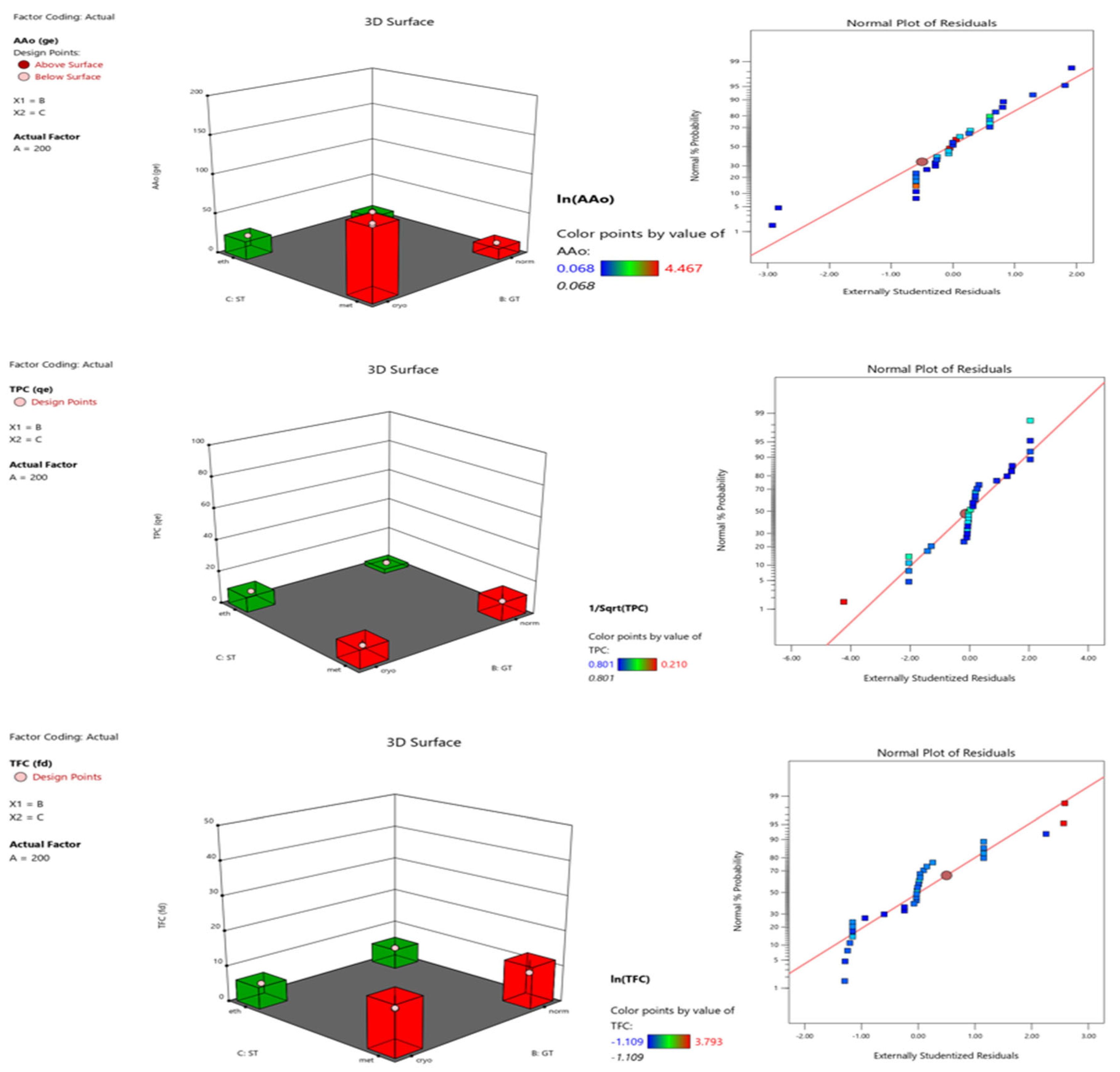
Particle size exhibited a non-linear, non-monotonic relationship with extraction efficiency, as captured by the quartic models. The highest antioxidant activity was recorded at the finest particle size of 200 µm, consistent with the expected increase in surface area and improved solvent–matrix contact at finer particle sizes. However, a marked reduction in AAO was observed at the centre of the design (400 µm) across all grinding and solvent combinations, followed by a secondary recovery at 500–600 µm under both cryogenic and normal grinding with methanol. This non-monotonic pattern, supported by the statistically significant quadratic (A2, F = 40.77, p < 0.0001) and quartic (A4, F = 25.73, p < 0.001) terms in the ANOVA, may reflect size-dependent differences in cell disruption mechanics: at 200 µm, complete cell rupture maximises surface area and solvent accessibility; at intermediate sizes (400 µm), partially disrupted cells may form a compacted matrix that impedes solvent diffusion; while at coarser sizes (500–600 µm), cryogenic embrittlement may facilitate solvent penetration along natural intercellular fracture planes without the diffusion resistance associated with compacted fine powder. Notably, particle size was a significant predictor only for AAO and not for TPC or TFC, indicating that the non-linear particle size effect is most pronounced for antioxidant-active compounds and that grinding method and solvent type remain the dominant drivers of phenolic and flavonoid recovery across all tested conditions.
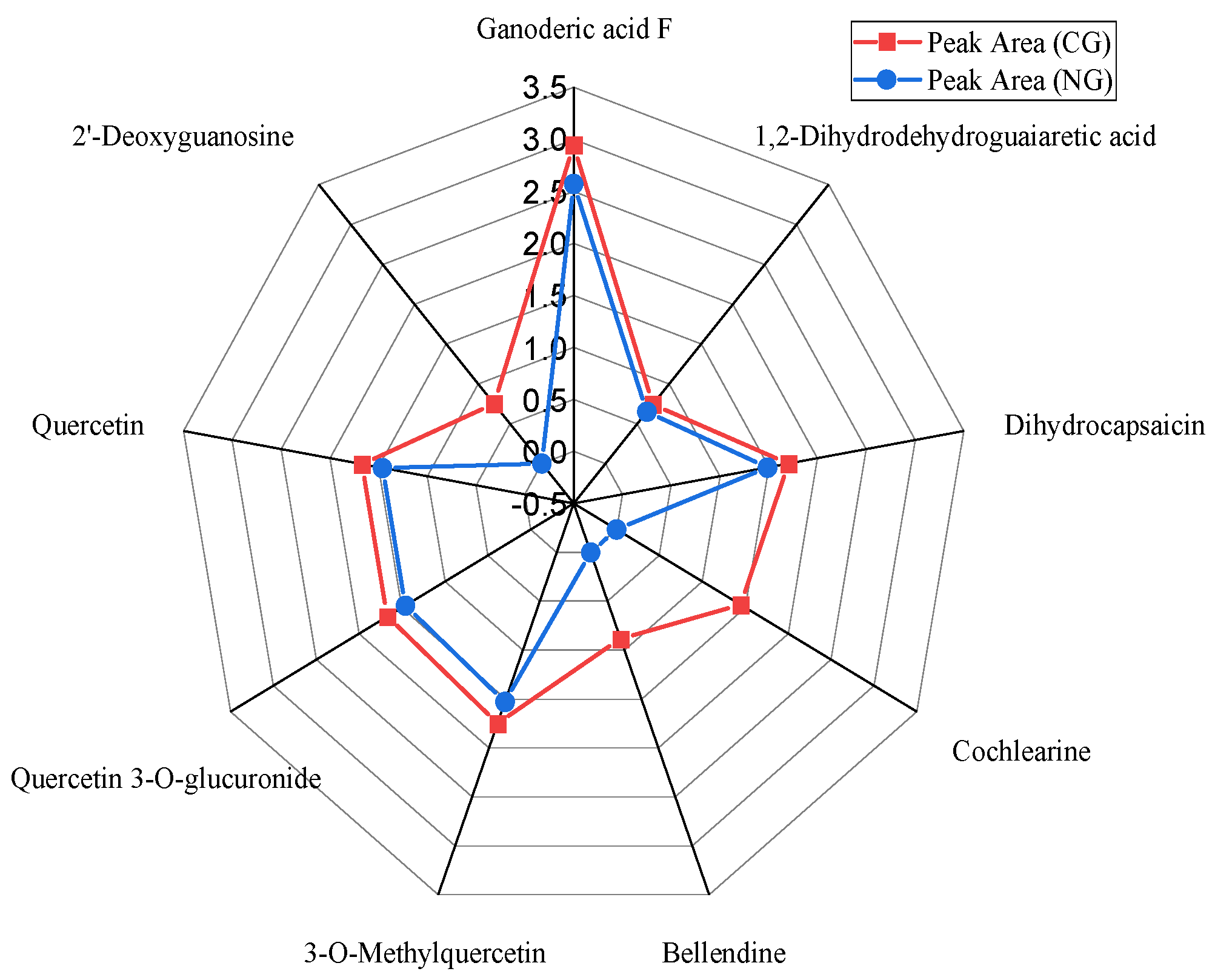
HRLC-MS analysis provided deeper insight into the compositional advantages of cryogenic grinding. The significantly higher peak areas and greater number of detectable compounds in cryogenically ground samples confirm that low-temperature processing minimises degradation of labile metabolites. Key flavonoids such as quercetin, 3-O-methylquercetin, and quercetin 3-O-glucuronide were present at higher levels in cryogenically ground extracts, consistent with the observed increases in total phenolic and flavonoid contents. These compounds are well known for their potent antioxidant, anti-inflammatory, and antimicrobial properties [
12,
20]. It is noted, however, that a subset of compounds, including alpha-santalal and 5,6,7,3′,4′-pentahydroxyisoflavone, were absent or at reduced levels in cryogenically ground samples, suggesting that cryogenic conditions may differentially affect certain volatile or structurally labile metabolites. The radar web visualisation (
Figure 2) further illustrates the broader and more balanced phytochemical distribution achieved under cryogenic grinding across the majority of detectable compounds, reinforcing the method’s overall superiority in preserving the phytochemical integrity of fennel seeds.
Using an I-optimal RSM design, the optimal extraction conditions were identified as cryogenic grinding, methanol extraction, and a particle size of 200 µm, achieving an overall desirability of 0.887. Validation experiments confirmed the robustness of the model, with prediction errors within ±5% for all three responses. This optimal combination shows promise for scale-up, as it balances high bioactive recovery with process efficiency under the studied laboratory conditions. The substantially higher phenolic and flavonoid levels at the optimum conditions, relative to other factor combinations, are consistent with the well-established positive relationship between polyphenol content and antioxidant capacity in plant extracts [
18,
21].
Several limitations of this study should be acknowledged. The bioactivity evaluation relied exclusively on chemical in vitro assays—DPPH radical scavenging, Folin–Ciocalteu, and aluminium chloride colorimetry—which are standard for phenolic screening but do not capture cellular bioavailability, metabolic transformation, or in vivo biological efficacy; the health-promoting properties associated with the identified flavonoids therefore reflect prior literature rather than direct experimental validation in this study. Methanol, identified as the optimal extraction solvent, is non-food-grade and was employed solely for research-scale screening; food-grade application requires substitution with approved solvents such as ethanol, which offers a viable alternative as noted in the applied section below.
From an applied perspective, the findings of this study offer preliminary relevance for the functional food and nutraceutical sectors, with the caveat that the identified optimum relies on methanol, a non-food-grade solvent; translation to industry requires prior demonstration of equivalent performance with food-grade alternatives, alongside extract stability and scalability studies. Cryogenic grinding at 200 µm combined with ethanolic extraction as a food-safe processing pathway yields a phytochemically defined fennel seed ingredient with a validated TPC of 11.31 mg GAE/g and TFC of 14.18 mg QE/g, alongside a confirmed profile of health-relevant flavonoids, including quercetin and quercetin 3-O-glucuronide, which are well documented for their roles in antioxidant defence, anti-inflammatory signalling, and cardiovascular health promotion. The quantified bioactivity indices and HRLC-MS phytochemical profile together provide the standardised ingredient specification that nutraceutical manufacturers require for batch-to-batch reproducibility and regulatory health claim substantiation. The non-linear relationship between particle size and bioactivity, captured by the quartic model, provides industry with a quantitative milling endpoint criterion that maximises bioactive yield without excessive energy input and is directly applicable to cryogenic milling operations already employed in commercial spice processing. Future investigation of encapsulation strategies and extract stability under food matrix storage conditions would complete the pathway from process optimisation to commercially viable functional food ingredient.