1. Introduction
The increasing global demand for sustainable wood resources and ecosystem restoration has intensified the need for high-quality planting materials in tropical forestry systems.
Falcataria falcata (L.) Greuter & R.Rankin is among the most important fast-growing tree species cultivated throughout Southeast Asia, particularly in the Philippines and Indonesia [
1,
2]. In the Philippines, this species is widely utilized for veneer, plywood, pallets, fruit boxes, and light construction materials because of its rapid growth, short rotation period, and desirable wood properties. In addition, its nitrogen-fixing capability and adaptability to marginal soils make it highly suitable for agroforestry systems and the rehabilitation of degraded land. Recent studies have further emphasized the ecological and silvicultural significance of falcata in plantation forestry. Its integration with crops has been shown to improve land productivity, although competition for nutrients and light may influence growth performance [
3]. Moreover, optimized nutrient management, including the application of slow-release fertilizers, enhances seed germination and early seedling growth, highlighting the importance of improving establishment during the initial developmental stages [
4]. Root development studies have likewise demonstrated that soil fertility and management practices strongly influence belowground interactions, seedling establishment, and long-term productivity [
5].
Despite its economic and ecological importance, the successful plantation establishment of falcata remains constrained by inconsistent germination and poor seedling vigor. Physical dormancy caused by an impermeable seed coat often results in delayed and uneven germination. Recent findings indicate that pre-sowing treatments, particularly hot-water scarification, significantly improve germination percentage and uniformity, demonstrating the need for effective seed enhancement technologies [
6]. Furthermore, seedling production is frequently challenged by unfavorable storage conditions, pest and disease incidence, and environmental variability, all of which may compromise seed quality and plantation success [
7].
Seed enhancement technologies, particularly seed priming and seed coating, have emerged as promising approaches for overcoming these limitations. Seed priming involves controlled seed hydration followed by re-drying, thereby activating pre-germinative metabolic processes such as enzyme synthesis, DNA repair, and reserve mobilization. These physiological changes enhance germination speed, synchronization, and seedling vigor. Recent studies have shown that priming significantly reduces mean germination time while improving root and shoot development under both optimal and stressful environmental conditions [
8].
More recently, seed biopriming, which combines seed priming with beneficial microorganisms, has gained increasing attention in both agricultural and forestry applications. Beneficial microorganisms, including
Rhizobium sp.,
Trichoderma sp., and arbuscular mycorrhizal fungi (AMF), enhance nutrient acquisition, stimulate root growth, and increase plant tolerance to biotic and abiotic stresses. In forestry species, mycorrhizal inoculation has been reported to improve seedling growth and disease resistance, underscoring the importance of symbiotic associations during the early stages of plant establishment [
9].
In parallel, seed coating and pelleting technologies have evolved into sophisticated delivery systems that can incorporate nutrients, microbial inoculants, and plant growth regulators directly into the seed microenvironment. Modern seed coatings function not only as physical barriers but also as biologically active interfaces that regulate water uptake, protect seeds from pathogens, and facilitate the controlled release of beneficial compounds. Recent advances have conceptualized coated seeds as engineered microhabitats that promote microbial colonization and improve rhizosphere interactions during early seedling development. Such innovations are particularly valuable for forestry applications in which seeds are exposed to stressful environmental conditions [
10].
Despite these advances, the application of integrated seed enhancement technologies in tropical tree species remains limited. Most studies have focused on crops, whereas relatively few have examined the combined effects of priming, microbial inoculation, growth regulators, and seed coating on tree seed physiology and early seedling development. Consequently, substantial knowledge gaps remain regarding the optimization of these technologies for tropical plantation species such as falcata.
Given the increasing importance of falcata in plantation forestry, agroforestry, and land restoration programs throughout the Philippines and other tropical regions, there is a need to develop science-based seed enhancement strategies that improve seed performance and seedling establishment. Therefore, this study evaluated the effects of integrated seed priming and coating treatments combined with microbial inoculants and plant growth regulators on the germination and early seedling performance of F. falcata. Specifically, the study aimed to: (i) improve germination efficiency and uniformity; (ii) enhance seedling vigor and root development; and (iii) investigate the relationships among germination and growth traits using principal component analysis (PCA). Multivariate analysis was employed to provide a comprehensive understanding of the interactions among germination characteristics, seedling vigor, and biomass allocation, thereby supporting the development of effective seed enhancement technologies for tropical forestry applications.
2. Materials and Methods
2.1. Study Site and Environmental Conditions
This research was conducted to assess early seedling growth of F. falcata at the Seed Laboratory and Germplasm Testing Facility of the Mindanao Forest Tree Seed Center (MFTSC), under the Forest and Wetland Research, Development and Extension Center (FWRDEC) of the Ecosystems Research and Development Bureau (ERDB), Department of Environment and Natural Resources (DENR), located in Maharlika, Bislig City, Surigao del Sur, Philippines. Growing was done in the greenhouse, which provides controlled environmental conditions ensuring consistency in temperature, humidity, and light regimes necessary for a reliable physiological evaluation. Such controlled conditions are critical for minimizing environmental variability and improving seedling performance.
2.2. Biological and Chemical Materials Sourcing
Falcata Seeds (Seedlot no. FM 8231) used in the study were acquired from MFTSC-accredited seed sources collected in September 2021; the seed collection guidelines were followed in accordance with DENR Administrative Order No. 2010-11, ensuring genetic quality and traceability.
The biological inoculants Trichoderma sp. used in the study were from the Regional Crop Protection Center (RCPC) of the Department of Agriculture—Region 10, and the endomycorrhizal fungi (Hi-Q VAM) were from DENR-ERDB. The Rhizobium sp., on the other hand, was isolated from the active nodules of Acacia mangium seedlings raised at the FWRDEC nursery, following the standard microbiological isolation procedures to ensure viability and symbiotic efficiency.
Chemical inputs consisted of hydroxypropyl methylcellulose (HPMC; 10 g per 500 mL) as a polymer coating agent, gibberellic acid (GA3) at 50 mg L−1 as a plant growth regulator, a commercial liquid nutrient formulation, and protective agents, including cypermethrin (insecticide) and a broad-spectrum fungicide (Mancozeb), which were all prepared according to the manufacturer’s recommended specifications.
2.3. Seed Pre-Treatment and Enhancement Protocol
To break dormancy in the treated seeds for the experiments, the seeds were dipped in boiling water (100 °C) for 30 s. Hydropriming was performed next by soaking the seeds in distilled water for 12 h. After hydropriming, seeds were air-dried for 2 h, and seed enhancement treatments were applied sequentially by soaking seeds in biological (
Rhizobium sp.,
Trichoderma sp., and endomycorrhiza) and/or chemical (GA
3, polymer coating, nutrients, insecticide, and fungicide) solutions for 5 min. After enhancement, treated seeds were air-dried for 20 min between applications to ensure uniform coating and absorption. Hydropriming was used as the foundational treatment for all seed enhancement combinations because it activates pre-germinative metabolic processes, enhances membrane repair, stimulates enzyme activity, and synchronizes germination without inducing radicle protrusion [
11,
12]. These physiological improvements create a uniform and metabolically active seed state that enhances the performance of subsequent biological inoculants and chemical treatments. Moreover, primed seeds provide a more favorable environment for microbial colonization and improve the efficiency of growth-promoting and protective compounds [
13,
14]. Therefore, all enhancement treatments were combined with hydropriming rather than applied independently, reflecting the study’s objective of developing an integrated seed enhancement protocol for
F. falcata. The treatments consisted of combinations of hydropriming, biological inoculants, and chemical treatments.
A total of 14 treatments were evaluated, ranging from hydropriming alone as the control (T1) to a fully integrated fortification treatment (T14) that combined physiological priming, hormonal activation (GA3), microbial inoculation (Rhizobium sp., Trichoderma sp., and endomycorrhiza), nutrient supplementation, polymer coating, and chemical protection. This gradient of treatments enabled the assessment of the individual and synergistic effects of integrated seed enhancement technologies on germination performance and seedling vigor. The specific treatment combinations are detailed below:
T1—Hydro Priming (Water)
T2—Hydro Priming (Water) + Rhizobium sp.
T3—Hydro Priming (Water) + Trichoderma sp.
T4—Hydro Priming (Water) + Endomycorrhiza
T5—Hydro Priming (Water) + GA3 + Rhizobium sp.
T6—Hydro Priming (Water) + GA3
T7—Hydro Priming (Water) + GA3 + Endomycorrhiza
T8—Hydro Priming (Water) + GA3 + Endomycorrhiza + Trichoderma sp.
T9—Hydro Priming (Water) + GA3 + Endomycorrhiza + Trichoderma sp. + Rhizobium sp.
T10—Hydro Priming (Water) + GA3 + Endomycorrhiza + Trichoderma sp. + Rhizobium sp. + Polymer coat + Insecticide
T11—Hydro Priming + GA3 + Endomycorrhiza + Trichoderma sp. + Rhizobium sp. + Polymer coat + Nutrients (Commercial)
T12—Hydro Priming (Water) + GA3 + Rhizobium sp. + Polymer coat + Nutrients + Fungicide
T13—Hydro Priming (Water) + GA3 + Rhizobium sp. + Polymer coat + Fungicide
T14—Hydro Priming (Water) + GA3 (Liquid) + Rhizobium sp. + Polymer coat + Fungicide + Insecticide + Nutrients (Commercial)
The researchers prepared growing media composed of subsoil and coco peat mixed at a 1:1 proportion. The mixed media was filled into the germination trays and sterilized for 15 min by steaming in boiling water. Seeds were directly sown into the trays.
The early seedling growth observations are conducted in the Germplasm Testing Facility (screen house), with temperatures ranging from 25 to 30 °C and relative humidity from 70 to 90% to promote uniform germination and seedling growth. Germination counts were recorded daily for 11 days, and seedlings were allowed to develop for 60 days.
2.4. Data Analysis
2.4.1. Experimental Design and Statistical Analysis
The experiment used a Completely Randomized Design (CRD) with fifteen treatments. Each treatment consists of four replicates, with 50 seeds per replicate. Daily germination counts were recorded for up to 11 days (the maximum germination period), and the seedlings were allowed to develop for 60 days.
Data were tested for normality using the Shapiro–Wilk normality test and were found to deviate significantly from normality (
p < 0.05), indicating a violation of the normality assumption. Hence, data were subjected to non-parametric statistical tests, Kruskal–Wallis, one-way analysis of variance (ANOVA), and post hoc test (Dwass–Steel–Critchlow–Fligner pairwise comparisons) using Jamovi version 2.6.44 (
https://www.jamovi.org, accessed on 16 May 2026).
A Principal Component Analysis (PCA) was performed in this research using R to explain relationships between seedling growth traits. PCA identified dominant variables that explained variation across treatments and facilitated multivariate pattern recognition and clustering of treatment responses, thereby providing a comprehensive understanding of seed growth dynamics. It enabled visualization of variance (PC1 and PC2) across treatment groups [
15].
2.4.2. Seedling Morphological and Biomass Assessment
Morphology and biomass were measured to assess seedling growth performance. Seedling length (root and shoot) was measured using a calibrated ruler, while root number and nodule formation were counted manually and recorded to assess early symbiotic establishment. For biomass determination, 30 randomly selected seedlings per replicate were oven-dried at 90 °C for 24 h until a constant weight was attained. Computation for the root–to-shoot ratio used the dry biomass data, providing insights into biomass allocation patterns and potential stress adaptation strategies. Furthermore, the root-to-shoot ratio was calculated to evaluate biomass allocation patterns and potential stress tolerance [
16]. This evaluation of seedling morphology serves as a direct indicator of early vigor and physiological robustness [
17,
18]. Seedling vigor was further quantified using the following indices:
Vigor index I = (Seedling length) × (Germination %) [
19]
Vigor index II = (Germination %) × (Seedling dry weight) [
20]
3. Results
3.1. Seedling Quality Performance
Significant differences were observed among the 14 seed enhancement treatments for all measured seedling quality parameters, including number of roots, number of nodules, root-to-shoot ratio, Vigor Index I, and Vigor Index II (
p < 0.001)
Table 1.
The number of roots ranged from 19.50 to 31.76 roots per seedling. The highest root production was recorded in T13 (HP + GA3 + Rhizobium sp. + Polymer coat + Fungicide) with 31.76 roots, followed by T12 (27.58 roots), T5 (27.13 roots), and T2 (26.68 roots). In contrast, the lowest root number was observed in T8 (19.50 roots), followed by T1 (20.20 roots) and T6 (20.50 roots). These findings indicate that treatments containing Rhizobium sp., particularly when combined with polymer coating and protective additives, substantially enhanced root proliferation in F. falcata seedlings.
Nodule formation also differed significantly among treatments. T4 (HP + Endomycorrhiza sp.) produced the highest number of nodules (5.49 nodules seedling−1), followed by T11 (5.17 nodules) and T8 (4.99 nodules). Conversely, T12 recorded the lowest nodulation response (3.60 nodules), while T1, T7, and T13 exhibited similarly lower nodule counts. The superior nodulation observed in endomycorrhizal treatments suggests a positive interaction between mycorrhizal fungi and root development processes that facilitate symbiotic establishment.
For the root-to-shoot ratio, values varied from 0.372 to 0.602. The highest ratios were observed in T14 (0.602) and T4 (0.593), both of which were statistically superior to most treatments. Meanwhile, T7 and T1 exhibited the lowest ratios (0.372 and 0.373, respectively). The greater biomass allocation to roots observed in T4 and T14 indicates enhanced belowground development and potentially improved resource acquisition capacity.
Vigor Index I ranged from 1720.86 to 2055.57. The highest value was recorded in T4 (2055.57), followed by T10 (2011.09). Treatments T3, T7, T9, T11, and T13 also exhibited relatively high vigor values. The lowest vigor was observed in T5 (1720.86), T6 (1754.59), and T8 (1758.60). Similarly, Vigor Index II differed significantly among treatments, ranging from 8.33 to 12.87. The highest value was observed in T7 (12.87), followed by T13 (12.57) and T1 (12.37). In contrast, T14 (8.33) and T6 (8.98) recorded the lowest values. These results suggest that while some treatments enhanced biomass accumulation and seedling robustness, others favored root development at the expense of total seedling dry matter production.
3.2. Principal Component Analysis (PCA)
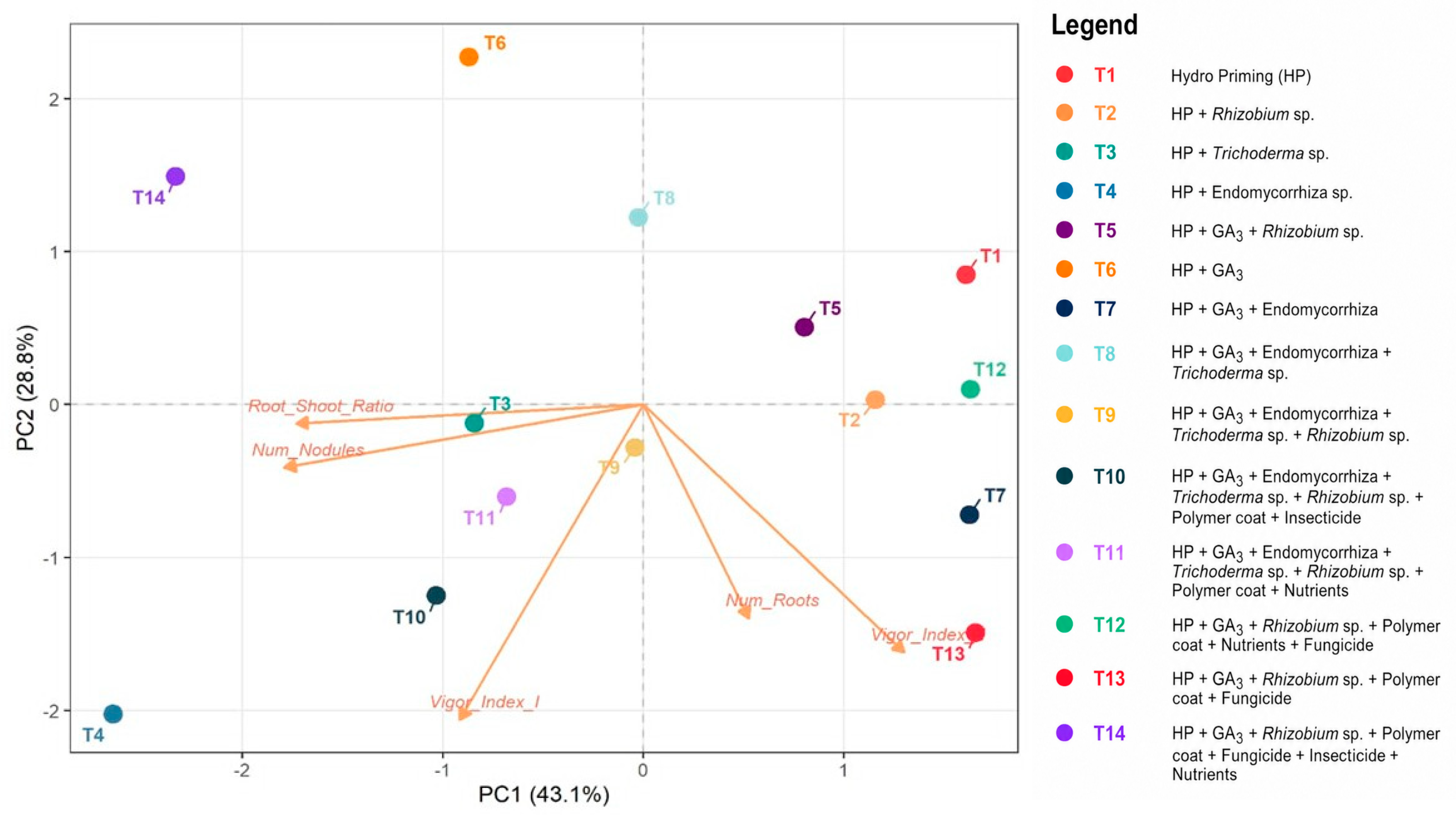
The PCA biplot explained 71.9% of the total variation in seedling growth performance, with Principal Component 1 (PC1) accounting for 43.1% and Principal Component 2 (PC2) for 28.8% (
Figure 1).
PC1 was strongly associated with Vigor Index II and the number of roots, which were positively loaded on the right side of the biplot. Treatments T13, T12, T7, and T1 were positioned in this direction, indicating their strong association with enhanced root production and seedling vigor. Among these, T13 showed the strongest positive relationship with both variables, confirming its superior performance in promoting seedling quality.
Conversely, root-to-shoot ratio and number of nodules were negatively associated with PC1 and were aligned toward the left side of the biplot. Treatments T3, T4, T10, T11, and T14 clustered in this region, indicating their greater influence on root biomass allocation and nodulation. T4 was particularly distinct due to its strong associations with the vigor index I and the root-to-shoot ratio, highlighting the effectiveness of endomycorrhizal inoculation in improving overall seedling quality.
PC2 primarily separated treatments according to differences in biomass partitioning and seedling vigor. T6 and T14 occupied the upper portion of the plot, reflecting stronger associations with root-to-shoot ratio and nodulation characteristics, whereas T10 and T4 were in the lower quadrants and were closely related to Vigor Index I. The spatial distribution of treatments indicates that different seed-enhancement combinations promoted distinct aspects of seedling development, ranging from root proliferation and vigor to nodulation and biomass allocation.
4. Discussion
The significant improvements in seedling quality traits observed among treatments demonstrate that integrating seed priming with biological inoculants and coating technologies can substantially influence early growth and physiological performance of F. falcata seedlings. Although previous studies have shown that hydropriming primarily improves germination synchronization, combining it with beneficial microorganisms appears to extend its benefits beyond germination to seedling establishment and vigor development.
The superior root production observed in T13 suggests that the synergistic interaction among hydropriming, gibberellic acid, Rhizobium inoculation, polymer coating, and fungicide protection enhanced root initiation and elongation processes. Rhizobium species are known not only for biological nitrogen fixation but also for producing phytohormones such as indole-3-acetic acid (IAA), gibberellins, and cytokinin that stimulate root architecture development and nutrient uptake. Recent studies have demonstrated that microbial seed treatments improve root system complexity, nutrient acquisition efficiency, and seedling resilience under nursery conditions [
21,
22].
The highest nodulation response observed in T4 highlights the beneficial role of endomycorrhizal fungi in facilitating symbiotic interactions within the rhizosphere. Arbuscular mycorrhizal fungi enhance phosphorus acquisition and improve root surface area, thereby creating favorable conditions for nodule formation and biological nitrogen fixation. Recent evidence suggests that mycorrhizal inoculation can significantly increase nodulation efficiency and nutrient-use effectiveness in leguminous tree species through improved plant–microbe interactions and enhanced root metabolic activity [
23,
24].
The elevated root-to-shoot ratios observed in T4 and T14 indicate a greater allocation of assimilates to belowground biomass. A higher root-to-shoot ratio is generally considered advantageous for nursery stock quality because it improves water absorption capacity, nutrient acquisition, and transplant survival after outplanting. Similar observations have been reported in forest nursery studies, in which microbial inoculation and bio-stimulant treatments promoted root development and increased seedling adaptability under field conditions [
25,
26].
Vigor Index I and II are widely recognized as comprehensive indicators of seedling performance because they integrate germination success with growth characteristics. The superior Vigor Index I observed in T4 indicates that endomycorrhizal inoculation substantially enhanced seedling biomass accumulation and overall growth potential. Mycorrhizal fungi improve nutrient uptake, particularly phosphorus and micronutrients, which are essential for photosynthesis, energy metabolism, and biomass production. Recent studies have consistently demonstrated positive effects of mycorrhizal inoculation on seedling vigor, growth rate, and stress tolerance in forestry species [
27,
28].
The PCA results further support the multivariate influence of seed enhancement technologies on seedling development. Treatments containing Rhizobium, particularly T13, were associated with root proliferation and vigor attributes, whereas endomycorrhizal treatments were closely related to nodulation, biomass allocation, and overall seedling quality. This separation indicates that different biological agents contribute through distinct physiological mechanisms. Rhizobium primarily enhances nitrogen acquisition and root growth, while endomycorrhiza improves phosphorus uptake, water relations, and carbon allocation patterns. Such complementary functions explain the improved performance observed in treatments combining multiple biological inoculants.
Overall, the findings demonstrate that seed enhancement strategies integrating hydropriming, microbial inoculants, growth regulators, and protective seed coatings can significantly improve seedling quality of F. falcata. Among the evaluated treatments, T13 was most effective in promoting root development and vigor, while T4 excelled in nodulation, root-to-shoot ratio, and overall seedling quality. These results emphasize the potential of biologically enhanced seed technologies as practical approaches for producing vigorous planting materials suitable for industrial tree plantation establishment and reforestation programs.
5. Conclusions
The present study demonstrated that integrating seed priming and seed coating technologies with beneficial microbial inoculants can significantly enhance the seedling quality of Falcataria falcata. Although previous evaluations of these seed enhancement treatments showed minimal differences in germination performance, the current findings reveal substantial benefits during seedling growth. This highlights the importance of assessing seed enhancement technologies beyond germination parameters, as improvements in early seedling development are critical determinants of successful plantation establishment.
Among the 14 treatments evaluated, formulations containing Rhizobium sp., endomycorrhiza, and seed-coating components consistently promoted superior seedling growth attributes. The treatment consisting of Hydro Priming + GA3 + Rhizobium sp. + Polymer Coat + Fungicide (T13) produced the highest number of roots and exhibited strong associations with seedling vigor, indicating its effectiveness in stimulating root system development. Meanwhile, Hydro Priming + Endomycorrhiza (T4) generated the highest nodule production, root-to-shoot ratio, and Vigor Index I, suggesting enhanced nutrient acquisition, biomass allocation, and overall seedling robustness. These responses demonstrate that different biological agents contribute distinct but complementary functions that collectively improve seedling quality.
The principal component analysis further supported these findings by clearly separating treatments according to their dominant growth-promoting effects. Treatments enriched with Rhizobium were associated primarily with root proliferation and vigor enhancement, whereas endomycorrhizal treatments were more strongly linked to nodulation, biomass partitioning, and balanced seedling development. Such differentiation underscores the potential of combining microbial inoculants with seed enhancement technologies to target specific physiological traits important for seedling establishment.
From a practical perspective, the results suggest that biologically enhanced seeds can serve as an effective and sustainable strategy for producing vigorous planting materials for industrial tree plantations and reforestation programs. Enhanced root growth, improved nodulation, and greater seedling vigor are expected to increase transplant success, improve nutrient-use efficiency, and promote better field establishment under diverse environmental conditions. Overall, while seed enhancement treatments may not always produce significant differences during germination, their positive effects on subsequent seedling growth and quality provide compelling evidence of their value in nursery production systems. Future research should focus on validating these nursery responses under field conditions, particularly survival, growth performance, stress tolerance, and long-term productivity, to fully establish the operational benefits of these seed enhancement technologies for F. falcata plantation development.
Author Contributions
D.M.G. led the conceptualization and resource sourcing, writing—original draft, methodology, formal analysis and investigation, data curation, and writing—review and editing. M.T.B. and J.S.G. performed data curation and formal analysis, contributed to methodology and software use, participated in writing—review and editing, provided validation and resources, and contributed to supervision of the research. M.O.L. and J.S.G. conducted investigation and data collection, contributed to data curation and visualization, and participated in manuscript review and editing. The authors of the work agree that D.M.G. contribution to the work is 60%, while M.T.B., M.O.L. and J.S.G. combined contribution is 40%. All authors have read and agreed to the published version of the manuscript.
Funding
The Philippine Council for Agriculture, Aquatic, and Natural Resources Research and Development (PCAARRD) under the Department of Science and Technology (DOST) funded the implementation of this research.
Data Availability Statement
The original contributions presented in this study include the article. Further inquiries can be directed to the corresponding author.
Acknowledgments
We would like to express our deep appreciation to the FWRDEC-ERDB technical staff, research assistants, and everyone who made this work possible. During the preparation of this manuscript, the author(s) used Grammarly Pro version, an online AI writing assistant for text editing purposes (e.g., grammar, structure, spelling, punctuation, and formatting). The authors have reviewed and edited the output and take full responsibility for the content of this publication.
Conflicts of Interest
The authors declare no conflicts of interest.
References
- Krisnawati, H.; Varis, E.; Kallio, M.; Kanninen, M. Paraserianthes falcataria (L.) Nielsen: Ekologi, Silvikultur, dan Produktivitas; CIFOR: Bogor, Indonesia, 2011. [Google Scholar]
- Hadi, E.E.W.; Herliyana, E.N.; Pari, G.; Pari, R. Growth performance and wood properties of sengon (Falcataria moluccana) in community forests of Indonesia. Biodiversitas 2019, 20, 1831–1837. [Google Scholar]
- Nurheni Wijayanto, S.H.T. Evaluation of an Agroforestry System: The Growth of 14-Month-Old Solomon Sengon (Falcataria moluccana) and Rice (Oryza sativa). J. Sylva Lestari 2022, 10, 254–266. [Google Scholar] [CrossRef]
- Naufal Madani, H.; Wijayanto, N.; Hartoyo, A.; Solikhin, A. Slow-release Fertilizer Application on Silk (Falcataria moluccana Miq.) and Rice (Oryza sativa L.) Plant Growth and Yield in an Agroforestry System. HAYATI J. Biosci. 2024, 31, 750–767. [Google Scholar] [CrossRef]
- Ambas, A.; Khatta, A.; Julius, K.; Kamu, A.; Chiang, L.; Terhem, R.; Awang Besar, N.; Hassan, A. Falcataria moluccana (Miq.) root distribution seedlings in response to nitrogen concentrations and tillage. Folia Oecol. 2024, 51, 47–55. [Google Scholar] [CrossRef]
- Paquit, J.C.L.-T.; Coritico, A.J.M. Effects of the Hot Water Pre-treatments and Storage Durations on the Seed Germination of Falcata (Falcataria falcata (L.) Greuter & R. Rankin). Bangladesh J. Bot. 2024, 53, 249–255. [Google Scholar] [CrossRef]
- Yodfiatfinda, Y.; Fathiya Azzahra, P.; Rukavina, B. Risk Analysis of Sengon (Falcataria moluccana Miq.) Seedling Production Using Fault Tree Method. J. Ilmu Kehutan. 2023, 17, 206–217. [Google Scholar] [CrossRef]
- Zhang, Y.; Du, J.; Huang, G.; Zhao, Y.; Man, P.; Song, A.; Zhao, Y.; Men, Q.; Wang, C.; Guo, M.; et al. Integrating AI in seed science: Toward an intelligent design paradigm. Plant Commun. 2026, 7, 101820. [Google Scholar] [CrossRef] [PubMed]
- Baskorowati, L.; Wirabuana, P.Y.A.P.; Hendrati, R.L.; Nurtjahjaningsih, I.L.G.; Setiadi, D.; Mashudi, M.; Susanto, M.; Pudjiono, S.; Sumardi, S.; Santoso Sulistiadi, H.B.; et al. Early boosting of genetically improved Falcataria moluccana with mycorrhiza for better growth and disease tolerance. For. Sci. Technol. 2024, 20, 124–135. [Google Scholar] [CrossRef]
- Singh, P.; Vaishnav, A.; Liu, H.; Xiong, C.; Singh, H.B.; Singh, B.K. Seed biopriming for sustainable agriculture and ecosystem restoration. Microb. Biotechnol. 2023, 16, 2212–2222. [Google Scholar] [CrossRef] [PubMed]
- Paparella, S.; Araújo, S.S.; Rossi, G.; Wijayasinghe, M.; Carbonera, D.; Balestrazzi, A. Seed priming: State of the art and new perspectives. Plant Cell Rep. 2015, 34, 1281–1293. [Google Scholar] [CrossRef] [PubMed]
- Forti, C.; Shankar, A.; Singh, A.; Balestrazzi, A.; Prasad, V.; Macovei, A. Hydropriming and Biopriming Improve Medicago truncatula Seed Germination and Upregulate DNA Repair and Antioxidant Genes. Genes 2020, 11, 242. [Google Scholar] [CrossRef] [PubMed]
- Maheshwari, D.K.; Dheeman, S.; Agarwal, M. Phytohormone-Producing Plant Growth-Promoting Rhizobacteria: Mechanisms and Applications. In Bacterial Metabolites in Sustainable Agroecosystem; Maheshwari, D.K., Ed.; Springer: Cham, Switzerland, 2015; pp. 159–182. [Google Scholar] [CrossRef]
- Choi, J.Y.; Han, S.; Lee, G.; Kim, J.; Lee, B. Effect of Seed Hydropriming on the Elongation of Plumule and Physiological Responses of Rice under Water Deficit Conditions. Plants 2024, 13, 3537. [Google Scholar] [CrossRef] [PubMed]
- Demšar, U.; Harris, P.; Brunsdon, C.; Fotheringham, A.S.; McLoone, S. Principal Component Analysis on Spatial Data: An Overview. Ann. Assoc. Am. Geogr. 2013, 103, 106–128. [Google Scholar] [CrossRef]
- Smith, S.; Read, D.J. Mycorrhizal Symbiosis, 3rd ed.; Academic Press: Amsterdam, The Netherlands, 2008. [Google Scholar]
- Khan, M.; Hussain, F. Palatability and animal preferences of plants in Tehsil Takht-e-Nasrati, District Karak, Pakistan. Afr. J. Agric. Res. 2012, 7, 5858–5872. [Google Scholar] [CrossRef]
- Silva, J.M.; Pereira, C.V.; Mano, F.; Silva, E.; Castro, V.I.B.; Sá-Nogueira, I.; Reis, R.L.; Paiva, A.; Matias, A.A.; Duarte, A.R.C. Therapeutic role of deep eutectic solvents based on menthol and saturated fatty acids on wound healing. ACS Appl. Bio Mater. 2019, 2, 4346–4355. [Google Scholar] [CrossRef] [PubMed]
- Kulkarni, M.G.; Ascough, G.D.; Van Staden, J. Effects of Foliar Applications of Smoke-Water and a Smoke-isolated Butenolide on Seedling Growth of Okra and Tomato. HortScience 2007, 42, 179–182. [Google Scholar] [CrossRef]
- Kalsa, K.K.; Abebie, B. Influence of seed priming on seed germination and vigor traits of Vicia villosa ssp. dasycarpa (Ten.). Afr. J. Agric. Res. 2012, 7, 3202–3208. [Google Scholar] [CrossRef]
- Backer, R.; Rokem, J.S.; Ilangumaran, G.; Lamont, J.; Praslickova, D.; Ricci, E.; Subramanian, S.; Smith, D.L. Plant growth-promoting rhizobacteria: Context, Mechanisms of Action, and Roadmap to Commercialization of Biostimulants for Sustainable Agriculture. Front. Plant Sci. 2018, 9, 1473. [Google Scholar] [CrossRef] [PubMed]
- Chandran, H.; Meena, M.; Swapnil, P. Plant Growth-Promoting Rhizobacteria as a Green Alternative for Sustainable Agriculture. Sustainability 2021, 13, 10986. [Google Scholar] [CrossRef]
- Begum, N.; Qin, C.; Ahanger, M.A.; Raza, S.; Khan, M.I.; Ashraf, M.; Ahmed, N.; Zhang, L. Role of Arbuscular Mycorrhizal Fungi in Plant Growth Regulation: Implications in Abiotic Stress Tolerance. Front. Plant Sci. 2019, 10, 1068. [Google Scholar] [CrossRef] [PubMed]
- Smith, S.E.; Smith, F.A. Roles of arbuscular mycorrhizas in plant nutrition and growth: New paradigms from cellular to ecosystem scales. Annu. Rev. Plant Biol. 2011, 62, 227–250. [Google Scholar] [CrossRef] [PubMed]
- Rouphael, Y.; Colla, G. Biostimulants in Agriculture; Frontiers Media SA: Lausanne, Switzerland, 2020. [Google Scholar] [CrossRef]
- Saia, S.; Aissa, E.; Luziatelli, F.; Cardarelli, M. Microbial-based biostimulants and root system enhancement in nursery production. Horticulturae 2024, 10, 156. [Google Scholar] [CrossRef]
- Fiorentino, N.; Ventorino, V.; Woo, S.L.; Pepe, O. Beneficial microbial inoculants and their effects on seedling growth and vigor. Agriculture 2023, 13, 562. [Google Scholar] [CrossRef]
- Marrassini, V.; Ercoli, L.; Kuramae, E.E.; Kowalchuk, G.A.; Pellegrino, E. Arbuscular mycorrhizal fungi originated from soils with a fertility gradient highlight a strong intraspecies functional variability. Appl. Soil Ecol. 2024, 197, 105344. [Google Scholar] [CrossRef]
| Disclaimer/Publisher’s Note: The statements, opinions and data contained in all publications are solely those of the individual author(s) and contributor(s) and not of MDPI and/or the editor(s). MDPI and/or the editor(s) disclaim responsibility for any injury to people or property resulting from any ideas, methods, instructions or products referred to in the content. |




 ,
,