Article

Effect of Different Treatments with Gibberellic Acid on the Germination of Pea Seeds (Pisum sativum L.)

by
Javier Giovanni Álvarez-Herrera
*,
Marilcen Jaime-Guerrero
and
Dilson Sebastián Torres-Piña
Grupo de Investigaciones Agrícolas (GIA), Facultad de Ciencias Agropecuarias, Universidad Pedagógica y Tecnológica de Colombia, Boyacá 153610, Colombia
*
Author to whom correspondence should be addressed.
Seeds 2026, 5(3), 31; https://doi.org/10.3390/seeds5030031
Submission received: 5 May 2026 / Revised: 25 May 2026 / Accepted: 29 May 2026 / Published: 11 June 2026

Abstract

Pea cultivation has witnessed significant growth in international trade in recent years, leading to increased export volumes worldwide. However, seed germination and early seedling growth often exhibit low uniformity, resulting in heterogeneous seedling sizes, which limit agronomic management and affect overall performance. As a result, this study aimed to assess the effects of gibberellin (GA) doses on the germination of the ‘Santa Isabel’ pea variety, one of Colombia’s most commonly cultivated varieties. A completely randomized design was employed with five treatments (0, 50, 100, 150, or 200 mg L−1). The application of 200 mg L−1 GA significantly enhanced germination percentage, germination potential, and germination speed index by 66.4%, 64.9%, and 71.5%, respectively, compared to the control. Furthermore, it increased the vigor index. The GA application reduced the mean germination time to 6.48 days, while the control exhibited 8.98 days. GA treatment increased seedling height to 5.3 cm, compared with 3.0 cm in the control. The variation coefficient in germinated seedling height increased as germination progressed and stabilized towards the end. Although GA did not affect the total fresh mass of the seedling, it did influence the proportion of mass allocated to each organ. Notably, there was a decrease in the amount of photoassimilates transferred from the seed to the leaves and stipules, accompanied by an increase in dry and fresh mass in the stems. The control treatment exhibited the highest fresh and dry leaf mass values compared with the GA-treated treatments.

1. Introduction

The cultivation of peas holds significant economic importance for many countries, and in recent years, production has increased, leading to an expansion of the planted area, primarily for export markets. This trend is attributed to the enormous growth potential in the foreign market [1]. In Colombia, peas are the second most important legume. Furthermore, they serve as a stabilizing factor in the economy of small producers and contribute significantly to food security [2]. However, the planting area has decreased from 32,549 ha in 2019 to 21,341 ha in 2024, with production of 37,142 t [3].
The germination and seed growth phase represents a critical period in crop establishment, exerting a decisive influence on production [4]. This process needs to be fast and uniform in pea cultivation, as varied seedling sizes limit agronomic management and reduce potential yield [5]. The ability of seeds to remain inactive or to germinate is controlled by various mechanisms, including morphological and physiological changes that activate the embryo. These mechanisms involve the balance of phytohormones regulated by gene expression at different levels [6]. Gibberellins (GA) play a crucial role in breaking seed dormancy and inducing germination, while abscisic acid (ABA) promotes dormancy and inhibits germination [4].
GA controls the vegetative growth of the embryo by weakening the endosperm layer and facilitating the mobilization of stored reserves towards the embryo [7]. Among the biologically active GAs, GA3 is the most commonly used in agriculture [8]. In pea seeds, GA3 has been shown to promote seedling expansion and elongation [5]. Several studies have evaluated the effects of different gibberellin doses on pea seed germination [9,10,11], reporting increases in biomass, chlorophyll content, number of leaves, photosynthetic rate, and plant height. Jaime-Guerrero et al. [5] specifically assessed pea seed germination, revealing that GA application improved germination percentage and reduced mean germination time (MGT). Although the GA application resulted in taller seedlings than the control treatment, no differences were observed between the evaluated doses (200 and 1000 mg L−1). Consequently, lower concentrations should be evaluated to identify the optimal exogenous GA dose capable of triggering physiological mechanisms during emergence processes, thereby improving germination parameters, visualizing its effects on the initial growth of the seedlings and on the distribution of biomass by organs, and obtaining quality seedlings for transplanting of the pea variety ‘Santa Isabel’ under controlled conditions in Tunja, Boyacá.

2. Materials and Methods

2.1. Location

The experiment was conducted in the greenhouse of the Faculty of Agricultural Sciences at the Pedagogical and Technological University of Colombia (Tunja, Boyacá), which has a plastic covering and is located at an altitude of 2700 m, at coordinates 5.55° N and 73.36° W. The average indoor temperature was 15.45 °C, with average maximum and minimum temperatures of 31.3 °C and 8.95 °C, respectively. The relative humidity inside the greenhouse ranged from 50.8% to 75.9%. The area has an average outdoor temperature of 13.45 °C, with minimum and maximum temperatures of 8.44 °C and 21.98 °C, respectively, and solar radiation that ranged from 4.8 to 5.2 kWh m−2 day−1 during the trial.

2.2. Plant Material and Germination Conditions

Certified ‘Santa Isabel’ pea seeds (Seed Distributions LERL Ltda., Bogotá, Colombia), lot 5013182857-03, with a purity of 98%, were used. These seeds had been stored dry for six months. They were sown in A-BA72 propagation trays (A y P de Colombia, Tenjo, Colombia), with a capacity of 72 cells. Seed Pro 8020 peat substrate (Projar Group, Valencia, Spain), composed of 80% blonde peat and 20% brown peat, with a particle size of 0 to 5 mm and a pH of 5.5, was used, and daily irrigation was applied to maintain moisture and promote germination.

2.3. Experimental Design

The gibberellin doses used comprised five treatments (0, 50, 100, 150, and 200 mg L−1), arranged in a completely randomized design with four replicates, for a total of 20 experimental units (EUs). Each EU contained 30 seeds, for a total of 600 seeds. Gibberellin from the product ProGibb® 10 SP (Sumitomo Biorational Company LLC (SBC), Libertyville, IL, USA) was used, which has a concentration of 100 g kg−1 of gibberellic acid. The seeds were soaked for 24 h in 1 L at 20 °C with each of the concentrations used prior to sowing.

2.4. Response Variables

Starting five days after sowing, the number of emerged seedlings was recorded every two days. At the conclusion of the germination trial, these cumulative counts were used to determine the final germination rate (GR), germination potential (GP), which is the maximum number of seeds germinated in a day divided by the total number of seeds planted [5], mean time to germination (MGT), germination speed index (GSI), and seedling height using a measuring tape.
Sixteen days after sowing (DAS), when the seedlings were ready for transplanting, the total fresh and dry mass, as well as the mass of each organ, of all sown plants was measured. For this purpose, the plants were dissected with a scalpel (germinated seeds, roots, stems, leaves, and stipules) and weighed using a Boeco Bas 31 plus analytical balance (Boeckel & Co. GmbH & Co. KG, Hamburg, Germany). Dry masses were obtained by placing the different seedling organs in a Memmert UNB500 drying oven at 70 °C for 48 h (Memmert GmbH + Co. KG, Schwabach, Germany). In addition, the seedling height uniformity index (SHUI), expressed as a percentage (Table 1), and the vigor index (VI) were calculated using the equation described by Beyaz and Kazankaya [12].

2.5. Statistical Analysis

Data normality was assessed using the Kolmogorov–Smirnov test, and homogeneity of variance was assessed using Bartlett’s test. Subsequently, data for percentage variables (GR and GP) were analyzed using generalized linear models (GLMs) with a binomial distribution and a logit link function. For the discrete time-dependent parameters (MGT and GSI), the non-parametric Kruskal–Wallis test was employed due to the non-continuous nature of count-dependent metrics. Continuous morphological data (seedling height, SHUI, and dry/fresh mass values) were subjected to a standard analysis of variance (ANOVA) to establish possible differences between treatments. A Tukey post hoc test (p < 0.05) was also performed to classify the treatments. Data was collected using the SAS OnDemand for Academics 9.4M8 program (SAS Institute Inc., Cary, NC, USA).

3. Results

3.1. Germination Parameters

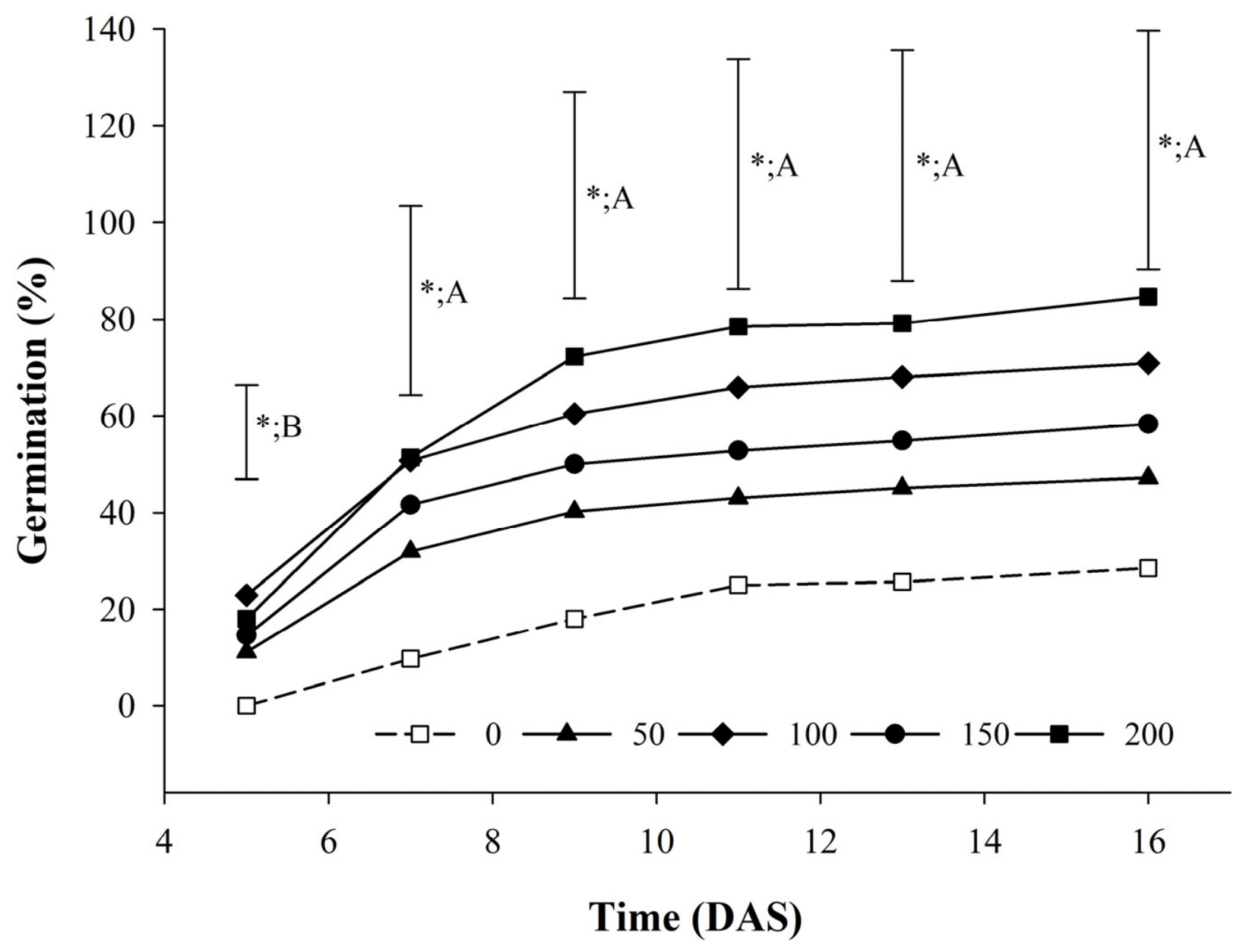
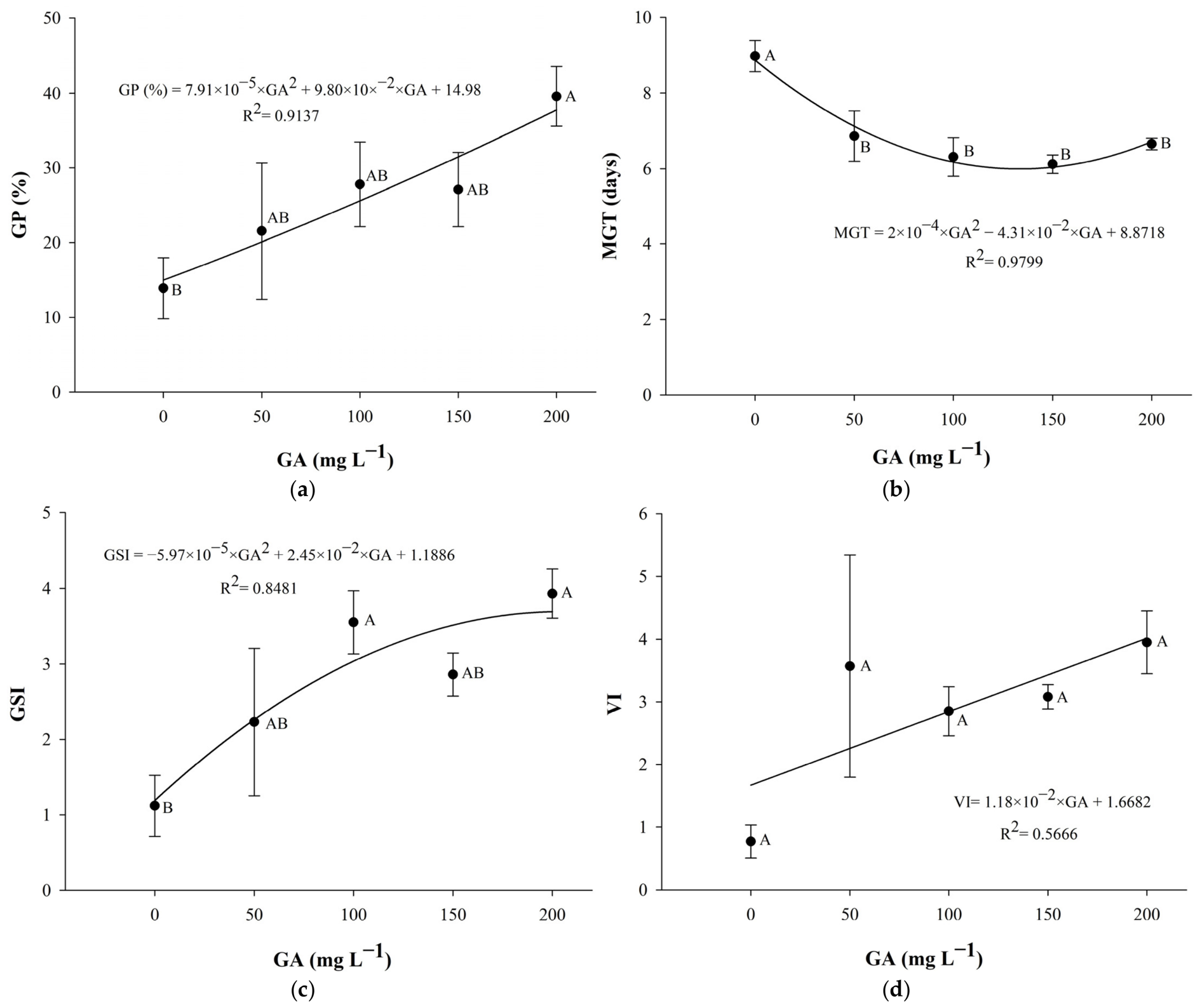
The germination percentage presented significant differences between treatments on all measurement days. Figure 1 shows that all gibberellin applications significantly enhanced the germination rate (GR) compared to the control (GLM, χ2 = 3.65, p < 0.02). However, no statistically significant differences were detected among the evaluated GA doses (p = 0.245), with the 200 mg L−1 treatment yielding the numerically highest cumulative values, and it was 31.1%, 83.6%, and 44.2% higher than the treatments that received the application of 150, 100, and 50 mg L−1, respectively, and 66.4% higher compared to the control. Germination potential (GP), the maximum daily germination percentage, showed significant differences between treatments, with the application of 200 mg L−1 GA yielding the highest values and exceeding the values obtained with 150, 100, and 50 mg L−1 and the control by 31.5%, 29.8%, 45.6%, and 64.9%, respectively (Figure 2a). Mean germination time (MGT) differed significantly among the GA doses applied (Kruskal–Wallis test, χ2 = 6.83, p < 0.0024). The control group recorded the highest value (8.98 days), whereas GA doses showed significantly lower and comparable values (6.48 days) (Figure 2b). This indicates a 38.5% reduction in MGT due to the GA application. Germination speed index (GSI) showed significant variation across the GA concentrations tested. The 200 mg L−1 dose showed the highest value, 71.5% higher than the control (Figure 2c). Vigor index (VI) did not show statistically significant differences between treatments. However, the 200 mg L−1 dose showed a numerically higher value (3.95) than the control (0.77). Notably, as the GA dose increased, VI also increased (Figure 2d).

3.2. Seedling Height (SH) and Seedling Height Uniformity Index (SHUI)

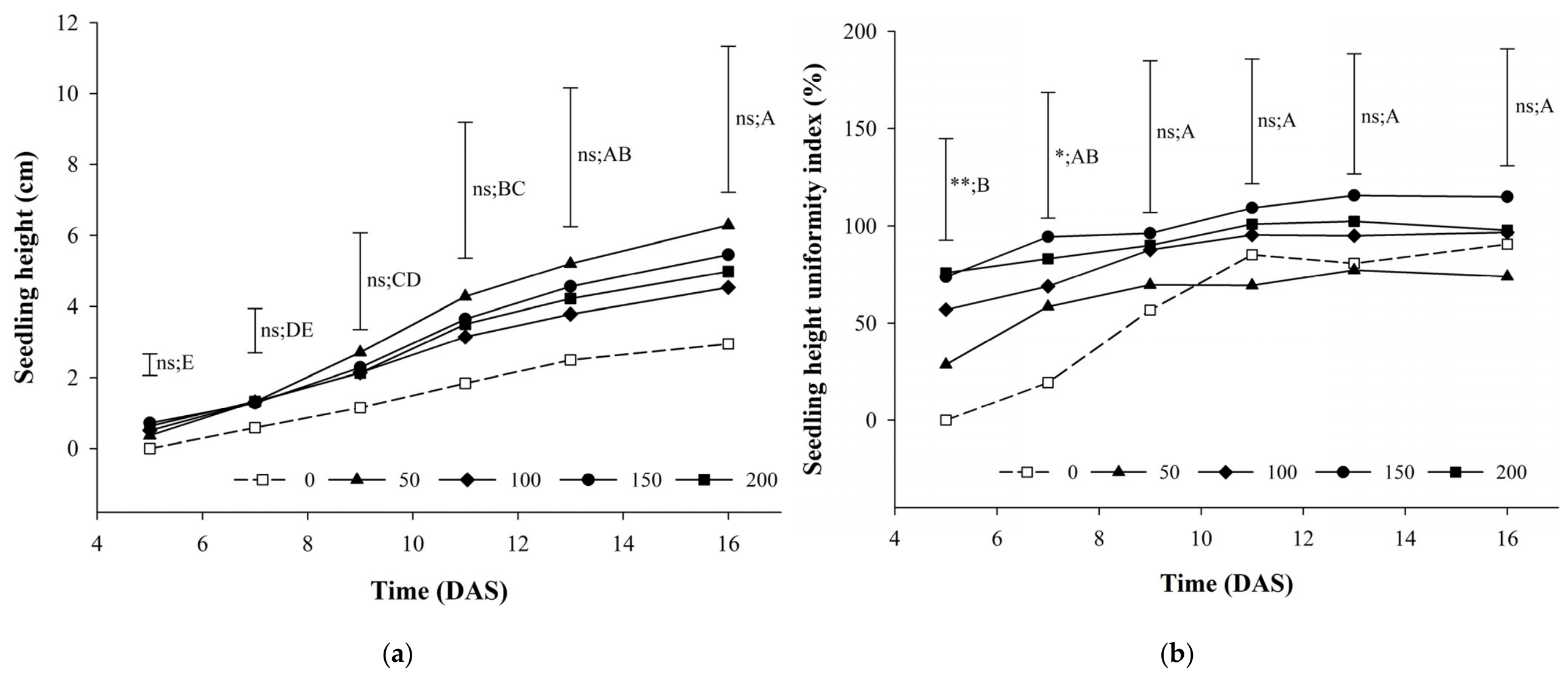
SH did not differ significantly among the evaluated GA doses; however, the average SH in the GA-treated groups was higher (5.3 cm) than in the control (3.0 cm) at 16 DAS (Figure 3a). Gibberellin doses significantly influenced SHUI. The treatment at 150 mg L−1 exhibited the highest SHUI values, whereas the control showed the lowest values at the initial measurement (Figure 3b). Moreover, SHUI increased as germination progressed, indicating more uniform growth and stabilizing towards the end of the trial. The average SHUI at the trial’s conclusion was 94.8%.

3.3. Fresh Mass Distribution by Organ

Root fresh mass (RFM) demonstrated highly significant differences between treatments (Table 2). The 200 mg L−1 dose yielded the highest values, whereas the control exhibited the lowest values. Stem fresh mass (STM) displayed significant differences between treatments (ANOVA, F(4,15) = 6.32, p < 0.0034). The application of 200 mg L−1 resulted in the highest STM values, surpassing the control by 68.8% (Table 2). When analyzing STM per plant, the 150 and 200 mg L−1 doses exceeded the control values by 25.76% (Table 3). Leaf fresh mass (LFM) was not significantly affected by different gibberellin doses (Table 2). Treatments, on average, presented an LFM of 0.30 ± 0.005 g. The control treatment had the highest LFM per plant compared to GA-treated treatments. Stipule fresh mass (STIFM) did not differ significantly between treatments, with averages across all applications of 0.13 ± 0.019 g. However, when evaluating STIFM per plant, the GA application decreased the mass translocated to this organ (Table 3). Germinated seed fresh mass (GSFM) was not significantly affected by GA application (Table 2). The 200 mg L−1 treatment presented the highest GSFM values, exceeding the control by 64%. Analysis of GSFM per plant did not reveal a significant effect (Table 3). Although total fresh mass (TFM) per experimental unit did not differ statistically between treatments (ANOVA, p = 0.118), the 200 mg L−1 treatment showed a 122% numerical increase compared to the control. TFM per plant showed no significant differences between treatments, with an average of 0.62 g per plant.

3.4. Dry Mass Distribution by Organ

The applied GA doses did not significantly impact either the root dry mass (RDM) per treatment or the RDM per plant (Table 3). However, the 200 mg L−1 dose showed 0.39 g, whereas the control recorded 0.21 g (Table 2). GA doses significantly influenced stem dry mass (SDM). The application of 200 mg L−1 obtained the highest values, exceeding the control by 72.9% (Table 2). This dose increased SDM per plant from 0.0118 g (control) to 0.0138 g. Leaf dry mass (LDM) did not differ significantly among the applied GA doses, with an average of 0.075 ± 0.006 g (Table 2). Analyzing leaf dry mass per plant revealed significant differences, with the control treatment having the highest values (Table 3). Stipule dry mass (STIDM) by treatment was unaffected by GA application. However, STIDM per plant showed significant differences, with the control treatment obtaining the highest values. Germinated seed dry mass (GSDM) differed significantly among the GA doses applied. The treatment with 200 mg L−1 had the highest values, exceeding the control by 59.08% (Table 2). GSDM per plant showed no significant differences (Table 3). Total dry mass (TDM) per experimental unit showed significant differences among the applied GA doses (Table 2), indicating that GA application increased the yield of germinated seedlings. However, when analyzed per plant, TDM showed similar behavior across all treatments, averaging 0.21 g (Table 3).

4. Discussion

4.1. Germination Parameters

The results obtained for GR, GP, MGT, and GSI indicate that exogenous GA application, particularly at 200 mg L−1, significantly enhances germination performance in pea variety ‘Santa Isabel’; however, since the response curve did not reach a plateau, further studies exploring higher concentrations (e.g., 250 to 300 mg L−1) are required to determine the absolute physiological optimum for this cultivar. The 66.4% increase in GR compared to the control is consistent with previous reports in peas [5] and Abelmoschus esculentus [13], in which GA was applied at a dose of 200 mg L−1 and obtained the highest GR values. In this regard, gibberellins favor the germination percentage because they increase the activity of endo-β-mannanase, which induces the enzymatic degradation of mannans in the cell walls of the endosperm, weakening the structures that surround the embryo [14], thereby allowing radicle protrusion and increasing the germination percentage [15].
The GP results are similar to those reported by Jaime-Guerrero et al. [5], who obtained the highest GP values (22.5%) at GA doses of 200 and 400 mg L−1, and are higher than those reported by Ouerghi et al. [11], who reported GP values of 8.85 for pea seeds. In this context, Xia et al. [16] report that applying GA increases GP by 11.8% in species such as cotton. Likewise, it should be noted that, commercially, a high GP is desirable, since this ensures that seedlings of the same size are obtained simultaneously, thus avoiding heterogeneity in growth.
The reduction in MGT from 8.98 to 6.48 days (38.5%) is particularly notable for agronomic practice, as it shortens the time required for transplanting, and this finding aligns with Jaime-Guerrero et al. [5], who reported MGT values of 8.79 days for the control and averages of 7.47 days for GA treatments, representing a 15% decrease in MGT. Du et al. [17] suggested that GA activates protease and α-amylase in seeds, elevating temperatures that promote enzymatic starch degradation, thereby disrupting hydrogen bonds within starch molecules. This process allows water absorption and subsequent swelling of the embryo, softening the aleurone layers in the endosperm, and facilitating emergence. Consequently, the reduction in mean germination time (MGT) reflects an accelerated transition from heterotrophic seed dependence to active seedling emergence, thereby optimizing cellular respiration and energy production at the onset of radicle protrusion [18].
The higher GSI at 200 mg L−1 (71.5% above the control) further supports the conclusion that GA primes the seeds for faster, more synchronized radicle emergence, although the synchronization is not perfect (see Section 4.2). The values obtained surpassed those reported by Khatami and Ahmadinia [19] and Jaime-Guerrero et al. [5] in peas, who reported GSIs of 3.6 and 2.7 germinated seeds per day, with the latter also using 200 mg L−1 GA. Optimal humidity and temperature conditions are essential for promoting germination and altering the abscisic acid/GA ratio. Higher concentrations of GA are needed to promote germination by activating genes in the GA signaling pathway, using receptors such as SLY1 and GID1 [20], which encode signals that promote radicle growth [21].
Although no statistically significant differences were found for VI, the GA application tended to increase this index. The low VI values overall (maximum of 3.95) are lower than those reported by Jaime-Guerrero et al. [5]; the influence of GA on germination and seedling length contributed to higher VI values. Exogenous GA application promotes plant growth by increasing amino acid content in the embryo and stimulating the synthesis of hydrolytic enzymes essential for endospermic starch assimilation during germination [22].

4.2. Seedling Height and Uniformity

The overall increase in seedling height in GA-treated groups is consistent with the well-documented role of gibberellins in stimulating cell division and elongation via xyloglucan endotransglycosylase (XET) activation, confirming the well-known effect of GA on cell elongation via increased cell wall extensibility and hexose accumulation, allowing turgor pressure to drive cell expansion along the longitudinal axis of the stem. This hormonal modulation explains why treated seedlings achieved superior height compared to the control, demonstrating that the exogenous supply effectively augmented endogenous gibberellin thresholds required for robust canopy development [7,23]. On the other hand, the localized reduction in height observed in specific treatments could be attributed to a transient phytotoxic effect or a shift in biomass allocation towards root structures rather than shoot elongation, and also may be attributed to excessive temperatures in the area (averaging 21.98 °C), which increased evaporation (3.31 mm), thereby lowering substrate humidity and exacerbating drought stress, similar to findings reported by Beyaz [24]. Additionally, the known impact of GA on plant length and inter-node elongation, due to its role in increasing cell wall extensibility, may contribute to seedling growth [7]. Another hypothesis suggests that GA possibly promotes acid invertase activity, thereby degrading sucrose into glucose and fructose, increasing hexose levels in the vacuole and promoting cell expansion through elevated osmotic potential [23].
A more critical finding is the temporal behavior of the Seedling Height Uniformity Index (SHUI). GA applications significantly enhanced this uniformity index, particularly at the 150 and 200 mg L−1 doses, demonstrating that GA priming actively minimizes structural discrepancies among seedlings compared to the untreated control. This high uniformity aligns directly with the commercial standard for synchronized transplant material in nursery production systems. The progressive increase in SHUI values over time, followed by a stabilization phase towards the end of the trial, reveals an important population dynamic: although initial germination events may be slightly asynchronous due to intrinsic seed traits (such as minor variations in seed size or initial endogenous hormone baselines), the exogenous GA application operates as a physiological equalizer. It accelerates the growth kinetics of slower-developing individuals, allowing them to rapidly catch up with earlier-emerging seedlings. In contrast, Jaime Guerrero et al. [5] reported a significantly lower uniformity (SHUI of 50.06%) despite using comparable GA doses, a variation likely due to differences in ambient greenhouse microclimates or initial seed lot quality. In practical terms, because the 200 mg L−1 GA dose simultaneously optimizes germination kinetics and maximizes final canopy homogeneity (stabilizing at an exceptionally high SHUI of 94.8%), growers do not face a trade-off between establishment speed and batch uniformity. Consequently, GA priming at this concentration serves as a reliable, synergistic tool to secure highly synchronized, robust, and commercially viable pea stands.

4.3. Fresh Mass Distribution by Organ

GA significantly altered the distribution of fresh mass among organs. The application of 200 mg L−1 dose increased stem fresh mass per treatment (STM) by 68.8% compared to the control, while leaf and stipule fresh mass per plant tended to decrease (though not always significantly). This pattern suggests that GA redirects photoassimilates and water towards the stem, promoting elongation at the expense of leaf and stipule expansion. Dai et al. [25] suggested that GA promotes proline accumulation, enhancing water retention and increasing plant tolerance to water stress.
The increase in root fresh mass at 200 mg L−1 (2.80 g vs. 0.73 g in the control; Table 2) is noteworthy and contrasts with some studies in which GA primarily affects shoots. These values surpass those reported by Jaime-Guerrero et al. [5], who obtained 0.63 and 0.75 g with and without GA, respectively, and by Tsegay and Andargie [26], who found values between 0.23 and 0.25 g. Castro-Camba et al. Reference [14] suggest that GA actively participates in root and hypocotyl elongation, as the exogenous application of GA under dark conditions promotes the activity of phytochrome-interacting factor 4 (PIF4) genes, which are involved in cell elongation.
Germinated seed fresh mass was not significantly affected per plant, meaning that the seed reserves themselves are not altered by GA, only their mobilization. Similarly, Jaime-Guerrero et al. [5] found that even doses ranging from 200 to 1000 mg L−1 of GA did not affect GSFM in peas.
The numerical increase in total fresh mass (TFM) per treatment (from 6.38 g in control to 18.16 g at 200 mg L−1, Table 2) reflects the combined effect of more germinated seeds and larger seedlings, but when expressed per plant, the difference disappears, a key point that many studies overlook. This aligns with Jaime-Guerrero et al. [5], who found no significant differences when applying GA at doses of 200 to 1000 mg L−1. This implies that the GA possibly promotes early germination by inducing key germination enzymes [27]. It does not alter TFM; rather, it affects the redistribution of photoassimilates within the plant and the water content of tissues. GA did not affect total fresh mass (TFM) per plant (averaging 0.62 g), indicating that the hormone does not alter the overall water uptake or biomass accumulation at this early stage.

4.4. Dry Mass Distribution by Organ

Dry mass results largely mirror fresh mass trends, with one important nuance: GA significantly increased stem dry mass (SDM) and total dry mass per treatment, but not per plant. This confirms that GA enhances the yield of usable seedlings per tray (more germinated seeds and taller plants), but individual seedling dry weight remains constant, indicating that GA affects SDM more than STM. However, Jaime-Guerrero et al. [5] found that 600 mg L−1 GA yielded the highest SDM values. Miceli et al. [28] similarly reported that lettuce plants treated with GA exhibited higher carbonic anhydrase activity, thereby favoring CO2 fixation during photosynthesis and increasing dry mass accumulation.
The reduction in leaf dry mass per plant with GA application (from 0.0077 g in control to 0.0021–0.0048 g in GA treatments, Table 3) indicates that GA reduced the allocation of photoassimilates to the leaves, favoring their accumulation in the stems. However, GA actively regulates biomass allocation by improving stomatal conductance and increasing water use efficiency, stimulating leaf area development. Additionally, the GA application can enhance the leaf/root ratio and alter plant morphological traits [28]. This is consistent with the known role of GA in promoting stem growth via the DELLA protein degradation pathway, which shifts the source-sink relationship [7].
Stipule dry mass (STIDM) per plant also decreased with GA, corroborating the idea that GA prioritizes stem elongation over lateral organ development. This is consistent with the observations of Jaime-Guerrero et al. [5], who found greater STIDM in the control treatment. Kalra and Bhatla [7] suggest that the GA application may reduce leaf size and translocate a significant portion of photoassimilates to the stem. Moreover, GA decreases the proportion of photoassimilates allocated to the stipules.
The germinated seed dry mass per treatment increased significantly at 200 mg L−1 (5.44 g vs. 2.23 g in the control, Table 2), but per plant, there was no difference, suggesting that GA does not alter the amount of reserves mobilized per seed; instead, more seeds germinate and retain their seed mass for longer. This is a novel observation that aligns with Jaime-Guerrero et al. [5], who reported that GA decreased the translocation of photoassimilates from the seed to other organs by up to 35%.
From a practical and economic standpoint, GA3 priming at 200 mg L−1 represents a highly viable strategy for commercial pea nurseries. Given the low concentrations required, the chemical cost per seed lot is minimal compared to the economic benefits of reducing mean germination time by approximately two days and achieving a highly synchronized seedling stand (SHUI > 94%). This acceleration minimizes greenhouse bench residence time, optimizes space utilization, and ensures a uniform transplant success rate under field conditions. For large-scale implementation, a 12 h seed-soaking protocol, followed by brief surface drying prior to mechanical sowing, is recommended.

5. Conclusions

Exogenous GA3 priming did not act as a dormancy-breaking agent but significantly enhanced the germination percentage, potential, and rate of ‘Santa Isabel’ pea seeds, with the 200 mg L−1 dose proving most effective. GA3 application minimized the mean germination time, accelerating the production of seedlings suitable for transplanting. Physically, GA-treated seeds produced taller seedlings and systematically enhanced growth synchronization over time; the Seedling Height Uniformity Index (SHUI) progressively rose, stabilizing at 94.8% by the end of the nursery cycle. Physiologically, GA3 did not alter total fresh weight gain but operated as a metabolic regulator, modifying biomass allocation. Exogenous GA application reduces the proportion of photoassimilates translocated from the seed to the leaves and stipules, favoring translocation to the stems. GA does not affect the total fresh mass accumulation of the plant but only alters the redistribution of photoassimilates among different plant organs. Consequently, GA3 priming at 200 mg L−1 represents a highly viable, synergistic strategy to optimize both development speed and commercial stand uniformity.

Author Contributions

Conceptualization, J.G.Á.-H.; methodology, J.G.Á.-H. and D.S.T.-P.; software, J.G.Á.-H. and M.J.-G.; validation, M.J.-G.; formal analysis, J.G.Á.-H. and M.J.-G.; investigation, D.S.T.-P.; resources, J.G.Á.-H. and M.J.-G.; data curation, J.G.Á.-H. and M.J.-G.; writing—original draft preparation, D.S.T.-P. and M.J.-G.; writing—review and editing, J.G.Á.-H. and M.J.-G.; visualization, J.G.Á.-H. and M.J.-G.; supervision, J.G.Á.-H.; project administration, J.G.Á.-H.; funding acquisition, J.G.Á.-H. and M.J.-G. All authors have read and agreed to the published version of the manuscript.

Funding

This research was supported by the Ministry of Science, Technology, and Innovation of Colombia (MinCiencias) (Grant No. CD 890-82276—through Call 890-2020 Mechanism 1) and ICETEX (CT 2023-0787). The work was carried out within the framework of the project titled “Analysis of the interactive effect of water stress and phenology on photosynthesis and yield of pea (Pisum sativum L.)”. The APC was funded through Call 08 of 2026 from the Universidad Pedagógica y Tecnológica de Colombia.

Data Availability Statement

The data presented in this study are openly available in Zenodo at https://doi.org/10.5281/zenodo.20499581.

Conflicts of Interest

The authors declare no conflicts of interest.

References

  1. Zhang, H.; Sun, H.; Tang, Z.; Wang, G. Integrated agronomy of pea (Pisum sativum L.): A review on cultivation, harvesting, and storage for sustainable agriculture. Front. Plant Sci. 2025, 16, 1670445. [Google Scholar] [CrossRef]
  2. Cadena-Guerrero, M.M.; Yepes-Chamorro, D.B.; Romero, J.V. Estabilidad fenotípica de arveja (Pisum sativum L.) en la zona productora de Nariño, Colombia. Agron. Mesoam. 2021, 32, 841–853. [Google Scholar] [CrossRef]
  3. AGRONET. Estadísticas Agropecuarias. Ministerio de Agricultura. Available online: https://agronet.gov.co/estadisticas/agricola?producto_nacional=08020101&ciclo_nacional_filter= (accessed on 3 May 2026).
  4. Smolikova, G.; Krylova, E.; Petřík, I.; Vilis, P.; Vikhorev, A.; Strygina, K.; Strnad, M.; Frolov, A.; Khlestkiana, E.; Medvedev, S. Involvement of Abscisic Acid in transition of pea (Pisum sativum L.) seeds from germination to post-germination stages. Plants 2024, 13, 206. [Google Scholar] [CrossRef]
  5. Jaime-Guerrero, M.; Álvarez-Herrera, J.G.; Camacho-Tamayo, J. Germination and growth of pea var. ‘Santa Isabel’ seeds subjected to different doses of gibberellin. Rev. Investig. Agrar. Ambient. 2023, 14, 91–112. [Google Scholar] [CrossRef]
  6. Miransari, M.; Smith, D.L. Plant hormones and seed germination. Environ. Exp. Bot. 2014, 99, 110–121. [Google Scholar] [CrossRef]
  7. Kalra, G.; Bhatla, S.C. Gibberellins. In Plant Physiology, Development and Metabolism; Bhatla, S.C., Lal, M.A., Eds.; Springer Nature: Singapore, 2018; pp. 617–628. [Google Scholar] [CrossRef]
  8. Das, D.; Kashtoh, H.; Panda, J.; Rustagi, S.; Mohanta, Y.K.; Singh, N.; Baek, K.H. From hormones to harvests: A pathway to strengthening plant resilience for achieving sustainable development goals. Plants 2025, 14, 2322. [Google Scholar] [CrossRef] [PubMed]
  9. Javed, T.; Ali, M.M.; Shabbir, R.; Anwar, R.; Afzal, I.; Mauro, R.P. Alleviation of copper-induced stress in pea (Pisum sativum L.) through foliar application of gibberellic acid. Biology 2021, 10, 120. [Google Scholar] [CrossRef]
  10. Singh, S.; Lal, G.M.; Bara, B.M.; Mishra, S.N. Effect of hydropriming and osmopriming on seed vigor and germination of pea (Pisum sativum L.) seeds. J. Pharmacogn. Phytochem. 2017, 6, 820–824. [Google Scholar]
  11. Ouerghi, K.; Abdi, N.; Maazaoui, H.; Hmissi, I.; Bouraoui, M.; Sifi, B. Physiological and morphological characteristics of pea (Pisum sativum L.) seeds under salt stress. J. New Sci. 2016, 28, 1559–1565. [Google Scholar]
  12. Beyaz, R.; Kazankaya, A. Effect of NaCl-induced salt stress on germination and initial seedling growth of Lotus corniculatus L. cv. ‘Leo’. Tekirdağ Ziraat Fak. Derg. 2024, 21, 24–34. [Google Scholar] [CrossRef]
  13. Lamichhane, A.; Mamata, K.C.; Shrestha, M. Effect of seed priming on germination of okra (Abelmoschus esculentus var. Arka Anamika). Malays. J. Sustain. Agric. 2021, 5, 111–114. [Google Scholar] [CrossRef]
  14. Castro-Camba, R.; Sánchez, C.; Vidal, N.; Vielba, J.M. Plant development and crop yield: The role of gibberellins. Plants 2022, 11, 2650. [Google Scholar] [CrossRef] [PubMed]
  15. Ferreira, V.F.; Ricaldoni, M.A.; Rosa, S.D.V.F.D.; Figueiredo, M.A.D.; Coelho, S.V.B.; Fantazzini, T.B. Endo-β-mannanase enzyme activity in the structures of Coffea arabica L. seeds under different types of processing and drying. Ciênc. Rural 2018, 48, e20170839. [Google Scholar] [CrossRef]
  16. Xia, J.; Hao, X.; Wang, T.; Li, H.; Shi, X.; Liu, Y.; Luo, H. Seed priming with gibberellin regulates the germination of cotton seeds under low-temperature conditions. J. Plant Growth Regul. 2023, 42, 319–334. [Google Scholar] [CrossRef]
  17. Du, G.; Zhang, H.; Yang, Y.; Zhao, Y.; Tang, K.; Liu, F. Effects of gibberellin pre-treatment on seed germination and seedling physiology characteristics in industrial hemp under drought stress condition. Life 2022, 12, 1907. [Google Scholar] [CrossRef] [PubMed]
  18. Fraile-Robayo, A.L.; Álvarez-Herrera, J.G.; Deaquiz-Oyola, Y.A. Effect of gibberellins on the propagation of tomato (Solanum lycopersicum L.) under different substrates enriched with fertilizer. Rev. Colomb. Cienc. Hortíc. 2012, 6, 41–54. [Google Scholar] [CrossRef]
  19. Khatami, S.; Ahmadinia, A. Increased germination and growth rates of pea and zucchini seed by FSG plasma. J. Theor. Appl. Phys. 2018, 12, 33–38. [Google Scholar] [CrossRef]
  20. Reed, R.C.; Bradford, K.J.; Khanday, I. Seed germination and vigor: Ensuring crop sustainability in a changing climate. Heredity 2022, 128, 450–459. [Google Scholar] [CrossRef]
  21. Binenbaum, J.; Weinstain, R.; Shani, E. Gibberellin localization and transport in plants. Trends Plant Sci. 2018, 23, 410–421. [Google Scholar] [CrossRef]
  22. Tapfumaneyi, L.; Dube, P.; Mavengahama, S.; Ngezimana, W. Effect of gibberellic acid and potassium nitrate seed treatments on the emergence and seedling vigor of Amaranth and Cleome gynandra. Agrosyst. Geosci. Environ. 2023, 6, e20359. [Google Scholar] [CrossRef]
  23. Kutschera, U.; Khanna, R. Mendel 200: Pea as a model system to analyze hormone-mediated stem elongation. Plant Signal. Behav. 2023, 18, 2207845. [Google Scholar] [CrossRef] [PubMed]
  24. Beyaz, R. Germination and seedling properties of Lotus corniculatus L. under simulated drought stress. Tekirdağ Ziraat Fak. Derg. 2023, 20, 879–889. [Google Scholar] [CrossRef]
  25. Dai, L.Y.; Zhu, H.D.; Yin, K.D.; Du, J.D.; Zhang, Y.X. Seed priming mitigates the effects of saline-alkali stress in soybean seedlings. Chil. J. Agric. Res. 2017, 77, 118–125. [Google Scholar] [CrossRef]
  26. Tsegay, B.A.; Andargie, M. Seed priming with gibberellic acid (GA3) alleviates salinity-induced inhibition of germination and seedling growth of Zea mays L., Pisum sativum var. abyssinicum A. Braun and Lathyrus sativus L. J. Crop Sci. Biotechnol. 2018, 21, 261–267. [Google Scholar] [CrossRef]
  27. Devika, O.S.; Singh, S.; Sarkar, D.; Barnwal, P.; Suman, J.; Rakshit, A. Seed priming: A potential supplement in integrated resource management under fragile intensive ecosystems. Front. Sustain. Food Syst. 2021, 5, 654001. [Google Scholar] [CrossRef]
  28. Miceli, A.; Moncada, A.; Sabatino, L.; Vetrano, F. Effect of gibberellic acid on growth, yield, and quality of leaf lettuce and rocket grown in a floating system. Agronomy 2019, 9, 382. [Google Scholar] [CrossRef]
Figure 1. Germination rate of pea seedlings from seeds subjected to different doses of gibberellic acid. DAS: days after sowing. * indicates a significant effect according to the general linear model (GLM) (p < 0.05). Letters before and after the semicolon indicate significant differences between treatments and between measurements over time, respectively, according to Tukey (p < 0.05). The vertical bars indicate the minimum significant difference, according to Tukey, between treatments (p < 0.05).
Seeds 05 00031 g001
Figure 2. (a) Germination potential (GP), (b) mean germination time (MGT), (c) germination speed index (GSI), and (d) vigor index (VI) of pea seedlings from seeds subjected to doses of gibberellic acid (GA). Different letters indicate significant differences between treatments according to Tukey (p < 0.05). Vertical bars indicate standard errors (n = 20).
Seeds 05 00031 g002
Figure 3. (a) Seedling height and (b) seedling height uniformity index of pea seedlings from seeds subjected to different doses of gibberellic acid. DAS: days after sowing. ns: not significant, * and ** indicate a significant effect according to the ANOVA (p < 0.05 and p < 0.01, respectively). Letters before and after the semicolon indicate significant differences between treatments and between measurements over time, respectively, according to Tukey (p < 0.05). The vertical bars indicate the minimum significant difference, according to Tukey, between treatments (p < 0.05).
Seeds 05 00031 g003
Table 1. Equations used for germination parameters.
ParameterEquationUnits
Germination rate GR = N S N × 100 %
Germination potential GP = Nmax N × 100 %
Mean germination time MGT = i = 1 k n i t i n i Days to germination
Germination speed index GSI = n i t i Seeds germinated by day
Vigor index V I = T G % × S L ( c m ) 100 ---
Seedling Height Uniformity Index S H U I = 1 S d μ × 100 %
Ns: number of germinated seeds; N: total number of seeds sown; Nmax: maximum number of seeds germinated in one day; ni: number of seeds germinated on the ith day; ti: time in days, for germination on the ith day; Sd: standard deviation of seedling height data per experimental unit; µ: average of the height data of each experimental unit; TG: total germination at the end of the research; SL: seedling length at the end.
Table 2. Dry and fresh mass per treatment of pea seedlings var. ‘Santa Isabel’ from seeds subjected to different doses of gibberellin.
MassGA
(mg L−1)
RootGerminated SeedStemStipuleLeafTotal
Dry00.2150 a2.2263 ab0.1113 b0.0240 a0.0873 a2.66 b
500.2913 a1.6362 b0.2121 ab0.0388 a0.0933 a2.27 b
1000.2921 a4.9586 a0.2884 ab0.0152 a0.0710 a5.63 ab
1500.2594 a3.8931 ab0.2691 ab0.0210 a0.0631 a4.51 ab
2000.3908 a5.4418 a0.4108 a0.0278 a0.0611 a6.33 a
Fresh00.7274 b4.4399 b0.7772 b0.1296 a0.3080 a6.38 a
501.3482 ab7.5374 ab1.1216 b0.2057 a0.2896 a10.50 a
1001.8340 ab10.9395 ab1.7944 ab0.0889 a0.3217 a14.98 a
1501.9940 ab8.8400 ab1.8124 ab0.1140 a0.3144 a13.07 a
2002.7991 a12.4230 a2.4930 a0.1399 a0.3068 a18.16 a
Different letters indicate significant differences between treatments according to Tukey (p < 0.05).
Table 3. Dry and fresh mass per plant of pea seedlings var. ‘Santa Isabel’ from seeds subjected to different doses of gibberellin.
MassGA
(mg L−1)
RootGerminated SeedStemStipuleLeafTotal
Dry00.0237 a0.1697 a0.0118 a0.0025 a0.0077 a0.2154 a
500.0151 ab0.1733 a0.0119 a0.0016 ab0.0048 ab0.2067 a
1000.0118 b0.1912 a0.0122 a0.0007 b0.0030 b0.2189 a
1500.0127 b0.1841 a0.0134 a0.0011 ab0.0031 b0.2143 a
2000.0135 b0.1769 a0.0138 a0.0010 b0.0021 b0.2072 a
Fresh00.0859 a0.4340 a0.0646 a0.0100 a0.0282 a0.6226 a
500.0779 a0.4378 a0.0736 a0.0090 a0.0185 ab0.6169 a
1000.0760 a0.4258 a0.0756 a0.0040 a0.0140 ab0.5954 a
1500.1006 a0.4239 a0.0897 a0.0056 a0.0155 ab0.6353 a
2000.0976 a0.4335 a0.0843 a0.0049 a0.0106 b0.6309 a
Different letters indicate significant differences between treatments according to Tukey (p < 0.05).
Disclaimer/Publisher’s Note: The statements, opinions and data contained in all publications are solely those of the individual author(s) and contributor(s) and not of MDPI and/or the editor(s). MDPI and/or the editor(s) disclaim responsibility for any injury to people or property resulting from any ideas, methods, instructions or products referred to in the content.