
Bioprocessing of Rose Hip Seed By-Products and Its Effects on Phenolic Composition and Antioxidant Activity



Abstract
1. Introduction
2. Materials and Methods
2.1. Sample Preparation
2.2. Reagents
2.3. Determination of Physical and Functional Properties
2.3.1. Moisture Content
2.3.2. Thousand-Seed Weight
2.3.3. Bulk and Tapped Density
2.3.4. Water Holding, Oil Absorption and Swelling Capacity
2.4. Antioxidant Activity
2.5. Identification and Quantification of Phenolic Compounds
2.6. Statistical Analysis
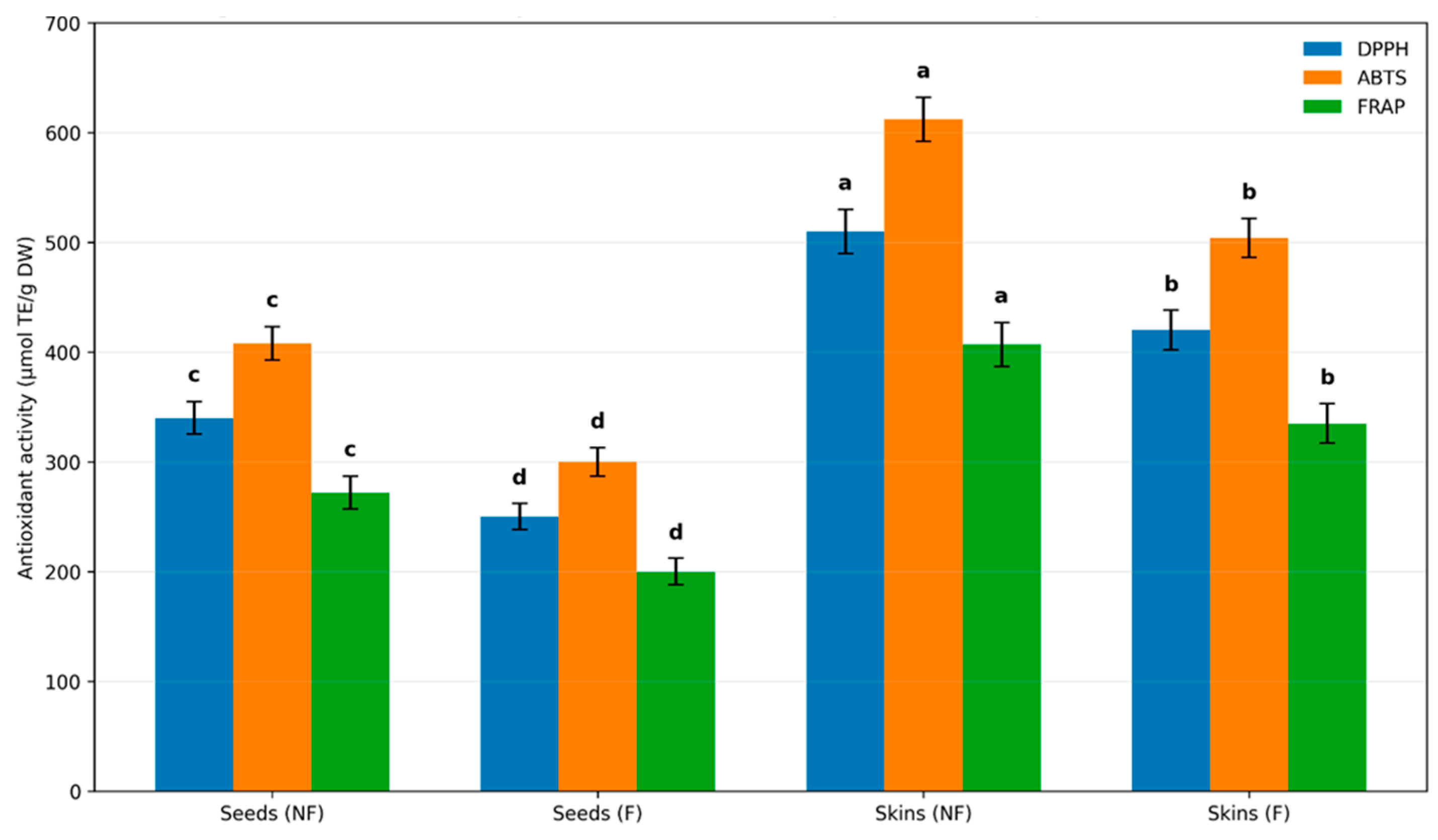
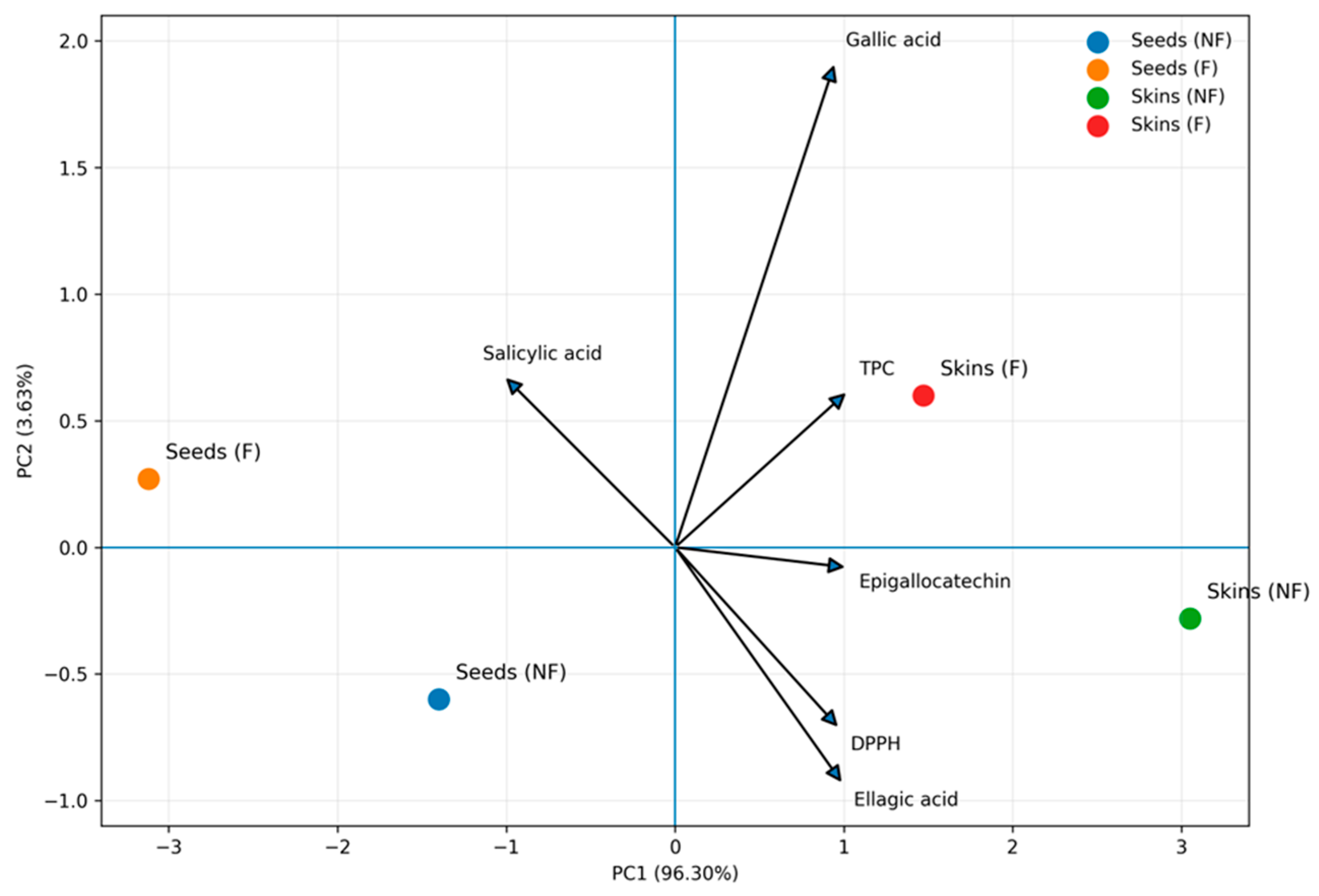
3. Results and Analysis
4. Conclusions
Supplementary Materials
Author Contributions
Funding
Data Availability Statement
Conflicts of Interest
References
- Ghendov-Mosanu, A.; Cristea, E.; Patras, A.; Sturza, R.; Niculaua, M. Rose Hips, a Valuable Source of Antioxidants to Improve Gingerbread Characteristics. Molecules 2020, 25, 5659. [Google Scholar] [CrossRef]
- Mannozzi, C.; Foligni, R.; Mozzon, M.; Petrucci, F.; Clementi, F.; Papa, F. Characterization of Lipid Substances of Rose Hip Seeds as a Potential Source of Functional Components: A review. Int. J. Food Stud. 2020, 9, 1867. [Google Scholar] [CrossRef]
- Kunc, N.; Hudina, M.; Osterc, G.; Bavcon, J.; Ravnjak, B.; Mikulič-Petkovšek, M. Phenolic Compounds of Rose Hips of Some Rosa Species and Their Hybrids Native Grown in the South-West of Slovenia during a Two-Year Period (2020–2021). Foods 2023, 12, 1952. [Google Scholar] [CrossRef] [PubMed]
- Hvattum, E. Determination of Phenolic Compounds in Rose Hip (Rosa canina) Using Liquid Chromatography Coupled to Electrospray Ionisation Tandem Mass Spectrometry and Diode-Array Detection. Rapid Commun. Mass Spectrom. 2002, 16, 655–662. [Google Scholar] [CrossRef]
- Tumbas, V.T.; Canadanovic-Brunet, J.M.; Cetojevic-Simin, D.D.; Cetcovic, G.S.; Ethilas, S.M.; Gille, L. Effect of rosehip (Rosa canina L.) phytochemicals on stable free redicals and human cancer cells. J. Sci. Food Agric. 2012, 92, 1273–1281. [Google Scholar] [CrossRef]
- Ahmad, N.; Anwar, F.; Gilani, A.-u.-H. Rose Hip (Rosa canina L.) Oils. In Essential Oils in Food Preservation, Flavor and Safety; Preedy, V.R., Ed.; Academic Press: London, UK, 2016; pp. 667–675. [Google Scholar] [CrossRef]
- Oargă, D.P.; Cornea-Cipcigan, M.; Nemeș, S.A.; Cordea, M.I. The Effectiveness of a Topical Rosehip Oil Treatment on Facial Skin Characteristics: A Pilot Study on Wrinkles, UV Spots Reduction, Erythema Mitigation, and Age-Related Signs. Cosmetics 2025, 12, 125. [Google Scholar] [CrossRef]
- Ilyasoğlu, H. Characterization of Rosehip (Rosa canina L.) Seed and Seed Oil. Int. J. Food Prop. 2014, 17, 1591–1598. [Google Scholar] [CrossRef]
- Grajzer, M.; Prescha, A.; Korzonek, K.; Wojakowska, A.; Dziadas, M.; Kulma, A.; Grajeta, H. Characteristics of rose hip (Rosa canina L.) cold-pressed oil and its oxidative stability studied by the differential scanning calorimetry method. Food Chem. 2015, 188, 459–466. [Google Scholar] [CrossRef]
- Van der Walt, A.C. Transdermal Diffusion Stability and Clinical Efficacy of Cosmetic Formulations Containing Rosa rubiginosa Rosehip Seed Oil. Ph.D. Thesis, North-West University (South Africa), Potchefstroom, South Africa, 2016. [Google Scholar]
- Kilic, U.; Elfaki, M.O.A. Rosehip Fruit Residue, Tobacco Leaf, Nettle Herb, and Nettle Seed Cake as Potential Ruminant Feeds: Nutritional Value, In Vitro Digestibility, Gas Production and Methane Emissions. Int. J. Sci. Res. Arch. 2025, 17, 900–908. [Google Scholar] [CrossRef]
- Ionescu, A.-D.; Voicu, G.; Stefan, E.-M.; Constantin, G.-A.; Tudor, P.; Militaru, G. Physico-Chemical and Resistance Characteristics of Rosehip Seeds. Agriculture 2025, 15, 1539. [Google Scholar] [CrossRef]
- Demir, N.; Yildiz, O.; Alpaslan, M.; Hayaloglu, A.A. Evaluation of volatiles, phenolic compounds and antioxidant activities of rose hip (Rosa L.) fruits in Turkey. LWT Food Sci. Technol. 2014, 57, 126–133. [Google Scholar] [CrossRef]
- Nađpal, J.D.; Lesjak, M.M.; Šibul, F.S.; Anačkov, G.T.; Četojević-Simin, D.D.; Mimica-Dukić, N.M.; Beara, I.N. Comparative study of biological activities and phytochemical composition of two rose hips and their preserves: Rosa canina L. and Rosa arvensis Huds. Food Chem. 2016, 192, 907–914. [Google Scholar] [CrossRef] [PubMed]
- Paunović, D.; Kalušević, A.; Petrović, T.; Urošević, T.; Đinović, D.; Nedović, V.; Popović-Djordjević, J. Assessment of Chemical and Antioxidant Properties of Fresh and Dried Rosehip (Rosa canina L.). Not. Bot. Horti Agrobot. 2019, 47, 108–113. [Google Scholar] [CrossRef]
- Pirone, B.N.; Ochoa, M.R.; Kesseler, A.G.; De Michelis, A. Chemical characterization and evolution of ascorbic acid concentration during dehydration of rosehip (Rosa eglanteria) fruits. Am. J. Food Technol. 2007, 2, 377–387. [Google Scholar] [CrossRef][Green Version]
- Concha, J.; Soto, C.; Chamy, R.; Zuniga, M.E. Effect of rosehip extraction process on oil and defatted meal physicochemical properties. J. Am. Oil Chem. Soc. 2006, 83, 771–775. [Google Scholar] [CrossRef]
- Ispiryan, A.; Jarienė, E. Comparative Assessment of Fermented and Non-Fermented Berry Seeds as Sources of Functional Oils. Foods 2025, 14, 3494. [Google Scholar] [CrossRef]
- Brand-Williams, W.; Cuvelier, M.E.; Berset, C. Use of a free radical method to evaluate antioxidant activity. LWT Food Sci. Technol. 1995, 28, 25–30. [Google Scholar] [CrossRef]
- Szentmihályi, K.; Vinkler, P.; Lakatos, B.; Illés, V.; Then, M. Rose Hip (Rosa canina L.) Oil Obtained from Waste Hip Seeds by Different Extraction Methods. Bioresour. Technol. 2002, 82, 195–201. [Google Scholar] [CrossRef]
- Igual, M.; Păucean, A.; Vodnar, D.C.; García-Segovia, P.; Martínez-Monzó, J.; Chiş, M.S. In Vitro Bioaccessibility of Bioactive Compounds from Rosehip-Enriched Corn Extrudates. Molecules 2022, 27, 1972. [Google Scholar] [CrossRef]
- Michalska-Ciechanowska, A.; Brzezowska, J.; Nicolet, N.; Haładyn, K.; Brück, W.M.; Hendrysiak, A.; Andlauer, W. Valorization of Rosehip (Rosa canina L.) Pomace Using Unconventional Carbohydrate Carriers for Beverage Obtainment. Molecules 2025, 30, 141. [Google Scholar] [CrossRef]
- Negrean, O.-R.; Farcas, A.C.; Nemes, S.A.; Cic, D.-E.; Socaci, S.A. Recent Advances and Insights into the Bioactive Properties and Applications of Rosa canina L. and Its By-products. Heliyon 2024, 10, e30816. [Google Scholar] [CrossRef]
- Nastić, N.; Vasić, A.; Šoronja Simović, D.; Vladić, J.; Jokić, S.; Aladić, K.; Vidović, S. Underutilized Rosa canina Herbal Dust as an Innovative Natural Functional and Health Promoting Ingredient: A Proposal of Two-Novel Approaches. Waste Biomass Valorization 2023, 14, 1207–1217. [Google Scholar] [CrossRef]
- Peña, F.; Valencia, S.; Tereucán, G.; Nahuelcura, J.; Jiménez-Aspee, F.; Cornejo, P.; Ruiz, A. Bioactive Compounds and Antioxidant Activity in the Fruit of Rosehip (Rosa canina L. and Rosa rubiginosa L.). Molecules 2023, 28, 3544. [Google Scholar] [CrossRef] [PubMed] [PubMed Central]
- Kerasioti, E.; Apostolou, A.; Kafantaris, I.; Chronis, K.; Kokka, E.; Dimitriadou, C.; Tzanetou, E.N.; Priftis, A.; Koulocheri, S.D.; Haroutounian, S.A.; et al. Polyphenolic Composition of Rosa canina, Rosa sempervivens and Pyrocantha coccinea Extracts and Assessment of Their Antioxidant Activity in Human Endothelial Cells. Antioxidants 2019, 8, 92. [Google Scholar] [CrossRef]
- Koczka, N.; Stefanovits-Bányai, É.; Ombódi, A. Total Polyphenol Content and Antioxidant Capacity of Rosehips of Some Rosa Species. Medicines 2018, 5, 84. [Google Scholar] [CrossRef] [PubMed]
- Fascella, G.; D’Angiolillo, F.; Mammano, M.M.; Amenta, M.; Romeo, F.V.; Rapisarda, P.; Ballistreri, G. Bioactive Compounds and Antioxidant Activity of Four Rose Hip Species from Spontaneous Sicilian Flora. Food Chem. 2019, 289, 56–64. [Google Scholar] [CrossRef]
- Wenzig, E.M.; Widowitz, U.; Kunert, O.; Chrubasik, S.; Bucar, F.; Knauder, E.; Bauer, R. Phytochemical Composition and in Vitro Pharmacological Activity of Two Rose Hip (Rosa canina L.) Preparations. Phytomedicine 2008, 15, 826–835. [Google Scholar] [CrossRef]
- Winther, K.; Campbell-Tofte, J.; Vinther Hansen, A.S. Bioactive ingredients of rose hips (Rosa canina L) with special reference to antioxidative and anti-inflammatory properties: In vitro studies. Bot. Targets Ther. 2016, 6, 11–23. [Google Scholar] [CrossRef]
- Rovná, K.; Ivanišová, E.; Žiarovská, J.; Ferus, P.; Terentjeva, M.; Kowalczewski, P.Ł.; Kačániová, M. Characterization of Rosa canina fruits collected in urban areas of Slovakia. Genome size, iPBS profiles and antioxidant and antimicrobial activities. Molecules 2020, 25, 1888. [Google Scholar] [CrossRef] [PubMed]
- Birben, E.; Sahiner, U.M.; Sackesen, C.; Erzurum, S.; Kalayci, O. Oxidative Stress and Antioxidant Defense. World Allergy Organ. J. 2012, 5, 9–19. [Google Scholar] [CrossRef]
- Sies, H. Oxidative Stress: A Concept in Redox Biology and Medicine. Redox Biol. 2015, 4, 180–183. [Google Scholar] [CrossRef] [PubMed]
- Rinnerthaler, M.; Bischof, J.; Streubel, M.K.; Trost, A.; Richter, K. Oxidative Stress in Aging Human Skin. Biomolecules 2015, 5, 545–589. [Google Scholar] [CrossRef] [PubMed]
- Krutmann, J.; Bouloc, A.; Sore, G.; Bernard, B.A.; Passeron, T. The Skin Aging Exposome. J. Dermatol. Sci. 2017, 85, 152–161. [Google Scholar] [CrossRef] [PubMed]



| Parameter | Seeds (NF) | Seeds (F) | Unit |
|---|---|---|---|
| Thousand-seed weight (TSW) | 11.73 a | 11.60 a | g |
| Length | 3.2 ± 0.4 a | 3.2 ± 0.4 a | mm |
| Width | 1.8 ± 0.2 a | 1.8 ± 0.2 a | mm |
| Thickness | 1.2 ± 0.2 a | 1.2 ± 0.2 a | mm |
| Shape index (L/W) | 1.78 a | 1.78 a | – |
| Moisture content | 7.5 ± 0.3 a | 7.8 ± 0.3 a | % |
| Bulk density | 0.42 ± 0.02 a | 0.41 ± 0.02 a | g/cm3 |
| Tapped density | 0.51 ± 0.02 a | 0.50 ± 0.02 a | g/cm3 |
| Carr index | 17.6 a | 18.0 a | % |
| Hausner ratio | 1.21 a | 1.22 a | – |
| Water holding capacity (WHC) | 2.1 ± 0.1 b | 2.3 ± 0.1 a | g/g |
| Oil absorption capacity (OAC) | 1.6 ± 0.1 a | 1.5 ± 0.1 a | g/g |
| Swelling capacity | 2.8 ± 0.2 b | 3.0 ± 0.2 a | mL/g |
| Color (L*) | 68.5 ± 1.2 a | 64.2 ± 1.5 b | – |
| Color (a*) | 5.4 ± 0.3 b | 6.2 ± 0.3 a | – |
| Color (b*) | 18.2 ± 0.6 a | 17.0 ± 0.5 b | – |
| Compound | Seeds (NF) (mg/g DW) | Seeds (F) (mg/g DW) | Skins (NF) (mg/g DW) |
|---|---|---|---|
| Gallic acid | 0.50 ± 0.01 c | 0.60 ± 0.02 b | 14.43 ± 0.50 a |
| Epigallocatechin | 10.89 ± 0.51 b | 6.50 ± 0.30 c | 20.35 ± 0.80 a |
| Catechin | 0.00 ± 0.00 a | 0.00 ± 0.00 a | 0.00 ± 0.00 a |
| p-Hydroxybenzoic acid | 0.04 ± 0.00 b | 0.06 ± 0.00 a | 0.03 ± 0.00 c |
| Chlorogenic acid | 0.00 ± 0.00 b | 0.05 ± 0.00 a | 0.00 ± 0.00 b |
| Caffeic acid | 0.06 ± 0.00 b | 0.07 ± 0.00 a | 0.05 ± 0.00 c |
| p-Coumaric acid | 0.00 ± 0.00 a | 0.00 ± 0.00 a | 0.00 ± 0.00 a |
| Benzoic acid | 0.00 ± 0.00 a | 0.00 ± 0.00 a | 0.00 ± 0.00 a |
| Ferulic acid | 0.51 ± 0.01 a | 0.40 ± 0.01 b | 0.32 ± 0.01 c |
| Quercetin-3-O-rutinoside | 0.00 ± 0.00 a | 0.00 ± 0.00 a | 0.00 ± 0.00 a |
| Naringin | 0.00 ± 0.00 a | 0.00 ± 0.00 a | 0.00 ± 0.00 a |
| Vanillic acid | 0.05 ± 0.00 b | 0.07 ± 0.00 a | 0.04 ± 0.00 c |
| Salicylic acid | 0.98 ± 0.03 b | 1.20 ± 0.04 a | 0.62 ± 0.02 c |
| Sinapic acid | 0.19 ± 0.01 a | 0.10 ± 0.00 b | 0.08 ± 0.00 c |
| Ellagic acid | 1.03 ± 0.02 b | 0.80 ± 0.02 c | 1.45 ± 0.05 a |
| Kaempferol-3-O-glucoside | 0.00 ± 0.00 a | 0.00 ± 0.00 a | 0.00 ± 0.00 a |
| Myricetin | 0.06 ± 0.00 a | 0.04 ± 0.00 b | 0.05 ± 0.00 ab |
| Valeric acid | 0.16 ± 0.00 a | 0.12 ± 0.00 b | 0.09 ± 0.00 c |
| trans-Cinnamic acid | 0.24 ± 0.01 a | 0.15 ± 0.01 b | 0.11 ± 0.00 c |
| Apigenin | 0.05 ± 0.00 a | 0.03 ± 0.00 b | 0.04 ± 0.00 ab |
| Quercetin | 0.13 ± 0.01 a | 0.08 ± 0.00 b | 0.10 ± 0.00 ab |
| Kaempferol | 0.00 ± 0.00 a | 0.00 ± 0.00 a | 0.00 ± 0.00 a |
| Quercetin-3-O-glucoside | 0.60 ± 0.05 a | 0.45 ± 0.03 b | 0.52 ± 0.04 ab |
| Variables | DPPH | ABTS | FRAP | Sum Phenolics | Epigallocatechin | Ellagic Acid | Gallic Acid | Salicylic Acid |
|---|---|---|---|---|---|---|---|---|
| DPPH | 1.00 | 0.91 ** | 0.88 ** | 0.82 ** | 0.88 ** | 0.74 ** | 0.65 * | 0.61 * |
| ABTS | 0.91 ** | 1.00 | 0.89 ** | 0.85 ** | 0.86 ** | 0.78 ** | 0.69 ** | 0.66 * |
| FRAP | 0.88 ** | 0.89 ** | 1.00 | 0.80 ** | 0.84 ** | 0.72 ** | 0.67 * | 0.63 * |
| Sum phenolics | 0.82 ** | 0.85 ** | 0.80 ** | 1.00 | 0.79 ** | 0.85 ** | 0.70 ** | 0.66 * |
| Epigallocatechin | 0.88 ** | 0.86 ** | 0.84 ** | 0.79 ** | 1.00 | 0.68 * | 0.52 | 0.48 |
| Ellagic acid | 0.74 ** | 0.78 ** | 0.72 ** | 0.85 ** | 0.68 * | 1.00 | 0.63 * | 0.55 |
| Gallic acid | 0.65 * | 0.69 ** | 0.67 * | 0.70 ** | 0.52 | 0.63 * | 1.00 | 0.77 ** |
| Salicylic acid | 0.61 * | 0.66 * | 0.63 * | 0.66 * | 0.48 | 0.55 | 0.77 ** | 1.00 |
Disclaimer/Publisher’s Note: The statements, opinions and data contained in all publications are solely those of the individual author(s) and contributor(s) and not of MDPI and/or the editor(s). MDPI and/or the editor(s) disclaim responsibility for any injury to people or property resulting from any ideas, methods, instructions or products referred to in the content. |
© 2026 by the authors. Licensee MDPI, Basel, Switzerland. This article is an open access article distributed under the terms and conditions of the Creative Commons Attribution (CC BY) license.
Share and Cite
Ispiryan, A.; Jariene, E.; Butu, A. Bioprocessing of Rose Hip Seed By-Products and Its Effects on Phenolic Composition and Antioxidant Activity. Seeds 2026, 5, 22. https://doi.org/10.3390/seeds5020022
Ispiryan A, Jariene E, Butu A. Bioprocessing of Rose Hip Seed By-Products and Its Effects on Phenolic Composition and Antioxidant Activity. Seeds. 2026; 5(2):22. https://doi.org/10.3390/seeds5020022
Chicago/Turabian StyleIspiryan, Audrone, Elvyra Jariene, and Alina Butu. 2026. "Bioprocessing of Rose Hip Seed By-Products and Its Effects on Phenolic Composition and Antioxidant Activity" Seeds 5, no. 2: 22. https://doi.org/10.3390/seeds5020022
APA StyleIspiryan, A., Jariene, E., & Butu, A. (2026). Bioprocessing of Rose Hip Seed By-Products and Its Effects on Phenolic Composition and Antioxidant Activity. Seeds, 5(2), 22. https://doi.org/10.3390/seeds5020022