Article

Advancement in Seed Collection Timing for Three European Tree Species: Abies alba, Larix decidua and Tilia cordata


by
Paula Garbacea
1,*,
Emanuel Stoica
1,*,
Alin-Madalin Alexandru
1,
Georgeta Mihai
1,
Katri Himanen
2 and
Heino Konrad
3
1
Department of Forest Genetics and Tree Breeding, “Marin Dracea” National Institute for Research and Development in Forestry, 077190 Bucharest, Romania
2
Natural Resources Institute Finland (Luke), Latokartanonkaari 9, 00790 Helsinki, Finland
3
Federal Research and Training Centre for Forests, Natural Hazards and Landscape, Seckendorff-Gudent-Weg 8, A-1131 Vienna, Austria
*
Authors to whom correspondence should be addressed.
Seeds 2026, 5(2), 20; https://doi.org/10.3390/seeds5020020
Submission received: 5 February 2026 / Revised: 24 March 2026 / Accepted: 26 March 2026 / Published: 28 March 2026

Abstract

The collection of high-quality seeds to produce forest seedlings is closely linked with the time of harvesting. Climate warming is already having visible effects in all life stages of forest tree species, including the timing of seed maturation. The purpose of this study was to update the knowledge on seed collection timing and to identify the indicators of physiological maturity for three key Eastern European tree species—silver fir (Abies alba), European larch (Larix decidua), and small-leaved lime (Tilia cordata). Seeds and cones were collected from Romanian clonal seed orchards and evaluated at several stages of seed maturation using germination tests for European larch and tetrazolium viability tests for silver fir and small-leaved lime. The results revealed species-specific differences in seed maturation timing: in silver fir seed viability increased slightly from late August to early September, in European larch germination remained low (≈20%) regardless of harvest time, while small-leaved lime viability declined significantly after late August. These findings suggest that the harvest period observed during the study years occurred earlier than the traditionally recommended intervals and could be linked to recent warming trends. This study highlights the relevance of re-evaluating seed collection schedules under changing climatic conditions, while further multi-year studies are required to confirm these patterns and refine practical recommendations.

1. Introduction

Forest restoration has become a critical concern in global forestry due to the increasing impacts of climate change, wildfires, and biotic disturbances caused by fungi, pathogens, and insects, which have contributed to forest degradation, biodiversity loss, and reduced ecosystem functioning. At the same time, even in managed forests where harvesting is part of planned rotation forestry, regeneration depends largely on the availability of viable, high-quality seeds [1].
Seeds play an important role in ensuring the continuity of forests by maintaining genetic diversity through DNA recombination and the regeneration of tree populations. As the initial stage in the life cycle of forest plants, seeds function as adaptive structures that help species survive under variable and often stressful environmental conditions [2,3]. Seed germination is a fundamental stage in the plant life cycle, marking the transition from dormancy to active growth and directly influencing the establishment and development of the plant [4]. This process involves a series of physiological events initiated by water uptake in the dry seed, leading to the emergence of the radicle or hypocotyl through the seed coat [5]. A seed’s germination capacity is largely determined by its maturity and quality [6]. Seeds that are anatomically or physiologically immature tend to germinate slowly or incompletely, even under favorable conditions [7]. Collection of conifer seeds before physiological maturity can also impact their storability negatively [8,9].
To support large-scale forest regeneration, seed orchards represent one of the most effective approaches for producing genetically improved, high-quality reproductive material seeds [10]. They offer advantages such as seed production at relatively regular intervals and ease of harvesting with relatively low economic costs compared with natural stands [11]. Moreover, they can support the reproduction of scattered or endangered species that do not regenerate effectively under natural forest conditions [12].
The design, location, and management of the seed orchards along with the timing of seed collection, have a significant impact on the viability, maturity, and germination potential of the harvested seeds [13,14]. The production and development of seeds are also influenced by several climatic factors, including the length of the growing season, accumulated thermal time, winter chilling, annual rainfall, and interactions among these variables [15].
Over recent decades, pronounced changes in global and regional climate patterns have been recorded. During the 20th century, the global average surface temperature increased by approximately 0.6 ± 0.2 °C, with the most rapid warming occurring between 1976 and 2000 [16]. Projections suggest a further increase of 1.4 to 5.8 °C between 1990 and 2100 [17]. Romania is also experiencing a warming trend across the country, with a significant increase in the number of summer days [18]. Average annual temperatures have increased by more than 1.5 °C over the past three decades and are projected to rise by approximately 1.2 °C between 2021 and 2050, and by more than 2 °C over the next 100 years [19,20]. Climatic changes are expected to have a direct impact on the timing of biological events in forest ecosystems. For example, the average growing season in Europe lengthened by approximately 10 days between 1962 and 1995, and is projected to increase by about 12% in the coming decades [21,22]. As a consequence, traditional harvesting schedules may no longer match the actual physiological ripening of the seeds, increasing the risk of collecting them either prematurely or too late [23]. This may lead to negative effects on seed quality and germination, and may also cause significant losses due to natural seed dispersal occurring before harvest [24]. Most temperate forest tree species do not produce abundant seed crops annually, as seed production is influenced by complex interactions between internal physiological processes and external environmental factors. As a result, good seed years occur only at certain intervals [25] and must be stored for use in poor crop years. Under these conditions, accurate timing of seed collection becomes essential to ensure seed quality and viability [26], particularly for tree species of significant ecological and economic importance in Romania, such as silver fir, European larch and small-leaved lime.
Silver fir (Abies alba Mill.) is one of the most valuable conifer species in Europe, appreciated for both its economic and ecological importance [27]. It is distributed across montane regions of Central, Southern and Eastern Europe, typically occurring at elevations between 500 and 2000 m above sea level [28]. In Romania, silver fir is predominantly found in the Carpathian Mountains, where it occupies approximately 5% of the country’s total forest area [29]. The species typically exhibits abundant fructification at intervals of 4–5 years in seed stands, while in seed orchards this periodicity is shortened to 2–3 years [30]. The presence of essential oils in the outer seed tissues has been associated with reduced germination, and silver fir is therefore often described as having low germination capacity (25–35%) [31]. Silver fir seeds exhibit physiological dormancy, which may limit germination even under favorable environmental conditions, while the seed coat may further restrict water and oxygen uptake. This dormancy can be overcome through cold stratification for 21 days, a pre-sowing treatment that mimics natural overwintering conditions and promotes germination [32,33]. When cones reach full maturity, they open and release the seeds, making the timing of cone harvest particularly critical. Romania has ten silver fir seed orchards covering a total of 85 hectares, as well as 3344 hectares of seed stands classified in the selected category [34].
European larch (Larix decidua Mill.) is a valuable deciduous conifer species native to Central Europe, recognized for its fast growth, high-quality timber, and ecological adaptability [35]. It typically grows in mountainous regions but can also occur at lower elevations, being found from as low as 200 m in Poland up to 2400–2500 m in the Alps [36]. In Romania, European larch is relatively rare, occupying approximately 0.4% of the country’s total forest area [29], mainly within the Carpathians, where it is often used in mixed stands [37]. European larch regularly produces seeds on average every 3 to 4 years and has a moderate germination capacity, typically ranging from 30–50% [38,39,40]. In recent years, as a result of climate warming, seed production in larch seed orchards has been very poor, and the cones opened very early in autumn, which causes the loss of a large amount until their harvest [41]. Unlike many temperate forest tree species, European larch seeds do not exhibit primary dormancy, allowing seed viability to be reliably assessed through standard germination tests [42]. Given its widespread use in afforestation, determining the optimal timing of seed maturity is particularly important for this species [43]. In Romania, 26 European larch seed orchards (134 ha) have been established and 20 are currently maintained and operational [44,45].
Small-leaved lime (Tilia cordata Mill.) is a broad-leaved tree species native to Europe, valued for its ecological importance, shade tolerance, and nectar-rich flowers that support pollinators [46]. Its core distribution lies in Central and Eastern Europe, but it can also be found as far north as southern Norway and Finland, and at elevations up to 1500 m in the central Alps [47]. In Romania, small-leaved lime covers approximately 1% of the country’s forested area and is often found in mixed broadleaved stands in lowlands and hilly regions up to 500–600 m. In some areas, it can also form pure stands [36]. Small-leaved lime produces seeds almost every year and has a moderate germination capacity, usually ranging from 50–60% [48,49]. In case of this species is well known that if the seeds have reached complete ripening, they will enter a state of physiological dormancy and will only germinate after 2–3 years [50]. From a practical point of view, it is very important to establish the time when the seeds are fully mature, before the fruit is fully ripe, to avoid seed dormancy. Romania currently has one small-leaved lime seed orchard with a total surface of 5 hectares [34].
The main objective of this study was to assess seed maturation dynamics and seed collection timing in three forest tree species important for forest regeneration in Europe.
Specifically, the research aimed to (1) identify indicators of physiological maturity relevant for timely seed collection, (2) to evaluate harvesting periods based on seed quality parameters, and (3) compare germination and viability performance across different maturity stages.

2. Materials and Methods

2.1. Study Material and Sampling Design

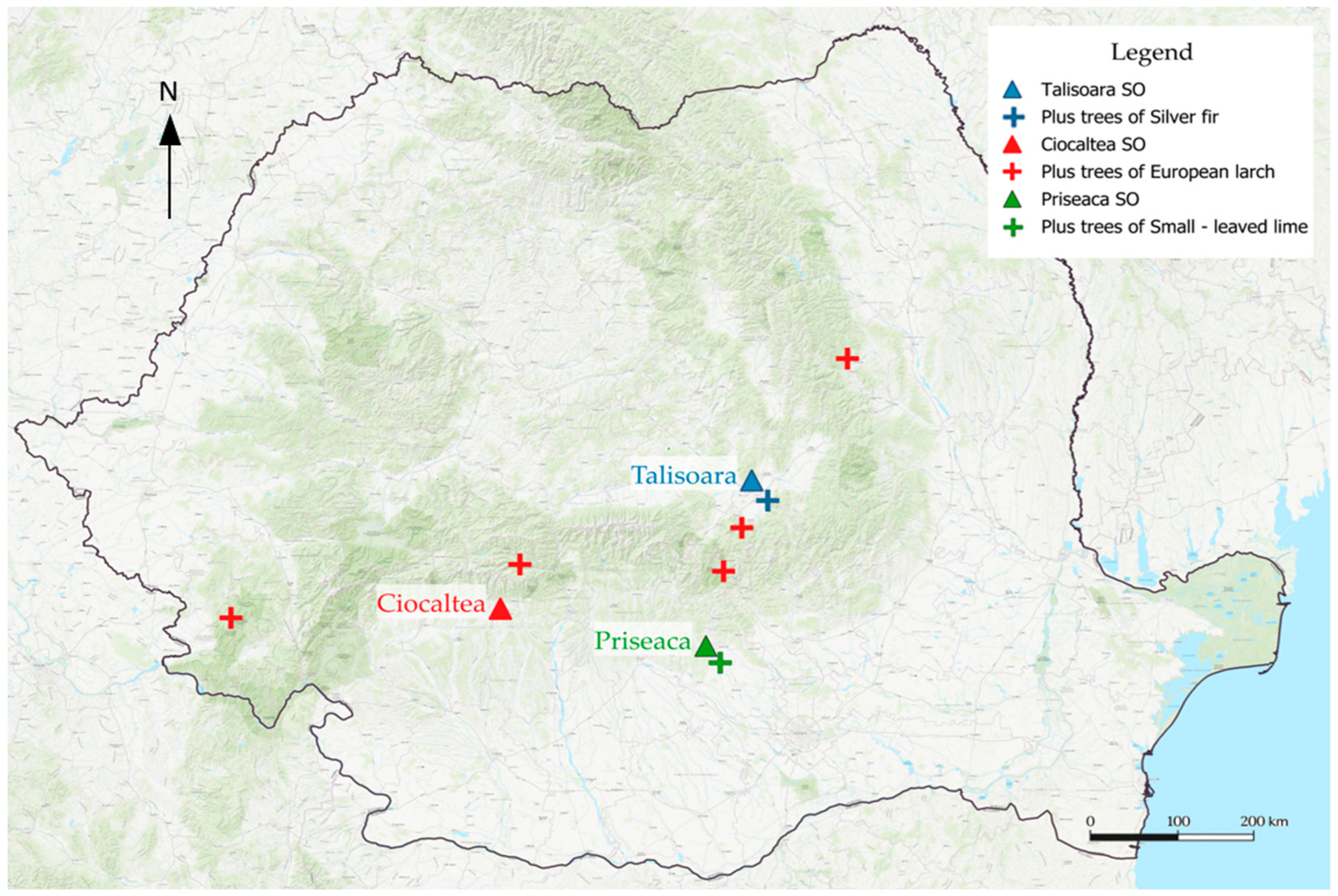
The study material consisted of seeds and cones of silver fir, European larch, and small-leaved lime, collected from three clonal seed orchards established by grafting. The geographic locations of the seed orchards are shown in Figure 1. They are distributed across distinct ecological regions of Romania: Tălișoara (Covasna County), for silver fir in the Eastern Carpathians, Ciocâltea (Vâlcea County) for European larch in the Southern Carpathians, and Priseaca II (Dâmbovița County) for small-leaved lime in the Subcarpathian area.
The main characteristics of clonal seed orchards are presented in Table 1. This table includes information on species, number of clones, seed orchard area, geographic coordinates, altitude, and year of establishment, providing context for environmental conditions and genetic structure of the studied material.
Cones and seeds were collected from 10–12 clones per seed orchard, with three individual trees sampled per clone, except for small-leaved lime, from which seeds were collected from five clones. For silver fir and small-leaved lime, the clones originated from a single forest district, whereas for European larch, they originated from five forest districts (Figure 1).
Only visually healthy, undamaged cones and seeds were collected; samples showing signs of insect infestation, mechanical damage, or disease were excluded, as the study focused on seed physiological maturity rather than biotic damage.
Seed production varied among the studied species during the study years, being around the average for silver fir, while for European larch and small-leaved lime it was very poor.

2.2. Seed Orchard Characteristics and Collection Schedule

Cone and seed collection was carried out in 2023 for silver fir and small-leaved lime, while for European larch, collection took place in both 2023 and 2024. Table 2 presents the collection schedule for the three studied species, including the collection year, the type of biological material, the specific calendar dates, and the time intervals between successive harvests.
All cones and seeds were harvested directly from the upper crowns of selected trees using climbing equipment. After harvesting, they were packed in paper bags and immediately brought to the Seed Laboratory of the National Forestry Research and Development Institute “Marin Dracea” for further analysis. European larch cones were stored at room temperature for one and three weeks, respectively, to allow for drying, cone opening, and seed release.

2.3. Seed Quality Analyses

To examine seed maturity, a germination test was applied to European larch, while tetrazolium viability testing was used for silver fir and small-leaved lime, following ISTA evaluation principles adapted to the objectives of this study [51]. For small-leaved lime, the excised embryos analysis was also used.

2.3.1. Germination Test (European Larch)

All seeds were extracted, cleaned, and counted. For European larch, a total of 10,424 seeds were analyzed across all trees, years, and collection dates. For each tree, up to 200 seeds (depending on seed availability per cone) with no visible external damage were placed in a Jacobsen germinator on moistened filter paper under controlled temperatures (20–30 °C). Germination was evaluated on days 4, 7, 10, 14, and 21. Seeds were classified as normally germinated when essential seedling structures were fully developed and healthy, in line with ISTA morphological criteria for normal seedlings. Germinated seeds were removed after each evaluation to prevent fungal or bacterial contamination. At the end of the test period all ungerminated seeds were verified by cutting and classified as empty (over 90%) and dead.
The number of seeds per replicate was lower than that prescribed for standard ISTA certification tests, as the objective was to assess relative germination responses among collection dates rather than to determine official germination percentages.

2.3.2. Tetrazolium Test (Silver Fir and Small-Leaved Lime)

Seed viability in silver fir and small-leaved lime was assessed using the tetrazolium staining test, following ISTA principles for viability evaluation. An aqueous solution of 2, 3, 5-triphenyl tetrazolium chloride at a concentration of 1% and a pH between 6.5 and 7.5 was used, in accordance with ISTA guidelines. Seeds were incubated in the staining solution at 30 °C in the dark for 24 h. Before staining, seeds were hydrated in distilled water for 24 h at room temperature.
(1)
Silver fir: Seeds were transversely cut at both ends to open the embryo cavity. For silver fir, a total of 1800 seeds were analyzed across all trees and collection dates. Viable seeds showed a uniform, intense, red staining of the entire embryonic tissues, indicating normal enzymatic activity. Non-viable seeds were evaluated by the presence of unstained or whitish-yellow areas, a complete lack of coloration in certain regions, or diffuse, uneven staining, particularly in the radicle or cotyledon region. Embryos exhibiting these defects were classified as non-viable.
(2)
Small-leaved lime: The pericarp was removed and the seeds were grouped by testa color. Then the seed coat (testa) was also removed before soaking in the tetrazolium solution. For small-leaved lime, a total of 960 seeds were analyzed across all trees and collection dates. Viable seeds exhibited a strong, uniform red staining of both the embryo and the endosperm, indicating intact metabolic activity. Non-viable seeds were identified by incomplete or patchy coloration, white or pale areas on the embryo or endosperm, necrotic tissues, or only partial staining or essential structures.

2.4. Statistical Analyses

The analyses were performed in IBM SPSS Statistics (version 20). The primary objective of the analysis was to evaluate the influence of collection date on seed maturity and quality for each species, as determined by the germination and the tetrazolium viability tests. Additionally, we focused on a putative clonal genetic variability in seed orchards regarding harvest time.
Data were analyzed using analysis of variance (ANOVA) based on linear mixed-effects models. For traits evaluated in more than one year, a combined analysis across years was performed. The linear model used for each trait was:
Yijk = μ + YRj + Ci + eijk
where Yijk is the individual tree value of the kth ramet of the ith clone in the jth year, μ is the overall mean, YRj is the jth year fixed effect, Ci is the ith clone random effect, eijk is the random error effect of the kth ramet of the ith clone in the jth year.
Pearson’s correlations based on clone means were also calculated to examine correlations among traits.

2.5. Climatic Data

Climatic data were obtained from the ClimateDT [52] database for the geographic locations of the three clonal seed orchards included in the study (Tălișoara, Ciocâltea, and Priseaca II). For each site, climatic variables were extracted for a ten-year period preceding seed collection (2013–2024), in order to characterize the climatic conditions under which cone and seed development occurred.
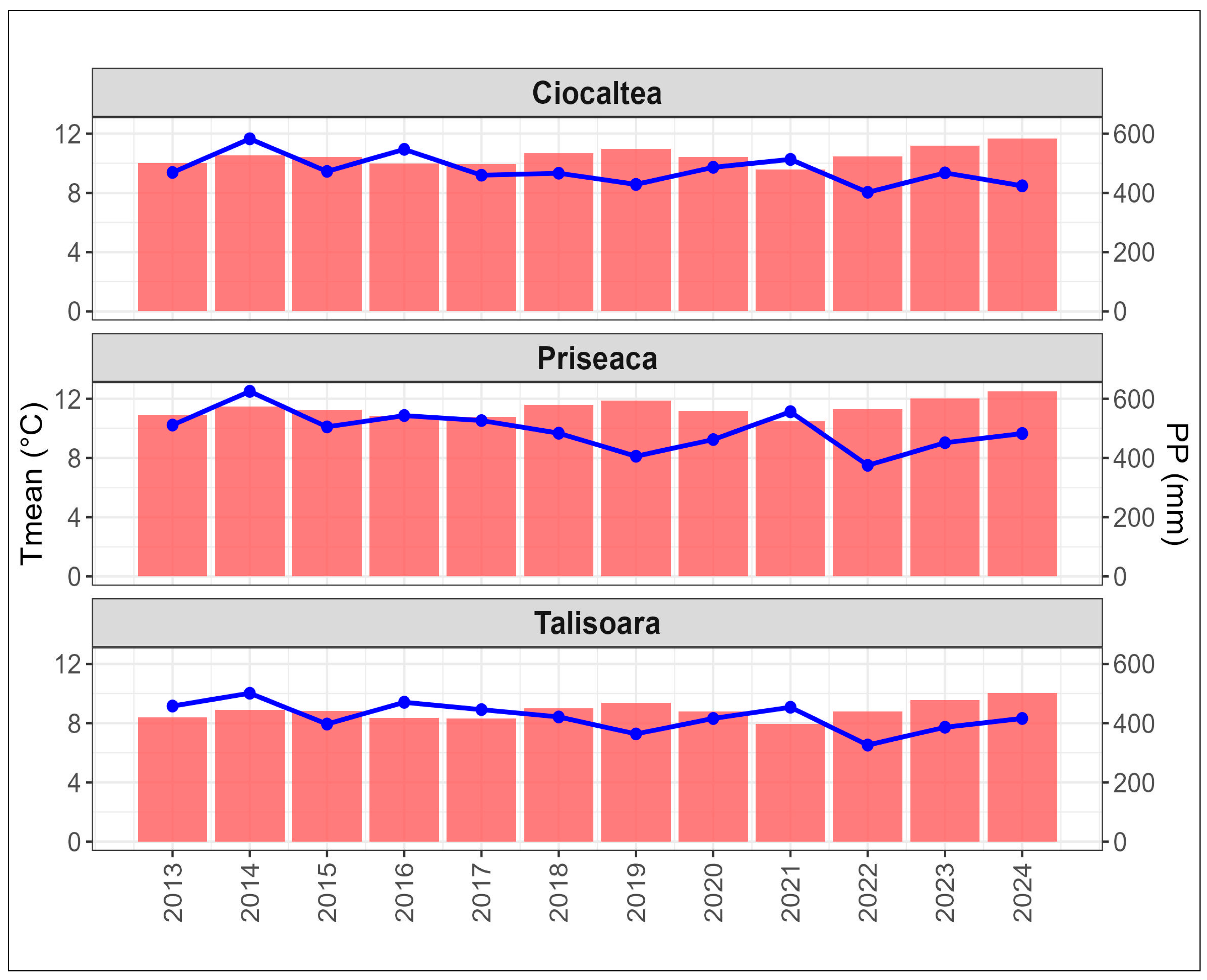
The analyzed climatic variables included mean annual temperature and mean annual precipitation. Climatic data were used to provide contextual information on long-term temperature and precipitation trends at the study sites and to support the interpretation of observed shifts in seed physiological maturity and the timing of seed collection (Figure 2).
Mean values of key climatic variables in the clonal seed orchards Talisoara (silver fir), Ciocâltea (European larch), and Priseaca II (small-leaved lime), showing the 10-year mean (2013–2024) and the annual means for the two seed collection years (2023 and 2024).

3. Results

3.1. Silver Fir

Seed samples were collected from the same trees at two dates: 31 August and 7 September 2023. The proportions of empty, viable, and non-viable seeds are shown in Table 3.
Seeds collected on 31 August showed that, out of 900 seeds, 38% were empty, 41% viable, and 21% non-viable. Seeds collected on 7 September showed that, out of 900 seeds, 42% were empty, 47% viable, and 11% non-viable. These results indicate a slight increase in seed viability from late August to early September, accompanied by a reduction in the proportion of non-viable seeds.
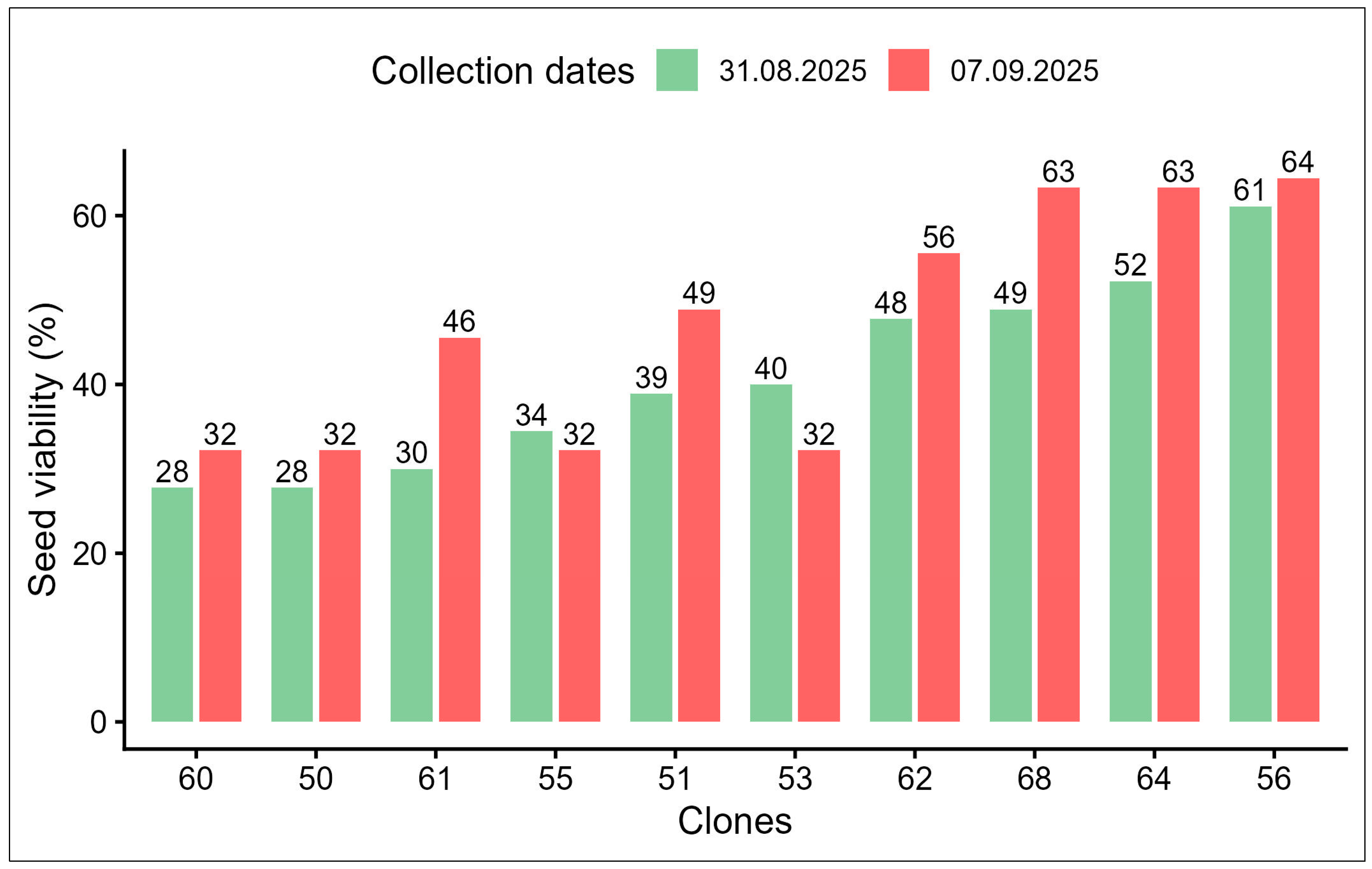
Clonal variation for seed viability was statistically significant (Table 4). Variation among clones is illustrated in Figure 3, showing consistent differences in seed viability across both collection dates. The proportion of viable seeds ranged from 27.8% to 61.1% at the first evaluation and from 32.2% to 64.4% at the second evaluation. The time of evaluation and clone-by- evaluation time interaction effects were not significant.

3.2. European Larch

Seed germination was evaluated in 2023 and 2024 using a total of 10,424 seeds extracted from cones collected in the clonal seed orchard. In 2023, germination averaged 20.7% for seeds collected on 14 September and 20.4% for those collected on 28 September, showing no improvement with delayed harvest (Table 5). The germination rate varied among clones in each case of evaluation as follows: between 4.0 and 32.0% for the first evaluation and between 2.0 and 36.7% for the second evaluation. There was no increase in germination rate between the two collecting times, the effect of clone and evaluation time was not significant (Table 6).
In 2023, the highest germination rate was obtained for clone 11 at the first evaluation and for clone 1 at the second evaluation, while the lowest germination rate was observed in clone 9.
In 2024 germination reached 19.7% for seed collected on 17 September and 19.6% for those collected on 1 October. The clone effect was significant for both traits, while evaluation time was significant for the number of seeds per cone (Table 6). The germination rate varied between 11 and 44% for the first evaluation and between 9 and 40.8% for the second evaluation. The number of seeds per cone varied between 18 and 55 for the first evaluation and between 15 and 43 for the second evaluation. Clone 8 had the best germination rate for both evaluations, while clones 7 and 4 had the lowest values. There was no correlation between clone germination and the number of seeds per cone, different clones obtained different results.
Evaluation time effect was significant for the number of seeds per cone, suggesting that the time of seed collecting is important for seed production. The effect of the year was not statistically significant, but the clone x year interaction was significant (Table 7).

3.3. Small-Leaved Lime

For seeds collected at the first collection date (22 August), results indicated 26% viable, 63% empty, and 11% non-viable seeds, representing the highest viability recorded during the study. For the seeds collected on 28 August, the analysis showed 12% viable, 62% empty, and 26% non-viable seeds. The analysis of seeds collected on 4 September revealed only 7% viable, 69% empty, and 24% non-viable seeds.
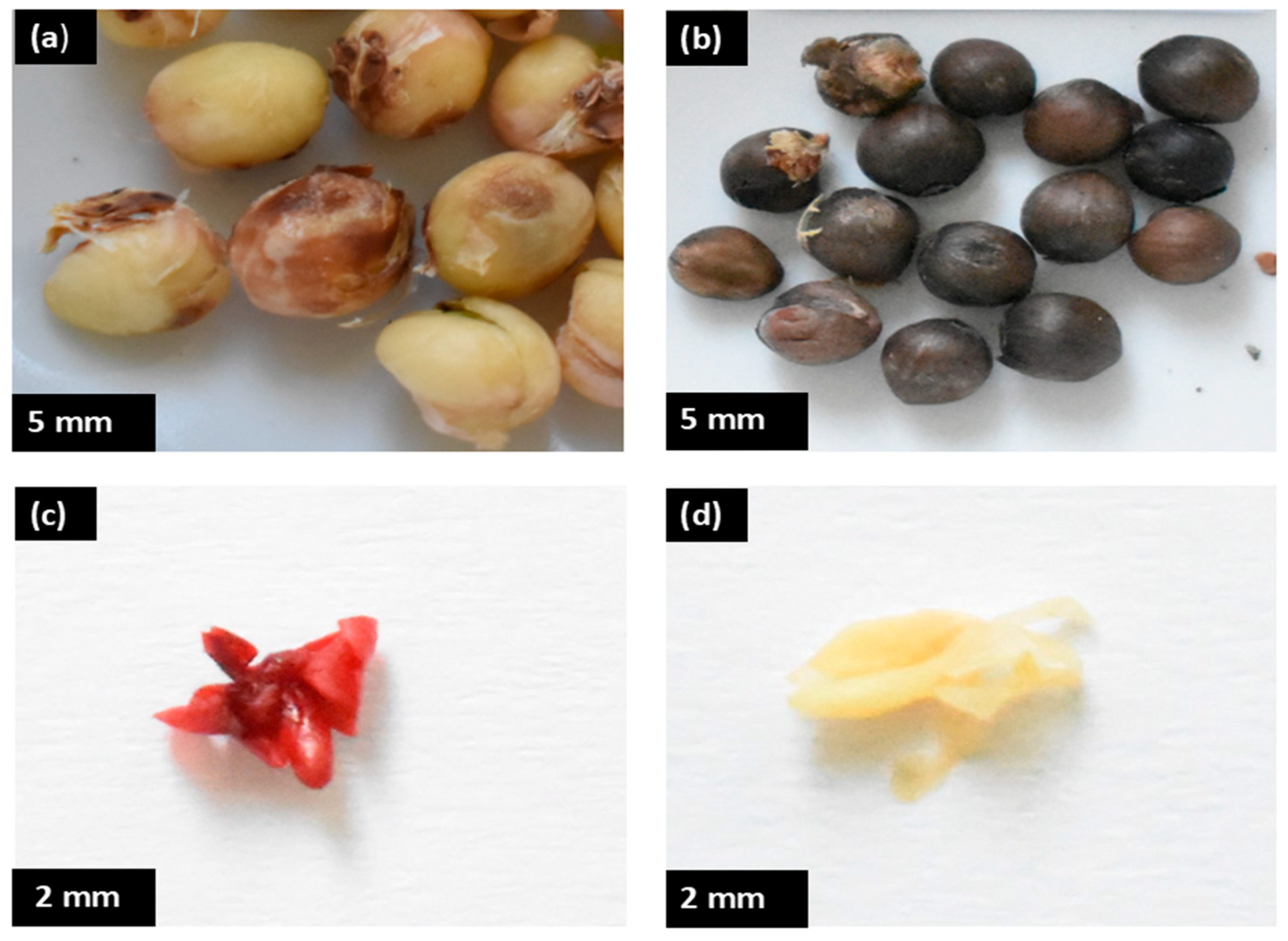
As shown in Table 8, the results indicate that seed viability was highest around 22 August, while delaying collection into early September was associated with lower viability and a higher proportion of empty and non-viable seeds. At the first evaluation, 26% of seeds had white testa, while seeds with black testa were only 11%. The percentage of the white-testa seeds decreased simultaneously with the ripening of fruits, while the percentage of the seeds with black-testa increased. At the end of the evaluation period, when all fruits had reached full maturity, all seeds had black testa.
Analyzing the tetrazolium test images from the first evaluation, it was found that the embryos excised from the white-testa seeds were fully developed and 76% viable and 24% non-viable (Figure 4). Pearson correlation coefficient between the percentage of the white-testa seeds and seed viability was very significant (r = 0.660 ***). Out of the total seeds which had black-testa, 60% had viable embryos and 40% non-viable embryos.
The clone effect, determined for the entire observation period, was significant for the percentage of the black-testa seeds, empty seeds and non-viable seeds (Table 9). The evaluation effect was significant for the percentage of the white-testa seeds and black-testa seeds, while cone × evaluation interaction was significant for dead seeds only.

3.4. Comparative Analysis Across Species

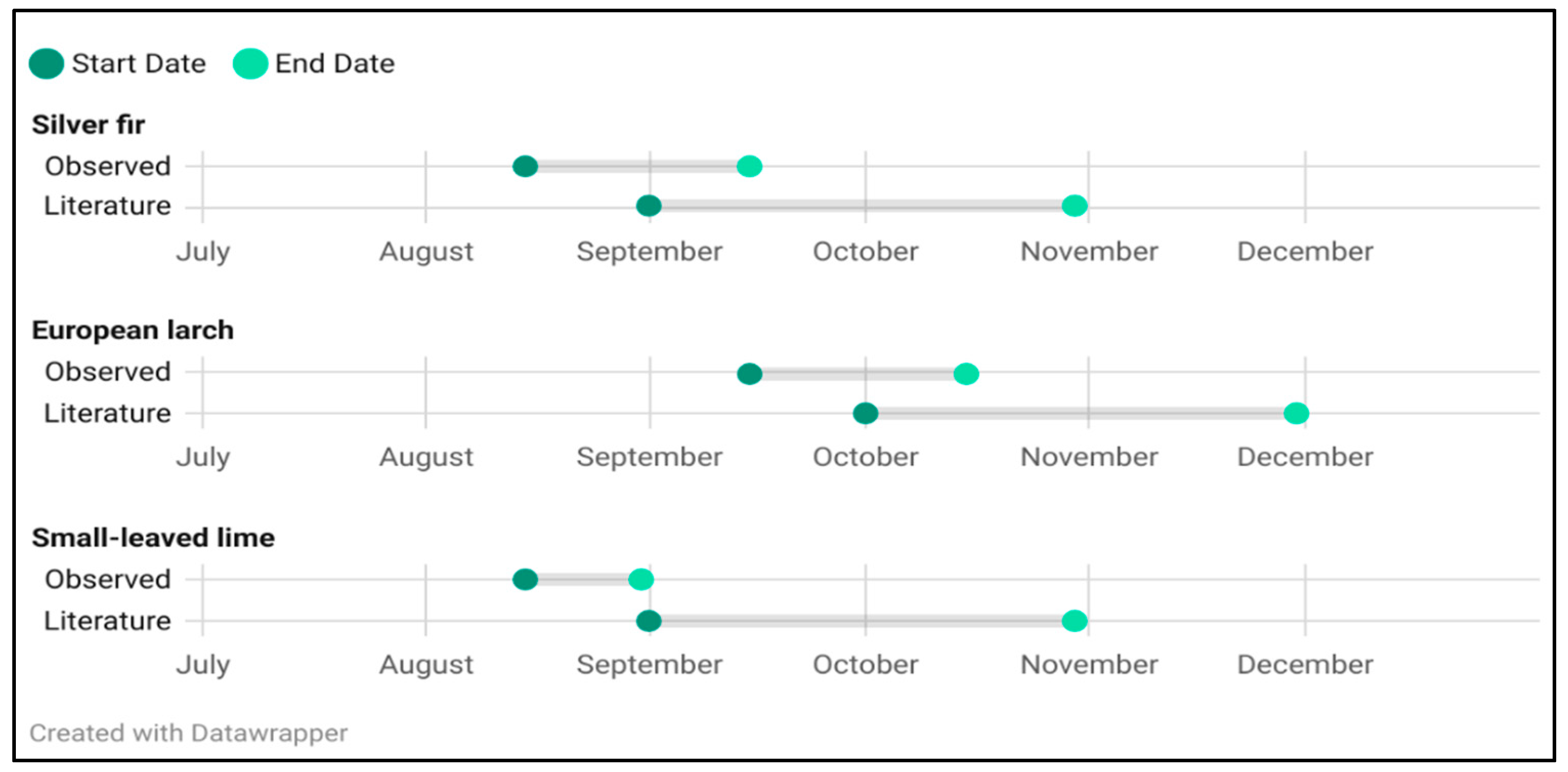
The three studied species showed distinct patterns in seed quality dynamics, assessed through seed viability or germination depending on the species, with differences in the timing of the observed harvest periods compared with those currently recommended in the literature (Table 10). Overall, the results indicate that the observed collection window varied among species, occurring in late August for small-leaved lime, early September in silver fir, and mid-September for European larch within the studied years. For European larch, this period should be interpreted as a practically appropriate and consistent collection window rather than as a statistically superior germination stage.
The results suggest that the collection periods observed in this study occurred earlier than those traditionally reported in the literature. Observed collection dates are based on data obtained in this study (2023–2024), while literature-based intervals were compiled from existing silvicultural and seed management guidelines, which describe general collection periods that may vary depending on climatic conditions [53,54,55]. As shown in Figure 5, the grey bars represent the collection periods reported in the literature and those observed in the present study, while the green points indicate the start and end dates of the collection periods observed in this study. For all three species, the collection periods observed in this study tended to occur earlier than those traditionally recommended in the literature.

4. Discussion

Climate change is already affecting all life stages of forest tree species, including reproductive phenology [56]. Plant phenology is widely recognized as one of the most sensitive biological indicators of climate change [57]. While the advancement of spring phenology under warming conditions is well documented, reproductive phenology remains comparatively less studied [58]. Very few research studies and data collection are available regarding the optimal harvest time to obtain high quality seeds under the changing environmental conditions. The optimal time to harvest is when the highest proportion of viable and germinable seeds can be collected.
To contextualize the observed shifts in seed maturation, climatic conditions during the relevant seed maturation years were evaluated relative to the 10-year means (2013–2024) for each clonal seed orchard (Figure 2). Across all sites, the years considered for seed collection were characterized by higher mean annual temperatures and, in most cases, lower annual precipitation compared with the recent decadal averages.
At Tălișoara (silver fir), the 2023 seed maturation year recorded a mean annual temperature of 9.54 °C, approximately 0.7 °C above the 10-year mean (8.84 °C). Annual precipitation in 2023 (642.4 mm) was slightly lower than the multiannual average of 700.57 mm.
At Ciocâltea (European larch), seed development occurred under warmer-than-average conditions in both 2023 and 2024. Mean annual temperatures reached 11.19 °C in 2023 and increased further to 11.65 °C in 2024, exceeding the 10-year mean of 10.49 °C. Annual precipitation was markedly lower than the long-term average (878 mm) in both years.
Similarly, at Priseaca II (small-leaved lime), the 2023 seed maturation year was characterized by a mean annual temperature of 12.02 °C, exceeding the multiannual mean of 11.34 °C, while annual precipitation (628.5 mm) was moderately reduced compared with the 10-year average (687 mm).
Although these climatic conditions are consistent with recent warming trends reported for Central and Eastern Europe, the analysis is based on a limited number of seed maturation years, which constrains the assessment of interannual variability and extreme climatic events. Nevertheless, the predominance of higher temperatures during the study years could have accelerated seed development and earlier attainment of physiological maturity, providing a plausible climatic context for the observed shifts in seed collection timing.
Based on physiological maturity indicators, this study evaluated to what extent the observed seed collection periods of silver fir, European larch and small-leaved lime correspond to current recommendations. Overall, the results suggest a tendency toward earlier seed maturation for the studied species compared with traditionally recommended intervals, most likely in response to climate change. These observations emphasize the need for further multi-year studies on seed development and indicate that seed collection schedules may need to be re-evaluated under changing climatic conditions.
Ma and Hänninen [59] analyzed long-term phenological records (1980–2013) for six temperate woody species and found a consistent advancement of both flowering and fruiting dates by approximately 4–5 days per decade. Consequently, the fruiting period now occurs roughly 15–17 days earlier than four decades ago. However, the length of the fruit development period exhibited divergent responses among species: it shortened in Aesculus hippocastanum, Prunus cerasus, and Sorbus aucuparia, but slightly lengthened in Ribes grossularia, Sambucus nigra, and Rubus fruticosus.
Experimental warming studies provide further evidence that reproductive development is highly sensitive to temperature. Collins et al. [60] showed that warming advanced both vegetative and reproductive phenophases in tundra plants, with reproductive stages responding more strongly and often exhibiting reduced duration compared with vegetative phases. These findings indicate that warming can asymmetrically alter the timing and length of reproductive processes, leading to species-specific adjustments in fruit or seed maturation.
At a continental scale, Menzel et al. [61] analyzed more than 125,000 phenological records across Europe (1951–2000) and found that spring and summer phases advanced by an average of 2.5 days per decade, with 78% of all phenological events occurring earlier. The strongest shifts were observed in Central and Eastern Europe—regions that have experienced pronounced warming trends. Collectively, these studies demonstrate that the earlier and variably shortened seed maturation periods identified in our study represent part of a broader European pattern of climate-driven advancement in reproductive phenology.
Similar trends have been documented in Mediterranean regions, where climatic warming has been particularly pronounced in recent decades. Peñuelas et al. [62] analyzed more than four decades of phenological data from the Western Mediterranean and observed a clear advancement of flowering and fruiting phases, closely linked to increasing spring temperatures. Their results showed that fruiting occurred progressively earlier over time, although the magnitude of change varied among species, reflecting differential temperature sensitivity. These findings provide regional-scale evidence consistent with our observations, suggesting that earlier seed maturation and variability in the duration of reproductive phases may represent a widespread response of woody species to recent climatic warming across Europe.
The timing of seed collection is closely linked to seed quality, and recent climatic changes present an additional challenge to this process. Rising temperatures have been shown to change plant phenology, with spring events advancing and autumn events being delayed [63]. Such shifts are expected to affect the maturation dynamics of cones and seeds, thereby influencing the harvest window for different forest species.
The year 2023 was a year with good fruiting for the silver fir seed orchard. In our study, seeds collected in early September had slightly higher viability than those harvested in late August. Similar observations were reported in Abies spectabilis by Negi and Sharma [64], who found that the timing of cone collection significantly affected both germination and seedling vigor. These findings indicate that precise harvest timing is critical for securing high-quality reproductive material in fir species, although further multi-year studies are required to confirm the consistency of this trend in silver fir.
Most studies use germination as the main indicator of silver fir seed-lot quality, although this method is time-consuming, and in the case of silver fir, a proportion of the seeds exhibit physiological dormancy that delays the results of the germination analysis [65]. In our study, we demonstrated that tetrazolium analysis could be used to evaluate seed maturity, especially for species that have dormancy. The method allows a quick and accurate assessment of the viable and mature seeds that have the potential to germinate.
In European larch seed orchards across Central and Northern Europe, increased irregularity in fruiting periodicity and declining seed production have been reported in recent years, trends largely attributed to unfavorable weather conditions such as late spring frosts and summer droughts [66,67]. These conditions are considered to negatively affect seed viability and complicate seed management and artificial regeneration. In the present study, reproductive phenology varied among clones and across evaluation periods, suggesting that harvest timing may influence seed quality.
It should be noted that although we carried out the examination of the non-germinated seeds in European larch, no connection with seed dormancy was found; instead, a high proportion of empty seeds was observed, as a result of weak fruiting, probably caused by climate warming.
Seeds of small-leaved lime have both deep physiological dormancy and physical dormancy, which requires a long pre-sowing treatment [68]. For this reason, sown seeds will not germinate at the beginning of the following growing season. Several studies present different methods to overcome dormancy in lime seeds, but there is no study that analyses the relationship between seeds maturity and fruit ripening. In practice, lime seeds are usually collected when they are fully mature, because most studies consider that there is a close relationship between seeds and fruit maturity. According to Vincent 1965 [69] lime fruits must be collected from the last week of August until the end of the first third of September, when brown spots begin to appear on the pericarp. The author noted that at this stage, seeds are immature, but they have semipermeable seed coats and contain a quantity of water that ensures their germination. Schubert 1962 [70] recommended that seeds be collected according to the state of embryo maturity, before germination inhibitors accumulate within the seeds.
Unlike previous studies that assumed seed maturity coincides with fruit ripening, our results suggest that physiological seed maturity precedes visible fruit ripening by approximately one to two weeks. We identified phenotypic markers that can serve as practical indicators of maturity particularly seed testa coloration. A white testa indicates physiological maturity at the pre-ripening stage, whereas a black testa corresponds to fully ripened fruits associated with increased dormancy. Harvesting fruits at the pre-ripening stage may therefore reduce the expression of physiological dormancy and improve seed quality. Delaying harvest beyond August did not improve seed quality; on the contrary, the proportion of dry and non-viable seeds increased.
A limitation of the present study lies in the experimental design. Silver fir and small-leaved lime were evaluated only in 2023, which was a fruiting year for these species during the study period, whereas European larch was evaluated over two consecutive years. For each species, sampling was conducted at only two or three dates per year. Consequently, the temporal pattern of seed maturation could not be fully characterized, and the absolute peak of seed viability or germination could not be determined with certainty. Therefore, the results should be interpreted as changes in harvesting time observed under the studied conditions, likely influenced by recent climatic conditions, rather than as definitive physiological maxima.
Further research should include multi-year and multi-site monitoring combined with climatic data and seed quality assessments to better characterize temporal variability and improve predictive models for seed collection timing.

5. Conclusions

This study provides insights into shifts in seed maturation and collection periods for silver fir (Abies alba), European larch (Larix decidua), and small-leaved lime (Tilia cordata) in recent years in Romania. The results suggest that seed physiological maturity may occur earlier than previously recommended intervals and could be associated with recent regional warming trends. The identification of morphological and physiological indicators of seed maturity may support improved scheduling of cone and seed collection, although further validation is required. A better understanding of seed development dynamics will support ongoing breeding programs for these species in Europe. Continued multi-year monitoring, integrated with climatic data could help refine future seed collection guidelines and support adaptive forest management under changing environmental conditions.

Author Contributions

Conceptualization, G.M., P.G., E.S., A.-M.A.; methodology, G.M., P.G., E.S., A.-M.A.; supervision, G.M., K.H. and H.K.; project administration, G.M., K.H. and H.K.; funding acquisition, G.M., K.H. and H.K.; writing, G.M., P.G., E.S., A.-M.A., K.H. and H.K. All authors have read and agreed to the published version of the manuscript.

Funding

This research was funded by OptFORESTS project from Horizon Europe Programme, grant number 101081774.

Data Availability Statement

The original contributions presented in this study are included in the article. Further inquiries can be directed to the corresponding author(s).

Conflicts of Interest

The authors declare no conflicts of interest.

References

  1. Parfenova, E.I.; Kuzmin, N.A.; Kuzmin, S.R.; Tchebakova, N.M. Climate Warming Impacts on Distributions of Scots Pine (Pinus sylvestris L.) Seed Zones and Seed Mass across Russia in the 21st Century. Forests 2021, 12, 1097. [Google Scholar] [CrossRef]
  2. Saatkamp, A.; Cochrane, A.; Commander, L.; Guja, L.K.; Jimenez-Alfaro, B.; Larson, J.; Nicotra, A.; Poschlod, P.; Silveira, F.A.O.; Cross, A.T.; et al. A Research Agenda for Seed-Trait Functional Ecology. New Phytol. 2019, 221, 1764–1775. [Google Scholar] [CrossRef]
  3. Kurek, K.; Plitta-Michalak, B.; Ratajczak, E. Reactive Oxygen Species as Potential Drivers of the Seed Aging Process. Plants 2019, 8, 174. [Google Scholar] [CrossRef]
  4. Vilcan, A.; Holonec, L.; Taut, I.; Sestras, R.E. Variability of the Traits of Cones and Seeds in Different Larch Clones II. The Energy and Capacity of Germination of Seeds. Bull. UASVM Hortic. 2011, 68, 481–487. [Google Scholar]
  5. Bewley, J.D.; Black, M. Seeds: Physiology of Development and Germination; Springer: Berlin/Heidelberg, Germany, 1986. [Google Scholar]
  6. Tanaka, Y. Assuring Seed Quality for Seedling Production: Cone Collection and Seed Processing, Testing, Storage, and Stratification. In Forestry Nursery Manual: Production of Bareroot Seedlings; Duryea, M.L., Landis, T.D., Perry, C.R., Eds.; Springer: Dordrecht, The Netherlands, 1984; pp. 27–39. [Google Scholar]
  7. Tilki, F.; Alptekin, C.U. Effects of Early Cone Collection and Cone Storage on Germination of Pinus sylvestris L. Silva Balcanica 2004, 4, 57–65. [Google Scholar]
  8. Johansson, H. Groningsmognad och lagringsmognad hos tidigt skördat granfrö (The Maturity of Early Collected Norway Spruce Seeds). Sven. Skogsvårdsföreningens Tidskr. 1954, 56, 213–224. [Google Scholar]
  9. Kardell, L. Investigations on Storage of Pine Cones and Pine Seeds (Pinus silvestris L.) in Northern Sweden; The Swedish National Board of Forestry (Skogsstyrelsen): Jönköping, Sweden, 1973.
  10. Mihai, G. O generație avansată de plantație seminceră pentru brad (An Advanced-Generation Seed Orchard for Silver Fir). An. ICAS 2007, 50, 45–56. [Google Scholar]
  11. Jha, K.; Mckinley, C. Tree Improvement: The Seed Orchard Approach. In ENVIS Forestry Bulletin; ENVIS Forestry Bulletin: Uttarakhand, India, 2006. [Google Scholar]
  12. Gomory, D.; Himanen, K.; Tollefsrud, M.M.; Uggla, C.; Kraigher, H.; Bordács, S.; Bozzano, M. Genetic Aspects in Production and Use of Forest Reproductive Material: Collecting Scientific Evidence to Support the Development of Guidelines and Decision Support Tools; European Forest Institute: Joensuu, Finland, 2021; 216p. [Google Scholar]
  13. Zobel, B.J.; Barber, J.; Brown, C.L.; Perry, T.O. Seed Orchards—Their Concept and Management. J. For. 1958, 56, 815–825. [Google Scholar] [CrossRef]
  14. European Forest Institute. Seed Harvesting, Processing, Storage, and Nursery Practices: How Management Practices Can Affect or Influence Genetic Diversity of Forest Reproductive Materials; Focus on Forest Genetic Diversity, Theme 5; (EUFORGEN); European Forest Institute: Joensuu, Finland, 2023. [Google Scholar]
  15. Singh, K.; Rani, D. Climate Change Impacts on Orchard Management: A Review; Association of Plant Science Researchers (APSR): Dehradun, Uttarakhand, 2023; pp. 1428–1446. [Google Scholar]
  16. Walther, G.-R.; Post, E.; Convey, P.; Menzel, A.; Parmesan, C.; Beebee, T.J.C.; Fromentin, J.-M.; Hoegh-Guldberg, O.; Bairlein, F. Ecological Responses to Recent Climate Change. Nature 2002, 416, 389–395. [Google Scholar] [CrossRef] [PubMed]
  17. Houghton, J.T.; Ding, Y.; Griggs, D.J.; Noguer, M.; Van der Linden, P.J.; Dai, X.; Maskell, K.; Johnson, C.A. (Eds.) Contribution of Working Group I to the Third Assessment Report of the Intergovernmental Panel on Climate Change. In IPCC, 2001: Climate Change 2001: The Scientific Basis; Cambridge University Press: Cambridge, UK; New York, NY, USA, 2001; 881p. [Google Scholar]
  18. Dumitrescu, A.; Bojariu, R.; Barsan, M.-V.; Marin, L.; Manea, A. Recent Climate Change in Romania from Observational Data (1961–2013). Theor. Appl. Climatol. 2015, 122, 111–119. [Google Scholar] [CrossRef]
  19. Ciornei, L.; Udrea, L.; Munteanu, P.; Simion, P.-S.; Petcu, V. The Effects of Climate Change. Trends Regarding the Evolution of Temperature in Romania. Ann. “Valahia” Univ. Targoviste Agric. 2023, 15, 50–57. [Google Scholar] [CrossRef]
  20. Bojariu, R.; Birsan, M.V.; Cica, R.; Velea, L.; Burcea, S.; Dumitrescu, A.; Marin, L. Climate Change–From Physical Basis to Risk and Adaptation; Printech: Bucuresti, Romania, 2015. [Google Scholar]
  21. Menzel, A.; Fabian, P. Growing Season Extended in Europe. Nature 1999, 397, 659. [Google Scholar] [CrossRef]
  22. Myneni, R.B.; Keeling, C.D.; Tucker, C.J.; Asrar, G.; Nemani, R.R. Increased Plant Growth in the Northern High Latitudes from 1981 to 1991. Nature 1997, 386, 698–702. [Google Scholar] [CrossRef]
  23. Reyes-Fox, M.; Steltzer, H.; Trlica, M.J.; McMaster, G.S.; Andales, A.A.; LeCain, D.R.; Morgan, J.A. Elevated CO2 Further Lengthens Growing Season under Warming Conditions. Nature 2014, 510, 259–262. [Google Scholar] [CrossRef] [PubMed]
  24. European Forest Genetic Resources Programme (EUFORGEN). Seed Orchards: Key Considerations in Establishing and Using Clonal and Seed Orchards for Forest Reproductive Materials; EUFORGEN: Rome, Italy, 2024. [Google Scholar]
  25. Li, Y.; Li, X.; Zhao, M.-H.; Pang, Z.-Y.; Wei, J.-T.; Tigabu, M.; Chiang, V.L.; Sederoff, H.; Sederoff, R.; Zhao, X.-Y. An Overview of the Practices and Management Methods for Enhancing Seed Production in Conifer Plantations for Commercial Use. Horticulture 2021, 7, 252. [Google Scholar] [CrossRef]
  26. Pires, R.; Baute, J. Importance of Seed Quality for Forestry Sector. Bol. Tec. Sif 2023, 3, 1–6. [Google Scholar] [CrossRef]
  27. Dinca, L.; Marin, M.; Radu, V.; Murariu, G.; Drasovean, R.; Cretu, R.; Georgescu, L.; Timiș-Gânsac, V. Which Are the Best Site and Stand Conditions for Silver Fir (Abies alba Mill.) Located in the Carpathian Mountains? Diversity 2022, 14, 547. [Google Scholar] [CrossRef]
  28. Mauri, A.; de Rigo, D.; Caudullo, G. Abies alba in Europe: Distribution, Habitat, Usage and Threats. In European Atlas of Forest Tree Species; San-Miguel-Ayanz, J., de Rigo, D., Caudullo, G., Houston Durrant, T., Mauri, A., Eds.; Publications Office of the European Union: Luxembourg, 2013; p. E01493b+. [Google Scholar]
  29. Gheorghe, M.; Olivier, B.; Calotă, I.C.; Nitu, D.M.; Dumitru, M. National Forest Inventory in Romania (Cycle I); Inventarul Forestier National: Voluntari, Romania, 2019. [Google Scholar]
  30. Mihai, G.; Alexandru, A. Silver-Fir-Seeds-Conservation; Editura Silvica: Voluntari, Romania, 2020. [Google Scholar]
  31. Morar, I.M.; Dan, C.; Sestras, R.E.; Stoian-Dod, R.L.; Truta, A.M.; Sestras, A.F.; Sestras, P. Evaluation of Different Geographic Provenances of Silver Fir (Abies alba) as Seed Sources, Based on Seed Traits and Germination. Forests 2023, 14, 2186. [Google Scholar] [CrossRef]
  32. Gogala, N.; Vardjan, M. The Location of the Cause of Dormancy, Viability and Seed Decay in the Silver Fir Abies alba Mill. Acta Biol. Slov. 1989, 37, 33–41. [Google Scholar] [CrossRef]
  33. Bradbeer, J.W. Seed Dormancy and Germination; Springer: Berlin/Heidelberg, Germany, 2013. [Google Scholar]
  34. Parnuta, G.; Budeanu, M.; Stuparu, E.; Scarlatescu, V.; Chesnoiu, E.N.; Tudoroiu, M.; Lorenț, A. Catalogul National al Materialelor de Bază Pentru Producerea Materialelor Forestiere de Reproducere; Editura Silvică: Voluntari, Romania, 2012. [Google Scholar]
  35. Da Ronch, F.; Caudullo, G.; Tinner, W.; de Rigo, D. Larix decidua and Other Larches in Europe: Distribution, Habitat, Usage and Threats. In European Atlas of Forest Tree Species; Publications Office of the European Union: Luxembourg, 2016. [Google Scholar]
  36. Sofletea, N. Dendrologie; Lucian Curtu; Editura Universitatii “Transilvania”: Brașov, România, 2007. [Google Scholar]
  37. Haralamb, A.M. Cultura Speciilor Forestiere; Editura Agro-Silvica: Bucharest, Romania, 1963. [Google Scholar]
  38. Matras, J.; Pâques, L. EUFORGEN Technical Guidelines for Genetic Conservation and Use for European Larch (Larix decidua); Bioversity International: Rome, Italy, 2008. [Google Scholar]
  39. Houšková, K.; Kurjak, D.; Petrik, P. Larix decidua: Best Practices for Producing High Quality Seedlings and Establishing Main European Tree Species. In Guidelines for Climate Adaptive Forest Restoration and Reforestation Projects; Elsevier: Amsterdam, The Netherlands, 2025; p. 481. [Google Scholar]
  40. Chalupa, V. In Vitro Propagation of European Larch (Larix decidua Mill.). J. For. Sci. 2004, 50, 553–558. [Google Scholar] [CrossRef]
  41. Poncet, B.N.; Garat, P.; Manel, S.; Bru, N.; Sachet, J.-M.; Roques, A.; Despres, L. The Effect of Climate on Masting in the European Larch and on Its Specific Seed Predators. Oecologia 2009, 159, 527–537. [Google Scholar] [CrossRef]
  42. Bezecný, P.; Lipovský, I.; Sumara, J.; Sramek, V. Silviculture (In Czech); Zemedelske Nakladatelstvin: Brazda, Czech Republic, 1992; p. 367. [Google Scholar]
  43. Jankowska, A.; Sagan, J.; Potocki, M. The Identification of the Abundance of European Larch Trees in Polish Forests. Forests 2023, 14, 1642. [Google Scholar] [CrossRef]
  44. Enescu, V. Seed Orchards for the Valuable and Fast Growing Forest Tree Species; ICAS Seria II; Institutul de Cercetări și Amenajări Silvice (ICAS): București, România, 1972. [Google Scholar]
  45. Teodosiu, M.; Mihai, G.; Ciocarlan, E.; Curtu, A.L. Genetic Characterisation and Core Collection Construction of European Larch (Larix decidua Mill.) from Seed Orchards in Romania. Forests 2023, 14, 1575. [Google Scholar] [CrossRef]
  46. Svejgaard Jensen, J. EUFORGEN Technical Guidelines for Genetic Conservation and Use for Lime (Tilia spp.); International Plant Genetic Resources Institute: Rome, Italy, 2003; p. 6. [Google Scholar]
  47. Eaton, E.; Caudullo, G.; de Rigo, D. Tilia cordata, Tilia Platyphyllos and Other Limes in Europe: Distribution, Habitat, Usage and Threats. In European Atlas of Forest Tree Species; San-Miguel-Ayanz, J., de Rigo, D., Caudullo, G., Houston Durrant, T., Mauri, A., Eds.; Publications Office of the European Union: Luxembourg, 2016; p. E010ec5+. [Google Scholar]
  48. Radoglou, K.; Dobrowolska, D.; Spyroglou, G.; Valeriu-Norocel, N. A Review on the Ecology and Silviculture of Limes:(Tilia cordata Mill., Tilia platyphyllos Scop, and Tilia tomentosa Moench.) in Europe. Bodenkult. Wien Munch. 2008, 15, 16. [Google Scholar]
  49. Negulescu, E.G.; Săvulescu, A. Dendrologie; Editura Agro-Silvică: București, România, 1965. [Google Scholar]
  50. De Jaegere, T.; Hein, S.; Claessens, H. A Review of the Characteristics of Small-Leaved Lime (Tilia cordata Mill.) and Their Implications for Silviculture in a Changing Climate. Forests 2016, 7, 56. [Google Scholar] [CrossRef]
  51. ISTA. International Rules for Seeds Testing; ISTA: Klosterneuburg, Austria, 2016; Volume 2016. [Google Scholar]
  52. Marchi, M.; Bucci, G.; Iovieno, P.; Ray, D. ClimateDT: A Global Scale-Free Dynamic Downscaling Portal for Historic and Future Climate Data. Environments 2024, 11, 82. [Google Scholar] [CrossRef]
  53. Rubtov, S. Cultura Speciilor Lemnoase in Pepiniera; Editura Agro-Silvica: Bucuresti, Romania, 1961. [Google Scholar]
  54. Enescu, V. Tehnica Culturilor Silvice, Seminte Si Pepiniere; Editura Didactica si Pedagogica: Bucuresti, Romania, 1968. [Google Scholar]
  55. Enescu, V. Seminte de Arbori Si Arbusti; Editura Agro-Silvica de Stat: Bucuresti, Romania, 1956. [Google Scholar]
  56. König, L.A.; Mohren, F.; Schelhaas, M.-J.; Bugmann, H.; Nabuurs, G.-J. Tree Regeneration in Models of Forest Dynamics–Suitability to Assess Climate Change Impacts on European Forests. For. Ecol. Manag. 2022, 520, 120390. [Google Scholar] [CrossRef]
  57. Bandoc, G.; Piticar, A.; Patriche, C.; Roșca, B. Climate Warming-Induced Changes in Plant Phenology in the Most Important Agricultural Region of Romania. Sustainability 2022, 14, 2776. [Google Scholar] [CrossRef]
  58. Sherry, R.A.; Zhou, X.; Gu, S.; Arnone, J.A.; Schimel, D.S.; Verburg, P.S.; Wallace, L.L.; Luo, Y. Divergence of Reproductive Phenology under Climate Warming. Proc. Natl. Acad. Sci. USA 2007, 104, 198–202. [Google Scholar] [CrossRef] [PubMed]
  59. Ma, Q.; Hänninen, H.; Berninger, F.; Li, X.; Huang, J.G. Climate Warming Leads to Advanced Fruit Development Period of Temperate Woody Species but Divergent Changes in Its Length. Glob. Change Biol. 2022, 28, 6021–6032. [Google Scholar] [CrossRef] [PubMed]
  60. Collins, C.G.; Elmendorf, S.C.; Hollister, R.D.; Henry, G.H.R.; Clark, K.; Bjorkman, A.D.; Myers-Smith, I.H.; Prevéy, J.S.; Ashton, I.W.; Assmann, J.J.; et al. Experimental Warming Differentially Affects Vegetative and Reproductive Phenology of Tundra Plants. Nat. Commun. 2021, 12, 3442. [Google Scholar] [CrossRef] [PubMed]
  61. Menzel, A.; Sparks, T.H.; Estrella, N.; Koch, E.; Aasa, A.; Ahas, R.; Alm-Kübler, K.; Bissolli, P.; Braslavská, O.; Briede, A.; et al. European Phenological Response to Climate Change Matches the Warming Pattern. Nature 2006, 437, 659–664. [Google Scholar] [CrossRef]
  62. Peñuelas, J.; Filella, I.; Comas, P. Changed Plant and Animal Life Cycles from 1952 to 2000 in the Mediterranean Region. Glob. Change Biol. 2002, 8, 531–544. [Google Scholar] [CrossRef]
  63. Gordo, O.; Sanz, J. Long Term Temporal Changes of Plant Phenology in the Western Mediterranean. Glob. Change Biol. 2009, 15, 1930–1948. [Google Scholar] [CrossRef]
  64. Negi, P.S.; Sharma, S. Effect of Time of Cone Collection on Seed Germination and Seedling Vigour Index of Abies spectabilis (D. Don) Spach. J. Tree Sci. 2017, 36, 35–39. [Google Scholar] [CrossRef]
  65. Black, M.; Bewley, J.D.; Halmer, P. The Encyclopedia of Seeds: Science, Technology and Uses; Cabi Publishing: Oxfordshire, UK, 2006. [Google Scholar]
  66. Markiewicz, P. Problems with Seed Production of European Larch in Seed Orchards in Poland. In Proceedings of the Seed Orchard Conference; Lindgren, D., Ed.; Swedish University of Agricultural Sciences: Umeå, Sweden, 2007; pp. 161–164. [Google Scholar]
  67. Kowalczyk, J.; Bociek, I. Variability of Cone Crops in the European Larch (Larix decidua Mill.) Seed Orchard in Sekocin Stary. For. Res. Pap. 2024, 84, 39–48. [Google Scholar] [CrossRef]
  68. Suszka, B.; Muller, C.; Bonnet-Masimbert, M. Seeds of Forest Broadleaves from Harvest to Sowing; INRA: Parin, France, 1996. [Google Scholar]
  69. Vincent, G. Forest Seed Management; State Agricultural Publishing House: Praha, Czech Republic, 1965. [Google Scholar]
  70. Schubert, J. Behandlung Und Aussaat von Tilia-Fruchten. Soz. Forstn. 1962, 12, 80–81. [Google Scholar]
Figure 1. The geographic location of clonal seed orchards (triangles) and plus trees (plus symbols) for silver fir (blue), European larch (red), and small-leaved lime (green) across Romania.
Seeds 05 00020 g001
Figure 2. Monthly and annual mean values of climatic conditions in the clonal seed orchards. Bars represent annual mean temperature (°C), and the line represents annual precipitation (mm).
Seeds 05 00020 g002
Figure 3. Silver fir seeds viability by clone at two harvest dates (Talisoara, 2023).
Seeds 05 00020 g003
Figure 4. Small-leaved lime seeds characteristics observed during the study period: (a) white testa, (b) black testa, (c) viable seed, and (d) non-viable seed.
Seeds 05 00020 g004
Figure 5. Comparison between seed collection periods reported in the literature (1956–1968) and the collection dates observed in this study (2023–2024). Grey bars represent the collection periods reported in the literature and those observed in the present study. Green points indicate the start and end dates of the collection periods observed in this study.
Seeds 05 00020 g005
Table 1. Geographic location and details of the clonal seed orchards.
Seed Orchard IDSpeciesNo. of ClonesTotal Area (ha)Lat. NLong. EAltitude(m)Year of
Establishment
Tălișoara/
PS-BR-CV
Silver fir221045°50′25°43′620–6801982
Ciocâltea/
PS-LA-VL84
European larch431045°08′23°51′5501984
Priseaca II/PS-TEP-DB88Small-leaved lime37544°55′25°23′3401986–1988
Table 2. Collection schedule and biological material harvested from the seed orchards of the studied species.
SpeciesCollection YearCollected MaterialCollection DatesInterval Between Collections (Days)
Silver fir2023Cones31 August; 7 September7 days
European larch2023Cones14 September; 28 September14 days
2024Cones17 September; 1 October14 days
Small-leaved lime2023Seeds22 August; 4 September13 days
Table 3. Distribution of seed categories by collection date (Talisoara, 2023).
Collection DateEmpty Seeds
(%)
Viable Seeds (%)Non-Viable
Seeds (%)
Total Seeds
31 August 2023384121900
7 September 2023424711900
Table 4. Analysis of variance for viability in silver fir (Talisoara, 2023).
Source of VarianceVariance (s2)
DFViability
Clone981.27 ***
Evaluation150.41
Clone × Evaluation97.15
Error4014.66
Significance levels: p ≤ 0.001 (***).
Table 5. Germination results of European larch across both years (2023–2024).
YearCollection DateNo. of Seeds TestedGermination (%)Number of Seeds/Cones
202314 September105820.7-
28 September110320.4-
202417 September434319.737.4
1 October392019.628.6
Table 6. Analysis of variance for germination and number of seeds/cones in European larch.
Source of VariationDFVariance (s2)
Germination 2023Germination 2024Number of Seeds/Cones 2024
Clone11132.546175.905 **367.649 **
Evaluation120.8570.344592.233 *
Clone x evaluation1198.57146.836143.070
Error24143.65938.968106.463
Significance levels: p ≤ 0.05 (*), p ≤ 0.01 (**).
Table 7. Analysis of variance for germination in European larch across years.
Source of VariationDFVariance (s2)
Germination
Year11.375
Clone11181.740
Evaluation139.840
Year x Clone11189.905 ***
Year x Evaluation110.048
Clone x Evaluation11106.550 *
Significance levels: p ≤ 0.05 (*) and p ≤ 0.001 (***).
Table 8. Results of the tetrazolium test for small-leaved lime seeds at three collecting dates in 2023.
Collecting DateTotal Number of SeedsWhite-Testa Seeds (%)Black-Testa Seeds (%)Empty (%)Viable (%)Non-Viable (%)
22 August 20233202611632611
28 August 2023320137621226
4 September 202332003169724
Table 9. Analysis of variance (ANOVA) for the proportion of white-testa, brown-testa, empty, viable, and non-viable seeds, showing the effects of clone, evaluation, and their interaction.
Source of VariationDFVariance (s2)
Black TestaWhite TestaEmpty SeedsViable SeedsNon-Viable Seeds
Clone4116.495 **4.300159.182 **41.79945.259 *
Evaluation2112.993 *117.636 **4.42739.98423.993
Clone x Evaluation840.0362.85235.80716.42933.342 *
Error3323.82312.30835.03816.32614.732
Significance levels: p ≤ 0.05 (*), p ≤ 0.01 (**).
Table 10. Comparative seed performance of silver fir, European larch, and small-leaved lime.
SpeciesYearCollection Date (s)Viability/Germination (%)Main Trend
Silver fir202331 August/7 September41 → 47 (viability)Viability increased slightly from late Aug. to early Sep.
European larch202314 September/28 September20.7 → 20.4 (germination)Stable, low germination regardless of date
202417 September/1 October 19.7 → 19.6 (germination)Slight decrease in later harvest
Small-leaved lime202322 August/28 August/4 September23 → 12 → 7 (viability)Sharp decline in viability after late Aug.
Disclaimer/Publisher’s Note: The statements, opinions and data contained in all publications are solely those of the individual author(s) and contributor(s) and not of MDPI and/or the editor(s). MDPI and/or the editor(s) disclaim responsibility for any injury to people or property resulting from any ideas, methods, instructions or products referred to in the content.