Communication

Human-Mediated Dispersal of Plantago asiatica Mucilaginous Seeds in Urban Environments

Faculty of Education, Hokkaido University of Education, Asahikawa Campus, Hokumoncho-9-chome, Asahikawa 070-8621, Hokkaido, Japan
*
Author to whom correspondence should be addressed.
These authors contributed equally to this work.
Seeds 2026, 5(2), 17; https://doi.org/10.3390/seeds5020017
Submission received: 27 March 2025 / Revised: 23 February 2026 / Accepted: 2 March 2026 / Published: 4 March 2026

Abstract

Seed dispersal by humans plays an important role in determining vegetation structure. The seeds of Asian plantain (Plantago asiatica L.) form adhesive mucilage upon hydration, facilitating their attachment to shoes and subsequent dispersal via epizoochory. We investigated the efficacy of this mechanism under various urban environmental conditions. After trampling wild P. asiatica stands, the number of seeds attached to shoe soles was counted. The remaining seeds were then counted after walking at designated distances (1, 2, 5, 10, 20, 50, 100, 200, 500, and 1000 m). The following results were obtained: (1) The retention rate after walking 1000 m varied by shoe type (slip-on (kakkusu) work shoes, 15.4%; leather shoes, 3.4%; rubber boots, 2.7%; running shoes, 13.5%; and sandals, 12.4%). (2) Within the first 50 m of walking, on average more than half of the attached seeds fell off under all investigated conditions. Significantly fewer seeds remained after walking 50 m on asphalt (30.9% of the initial seeds) than on grass (48.2%), whereas after walking 1000 m, similar proportions (15.4% on asphalt and 15.7% on grass) remained on the work shoes. These results indicate that human-mediated short- and long-distance dispersal of mucilaginous seeds of this species is effective in diverse urban environments.

1. Introduction

Human-mediated dispersal [1], also called anthropochory [2], has two important consequences. First, it determines the distribution and abundance of plants in many regions worldwide [3,4], including urban areas [5], protected areas [6], and arid regions [7]. Second, unexpected introduction of seeds by humans is a major concern in protected areas [2,4,8]. Human-mediated dispersal can be classified into human-vectored and human-altered dispersal [3,4]. Human-vectored dispersal refers to the direct transfer of diaspores (i.e., units of dispersal) by humans or by human-driven objects, such as vehicles [9,10,11], cargo [12], and livestock [13]. Human-altered dispersal refers to the indirect effects of humans on natural dispersal [3,4]. Given these key roles, human-mediated dispersal has recently become a major research topic [2,4].
Dispersal by animals (including humans) can be classified into three categories [14]: endozoochory (i.e., dispersal after eating [15,16]), synzoochory (i.e., dispersal associated with seed caching or storage [17,18]), and epizoochory (i.e., dispersal by attachment to body surfaces [19,20]). Compared with the first two categories, however, epizoochory has been less studied [21,22], even though it plays important roles in both short- and long-distance dispersal [13,23]. Epizoochory is achieved via a variety of mechanisms, including attachment with hooks, hair, or adhesive substances [20,24]. In some species, the diaspores produce polysaccharide mucilage, a phenomenon known as myxodiaspory (for diaspores) [19], myxocarpy (for fruits) [25], or myxospermy (for seeds) [25,26]. Some of these mucilages become adhesive after wetting [27,28] and have been hypothesized to act as glue, assisting in seed dispersal during epizoochory. However, although this hypothesis has long been recognized (e.g., Ref. [29]), quantitative evidence remains limited [30].
Several species in the genus Plantago produce polysaccharide seed mucilage (e.g., P. afra [31], Asian plantain (P. asiatica) [23,32], P. indica (syn. P. psyllium) [31], P. major [33,34], and P. ovata [35,36,37]), which is primarily composed of hemicelluloses [31]. Recently, our previous study (Abe et al. [23]) provided quantitative experimental evidence that the seed mucilage of Asian plantain (P. asiatica) facilitates seed dispersal during epizoochory by acting as glue to promote attachment to shoes. Subsequently, Dosil Hiriart et al. [19,21], using both living and taxidermied birds, experimentally showed that the fruit mucilage produced by the herb Adenostemma brasilianum effectively facilitates attachment to feathers using both living and taxidermied birds. Furthermore, studies by Sato et al. [20,38] and Mohammed et al. [39,40], using taxidermied animals and sheep fleece, respectively, also provided empirical evidence that the seeds of several species that produce adhesive substances can effectively attach to the animal surfaces. Despite these recent advances, however, except for the field walking experiment by Abe et al. [23], the efficacy of seed mucilage in epizoochory has been tested primarily in controlled environmental conditions. Furthermore, the experiment by Abe et al. [23] was performed only in limited field conditions (i.e., one type of road (sandy soil) using only one type of shoe). To test the general validity of the efficacy of seed mucilage in human-vectored dispersal, it is necessary to conduct experiments under conditions that realistically reflect urban environments. To fill this knowledge gap, the present study aimed to assess the general effectiveness of seed-produced mucilage in human dispersal, focusing on the attachment of seeds to shoes. We hypothesized that seeds of P. asiatica can be effectively dispersed by humans in diverse urban environments.

2. Materials and Methods

2.1. Study Species

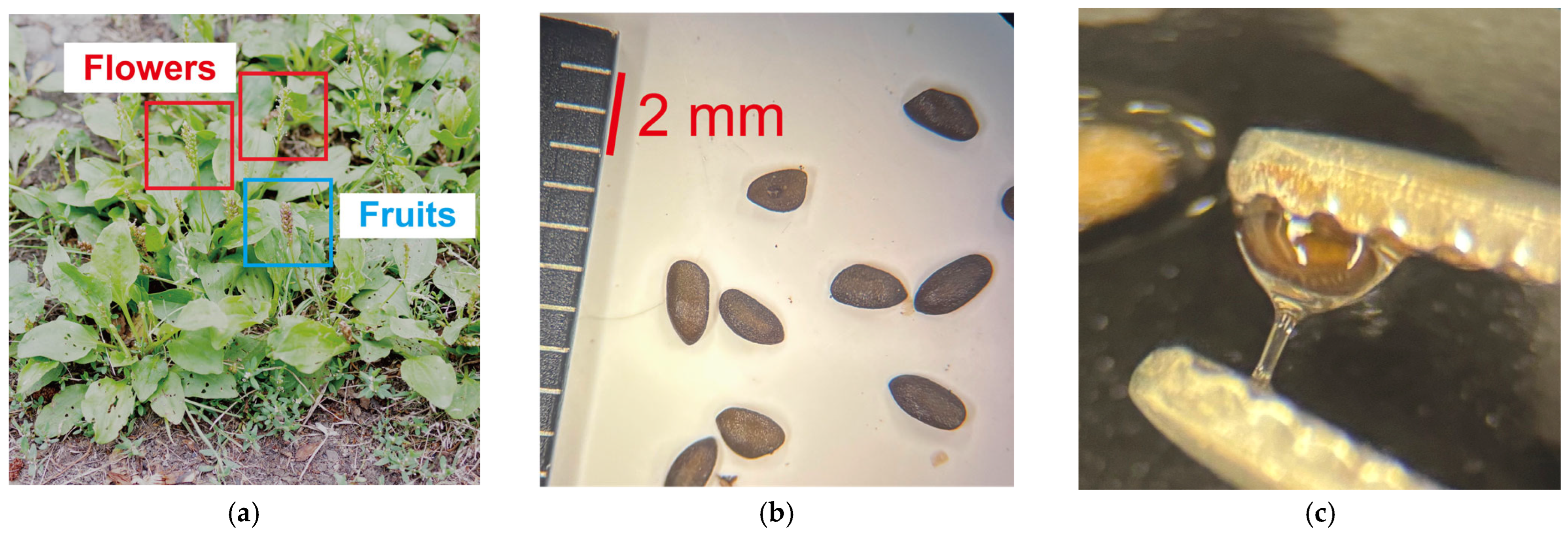
Asian plantain (Plantago asiatica L.) (Plantaginaceae) is a rosette-forming perennial herb (Figure 1a) native to East Asia, including Japan [41], Korea [42], China [43], Eastern Siberia [44], and the Russian Far East [44]. From summer to early autumn, its inflorescences and infructescences extend above the rosette (Figure 1a), producing dehiscent fruits (pyxides) (see Ref. [23] for a photograph of the fruits). Its seeds produce sticky mucilage upon hydration (Figure 1c). In Japan, this species is a common weed growing in open or partially shaded habitats, such as roadsides. Although it is also used in traditional medicine [43,44,45,46], its potential to invade high-altitude protected areas has recently become a concern [47,48].

2.2. Study Site and Plant Materials

The experiments were conducted from 29 August to 21 September 2024, at the Asahikawa Campus of the Hokkaido University of Education (43°47′ N, 142°21′ E, 107 m a.s.l.), located in an urban area of Asahikawa City in Hokkaido, which is in a cool temperate region of Japan. The site is within 4 km of the Asahikawa Local Meteorological Observatory. The mean annual temperature and precipitation during 2005–2024 at the observatory were 7.54 °C and 1119 mm, respectively (weather data were obtained from the Japan Meteorological Agency, retrieved on 2 February 2026). On the campus, P. asiatica naturally grows along roadsides, including both sunlit and partially shaded habitats. For the following experiments, we haphazardly chose P. asiatica stands that had a sufficient number of mature fruits at the time of the experiment.

2.3. Walking Experiments

In the following two experiments (Section 2.4 and Section 2.5), we performed trampling and 1000 m walking trials, following the procedure described by Abe et al. [23] with some modifications. Each trial consisted of five steps: (1) a participant selected one P. asiatica stand section. Before trampling, the stand, including its fruits and seeds, was hydrated using tap water from a watering can. (2) Wearing shoes, the participant trampled the stand 20 times. Each section was used only once during the experiment by marking the tramped section. (3) The participant carefully removed their shoes to avoid seed loss, placed them on a plastic tray, and carried them to the walking experiment’s starting point. (4) At the starting point (i.e., the 0 m point), the participant counted the number of seeds attached to the shoes. If none were found (i.e., only four cases among all 120 trials), the trial was stopped with the initial seed number recorded as zero. (5) The participant put the shoes back on, started walking at a constant normal speed, and stopped at designated distances (1, 2, 5, 10, 20, 50, 100, 200, 500, and 1000 m from the starting point) to count the seeds attached to the shoes while sitting on a portable chair. The walking lanes were 50 m in length, requiring round trips for distances greater than 50 m. The trial concluded at 1000 m. The differences from the study by Abe et al. [23] were as follows: (1) we used different study locations (cities); (2) we used different participants, leading to variation in shoe length [26.0 cm (present study), vs. 24.5 cm (Abe et al. [23])]; (3) we artificially hydrated the stands in the current study, whereas Abe et al. relied solely on natural rainfall.

2.4. Shoe Comparison Experiment

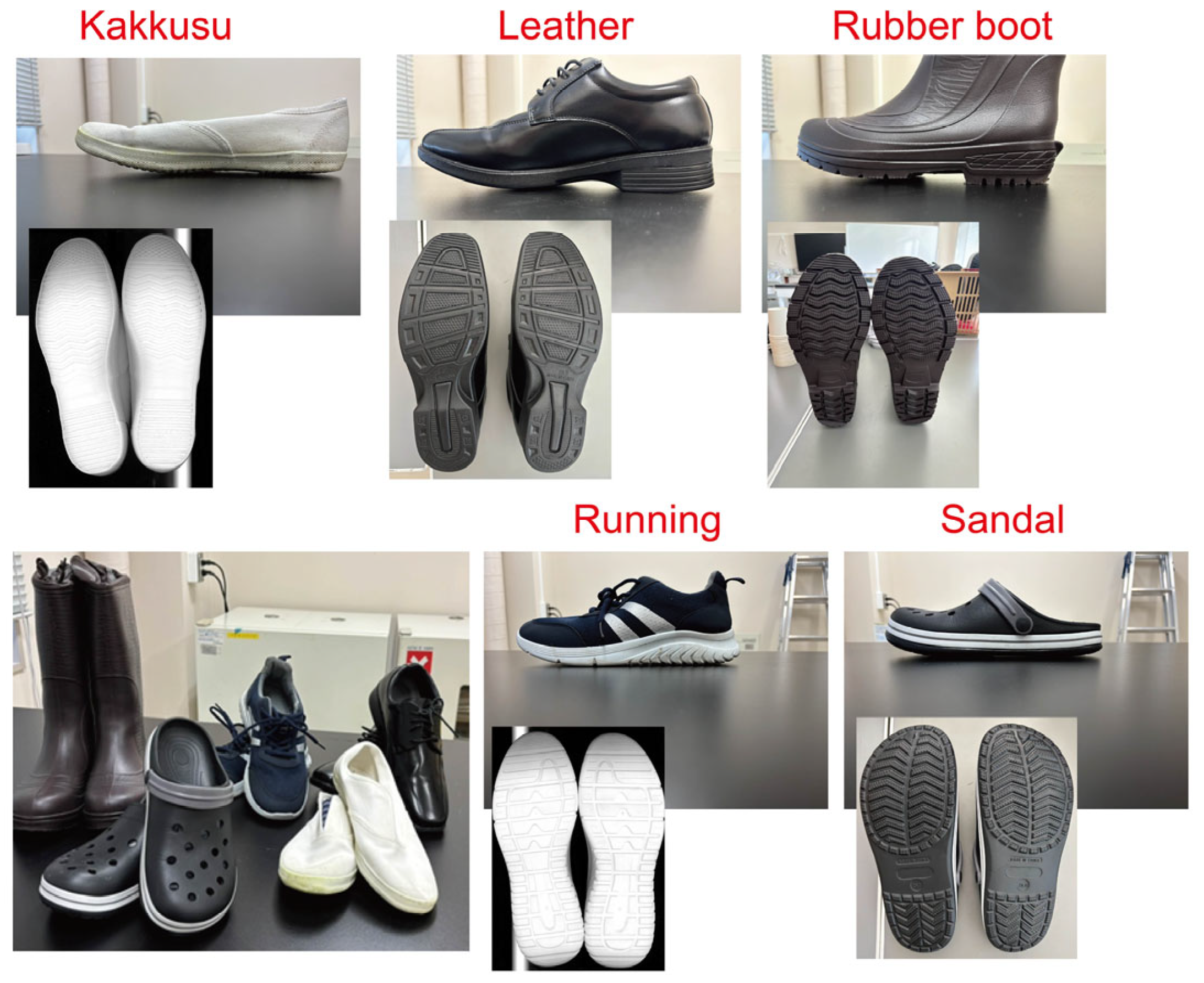
In the first experiment, we compared five shoe types (Figure 2). Each shoe type was tested over 20 walking trials. Although the shoes varied in design, all had synthetic rubber soles with different tread patterns. For consistency, only an asphalt road (see Section 2.5 below) was used for all trials.

2.5. Road Comparison Experiment

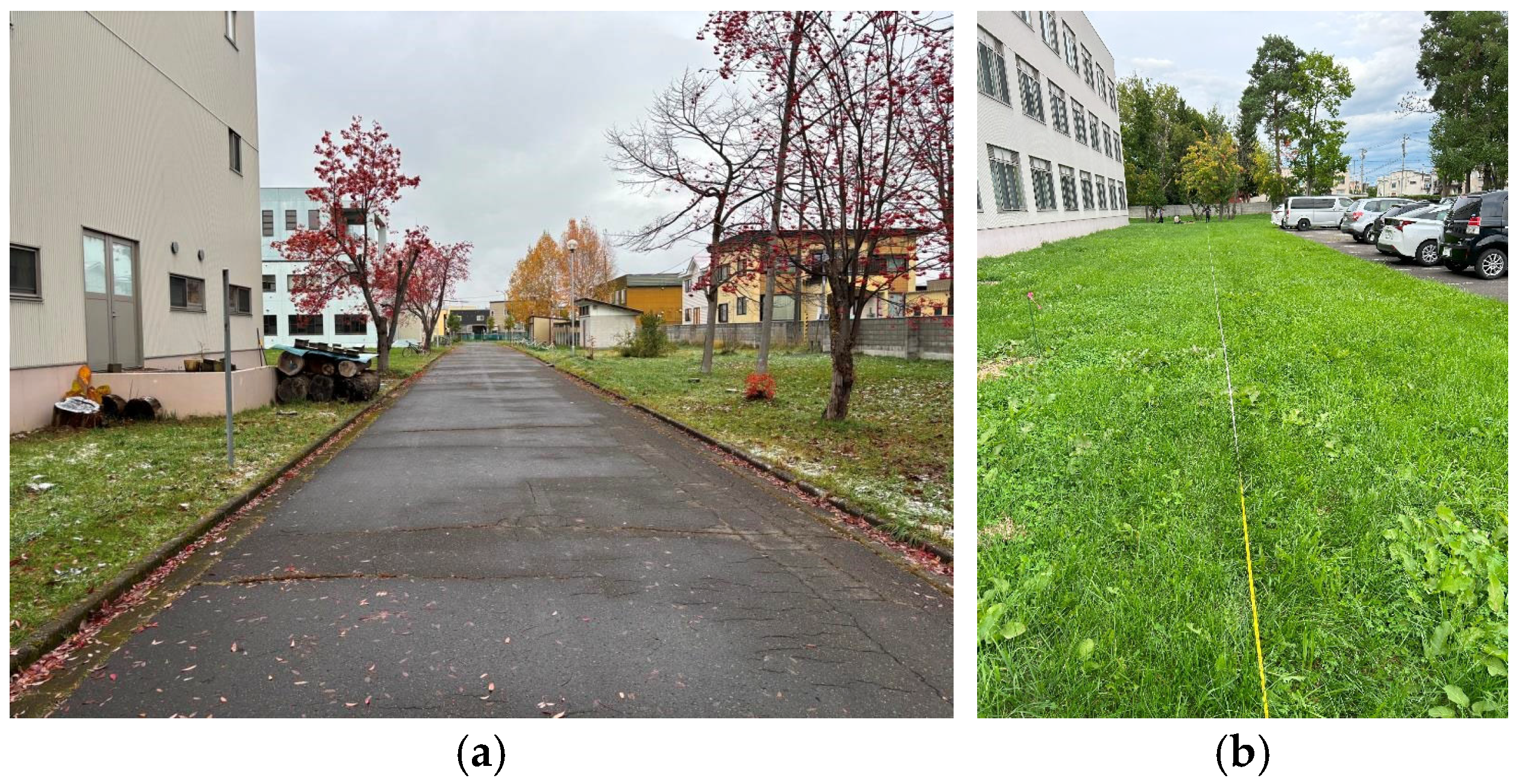
In the second experiment, we assessed dispersal effectiveness on different road surfaces. We selected two walking lanes (grass vs. asphalt) on the university campus (Figure 3). For consistency, only one type of shoe (“kakkusu” work shoes; see Figure 2) was used in this experiment. The grass lane was covered with machine-trimmed grasses (Poaceae spp.) with occasional eudicots (e.g., Taraxacum officinale, Rumex obtusifolius, and Plantago lanceolata) and was selected to exclude areas where P. asiatica grew. Each lane underwent 20 walking trials. The above two experiments (Section 2.4 and Section 2.5) were performed only when the surface of the asphalt road was dry. We did not control other factors (e.g., temperature, weather, and wind speed); these uncontrolled factors were treated as random effects in the subsequent GLMMs.

2.6. Data Analysis

A total of 120 trials were performed, consisting of 100 trials on the asphalt road using the five shoe types (20 trials per type) and 20 trials on the grass lane using only the kakkusu shoes. Data from the 20 trials using the kakkusu shoes on the asphalt road were used in both the shoe and road comparison analyses. Consequently, both the shoe-type and road-type analyses were performed using a consistent sample size of 20 trials per group (e.g., grass vs. asphalt, with the five shoe types).
Data were analyzed with R ver. 4.5.2 [49] using the cowplot [50], ggbeeswarm [51], ggplot2 [52], and lme4 [53] packages. First, we constructed generalized linear mixed models (GLMMs) with the function glmer (family = poisson (link = “log”)) to compare seed attachment across shoe types after the trampling (but before walking), with shoe type as the fixed effect. The Poisson distribution was used to predict the positive and discrete dependent variables [54] (i.e., the number of seeds attached to shoe soles after the trampling). Second, we tested whether shoe type or road surface influenced seed retention on the shoes. The fraction of seeds remaining on shoe soles at each distance was calculated as the total number of seeds remaining at a given distance (1 m to 1000 m) divided by the total number of seeds initially attached after the trampling (i.e., at 0 m), with both values summed across all 20 trials (n = 20 per road/shoe type). The retention rates after walking 50 m and 1000 m, which can be considered as indicators of short- and long-distance dispersal, were compared using the logistic regression GLMMs with the function glmer (family = binomial (link = “logit”)) with shoe type or road surface as the fixed effect. We used the binomial distribution to predict binary outcomes (i.e., remaining or falling off) [54]. In all GLMMs, both participant variation and the experiment date were included as random intercepts.

3. Results

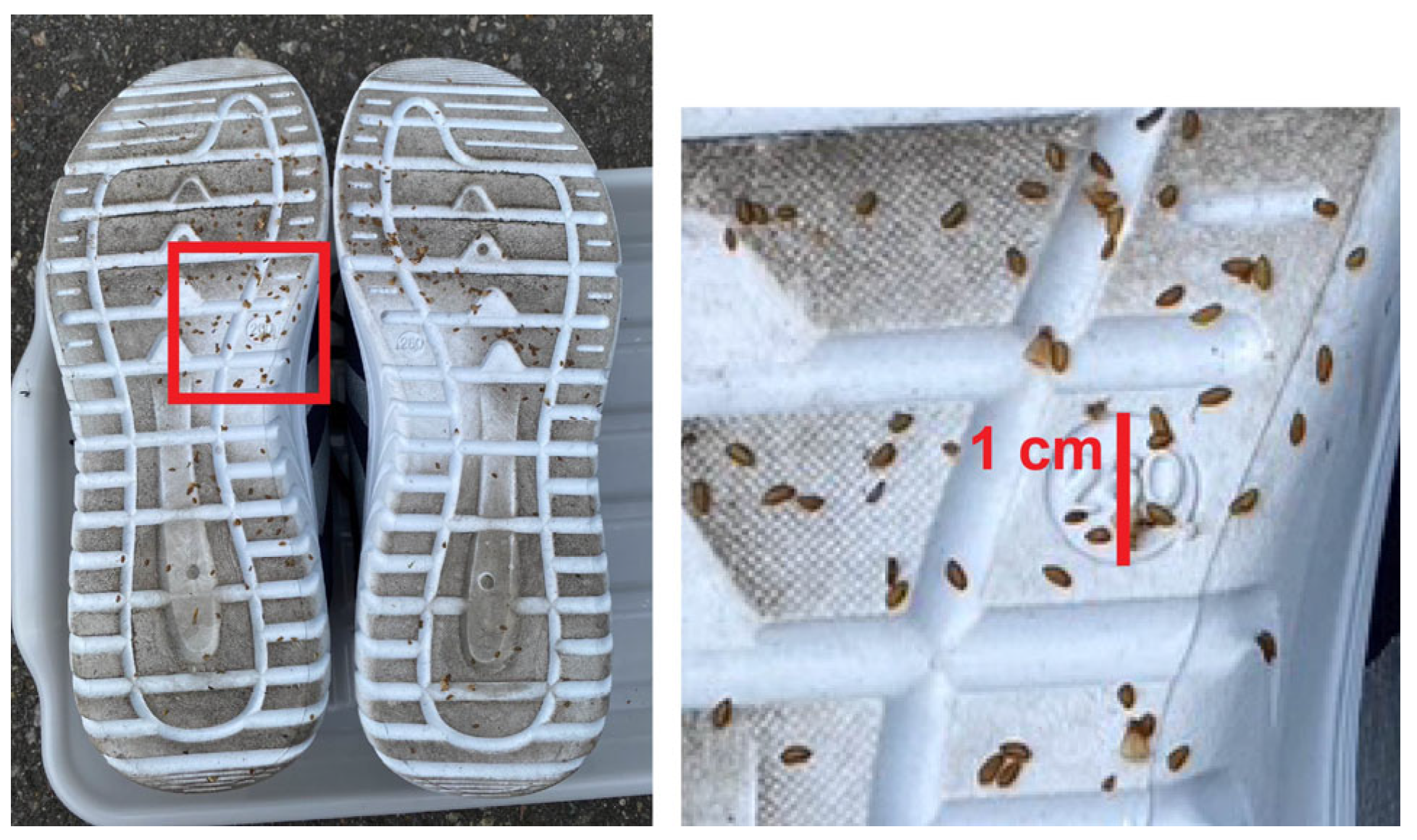
A total of 8180 seeds were attached to the shoe soles across 120 trials. In all experiments, seeds attached to the shoes remained intact (i.e., not crushed) after walking (Figure 4).

3.1. Shoe Type Comparison

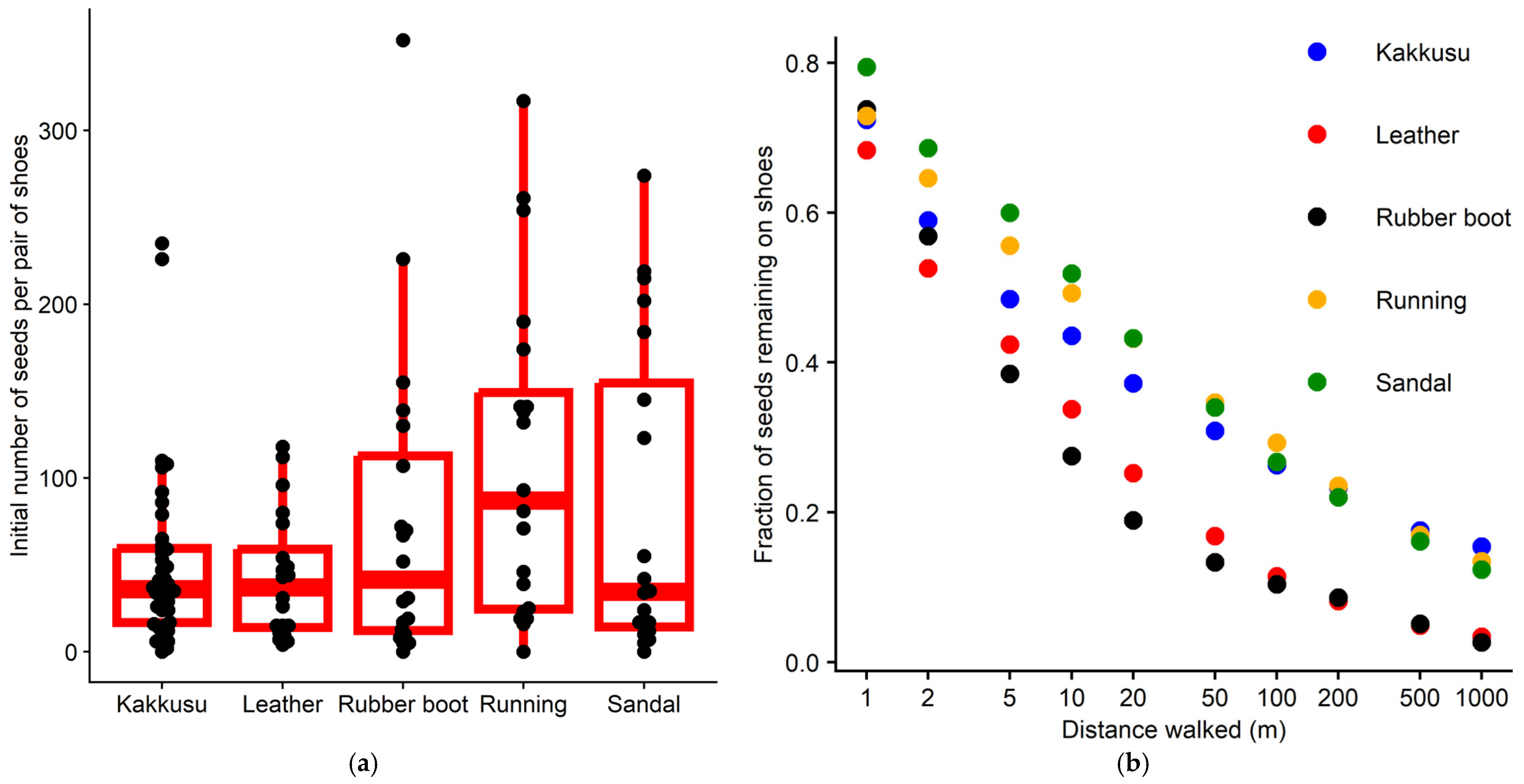
After the trampling but before the walking experiments, the number of seeds adhered to the leather shoes (median: 37; mean: 42.8 seeds per pair) was similar to that of the kakkusu work shoes (median: 36; mean: 50.1), with no significant difference in the mean (p = 0.068). In contrast, significantly more seeds attached to all other shoe types than to the kakkusu work shoes (p < 0.01) (Figure 5; median: rubber boots, 41.5; running shoes, 87; sandals, 34.5; mean: rubber boots, 75.4; running shoes, 109; sandals, 81.8).
Seed retention rates after walking 50 m on the asphalt road differed among the shoe types (Figure 5b; kakkusu work shoes, 30.9%; leather shoes, 16.8%; rubber boots, 13.3%; running shoes, 34.6%; and sandals, 34.0%). The leather shoes and rubber boots retained significantly fewer seeds than the other types (p < 0.01), while the differences among the remaining shoe types (kakkusu shoes, running shoes, and sandals) were not significant (p > 0.397).
Seed retention rates after walking 1000 m showed a similar pattern (kakkusu work shoes, 15.4%; leather shoes, 3.4%; rubber boots, 2.7%; running shoes, 13.5%; and sandals, 12.4%). The leather shoes and rubber boots were significantly less effective at retaining seeds for long-distance dispersal than the other types (p < 0.01), whereas the differences among the remaining shoe types (kakkusu shoes, running shoes, and sandals) were not significant (p > 0.368).

3.2. Road Type Comparison

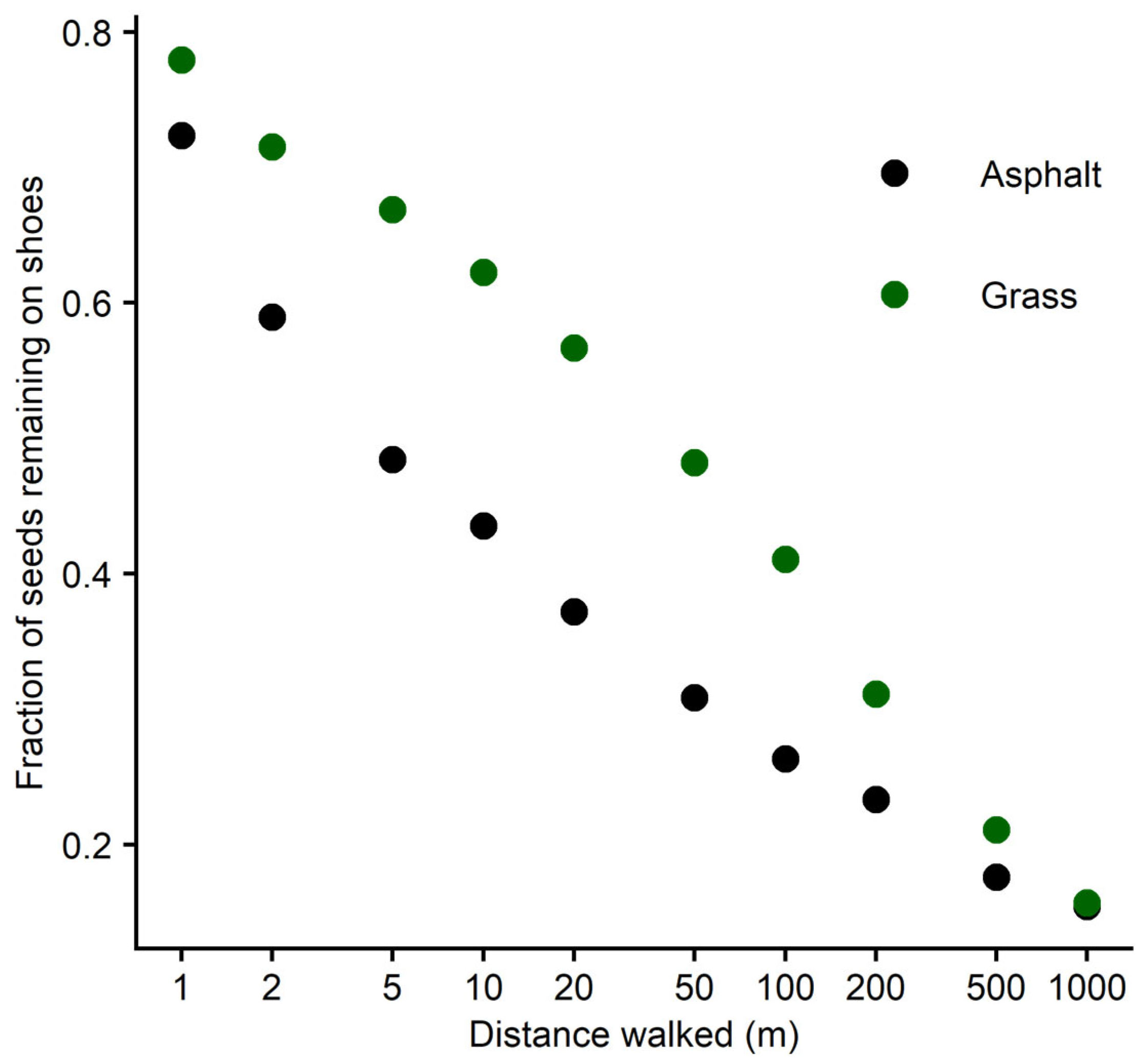
Total numbers of 836 and 1166 seeds were attached to the kakkusu work shoes after the trampling and were used for the subsequent asphalt and grass experiments, respectively. After walking 50 m, 30.9% (asphalt) 48.2% (grass) of seeds remained on the shoes, with a significant difference (p < 0.01). After walking 1000 m, similar fractions of seeds, 15.4% (asphalt) and 15.7% (grass), remained on the shoes (Figure 6).

4. Discussion

Short- and long-distance dispersal are central topics in seed ecology. Although there is no consensus on their definitions [55], researchers agree that both are important for the recruitment of plants. In the present study, we set 1 km as an arbitrary threshold for long-distance dispersal. We found that after walking for 1 km, 15.4% (asphalt) and 15.7% (grass) of the initially attached seeds remained on the kakkusu work shoes (Figure 6). These values are comparable to the 20.8% retention rate for the same work shoes reported by Abe et al. [23] after a 1 km walk on a sandy sports ground after natural rainfall events. In the shoe comparison experiment, all tested shoes carried seeds for more than 1 km, though the retention rates varied among shoe types (2.7–15.4%). These results indicate that seeds of P. asiatica can be dispersed via human-mediated epizoochory in urban environments, and the efficacy depends on conditions such as road surfaces and shoe types. Furthermore, it should be noted that seeds attached to shoes can be carried beyond 1 km via vehicles after walking for certain distances to parking lots or bus stops, as previously suggested [1,23].
The epizoochory of seeds on clothing is a result of interactions between seeds and their environments [6], which in the present study consisted of both shoes and road surfaces. Both the total number of initially attached seeds and the fraction of seeds remaining on the shoes after the 1 km walk differed among the shoe types (2.7–15.4%, Figure 5b). These observed differences among the shoes may be attributed to (1) shoe sole materials and (2) shoe sole morphology, such as tread patterns and depth. Similarly, Mount and Pickering [6] reported that the species composition of seeds attached to socks varies among sock types, though they did not investigate the dispersal. Although the soles of all types of shoes used in the experiments were made of synthetic rubbers, the hardness of the materials varied. Some had soft soles (kakkusu work shoes, sandals, and running shoes), while others had hard soles (rubber boots and leather shoes). Consistently with the results of the road comparison experiment (hard asphalt vs. soft grass, Figure 6), more seeds remained on soft surfaces than on hard surfaces after walking (Figure 5b). However, since we haphazardly chose shoes based on availability and cost, we do not have detailed information on the shoe sole materials. Additionally, we did not measure the physical properties of the shoe soles. Therefore, future studies are needed to test the effects of the physical and morphological properties of shoe soles. This information will be useful in improving the design of mountaineering shoes to minimize their impact on natural vegetation.
The other component of the seed environment is the road surface. Urban environments are characterized by a mosaic of human-created road surfaces, such as asphalt and grass. More seeds were dropped within the first 50 m of walking on the asphalt road than on the grass (Figure 6). This may have been due to the difference in the hardness of the road materials. Seeds on the soles of the shoes may have been scraped off more forcefully on the hard asphalt than on the soft grass, resulting in a lower fraction of seeds remaining on the shoes during walking. However, because we did not measure the physical properties of the roads, further studies are needed to test the effects of the physical and morphological properties of roads, which may play a significant role in determining urban vegetation and in weed management in protected areas.
Overall, these results indicate that seeds of P. asiatica can be effectively dispersed by humans in various environments. In most previous studies on human-vectored dispersal (i.e., direct dispersal by humans or vehicles), investigators only recorded the number of seeds on clothing or vehicles, without reporting quantitative dispersal distances. Hence, quantitative assessment of dispersal distance remains very limited. As an exceptional case, Wichmann et al. [1] reported dispersal distances of Brassica spp. seeds, which do not have apparent sticky mucilage (James Bullock, personal communication). They reported that most of the Brassica seeds attached to the shoes dropped off within the first 5 m of walking, while some seeds were retained after 5 km. Although their results cannot be compared directly to our findings because we stopped walking at 1 km, we observed a similar pattern: a considerable fraction of seeds (33.1–61.5%) dropped off within the first 5 m, and over 50% were lost within the first 50 m, while a small but non-negligible fraction of seeds (2.7–15.7%) remained on the shoes after the 1 km walks (Figure 5b and Figure 6).
Unintended seed flow into protected areas caused by humans is a major concern [3,4]. Although P. asiatica is used as a traditional medicinal plant [45,46], it is also a common weed in Japan, especially in urban areas. Recently, its potential invasiveness has become a serious concern in high-altitude protected areas [47,48]. To prevent unintended seed flow, doormats and shoe-washing stations have been implemented. The present results, together with those reported in our previous study [23], can be applied to enhance these prevention techniques. Mount and Pickering [6] experimentally demonstrated that seeds can also attach to clothing surfaces other than shoe soles (i.e., shoe sides, socks, or trousers). In the present study, the participants deliberately stepped on the P. asiatica stands, resulting in seed attachment mainly to the soles of the shoes (but not to other parts of the clothing). Hence, only shoe soles were investigated. This differs from natural walking through stands, in which seeds can stick to clothing anywhere. Additionally, although the importance of vehicles (such as cars) in seed dispersal has long been recognized [56,57], they were not investigated in the present study. Although these alternative mechanisms of seed dispersal are not mutually exclusive to the present results on shoes, further inclusive studies are needed to test them. Furthermore, we used artificial watering with a watering can, which differs from the natural rainfall described in Abe et al. [23]. Given these limitations, future studies should include tests using natural trampling and rainfall conditions.
Seed mucilage has versatile functions, other than in epizoochory (see recent reviews by Kreitschitz and Gorb [30], Levengood et al. [58], Tsai et al. [59], and Yang et al. [60]). These include absorbing and/or retaining water [61,62,63,64,65] and anchoring seeds to the soil (i.e., antitelechory) [66,67]. Some mucilages protect seeds from predators [68,69,70,71,72] or pathogens [73] and protect seeds inside the digestive tracts of animals for subsequent endozoochory [74,75]. Importantly, some of these studies on these alternative functions were conducted on congeners of the present study species Plantago asiatica L., such as P. albicans L. [64], P. arborescens Poir. [75], P. coronopus L. [64], P. lagopus L. [64], P. lanceolata L. [64,73,74,76], sea plantain (P. maritima L.) [66], P. minuta Pall. [63], blond plantain (P. ovata Forssk.) [66,72,74,76], and psyllium (P. psyllium) [74,76]. In the present study, we focused solely on adhesion during epizoochory in P. asiatica. Nevertheless, we emphasize that these alternative mechanisms are not mutually exclusive with epizoochory. Therefore, the mucilage of P. asiatica seeds may have multiple functions, and further studies are needed to test relative contributions of these alternative functions in each ecosystem. Furthermore, although epizoochory occurs through various mechanisms (e.g., attachment via hairs or spines [38]), we only tested one species with sticky mucilage. Given these important limitations, further studies are needed before generalizing the present findings.

5. Conclusions

Mucilaginous P. asiatica seeds attached to shoes can disperse over 1 km (i.e., long-distance dispersal) on both asphalt and grass roads and via various shoe types. This information is valuable for understanding and managing urban vegetation and preventing the unintended introduction of seeds.

Supplementary Materials

The following supporting information can be downloaded at https://www.mdpi.com/article/10.3390/seeds5020017/s1. All dataset (CSV file) used in the present analysis.

Author Contributions

Conceptualization, methodology, investigation, analyses, and writing S.I., K.K. and Y.K.; supervision, K.K. All authors have read and agreed to the published version of the manuscript.

Funding

This research was funded by the JSPS KAKENHI Grant Number 23K05931.

Institutional Review Board Statement

Not applicable.

Informed Consent Statement

Not applicable.

Data Availability Statement

All dataset are included in the Supplementary Materials. Further inquiries can be directed to the corresponding author.

Acknowledgments

We thank Kakeru Akimoto, Yukiya Endo, Syoma Ootsu, Naoki Kawamura, Daishi Kurosaki, Ukyo Saito, Ryuki Sasaki, Kaito Sugikawa, Sotaro Takahira, Momoka Takeuchi, Haruki Fujihara, Sota Matsuda, Yuine Oosaka, Haruna Iizuka, Taku Yoshimura, and Kento Mikura for participating the walking experiments.

Conflicts of Interest

The authors declare no conflicts of interest.

References

  1. Wichmann, M.C.; Alexander, M.J.; Soons, M.B.; Galsworthy, S.; Dunne, L.; Gould, R.; Fairfax, C.; Niggemann, M.; Hails, R.S.; Bullock, J.M. Human-mediated dispersal of seeds over long distances. Proc. R. Soc. B Biol. Sci. 2009, 276, 523–532. [Google Scholar] [CrossRef] [PubMed]
  2. Krigas, N.; Dijon, C.; Samartza, I.; Avtzis, D.N.; Anestis, I.; Pipinis, E.; Gudžinskas, Z. Forewarned Is Forearmed: Documentation on the Invasion Risk of Asclepias speciosa in Greece and Europe. Agriculture 2025, 15, 324. [Google Scholar] [CrossRef]
  3. Bullock, J.M.; Bonte, D.; Pufal, G.; da Silva Carvalho, C.; Chapman, D.S.; García, C.; García, D.; Matthysen, E.; Delgado, M.M. Human-Mediated Dispersal and the Rewiring of Spatial Networks. Trends Ecol. Evol. 2018, 33, 958–970. [Google Scholar] [CrossRef]
  4. Ansong, M. Unintentional human-vectored dispersal contributes to the spread of high risk weed species. Weed Res. 2024, 64, 149–157. [Google Scholar] [CrossRef]
  5. Lu, S.; Luo, X.; Han, L.; Yang, J.; Jin, J.; Yang, J. Genetic patterns reveal differences between the invasion processes of common ragweed in urban and non-urban ecosystems. Glob. Ecol. Conserv. 2022, 38, e02214. [Google Scholar] [CrossRef]
  6. Mount, A.; Pickering, C.M. Testing the capacity of clothing to act as a vector for non-native seed in protected areas. J. Environ. Manag. 2009, 91, 168–179. [Google Scholar] [CrossRef] [PubMed]
  7. Bliege Bird, R.; Bird, D.W.; Martine, C.T.; McGuire, C.; Greenwood, L.; Taylor, D.; Williams, T.M.; Veth, P.M. Seed dispersal by Martu peoples promotes the distribution of native plants in arid Australia. Nat. Commun. 2024, 15, 6019. [Google Scholar] [CrossRef] [PubMed]
  8. Koyama, A.; Egawa, C.; Akasaka, M. Hiking trails extending from high elevations aid further spread of alien plant species in subalpine and alpine zones. Biol. Invasions 2024, 27, 39. [Google Scholar] [CrossRef]
  9. von der Lippe, M.; Bullock, J.M.; Kowarik, I.; Knopp, T.; Wichmann, M. Human-Mediated Dispersal of Seeds by the Airflow of Vehicles. PLoS ONE 2013, 8, e52733. [Google Scholar] [CrossRef]
  10. Pickering, C.; Ansong, M. Human-mediated dispersal of the seeds of Australian weeds. Victorian Nat. 2020, 137, 269–275. [Google Scholar]
  11. Yang, M.; Pickering, C.M.; Xu, L.; Lin, X. Tourist vehicle as a selective mechanism for plant dispersal: Evidence from a national park in the eastern Himalaya. J. Environ. Manag. 2021, 285, 112109. [Google Scholar] [CrossRef]
  12. Whinam, J.; Chilcott, N.; Bergstrom, D.M. Subantarctic hitchhikers: Expeditioners as vectors for the introduction of alien organisms. Biol. Conserv. 2005, 121, 207–219. [Google Scholar] [CrossRef]
  13. Manzano, P.; Malo, J.E. Extreme long-distance seed dispersal via sheep. Front. Ecol. Environ. 2006, 4, 244–248. [Google Scholar] [CrossRef]
  14. Beckman, N.G.; Kuprewicz, E.K.; Borah, B.; Bullock, J.M.; Gallinat, A.S.; González-Varo, J.P.; Jain, A.; Lim, J.Y.; Motta, C.I.; Nevo, O.; et al. Animal-mediated seed dispersal: A review of study methods. Appl. Plant Sci. 2026, e70043. [Google Scholar] [CrossRef]
  15. Green, A.J.; Wilkinson, D.M. Darwin’s Digestion Myth: Historical and Modern Perspectives on Our Understanding of Seed Dispersal by Waterbirds. Seeds 2024, 3, 505–527. [Google Scholar] [CrossRef]
  16. Pauly, G.; Cécile, V.; Mélanie, R.; Pierre-Yves, Q.; Jérôme, S.; Yann, D.; Adélie, C.; Richard, C.; Tanguy, D.; Baltzinger, C. Endozoochorous plant dispersal by the Brown Bear (Ursus arctos) in the Pyrénées: Angiosperms but also ferns and mosses and the importance of disaggregation agents. Bot. Lett. 2025, 172, 119–131. [Google Scholar] [CrossRef]
  17. Gómez, J.M.; Schupp, E.W.; Jordano, P. Synzoochory: The ecological and evolutionary relevance of a dual interaction. Biol. Rev. 2019, 94, 874–902. [Google Scholar] [CrossRef]
  18. Fedriani, J.M.; Calvo, G.; Delibes, M.; Ayllón, D.; Garrote, P.J. The overlooked benefits of synzoochory: Rodents rescue seeds from aborted fruits. Ecosphere 2020, 11, e03298. [Google Scholar] [CrossRef]
  19. Dosil Hiriart, F.D.; Hernández, M.P.; Segura, L.N.; Katinas, L. Myxodiaspory in Adenostemma brasilianum (Asteraceae): Morphological and histochemical strategies for diaspore dispersion. Bot. J. Linn. Soc. 2024, 207, 389–405. [Google Scholar] [CrossRef]
  20. Sato, K.; Goto, Y.; Koike, S. Epizoochorous seed dispersal by two Phasianidae birds: Green pheasant (Phasianus versicolor) and Chinese bamboo partridge (Bambusicola thoracicus). Ecol. Res. 2025, 40, 37–43. [Google Scholar] [CrossRef]
  21. Dosil Hiriart, F.D.; Katinas, L.; Segura, L.N. The fruit dispersion of Adenostemma brasilianum (Asteraceae) by birds: An experimental approach. New Zealand J. Bot. 2025, 63, 521–536. [Google Scholar] [CrossRef]
  22. Hernandez, J.O.; Naeem, M.; Zaman, W. How Does Changing Environment Influence Plant Seed Movements as Populations of Dispersal Vectors Decline? Plants 2023, 12, 1462. [Google Scholar] [CrossRef] [PubMed]
  23. Abe, N.; Koyama, K.; Okamoto, A.; Katayama, K.; Kato, Y.; Mimura, N.; Okoshi, S.; Tanaka, Y. Seed mucilage promotes dispersal of Plantago asiatica seeds by facilitating attachment to shoes. Sustainability 2022, 14, 6909. [Google Scholar] [CrossRef]
  24. Lukács, K.; Kiss, R.; Tóth, Á.; Godó, L.; Deák, B.; Valkó, O. Effects of laundry washing on germination of cloth-dispersed seeds depends on washing intensity not on detergent type. J. Environ. Manag. 2025, 375, 124345. [Google Scholar] [CrossRef]
  25. Viudes, S.; Burlat, V.; Dunand, C. Seed mucilage evolution: Diverse molecular mechanisms generate versatile ecological functions for particular environments. Plant Cell Environ. 2020, 43, 2857–2870. [Google Scholar] [CrossRef]
  26. Cowley, J.M.; Herliana, L.; Neumann, K.A.; Ciani, S.; Cerne, V.; Burton, R.A. A small-scale fractionation pipeline for rapid analysis of seed mucilage characteristics. Plant Methods 2020, 16, 20. [Google Scholar] [CrossRef]
  27. Mukherjee, T.; Lerma-Reyes, R.; Thompson, K.A.; Schrick, K. Making glue from seeds and gums: Working with plant-based polymers to introduce students to plant biochemistry. Biochem. Mol. Biol. Educ. 2019, 47, 468–475. [Google Scholar] [CrossRef] [PubMed]
  28. Kreitschitz, A.; Kovalev, A.; Gorb, S.N. Plant seed mucilage as a glue: Adhesive properties of hydrated and dried-in-contact seed mucilage of five plant species. Int. J. Mol. Sci. 2021, 22, 1443. [Google Scholar] [CrossRef]
  29. Woodruffe-Peacock, E.A. A Fox-Covert Study. J. Ecol. 1918, 6, 110–125. [Google Scholar] [CrossRef]
  30. Kreitschitz, A.; Gorb, S.N. Natural nanofibers embedded in the seed mucilage envelope: Composite hydrogels with specific adhesive and frictional properties. Beilstein J. Nanotechnol. 2024, 15, 1603–1618. [Google Scholar] [CrossRef]
  31. Dybka-Stępień, K.; Otlewska, A.; Góźdź, P.; Piotrowska, M. The renaissance of plant mucilage in health promotion and industrial applications: A review. Nutrients 2021, 13, 3354. [Google Scholar] [CrossRef]
  32. Tomoda, M.; Yokoi, M.; Ishikawa, K. Plant mucilages. XXIX. Isolation and characterization of a mucous polysaccharide, ‘Plantago-mucilage A’ from the seeds of Plantago major var. asiatica. Chem. Pharm. Bull. 1981, 29, 2877–2884. [Google Scholar] [CrossRef][Green Version]
  33. Yousefi, M.; Khanniri, E.; Khorshidian, N. Effect of Plantago major L. seed mucilage on physicochemical, rheological, textural and sensory properties of non-fat yogurt. Appl. Food Res. 2025, 5, 100687. [Google Scholar] [CrossRef]
  34. Hasheminya, S.-M.; Dehghannya, J. Development and characterization of Plantago major L. seeds mucilage—Polyvinyl alcohol nano-biocomposite films incorporating Satureja sahendica Bornm. essential oil nanoemulsion and zinc oxide nanoparticles. Int. J. Biol. Macromol. 2025, 306, 141629. [Google Scholar] [CrossRef]
  35. Cowley, J.M.; Ren, Y.; Štrkalj, L.; Foster, T.J.; Burton, R.A. The influence of mucilage-rich flours from diverse Australian Plantago species on the pasting, storage, and gluten-free breadmaking properties of rice flour. Food Hydrocoll. 2025, 160, 110788. [Google Scholar] [CrossRef]
  36. Herliana, L.; Cowley, J.M.; O’Donovan, L.A.; Bianco-Miotto, T.; Burton, R.A. Morphological and developmental analysis of Plantago spp. seed capsules reveal key features of the dehiscence zones. Ann. Bot. 2025, 135, 1425–1440. [Google Scholar] [CrossRef]
  37. Naliyadhara, M.V.; Chovatiya, R.B.; Vekariya, S.R.; Undhad, D.D.; Buddhadev, S.S. Innovative Drug Delivery Systems: The Comprehensive Role of Natural Polymers in Fast-Dissolving Tablets. Eng. Proc. 2025, 87, 40. [Google Scholar] [CrossRef]
  38. Sato, K.; Goto, Y.; Koike, S. Seed attachment by epizoochory depends on animal fur, body height, and plant phenology. Acta Oecologica 2023, 119, 103914. [Google Scholar] [CrossRef]
  39. Mohammed, S.; Mummenhoff, K. Functional divergence exists in mucilage-mediated seed dispersal, but not in germination of myxospermic Lepidium campestre and Lepidium draba (Brassicaceae). Acta Oecologica 2024, 125, 104042. [Google Scholar] [CrossRef]
  40. Mohammed, S.; Steinbrecher, T.; Leubner-Metzger, G.; Mummenhoff, K. Differential Primary Seed and Fruit Dispersal Mechanisms and Dispersal Biomechanics in Invasive Dehiscent and Indehiscent-Fruited Lepidium Species. Plants 2025, 14, 446. [Google Scholar] [CrossRef] [PubMed]
  41. Kato-Noguchi, H.; Hamada, N.; Clements, D.R. Phytotoxicities of the invasive species Plantago major and non-invasive species Plantago asiatica. Acta Physiol. Plant. 2015, 37, 60. [Google Scholar] [CrossRef]
  42. Chun, S.J.; Kim, J.; Cui, Y.; Lee, J.W.; Kim, C.G.; Nam, K.H. Exploring the metabolome network and phytoremediation potential of wild plant species thriving in a heavy metal-contaminated abandoned mine in Korea. Plant Physiol. Biochem. 2025, 226, 110072. [Google Scholar] [CrossRef]
  43. Ma, W.; Zeng, Y.; Zhou, J.; Hu, R.; Liu, H.; Liu, Y. Traditional utilization of weeds and ethnic ecological wisdom in Longsheng terraces—A study based on globally important agricultural heritage systems. J. Ethnobiol. Ethnomedicine 2025, 21, 84. [Google Scholar] [CrossRef] [PubMed]
  44. Kovalev, V.V.; Kondrat’ev, K.V.; Khozhaenko, E.V.; Belous, A.N.; Podkorytova, E.A.; Kondrat’eva, G.K. The Asiatic Plantain (Plantago asiatica L.) as a Potenital Source of Polysaccharides. Pharm. Chem. J. 2023, 57, 1043–1048. [Google Scholar] [CrossRef]
  45. Qian, B.; Jun, H.; Li, D.; Yue, Z.; Xu, H. Anti-inflammatory effect of Plantago asiatica crude extract in rat gout arthritis model. J. Immunotoxicol. 2025, 22, 2453156. [Google Scholar] [CrossRef] [PubMed]
  46. Ou, G.; Wu, J.; Wang, S.; Bi, W.; Peng, R.; Liu, P.; Jiang, Y.; Chen, Y.; Xu, H.; Deng, L.; et al. Plantago asiatica L. extract alleviates hyperuricemia-associated renal injury by modulating gut microbiota to inhibit NLRP3 inflammasome activation. Phytomedicine 2026, 151, 157771. [Google Scholar] [CrossRef] [PubMed]
  47. Yamashita, T.; Yoshida, M.; Ohnuna, S. Germinated plants from seeds carried by tourist’s shoes into Mt. Tateyama, Toyama Prefecture, Central Japan. Bull. Bot. Gard. Toyama 2008, 13, 15–21. [Google Scholar]
  48. Sano, S.; Nakayama, Y.; Ohigashi, K.; Nogami, T.; Yagyu, A. Flowering behaviors of the inflorescences of an alien plant (Plantago asiatica), an alpine plant (Plantago hakusanensis), and their hybrids on Mt. Hakusan, Japan. Weed Biol. Manag. 2016, 16, 108–118. [Google Scholar] [CrossRef]
  49. R Core Team. R: A Language and Environment for Statistical Computing; R Foundation for Statistical Computing: Vienna, Austria, 2025. [Google Scholar]
  50. Wilke, C.O. cowplot: Streamlined plot theme and plot annotations for ‘ggplot2’. CRAN Repos. 2016, 2, R2. [Google Scholar]
  51. Clarke, E.; Sherrill-Mix, S. ggbeeswarm: Categorical Scatter (Violin Point) Plots. 2017. Available online: https://CRAN.R-project.org/package=ggbeeswarm (accessed on 17 January 2021).
  52. Wickham, H. ggplot2: Elegant Graphics for Data Analysis; Springer: New York, NY, USA, 2016. [Google Scholar]
  53. Bates, D.; Mächler, M.; Bolker, B.; Walker, S. Fitting linear mixed-effects models using lme4. J. Stat. Softw. 2015, 67, 48. [Google Scholar] [CrossRef]
  54. Thiele, J.; Markussen, B. Potential of GLMM in modelling invasive spread. CABI Rev. 2012, 7, 1–10. [Google Scholar] [CrossRef]
  55. Nathan, R.; Perry, G.; Cronin, J.T.; Strand, A.E.; Cain, M.L. Methods for estimating long-distance dispersal. Oikos 2003, 103, 261–273. [Google Scholar] [CrossRef]
  56. Clifford, H.T. Seed Dispersal by Motor Vehicles. J. Ecol. 1959, 47, 311–315. [Google Scholar] [CrossRef]
  57. Hodkinson, D.J.; Thompson, K. Plant dispersal: The role of man. J. Appl. Ecol. 1997, 34, 1484–1496. [Google Scholar] [CrossRef]
  58. Levengood, H.; Smith, L.; Gillis, S.; Zhou, Y.; Zhang, C. Plantago species are emerging model organisms for functional genomics and stress biology. Plant Cell Rep. 2025, 44, 142. [Google Scholar] [CrossRef] [PubMed]
  59. Tsai, A.Y.-L.; McGee, R.; Dean, G.H.; Haughn, G.W.; Sawa, S. Seed Mucilage: Biological Functions and Potential Applications in Biotechnology. Plant Cell Physiol. 2021, 62, 1847–1857. [Google Scholar] [CrossRef]
  60. Yang, X.; Baskin, J.M.; Baskin, C.C.; Huang, Z. More than just a coating: Ecological importance, taxonomic occurrence and phylogenetic relationships of seed coat mucilage. Perspect. Plant Ecol. Evol. Syst. 2012, 14, 434–442. [Google Scholar] [CrossRef]
  61. Harper, J.L.; Benton, R.A. The behaviour of seeds in soil: II. The germination of seeds on the surface of a water supplying substrate. J. Ecol. 1966, 54, 151–166. [Google Scholar] [CrossRef]
  62. Kreitschitz, A.; Vallès, J. Achene morphology and slime structure in some taxa of Artemisia L. and Neopallasia L. (Asteraceae). Flora 2007, 202, 570–580. [Google Scholar] [CrossRef]
  63. Zhang, C.P.; Wu, C.X.; Song, Y.C.; Tian, C.Y.; Feng, G. Effects of mucilage on seed germination of the desert ephemeral plant Plantago minuta Pall. under osmotic stress and cycles of wet and dry conditions. Plant Species Biol. 2014, 29, 109–116. [Google Scholar] [CrossRef]
  64. Teixeira, A.; Iannetta, P.; Binnie, K.; Valentine, T.A.; Toorop, P. Myxospermous seed-mucilage quantity correlates with environmental gradients indicative of water-deficit stress: Plantago species as a model. Plant Soil 2020, 446, 343–356. [Google Scholar] [CrossRef]
  65. Bhatt, A.; Daibes, L.F.; Chen, X.; Yu, D.; Niu, Y.; Gallacher, D.J. Mucilage affects seed water imbibition and germination time of subtropical monsoonal forbs. Botany 2022, 100, 803–812. [Google Scholar] [CrossRef]
  66. Pan, V.S.; Girvin, C.; LoPresti, E.F. Anchorage by seed mucilage prevents seed dislodgement in high surface flow: A mechanistic investigation. Ann. Bot. 2022, 129, 817–830. [Google Scholar] [CrossRef] [PubMed]
  67. Bhaskaran, K.; Saveri, P.; Deshpande, A.P.; Varughese, S. Role of microstructure of cellulosic mucilage in seed anchorage: A mechanical interpretation of antitelechory in plants. Plant Soil 2025, 513, 401–416. [Google Scholar] [CrossRef]
  68. Huang, Z.; Yitzchak, G.; Zhenghai, H. Structure and function of mucilaginous achenes of Artemisia monosperma inhabiting the Negev desert of Israel. Isr. J. Plant Sci. 2000, 48, 255–266. [Google Scholar] [CrossRef]
  69. Western, T.L. The sticky tale of seed coat mucilages: Production, genetics, and role in seed germination and dispersal. Seed Sci. Res. 2011, 22, 1–25. [Google Scholar] [CrossRef]
  70. LoPresti, E.F.; Pan, V.; Goidell, J.; Weber, M.G.; Karban, R. Mucilage-bound sand reduces seed predation by ants but not by reducing apparency: A field test of 53 plant species. Ecology 2019, 100, e02809. [Google Scholar] [CrossRef]
  71. Pan, V.S.; McMunn, M.; Karban, R.; Goidell, J.; Weber, M.G.; LoPresti, E.F. Mucilage binding to ground protects seeds of many plants from harvester ants: A functional investigation. Funct. Ecol. 2021, 35, 2448–2460. [Google Scholar] [CrossRef]
  72. Gorges, H.; Gorb, S.N. Too sticky to steal: Species-specific influence of seed mucilage on ant-mediated dispersal. Plant Soil 2026. [Google Scholar] [CrossRef]
  73. Lee, K.; Kreitschitz, A.; Lee, J.; Gorb, S.N.; Lee, H. Localization of phenolic compounds at an air–solid interface in plant seed mucilage: A strategy to maximize its biological function? ACS Appl. Mater. Interfaces 2020, 12, 42531–42536. [Google Scholar] [CrossRef] [PubMed]
  74. Kreitschitz, A.; Haase, E.; Gorb, S.N. Removal of the mucilage reduces intact seed passage through the digestive system of birds. Seed Sci. Res. 2024, 34, 177–185. [Google Scholar] [CrossRef]
  75. Vazačová, K.; Münzbergová, Z. Simulation of Seed Digestion by Birds: How Does It Reflect the Real Passage Through a Pigeon’s Gut? Folia Geobot. 2013, 48, 257–269. [Google Scholar] [CrossRef]
  76. Kreitschitz, A.; Haase, E.; Gorb, S.N. The role of mucilage envelope in the endozoochory of selected plant taxa. Sci. Nat. 2020, 108, 2. [Google Scholar] [CrossRef] [PubMed]
Figure 1. (a) A stand of Asian plantains (Plantago asiatica L.) at the study site showing its inflorescences and infructescences, some containing mature seeds. (b) Mature seeds (before wetting) typically measure 1–2 mm in length. (c) A wet seed covered in mucilage held with tweezers. Photographs taken by (a) Kohei Koyama on 30 August and (b,c) Sota Inomata on 14 November 2024.
Seeds 05 00017 g001
Figure 2. Shoes used in the experiments (slip-on work shoes (kakkusu), leather shoes, rubber boots, running shoes, and sandals). Photographs taken by Sota Inomata between 2024 and 2025.
Seeds 05 00017 g002
Figure 3. (a) Asphalt and (b) grass lanes used in the walking experiment. Both lanes were 50 m long. The yellow line in the grass lane was a measuring tape. Photographs were taken by Sota Inomata and Yudai Kudo in September 2024.
Seeds 05 00017 g003
Figure 4. Plantago asiatica seeds attached to the soles of running shoes. Photographs taken by Sota Inomata on 16 September 2024.
Seeds 05 00017 g004
Figure 5. (a) Total number of Plantago asiatica seeds attached to shoe soles after the trampling and before walking (i.e., at the 0 m point). Each black closed circle indicates the number of seeds on a pair of shoes recorded in each trial (n = 20 per shoe type). Beeswarm plots (black circles) are superimposed on the red boxplots, in which the lower and upper hinges (the horizontal edges of the boxes) indicate the 25th and 75th percentiles, respectively, and the red horizontal bars within the boxes indicate the medians. (b) Fraction of seeds remaining on shoe soles after walking, calculated as the total number of seeds remaining at a given distance divided by the total number of seeds initially attached (i.e., at 0 m), with both values summed across all 20 trials (n = 20 per shoe type). The dataset is available in the Supplementary Materials.
Seeds 05 00017 g005
Figure 6. Fraction of seeds remaining on shoe soles at each distance, calculated as the total number of seeds remaining at a given distance divided by the total number of seeds initially attached after the trampling (i.e., at 0 m), with both values summed across all 20 trials (n = 20 per road type). The dataset is available in the Supplementary Materials.
Seeds 05 00017 g006
Disclaimer/Publisher’s Note: The statements, opinions and data contained in all publications are solely those of the individual author(s) and contributor(s) and not of MDPI and/or the editor(s). MDPI and/or the editor(s) disclaim responsibility for any injury to people or property resulting from any ideas, methods, instructions or products referred to in the content.