Article

Effects of Seed Pre-Treatments on Moringa oleifera (Lam.) Germination: Advancing Sustainable Cultivation of a Multipurpose Plant Species

1
Institute of Forestry, Hetauda Campus, Tribhuvan University, Hetauda 44100, Nepal
2
Institute of Life Sciences and the Environment, University of Southern Queensland, Toowoomba, QLD 4350, Australia
3
Ministry of Forests and Environment, Government of Nepal, Kathmandu 44600, Nepal
4
The Northwest Institute of Eco-Environment and Resources, Chinese Academy of Sciences, Lanzhou 730000, China
*
Author to whom correspondence should be addressed.
Seeds 2026, 5(2), 16; https://doi.org/10.3390/seeds5020016
Submission received: 9 December 2025 / Revised: 24 January 2026 / Accepted: 26 January 2026 / Published: 25 February 2026

Abstract

Moringa oleifera (Lam.) is a multipurpose agroforestry tree cultivated worldwide for its nutritional, medicinal, and economic value, and it is increasingly grown commercially in subtropical regions, including Nepal. While vegetative propagation is feasible, large-scale production relies predominantly on seeds, making efficient germination critical for seedling establishment, uniform growth, sustainable production, and preservation of genetic diversity. Seed pre-treatments are widely recognized as a simple and effective approach to enhance germination, early seedling vigor, and nursery performance. This study evaluated the effects of seven pre-sowing treatments under controlled nursery conditions to determine the most effective method for improving Moringa oleifera seedling production. A total of 2100 seeds were used, with 100 seeds per treatment and three replicates, arranged in a Completely Randomized Design (CRD). Treatments included control (no pretreatment), normal water soaking (12 h and 24 h), alternating wetting (water) and drying cycles (12 h each), hot water soaking (60 °C for 5 min), cow urine soaking (1:2 of urine to water proportions for 12 h), and hydrochloric acid soaking (35% for 20 min). All pre-treatments were conducted at room temperature, and the seeds were subsequently sown in controlled nursery conditions. Seed germination was monitored twice daily for 30 days, and data were analyzed using one-way ANOVA and Tukey’s HSD test to identify significant differences in germination performances. Results demonstrated that alternating wetting and drying produced the highest germination percentage (89%), shortest mean germination time (8.44 days), and strongest seedling vigor, outperforming all other treatments. Conversely, cow urine and acid treatments completely inhibited germination. This study recommends alternating wetting and drying as a simple, low-cost, and chemical-free pre-treatment to optimize Moringa oleifera seedling production in nurseries. These findings provide practical guidance for commercial and smallholder farmers, contributing to sustainable agroforestry, food security, and climate-resilient livelihoods in resource-limited habitats.

1. Introduction

Moringa oleifera (hereafter, Moringa) is a fast-growing (5–12 m tall), drought-tolerant, deciduous to evergreen perennial belonging to the monogenetic family Moringaceae [1,2]. Native to northern India, Moringa is now widely cultivated across semi-arid, tropical, and subtropical regions worldwide [3] including in Nepal as an agroforestry species in lowland areas [4]. It thrives in well-drained loam to clay loam soils with neutral to slightly acidic pH and tolerates temperatures between 25 and 35 °C [5,6], occasionally up to 48 °C in the shade in drought-prone sites [7]. The species requires at least 500 mm of annual rainfall and does not withstand prolonged waterlogging, making it ideal for restoration, afforestation, and reforestation initiatives in dry zones [7,8,9].
Renowned as the “miracle tree” or “tree of life,” Moringa is valued for its nutritional, medicinal, and industrial uses [10]. All plant parts—leaves, flowers, pods, seeds, bark, and roots—are rich in bioactive compounds, including phenolics, glucosinolates, and carotenoids, contributing to their wide use in food, traditional medicine, and agroforestry [11,12,13]. Beyond its socio-economic benefits, Moringa provides key ecosystem services such as carbon sequestration, soil stabilization, and biodiversity enhancement [14,15] and could be a species that ameliorates beyond rural settings to the (semi)urban environments [16,17].
Some studies have been carried out in the past regarding the seed germination of Moringa employing various pretreatments. For example, normal water soaking for three different time periods (24, 48, and 72 h) and scarification in Algeria [18], salinity test in Bangladesh [9], three different propagation methods in South Africa [6], and three seed treatments in Turkey [19]. Moreover, research suggests that high metabolic activity and oil content cause rapid seed viability loss, similar to many tropical species [3]. Seed germination is influenced by environmental conditions and pre-sowing treatments that regulate water absorption and enzyme activation [20]. Studies suggest that pre-treatments of seeds, such as soaking and priming, scarification, improve germination rate and uniformity [7,21,22,23]. However, despite its therapeutic and nutritional potential, the seed germination of Moringa remains sparse in resource-poor regions like Nepal [24,25].
In this context, this study aims to evaluate the effects of various pre-sowing treatments on Moringa oleifera seeds germination under nursery conditions in Nepal. Specifically, it compares seven treatments to identify effective, low-cost, and chemical-free methods suitable for large-scale seedling production. The key innovation of this study lies in three aspects. First, it provides the first systematic evidence that an alternate wetting–drying cycle—a simple and entirely chemical-free treatment—substantially improves both germination rate and germination speed compared with commonly used soaking and priming methods focusing on water-drying cycles. Second, it offers a robust comparative assessment of seven pre-sowing treatments using a large sample size and a controlled CRD experimental design, generating a clear and statistically validated hierarchy of germination performance. Third, it delivers practical, low-cost, and scalable guidance tailored for smallholder and commercial nurseries, demonstrating a treatment that is both effective and accessible for resource-limited agroforestry systems.

2. Materials and Methods

2.1. Study Area

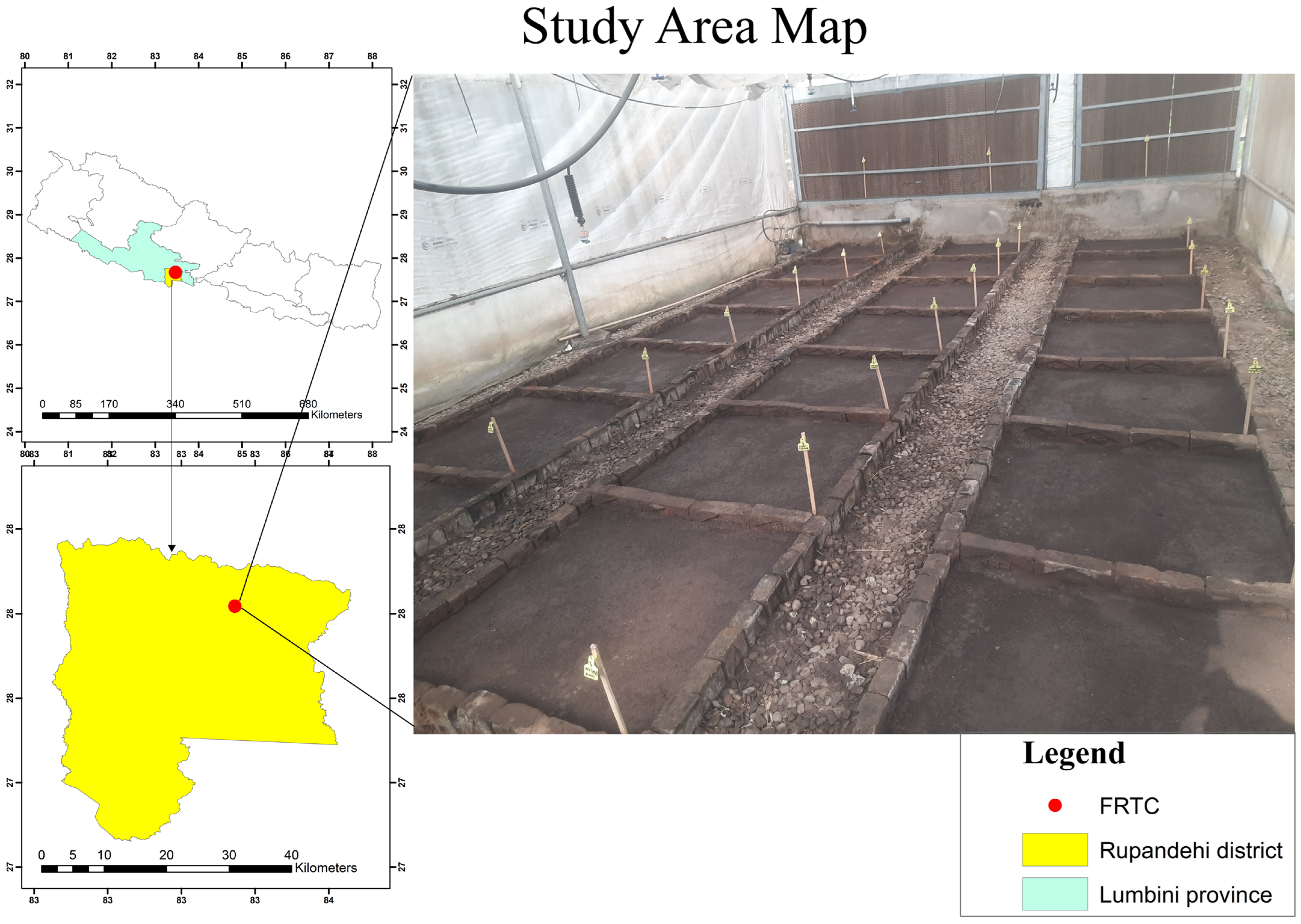
The experiment was conducted in a shaded nursery at the Forest Research and Training Centre (FRTC), Butwal, Lumbini Province, Nepal (Coordinates: 23.69 N, 83.43 E) (Figure 1). The area has a humid tropical climate with an average annual temperature of 29.5 °C, mean annual rainfall of 105.7 mm, and approximately 80 rainy days per year [26].
The experiment was conducted in a high-tech nursery where polyethylene (PE) films were used to provide shade and thermal insulation, preventing direct sunlight exposure to the seedlings. The potting mixture consisted of soil, sand, and vermicompost in a 3:1:1 ratio to ensure balanced aeration, drainage, and nutrient availability. During the first 15 days, each block received 10 L of water daily—5 L in the morning and 5 L in the evening—while for the remaining 14 days, irrigation was reduced to 5 L per block in the evening. As previous research suggests [7], the Moringa seeds germinate completely in 15 days after sowing, and the main reason for adopting a standardized irrigation process in the nursery beds is to facilitate the germination process, along with minimizing the heterogeneous effect of the moisture gradient. Standard nursery management practices, including regular weeding, cleaning, and irrigation, were consistently applied to maintain optimal growth conditions.

2.2. Pre-Treatment and Germination

Seed pre-treatment regulates germination by controlling temperature, hormonal levels, and moisture during the early imbibition phase [27]. Normal germination, defined as the production of a normal seedling, was assessed based on radicle emergence of at least 2 mm in length, indicating visible seedling emergence from the embryo. This criterion was used to evaluate seed viability and vigor [11]. Various physical and hydropriming techniques were tested following established methods [22,28].
Pre-germinative treatments involved soaking seeds in water for varying durations to promote uniform emergence and to facilitate the assessment of seed vigor. Normal water soaking activates metabolic processes by enhancing water uptake and enzyme activity essential for radicle protrusion [29]. Previous studies estimated that optimal germination occurs after 24–72 h of soaking in water, whereas such prolonged soaking beyond four days can reduce seed viability [7,21]. Every treatment was replicated under controlled nursery conditions. Germination percentage, mean germination time, and germination index were recorded to determine the most effective pre-sowing method for improving Moringa seeds’ performance.

2.2.1. Seed Source, Seed-Bed Soil Mixture, and Pre-Sowing Seed Treatments

A base pot mixture was prepared by mixing normal soil, sand, and vermicomposting manure in the ratio of 3:1:1. The concept of seed treatment is the application of biological and chemical agents that can increase germination and ensure the uniform emergence [30,31,32]. Seed dormancy has been defined as the inability of a viable seed to germinate under favorable conditions [33]. Seed dormancy is an important aspect that affects the germination period of the seed. Different pre-sowing treatments are carried out to enhance germination. Thus, seven treatments were selected and were replicated three times (7 × 3 = 21 treatments) in our study to perform the intended experiment (Table 1). Seeds of Moringa were purchased from the local retailer, ensuring the homogeneity of the seeds for observing the treatment performance. For this experiment, we used materials like seeds, polybags, dilute HCl, cow urine, high-tech nursery, sand, soil, vermicompost, and measuring tape, to name a few.

2.2.2. Preparation of Experimental Plots

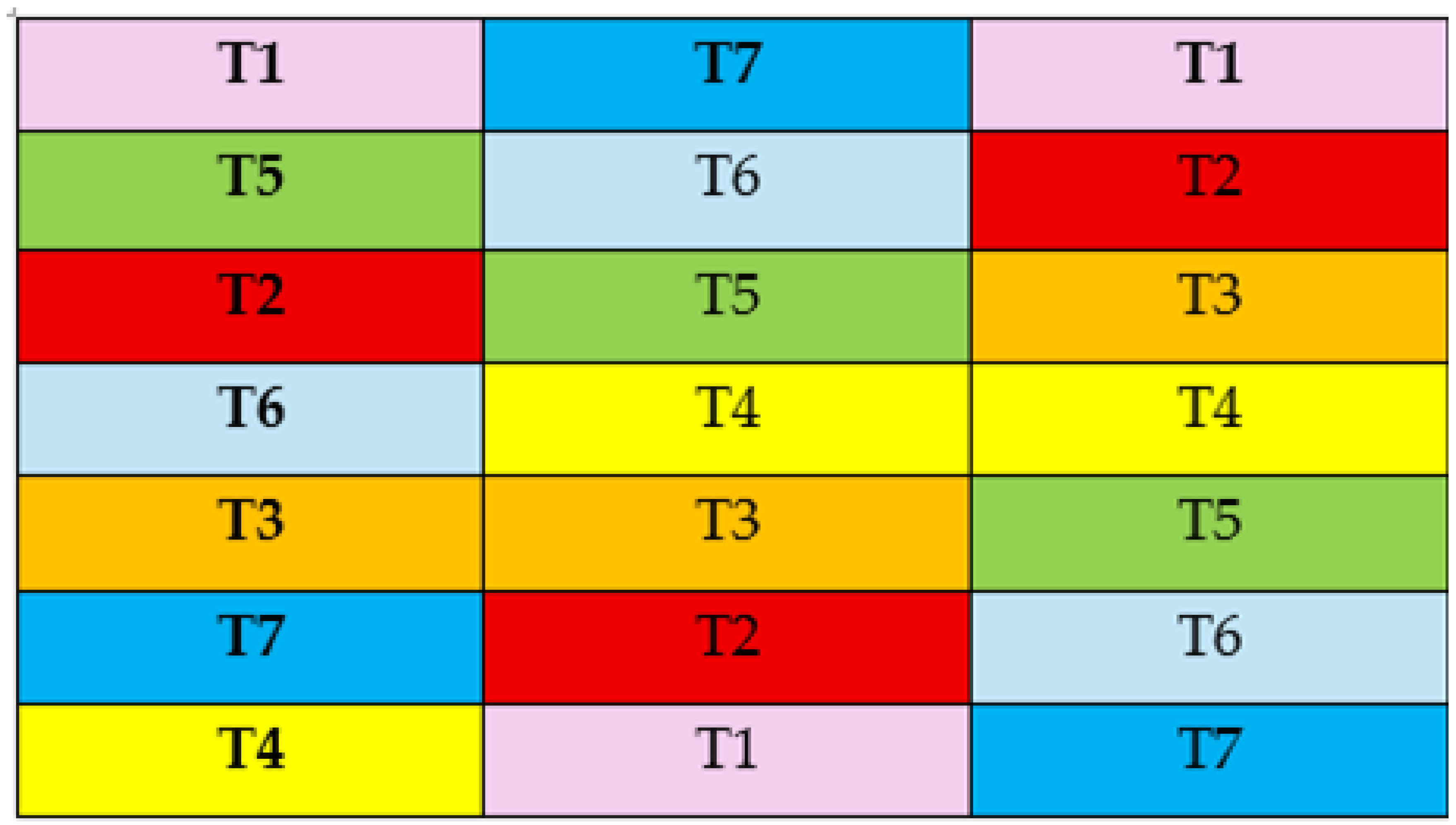
Experimental plots of size 1 m × 1 m were prepared in the nursery of Forest Research and Training Centre (FRTC), Butwal, Lumbini Province, Nepal. In each plot, 100 treated seeds were sown (10 rows × 10 columns), and the soil surface was made even for uniform placement. For each treatment, there were three replications, which means there were altogether 300 seeds for each treatment and 21 plots—three plots per treatment, each with 100 seeds (Figure 2). The complete randomized design (CRD) sampling technique was used to determine the plot placement in the nursery.
Total seeds for trial were 100 (seeds) × 7 (treatments) × 3 (replications) = 2100 seeds. Data were recorded every three days once germination started until they ceased to germinate, and the seedling length was measured using a normal tape measure. Seeds were considered germinated by the visible protrusion of the split seed coat with cotyledons, hypocotyls, and epicotyls on the soil surface. The final germination percentage alone is not enough to reflect the speed and pattern of germination; thus, various parameters must be evaluated [34]. These parameters of nursery seedling stock quality could be used to predict their field performance in a plantation as well [35]. Different pre-sowing treatments where T1 represents no treatment or control, T2 represents normal water (room temperature) for 24 h, T3 represents alternate wetting and drying for 12 h, T4 represents soaking in hot water (60 degree) for 5 min, T5 represents normal water (room temperature) for 12 h, T6 represents cow urine (1:2) for 12 h and T7 represents 35% conc. HCl for 20 min is used to evaluate the speed of germination of Moringa. Moreover, the detailed analysis of the results can be found in the Supplementary Materials.

2.3. Data Analysis

Data were analyzed using various indices, factors, germination percentages, and seedling heights. Different factors, such as time, seedling heights, and vigor, were recorded for measuring or estimating the germination speed of Moringa, as suggested in a previous study [36].
Final Germination Percentage (GP) = number of seeds germinated/number of seeds sown × 100
Mean Germination Time (MGT) = ΣFX/ΣF,
Mean Germination Rate (MGR) = CV/100 = 1/T
where F is the number of seeds germinated in X days; T is the mean germination time, CV is the coefficient of velocity; Germination Index (GI) = Σ(Gt/Dt); Where Gt is the number of germinated seeds on the day t and Dt is the time corresponding to the germination period; Vigor Index = Germination (%) × Seedling total length [37].
An analysis of variance (ANOVA) test was performed to find out the significant differences between means. ANOVA was used for 5% significance level to test whether different treatments had significant effects. The Statistical Package for Social Sciences (SPSS version 22.0) software was used to analyze the significant difference. The Tukey Honest Significant Difference (HSD) was further used to determine the significant pairs of treatment means with equal replications that differ significantly. Microsoft Excel (version 365) was used to summarize the percentages, indices, tables, and graphs.

3. Results

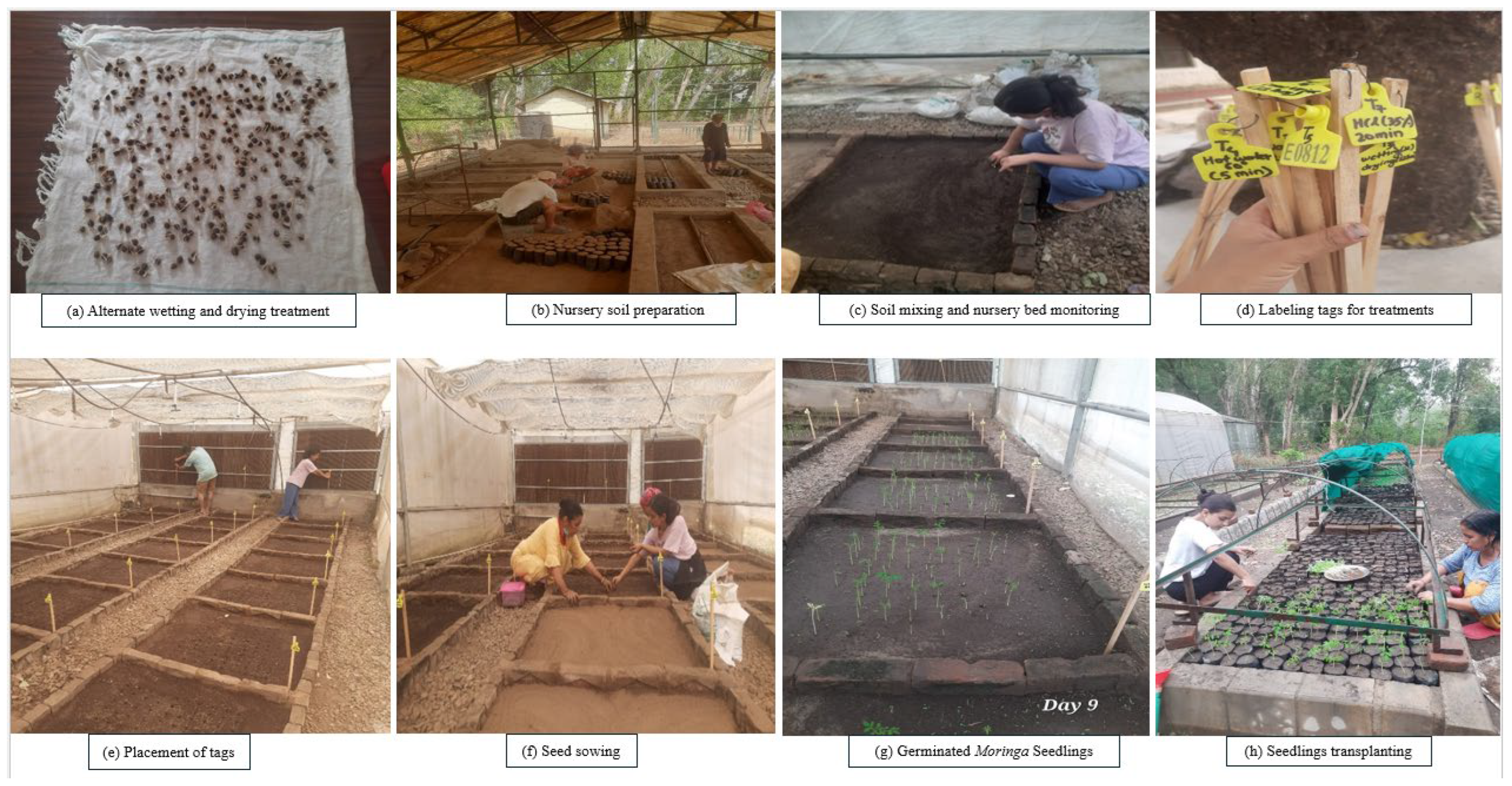
Overall, the alternate wetting and drying treatment (T3) produced the best results among all pre-seed treatments of Moringa, with the highest final germination percentage (89%), the fastest mean germination time (8.44 days), the highest mean germination rate (0.12), germination index (11.31), and vigor index (4137). T1 (control) and T4 (hot water treatment for 5 min) also performed well, each with 88.33% germination and relatively strong indices (both germination and vigor), though T3 outperformed them overall (Table 2). T2 (water soaking) and T5 (boiling water treatment) showed moderate effectiveness, while T6 (acid treatment) and T7 (cow urine treatment) resulted in 0% germination and zero values across all parameters, indicating complete seed failure under those conditions. The sample pictures of each experiment are presented in Figure 3.

3.1. Tukey Honest Significant Difference Tests

The treatment comparison table shows that T3 achieved the highest mean value ( y ¯ i = 89), followed closely by T1 and T4 (both 88.33), indicating strong performance. T5 and T2 showed moderate to low performance, with mean values of 84 and 74, respectively. Treatments T6 and T7 had zero performance, significantly underperforming compared to all others (Table 3). The large negative deviations from T1–T5 confirm the ineffectiveness of T6 and T7 in this context.

3.2. ANOVA Tests

Data were recorded every three days after seed sowing for 30 days. The final germination percentage alone is insufficient to determine the optimal germination performance of Moringa seeds. The analysis of variance revealed a highly significant treatment effect, with the calculated F-value (120.06) far exceeding the tabulated value (2.85) (Table 4). The treatment sum of squares (SS = 31,249.91) accounted for nearly all variation, while the error variance was minimal (SS = 607.33), confirming that the differences among treatments were statistically significant.
Further detailed analysis of the experimental outcomes through ANOVA revealed highly significant treatment effects across all germination parameters of Moringa oleifera. Treatments consistently accounted for most of the variation, with minimal error variance. The F-values (ranging from 85.57 to 626.44) greatly exceeded critical thresholds, confirming strong treatment effects on germination percentage, mean germination time, germination index, and vigor index (Table 5).
Post-hoc comparisons identified several significant treatment pairs (see Supplementary Materials), highlighting clear differences in seedling performance across treatments. The F-test revealed substantial variation in mean germination rate among treatments, which was statistically significant (F = 626.44). Significant pairs included (T1, T6), (T1, T7), (T3, T2), (T3, T6), (T3, T7), (T4, T2), (T4, T6), (T4, T7), (T5, T2), (T5, T6), and (T5, T7).
Similarly, germination time varied significantly among treatments (F = 378.26), with significant pairs (T2, T7), (T3, T4), (T3, T5), (T3, T6), (T3, T7), (T4, T7), (T5, T7), and (T6, T7). The germination index also differed significantly (F = 85.57), with significant pairs (T1, T6), (T1, T7), (T3, T2), (T2, T6), (T2, T7), (T3, T6), (T3, T7), (T4, T6), (T4, T7), (T5, T6), and (T5, T7). Finally, the vigor index showed significant variation across treatments (F = 136.50), with significant pairs (T1, T6), (T1, T7), (T2, T6), (T2, T7), (T3, T2), (T3, T5), (T3, T6), (T3, T7), (T4, T6), (T4, T7), (T5, T6), and (T5, T7).

4. Discussion

The results clearly demonstrate that pre-sowing treatments exert a strong influence on the germination performance of Moringa oleifera seeds. Among the tested treatments, alternate wetting and drying (T3) exhibited superior performance, achieving the highest final germination percentage (89%), the fastest mean germination time (8.44 days), and the strongest germination, vigor, and growth indices compared with all other treatments. The control (T1) and hot water treatment (T4) also produced a high germination percentage (88.33%), although marginally lower than T3. In contrast, soaking (T2) and boiling water (T5) treatments showed moderate success, while acid (T6) and cow urine (T7) treatments completely inhibited germination, resulting in 0% emergence. Analysis of variance (ANOVA) and post hoc comparisons revealed significant differences among treatments across all measured germination parameters, confirming the critical role of pre-sowing methods in enhancing seed germination. Overall, these findings suggest that simple pre-germination treatments not only improve germination performance but also contribute to the development of more vigorous and taller seedlings during early growth.
Moreover, the improved germination performance observed under the alternate wetting and drying (AWD) treatment can be attributed to several underlying physiological mechanisms. Unlike continuous soaking, which may cause excessive imbibition and solute leakage, the cyclic hydration–dehydration process in the Moringa seeds promotes controlled water uptake that supports early metabolic activation while preventing cellular damage [36,38]. During the initial hydration phase in the seeds, partial imbibition allows membranes to rehydrate and repair structural integrity, reducing leakage of electrolytes and essential metabolites [39,40]. Repeated wetting cycles can also activate key germination-related enzymes, including amylases and proteases, by progressively reinitiating metabolic pathways necessary for radicle emergence, and seed post-maturation [41,42,43].
Further, the intermittent drying periods appear to enhance metabolic readiness by allowing the seed to stabilize between hydration events [39]. This stabilization supports the reorganization of cellular structures, efficient mobilization of stored reserves, and priming of respiratory pathways [44]. In contrast, continuous soaking may lead to hypoxic conditions and loss of nutrients into the surrounding water [45]. The reduced leaching losses under AWD ensure that sugars, amino acids, and minerals remain available for embryonic growth, contributing to faster and more uniform germination [9,46]. Together, these mechanisms suggest that AWD functions as a form of physiological priming that prepares Moringa seeds for rapid germination upon final hydration.
Moreover, the superior performance of the alternate wetting and drying method supports the principle that controlled hydration–dehydration cycles activate physiological processes that enhance Moringa seeds germination. In contrast, Gbenou et al. (2021) [12] reported a lower germination rate (74.16%) for Moringa seeds heated to 50 °C, suggesting that wetting and drying are more effective than heat exposure in promoting seedling emergence. The failure of acid and cow urine treatments was likely due to embryo damage from corrosive exposure, consistent with other researchers’ findings, who observed reduced germination following acid treatment [47]. However, only 65.33% germination was previously reported for Moringa seeds 20 days after sowing in saline soil [9]. Notably, the alternate wetting and drying method produced the highest germination index, vigor index, and mean germination rate, while achieving the shortest germination time, with emergence occurring within 7–15 days.
In contrast, prolonged soaking also proved less effective, with 24 h water soaking yielding only 74% germination [7], likely due to the leaching of sugars and proteins into the water, oxygen deprivation (hypoxia), cell membrane damage, fostering microbial growth, hormonal imbalance, and impaired energy metabolism. This aligns with findings of reduced germination after 48 h of soaking [12], though Oshunsanya et al. (2015) reported a higher rate (86%) after 24 h soaking [28]. These variations indicate that germination outcomes depend not only on treatment type but also on exposure duration and experimental conditions.
Furthermore, seed behavior in Moringa aligns with that of many tropical tree species, which typically germinate rapidly under warm, moist conditions due to their soft seed coats. Complex pre-treatments are generally unnecessary; however, simple methods such as wetting–drying cycles or hot water exposure can substantially enhance germination. Effectiveness may vary by species, seed provenance, collection practices, and storage conditions [11]. Historical studies have shown wide variability in germination rates, ranging from 90% in untreated seeds of many species, including tropical plants, to as low as 11.11% with warm water, while acid treatments consistently failed [41].
Although the control and hot water treatments performed relatively well, the alternate wetting and drying method clearly emerged as the most effective and consistent approach for seedling production. Nouman et al. (2021) [22] reported that certain pre-sowing treatments improve Moringa seed germination [22], whereas Inuwa (2025) and Oshunsanya et al. (2015) [28] suggested that pre-treatment may not always be necessary [19,28]. The present findings provide strong evidence that alternate wetting and drying, achieving 89% germination, offers a practical balance between simplicity and effectiveness.
Overall, this study introduces the alternate wetting and drying method (12 h intervals) as a novel, low-cost, and highly effective pre-sowing treatment for enhancing Moringa seed germination and early seedling vigor. Its chemical-free nature makes it particularly suitable for smallholder farmers and nurseries in resource-limited settings. However, the study was conducted under controlled nursery conditions and did not evaluate long-term field performance. Environmental variables such as soil type, temperature fluctuations, and management practices were not examined. In addition, seedling vigor was assessed primarily through height at an early stage, indicating the need for future research to incorporate a broader set of physiological and morphological indicators of seedling quality. Future studies should therefore test this method across diverse agroecological zones, including field trials that assess transplant survival, growth, and adaptability under real-world conditions.

5. Conclusions

Seed pre-treatments play a critical role in achieving reliable germination in seed-propagated species. This study demonstrates that alternate wetting and drying (12 h cycles) is a simple, low-cost, and highly effective pre-treatment for Moringa oleifera, producing the highest germination rate (89%), fastest emergence, and greatest seedling vigor compared with conventional methods. In contrast, acid and cow urine treatments reduced germination performance. The superior effectiveness of the wetting–drying approach likely results from controlled hydration–dehydration cycles that promote membrane repair, limit solute leakage, activate metabolic processes, and prevent hypoxic stress. This method offers a practical, chemical-free solution well suited to smallholders and resource-limited nursery systems. Future studies should evaluate its performance under field conditions, including transplant survival and long-term growth. Improving Moringa propagation has direct implications for sustainable agroforestry, food security, and climate-resilient livelihoods.

Supplementary Materials

The following supporting information can be downloaded at: https://www.mdpi.com/article/10.3390/seeds5020016/s1.

Author Contributions

M.P. conceived the study, designed the methodology, collected and analyzed the data, and prepared the original draft. C.P. and H.P.P. were involved in data editing, refining sections, English language checking, and writing the discussion. V.K.Y. and T.M. supervised the entire research, edited the manuscript, and performed proofreading. All authors have read and agreed to the published version of the manuscript.

Funding

No financial funding was received for this research. However, the Forest Research and Training Center, Butwal, provided nursery facilities and other official spaces for conducting nursery experiments for this study.

Data Availability Statement

The data will be available upon request from the first author.

Acknowledgments

The authors are indebted to the Forest Research and Training Center, Butwal, and its cooperative staff for providing the platform that made this study possible in their nursery facilities. All persons involved in this research were provided with pre-consent to participate.

Conflicts of Interest

The authors declare that there are no financial or other conflicts of interest among the authors, supporting organizations, or related to the data used in this research.

References

  1. Boopathi, N.M.; Abubakar, B.Y. Botanical Descriptions of Moringa spp. In The Moringa Genome; Boopathi, N.M., Raveendran, M., Kole, C., Eds.; Springer International Publishing: Cham, Switzerland, 2021; pp. 11–20. [Google Scholar]
  2. Alavilli, H.; Poli, Y.; Verma, K.S.; Kumar, V.; Gupta, S.; Chaudhary, V.; Jyoti, A.; Sahi, S.V.; Kothari, S.L.; Jain, A. Miracle Tree Moringa oleifera: Status of the Genetic Diversity, Breeding, In Vitro Propagation, and a Cogent Source of Commercial Functional Food and Non-Food Products. Plants 2022, 11, 3132. [Google Scholar] [CrossRef]
  3. Cirlini, M.; Del Vecchio, L.; Leto, L.; Russo, F.; Dellafiora, L.; Guarrasi, V.; Chiancone, B. Sprouts of Moringa oleifera Lam.: Germination, Polyphenol Content and Antioxidant Activity. Molecules 2022, 27, 8774. [Google Scholar] [CrossRef] [PubMed]
  4. Pandey, H.P.; Pokhrel, N.P.; Luitel, D.R.; Acharya, K.; Shah, K.K. Diversity of Agroforestry Species and Uses in Two Ecological Regions: A Case from Central Nepal. Adv. Agric. 2021, 2021, 1198341. [Google Scholar] [CrossRef]
  5. Garg, P.; Pundir, S.; Ali, A.; Panja, S.; Chellappan, D.K.; Dua, K.; Kulshrestha, S.; Negi, P. Exploring the Potential of Moringa oleifera Lam. in Skin Disorders and Cosmetics: Nutritional Analysis, Phytochemistry, Geographical Distribution, Ethnomedicinal Uses, Dermatological Studies and Cosmetic Formulations. Naunyn. Schmiedeberg’s Arch. Pharmacol. 2024, 397, 3635–3662. [Google Scholar] [CrossRef]
  6. Mahlangu, N. Growth, Yield and Nutritional Composition of Moringa oleifera Under Different Propagation Methods. Master’s Thesis, University of Limpopo, Polokwane, South Africa, 2024. [Google Scholar]
  7. Pérez-Rivera, E.P.; Montes-Ávila, J.; Castro-Tamayo, C.B.; Portillo-Loera, J.J.; Castillo-López, R.I. Agronomical Aspects of Moringa oleifera (Moringa). In Biological and Pharmacological Properties of the Genus Moringa; CRC Press: Boca Raton, FL, USA, 2021. [Google Scholar]
  8. Ranal, M.A.; Santana, D.G. How and Why to Measure the Germination Process? Braz. J. Bot. 2006, 29, 1–11. [Google Scholar] [CrossRef]
  9. Uddin, K. Effect of Salinity on Seed Germination and Seedling Establishment of Moringa oleifera. Master’s Thesis, Sher-e-Bangla Agricultural University, Dhaka, Bangladesh, 2021. [Google Scholar]
  10. Zeeshan, A.; Munir, M.; Sadia, S. Unlocking the Promise of the Miracle Tree: A Review on Therapeutic Applications and Phytochemistry of Moringa oleifera L. J. Bioresour. Manag. 2024, 11, 102–122. [Google Scholar]
  11. Dubey, S.; Kumar, G.; Sahu, R.; Kumar, A. Moringa oleifera L. Seed Quality Assessment as Impacted by Pre-Treatments of Sowing. Am. J. Agric. For. 2022, 10, 156–159. [Google Scholar] [CrossRef]
  12. Gbenou, P.; Hombada, D.; Nevis, D. Evaluation of The Effect of Pre-Treatment Of Moringa oleifera Lamarck (Moringaceae) Seeds at the Early Stage of Germination for Massive Production in South Benin. Eur. Sci. J. 2021, 17, 165. [Google Scholar] [CrossRef]
  13. Pandey, H.P.; Aryal, S.; Poudyal, B.H.; Bhusal, S.; Maraseni, T.N. Navigating Climate Change: Impacts on Indigenous Practices Concerning Agrifood Systems in Nepal’s Socio-Ecological Landscape. Sustain. Horiz. 2025, 14, 100143. [Google Scholar] [CrossRef]
  14. Ghimire, S.; Subedi, L.; Acharya, N.; Gaire, B.P. Moringa oleifera: A Tree of Life as a Promising Medicinal Plant for Neurodegenerative Diseases. J. Agric. Food Chem. 2021, 69, 14358–14371. [Google Scholar] [CrossRef] [PubMed]
  15. Khaled, H.B.; Alenzi, S.K.; Aldhafiri, F.J.; Alanazi, R.A.; Alshammari, B.; Alanazi, S.S. A Cross-Sectional Study Assessing the Saudi Population’s Awareness and Perception of the Nutritional and Medicinal Benefits of the Miracle Tree: Moringa oleifera. Asian J. Pharm. Res. Health Care 2024, 16, 197. [Google Scholar] [CrossRef]
  16. Kumar, P.; Perez, K.C.; Biswal, A.; Sun, H.; Dwivedi, A.K.; Hama, S.; Khalili, S.; Ahlawat, A.; Andrade, M.d.F.; Alves, R.A.; et al. Overlooked Considerations in Prescribing Green and Blue Infrastructure Solutions for Urban Environments. Innovation 2025, 101184. [Google Scholar] [CrossRef]
  17. Aryal, P.C.; Aryal, C.; Khadka, D.; Aryal, A.; Rayamajhi, K.; Shrestha, S.; Khanal, B.; Karki, D.; Pandey, H.P.; Maraseni, T. Wings Across the Gradient: Butterfly Diversity Declines Along an Urbanization Gradient in the Subtropical Himalayas. Urban Ecosyst. 2025, 29, 8. [Google Scholar] [CrossRef]
  18. Kacem, N.S. Assessment of the Germination Potential of Moringa oleifera Seeds Under Different Treatment Conditions. Ecol. Eng. Environ. Technol. 2024, 25, 321–325. [Google Scholar] [CrossRef]
  19. Inuwa, A. Effect of Pre-Sowing Seed Treatmentf Moringa (Moringa oleifera) on Sandy Loam Soil. Int. Congr. Turk. Sci. Technol. Publ. 2025, 867–870. Available online: http://turjaf.com/index.php/TURSTEP/article/view/570.
  20. Soares, T.F.S.N. Seed Treatment, Stress Tolerance, and Genetic Variability of Moringa oleifera Lam. Ph.D. Thesis, Universidade Federal de Sergipe, São Cristóvão, Brazil, 2023. [Google Scholar]
  21. El-Absy, K.M.A.; Khazen, N.A.; Al-Rashidi, M.M.; Anezi, B.B.A.; Anezi, F.H.A.; Atawi, N.S.A.; Anezi, A.S.A.; Balawi, H.N.A. Comparing between Germination Percentage in Moringa peregrina and Moringa oleifera Under Laboratory Conditions. Asian Plant Res. J. 2019, 2, 1–9. [Google Scholar] [CrossRef]
  22. Nouman, W.; Siddiqui, M.; Basra, S.; Afzal, I.; Rehman, H. Enhancement of Emergence Potential and Stand Establishment of Moringa oleifera Lam. by Seed Priming. Turk. J. Agric. For. 2012, 36, 227–235. [Google Scholar] [CrossRef]
  23. Palada, M.C.; Chang, L.C. Suggested Cultural Practices for Vegetable Amaranth. In International Cooperators Guide; Central Philippine University: Iloilo City, Philippines, 2003. [Google Scholar]
  24. Atreya, K.; Tiwari, K.R.; Kalwar, O.P. Does Moringa Tree Support Income for the Rural Poor in the Churia Region of Nepal? For. Trees Livelihoods 2025, 34, 155–169. [Google Scholar] [CrossRef]
  25. Kantilata, T.; Mousami, P.; Prabin, A. Moringa oleifera: A Review Article on Nutritional Properties and Its Prospect in the Context of Nepal. Acta Sci. Agric. 2019, 3, 47–54. [Google Scholar] [CrossRef]
  26. Gyawali, G.; Paudyal, K.R. Geological Causes of Shrawan Danda and Siddhababa Landslides in the Northern Vicinity of Butwal City, Western Nepal. Geogr. Base 2023, 10, 33–45. [Google Scholar] [CrossRef]
  27. Kumar, M.; Sarvade, S.; Kumar, R.; Kumar, A. Pre-Sowing Treatments on Seeds of Forest Tree Species to Overcome the Germination Problems. Asian J. Environ. Ecol. 2024, 23, 1–18. [Google Scholar] [CrossRef]
  28. Oshunsanya, S.O.; Fagbenro, J.A.; Aliku, O.; Oke, O.A.; Rahmann, G.; Olabiyi, T.I.; Olowe, V.I. Nursery Establishment of Moringa oleifera as Affected by Pre-Sowing Seed Treatments in a Coarse Textured Soil. In Proceedings of the Scientific Track Proceedings of the 3th Afican Organic Conference, Lagos, Nigeria, 5–9 October 2015. [Google Scholar]
  29. Raj, A.B.; Raj, S.K. Seed Priming: An Approach towards Agricultural Sustainability. J. Appl. Nat. Sci. 2019, 11, 227–234. [Google Scholar] [CrossRef]
  30. Forti, C. Seeds in the Context of Agricultural Research: Combining Traditional and Innovative Approaches to Boost Seed Quality. Ph.D. Thesis, University of Pavia, Pavia, Italy, 2020. [Google Scholar]
  31. Gandhi, G.; Sidhu, A.; Bhardwaj, U.; Sidhu, M.S.; Sharma, A.B.; Khepar, V. Laser-Disintegrated Copper-Activated Salicylic Acid (Cu-SA) Nanoparticles Suppressed the Seed-Borne Pathogens of Rice with Enhanced Seed Invigoration Parameters. Environ. Sci. Pollut. Res. 2024, 31, 42461–42475. [Google Scholar] [CrossRef]
  32. Kumar, N.; Upadhyay, G.; Chhetri, K.B.; Harsha, B.R.; Malik, G.K.; Kumar, R.; Jasrotia, P.; Samota, S.R.; Kumar, N.; Chhokar, R.S. Pre- and Post-Harvest Management of Wheat for Improving the Productivity, Quality, and Resource Utilization Efficiency. In Wheat Science; CRC Press: Boca Raton, FL, USA, 2023. [Google Scholar]
  33. Hilhorst, H.W.M.; Finch-Savage, W.E.; Buitink, J.; Bolingue, W.; Leubner-Metzger, G. Dormancy in Plant Seeds. In Dormancy and Resistance in Harsh Environments; Lubzens, E., Cerda, J., Clark, M., Eds.; Springer: Berlin/Heidelberg, Germany, 2010; pp. 43–67. [Google Scholar]
  34. Al-Mudaris, M.A. Notes on Various Parameters Recording the Speed of Seed Germination. Tropenlandwirt-J. Agric. Trop. Subtrop. 1998, 99, 147–154. [Google Scholar]
  35. Bayala, J.; Dianda, M.; Wilson, J.; Ouédraogo, S.J.; Sanon, K. Predicting Field Performance of Five Irrigated Tree Species Using Seedling Quality Assessment in Burkina Faso, West Africa. New For. 2009, 38, 309–322. [Google Scholar] [CrossRef]
  36. Muhl, Q.E. Seed Germination, Tree Growth and Flowering Responses of Moringa oleifera Lam. (Horseradish tree) to Temperature. Master’s Thesis, University of Pretoria, Pretoria, South Africa, 2009. [Google Scholar]
  37. Shayganfar, A.; Mirahmadi, S.F.; Mumivand, H. From Seed to Medicine: Photothermal Effects on Salvia spinosa L. Germination and Their Pharmacological Relevance. J. Med. Plants 2025, 24, 70–80. [Google Scholar] [CrossRef]
  38. Ahmad, T.A.; Ahmad, F.K.; Rasul, K.S.; Aziz, R.R.; Omer, D.A.; Tahir, N.A.-R.; Mohammed, A.A. Effect of Some Plant Extracts and Media Culture on Seed Germination and Seedling Growth of Moringa oleifera. J. Plant Prod. 2020, 11, 669–674. [Google Scholar] [CrossRef]
  39. Hegarty, T.W. The Physiology of Seed Hydration and Dehydration, and the Relation between Water Stress and the Control of Germination: A Review. Plant Cell Environ. 1978, 1, 101–119. [Google Scholar] [CrossRef]
  40. Woodstock, L.W. Seed Imbibition: A Critical Period for Successful Germination. J. Seed Technol. 1988, 12, 1–15. [Google Scholar]
  41. Ali, A.S.; Elozeiri, A.A.; Ali, A.S.; Elozeiri, A.A. Metabolic Processes During Seed Germination. In Advances in Seed Biology; IntechOpen: London, UK, 2017. [Google Scholar]
  42. Jimenez-Lopez, J.C. Advances in Seed Biology; IntechOpen: London, UK, 2017. [Google Scholar]
  43. Kandar, C.C.; Pal, D. Relation Between Seed Life Cycle and Cell Proliferation. Metabolic Changes in Seed Germination. In Seeds: Anti-Proliferative Storehouse for Bioactive Secondary Metabolites; Pal, D., Ed.; Springer Nature: Singapore, 2024; pp. 49–79. [Google Scholar]
  44. Bennett, C.F.; Latorre-Muro, P.; Puigserver, P. Mechanisms of Mitochondrial Respiratory Adaptation. Nat. Rev. Mol. Cell Biol. 2022, 23, 817–835. [Google Scholar] [CrossRef] [PubMed]
  45. Serventi, L. Soaking Water Composition. In Upcycling Legume Water: From Wastewater to Food Ingredients; Serventi, L., Ed.; Springer International Publishing: Cham, Switzerland, 2020; pp. 27–39. [Google Scholar]
  46. Geem, K.R.; Kim, G.; Sung, J. Alternate Wetting and Drying and Nitrogen Fertilizations under Different Soil Conditions Alter Carbohydrate and Nitrogen Metabolisms in Rice. Appl. Biol. Chem. 2025, 68, 28. [Google Scholar] [CrossRef]
  47. Mallenakuppe, R.; Homabalegowda, H.; Gouri, M.; Basavaraju, P.; Chandrashekharaiah, U. History, Taxonomy and Propagation of Moringa oleifera—A Review. SSR Inst. Int. J. Life Sci. 2019, 5, 2322–2327. [Google Scholar] [CrossRef]
Figure 1. Location of the experimental site and its general ground view before the experiment [FRTC in this map stands for the Forest Research and Training Centre, Butwal, Lumbini Province, Nepal].
Seeds 05 00016 g001
Figure 2. Plot design for the pre-sowing treatment study. Different colored cells indicate different treatment types.
Seeds 05 00016 g002
Figure 3. Representative photo plates of the nursery seed treatment experiments conducted in this study. Free, prior, and informed consent was obtained from all individuals involved.
Seeds 05 00016 g003
Table 1. The type of pre-sowing seed treatments adopted in this experiment. Color plates indicate the types of seed treatments before sowing them.
Treatments’ CodeTreatments’ Descriptions
T1Seeds were sown with no treatment (control), meaning that the seeds were sown directly without any treatment
T2Soaking in normal water (room temperature) for 24 h
T3Alternate wetting (12 h) and drying (12 h)
T4Soaking in hot water (60 degrees) for 5 min
T5Seeds immersed in normal water (room temperature) for 12 h
T6Seeds soaked in cow urine (1:2—diluted with water) for 12 h
T7Seeds immersed in 35% concentrated HCl for 20 min
Table 2. Germination parameters and the outcomes of Moringa oleifera germinations.
TreatmentsFinal Germination Percentage (G)%Mean Germination Time (MGT) (Days)Mean Germination Rate (MGR)Germination Index (GI)Vigor Index (VI)
T188.339.240.1110.243694
T2749.660.108.333251
T3898.440.1211.314137
T488.338.680.1210.933773
T5848.530.1210.553280
T600000
T700000
Table 3. The Tukey test for different treatment means for Moringa seed germination performances [ y ¯ i is the mean germination value for respective treatments and T1, …, T7 are the treatment types].
Treatments y ¯ i y ¯ i − T1 y ¯ i − T2 y ¯ i − T3 y ¯ i − T4 y ¯ i − T5 y ¯ i − T6 y ¯ i − T7
T3890.67 (ns)15 (ns)0 (ns)0.67 (ns)4 (ns)89 *89 *
T188.330 (ns)14.33 (ns)0.67 (ns)0 (ns)4.33 (ns)88.33 *88.33 *
T488.330 (ns)14.33 (ns)−0.67 (ns)0 (ns)4.33 (ns)88.33 *88.33 *
T584−4.33 (ns)10 (ns)−5 (ns)−4.33 (ns)0 (ns)84 *84 *
T274−14.33 (ns)0 (ns)−15 (ns)−14.33 (ns)−10 (ns)74 *74 *
T60−88.33 *−74 *−89 *−88.33 *−84 *0 (ns)0 (ns)
T70−88.33 *−74 *−89 *−88.33 *−84 *0 (ns)0 (ns)
Note: Asterisks (*) indicate the pair of treatments that differ significantly; ns stands for treatments that are not significant; y ¯ i is the mean value of the germination percentage of the respective treatments. Results indicate the treatments pairs (T3, T6), (T3, T7), (T1, T6), (T1, T7), (T4, T6), (T4, T7), (T5, T6), (T5, T7), (T2, T6) and (T2, T7) differ significantly according to germination percentage.
Table 4. Analysis of variance of seed germination with respect to different treatments [DF stands for degree of freedom, Fcal is the calculated F-statistic, and Ftab is the tabulated F-statistic].
Source of VariationDFSSMSSFcalFtab
Due to treatment631,249.915208.32120.062.85
Due to an error14607.3343.38
Total2031,857.24
Table 5. Analysis of variance of mean germination percentage, mean germination time, germination index, and vigor index with respect to different treatments [DF stands for degree of freedom, SS stands for sum of squares, MS stands for mean sum of squares, Fcal stands for f-statistic calculated, and Ftab stands for f-statistic tabulated].
Source of VariationsDFSSMSFcalFtab
Mean germination rate
Due to treatment60.050.01626.442.85
Due to an error140.000.00
Total200.05
Mean germination time
Due to treatment6201.6140.32378.263.11
Due to an error12 ¥1.280.11
Total17202.89
Germination index
Due to treatment6468.1778.0385.572.85
Due to an error1412.770.91
Total20480.94
Vigor index
Due to treatment610,503,501.241,750,583.54136.502.85
Due to an error14179,54612,824.71
Total2010,683,047.24
Note: This (¥) indicates that two of the treatments did not yield any seedlings; therefore, germination time could not be calculated. As a result, the degrees of freedom for the error term were further reduced to 12.
Disclaimer/Publisher’s Note: The statements, opinions and data contained in all publications are solely those of the individual author(s) and contributor(s) and not of MDPI and/or the editor(s). MDPI and/or the editor(s) disclaim responsibility for any injury to people or property resulting from any ideas, methods, instructions or products referred to in the content.