1. Introduction
Rice is a source of carbohydrates for more than half of the world’s population [
1]. In Pakistan, rice is the second major cereal, with a 0.6 percent share in the GDP of the country [
2]. The majority of rice in Pakistan is cultivated through transplanting seedlings, followed by extensive flooding till ripening [
3]. The conventional method of rice sowing is not only labor-intensive but also poses threats to dwindling natural resources and the environment [
4]. Water scarcity and higher temperatures associated with climate change can hit the rice production system severely [
5]. Water use efficiency of conventionally transplanted rice is very low, as 3000–5000 L of water is required to produce only 1 kg of rice [
6]. Extensive flooding of rice fields multiplies the chances of water body contamination through the leaching of agro-chemicals [
7]. Furthermore, puddling in conventionally transplanted rice requires ploughing in standing water, which severely damages the physical and biological health of soil [
8]. Moreover, emissions of methane associated with transplanted paddy fields contribute to global warming and climate change [
9]. This, coupled with growing food demands, has made the current rice production system vulnerable [
10]. A sustainable, environmentally friendly, and highly productive rice crop establishment technique is the need of the hour to ensure food security for an ever-expanding population [
11].
Direct seeding of rice (DSR) has the potential to produce comparable yields while having minimal impact on climate, water resources, and soil structure by cutting down methane emissions, continuous flooding, and puddling of soil [
12]. DSR not only has the ability to withstand water shortage but to secure 10–15% additional water savings compared to conventional transplanted rice [
13]. Further, the adverse effects of puddling can be avoided by the adoption of DSR [
14]. Direct sowing of rice also has an economic advantage (17%) owing to reduced production costs. Costs incurred by nursery raising and puddling are excluded from the total cost of production, thus resulting in a higher benefit–cost ratio [
15]. Being labor-efficient and conducive to mechanization, DSR can also be a useful tool for large-scale cooperative farming [
11]. Moreover, the global warming potential of DSR is less than 50%, and it can cut methane emissions by 85.6 to 96.8% compared to conventionally flooded transplanted rice, making DSR a more environmentally sustainable rice establishment method [
16,
17]. Despite many benefits, DSR has not gained popularity among farmers, possibly due to poor crop stand, higher weed infestation, and crop lodging [
18].
Non-uniform crop stand has been observed in DSR fields due to poor seed emergence. Inferior emergence under DSR may be attributed to improper sowing time, seedbed or seeding depth [
19]. Sowing seeds at optimum depth is found to be a major challenge, as precision in depth of seeding is hard to achieve in the field, which results in poor crop stand. Seeds sown at the surface are prone to physical damage by water flow or birds, resulting in a poor stand [
20]. Likewise, placement into the deeper layers of soil limits the success rate of seedling establishment [
21]. Depth of the seed placement is found to be inversely proportional to the emergence percentage and prolongs mean emergence time [
22]. Further, a hardened soil layer resulting from rainfall or dryness can further decrease the emergence chances of deep-sown seeds [
23]. Determining proper seeding depth is of utmost importance in the case of DSR, as each soil layer has different temperature and moisture regimes, which impact seedling emergence [
24]. Sowing seeds too shallow or too deep poses threats to crop stand success, as sowing seeds at shallow depths will cause lodging of the crop, while sowing of seeds at greater depth will reduce germination and, hence, will result in a poor crop stand [
25]. Early and vigorous emergence of rice seedlings from uneven sowing depth can ensure a desirable crop stand in DSR.
The potential of a seedling to emerge from a particular soil layer is not only controlled externally, but some internal factors also affect this, like the genetic potential of a cultivar and the architecture of root and shoot axis. It is now understood that release of germination-promoting or germination-regulating compounds is controlled by specific genes [
26]. So, every genotype under different seeding depth exhibits varying emergence rates [
27]. Selection of genotypes having the potential to emerge from a deeper soil layer seems to be the solution to poor seed emergence under DSR. Further, cultivars having the ability to germinate from deeper soil layers can provide a uniform stand even during dry spells due to their extended ability to utilize moisture [
28]. Moreover, delayed emergence from deep sowing of suitable varieties can pave the way for the use of nonselective herbicides to manage weeds [
29]. There are few identified morphological characteristics responsible for faster emergence of rice seedlings [
27]. Genotypes having higher germination rate, vigorous seedlings, faster root penetration and improved tillering capacity are more suitable for DSR. Among other characteristics, coleoptile and mesocotyl are important indicators for the evaluation of genotypes, as in grasses, these structures, along with some early nodes, extend to facilitate the emergence of seedlings [
30]. The ability of a genotype to emerge from a deeper layer of soil is positively correlated with mesocotyl length [
25]. The elongation of coleoptile and mesocotyl varies among cultivars as well as under various depths [
30]. A longer mesocotyl has proved to be a desirable trait in deep sowing-tolerant cultivars [
31]. Cultivars with mesocotyl length over 3 cm possess higher potential for successful stand establishment under deep sowing conditions [
32]. Mesocotyl elongation is governed by the interplay of light and endogenous phytohormone signaling. In the absence of light, cells of the mesocotyl divide and multiply actively. This cell division is further augmented by the elevated concentrations of gibberellins, cytokinins and auxins, ultimately resulting in elongated mesocotyls [
33]. The differential potential of varieties to elongate their mesocotyls is also reported; this is regulated by particular genes [
34]. Xue et al. (2025) identified six quantitative trait loci (QTLs) associated with mesocotyl elongation and emergence rate of rice sown at various depths through a genome-wide association study (GWAS) of 300 genotypes [
35]. Among these QTLs, qML3 was strongly associated with the elongation of mesocotyl. The elongation of mesocotyl, influenced by light-, temperature- or hormone-regulated gene expression, facilitates the emergence of deep-sown rice. Furthermore, mesocotyl length has been found to be positively correlated with other seedling parameters under deep seeding, like emergence rate, root length, root fresh weight, shoot fresh weight, total fresh weight and germination rate [
27]. Hence, mesocotyl elongation and the ability of the first leaf to emerge along with some above-mentioned parameters can be used to screen suitable cultivars for deep sowing under the DSR system.
There has been little work done on the response of rice cultivars sown at various depths under DSR systems. Therefore, this study was planned to evaluate ten local rice cultivars for their potential to emerge from a deeper soil layer. The outcomes of this experiment may identify the best-suited cultivars for direct seeded rice to minimize poor germination and establishment challenges. The findings of this study will be helpful to establish a benchmark for desirable characteristics of the cultivars suited for direct seeding.
2. Materials and Methods
A study was conducted at PARC Rice Programme, Kala Shah Kaku, Lahore, during the summer season of 2022 under semi-controlled conditions to evaluate the ability of rice cultivars to emerge from various soil depths. Eight fine rice cultivars (Super Basmati, Basmati-515, PK-1121 aromatic, Kisan Basmati, Chenab Basmati, Punjab Basmati, Super Basmati-2019 and Super Gold) and two coarse grain varieties (KSK-282 and KSK-133) were sown at 3 sowing depths (0, 2.5 and 5.0 cm) in pots. Transparent polyethylene pots having upper and lower diameters of 8.5 and 5.5 cm, respectively, with a height of 11.5 cm were filled with 460 g of sun-dried ground soil up to a depth of 9 cm. Clayey loam soil (20% sand, 44% clay and 36% silt) was characterized by a saturation percentage in the range of 37–40%, EC around 2 ms/cm and pH of 8.1. Before filling pots, soil was homogenized by thorough hand mixing. Healthy and intact seeds were selected from seed lots having >90% germination. Seeds, not exceeding one year in age, were acquired from the Rice Research Institute, Kala Shah Kaku, Lahore, Pakistan. In each experimental unit, 10 seeds of a variety were sown. In particular 10 seeds were selected to maintain optimum spatial distribution without intra-specific competition within the limited surface area of the pots. Seeding depth was maintained with a measuring scale. For surface sowing, seeds were placed equidistantly on the soil surface at the 9 cm fill line and left uncovered. For 2.5 cm and 5.0 cm depths, pots were initially filled to a depth of 6.5 and 4 cm, respectively. After seed placement, additional soil was added to reach a uniform total depth of 9 cm. All pots were arranged in a completely randomized design with 3 repeats, totaling 90 experimental units (10 cultivars × 3 sowing depths × 3 replications). This experimental setup ensured the statistical power of F-test in an ANOVA through providing 58 degrees of freedom for the error term. These experimental units were arranged in the laboratory at mean room temperature (30.9 ℃) with a natural day length of approximately 13 h. No artificial light source was provided to the experimental units. The pots were irrigated immediately after sowing and kept at field capacity throughout the experimental period. Initially, 100 mL water was applied to each pot with the help of a volumetric flask to achieve field capacity. Afterwards, to maintain uniform hydrological conditions throughout the experimental period, evaporation losses were compensated daily through addition of measured water. Measurements were recorded against mean emergence percentage, mean emergence time, mesocotyl length, coleoptile length, prophyll leaf length, first leaf sheath length, first leaf blade length, root length and shoot length.
Emerged seeds on each day were counted regularly for 14 days from all the experimental units. Emergence percentage was calculated by dividing visible seedlings by the total number of seeds planted. Mean emergence time was calculated by using the formula MET = {∑ (n × d)}/N as reported by Ellis and Robert (1981) [
36]. In the formula “n” is the number of seeds germinated on day “d”, while “N” is the total number of seeds sown. At 14 DAS, five representative seedlings were carefully washed from the soil for measurement. This sample size comprised 50% of the population and was deemed as representative of a particular genotype’s performance. Such representative sampling is a well-established practice in seedling development studies [
27].
These representative seedlings were measured for mesocotyl and coleoptile length with the help of a measuring scale (Master Scales, Lahore, Pakistan). Shoot length (cm) was measured from root collar to the tip of the tallest leaf. Root length (cm), prophyll leaf length, first leaf sheath length (cm) and first leaf blade length (cm) were also measured with the measuring scale.
Recorded data were analyzed using RStudio (v4.2.0). Means of the parameters studied were compared using the least significant difference test LSD at
p ≤ 0.05 [
37].
4. Discussion
In this study, the majority of varieties demonstrated similar emergence rates under different sowing depths, showing no significant effect of genotypes on emergence percentage. Nevertheless, the emergence percentage of various varieties ranged from 81 to 100%. The statistically similar emergence percentage exhibited by most of the cultivars under different sowing depths (0, 2.5 and 5.0 cm) indicates the identical genetic potential of these genotypes to emerge up to a depth of 5 cm. However, Punjab Basmati exhibited increasing emergence percentage with increasing SD and achieved 100% emergence at 5.0 cm SD (
Table 2). Punjab Basmati also showed superiority regarding mesocotyl elongation under deep sowing (3.55 cm at 5.0 cm SD) (
Table 5). The longer mesocotyls have already been reported to encourage emergence under deep sowing conditions [
38]. However, the underlying genetic variation of these cultivars to emerge from deeper soil layers can be further explored by subjecting their seeds to greater depths.
Sowing seeds at 2.5 cm resulted in maximum emergence percentage irrespective of the cultivar. Percentage emergence decreased across all the cultivars when sowing depth was increased from 2.5 cm to 5.0 cm. Similar results were obtained by Chamara et al. (2018) [
39], who reported the influence of sowing depth on emergence percentage of various rice cultivars. With increasing SD, time spent in the dark by an emerging seedling also increased (
Table 3). Longer time without light means a prolonged heterotrophic growth phase, necessitating a higher rate of reserve mobilization towards the growing parts of the seedling [
40], which may lead to the early exhaustion of seed reserves and result in the failure of the seedling to reach the surface. Depletion of the endogenous seed reserves before the transition to autotrophy in the deep-sown seedlings (5.0 cm) reduced the emergence percentage. Lower seed germination at deeper layers of soil is also attributed to the restricted oxidation process due to depletion of oxygen. Anoxic conditions also lead to the unavailability of essential nutrients and the accumulation of toxic compounds, which restrict the germination in deeper layers of the soil [
41]. On the other hand, exposure of the upper portion of the surface-sown seed to the outer environment reduced emergence percentage due to desiccation of newly emerging parts of the seedling. Further, reduced anchorage of surface-sown seedlings causes them to float and be exposed, which also results in lower emergence rate and higher mortality of seedlings [
39]. Therefore, a sowing depth of 2.5 cm is established as the optimal sowing depth for direct seeding, as it provides the critical balance of moisture, oxygenation, and mechanical anchorage for the germinating seed without inhibiting shoot emergence through excessive physical impedance.
The interaction effect of genotypes and SD illustrated relatively consistent MET of all the genotypes at 2.5 cm SD. Similarly, MET did not vary statistically among genotypes at a certain SD; however, emergence was delayed significantly with deeper seed placement. Increasing SD from shallow (0 cm) to deep (5 cm) resulted in a delay of up to 2 days in seedling emergence of a few cultivars, i.e., Super Gold. Delayed emergence of rice seedlings with increasing sowing depth was also observed by Yang et al. (2021) [
27], who reported up to 90% reduction in seedling emergence rate under deep sowing. Sowing seeds deep in the soil exerts a burden on the germinating seed for mobilization of reserves to extend the growing plumules towards the surface to start photosynthetic activity [
23]. This tendency to utilize endogenous seed reserves increases with the SD. Mean emergence time data (
Table 3) illustrate a longer dark period for the deep-sown seedling (5.0 cm), which ultimately results in the exhaustion of seed reserves. Seedlings devoid of energy reserves may negatively impact the quality and vigor of emerging seedlings. Furthermore, potential photo-oxidative stress upon light exposure may further compromise the health of these already depleted seedlings.
In addition to reserve exhaustion, sowing at depths greater than 3 cm results in the unfolding of leaves beneath the soil surface which lack the force to overcome the mechanical resistance of soil present above [
42]. Further, normal root growth and function is inhibited at greater depths aimed at limited oxygen supply. A hypoxic environment restricts respiration, thus limiting the energy supply, which slows physiological functions and delays the emergence of seedlings [
43]. Despite the multiple challenges associated with deep sowing of rice, the selection of suitable cultivars with the potential to expedite emergence from deeper soil, such as Punjab Basmati, helps to achieve a uniform stand of directly sown crop.
In this study, different varieties elongated coleoptile and prophyll lengths under deep sowing. However, there were no measurable mesocotyls detected in surface-sown seeds. Elongation in mesocotyl cells is inhibited due to the exposure to light, as mesocotyl cells preferentially divide in the absence of light [
33]. Conversely, there was an increasing trend in mesocotyl elongation with increasing SD. All varieties produced >3.0 cm long mesocotyls except KSK-282 at 5.0 cm SD, demonstrating their potential to emerge under deep sowing. An increasing trend in mesocotyl length (ML) was also reported by Lu et al. (2019) [
31], who found elongated mesocotyls at 5 and 7 cm SD. Additionally, this pattern was also confirmed by Xue et al. (2025), who reported a significant increase in ML at 2, 4 and 7 cm mulch depth [
35]. However, previous studies reported the varying extents of different varieties to elongate mesocotyl, which was not observed in the current study. Nevertheless, subjecting seeds of tested cultivars to further depths can illustrate the underlying differential potential of these genotypes.
There was an inconsistent pattern in prophyll elongation, as maximum prophyll length was achieved at 5.0 and surface sowing. Conversely, sowing seeds at 2.5 cm resulted in the shortest prophyll leaves. Longer prophyll leaves under deep sowing contribute to the pushing force against the mechanical hindrance of soil and protect the growing seedlings like the coleoptile [
44]. Similarly, elongated prophylls were reported to protect growing seedlings from desiccation and harsh temperatures, providing the basis for elongated prophylls in surface-sown seedlings [
45]. However, the reduced elongation of prophyll at 2.5 cm SD is to be further investigated for its role in emerging seedlings. The prophyll elongation also varies with the genotypes. PK-1121 aromatic demonstrated longer coleoptile and prophyll lengths as compared with other varieties and it may be utilized for direct seeding to produce a uniform crop stand. Even and successful seedling emergence under direct seeded rice is the result of various attributes of genotypes, among other factors. These characteristics include coleoptile, mesocotyl and prophyll lengths. A positive correlation between seedling emergence and improved mesocotyl length has already been documented [
30]. Genotypes having more than 3 cm long mesocotyl are found to be effective for deep sowing under direct seeded rice culture [
32]. A genetic basis for deep sowing tolerance has also been associated with the presence of genes associated with mesocotyl elongation through GWAS of 300 rice genotypes [
35]. Yang et al. (2021) described a positive association between mesocotyl length and improved emergence of deep-sown direct seeded rice [
27].
Although there was no direct significant effect of sowing depth on first leaf length (FLL), there was an increasing trend in FLL with growing SD. These results are in accordance with findings of Ogiwara and Ohshita (2021), who reported improved first internode and adjacent structures due to rapid elongation of mesocotyl and embryonic axis under deep sowing [
28]. Varieties with improved growth parameters like first leaf and first leaf sheath proved to have better germination and seedling establishment under deep sowing. Cultivars with improved length of the embryonic axis showed a positive correlation with plant height, leaf length and number of leaves [
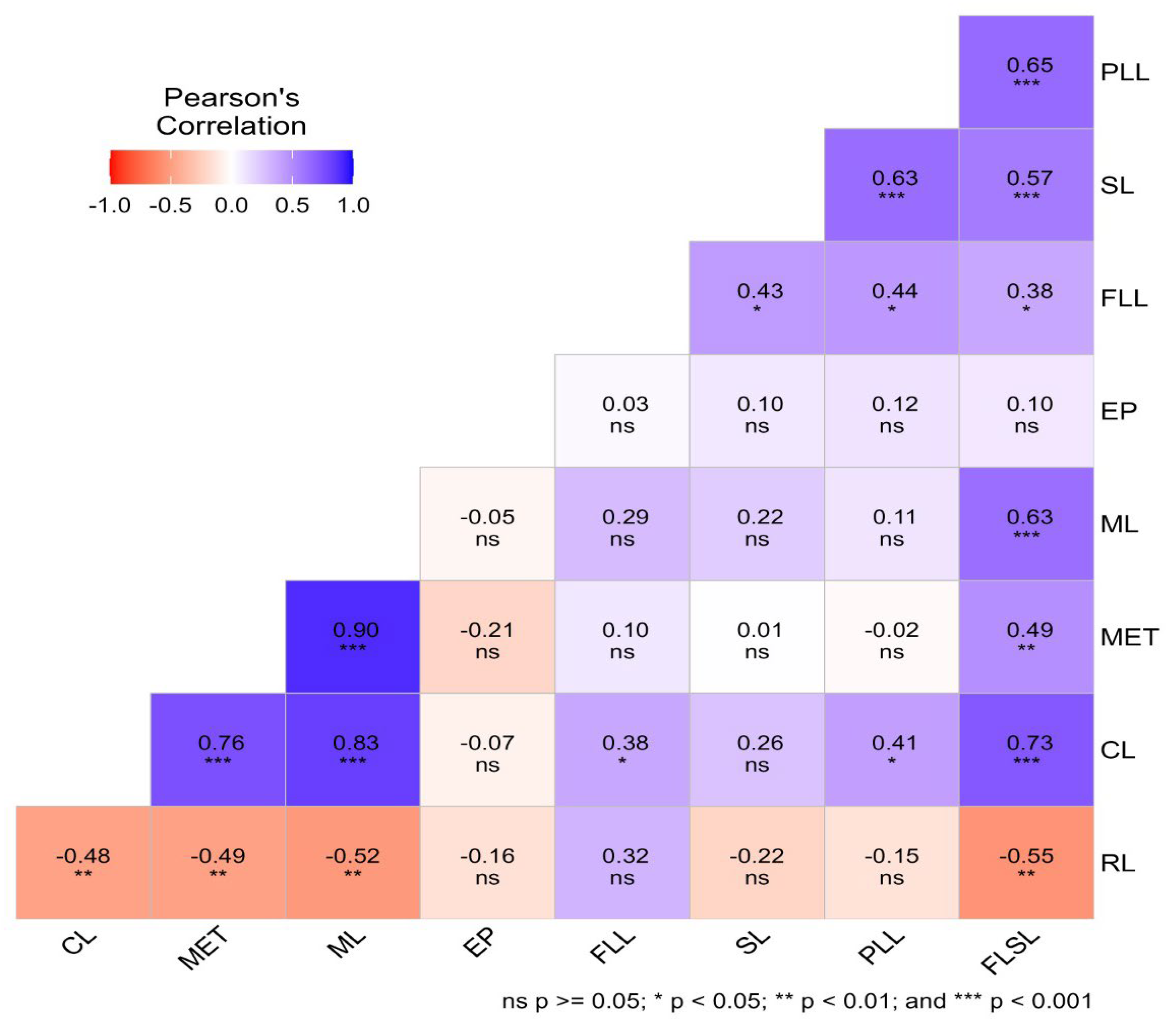
27]. These finding are in accordance with our results suggesting a positive correlation among first leaf sheath length, mesocotyl length, coleoptile length and shoot length (
Figure 1). Thus, the inclusion of growth parameters like first leaf and first leaf sheath length along with other seedling parameters in the selection criteria of a suitable cultivar for direct seeded rice will provide insight to the researcher, leading towards the selection of the most suitable cultivar for a direct seeded system.
A declining trend in root growth was recorded with increasing SD. However, the reduction in root growth was genotype-specific. Reduced root growth under deep sowing is probably due to the low respiration rate caused by limited oxygen, as reported by Fu et al. (2012) [
46]. Root growth declines under hypoxic conditions, as the oxygen limitation restricts ATP synthesis, thus reducing cell division. Further, the accumulation of lactate and ethanol as a consequence of anaerobic respiration results in the acidification of cytosol, hence arresting cell multiplication and ultimately root growth [
47].
On the other hand, hypoxia may encourage shoot elongation, as the shoot is the pathway for the plant to access atmospheric oxygen [
48]. In the current study, an increasing trend in shoot length was observed with increasing SD. Enhanced shoot growth of deep-sown rice has already been reported [
37]. In deep-sown rice, delayed emergence serves to conserve soluble sugars, which are used later to produce more energy and promote shoot growth after seedling emergence [
43]. However, longer shoots under deep sowing indicate higher utilization of the endogenous seed resources, which may exert a negative impact on seedling quality at later stages. To compensate, rice has the ability to maintain active fermentation metabolism to promote ATP synthesis for energy needed to expand cells under deep sowing [
48]. Moreover, due to higher utilization of the residual moisture and increased exposure to deeper soil nutrients, which otherwise remain unexplored by the roots, deep-sown seeds showed higher growth rate and improved plant height [
25]. Genotypes with higher ability to extend roots and shoots at 5.0 cm SD may have higher potential to withstand deep sowing, as root length is found to be positively correlated with seedling emergence [
27].
Thus, varieties with longer roots, mesocotyls, coleoptiles, prophyll leaves may have good potential to produce a uniform stand under direct seeded rice. This study illustrates the desirable traits of rice cultivars with the ability to tolerate deep sowing, which will be helpful to screen out suitable genotypes for direct seeded rice.




 ,
,