1. Introduction
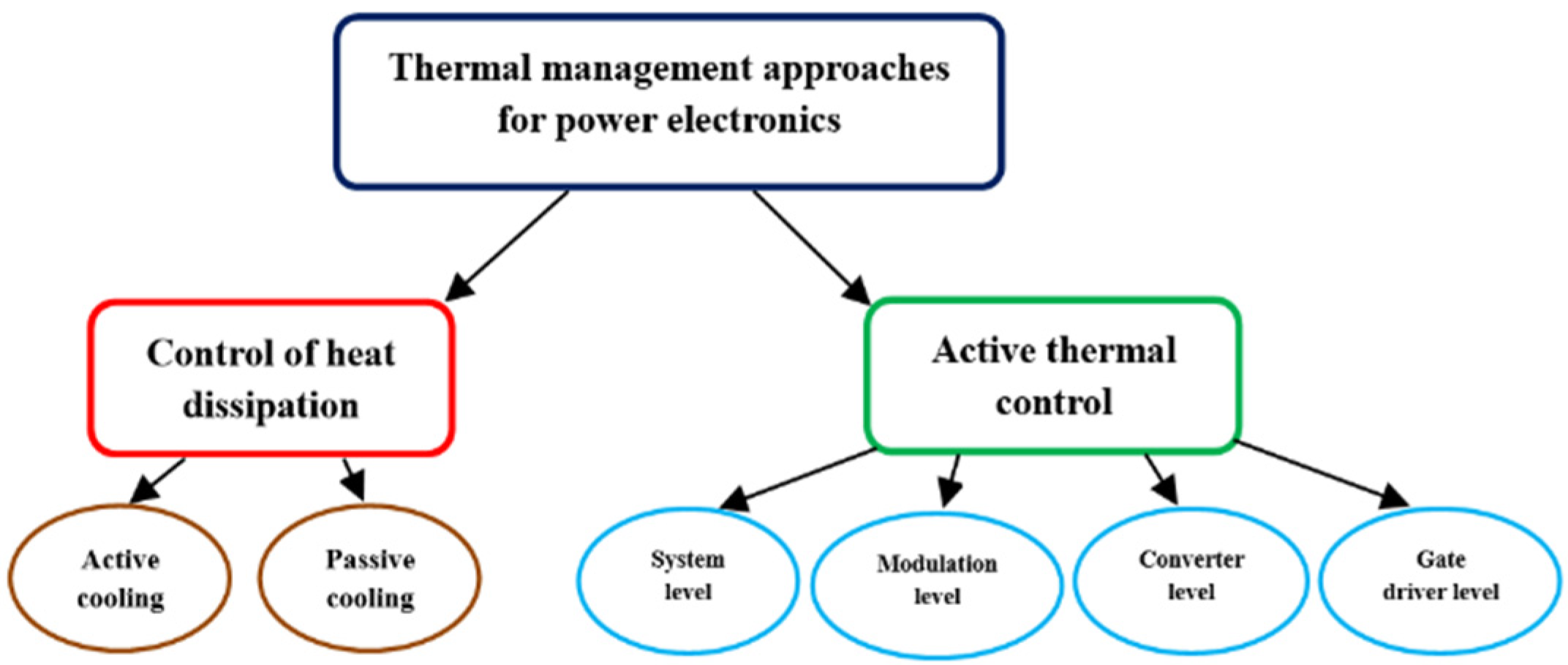
Given the need to ensure reliability, efficiency, and safety in power electronics, thermal management is crucial since overheating may reduce performance, limit lifespan, and result in safety hazards. Effective cooling techniques enable more compact designs where weight and volume are restricted while preserving the optimum temperatures for high-performance operation, energy efficiency, and industry standard compliance. Generally, power electronics thermal management could potentially be addressed in two approaches. Controlling the electrical parameters through active thermal control (ATC) is the first approach, which is devoted to controlling the temperature of the junction and minimizing a power semiconductor’s thermal cycling. For the purpose of controlling the junction temperatures in real time, ATC uses temperature-related control parameters to reduce short- and medium-term thermal cycles. By modifying the losses in the targeted devices using certain temperature-related control parameters [
1], thermal control seeks to manage the junction temperatures. The switching frequency [
2,
3], modulation method [
4], DC-link voltage [
5], gate voltage [
6], or reactive power distribution [
7] are included among these parameters. Using a variety of active and passive cooling techniques to regulate the devices’ heat dissipation is the second thermal management approach. A number of cooling techniques have been introduced in [
8,
9,
10,
11]. This method typically uses a fluid as the coolant, and depending on the kind of working fluid, either a fan or a pump is used to provide forced convection and coolant flow. When free convection is the primary heat transfer mechanism, passive techniques—also referred to as classical cooling methods—use fins and heatsinks [
12].
Figure 1 provides a global overview of thermal management approaches in power electronics, distinguishing between active control techniques and passive cooling strategies.
Two important factors and metrics influencing the development of power conversion technologies are efficiency and power density. The switching frequency may be often raised to many megahertz by utilizing GaN HEMTs. Smaller passive components can therefore be employed, perhaps contributing to an improvement in power density. GaN technology has previously been shown to be advantageous in several power electronics applications, including microgrids [
13,
14], wireless chargers [
15], EV battery chargers [
16], on-board chargers [
17], AC electric motors [
18,
19], electric cars [
20,
21,
22,
23], and resonant converters [
24].
Due to its better material qualities and application relevance, GaN has surpassed other contenders [
25]. Si, GaN, and SiC are all three different semiconductor materials whose five essential electrical characteristics are listed in
Table 1. The most crucial factors for power transistors in power conversion systems currently available on the market are conduction efficiency (on resistance), breakdown voltage, size, switching efficiency, junction temperature, current handling, and price.
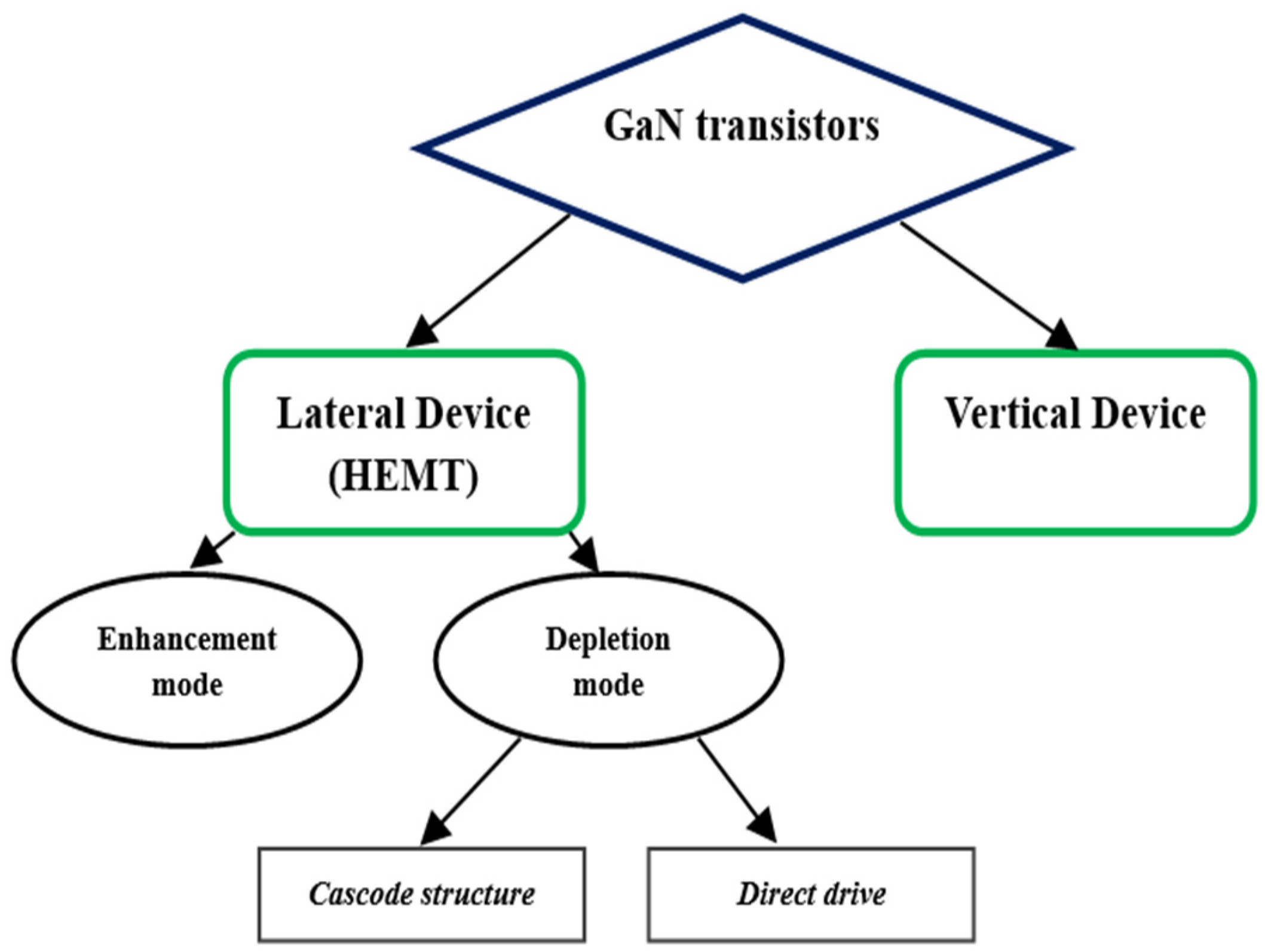
GaN transistors are classified mainly into two types based on their structure. According to
Figure 2, all of the devices that are presently available on the market belong to one of the following categories. The majority of commercially available devices [
26] are lateral GaN HEMTs, and given that vertical GaN devices are still not being commercialized and considering vertical GaN devices share structural similarities with Si and SiC devices, which have different thermal management strategies [
27] due to their larger size and fewer thermal issues. Therefore, the sole emphasis of this review paper will be lateral GaN HEMTs.
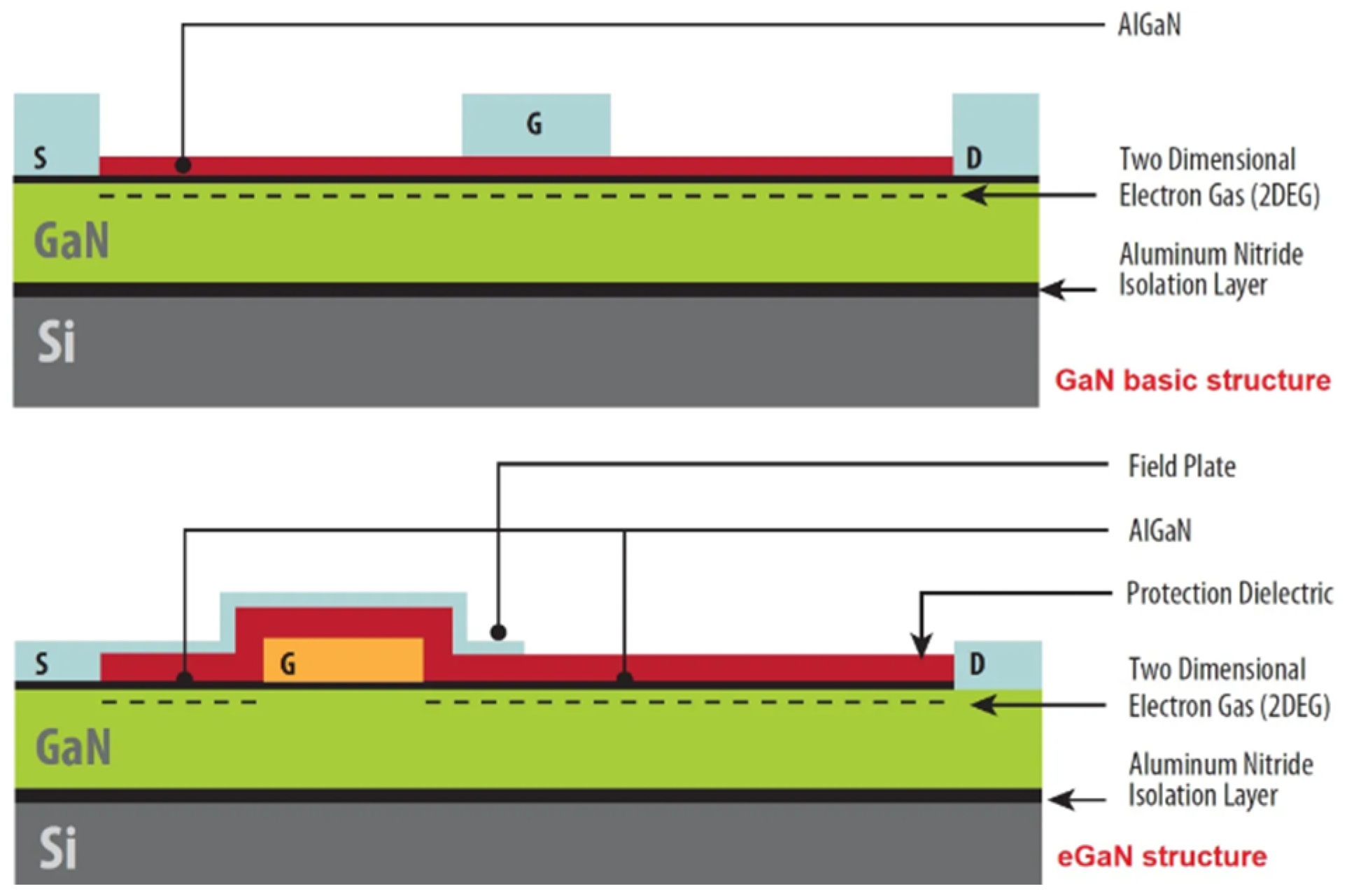
The eGaN FET (enhancement-mode GaN FET) structure is designed as a lateral device where the gate, source, and drain terminals are positioned on the same plane, allowing for high-speed switching, low on-resistance, and high-power applications,
Figure 3 illustrates its lateral structure.
With advancements in smaller die sizes and chip-scale packaging, GaN transistors have reached impressive power density levels, making effective thermal management more critical than ever for ensuring reliable performance. Ref. [
29] worked on developing a straightforward yet efficient temperature control system for GaN FETs at the chip scale. Despite the generated heat usually becoming dissipated through the heatsink attached to the substrate of the power device due to the top PCB packaging layers’ very high thermal resistance [
30,
31,
32,
33], for lateral GaN devices, the heat becomes dissipated through all the paths. Thermal management for GaN devices relies on carefully optimized heat dissipation paths, primarily directed downward and upward from the transistor. The downward path conducts heat through solder joints into the PCB, where it is either dissipated directly or transferred to a heatsink on the opposite side of the PCB. Alternatively, in the upward path, heat flows through a thermal interface material (TIM) to a heatsink mounted on top, if used, providing an additional path for cooling.
While GaN’s fast-switching capabilities offer compact and efficient power designs, they also increase heat generation, making thermal management a primary concern over other side effects such as EMI or parasitics. This review focuses solely on addressing thermal challenges, with EMI and layout parasitics discussed only when directly influencing heat dissipation.
Effective thermal management is essential for GaN transistor performance, requiring precise modeling, measurement, and layout design. Ref. [
34] discussed his encounters with GaN-based DC-DC converters’ thermal management, with particular emphasis on an interleaved buck-boost design. Thermal models simulate parasitic components, like inductances, to predict in-circuit behavior and optimize heat dissipation. GaN transistor models also incorporate temperature-dependent capacitances, resistances, and inductive elements to simulate heat generation and dissipation across various conditions. High-frequency applications, in particular, demand attention to layout and package inductances for optimal thermal performance. Accurate thermal measurement depends on high-bandwidth, low-capacitance probes with strong Common Mode Rejection Ratios (CMRR) to capture critical switching behavior, as thermal characteristics of gate-to-drain (QGD) and output capacitances (C
OSS) influence voltage transitions. PCB layout is another key factor, where inductance affects transistor temperatures through proximity effects in copper traces, vias, and overall geometry, impacting the thermal pathway and requiring design strategies to reduce hotspots. Thermal considerations also extend to current measurement systems, like coaxial shunts, which must handle thermally induced parasitics accurately, especially in high-speed switching. Thermally aware circuit simulation must include all parasitics and inductances to prevent errors in thermal predictions, ensuring robust performance in high-power applications.
GaN HEMTs require more intense heat dissipation since they have a higher heat flux density than SiC devices due to their smaller die size and lower thermal conductivity (GaN: 130 W/m⋅K against SiC: 380 W/m⋅K). Numerous attempts have been made to increase thermal management, such as PCB replacement with highly thermally conductive DBC, improving thermal dissipation performance with improved heatsinks, double-sided cooling designs, active integrated cooling approaches, and so forth [
35,
36,
37,
38,
39,
40,
41,
42,
43,
44,
45,
46].
Ref. [
47] presents a thorough examination of the thermal issues associated with GaN high-electron-mobility transistors (HEMTs), where efficient heat transfer is necessary to manage the high-power-density of GaN while preventing junction self-heating. The resistance in layers within a few micrometers of the junction can hinder heat dispersion, increasing temperatures in the device channel and affecting performance. In semiconductor devices, the occurrence of temperature rise brought on by the production of joule heat when current passes through transistor channels while the device is operating is known as the self-heating effect (SHE) [
21,
22,
48,
49,
50]. Reduced performance results from the channel temperature increase because it lowers drain current and carrier mobility and could result in a change in the threshold voltage [
51].
Ref. [
52] examines how thermal boundary resistance (TBR) affects GaN-based semiconductor devices’ heat management by contrasting different substrates and interlayer materials that attempt to minimize TBR, such as SiN and AlN. Common substrates like silicon (Si), silicon carbide (SiC), and diamond each have distinct thermal properties and compatibility levels with GaN, affecting heat dissipation. SiC, with better conductivity and lower lattice mismatch than Si, is preferred despite higher costs, while diamond, offering much higher conductivity, faces integration challenges due to lattice mismatch, which can lead to disorder and defects that undermine its thermal benefits. Transition layers like aluminum nitride (AlN) are often necessary to manage lattice mismatch, but these add their own resistance, especially when thicker layers are used, as with GaN on Si structures. Thermal Boundary Resistance (TBR) between GaN and its substrates is another significant factor; phonon scattering at these interfaces can restrict heat flow, and models such as the Diffuse Mismatch Model (DMM) and Acoustic Mismatch Model (AMM) are used to estimate these resistance limits.
A thorough analysis of the various liquid cooling approaches is presented in [
35]. Ref. [
53] explains how to anticipate the switching oscillations of GaN power devices using the high-frequency setup simulation in Ansys Q3D. Adding RC snubbers serves as the ringing mitigation strategy for the GaN-predicated driving circuit; nevertheless, this method was predicated on optimizing EMC behavior without accounting for the appearance of thermal issues. Numerous studies have focused on enhanced power module topologies to improve the performance of GaN devices [
54,
55,
56,
57].
Ref. [
58] surveyed and assessed a number of heat dissipation techniques used in GaN-based power converters with high power densities; two dissipation solutions were thoroughly examined: bottom-side dissipation utilizing thermal vias and top-side dissipation using a variety of thermal interface materials. Notably, the interior temperatures of the transistors are not uniform [
59,
60]. However, in order to simplify the model, the junction temperature was determined and maintained consistently throughout the device’s interior. The thermal behavior of GaN HEMTs was predicted using a similar thermal model. Such a thermal model represents GaN’s physical structure, or its multiple interior layers [
61,
62].
Ref. [
63] examines the thermal management issues associated with GaN power devices utilized in a 4-level totem-pole power factor correction (PFC) converter. In order to analyze aspects including copper thickness, PCB materials, and thermal via layouts in a 3.7 kW PFC configuration, 3D thermal models using FEM simulations were created. After examining several cooling methods, the study concluded that employing small heatsinks in conjunction with top-side cooling successfully reduced thermal resistance.
Ref. [
43] introduced a novel method for controlling heat in high-power GaN devices by directing water jets onto their surfaces via a 3D-printed polymer nozzle. Even during strenuous power conversion operations, it has been proven that the nozzle’s nine tiny jets can manage heat fluxes of up to 900 W/cm
2, which keeps device temperatures beneath 100 °C. After being tested on a DC-AC power converter, this cooling setup effectively dissipated up to 21 W of heat at 37 W/cm
2. Two insulation coatings were evaluated: boron nitride (BN) provided strong thermal performance but suffered corrosion, while aluminum oxide (Al
2O
3) resisted corrosion but had lower thermal conductivity. The system demonstrated strong cooling capabilities, though BN’s corrosion and the complexity of assembling the 3D-printed nozzles pose challenges. Ultimately, while the method shows promise for high-efficiency cooling, improvements in materials and design integration would be beneficial for long-term use in GaN-based devices.
Unlike existing review articles that typically focus on individual aspects of thermal management—such as packaging technologies, cooling solutions, or material-level improvements—this work provides a unified system-level analysis specifically tailored to high-power-density and high-frequency GaN-based converters. In contrast to prior surveys (e.g., [
37]), which primarily address device- or package-level thermal solutions, the present review systematically correlates packaging, PCB layout, heatsink integration, thermal interface materials, soldering technologies, and dielectric material selection within a single coherent framework.
A distinguishing contribution of this review is its explicit focus on GaN converters operating under high switching frequencies extending from several hundred kilohertz to the multi-megahertz range, where thermal, electrical, and layout constraints are strongly coupled. Furthermore, this work emphasizes design trade-offs and decision-making criteria by comparing thermal strategies not only in terms of thermal resistance but also with respect to integration complexity, manufacturability, cost, and reliability implications. By consolidating recent experimental results, numerical modeling insights, and material innovations published predominantly after 2020, this review aims to serve as both a comprehensive reference and a practical design-oriented guide for GaN system developers.
This review organizes thermal management strategies for GaN-based power converters into a structured, multi-level framework that reflects both physical hierarchy and design workflow.
Section 2 focuses on packaging-level thermal extraction, including flip-chip, wafer-level packaging, and double-sided cooling technologies.
Section 3 examines embedded and hybrid cooling strategies that extend thermal paths beyond the package by integrating heat-spreading and extraction mechanisms within the PCB and substrate stack-up.
Section 4 and
Section 5 introduce thermal modeling approaches and temperature measurement techniques, respectively, which are essential for quantitatively evaluating thermal behavior and validating advanced cooling concepts.
Section 6 addresses thermal management through PCB layout optimization, with emphasis on copper geometry, thermal vias, and current path shaping for lateral heat spreading.
Section 7 reviews external heat extraction using heatsinks, including passive, forced-air, and liquid-cooled solutions.
Section 8 discusses thermal interface materials (TIMs), followed by
Section 9 on soldering technologies and
Section 10 on dielectric material selection. Throughout the review, each domain is discussed with respect to GaN-specific constraints such as localized hot spots, thermal boundary resistance, and compact form factors, and comparative data and trade-offs are provided to support informed thermal design decisions.
2. Thermal Management Strategies: Packaging
2.1. Role of Packaging in GaN Thermal Management
In GaN-based power converters, packaging plays a central role in thermal management by defining the primary heat extraction paths from the active channel to the ambient environment. Unlike silicon and SiC devices, lateral GaN HEMTs exhibit extremely high heat flux densities due to their small die size and localized two-dimensional electron gas (2-DEG) channel. As a result, thermal resistance within the package—rather than the heatsink alone—often becomes the dominant contributor to junction temperature rise. Packaging must therefore simultaneously fulfill electrical, mechanical, and thermal functions, including minimizing parasitic inductance, ensuring mechanical integrity under thermal cycling, and providing low-resistance heat-spreading paths. This makes packaging-level thermal design a key enabler for high-frequency and high-power-density GaN operation.
Packaging strategies can be broadly categorized into single-sided and double-sided cooling. Single-sided designs are easier to implement but suffer from limited thermal spreading. In contrast, double-sided cooling packages (e.g., flip-chip, DSC) enable heat flow from both top and bottom interfaces, improving thermal dissipation under high-power conditions. Embedded cooling and hybrid structures (covered in
Section 3) offer alternative routes for thermal optimization using PCB-integrated channels and advanced layouts.
Packaging in GaN-based converters serves a dual purpose: ensuring electrical integrity and enabling efficient heat extraction from the die to ambient. Unlike conventional Si devices, GaN HEMTs face unique packaging constraints due to their lateral or vertical topology, small die area, and elevated heat flux. As such, the packaging must address not only electrical isolation and mechanical integrity, but also minimize parasitic inductance and thermal resistance.
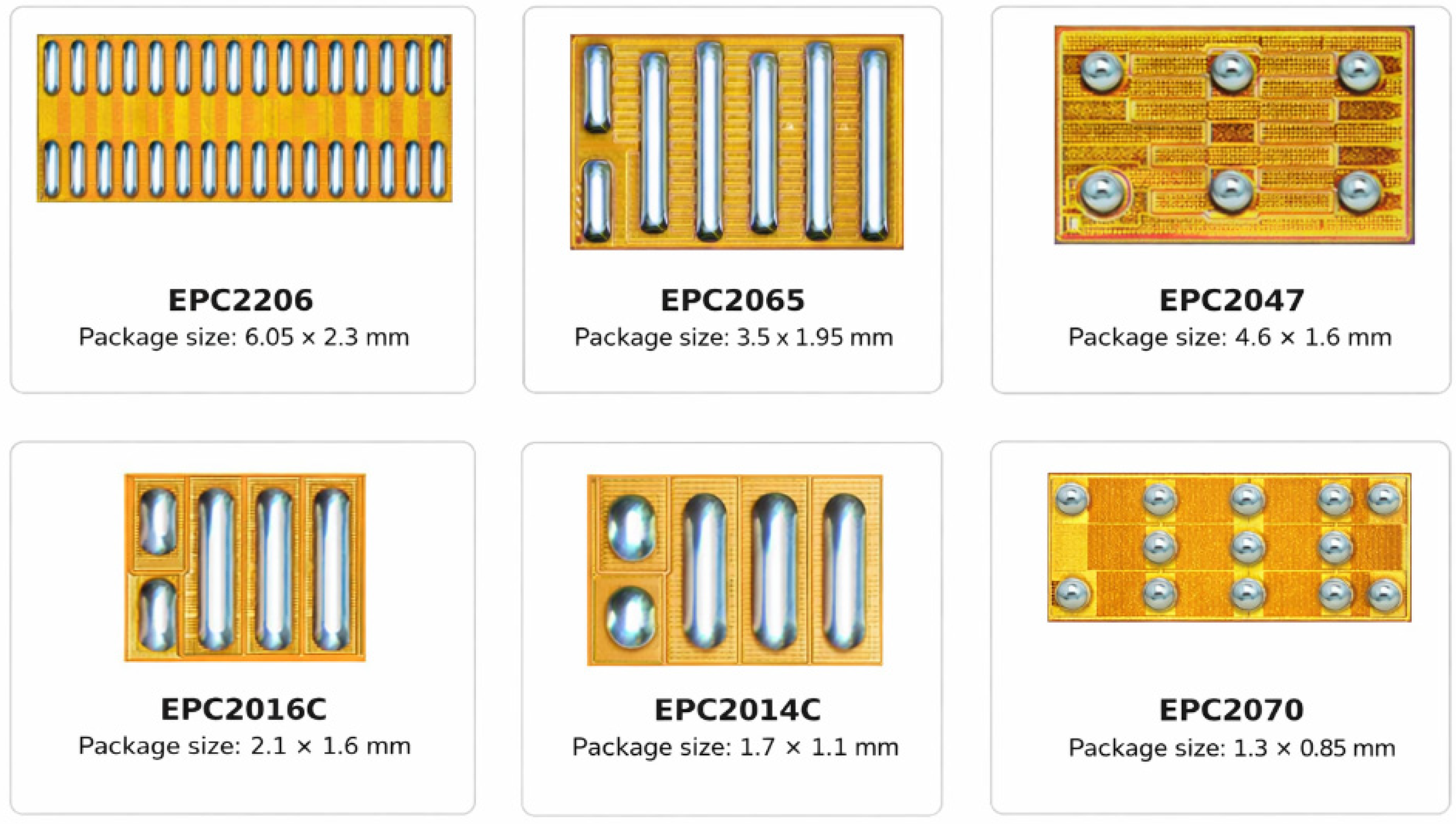
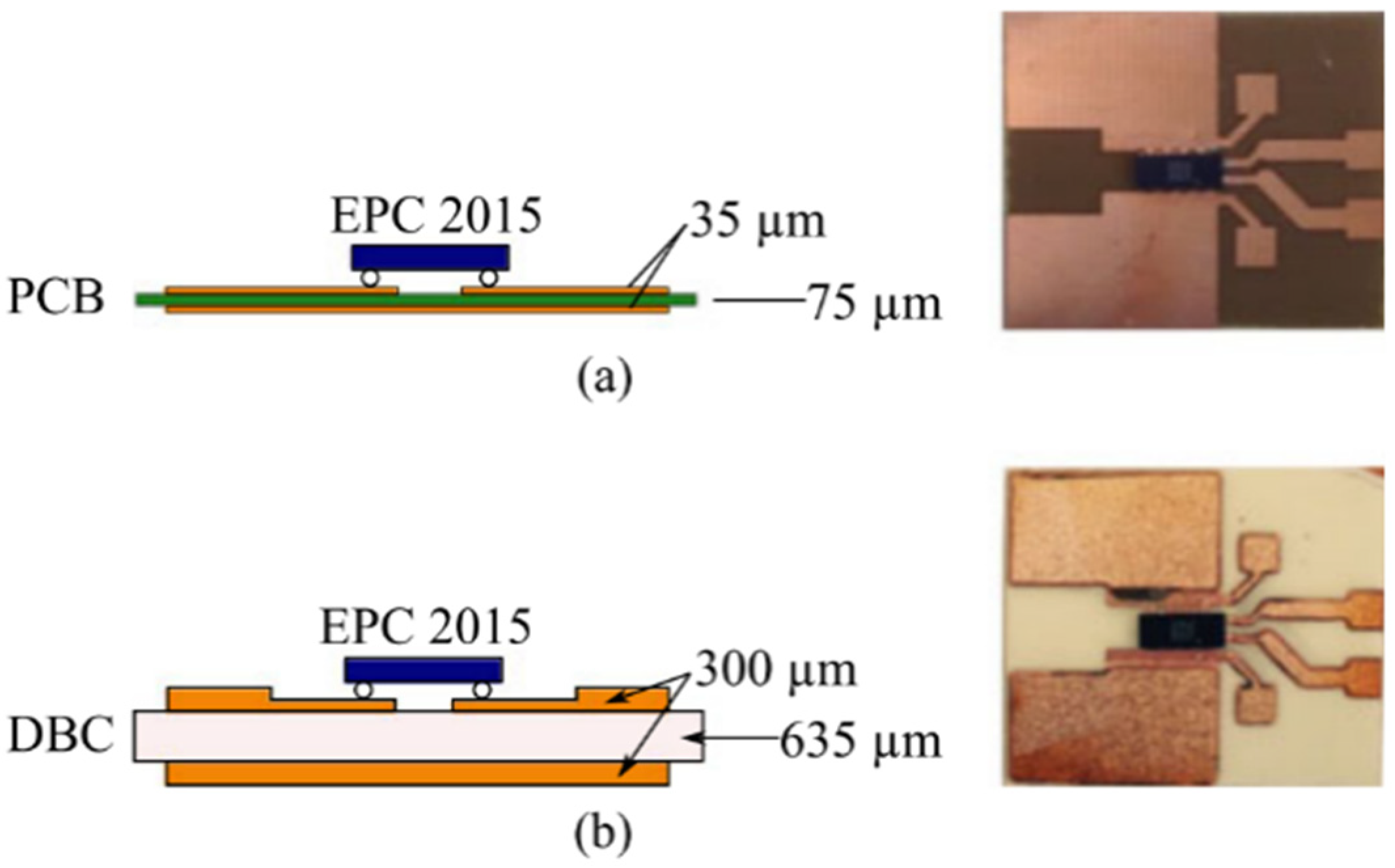
Wafer Level Packaging (WLP) of GaN transistors integrates packaging directly at the wafer stage, reducing size, enhancing thermal performance, and lowering parasitic losses, making it ideal for high-frequency and high-power applications. Pictures of WLP GaN transistors made by EPC are shown in
Figure 4.
2.2. Substrate and Interface Materials
Substrate materials in GaN packaging—such as aluminum nitride (AlN), silicon nitride (Si
3N
4), and diamond composites—are selected for their high thermal conductivity, mechanical integrity, and electrical insulation. These substrates serve a structural role, facilitating heat spreading from the GaN die to the system-level heatsink. While TIMs also influence heat transfer, they are functionally distinct and will be discussed in detail in
Section 8. To provide an early comparative overview,
Table 2 summarizes key characteristics that differentiate substrates from TIMs in GaN power packaging applications:
GaN devices are developed to switch high current in a tiny package, which poses serious thermal problems [
26,
64,
65]. The heat dissipation of lateral GaN dies needs to be carefully controlled because of the high current density and the small conductive channel in the lateral structure. Its two-dimensional (2-D) electron gas layer’s conductive channel generates most of the heat. Because the 2-D electron gas is adjacent to the electrical pad, a considerable amount of heat can still escape through its upper surface even though the substrate is the major heat-dissipation channel. The region that experiences the highest Junction temperature (T
j) in a power transistor is then this channel that forms underneath the gate. In the context of a bottom-side cooling package, a substrate with a high thermal conductivity (k
T) and decreased thickness might assist in “pulling” the heat downward and out from the channel. Using SiC and diamond as the substrate for GaN HEMTs is one example of this [
66,
67,
68,
69,
70]. Ga
2O
3 devices with low k
T can also use this technique [
71,
72,
73,
74,
75,
76].
Due to its lower specific ON resistance, GaN HEMT holds the potential to significantly boost efficiency and power density, specifically for likely megahertz (MHz) applications, along with reduced switching loss [
77,
78,
79]. Its lateral device form, tiny die size, high heat flux density, and fast switching, however, push the boundaries of packaging by requiring incredibly minimal parasitic inductances and thermal resistances [
80,
81,
82]. GaN HEMT power modules with low parasitics and high thermal resistance remain difficult to package [
82,
83,
84]. Therefore, to expand GaN HEMT utilization in high-frequency and high-power-density converters, advancements in packaging technology are required [
35,
85].
2.3. Packaging Topologies for GaN HEMTs
Different packaging topologies offer markedly different thermal, electrical, and reliability performances in GaN-based converters. Wafer-Level Chip-Scale Packages (WLCSP) and flip-chip packages minimize parasitic inductance and enable compact layouts, but their limited mechanical compliance and small solder interfaces make them sensitive to thermal cycling and solder fatigue. Conventional leaded packages such as TO-220 or TO-247 provide robust mechanical attachment but suffer from high loop inductance and relatively poor thermal spreading, limiting their suitability for high-frequency GaN operation. PCB-embedded and hybrid PCB–DBC packages improve both heat-spreading and electrical performance by shortening thermal and current paths; however, they require complex fabrication processes and higher manufacturing cost. Consequently, no single packaging topology is universally optimal, and the selection must balance thermal resistance, switching speed, mechanical reliability, and system-level integration constraints.
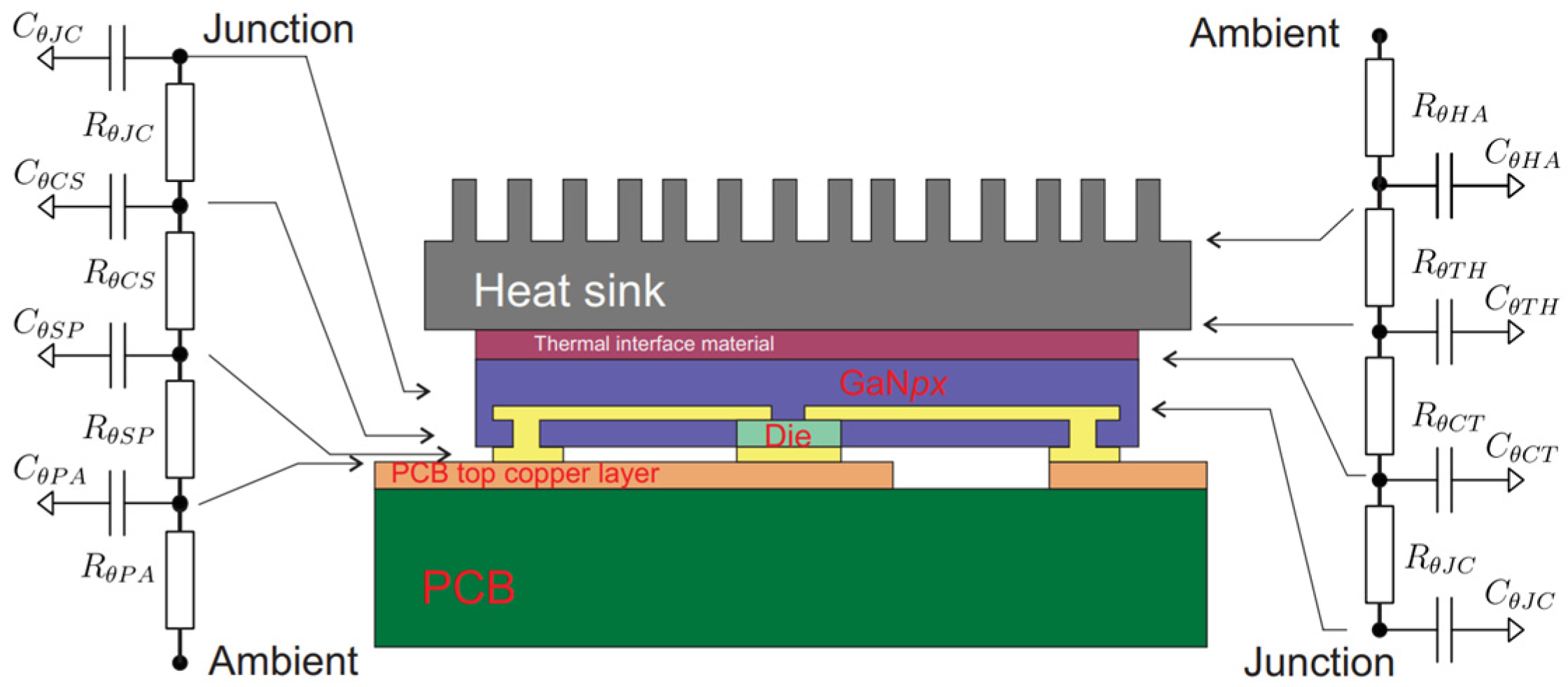
Figure 5 illustrates a representative thermal resistance network commonly used to model heat flow in GaN-based power devices. The junction-to-case resistance (Rjc) captures heat conduction from the active GaN channel through the die and package, while the case-to-heatsink resistance (Rcs) accounts for interfacial effects governed by surface roughness, contact pressure, and the selected thermal interface material. The heatsink-to-ambient resistance (Rsa) represents convective and radiative heat transfer to the surrounding environment. For lateral GaN HEMTs, heat may split between top-side and bottom-side paths depending on the packaging architecture, making accurate estimation of each resistance component essential for predicting junction temperature under realistic operating conditions.
2.4. Double-Sided and Hybrid Cooling Structures
To overcome the limitations of single-side thermal paths, modern GaN packaging explores double-sided cooling (DSC) and hybrid structures. These involve copper posts or filled vias to connect top and bottom surfaces to heat spreaders, enabling more uniform heat dissipation. Some approaches embed microchannels in ceramic or polymer substrates for direct liquid cooling. Hybrid structures like those shown in [
86] integrate symmetrical copper planes, top- and bottom-side heat paths, and low-inductance layouts. These reduce the thermal gradient across the die and lower junction temperatures by over 30% compared to conventional packages, making them suitable for EV and telecom applications. Several investigations have demonstrated that optimizing device packaging improves device thermal efficiency [
71,
87,
88,
89,
90,
91].
There have been further investigations into vertical GaN transistors’ temperature-dependent properties and dynamic switching capabilities [
92,
93,
94,
95,
96]. Vertical GaN transistors are packaged similarly to their SiC equivalents. For instance, it recently came to light that the TO-247 packed vertical GaN fin junction-gate field-effect transistor (FinJFET) has superior thermal efficiency at high temperatures and also under avalanche and short-circuit situations [
97,
98,
99].
In accordance with a newly developed multichannel structure, GaN power HEMTs have recently been proved to operate up to 10 kV [
100] and are commercially accessible in the voltage ranges of 15–900 V [
26,
101]. For GaN HEMTs, thermal management poses challenges for two reasons. Initially, all commercial GaN power HEMTs are made on inexpensive Si or sapphire substrates that include a multi-layer buffer area along with a significant dislocation density across the substrate and the GaN device layers. Second, compared to vertical devices, the current in lateral GaN HEMTs is spatially limited, which exacerbates the nonuniformity of heat generation and dissipation.
Ref. [
102] proved that a GaN-on-diamond HEMT with an identical active area has a power density that is three times higher than a GaN-on-SiC HEMT. It has been shown in the literature that GaN HEMTs could be covered with high thermal conductivity heat-spreading layers utilizing nanocrystalline diamond (NCD) [
103,
104,
105]. According to electrothermal modeling, NCD-capped GaN HEMTs have a 30% lower peak Tj than a reference HEMT [
106]. E-field crowding can be further decreased in NCD by incorporating p-type doping [
107].
2.5. Soldering and Die-Attach Technologies
In GaN-based converters, solder joints serve both mechanical and thermal roles, connecting the power device to the PCB or module substrate while providing a heat dissipation path. Due to the small die size and high heat flux density of GaN transistors, even modest resistance at the solder layer can create thermal bottlenecks. Furthermore, mismatches in coefficients of thermal expansion (CTE) between GaN, substrates, and solder can introduce severe thermomechanical stress during cycling.
Traditional solder materials like Sn63Pb37 and SAC305 are widely used due to their manufacturability and low melting points. However, their moderate thermal conductivity and fatigue performance can become limiting in high-power or high-reliability designs. Advanced materials such as nano-silver pastes or AuSn eutectic alloys provide improved conductivity and resistance to thermal fatigue but at increased cost and process complexity. Packaging approaches like flip-chip and GaNPX, which eliminate wire bonds, transfer all mechanical stress into the solder layer, making material choice even more critical.
Table 3 summarizes commonly used soldering materials for GaN power modules, highlighting trade-offs in thermal performance, fatigue life, and integration complexity.
Modeling of solder fatigue [
108] using approaches like the Coffin-Manson equation can estimate failure cycles based on thermal swing (ΔT) and mean temperature (Tm), helping designers extend reliability in GaN systems. Flip-chip designs using nano-silver bumps have shown stress reduction to <80 MPa under fast switching. Despite high performance, challenges remain with manufacturability and interface reliability at large scale. Nevertheless, the literature remains extremely limited in terms of comparative studies on the effect of solder materials on thermal performance and fatigue resistance in GaN-based high-power-density converters. This represents a critical gap for future research and standardization efforts [
109].
At this stage, it becomes clear that the quality of soldering directly impacts the thermal and mechanical reliability of GaN devices. Materials such as nano-silver solder exhibit remarkable heat conductivity but need meticulous application to avert thermal stress and fatigue. Resolving soldering issues enhances thermal pathways and extends operational durability, especially in circumstances with quick temperature fluctuations.
Overall, advanced packaging architectures for GaN HEMTs demonstrate significant potential for managing the extreme heat flux densities associated with high-frequency and high-power-density operation. By optimizing heat extraction paths within the package and minimizing parasitic inductances, modern packaging solutions contribute simultaneously to improved thermal and electrical performance. The practical effectiveness of these approaches, however, depends on system-level constraints that extend beyond thermal resistance alone, motivating a broader discussion of packaging-level trade-offs and limitations in the following subsection.
2.6. Packaging-Level Thermal Trade-Offs and Limitations
Despite major advances in GaN packaging technologies, packaging-level thermal optimization inevitably involves critical trade-offs. Achieving low thermal resistance often requires thicker copper layers, high-conductivity substrates, or double-sided cooling architectures, which increase cost, weight, and manufacturing complexity. Highly integrated solutions—such as embedded or hybrid PCB–DBC packages—offer excellent thermal and electrical performance but reduce reworkability and increase sensitivity to thermo-mechanical stress during power and temperature cycling. Similarly, advanced materials with superior thermal conductivity, including diamond substrates or nano-silver die-attach, introduce challenges related to scalability, long-term reliability, and compatibility with standard industrial assembly processes. Consequently, packaging optimization for GaN devices must be application-driven, balancing thermal performance against reliability, cost, integration density, and manufacturability rather than targeting minimum thermal resistance alone.
Table 4 summarizes the thermal, electrical, and integration-level trade-offs associated with commonly adopted GaN packaging strategies, highlighting that no single solution is universally optimal across all applications.
Although packaging defines the primary thermal extraction paths at the device level, its performance is ultimately constrained by the available heat-spreading area and the interfaces connecting the package to the surrounding system. As power density and switching frequency continue to increase, packaging-level solutions alone may become insufficient to maintain acceptable junction temperatures. This has motivated the development of embedded and hybrid cooling strategies that extend thermal paths beyond the package by integrating heat extraction and spreading mechanisms directly within the PCB and substrate stack-up. The following section examines these approaches and their role in addressing the thermal limitations of conventional packaging in high-power-density GaN converters.
3. Embedded and Hybrid Cooling Strategies
In this review, a clear distinction is made between packaging-level thermal management and board-integrated cooling strategies. Packaging-level solutions, discussed in
Section 2, are confined to the device package itself and focus on internal heat extraction paths such as die-attach, substrates, and double-sided cooling within the package boundaries. In contrast, the embedded and hybrid cooling strategies examined in this section extend thermal paths beyond the package by integrating heat-spreading and extraction mechanisms directly within the PCB and substrate stack-up. This hierarchical separation reflects the physical progression of heat flow from the device package into the surrounding system and avoids overlap between package- and board-level thermal design considerations.
For power electronics and high-frequency applications, embedding GaN HEMTs in PCBs has several benefits, including improved heat management, less parasitic losses, and space savings. Heat dissipates more efficiently when it comes into close contact with the PCB material, reducing operating temperatures and increasing reliability. Additionally, embedded arrangement shortens connections, which reduces inductance and boosts switching effectiveness. Because surface area is reduced, this method enables compact designs, which makes it perfect for high-density industries like aerospace and automotive. Thanks to improvements in PCB manufacturing capabilities, GaN HEMTs could be effectively embedded inside the PCB [
110,
111,
112].
It is crucial to modify the traditional packaging for high-speed GaN devices or eliminate the bonding wires out of the package. If not, there may be a risk of catastrophic voltage overshoot, parasitic ringing, electromagnetic interference (EMI), and reliability problems. Ref. [
110] suggests using PCB embedding technology for developing an ultrathin GaN module with ultrasmall parasitic inductances; using FEA simulation, meticulous electro-thermal codesign was carried out.
An asymmetric and thermally optimized PCB-embedded GaN transistor in a single chip package has been investigated in [
113]. It has been proven that this technique can reduce transistor rising temperatures and maximize output power in low-voltage DC/DC converter systems, enabling high power density operation. Minimal thermal resistance throughout the transistor and the heatsink is required for safe operation. However, the drawback of this technique is that the use of weak bulk via limits larger output powers, leading to failures at higher output currents.
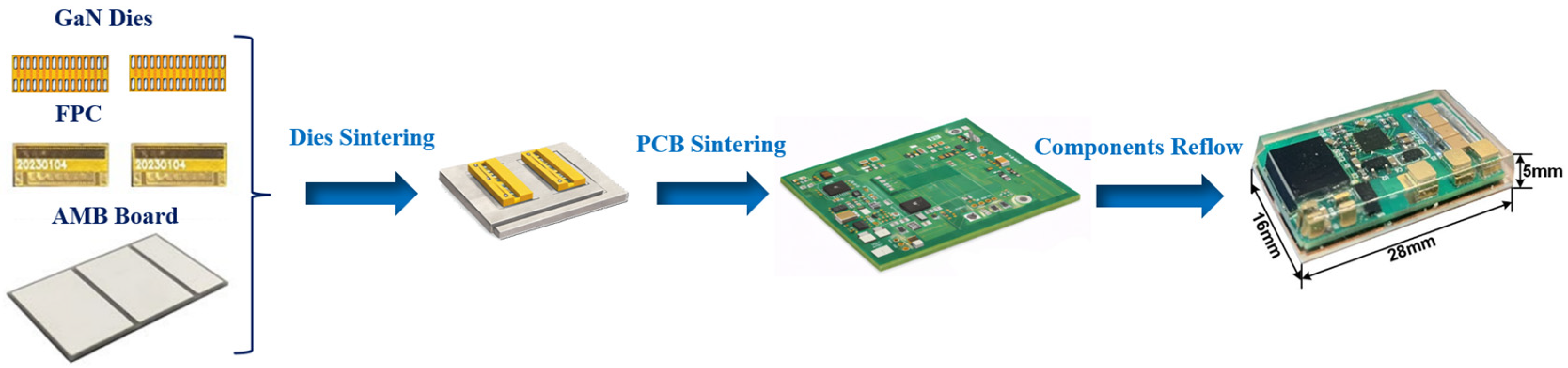
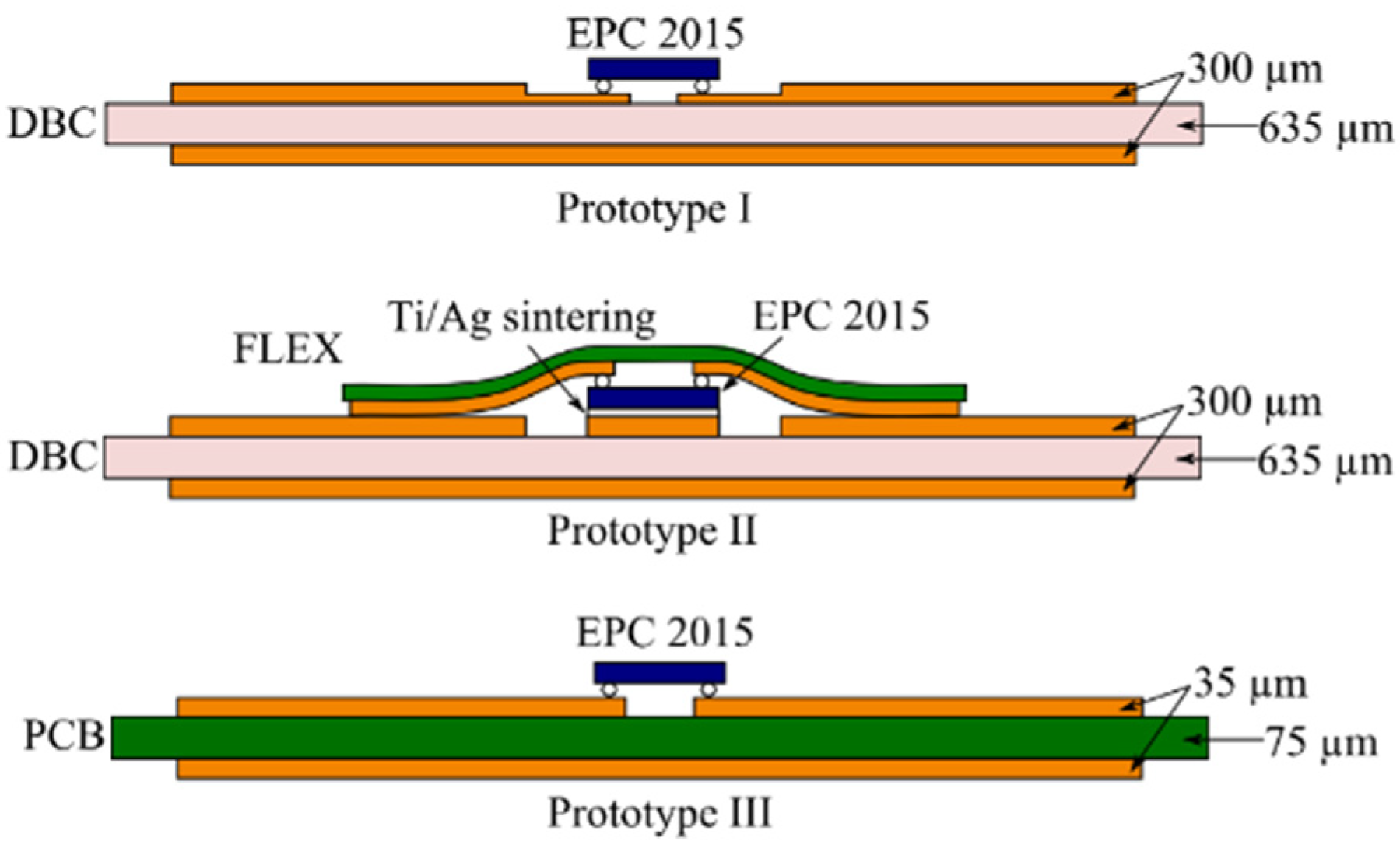
For the purpose of promoting high-power-density converters, ref. [
114] presents the development of a GaN HEMT integrated power module employing silver sintering. The module seeks to enhance thermal management while reducing parasitic inductances in gate and power loops. Its low thermal resistance (0.05 °C/W from junction to case) along with minimal inductance values (1.7 nH for the power loop and approximately 2 nH for the gate loop) are made feasible due to silver sintering and a multi-layer PCB design, which makes it perfect for fast-switching applications. Nevertheless, the high reflow temperatures required might induce warping, which affects long-term durability and necessitates cautious handling during production. It also should be addressed that the use of a multi-layer PCB and silver sintering increases manufacturing complexity and costs.
Figure 6 presents how the integrated GaN HEMT power module is realized using silver sintering
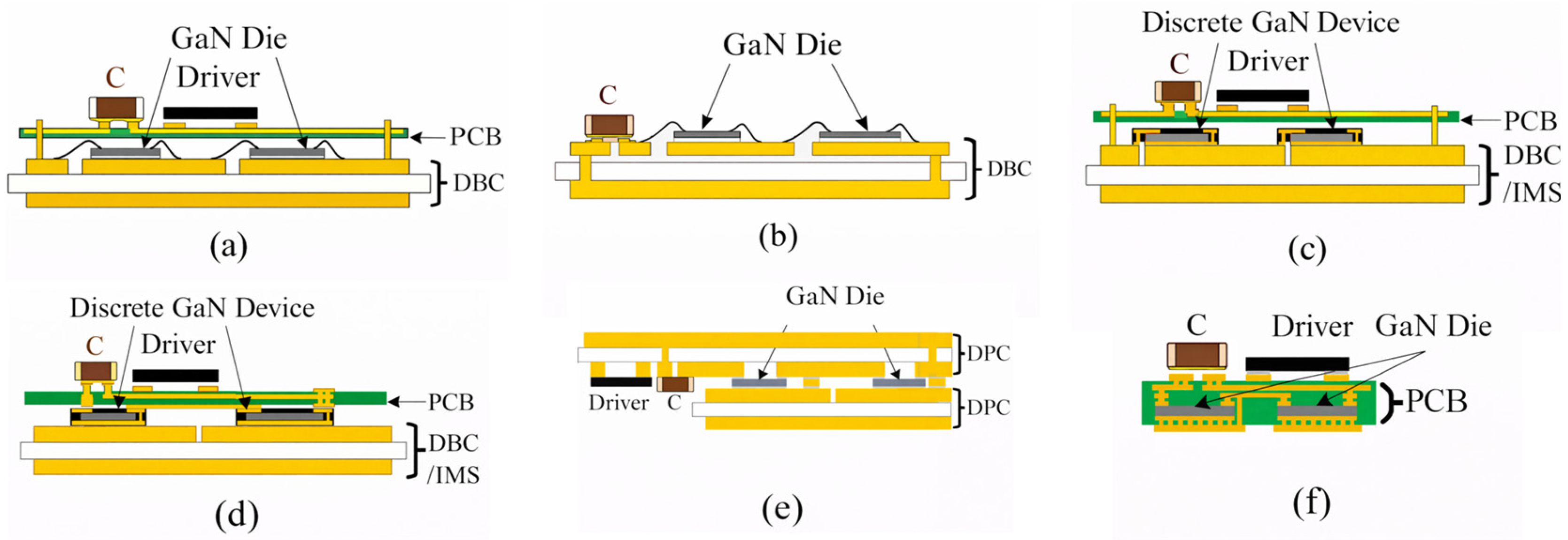
Figure 7 compares several representative GaN HEMT packaging configurations based on IMS, DBC, and embedded architectures, illustrating their respective thermal and integration concepts. As shown in
Figure 7a, ref. [
57] suggests a traditional housing-type package for high-power GaN HEMT applications that use DBC substrate to enhance thermal performance.
Figure 7b shows an enhanced package based on traditional wire-bonding, in which flux cancelation is achieved by using the opposite side copper layer of the DBC substrate [
115,
116]. Bottom-side cooling discrete devices, like GaN Systems’ integrated GaN HEMTs with the GaNPX package, are repackaged within a low-profile module made for silicon carbide (SiC) devices rather than being packed as bare dies [
56]. As shown in
Figure 7c, an insulated metal substrate (IMS) is used instead of the DBC substrate, and a PCB with integrated gate drivers and decoupling MLCCs is positioned above the module [
117]. Discrete GaN HEMTs enabling top-side cooling are additionally repackaged, as seen in
Figure 7d. In contrast to
Figure 7c, the devices’ top cooling side is soldered on a DBC board, and the other side is soldered using a driver board based on a PCB [
118]. For GaN HEMTs, a double-sided cooling package is also being studied [
119], illustrated in
Figure 7e. To resolve the insulation issue and further lower parasitic inductance, the PCB embedded package is suggested for use within the fabrication phase [
110].
Ref. [
120] focuses on the development of an embedded cooling RF silicon interposer for a GaN (Gallium Nitride) transceiver/receiver (TR) array, designed to manage the intense heat generated by high-power RF devices in a compact package. The cooling system uses a micropin-fin flow boiling setup within the silicon interposer, which helps manage localized heat spots by efficiently dissipating heat. However, the design has drawbacks, including complexities in integrating such a cooling system and challenges with the dielectric properties of deionized water, particularly at certain frequencies.
Embedded strategies are attractive since they have demonstrated several benefits altogether. Nevertheless, manufacturing challenges exist, as PCBs must handle high power densities and ensure quality despite limited accessibility.
System efficiently blends passive and active cooling techniques to handle challenging heat dissipation requirements. By maintaining moderate temperatures, this combination increases efficiency and extends the life of the converter. GaN discrete devices are now exposed to sophisticated wire-bonded packaging thanks to all attempts of device manufacturers [
121].
Due to the lateral structure’s short conductive channel and high current density, which result in a smaller size within a specific current compared to Si and SiC, the heat dissipation of lateral GaN dies requires being carefully planned. Conventional wire bonding methods [
56,
57,
122] are reliable and low-cost for integrating GaN HEMTs. However, the lateral power loop created by the addition of bonding wires results in substantial power loop inductance. To reduce power loop inductance, a vertical power loop can be achieved by implementing through-holes in the ceramic substrate; however, this comes at the penalty of higher costs and fewer layers available for design freedom. Numerous concepts that are hybrid have been adopted in [
117,
118,
123,
124].
A number of advanced packages, such as GaNPX, PQFN, and LGA, etc., have also been produced without bonding wires. Certain power modules were suggested, based on the discrete GaN devices that made use of these sophisticated packages: Discrete GaN HEMTs GS66508T with GaNPX packaging were used in a hybrid GaN power module made up of PCB and direct-bonded copper (DBC), which was presented in [
118]. However, the realized power loop inductance of 2.65 nH is substantial for high switching frequencies GaN applications. Two DBC ceramic substrates were layered over the GaN bare dies in [
125] to create a double-sided cooling 650 V/30 A GaN module that integrated gate drivers and decoupling capacitors.
In contrast to many hybrid approaches [
117,
118,
123,
124,
126,
127] proposes a hybrid PCB-on-DBC architecture power module design with an additional heat dissipation channel to allow for a double-sided cooling effect and reduced thermal impedance. The design has a DBC at the bottom and a multilayer PCB at the top. The hybrid design incorporates the benefits of both the low-cost PCB and the highly thermally conductive DBC substrate. Two GaN dies are positioned in the intermediate layer between the PCB on top and the DBC on the bottom. The design’s high production cost and weight in comparison to previous designs render it unsuitable for deployment in electric vehicle applications, despite its higher overall performance.
In [
127], a small-sized PCB-on-DBC (direct bonded copper) GaN half-bridge power module including integrated gate drivers, low thermal resistance, low inductance, and double-sided cooling (DSC) has been suggested. In order to achieve DSC and increased design freedom, hybrid PCB and DBC technology with multilayer connections is investigated as a cost-effective alternative. Nevertheless, the switching frequency is 600 KHz; it remains below the megahertz range.
Ref. [
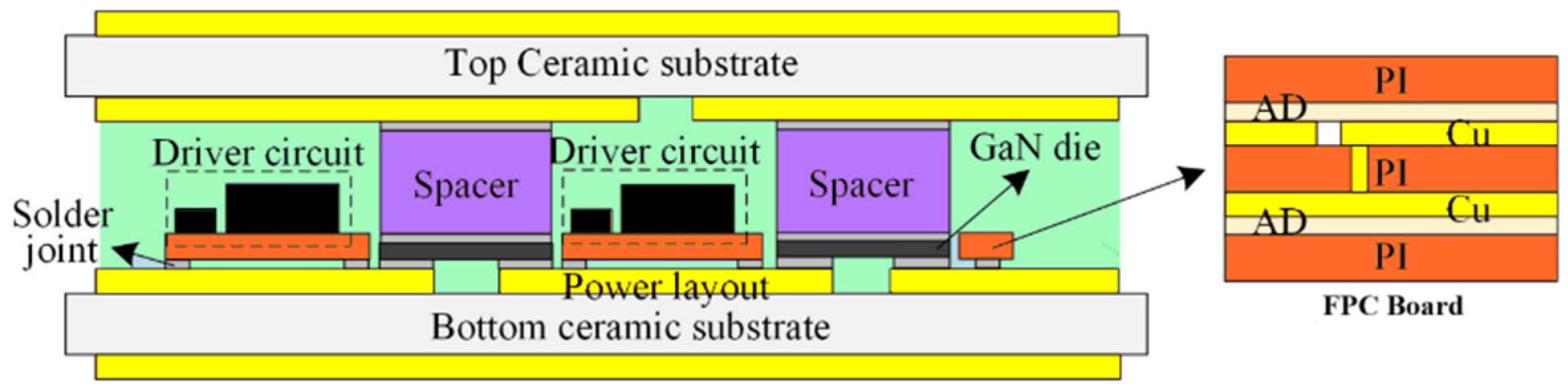
86] focuses on a hybrid double-sided cooling (DSC) packaging intended for multichip GaN power modules that guarantee adequate current sharing and can withstand high switching speeds. A flexible printed circuit (FPC) board and two ceramic substrates are combined in the DSC package to provide a uniform power and gate configuration and enable cooling from both sides of the GaN HEMTs. It has been proven that it reduces power loop inductance to 0.65 nH and maintains stable current sharing even at fast switching rates, reaching up to −29.3 A/ns and 204 V/ns. The package shows improved thermal performance, with lower junction temperature rises compared to single-sided cooling. However, integrating the FPC and ceramic substrates complicates the manufacturing process, and the package must handle high thermal and mechanical stresses, particularly under high applied pressure. The hybrid package’s structure also presents challenges in achieving ideal thermal resistance values due to the complex thermal coupling involved.
Figure 8 depicts the hybrid double-sided cooling (DSC) package structure proposed in [
86], designed to enhance both thermal performance and current sharing in multichip GaN modules.
These representative embedded and hybrid cooling architectures demonstrate that extending thermal paths beyond the device package can significantly enhance heat extraction and reduce parasitic effects in high-power-density GaN converters. However, the thermal behavior of such multi-layer and multi-interface structures is inherently complex, involving coupled heat generation, lateral and vertical heat spreading, and strong interactions between electrical and thermal phenomena. Evaluating their effectiveness therefore requires quantitative analysis capable of capturing localized heat sources, interface resistances, and transient operating conditions. This motivates the use of dedicated thermal modeling approaches, which are essential for predicting temperature distribution, identifying hot spots, and guiding the optimization of advanced cooling strategies in GaN-based power converters.
4. Thermal Modeling Approaches for GaN-Based Power Converters
Thermal modeling is a fundamental tool for the design, optimization, and reliability assessment of GaN-based power converters. Due to the high-power-density, localized heat generation, and strong electro-thermal coupling inherent to GaN HEMTs, accurate thermal models are essential for predicting junction temperature, identifying hot spots, and evaluating cooling strategies before hardware implementation. Depending on the required accuracy and computational cost, thermal modeling approaches can be broadly classified into compact thermal models, numerical finite-element models, and electro-thermal co-simulation frameworks.
4.1. Compact Thermal Models
Compact thermal models (CTMs) represent the thermal behavior of power devices using equivalent thermal resistance–capacitance (RC) networks. These models are widely used in circuit-level simulations due to their low computational cost and ease of integration into SPICE-based tools, serving as a bridge between detailed physical simulations and system-level design optimization. Recent studies have demonstrated that combining compact RC representations with experimental calibration can significantly improve hotspot temperature estimation in GaN HEMTs under both transient and steady-state operating conditions by coupling electrical measurements with thermal simulations [
128]. In addition, advanced electro-thermal co-simulation frameworks integrating compact thermal networks into electrical device models have been reported to accurately reproduce DC and pulsed I–V characteristics at elevated temperatures, highlighting the strong interaction between self-heating and electrical performance in GaN devices [
129]. Furthermore, extensions of conventional CTMs increasingly incorporate temperature-dependent material properties and self-heating feedback effects, which is particularly relevant for high-frequency GaN power converters where thermal transients directly influence switching behavior and long-term reliability [
130]. Despite these advances, compact thermal models generally assume a spatially uniform junction temperature and remain limited in their ability to capture localized hot spots arising from non-uniform heat generation in lateral GaN HEMTs.
4.2. Finite-Element Thermal Modeling
Finite-element method (FEM)–based thermal modeling provides a spatially resolved representation of heat generation and dissipation within GaN devices, packages, and PCBs. By solving the heat conduction equation over realistic three-dimensional geometries, FEM models can account for material anisotropy, thermal boundary resistance at heterogeneous interfaces, and multilayer stack-ups often encountered in advanced packaging. This approach is particularly valuable for lateral GaN HEMTs, where highly localized heat generation near the two-dimensional electron gas (2-DEG) channel leads to steep thermal gradients that are not captured by simple compact models. Recent work has demonstrated FEM-based electrothermal simulations for wafer-level packaged GaN transistors, enabling accurate prediction of hotspot temperature distributions under realistic operating conditions [
131]. Dynamic thermal coupling effects, calibrated against transient measurements, have also been investigated using FEM models, showing how layout and material parameters influence overall device thermal impedance [
132]. In addition, near-junction thermal transport models based on FEM have been developed to assess the role of GaN/diamond heterostructures and thermal boundary resistance on junction temperature profiles, offering design guidelines for high heat flux applications [
133]. Despite these advances, the fidelity of FEM models strongly depends on reliable material property data and interface modeling, and their computational cost can limit use in iterative design loops, motivating hybrid modeling workflows that combine FEM with reduced-order models.
4.3. Electro-Thermal Co-Simulation
Electro-thermal co-simulation combines electrical circuit simulation with dynamic thermal models to capture the mutual interaction between temperature and electrical behavior in power devices. In GaN-based converters, temperature variations directly affect key electrical parameters such as on-resistance, threshold voltage, carrier mobility, and switching losses, creating strong feedback between electrical operation and thermal state. Recent electro-thermal co-simulation frameworks have demonstrated accurate reproduction of DC and pulsed I–V characteristics of GaN HEMTs by coupling SPICE-based electrical models with compact or FEM-derived thermal networks, enabling time-dependent prediction of junction temperature under realistic operating conditions [
129]. Such approaches are particularly relevant for high-frequency GaN converters, where switching losses and thermal transients are tightly interdependent and cannot be treated independently. Furthermore, studies incorporating transient thermal impedance and dynamic self-heating effects have shown that electro-thermal coupling significantly influences both steady-state performance and short-term thermal excursions in GaN devices [
132]. Despite its high fidelity, electro-thermal co-simulation requires careful calibration of both electrical and thermal sub-models and is associated with increased computational complexity, which may limit its applicability in large-scale parametric design optimization.
4.4. Modeling Trade-Offs and Practical Considerations
Each thermal modeling approach presents inherent trade-offs between accuracy, complexity, and computational efficiency. Compact models are suitable for early-stage design and control development but lack spatial resolution. FEM-based models provide detailed thermal insight but are time-consuming and dependent on accurate material and interface data. Electro-thermal co-simulation offers the most realistic representation of GaN converter behavior, yet at the cost of increased modeling effort and simulation time. Consequently, an effective thermal design workflow for GaN-based converters often combines multiple modeling levels, using FEM simulations to extract parameters for compact or electro-thermal models employed at the system level.
While thermal modeling provides powerful insight into heat generation, diffusion, and temperature distribution in GaN-based power converters, its accuracy strongly depends on experimental validation. Model assumptions related to material properties, interface resistances, and heat source localization must be verified under realistic operating conditions. Consequently, reliable temperature measurement techniques are essential not only for model calibration and validation, but also for assessing the effectiveness of thermal management strategies during converter operation. The following section reviews the principal temperature measurement approaches applicable to GaN devices and discusses their respective advantages and limitations.
5. Temperature Measurement Techniques for GaN Devices
Accurate temperature measurement is essential for validating thermal models, assessing reliability, and ensuring safe operation of GaN-based power converters. Due to the small die size, high power density, and fast switching behavior of GaN HEMTs, conventional temperature sensing techniques developed for silicon devices are often insufficient. Temperature gradients can be highly localized, and rapid thermal transients may occur during switching events, making both spatial and temporal resolution critical. As a result, a range of electrical, optical, and embedded sensing techniques has been developed to characterize the thermal behavior of GaN devices.
5.1. Electrical Temperature Measurement Methods
Electrical temperature measurement techniques exploit the temperature dependence of intrinsic device parameters, commonly referred to as temperature-sensitive electrical parameters (TSEPs). In GaN HEMTs, parameters such as on-state resistance (RDSon), threshold voltage, gate leakage current, and body-diode or reverse conduction characteristics exhibit predictable temperature dependence and have been investigated for junction temperature monitoring under realistic operating conditions [
134]. Among these, RDSon-based sensing is widely used due to its simplicity and compatibility with in situ measurements during converter operation; recent experimental studies have demonstrated that, under controlled conditions, dynamic RDSon can be calibrated against junction temperature even during switching tests, albeit with complexity introduced by voltage stress effects [
135]. Threshold voltage and other TSEPs, including low current saturation voltage and body-like diode characteristics, have also been analyzed for steady-state temperature estimation, with mixed results in linearity and stability depending on device structure and measurement setup [
136]. However, electrical methods require careful calibration and separation of self-heating effects from electrical stress, and their accuracy can be degraded at high switching frequencies due to parasitic inductances and dynamic current sharing, necessitating hybrid approaches and careful experimental design to isolate true temperature effects.
5.2. Optical and Infrared-Based Techniques
Optical temperature measurement techniques provide non-contact, spatially resolved thermal characterization of GaN devices and are particularly valuable for analyzing localized self-heating phenomena. Infrared (IR) thermography is commonly employed to visualize surface temperature distributions and identify hot spots at the package or PCB level; however, its accuracy is limited by emissivity uncertainty, diffraction-limited spatial resolution, and the inability to directly access junction temperature in encapsulated GaN HEMTs [
137]. To overcome these limitations, advanced optical techniques such as micro-Raman spectroscopy and thermoreflectance microscopy have been increasingly applied to GaN devices, enabling localized temperature measurements with micrometer- and sub-micrometer-scale spatial resolution directly in the vicinity of the two-dimensional electron gas (2-DEG) channel [
138]. These methods are particularly well suited for investigating self-heating effects, quantifying thermal gradients, and validating finite-element thermal models of GaN HEMTs. Nevertheless, their application remains largely confined to laboratory environments due to the need for specialized optical setups, careful calibration, and limited accessibility during normal converter operation.
5.3. Embedded and Sensor-Based Temperature Monitoring
Embedded and sensor-based temperature monitoring techniques integrate thermal sensors directly within the package, die, or PCB, enabling real-time temperature observation during normal converter operation. Common approaches include embedded thermocouples, resistance temperature detectors (RTDs), and patterned thermistor strips integrated onto device surfaces. Recent work has demonstrated on-chip array junction temperature monitoring units for GaN HEMTs using patterned thermistor strips, which provide spatially resolved temperature information with high accuracy when compared to thermal imaging, contributing to improved reliability assessment in high-frequency, high-power-density operation [
139]. In addition, monolithic integration of micro-thin-film thermocouples onto GaN HEMT channels has been shown to enable direct temperature measurement with high spatial resolution and sensitivity, bypassing some limitations of off-chip sensing methods [
140]. While embedded sensors provide robust and continuous thermal data, they typically measure temperature at locations offset from the actual junction or thermal hotspots, leading to potential underestimation of peak channel temperature in GaN HEMTs. Accurate interpretation therefore requires correlation with thermal models to reconstruct junction temperature from measured points and account for spatial thermal gradients through the device and packaging [
141].
5.4. Comparison and Practical Limitations
Each temperature measurement technique presents inherent trade-offs between accuracy, spatial resolution, temporal response, and implementation complexity. Electrical methods are well suited for in situ monitoring but rely on accurate calibration and are sensitive to parasitic effects. Optical techniques offer high spatial resolution but are limited by accessibility and experimental complexity. Embedded sensors enable continuous monitoring but often fail to capture localized hot spots at the GaN channel. Consequently, comprehensive thermal characterization of GaN-based converters typically combines multiple measurement approaches, supported by thermal modeling to bridge the gap between measured and actual junction temperatures.
From a reliability perspective, thermal management plays a decisive role in determining the long-term performance and lifetime of GaN-based power converters. Elevated junction temperatures, steep thermal gradients, and repetitive thermal cycling accelerate degradation mechanisms such as charge trapping in the GaN buffer, dynamic on-resistance increase, threshold voltage drift, and thermo-mechanical fatigue in solder joints and die-attach layers. Unlike conventional silicon devices, the highly localized heat generation in lateral GaN HEMTs makes them particularly sensitive to non-uniform temperature distribution. Consequently, effective thermal design must not only reduce peak junction temperature but also mitigate thermal gradients and temperature swings in order to ensure reliable operation under realistic mission profiles, especially in automotive and high-power-density applications.
While device- and package-level thermal strategies are essential, their effectiveness is strongly influenced by how heat is distributed and extracted at the board level. The following section therefore focuses on thermal management through PCB layout, examining how copper geometry, via placement, and dielectric properties govern heat diffusion in high-power-density GaN converters.
6. Thermal Management Through PCB Layout
Efficient thermal management in GaN-based power converters depends not only on packaging or cooling devices, but also on how heat is guided through the PCB itself. Key design variables such as copper trace geometry, thermal via placement, copper thickness, and component distribution significantly affect board-level heat conduction.
6.1. Copper Traces
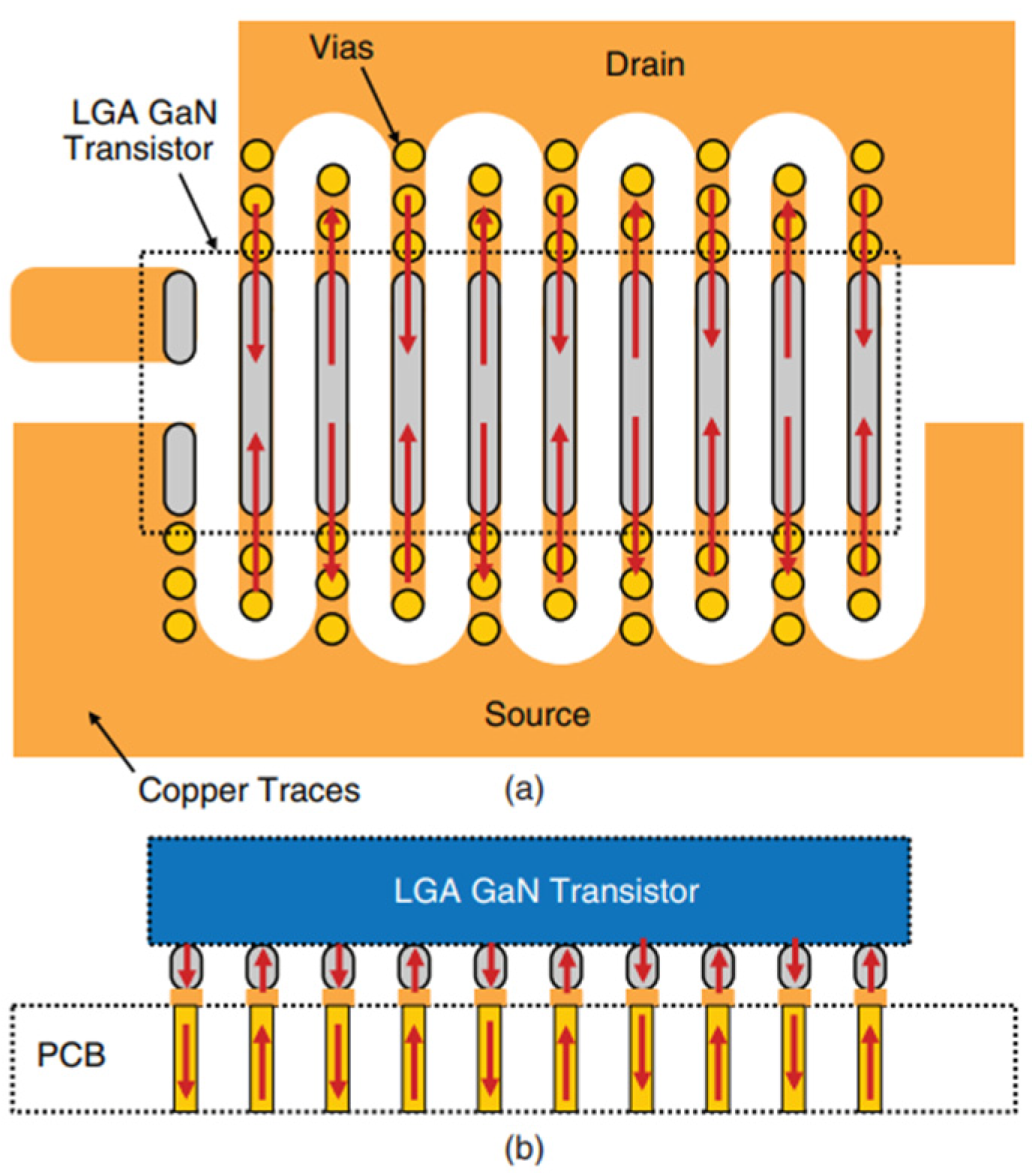
In the design phase of high-power-density GaN-based converters, PCB copper tracks play a critical role in thermal management by influencing heat dissipation and overall efficiency. Copper’s high thermal conductivity helps spread heat away from GaN devices, reducing local hot spots and improving reliability. Copper track width, thickness, and arranging might be optimized by designers to improve heat flow throughout the PCB. Using thicker copper layers or adding thermal vias are other viable options, particularly when significant power densities are involved. Balancing these copper track designs with the converter’s electrical performance requirements is key, as it ensures both efficient heat management and minimal electrical losses, making this a vital consideration in high-power applications. However, solutions like thermal vias may enhance thermal management but simultaneously generate EMC issues by increasing parasitic inductances, which impact the reliability of the high-power-density converter, so finding a compromise during the designing stage is crucial.
An example of thermal vias for an LGA GaN transistor is presented in
Figure 9.
For GaN HEMTs deployed on PCB substrates, ref. [
142] investigated three different heat management techniques: thermal vias, thicker copper traces, and Peltier modules. The Peltier module with the high top layer copper thickness, however, appeared to be the best combination.
Ref. [
143] emphasizes the use of commercial discrete power GaN FETs (GaN Systems ‘GS61004B’) for board optimization in conditions where convection from ambient air is absolutely forbidden. Finite element analysis is used to examine the temperature and electromagnetic behaviors, which are the main reliability issues with the board design. Large pads and/or copper traces are required since heat is mostly carried via the bottom electric connections of the chosen transistor due to its absence of a heatsink flange. It is crucial to keep in mind that a thermal model of a PCB or power module made with COMSOL Multiphysics or similar CAD software may be easily integrated with a structural mechanics investigation for reliability numerical analysis. Given that GaN devices feature almost innovative inner structures and odd pins or pads, the main drawback of the used approach is the amount of time needed to design and construct a prototype as well as the setup of spontaneous test benches for an appropriate verification and validation of the modeling.
An alternative strategy for thermal management for an integrated motor drive (IMD) with high power density that makes use of GaN HEMTs is given by [
144]. An efficient bottom-side cooling technique without the need for a heatsink has been researched using an improved PCB design. To increase the thermal performance and lower the parasitic inductances, four distinct PCB design parameters—copper thickness, area, via pitch, and distance between devices—were taken into consideration. The area (>2.5 in2) and thickness (>2 oz/ft2) of the copper have been shown to have the greatest influence on the thermal performance of GaN HEMTs. Nevertheless, the multilayer architecture that is being proposed is extremely large, expensive, and complex.
6.2. Parasitic Elements
While parasitic inductances can indirectly influence heat generation through switching losses, their discussion remains peripheral in this review. Only parasitic effects that directly modify thermal resistance paths—such as copper trace design and via placement—are included in subsequent sections.
Switching losses in hard-switched GaN converters include E
oss (energy stored in output capacitance) and E
oss (equivalent energy stored in output capacitance) losses, as well as turn-on/turn-off voltage-current (VI) overlap losses. The area where the voltage and current waveforms overlap throughout the transistor’s turn-on and turn-off phases is known as the voltage and current overlap losses, which are particular to hard-switching. E
oss and E
qoss losses are caused by the drain-source capacitances (C
oss) in GaN HEMTs and only occur during the turn-on phase [
145,
146]. The transistor’s C
oss capacitance is the source of E
oss. The C
oss discharges through the transistor when the drain-source voltage decreases during the transistor’s switching process. Developing suitable cooling solutions for the power transistors to guarantee that they consistently run within safe temperature limits becomes easier with an understanding of these losses.
Ref. [
147] provides an accurate analytical model of GaN HEMTs that optimizes deadtime for increased efficiency by accounting for the circuit’s parasitic inductances, nonlinear capacitances, particular reverse characteristics, etc. LTspice simulation is used to validate the proposed model initially. Simulation in LTspice has confirmed the viability of a new parasitics-based current measurement technique that was offered for experimental validation. The proposed analytical model of GaN HEMTs was then validated by experiments.
Ref. [
148] examines the impact of heat conductivity and parasitic elements on PCB switching loops. Three synchronous boost converters with GaN transistors had been designed, created, and evaluated in order to assess various PCB layout types. The following converter configurations were used: basic 2-layer circuit with transistors cooled from below; more complex 4-layer PCB with the same transistors interspersed; 4-layer PCB with transistors cooled from above.
Due to the influence of PCB track capacitances and parasitic inductances, high switching speeds of GaN transistors would deteriorate their otherwise excellent switching properties [
149,
150]. Consequently, the reduced inductance structure of the gate-source driving circuit and the drain-source power circuit must be taken into account when designing power converters using GaN transistors.
The removal of stray inductances is not nearly as critical as thermal design. Tests in [
148] have demonstrated that additional layers may negatively impact converter efficiency and that 2-layer architecture could result in an overall slightly <0.1% more efficiency compared to 4-layer design, despite the risk of drain-source overvoltage impulses at the boost transistor in a converter with a 2-layer PCB design. Ref. [
151] emphasizes PCB parasitic capacitance in GaN-Based Full Bridge converters and examines the extra switching loss caused by them. In addition to explaining parasitic capacitance loss, the entire bridge model containing PCB parasitic capacitance—which encompasses both the power loops and the control circuits—was given.
6.3. Gate Loop
In high-power-density GaN converters, the gate loop and driver circuitry are crucial not just for achieving efficient switching but also for managing heat. The gate driver is responsible for precisely controlling when and how the GaN transistors switch on and off, and how well it does this directly affects power losses, which turn into heat. By minimizing gate loop inductance and optimizing driver placement, designers can reduce unnecessary switching losses and minimize heat generation. A well-designed gate loop allows for cleaner and faster switching, decreasing thermal stress on components. The driver’s layout, along with its thermal characteristics, plays a key role in managing the converter’s thermal profile, ensuring reliable operation at high frequencies and power densities. Controlling the GaN HEMTs involves reducing the gate loop inductance. Furthermore, the power loop’s high parasitic components will result in increased switching losses and voltage overshoot across the lateral GaN HEMTs, reducing their reliability and long-term sustainability [
152].
The gate loop is essential for minimizing parasitic inductance and resistance, which are frequent challenges in high-speed GaN transistors; reducing these parasitics helps prevent excess heat from oscillations and voltage spikes. The gate driver further influences thermal management by controlling switching behavior, including voltage rise and fall times. The gate driver could optimize both switching and conduction losses, directly impacting heat generation through adjustable parameters like gate resistance (RG) and a two-step design for precise dv/dt and di/dt control. An active thermal control technique is introduced in [
153], where the gate driver dynamically adjusts switching and conduction losses based on thermal conditions to reduce thermal cycling and stabilize temperatures, especially at lower power levels. This approach, by tuning gate driver parameters to mitigate thermal cycling, helps reduce mechanical stress and prolongs device life, effectively balancing efficiency with thermal reliability in high-power-density applications.
Deadtime possesses a significant impact on the conduction losses of GaN HEMTs [
154]. Reverse conduction can occur in GaN HEMTs [
155,
156]. However, because the voltage drop exceeds that of diodes, the reverse conduction losses are significant [
157]. There are mainly two methods used to decrease reverse conduction losses. The first strategy is cutting down on dead time since losses occur during this period due to reverse conduction. The second method is to switch it off by adjusting the gate-source voltage.
With the aim to minimize power electronic interfaces (PEI), ref. [
158] provides an overview of circuit modeling, switching methods, and active gate drive circuits for GaN devices. Numerous methods from the literature were examined and sorted to describe the present status of GaN-based high-frequency PEI.
6.4. Power Loop
In GaN high-power-density converters, the power loop plays a significant role in thermal management by influencing how efficiently power flows through the system and how much heat is generated as a result. The power loop includes the main current path for power delivery, and its design—specifically, the layout and minimization of inductance—can reduce conduction losses and switching losses, both of which contribute to heat buildup. By keeping the power loop short and using wider, low-resistance traces, engineers can cut down on conduction and switching losses that lead to unwanted heat. In addition to improving heat distribution and dissipation, this increases the converter’s reliability and enables it to manage higher power levels without overheating.
High-power-density GaN-based converters require an enhanced layout technique that offers the advantages of a single-sided component PCB design, consistent inductance independent of board thickness, magnetic field self-cancelation, and reduced loop size, yielding excellent performance for both single and multilayer architecture. The magnetic energy stored within the loop determines its inductance; by taking advantage of the connection between neighboring conductors to create magnetic field self-cancellation, the total loop inductance may be further reduced. The device’s total inductance could also be substantially reduced by magnetic field self-cancellation when the drain and source terminals on one side are interleaved to create several tiny loops with opposing currents [
159].
By reducing power loop inductance along with thermal resistance near the chip-scale package (CSP) FETs, the PCB power loop layout may be in optimized in tandem for both electrical and thermal performance. Using an EPC2218 200V, 8 mΩ GaN FET, ref. [
160] presents an enhanced PCB designing method for CSP power semiconductors that concurrently lowers power loop inductance and thermal impedance from junction to ambient. It starts by reviewing designing strategies for reducing power loop inductance and then demonstrates how they might not always be the most thermally efficient. Next, an alternative design that both maximizes thermal performance and maintains electrical efficiency is suggested. Nevertheless, the production cost of this design is high, and its size weakens the advantage of GaN transistors in terms of compact converters.
The enhanced performance of GaN FETs presents two primary issues. Firstly, parasitic inductance of semiconductors and the circuits they occupy needs to be carefully tracked in order to achieve faster switching. Second, the transistors’ decreased size reveals a less surface area for heat to flow out of the device, which might make controlling the functioning temperature more challenging [
29].
Due to a comparatively higher junction to ambient thermal resistance, the heat released, particularly during switching events or transient changes, is transformed into an increase in the temperature of the GaN material and integrated silicon substrate [
161]. These problems need to be extensively examined while taking layout concerns and electrical insulation constraints into account in order to increase the reliability and efficiency of GaN HEMTs [
119,
161,
162,
163].
A double-sided cooled, gate driver-integrated 650V/60A GaN half-bridge phase-leg power module with simultaneous optimization of stray inductance, stray capacitance, and thermal resistance is developed in [
126,
164] adopting a co-design, co-optimization approach. Thermal resistance along with power loop inductance per die were tuned to 0.31 °C/W and 0.91 nH, respectively. The parallel GaN chip’s dynamic current distribution and thermal performance have been enhanced. Optimized capacitance and stray inductance lead to more dependable and stable operation.
Ref. [
165] offers a multi-physics analysis of the power loop design in GaN transistor implementation, whereby a different layout is suggested and a GaN transistor (GS66504B) is used to conduct a multi-physics performance analysis across several PCB designs. A multi-physic study of the power loop architecture has been established by evaluating the parasitic inductance and thermal distribution of each arrangement. In contrast, the reduced configuration offers a significant inductance compared to typical designs and has no significant thermal management consideration during the design phase, although the lowest power loop inductance was 2.32 nH.
Full-bridge and half-bridge designs are commonly used to manage high power levels and improve efficiency. Full-bridge structures are suitable for higher applications due to how they can manage higher power output and provide better control over current flow. Half-bridge designs, on the other hand, offer simplicity and efficiency with fewer components, which can help reduce size and cost. Ref. [
166] Presents a thorough analysis of the hard-switching half-bridge design.
Table 5 summarizes key PCB layout parameters that influence thermal performance and their typical design ranges in GaN-based power converters:
It has been well demonstrated that the PCB layout profoundly influences the thermal performance of GaN-based devices. The strategic arrangement of components, appropriate copper thickness, and thermal vias provide enhanced heat dissipation, hence minimizing hotspots. On the other side, it is important to note that parasitic inductances and electromagnetic interference (EMI) provide issues in high-speed switching situations. By meticulously balancing these aspects, PCB designs may enhance both thermal and electrical performance, ensuring reliability in high-power applications.
Even with advanced packaging and optimized layout, external heat extraction remains essential for high-power applications. The following section examines how heatsink designs—both passive and active—can be tailored for GaN-based systems to meet stringent thermal demands.
7. Thermal Management Using Heatsinks
The selection of external cooling solutions for GaN-based power converters is strongly influenced by the distinctive thermal characteristics of GaN devices, namely extremely high heat flux densities concentrated over very small die areas. Unlike silicon-based power devices, where heat spreading occurs over larger junction regions, lateral GaN HEMTs generate localized hot spots that can exceed several hundred W/cm2 even at moderate power levels. As a result, heatsink selection for GaN systems cannot be based solely on total power dissipation, but must also account for local heat flux density, cooling efficiency near the package interface, and compatibility with compact, high-frequency converter architectures.
Heatsinks are essential components in GaN-based thermal management, enabling efficient heat extraction from compact, high-power devices. Their performance depends on material (typically aluminum or copper), geometry (fin shape, height, and spacing), and the cooling mechanism (natural or forced convection). In surface-mount GaN packages, top-side or multi-surface cooling enables direct thermal paths from the die to ambient, minimizing reliance on PCB thermal vias. Bottom-side cooling is common in embedded designs but can introduce layout complexity. Integration with TIMs—such as gap fillers or greases—further reduces thermal contact resistance.
Table 6 compares passive and active heatsink configurations used in GaN-based converters, evaluating their thermal resistance and cooling efficiency across different power levels.
The choice between passive and active heatsink technologies depends on power level, spatial constraints, and reliability requirements. Passive finned sinks remain dominant in low-to-moderate power systems, especially where cost and simplicity are priorities. For higher power densities, embedded heat pipes and vapor chambers offer improved thermal spreading without large airflow demands. Liquid cold plates, while offering unmatched thermal resistance, require pumps, flow control, and sealing, making them suitable for mission-critical applications like EV onboard chargers or telecom backplanes.
In an attempt to improve heat dissipation in high-power applications such as electric vehicles, ref. [
167] focused on thermal management strategies for GaN power transistors, evaluating different TIMs and heat spreader designs to minimize thermal resistance across the transistor and heatsink while controlling stray capacitance to limit electromagnetic interference (EMI). The study shows that a copper heat spreader combined with optimized TIMs can reduce thermal resistance by up to 30%, improving heat management without increasing EMI, which supports higher power density and efficiency. However, the added volume may affect compactness in high-density setups.
Ref. [
168] examined innovative thermal management solutions for a lightweight, three-level GaN inverter aimed at hybrid and electric vehicle applications, delving into several key strategies: optimizing thermal vias to improve heat dissipation, using a graphene layer under the chip to reduce the temperature gradient between the chip and PCB for better lateral heat flow, and experimenting with various heat-sink configurations, including adhesive thermal foil, DBC substrates, and graphene foam. According to study findings, these methods—especially the use of graphene foam—significantly improve heat management, leading to more reliable operation and potentially enabling higher power densities.
Ref. [
169] suggests an optimization framework for multi-level (ML) totem pole (TP) power-factor correction (PFC) converters. The approach takes into account practical layout aspects, power stage, thermal, DM filter, and magnetic designs, in order to determine the levels of voltage and switching frequency that decrease power losses, system cost, and size. The intention was to address the intricate trade-offs between components and various proprieties that compose up the design process. One by one, the design and selection algorithms for PFC inductor, heatsink, high-frequency line FETs, flying capacitor, bus capacitor, low-frequency rectifying FETs, and EMI filter have been defined in order to make the framework. Ultimately, 3L, 4L, and 5L TP PFC designs with switching frequencies that vary from 25 kHz to 135 kHz are supported by the suggested architecture, but those designs are still not reaching the megahertz range, which is the case desired for GaN applications.
Ref. [
170] proposes a new “lung-inspired” heatsink design for high-power GaN electronic devices that incorporates Phase Change Materials (PCM) to manage transient thermal loads. Improved cooling performance and effective heat exchange are made possible by the lung-inspired shape, which enables cooling air to circulate through and around the PCM [
171]. The study evaluates three heatsink designs with varying PCM volumes and finds that a design with higher PCM content offers the best thermal management, maintaining chip temperatures near the PCM’s melting point during peak power loads. Results show significant cooling improvements, with the selected heatsink design keeping temperatures below critical limits for extended operation times. However, potential limitations exist in continuous cooling capacity once the PCM is fully melted and manufacturing complexity due to the intricate lung-inspired structure.
Ref. [
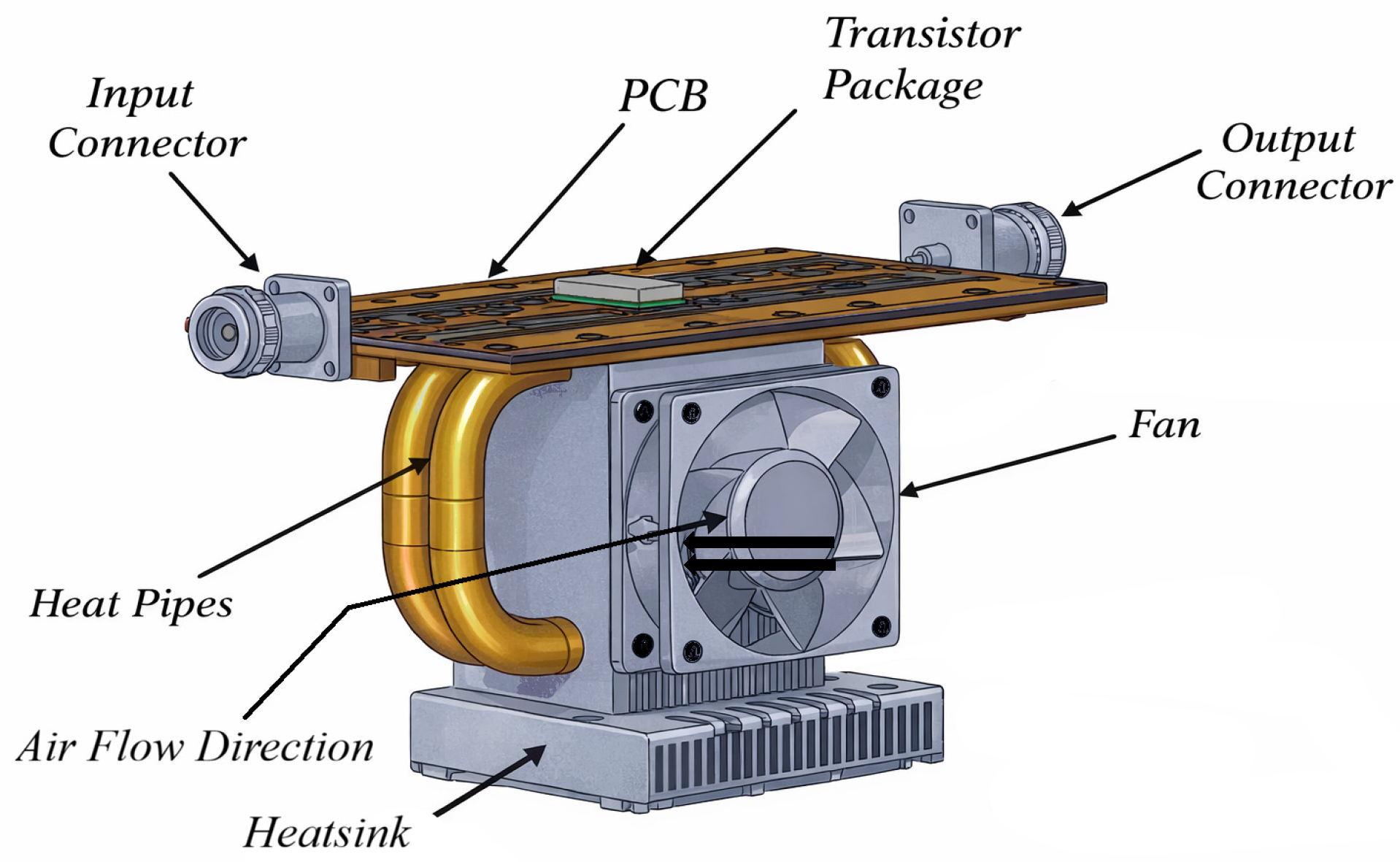
172] examines a forced air cooling design that integrates heat pipes within a heatsink for GaN-based high-power RF amplifiers to improve heat dissipation. By embedding heat pipes, the study achieves a 31.5% reduction in transistor temperature, lowering it from 100.2 °C to 68.6 °C, based on steady-state thermal simulations at various airflow rates. Results reveal that, when compared to typical heatsinks solely, this method allows for a more efficient and compact heatsink that can manage significant heat flux. However, adding heat pipes increases the design complexity of the heatsink, and the cooling effect is limited by the maximum airflow rate, with diminishing returns beyond a certain threshold.
Figure 10 shows the RF power amplifier employing a heat-pipe-based heatsink proposed in [
172], demonstrating enhanced thermal spreading for high-power GaN applications.
The design and efficiency of a two-phase GaN-based buck converter module that leverages a copper-core PCB with direct heatsink pads were the focus of [
173] to improve thermal management. The approach focuses on creating an efficient heat dissipation path from the GaN HEMTs in high-power systems, enabling heat to spread more effectively across a larger area. It has been proven that the module is capable of handling up to 176 W with a power density of 9.8 kW/L while maintaining GaN device temperatures below 90 °C. It reaches a maximum efficiency of 92.5% at 25 W output when forced air cooling is used. However, proper fan positioning is necessary to avoid uneven cooling, which might result in thermal imbalances in the module.
Based on the characteristic heat flux regimes encountered in GaN-based converters,
Table 7 provides a guideline mapping typical application conditions to suitable external cooling strategies.
Recent trends show a shift toward integrated and multifunctional heatsink designs that combine compact size with advanced thermal performance. Hybrid cooling systems—including phase-change media, microchannel integration, and topology-optimized fins—are increasingly tested in GaN power stages to push performance beyond natural convection limits. However, these methods bring trade-offs in manufacturability, cost, and mechanical complexity, and thus require careful system-level evaluation before adoption.
Regardless of heatsink efficiency, the interface between device and sink often represents a thermal bottleneck.
Section 8 introduces TIMs, which are crucial for minimizing contact resistance and enabling consistent heat transfer.
8. Thermal Management Through Thermal Interface Material (TIM)
For clarity, this review adopts a consistent taxonomy distinguishing thermal interface materials (TIMs) from substrates based on their functional role in the thermal path. TIMs are defined as compliant interfacial layers placed between two solid surfaces to reduce contact thermal resistance by improving surface conformity, without providing mechanical support or structural heat spreading. In contrast, substrates are load-bearing structural materials that provide both electrical insulation and lateral heat spreading, forming an integral part of the package or PCB stack-up. This distinction is maintained throughout the manuscript to avoid ambiguity between interfacial contact layers and structural thermal elements. This section specifically focuses on TIMs and their relevance to GaN-based converters, while substrates and encapsulants are addressed in
Section 2.
TIMs are essential for filling air gaps between surfaces, significantly reducing thermal resistance and enhancing heat dissipation. Positioned between a heatsink’s baseplate and the device or PCB, TIMs create a continuous thermal pathway. They come in various forms tailored to specific design needs: Solid thermal pads provide both insulation and support, especially when compressed to improve contact; liquid gap fillers are flexible and ideal for filling uneven spaces, making them perfect for multisided cooling; thermal grease offers minimal resistance on flat surfaces, ensuring a tight, low-resistance interface; and phase-change materials adjust from solid to semi-liquid at set temperatures, creating a conductive path by adapting to surface irregularities. Selecting the right TIM depends on thermal conductivity, thickness, compressibility, and electrical insulation requirements, with some applications needing high dielectric breakdown voltage for isolation. With high conductivity and compressible structures, TIMs can substantially reduce thermal resistance, especially in high-power-density setups where applying TIM to all surfaces maximizes cooling efficiency.
Table 8 lists commonly used TIMs in GaN power electronics, comparing their thermal conductivities and interface performance under operating conditions.
From a thermal design standpoint, the choice of TIM must balance conductivity, manufacturability, and reliability. In GaN-based power converters, interface-level resistance can dominate overall thermal impedance, especially in high-power-density systems with compact layouts. Advanced carbon-based TIMs (e.g., vertically aligned CNTs, graphene foams) have shown exceptional performance in laboratory studies, but production costs and integration challenges still limit their commercial deployment. Conversely, commercial pads and greases remain dominant in industry despite moderate performance due to ease of use and compliance with insulation standards.
It is essential to develop higher-performance TIMs, especially advanced TIMs, for solving the heat dissipation issues of high-power electronics, especially GaN HEMTs. A TIM is a material that serves as a heat dissipation path within an electronic device’s heat dissipation process by bridging the gap between the heat-producing element and the heatsink component. The heat is subsequently transmitted across the contact between the heatsink and the heating component’s rigid surfaces; the contact could never be perfect [
174,
175], so it is filled with the interface [
176].
The field of TIM research has expanded in the last several years, particularly when it comes to different high-thermal-conductivity materials like boron nitride and carbon-based materials [
177,
178,
179,
180]. Additionally, researchers have given thorough explanations of the TIMs’ manufacturing procedure [
180,
181,
182,
183], enhancing mechanism [
184,
185], and applications [
186,
187].
Given that GaN HEMTs are miniature, high-power-density converters, they necessitate TIMs that have excellent thermal conductivity to dissipate heat from the transistors effectively [
188].
Ref. [
189] discusses carbon-based TIMs, which have attracted interest due to their high thermal conductivity and suitability for dissipating heat from tiny, high-power electronic devices. These materials include graphene, carbon nanotubes (CNTs), and three-dimensional graphene structures like foams and aerogels. The unique thermal management capabilities provided by various carbon-based TIMs, from one-dimensional carbon nanotubes (CNTs), two-dimensional graphene films, and three-dimensional graphene networks, were investigated in the same work. It looks at how the structures of these materials affect thermal conduction through processes such as phonon transport. The study also covers a range of thermal conductivity measurement methods, from steady-state to nanoscale approaches, acknowledging that there is no specific measurement methodology that can accurately capture all thermal characteristics of TIMs.
There is an increasing interest in enhanced carbon-based TIMs since current commercial TIMs, including thermal pads and greases, lack optimum thermal conductivity and flexibility. Problems still exist, though, especially when it comes to minimizing heat resistance at interfaces where improperly matched materials and uneven surfaces can obstruct efficient contact. Accurately producing aligned carbon structures, such as 3D graphene or vertically aligned carbon nanotubes, demands accuracy, and scaling these materials for widespread application is still costly and technically difficult.
Ref. [
190] evaluated oriented-structured improved TIMs, especially for high-power electronic devices that require effective heat dissipation because of their smaller size and higher power density. It draws attention to the exceptional heat conductivity of materials like graphene, carbon fiber, and hexagonal boron nitride. To optimize heat transfer, alignment techniques such as magnetic field orientation, freeze-drying, and extrusion, which help orient these materials effectively within TIMs, have been discussed in the same work. However, there are challenges: these advanced TIMs are expensive and complex to produce on a large scale, and achieving consistent low-resistance contact with device surfaces remains difficult.
The impact of a graphene TIM on GaN transistor and converter dissipation was briefly examined in [
168,
191]. Ref. [
188] focuses on the difficulties of controlling heat in compact, high-power devices as it investigates the effects of heat dissipation mechanisms on GaN-based power converters used in energy conversion. Graphite-enhanced TIMs were examined; however, because of their electrical conductivity, they would need further shielding notwithstanding their high thermal conductivity, which would add another level of complexity in some applications.
Refs. [
192,
193] focus on GaN RF semiconductors, which are well-known for their significant heat flux and temperature sensitivity, and describe how to choose and test metallic TIMs for difficult circumstances. Particularly, it explores the use of various metallic TIMs, such as indium and indium alloys, that provide high thermal conductivity and mechanical stability under extreme conditions.
Conventional TIMs, such as polymers, metallic solders, and greases, as well as novel materials, including carbon-based structures, were evaluated in [
194] to overcome heat dissipation difficulties in high-performance devices.
In order to address heat management in high-power semiconductor devices, a novel three-layer graphene-based TIM is presented in [
195], where TIM’s core layer is vertically aligned graphene, and to enhance heat transmission at the interface, a liquid metal cap is placed on both surfaces. It has been proven that the setup could achieve a high thermal conductivity of 176 W/m·K and minimize contact thermal resistance to 4–6 K mm
2/W by filling micro-gaps at the contact points. It has also been shown that the liquid metal buffer enhances contact efficiency, ensuring better heat dissipation even on rough surfaces compared to traditional graphene TIMs. However, the manufacturing process is complex and costly, making scalability a challenge, and further testing is needed to confirm the material’s reliability and performance over time in real-world conditions.
Ref. [
196] investigates the development of melamine foam-enhanced polymer-based TIMs to increase EMI shielding, compression resistance, and thermal conductivity. Using melamine foam as a structural framework, the researchers combined natural rubber (NR) and reduced graphene oxide (rGO) to create a three-dimensional network. This approach improved the the TIM’s thermal and mechanical properties, achieving a thermal conductivity of 1.53 W/m·K and an EMI shielding effectiveness of 26 dB in the X-band at a low filler content, striking a good balance between heat management and EMI protection for advanced electronics. However, the process faces challenges like ensuring uniform filler distribution, managing thermal resistance, and scaling up production. Additionally, the complex preparation and associated costs could limit large-scale application.
In order to enhance thermal management in flexible electronics alongside other innovative technologies, ref. [
197] presents a novel sandwich-structured TIM. The TIM has small copper layers on the top and bottom, as well as a core of vertically aligned copper nanowires covered in 3D graphene. It has been detailed that the graphene layer boosts thermal conductivity and shields the nanowires from oxidation, while the copper layers help create strong, low-resistance contacts during assembly. The discussed design results in a thermal resistance of about 0.23 mm
2 K W
−1, much lower than traditional TIMs. However, the need for precise control over nanowire dimensions to balance thermal and mechanical performance is inevitable.
It has been proven that TIMs are essential in thermal management for filling tiny voids between components and heatsinks in order to minimize thermal resistance. Advancements in TIM technology, including carbon-based materials and phase-change alternatives, provide enhanced thermal conductivity and adaptability. Although these advancements improve performance, issues related to scalability and compatibility persist, requiring more research to satisfy the requirements of high-power, compact systems.
In addition to thermal interfaces, the dielectric material of the PCB core significantly influences thermal conductivity, insulation reliability, and integration density. The next section investigates various dielectric options and their impact on GaN converter performance.
9. Thermal Management Through the PCB Dielectric Material
Beyond interface materials, the choice of PCB dielectric directly affects both thermal conduction and electrical isolation. This section evaluates dielectric options tailored for GaN power designs.
The choice of PCB dielectric material directly influences the thermal and electrical behavior of GaN-based converters. Key factors include thermal conductivity, dielectric strength, thickness, and expansion compatibility with GaN packages. As converters reach higher power densities, thermal insulation alone becomes insufficient—heat spreading and extraction through the PCB stack-up is now a design priority.
Table 9 provides a comparison of various dielectric materials in terms of thermal conductivity, mechanical compliance, and reliability, all of which affect thermal performance over time.
The low thermal conductivity of standard FR4 (typically <0.5 W/m·K) [
198] can create heat accumulation near GaN devices, especially in dense converter layouts. Advanced dielectric materials like Alumina (Al
2O
3) [
199] and ThinLam
® offer significantly improved thermal paths. However, these materials often require thicker layers to maintain electrical isolation, which can increase cost and impact layout density.
The assessment of the use of a ceramic substrate with GaN transistors (EPC 2015) in [
199] indicated that ceramic substrates may provide both sufficient electrical performance (parasitic inductances of 1–2 nH) and beneficial thermal management. Notably, ceramic substrate has a higher relative permittivity than FR4 and other dielectric materials, is heavier, and takes up more volume than conventional dielectric materials. Additionally, the gate driver, which is always located near the transistor and the other passive components, will be impacted by ceramics’ increased heat conductivity [
200].
Figure 11 illustrates the structural differences between PCB-based and DBC-based mounting of an EPC2015 GaN transistor, emphasizing the impact of substrate material and thickness on heat spreading and thermal conduction.
Reference [
201] investigated several GaN transistor heat management techniques. These techniques were based on the transistor’s placement and mounting, and the outcomes were confirmed using experimental measurements and a COMSOL simulation.
Figure 12 illustrates the experimental configuration used to evaluate advanced thermal management solutions under high heat-flux operating conditions.
The authors of [
142] evaluated three distinct thermal management alternatives for GaN HEMTs mounted on PCB substrates: thermal vias, thicker copper traces, and Peltier modules.
The effect of ThinLam
®, a high-conductivity dielectric laminate, has been studied in [
202]. Compared to FR4, it enabled a 17% reduction in component thermal resistance. Its integration into voltage regulator boards improved heat distribution without adding mechanical complexity, making it a viable option for high-frequency GaN circuits.
Ref. [
203] assessed FR4 and alternative dielectric materials for power electronics under thermal and electrical stress. Using temperature-dependent partial discharge tests, the study quantified insulation breakdown and material degradation. Results highlighted that FR4 maintained sufficient isolation but exhibited strong sensitivity to thermal cycling, making advanced composites more desirable in high-density GaN layouts.
In [
204], a compact two-phase immersion cooling system was evaluated for GaN-based power electronics. The setup used Novec 7000 dielectric fluid to manage heat through phase change—boiling and condensation—without mechanical pumps. Surface enhancements like grit blasting and pin fins boosted the heat transfer coefficient. The system achieved a Cooling System Performance Index (CSPI) of 37 W/L·K, showing strong potential for space-constrained high-power applications.
Ref. [
205] presents the design and optimization of a 100 V GaN multi-chip power micromodule using an AlN DBC substrate, targeting high-density, low-voltage DC-DC converters. The study focuses on addressing two primary challenges in GaN technology: minimizing parasitic inductances and improving heat dissipation. Key innovations include using through-plated copper vias in the DBC substrate, which significantly reduces inductance in both the gate and power loops and allows for effective heat removal. The design provides stable operation at 100 V and continuous output currents up to 7 A per channel, making it suitable for compact, efficient power applications.
A near-junction thermal management approach for GaN-on-SiC monolithic microwave integrated circuit (MMIC) power amplifiers was investigated in [
206], using an innovative embedded microchannel cooling system integrated directly into the substrate beneath the GaN transistors. This design targets the intense heat generated by these devices, aiming to control localized hotspots and enhance the amplifier’s performance, which often suffers from high temperatures. It has been proven that the embedded microchannels reduced the device’s peak temperature by 41.4 °C compared to traditional cooling methods; it also successfully eliminates thermal coupling between two transistors spaced 600 µm apart, highlighting the system’s potential for high-power MMIC applications.
Ref. [
207] Focuses on PCB-only thermal management methods for eGaN FETs in a half-bridge configuration, where the PCB serves as the main heat dissipation channel, as employing heatsinks is impracticable due to low-power GaN FET converter cost limits. The study looks at strategies to reduce thermal resistance between FET junctions and ambient air, such as increasing copper thickness, adding thermal vias, optimizing component spacing, and using a multi-layer PCB. These approaches collectively lower junction-to-ambient thermal resistance (R
θJA) by up to 35%, allowing the devices to handle higher power densities without overheating. Key findings include a 21% reduction in R
θJA when copper thickness increased from 1 oz to 2 oz, a 30% decrease with thermal vias under FET pads, and a 5% drop by optimizing FET spacing to minimize co-heating. However, these methods come with challenges: thicker copper and extensive vias increase manufacturing costs and complexity, complicate PCB fabrication, especially for designs with fine features, and do not yield linear thermal benefits beyond certain limits.
Ref. [
142] investigates thermal management techniques for GaN power devices on PCB substrates, emphasizing efficient heat dissipation techniques that involve no external heatsinks. The investigation assesses PCB-based solutions such as thicker copper planes, additional thermal vias, and improved layout designs; nevertheless, these techniques have limitations that might limit power control in very high-power applications, including higher manufacturing costs and complexity because of additional copper layers, vias, and a smaller cooling capacity compared to active alternatives.
The dielectric material in PCBs is vital for thermal performance, with high-conductivity alternatives such as alumina and AlN enhancing heat dissipation. Nonetheless, these materials have trade-offs, including elevated cost and weight. Advancements in dielectric materials emphasize the equilibrium between thermal conductivity and mechanical and electrical characteristics, providing feasible choices for the increasing demands of GaN technology.
10. Comparative Evaluation and Discussion
With thermal management challenges spanning across structural, material, and electrical domains, a system-level comparison is necessary to contextualize the strategies explored. This section summarizes the trade-offs between techniques in terms of thermal efficiency, integration complexity, and cost, providing a practical guide for technology selection in different application environments.
Before presenting a comparative evaluation of individual thermal management techniques, it is instructive to examine how research focus and technology adoption have evolved over time. Understanding these trends helps contextualize the maturity, readiness level, and practical relevance of the strategies compared in this section.
An analysis of the publication timeline of the studies reviewed in this work reveals a clear evolution in thermal management research for GaN-based power converters. Early studies primarily focused on packaging-level thermal extraction and conventional heatsink solutions. From approximately 2016 onward, increased attention was given to PCB-assisted heat spreading, thermal via optimization, and compact packaging such as wafer-level and flip-chip GaN devices. Since 2020, a marked growth in publications has been observed in advanced and integrated thermal solutions, including embedded and hybrid cooling architectures, double-sided cooling, and high-performance thermal interface materials such as phase-change compounds, graphene-based TIMs, and liquid metals. In parallel, electro-thermal modeling and co-design approaches have become increasingly prominent, reflecting the need to manage coupled thermal and electrical effects in high-frequency, high-power-density GaN converters.
Table 10 summarizes the chronological evolution of thermal management research in GaN-based power converters.
Building on these observed research trends,
Table 11 provides a comparative analysis of representative thermal management strategies, highlighting their relative performance, integration complexity, and cost across different application domains. The qualitative ratings reported in
Table 11 for thermal performance, integration complexity, and cost are derived from a comparative synthesis of the reviewed literature rather than from absolute numerical metrics. Integration complexity reflects factors such as manufacturing process maturity, number of assembly steps, requirement for specialized equipment, and compatibility with standard PCB and packaging technologies. Cost levels are evaluated relative to conventional air-cooled, single-sided packaged GaN solutions and account for material cost, fabrication complexity, and system-level integration overhead. Thermal performance rankings are based on reported reductions in thermal resistance or junction temperature under comparable operating conditions. These qualitative classifications are intended to support relative comparison and design decision-making rather than to provide exact economic or performance quantification.
Each solution offers a trade-off between thermal efficiency, integration cost, reliability, and readiness level. For example, advanced liquid-cooled heatsinks offer excellent thermal spreading but may require active pumping, larger enclosures, and sealing, making them impractical for consumer or lightweight applications. Meanwhile, PCB-based approaches such as high-conductivity laminates (e.g., ThinLam®) and optimized copper layouts present a scalable and cost-effective option, especially when integrated with dense thermal vias.
Despite recent advances, technologies like phase-change TIMs, transient liquid phase bonding, and immersion cooling remain in early adoption stages, often limited to high-end aerospace or military systems. On the other hand, hybrid solutions—such as double-sided cooling combined with optimized PCB and TIM layers—are gaining momentum in commercial GaN-based converters due to their balanced performance and integration feasibility.
No thermal management approach can completely address the diverse thermal challenges of GaN converters; each involves trade-offs across thermal, electrical, and mechanical domains. Hybrid approaches—such as combining double-sided cooling, advanced TIMs, and via-optimized PCBs—are increasingly adopted for compact high-density designs. For cost-sensitive applications, layout optimization and proper TIM selection remain the most practical enhancements. While emerging solutions like microchannels and immersion cooling offer superior performance, they are often limited by complexity and integration challenges. Regardless of the strategy, electrothermal modeling is essential to ensure effective cooling under realistic operating conditions.
11. Conclusions
This review has presented a comprehensive analysis of thermal management strategies for high-power-density GaN-based power converters, addressing challenges that arise from the combination of small die size, high heat flux density, and fast switching operation. Thermal management was examined across multiple levels, including packaging technologies, thermal modeling approaches, temperature measurement techniques, PCB layout optimization, heatsink integration, thermal interface materials, and dielectric material selection.
At the packaging level, advanced solutions such as wafer-level packaging, flip-chip, double-sided cooling, and embedded or hybrid structures enable significant reductions in thermal resistance and parasitic inductance. However, these benefits are accompanied by increased manufacturing complexity, cost, and sensitivity to thermo-mechanical stress, highlighting the necessity of application-driven design choices. Thermal modeling—ranging from compact RC networks to finite-element and electro-thermal co-simulation—was shown to be indispensable for predicting junction temperature, identifying hot spots, and guiding design optimization, while temperature measurement techniques remain essential for model validation and in situ thermal assessment.
Board-level thermal management through PCB layout was identified as a critical factor governing heat diffusion beyond the package, where copper geometry, via density, and dielectric material properties strongly influence junction-to-ambient thermal resistance. External cooling solutions, including passive and active heatsinks, vapor chambers, and liquid cooling, further extend the thermal operating envelope of GaN converters but introduce trade-offs related to system size, reliability, and integration complexity. Similarly, thermal interface materials play a pivotal role in minimizing interfacial resistance, yet advanced high-conductivity TIMs face challenges in scalability, cost, and long-term reliability.
Overall, no single thermal management strategy emerges as universally optimal. Effective thermal design for GaN-based converters requires a holistic, multi-level co-design approach that balances thermal performance with electrical efficiency, mechanical reliability, manufacturability, and cost. Future research directions include the development of reliability-aware thermal design methodologies, improved electro-thermal models incorporating aging effects, advanced in situ temperature sensing, and scalable high-performance materials for packaging and interfaces. Addressing these challenges will be essential to fully exploit the potential of GaN technology in next-generation high-power-density and high-reliability power electronic systems.
From a practical design perspective, the findings of this review suggest that thermal optimization in GaN-based converters should not be approached as an isolated problem at the device or cooling level, but rather as an integrated system-level challenge. Early-stage electro-thermal co-design, supported by validated modeling and measurement frameworks, is essential to avoid overdesign and to ensure robust operation under realistic electrical, thermal, and environmental stresses. In particular, the strong coupling between temperature, electrical performance, and degradation mechanisms in GaN devices underscores the need to explicitly link thermal management strategies with reliability and lifetime considerations. As GaN technology continues to penetrate automotive, aerospace, and data-center applications, future advances will increasingly rely on reliability-aware thermal design, digital-twin–based electro-thermal modeling, and cost-effective manufacturing solutions that can be scaled to high-volume production.




 ,
,