1. Introduction
Precipitation forecast plays a crucial role in water resource management, agriculture, and climate disaster mitigation. Reliable forecasts are particularly critical in regions prone to hydroclimatic extremes, where the increasing frequency and intensity of droughts and floods amplified by anthropogenic climate change pose significant socioeconomic and environmental challenges [
1,
2,
3,
4].
In Brazil, seasonal climate forecasting is of strategic importance because much of the national economy depends on rainfall-driven systems, such as energy production [
5] and agriculture [
6]. The state of Minas Gerais, located in southeastern Brazil, represents a particularly sensitive region. With an area of 586,000 km
2 and a diverse topography that includes high mountain ranges in the south and lower plateaus in the north, Minas Gerais exhibits substantial climatic heterogeneity [
7]. Orographic effects increase rainfall in elevated central and southern areas, while the northern and western regions tend to experience drier conditions [
8].
The rainy season is strongly influenced by the South Atlantic Convergence Zone (SACZ), a persistent convective band that can produce long-lasting rainfall episodes [
9,
10,
11]. When the SACZ remains stationary, widespread floods and landslides often occur in central and southern Minas Gerais, as seen in late 2021 and early 2022 [
12,
13,
14]. Conversely, in years when the SACZ is weak or displaced, northern Minas Gerais often experiences prolonged droughts, severely impacting agriculture and water availability [
15].
Despite their importance, seasonal precipitation forecasts for Minas Gerais remain highly challenging. The region lies in a climatic transition zone between tropical and subtropical regimes, where the influence of large-scale drivers such as the El Niño–Southern Oscillation (ENSO) is moderate and inconsistent [
16]. ENSO phases that strongly determine rainfall in northern and northeastern Brazil often have weaker and less predictable effects in Minas Gerais [
17,
18]. Capturing such complex and region-specific climate signals remains particularly difficult for traditional forecasting approaches, which rely on dynamical models.
Seasonal climate forecasting systems are typically designed to predict anomalies relative to climatological conditions, often expressed in probabilistic categories such as above-normal, near-normal, or below-normal precipitation. This probabilistic framework reflects the limited predictability at seasonal timescales, where the signal-to-noise ratio is often weak, and the predictability largely depends on slowly evolving components of the climate system, including sea surface temperatures, large-scale circulation patterns, and land–atmosphere interactions [
19,
20]. As a result, seasonal forecasts are generally interpreted in terms of the likelihood of anomalous conditions rather than deterministic predictions of precipitation amounts [
21].
Traditional forecasting approaches are based on dynamical models, known as General Circulation Models (GCMs), which numerically solve the fundamental equations governing atmospheric and oceanic processes [
22]. Seasonal predictions derived from GCMs, such as those provided by the North American Multi-Model Ensemble (NMME) and the European Centre for Medium-Range Forecasts (ECMWF) seasonal forecasting system (SEAS5), have advanced significantly in recent decades [
23,
24]. However, despite these improvements, such models remain computationally intensive and continue to face limitations in both spatial and temporal resolution, which constrain their ability to capture regional climatic variability with sufficient accuracy [
25,
26].
In recent decades, several approaches have been developed to improve the regional representation of seasonal climate predictions. Dynamical and statistical downscaling techniques have been widely applied to bridge the spatial gap between coarse-resolution global climate models and local climate variability. Dynamical downscaling employs regional climate models nested within global circulation models, while statistical downscaling methods establish empirical relationships between large-scale predictors and local-scale climate variables [
27,
28,
29,
30,
31,
32]. These techniques have been widely used to improve regional climate projections and seasonal prediction systems.
Artificial intelligence (AI) and machine learning (ML) techniques in particular have recently emerged as powerful tools within this broader framework, enabling the identification of complex nonlinear relationships between predictors and climate variables. Unlike dynamical models, AI-based approaches can efficiently process large volumes of observational and reanalysis data, identify nonlinear relationships, and generate forecasts with reduced computational cost. Neural networks and ensemble learning methods, for example, have shown potential to capture complex spatiotemporal rainfall patterns [
33]. Several studies have demonstrated the potential of machine learning algorithms to improve precipitation prediction at seasonal and subseasonal timescales, including applications based on artificial neural networks, gradient boosting methods, and hybrid deep learning architectures [
34]. These approaches can complement traditional dynamical forecasting systems by efficiently extracting patterns from large observational datasets and producing predictions with relatively low computational cost.
Also, leading meteorological institutions such as the ECMWF and the United Kingdom’s national meteorological service (UK Met Office) are increasingly incorporating AI techniques into operational forecasting, reporting improvements in accuracy and efficiency [
35]. These recent advances have demonstrated that machine learning can outperform traditional models in subseasonal-to-seasonal forecasting, particularly when trained on high-resolution precipitation datasets [
36,
37].
In this context, the present study explores the use of a supervised machine learning approach to improve seasonal precipitation forecasting in Minas Gerais. By training models on a high-resolution dataset and applying ensemble techniques, this research aims to predict four consecutive seasons, evaluating the extent to which AI can overcome the limitations of traditional models and provide more accurate rainfall predictions throughout the year. Given the state’s climatic diversity, its socioeconomic dependence on stable rainfall regimes, and the recurrent risks posed by precipitation extremes, improving these year-round seasonal forecasts offers a pathway to strengthen agricultural planning, optimize hydropower generation, and enhance disaster risk reduction strategies.
The remainder of this paper is organized as follows:
Section 2 describes the dataset employed and the methodology adopted.
Section 3 presents the results obtained with the AI models, while
Section 4 provides a detailed discussion of these findings. Finally,
Section 5 summarizes the main conclusions and highlights the study’s limitations.
2. Materials and Methods
2.1. Study Area
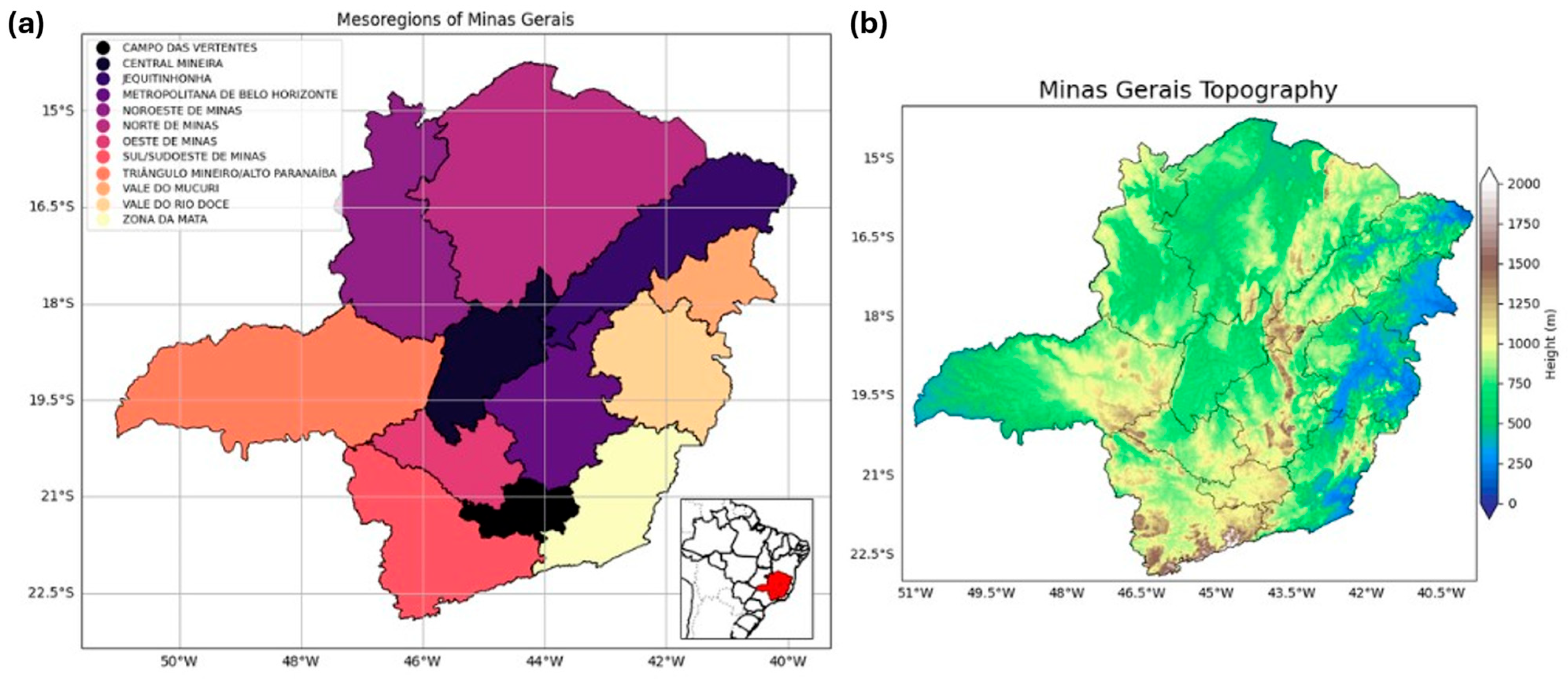
The state of Minas Gerais, located in southeastern Brazil, is characterized by its large territorial extent and diverse landscapes and climatic conditions, as shown in
Figure 1. Covering an area of approximately 586,521 km
2, Minas Gerais shares borders with the states of Bahia, Goiás, Mato Grosso do Sul, Espírito Santo, São Paulo, and Rio de Janeiro.
This geographical diversity results in pronounced variations in topography and altitude, ranging from lowland areas in the northeastern and western portions of the state to mountainous regions in the south. Notably, the Serra da Mantiqueira mountain range includes some of the highest elevations in the region, with peaks reaching approximately 2800 m above sea level (
Figure 1b).
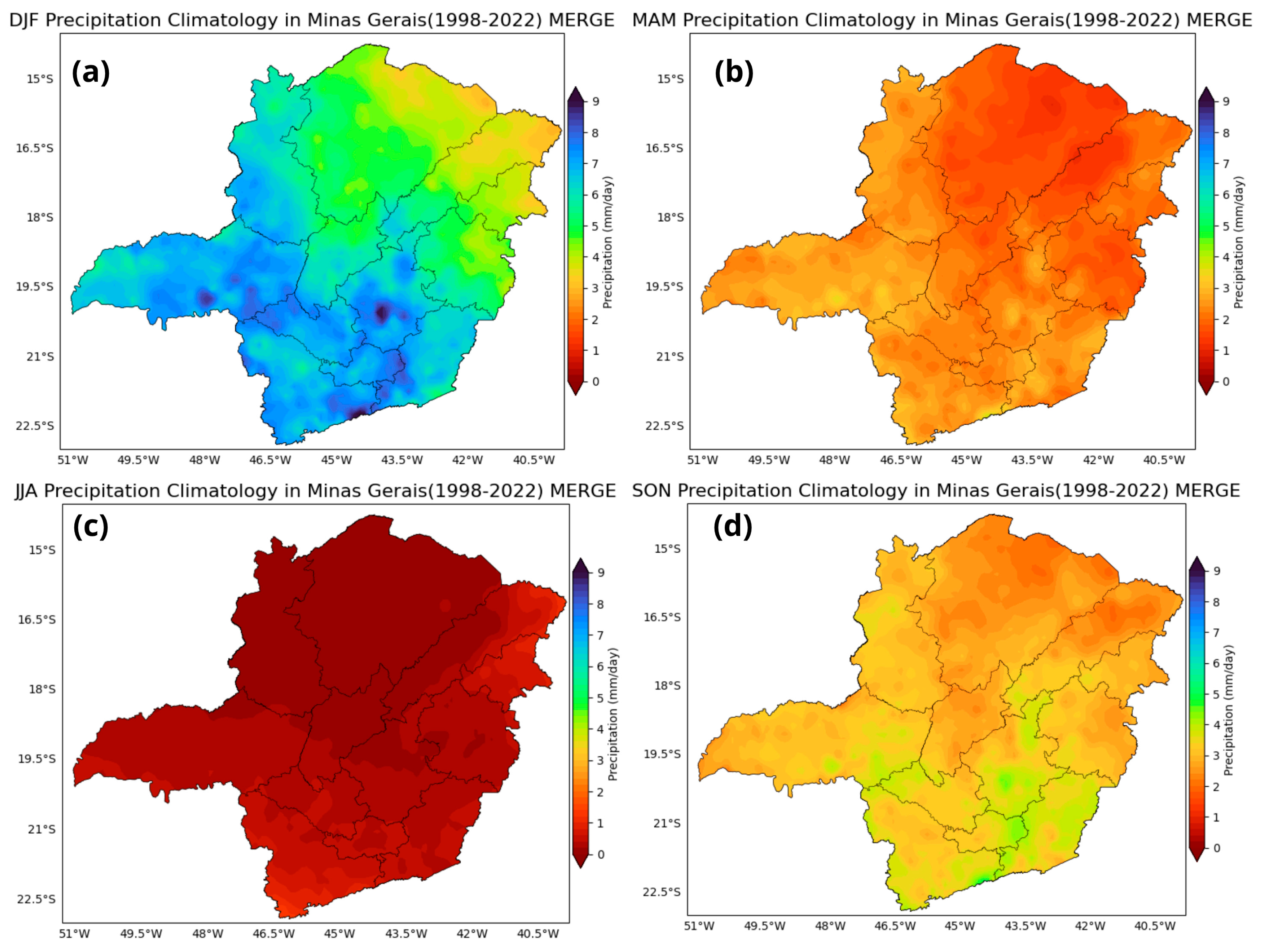
Precipitation in Minas Gerais exhibits a pronounced seasonal cycle typical of a tropical–subtropical transition region. Based on the Center for Weather Forecast and Climate Studies (CPTEC) precipitation dataset (MERGE) climatology for 25 years (1998–2022), rainfall exhibits strong spatial contrasts and clear seasonal dependence (
Figure 2).
Austral summer (December–January–February, DJF) corresponds to the wettest season, with higher precipitation concentrated over the central, southern, and southeastern portions of the state, where mean daily values frequently exceed 8 mm day−1. This pattern is primarily associated with the SACZ and orographic effects in elevated areas.
During autumn (March–April–May, MAM), precipitation decreases across most of the state, marking the transition from the wet to the dry season. Rainfall remains moderate in southern and eastern regions, influenced by residual convective activity and frontal systems. Winter (June–July–August, JJA) is the driest season, with precipitation values generally below 1 mm day−1 over most of Minas Gerais. This period is characterized by the dominance of subsident atmospheric conditions and reduced convective activity, particularly in the northern and western mesoregions.
Spring (September–October–November, SON) marks the onset of the rainy season, with increasing precipitation over the western and southern sectors. Rainfall during this season exhibits high spatial and temporal variability, reflecting the transitional nature of large-scale circulation patterns and the gradual re-establishment of convective systems.
The strong seasonal contrasts in precipitation, combined with complex topography and regional atmospheric drivers, make Minas Gerais a challenging area for seasonal precipitation forecasting. These factors contribute to strong spatial heterogeneity and nonlinear rainfall patterns, which are often difficult to capture using traditional modeling approaches.
In this context, the use of high-resolution observational datasets becomes essential to adequately represent regional-scale variability. Moreover, advanced modeling techniques, such as AI-based methods, offer a promising framework to better capture nonlinear relationships and improve the representation of spatial and temporal rainfall variability in climatically heterogeneous regions.
2.2. Data Sources
The precipitation dataset used in this study was obtained from MERGE [
40,
41], a product developed by the Center for Weather Forecast and Climate Studies, National Institute for Space Research (CPTEC/INPE). This dataset provides monthly gridded precipitation data at a spatial resolution of 0.1° × 0.1°, covering the period from 1998 to the present, and is widely used for regional climate analyses in Brazil.
For comparison with dynamical seasonal forecasting systems, data from multiple international modeling centers were considered. The selected models included the Euro-Mediterranean Center on Climate Change (CMCC) climate model (CMCC-CM3), SEAS5 system from the ECMWF, System 8 from Météo-France (MF), Hadley Centre Global Environmental Model version 3, Global Coupled configuration 2.0 (HadGEM3-GC2.0) model from the UK Met Office (UKMO), and Climate Forecast System version 2 (CFSv2) model from the National Centers for Environmental Prediction (NCEP).
The NCEP-CFSv2 data were obtained from the NMME, while the remaining models (CMCC, ECMWF, Météo-France, and UKMO) were retrieved from the Copernicus Climate Data Store (CDS). These datasets have a horizontal resolution of 1° × 1° and were used to provide a multi-model benchmark for evaluating the AI-based seasonal precipitation forecasts [
23].
To ensure a consistent and fair comparison across datasets, the high-resolution MERGE data (0.1° × 0.1°) and the AI-based forecasts were regridded to a common spatial resolution of 1° × 1°, matching the grid of the dynamical models. The regridding procedure was performed using a conservative remapping method, preserving the spatially aggregated precipitation totals and ensuring that all verification metrics were computed over identical spatial support.
2.3. Methods
2.3.1. Analysis of Precipitation Data over the State of Minas Gerais
To characterize the climatological behavior of precipitation over the study region and provide a reference framework for subsequent analyses, a seasonal climatology was computed. After acquiring the precipitation data, seasonal climatology was calculated for 25 years (1998–2022) to establish a reference baseline. The climatology was computed separately for each of the four climatological seasons: summer (DJF), autumn (MAM), winter (JJA), and spring (SON).
Seasonal precipitation anomalies were then calculated as the difference between the observed seasonal precipitation and the corresponding climatological mean for each season. This approach enables the identification of positive and negative deviations from average conditions and supports the characterization of hydroclimatic variability.
The analysis of seasonal anomalies provided a framework to contextualize precipitation patterns within the historical record, facilitating the interpretation of forecast performance under conditions close to or deviating from climatological norms. This step is essential for assessing the representativeness of the analyzed years and for supporting the evaluation of AI-based seasonal precipitation forecasts.
2.3.2. Training Strategy
Precipitation forecasting was performed using a feedforward multilayer perceptron (MLP) neural network. The MLP model represents a data-driven approach trained to learn the nonlinear relationships between the predictor variables and precipitation. By learning patterns directly from historical data, the neural network generates forecasts for independent evaluation periods, i.e., data that were not used during training.
Before defining the final model configuration, a set of exploratory experiments was conducted to determine the most appropriate training strategy for seasonal precipitation forecasting in the study region. These preliminary analyses focused on evaluating different combinations of predictor variables and temporal lead times to identify configurations capable of maximizing predictive skill while maintaining model stability.
Different lead-time configurations were initially tested to investigate the influence of antecedent climate conditions on the predictability of seasonal precipitation. In particular, experiments were conducted using predictors from the previous season to forecast the following season. However, these configurations produced lower predictive performance when compared with the final strategy adopted in this study. As a result, the best results were obtained when predictors from the corresponding season of the previous year were used to estimate precipitation conditions for the target season.
In addition to the evaluation of lead times, different sets of predictor variables were also tested to determine which variables contributed most to precipitation predictability. The candidate predictors included 10 m and 100 m wind components, 2 m air temperature, surface shortwave and longwave radiation fluxes, soil moisture at different layers, and precipitation. The selection of these variables was initially guided by correlation analyses with the target precipitation field to identify potential large-scale drivers of seasonal rainfall variability.
An experiment was performed using combinations of these variables as inputs to the neural network. However, the results indicated that the inclusion of a larger number of predictors did not improve forecast performance. In fact, experiments using multiple atmospheric and surface variables produced higher error metrics, including larger Root Mean Square Error (RMSE) and Mean Squared Error (MSE), when compared with experiments using precipitation as the sole predictor variable. For example, in the multi-predictor configuration, RMSE values reached approximately 0.999 during summer (DJF) and up to 2.108 during spring (SON), whereas the precipitation-only configuration resulted in substantially lower errors, with RMSE values around 0.471 for DJF and 0.253 for SON. Similar improvements were observed for MSE values, which were consistently lower in the precipitation-only experiments across all seasons. These results suggest that the additional predictors may introduce noise or redundant information that reduces the model’s ability to generalize.
Based on these exploratory analyses, the final training strategy adopted in this study used precipitation from the corresponding season of the previous year as the primary predictor, which provided the most stable and accurate forecasts according to the validation metrics.
After defining the lead time and predictor variables, the historical dataset from 1998 to 2022 was used for training, and 10% of this dataset was reserved as a validation subset during the training process. This validation subset was used to monitor model performance and ensure adequate generalization during training, following common practices in deep learning methodologies [
42].
The training and evaluation framework adopted in this study is based on a temporal expanding window approach [
43]. For each target prediction time step
t, the model is trained using all available historical data up to time
t − 1, and subsequently applied to predict the target at time
t, as expressed by Equation (1):
where
represents the input feature vector at time
, including temporal (year and month) and spatial (latitude and longitude) information, as well as the predictor variable (precipitation from the corresponding season of the previous year), and
denotes the neural network model trained on the dataset up to time
.
Within each training iteration, 10% of the available data is used as a validation subset to monitor model performance and support the optimization process. This validation step is part of the training procedure and does not interfere with the temporal structure of the expanding window framework.
This formulation implies that the model is iteratively re-trained over time, allowing it to incorporate newly available information while preserving temporal consistency and preventing information leakage [
43].
The neural network weights are initialized using the He normal scheme, which samples values from a normal distribution scaled for Rectified Linear Unit (ReLU) activations, improving training stability and convergence. In addition, this initialization introduces stochasticity across different training runs, as each model starts from a distinct point in the parameter space [
44].
In this approach, spatial predictions are generated using a neural network model trained on all available samples across the spatial domain, rather than training separate models for each grid point. Although a single model is used per training instance, the final ensemble is obtained from multiple independently trained models with different random weight initializations. The dataset is structured in tabular form, where each sample corresponds to a specific grid point and time step, and the input features include temporal (year and month) and spatial (latitude and longitude) information, along with the predictor variable. During inference, the trained model produces a precipitation estimate for each input sample independently. The spatial prediction field is then reconstructed by aggregating these point-wise predictions over the entire grid, resulting in a continuous spatial representation of precipitation across the study region.
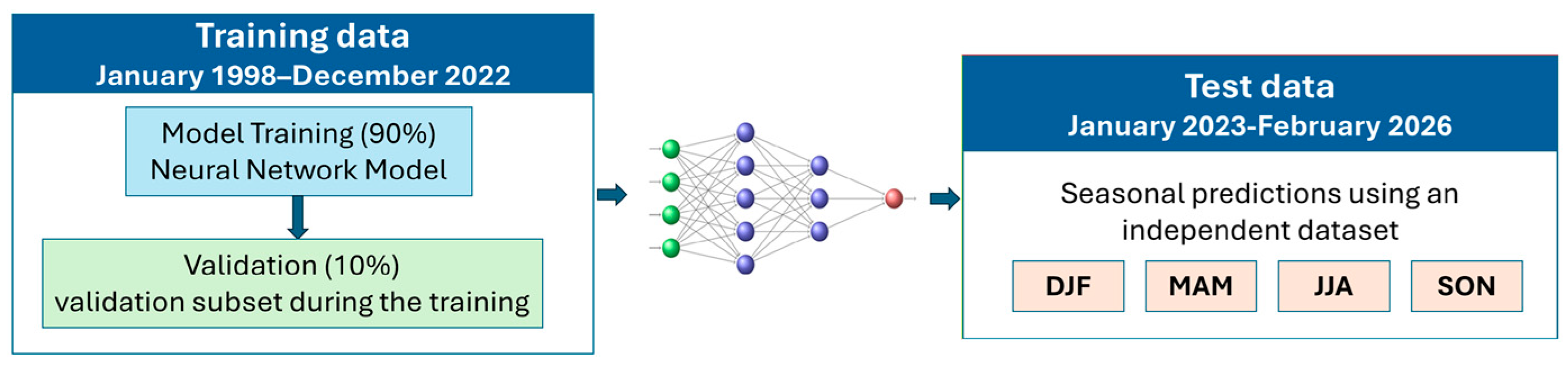
Figure 3 illustrates the workflow adopted for the neural network experiments conducted in this study. The dataset partitioning was designed to preserve the temporal structure of the data and prevent information leakage between training and evaluation periods. For model development, historical data from 1998 to 2022 were used, and the trained models were subsequently applied to generate precipitation forecasts for independent evaluation years (2023, 2024, and 2025), which were completely excluded from the training and validation stages. In addition, a forecast for the austral summer season (DJF) of 2026 was generated using observed precipitation data from December 2025 to February 2026, allowing a preliminary near-real-time assessment of model performance. Overall, this framework ensures that model evaluation is performed using out-of-sample data and closely reflects operational forecasting practices commonly adopted in climate prediction studies.
2.3.3. Hyperparameter Optimization
The performance of neural network models strongly depends on the appropriate selection of hyperparameters. Parameters such as the number of hidden layers and the number of neurons per layer directly influence the model’s ability to capture complex nonlinear relationships present in climate data. Inadequate configurations may lead to underfitting or overfitting, thereby reducing the model’s capability to generalize to unseen data. However, identifying an optimal set of hyperparameters is challenging due to the large search space and the absence of analytical rules to determine the best architecture a priori. For this reason, systematic hyperparameter optimization techniques are commonly employed to explore different configurations [
42].
In this study, hyperparameter optimization was performed using a Random Search algorithm [
45]. This approach allows efficient exploration of hyperparameter space by randomly sampling combinations of parameters and evaluating their predictive performance. The search space considered variations in the number of hidden layers, ranging from 1 to 3, the number of neurons per hidden layer selected from the set {16, 32, 50, 64, 96}, and the learning rate of the optimizer, with candidate values of 0.001 and 0.0005. These hyperparameters were randomly sampled during the optimization process to identify the configuration that minimized the validation error.
For each configuration randomly sampled by the Random Search algorithm, the model was trained and evaluated using the MSE computed on the validation subset used during training. The architecture that minimized the validation error during this Random Search procedure was selected as the optimal configuration for generating the seasonal precipitation forecasts. Following this optimization process, the configuration that minimized the validation MSE was selected as the final model for generating the four-season precipitation forecasts.
Table 1 summarizes the optimal hyperparameter configurations selected through the Random Search procedure for each target seasonal forecast. The optimization results indicate that the best-performing models consistently adopted an architecture with three hidden layers and a learning rate of 0.0005 across all seasons. The optimal number of neurons varied slightly depending on the season, with 64 neurons for DJF and 96 neurons for MAM, JJA, and SON. These configurations correspond to those that minimized the MSE during the validation phase, considering the training period from 1998 to 2022 for each season. The selected optimal configurations were subsequently used to generate the seasonal precipitation forecasts for the years 2023 to 2025, as well as for the austral summer season (DJF) of 2026.
2.3.4. AI Model Training and Validation
The forecasting models were implemented using feedforward MLP networks within a supervised machine learning approach, trained on the MERGE dataset to predict precipitation separately for each climatological season (DJF, MAM, JJA, and SON). In this approach, the network learns the relationship between historical predictor variables and the corresponding observed precipitation values.
To ensure seasonal consistency, the training for each specific season was conducted exclusively using data from the same season in previous years. For instance, to forecast the DJF period, the model’s input consisted solely of DJF historical data. The same logic was applied to the other three seasons (MAM, JJA, and SON), allowing the network to capture the specific climate drivers and variability unique to each period.
The AI model is a neural network architecture, consisting of multiple layers in which input data are processed by interconnected neurons until reaching the output layer. During training, the network weights were iteratively updated using the Adaptive Moment Estimation (Adam) optimizer [
46], a gradient-based optimization algorithm used to minimize the MSE between predicted and observed precipitation values. The initial learning rate adopted for the optimizer was 0.005, and the models were trained for 50 epochs using a batch size of 10.
The AI model training was implemented using the TensorFlow (Google LLC, Mountain View, CA, USA) library in Python 3.11 (Python Software Foundation, Wilmington, DE, USA), a widely used tool for large-scale numerical computation and machine learning. The choice of this Machine Learning methodology was based on the study by Anochi et al. [
33].
Model performance during training and validation was assessed using the MSE as the evaluation metric. For each iteration, the MSE was computed according to Equation (2) and used to guide the optimization of the AI model.
where
is the number of time steps,
is the observed data, and y is the model’s prediction.
Additionally, the execution time of each model was measured, from the initial data processing to the generation of the final plots. As expected, execution time increased with data resolution.
2.3.5. AI Model Predictions and Ensemble Approach
Forecast simulations were performed for all four climatological seasons using the independent evaluation years 2023–2025 as the primary target prediction period, with an additional forecast generated for the austral summer season (DJF) of 2026. For the austral summer (DJF), the seasonal period was defined as December of the previous year and January–February of the target year, following standard climatological conventions. The MERGE precipitation dataset was adopted due to its high temporal resolution and frequent updates, which make it particularly suitable for near-real-time applications and for the analysis of recent and ongoing events. These characteristics allow the proposed methodology to be applied not only in retrospective analyses but also in current and operational forecasting contexts, especially in regions prone to extreme precipitation events such as Minas Gerais.
To further improve predictive accuracy, an ensemble strategy was employed.
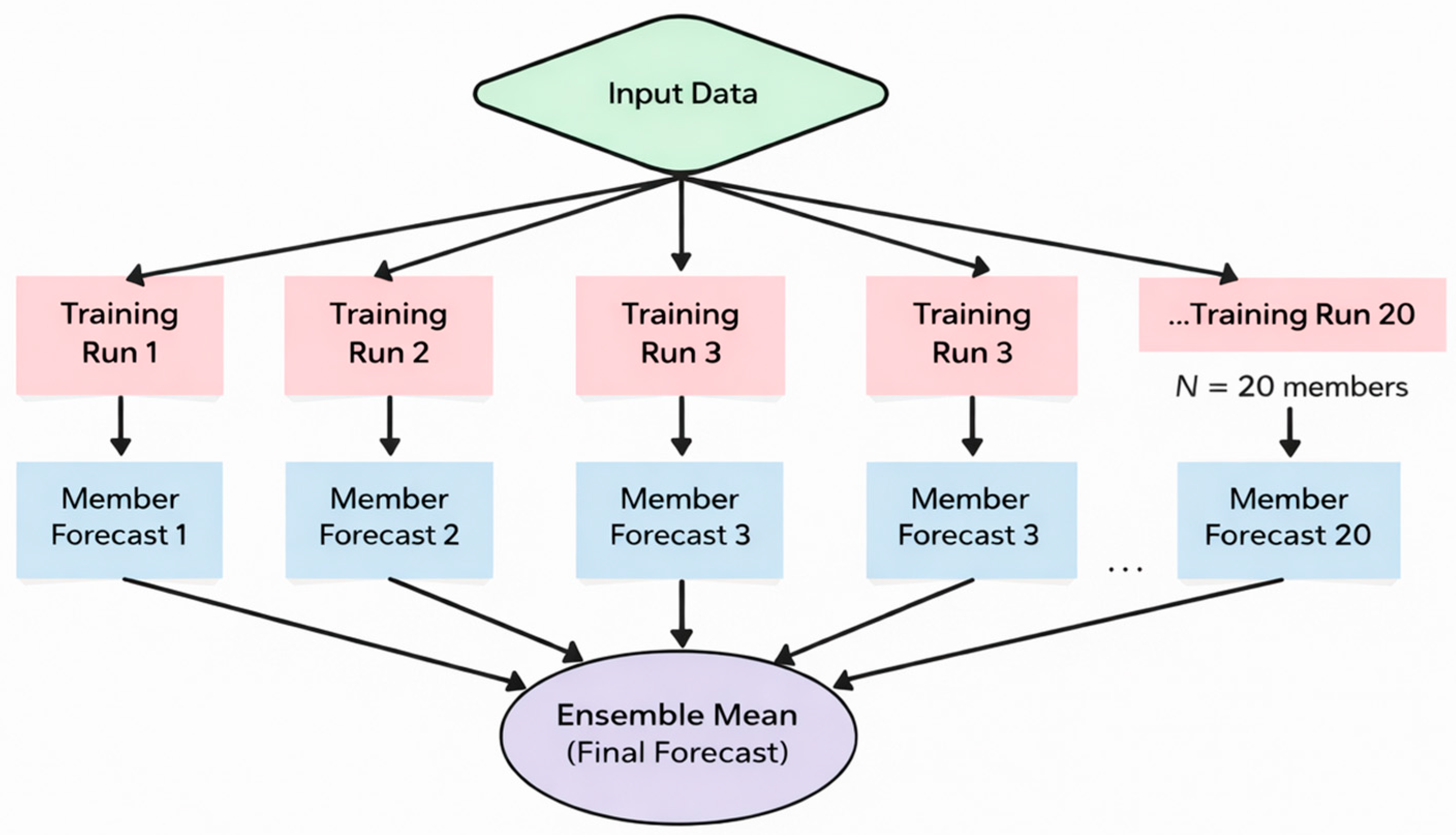
Figure 4 presents the conceptual framework of the ensemble forecasting approach adopted in this study. The input dataset is first provided to the machine learning model, which is trained multiple times through independent training runs. Each run uses different random initializations of the AI model weights, which naturally leads to slightly different model solutions during the optimization process. As a result, each independent training produces a distinct precipitation forecast, referred to as an ensemble member.
In this study, a total of 20 ensemble members were generated. The final seasonal prediction corresponds to the ensemble mean, calculated as the arithmetic average of the precipitation forecasts produced by all ensemble members. Averaging across members helps reduce stochastic variability associated with AI model training and provides a more robust estimate of the predicted precipitation patterns.
In addition to the ensemble mean, the dispersion among ensemble members was also analyzed as an indicator of forecast uncertainty. However, the ensemble spread was found to be negligible, with near-zero variability among members. This indicates a high level of agreement within the ensemble, suggesting limited sensitivity to initial conditions and/or strong constraints imposed by the modeling framework. As a result, the ensemble provides a consistent but potentially under-dispersive estimate of the forecast uncertainty.
2.3.6. Forecast Verification Metrics
The performance of the seasonal precipitation forecasts was evaluated by comparing the model predictions with the corresponding observed precipitation derived from the MERGE dataset. Only data not used during the AI model training phase were considered for the verification analysis. Three statistical metrics were employed to assess model performance: MSE (Equation (2)), RMSE (Equation (3)), and the Pearson correlation coefficient (r) (Equation (4)).
MSE quantifies the average squared difference between predicted and observed values. RMSE is derived from the square root of the MSE and provides an estimate of the typical magnitude of prediction errors:
where
is the total number of observations (or grid cells),
represents the observed precipitation, and
denotes the predicted precipitation.
Finally, the Pearson correlation coefficient (
) was calculated to evaluate the ability of the forecasting system to reproduce the spatial and temporal variability of precipitation patterns:
where
and
correspond to the mean values of observed and predicted precipitation, respectively.
In this framework, the best-performing models are characterized by low RMSE and MSE, and higher correlation coefficients, indicating a better agreement between predicted and observed precipitation patterns. To facilitate the interpretation of forecast performance, the verification metrics were presented both as overall summary values in tables and as spatial maps aggregated at the mesoregion scale, enabling a regional assessment of forecast errors across Minas Gerais.
3. Results
3.1. Observed Precipitation Anomalies
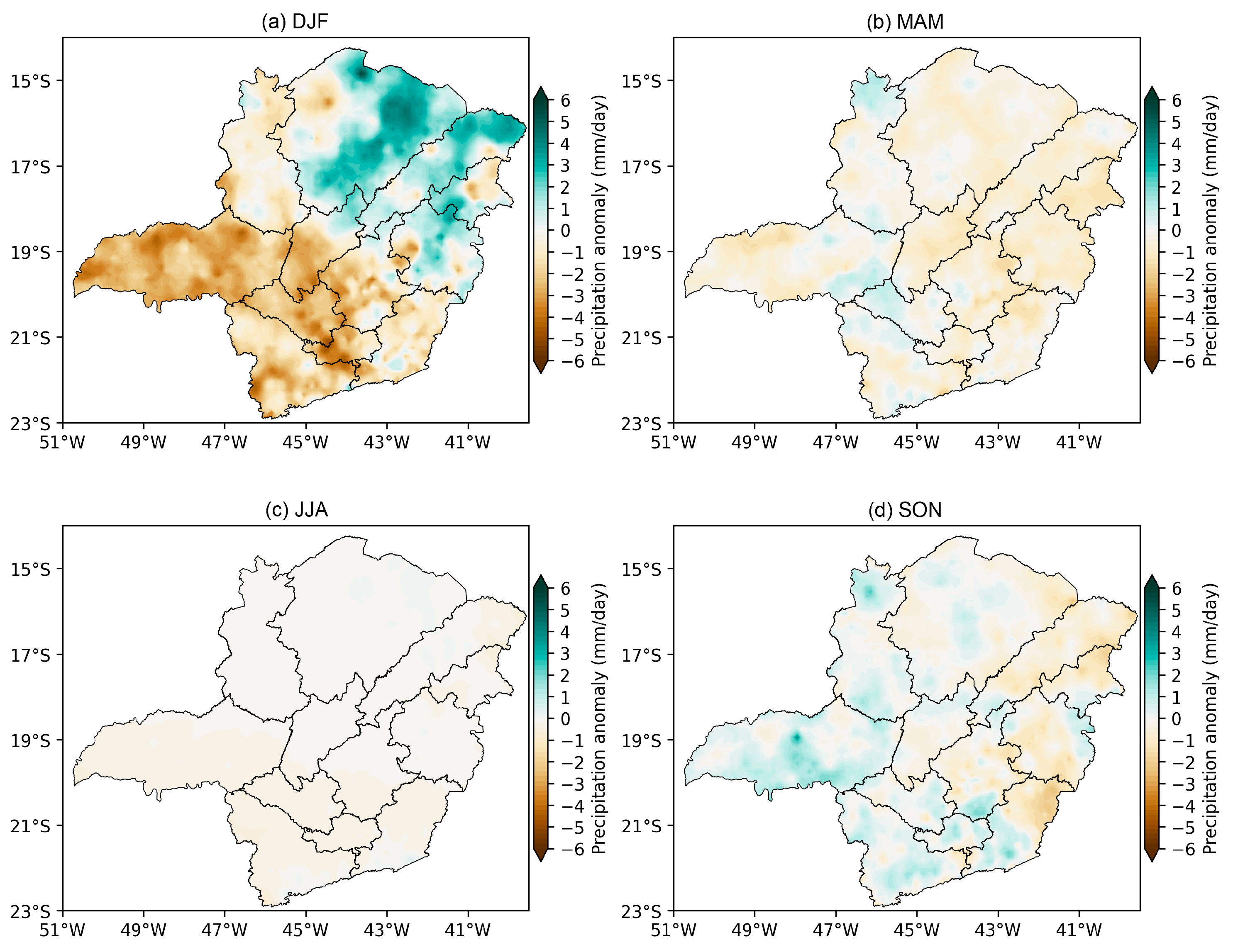
Observed seasonal precipitation anomalies for 2024 were calculated relative to 25 years (1998–2022) derived from the MERGE dataset and are presented in
Figure 5. The anomaly fields are included to provide a climatological context for the analyzed year, indicating whether seasonal conditions were wetter or drier than the long-term mean. This information supports the interpretation of forecast performance under different climatic regimes.
During austral summer (DJF;
Figure 5a), precipitation anomalies exhibit a heterogeneous spatial pattern across Minas Gerais. Predominantly negative anomalies are observed over the central, southern, and southwestern portions of the state, indicating rainfall below the climatological average in these regions. In contrast, positive anomalies are evident in northern and northeastern mesoregions, reflecting localized above-average precipitation during the peak of the rainy season.
In autumn (MAM;
Figure 5b), precipitation anomalies are generally weak and spatially uniform, with values close to zero over most of the state. This pattern indicates precipitation conditions largely consistent with the climatological mean, with only isolated areas presenting small positive or negative departures.
Winter (JJA;
Figure 5c) is characterized by anomalies close to zero throughout Minas Gerais, reflecting the climatologically dry and stable conditions typical of this season. The limited spatial variability observed during JJA suggests minimal deviation from average winter precipitation.
In spring (SON;
Figure 5d), anomalies display increased spatial variability. Negative anomalies dominate central and eastern mesoregions, while localized positive anomalies are observed in western and southern areas. This pattern suggests a spatially heterogeneous onset of the rainy season in 2024, with delayed precipitation in some regions and above-average rainfall in others.
Overall, the observed anomaly patterns indicate that DJF and SON presented the most pronounced departures from climatological conditions in 2024, whereas MAM and JJA were closer to average conditions. These seasonal contrasts provide important context for the evaluation of AI-based seasonal precipitation forecasts presented in the following sections.
3.2. Seasonal Precipitation Forecasts Using AI Models
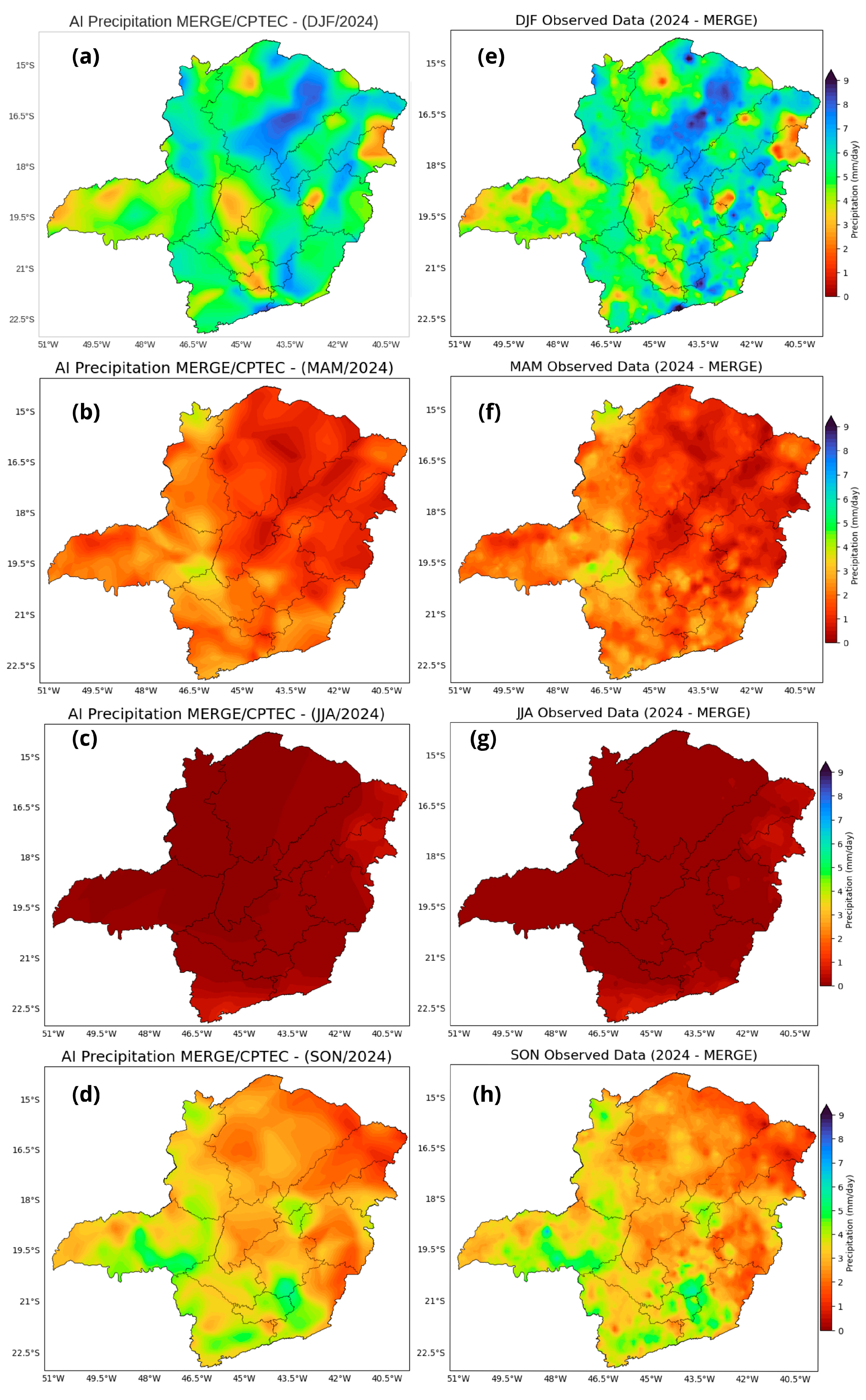
The ensemble forecasts for the four seasons of 2024, generated by the AI model trained with MERGE data, are presented in
Figure 6a–d, alongside the observed data (e–h). The comparison allows for a direct visual assessment of the model’s ability to reproduce the spatial distribution and seasonal variability of precipitation over Minas Gerais.
For the austral summer (DJF), the AI model (
Figure 6a) presents the spatially heterogeneous distribution of precipitation across Minas Gerais, with the blue-shaded areas highlighting regions of higher rainfall accumulations. When compared to observations (
Figure 6e), the forecast captures the overall distribution of rainfall, although differences in precipitation intensity are evident in localized areas, particularly in regions affected by strong convective variability.
During the transition seasons, Autumn (MAM) and Spring (SON), the model demonstrated a high capacity to represent the seasonality. During autumn (MAM), the model successfully represents the seasonal reduction in precipitation and its spatial pattern. Forecasted (
Figure 6b) and observed (
Figure 6f) fields show good agreement, especially over southern and eastern mesoregions, indicating the model’s ability to capture transitional precipitation regimes. For spring (SON), the AI forecast (
Figure 6d) indicates an increase in precipitation over western and southern sectors, consistent with the observed reestablishment of rainfall (
Figure 6h). While the spatial pattern is generally well reproduced, differences in precipitation magnitude are observed in regions characterized by higher variability during the onset of the rainy season.
In winter (JJA), both forecasted (
Figure 6c) and observed (
Figure 6g) precipitation fields indicate widespread dry conditions across the state. The high degree of similarity between simulated and observed patterns reflects the reduced spatial variability of precipitation during this season.
Overall, the AI model demonstrates skill in reproducing the large-scale spatial distribution of precipitation across all seasons, with stronger agreement during periods of lower variability and increased discrepancies during wetter and transitional seasons.
3.3. Seasonal Performance Metrics
The quantitative performance of the AI ensemble forecasts is summarized in
Table 2 using RMSE, MSE, and r. These metrics provide an objective evaluation of forecast accuracy across the four climatological seasons.
The analysis of forecast performance across the three evaluated years reveals a consistent seasonal pattern, with low interannual variability in the overall skill of the AI ensemble.
As shown in
Table 2, the lowest error values are consistently observed during the winter season (JJA), with RMSE values ranging from 0.114 to 0.153 and MSE values between 0.018 and 0.023. These low values indicate a high level of agreement between predicted and observed precipitation. As shown in
Table 2, the lowest error values are consistently observed during the winter season (JJA). This behavior is consistent across all years and reflects the reduced variability and increased atmospheric stability that characterize the dry season in the region, conditions that tend to favor higher predictability. Autumn (MAM) also exhibits relatively low error values, with RMSE ranging from 0.301 to 0.368, maintaining stable performance associated with its transitional nature and moderate precipitation variability.
In contrast, higher RMSE values are obtained for summer (DJF) and spring (SON), which correspond to periods dominated by convective activity and greater spatial and temporal variability. For DJF, RMSE values range from 0.405 to 0.676, while for SON they vary between 0.253 and 0.291. Although some interannual differences in error magnitude are evident, these variations remain within a relatively narrow range, indicating that the model performance does not substantially degrade from one year to another. This suggests that the AI ensemble is robust under different hydroclimatic conditions, even when precipitation patterns deviate from climatological norms.
The correlation results further support this interpretation, with consistently high values across all seasons and years, generally exceeding 0.93 and reaching up to 0.98. These values indicate that the model is able to reproduce key aspects of the variability of precipitation, even in seasons with higher forecast uncertainty. However, these high correlation values should be interpreted with caution.
In this study, correlation is computed between spatial precipitation fields rather than temporal series. Therefore, it primarily reflects the model’s ability to reproduce the spatial distribution and regional gradients of precipitation. In regions such as Minas Gerais, where precipitation patterns are strongly influenced by topography and large-scale circulation, high spatial correlations can be achieved when the dominant structures are well represented. As a result, part of the correlation skill may be associated with the reproduction of these large-scale and persistent spatial patterns, rather than fully independent predictive capability.
Overall, the combined multi-year evaluation demonstrates that the AI-based ensemble approach provides stable seasonal forecasts, with performance variations primarily driven by intrinsic seasonal predictability rather than interannual instability of the model itself. This consistency reinforces the robustness of the proposed methodology and supports its applicability for operational seasonal forecasting in regions with complex climatic dynamics.
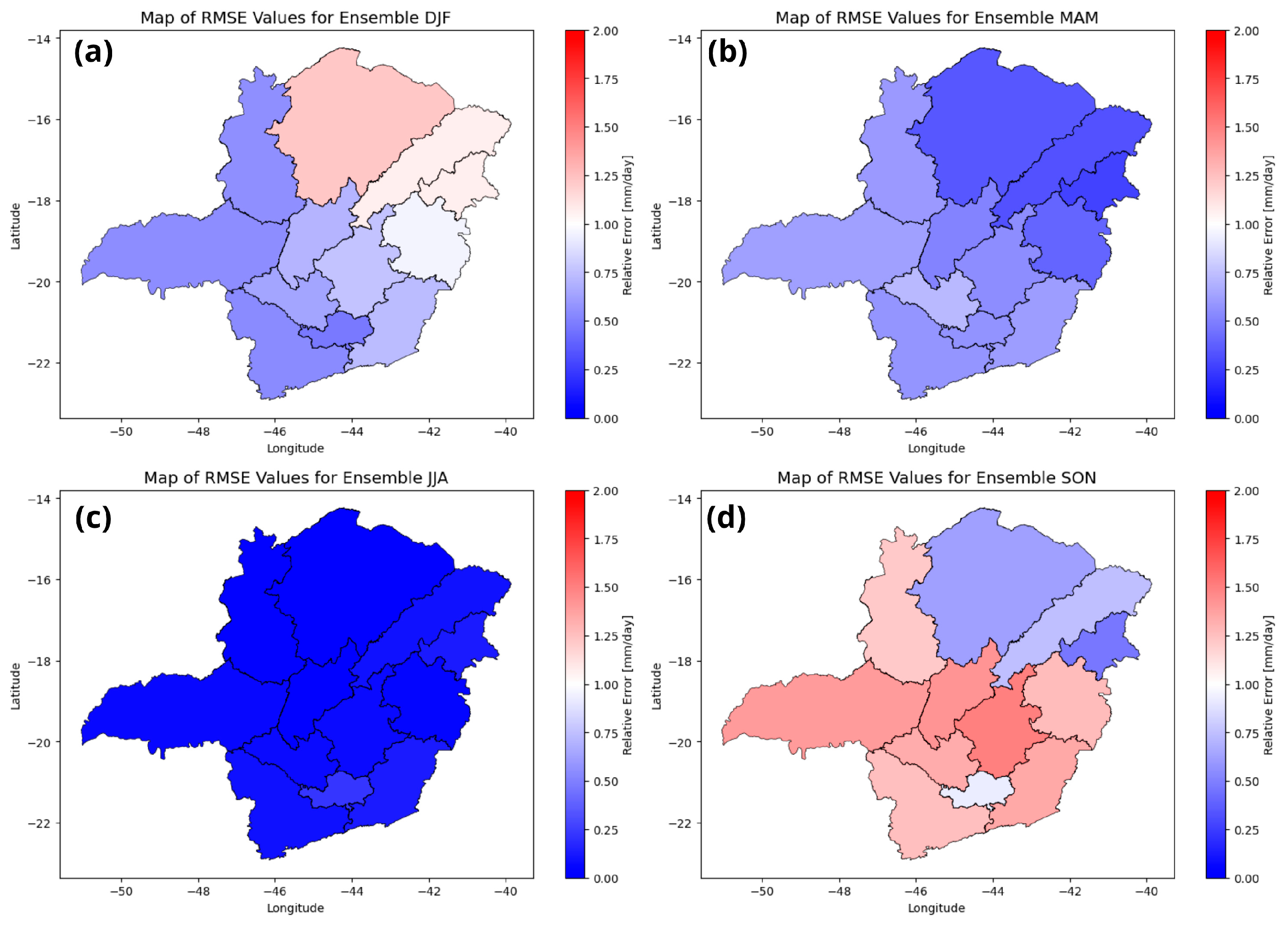
The spatial distribution of forecast errors, represented by RMSE maps in
Figure 7 and aggregated by mesoregions, reveals clear seasonal differences in model performance. During DJF (
Figure 7a) and SON (
Figure 7d), higher RMSE values are observed in regions characterized by strong spatial variability and convective activity, particularly over central and western mesoregions.
In contrast, JJA (
Figure 7c) exhibits uniformly low RMSE values across most of the state, indicating high spatial consistency between forecasts and observations under predominantly dry and stable atmospheric conditions. Autumn (MAM;
Figure 7b) presents intermediate RMSE values, with relatively homogeneous spatial patterns and lower errors compared to DJF and SON, reflecting the reduced convective influence during the transition from the wet to the dry season.
Overall, the spatial RMSE patterns are consistent with the seasonal dependence identified in the aggregated performance metrics, confirming improved forecast skill during periods of lower precipitation variability and increased uncertainty during convectively active seasons.
3.4. Comparison Between AI and Dynamical Seasonal Forecasts
A comparison between the AI ensemble forecasts and the dynamical seasonal prediction systems is presented in
Table 3 and
Figure 8. The analysis includes forecasts from multiple international centers (ECMWF, UK Met Office, Météo-France, CMCC, and NCEP), providing a comprehensive multi-model benchmark. Overall, the results show that the AI-based approach consistently outperforms the dynamical seasonal forecasts across all seasons.
The results presented in
Table 3 indicate that the dynamical models exhibit consistently higher RMSE and MSE values compared to the AI-based ensemble. Across all evaluated seasons and years, RMSE values for the dynamical models typically range between approximately 2.3 and 4.4, depending on the model and season, whereas the AI model presents significantly lower values, generally below 0.7. Similarly, MSE values for the dynamical systems are considerably higher, often exceeding 10 in several seasons, highlighting the larger magnitude of forecast errors. The correlation coefficients were generally close to zero across most models, seasons, and years, suggesting a limited ability of the dynamical systems to reproduce the observed spatial and temporal variability of precipitation at the regional scale.
Among the evaluated models, some systems show relatively better performance in specific seasons. For instance, the CMCC model demonstrates comparatively lower errors during summer (DJF), while CMCC and NCEP exhibit improved performance in autumn (MAM), with RMSE values in some cases approaching 1.1–1.7. The ECMWF model presents slightly better results during spring (SON), with RMSE values around 2.5–2.6. Additionally, the NCEP model demonstrates relatively lower errors during winter (JJA), with RMSE values below 1.2 in some years. However, these differences are relatively small, and no single dynamical model consistently outperforms the others across all seasons.
In contrast, the AI ensemble consistently achieves substantially lower error metrics and higher correlation values, indicating superior skill in capturing both the magnitude and spatial distribution of seasonal precipitation. These results highlight the advantage of the AI-based approach in representing regional-scale variability, particularly when trained on high-resolution observational data, even when compared to state-of-the-art dynamical forecasting systems.
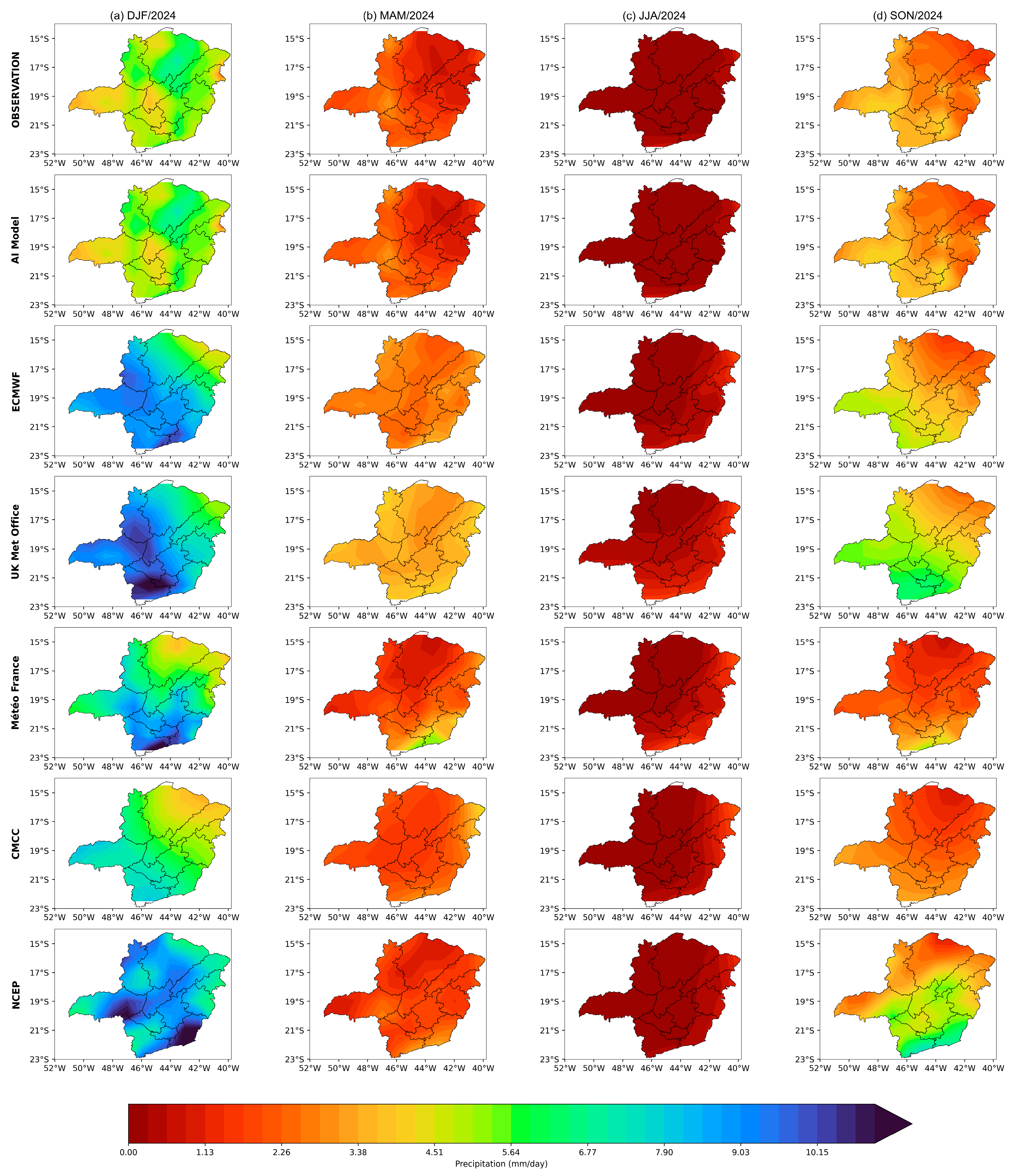
Seasonal precipitation forecasts for 2024 produced by the dynamical models are shown in
Figure 8 and compared with both the AI-based forecasts and the observed precipitation fields. The comparison reveals consistent differences in the ability of the models to represent spatial patterns and seasonal transitions across Minas Gerais.
During austral summer (DJF;
Figure 8a), most dynamical models reproduce the large-scale wet conditions but exhibit significant spatial differences when compared to observations. In several models, precipitation maxima over central and southern mesoregions are overestimated or displaced. Among them, the CMCC model shows comparatively better agreement with the observed precipitation patterns, although localized maxima over central and southern mesoregions remain overestimated. In contrast, the AI forecasts show a closer agreement with the observed spatial distribution, capturing localized features with greater detail.
In autumn (MAM;
Figure 8b), the dynamical models generally present more homogeneous precipitation patterns, with limited spatial contrast across the state. While the large-scale gradient is partially represented, finer-scale variability is less evident. The NCEP and CMCC models exhibit relatively improved performance compared to the other dynamical systems, better capturing the large-scale distribution of precipitation. Even so, the representation of regional variability remains smoother than observed. The AI model, on the other hand, maintains a more detailed spatial structure, particularly in transition zones between wetter and drier regions.
During winter (JJA;
Figure 8c), all models show strong agreement with the observed dry-season conditions, characterized by very low precipitation across most of Minas Gerais. In this season, differences between the AI and dynamical models are reduced, reflecting the lower variability and higher predictability associated with stable atmospheric conditions.
In spring (SON;
Figure 8d), which corresponds to the onset of the rainy season, the dynamical models display greater spread in their predictions. The ECMWF model stands out by better representing the spatial gradient and the intensification of precipitation compared to the other dynamical systems. Nevertheless, most models still exhibit smoother patterns and some displacement of precipitation maxima. The AI forecasts generally reproduce the spatial distribution and magnitude of precipitation more consistently, particularly in central and eastern mesoregions, where the onset of convective activity is more pronounced.
Overall, while some dynamical models show relatively better performance in specific seasons, they tend to present greater difficulty in accurately representing the spatial variability of precipitation across Minas Gerais. In contrast, the AI-based approach demonstrates ability to capture regional-scale gradients and localized features, suggesting its potential as a complementary tool to traditional dynamical forecasting systems, especially during convectively active seasons (DJF and SON).
4. Discussion
The application of a supervised machine learning approach for seasonal precipitation forecasting over Minas Gerais demonstrated a promising capacity to reproduce spatial and seasonal rainfall patterns. The use of the MERGE dataset as a high-resolution input source proved particularly advantageous, allowing the model to represent regional-scale variability that is commonly underestimated or smoothed by global dynamical forecasting systems [
25,
26].
Another important aspect in seasonal forecasting systems is the dependence of forecast skill on lead time. In operational seasonal prediction systems, forecast skill generally decreases as the forecast horizon increases, and evaluating this behavior is essential for a complete assessment of model performance. In the present study, however, the experimental design focused on exploring the potential of a machine learning approach to identify predictive relationships between antecedent large-scale conditions and seasonal precipitation over the study region. For this purpose, predictors from the corresponding season of the previous year were used to estimate precipitation conditions for the target season, allowing the AI model to explore lagged relationships between antecedent large-scale climate variability and regional precipitation patterns. A more comprehensive evaluation, including multiple lead times and a broader hindcast framework, could provide additional insights into the robustness and operational applicability of the proposed methodology, representing a natural direction for future research.
The choice of precipitation as the primary predictor was not arbitrary but resulted from systematic sensitivity experiments. Multiple predictor configurations—including atmospheric and surface variables such as near-surface air temperature, wind fields, radiation fluxes, and soil moisture—were tested. These experiments consistently resulted in higher error metrics compared to the precipitation-only configuration, indicating that the inclusion of additional variables did not improve forecast skill and, in some cases, degraded model performance.
From a physical perspective, seasonal precipitation in tropical and subtropical regions often exhibits a degree of interannual persistence associated with large-scale climate modes and land–atmosphere feedbacks. In this context, precipitation can be interpreted as an integrative variable that reflects the combined influence of multiple climate drivers. Previous studies have shown that precipitation-based or univariate approaches can retain meaningful predictive information in seasonal forecasting applications, particularly when persistence plays a significant role [
37,
47].
Consistent with this perspective, the sensitivity experiments conducted in this study suggest that the inclusion of multiple predictors may introduce noise and increase model complexity without adding predictive value. Similarly, alternative lead-time configurations based on preceding seasons resulted in reduced predictive performance. These findings indicate that, for the study region, seasonal precipitation persistence is a key source of predictability that can be effectively exploited by the AI model, while still allowing it to capture spatial variability through nonlinear relationships.
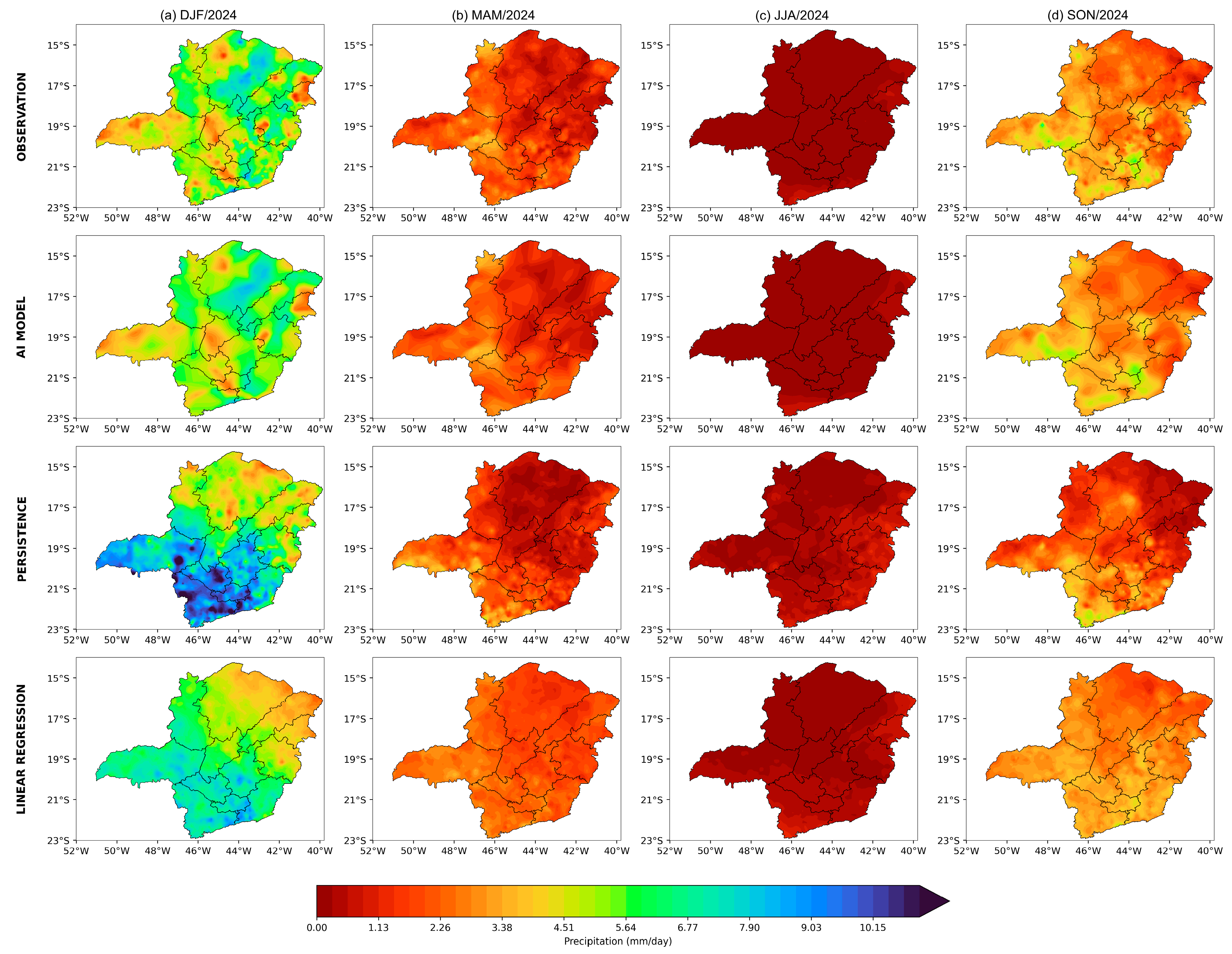
To further assess whether the predictive skill of the AI model is primarily driven by persistence, additional baseline experiments were conducted using (i) a persistence model based on precipitation from the corresponding season of the previous year, and (ii) a simple linear regression model using the same predictor. The comparison of these approaches with the observed precipitation fields (
Figure 9) reveals clear differences in performance.
The persistence model shows limited skill, failing to adequately represent regional contrasts, precipitation intensity, and spatial variability, particularly in areas influenced by topography and convective processes. The linear regression model produces slightly smoother fields but exhibits similar limitations, with reduced ability to represent spatial gradients and variability. Overall, both baseline approaches are unable to reproduce the observed spatial structure of precipitation with sufficient accuracy.
In contrast, the AI model demonstrates a substantially improved representation of spatial patterns, including a more accurate depiction of precipitation gradients and localized maxima. These results indicate that the predictive skill of the AI model cannot be explained by persistence or simple linear relationships alone. Instead, the model effectively captures nonlinear spatial dependencies that enhance its ability to represent regional-scale variability. This comparison provides strong evidence that the proposed approach offers added value beyond simple statistical baselines.
A central result of this study is the marked seasonal dependence of forecast performance. The highest skill observed during winter (JJA) reflects the predominance of stable atmospheric conditions and the climatologically dry regime over the region, which reduces precipitation variability and forecast uncertainty. Similar behavior has been reported in previous studies, where both statistical and dynamical models tend to exhibit improved performance during dry seasons characterized by large-scale atmospheric control [
25,
33,
37,
48]. In contrast, the wet seasons (DJF and SON) represent a more challenging forecasting environment due to the influence of mesoscale and convective systems, including the SACZ, local convection, and orographic effects [
8,
9,
10]. These processes introduce strong spatial heterogeneity and temporal intermittency, which are difficult to capture using seasonal forecasting approaches.
Despite these challenges, the AI-based forecasts maintained relatively low error levels during DJF and SON when compared to dynamical models. The spatial patterns indicate that the AI model was more effective in reproducing localized precipitation features, particularly in central and southern mesoregions, where convective activity and topographic influences are more pronounced. These findings are consistent with recent literature highlighting the ability of machine learning models to capture nonlinear relationships and subgrid-scale variability when trained on high-resolution observational datasets [
33,
48].
The comparison with the dynamical forecasts further emphasizes the limitations of traditional dynamical models in regions with complex terrain such as Minas Gerais. Although the dynamical systems are generally able to represent large-scale circulation signals and broad seasonal tendencies, they tend to produce smoother precipitation fields and higher error metrics, particularly during convectively active seasons. This behavior suggests that, although dynamical models are essential for representing physical processes at the global scale, their coarse spatial resolution constrains their ability to accurately simulate regional precipitation magnitude and spatial gradients [
23,
24,
25].
While the comparison with dynamical models provides a useful benchmark, it is important to acknowledge that the two approaches are not strictly equivalent. The AI model is trained using high-resolution observational data and is effectively optimized for regional-scale prediction, whereas dynamical models are global systems designed to simulate large-scale physical processes and are not specifically calibrated for local applications. Although efforts were made to ensure consistency through regridding to a common spatial resolution, differences in model structure, objectives, and scale remain inherent to the comparison.
In addition, the independent evaluation period is limited to a relatively short multi-year window, which, while sufficient to provide an initial out-of-sample assessment, does not allow for a comprehensive long-term validation of forecast skill. Therefore, the results should be interpreted within the context of this restricted evaluation period. Overall, the AI-based forecasts should be viewed as a complementary approach that enhances regional detail, rather than a replacement for dynamical forecasting systems. Future work should focus on extending the evaluation through longer hindcast experiments and exploring hybrid frameworks combining dynamical model outputs with AI-based downscaling techniques to further improve seasonal prediction skill.
The spatial analysis of forecast errors indicates that transitional zones, such as the boundary between the drier northern regions and the wetter southern highlands, remain challenging for both approaches. RMSE patterns in these areas suggest sensitivity to sharp climatic gradients and highlight the importance of incorporating additional predictors related to topography and land–atmosphere interactions [
49]. These results are in line with broader assessments showing that AI and machine learning can complement or surpass dynamical systems in seasonal and subseasonal prediction when appropriately trained and calibrated [
34,
36].
Overall, the results indicate that AI-based seasonal forecasting represents a potentially valuable complementary approach to traditional dynamical models, especially for regional-scale applications in climatically heterogeneous areas.
5. Conclusions
This study evaluated the potential of an artificial intelligence (AI)-based approach for seasonal precipitation forecasting over Minas Gerais, through comparison with dynamical forecasting systems and simple statistical baselines. The analysis focused on the ability of the proposed framework to reproduce the spatial distribution of seasonal precipitation at the regional scale.
The results indicate that the AI-based methodology, trained using the high-resolution MERGE-CPTEC dataset, consistently achieved lower error metrics (RMSE and MSE) and higher spatial agreement with observations than both the dynamical models and the baseline approaches (persistence and linear regression). The highest skill was observed during the dry winter season (JJA), when atmospheric conditions are more stable, and precipitation variability is reduced. During the wet seasons (DJF and SON), which are characterized by enhanced convective activity and greater spatial heterogeneity, the AI forecasts maintained reasonable spatial coherence and closer agreement with observations than the dynamical baseline, despite the increased forecasting complexity.
The inclusion of baseline models demonstrates that the predictive skill of the AI model cannot be explained by interannual persistence alone. Both the persistence and linear regression approaches showed limited ability to reproduce the observed spatial structure of precipitation. In contrast, the superior performance of the AI model—particularly in capturing spatial gradients and localized precipitation features—indicates that its skill extends beyond simple persistence or linear relationships, reflecting its ability to learn nonlinear spatial dependencies.
Beyond quantitative accuracy, the results highlight the potential of the AI model ensemble approach for seasonal forecasting applications. The ensemble strategy contributed to forecast stability by reducing random variability associated with AI model initialization and training, while the computational efficiency of the AI framework allows the generation of high-resolution seasonal forecasts at a substantially lower cost than global dynamical models. This characteristic may be particularly useful for regional meteorological centers that require timely climate information to support decision-making in sectors such as agriculture and water resource management.
The forecasting design shown in this study is based on a fixed lead-time configuration and is primarily intended to evaluate the ability of the AI model to capture spatial patterns of seasonal precipitation. Therefore, it does not represent a complete operational forecasting framework, in which forecast skill is typically assessed across multiple lead times. Additional experiments using shorter lead-time predictors resulted in reduced performance, suggesting that interannual persistence plays a dominant role in the predictability of seasonal precipitation in the study region. Nevertheless, a systematic evaluation of lead-time dependency remains an important topic for future research.
During the development of the modeling framework, several predictor configurations were explored to identify the most suitable setup for seasonal precipitation prediction in the study region. Additional experiments incorporating multiple atmospheric and surface variables, including wind fields, air temperature, radiation fluxes, and soil moisture, also did not improve forecast skill, producing higher RMSE and MSE values relative to experiments using precipitation as the primary predictor. These results suggest that, for the climatic conditions of Minas Gerais, seasonal precipitation exhibits strong temporal persistence and that simpler predictor structures may provide more robust predictive signals for machine learning models.
Although the results are promising, the present analysis represents an initial assessment of the methodology, and further evaluation using longer hindcast periods would be necessary to fully characterize forecast skill, uncertainty, and sensitivity to large-scale climate forcing.
Future research should therefore aim to extend this framework by incorporating longer hindcast datasets and additional large-scale predictors, such as sea surface temperature anomalies and atmospheric circulation indices, to improve the representation of climate drivers and extreme precipitation events. Moreover, the exploration of advanced deep learning architectures capable of capturing longer-term temporal dependencies may further improve forecast skill during transitional periods between dry and wet seasons.