Article

Comparative Analysis of the Accuracy of Temperature and Precipitation Data in Brazil

by
P. C. M. de Menezes
1,2,3,*,
D. C. de Souza
2,3,4,
M. G. Tavares
2,3,5 and
R. A. G. Marques
2,3,6
1
Department of Computer Science, Federal University of Alfenas, Av. Jovino Fernandes Sales 2600, Alfenas 37133-840, MG, Brazil
2
IRB(P&D), Av. República do Chile, 330-4∘ andar, Rio de Janeiro 20031-170, RJ, Brazil
3
Brazilian Center of Risk and Resilience Studies, R. Equador, 335-Santo Cristo, Rio de Janeiro 20220-410, RJ, Brazil
4
Institute of Astronomy, Geophysics and Atmospheric Sciences, University of São Paulo, Rua do Matão 1226, Cidade Universitária, São Paulo 05508-090, SP, Brazil
5
National Institute for Space Research (INPE), Presidente Dutra Rod. (BR-116), km 39, Cachoeira Paulista 12630-000, SP, Brazil
6
Department of Statistics, Federal University of Alfenas, Av. Jovino Fernandes Sales 2600, Alfenas 37133-840, MG, Brazil
*
Author to whom correspondence should be addressed.
Meteorology 2026, 5(1), 3; https://doi.org/10.3390/meteorology5010003
Submission received: 1 November 2025 / Revised: 7 January 2026 / Accepted: 9 January 2026 / Published: 20 January 2026

Abstract

Accurate air temperature and precipitation data are fundamental for environmental and socioeconomic applications in Brazil. However, the observational network managed by the National Institute of Meteorology, suffers from spatial gaps, necessitating the use of gridded datasets. This study provides a rigorous comparative assessment of three prominent gridded products—the station-interpolated dataset of Brazilian Daily Weather Gridded Data (BR-DWGD), the satellite-gauge blended product MERGE, and the ERA5-Land Reanalysis dataset—against station data. We evaluate the performance of the institutionally supported MERGE and ERA5-Land products as viable alternatives to the interpolated dataset. Daily data for maximum temperature (Tmax), minimum temperature (Tmin), and total precipitation were selected from 1994 to 2024 and analyzed using statistical metrics. The interpolated product showed the highest fidelity to observations, especially for temperature. For precipitation, the MERGE product demonstrated the best performance, achieving higher correlation and lower error than both the interpolated dataset and the poorly performing ERA5-Land. For temperature, ERA5-Land proved to be an excellent alternative for minimum temperature, but exhibited significant regional biases for maximum temperature and a tendency to underestimate heat extremes. We conclude that MERGE is the most robust alternative for precipitation studies in Brazil. ERA5-Land is a highly reliable source for minimum temperature, but its direct use for maximum temperature requires caution.

1. Introduction

Accurate air temperature and precipitation data are fundamental for various environmental applications, including climate change studies, risk assessment, and the development of mitigation and adaptation strategies [1,2]. Such information also underpins agricultural planning and water resource management [3] and the development of hydrological and ecosystem models [4,5]. The reliability of this data is critical, as uncertainties can propagate into subsequent models, affecting simulations of agricultural productivity and streamflow projections [6,7].
Brazil, with its vast size and climatic diversity [8], has faced an increase in the frequency and intensity of extreme events, such as severe droughts in the Northeast and Southeast [1,2] and floods in the southern region [9,10], intensifying the need for accurate data for monitoring and adaptation. The network of surface meteorological stations, operated by the National Institute of Meteorology (INMET), Brasília, Brazil, is the basis for climate monitoring in the country [11]. However, this network has limitations in density and spatial homogeneity, with less coverage in remote regions like the Amazon Basin. Additionally, the network can have temporal discontinuities (gaps), posing a challenge for long-term climatological analyses.
Due to these gaps, researchers often turn to alternative data sources in a gridded format, which offer continuous spatial coverage. These sources include products derived from remote sensing [12,13], reanalysis models [14,15], and grids generated by interpolating observational data. Reanalysis products, such as ERA5-Land [16,17], and products that merge satellite and rain gauge data, like MERGE [18], are widely used.
In parallel, high-resolution gridded datasets have been developed in Brazil from the interpolation of a dense set of surface observations, a prominent example being the dataset developed by Xavier et al. [19], the Brazilian Daily Weather Gridded Data database (BR-DWGD). Although these data sources are powerful tools, they are generated by different methodologies, which introduces inherent uncertainties. Therefore, their rigorous validation against independent observational data is an indispensable step before their application [20].
In this context, our central objective is to conduct a comparative and rigorous assessment of the accuracy of different gridded data products for Brazil. We will compare daily total precipitation and temperature data from distinct datasets with observations from the INMET station network, which will serve as our “ground truth” reference. Although temperature is an assimilated variable in reanalysis models, including it in this comparison is a strategic move. The justification lies in quantifying the specific accuracy trade-offs when transitioning from the station-interpolated (BR-DWGD) database—which, despite its high accuracy, faces uncertainties regarding long-term maintenance—to institutionally supported operational products like ERA5-Land. Thus, we aim to verify to what extent the wide-coverage grids can serve as viable, long-term alternatives for Brazilian climatology.

2. Materials and Methods

2.1. Study Area

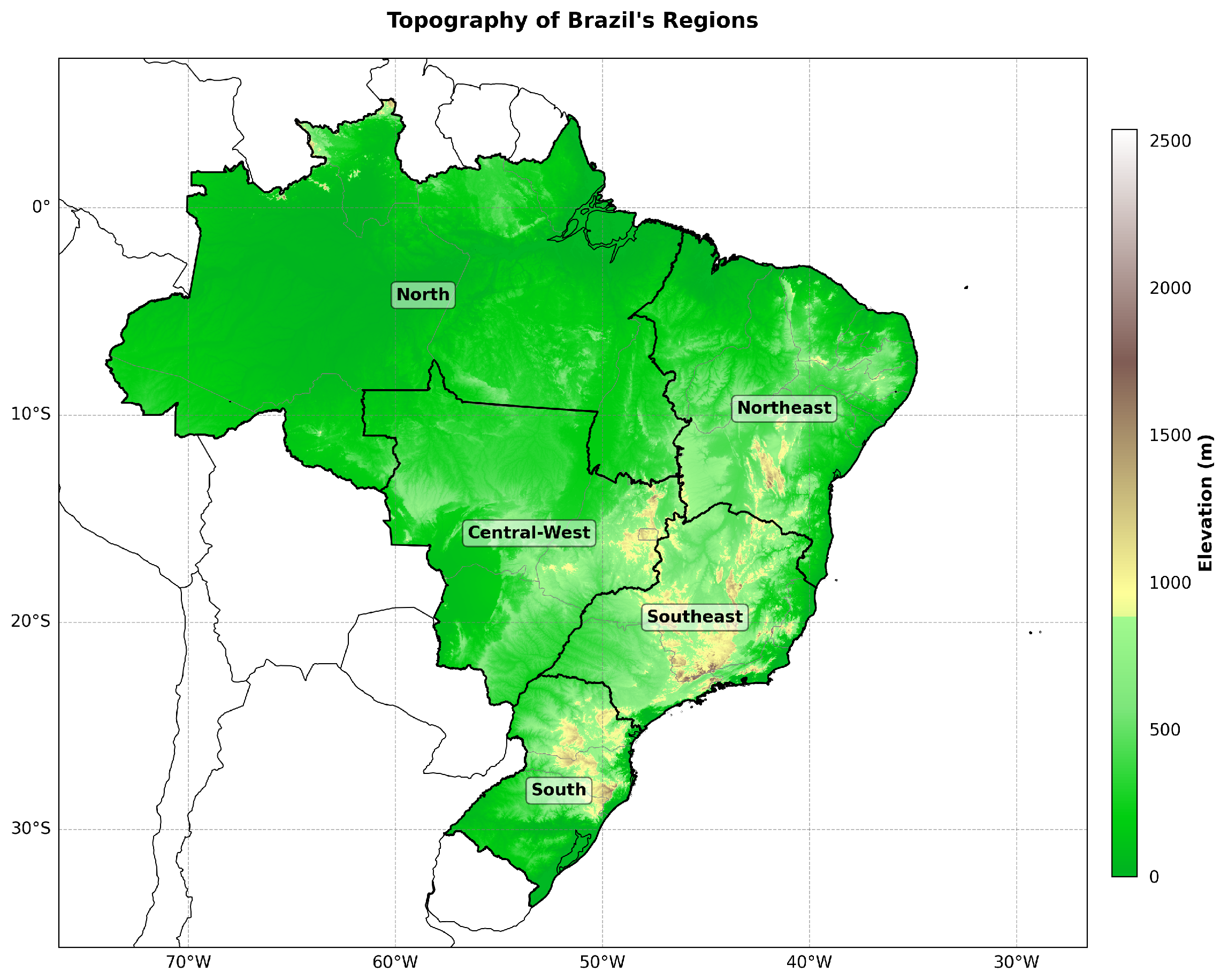
The study encompasses the Brazilian territory, spanning latitudes from 5° N to 34° S and longitudes from 34°47′ W to 73°59′ W. This extent results in substantial climatic diversity under the Köppen classification [8]. According to the country-specific mapping by Alvares et al. [21], the territory is dominated by Type A climates (tropical, ∼81.4%), followed by Type C (temperate, ∼13.7%) and Type B (semi-arid, ∼4.9%). This diversity, combined with heterogeneous topography (Figure 1), can affect the accuracy of gridded datasets. While precipitation exhibits strong spatial variability driven by orography, temperature fields are also significantly influenced by elevation and lapse rate variations. These complex interactions pose challenges for gridded products, as interpolation algorithms and reanalysis models may struggle to resolve local microclimates in mountainous regions compared to the more uniform topography of the North. Such characteristics pose challenges for gridded products, as interpolation algorithms, reanalysis models, and satellite estimates may behave differently across distinct precipitation regimes [22,23].
For example, high-intensity, short-duration convective precipitation, common in Type A climates, is often underrepresented in lower-resolution grids [24,25,26], whereas estimates are usually better and more consistent for Types B and C [25]. However, in coastal zones and in regions with complex terrain, such as Brazil’s South and Southeast, satellite-based precipitation estimates tend to be biased [23,27].

2.2. Data Source

Data were collected from four different sources: observational data provided by INMET, and gridded datasets generated from three distinct products—BR-DWGD, MERGE, and ERA5-Land. A summary of the main characteristics of these datasets is presented in Appendix A (Table A1)
Among the various variables available from these sources, precipitation and temperature data were selected, and the analyses were conducted for the seasonal periods: DJF (summer), MAM (autumn), JJA (winter), and SON (spring). The gridded data product underwent a pre-processing procedure, including: extracting data from the gridded products to the station points; hourly data was averaged to a daily scale; and pairing valid data between observations and estimates.
All datasets were collected for the period between 2000 and 2024 for precipitation data (INMET, BR-DWGD, MERGE, and ERA5-Land), and between 1994 and 2024 for temperature data (INMET, BR-DWGD, and ERA5-Land). The Total Precipitation in ERA5-Land represents the daily precipitation amount, and is therefore treated simply as precipitation. Appendix A (Table A2) summarizes the number of grid points available across the Brazilian regions for each dataset.

2.2.1. Observational Database

Observational data from the INMET network of Surface Meteorological Observation Stations were used [11]. Series of total daily precipitation (mm) and air temperatures (°C) were collected. Station selection followed quality and completeness criteria. The raw data provided by INMET undergoes standard quality control procedures following World Meteorological Organization (WMO), Geneva, Switzerland, guidelines to remove gross errors. For this study, we applied an additional filter, selecting only stations with at least (>80% valid data) valid data for the analyzed period (2000–2024) to ensure temporal consistency and minimize the impact of gaps on the statistical metrics.

2.2.2. BR-DWGD Product

The BR-DWGD (Brazilian Daily Weather Gridded Data) dataset provides daily estimates obtained through the interpolation of data from 11,473 rain gauges and 1252 meteorological stations managed by the National Water and Sanitation Agency (ANA), Brasília, Brazil, and the National Institute of Meteorology (INMET) [19,28]. The interpolation employs methods such as Inverse Distance Weighting (IDW) and Angular Distance Weighting (ADW). The product features a spatial resolution of 0.1° × 0.1° (approximately 10 km) and covers the period from 1 January 1961, to 20 March 2024.

2.2.3. MERGE Product

The MERGE product is a dataset developed by the National Institute for Space Research (INPE) that blends satellite-based estimates (Tropical Rainfall Measurement Mission/Global Precipitation Measurement (TRMM/GPM)) with rain-gauge observations [18]. Its data are available from 2000 to the present, with a spatial resolution of 0.25° × 0.25°. MERGE is particularly advantageous in regions with sparse observational networks and has been widely applied in Brazil for precipitation-derived analyses [29,30,31,32].

2.2.4. ERA5-Land Product

The ERA5-Land reanalysis product is a global gridded dataset with a spatial resolution of approximately 0.1°, developed by the European Centre for Medium-Range Weather Forecasts (ECMWF) based on the ERA5 system [17]. Comprising a network of daily and hourly data from 1979 to the present, ERA5-Land provides a robust foundation for studies involving land surface processes, such as vegetation dynamics and hydrological monitoring. Several studies focusing on droughts, precipitation, and temperature have successfully applied and validated this dataset, including Bonshoms et al. [33], Chang et al. [34], Espinosa et al. [35], Ippolito et al. [36], and Xu et al. [37].

2.3. Statistical Evaluation Metrics

The accuracy of the products was assessed using a set of statistical metrics, comparing the values estimated by the gridded products with those observed at the stations [6,7]. In the following equations, P i represents the value estimated by the product for the data pair i, O i is the corresponding value observed at the station, N is the total number of data pairs analyzed, while P ¯ and O ¯ are the means of the estimated and observed value sets, respectively.
Mean Error (ME)measures the average tendency of overestimation (me > 0 ) or underestimation (ME < 0 ) of the gridded product. A value close to zero indicates a model with low systematic bias.
ME = 1 N i = 1 N ( P i O i )
Mean Absolute Error (MAE) represents the average magnitude of the error, without considering its direction. It is a direct measure of the expected average error.
MAE = 1 N i = 1 N | P i O i |
Root Mean Square Error (RMSE) also measures the magnitude of the error but assigns a greater weight to large errors due to the squared term. It is always greater than or equal to the MAE, and a large difference between RMSE and MAE suggests the occurrence of large-magnitude errors.
RMSE = 1 N i = 1 N ( P i O i ) 2
Pearson Correlation Coefficient (r) quantifies the degree of linear association between the estimated and observed values, ranging from −1 to +1. Values close to +1 indicate a strong positive linear correlation.
r = i = 1 N ( P i P ¯ ) ( O i O ¯ ) i = 1 N ( P i P ¯ ) 2 i = 1 N ( O i O ¯ ) 2
Coefficient of Determination ( R 2 ) indicates the proportion of the variance in the observed data that is explained by the model. It ranges from 0 to 1, where values closer to 1 represent a better fit of the model to the data.
R 2 = 1 i = 1 N ( O i P i ) 2 i = 1 N ( O i O ¯ ) 2
To complement the visual analysis, this section presents a quantitative evaluation of the performance of the gridded data products (ERA5-Land, MERGE, and BR-DWGD) against the point observations from the INMET stations. The metrics used for this comparison include the Root Mean Square Error (RMSE), scatter plots, Quantile-Quantile (Q-Q) plots, Probability Density Function (PDF) analysis, and Taylor diagrams.

3. Results

3.1. Spatial Analysis of Climatic Patterns

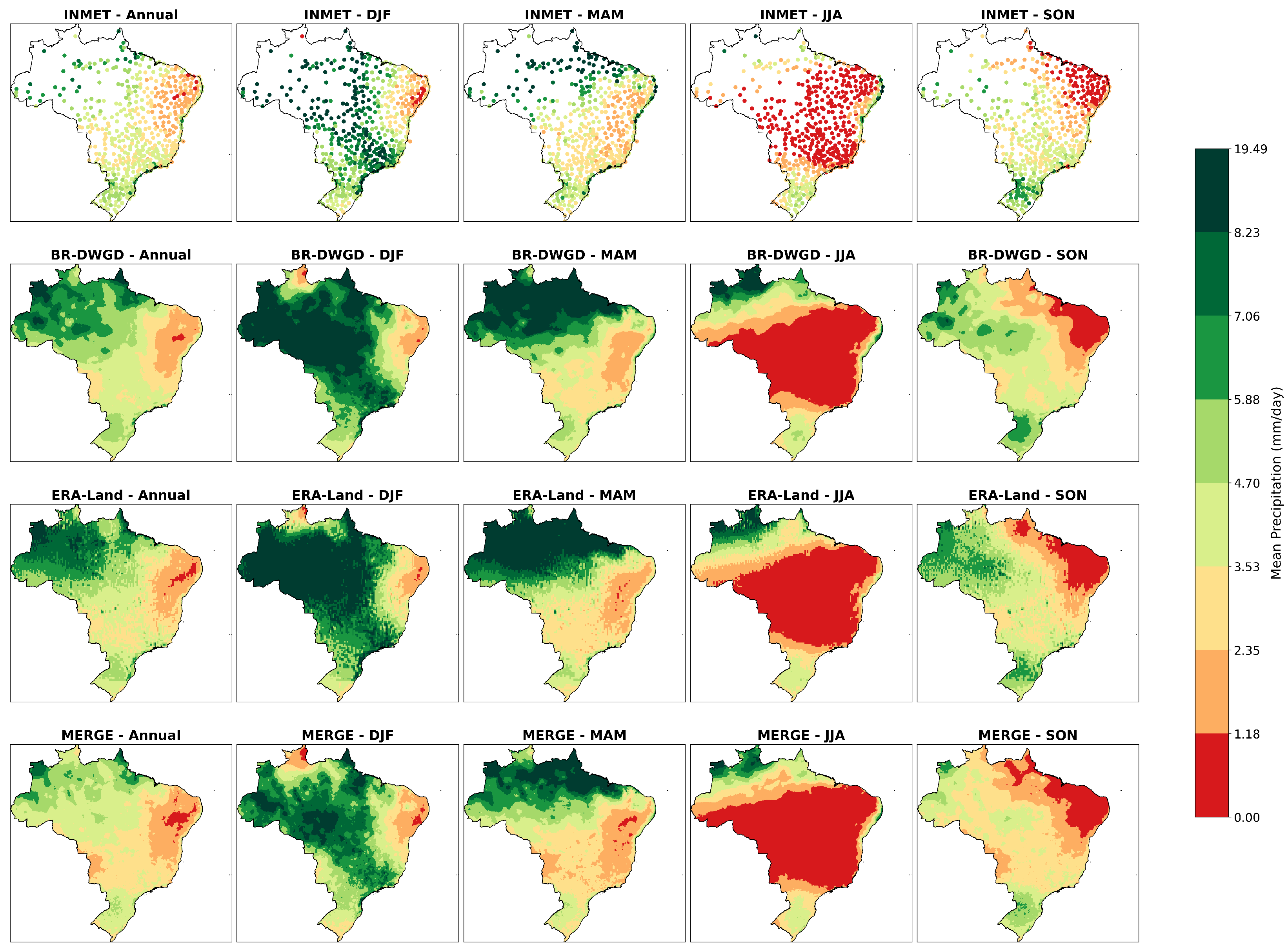
The analysis of precipitation from the products (Figure 2) reveals that, in general, all show similar spatial and seasonal variability. The analyzed products are able to represent the main climatological features of Brazil: (i) the precipitation maximum in summer (DJF) extending from the Northwest to the Southeast, associated with the occurrence of the South Atlantic Convergence Zone (SACZ) [38,39]; (ii) the maximum in the northern portion in MAM, consistent with the southernmost positioning of the Intertropical Convergence Zone (ITCZ) in this period [40]; (iii) the dry season in JJA in most of the country (except the extreme north and south), due to the dry phase of the South American monsoon [41,42] and the northernmost positioning of the ITCZ [40], with precipitation in the Southern Region associated with the activity of frontal systems [43]; and (iv) the return of rains in spring (SON) in the central regions.
When focusing on annual totals (Figure 2, first column), the differences in precipitation magnitude become more evident. The greatest disagreements between the products are found in regions with low meteorological station coverage, such as the western Amazon. In this case, the ERA5-Land product tends to place a more extensive region of maximum accumulation ( < 70,000 mm) than BR-DWGD and, especially, MERGE. A comparison with the results obtained by Luiz-Silva et al. [44], which used interpolated rain gauge data, indicates that this maximum detected by BR-DWGD may be an overestimation. This interpretation is further supported by previous studies showing that satellite-based precipitation products perform well in this region [45,46].
During the summer (DJF), differences in daily precipitation fields are also pronounced. In the western Amazon, the interpolation procedure may reasonably reproduce the large-scale summer variability associated with the South American Convergence Zone (SACZ) and the South American Low–Level Jet (SALLJ), which are the primary large-scale precipitation drivers in the region [47]. However, the low density of rain gauges likely limits its ability to capture the spatial variability linked to mesoscale convective systems, which also modulate precipitation in this area [48]. By assimilating satellite-based estimates, the MERGE product might tend to better capture the spatial pattern of precipitation in this region [45].
In MAM, discrepancies between the products become more evident in the northern Amazon, with ERA5-Land and BR-DWGD indicating higher daily accumulations than MERGE. During this season, the southward displacement of the ITCZ favors the development of squall lines along the coast that propagate inland [49,50]. These systems may be poorly represented by BR-DWGD due to the low density of stations in the region, leading, as in the western Amazon, to potential overestimation. For ERA5-Land, previous studies have shown that numerical models often struggle to represent tropical moisture convergence accurately, partly due to biases in simulated Pacific SSTs [51], as well as difficulties in resolving mesoscale convergence features such as squall lines [48].
In contrast, during the dry season (JJA) and the onset of the rainy season (SON), there is generally greater agreement among the products. This pattern is also observed for the Brazilian Southeast and most of the South region across all seasons. In southeastern Brazil, where station coverage is relatively high and precipitation is predominantly modulated by large-scale systems such as the SACZ and frontal systems, this level of agreement is expected. A similar situation is observed in southern Brazil, although mesoscale convective systems become more frequent during the warm season [52]. Nevertheless, these systems are generally well detected by satellite-based estimates [53,54], and their synoptic environment is adequately captured by ERA5-Land [55], leading to a good depiction of the spatial pattern of rainfall.
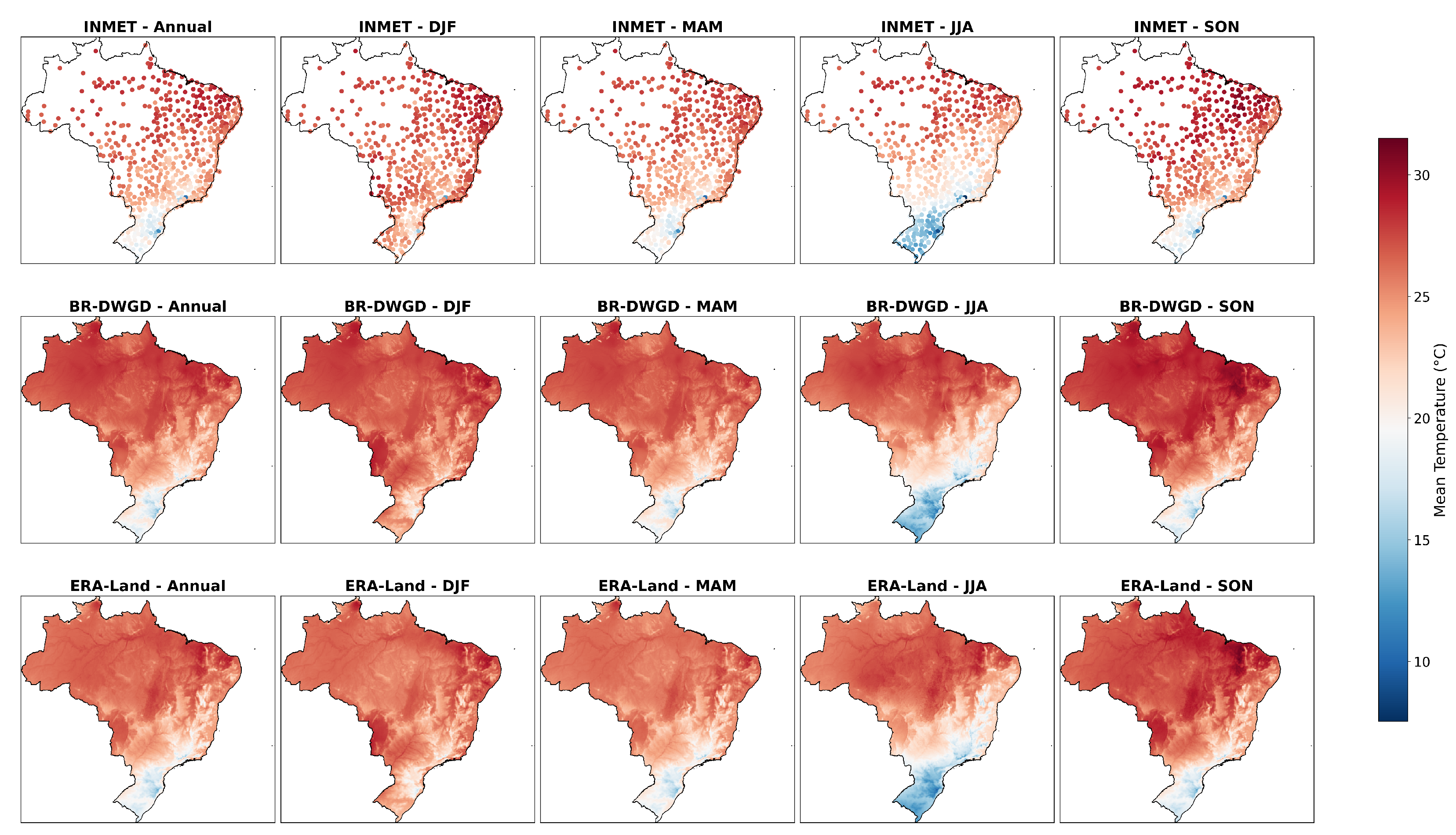
The spatial fields of temperature across the products are very similar, so differences become evident only when analyzed quantitatively, as discussed in Section 3.2. The corresponding results can be found in the Appendix A (Figure A1).

3.2. Quantitative Performance Evaluation of the Products

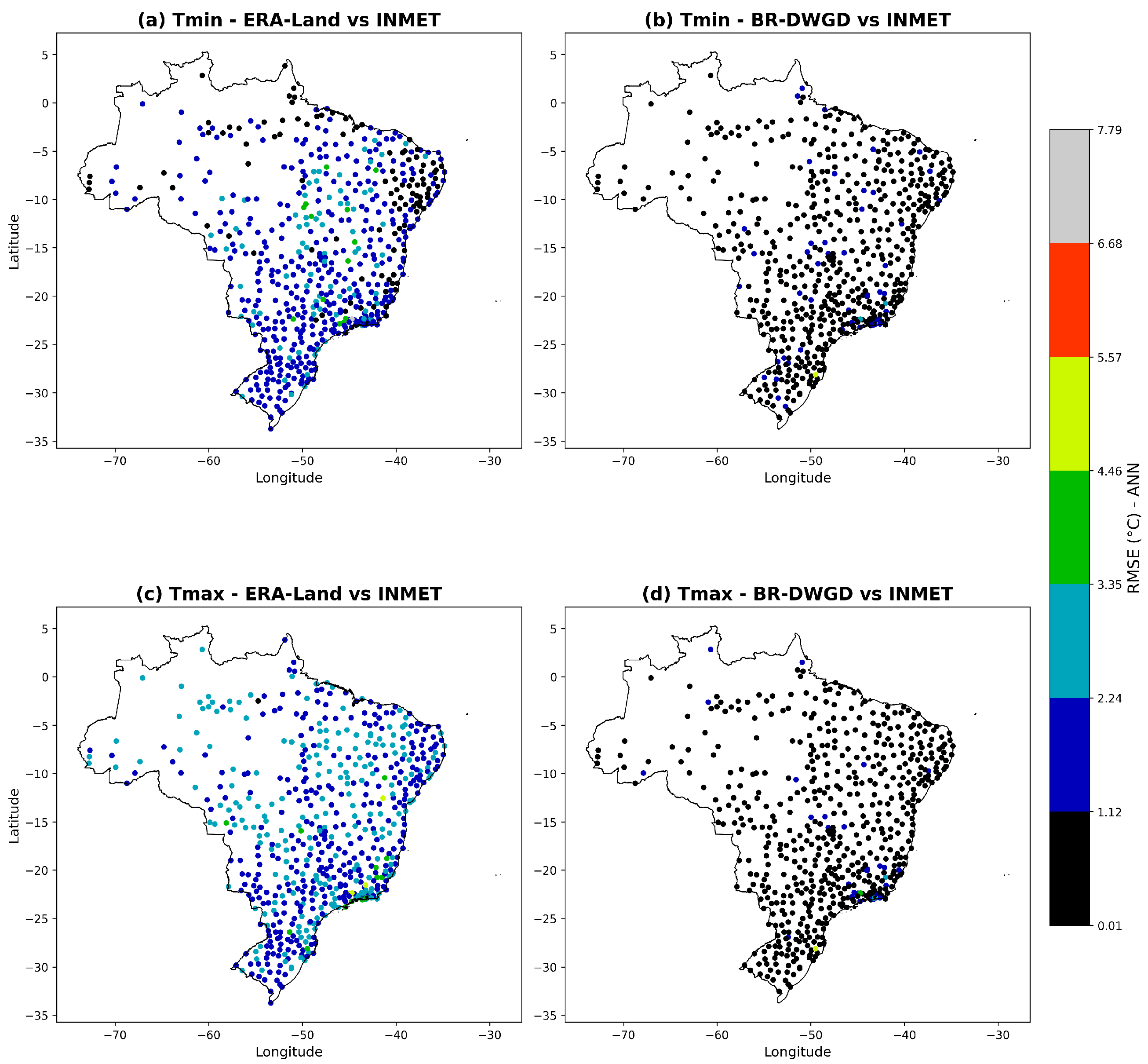
Figure 3 summarizes the RMSE for maximum and minimum temperatures. For Tmax, ERA5-Land exhibits the largest errors (often > 3   C), especially over the continental interior and in mountainous regions of southeastern and southern Brazil, consistent with the topographic gradients shown in Figure 1. In contrast, BR-DWGD (derived from direct interpolation of INMET observations) shows uniformly low RMSE values (<1 °C), as expected. For Tmin, ERA5-Land performs comparatively better, with smaller and more spatially homogeneous errors (generally 2– 3   C), while BR-DWGD again maintains high accuracy (RMSE < 1   C). Overall, the patterns for both Tmax and Tmin reflect the anticipated superiority of observation-based interpolation over model-derived estimates, particularly in regions of complex terrain.
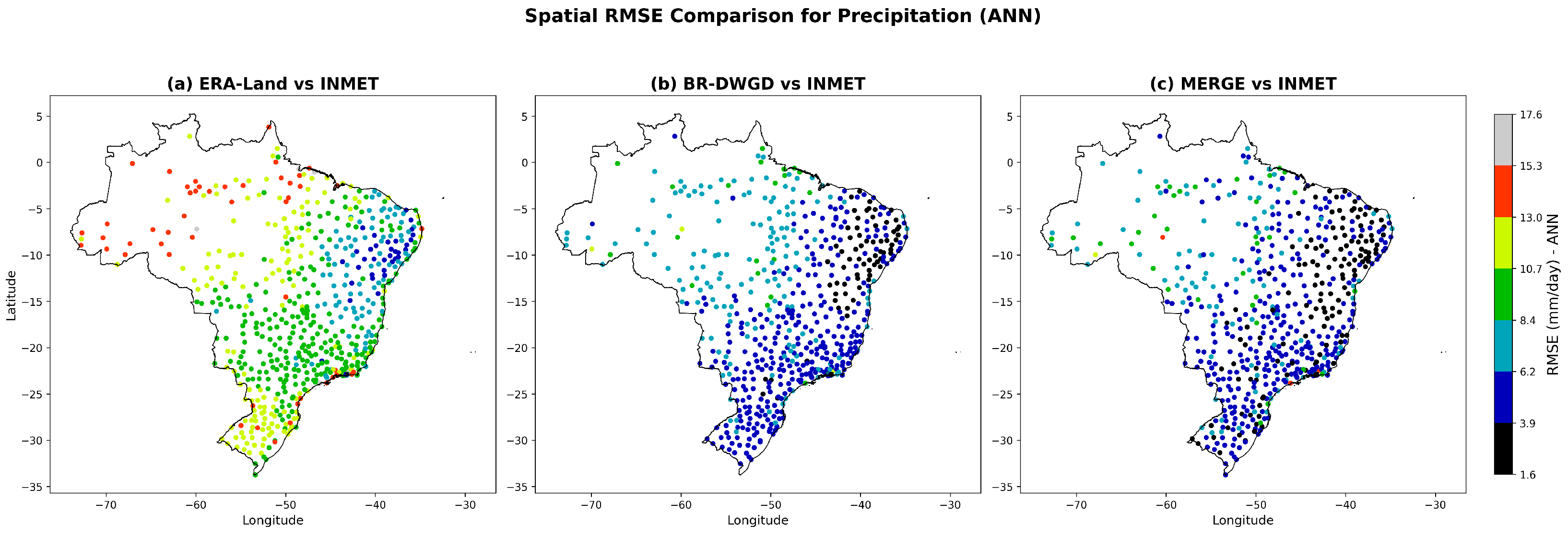
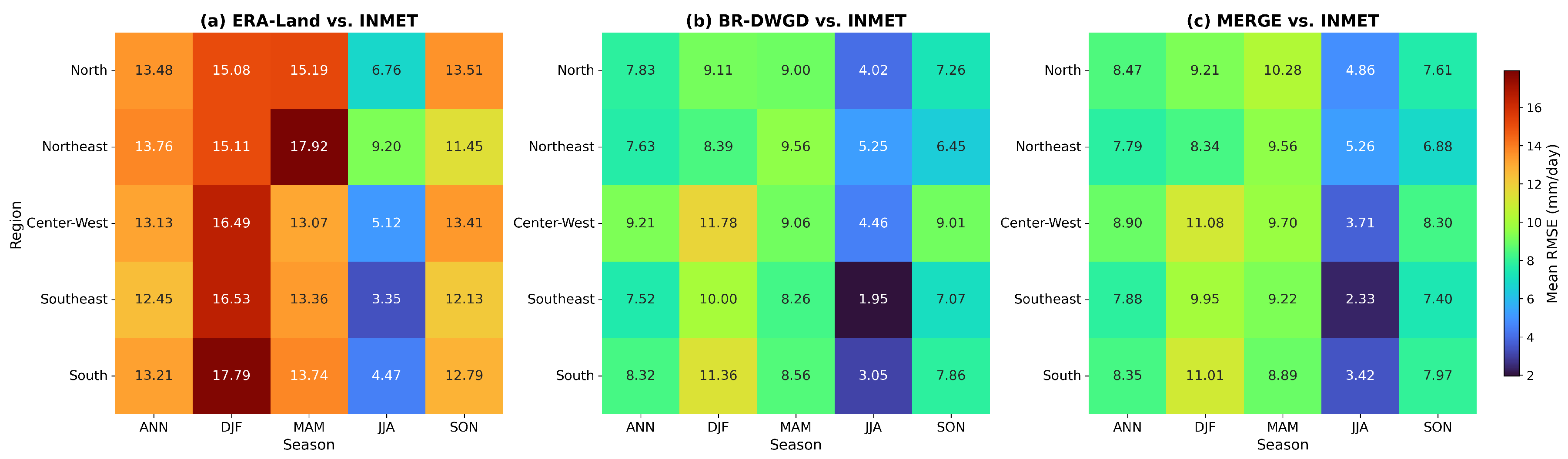
The RMSE analysis of daily precipitation (Figure 4c) shows that the MERGE product performs better than ERA5-Land (Figure 4a), which consistently exhibits the largest errors. BR-DWGD (Figure 4b) again yields the lowest errors, corroborating its close agreement with station data. Across all products, errors increase from the coast toward the continental interior, where gauge coverage is sparser. In addition, the mountainous sectors of the South and Southeast tend to show larger errors than adjacent lowland areas, in line with the well-documented difficulties of both satellite-based estimates and reanalyses in representing precipitation over complex terrain [56,57,58,59].
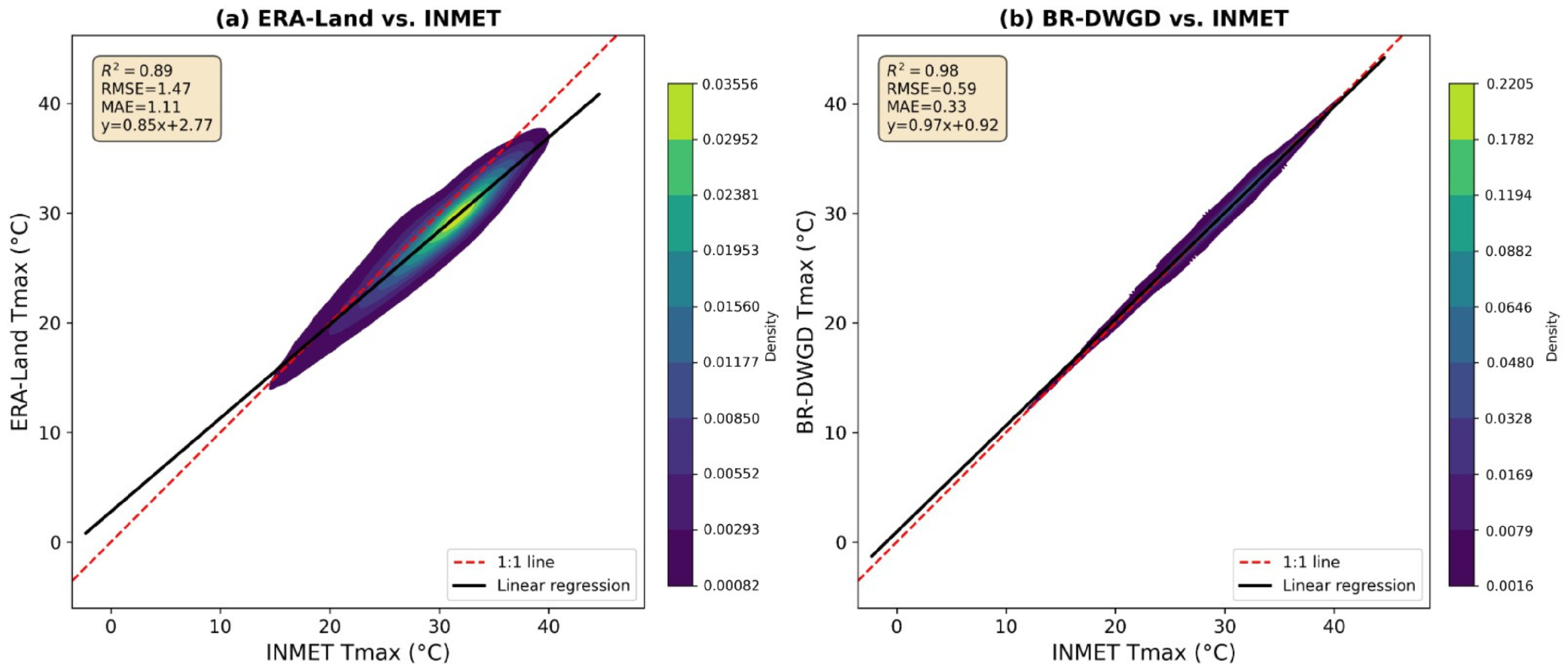
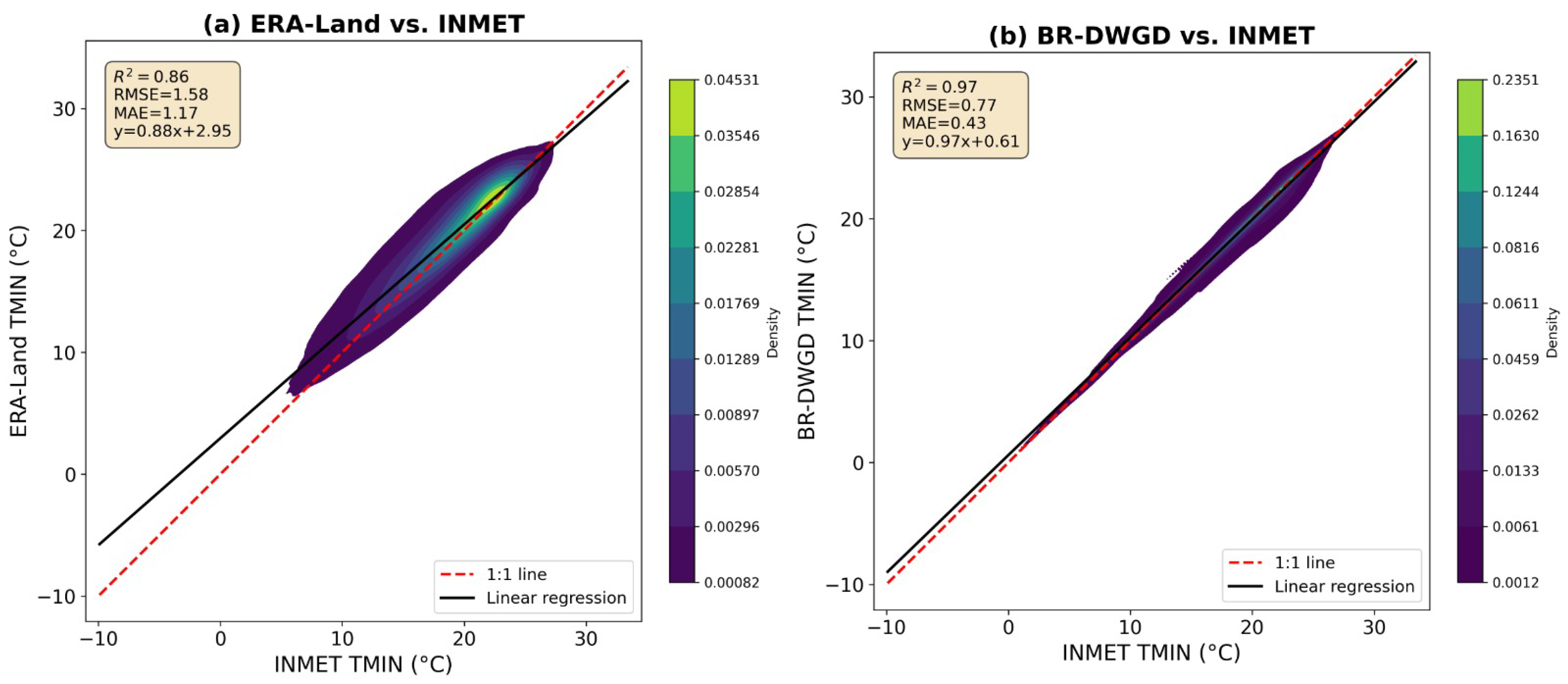
The density scatter plots (Figure 5, Figure 6 and Figure 7) confirm and refine the correlation results. For maximum temperature (Figure 5) and minimum temperature (Figure 6), both products (BR-DWGD and ERA5-Land) show a clear concentration of points along the 1 : 1 line. As expected, the BR-DWGD product exhibits an almost perfect fit, with R 2 = 0.98 for Tmax and 0.97 for Tmin, and RMSEs of only 0.59 °C and 0.77 °C, respectively. ERA5-Land also shows strong correlations with the observations, with R 2 = 0.89 (Tmax) and 0.86 (Tmin), albeit with a slightly larger bias.
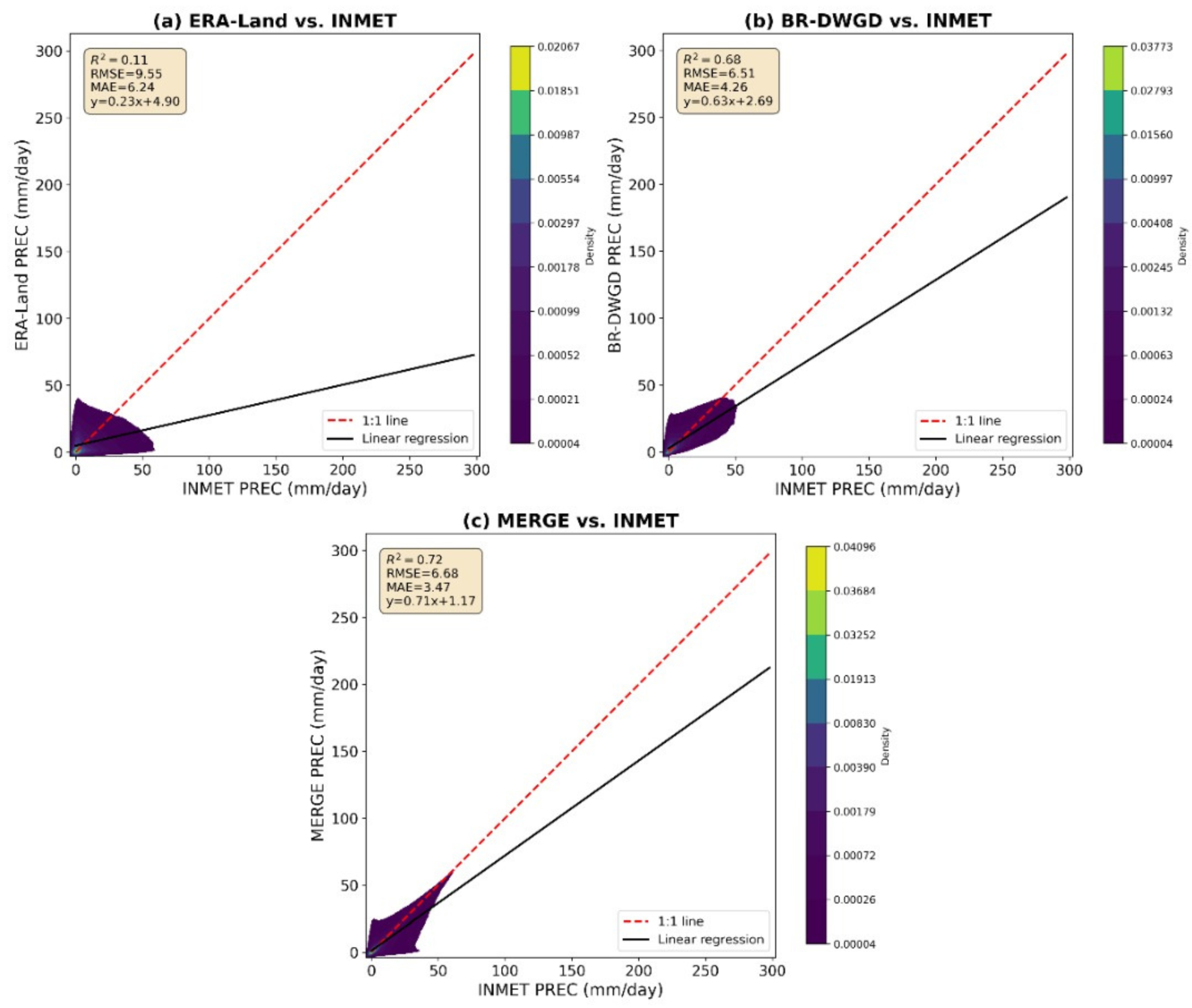
In contrast, the analysis for precipitation (Figure 7) shows substantially greater dispersion. The MERGE product presented the highest correlation, with R 2 = 0.72 , although its RMSE (6.68 mm) was slightly higher than that of BR-DWGD ( R 2 = 0.68 ; RMSE = 6.51 mm). The apparent contradiction between a lower RMSE and a lower R 2 for BR-DWGD can be attributed to the nature of the interpolation method. While BR-DWGD minimizes mean errors by being constrained to station data (resulting in lower RMSE), the MERGE product, which incorporates satellite estimates, better captures the spatial-temporal variability and phase of precipitation events, resulting in a higher coefficient of determination ( R 2 ). ERA5-Land, in turn, exhibits low skill ( R 2 = 0.11 , RMSE = 9.55 mm), indicating that, although it can reproduce the large-scale spatial distribution of seasonal precipitation (Figure 7), it may not be suitable for representing local conditions and should therefore be used with caution.
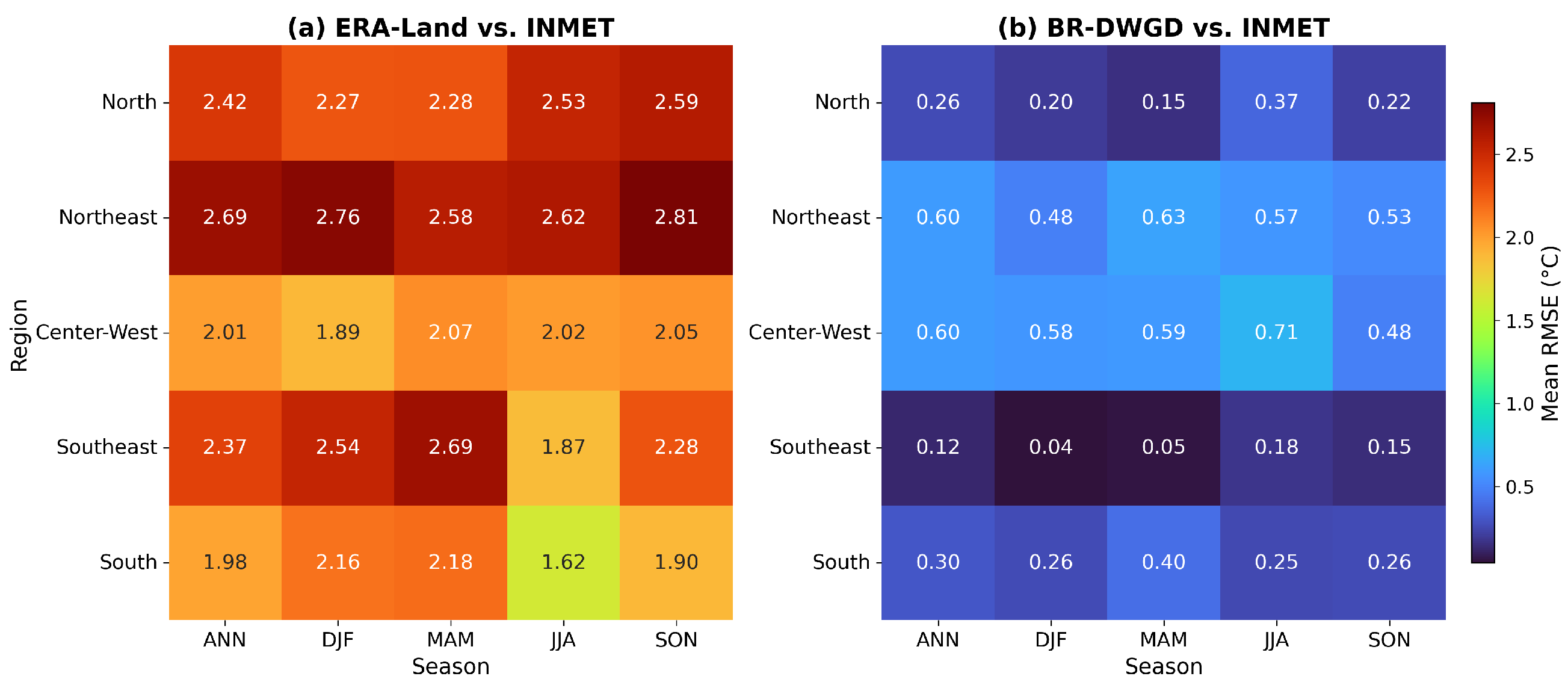
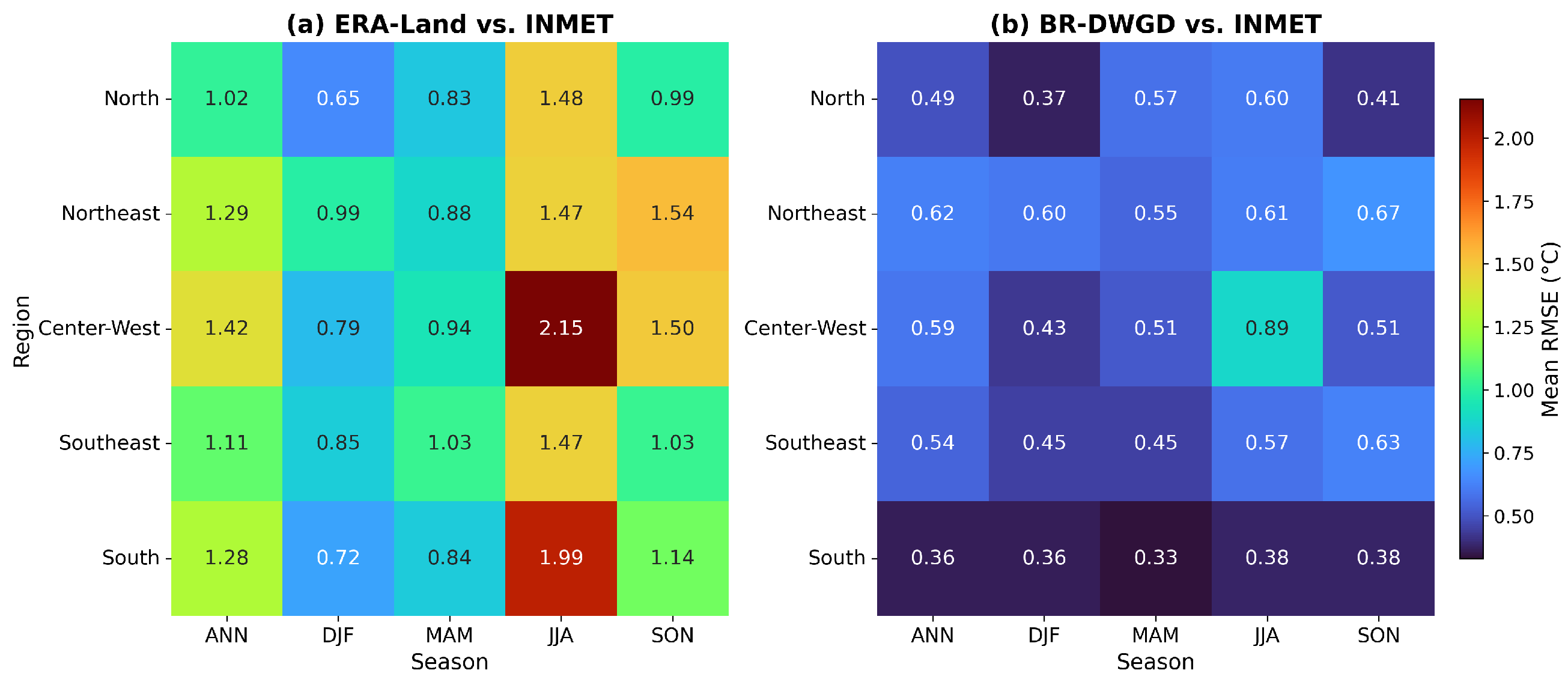
Seasonal heatmaps (Figure 8 and Figure 9) highlight that temperature errors are generally small for both BR-DWGD and ERA5-Land. For Tmax, ERA5-Land exhibits relatively larger RMSE over the Northeast and, to a lesser extent, the North throughout the year, with lower errors in the South and Southeast during JJA, whereas BR-DWGD errors remain close to zero in most regions. For Tmin, ERA5-Land shows a more spatially homogeneous pattern, with a clear seasonal modulation: RMSE peaks in JJA, especially over the Central-West and South, and remains elevated in SON over the Central-West and Northeast. BR-DWGD, in turn, maintains low RMSE in all seasons, with modest increases in JJA over the Central-West. Overall, these patterns are consistent with the expectation that an observation-based gridded product and a reanalysis that assimilates temperature both yield relatively small temperature errors.
Regarding precipitation, the RMSE heatmaps (Figure 10) highlight clear differences in performance among the products. ERA5-Land (Figure 10a) systematically exhibits the highest RMSE values both seasonally and in the annual metrics. For all products, JJA shows markedly lower RMSE, which is directly related to the climatological regime depicted in Figure 2, where this season corresponds to the dry season over most of Brazil. The reduced rainfall amounts during this period limit the magnitude of absolute errors, leading to smaller RMSE values compared to the wet season. In DJF, ERA5-Land errors are particularly large over the South region. As previously discussed, the reanalysis is able to capture the large-scale spatial pattern associated with mesoscale convective systems in this sector and season; however, the scatterplot analysis (Figure 7) reveals substantial pointwise discrepancies, likely linked to model-physics limitations in representing mesoscale convection [60], especially over complex topography [59], consistent with the biases seen in Figure 4.
In contrast, BR-DWGD (Figure 10b) and MERGE (Figure 10c) display substantially lower RMSE and very similar spatial and seasonal patterns, indicating a more consistent representation of daily precipitation. Both products show higher errors in DJF, particularly over the Central-West and parts of the Southeast. ERA5-Land also presents reduced errors in JJA relative to DJF, but the seasonal contrast is more pronounced and overall RMSE remains higher than in BR-DWGD and MERGE. During DJF, ERA5-Land yields comparable RMSE across Southeast and Central-West, whereas BR-DWGD and MERGE exhibit a clear improvement over the Southeast, suggesting a better representation of SACZ-related precipitation than in ERA5-Land. Additionally, both BR-DWGD and MERGE show relatively lower RMSE in the Northeast during DJF and MAM, when compared to other regions in the same seasons, while ERA5-Land maintains comparatively larger errors there. This bias in ERA5-Land may be associated with difficulties in representing the southward displacement of the ITCZ from DJF to MAM [40], extreme events linked to upper-tropospheric vortices [61], and mesoscale circulations such as sea-breeze instabilities and orographic effects that trigger localized convection, especially along the coastal zone and adjacent mountain ranges [62].
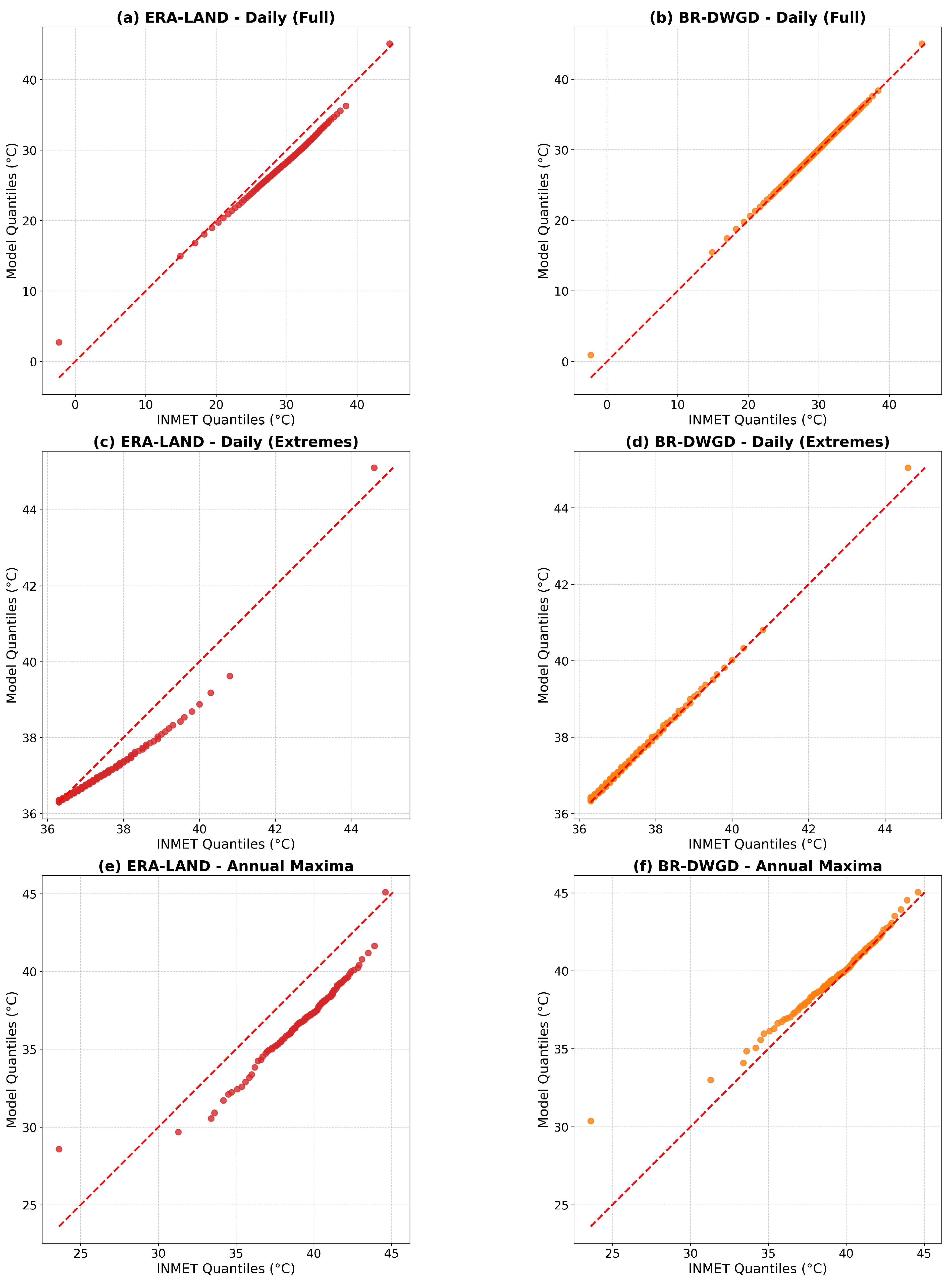
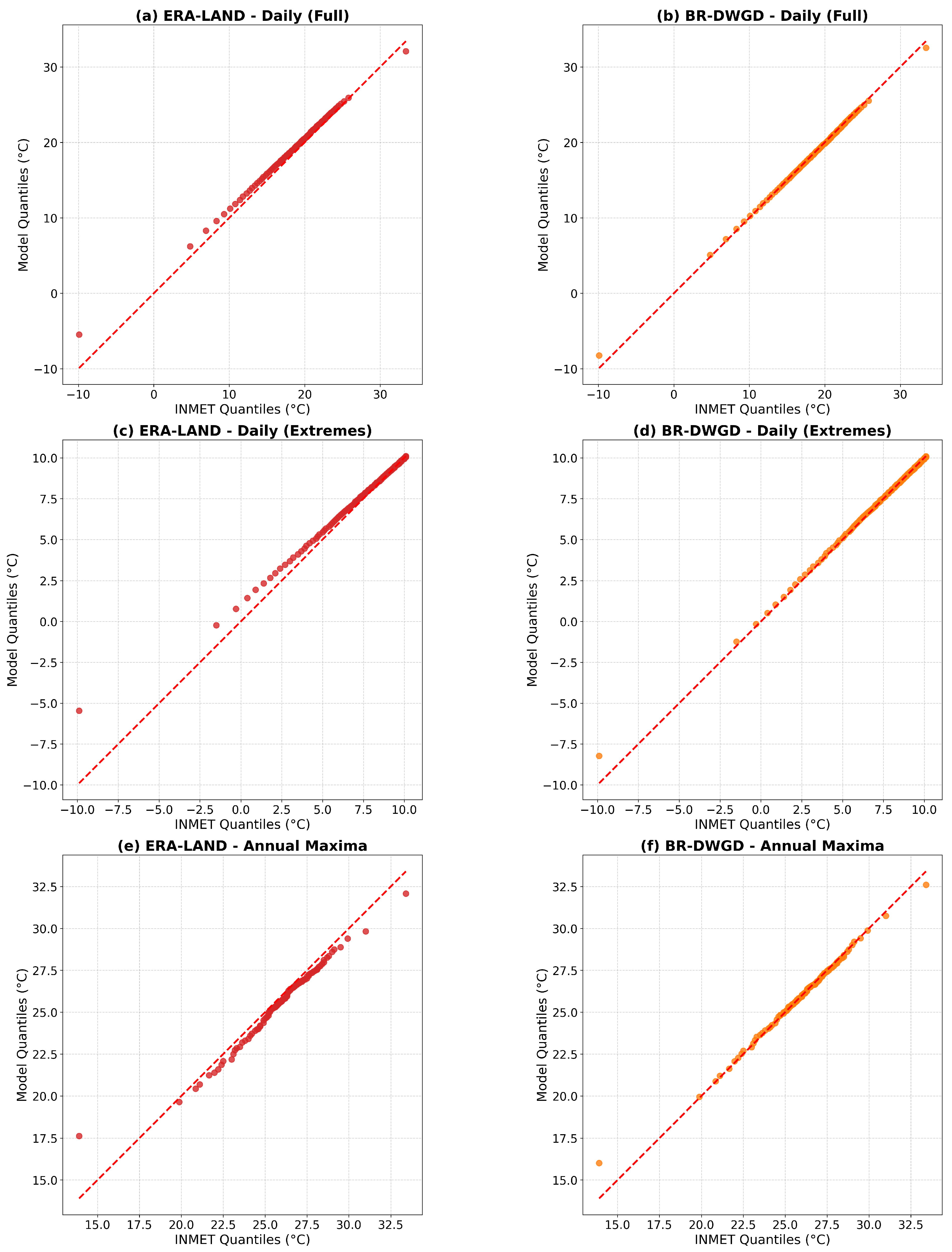
Figure 11 and Figure 12 show Q–Q plots for Tmax and Tmin, respectively, highlighting a consistently good agreement between BR-DWGD and INMET, with curves lying very close to the 1 : 1 line for both variables. In contrast, ERA5-Land exhibits a warm-tail bias for Tmax, systematically underestimating daily values and annual maxima, with the largest discrepancies for extreme events (above the 95th percentile), indicating limitations in representing peak heat. For Tmin, ERA5-Land performs better overall but remains warm-biased at the cold tail, overestimating Tmin and thus underestimating cold extremes (below the 5th percentile).
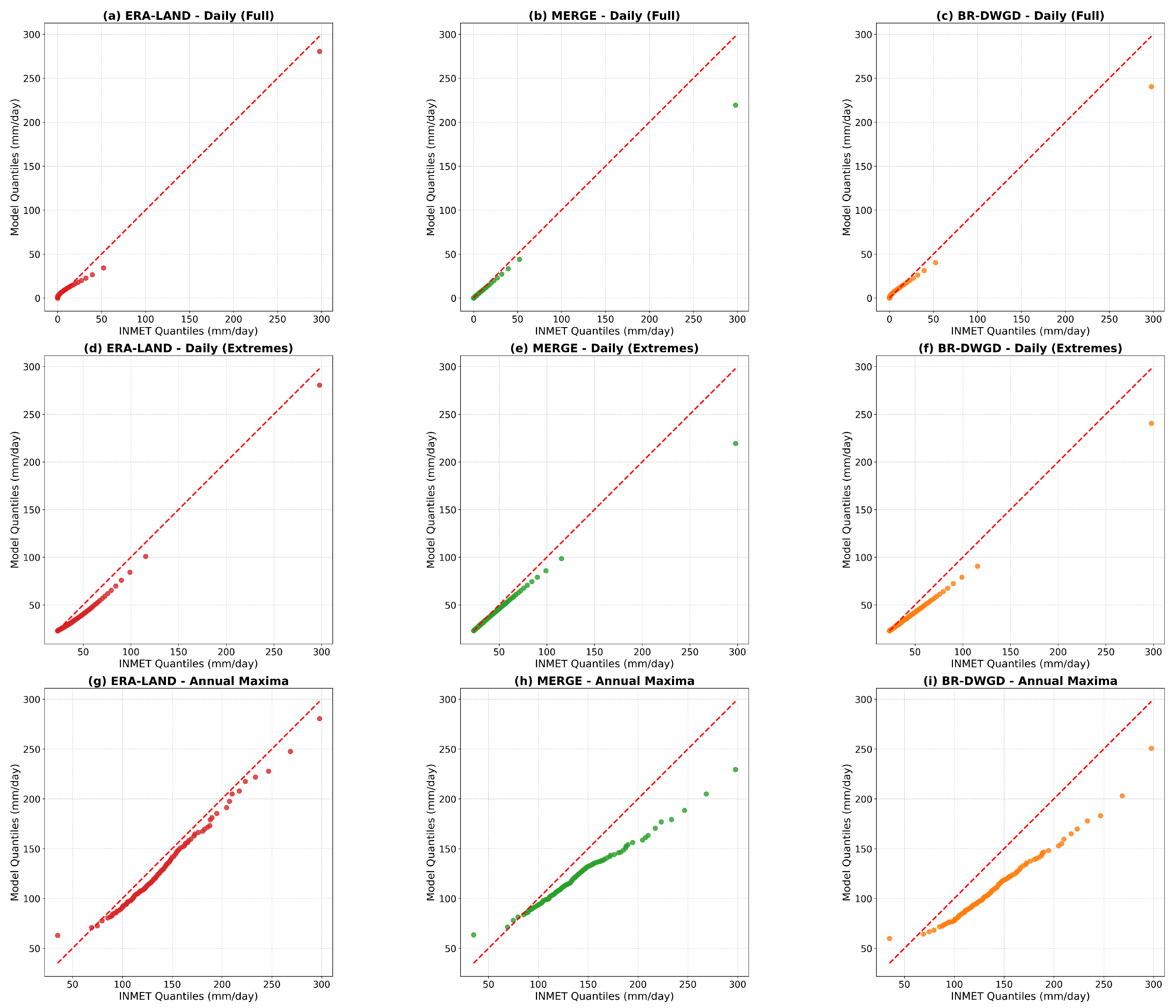
The analysis of precipitation distributions (Figure 13) indicates that all products tend to underestimate precipitation extremes. For daily values, however, MERGE shows a nearly perfect fit, whereas ERA5-Land markedly underestimates the upper tail of the distribution. The same pattern holds for extremes (above the 95th percentile), but with all products exhibiting larger biases (underestimation) than for daily values. For annual values, all products tend to overestimate precipitation below ∼50 mm (MERGE and BR-DWGD) and below ∼30 mm (ERA5-Land), while underestimating values above these thresholds.
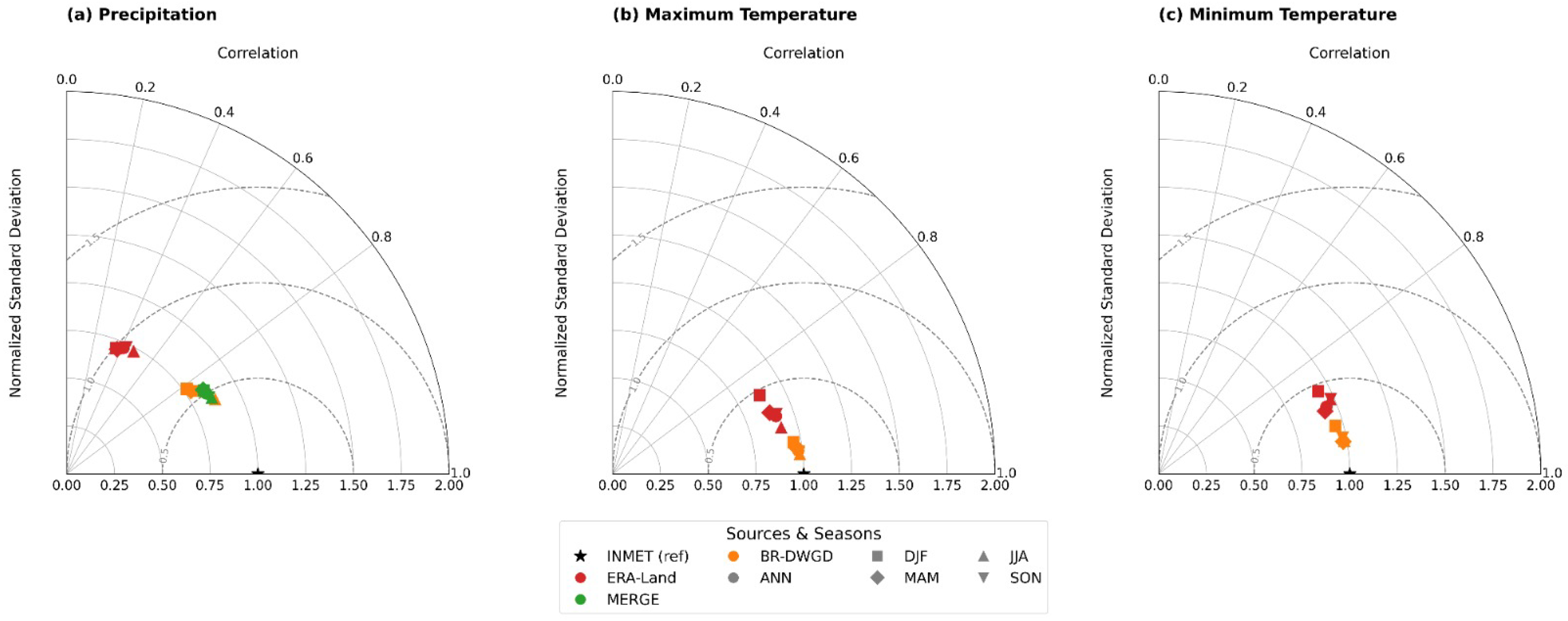
Finally, the Taylor diagrams [63], presented in Figure 14, summarize the statistical performance of the products relative to the INMET data. For daily precipitation (Figure 14a), the MERGE product (green) showed the best overall results, with correlations (r) above 0.8, normalized standard deviation close to 1, and normalized RMSE less than or equal to 0.5. BR-DWGD (orange) showed slightly inferior performance (normalized standard deviation 0.75 ). ERA5-Land (red) showed the worst performance (r 0.4 ).
For maximum temperature (Figure 14b), the BR-DWGD product (orange) shows near-perfect performance. ERA5-Land (red) also shows excellent correlation (r > 0.95 ) but slightly underestimates variability (normalized standard deviation ∼ 0.9–0.95). Meanwhile, for minimum temperature (Figure 14c), the performance of both products is exceptional, with ERA5-Land and BR-DWGD showing almost indistinguishable points very close to the reference, confirming the extremely high fidelity of both for this variable.

4. Discussion

The main objective of this study was to evaluate the accuracy of independent gridded data products: BR-DWGD, ERA5-Land and MERGE, against INMET observational data. The quantitative results confirmed what was expected: the BR-DWGD product, being generated by the direct interpolation of station data, showed the most accurate performance in direct comparison with INMET for most of the performed analysis, being able to accurately reproduce the expected temperature and precipitation spatial pattern and presenting lower overall RMSE and high correlation with the observational dataset.
However, the motivation for this analysis lies precisely in the nature of the BR-DWGD product. Although it satisfactorily represents the climate in Brazil, its database is not maintained by a robust research institution, depending on the efforts of independent researchers. This creates uncertainties about its long-term updating and maintenance. Therefore, it becomes crucial to assess whether institutional alternatives, such as ERA5-Land, can be used reliably. ERA5-Land, in turn, is a dynamic product, with constant updates, and its next generation (ERA6) is planned for release in 2027, which reinforces its strategic relevance. On the other hand, the MERGE product is maintained by the Brazilian National Institute for Atmospheric Research.
The performance analysis revealed important nuances. Regarding temperature data, ERA5-Land showed mixed performance. While errors for Tmin were moderate, the product exhibited significant regional biases for Tmax, with the largest errors concentrated in the Northeast and North of Brazil, peaking during spring (SON, 2.81 °C) and summer (DJF, 2.76 °C). Overall high RMSE were also observed in the Southeast. As previously reported, the reanalysis struggles with accurately representing temperature extremes [64]. Although temperature is assimilated by the reanalysis, surface fields are primarily derived from the model’s physics schemes, which may explain these biases. Insufficient simulation of turbulent exchange in the boundary layer, particularly over complex terrain, can lead to a systematic underestimation of near-surface maximum temperatures [65]. This suggests that, while ERA5-Land can be a useful tool, its application for studies on heat extremes requires caution, particularly in regions with complex topography.
For precipitation, the MERGE product was able to show significantly superior results to ERA5-Land, even presenting higher accuracy than the BR-DWGD for some seasons. This finding indicates that the blending methodology, which merges observational rain gauge data with satellite estimates, presents itself as an extremely promising and accurate alternative for climatic applications in Brazil, especially in regions with sparse station coverage, surpassing pure reanalysis and interpolation methods. This superiority of blend-based products is consistent with regional validations focused on areas of high complexity. Comparative studies in both the Legal Amazon [66] and river basins in the Northeast [30] also identified that precipitation products integrating satellite data with ground correction (such as MERGE, CHIRPS, or IMERG) tend to outperform pure reanalyses (like ERA5-Land) in representing local rainfall regimes. Nonetheless, all products still face difficulties in capturing extremes in these regions.
The ERA5-Land dataset demonstrated low overall accuracy in representing precipitation over Brazil. The exception to this was during JJA, which corresponds to the dry season in most of Brazil; the lower RMSE during this period can be attributed to the reduced overall rainfall, while large-scale rainfall systems (such as frontal systems), which are well represented by model dynamics(see, for example, [67]), contribute to the improved performance. There is no significant added value from ERA5 to ERA5-Land [68,69], and ERA5 precipitation has been shown to perform worse than other variables, being highly dependent on the density of observations [27,70,71]. In our analysis, it was found that ERA5-Land struggles primarily in representing precipitation associated with regions and seasons where mesoscale convective systems drive precipitation variability. Overall, MERGE proved to be a more robust product, with superior performance compared to ERA5-Land and comparable to BR-DWGD, though blended datasets remain a reliable option in regions with sparse observations [46].
Furthermore, while station data are treated as ground truth, it is crucial to acknowledge the inherent uncertainties in point-based precipitation measurements. As comprehensively reviewed by [72], precipitation gauges are subject to systematic errors, particularly wind-induced undercatch, which can significantly alter measurement accuracy during high-wind events or solid precipitation. Although solid precipitation is rare in Brazil and restricted to specific high-altitude events in the South, the aerodynamic blockage effects of gauge bodies also apply to liquid rainfall [73]. In this study, we utilized the standard quality-controlled dataset provided by INMET without applying additional corrections for wind-induced bias or evaporation losses. While these instrumental uncertainties are relevant for a strict hydrological mass balance, addressing them requires detailed metadata on gauge types and local wind exposure that are beyond the scope of this broad-scale comparative assessment. Future studies focusing specifically on instrumental accuracy in tropical climates could refine these observations further.
Finally, it is essential to emphasize that any validation process in Brazil faces a structural challenge: the lack of observational data in vast portions of the territory. The historical “observation gap,” especially in the North and Northeast regions, is a major challenge for assessing the true quality of any gridded product. In these areas, the BR-DWGD interpolation itself is less reliable, and independent products (ERA5-Land and MERGE) lack dense “ground truth” for their validation and calibration, which limits the scope of our conclusions in these locations. Similar issues have been previously reported in other parts of South America [45,46], underscoring the urgent need for increased investments in the observational network and efforts to develop blended products combining available in situ observations and satellite estimates.

5. Conclusions

This study conducted a rigorous comparative assessment of the accuracy of the BR-DWGD [19,28], ERA5-Land [17], and MERGE [18] gridded datasets for precipitation and temperature in Brazil, using the INMET observational network as the “ground truth” reference [11]. The results confirm that, although BR-DWGD shows the highest fidelity to the stations, its maintenance uncertainty justifies the search for institutional alternatives. It is concluded that the MERGE product is a robust and highly accurate alternative for precipitation studies in Brazil, significantly surpassing ERA5-Land. The blending methodology proved to be the most suitable for representing precipitation in the territory. In contrast, ERA5-Land, although dynamic and strategically relevant, requires caution. While it showed moderate performance for Tmin, it revealed significant regional biases for Tmax, especially in the Central–West and Northeast, limiting its direct application for heat extreme studies in these areas.
However, the central motivation for this study was to evaluate the viability of institutionally supported products with continuous updates (MERGE and ERA5-Land) as alternatives to BR-DWGD. Although the product described by Xavier et al. [19] is highly accurate, its reliance on independent researchers introduces uncertainties regarding its long-term maintenance and future updates. This potential limitation makes it crucial to validate institutional alternatives for ongoing climatological monitoring and operational systems. Finally, this study reinforces that the historical “observation gap,” particularly in the North and Central–West regions, remains the primary challenge for the comprehensive validation of any gridded product in Brazil, limiting the scope of our conclusions in these sparsely gauged areas.

Author Contributions

Conceptualization, R.A.G.M. and D.C.d.S.; methodology, P.C.M.d.M., D.C.d.S. and M.G.T.; software, P.C.M.d.M.; validation, P.C.M.d.M., D.C.d.S. and M.G.T.; formal analysis, P.C.M.d.M.; investigation, P.C.M.d.M., D.C.d.S. and M.G.T.; resources, R.A.G.M.; data curation, P.C.M.d.M. and D.C.d.S.; writing—original draft preparation, P.C.M.d.M., D.C.d.S. and M.G.T.; writing—review and editing, P.C.M.d.M., D.C.d.S. and M.G.T.; visualization, P.C.M.d.M.; supervision, R.A.G.M. and D.C.d.S.; project administration, R.A.G.M.; funding acquisition, R.A.G.M. All authors have read and agreed to the published version of the manuscript.

Funding

This research was funded by IRB(P&D).

Data Availability Statement

All data are sourced from open-access databases and are freely available without restrictions.

Acknowledgments

The authors acknowledge IRB(P&D) for providing the resources necessary for the development of this research. M.G.T. thanks for the support from the Coordination for the Improvement of Higher Education Personnel—Brazil (CAPES)—Funding Code 001.

Conflicts of Interest

Authors P. C. M. de Menezes, D. C. de Souza, M. G. Tavares and R. A. G. Marques were employed by the company IRB(P&D), Brazil. The funders had no role in the design of the study; in the collection, analyses, or interpretation of data; in the writing of the manuscript; or in the decision to publish the results.

Appendix A. Additional Materials

In this appendix, we present supplementary figures and tables that support the main analysis. Figure A1 provides a spatial comparison of mean daily temperatures across different seasons, illustrating the consistency between the observational data and the gridded products used in this study. Additionally, Table A1 and Table A2 detail the characteristics of the datasets and the density of grid points per region, respectively.
Figure A1. Spatial comparison of mean daily temperature (°C) among INMET station data (top row), the BR-DWGD product (middle row), and the ERA5-Land product (bottom row), for the annual mean and for the seasons: summer (DJF), autumn (MAM), winter (JJA), and spring (SON).
Meteorology 05 00003 g0a1
Table A1. Summary of the characteristics of the precipitation and temperature datasets for the evaluation sources.
DatasetVariable(s)SourceMethodologySpatial ResolutionTemporal ResolutionReference
INMETPrecipitation; Temperatures (min, med, max)INMETSurface observationPointDaily [11]
BR-DWGDPrecipitation; Temperatures (min, max, med)BR-DWGDStation interpolation 0.1 × 0.1 Daily [19]
MERGEPrecipitationINPESatellite (TRMM/GPM) + rain gauges 0.25 × 0.25 Daily [18]
ERA5-Land2 m Air Temperature; Total PrecipitationECMWFReanalysis (land component of ERA5) 0.1 × 0.1 Hourly [17]
Table A2. Summary of the number of available grid points or stations per dataset in each Brazilian region.
RegionINMET (Stations)MERGE (Grid Points)BR-DWGD (Grid Points)ERA5-Land (Grid Points)
South92527152715286
Southeast160797279727980
Central-West10313,54913,54913,544
North9131,43931,43831,480
Northeast15012,78112,78112,779

References

  1. Cunha, A.P.M.A.; Zeri, M.; Leal, K.D.; Costa, L.; Cuartas, L.A.; Marengo, J.A.; Tomasella, J.; Barbosa, H.A.; Alvalá, R.C.S.; Medeiros, S.F.D.S. Extreme drought events over Brazil from 2011 to 2019. Atmosphere 2019, 10, 642. [Google Scholar] [CrossRef]
  2. Marengo, J.A.; Nobre, C.A.; Seluchi, M.E.; Cuartas, A.; Alves, L.M.; Mendes, D.; Dias, M.A.F.S. A seca e a crise hídrica em São Paulo. Rev. USP 2015, 106, 31–44. [Google Scholar] [CrossRef]
  3. Vörösmarty, C.J.; Green, P.; Salisbury, J.; Lammers, R.B. Global Water Resources: Vulnerability from Climate Change and Population Growth. Science 2000, 289, 284–288. [Google Scholar] [CrossRef] [PubMed]
  4. Costa, M.H.; Foley, J.A. Combined Effects of Deforestation and Doubled Atmospheric CO2 Concentrations on the Climate of Amazonia. J. Clim. 2000, 13, 18–34. [Google Scholar] [CrossRef]
  5. Sampaio, G.; Nobre, C.; Costa, M.H.; Satyamurty, P.; Soares-Filho, B.S.; Cardoso, M. Regional climate change over eastern Amazonia caused by pasture and soybean cropland expansion. Geophys. Res. Lett. 2007, 34, L17709. [Google Scholar] [CrossRef]
  6. Willmott, C.J. On the validation of large-scale models. Phys. Geogr. 1985, 6, 184–194. [Google Scholar]
  7. Legates, D.R.; McCabe, G.J. Evaluating the use of “goodness-of-fit” measures in hydrologic and hydroclimatic model validation. Water Resour. Res. 1999, 35, 233–241. [Google Scholar] [CrossRef]
  8. Beck, H.E.; Zimmermann, N.E.; McVicar, T.R.; Vergopolan, N.; Berg, A.; Wood, E.F. Present and future Köppen-Geiger climate classification maps at 1-km resolution. Sci. Data 2018, 5, 180214. [Google Scholar] [CrossRef]
  9. de Souza, D.C.; da Silva, R.R. Ocean–Land Atmosphere Model (OLAM) performance for major extreme meteorological events near the coastal region of southern Brazil. Clim. Res. 2021, 84, 1–21. [Google Scholar] [CrossRef]
  10. Simoes-Sousa, I.T.; Camargo, C.M.L.; Tavora, J.; Piffer-Braga, A.; Farrar, J.T.; Pavelsky, T.M. The May 2024 flood disaster in southern Brazil: Causes, impacts, and SWOT-based volume estimation. Geophys. Res. Lett. 2025, 52, e2024GL112442. [Google Scholar] [CrossRef]
  11. INMET. Normais Climatológicas do Brasil 1981–2010. 2020. Available online: https://portal.inmet.gov.br/normais (accessed on 12 March 2025).
  12. Dos Reis, J.B.C.; Rennó, C.D.; Lopes, E.S.S. Validation of satellite rainfall products over a mountainous watershed in a humid subtropical climate region of Brazil. Remote Sens. 2017, 9, 1240. [Google Scholar] [CrossRef]
  13. Paredes-Trejo, F.J.; Barbosa, H.A.; Kumar, T.V.L. Validating CHIRPS-based satellite precipitation estimates in Northeast Brazil. J. Arid Environ. 2017, 139, 26–40. [Google Scholar] [CrossRef]
  14. de Araújo, C.S.P.; e Silva, I.A.C.; Ippolito, M.; de Almeida, C.D.G.C. Evaluation of air temperature estimated by ERA5-Land reanalysis using surface data in Pernambuco, Brazil. Environ. Monit. Assess. 2022, 194, 381. [Google Scholar] [CrossRef] [PubMed]
  15. de Araújo, G.R.G.; Frassoni, A.; Sapucci, L.F.; Bitencourt, D.; de Brito Neto, F.A. Climatology of heatwaves in South America identified through ERA5 reanalysis data. Int. J. Climatol. 2022, 42, 9430–9448. [Google Scholar] [CrossRef]
  16. Hersbach, H.; Bell, B.; Berrisford, P.; Hirahara, S.; Horányi, A.; Muñoz-Sabater, J.; Nicolas, J.; Peubey, C.; Radu, R.; Schepers, D.; et al. The ERA5 global reanalysis. Q. J. R. Meteorol. Soc. 2020, 146, 1999–2049. [Google Scholar] [CrossRef]
  17. Muñoz-Sabater, J.; Dutra, E.; Agustí-Panareda, A.; Albergel, C.; Arduini, G.; Balsamo, G.; Boussetta, S.; Choulga, M.; Harrigan, S.; Hersbach, H.; et al. ERA5-Land: A state-of-the-art global reanalysis dataset for land applications. Earth Syst. Sci. Data 2021, 13, 4349–4383. [Google Scholar] [CrossRef]
  18. Rozante, J.R.; de Goncalves, L.G.G.; de Oliveira, G.S.; de Souza, E.B. Combining TRMM and surface observations of precipitation: Technique and validation over South America. Weather. Forecast. 2010, 25, 885–894. [Google Scholar] [CrossRef]
  19. Xavier, A.C.; King, C.W.; Scanlon, B.R. Daily gridded meteorological variables in Brazil (1980–2013). Int. J. Climatol. 2016, 36, 2644–2659. [Google Scholar] [CrossRef]
  20. Paredes-Trejo, F.; Barbosa, H.; Kumar, T.V.L.; de Oliveira, M.; dos Santos, C.A. Validation of the ERA5-Land temperature and relative humidity products in the state of Pernambuco, Northeastern Brazil. Atmos. Res. 2022, 273, 106170. [Google Scholar]
  21. Alvares, C.A.; Stape, J.L.; Sentelhas, P.C.; de Moraes Gonçalves, J.L.; Sparovek, G. Köppen’s climate classification map for Brazil. Meteorol. Z. 2013, 22, 711–728. [Google Scholar] [CrossRef]
  22. Xie, W.; Yi, S.; Leng, C.; Xia, D.; Li, M.; Zhong, Z.; Ye, J. The evaluation of IMERG and ERA5-Land daily precipitation over China with considering the influence of gauge data bias. Sci. Rep. 2022, 12, 8085. [Google Scholar] [CrossRef]
  23. Benítez, V.D.; Müller, G.V.; Doyle, M.E.; Forgioni, F.P.; Lovino, M.A. Can Satellite Products Recognise Extreme Precipitation Over Southeastern South America? Int. J. Climatol. 2025, 45, e8741. [Google Scholar] [CrossRef]
  24. Melo, D.C.D.; Xavier, A.C.; Bianchi, T.; Oliveira, P.T.S.; Scanlon, B.R.; Lucas, M.C.; Wendl, E. Performance evaluation of rainfall estimates by TRMM Multi-satellite Precipitation Analysis 3B42V6 and V7 over Brazil. J. Geophys. Res. Atmos. 2015, 120, 9426–9436. [Google Scholar] [CrossRef]
  25. Gadelha, A.N.; Coelho, V.H.R.; Xavier, A.C.; Barbosa, L.R.; Melo, D.C.D.; Xuan, Y.; Huffman, G.J.; Petersen, W.A.; Almeida, C.N. Grid box-level evaluation of IMERG over Brazil at various space and time scales. Atmos. Res. 2019, 218, 231–244. [Google Scholar] [CrossRef]
  26. Luo, N.; Guo, Y. Impact of model resolution on the simulation of precipitation extremes over China. Sustainability 2021, 14, 25. [Google Scholar] [CrossRef]
  27. Liu, R.; Zhang, X.; Wang, W.; Wang, Y.; Liu, H.; Ma, M.; Tang, G. Global-scale ERA5 product precipitation and temperature evaluation. Ecol. Indic. 2024, 166, 112481. [Google Scholar] [CrossRef]
  28. Xavier, A.C.; Scanlon, B.R.; King, C.W.; Alves, A.I. New improved Brazilian daily weather gridded data (1961–2020). Int. J. Climatol. 2022, 42, 8390–8404. [Google Scholar] [CrossRef]
  29. Cassalho, F.; Rennó, C.D.; dos Reis, J.B.C.; da Silva, B.C. Hydrologic validation of MERGE precipitation products over anthropogenic watersheds. Water 2020, 12, 1268. [Google Scholar] [CrossRef]
  30. Silva, E.H.D.L.; Silva, F.D.S.; Junior, R.S.D.S.; Pinto, D.D.C.; Costa, R.L.; Gomes, H.B.; Júnior, J.B.C.; de Freitas, I.G.F.; Herdies, D.L. Performance assessment of different precipitation databases (Gridded analyses and reanalyses) for the new Brazilian agricultural frontier: SEALBA. Water 2022, 14, 1473. [Google Scholar] [CrossRef]
  31. de Souza, D.C.; Crespo, N.M.; da Silva, D.V.; Harada, L.M.; de Godoy, R.M.P.; Domingues, L.M.; Luiz, R.; Bortolozo, C.A.; Metodiev, D.; de Andrade, M.R.M.; et al. Extreme rainfall and landslides as a response to human-induced climate change: A case study at Baixada Santista, Brazil, 2020. Nat. Hazards 2024, 120, 10835–10860. [Google Scholar] [CrossRef]
  32. Laureanti, N.C.; Tavares, P.D.S.; Tavares, M.; Rodrigues, D.C.; Gomes, J.L.; Chou, S.C.; Correia, F.W.S. Extreme seasonal droughts and floods in the Madeira River Basin, Brazil: Diagnosis, causes, and trends. Climate 2024, 12, 111. [Google Scholar] [CrossRef]
  33. Bonshoms, M.; Ubeda, J.; Liguori, G.; Körner, P.; Navarro, Á; Cruz, R. Validation of ERA5-Land temperature and relative humidity on four Peruvian glaciers using on-glacier observations. J. Mount. Sci. 2022, 19, 1849–1873. [Google Scholar]
  34. Chang, Y.; Qi, Y.; Wang, Z. Comprehensive evaluation of IMERG, ERA5-Land and their fusion products in the hydrological simulation of three karst catchments in Southwest China. J. Hydrol. Reg. Stud. 2024, 52, 101671. [Google Scholar] [CrossRef]
  35. Espinosa, L.A.; Portela, M.M.; Gharbia, S. Assessing changes in exceptional rainfall in Portugal using ERA5-land reanalysis data (1981/1982–2022/2023). Water 2024, 16, 628. [Google Scholar] [CrossRef]
  36. Ippolito, M.; De Caro, D.; Cannarozzo, M.; Provenzano, G.; Ciraolo, G. Evaluation of daily crop reference evapotranspiration and sensitivity analysis of FAO Penman-Monteith equation using ERA5-Land reanalysis database in Sicily, Italy. Agric. Water Manag. 2024, 295, 108732. [Google Scholar]
  37. Xu, C.; Wang, W.; Hu, Y.; Liu, Y. Evaluation of ERA5, ERA5-Land, GLDAS-2.1, and GLEAM potential evapotranspiration data over mainland China. J. Hydrol. Reg. Stud. 2024, 51, 101651. [Google Scholar] [CrossRef]
  38. Carvalho, L.M.V.; Jones, C.; Liebmann, B. The South Atlantic convergence zone: Intensity, form, persistence, and relationships with intraseasonal to interannual activity and extreme rainfall. J. Clim. 2004, 17, 88–108. [Google Scholar] [CrossRef]
  39. Ma, H.-Y.; Ji, X.; Neelin, J.D.; Mechoso, C.R. Mechanisms for precipitation variability of the eastern Brazil/SACZ convective margin. J. Clim. 2011, 24, 3445–3456. [Google Scholar] [CrossRef][Green Version]
  40. Berry, G.; Reeder, M.J. Objective identification of the intertropical convergence zone: Climatology and trends from the ERA-Interim. J. Clim. 2014, 27, 1894–1909. [Google Scholar] [CrossRef]
  41. Gan, M.A.; Kousky, V.E.; Ropelewski, C.F. The South America monsoon circulation and its relationship to rainfall over west-central Brazil. J. Clim. 2004, 17, 47–66. [Google Scholar] [CrossRef]
  42. de Carvalho, L.M.V.; Cavalcanti, I.F.A. The South American Monsoon System (SAMS). In The Monsoons and Climate Change: Observations and Modeling; Springer: Berlin/Heidelberg, Germany, 2015; pp. 121–148. [Google Scholar]
  43. de Souza, D.C.; Ramos da Silva, R.; Gomes da Silva, P.; Fetter Filho, A.F.H.; Mendez, F.J.; Werth, D. A hybrid regional climate downscaling for the southern Brazil coastal region. Int. J. Climatol. 2022, 42, 6753–6770. [Google Scholar] [CrossRef]
  44. Luiz-Silva, W.; Oscar-Júnior, A.C.; Cavalcanti, I.F.A.; Treistman, F. An overview of precipitation climatology in Brazil: Space-time variability of frequency and intensity associated with atmospheric systems. Hydrol. Sci. J. 2021, 66, 289–308. [Google Scholar] [CrossRef]
  45. da Motta Paca, V.H.; Espinoza-Davalos, G.E.; Moreira, D.M.; Comair, G. Variability of trends in precipitation across the Amazon River basin determined from the CHIRPS precipitation product and from station records. Water 2020, 12, 1244. [Google Scholar] [CrossRef]
  46. Sapucci, C.R.; Mayta, V.C.; da Silva Dias, P.L. Evaluation of diverse-based precipitation data over the Amazon Region. Theor. Appl. Climatol. 2022, 149, 1167–1193. [Google Scholar] [CrossRef]
  47. Marengo, J.A.; Fisch, G.; Morales, C.; Vendrame, I.; Dias, P.C. Diurnal variability of rainfall in Southwest Amazonia during the LBA–TRMM field campaign of the austral summer of 1999. Acta Amazon. 2004, 34, 593–603. [Google Scholar] [CrossRef]
  48. Ramírez-Nina, R.G.; da Silva Dias, M.A.F.; da Silva Dias, P.L. Variability of the diurnal cycle of precipitation in South America. Meteorology 2025, 4, 13. [Google Scholar] [CrossRef]
  49. Sousa, A.C.; Candido, L.A.; Satyamurty, P. Convective cloud clusters and squall lines along the coastal Amazon. Mon. Weather Rev. 2021, 149, 3589–3608. [Google Scholar] [CrossRef]
  50. Douglas, V.D.A.; Silva, T.L.D.V.; Camargo, R.; Veleda, D. Influence of sea stratification and troposphere stability over the coastal squall lines of eastern Amazon. Clim. Dyn. 2025, 63, 8. [Google Scholar] [CrossRef]
  51. Martins, G.; von Randow, C.; Sampaio, G.; Dolman, A.J. Precipitation in the Amazon and its relationship with moisture transport and tropical Pacific and Atlantic SST from the CMIP5 simulation. Hydrol. Earth Syst. Sci. Discuss. 2015, 12, 671–704. [Google Scholar]
  52. Durkee, J.D.; Mote, T.L. A climatology of warm-season mesoscale convective complexes in subtropical South America. Int. J. Climatol. 2010, 30, 418–431. [Google Scholar] [CrossRef]
  53. Demaria, E.M.C.; Rodriguez, D.A.; Ebert, E.E.; Salio, P.; Su, F.; Valdes, J.B. Evaluation of mesoscale convective systems in South America using multiple satellite products and an object-based approach. J. Geophys. Res. Atmos. 2011, 116, D08103. [Google Scholar] [CrossRef]
  54. Rasmussen, K.L.; Choi, S.L.; Zuluaga, M.D.; Houze, R.A., Jr. TRMM precipitation bias in extreme storms in South America. Geophys. Res. Lett. 2013, 40, 3457–3461. [Google Scholar] [CrossRef]
  55. Piersante, J.O.; Rasmussen, K.L.; Schumacher, R.S.; Rowe, A.K.; McMurdie, L.A. A synoptic evolution comparison of the smallest and largest MCSs in subtropical South America between spring and summer. Mon. Weather Rev. 2021, 149, 1943–1966. [Google Scholar] [CrossRef]
  56. Scheel, M.L.M.; Rohrer, M.; Huggel, C.; Santos Villar, D.; Silvestre, E.; Huffman, G.J. Evaluation of TRMM Multi-satellite Precipitation Analysis (TMPA) performance in the Central Andes region and its dependency on spatial and temporal resolution. Hydrol. Earth Syst. Sci. 2011, 15, 2649–2663. [Google Scholar] [CrossRef]
  57. Derin, Y.; Anagnostou, E.; Berne, A.; Borga, M.; Boudevillain, B.; Buytaert, W.; Chang, C.-H.; Delrieu, G.; Hong, Y.; Hsu, Y.-C.; et al. Multiregional satellite precipitation products evaluation over complex terrain. J. Hydrometeorol. 2016, 17, 1817–1836. [Google Scholar] [CrossRef]
  58. Ferguglia, O.; Palazzi, E.; Arnone, E. Elevation dependent change in ERA5 precipitation and its extremes. Clim. Dyn. 2024, 62, 8137–8153. [Google Scholar] [CrossRef]
  59. Qian, L.; Zhao, P. Assessment of ERA5-Land reanalysis precipitation data in the Qilian Mountains of China. Atmosphere 2025, 16, 826. [Google Scholar] [CrossRef]
  60. Halladay, K.; Kahana, R.; Johnson, B.; Still, C.; Fosser, G.; Alves, L. Convection-permitting climate simulations for South America with the Met Office Unified Model. Clim. Dyn. 2023, 61, 5247–5269. [Google Scholar] [CrossRef]
  61. Kousky, V.E.; Gan, M.A. Upper tropospheric cyclonic vortices in the tropical South Atlantic. Tellus 1981, 33, 538–551. [Google Scholar] [CrossRef]
  62. Oliveira-Júnior, J.F.; Gois, G.; Lima Silva, I.J.; Oliveira Souza, E.; Jardim, A.M.R.F.; Silva, M.V.; Shah, M.; Jamjareegulgarn, P. Wet and dry periods in the state of Alagoas (Northeast Brazil) via Standardized Precipitation Index. J. Atmos. Sol.-Terr. Phys. 2021, 224, 105746. [Google Scholar] [CrossRef]
  63. Taylor, K.E. Summarizing multiple aspects of model performance in a single diagram. J. Geophys. Res. Atmos. 2001, 106, 7183–7192. [Google Scholar] [CrossRef]
  64. Bhattacharyya, S.; Hassan, M.A.; Sreekesh, S.; Choudhary, V. How well do the reanalysis datasets capture hot and cold extremes and their trends in India? Atmos. Res. 2025, 321, 108073. [Google Scholar] [CrossRef]
  65. Davy, R.; Ezau, I. Planetary boundary layer depth in global climate models induced biases in surface climatology. arXiv 2014, arXiv:1409.8426. [Google Scholar] [CrossRef]
  66. da Silva Campos, B.; de Oliveira, G.; Sobrinho, T.; da Silva, M.P.; de Holanda, R.; Reis, H.; Guedes, B.; da Silva, J.; Gadelha, A.N.; Coelho, V.H.R.; et al. Performance Evaluation of CHIRPS, ERA5-Land, and IMERG Precipitation Products in the Legal Amazon. Climate 2023, 11, 241. [Google Scholar]
  67. Catto, J.; Jakob, C.; Nicholls, N. A global evaluation of fronts and precipitation in the ACCESS model. Aust. Meteorol. Oceanogr. J. 2013, 63, 191–203. [Google Scholar] [CrossRef]
  68. Xu, J.; Ma, Z.; Yan, S.; Peng, J. Do ERA5 and ERA5-Land precipitation estimates outperform satellite-based precipitation products? A comprehensive comparison between state-of-the-art model-based and satellite-based precipitation products over mainland China. J. Hydrol. 2022, 605, 127353. [Google Scholar] [CrossRef]
  69. Gomis-Cebolla, J.; Rattayova, V.; Salazar-Galán, S.; Francés, F. Evaluation of ERA5 and ERA5-Land reanalysis precipitation datasets over Spain (1951–2020). Atmos. Res. 2023, 284, 106606. [Google Scholar] [CrossRef]
  70. Pereira, D.R.; Oliveira, A.R.; Costa, M.S.; Ramos, T.B.; Rollnic, M.; Neves, R.J.J. Evaluation of precipitation products in a Brazilian watershed: Tocantins–Araguaia watershed case study. Theor. Appl. Climatol. 2024, 155, 7845–7865. [Google Scholar] [CrossRef]
  71. Brown, J.R.C.; Woods, R.; da Rocha, H.R.; Roberti, D.R.; Rosolem, R. Evaluation of high-resolution meteorological data products using flux tower observations across Brazil. EGUsphere 2025, 2025, 1–31. [Google Scholar] [CrossRef]
  72. Gultepe, I.; Heymsfield, A.J.; Fernando, H.J.S.; Pardyjak, E.; Dofour, A.; Hoch, S.W.; Silver, Z.; Chaboureau, J.-P. A review of high latitude precipitation: Cold air process and surface measurements. Pure Appl. Geophys. 2019, 176, 1–27. [Google Scholar]
  73. Pollock, M.D.; O’Donnell, G.; Quinn, P.; Dutton, M.; Black, A.; Wilkinson, M.E.; Colli, M.; Stagnaro, M.; Lanza, L.G.; Lewis, E. Quantifying and mitigating wind-induced undercatch in rainfall measurements. Water Resour. Res. 2018, 54, 3863–3875. [Google Scholar] [CrossRef]
Figure 1. Topographic map of the study area (Brazil), highlighting the main relief features.
Meteorology 05 00003 g001
Figure 2. Spatial comparison of mean daily precipitation (mm/day) among INMET station data, BR-DWGD, ERA5-Land, and MERGE.
Meteorology 05 00003 g002
Figure 3. RMSE (°C) of daily minimum temperature (Tmin) between ERA5-Land and INMET (a), and BR-DWGD and INMET (b); and daily maximum temperature (Tmax) between ERA5-Land and INMET (c), and BR-DWGD and INMET (d). ANN refers to “annual”.
Meteorology 05 00003 g003
Figure 4. RMSE (mm/day) of daily precipitation between ERA5-Land vs. INMET (a), BR-DWGD vs. INMET (b), and MERGE vs. INMET (c). ANN refers to “annual”.
Meteorology 05 00003 g004
Figure 5. Density scatter plots for daily maximum temperature (Tmax), comparing the products with each other and with the INMET reference. The ERA5-Land (a), and BR-DWGD (b) products.
Meteorology 05 00003 g005
Figure 6. Density scatter plots for daily minimum temperature (Tmin), comparing the products with each other and with the INMET reference. The ERA5-Land (a), and BR-DWGD (b) products.
Meteorology 05 00003 g006
Figure 7. Density scatter plots for daily precipitation, comparing the products with each other and with the INMET reference. The ERA5-Land (a), BR-DWGD (b), and MERGE (c) products.
Meteorology 05 00003 g007
Figure 8. Density heatmap of RMSE for maximum temperature (Tmax) data from the ERA5-Land (a) and BR-DWGD (b) products, showing seasonal (DJF, MAM, JJA, SON) and annual (ANN) averages across all Brazilian regions. Reference data from INMET station observations.
Meteorology 05 00003 g008
Figure 9. Density heatmap of RMSE for minimum temperature (Tmin) data from the ERA5-Land (a) and BR-DWGD (b) products, showing seasonal (DJF, MAM, JJA, SON) and annual (ANN) averages across all Brazilian regions. Reference data from INMET station observations.
Meteorology 05 00003 g009
Figure 10. Density heatmap of RMSE for daily precipitation (pr) data from the ERA5-Land (a), BR-DWGD (b), and MERGE (c) products, showing seasonal (DJF, MAM, JJA, SON) and annual (ANN) averages across all Brazilian regions. Reference data from INMET station observations.
Meteorology 05 00003 g010
Figure 11. Q–Q (Quantile–Quantile) plots for daily maximum temperature (Tmax). INMET quantiles (x-axis) are compared with ERA5-Land and BR-DWGD quantiles (y-axis) for: (a,b) the full daily series; (c,d) the upper tail (values above the 95th percentile); and (e,f) annual maxima.
Meteorology 05 00003 g011
Figure 12. Q–Q (Quantile–Quantile) plots for daily minimum temperature (Tmin). INMET quantiles (x-axis) are compared with ERA5-Land and BR-DWGD quantiles (y-axis) for: (a,b) the full daily series; (c,d) the lower tail (values below the 5th percentile); and (e,f) annual minima.
Meteorology 05 00003 g012
Figure 13. Q-Q (Quantile-Quantile) plots for daily precipitation, comparing INMET quantiles (x-axis) with ERA5-Land, MERGE, and BR-DWGD quantiles (y-axis) for: (ac) the entire daily series; (df) daily extremes (> 25 mm/day); and (gi) annual maximums.
Meteorology 05 00003 g013
Figure 14. Taylor diagram for (a) daily precipitation, (b) daily maximum temperature (Tmax), and (c) daily minimum temperature (Tmin). The reference point (INMET) is on the x-axis at (1,0). The points represent the annual (ANN) and seasonal (DJF, MAM, JJA, SON) performance of the ERA5-Land (red), MERGE (green), and BR-DWGD (orange) products.
Meteorology 05 00003 g014
Disclaimer/Publisher’s Note: The statements, opinions and data contained in all publications are solely those of the individual author(s) and contributor(s) and not of MDPI and/or the editor(s). MDPI and/or the editor(s) disclaim responsibility for any injury to people or property resulting from any ideas, methods, instructions or products referred to in the content.