1. Introduction
Taiwan’s offshore wind energy sector has undergone rapid evolution over the past decade, transitioning from initial demonstration projects to large-scale commercial operations. This transformation has been driven by multiple factors, both internal and external. To start, the Taiwan Strait is renowned for its strong and consistent wind speeds, making it one of the world’s premier locations for offshore wind energy development. According to the World Bank’s wind speed and power potential maps, Taiwan’s western coastline exhibits high wind speeds, particularly suitable for offshore wind farms. Research indicates that wind speeds in the Taiwan Strait can reach 10–12 m/s, providing optimal conditions for energy generation [
1,
2].
Recognizing this potential, the Taiwanese government initiated the “Thousand Wind Turbines Project” in 2012, outlining a 20-year roadmap for the development of offshore wind energy. This plan encompassed three phases, demonstration projects, commercial application rounds, and zonal development, aiming to systematically build the industry’s capacity and infrastructure [
3]. Taiwan’s approach to offshore wind development reflects characteristics of the East Asian developmental state model, wherein the government plays a central role in steering industrial growth. Despite neoliberal trends, Taiwan has maintained a strong state presence, utilizing policy tools to promote local industrial development and maintain control over infrastructure [
4].
In line with the globally growing trend and Taiwan’s position as a country with one of the best wind resources in the world, the Taiwan National Science & Technology Council (NSTC) and National Taiwan University (NTU) have played pivotal roles in advancing floating offshore wind research and innovation. With funding from the NSTC and support through the prestigious Yushan Fellowship program and the Taiwan Shipbuilding Corporation, NTU researchers designed TaidaFloat [
5,
6], a 15 MW semi-submersible floating platform specifically tailored for local environmental, manufacturing, and port conditions [
7,
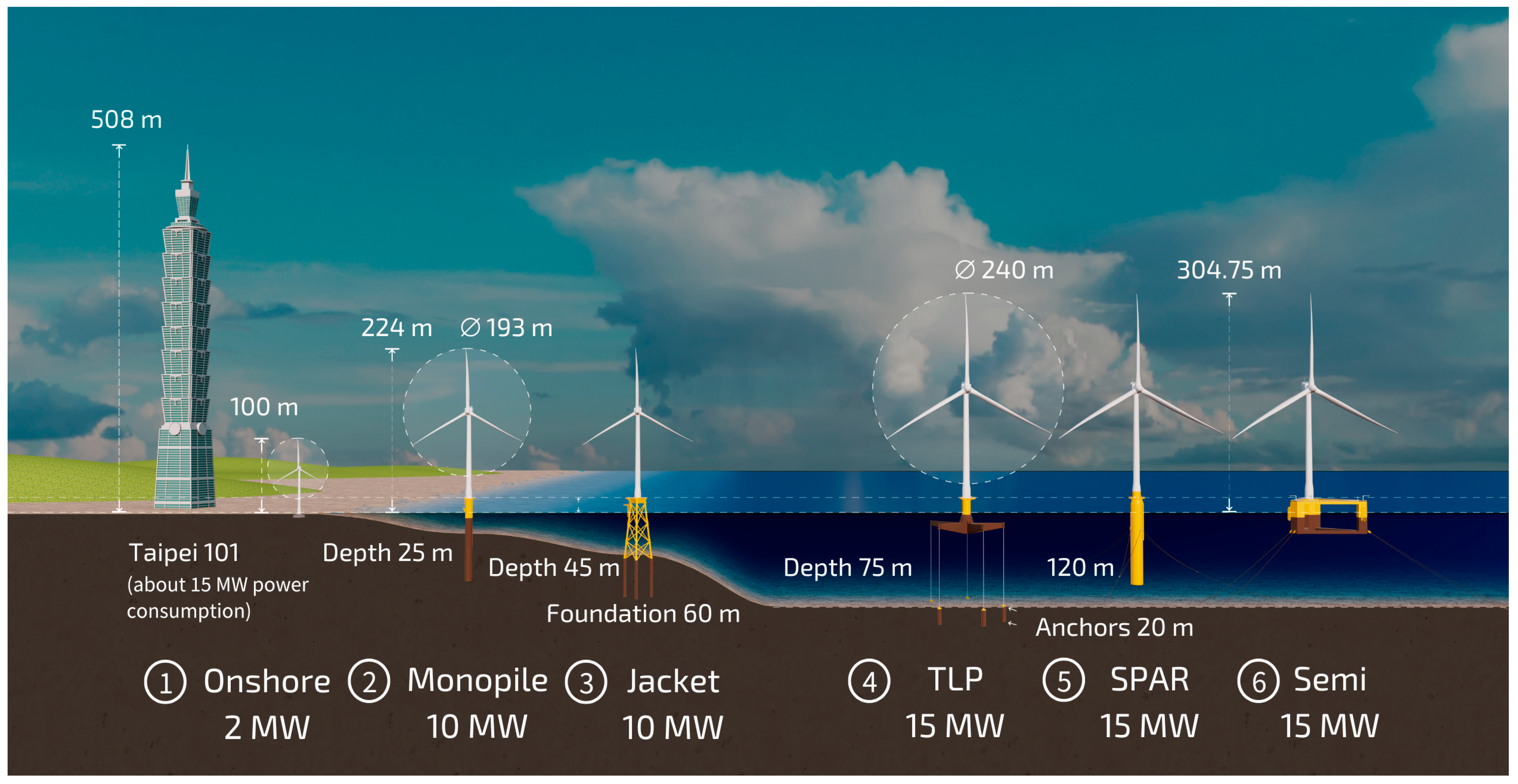
8], as shown in
Figure 1(6). This platform has earned approval in principle from the American Bureau of Shipping and has undergone scale model testing, marking a major milestone in Taiwan’s path toward deep-water wind power [
9]. Beyond hardware innovation, NTU established the Offshore Wind Power Credit Program in 2018 and later launched the Taiwan–Netherlands joint talent cultivation initiative. Taiwan’s Ship and Ocean Industries Research & Development Center (SOIC) has also presented its DeltaFloat design for a 10 MW turbine [
10], sponsored by the Ministry of Economic Affairs. Researchers from National Cheng Kung University and National Taiwan Ocean University have also been sponsored by the Taiwanese government to conduct simulation and experimental research on barge-type FOWT [
11].
Figure 1.
Typical turbine dimensions and types of floating wind turbines; №6 is TaidaFloat. Figure translated from [
6].
Figure 1.
Typical turbine dimensions and types of floating wind turbines; №6 is TaidaFloat. Figure translated from [
6].
A paper presented at the World Conference on Floating Solutions in Tokyo, Japan, in 2023, sheds light on the latest advancements in floating offshore wind demo projects worldwide as of that date [
12], highlighting that approximately 30% of these projects successfully transition to grid connection after testing. While none are based in Taiwan, many are located in France. Maktabi and Rusu [
13] provide details on how France actively pursues floating offshore wind energy as part of its strategy to diversify renewable energy sources and achieve carbon neutrality. The country’s geographical features, particularly the steep continental shelf in the Mediterranean, make floating wind technology more suitable than fixed-bottom turbines. On the Atlantic side, several deep-water zones along the western coast also present strong wind conditions ideal for floating platforms, further broadening France’s deployment potential. This approach aligns with France’s commitment to expanding its offshore wind capacity, with a target of 40 GW by 2050.
The most significant floating offshore wind projects that have passed through the planning and tendering phases in France and reached execution are the following [
13]:
(i) Floatgen is a standalone EU-funded technology demonstrator and France’s first operational floating wind turbine off Le Croisic on the Atlantic coast. It features a 2 MW Vestas V80 turbine mounted on Ideol’s barge-type floating foundation, which incorporates a patented “damping pool” design. Operational since 2017, Floatgen produced 6.8 GWh of electricity in 2020, representing a 14% increase in generation compared to 2019.
(ii) Provence Grande Large in the Mediterranean Sea features three Siemens Gamesa 8 MW turbines mounted on TLP floaters designed by SBM Offshore and IFP Energies Nouvelles. The installation was completed by October 2023, and the project began delivering electricity to the grid in November 2024. It is owned by EDF Renewables and Enbridge Éolien France 2 S.à.r.l, a subsidiary of Enbridge Inc. and CPP Investments [
14].
(iii) Eolmed in the Occitanie region comprises three Vestas V164-10 MW turbines mounted on BW Ideol’s Damping Pool floating foundations. Construction of the project commenced in 2022, with electricity production anticipated to begin in 2024. Operated by Qair, EolMed also includes TotalEnergies as a minority stakeholder with a 20% share. The infrastructure includes a floating electrical hub that was installed in late 2023.
(iv) Eoliennes Flottantes du Golfe du Lion (EFGL) in the Mediterranean Sea consists of three Vestas V164-10 MW turbines installed on Principle Power’s WindFloat semi-submersible foundations. EFGL reached financial close in January 2022, with commissioning scheduled for the end of 2023. It is being developed by Ocean Winds—a joint venture between EDP Renewables and ENGIE—in partnership with Banque des Territoires.
The Taiwanese government was also preparing to launch its inaugural floating offshore wind demonstration tender in 2024, with the goal of kick-starting the development of floating wind technology in the region. The initiative was part of Taiwan’s broader strategy towards net zero and to unlock the offshore wind resources that were left untapped due to the limitations of fixed-bottom offshore wind installations. The tender was planned for launch by the end of 2024 or early 2025. There was an accumulation of delays, however, resulting from extended discussions over incentive mechanisms, particularly the Feed-in Tariff (FiT) for floating wind projects. The demonstration project was expected to add approximately 100–200 MW of floating wind capacity. Depending on the number of finalist tenderers, a limitation of the maximum capacity per project would have been introduced to encourage a diverse range of technological approaches and developers. The minimum size of the project envisaged would be no less than 50 MW.
Developers were required to submit proposals detailing project plans and locations, ensuring sites are beyond the low tide line and do not overlap with protected sea areas. All projects must undergo and pass the preliminary Environmental Impact Assessment (EIA) review process. The tender was designed to select demonstration projects for floating offshore wind in the Taiwan Strait, preparing for future commercial-scale floating wind tenders after fixed-bottom sites are developed [
15].
Domestic developers have emphasized the importance of including floating wind projects in Taiwan’s 2025 Renewable Energy Feed-in Tariff (FiT) review. They argue that supportive FiTs are crucial for assessing project viability and attracting investment [
16,
17].
BlueFloat Energy, for instance, has announced its “Winds of September Phase 1” project [
18], aiming to install up to 12 floating platforms with a total capacity of 180 MW. The company has been actively preparing for the upcoming demonstration tender and collaborating with local institutions to enhance Taiwan’s capabilities in floating wind energy. Similarly, the Rui Li 1 Floating Offshore Wind project [
19], led by IX Renewables, has passed the preliminary EIA review and plans to participate in the upcoming tender. The project is designed to feature 12 floating wind turbines totaling 180 MW. The other projects, although not categorized as a formal “demonstrator project” like some smaller-scale pilots, have been planning early-stage floating wind development that contributes to Taiwan’s efforts in advancing floating wind technology.
Although France and Taiwan possess strong offshore wind resources, suitable development sites, and demonstrated experience in deploying fixed-bottom offshore wind projects, adopting floating offshore wind technology has progressed much more rapidly in France than in Taiwan. This raises the question: what factors have contributed to the comparatively slow development of floating offshore wind in Taiwan?
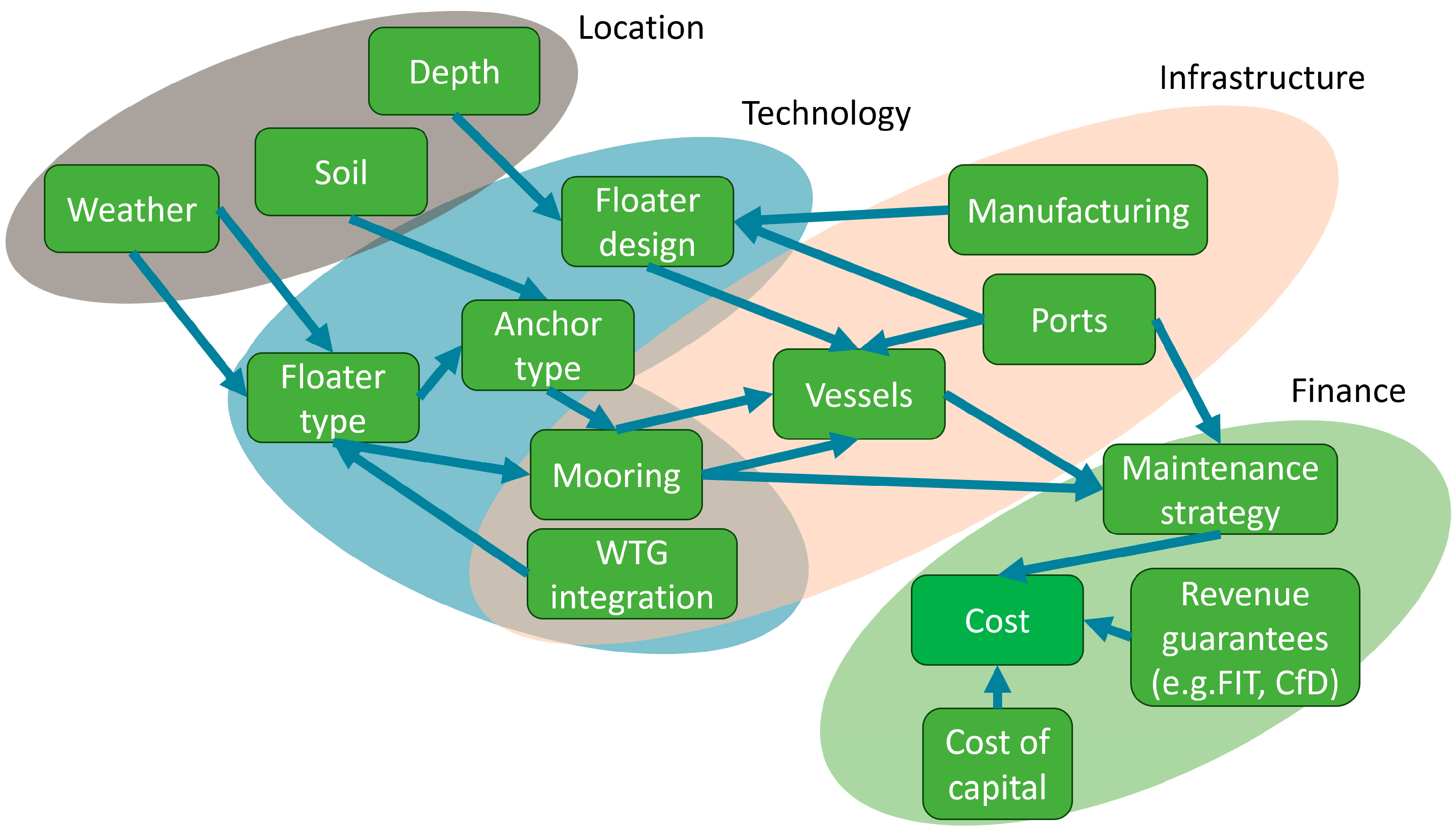
The paper examines the factors that hindered the development process, ultimately causing offshore wind developers, who had invested heavily in development costs and mobilization, to lose interest in Taiwan’s floating offshore wind business; high-level factors affecting FOWT cost are summarized in
Figure 2. It analyzes the differences between a country like France, where floating offshore wind appears to be ramping up steadily, and Taiwan. Finally, it proposes solutions based on the results of the gap analyses and interviews with industry leaders in Taiwan and abroad.
With Taiwan’s energy outlook increasingly strained, nuclear reactors being phased out, and fossil fuel imports remaining high, the country faces growing pressure to accelerate its transition to renewable energy [
20]. Demands from the industrial sector further amplify this urgency, as global supply chains push for compliance with environmental, social, and governance (ESG) standards. To meet these expectations and ensure long-term energy security, Taiwan must turn to its vast but largely untapped offshore wind potential, particularly in deeper waters inaccessible to traditional fixed-bottom turbines.
While not officially announced, many developers have quietly withdrawn from pursuing floating offshore wind projects, including the demonstration projects in Taiwan. This sudden yet unsurprising exit has left the sector largely deserted, casting a shadow over the future of floating wind energy development in the region. The withdrawal of key players, driven by escalating costs, regulatory hurdles, and tendering delays [
21], has created uncertainty surrounding Taiwan’s ambitions to become a leader in floating offshore wind technology, leaving its once-promising floating wind initiatives in a precarious position.
In contrast, on the other side of the strait, China’s floating offshore wind (FOW) sector has progressed rapidly in recent years, supported by abundant deep-water wind resources, strong industrial capacity, and sustained government investment. High-resolution offshore wind assessments demonstrate that China possesses some of the world’s most extensive deep-water wind potential, with southeastern and southern coastal regions showing high mean wind speeds and large technically exploitable areas [
22]. This resource endowment significantly exceeds that of many regional and European markets, providing the physical basis for large-scale floating wind development.
China has also moved quickly to develop the core engineering foundations of FOW technology. Several peer-reviewed studies document the design and validation of full-scale FOWT prototypes in China [
23,
24]. The ability to design, model, and test multi-megawatt turbine floaters at full scale domestically reflects a high degree of technological maturity. By contrast, academic literature on Taiwan and France shows that most of their floating wind research remains focused on conceptual design [
6], numerical modeling [
25], or small demonstrators [
26].
China’s progress is further reinforced by national-level planning and policy support. Peer-reviewed analyses of China’s offshore wind policies show that the 14th Five-Year Plan explicitly identifies floating wind as a strategic technology to be commercialized through coordinated R&D, localized production, and offshore engineering capability [
27]. This policy foundation is considerably more detailed and industry-oriented than the frameworks described in academic evaluations of other countries, where regulatory, spatial-planning, and financing barriers continue to impede full-scale floating wind deployment [
28]. China’s alignment of industrial strategy, technological development, and manufacturing capacity, therefore, provides conditions for faster scaling.
While the existing literature provides valuable insights into the financial, environmental, and infrastructure aspects of floating offshore wind development in Taiwan and France, it often examines these topics in isolation. Many studies explain the costs, policies, and technologies in each country, but none directly compare how these factors interact and affect the growth of each market. There is limited research that demonstrates how the unique or shared features between Taiwan and France have contributed to or hindered the development of floating offshore wind in either location.
There is also a lack of studies that clearly map how the differences or similarities between the two countries have shaped the success or challenges of each market. It is unclear whether certain regulations, supply chain setups, or public support have had a greater impact in one country compared to another. This leaves an important gap in understanding why one market may be moving faster or facing more difficulties than the other.
Additionally, some important details about floating offshore wind development are not documented in the literature. These include the more practical and less visible parts of the process, such as how tenders are managed, how projects are negotiated, and the inside knowledge that industry professionals gain through their work. These details can only be understood adequately by speaking directly with the individuals who have worked on these projects. Therefore, it was necessary to interview professionals from both Taiwan and France to gain deeper, real-world insights that are missing from the published research.
In this context, the present paper is especially relevant, as it addresses a critical gap in Taiwan’s energy strategy. By focusing on the development of floating offshore wind technology, the research provides a structured roadmap for unlocking these deeper offshore resources. It contributes not only to the technical discourse but also to the broader policy and industrial planning efforts needed to make floating wind a viable part of Taiwan’s future energy mix.
2. Methods
2.1. Study Design
This research employs a qualitative study to compare the reasons why the floating offshore wind industries in Taiwan and France either advanced or stagnated. It uses semi-structured interviews with key players, developers, consultants, engineers, and supply chain stakeholders from both countries. Interviews are audio-recorded, transcribed verbatim, not anonymized, and then analyzed using Braun & Clarke’s reflexive thematic analysis framework [
29]. The analysis was conducted with the assistance of a computerized Large Language Model (LLM). The goal is to uncover underlying drivers, such as policy, finance, technology, and stakeholder collaboration, that shape each national market’s trajectory.
The Braun & Clarke’s framework consists of six phases:
Phase 1, Familiarization: deep engagement with the data: repeatedly reading transcripts and listening to recordings, while taking reflexive memos to spot early patterns and analytic observations.
Phase 2, Coding: Line-by-line coding to assign concise labels to meaningful segments across transcripts, capturing explicit (semantic) and underlying (latent) meanings. This reflexive process blends data-driven insights with researchers’ theoretical awareness.
Phase 3, Searching for themes: Clustering codes into candidate themes, representing broader patterns (e.g., “subsidy dependency”, “local supply chain strength”).
Phase 4, Reviewing themes: Refining themes through recursive review to ensure coherence, distinction, and sufficient data support. This may involve merging overlapping themes, splitting broad ones, discarding weak themes, or recoding data for clarity.
Phase 5, Defining and naming themes: Clearly defining and titling themes to capture their essence and role in the overall narrative. It includes documenting the theme scope, significance, and inter-theme relationships in the reflexive journals.
Phase 6: Writing up: The final phase produces a polished analytic report that weaves together the narrative interpretation of how themes answer the research questions, the illustrative data extracts (quotations) to ground themes in participants’ voices, and the literature integration to situate findings within existing research.
This “thick description” not only explains the differences and similarities between Taiwan and France’s industry trajectories but also sets the stage for deeper market and literature follow-up, guiding targeted quantitative analyses, policy evaluation, or supply chain mapping informed by key themes.
Throughout the process, reflexive journal entries document the researcher’s evolving thoughts, assumptions, and decisions, enhancing transparency and trustworthiness. The analysis remains recursive and not strictly linear, as phases overlap and themes tangentially evolve through continual reflection.
2.2. Interviewees
For thematic analysis, we conducted interviews with industry leaders in Taiwan and France who were involved in various stages of the development of floating offshore wind in both countries. Although the sample is small, it is the most representative as these are the key individuals who actually made the critical project decisions. Interviewees are the following:
Kevin Liu, the former CEO of Iberdrola Taiwan, who led the company’s offshore wind development initiatives. He currently serves as CEO of Walsin Cables, focusing on power cable solutions for energy infrastructure. Liu is recognized for bridging international expertise with Taiwan’s growing renewable sector.
James Wu, the former CEO of Taiya Renewable, a company engaged in offshore wind development and energy transition projects in Taiwan. He is now an independent consultant, advising multiple stakeholders in Taiwan’s energy transition. Wu brings deep experience in renewable energy policy and project execution.
Victoria Yang Winsløw, the CEO of Lautec Taiwan and a leading figure in Taiwan’s offshore wind industry. Joining the Taiwan wind industry at an early stage, she has managed key projects, including Formosa 1 and Greater Changhua, with a focus on joint ventures, commercial agreements, and asset management. She now focuses on strengthening Lautec’s role in Taiwan’s energy transition.
Michael Pinkerton, who formerly served as Country Manager of BlueFloat Energy in Taiwan. He was instrumental in launching early-stage offshore floating wind initiatives in the region.
Henrik Mørup Lehmann, Senior Director at Copenhagen Offshore Partners (COP), where he is responsible for project origination and early development activities for offshore wind projects in Taiwan, including both fixed-bottom and floating technologies. Based in Taipei, he supports the development and execution of COP’s offshore wind initiatives across Asia.
Lucas Lin, Chairman of Synera Renewable Energy, a major player in Taiwan’s offshore wind sector. He has led the development of large-scale projects and cross-border joint ventures in the renewables sector. Lin is a central figure in promoting Taiwan as a regional hub for green energy.
Luis González-Pinto Barrenetxea, who has been an advocate of floating wind energy for over 12 years. First, in Saitec Offshore, where he served as COO, he financially closed the 2 MW prototype in Europe. Then, in Taiwan, he served as Country Manager for OWC. He currently works at SRE, playing a key role in the Formosa 5 project, where he supports localization, site planning, and tender preparation for Taiwan’s first floating wind farm.
Walid Oulmane, Chief Commercial Officer at Dajin. He previously served as Head of Ports and Global Industrialization at BlueFloat Energy. In these roles, he leads the development of port infrastructure and industrial strategies to support the global deployment of floating offshore wind projects, with a focus on supply chain readiness and execution across key international markets.
The interviews were conducted online and in person from 20 May to 10 June 2025.
2.3. Interview Questions
A list of 13 questions was addressed during the interviews for participants representing the Taiwanese industry:
- (1)
From your perspective, what were the primary technical or operational challenges facing floating wind projects in Taiwan?
- (2)
What role did Taiwan’s regulatory or permitting framework play in the current status of floating wind projects?
- (3)
How did Taiwan’s supply chain readiness impact floating wind development compared to fixed-bottom projects?
- (4)
Why do you think investors have been hesitant to support floating wind in Taiwan?
- (5)
How do costs for floating wind compare to fixed-bottom projects in Taiwan, and to other floating projects worldwide, and where are the biggest cost bottlenecks?
- (6)
Is there a sweet number for IRR that investors try to hit in offshore wind projects?
- (7)
What kind of risk-sharing mechanisms or government guarantees would make floating wind more viable for developers?
- (8)
Are there any promising floating wind technologies you believe are a better fit for Taiwan’s marine environment?
- (9)
What would a realistic timeline for floating wind revitalization in Taiwan look like, assuming current barriers are addressed?
- (10)
How important is regional cooperation (e.g., with Japan or South Korea) in accelerating floating wind progress in Taiwan?
- (11)
What policies or incentives would make the most immediate difference in jumpstarting the floating wind sector again?
- (12)
What role do you see floating wind playing in Taiwan’s energy mix over the next 10–20 years?
- (13)
If you could change one thing, just one policy, market condition, or technology, what would have the greatest impact on floating wind’s future in Taiwan?
And a similar list of 13 questions for the interviewees representing the French industry:
- (1)
From your perspective, what were the primary technical or operational challenges facing floating wind projects in France?
- (2)
What role did France’s regulatory or permitting framework play in the current status of floating wind projects?
- (3)
How did France’s supply chain readiness impact floating wind development compared to fixed-bottom projects?
- (4)
Why do you think investors have been willing to support floating wind in France?
- (5)
How do costs for floating wind compare to fixed-bottom projects in France, and to other floating projects worldwide, and where are the biggest cost bottlenecks?
- (6)
Is there a sweet number for IRR that investors try to hit in offshore wind projects?
- (7)
What kind of risk-sharing mechanisms or government guarantees would make floating wind more viable for developers?
- (8)
Are there any promising floating wind technologies you believe are a better fit for France’s marine environment?
- (9)
What would a realistic timeline for floating wind commercial-scale deployment in France look like, assuming current barriers are addressed?
- (10)
How important is regional cooperation (e.g., with Spain, UK, or Italy) in accelerating floating wind progress in France?
- (11)
What policies or incentives would make the most immediate difference in accelerating the floating wind sector in France?
- (12)
What role do you see floating wind playing in France’s energy mix over the next 10–20 years?
- (13)
If you could change one thing, just one policy, market condition, or technology, what would have the greatest impact on floating wind’s future in France?
2.4. Limitations
A key limitation of this study is the potential reluctance of interviewees to share sensitive or strategic information, especially since there have been no public announcements clarifying the industry’s future direction, especially in Taiwan. This may have limited the depth of insight into the factors shaping market dynamics.
To address this, all participants were provided with clear introductions and assurances of confidentiality, as needed. We also obtained their explicit consent to use their responses (and, if they choose, their names) in the research. Ensuring transparency and data protection aims to build trust and encourage open and honest dialog, helping mitigate the barrier of guarded responses.
To further cross-check respondents’ opinions, this study compiles and independently analyzes technical and financial factors mentioned by the interviewees, such as the port specifications.
3. Comparative Study Results
Following Braun and Clarke’s six-phase methodology [
29], the analysis identifies and contrasts the key thematic patterns shaping the floating offshore wind sectors in both countries. The selected themes emerged after a rigorous process of data familiarization, coding, and thematic consolidation, providing insights into infrastructure preparedness, regulatory design, supply chain maturity, and investment frameworks. While both countries share overarching technical challenges intrinsic to floating technologies, their institutional and developmental responses diverge significantly.
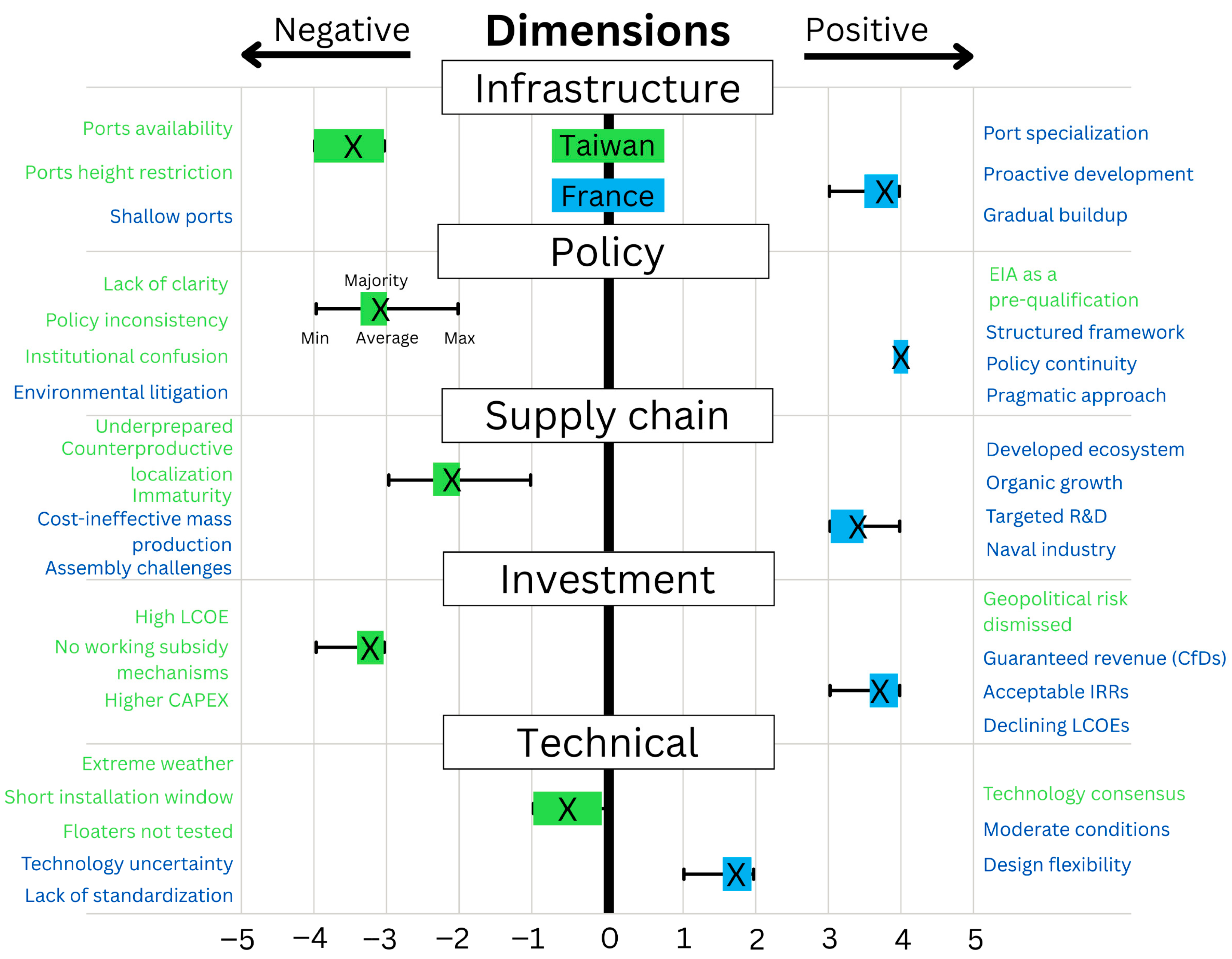
Figure 3 visualizes the aggregated expert evaluations across five key development dimensions: infrastructure and ports, regulatory and FiT policy, supply chain and localization, investment climate, and technical and environmental factors. Scores range from −5 (hampering development) to +5 (beneficial to development). The figure illustrates that France consistently demonstrates more enabling conditions across all axes, while Taiwan’s lower values highlight persistent structural and policy barriers limiting the sector’s growth. It is also seen that technology is not seen as an obstacle in Taiwan, despite the more challenging environmental conditions.
3.1. Theme 1: Infrastructure and Port Readiness
A consistent and prominent theme in the Taiwanese context is the infrastructural inadequacy of its ports to accommodate floating offshore wind components. Multiple interviewees, including Lucas Lin and James Wu, identified port congestion and physical limitations as key barriers to project feasibility. Ports like Taichung and Kaohsiung, originally designed for commercial and containerized trade, are poorly equipped to handle floaters that can exceed 300 m in height and weigh more than 5000 tons. This aligns with the numerical details further provided in the subsequent chapter. Lucas Lin and the others highlighted that Taiwan’s geography, coupled with flight path restrictions in Taipei port due to its proximity to Taoyuan Airport and a lack of suitable harbor modifications, such as the breakwater in Taichung, as highlighted by Henrik Lehman, prevents the efficient integration and pre-assembly of floating units. Even attempts at adapting quayside facilities were deemed insufficient due to limited spatial availability and competing industrial and commercial usage. Lehman particularly stressed that any floating wind integration activities would not be possible before the completion of the breakwater in Taichung port in 2032.
In contrast, France, although not immune to port-related challenges, demonstrates a more proactive and scalable approach. Walid Oulmane emphasized that France strategically initiated floating projects of moderate capacity, starting with a few turbines, then ramping up to 250–300 MW, and subsequently launching gigawatt-scale projects in the next tendering rounds, which helped progressively unlock supply chain and port investments. The gradual buildup in France allowed for focused port retrofitting and minimized disruption, as discussed in Chapter 2. Although deep-draft floaters and steel-concrete hybrid solutions still present logistical hurdles, France’s alignment of port development with national tendering timelines has effectively mitigated the bottlenecks experienced in Taiwan. The collaboration between different French ports, according to Oulmane, also ensured that each port became specialized in one aspect of the supply chain (pre-fabrication, manufacturing, or integration), thereby benefiting from increased synergy.
In conclusion, while both countries recognized the critical role of ports and faced increased challenges in developing them, France’s strategic foresight contrasts with Taiwan’s slower and fragmented response, which may be partially due to the country’s limited geography.
3.2. Theme 2: Regulatory and Policy Framework
The interviews revealed striking contrasts in the regulatory environments of Taiwan and France, especially in terms of policy coherence and developmental incentives. In Taiwan, respondents consistently described a lack of regulatory clarity and institutional coordination. Victoria Winslow recounted how initial plans for a fixed-bottom wind auction were ultimately shelved due to political concerns about high subsidy costs. Feed-in tariffs, initially intended to support demonstration projects in floating offshore wind, were withdrawn in favor of fixed-bottom developments, which were seen as cheaper and politically safer. The Taiwanese approach, characterized by its quick shift from auction-based support to CPPA models, left developers without a viable economic model to pursue floating projects.
Moreover, the lack of coordination between the Bureau of Energy (BOE) and the Industrial Development Bureau (IDB) further exacerbated confusion. Interviews particularly mentioned that developers were awarded projects in a certain round with a set of localization requirements to later discover a change in these constraints in the following rounds, which were neither anticipated nor aligned with project economics. Kevin Liu added that applying the same environmental impact assessment (EIA) rigor to floating wind as to fixed-bottom projects introduced further delays and uncertainty. He suggested that a more tailored permitting model, perhaps akin to European feasibility licensing, would have provided developers with more design flexibility and realistic timelines. At the same time, other interviewees, such as Michael Pinkerton and Lucas Lin, praised the EIA process for floating wind and noted that it facilitated a quick pre-qualification for the various projects.
Conversely, France has adopted a structured and transparent regulatory framework that has generated both predictability and momentum. From initial tenders such as AO5 to subsequent expansions under AO6 and AO9, the French government has ensured policy continuity and scaling. Walid Oulmane praised France’s “pragmatic approach”, which incrementally increases capacity, thereby allowing supply chains and permitting institutions to adjust accordingly. While France also benefits from centralization of responsibilities, with grid connection and transmission infrastructure managed by the national utility RTE (Réseau de Transport d’Électricité). This model removes a major burden from developers and ensures synchronized progress across infrastructure, permitting, and commercial operations. Although legal delays through environmental litigation remain a risk in France, the overarching policy framework offers long-term visibility, something sorely lacking in the Taiwanese case.
For the sake of clarity, France has established a clear and structured roadmap for the deployment of floating offshore wind, transitioning from pilot projects to full-scale commercial developments.
Table 1 illustrates this progression, with projects awarded through competitive tenders (AO5–AO9) and staggered commissioning dates that extend into the 2030s. With multi-GW capacity planned and awarded in successive rounds, something that is clearly lacking in the Taiwanese floating wind landscape. Below is a table of the upcoming floating wind projects in France.
3.3. Theme 3: Supply Chain and Industrial Capability
The readiness of the supply chain was another major differentiator between the two countries. Taiwan, despite early efforts to localize offshore wind components, remains significantly underprepared for the demands of floating wind. Kevin Liu observed that many components necessary for floating platforms, such as dynamic cabling and advanced mooring systems, are not yet available domestically. Furthermore, efforts to mandate local content without accompanying capacity-building initiatives have had counterproductive results. An interviewee who chose to remain anonymous recounted instances where government officials directly mediated supplier-developer contracts, a level of intervention that underscores the immaturity of Taiwan’s industrial base in this sector. Several developers faced delays and inflated costs due to an insufficiently vetted supplier ecosystem and the absence of proven fabrication standards for floaters. It is worth noting Michael Pinkerton’s comment that no localization rules were mandated for floating offshore wind projects in Taiwan.
France, by contrast, entered the floating wind sector with a more developed offshore wind supply chain already in place. According to Oulmane, France was exporting blades and nacelles before any floating project was even operational. This foundation enabled more targeted R&D and partnerships in the floating segment. French firms could also adapt existing naval and offshore engineering capacities to support floating infrastructure. Though challenges persist, particularly in final assembly and cost-effective mass production of large-scale floaters, the French supply chain benefits from a combination of national investment programs and EU-backed innovation initiatives. The comparative result is that while Taiwan’s supply chain struggles with enforced localization for fixed-bottom projects and insufficient readiness, France’s ecosystem has grown organically in alignment with industrial capability and market demand.
3.4. Theme 4: Investment Climate and Economic Viability
A key barrier to the deployment of floating offshore wind in Taiwan is the lack of a stable and attractive investment framework. Multiple interviewees emphasized that project economics under current conditions are not viable. Lucas Lin mentioned that the Taiwanese government asked developers to propose Corporate Power Purchase Agreement (CPPA) prices for floating wind projects. The prices submitted ranged from 6.9 to 12 NTD/kWh (approximately $0.22 to $0.38 USD/kWh), a level significantly above typical fixed-bottom wind tariffs and far beyond what the local market would accept. These price levels implicitly reflect the high LCOE for floating wind in Taiwan and the low likelihood of achieving bankable internal rates of return (IRRs) without additional subsidies or risk-sharing mechanisms.
Victoria Winslow reinforced this point, noting that Taiwan’s Round Three auction process reached a zero-subsidy level for fixed-bottom wind, and that the government subsequently decided not to proceed with the originally planned floating wind auction due to cost concerns. Developers were effectively expected to deliver floating wind projects at prices competitive with those of fixed-bottom projects, despite the fact that floating CAPEX is often estimated to be 50% higher or more, and logistical costs significantly escalate due to port and mooring complexity.
James Wu and Henrik Lehman further noted that investors typically expect IRRs in the high single-digit to low double-digit range (e.g., 8–12%) to justify capital deployment in new markets. Michael Pinkerton further explained that self-funded developers, such as large utility companies, are generally willing to accept an internal rate of return (IRR) below 10%. In contrast, developers relying on external financing typically expect IRRs in the range of 12–15% for fixed-bottom offshore wind projects. According to Kevin Liu, floating wind projects would require even higher returns, several percentage points more, to account for the increased technical and financial risks involved. In all cases, under Taiwan’s current CPPA-driven model, this threshold is rarely met, especially with no feed-in tariffs, no investment tax credits, and no clarity on cost recovery. Wu remarked that the financial risks, compounded by policy instability, essentially deterred long-term capital from committing to floating wind demonstration projects. It was interesting to learn, however, from Michael Pinkerton, that the investors do not see geopolitical risk in Taiwan as a major factor in making investment decisions, despite Floating Wind being the most vulnerable to armed action and sabotage [
31].
By contrast, the investment climate in France is markedly more favorable. The structural design of French tenders, such as bundling seabed rights, grid connection, and pricing under a single award, has created a bankable and scalable economic model. According to Walid Oulmane, France’s approach to starting with 250–300 MW projects offer developers sufficient scale to drive down LCOE through learning effects to around 85 EUR/MWh for EOL5 and 115 EUR/MWh, while also spreading fixed costs across larger production volumes. Additionally, developers benefit from Contracts for Difference (CfDs) that guarantee revenue, as well as coordinated grid planning under RTE (Réseau de Transport d’Électricité), which removes major infrastructure risks from private hands.
In summary, while France offers a framework conducive to achieving acceptable IRRs and declining LCOEs over time, Taiwan’s current investment conditions, marked by high cost, unclear policy signals, and no subsidy mechanisms, render floating wind financially unviable without structural reform.
3.5. Theme 5: Environmental and Technical Challenges
Environmental and technical factors pose significant obstacles to the development of floating offshore wind in both Taiwan and France, affecting floater design, mooring strategies, and installation feasibility.
In Taiwan, harsh oceanographic conditions, strong currents, shallow seabed, and frequent typhoons require highly resilient engineering solutions [
32,
33]. Interviewee Lucas Lin emphasized that floating platforms in Taiwan “move a lot” due to intense wind and current patterns, necessitating powerful anchoring systems. Catenary mooring lines are commonly considered due to their more straightforward installation, but their wide seabed footprint [
34] is problematic in areas heavily used by fisheries.
Typhoon activity and winter further complicate operations. Louis Barrenetxea noted that Taiwan’s installation window is limited to just four to six months per year, placing tight constraints on deployment schedules and vessel mobilization, compared to 10 months in neighboring Korea. These short weather windows increase both project timelines and risk exposure. Floaters must also be engineered to withstand storm loads, which adds to capital expenditures and design complexity. The good news for Taiwan is that there is a general consensus on the type of floater to be used, which is semi-submersible, according to Barrenetxea.
In contrast, France faces less extreme meteorological threats but contends with technical uncertainty in platform standardization. Walid Oulmane highlighted that over 110 floating designs exist, though only a handful, perhaps five or six, are expected to reach commercial maturity. French developers are experimenting with both steel and concrete floaters. Steel designs are lighter (approx. 5000 tons) and modular, easing fabrication, while concrete platforms can exceed 25,000 tons and require specialized port infrastructure for load-out. The choice of platform is highly context-specific: France’s Atlantic coast demands robust, weather-resistant systems, while the calmer Mediterranean allows for broader design flexibility.
In sum, both countries must navigate highly localized environmental and engineering constraints. Taiwan’s challenges are dominated by extreme weather and limited spatial availability, demanding robust and compact technical solutions. France, although benefiting from more moderate conditions, faces the task of scaling and industrializing floater platforms amid a fragmented technology landscape.
3.6. Is TaidaFloat a Feasible Prototype?
The TaidaFloat model, developed by National Taiwan University, represents Taiwan’s most visible effort to create a domestically engineered floating offshore wind (FOW) platform. Its conceptual foundation lies in adapting to the country’s unique maritime conditions, particularly shallow waters, strong currents, and exposure to typhoons, while supporting national ambitions for technology localization and supply chain independence.
From an academic and technological innovation standpoint, the model demonstrates Taiwan’s growing interest in contributing to the global FOW knowledge base. As noted by Kevin Liu, the TaidaFloat is one of the few local designs to move beyond conceptual drawings, reflecting meaningful research efforts within Taiwanese academia. However, he also acknowledges that the model has not been demonstrated at sea, nor progressed through full-scale prototyping, which places it at a low Technology Readiness Level (TRL), according to Michael Pinekerton. Without validation under real offshore conditions, the design remains speculative and lacks industrial credibility.
Henrik Lehman offers a more direct critique. He explains that the Taiwanese government attempted to push developers to include the TaidaFloat in early demonstration projects, despite its lack of commercial viability. Though perhaps well-intentioned in supporting domestic innovation, this policy initiative was rejected by developers, who viewed the requirement as incompatible with technical risk management and project financing norms. Lehman points out that the floater was “not considered by any developer” because it lacked industrial support and had no history of deployment or certification. Incorporating such a model into demonstration-scale projects, which are already burdened with environmental and logistical challenges, was seen as increasing the risk of failure and undermining investor confidence.
The episode highlights a policy misalignment between Taiwan’s aspirations for localization and the practical realities of floating wind development. While promoting local technology is a legitimate long-term goal, doing so by mandating the use of an unproven floater undermines the credibility of the broader FOW program. It also reveals a potential gap in governmental understanding of how technology readiness, industrial scalability, and financial bankability intersect in offshore energy development.
Moving forward, the TaidaFloat could still play a meaningful role, but only if supported by structured public investment in testing, validation, and certification infrastructure. Rather than mandating its commercial use prematurely, the government should consider supporting the deployment of prototypes at a national deepwater test site, in collaboration with academic institutions and industrial partners. If successful, this would allow the TaidaFloat platform to gradually gain credibility, much like the evolution of early floating wind prototypes in Norway, France, and Japan.
3.7. Is Floating Wind Needed in Taiwan?
A central strategic question facing Taiwan’s offshore wind sector is how to sequence the development of fixed-bottom and floating technologies. While global markets, such as Japan, Norway, and parts of the United States, are moving toward floating offshore wind due to geophysical necessity, Taiwan’s case is more complex. Based on insights from key industry stakeholders, including Henrik Lehman and Luis Barrenetxea, it becomes evident that Taiwan still holds considerable untapped potential in fixed-bottom offshore wind (FBOW), raising doubts about the urgency of prioritizing floating solutions.
Henrik Lehman argues that Taiwan’s west coast continues to offer ample shallow-water sites that are technically and economically viable for fixed-bottom foundations. These areas are already familiar to developers and supported by a growing domestic supply chain. Lehman criticizes the government’s recent push toward floating wind, suggesting it is driven more by industrial policy than by actual need. He warns that floating projects, which involve higher capital costs, unproven floater designs, and more complex environmental constraints, are being prematurely promoted at the expense of optimizing the fixed-bottom sector. For Lehman, Taiwan should focus on scaling what works, such as monopile and jacket foundations in known waters, before leaping into floating deployment, which, in his view, remains technically unnecessary and economically unjustified under current conditions.
Luis Barrenetxea reinforces this line of reasoning by emphasizing that “there are still enough fixed-bottom sites to go for many more rounds” of offshore development. His comment suggests that Taiwan’s geospatial constraints, often cited as justification for adopting floating technology, are not yet acute. Barrenetxea implicitly calls for a more pragmatic sequencing approach, one that extracts the full potential of fixed-bottom areas before transitioning to floating solutions. This would mirror deployment models in markets like the UK and France, where floating wind is positioned as a long-term complement to fixed-bottom capacity, not an immediate replacement.
The practical advantages of a “fixed-bottom first” strategy are clear. Fixed-bottom wind benefits from established engineering solutions, a maturing supply chain, and falling Levelized Costs of Energy (LCOEs). In contrast, floating projects involve higher upfront investment, longer development timelines, and uncertainty around mooring, port infrastructure, and maintenance. Furthermore, as both Lehman and Gonzalez suggest, Taiwan’s relatively shallow west coast does not present the kind of seabed or depth constraints that demand an urgent shift to floating.
This sequencing argument does not outright reject floating wind. Rather, it positions FOW as a strategic reserve, a longer-term solution to be pursued when fixed-bottom options are exhausted, or when deeper-water zones, user conflicts, or ecological considerations require alternative deployment models. Floating wind development could continue in parallel at a demonstration or R&D level, with support for platform testing, typhoon resilience studies, and mooring innovations. However, such efforts should not distort the larger policy and investment focus, which remains more effectively served by the continued expansion of fixed-bottom capacity in the near to medium term.
While not yet mature, hybrid wave-wind and solar-wind farms can increase the attractiveness of floating wind. Different studies consistently note the beneficial effects of co-locating these various energy-producing devices. If co-located on one floater, the following beneficial effects are observed: wave dampening effect, more effective material use, prolongation of fatigue life and emergency power supply for malfunctioning turbines [
35,
36,
37]. Or, if co-located at the same site, there are cable and maintenance cost savings, as well as evening out the hourly power curve [
38,
39]. However, there is also data that indicates that LCOE of combined systems can be higher due to conflicting requirements of the devices [
40].
In conclusion, the insights from Lehman and Gonzalez challenge the current trajectory of Taiwan’s offshore wind policy. They support a rational, phased development model in which fixed-bottom foundations remain the foundation of Taiwan’s energy transition strategy. Floating wind, while promising in the long term, should be positioned strategically, developed cautiously, thoroughly tested, and deployed only when clearly justified by geography or system requirements.
4. Techno-Economic Analysis
The above respondents’ opinions might be biased or focused on only one familiar country; to cross-check them, this study compiles and independently analyzes technical and financial factors mentioned by the interviewees: (i) differences in cost and risk due to environmental conditions; (ii) port specifications; (iii) financing schemes.
4.1. Impact of Environmental Conditions on Mooring Requirements in France
To understand the impact of mooring requirements in France, this section will discuss the mooring system requirements of two flagship French FOW developments: the Éoliennes Flottantes du Golfe du Lion (EFGL) pilot project in the Mediterranean already under construction as described in the previous chapter, and the Lannion floating wind farm in the Atlantic (also known as Pennavel). Although similar in technology, both utilize semi-submersible platforms; the environmental conditions and scale of deployment result in substantial differences in mooring system design, tension loads, and economic implications.
At the EFGL site, located 16 km offshore from Leucate in the Mediterranean Sea, each 10 MW WindFloat semi-submersible platform is anchored by a three-line catenary mooring system arranged in 120-degree intervals, optimal for that scenario [
33]. There were 9 mooring lines, each 400–500 m long [
21], with anchors designed for the sandy seabed conditions typical of the Mediterranean.
In contrast, the hypothetical Lannion project off the Atlantic coast of Brittany is a pre-commercial-scale development expected to feature around 47 turbines in water depths of 75 m. Similarly to EFGL, it employs a three-line catenary system per platform. However, due to the more demanding metocean conditions, the chains used here are significantly more robust: each mooring line has a diameter of 133 mm. These chains have a combined weight of over 23,000 tons across the entire wind farm, which exceeds the yearly production capacity of some major chain suppliers [
41]. Anchors at Lannion weigh 15 tons each and are embedded in a sandy seabed [
42]. The harsher Atlantic conditions at Lannion necessitate not only thicker chains but also improved fatigue resistance and stronger connectors to withstand increased cyclic loading.
Mooring installation strategies are adapted to project scale and site conditions. EFGL uses a streamlined approach, employing one anchor handling tug supply (AHTS) vessel with dynamic positioning (DP2) and one support vessel. Moorings are pre-laid before towing the floating platforms to the site. All components are transported to Port-la-Nouvelle for assembly and deployment.
For Lannion, the installation complexity increases significantly due to the system’s mass and quantity. Two large-class AHTS vessels with DP2 and remotely operated vehicles (ROVs) will manage phased pre-lay campaigns. Mooring chains are manufactured in Spain (Vicinay) and shipped from Bilbao. Anchors, on the other hand, come from the Netherlands via Rotterdam. Cherbourg serves as the base port for integration and dispatch.
The EFGL project, as a pilot, achieves a cost-efficient balance between performance and feasibility. Mooring capital expenditures are estimated at €3.3 million, or about €110,000 per installed MW, representing roughly 2% of the total project cost. With moderate environmental loads, smaller chain sizes and lighter anchors are sufficient.
In contrast, the Lannion project must contend with the economic consequences of using significantly larger mooring components. The Ø133 mm chains, extensive line lengths, and large anchor fleet add considerable weight and volume, raising both fabrication and transport costs. Estimates suggest that the mooring system’s CAPEX ranges between €120,000 and €150,000 per MW. Installation demands are higher due to vessel requirements [
43], multiple campaigns, and specialized port logistics. The total system mass also increases the seabed footprint and structural fatigue considerations.
The EFGL and Lannion projects represent the two extremes of France’s floating offshore wind spectrum: one a pilot in calm waters, the other a large-scale effort in more extreme conditions. While both rely on a 3-line catenary mooring architecture, the chain diameters, component weights, and installation logistics differ substantially.
EFGL’s mooring system is optimized for mild Mediterranean conditions, emphasizing efficient use of smaller components and minimal offshore complexity. Lannion’s system, meanwhile, addresses the rigorous Atlantic environment through heavier chains, stronger anchors, and enhanced redundancy, at the cost of higher CAPEX and more challenging deployment. These contrasting strategies provide valuable insights into how future commercial floating wind farms might balance performance, resilience, and cost, depending on regional oceanographic conditions.
4.2. Impact of Environmental Conditions on Mooring Requirements in Taiwan
The deployment of Floating Offshore Wind Turbines in typhoon-prone regions, such as Taiwan, presents major engineering challenges, primarily due to extreme environmental loading. A study led by a group of researchers from National Taiwan University and the University of Tokyo, using a 15 MW semi-submersible FOWT as a case study, employed OrcaFlex simulations to compare mooring line tensions across six global regions, including Taiwan, under 50-year return period events [
32].
The study unequivocally indicates that the Taiwan Strait is one of the most challenging, if not the most challenging, regions for mooring a FOWT around the world. Mooring line fatigue is also a particular concern [
44].
In the Taiwan Strait, tropical cyclones (typhoons) result in combined wind speeds exceeding 60 m/s, significant wave heights of over 13 m, and surface currents reaching almost 2 m/s. These conditions exceed those observed in regions such as the North Sea (Hs ≈ 13.4, wind speed ≈ 34 m/s) or West Africa (Hs ≈ 5 m, wind speed ≈ 14 m/s), the latter being very similar to the conditions in Mediterranean France as described in the previous section.
Simulations of peak mooring line tension during extreme weather events indicate that Taiwan faces significantly higher loads than other major offshore wind regions, with values reaching approximately 8.2 MN, compared to 4.5 MN in the North Sea and 3.2 MN off the coast of West Africa. These elevated tension levels necessitate the use of more robust mooring systems. In Taiwan, this includes studless chains with diameters of at least 165 mm, a 3 × 3 catenary mooring configuration (comprising nine lines), and line lengths of approximately 850 m to accommodate platform motion and the required pretension. As a result, the overall mooring system mass is estimated to be 20–40% greater than that used in non-typhoon-prone regions, which has direct implications for both cost and installation complexity.
The result is a 30–50% increase in CAPEX for the mooring system, which may account for 10–15% of the total project cost increase in typhoon regions, unless special novel mooring solutions for harsh environments are adopted [
33].
Taiwan’s exposure to high-intensity typhoons significantly elevates mooring tension requirements, chain dimensions, and design safety margins. These conditions impose substantial economic burdens on FOWT projects, necessitating site-specific design optimization, advanced dynamic modeling, and potentially hybrid mooring solutions to ensure structural integrity and commercial viability.
4.3. Offshore Wind Port Infrastructure in France
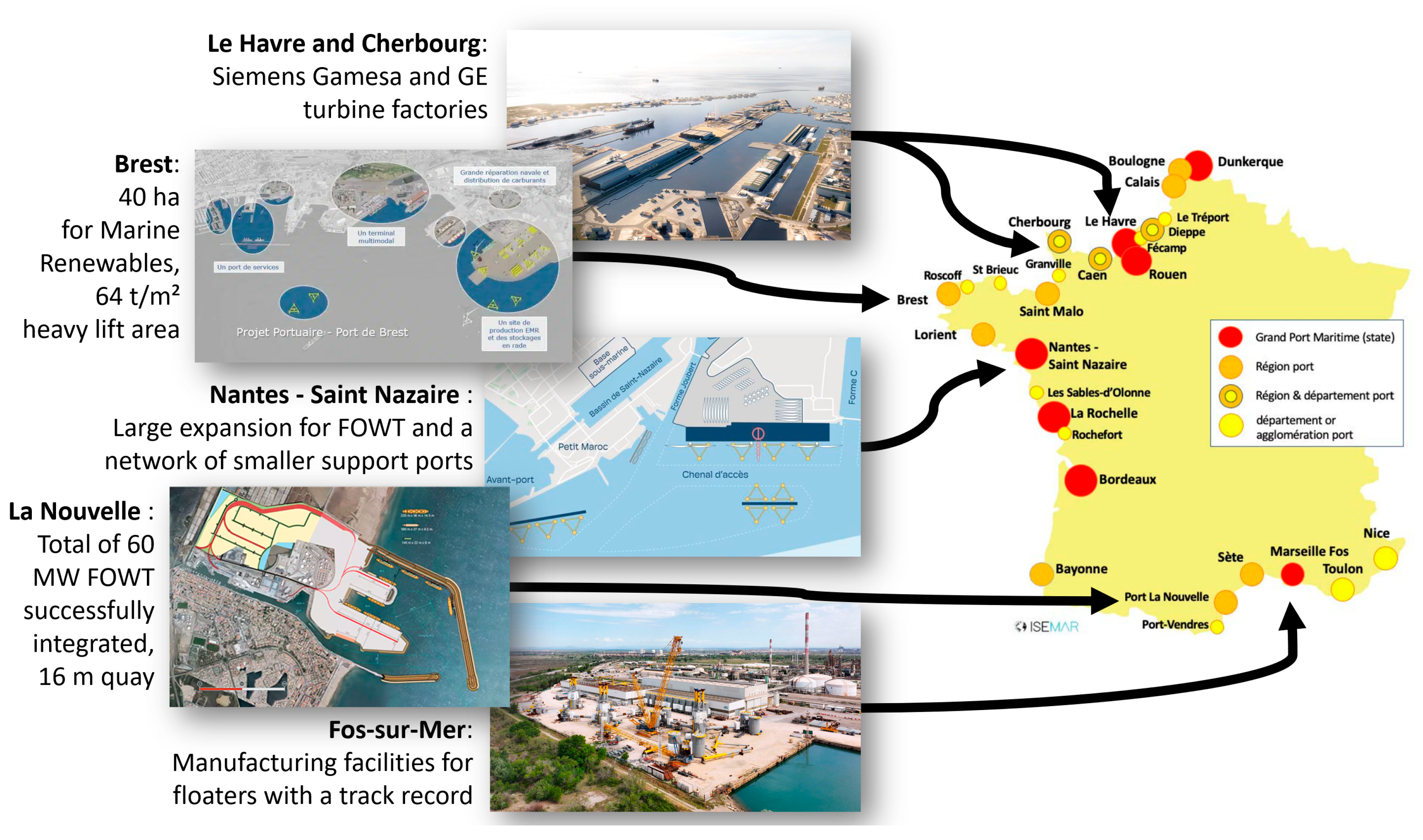
To deliver on their floating offshore wind ambitions, France must rely heavily on ports that can support the industrial-scale assembly, integration, and deployment of floating wind turbines, as shown in
Figure 4. These operations require quays with high bearing capacities, deep water access, extensive laydown areas, and enough air clearance for turbine erection. In recent years, several key ports in France have undergone major upgrades, with investments aligned with the timeline of upcoming floating wind projects from tendering rounds AO5 through AO9 [
45].
Nantes–Saint-Nazaire, located in the Pays de la Loire region, is one of the leading ports in this transformation. It currently offers quay bearing capacities of around 15 t/m
2 [
46] (specifically upgraded for GE Renewables) and draughts of 12 to 14 m, making it suitable for heavy offshore operations. As part of the ÉOLE project [
47], the port is undergoing upgrades, including electrification of quays, which began in 2021 and was completed in spring 2024 [
46]. It also serves as the installation port for the Îles d’Yeu and Noirmoutier offshore wind farm, with 14.5 hectares allocated to Siemens Gamesa Renewable Energy from March 2024 through the end of 2025 [
48]. The combination of adequate bearing strength and deep-water access gives Saint-Nazaire a crucial role in handling turbine integration and tow-out operations.
In the north, a 36-hectare Siemens Gamesa plant has been producing blades and nacelles in Le Havre since 2022; it was built alongside its own port facilities [
30]. Le Havre has also served as a logistics hub for the nearby windfarms, particularly welcoming an offshore substation [
49]. Its heavy-lift quays are up to 16 m in depth, but only provide a 6–10 t/m
2 capacity, making them unsuitable for large floater assembly or turbine integration [
50].
In Brittany, the Port of Brest has positioned itself as a key industrial base for floater fabrication and pre-assembly. Significant upgrades began in 2013, and by 2020, a major expansion of the port was completed. The port now features a dedicated 40-hectare terminal for marine renewable energy, as well as a 400-m-long, heavy-duty quay. Its bearing capacities range from 10 to as high as 64 t/m
2 in reinforced areas, making it one of the few French ports capable of supporting the weight of fully assembled floating substructures and turbines [
51]. While container terminal draughts reach 14 m, the heavy lift quay for marine energy projects’ depth is 12 m, but the access channel only reaches 8 m, making it a bottleneck [
52]. Brest is poised to support multiple floating wind projects along France’s Atlantic coastline, especially those awarded through AO5 and AO9 [
53].
Port-La Nouvelle, located in the Occitanie region on the Mediterranean coast, is also undergoing transformation into a floating wind logistics hub. Initial port modernization commenced in 2019, with the completion of a 300-m quay and 23 hectares of new industrial land scheduled for 2026. The quay depth is currently 11 m, with expansion plans increasing this to 16 m and 15 t/m
2 [
54] to allow for larger component handling. Port-La Nouvelle currently serves as the staging and integration site for the Eolmed and EFGL pilot projects, both 30 MW floating wind farms utilizing 10 MW turbines. The port’s quay has been reinforced to accommodate heavy loads, and the region has committed €237 million to the port’s redevelopment, making it a critical player for the AO6 and AO9 floating projects in the Mediterranean [
54].
Further east, the Port of Marseille’s Fos-sur-Mer terminal is being positioned as a future large-scale industrial platform for floating offshore wind. Floaters for both PGL and EFGL farms were assembled at its Eiffage Metal site [
55].The DEOS project, launched in 2024, aims to deliver an 80-hectare assembly yard with a high-capacity quay by 2028. This new infrastructure will support the manufacturing and deployment of up to 25 floating wind turbines and 50 floating foundations annually. The quay will offer depths of up to 14.5 m, making it suitable for towing fully assembled floaters. With its proximity to AO6 and AO9 zones and an already established industrial ecosystem, Fos-sur-Mer is set to become a cornerstone of France’s floating wind supply chain.
Cherbourg, in the Normandy region, has also seen earlier investments in offshore wind port infrastructure. A heavy-duty quay with a bearing capacity of approximately 15 t/m
2 became operational in 2015. By 2016, an additional 100 hectares of industrial land had been developed to support marine renewable energy activities, and a turbine blade factory was inaugurated in 2019 [
56]. The site was initially intended to support fixed-bottom offshore wind, but its capabilities also enable it to serve as a maintenance and logistics hub for future floating wind projects, particularly those located off the Normandy coast [
57].
In summary, France has adopted a regional strategy for floating offshore wind port infrastructure, where different ports specialize in various stages of the project lifecycle: fabrication in Brest, integration in Saint-Nazaire and Port-La Nouvelle, industrial scaling in Fos-sur-Mer, and operational support in Cherbourg. While most of these ports are progressing according to schedule, a key concern remains the quay bearing capacity, which must often exceed 30 t/m2 to support the assembly of floating substructures and the integration of turbines. Draught, laydown space, and air clearance are also limiting factors. Nevertheless, with phased upgrades planned through 2028, these ports are being aligned with the deployment schedule of French tendering rounds AO5 to AO9. This long-term visibility enables coordinated investment, ensures supply chain readiness, and cements France’s leadership in the European floating wind market.
4.4. Status of Ports in Taiwan
Ivanov and Ma [
58] outlined port requirements for the installation and storage of different components, and demonstrated that port infrastructure is vital for all stages of a floating wind project.
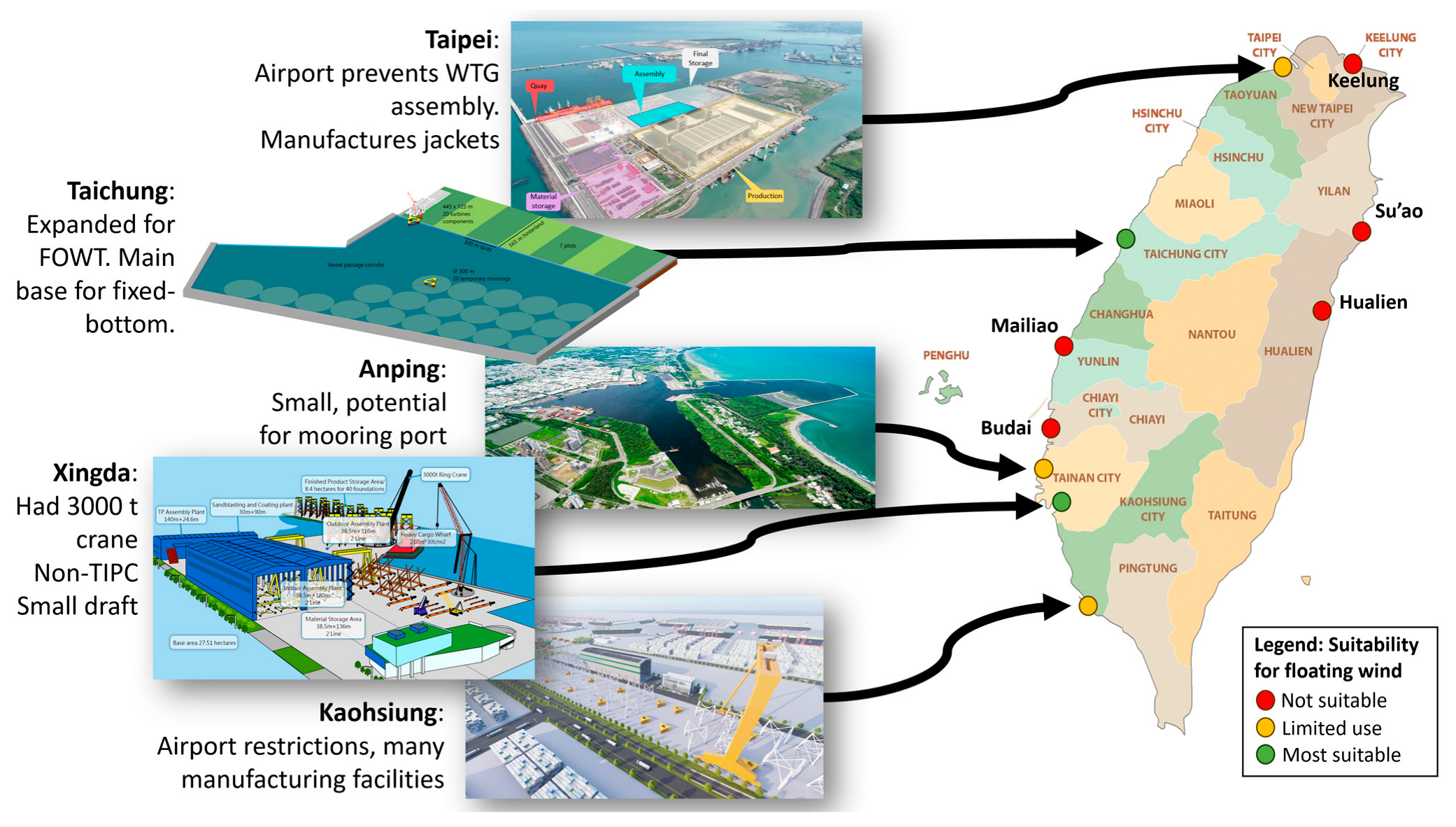
Figure 5 and
Table 2 summarize the main port constraints in Taiwan’s ports, excluding those with a heavy military presence. It shows that the current port infrastructure in Taiwan is not suitable for FOWT assembly and turbine integration.
The required quay bearing capacity for the floater assembly was determined to be 28.3 t/m2. Only Xingda Harbor achieves this, but its reinforced part is too small in area. Even more might be required for turbine integration, depending on the turbine model. The bearing capacity could be adjusted by temporarily spreading steel sheets to spread a concentrated load, but only to a limited extent; quay rebuilding is required to permanently increase the capacity.
With the exception of Taipei, which is already a manufacturing hub for offshore wind steel structures and has a wide entrance channel, other ports are heavily reliant on shipping business and feature narrow entrances. In the event of an accident during floater towing, these narrow entrances may be blocked off. Even if there is no accident, towing operations would block the channel for several hours, causing losses due to cargo shipping delays in millions of USD, which the project owner would pay. These factors prompted port authorities to ban such operations in narrow-entrance commercial ports. Out of port assembly, similar to Hywind Scotland, is unlikely, but could be facilitated by new technologies [
59].
Ultimately, the quay depth is the biggest concern in Taiwan. Taipei Port is the deepest port in Taiwan, but due to the nearby Taoyuan Airport’s 3rd terminal height restriction zone, turbines cannot be assembled there; a similar problem exists in Kaohsiung. When the wind turbine is installed on the floater, it sinks due to the added weight; this is the floater’s minimal installation draught. It must be shallower than the quay and port channel depth, so tow the floater outside, where more ballast water will be taken in to further lower the draught to operational. While different floaters’ operational draughts are the same, the installation draughts are not. For floaters with minimal pontoon volume, such as WindFloat, TetraSpar, PGL’s TLP, etc., it is very close to operational draught (±15–20 m), requiring deep quays or difficult-to-install floating aids (such as used in WindFloat Portugal demo). In the cases of TaidaFloat and DeltaFloat, the large pontoon volume provides extra buoyancy when not filled with ballast, resulting in a minimal installation draught, e.g., under 4.5 m for TaidaFloat. This makes them suitable even for the shallowest harbors, such as Xingda.
Table 2.
General specifications of Taiwanese and French ports.
Table 2.
General specifications of Taiwanese and French ports.
| Port | Quay Depth, m | Max Quay Capacity t/m2 | Main Traffic and Entrance Channel |
|---|
| France | | | |
| Le Havre [50] | 16 | 6 | Cargo and cruise/1 shallow |
| Brest [52] | 12 | 64 | Cargo and ship repair/1 shallow |
| Nantes-Saint Nazaire [47] | 14 | 15 | Cargo/wide river |
| La Nouvelle [54] | 16 | - | Industrial/1 wide |
| Fos-sur-Mer [60] | 14.5 | - | Mixed |
| Taiwan | | | |
| Taipei [61] | 15 (Heavy-duty quay) | 20 | Industrial/1 wide |
| Taichung [62] | 14 (Ocean engineering area) | 15 | Cargo/1 narrow |
| Anping [61] | 11 (Quay no. 13) | - | Fishery/1 narrow |
| Xingda [61] | 8 (Heavy-duty quay) | 30 | Industrial/1 shallow |
| Kaohsiung [61] | 10 (outside CSBC dry dock) | - | Cargo/2 narrow |
4.5. Financing and Revenue Schemes in France
Floating offshore wind projects in France typically adopt a project-finance model that combines equity investment from large energy consortia, such as EDF, Engie, and TotalEnergies, with commercial debt financing and strategic public support. The European Investment Bank (EIB) plays a significant role, having co-financed three major floating wind farms in the Mediterranean with over €210 million in loans. These projects benefit from InnovFin and EFSI guarantees, helping to mitigate investor risk during early-stage deployment [
63].
Public grants from French agencies such as ADEME, along with innovation-driven investment through programs like Investissements d’Avenir, complement this structure by funding R&D and first-of-a-kind deployments. In parallel, the European Union’s Horizon 2020 and Innovation Fund programs provide cross-border funding for technology validation and supply chain development.
From an economic and technical perspective, France exhibits a high average capacity factor for floating offshore wind at 42.2%, surpassing other Mediterranean countries. Additionally, it boasts the lowest average Levelized Cost of Energy (LCOE) in the region at €67.5/MWh, making it economically competitive [
64].
On the revenue side, France relies on a Contract for Difference (CfD) scheme to provide predictable income for commercial-scale floating wind farms. Under this model, developers receive a 20-year “strike price” for the electricity generated. If wholesale electricity prices fall below this strike price, the government pays the difference as a premium; if they rise above, the developer pays the difference back. This two-way CfD design is central to de-risking long-term investments while encouraging competitive bidding.
For example, in 2023, the European Commission approved a €2.08 billion CfD scheme for a 230–270 MW floating wind farm in South Brittany, offering 20 years of monthly variable premiums [
65]. Later that year, a €4.12 billion support scheme was approved for two commercial-scale floating wind farms (each with a capacity of up to 280 MW) in the Gulf of Lion [
66].
Before this shift to CfDs, France used feed-in tariffs (FiTs) to support early demonstration projects, such as Groix & Belle-Île, and Provence Grand Large, offering a fixed rate per kWh to offset the high costs of emerging technologies. These FiTs were essential in de-risking initial investments but are now being phased out in favor of auction-based mechanisms.
Looking forward, corporate Power Purchase Agreements (PPAs) are expected to play a growing role, especially as floating wind costs decline, and more projects pursue merchant-market exposure. Peer-reviewed research emphasizes that investor appetite for PPAs will rise as financing matures and cost structures stabilize.
From a cost perspective, floating offshore wind still presents higher CAPEX and OPEX than fixed-bottom alternatives. However, techno-economic studies suggest that costs are declining rapidly. According to an MDPI study, levelized costs could reach €0.09–0.13 per kWh in optimal conditions, with semi-submersible platforms showing the most promising path to scalability. Another modeling study predicts LCoE reductions of around € 0.05 per kWh under favorable scenarios with industrial scaling [
67].
France’s auction framework has also evolved to facilitate large-scale deployment. Since 2021, tenders have focused on pre-zoned areas with completed environmental assessments, reducing permitting risks and time. Auctions follow a pay-as-bid CfD structure, prioritizing price efficiency and local content commitments. Winners are required to meet industrial development targets, ensuring that economic benefits are retained within the French maritime supply chain.
These policy choices align with global best practices. A recent comparative study of renewable auction schemes highlights the widespread adoption of two-way CfDs in markets where investor risks remain high. The study concludes that such designs are particularly effective in attracting long-term capital to high-CAPEX technologies, such as floating wind [
68].
Financing and Revenue Schemes in Taiwan
While several floating offshore wind demonstration zones have been approved in Taiwan, particularly near Hsinchu and Miaoli, the final structure of feed-in tariffs (FiTs) and tender rules has not been finalized to date. Noting that multiple drafts have been issued by the MoEA to seek feedback from stakeholders [
69].
The financing model for floating offshore wind in Taiwan is expected to closely mirror the project finance structures already employed for successful projects, such as Formosa 1 and Formosa 2. These structures typically involve a blend of local and international equity partners, such as Copenhagen Infrastructure Partners (CIP), Ørsted, StonePeak, combined with commercial debt from both Taiwanese and international banks. Developers must secure long-term power purchase agreements (PPAs) or FiT-backed offtake contracts, usually with Taipower, the state-owned utility. Taiwanese financial regulations also require developers to contribute a minimum equity investment, typically around 5% of total capital expenditures, to secure debt financing. However, CIP and other major investors have noted that no commercial-scale floating wind projects in Taiwan have yet reached financial close, primarily because lenders require very conservative debt ratios, high debt service coverage, and guaranteed revenue streams likely in the form of generous FiTs or stable PPAs [
70].
Revenue mechanisms for floating offshore wind in Taiwan are evolving but are likely to initially rely on tailored FiTs specific to floating projects, separate from those offered for fixed-bottom wind farms. The latest proposals suggest floating wind FiTs may follow a two-tier structure, for example, NT
$5.8/kWh for the first 10 years, declining to NT
$3.8/kWh thereafter. Industry groups have formally requested that floating wind be included in the FiT system in the upcoming 2024–2025 revision cycle [
16]. In parallel, corporate PPAs are gaining traction, as demonstrated by the landmark 20-year PPA signed between Ørsted and TSMC for the Changhua 2b & 4 offshore wind project [
71]. This type of long-term corporate offtake is increasingly seen as essential for securing bankable revenues in Taiwan’s competitive market. Over time, floating wind is also expected to benefit from auction-based procurement rounds similar to Taiwan’s fixed-bottom offshore tenders, where competitive bidding for grid capacity and pricing will further shape revenue structures.
While floating wind carries higher capital and operational costs compared to fixed-bottom alternatives, the Taiwanese government and developers are working together to make these projects financially viable. Developers emphasize the need for floating-specific FiTs that account for the higher costs and risks of early deployments, with phased reductions as the industry matures. The government is also developing a regulatory framework to address site allocation, environmental permitting, fisheries compensation, and interconnection issues, with detailed floating wind regulations, which were expected by late 2024 and have not been issued to date.
Key precedents from Taiwan’s offshore sector, particularly the Formosa series, offer valuable lessons. Both Formosa 1 and Formosa 2 achieved financial close through debt-equity structures supported by 20-year FiT-backed revenue guarantees from Taipower. The success of long-term corporate PPAs, as demonstrated by Ørsted’s agreement with TSMC, signals growing confidence in private offtake models that could also apply to floating wind as the market matures.
In another interesting development, the FengMiao 1 Offshore Wind Farm has recently secured multiple Corporate Power Purchase Agreements (CPPAs), marking a significant shift in the country’s renewable energy procurement model. In November 2024, Sino-American Silicon Products Inc. (SAS) and its subsidiary, Sustainable Energy Solution (SES), entered into a 30-year CPPA with Copenhagen Infrastructure Partners (CIP) for the 500 MW Phase 1 of Fengmiao 1. Other companies have followed, such as Google and United Microelectronics Corporation (UMC). This agreement is notable for being the first CPPA in Taiwan’s Round 3 Zonal Development Offshore Wind Auction and represents a pioneering move from traditional feed-in tariff (FiT) models to direct corporate procurement of offshore wind energy [
72]. However, it is worth noting that FengMiao 1 was the only project to reach Financial Close in its tendering round (so far), raising serious concerns about the appetite of investors, developers, and buyers for additional projects.
In conclusion, Taiwan’s floating offshore wind sector is building a solid foundation with project-finance models supported by a mix of equity, debt, and government-aligned offtake structures. Revenue schemes will likely combine demonstration-stage FiTs with corporate PPAs and eventually competitive auctions. However, the anticipated rollout of floating-specific FiTs and regulatory clarity by 2025 has not been published yet, which is raising concerns on how well-positioned Taiwan is to accelerate floating wind development.
5. Concluding Recommendations
A comprehensive strategy that addresses multiple areas simultaneously is necessary to revitalize the stalled development of floating offshore wind in Taiwan, one that addresses policy clarity, financial incentives, infrastructure readiness, permitting efficiency, technological flexibility, and institutional coordination. Drawing from both local stakeholder insights and lessons from France, this strategy outlines a comprehensive path forward. If all these recommendations are successfully and timely implemented, Taiwan can not only fulfill its growing green energy needs, but also establish a new industry, with the potential to lead the Asian market.
- i.
Establish a clear, phased policy framework with medium-scale pilot auctions:
Primarily, Taiwan must establish a clear, phased policy framework centered on medium-scale pilot auctions. Interviewees repeatedly emphasized the lack of long-term visibility in Taiwan’s floating offshore wind market, contrasting it with France’s structured auction model. Taiwan should initiate a national floating wind roadmap that begins with project sizes in the range of 250–300 MW. These are sufficiently large to attract committed investors and justify necessary infrastructure upgrades, yet small enough to mitigate technology and execution risk. Over time, project capacities can expand to 500 MW and eventually to gigawatt-scale development. Announcing a pipeline of tenders with predictable timing and scale would provide the certainty developers and supply chain actors need to plan investment and resource allocation. A “Floating Round One” auction, covering multiple pre-identified zones with seabed rights, grid access, and guaranteed pricing, would mark an effective first step.
- ii.
Reinstate and tailor financial incentives for floating projects:
In tandem, the Taiwanese government must reinstate and tailor financial incentives to meet the higher capital costs of floating projects. Interviews revealed that, in the absence of feed-in tariffs or investment support mechanisms, current floating offshore wind economics in Taiwan are not viable. The government should consider reintroducing feed-in tariffs for early projects and complement them with mechanisms such as Investment Tax Credits (ITCs), modeled after the U.S. Inflation Reduction Act, or Contracts for Difference (CfDs) as used in Europe. Additionally, project developers should be given the flexibility to choose between long-term CfDs and Corporate Power Purchase Agreements (CPPAs), depending on their business model. These instruments would help bridge the cost gap and attract institutional capital into the floating segment. A dedicated financial package administered by the Bureau of Energy could underpin the first 500 MW of floating capacity.
- iii.
Designate and develop floating-specific port infrastructure:
Infrastructure readiness, particularly port capability, emerged as one of the most urgent and constraining factors across all Taiwanese interviews. To support floating deployment, the government must designate and develop a port hub specifically for floating vessels. Either Kaohsiung or an expanded area of Taichung Port should be selected as the national base for integrating floating wind energy. This port would require investment in deep-draft quays, expansive laydown and assembly zones, and load-out infrastructure capable of handling floaters weighing between 5000 and 25,000 tons. Co-financing models involving public investment and private project commitments, similar to those used in France, can facilitate these upgrades. A “Floating Wind Port Development Initiative”, under the Ministry of Transportation and Communications, should be launched to plan, fund, and oversee these critical investments, and accelerate the completion of the breakwater in Taichung port.
- iv.
Reform offshore grid infrastructure:
From a transmission perspective, in Taiwan, offshore wind developers currently bear the cost and risk of building offshore transmission lines, which can hinder project financing and slow development. In contrast, France adopts a risk-sharing model where the transmission system is developed and operated by the state-owned grid operator, RTE. This approach reduces financial pressure on developers and improves project bankability. Introducing a similar mechanism in Taiwan, potentially led by Taiwan Power Company (TPC), or a privately owned company, could significantly accelerate offshore wind deployment by creating a more stable and investor-friendly environment. This point was interestingly supported by Liu and Wu, but rejected by Lehman and others.
- v.
Streamline permitting and environmental impact assessments:
In parallel, Taiwan’s permitting and environmental assessment processes must be streamlined to reflect the specific characteristics of floating technology. Current regulations treat floating and fixed-bottom wind similarly, despite the former’s minimal seabed impact and modular deployment model. A separate permitting pathway for floating projects should be introduced, with modified environmental criteria and expedited approval timelines. Moreover, Taiwan could adopt feasibility licensing, similar to France’s approach, allowing developers to secure site access and conduct environmental studies prior to full commitment. Reforming the Environmental Impact Assessment (EIA) framework in this direction would reduce regulatory uncertainty and encourage innovation.
- vi.
Enable technology flexibility and support industrial pilot testing:
Technological flexibility is another cornerstone of revitalization. Taiwan should avoid mandating specific floater or mooring designs, as premature standardization could stifle innovation and exclude technologies better suited to local conditions. Instead, the government should support a competitive, technology-neutral framework that allows developers to propose the most appropriate solutions. This should be reinforced through public funding for pilot platforms, deep-water test sites, and R&D collaboration with international original equipment manufacturers (OEMs). Public–private partnerships involving academic institutions and industrial actors can also be used to validate typhoon-resilient designs under local conditions, bridging the current technology readiness gap.