
Article

Supporting Mealtimes: Palatability of IDDSI Level 3 Smoothies
1
School of Communication Sciences and Disorders, Louisiana Tech University, Ruston, LA 71272, USA
2
School of Biological Sciences, Louisiana Tech University, Ruston, LA 71272, USA
3
Private Practice, Saskatoon, SK, Canada
*
Author to whom correspondence should be addressed.
Dietetics 2026, 5(2), 29; https://doi.org/10.3390/dietetics5020029
Submission received: 22 January 2026 / Revised: 9 March 2026 / Accepted: 22 April 2026 / Published: 8 May 2026

Abstract

Background: Dysphagia is a medically complex condition that often necessitates modified food textures to ensure safe swallowing. As smoothies continue to grow in popularity, developing nutritionally balanced recipes that meet the International Dysphagia Diet Standardisation Initiative (IDDSI) Level 3 guidelines may offer practical, appealing options for caregivers and individuals managing dysphagia. Standardized recipes can potentially also support consistency in preparation. Purpose: The purpose of this research was to develop and evaluate palatable smoothie recipes that meet the IDDSI Level 3 consistency guidelines. Method: In this descriptive pilot study, using a pre-test/post-test design, 32 preprofessional students evaluated three smoothies prepared in a laboratory setting. Both fresh and frozen ingredients were used, and each smoothie was tested for IDDSI Level 3 consistency using the IDDSI funnel. Participants rated the smoothies on color, aroma, texture, flavor, appearance, palatability, and overall acceptability using a five-point Likert scale. Results: The results varied across evaluation criteria. Texture and color were the most influential factors in participants’ assessments. The strong impact of texture was an unexpected finding, as all smoothies met Level 3 standards according to the IDDSI funnel. Conversely, the influence of color was expected, as visual presentation is known to significantly affect food perception and acceptance. Conclusions: Given their nutritional value and ease of preparation, smoothies can be a practical addition to modified diets. While IDDSI Level 3 appears to be an appropriate consistency for this purpose, further research may be needed to evaluate the reliability of the IDDSI funnel in ensuring consistent texture outcomes.

1. Introduction

Dysphagia is a medically complex disorder with approximately one in 25 adults experiencing a swallowing problem in the United States [1]. Dysphagia is defined as a disorder involving the oral cavity, pharynx, esophagus or gastroesophageal junction [2]. Dysphagia can cause aspiration pneumonia, chronic lung disease, malnutrition, dehydration, choking, and even death [3,4]. Often, dysphagia is a result of various causes related to neurological conditions and physiological and structural changes [5], such as cerebrovascular accidents, Parkinson’s disease, treatment for cancer, and use of some medications. Assisting families with symptoms of dysphagia through diet modification using nutritional smoothie recipes is an option to consider. With the complexity of dysphagia, interprofessional collaboration is needed to optimize treatment [6]. Two professionals needed on the team to treat dysphagia include speech–language pathologists (SLPs), and registered dietitian nutritionists (RDNs) who work collaboratively with the caregivers to support an acceptable diet and curb a possible decline in quality of life [7]. The SLP would prescribe the level of texture-modified diet required, while the RDN would ensure nutritional needs are being met.

1.1. Diet Modifications and Quality-of-Life Considerations

Dysphagia management may include recommending modified-texture diets (MTDs). MTDs can range from soft food textures to purees to thickened liquids. To make modifications standard, the International Dysphagia Diet Standardisation Initiative (IDDSI) was introduced over the recent years [8]. The initiative established a framework and detailed level definitions [9]. The IDDSI framework provides “common terminology for describing food textures and drink thicknesses to improve safety for individuals with swallowing difficulties” (para. 3). These levels allow descriptions for other foods outside the main meal such as mustard, dipping sauces, or smoothies. There are seven levels within two broad categories of foods and drinks. For example, Level 3 is described as a liquidized food that can also be considered a moderately thick drink. Details of the IDDSI framework are located on the IDDSI website.
Although modifying the texture of food may assist in the prevention of aspiration, the therapeutic use of MTD has created controversy [10]. Research has shown that patients may refuse to eat MTD foods [11,12], may have compromised nutritional statuses over time [13], and may become dehydrated on an MTD [14,15]. Various texture levels have been developed and standardized through the IDDSI project but considerable empirical data is lacking to safely nourish and hydrate individuals who require these foods (e.g., [16,17]). There is a paucity of published research in utilizing modified diets to help prevent aspiration [18] and a lack of replicated evidence showing how to modify food texture while maintaining adequate nutrition and hydration [17]. For example, [17] found that 10 long-term care facilities did not consistently calculate the nutrient content of the diet provided to their clients. They found that more study is needed, specifically for pureed food, production of food, nutritional quality, and acceptability of the MTD. Ultimately, the provision of clearer guidelines, backed by scientific evidence, will assist with providing appropriate diet recommendations for clients with dysphagia while offering improved quality of life for both the caregiver and the individual with dysphagia.
Quality of life can be influenced by the fundamental activities of eating and drinking [7], skills often taken for granted until swallowing problems are noticed. When swallowing is disrupted, a negative impact occurs on the quality of life for individuals [19] and their caregivers [20]. When one experiences dysphagia, sharing meals with others can become embarrassing and burdensome [21], and meal socialization is often avoided altogether [22]. Families influence what and when we eat, and how feeding is carried out [23]. Eating together expresses human values, supports cultural traditions, and develops social bonds. When eating is disrupted due to dysphagia, caregivers generally have difficulty mitigating its impact and struggle to manage nutritional needs [24].
Community support from trained SLPs and/or RDNs can be limited or nonexistent in some areas. This adds stress in the home when providing nutritional needs for an individual with dysphagia, potentially resulting in caregiver burden and burnout [25]. Hoenig and Hamilton [26] first addressed caregiver burnout and defined it as the strain or load carried by a person who is supporting a person who may be elderly, chronically ill or disabled. Hoenig and Hamilton believed that burdens could be divided into subjective and objective burdens. Subjective burdens primarily involve the personal feelings of caregivers generated during caring functions, whereas objective burdens are defined as events or activities related to negative caring experiences. In research, limited focus has been on caregiver needs, when it is clear that caregivers are part of planning and presenting food and beverages [22]. A treatment approach that integrates caregivers into the plan from the beginning is needed to optimize positive outcomes, particularly in meal planning and preparation.
By involving the caregiver early in the treatment plan, socialization at mealtime can be the focus [4], with the preparation of food itself becoming less of a burden. This is critical because caregivers and those with dysphagia may want to eat for the pleasure of socialization, but as symptoms increase, both health and quality of life take a downward turn [7]. Caregivers feel like meals eaten at home lack a feeling of togetherness (e.g., [27,28,29,30,31]).
Collaborative work between SLPs and RDNs can, in part, reduce caregiver burden and burnout [32]. This is a prominent issue as caregivers try, often on their own initiative, to feed the person with dysphagia while maintaining quality of life for everyone in the household. Caregivers clearly need to be part of the treatment plan to improve outcomes [33]. When dysphagia arises, meals at home often become more frequent, and recipe choices may become limited. Keeping meals pleasurable and maintaining an interactive experience in the home is paramount to the well-being of the person with dysphagia and their support unit [34]. The use of standardized recipes may make food preparation less stressful for the caregiver and provide appropriate nutritional options for all to enjoy.

1.2. Home Health with Standardized Recipes

The premise of clearer guidelines for dysphagia management is that individuals can enjoy a longer quality of life in the comfort of their own homes [35]. More professionals are turning to caregivers and home care providers to assist with dysphagia management [35]. The theoretical process of treatment in the home is collaborative and includes both the client and the caregiver to determine what adaptations are needed and what materials can be used within the home [36]. For example, caregivers may be at a loss for where to go for MTD recipes that use readily available fresh and frozen ingredients; can be made relatively quickly; are nutritionally sound; and can be enjoyed by all when eating together with the person who is experiencing dysphagia. One solution may be the use of MTD recipes that are smoothies. The popularity of smoothies has been on the rise over the past few decades [37] which could make them a valuable, nutrient-dense addition to meals.
Smoothies that are based on nutrient-dense ingredients and contain fruits, vegetables, protein, fiber, water, and can be fortified with liquid and powder vitamins and minerals. Smoothies can be an excellent source of micronutrients including water-soluble vitamins, provitamin A, etc. [38]. Fruits and vegetables are also good sources of phytochemicals and fiber, which are necessary for a healthy lifestyle, and are consumed year-round. With the World Health Organization recommending at least 400 g of fruit and vegetables per day, excluding potatoes, sweet potatoes, and other starchy roots, smoothies are also a good source of fruit and vegetables for everyone. Smoothies can be a good alternative to texture-modified foods, usually softened by being cooked with a relatively large amount of water and therefore providing lower nutritional content than conventional diets, possibly contributing to the undernutrition of patients with dysphagia (e.g., [17,18,39,40]. Patients may need to consume a volume of food that exceeds the tolerance of their gastrointestinal tract to achieve appropriate nutrient intake.
Although smoothies can be a good source of nutrients and have gained popularity, commercially available products are often high in sugar and contain various unhealthy ingredients. For example, one smoothie from a popular chain can contain more than 50 g of added sugar [37]. The World Health Organization (2015) [41] recommends less than 10% of total energy intake from free sugars, which is equivalent to 50 g per day for a person who is consuming about 2000 calories per day. With this unhealthy addition of sugar to some commercially available smoothies, healthy homemade alternatives should be offered to caregivers and clients with dysphagia with readily available produce in their community.
Not only do nutrients in smoothies need to be a factor in recipes, but palatability must also be considered within a client and family’s preferences. Palatability is “the fact of quality of being acceptable or agreeable to the taste; tastiness” [42] or the subjective preference for a food. Acceptable palatability can be achieved through blending fruits, vegetables, and other ingredients to the required consistency and texture to obtain an appropriate sugar-to-acid ratio, along with other sensory attributes such as color, flavor, and smell [43]. Together, RDNs and SLPs can provide recipe suggestions that are palatable within the family’s preferences, can reduce caregiver burden, and contain appropriate and adequate nutrients.

1.3. Research Purpose

The purpose of this pilot research project was two-fold: (1) to provide an opportunity to preprofessional SLP and RDN programs to engage in experiential learning around caring issues for those with dysphagia, and (2) to develop recipes for palatable smoothies at the IDDSI Level 3, simulating a home caregiver. The project took place at a regional public university with approximately 12,000 students.

2. Methods

Institutional Review Board approval was obtained for the acceptability of smoothie taste-testing with students in SLP and RDN programs. This research project was developed and arranged by the SLP and RDN faculty.

2.1. Participants

A purposive, convenience sample of upper-level SLP and RDN preprofessional program students served as participants; faculty believed they would benefit from interprofessional education and experiential learning, while serving as proxies for clients and caregivers. This group of students are soon-to-be professionals who will be establishing ways to transition clients from medical facilities to the home setting. All students enrolled in upper-level courses participated in the study, with a mean age of 22.5 years; all were female. The small program sizes determined the final participant sample size. Faculty observation noted that students have included smoothies in their diets to a greater extent than in the past. None of these participants had swallowing difficulties. To prepare for the taste test, faculty participated in five face-to-face planning meetings and several email exchanges. Objectives, activities, and responsibilities were determined, delegated, and carried out before and during the taste test. Participants were not provided specific training for taste-testing other than the instructions provided at the time of the testing. This was consistent with them being a proxy for caregivers and clients who would only receive instructions on preparing the smoothies and tasting for preferences at the time of discharge from a medical facility. Additionally, this university setting does not have a sensory testing center, similar to others of this size. A food preparation laboratory space was used to conduct this pilot study. Participants were asked how they felt about consuming the smoothies in the future and were provided open-ended questions to expand on recommendations for recipe adjustments. Factors such as the social aspects of eating, the environment in which one eats, nutritional knowledge, specific diets, emotions, health, the nature of the products, packaging, etc., also have a very important influence on whether a person chooses to consume items. In consideration of these factors, new food product developers should take into account the attitudes and expectations of potential consumers, and we wished to address some of these with the open-ended questions.

2.2. Taste-Testing

In preparation for the study, under the guidance of the nutrition faculty, a graduate nutrition student gathered various smoothie recipes and pre-tested them for palatability and preparation instructions. The recipe choices were based on local availability and ingredient costs. The initial screen by faculty for palatability and the taste-testing by the student sample was deemed essential as unappealing food items can reduce food and fluid intake, resulting in dehydration and weight loss, further exacerbating dysphagia. Additionally, the researchers chose to use a publicly available app to analyze each recipe for macronutrients and some micronutrients, simulating what would be accessible to caregivers. The results could be compared to client nutrient goals established by the consulting RDN. The three smoothie recipes in this study were analyzed for protein, carbohydrate, fiber, and selected micronutrients. See Appendix A—Smoothie Recipes.
The taste-testing took place on the university campus in the Nutrition and Dietetics food laboratory. Three separate kitchen preparation stations and nine blinded taste-test stations were prepared. All ingredients for a recipe were made available at the designated kitchen station. In addition, each station was equipped with typical household equipment, including a standard kitchen blender, mixing bowl, cutting knife, measuring cup, measuring spoons, cutting board, and dishcloth. An IDDSI Flow Test Funnel was used to determine Level 3 consistency. Each smoothie was made according to the recipe specifications and refrigerated. To keep participants blinded to the kitchen preparations, all remaining ingredients were removed, and the equipment was cleaned. Each tasting station included a sample of each of the three recipes labeled with symbols (circle, square, triangle). At the time of pouring into taste-testing cups, the IDDSI Flow Test Level 3 moderate thickness was confirmed using the IDDSI Flow Test Procedures (https://www.iddsi.org/standards/testing-methods, accessed on 13 July 2022). This test is used for clients and caregivers, and has been used previously with students who were proxies for school nutrition personnel [44].
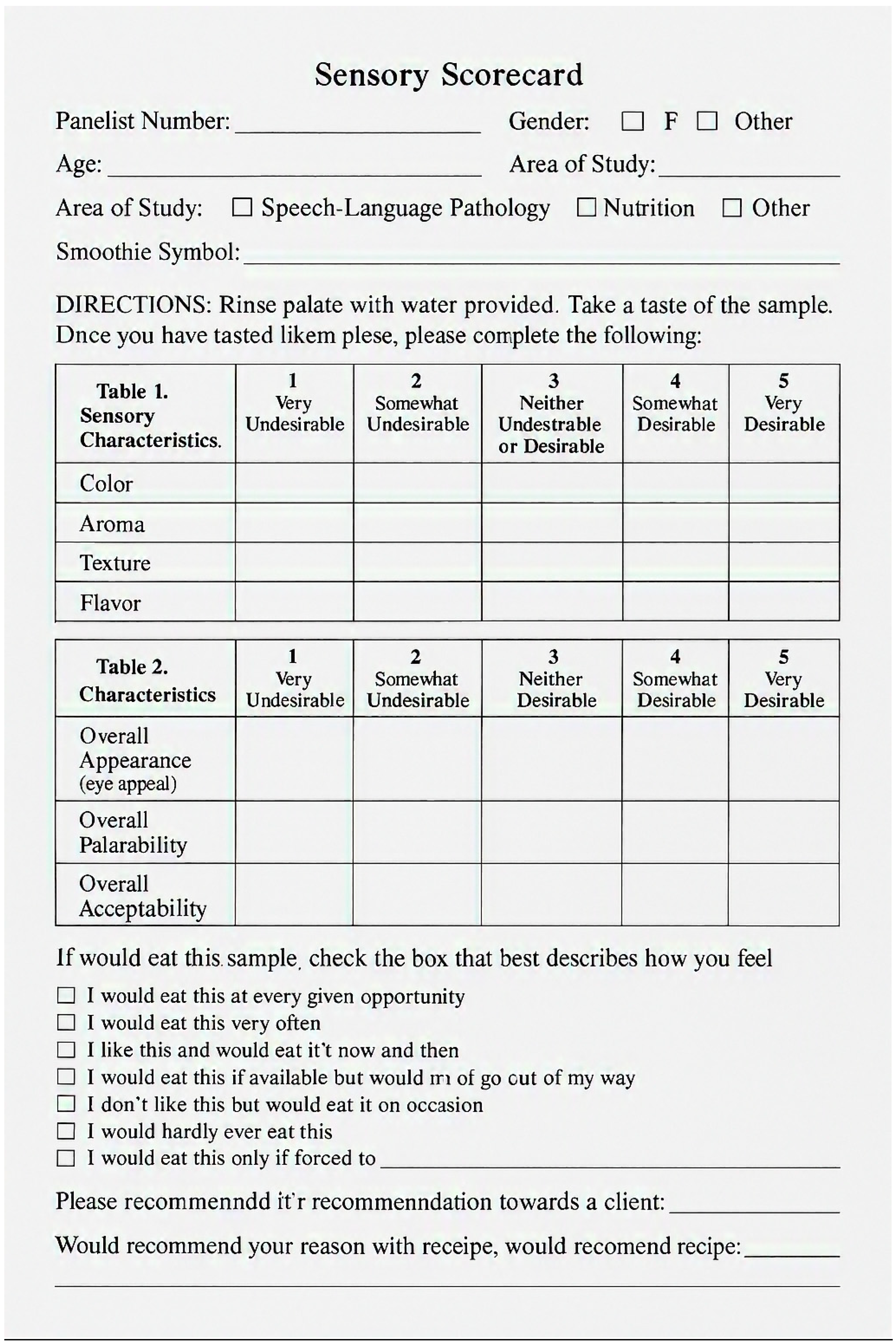
Participants were instructed not to chew gum or eat mints for 30 min prior to the taste test. Each participant was cleared for allergies before entering the laboratory and was blinded to the ingredients of each smoothie. One SLP student could not taste-test two smoothies due to allergies. She tested one smoothie, but her results were not included in the data analysis. Within 10 min of preparing the smoothies, the first group of nine participants arrived at the laboratory. They were seated at tables with cardboard dividers to prevent each participant from seeing the others. They were given water to cleanse their palates prior to the first taste test and between each sample. Three flavors of smoothies (1.5 ounces each) were poured into 3-ounce plastic disposable cups, in random order, in front of the participant to prevent order effects. No straws were used. Each taste station had a note that defined the word palatability as “pleasant to taste.” Next to the cups was a Sensory Scorecard. The Sensory Scorecard was modeled after sensory criteria requirements found in article “Sensory Evaluation as a Tool in Determining Acceptability of Innovative Products Developed by Undergraduate Students in Food Science and Technology” at The University of Trinidad and Tobago and a previous study project conducted at this university [45,46]. The scorecard used a Likert scale (1–5) for participant responses on color, aroma, texture, flavor, overall appearance, palatability, and acceptability. A five-point scale was used for ease of evaluation. The Likert scale grading categories were as follows:
  • Very Undesirable;
  • Somewhat Undesirable;
  • Neither Undesirable or Desirable;
  • Somewhat Desirable;
  • Very Desirable.
Additional comments were solicited on the scorecard. See Appendix B for the Sensory Scorecard.
When the first group of participants started the taste-testing, one SLP student asked for a definition of palatability. We provided a definition to her and then pasted the definition on the tables for all participants. Two more groups of participants entered the laboratory and completed the same evaluations of the 3 smoothies. In total, 32 students from the RDN (n = 18) and SLP (n = 14) programs participated. Sensory Scorecards were collected from each student before they left the laboratory.
The results of the Likert scale items on the scorecards were entered into IBM® SPSS® Statistics (Version 29), and the student comments were transcribed and entered into an Excel® (2021) (spreadsheet. Inter-rater and intra-rater reliabilities were obtained by reviewing 25% of the transcriptions. Inter-rater and intra-rater reliabilities were > 98%; they would have been 100%, but one participant’s written comment had two illegible words. Kappa values may be interpreted as follows: 0.41 to 0.60 is fair, 0.61 to 0.80 is good, and >0.80 is very good reliability among raters [47]. The data suggests that the Kappa coefficients for the inter-rater and intra-rater reliability analyses were very good. Disagreements were resolved through discussion.

3. Results

The nutrient analysis for each recipe in this pilot project was conducted on the Happy Forks website. Each smoothie was deemed to have adequate nutrients. The results are posted in Table 1.

3.1. Characteristics

Means and standard deviations were used to describe participant scorecard responses toward the smoothies. Table 2 displays the data.

3.2. Sensory Evaluations

3.2.1. Color

Color received the lowest total score of 2.77 (SD 1.47) out of the four sensory characteristics. On the Likert scale, color was viewed as only somewhat desirable. The Mango–Carrot Smoothie scored the highest total sensory score for color at 3.35 (SD 1.45) with a Likert scale rating of either undesirable or desirable. The Mixed Berry Smoothie scored the lowest at 1.69 (SD 1.03) and was rated as very undesirable. The Shamrock Smoothies scored 3.27 (SD 1.28) with a rating of either undesirable or desirable.

3.2.2. Aroma

Within the four sensory characteristics, aroma scored the highest total score at 3.21 (SD 1.27). On the Likert scale, aroma was scaled as neither undesirable or desirable. The Mixed Berry Smoothie scored the highest 3.61 (SD 1.23) and the Shamrock Smoothie scored the lowest 3.45 (1.43), with both earning a Likert scale rating that is neither undesirable or desirable.

3.2.3. Texture

Within the four sensory characteristics, texture received the second lowest total score at 2.78 (SD 1.47). On the Likert scale texture was viewed as only somewhat desirable. The Mango–Carrot Smoothie scored the lowest, 1.55 (SD 0.76), with a Likert scale rating of very undesirable. The Shamrock Smoothie scored the highest 3.64 (SD 1.36) as neither undesirable or desirable.

3.2.4. Flavor

Within the four sensory characteristics, flavor received a total score of 3.43 (SD 1.23) and earned a neither undesirable nor desirable grading category. The Shamrock Smoothie scored the highest at 4.00 (SD 1.29) with a grading category of somewhat desirable. The Mixed Berry Smoothie scored 3.31 (SD 1.17) and earned a rating of neither undesirable or desirable for flavor.

3.3. Overall Characteristics

3.3.1. Overall Appearance

Within the Overall Characteristics, appearance was judged as having the lowest total sensory score at 2.65 (SD 1.37). On the Likert scale, the overall appearance of the smoothies was viewed as only somewhat desirable, with the Mixed Berry Smoothie receiving the lowest score at 1.75 (SD 0.88) and a grading category of very undesirable. The Shamrock Smoothie scored the highest at 3.21 (SD 1.9) and a grading category of neither undesirable nor desirable. The Mango–Carrot Smoothie scored 2.97 (SD 1.51) and a grading category at almost neither undesirable nor desirable.

3.3.2. Overall Palatability

Within the Overall Characteristics, palatability scored the highest total sensory score at 3.20 (SD 1.43) with a grading category of neither undesirable nor desirable. The Shamrock Smoothie scored the highest at 3.91 (SD 1.37) and the Mixed Berry scored second with a score of 3.34 (SD 1.33). Both earned a grading category of neither undesirable nor desirable. The Mango–Carrot Smoothie scored the lowest at 2.31 (SD 1.09) and a grading category of somewhat undesirable.

3.3.3. Overall Acceptability

Within the Overall Characteristics, acceptability was scored in the middle with 3.18 (SD 1.33). The Shamrock Smoothie scored the highest with 3.94 (SD 1.22) and the Mixed Berry Smoothie was second with 3.19 (SD 0.21). Each earned a grading category of neither undesirable or desirable. The Mango–Carrot Smoothie scored the lowest at 2.38 (SD 1.10) and a grading category of somewhat undesirable.

3.4. Comparison Between Smoothie Scores

A series of repeated-measures ANOVAs were used to analyze the difference between smoothie responses by each participant and between groups (SLP and RDN students). The results are presented in Table 3. The following can be used to interpret values for Eta partial squared: 0.01 is a small effect size, 0.06 is a medium effect size and 0.14 or higher is a large effect size.
The main effect of the color scores of the smoothies was statistically significant, sphericity assumed F(2, 60) = 20.21, p < 0.001, η p2 = 0.40. In pairwise comparisons, there was a significant difference in color between the Mixed Berry and the Mango (p < 0.001) and between the Mixed Berry and the Shamrock smoothies (p < 0.001). There was not a significant difference between participant groups for the color of smoothies, sphericity assumed F(2, 60) = 1.85, p = 0.28, η p2 = 0.04.
The main effect of aroma was not statistically significant between smoothies, sphericity assumed F(2, 60) = 0.337, p = 0.76, η p2 = 0.009. There was no significant difference between participant groups for aroma F(2, 60) = 0.49, p = 0.61, η p2 = 0.02.
The main effect of texture was statistically significant, sphericity assumed F(2, 60) =33.94, p < 0.001, η p2 = 0.46. In pairwise comparisons, there was statistical significance between Mango and Shamrock (p < 0.001), and between Mango and Mixed Berry (p < 0.001), but not between Shamrock and Mixed Berry (p = 0.12). There was not a significant difference between participant groups for aroma F(2, 60) = 2.39, p = 0.10. η p2 = 0.07.
The main effect of flavor was statistically significant, sphericity assumed F(2, 60) = 8.38, p = 0.001, η p2 = 0.20. In pairwise comparisons, there was a significant difference between Mango and Shamrock (p < 0.001) and between Shamrock and Mixed Berry (p = 0.009) smoothies, but not between Mango and Mixed Berry (p = 0.23) smoothies. There was no significant difference between participant groups for describing the taste of the smoothies; sphericity assumed F(2, 60) = 1.57, p = 0.25, η p2 = 0.05.
The main effect of appearance was statistically significant between smoothies, sphericity assumed F(2, 60) = 19.80, p < 0.001, η p2 = 0.34. In pairwise comparisons, there was statistical significance between Mango and Mixed Berry (p < 0.001) and between Shamrock and Mixed Berry (p < 0.001) smoothies, but not between Mango and Shamrock. There was not a significant difference between participant groups for aroma F(2, 60) = 1.18, p = 0.14, η p2 = 0.03.
The main effect of palatability was statistically significant, sphericity assumed F(2, 60) = 19.90, p < 0.001, η p2 = 0.34. In pairwise comparisons, there was a significant difference between Mango and Shamrock (p < 0.01) and between the Mango and Mixed Berry (p = 0.001) smoothies but not between the Shamrock and Mixed Berry (p = 0.08). There was also a significant difference between participant groups, sphericity assumed F(2, 60) = 5.49, p = 0.01, η p2 = 0.13.
The main effect of acceptability of smoothie scores was statistically significant, sphericity assumed F(2, 60) = 16.78, p < 0.001, η p2 = 0.36. All pairwise comparisons were significant as all ps were < 0.009. There was no significant difference between participant groups for acceptability of the smoothies, sphericity assumed F(2, 60) = 1.49, p = 0.23, η p2 = 0.05.
A post hoc analysis was performed to determine comparisons between participant groups for the sensory score of palatability. The comparison of means between nutrition and SLP student participants was analyzed using a two-tailed independent-samples t-test. Results indicated a significant difference between participant groups of SLP and RDN students in scores of palatability of Shamrock Smoothies: t(23.11) = −1.95. p = 0.02.

3.5. Participant Comments

To analyze the comments for questions number two (Please explain your reason for this feeling towards the sample), three (Please explain your reason for the recommendation), and four (Please provide us with ways to improve this product recipe), a typical procedure of qualitative research was used [48] by the researchers. First, each participant’s comments were transcribed into an Excel© spreadsheet by question and smoothie recipe. For example, all answers to question number two for Mixed Berry were entered into one sheet in a separate column, and all answers to question number three were entered into the same sheet but in a separate column. Next, themes were observed to generate categories that each answer could be assigned to. One researcher reviewed the data for themes. Another checked the themes for accuracy. Lastly, the data were independently coded according to the categories by a third researcher who was trained in the themes. By using this approach, the authors derived, modified, refined and agreed upon a coding scheme that captured major themes in the data [49,50]. This approach established inter-rater and intra-rater reliabilities at 97% and 99% respectively. Disagreements were resolved through discussion.
The themes identified were as follows, with the examples provided in the parentheses being direct quotes from participants: taste (e.g., It is very delicious), texture (e.g., Loved the soft texture), smell (e.g., Loved the fresh smell), visual (e.g., This looks terrifying ha ha!), color (e.g., I like green food so I wasn’t scared to try this), or overall (e.g., I wouldn’t recommend something I wouldn’t eat myself). Some participants did not provide an explanation and are noted as having no entry. Some participant explanations mentioned more than one theme, which is reflected in the data numbers. Table 4 displays the number of neutral (e.g., Not bad, but it’s okay) and positive (e.g., It has a desirable taste and is not too potent) participant responses toward the smoothies.
The comments in the open-ended responses were similar for taste and texture. For example, if participants commented on the texture as the reason for their feeling toward the sample (explanation to number two), participants also noted the texture when explaining their recommendation for a client (explanation to number three) and also a way to improve the recipe (explanation to number four). As noted in Table 4, the Shamrock Smoothie received more neutral and positive comments for all aspects described by participants than the Mixed Berry and Mango–Carrot.

3.6. Description of Feeling

Participant descriptions of feelings towards each smoothie were analyzed in terms of frequency of responses. Table 5 displays the results. The Shamrock Smoothie received the greatest number of positive ratings with descriptive terminology, as four participants stated they would eat it at every opportunity, six participants stated they would eat it very often, and eight stated they liked it and would eat it now and then. The Mango–Carrot Smoothie received the lowest number of positive ratings, with 12 participants stating they would hardly ever eat it and another 10 saying they would eat it only if forced to do so.

3.7. Recommendations to Clients

Participant description of their recommendations to clients for each smoothie is presented in the frequency of responses. Table 6 displays the results of the frequency of participant recommendations. The Shamrock Smoothie received the greatest number of positive ratings, with 13 participants stating they strongly agreed and another 13 agreeing to recommend the smoothie to their clients. The Mango–Carrot Smoothie received the lowest number of positive ratings, with 4 participants stating that they strongly disagree and 13 that they disagree with recommending the smoothie to clients.
Participants provided suggestions on how to improve the recipe. Again, the suggestions had similar themes as the other two open-ended responses (i.e., explanations of feelings and recommendations to clients for each smoothie): taste (e.g., Try and make the flavor stronger and last longer), texture (e.g., I think the black chunks could be gone), smell (Make it smell better), visuals (Worst to look at), color (Maybe add dye to help the color), overall (I rate it 5 stars), and other (add more fruits). Table 7 displays the results with the number of suggestions to improve the sensory experiences for each smoothie. Participants provided the most suggestions for texture improvement for the Mango–Carrot Smoothie. The Mixed Berry Smoothie received the most suggestions for improving color. These responses support the participants’ lower scores for these smoothies throughout the Sensory Scorecard ratings and comments.

4. Discussion

The purpose of this research project was to develop standardized recipes for consumer-acceptable smoothies at the IDDSI Level 3 while providing an interprofessional education opportunity for upper-level RDN and SLP students. Three recipes were prepared by researchers and tested by 32 participants: Mango–Carrot, Shamrock, and Mixed Berry. The first to consider is the Mango–Carrot recipe: it had the poorest rating because of texture. This was an interesting find, as each smoothie recipe was measured using the IDDSI Flow Test Funnel to determine Level 3 consistency and should have had the same consistency between each. The different ratings between the Mango–Carrot and the other two smoothies may be due to the raw carrot not pureeing completely. There were some very small granular pieces of carrot that did not puree completely, but could fit through the funnel. Participants noted these smaller pieces. Although there are some smoothie recipes with carrots that require the carrot to be cooked prior to pureeing (e.g., [51], we chose to keep the recipes similar by using raw or frozen fruits and vegetables because cooking fruits and vegetables can alter the taste and texture [52], nutritional status [53] and so on.
The Shamrock recipe rated the highest on the Sensory Scorecard. It had an acceptable color, taste and texture. This recipe did not have added textures from raw carrots or seeds from berries or have color changes from foods like bananas. This recipe stayed a vibrant green color and maintained a smooth texture throughout the sample taste-testing. Importantly, there was a statistically significant difference between participant groups in nutrition and in SLP in the sensory score of palatability. The SLP students rated the Shamrock at 3.40 and the nutrition students at 4.33. This difference may be due to the fact that students in nutrition are introduced to the concept of palatability throughout their courses. It is a concept that is important to their profession. SLP students are not introduced to palatability until their course in dysphagia, and these participants had not had a university-level course in dysphagia prior to this taste-testing. It occurs later in the curriculum sequence.
Finally, the Mixed Berry recipe had a low rating due to color and a somewhat low rating with texture. When the Mixed Berry Smoothie was initially blended, it was a vibrant purple color that was pleasing to look at. However, within 3 min, the color changed to a brownish color that was no longer visually pleasing. This is most likely due to enzymic browning. Enzymic browning is a process in which fruits, such as bananas, turn brown due to exposure to oxygen in the air [54]. In this recipe, bananas were used, and the brown color quickly replaced the vibrant purple color. In addition to the enzymic browning, the Mixed Berry Smoothie had dark seeds from the berries (blueberries, raspberries, blackberries) that added further distractions to the appearance and perhaps added an unpleasantness to the texture because the seeds could be felt when sampling the Mixed Berry Smoothie.
Taken together, smoothie recipes at IDDSI Level 3 can be created from fresh and frozen foods found in a home pantry or freezer, using home measurement and blending equipment. IDDSI Level 3 modified textures can be achieved without purchasing commercial thickeners, thereby making the transition from medical facilities to a home setting less intimidating for caregivers and allowing for the utilization of foods already in the home, limiting initial costs. Instruction on how to determine the IDDSI level of foods and beverages using the IDDSI methods is essential. Armed with the measurement knowledge and the client’s taste preferences, recipes can be successfully adjusted to support adequate nutritional intake.
Work is needed to develop additional recipes that have a nutrient-dense base to support the maintenance of the nutritional status of those with dysphagia. Smoothies have gained popularity in recent years and, as such, have the potential to provide a way for families to share the experience of consuming smoothies with individuals with dysphagia, providing a sense of normalcy as they transition to the home setting.

5. Limitations

A few limitations were apparent in this pilot study. First, the cohort of SLP and RDN students does not necessarily represent the typical dysphagia population in terms of age and gender. Students were all females, with a mean age of 22 years, 6 months. The student enrollment reflects the nature of female-dominated professions. The sample size was small, but included upper-level student cohorts in the two preprofessional programs. The programs are relatively small in comparison to larger universities. Biased perceptions of the smoothie taste-test based on age and gender in this group may be significantly different from those of an older or mixed-age group and tasters of other gender identities.
Second, utilizing three smoothie recipes at IDDSI 3 was a good starting point for this pilot study; however, more full-meal-replacement smoothie recipe options assessed by RDNs and SLPs at IDDSI Level 3 that offer more variability in smoothie taste (e.g., savory versus sweet) are needed to determine acceptability in the taste-testers within the general population. Multiple RDN- and SLP-approved recipes would be needed prior to data collection with dysphagia groups, where quality of life is at stake when modifying diets to smoothies from solid food and thin liquids. The researchers acknowledge that consumer taste-testing typically uses a nine-point Likert scale with larger participant samples for extensive evaluations, which will be considered in the future.
Third, these recipes were made in consultation with only two professions. Perhaps the dentistry profession should be included to consider dental erosion [55]. This study did not consider the critical pH levels of smoothies. Some smoothies may cause dental erosion.
Finally, these recipes were created and prepared by a team of researchers in a university setting who had access to appropriate kitchen tools (e.g., blender, sharp knives, peeling knife) and nutritious food, and helped each other read the recipes and prepare the smoothies. These recipes may be challenging to reproduce in homes that do not have access to appropriate ingredients, kitchen tools, or literacy skills.

6. Future Directions

More study is needed on appropriate texture modifications for nutritional needs (e.g., [18] based on IDDSI Level 3 and likely expanded to Level 4 (e.g., [56]). Future directions from this study can include modifying these three recipes using the most common RDN and SLP student feedback (color, texture, aroma) based on taste-testings arranged to be blinded to other subject reactions, feedback, and choices. For example, adding color to the Mixed Berry recipe may be one option (e.g., reduce banana content, which turns brown, add red beet juice and more strawberries). Another approach may be to keep the vibrant orange Mango–Carrot combination but steam/soften and cool the carrots before adding to the blender to reduce the texture noticed by many; however, nutrient contents [57] and the taste [58] would likely be altered. Although the focus is on smoothies for modified diets, a variety of smoothies, each with distinct flavors, aromas, and colors, can be offered to make the next scientific taste-testing more palatable to tasters of all ages, especially the elderly and their families. An evidence-based smoothie recipe cookbook could be developed in the future, where various recipe combinations can be showcased so families may obtain the appropriate nutritional value needed for daily intake while finding flavors and tastes they prefer. Furthermore, future research would look at the modifications needed where smoothie recipes are adjusted to improve fiber, mineral and vitamin content and adequate hydration while increasing the variety of flavors such as tangy and savory. Finally, smoothie recipes need to be tested in more depth with caregivers in the home, and those with dysphagia who may benefit nutritionally and socially by adding smoothie recipes to the daily plan. These people are the ones who have to prepare and consume the smoothies for medical reasons. Through these future directions, SLPs and RDNs can join in a team-based approach with others in the medical community to test the physiological benefits of consumption of smoothies studied over the long term in clients with dysphagia by arranging pre-test and post-test nutrient evaluations of a specific client group. Adding other team members to the study, such as nurses and physicians who follow subjects with dysphagia, will add further analysis to the value of meal-replacement smoothies (e.g., blood work study).

7. Conclusions

Modified textures, studied in a manner that benefits nutritional value, are needed for those with dysphagia. IDDSI Level 3 may be a good consistency for creating smoothie recipes for caregivers and those with dysphagia. With the rise in popularity of smoothies, they can be an accessible and nutritionally rich addition for those who eat or have to prepare a modified diet. In this study, we tested three recipes with an outcome where the feedback was consistent between participant groups across the three recipes. With further long-term research and recipe development, the nutritional needs of clients and the quality of life for both the persons with dysphagia and their caregivers have the potential to be greatly improved.

Author Contributions

Conceptualization, C.K., S.C., O.M. and D.E.; methodology, C.K., S.C. and O.M.; software, C.K. and S.C.; validation, C.K. and S.C.; formal analysis, C.K., S.C., O.M. and K.P.; resources, S.C. and D.E.; writing—original draft preparation, C.K. and O.M.; writing—review and editing, C.K., S.C., O.M. and K.P.; project administration, C.K., S.C., O.M., D.E. and K.P. All authors have read and agreed to the published version of the manuscript.

Funding

This research received no external funding.

Institutional Review Board Statement

The study was conducted in accordance with the Declaration of Helsinki, and approved by the Institutional Review Board of Louisiana Tech University (IRB 22-113; 30 September 2022).

Informed Consent Statement

Informed consent was obtained from all subjects involved in the study.

Data Availability Statement

The raw data supporting the conclusions of this article will be made available by the authors on request.

Conflicts of Interest

Orlene Martens was self-employed in her private practice. She participated in the planning and implementation of the study. The role of the private practice was providing expertise in client care and in editing the manuscript. The remaining authors declare that the research was conducted in the absence of any commercial or financial relationships that could be construed as a potential conflict of interest.

Appendix A

Smoothie Recipes Used in Study
Mixed Berry Smoothie
Ingredients
1 medium banana (frozen)
½ cup fresh spinach
½ cup vanilla yogurt
5 Tbsp milk
½ cup mixed berry fruit (frozen)
Directions
Puree all the ingredients together in a blender until smooth.
Shamrock Smoothie
Ingredients
1 medium banana, frozen
1 cup fresh spinach
½ cup vanilla yogurt
1 Tbsp honey
3 Tbsp milk
Directions
Puree all the ingredients together in a blender until smooth.
MangoCarrot Smoothie
½ cup vanilla yogurt
1 ½ cup mango
1 cup peeled carrots
½ cup cottage cheese
1 cup orange juice
Directions
Puree all the ingredients together in a blender until smooth.

Appendix B

Figure A1. Sensory Scorecard Likert Scale 1–5 and Written Evaluation [44,45]
Dietetics 05 00029 g0a1

References

  1. Bhattacharyya, N. The prevalence of dysphagia among adults in the United States. Otolaryngol.—Head Neck Surg. 2014, 151, 765–769. [Google Scholar] [CrossRef]
  2. American Speech-Language-Hearing Association. Preferred Practice Patterns for the Profession of Speech-Language Pathology [Preferred Practice Patterns]. 2004. Available online: https://www.asha.org/policy/ (accessed on 13 July 2022).
  3. Hemsley, B.; Steel, J.; Sheppard, J.J.; Malandraki, G.A.; Bryant, L.; Balandin, S. Dying for a meal: An integrative review of characteristics of choking incidents and recommendations to prevent fatal and nonfatal choking across populations. Am. J. Speech-Lang. Pathol. 2019, 28, 1283–1297. [Google Scholar] [CrossRef]
  4. Smith, R.; Bryant, L.; Hemsley, B. Dysphagia and quality of life, participation, and inclusion experiences and outcomes for adults and children with dysphagia: A scoping review. Perspectives 2022, 7, 181–193. [Google Scholar] [CrossRef]
  5. Aslam, M.; Vaezi, M.F. Dysphagia in the elderly. Gastroenerol. Hepatol. 2013, 9, 784–795. [Google Scholar]
  6. Goldman, B. The Power of Teamwork: How We Can All Work Better Together; HarperCollins: Sydney, NSW, Australia, 2023. [Google Scholar]
  7. Moloney, J.; Walshe, M. “I had to idea what a complicated business eating is…”: A qualitative study of the impact of dysphagia during stroke recovery. Disabil. Rehabil. 2018, 40, 1524–1531. [Google Scholar] [CrossRef]
  8. Cichero, J.M.; Lam, P.; Steel, C.M.; Hanson, B.; Chen, J.; Dandas, R.O.; Duivestein, J.; Kayashita, J.; Lecko, C.; Murray, J.; et al. Development of international terminology and definitions for texture-modified-foods and thickened fluids used in dysphagia management: The IDDSI framework. Dysphagia 2017, 32, 293–314. [Google Scholar] [CrossRef] [PubMed]
  9. International Dysphagia Diet Standardisation Initiative. The IDDSI Framework and Detailed Level Definitions. 2016. Available online: https://iddsi.org/framework/ (accessed on 13 July 2022).
  10. O’Keeffe, S.T.; Leslie, P.; Lazenby-Paterson, T.; McCurtin, A.; Collins, L.; Murray, A.; Smith, A.; Mulkerring, S. Informed or misinformed consent and use of modified texture diets in dysphagia. BMC Med. Ethics 2023, 24, 7. [Google Scholar] [CrossRef]
  11. Colodny, N. Determinants of noncompliance of speech-language pathology recommendations among patients and caregivers. Perspectives 2007, 16, 20–24. [Google Scholar] [CrossRef]
  12. Shim, J.S.; Oh, B.M.; Han, T.R. Factors associated with compliance with viscosity-modified diet among dysphagic patients. Ann. Rehabil. Med. 2013, 37, 628–632. [Google Scholar] [CrossRef]
  13. Wu, S.X.; Miles, A.; Braakhuis, A.J. Texture-modified diets, nutritional status and mealtime satisfaction: A systematic review. Healthcare 2021, 9, 624. [Google Scholar] [CrossRef]
  14. Namasivayam-MacDonald, A.M.; Slaughter, S.E.; Morrison, J.; Steele, C.M.; Carrier, N.; Lengyel, C.; Keller, H.H. Inadequate fluid intake in long term care residents: Prevalence and determinants. Geriatr. Nurs. 2018, 39, 330–335. [Google Scholar] [CrossRef]
  15. Vivanti, A.P.; Campbell, K.L.; Suter, M.S.; Hannan-Jones, M.T.; Hulcombe, J.A. Contribution of thickened drinks, food and enteral and parenteral fluids to fluid intake in hospitalised patients with dysphagia. J. Hum. Nutr. Diet. 2009, 22, 148–155. [Google Scholar] [CrossRef]
  16. Dietitians Association of Australia; The Speech Pathology Association of Australia Limited. Texture-modified foods and thickened fluids as used for individuals with dysphagia: Australian standardised labels and definitions. Nutr. Diet. 2007, 64, S53–S76. [Google Scholar] [CrossRef]
  17. Keller, H.; Chambers, L.; Niezgoda, H.; Duizer, L. Issues associated with the use of modified texture foods. J. Nutr. Health Aging 2012, 16, 195–200. [Google Scholar] [CrossRef] [PubMed]
  18. O’Keeffe, S.T. Use of modified diets to prevent aspiration in oropharyngeal dysphagia: Is current practice justified? BMC Geriatr. 2018, 18, 167. [Google Scholar] [CrossRef]
  19. Chen, P.; Golub, J.S.; Hapner, E.R.; Johns, M.M. Prevalence of perceived dysphagia and quality-of-life impairment in a geriatric population. Dysphagia 2009, 24, 1–6. [Google Scholar] [CrossRef]
  20. Carmignani, I.; Locatello, L.; Desideri, I.; Bonomo, P.; Olmetto, E.; Livi, L.; Le Saec, O.; Coscarelli, S.; Mannelli, G. Analysis of dysphagia in advanced-stage head-and-neck cancer patients: Impact on quality of life and development of preventive swallowing treatment. Eur. Arch. Oto-Rhino-Laryngol. 2018, 275, 2159–2167. [Google Scholar] [CrossRef] [PubMed]
  21. Davis, C.; Namasivayam-MacDonald, A.M.; Shune, S.E. Contributors to poststroke dysphagia-related caregiver burden. Am. J. Speech-Lang. Pathol. 2021, 30, 1061–1073. [Google Scholar] [CrossRef]
  22. Lawton, J. Counseling clients with dysphagia: A resource for clinicians. Perspectives 2022, 7, 807–815. [Google Scholar] [CrossRef]
  23. Wakabayashi, H. Role of acute phase hospital, community coordination, and home rehabilitation in dysphagia and nutrition support team for a joy of eating. Gan Kagaku Ryoho. 2009, 36, 5–7. (In Japanese) [Google Scholar] [PubMed]
  24. Ekberg, O.; Mandy, S.; Woisard, V.; Wuttge-Hannig, A.; Ortega, P. Social and psychological burden of dysphagia: Its impact on diagnosis and treatment. Dysphagia 2002, 17, 139–146. [Google Scholar] [CrossRef] [PubMed]
  25. Sura, L.; Madhavan, A.; Carnaby, G.; Crary, M.A. Dysphagia in the elderly: Management and nutritional considerations. Clin. Interv. Aging 2012, 7, 287–298. [Google Scholar] [CrossRef]
  26. Hoenig, J.; Hamilton, M.W. The schizophrenic patient in the community and his effect on the household. Int. J. Soc. Psychiatry 1966, 12, 165–176. [Google Scholar] [CrossRef] [PubMed]
  27. Johansson, A.E.M.; Johansson, U. Relatives’ experiences of family members’ eating difficulties. Scand. J. Occup. Ther. 2009, 16, 25–32. [Google Scholar] [CrossRef] [PubMed]
  28. Nund, R.L.; Scarinci, N.A.; Cartmill, B.; Ward, E.C.; Kuipers, P.; Porceddu, S.V. Third-party disability in carers of people with dysphagia following non-surgical management for head and neck cancer. Disabil. Rehabil. 2016, 38, 462–471. [Google Scholar] [CrossRef]
  29. Nund, R.L.; Ward, E.C.; Scarinci, N.A.; Cartmill, B.; Kuipers, P.; Porceddu, S.V. Carers’ experiences of dysphagia in people treated for head and neck cancer: A qualitative study. Dysphagia 2014, 29, 450–458. [Google Scholar] [CrossRef]
  30. Patterson, J.M.; Rapley, T.; Carding, P.N.; Wilson, J.A.; McColl, E. Head and neck cancer and dysphagia; caring for carers. Psycho-Oncol. 2013, 22, 1815–1820. [Google Scholar] [CrossRef]
  31. Penner, J.L.; McClement, S.; Lobchuk, M.; Daeninck, P. Family members’ experiences caring for patients with advanced head and neck cancer receiving tube feeding: A descriptive phenomenological study. J. Pain Symptom Manag. 2012, 44, 563–571. [Google Scholar] [CrossRef]
  32. Namasivayanm-MacDonald, A.M.; Shune, S.E. The burden of dysphagia on family caregivers elderly: A systematic review. Geriatrics 2018, 3, 30–42. [Google Scholar] [CrossRef]
  33. Sullivan, P.A. Dysphagia in the elderly and in dementia: Helping the helper. Perspect. Swallowing Swallowing Disord. (Dysphagia) 2008, 17, 12–18. [Google Scholar] [CrossRef]
  34. Howells, S.R.; Cornwell, P.L.; Ward, E.C.; Kuipers, P. Dysphagia care for adults in the community setting commands a different approach: Perspectives of speech-language therapists. Int. J. Lang. Commun. Disord. 2019, 54, 971–981. [Google Scholar] [CrossRef]
  35. Malone, M.L.; Loehr, J. Home health care for adults: A tutorial for SLPs. Perspect. Gerontol. 2013, 18, 7–13. [Google Scholar] [CrossRef]
  36. Shune, S.; Linville, D.; Namasivayam-MacDonald, A. Integrating family-centered care into chromic dysphagia management: A tutorial. Perspect. ASHA Spec. Interest Groups 2022, 7, 795–806. [Google Scholar] [CrossRef]
  37. Healthline 2020. Are Smoothies Good for You? Available online: https://www.healthline.com/nutrition/are-smoothies-good-for-you (accessed on 13 July 2022).
  38. Zbinden, M.D.; Vignatti, C.I.; Benenaula, M.A.F.; Böhm, V.; Pirovani, M.E. Exploring Design Strategies for Healthier Fruit Smoothies. Curr. Food Sci. Technol. Rep. 2025, 3, 1–9. [Google Scholar] [CrossRef]
  39. Maeda, K.; Ishida, Y.; Nonogaki, T.Y.; Amanaka, Y.; Matsuyama, R.; Kato, R.; Mori, N. Burden of premorbid consumption of texture modified diets in daily life on nutritional status and outcomes of hospitalization. J. Nutr. Health Aging 2019, 23, 973–978. [Google Scholar] [CrossRef]
  40. Poisson, P.; Laffond, T.; Campos, S.; Dupuis, V.; Bourdel-Marchasson, I. Relationships between oral health, dysphagia and undernutrition in hospitalised elderly patients. Gerodontology 2016, 8, 161–168. [Google Scholar] [CrossRef]
  41. Guideline: Sugars Intake for Adults and Children; World Health Organization: Geneva, Switzerland, 2015.
  42. Dictionary (n.d.). Palatability. Available online: https://www.dictionary.com/browse/palatability (accessed on 11 December 2023).
  43. Balaswamy, K.; Prabhakara Rao, P.G.; Nagender, A.; Narsing Rao, G.; Sathiay, M.K.; Jyothirmayi, T.; Math, R.G.; Satyanarayana, A. Development of smoothies from selected fruit pulps/juices. Int. Food Res. J. 2013, 20, 1181–1185. [Google Scholar]
  44. Shaw, C.; Moore, M.; Camel, S.; Douglas, C. Assessment of International Dysphagia Guidelines for use in Child Nutrition Programs. J. Child Nutr. Manag. 2019, 43, 1–13. [Google Scholar]
  45. Buzulak, E. Consumer Acceptability of Protein Bars Made with Cricket Powder Among International African and American Students and Faculty. Unpublished Thesis, Louisiana Tech University, Ruston, LA, USA, 2023. [Google Scholar]
  46. Singh-Ackbarali, D.; Maharaj, R. Sensory evaluation as a tool in determining acceptability of innovative products developed by undergraduate students in Food Science and Technology at the University of Trinidad and Tobago. J. Curric. Teach. 2014, 3, 10–27. [Google Scholar] [CrossRef]
  47. Warner, R.M. Applied Statistics: From Bivariate Through Multivariate Techniques; Sage Publications, Inc.: Thousand Oaks, CA, USA, 2008. [Google Scholar]
  48. Marshall, C.; Rossman, G.B. Designing Qualitative Research, 3rd ed.; Sage Publications, Inc.: Thousand Oaks, CA, USA, 1999. [Google Scholar]
  49. Rosenfield, D.; Oandasan, I.; Reeves, S. Perceptions versus reality: A qualitative study of students’ expectations and experiences of interprofessional education. Med. Educ. 2011, 45, 471–477. [Google Scholar] [CrossRef] [PubMed]
  50. Richards, L.; Morse, J.M. Qualitative Methods, 3rd ed.; Sage Publications, Inc.: New York, NY, USA, 2013. [Google Scholar]
  51. Krivokapic, S.; Pejatovic, T.; Perovic, S. Chemical characterization, nutritional benefits and some processed products from carrot (Daucus carota L.). Agric. For. 2020, 66, 191–216. [Google Scholar] [CrossRef]
  52. Simon, P.W.; Lindsay, R.C. Effects of process upon objectives and sensory variables of carrots. J. Am. Soc. Hortic. Sci. 1983, 108, 928–931. [Google Scholar] [CrossRef]
  53. Sharma, K.D.; Karki, S.; Thakur, N.; Attri, S. Chemical composition, functional properties and process of carrot-a review. J. Food Sci. Technol. 2011, 49, 22–32. [Google Scholar] [CrossRef] [PubMed]
  54. Wang, S.; Lin, T.; Man, G.; Li, H.; Zhao, L.; Wu, J.; Liao, X. Effects of anti-browning combinations of ascorbic acid, citric acid, nitrogen and carbon dioxide on the quality of banana smoothies. Food Bioprocess Technol. 2014, 7, 161–173. [Google Scholar] [CrossRef]
  55. Black, S.M.; Chadwick, R.G. An in vitro investigation of the erosive potential of smoothies. Br. Dent. J. 2013, 214, E9. [Google Scholar] [CrossRef] [PubMed]
  56. Dhillon, B.; Singh Sodi, N.; Sing, D.; Kaur, A. Analyses of functional diets formulated for dysphagia patients under international dysphagia diet initiative (IDDSI) level 3 to 7. J. Food Meas. Charact. 2022, 16, 3537–3546. [Google Scholar] [CrossRef]
  57. Phillips, K.M.; Palmer, J.K. Effect of freeze-drying and heating during analysis on dietary fiber in cooked and raw carrots. J. Agric. Food Chem. 1991, 39, 1216–1221. [Google Scholar] [CrossRef]
  58. Trejo Araya, X.I.; Smale, N.; Zabaras, D.; Winley, E.; Forde, C.; Stewart, C.M.; Mawson, A.J. Sensory perception and quality attributes of high pressure processed carrots in comparison to raw, sous-vide and cooked carrots. Innov. Food Sci. Emerg. Technol. 2009, 10, 420–433. [Google Scholar] [CrossRef]

Table 1. Smoothie nutrient analysis.
SmoothiesTotal
Calories
ProteinCarbohydratePhosphorousCalciumMagnesiumZincPotassium
Mango–Carrot55921.84 g93.65 g438 mg382 mg93 mg2.03 mg1635 mg
Shamrock3039.67 g64.45 g249 mg301 mg81 mg1.62 mg933 mg
Mixed Berry29010.60 g57.49 g277 mg238 mg76 mg1.62 mg923 mg
Note: Nutrient analysis per 8 oz serving. Nutrient analysis done using Happy Forks (https://happyforks.com/).
Table 2. Descriptive data of the Sensory Scorecard.
All
Smoothies
Mango–Carrot Smoothie (Circle)Shamrock Smoothie
(Square)
Mixed Berry Smoothie
(Triangle)
Characteristics Total Total SLP RDN Total SLP RDN Total SLP RDN
N = 32 N = 32 n = 14 n = 18 N = 32 n = 14 n = 18 N = 32 n = 14 n = 18
Sensory M
(SD)
M
(SD)
M
(SD)
M
(SD)
M
(SD)
M
(SD)
M
(SD)
M
(SD)
M
(SD)
M
(SD)
Color2.77 (1.47)3.35 (1.45)3.50 (1.28)3.24 (1.60)3.27 (1.28)2.93 (1.43)3.56 (1.09)1.69 (1.03)1.40 (0.91)1.94 (1.08)
Aroma3.51 (1.27)3.61 (1.23)3.57 (1.22)3.65 (1.27)3.45 (1.43)3.13 (1.50)3.72 (1.36)3.47 (1.16)3.13 (1.35)3.76 (0.90)
Texture2.78 (1.47)1.55 (0.76)1.64 (0.92)1.47 (0.62)3.64 (1.36)3.60 (1.24)3.67 (1.49)3.09 (1.32)2.60 (1.18)3.53 (1.32)
Flavor3.43 (1.29)2.94 (1.18)3.00 (1.24)2.88 (1.16)4.00 (1.29)3.67 (1.29)4.28 (1.29)3.31 (1.17)2.93 (1.28)3.65 (0.99)
Overall
Appearance
2.65 (1.37)2.97 (1.51)3.00 (1.46)2.94 (1.60)3.21
(1.9)
2.87 (1.30)3.50 (1.19)1.75 (0.88)1.47 (0.91)2.00 (0.79)
Overall
Palatability
3.20 (1.43)2.31 (1.09)2.60 (1.18)2.06 (0.96)3.91 (1.37)3.40 (1.59)4.33 (1.02)3.34 (1.33)2.87 (1.35)3.76 (1.20)
Overall
Acceptability
3.18 (1.33)2.38 (1.10)2.40 (1.12)2.35 (1.11)3.94 (1.22)3.73 (1.03)4.11 (1.36)3.19 (0.21)2.73 (1.28)3.59 (1.00)
Table 3. Repeated-measures analysis of participant scores.
Between-Participant-Group DifferencesBetween-Smoothie
Differences
Pairwise Comparison
Between Smoothies
ColorF(2, 60) = 1.85,
p = 0.28, η p2 = 0.04
* F(2, 60) = 20.21,
p < 0.001, η p2 = 0.40
Mango & Shamrock p = 0.78
* Mango & Mixed Berry p < 0.001
* Shamrock & Mixed Berry p < 0.001
AromaF(2, 60) = 0.49,
p = 0.61, η p2 = 0.02
* F(2, 60) = 0.337,
p = 0.76, η p2 = 0.009
* Mango & Shamrock p > 0.05
* Mango & Mixed Berry p > 0.05
* Shamrock & Mixed Berry p > 0.05
TextureF(2, 60) = 2.39,
p = 0.10. η p2 = 0.07
* F(2, 60) =33.94,
p < 0.001, η p2 = 0.46
* Mango & Shamrock p < 0.001
* Mango & Mixed Berry p < 0.001
Shamrock & Mixed Berry p = 0.12
FlavorF(2, 60) = 1.57,
p = 0.25, η p2 = 0.05
* F(2, 60) = 8.38,
p = 0.001, η p2= 0.20
* Mango & Shamrock p < 0.001
Mango & Mixed Berry p = 0.29
* Shamrock & Mixed Berry p = 0.009
AppearanceF(2, 60) = 1.18,
p = 0.14, η p2 = 0.03
* F(2, 60) = 19.80,
p < 0.001, η p2 = 0.34
Mango & Shamrock p = 0.48
* Mango & Mixed Berry p < 0.001
* Shamrock & Mixed Berry p < 0.001
Palatability* F(2, 60) = 5.49,
p = 01, η p2 = 0.13
* F(2, 60) = 19.90,
p < 0.001, η p2 = 0.34
* Mango & Shamrock p < 0.001
* Mango & Mixed Berry p = 0.001
Shamrock & Mixed Berry p = 0.08
AcceptabilityF(2, 60) = 1.49,
p = 0.23, η p2 = 0.05
F(2, 60) = 16.78,
p < 0.001, η p2 = 0.359
* Mango & Shamrock p< 0.001
* Mango & Mixed Berry p = 0.009
* Shamrock & Mixed Berry p = 0.006
* Denotes a statistically significant difference at p ≤ 0.05.
Table 4. Number of positive comments towards the smoothie.
SmoothieTasteTextureSmellVisualColorOverallNo EntryOther
Reason for feelings
  Mango–Carrot9/181/224/62/31/30/110/2
  Shamrock12/199/192/81/16/102/301/1
  Mixed Berry11/199/210/14/50/80/000/1
Reason for recommendation
  Mango–Carrot10/150/160/10/10/14/910/0
  Shamrock16/188/100/00/21/14/513/5
  Mixed Berry12/174/90/20/11/34/703/4
Table 5. Frequency of description of feeling for each smoothie.
Mango–Carrot Smoothie (Circle)Shamrock Smoothie
(Square)
Mixed Berry Smoothie
(Triangle)
Describe How You FeelSLPRDNTotalSLPRDNTotalSLPRDNTotal
I would eat this at every given opportunity011234022
I would eat this very often000156123
I like this and would eat it now and then202268246
I would eat this if available but would not go out of my way055415022
I don’t like this but would eat it on
occasion
1124154610
I would hardly ever eat this6612113415
I would eat this only if forced to5510112314
Total141832141832141832
Table 6. Frequency of recommendations.
Mango–Carrot Smoothie
(circle)
Shamrock Smoothie
(square)
Mixed Berry Smoothie
(triangle)
Recommendation to ClientSLPRDNTotalSLPRDNTotalSLPRDNTotal
Strongly disagree044011101
Disagree5813011426
Neither disagree or agree336404369
Agree52785134812
Strongly agree11221113224
Total141832141832141832
Table 7. Number of suggestions on ways to improve the smoothie recipe.
Smoothie TasteTextureSmellVisualColorOverallNo EntryOther
MangoCarrot323014142
Shamrock47318065
Mixed Berry591020063
Disclaimer/Publisher’s Note: The statements, opinions and data contained in all publications are solely those of the individual author(s) and contributor(s) and not of MDPI and/or the editor(s). MDPI and/or the editor(s) disclaim responsibility for any injury to people or property resulting from any ideas, methods, instructions or products referred to in the content.