Article

Estimating Sodium Intake and Its Sources in Burkina Faso and Senegal: A Multi-Method Dietary Assessment Validated Against Urinary Sodium Excretion


1
GroundWork, 7306 Fläsch, Switzerland
2
Helen Keller International, Dakar BP 29.898, Senegal
3
Helen Keller International, Ouagadougou 06, Burkina Faso
4
Département Biomédical et Santé Publique, Institut de Recherche en Sciences de la Santé, Ouagadougou 03, Burkina Faso
5
Science and Business Development Department, Biolab, Amman 11183, Jordan
*
Author to whom correspondence should be addressed.
Dietetics 2026, 5(2), 22; https://doi.org/10.3390/dietetics5020022
Submission received: 27 November 2025 / Revised: 12 January 2026 / Accepted: 18 March 2026 / Published: 2 April 2026

Abstract

Accurate assessment of sodium intake and its dietary sources is essential for developing effective sodium reduction strategies. This study estimated total dietary sodium intake (DSI) and source-specific contributions using questionnaire-based methods, validated against urinary sodium excretion (USE). Two cross-sectional surveys were conducted in 2023 among adults aged 15–59 years in Burkina Faso (N = 749) and Senegal (N = 1340), selected through stratified sampling. USE was estimated from spot urine samples, calibrated using 24 h urine collections in a sub-sample (eUSE). DSI was assessed using three complementary methods: (1) household purchasing/adult male equivalent (AME) for small-commodity foods and discretionary salt, (2) 24 h recall for sodium-rich foods consumed in and outside the home, and (3) a food frequency questionnaire for composite dishes eaten outside the home. Median DSI from dietary methods (2.6 g/day) closely matched estimates from eUSE (2.7 g/day) in Burkina Faso but was overestimated in Senegal (5.4 vs. 3.1 g/day), mainly due to difficulty estimating discretionary salt use in households buying large quantities. The country-specific validation of spot urine showed good agreement with 24 h collections. Combining complementary dietary intake methods offers a feasible approach to estimating total and source-specific sodium intake in settings with frequent small salt purchases. In settings with large salt purchases and salt being used for purposes other than human consumption, the salt purchasing/AME method to quantify the use of discretionary salt at the household level should be replaced by the salt disappearance method.

1. Introduction

Non-communicable diseases (NCDs), including cardiovascular diseases, cancer, and diabetes, are estimated to account for 74% of all deaths globally, with the majority occurring in low- and middle-income countries (LMIC) [1]. Excessive sodium intake has been recognized as a major modifiable risk factor for cardiovascular conditions, such as hypertension, heart attack, and stroke, which together are responsible for around 18 million deaths annually [1,2]. The economic impact of hypertension alone is substantial, with costs running into billions of US dollars, though in LMICs, the true public health and individual economic burden remains poorly quantified [3]. In sub-Saharan Africa, 45% of women and 34% of men are estimated to have hypertension [4]. Recent data for Senegal and Burkina Faso are limited; a 2015 study in Dakar (Senegal) reported a hypertension prevalence of 25% in adults [5], while a survey in Burkina Faso in 2013 estimated an overall prevalence of hypertension of 18% [6].
The World Health Organization (WHO) recommends a maximum daily sodium intake of 2 g, corresponding to 5 g of salt [7]. Despite this, average sodium intakes in many countries exceed this recommendation, prompting the WHO to promote population-level reduction strategies as a cost-effective approach to mitigate the NCD burden. A 2016 systematic review covering 13 sub-Saharan African countries found that the mean population sodium intake in West African countries was consistently and considerably above the WHO recommendation [8]. Recently, country-specific estimates have remained scarce. The gold standard for assessing total sodium intake is 24 h urinary sodium excretion [9], though spot urine samples have been proposed as a more practical alternative for population studies, despite ongoing debate regarding their validity [10].
In some LMICs, discretionary salt added during cooking and at the table may constitute the main source of dietary sodium [11]. However, as countries undergo economic and nutritional transitions, processed foods and condiments are becoming increasingly important contributors to sodium intake [12]. Common high-sodium processed foods in West Africa include instant noodles, roasted nuts, bread, biscuits or crackers, sauces and soups, meat snacks, and bouillon cubes. The contribution of these foods to overall sodium consumption and the associated NCD risk continues to be a public health concern.
Rather than focusing solely on total sodium intake, it is increasingly important to quantify the contribution of different sources to overall consumption. Laboratory assessment of sodium intake from specific sources requires sophisticated labeling techniques and is typically limited to a single salt source within a small study sample, posing substantial constraints for population-level investigations [13]. Consequently, dietary assessment methods have been widely used. However, these approaches can be time-consuming and often underestimate intake due to omission or difficulty in quantifying sodium from discretionary salt added during cooking or at the table, as well as underreporting and challenges in accurately estimating sodium content in recipes [14].
To address these limitations, researchers have employed a variety of methods, including dietary recalls, weighed food records, and food frequency questionnaires, with repeated measurements demonstrating improved agreement with urinary sodium excretion [15,16]. One study combined household salt weighing over a one-week period with a structured questionnaire to assess intake from other sources, finding only a slight underestimation compared to 24 h urinary sodium excretion [17]. However, these methods have primarily been validated in the USA and China and require multiple household visits, which impose a considerable logistical burden for large population surveys. In Ethiopia, a more recent study estimated household discretionary salt intake using the salt disappearance method—providing households with a fixed quantity of salt and measuring disappearance after 1 week—combined with calculations based on the adult female equivalent. This approach yielded intake estimates approximately 20% higher than those from observed weighed food records but comparable to urinary sodium excretion measurements [18].
To overcome the challenges associated with repeated household visits and minimize the risk of underestimating sodium intake, we used a combination of established questionnaire-based dietary assessment methods to achieve a focused and comprehensive assessment of sodium intake and its sources in Burkina Faso and Senegal. The results were validated against urinary sodium excretion using both spot urine and 24 h urine collections.
The findings presented here are drawn from the Burkina Faso and Senegal Salt and Sodium Intake Surveys (SSIS) 2023, which aimed to provide a comprehensive overview of salt and sodium consumption in non-pregnant women and men [19,20].

2. Materials and Methods

2.1. Survey Design and Participants

Both surveys in Burkina Faso and Senegal used a three-stage sampling approach. Sampling consisted of all households, regardless of nationality and/or ethnicity, residing in the surveyed country at the time of survey data collection; within selected households, up to one man and one non-pregnant woman 15–59 years of age were eligible.
In Senegal, the survey employed a nationally representative, stratified sampling design comprising five geographic strata: West (Dakar and Thiès), Center (Fatick, Kaffrine, Diourbel, and Kaolack), North (Saint-Louis, Louga, and Matam), East (Tambacounda and Kédougou), and South (Sédhiou, Ziguinchor, and Kolda). Sampling was conducted in three stages. First, 75 enumeration areas (EAs) were selected, with 15 EAs drawn per stratum using probability proportional to population size. In the second stage, a household listing was carried out within each selected EA, from which 12 households were randomly chosen with equal probability. In the final stage, up to one eligible non-pregnant woman and one eligible man aged 15–59 years were randomly selected from each participating household.
In Burkina Faso, a nationally representative sampling design was not feasible due to security constraints. Instead, a stratified sampling approach was adopted, with three strata defined to reflect regional differences in dietary patterns: Center (Centre, Centre–Ouest, Plateau–Central), West (Cascades, Hauts-Bassins, Sud-Ouest), and South (Centre–Est, Centre–Sud). Sampling procedures followed the same approach as used in Senegal, with a total of 45 EAs selected across the three strata.
The survey protocols were approved by the Comité National d’Ethique de la Recherche pour la Santé in Senegal (SEN22/130) and by the Comité d’Ethique pour la Recherche en Santé in Burkina Faso (2022-10-215). The study protocols can be accessed at https://osf.io/h9dqw/ (accessed on 26 November 2025).

2.2. Dietary Assessment

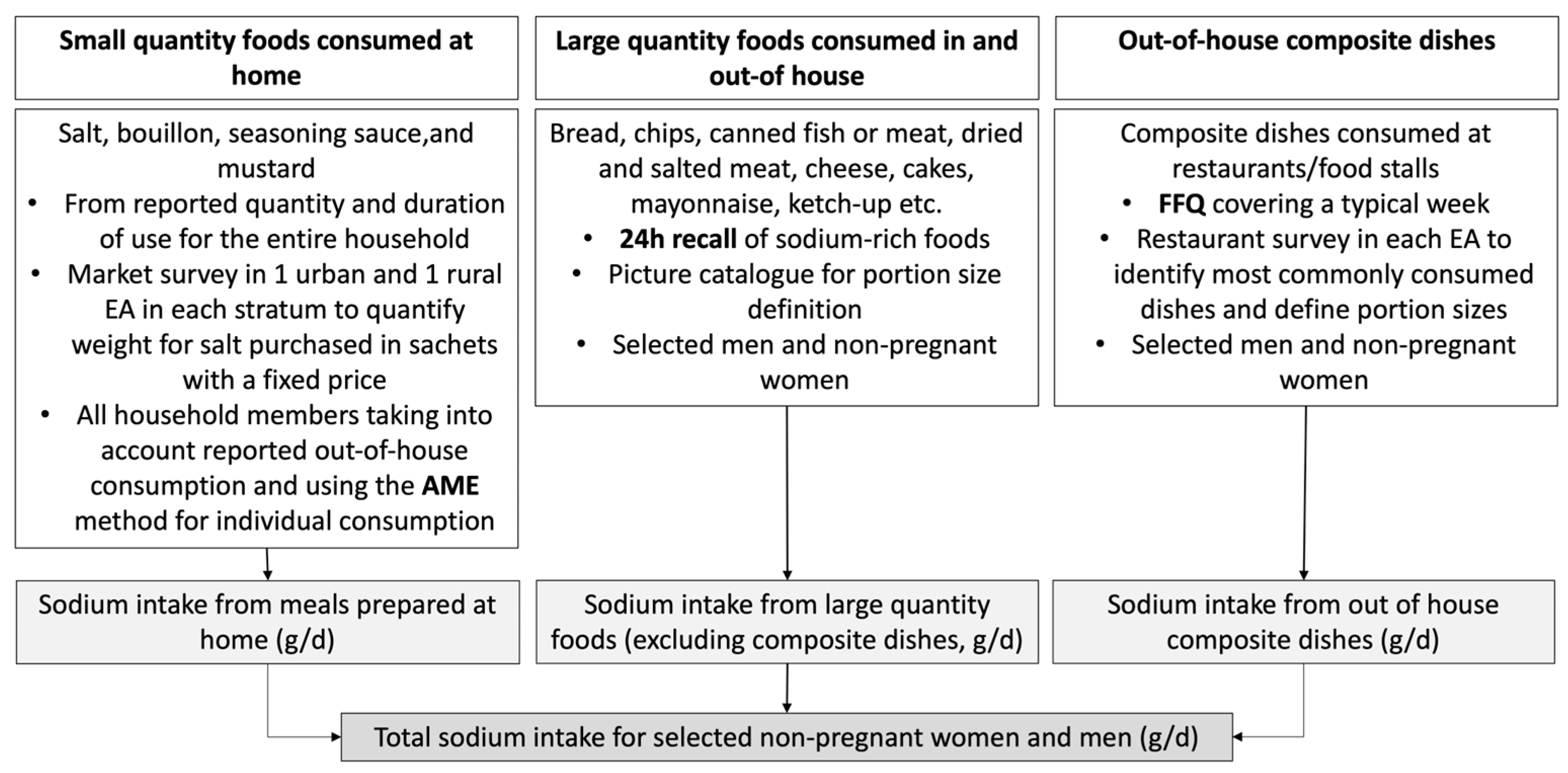
To assess individual sodium intake and the relative contribution of different foods to the overall intake, a combination of three dietary intake methods was used: (1) the household purchasing/adult male equivalent (AME) method to quantify consumption of small-quantity foods such as salt and bouillon at the household level; (2) a food frequency questionnaire (FFQ) to capture composite dishes consumed out-of-house; and (3) a 24 h recall focused on sodium-rich foods consumed in large quantities (Figure 1). Household daily consumption of small-quantity foods was calculated by dividing the amount bought at the last purchase by the duration over which it is usually consumed. Individual daily consumption was then estimated by partitioning household intake among family members using the AME method [21,22], adjusted for the frequency of meals eaten outside the home. For foods consumed in large quantities, portion sizes in the 24 h recall were estimated using a picture catalog, while portion sizes for composite dishes consumed out-of-house (assessed via FFQ) were estimated by weighing portions at a restaurant in each cluster. Total individual daily sodium intake was calculated by summing contributions from household small-quantity foods, large-quantity foods reported in the 24 h recall, and composite dishes consumed out-of-house.
Preliminary studies in both Burkina Faso and Senegal informed the selection of foods included in the survey. Based on a literature review and consultations with local researchers, all potentially relevant high-sodium foods were initially listed. These included items very high in sodium but typically consumed in small quantities (e.g., salt, bouillon), foods with moderate sodium content consumed in larger quantities (e.g., bread), and foods with intermediate characteristics. Subsequently, a pilot questionnaire was administered in one urban and one rural community near the capital cities to identify which high-sodium foods were actually consumed locally. Popular dishes prepared in restaurants were also documented for inclusion as out-of-house foods. The list of composite dishes included in the FFQ was also validated. Sodium content for included foods and dishes was obtained from the ARCH Senegal [23], INDDEX24 Burkina Faso [24], and the West African FAO/INFOODS food composition tables [25].

2.3. Procedures

Interview questionnaires were written in French by the research team and programmed in KoboCollect for tablet-based data entry. The French version of the questionnaires is available at https://osf.io/h9dqw/.
The household-level module was administered first, after obtaining oral consent from the household head or another qualified adult respondent. This module collected information on household composition (age, sex, out-of-house eating patterns), household head characteristics, water and sanitation, land and animal ownership, dwelling characteristics, and household food purchase and consumption patterns for small-quantity, sodium-rich foods (e.g., salt, bouillon, seasoning sauce, and mustard). Following the household module, up to one male and up to one non-pregnant female aged 15–59 years were randomly selected by the tablet. Written informed consent was obtained from the selected individual(s) before administering the individual questionnaire modules and collecting urine samples.
Individual questionnaires included questions on age, marital status, and educational level, as well as a 24 h recall for high-sodium foods consumed in large quantities (e.g., bread, chips, processed meat, fish, and seafood) and a food frequency section for composite dishes consumed out-of-house.
Complete 24 h urine collection, the gold standard for sodium intake assessment, is challenging and was therefore not feasible for the entire survey population. Thus, we collected a 24 h urine sample from a convenience sub-sample (the first two male and first two female interviewees in each EA) to allow calculation of a population-specific correction factor, as suggested by WHO and others [10,26,27]. Two collection procedures were applied: individuals selected for a spot urine sample were provided with a pre-labeled container and asked to provide a urine sample at their convenience. Participants selected for 24 h urine collection received a larger container and additional collection materials; to also obtain a spot sample from these participants within the 24 h period, they were provided with a small urine container. Completeness of the 24 h urine collection was assessed during data collection by volume (≥500 mL), length of collection (≥20 h), and self-reported missing ≤1 void [28,29]. Urine samples were stored in cold boxes until transport to a regional health facility within 24 h, where they were aliquoted and stored at −20 °C until shipment for analysis.
Urinary sodium and creatinine concentrations were analyzed by Biolab (Amman, Jordan) using a Roche c503 SER clinical analyzer. The laboratory participates regularly in external quality control schemes, demonstrating consistently high performance, and conducted daily quality control during analysis of the samples presented here.
In addition to household and individual data, vendor information was collected from one randomly selected restaurant or food stall located in or near each EA. A short questionnaire was administered to assess the relative contribution of salt and bouillon in the composite dishes prepared on the day of the interview, using the proportional piling method [30,31].

2.4. Data Management and Statistical Analysis

Data analysis was done using StataNow® version SE 19.5 (Stata Corp, College Station, TX, USA). The statistical precision of prevalence estimates or those of central tendency for continuous means was assessed using 95% confidence intervals (CI), which were calculated accounting for the complex sampling, including cluster and stratified sampling used in both surveys. Dietary intake data as well as urinary sodium excretion data were not normally distributed, and therefore a Box–Cox transformation was applied prior to modeling. Results are presented as back-transformed estimated medians with 95% CI.
We investigated differences between subgroups, such as country, type of residence, and sex, in bivariate analyses by applying a weighted chi-square test of independence in the case of binary data, and a weighted regression was applied to Box–Cox transformed values in the case of continuous data.
For urinary sodium concentration, the following conversion was used: 1 mmol/L Na = 23 mg/L Na [29]. Approximate 24 h Na excretion was calculated using this equation (where Cr is creatinine) [32]:
approximate   24   h   N a m g d = N a   s p o t   u r i n e   ( m g l ) C r   s p o t   u r i n e ( m g l ) × s e x   s p e c i f i c   24   h   C r   ( m g d )
For sex-specific 24 h Cr, we used the sex-specific mean of the measured creatinine excretion from the 24 h urine sub-sample in each country. To derive the estimated urinary sodium excretion (eUSE) used as the reference in the present article, approximate 24 h Na excretion was further corrected using the coefficients resulting from the country-specific regression of approximate 24 h Na excretion versus measured 24 h sodium excretion in the sub-sample.
For the analysis presented in this article, we calculated the following dietary sodium intake variables:
  • Individual sodium intake from small-quantity foods using the household purchasing/AME method: For the small-quantity foods, we calculated the estimated intake from discretionary salt (DS) and from other small commodities (OSC) separately:
    • Crude individual sodium intake from discretionary salt (DS crude): We first corrected the quantity and duration of salt use at the household level. For salt purchased in sachets smaller than 1 kg, the reported price was considered more reliable than the reported weight. Therefore, we adjusted the weight using a regression based on data obtained by weighing all selling units and recording their price in one urban and one rural EA per stratum. When such data were limited, the regression coefficient was calculated after visually identifying and excluding obvious outliers from the price vs. weight scatter plot for purchases under 1 kg. Using purchased salt quantities and duration of use, we identified duration outliers through visual inspection of the quantity vs. duration plot and corrected duration using the regression coefficient. Crude household daily salt intake was then calculated by dividing the purchased salt quantity by the duration of use, with extreme values replaced by the 2.5th and the 97.5th percentiles. Using the AME method [21], we derived individual daily salt intake (g), which was then converted to sodium intake (g/day) using a factor of 0.3876.
    • Corrected individual sodium intake from discretionary salt (DS corrected): Crude household daily salt consumption was further adjusted for salt used for non-dietary purposes (e.g., animal feeding, washing chickens, sharing with others) to derive corrected household salt intake. The AME method was then applied, taking into account the individual out-of-house eating rate, to calculate corrected individual daily sodium intake (g/day) from discretionary salt.
    • Individual sodium intake from other small commodity (OSC) foods (bouillon, seasoning sauce, and mustard) used at the household: Individual daily consumption of each OSC item (calculated using the same approach as for DS crude and DS corrected) was multiplied by its typical sodium content (bouillon 221.0 mg/g, seasoning sauce 3.7 mg/g, soy sauce 54.9 mg/g, mustard 11.0 mg/g) and summed to estimate total individual sodium intake from other small-quantity foods consumed at the household level. Extreme values were replaced by the 2.5th and the 97.5th percentiles.
  • Individual sodium intake from large-quantity foods (LQF) assessed using a single 24 h recall: Daily consumption of each reported food item was multiplied by its sodium content. The resulting value was adjusted for the individual’s in-house consumption frequency to account for days when the participant did not consume meals at home. Sodium intake from all reported large-quantity foods was then summed to calculate total daily sodium consumption from these foods consumed within the household.
  • Individual sodium intake from out-of-house composite dishes (CD) assessed using a food frequency questionnaire: Weekly consumption of each reported composite meal was multiplied by its sodium content. The estimate was further adjusted based on the individual’s frequency of eating out-of-house, and the weekly total was divided by seven to derive an average daily sodium intake from out-of-house composite dishes. Daily sodium intake from all reported composite meals was summed to estimate total daily sodium consumption from meals consumed outside the household.
Finally, different combinations of these dietary assessment methods were compared with sodium intake estimated from eUSE, accounting for the fact that approximately 93% of ingested sodium is excreted in a 24 h urine sample [33]. Agreement between dietary and urinary estimates was evaluated using Bland–Altman analyses.

3. Results

3.1. Main Characteristics and Household Salt Purchasing Patterns

Overall, this analysis included 471 households in Burkina Faso and 809 households in Senegal, each with a randomly selected non-pregnant woman and/or man (Table 1). The two settings differed in several characteristics: 67% of households were from urban areas in Burkina Faso, while only 39% were urban households in Senegal; more households in Senegal owned livestock, purchased salt in large quantities, and used salt for purposes other than human consumption than in Burkina Faso; and mean household size was higher in Senegal than in Burkina Faso.
Within these households, 423 women and 326 men were assessed in Burkina Faso, and 757 women and 583 men in Senegal. The mean age was approximately 32 years in women and was comparable in both settings. However, for men, the population was slightly older in Burkina Faso (mean age of 35 years) compared to Senegal (mean age of 31 years). The estimated median urinary sodium excretion (eUSE, estimated from spot urine samples, calibrated using 24 h urine collections in a sub-sample) was comparable in women, with around 2.8 g/d, but men in Burkina Faso had a lower excretion, with 2.3 g/d, compared to men in Senegal (3.0 g/d). Out-of-house meal consumption was higher in both men and women in Burkina Faso than in Senegal.
In this analysis, we compare a more urban setting (Burkina Faso) to a more rural setting (Senegal).

3.2. Comparison of Dietary Sodium Intake Estimates Using Different Dietary Intake Methods and Combinations Thereof with Urinary Sodium Excretion

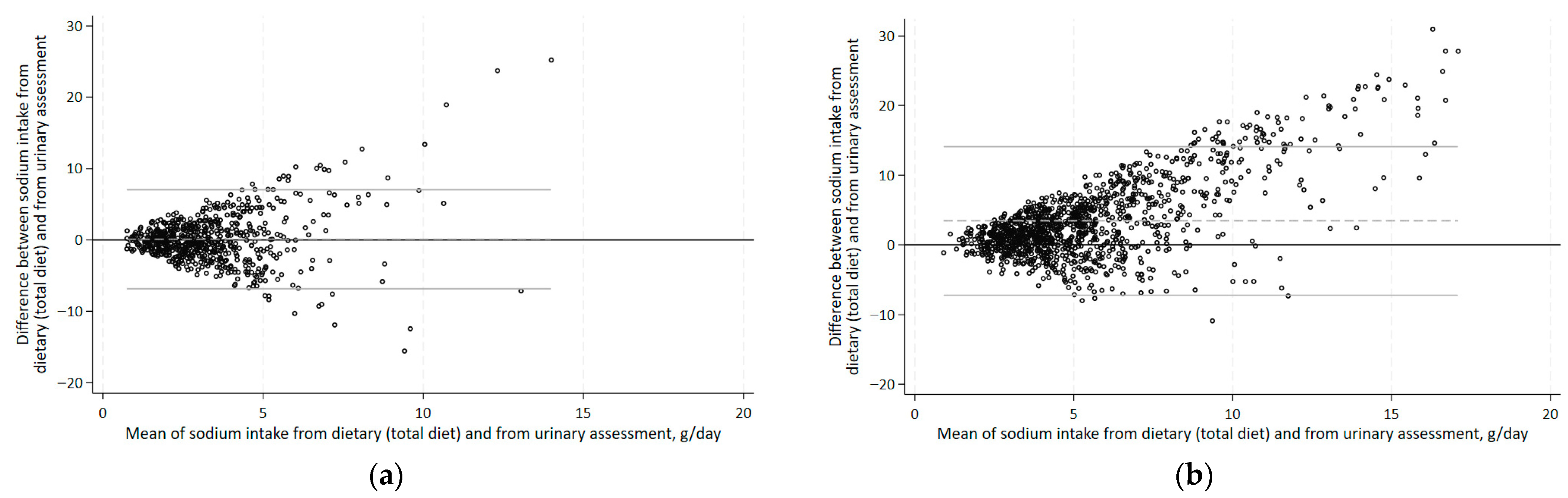
The Bland–Altman plots in Figure 2 demonstrate that at the population level, the combined questionnaire-based approach to estimating total dietary sodium intake (DSI) achieved satisfactory agreement with reference measures in Burkina Faso, whereas the agreement was weaker in Senegal. The approach included household purchasing/AME for discretionary salt and other small commodities consumed at the household, 24 h recalls for sodium-rich foods consumed in large quantities inside and outside the household (excluding composite dishes), and a food frequency questionnaire for composite dishes consumed outside the household. Comparing the dietary assessment estimates with the reference method of estimated urinary sodium excretion (eUSE), adjusted for the 93% fraction of ingested sodium excreted in urine, yielded mean differences (95% limits of agreement) of 0.1 g/d (−6.8, 7.0) in Burkina Faso and 3.4 g/d (−7.2, 14.1) in Senegal. While the mean bias was small, suggesting acceptable agreement at the population level, the wide limits of agreement indicate substantial random error at the individual level. The plots also show that at lower levels of intake, the results are in agreement, but not at higher intakes. This is most likely related to errors when estimating the duration of use for large purchases and/or the proportion used for purposes other than human consumption. This suggests that dietary assessment methods may be used to estimate average sodium intake and major contributing food sources at the population level; however, urinary sodium excretion is needed for individual-level assessments. Additional plots showing the limits of agreement between different combinations of the dietary intake methods used and eUSE are presented in Figure S1. For Burkina Faso, mean differences are larger when not using DSI from the total diet, while for Senegal, they are smaller but clearly show an overestimation of sodium intake from dietary methods for all combinations in Senegal.
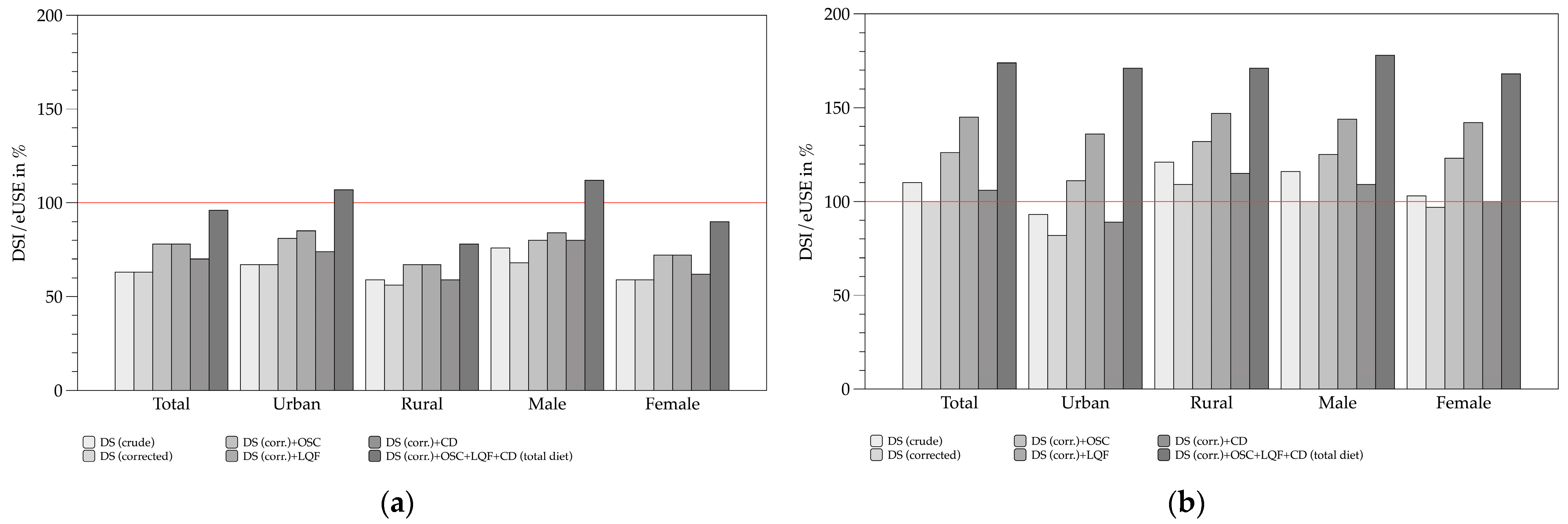
The combination of dietary intake methods to estimate sodium intake from the total diet compared to urinary sodium excretion worked rather well in Burkina Faso overall (96%) and in urban areas (107%), but intake was slightly underestimated in rural areas (78%) and female participants (90%) and slightly overestimated in male participants (112%, Figure 3a). There were no significant differences in intake from DS between households with or without livestock, but when households owned salt-consuming livestock, their intake of DS was smaller. Households purchasing small quantities of salt showed a lower intake from DS than households purchasing larger quantities (Table S1). Overall median dietary sodium intake was similar when using a combination of dietary intake methods to estimate sodium from the total diet (2.6 g/d) compared to eUSE (2.7 g/d) in Burkina Faso (Table S2). In contrast, in Senegal, the combination of dietary intake methods resulted in a considerably higher daily intake than that estimated from eUSE (5.4 vs. 3.1 g/d). Figure 3b highlights that the combination of dietary intake methods to estimate sodium intake from the total diet overestimates daily sodium intake in Senegal when compared to urinary sodium excretion overall, but also when presented by type of residence or sex (all > 160% compared to eUSE). The estimates from eUSE were already reached when only assessing DSI from DS, except for urban areas, suggesting an issue with the household purchasing method, particularly in rural areas. Men and women in households that own salt-consuming livestock (more common in rural areas) showed a higher salt intake (3.5 vs. 2.5 g/d in those not owning any livestock), indicating that the proportion used for non-human consumption might have been difficult to estimate (Table S3). Similarly, in households purchasing larger quantities of salt, salt intake was higher, with 4.3 g/d compared to 2.6 g/d in households purchasing small quantities, suggesting that the duration of salt use might have been difficult to estimate. Thus, even correcting DS intake for salt used for purposes other than human consumption and for out-of-house consumption did not allow for a better match to these estimates. The figure also shows that the contribution of sodium from composite dishes consumed out-of-house was minimal in both countries, even in urban settings where eating out is more common.

3.3. Contribution of Dietary Sodium from Various Dietary Sources in Non-Pregnant Women and Men in Burkina Faso and Senegal

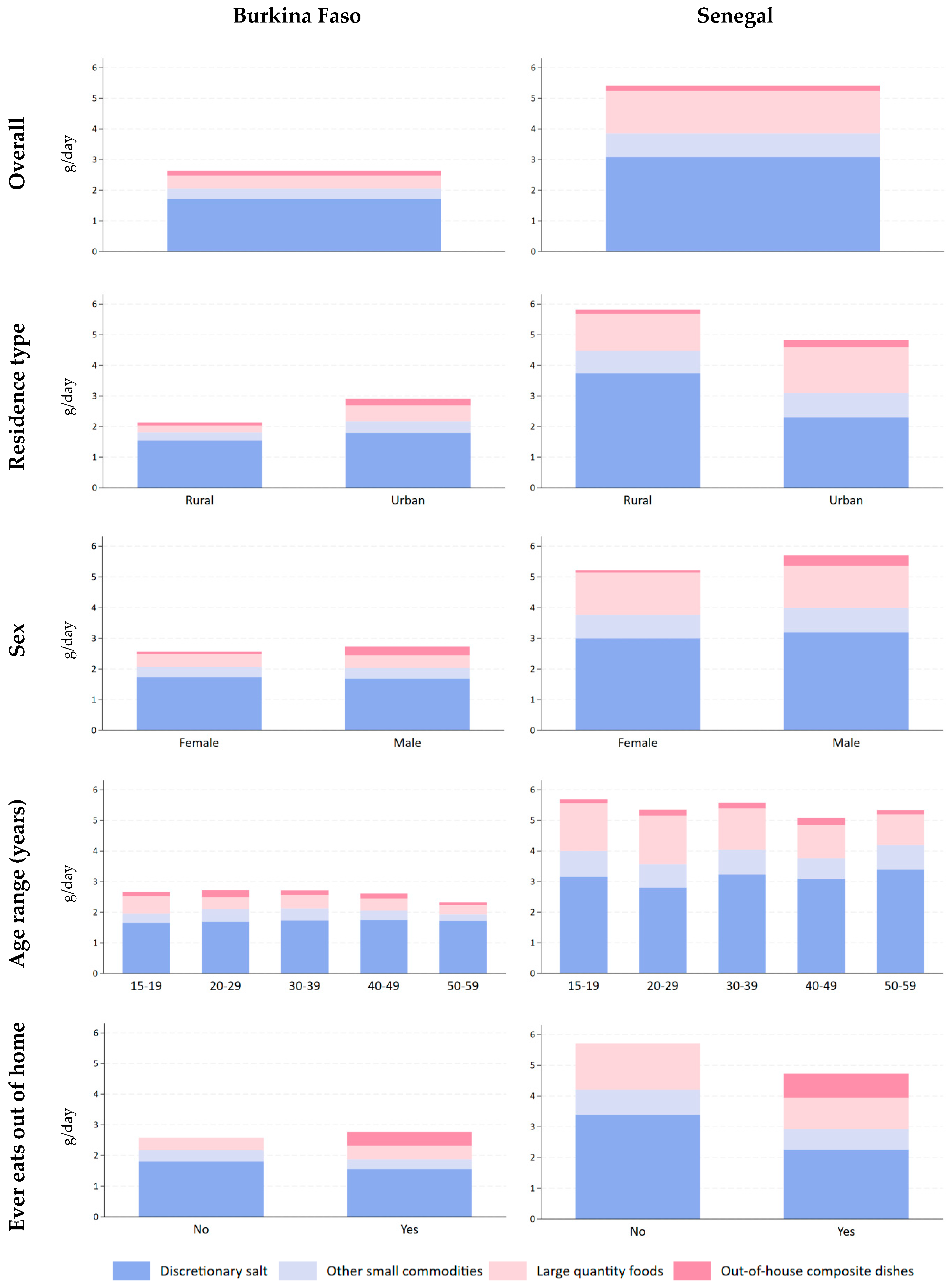
Most dietary sodium originated from discretionary salt used at the household level, while the contribution from sodium-rich foods consumed in large quantities in and outside of the household and other small commodity foods consumed at the household level was smaller in both countries (Figure 4). The contribution from out-of-house composite dishes was small, as most men and women did not consume meals out-of-house; if they did, the frequency was rather low (Table 1). In Senegal, sodium intake estimated through dietary intake methods was double that in Burkina Faso, driven primarily by discretionary household salt and, to a lesser extent, small commodities and foods consumed in large quantities. Intake from discretionary household salt was 1.6-fold higher in rural areas in Senegal compared to urban areas, suggesting an issue with the household purchasing/AME method, mainly in rural areas where many households own salt-consuming livestock. However, even in urban areas, estimated intake from discretionary household salt was higher than intake from discretionary salt in urban Burkina Faso, while eUSE was comparable in both countries. This discrepancy suggests potential limitations in the assessment of discretionary salt consumption also in urban areas. One contributing factor may be the negligible proportion of households purchasing salt in bulk in Burkina Faso, compared with 9% in urban and 29% in rural Senegal (Table S4, Figure S2), which complicates the estimation of the duration of use of such large salt purchases and the proportion allocated to non-dietary purposes. Consumption of complementary dishes outside the home was associated with a slight reduction in household discretionary salt intake in Burkina Faso. In Senegal, household discretionary salt intake was substantially lower among individuals eating out, likely reflecting the predominantly urban population consuming composite dishes outside the home, where salt intake estimates are more accurate than in rural areas.

3.4. Urinary Sodium Excretion to Estimate Total Sodium Intake

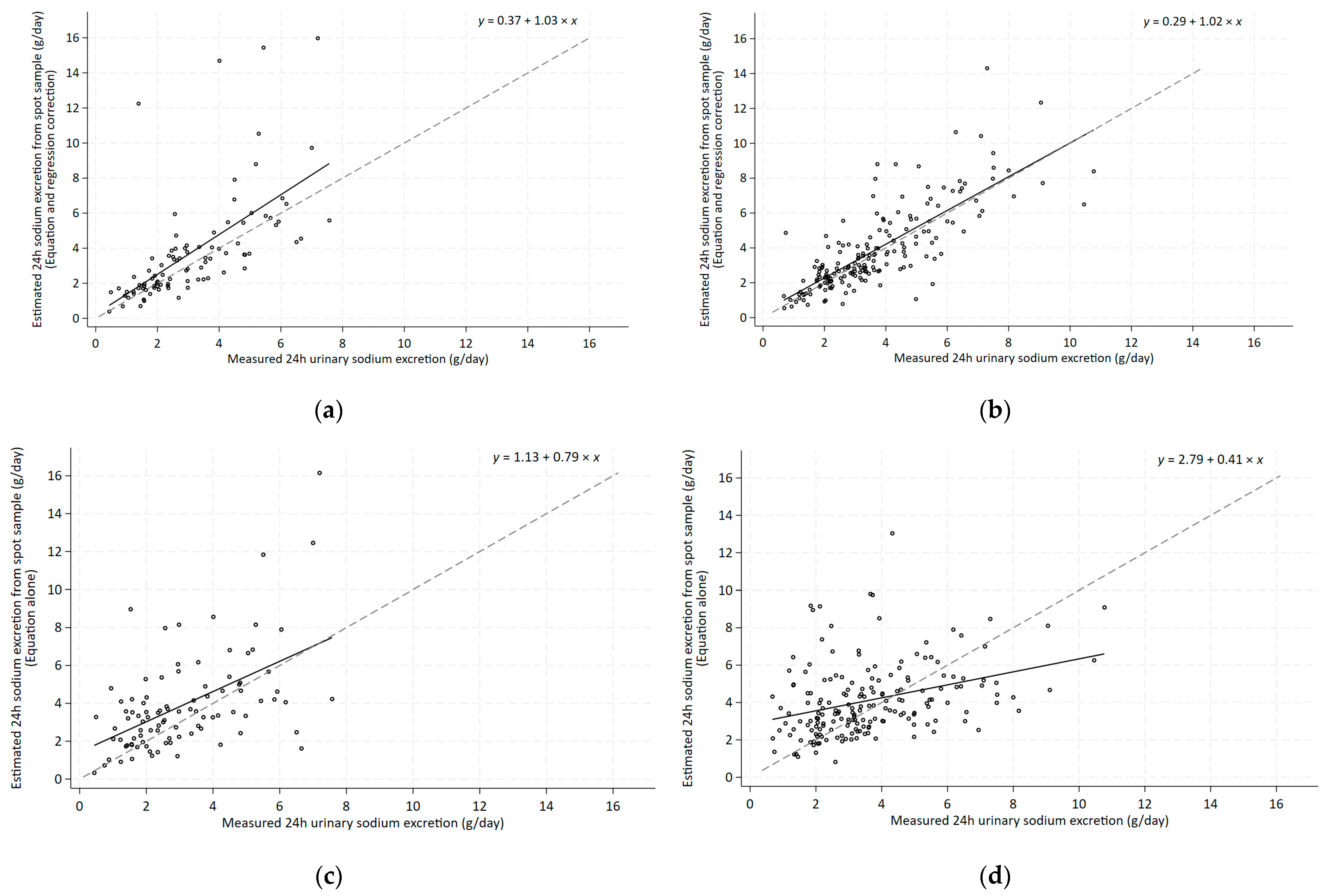
Since questionnaire-based dietary intake methods can largely overestimate sodium intake in some settings, as shown here for Senegal, using eUSE might be the method of choice in large-scale surveys to estimate total sodium intake in a population. Using the sub-sample of 24 h urine samples, we have conducted a country-specific adjustment to the spot urine sample results. The sub-sample consisted of around 10% of participants collecting both a 24 h urine sample and a spot urine sample within the 24 h period, while the remaining participants collected a spot urine sample only. This allowed us to correct the approximate 24 h Na excretion calculated by the equation for spot urine samples as described in Mann et al. [32] using the coefficients resulting from the country-specific regression of approximate 24 h Na excretion versus measured 24 h sodium excretion in the sub-sample. Our country-specific validation has shown that approximate 24 h Na excretion from spot urine samples additionally corrected with the country-specific regression coefficient is a feasible approach in both countries (R2 = 0.410, p < 0.001 in Burkina Faso (Figure 5a) and R2 = 0.560, p < 0.001 in Senegal (Figure 5b)) and improves the regression compared to using the equation alone (R2 = 0.280; p = 0.003 in Burkina Faso (Figure 5c) and R2 = 0.115; p < 0.001 in Senegal (Figure 5d)). Median sodium intake (95% CI) estimated from 24 h urine samples, spot urine samples, and spot urine samples applying the country-specific regression correction was 2.9 g/d, 3.3 g/d, and 3.2 g/d in Burkina Faso, respectively, and 3.4 g/d, 4.1 g/d, and 3.5 g/d in Senegal, respectively (Table S5).

4. Discussion

We aimed to estimate total sodium intake as well as dietary sources of sodium using a combination of different questionnaire-based dietary intake methods in a single visit for each participant. Our results have shown that this approach worked well in the context of Burkina Faso, where the majority of households were in urban areas, purchasing salt in small amounts, and fewer households owned livestock compared to the setting in Senegal. The mostly rural setting with a considerable proportion of households owning livestock led to a large overestimation of total dietary sodium intake when compared to estimates from urinary sodium excretion in Senegal.
We used the estimation of dietary sodium intake from urinary sodium excretion in a spot urine sample, validated and regression corrected against 24 h urine samples in a sub-sample, as our reference method, and compared all different combinations of dietary intake methods to this estimated urinary sodium excretion (eUSE). To estimate dietary sodium intake from eUSE, we accounted for the loss of approximately 7% of dietary sodium as suggested in a review by Lucko et al. [33]. Although a single 24 h urine sample is not ideal for estimating an individual’s usual salt intake due to daily dietary variation, it is considered sufficient for estimating average 24 h sodium intake at the population level [34]. In practice, complete 24 h urine collections are burdensome, costly, and inconvenient for participants, often leading to low response rates [35] and limiting their feasibility in large-scale surveys. In our survey, around 10% of participants collected both a 24 h urine sample and a spot urine sample within the 24 h period, while the remaining participants collected a spot urine sample only. This allowed us to correct the approximate 24 h Na excretion calculated by the equation for spot urine samples as described in Mann et al. [32] using the coefficients resulting from the country-specific regression of approximate 24 h Na excretion versus measured 24 h sodium excretion in the sub-sample. Correlation analyses with our data have shown that approximate 24 h urinary Na excretion from a spot urine sample using a country-specific regression correction is a valid alternative to using full 24 h urine samples and results in a better correlation and median estimates closer to those from the 24 h collections than without regression correction. These findings suggest that spot urine samples should be validated against 24 h collections in a small sub-sample. Even though in the context of Burkina Faso and Senegal, the response rate for 24 h urine collection was high, it still required a second visit to households to collect the 24 h urine sample two days after the first visit, in which dietary intake was assessed using questionnaire-based intake methods, whereas spot urine samples can be collected within the first visit.
Different dietary intake methods can be used to estimate sodium intake from the diet. We used a combination of methods in order to assess where most dietary sodium in the diet comes from, as well as to estimate total sodium intake by combining all three methods. All our methods (24 h recall, FFQ, household purchase/AME) were interview-based and administered on a single day. However, such subjective methods are prone to errors—typically resulting in intake underestimations—which can arise from the use of food composition tables, reporting of portion size, and misreporting of food choices [36]. Due to these limitations of dietary intake methods, we used sodium excretion as our reference method because it is an objective indicator of dietary sodium intake and can therefore be used for validating the accuracy of other methods. This validation has shown that the combination of dietary intake methods worked well in Burkina Faso, resulting in a median intake of 96% compared to the estimation from eUSE. This is in better agreement than other studies comparing a 24 h recall to a 24 h urine collection, which have shown that reported values were around 20% lower than those based on urine collections [36]. In contrast, in Senegal, the validation has shown that using dietary intake methods resulted in a large overestimation of sodium intake compared to estimates from eUSE (174%), which is similar to a recent study also reporting an overestimation when comparing a 3-day dietary recall method with 24 h urinary sodium excretion, though the overestimation was smaller, with around 130% [37]. In Senegal, the eUSE value was reached when just assessing the intake from discretionary salt used at the household level, suggesting that an overestimation is occurring at that stage, probably related to the use of the household purchasing/AME method.
Estimating sodium intake from discretionary salt is challenging. The lithium-tagged method, considered the gold standard, has been used in a recent study in New Zealand [38] as well as in an older study in Benin [13]. However, this method is cumbersome and expensive, as all household salt needs to be labeled prior to distribution to the households, and multiple 24 h urine collections are needed during the study period of around 1 week. Thus, this method is not feasible for large surveys. Therefore, we used in our survey the more field-friendly questionnaire-based household purchasing/AME method, which is based on the reported quantity last purchased and the reported habitual duration of use for that quantity. However, this approach turned out to be challenging for households that buy large quantities of salt, which was much more common in Senegal than in Burkina Faso, and thus resulted in difficulties in estimating the duration of use. Further, particularly in Senegal, salt was often used for purposes other than human consumption, and this proportion, assessed in our survey by simply asking what proportion of the purchased quantity was used for purposes other than human consumption, was difficult to estimate for the participants. These two factors likely led to an overestimation of sodium intake from discretionary salt in Senegal overall, but particularly in rural households where more households own salt-consuming livestock. Nonetheless, even in urban areas of Senegal, over a third of the households own salt-consuming livestock, and close to 10% buy salt in bulk, thus likely also resulting in an overestimation in the urban context, though to a lesser extent (Table S4). Correcting for salt used for purposes other than human consumption and out-of-house consumption resulted in a slight reduction in individual sodium intake from discretionary salt from 3.4 g/d to 3.1 g/d. However, this value corresponds to 100% of the value estimated from the 93%-fraction adjusted eUSE and indicates that we did not accurately capture household salt consumption in Senegal. In comparison, the portion from discretionary salt corresponds to 63% of that of the 93%-fraction adjusted eUSE in Burkina Faso. This is more or less in line with the few and rather old studies that have tried to estimate the portion from discretionary salt in other African countries: 60% of total sodium intake was estimated to be from discretionary salt in Mozambique, 52% in Benin, and 40% in South Africa [39]. This highlights that most likely, the estimates for discretionary salt in Senegal are not correct when using the household salt purchasing/AME method in that setting. Notwithstanding, the household purchasing/AME method worked better in the sub-group of households living in urban areas of Senegal, where 82% of sodium came from discretionary salt (vs. 109% in rural areas), highlighting the limitation of the method, particularly for rural areas. In Burkina Faso, the method worked well for rural areas as well, but there, even the rural settings were mostly semi-urban settings due to the situation not allowing for entering certain areas to conduct a full national survey. Similarly, the method was considered acceptable among women in rural and urban areas of Northern Ghana, where discretionary salt intake accounted for 71% of urinary sodium excretion [40].
Another field-friendly approach was used in a recent study in Ethiopia, in which household salt disappearance rates were measured [41]. A known quantity of salt was provided to households, which were instructed to use this salt exclusively for meals consumed at the household, but not for other purposes, such as animal feeding. When combined with the AME method to estimate intake among non-pregnant women of reproductive age, this approach only slightly overestimated median discretionary salt intake compared with weighed food records (2.8 g/d vs. 2.5 g/d). This estimate is only marginally lower than the 3.1 g/day observed in Senegal using the household purchasing/AME method. However, in the Ethiopian study, estimates derived from 24 h urine collections attributable to discretionary salt alone were higher (3.4 g/d), implying that total urinary sodium excretion would be substantially higher than the 3.1 g/day measured in Senegal. These findings suggest that the salt disappearance method may provide more accurate estimates in settings where salt is commonly purchased in bulk and used for purposes other than human consumption, although its implementation would require an additional household visit.
We have shown that the combination of three questionnaire-based dietary intake methods allows for the estimation of total sodium intake as well as proportions from different sources on a single day. The chosen methods work well in settings where salt is purchased in small quantities and, therefore, duration of use can be easily estimated and where no large portions are used for purposes other than human consumption, while in settings where salt is usually purchased in bulk and large portions of household salt are used for purposes other than human consumption, the household purchasing/AME method might be replaced by the salt disappearance method [41]. A validation against USE using 24 h urine collections in a small sub-sample is recommended. In our surveys, the sub-sample was 10% of the total. If only total sodium intake is of interest, the simplest approach would be the use of a spot urine sample and applying the equation for approximate sodium intake (thus requiring also a urine creatinine assessment) with a regression correction from a country-specific validation against 24 h urine collections in a small sub-sample.
One limitation of this survey was that we did not collect 24 h urine samples from all participants and had to compare sodium intake estimated using a combination of dietary intake methods with approximate sodium intake calculated from spot urine samples. However, we included a correction factor from our internal country-specific validation, which showed good agreement with 24 h urine excretion in our sub-sample. We further conducted a sensitivity analysis, only including participants of the sub-sample who had shown comparable median measured 24 h urinary sodium excretion and estimated 24 h urinary sodium excretion from a spot sample, including the regression correction. The general limitations of indirect dietary intake methods as used in this survey are that these methods are subjective, and misreporting is possible. A strength of the survey was the large sample size in both surveys and the national representativeness of the survey in Senegal.

5. Conclusions

To estimate total dietary sodium intake in an African population, the use of spot urine samples with a validation against 24 h urine samples in a sub-sample is a field-friendly and valid alternative to using 24 h urine collections. If there is interest in understanding the origin of the sodium, though, this method needs to be complemented with dietary assessments. We show that the combination of three questionnaire-based dietary intake methods administered on a single day to estimate total sodium intake (from small commodity foods such as salt and bouillon at the household, from large-quantity foods, and from out-of-house composite dishes) can be used in settings where households purchase rather small quantities of salt regularly. In contrast, in settings where households purchase large quantities of salt and use it for purposes other than human consumption, overestimations are likely. Thus, the household purchasing/AME method should be replaced by the salt disappearance method in order to accurately estimate intake from discretionary salt. Further, in settings where out-of-house consumption is not common (as in our two surveys), the FFQ to assess sodium intake from out-of-house composite dishes may be dropped. Using this questionnaire-based dietary intake approach has the advantage that only a single visit to a household is needed and that the most common food sources of sodium can be identified. To test the validity of such a dietary intake approach, a 24 h urine sample should be collected in a sub-sample of participants to compare total dietary sodium intake with that from urinary excretion. Both approaches can be important for the development of strategies to reduce population salt intake and prevent non-communicable diseases. In a first step, total dietary sodium intake in the population can be estimated using spot urine samples validated against 24 h urine samples in a sub-sample. In case of excess sodium intake, in a second step, the dietary intake approach (replacing the household purchasing/AME method with the salt disappearance method in settings where bulk purchases of salt are observed) can be used to identify the main sources, which will help governments to develop salt reduction strategies. Such strategies might include the reduction in salt in processed foods [42] or behavioral change interventions to reduce salt intake [43], which have shown an effect on blood pressure.

Supplementary Materials

The following supporting information can be downloaded at https://www.mdpi.com/article/10.3390/dietetics5020022/s1. Table S1: Comparison of uncorrected and corrected individual dietary sodium intakes (g/day) from discretionary salt using the household purchasing/AME method by different characteristics in non-pregnant women and men 15 to 59 years of age in Burkina Faso; Table S2: Comparison of sodium intake using different dietary intake assessment approaches with urinary sodium excretion in non-pregnant women and men 15 to 59 years of age in Burkina Faso and Senegal; Table S3: Comparison of uncorrected and corrected individual dietary sodium intakes (g/day) from discretionary salt using the household purchasing/AME method by different characteristics in men and non-pregnant women 15 to 59 years of age in Senegal; Table S4: Comparison of household salt purchasing and usage patterns and livestock owning between urban and rural residence in Burkina Faso (N = 471) and Senegal (N = 809); Table S5: Median daily sodium intake estimated from urinary sodium excretion (eUSE) and dietary intake methods in the sub-sample of participants collecting 24 h urine samples; Figure S1: Bland–Altman plots of sodium intake using different combinations of questionnaire-based dietary intake methods vs. estimates from urinary sodium excretion in Burkina Faso and Senegal; Figure S2: Distribution of salt purchase quantity by type of residence in Burkina Faso (N = 471: urban, N = 252; rural, N = 219) and Senegal (N = 809: urban, N = 243; rural, N = 566).

Author Contributions

Conceptualization, R.W., V.C., F.R., K.K. and M.F.B.; methodology, R.W., K.K., M.F.B., F.R. and N.P.; formal analysis, J.P.W. and V.G.; investigation, R.W., V.C., K.K., M.F.B., R.K., N.Y.S., S.P.N., J.K., Z.N. and J.P.W.; data curation, V.G.; writing—original draft preparation, R.W.; writing—review and editing, F.R. and V.G.; visualization, R.W. and V.G.; supervision, R.W., K.K., M.F.B., R.K. and V.C.; project administration, R.W., K.K., M.F.B. and V.C.; funding acquisition, V.C. All authors have read and agreed to the published version of the manuscript.

Funding

This research was funded by the Gates Foundation, grant number INV-007916.

Institutional Review Board Statement

The two surveys were conducted in accordance with the Declaration of Helsinki and approved by the Comité d’Ethique pour la Recherche en Santé in Burkina Faso (2022-10-215) on 12 October 2022 and by the Comité National d’Ethique de la Recherche pour la Santé in Senegal (SEN22/130) on 30 January 2023.

Informed Consent Statement

Informed consent was obtained from all subjects involved in the study.

Data Availability Statement

Deidentified data described in the manuscript, code book, and analytic code may be made available upon request pending application and approval.

Acknowledgments

We thank all families for their participation, as well as data collection teams for their great efforts. We greatly appreciate the support from the National Institutes of Statistics and Demography in Burkina Faso and Senegal. We thank Ebenezer Adjetey for the programming of electronic questionnaires and Cindy Solliard and Dedenyo Adossi for helping with the development and translation of study tools and training.

Conflicts of Interest

Authors R.W., F.R., N.P., J.P.W. and V.G. were employed by the company GroundWork and Z.N. was employed by the company Biolab. The remaining authors declare that the research was conducted in the absence of any commercial or financial relationship that could be construed as a potential conflict of interest. The funder had no role in the design of the surveys; in the collection, analyses, or interpretation of data; in the writing of the manuscript; or in the decision to publish the results.

Abbreviations

The following abbreviations are used in this manuscript:
AMEAdult male equivalent
CDComposite dishes
CrCreatinine
DSDiscretionary salt
DSIDietary sodium intake
EAEnumeration area
FFQFood frequency questionnaire
LMICLow- and middle-income countries
LQFLarge-quantity foods
NCDNon-communicable disease
OSCOther small commodities
SSISSalt and sodium intake survey
WHOWorld Health Organization
eUSEEstimated urinary sodium excretion (from a spot sample with country-specific regression correction against full 24 h urine collections in a sub-sample)
USEUrinary sodium excretion

References

  1. World Health Organization. Noncommunicable Diseases. Available online: https://www.who.int/news-room/fact-sheets/detail/noncommunicable-diseases (accessed on 24 August 2023).
  2. Kong, F.; Liu, Q.; Zhou, Q.; Xiao, P.; Bai, Y.; Wu, T.; Xia, L. Dietary Salt Intake and Cardiovascular Outcomes: An Umbrella Review of Meta-Analyses and Dose-Response Evidence. Ann. Med. 2025, 57, 2582065. [Google Scholar] [CrossRef] [PubMed]
  3. Schutte, A.E.; Srinivasapura Venkateshmurthy, N.; Mohan, S.; Prabhakaran, D. Hypertension in Low- and Middle-Income Countries. Circ. Res. 2021, 128, 808–826. [Google Scholar] [CrossRef]
  4. Zhou, B.; Carrillo-Larco, R.M.; Danaei, G.; Riley, L.M.; Paciorek, C.J.; Stevens, G.A.; Gregg, E.W.; Bennett, J.E.; Solomon, B.; Singleton, R.K.; et al. Worldwide Trends in Hypertension Prevalence and Progress in Treatment and Control from 1990 to 2019: A Pooled Analysis of 1201 Population-Representative Studies with 104 Million Participants. Lancet 2021, 398, 957–980. [Google Scholar] [CrossRef]
  5. Macia, E.; Gueye, L.; Duboz, P. Hypertension and Obesity in Dakar, Senegal. PLoS ONE 2016, 11, e0161544. [Google Scholar] [CrossRef]
  6. Soubeiga, J.K.; Millogo, T.; Bicaba, B.W.; Doulougou, B.; Kouanda, S. Prevalence and Factors Associated with Hypertension in Burkina Faso: A Countrywide Cross-Sectional Study. BMC Public Health 2017, 17, 64. [Google Scholar] [CrossRef]
  7. World Health Organization. Guideline: Sodium Intake for Adults and Children. Available online: https://www.who.int/publications/i/item/9789241504836 (accessed on 26 November 2025).
  8. Oyebode, O.; Oti, S.; Chen, Y.; Lilford, R.J. Salt Intakes in Sub-Saharan Africa: A Systematic Review and Meta-Regression. Popul. Health Metr. 2016, 14, 1. [Google Scholar] [CrossRef]
  9. Perin, M.S.; Gallani, M.C.B.J.; Andrechuk, C.R.S.; São-João, T.M.; Rhéaume, C.; Cornélio, M.E. What Methods Have Been Used to Estimate Salt Intake? A Systematic Review. Int. J. Food Sci. Nutr. 2020, 71, 22–35. [Google Scholar] [CrossRef] [PubMed]
  10. Huang, L.; Crino, M.; Wu, J.H.Y.; Woodward, M.; Barzi, F.; Land, M.A.; McLean, R.; Webster, J.; Enkhtungalag, B.; Neal, B. Mean Population Salt Intake Estimated from 24-h Urine Samples and Spot Urine Samples: A Systematic Review and Meta-Analysis. Int. J. Epidemiol. 2016, 45, 239–250. [Google Scholar] [CrossRef]
  11. Esche, J.; Thamm, M.; Remer, T. Contribution of Iodized Salt to Total Iodine and Total Salt Intake in Germany. Eur. J. Nutr. 2020, 59, 3163–3169. [Google Scholar] [CrossRef] [PubMed]
  12. Menyanu, E.; Russell, J.; Charlton, K. Dietary Sources of Salt in Low- and Middle-Income Countries: A Systematic Literature Review. Int. J. Environ. Res. Public Health 2019, 16, 2082. [Google Scholar] [CrossRef]
  13. Melse-Boonstra, A.; Rozendaal, M.; Rexwinkel, H.; Gerichhausen, M.J.; van den Briel, T.; Bulux, J.; Solomons, N.W.; West, C.E. Determination of Discretionary Salt Intake in Rural Guatemala and Benin to Determine the Iodine Fortification of Salt Required to Control Iodine Deficiency Disorders: Studies Using Lithium-Labeled Salt. Am. J. Clin. Nutr. 1998, 68, 636–641. [Google Scholar] [CrossRef]
  14. McLean, R.M. Measuring Population Sodium Intake: A Review of Methods. Nutrients 2014, 6, 4651–4662. [Google Scholar] [CrossRef] [PubMed]
  15. Rhodes, D.G.; Murayi, T.; Clemens, J.C.; Baer, D.J.; Sebastian, R.S.; Moshfegh, A.J. The USDA Automated Multiple-Pass Method Accurately Assesses Population Sodium Intakes. Am. Clin. Nutr. 2013, 97, 958–964. [Google Scholar] [CrossRef] [PubMed]
  16. Day, N.E.; McKeown, N.; Wong, M.-Y.; Welch, A.; Bingham, S. Epidemiological Assessment of Diet: A Comparison of a 7-Day Diary with a Food Frequency Questionnaire Using Urinary Markers of Nitrogen, Potassium and Sodium. Int. J. Epidemiol. 2001, 30, 309–317. [Google Scholar] [CrossRef]
  17. Zhang, L.; Zhao, F.; Zhang, P.; Gao, J.; Liu, C.; He, F.J.; Lin, C.-P. A Pilot Study to Validate a Standardized One-Week Salt Estimation Method Evaluating Salt Intake and Its Sources for Family Members in China. Nutrients 2015, 7, 751–763. [Google Scholar] [CrossRef]
  18. Agbemafle, I.; Woldeyohannes, M.; Tessema, M.; Fereja, M.; Arnold, C.D.; Banjaw, B.T.; Hussen, A.; Kebebe, T.; Goh, Y.E.; Arabi, M.; et al. Assessment of Women’s Discretionary Salt Intake and Household Salt Utilization in Preparation for a Salt Fortification Trial in Oromia Region, Ethiopia. Matern. Child Nutr. 2024, 21, e13768. [Google Scholar] [CrossRef]
  19. Helen Keller International; GroundWork. Salt and Sodium Intake Survey Senegal 2023; Dakar, Sénégal, 2024; Available online: https://groundworkhealth.org/wp-content/uploads/2024/05/E_SSIS-SENEGAL_report_FINAL_240426.pdf (accessed on 26 November 2025).
  20. Helen Keller International; GroundWork. Salt and Sodium Intake Survey Burkina Faso 2023; Ouagadougou, Burkina Faso, 2024; Available online: https://groundworkhealth.org/wp-content/uploads/2024/09/E_SSIS-Burkina-Faso_report_240829_final.pdf (accessed on 26 November 2025).
  21. Weisell, R.; Dop, M. The Adult Male Equivalent Concept and Its Application to Household Consumption and Expenditures Surveys (HCES). Food Nutr. Bull. 2012, 33, S157–S162. [Google Scholar] [CrossRef]
  22. Fiedler, J.L.; Lividini, K.; Bermudez, O.I.; Smitz, M.F. Household Consumption and Expenditures Surveys (HCES): A Primer for Food and Nutrition Analysts in Low- and Middle-Income Countries. Food Nutr. Bull. 2012, 33, S170–S184. [Google Scholar] [CrossRef]
  23. Vanderkooy, A.; Ferguson, E.L.; Sy, N.Y.; Kane, R.; Diagne, M.; Mbodji, A.; Pries, A.M. High Unhealthy Food and Beverage Consumption Is Associated with Poor Diet Quality among 12–35-Month-Olds in Guédiawaye. Front. Nutr. 2023, 10, 1125827. [Google Scholar] [CrossRef] [PubMed]
  24. INDDEX Project; Tufts University. Burkina Faso Dietary Reference Data (INDDEX24 Global FMDB); Tufts University: Boston, MA, USA, 2022. [Google Scholar]
  25. FAO. West African Food Composition Table; FAO: Rome, Italy, 2012. [Google Scholar]
  26. WHO/PAHO Regional Expert Group for Cardiovascular Disease Prevention through Population-wide Dietary Salt Reduction. Protocol for Population Level Sodium Determination in 24-h Urine Samples; PAHO: Washington, DC, USA, 2010; pp. 1–40. [Google Scholar]
  27. McLean, R.; Williams, S.; Mann, J. Monitoring Population Sodium Intake Using Spot Urine Samples: Validation in a New Zealand Population. J. Hum. Hypertens. 2014, 28, 657–662. [Google Scholar] [CrossRef]
  28. John, K.A.; Cogswell, M.E.; Campbell, N.R.; Nowson, C.A.; Legetic, B.; Hennis, A.J.M.; Patel, S.M. Accuracy and Usefulness of Select Methods for Assessing Complete Collection of 24-h Urine: A Systematic Review. J. Clin. Hypertens. 2016, 18, 456–467. [Google Scholar] [CrossRef]
  29. Meyer, H.E.; Johansson, L.; Eggen, A.E.; Johansen, H.; Holvik, K. Sodium and Potassium Intake Assessed by Spot and 24-h Urine in the Population-Based TromsØ Study 2015–2016. Nutrients 2019, 11, 1619. [Google Scholar] [CrossRef] [PubMed]
  30. Watson, C. Proportional Piling in Turkana: A Case Study. RRA Notes 1994, 20, 131–132. [Google Scholar]
  31. WFP. Rakhine Emergency Relief Post Distribution Monitoring Report; WFP: Rome, Italy, 2014. [Google Scholar]
  32. Mann, S.J.; Gerber, L.M. Estimation of 24-h Sodium Excretion from Spot Urine Samples. J. Clin. Hypertens. 2010, 12, 174–180. [Google Scholar] [CrossRef] [PubMed]
  33. Lucko, A.M.; Doktorchik, C.; Woodward, M.; Cogswell, M.; Neal, B.; Rabi, D.; Anderson, C.; He, F.J.; MacGregor, G.A.; L’Abbe, M.; et al. Percentage of Ingested Sodium Excreted in 24-h Urine Collections: A Systematic Review and Meta-Analysis. J. Clin. Hypertens. 2018, 20, 1220–1229. [Google Scholar] [CrossRef]
  34. World Health Organization (WHO). How to Obtain Measures of Population-Level Sodium Intake in 24-h Urine Samples; WHO: Cairo, Egypt, 2018. [Google Scholar]
  35. Cogswell, M.E.; Elliott, P.; Wang, C.Y.; Rhodes, D.G.; Pfeiffer, C.M.; Loria, C.M. Assessing U.S. Sodium Intake through Dietary Data and Urine Biomarkers. Adv. Nutr. 2013, 4, 560–562. [Google Scholar] [CrossRef]
  36. Bentley, B. A Review of Methods to Measure Dietary Sodium Intake. J. Cardiovasc. Nurs. 2006, 21, 63–67. [Google Scholar] [CrossRef] [PubMed]
  37. Durán-Cabral, M.; Estévez-Santiago, R.; Winter-Matos, A.; García-Estrella, K.; Olmedilla-Alonso, B.; García-Lithgow, C.H. Assessment of Dietary Sodium, Potassium and Sodium-Potassium Ratio Intake by 72 h Dietary Recall and Comparison with a 24 h Urinary Sodium and Potassium Excretion in Dominican Adults. Nutrients 2025, 17, 434. [Google Scholar] [CrossRef]
  38. McLean, R.M.; Wang, N.X.; Cameron, C.; Skeaff, S. Measuring Sodium from Discretionary Salt: Comparison of Methods. Nutrients 2023, 15, 5076. [Google Scholar] [CrossRef]
  39. Bhat, S.; Marklund, M.; Henry, M.E.; Appel, L.J.; Croft, K.D.; Neal, B.; Wu, J.H.Y. A Systematic Review of the Sources of Dietary Salt Around the World. Adv. Nutr. 2020, 11, 677–686. [Google Scholar] [CrossRef]
  40. Davis, J.N.; Kumordzie, S.M.; Arnold, C.D.; Wessells, K.R.; Nyaaba, K.W.; Adams, K.P.; Tan, X.; Becher, E.; Vosti, S.A.; Adu-Afarwuah, S.; et al. Consumption of Discretionary Salt and Salt from Bouillon among Households, Women, and Young Children in Northern Region, Ghana: A Mixed-Methods Study with the Condiment Micronutrient Innovation Trial (CoMIT) Project. Curr. Dev. Nutr. 2024, 8, 102088. [Google Scholar] [CrossRef]
  41. Goh, Y.E.; Manger, M.S.; Duggal, M.; Das, R.; Agarwal, S.; Saklani, S.; Budhija, D.; Jamwal, M.; Singh, B.L.; Long, J.M.; et al. Comparison of Methods to Assess Discretionary Salt Intake among Nonpregnant Women of Reproductive Age in Punjab, India. Curr. Dev. Nutr. 2025, 9, 107456. [Google Scholar] [CrossRef] [PubMed]
  42. Gaziano, T.; Kapaon, D.; du Toit, J.D.; Crowther, N.J.; Wade, A.N.; Fabian, J.; Riumallo-Herl, C.; Roberts-Toler, F.C.; Gómez-Olivé, X.; Tollman, S. Sodium Reduction Legislation and Urinary Sodium and Blood Pressure in South Africa. JAMA Cardiol. 2025, 10, 335–342. [Google Scholar] [CrossRef] [PubMed]
  43. Xun, R.; Gao, Y.; Zhen, S.; Mao, T.; Xia, H.; Zhang, H.; Sun, G. Effects of Behavioral Interventions for Salt Reduction on Blood Pressure and Urinary Sodium Excretion: A Systematic Review and Meta-Analysis of Randomized Controlled Trials. Glob. Heart 2023, 18, 65. [Google Scholar] [CrossRef] [PubMed]
Figure 1. Dietary intake methods used to assess total sodium intake in participating men and non-pregnant women. AME: adult male equivalent; FFQ: food frequency questionnaire.
Dietetics 05 00022 g001
Figure 2. Bland–Altman plots of sodium intake from the total diet estimated using a combination of questionnaire-based dietary intake methods vs. estimated urinary sodium excretion in Burkina Faso (a) and Senegal (b). Mean difference (95% CI): 0.1 g/d (−6.8, 7.0) in Burkina Faso; 3.4 g/d (−7.2; 14.1) in Senegal. The dashed line represents the mean difference, and the solid gray lines indicate the 95% limits of agreement. Intakes exceeding 30 g/d (N = 2 for the urinary assessment and N = 12 for the dietary assessment) are not shown.
Dietetics 05 00022 g002
Figure 3. Median dietary sodium intake estimates (DSI) using different questionnaire-based dietary intake methods and combinations thereof compared to estimates of sodium intake from estimated urinary sodium excretion (eUSE) after adjusting for the 93% fraction of ingested sodium excreted in urine in non-pregnant women and men in Burkina Faso (a) and Senegal (b). DS: discretionary salt; OSC: other small commodities; LQF: large-quantity foods; CD: composite dishes (out-of-house). The red line represents the line of equality.
Dietetics 05 00022 g003
Figure 4. Dietary sodium intake (g/d) from different sources (discretionary salt, other small commodities, large-quantity foods, out-of-house composite dishes) in non-pregnant women and men in Burkina Faso and Senegal, by residence type, sex, age, and out-of-house eating patterns. Values are estimated medians (back-transformed Box–Cox means).
Dietetics 05 00022 g004
Figure 5. Measured 24 h urinary sodium excretion versus estimated 24 h sodium excretion from a spot urine sample using the equation [32] with additional regression correction from our internal validation in (a) Burkina Faso (N = 95; R2 = 0.410; p < 0.001) and (b) Senegal (N = 184; R2 = 0.560; p < 0.001) or using the equation alone in (c) Burkina Faso (R2 = 0.280; p = 0.003) and (d) Senegal (R2 = 0.115; p < 0.001). The solid line represents the regression line, and the dashed line represents the line of equality.
Dietetics 05 00022 g005
Table 1. Comparison of basic characteristics and household salt purchasing patterns between Burkina Faso (N = 471) and Senegal (N = 809).
Burkina FasoSenegalp-Value
Households of enrolled participantsn/N%, Mean 1(95% CI) 2n/N%, Mean 1(95% CI) 2
Urban residence252/47166.7(49.4, 80.5)243/80938.8(27.7, 51.2)0.008
Food secure 3186/47138.0(30.2, 46.6)274/80937.8(32.6, 43.3)0.966
Household owns any livestock246/47147.3(38.6, 56.3)586/80965.6(60.0, 70.8)0.001
Household owns any salt-consuming livestock186/47133.1(24.8, 42.5)524/80958.9(52.8, 64.7)<0.001
Household purchases large quantities of salt (>5 kg)5/4251.6(0.6, 4.1)233/53421.3(17.7, 25.5)<0.001
Household purchases small quantities of salt (<1 kg)359/43083.4(78.3, 87.5)380/76757.0(52.0, 61.9)<0.001
Household uses salt for purposes other than human consumption79/46421.0(15.0, 28.7)275/80035.2(28.0, 43.1)0.008
Household size4716.2(5.6, 6.8)8099.6(8.9, 10.2)<0.001
Salt bought at last purchase (g)471786(619, 953)8093506(2919, 4093)<0.001
Non-pregnant women 15–59 years
Age (years)42332.5(31.3, 33.7)75731.9(30.7, 33.1)0.460
eUSE 44122.7(2.4, 3.0)7432.9(2.8, 3.1)0.168
Out-of-house meal consumption (times/week) 0.007
 None33175.8(69.4, 81.2)66485.6(80.8, 89.3)
 1–7 meals7318.5(14.6, 23.2)8212.7(9.2, 17.4)
 8–14 meals165.1(2.3, 10.9)81.3(0.5, 3.2)
 15–21 meals30.6(0.2, 2.3)30.4(0.1, 1.7)
Men 15–59 years
Age (years)32635.4(34.1, 36.7)58330.5(29.3, 31.6)<0.001
eUSE 43162.3(2.0, 2.7)5603.0(2.8, 3.2)<0.001
Out-of-house meal consumption (times/week) <0.001
 None16343.0(36.2, 50.1)41465.2(59.4, 70.4)
 1–7 meals10535.7(28.4, 43.6)12823.8(18.6, 30.0)
 8–14 meals5020.0(13.6, 28.4)317.9(4.6, 13.1)
 15–21 meals81.3(0.6, 3.1)103.1(1.5, 6.4)
1 Percentages and means weighted for unequal probability of selection. 2 CI = confidence interval, calculated taking into account the complex sampling design. 3 Assessed by the Food and Nutrition Technical Assistance Household Food Insecurity Access Scale. 4 Values are Box–Cox-adjusted medians (95% CI), back-transformed to the original scale. eUSE: estimated urinary sodium excretion (eUSE was estimated from spot urine samples, calibrated using 24 h urine collections in a sub-sample).
Disclaimer/Publisher’s Note: The statements, opinions and data contained in all publications are solely those of the individual author(s) and contributor(s) and not of MDPI and/or the editor(s). MDPI and/or the editor(s) disclaim responsibility for any injury to people or property resulting from any ideas, methods, instructions or products referred to in the content.