

Proceeding Paper

Bioinformatics Screening of Phenylpropanoids from Pyrostegia venusta in ER+ Breast Cancer †
by
Ana Carolina Maldonado da Costa e Silva
1,
Samara Maria Piccirillo de Brito
1,
Jhuan Luiz Silva
2,
Alex Luiz Pereira
1,
Giulia Maria Camara Leme
3,
Luiz Henrique Cruz
1,
Isabela Cristina Gomes Honório
4,
Juliana da Silva Coppede
3 and
Silvio de Almeida-Junior
1,3,*
1
Biosciences and Health Laboratory, Department of Biosciences, State University of Minas Gerais, Passos 37900-004, Brazil
2
Post Graduate Program in Health Promotion, University of Franca, Franca 14404-600, Brazil
3
Post Graduate Program in Biotechnology, University of Ribeirão Preto, Ribeirão Preto 14096-900, Brazil
4
Department of Agricultural and Earth Sciences, State University of Minas Gerais, Passos 37900-004, Brazil
*
Author to whom correspondence should be addressed.
Presented at the 1st International Online Conference on Personalized Medicine, 29–31 October 2025; Available online: https://sciforum.net/event/IOCPM2025.
Med. Sci. Forum 2026, 41(1), 2; https://doi.org/10.3390/msf2026041002
Published: 26 January 2026
(This article belongs to the Proceedings of The 1st International Online Conference on Personalized Medicine)

Abstract

This study investigated the cytotoxic, antiproliferative, and molecular interaction profiles of the phenylpropanoids verbascoside and isoverbascoside from Pyrostegia venusta using in silico approaches. Computational predictions suggested differential cytotoxicity trends between tumor and non-tumor breast cell models compared with tamoxifen. QSAR analyses indicated antiproliferative potential, while docking studies revealed stable ligand–protein interactions with estrogen-related targets and PTEN. ADMET predictions suggested favorable metabolic characteristics, including limited CYP3A4 interaction. Overall, these results provide predictive insights that support further experimental investigation of these phenylpropanoids in ER+ breast cancer models.

1. Introduction

Breast cancer remains one of the leading causes of morbidity and mortality among women worldwide, representing a major global public health challenge [1]. In Brazil, it was estimated that by the end of the 2023–2025 triennium approximately 704,000 new cancer cases per year would be diagnosed, excluding non-melanoma skin cancer, of which around 244,000 would affect women. Female breast cancer remains the most prevalent cancer type in the South and Southeast regions [2].
Drug resistance and the adverse effects associated with conventional therapies, such as chemotherapy and hormone therapy, have driven the search for safer and more effective therapeutic strategies [3]. In this context, natural compounds derived from medicinal plants have emerged as promising sources of bioactive molecules with selective cytotoxic potential and modulatory effects on molecular pathways associated with carcinogenesis [4]. Among the various classes of pharmacologically relevant secondary metabolites, phenylpropanoids stand out due to their antioxidant, anti-inflammatory, and antiproliferative properties [5].
The species Pyrostegia venusta (commonly known as flame flower or “cipó-de-são-joão”), widely used in Brazilian traditional medicine, is rich in phenolic compounds and exhibits recognized antioxidant and antimicrobial activities [6]. The abundance of phenylpropanoids in this species, including verbascoside [7] and isoverbascoside [6], suggests a chemopreventive and antitumor potential that remains largely unexplored in breast cancer models.
The identification and in silico characterization of these compounds represent an essential initial approach to understanding their mechanisms of action and possible molecular interactions with relevant therapeutic targets [8]. Accordingly, the present study aimed to evaluate the cytotoxic and antitumor potential of verbascoside and isoverbascoside from Pyrostegia venusta against breast cancer cell lines using in silico methodologies. Based on their chemical structure and previously reported bioactive properties, it is hypothesized that verbascoside and isoverbascoside interact favorably with molecular targets involved in breast cancer progression, resulting in predicted cytotoxic and antitumor activity in breast cancer cell lines as assessed by in silico analyses.

2. Materials and Methods

2.1. Selection of the Plant and Compounds of Interest

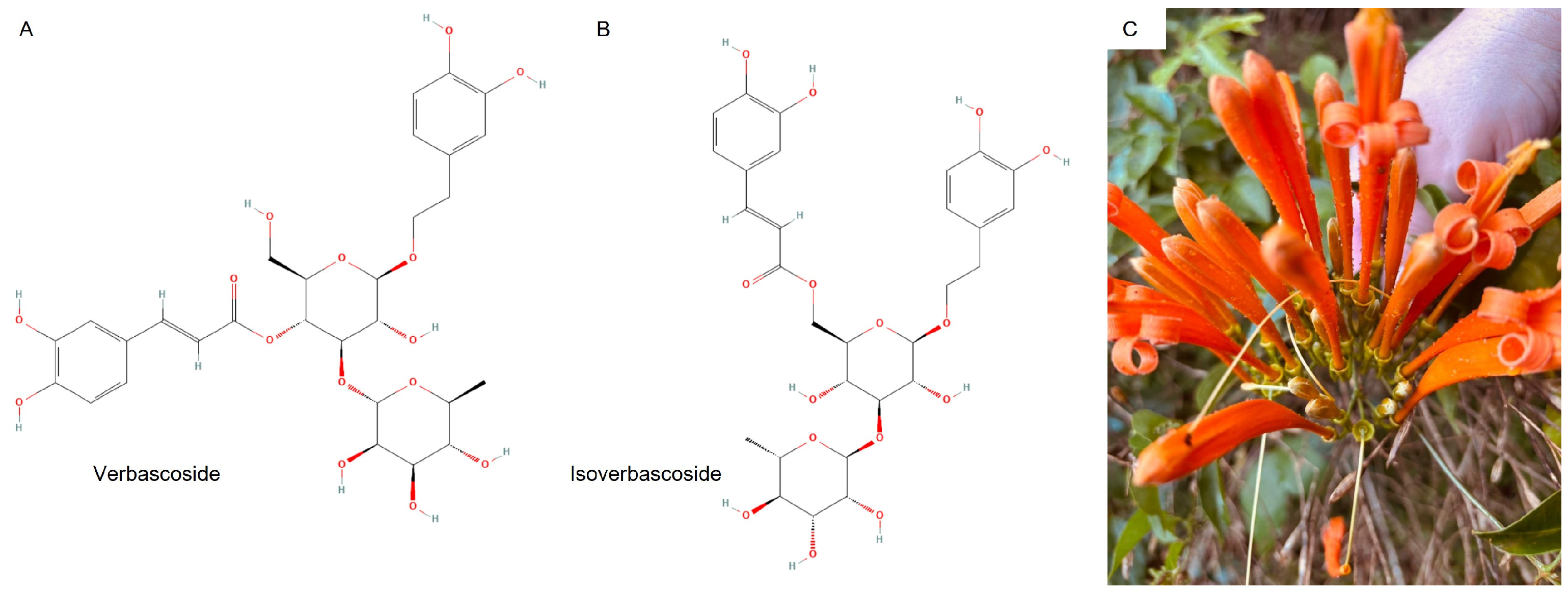
The cytotoxic potential and molecular mechanisms of action of the phenylpropanoids verbascoside (Figure 1A) and isoverbascoside (Figure 1B) [9], isolated from Pyrostegia venusta (Figure 1C), were evaluated using in silico methods. The selection of this plant species was based on the availability of specimens cultivated in the Medicinal Garden of the State University of Minas Gerais (UEMG), Academic Unit of Passos, Passos, Brazil, which enables the continuity of experimental studies and the optimization of cultivation conditions aimed at obtaining higher concentrations of bioactive compounds.

2.2. Prediction of Cytotoxicity and Antitumor Activity in Breast Cancer

The cytotoxic potential of the compounds was evaluated using in silico methodologies. Initially, the CLC-Pred software 2.0, Moscow, Russia “https://way2drug.com/clc-pred/ (accessed on 11 July 2025)” [10] was employed to estimate cytotoxicity against the non-tumorigenic epithelial cell line MCF-10A, used as a reference model for assessing selectivity. Predictions were expressed as pIC50 values, according to the software’s validation criteria. Subsequently, the antitumor potential was investigated using the BC CLC-Pred 1.0 platform, Moscow, Russia “https://way2drug.com/bc/ (accessed on 11 July 2025)” [11], which predicts activity against breast cancer cell lines, notably MCF-7 (mammary gland adenocarcinoma) and T-47D (mammary gland ductal carcinoma), both estrogen receptor–positive, expressed as pIC50 and pIG50. All predictions were interpreted within the applicability domain of the models, ensuring that the evaluated compounds fall within the chemical space covered by the training datasets, thereby increasing the reliability of the predictions. The evaluated compounds included the phenylpropanoids isolated from Pyrostegia venusta, verbascoside (Compound CID: 5281800) and isoverbascoside (Compound CID: 6476333), along with the reference drug tamoxifen (Compound CID: 2733526), all retrieved from the PubChem database Maryland, United States (USA) “https://pubchem.ncbi.nlm.nih.gov/ (accessed on 11 July 2025)”.

2.3. Identification of Interactions with the Estrogen Receptor and CYP3A4

The molecular interactions of the compounds with the estrogen receptor (ER) and the CYP3A4 enzyme were evaluated using the ADMETlab 2.0 platform Zhejiang, China “https://admetmesh.scbdd.com/ (accessed on 11 July 2025)” [12]. For these classification endpoints, the platform outputs qualitative probability classes rather than absolute numerical affinity values. Specifically, the prediction probabilities generated by the underlying machine-learning models are internally mapped into six categorical symbols: 0–0.1 (---), 0.1–0.3 (--), 0.3–0.5 (-), 0.5–0.7 (+), 0.7–0.9 (++), and 0.9–1.0 (+++).
These symbols therefore represent probability ranges associated with the predicted likelihood of interaction or classification outcome, and should be interpreted as qualitative indicators of confidence rather than quantitative binding scores. Consequently, the ER and CYP3A4 outputs allow comparative qualitative assessment of interaction tendencies and metabolic behavior, but do not provide direct numerical measures suitable for statistical comparison. The predictive reliability of the models is supported by their reported performance metrics, including area under the ROC curve, accuracy, Matthews correlation coefficient, specificity, and sensitivity, as provided by the ADMETlab 2.0 validation framework [12].

2.4. Molecular Docking

The three-dimensional structure of the protein was obtained from the Protein Data Bank (PDB) “https://www.rcsb.org/ (accessed on 11 July 2025)” under the accession code PDB ID: 1D5R. The binding to the tumor suppressor protein PTEN (Phosphatase and Tensin Homolog) was evaluated using in silico molecular docking methodology through the CB-Dock2 platform Chengdu, China “https://cadd.labshare.cn/cb-dock2/ (accessed on 11 July 2025)” [13]. Tamoxifen was used as the reference compound for model validation and comparison of binding affinity. The selection of PTEN [14] as a molecular target was based on its crucial role in regulating the PI3K/AKT/mTOR signaling pathway, as PTEN suppression or loss-of-function leads to constitutive activation of this pathway, promoting uncontrolled cell proliferation, enhanced survival signaling, metabolic reprogramming, and resistance to apoptosis, hallmarks frequently observed in breast cancer progression. Additionally, PTEN presents a well-characterized phosphatase domain [15] with a defined active site and available high-resolution crystallographic structures, which support its suitability for structure-based molecular docking analyses. Docking results were expressed as binding free energy (kcal.mol−1).

3. Results

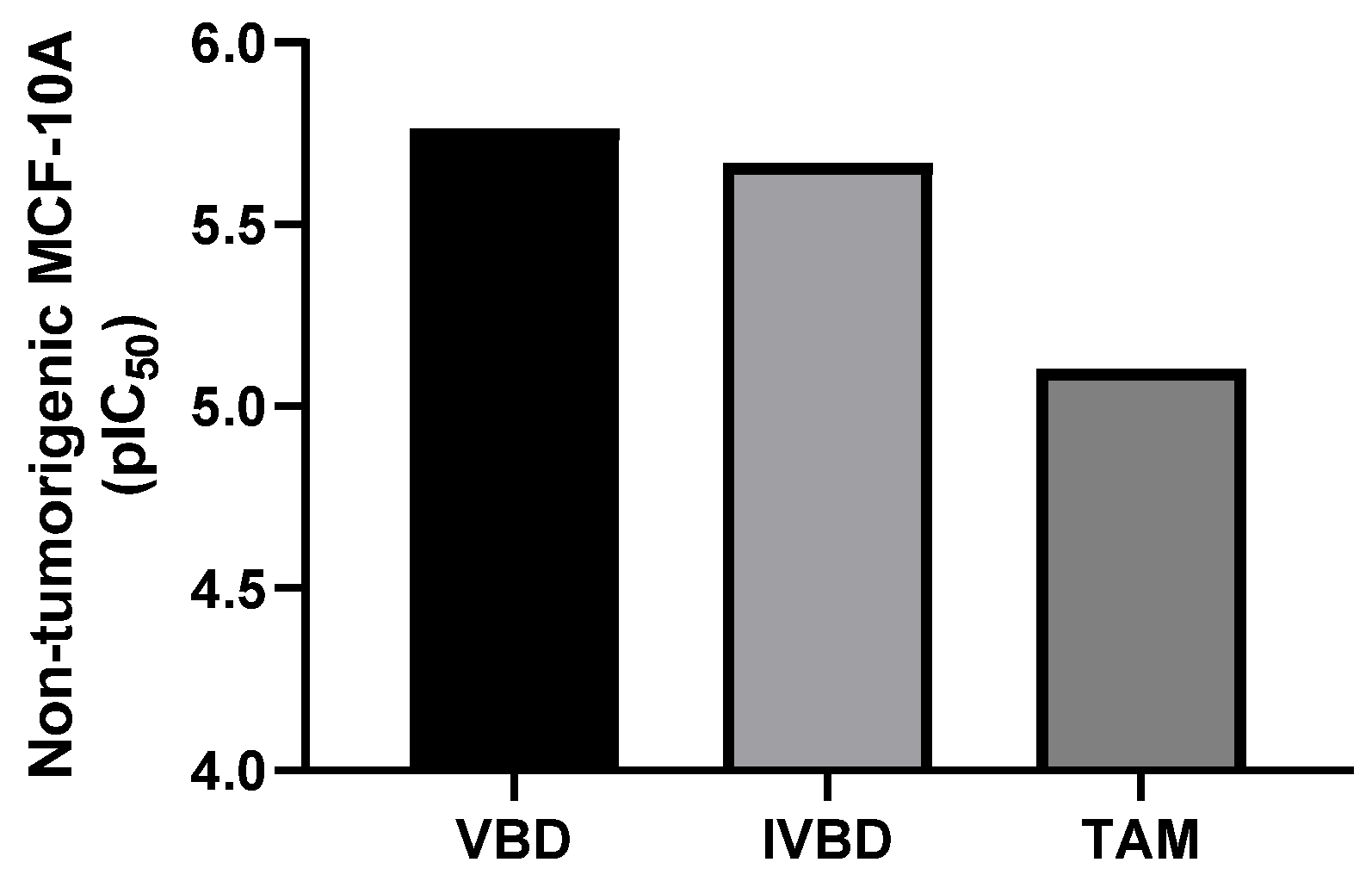
The phenylpropanoids (Figure 2) exhibited lower predicted cytotoxicity toward the non-tumorigenic MCF-10A cell line compared to tamoxifen, with pIC50 values of 5.76 (verbascoside) and 5.66 (isoverbascoside), while the reference drug presented a pIC50 of 5.10. Although these differences are numerically small, they suggest a trend toward reduced cytotoxicity in non-tumor cells. However, given the in silico nature of the predictions and the absence of associated statistical dispersion metrics, these differences should be interpreted as indicative rather than biologically definitive.
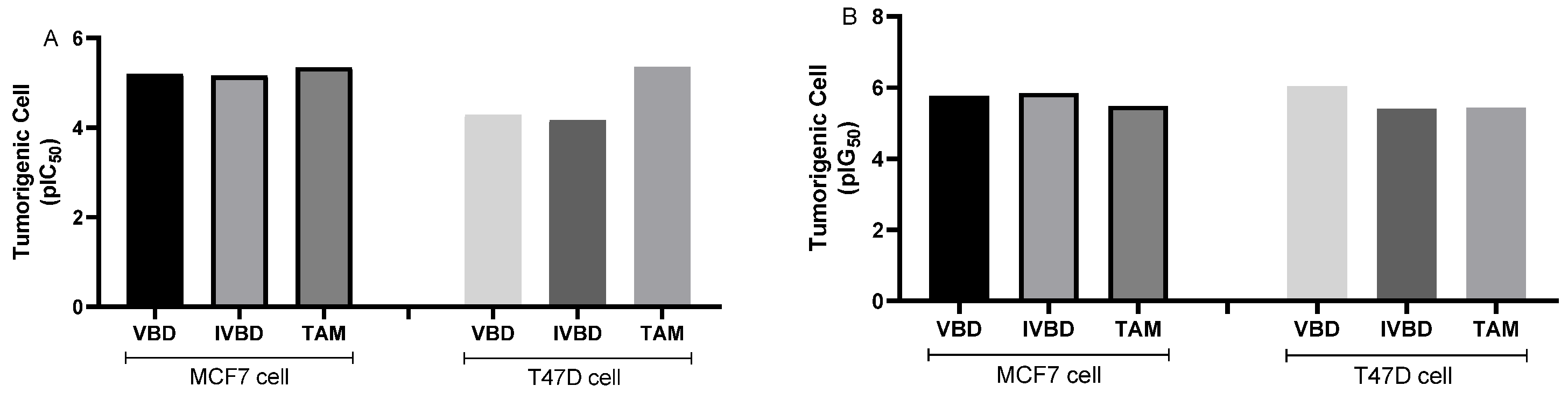
In the antitumor activity assessment (Figure 3A), the pIC50 values in MCF-7 cells were similar between the phenylpropanoids (pIC50 = 5.20 and 5.16), whereas tamoxifen showed higher cytotoxic potency (pIC50 = 5.35). In T47D cells, the phenylpropanoids exhibited lower activity (pIC50 = 4.28 and 4.17), while tamoxifen maintained a stronger cytotoxic effect (pIC50 = 5.35).
Regarding antiproliferative potential (Figure 3B), the QSAR models for MCF-7 cells predicted higher pIG50 values for the phenylpropanoids (5.76 and 5.85) compared to tamoxifen (pIG50 = 5.48), indicating greater anticipated antiproliferative activity. In T47D cells, verbascoside reached the highest predicted value (pIG50 = 6.03), surpassing both isoverbascoside (pIG50 = 5.41) and tamoxifen (pIG50 = 5.44). According to the platform’s criteria, values above 6 are considered highly relevant.
The in silico predictions indicated low interaction of the phenylpropanoid isoverbascoside in the NR-ER and NR-ER-LBD assays (Table 1), whereas tamoxifen demonstrated strong estrogen receptor engagement, as expected. Regarding metabolic parameters, both verbascoside and isoverbascoside were not predicted to inhibit CYP3A4, in contrast to tamoxifen, which showed a higher likelihood of acting as a substrate and a moderate inhibitor of this isoenzyme.
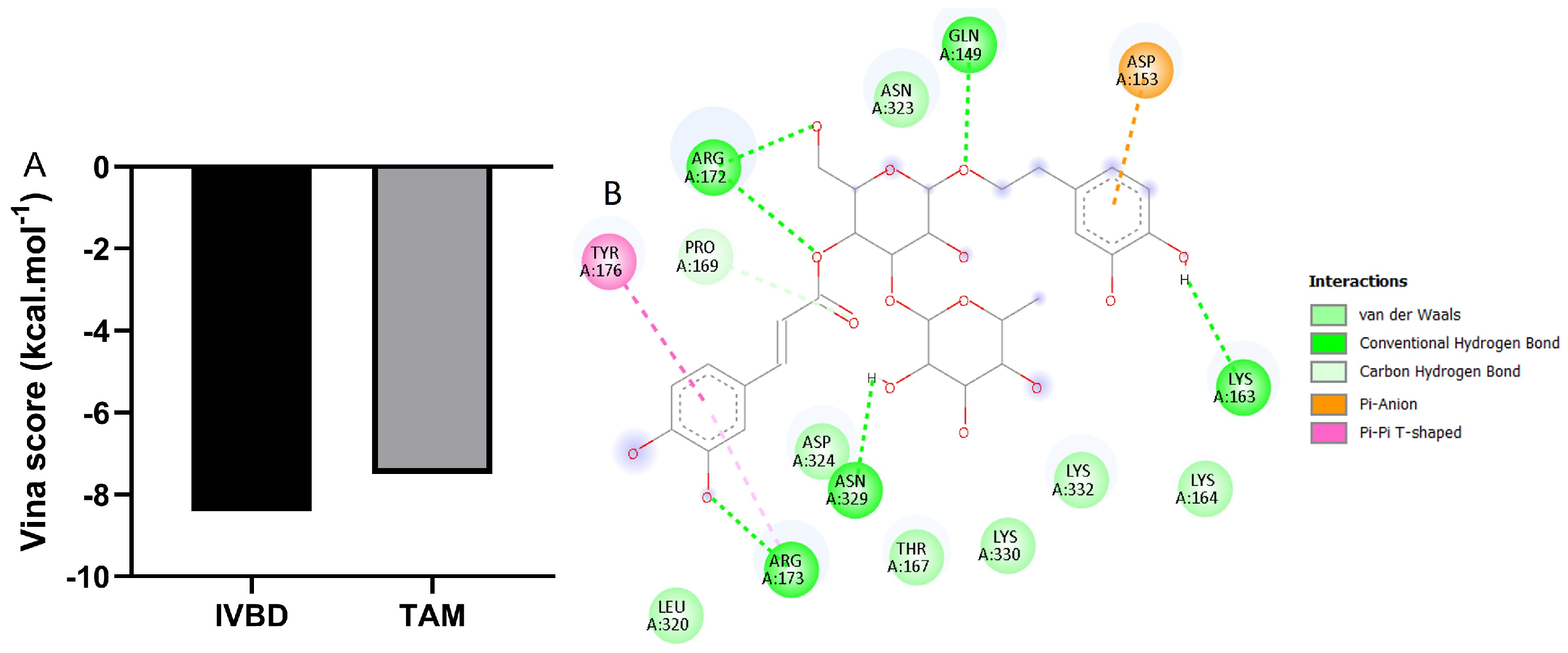
Molecular docking analysis (Figure 4A) indicated a higher predicted affinity for isoverbascoside, with a binding energy of −8.4 kcal.mol−1, surpassing tamoxifen (−7.5 kcal.mol−1) and suggesting a more stable interaction with the modeled target. The docking pose (Figure 4B) revealed a favorable binding mode within the protein’s active site, characterized by multiple non-covalent interactions. The complex was primarily stabilized by six conventional hydrogen bonds involving residues GLN149, ARG172, LYS163, ASN329, ASP324, and ARG173, highlighting the essential role of polar groups and glycosidic moieties in site recognition.
Additionally, aromatic interactions contributed significantly to anchoring the phenolic ring, including a T-shaped π–π interaction with TYR176 and a strong π–anion interaction with ASP153. Van der Waals forces involving PRO169, LEU320, and other nearby residues further supported the precise accommodation of the ligand within the hydrophobic pocket. Together, these findings confirm that the ligand binds in a stable and specific manner, engaging both polar and aromatic regions of the active site.

4. Discussion

The in silico analyses conducted in this study indicate that the phenylpropanoids verbascoside and isoverbascoside exhibit predicted trends of cytotoxic selectivity when compared with tamoxifen, particularly in the non-tumorigenic MCF-10A cell line. Although these findings are derived exclusively from computational predictions and should not be interpreted as direct evidence of an improved safety profile, they highlight the value of in silico approaches as early-stage screening tools for identifying compounds with differential activity toward tumor and non-tumor cells [16]. Such predictions provide a rational basis for prioritizing candidates for subsequent experimental validation.
In this context, the observed selectivity trends are consistent with previous reports describing the antioxidant properties and low toxicity of Pyrostegia venusta extracts [6,8]. Moreover, the higher predicted antiproliferative activity of verbascoside reinforces its relevance as a promising molecular scaffold for ER+ breast cancer research. Similar applications of in silico early-screening strategies have been successfully employed to identify natural compounds with selective antitumor potential, supporting the translational relevance of computational methodologies in natural product–based drug discovery [17,18].
Phenylpropanoid-rich extracts have been reported to interact with molecular pathways associated with carcinogenesis, including estrogen-related signaling and tumor suppressor–associated proteins [19]. In this context, the predicted interaction of isoverbascoside with the estrogen receptor is consistent with previous in silico and experimental reports describing the affinity of phenolic compounds toward ER+ tumor models. Regarding PTEN, the observed binding affinity suggests a potential structural compatibility between isoverbascoside and the protein; however, molecular docking alone does not imply functional activation, stabilization, or enhancement of PTEN signaling [14]. Any possible influence on the PI3K/AKT/mTOR pathway remains speculative and cannot be inferred without functional assays.
The CYP3A4 profiling revealed distinct metabolic behaviors. Verbascoside showed neither substrate affinity nor inhibitory effect, indicating a low likelihood of CYP3A4-mediated interactions and suggesting a favorable metabolic safety profile. Isoverbascoside displayed moderate substrate potential but no inhibitory activity, while tamoxifen, as expected, exhibited strong substrate behavior and moderate inhibition, consistent with reports of its extensive CYP3A4 metabolism [20]. These findings collectively indicate that verbascoside may present fewer pharmacokinetic interactions than tamoxifen.
The docking results indicate the formation of stable ligand–protein complexes mediated by non-covalent interactions, such as hydrogen bonds, π-interactions, and hydrophobic contacts. These interactions reflect favorable binding geometry rather than direct evidence of biological modulation, in agreement with the limitations inherent to structure-based computational approaches [8,13]. Thus, the stronger predicted affinity of isoverbascoside toward PTEN should be interpreted as a starting point for hypothesis generation rather than proof of tumor-suppressive activity.
Overall, the integrated in silico analyses performed in this study provide a coherent preliminary framework for the evaluation of verbascoside and isoverbascoside as natural phenylpropanoids of interest in ER+ breast cancer drug discovery and early-stage screening [12]. The predicted trends of cytotoxic selectivity, receptor interaction profiles, and docking results highlight these compounds as candidates for further investigation [21]. However, the study is limited by its exclusive reliance on computational models, which do not account for biological complexity, do not provide statistical dispersion metrics, and do not imply functional modulation of molecular targets. Consequently, the findings should be interpreted as hypothesis-generating rather than confirmatory, and experimental validation through cell-based and molecular assays is required to establish cytotoxic efficacy, receptor modulation, and any potential involvement of PTEN-related signaling pathways [14].

5. Conclusions

The results indicate that these phenylpropanoids, particularly isoverbascoside, exhibit promising in silico antitumor potential for breast cancer, demonstrating predicted cell selectivity and relevant interactions with hormone receptors and molecular biomarkers. However, these findings are preliminary and based on computational analyses, highlighting the need for further in vitro and in vivo studies to validate their antitumor efficacy and safety profiles.

Author Contributions

Conceptualization: S.d.A.-J. and I.C.G.H.; methodology: A.L.P. and J.L.S.; software: G.M.C.L. and L.H.C.; validation: S.d.A.-J. and J.L.S.; formal analysis: A.C.M.d.C.e.S.; investigation: A.C.M.d.C.e.S. and S.M.P.d.B.; resources: S.d.A.-J.; data curatorship: S.d.A.-J.; writing—preparation of the original draft: A.C.M.d.C.e.S. and S.M.P.d.B.; writing—proofreading and editing: S.d.A.-J.; visualization: I.C.G.H.; supervision: J.d.S.C.; project administration: S.d.A.-J. All authors have read and agreed to the published version of the manuscript.

Funding

This research received no external funding.

Institutional Review Board Statement

Not applicable.

Informed Consent Statement

Not applicable.

Data Availability Statement

Data is contained within the article.

Conflicts of Interest

The authors declare no conflicts of interest.

Abbreviations

UEMGState University Minas Gerais
MCF-10ANon-tumorigenic epithelial cell line
pIC50Prediction of 50% inhibition value of cell
pIG50Prediction of 50% proliferation value of cell
PTENPhosphatase and Tensin Homolog
MCF-7Human breast cancer cell proliferation
T-47DEpithelial cells isolated from a pleural effusion
VBDVerbascoside
IVBDIsoverbascoside
TAMTamoxifen

References

  1. Xiong, X.; Zheng, L.-W.; Ding, Y.; Chen, Y.-F.; Cai, Y.-W.; Wang, L.-P.; Huang, L.; Liu, C.-C.; Shao, Z.-M.; Yu, K.-D. Breast Cancer: Pathogenesis and Treatments. Signal Transduct. Target. Ther. 2025, 10, 49. [Google Scholar] [CrossRef] [PubMed]
  2. Primo, W.Q.S.P. National Cancer Institute and the 2023–2025 Estimate—Cancer Incidence in Brazil. Rev. Bras. Ginecol. Obs. 2023, 45, 1–2. [Google Scholar] [CrossRef] [PubMed]
  3. Liu, S.; Zhang, X.; Wang, W.; Li, X.; Sun, X.; Zhao, Y.; Wang, Q.; Li, Y.; Hu, F.; Ren, H. Metabolic Reprogramming and Therapeutic Resistance in Primary and Metastatic Breast Cancer. Mol. Cancer 2024, 23, 261. [Google Scholar] [CrossRef] [PubMed]
  4. Li, Q.; Ye, Z.; Wang, G.; Chen, Y.; Deng, J.; Wang, D.; Wang, Y. Natural Products as Novel Therapeutic Agents for Triple-Negative Breast Cancer: Current Evidence, Mechanisms, Challenges, and Opportunities. Molecules 2025, 30, 1201. [Google Scholar] [CrossRef]
  5. Damasceno, J.L.; Ozelin, S.D.; Leandro, L.F.; Ambrosio, M.A.L.V.; Garcia, L.A.; Garcia, R.; Almeida Júnior, S.; Magalhães, L.F.; Santiago, M.B.; Noronha, F.d.F.; et al. Evaluation of the Biological Potential of Crude Extracts of Brazilian Medicinal Plants in a Social Context and for Safe Use in Human Health. J. Ethnopharmacol. 2026, 357, 120967. [Google Scholar] [CrossRef]
  6. de Sousa, M.B.; Júnior, J.O.C.S.; Barbosa, W.L.R.; da Silva Valério, E.; da Mata Lima, A.; de Araújo, M.H.; Muzitano, M.F.; Nakamura, C.V.; de Mello, J.C.P.; Teixeira, F.M. Pyrostegia venusta (Ker Gawl.) Miers Crude Extract and Fractions: Prevention of Dental Biofilm Formation and Immunomodulatory Capacity. Pharmacogn. Mag. 2016, 12, S218–S222. [Google Scholar] [CrossRef]
  7. Gavilan, N.H.; de Freitas Morel, L.J.; da Silva Coppede, J.; Taleb-Contini, S.H.; de Castro França, S.; Bertoni, B.W.; Pereira, A.M.S. Genetic Diversity and Verbascoside Content in Natural Populations of Pyrostegia venusta (Ker Gawl.) Miers. Mol. Biol. Rep. 2022, 49, 8617–8625. [Google Scholar] [CrossRef]
  8. de Souza, M.C.; Bertini, L.; Szmaruk, J.E.; de Almeida, M.R.; Agneis, M.L.G.; Cesário, R.C.; Caputo, W.L.; da Costa, C.L.; Garcia, V.A.D.S.; Seiva, F.R.F. Effect of Drying Methods on Bioactivity of Pyrostegia venusta Extracts: Antioxidant Assays, Cytotoxicity, and Computational Approaches. Pharmaceuticals 2025, 18, 1315. [Google Scholar] [CrossRef]
  9. Pereira, A.M.S.; Hernandes, C.; Pereira, S.I.V.; Bertoni, B.W.; França, S.C.; Pereira, P.S.; Taleb-Contini, S.H. Evaluation of Anticandidal and Antioxidant Activities of Phenolic Compounds from Pyrostegia venusta (Ker Gawl.) Miers. Chem.-Biol. Interact. 2014, 224, 136–141. [Google Scholar] [CrossRef]
  10. Lagunin, A.A.; Rudik, A.V.; Pogodin, P.V.; Savosina, P.I.; Tarasova, O.A.; Dmitriev, A.V.; Ivanov, S.M.; Biziukova, N.Y.; Druzhilovskiy, D.S.; Filimonov, D.A.; et al. CLC-Pred 2.0: A Freely Available Web Application for In Silico Prediction of Human Cell Line Cytotoxicity and Molecular Mechanisms of Action for Druglike Compounds. Int. J. Mol. Sci. 2023, 24, 1689. [Google Scholar] [CrossRef]
  11. Lagunin, A.A.; Sezganova, A.S.; Muraviova, E.S.; Rudik, A.V.; Filimonov, D.A. BC CLC-Pred: A Freely Available Web-Application for Quantitative and Qualitative Predictions of Substance Cytotoxicity in Relation to Human Breast Cancer Cell Lines. SAR QSAR Environ. Res. 2024, 35, 1–9. [Google Scholar] [CrossRef] [PubMed]
  12. Xiong, G.; Wu, Z.; Yi, J.; Fu, L.; Yang, Z.; Hsieh, C.; Yin, M.; Zeng, X.; Wu, C.; Lu, A.; et al. ADMETlab 2.0: An Integrated Online Platform for Accurate and Comprehensive Predictions of ADMET Properties. Nucleic Acids Res. 2021, 49, W5–W14. [Google Scholar] [CrossRef] [PubMed]
  13. Liu, Y.; Yang, X.; Gan, J.; Chen, S.; Xiao, Z.-X.; Cao, Y. CB-Dock2: Improved Protein–Ligand Blind Docking by Integrating Cavity Detection, Docking and Homologous Template Fitting. Nucleic Acids Res. 2022, 50, W159–W164. [Google Scholar] [CrossRef] [PubMed]
  14. Yari, K.; Hakimi, A.; Mohammadi, M.; Ammari-Allahyari, M.; Salari, N.; Ghasemi, H. The Association of PTEN Gene Mutations with the Breast Cancer Risk: A Systematic Review and Meta-Analysis. Biochem. Genet. 2024, 62, 1617–1635. [Google Scholar] [CrossRef]
  15. Lee, J.-O.; Yang, H.; Georgescu, M.-M.; Cristofano, A.D.; Maehama, T.; Shi, Y.; Dixon, J.E.; Pandolfi, P.; Pavletich, N.P. Crystal Structure of the PTEN Tumor Suppressor: Implications for Its Phosphoinositide Phosphatase Activity and Membrane Association. Cell 1999, 99, 323–334. [Google Scholar] [CrossRef]
  16. Kao, H.-J.; Weng, T.-H.; Chen, C.-H.; Chen, Y.-C.; Chi, Y.-H.; Huang, K.-Y.; Weng, S.-L. Integrating In Silico and In Vitro Approaches to Identify Natural Peptides with Selective Cytotoxicity against Cancer Cells. Int. J. Mol. Sci. 2024, 25, 6848. [Google Scholar] [CrossRef]
  17. Chavda, V.P.; Ertas, Y.N.; Walhekar, V.; Modh, D.; Doshi, A.; Shah, N.; Anand, K.; Chhabria, M. Advanced Computational Methodologies Used in the Discovery of New Natural Anticancer Compounds. Front. Pharmacol. 2021, 12, 702611. [Google Scholar] [CrossRef]
  18. Adikusuma, W.; Firdayani, F.; Andrina Kusumastuti, S.; Nuralih, N.; Listiana, S.; Masyita, A.; Muhammad Irham, L.; Hodijah, S.; Zulaikha Hildayani, S.; Mugiyanto, E. Integrative Network Pharmacology and Experimental Validation Reveal Emodin Derivatives as Potential Therapeutics for Hepatocellular Carcinoma. J. Egypt. Natl. Cancer Inst. 2025, 37, 52. [Google Scholar] [CrossRef]
  19. Turgunbayeva, A.A.; Sultanova, N.A.; Hamad, M.S.; Savelyev, V.A.; Chernyak, E.I.; Bagryanskaya, I.Y.; Pokrovsky, M.A.; Pokrovsky, A.G.; Gemejiyeva, N.G.; Shults, E.E. Isolation and Identification of Secondary Metabolites in Rheum tataricum L.Fil. Growing in Kazakhstan and Surveying of Its Anticancer Potential. Molecules 2025, 30, 2978. [Google Scholar] [CrossRef]
  20. Zhang, Y.; Wang, Z.; Wang, Y.; Jin, W.; Zhang, Z.; Jin, L.; Qian, J.; Zheng, L. CYP3A4 and CYP3A5: The Crucial Roles in Clinical Drug Metabolism and the Significant Implications of Genetic Polymorphisms. PeerJ 2024, 12, e18636. [Google Scholar] [CrossRef]
  21. Dong, J.; Wang, N.-N.; Yao, Z.-J.; Zhang, L.; Cheng, Y.; Ouyang, D.; Lu, A.-P.; Cao, D.-S. ADMETlab: A Platform for Systematic ADMET Evaluation Based on a Comprehensively Collected ADMET Database. J. Cheminform. 2018, 10, 29. [Google Scholar] [CrossRef]
Figure 1. Identification of phenylpropanoids verbascoside (A) and isoverbascoside (B) from the floral extract of the plant Pyrostegia venusta (C).
Msf 41 00002 g001
Figure 2. Predicted cytotoxic potential of the non-tumorigenic epithelial cell line MCF-10A for the phenylpropanoids verbascoside (VBD) and isoverbascoside (IVBD) from Pyrostegia venusta compared to the reference drug tamoxifen (TAM), expressed as pIC50 values obtained by in silico prediction using the CLC-Pred platform. Values represent single-point predictions generated by QSAR models and do not include statistical dispersion measures.
Msf 41 00002 g002
Figure 3. Predicted antitumor (A) and antiproliferative (B) activities of the phenylpropanoids verbascoside (VBD) and isoverbascoside (IVBD) from Pyrostegia venusta compared to tamoxifen (TAM) in MCF-7 and T-47D breast cancer cell lines. Predictions are expressed as pIC50 and pIG50 values obtained from BC CLC-Pred QSAR models. Results correspond to single predicted values without associated standard errors or confidence intervals and should be interpreted as comparative in silico trends.
Msf 41 00002 g003
Figure 4. Molecular anchorage (A) of the phenylpropanoid isoverbascoside (IVBD) and standard drug tamoxifen (TAM) against the PTEN protein, demonstrating free energy released (kcal.mol−1) and residue binding site (B).
Msf 41 00002 g004
Table 1. Determination of integration between phenylpropanoid compounds of Pyrostegia venusta against endocrine receptors and modulation of P450 isoenzymes (CYP3A4).
TestVerbascosideIsoverbascosideTamoxifen
NR-ER0.3–0.50.5–0.70.9–1.0
NR-ER-LBD0.1–0.30.3–0.50–0.1
Substrate CYP3A40–0.10.7–0.90.9–1.0
Inhibition CYP3A40–0.10–0.10.7–0.9
Disclaimer/Publisher’s Note: The statements, opinions and data contained in all publications are solely those of the individual author(s) and contributor(s) and not of MDPI and/or the editor(s). MDPI and/or the editor(s) disclaim responsibility for any injury to people or property resulting from any ideas, methods, instructions or products referred to in the content.