1. Introduction
Acute viral hepatitis (AVH) persists in Pakistan despite improvements in cleanliness, health knowledge, and socioeconomic situations, making viral hepatitis a significant public health concern. One of the most significant systemic diseases, acute viral hepatitis (AVH), is brought on by hepatotropic viruses to which humans are susceptible. Hepatitis A and E are hyperendemic in Pakistan [
1]. Twenty million cases of acute viral hepatitis are recorded worldwide each year, with the hepatitis E virus (HEV) being the most common cause in developing nations like Pakistan.
The increased severity of hepatitis E virus (HEV) infection during pregnancy is attributed to pregnancy-associated immunological modulation, characterized by a shift toward T-helper-2-dominant immune responses that impair effective viral clearance. In addition, elevated levels of estrogen and progesterone may enhance HEV replication, while HEV genotype prevalent in South Asia is strongly associated with fulminant hepatic failure and increased maternal mortality.
By the feco-oral route, primarily through the ingestion of tainted food and water or contact with untreated sewage, HEV causes a self-limiting illness [
2,
3,
4]. Furthermore, another documented method of hepatitis E virus transmission is blood transfusion. In Pakistan, zoonotic transmission (genotypes 3 and 4 circulating in numerous species worldwide) seems to be rare, whereas genotype 1 (pathogenic solely for humans and non-human primates, as genotype 2) is the primary cause of HEV [
5,
6,
7]. Even while hepatitis E is known to resolve on its own in developing nations, pregnant women experience more severe symptoms [
8]. The main consequence of genotype-driven breakouts in pregnant women is the onset of fulminant hepatic failure [
1]. The third trimester of pregnancy is typically when the mortality rate occurs, and it might reach 30% [
9]. Globally, seroprevalence studies of hepatitis E virus (HEV) report wide variability, with overall anti-HEV antibody prevalence estimates ranging from approximately 2% to 20% in the general population, and even higher rates in endemic regions. In Pakistan, several studies have documented HEV seroprevalence among pregnant women and other high-risk groups as high as 30–60%, reflecting persistent endemicity and frequent exposure in the community.
Although pregnant women should not have a greater rate of HEV seropositivity than the general population, the disease did appear as severe in this particular demographic, and their prognosis was worse. In regions with improved water and sanitation, hepatitis E infections are rare. Most places have shown serological evidence of previous virus exposure, with greater seroprevalence rates in locations with less sanitation and a higher risk of transmission [
10]. Data on hepatitis E virus (HEV) infection among pregnant women in South Punjab, Pakistan, remain scarce, particularly among asymptomatic antenatal populations. The present study is novel in simultaneously assessing both anti-HEV IgM and IgG seroprevalence in asymptomatic pregnant women from this under-reported region, thereby providing updated insight into ongoing and past HEV exposure and revealing the silent circulation of HEV in this high-risk group. Given that hepatitis E infection can pose a concern during pregnancy, the purpose of this study was to assess the virus’s seroprevalence in pregnant women from a tertiary care facility in South Punjab, Pakistan, in order to look into our area, where no prior research has been published. This study aims to determine the prevalence of ongoing and previous hepatitis E virus (HEV) infection by detecting anti-HEV IgM and IgG antibodies among pregnant women attending a tertiary care center in South Punjab, Pakistan. Additionally, this study seeks to evaluate the association of HEV seropositivity with selected sociodemographic and environmental risk factors, thereby contributing region-specific evidence to inform antenatal screening and public health interventions.
2. Materials and Methods
The presence of HEV antibodies (IgM and IgG) was checked in all (n = 100) serum samples using enzyme-linked immunosorbent assay (ELISA) kits (DIA.PRO-Italy, Sesto San Giovanni, Italy). The ELISA was carried out in compliance with the manufacturer’s instructions. The following criteria provided by the manufacturer were used to interpret the test results: the ratio of the sample’s OD 450 nm to the cut-off value.
To determine the associated factors influencing the seroprevalence attained in the pregnant women participating in the current investigation, a number of sociodemographic data were also gathered. These include things like drinking water quality, sanitation habits, educational attainment, and socioeconomic level. The percentage (% out of total number and positives) was computed after all the information was gathered; the information are outlined in
Table 1.
A structured, pre-designed questionnaire was administered to all participants at the time of sample collection to obtain sociodemographic and exposure-related information. The questionnaire included details on age, place of residence (urban or rural), educational status, source of drinking water, sanitation practices, past history of jaundice, and socioeconomic status. All information was collected through face-to-face interviews conducted by trained personnel, and responses were recorded prior to serological testing.
A total of 100 blood samples were collected from asymptomatic pregnant women attending the inpatient and outpatient antenatal clinics of a tertiary care hospital in South Punjab, Pakistan. Following collection, blood samples were allowed to clot at room temperature and were subsequently centrifuged to separate serum. The sera were aliquoted and stored at −20 °C until serological analysis for anti-HEV IgM and IgG antibodies was performed.
Participants were asked about their primary source of drinking water as part of the questionnaire. Drinking water was categorized as (i) untreated water, referring to unboiled tap water or groundwater consumed without filtration; (ii) boiled water; and (iii) commercially filtered or bottled water. Of the 100 participants, 3 reported using untreated water, 79 reported using boiled water, and the remaining 18 reported using commercially filtered or bottled water. These categories were used to assess potential environmental risk factors associated with HEV seropositivity.
To ascertain the seroprevalence of hepatitis E antibodies in asymptomatic pregnant women from the tertiary care hospital in South Punjab, Pakistan, a two-month cross-sectional descriptive research was conducted. During the study period, all asymptomatic pregnant women visited both the inpatient and outpatient departments. Samples were taken from successive antenatal women who were attending outpatient and inpatient obstetrics and gynecology departments after receiving approval from the Institute Ethics Committee. A total of 100 samples were taken from pregnant women who were asymptomatic. No duplicate samples were taken from the same individual. During the prenatal checkup, blood samples were taken in addition to routine screening tests. Additionally, prior to the detection, the serum was separated and kept in a deep freezer at −20 °C.
For the purpose of detecting HEV IgM and IgG, blood samples from asymptomatic pregnant women were obtained. Most of them were pregnant and in the third trimester. The sample-gathering process was finished in three months. Along with routine screening tests during the prenatal checkup, 2 ml of blood was drawn from asymptomatic pregnant women. Before being used, all sera were kept apart and stored at −20 °C in a deep freezer. The same individual did not have a repeat sample taken. About 59% of the pregnant women in the study had a good education and have completed or are pursuing a degree. Out of them, just three lack literacy. All of the others have completed higher secondary education.
3. Results and Discussion
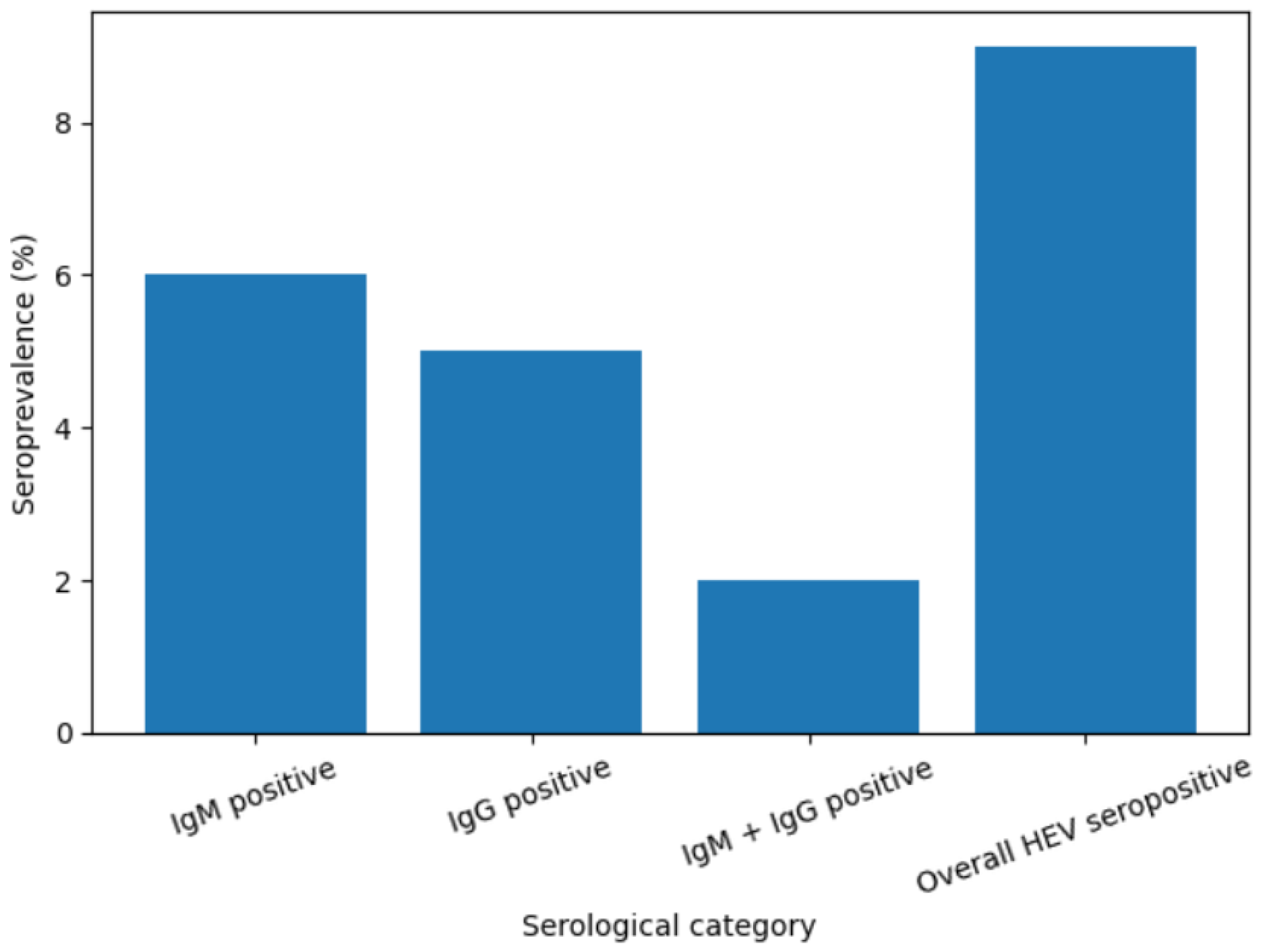
A total of 100 asymptomatic pregnant women attending the inpatient and outpatient antenatal clinics of [Nishtar Hospital II], a tertiary care center in South Punjab, Pakistan, were enrolled in this study. Participants’ ages ranged from 19 to 42 years. The majority (82%) resided in rural areas, and 59% had completed or were pursuing graduate or postgraduate education. All participants belonged to the middle socioeconomic class. Serological testing for anti-HEV antibodies revealed that 9% of participants were positive (IgM and/or IgG). Specifically, 6% tested positive for IgM antibodies, indicating recent infection, 5% for IgG antibodies, indicating past exposure, and 2% showed positivity for both IgM and IgG (
Figure 1). Analysis by sociodemographic and environmental factors showed that 5 of 18 urban participants were HEV-positive (27.8%), compared to 4 of 82 rural participants (4.9%), though this difference likely reflects the unequal number of participants rather than a true epidemiological trend. Regarding water source, 1 of 3 participants using untreated water, 6 of 79 using boiled water, and 2 of 18 using commercially filtered or bottled water tested positive for HEV antibodies (
Table 1). No clinical signs of hepatitis were observed in any participant. Liver function tests were not performed, as the study focused on asymptomatic antenatal women undergoing routine screening; this limitation is acknowledged.
Our study participants range in age from 19 to 42. Just 21% of them use boiling water, which is a sign of poor drinking water quality. Our study group’s socioeconomic status includes middle-class individuals. Nobody from a lower socioeconomic background was present. About 82 percent of the pregnant women in our study were from rural areas. Antibody positivity is displayed in
Table 1, along with a few demographic factors. Nine samples (9%) out of 100 were positive for HEV antibodies, where five (5%) were IgG-positive and six (6%) were IgM positive (Figure). Equivocal IgM findings were seen in two samples. Likewise, IgG was also discovered to be ambiguous in one sample. However, after being left for two weeks for confirmation, we were unable to replicate it. IgM and IgG were detected in two samples.
HEV infection is a serious public health risk. In poor nations, hepatitis E virus is the source of both widespread outbreaks and isolated episodes of acute viral hepatitis. In most cases, the infection is moderate and goes away on its own. A possible risk factor for fulminant hepatic failure and maternal death during pregnancy is HEV, particularly during the third trimester. Nine (9%) of the 100 pregnant women who were examined for HEV antibodies tested positive in our study. There are no indications of hepatic involvement, and all patients are asymptomatic. Seropositivity is 9% overall. In total, five tested positive for IgG and six tested positive for IgM. Numerous research studies have been conducted in our nation to determine the seroprevalence of HEV infection, with some focusing especially on pregnant women because they are more susceptible to this virus. The majority of these research papers tried to identify IgG antibodies. Our research aligns with a prior study conducted in South Punjab, Pakistan, which revealed a prevalence rate of 14%. One study [
11] explains that in terms of their level of education, sanitation habits, and drinking water quality, South Punjab residents’ lifestyles are not all that different from those in our area. Our results are consistent with a prevalence of 7.7% reported in a French study. No history of liver disease was revealed by any of the women who tested positive for HEV IgG [
12].
In a study conducted in Multan, when asymptomatic women were also included in the population under investigation, a high seropositivity of 33.67% was recorded [
13]. The study showed that pregnant women from the lower middle class in Bangladesh had a higher seroprevalence of anti-HEV IgG (57.4%) than pregnant women from the upper middle class (15.1%) [
14]. Low socioeconomic level, which is regarded as one of the risk factors, was linked to a higher prevalence [
13]. Our investigation found no significant relationship between educational status and outcomes. Research indicates that the frequency is much higher in urban areas than in rural ones.
According to the authors, some studies showed an increasing trend in HEV antibody seroprevalence, but that result was not significant. About 6% of the analyzed samples were positive for IgM. IgM indicates an acute infection; however, none of the study participants had any symptoms. Jaundice was not present. Nine pregnant women previously reported having jaundice. Two of the six positive cases experienced jaundice while attending school. Numerous national and international investigations have shown varying seroprevalences. According to a Nigerian study, 0.4% of pregnant women tested positive for HEV IgM. In the work presented by Singh on symptomatic patients suspected of having AVH at the “All India Institute of Medical Sciences” (AIIMS), located in Delhi [
15], a very high IgM-positive (40%) rate was observed [
15]. Another study conducted in 2003 at the same facility revealed that 36.6% of putative pregnant women tested positive for IgM anti-HEV antibodies [
16]. The study participants in the two aforementioned investigations were suspected patients. Thus, there was a lot of positivism.
According to a study conducted at Hyderabad’s Red Crescent General Hospital and Saint Elizabeth Hospital, 48.9% of pregnant women with HEV infection experienced serious problems [
17]. We have not sought to learn about the complications because the women in our study are asymptomatic. Due to fulminant hepatitis, HEV infection during pregnancy, particularly in the third trimester, results in poor fetomaternal outcomes.
In contrast to our data, a high (60%) prevalence of HEV IgM was present [
18]. They used a Rapid Test (ICT) to identify IgM in their investigation. In addition, the majority of individuals use open sanitation, which is one of the risk factors linked to the incidence of HEV [
18].
About 59% of the participants in our survey have a high level of education. According to earlier research, women who did not finish their higher secondary education were more likely to have HEV IgG seropositivity [
14]. According to our survey, about 20% of individuals without a higher secondary education were determined to be positive, which is slightly higher (14.6%) than those who have graduated and postgraduates. A Cameroonian study by Bigna found that 3.5% of pregnant women with no symptoms had this condition [
19]. In a related study conducted in China, 6.0% of expectant mothers tested positive for anti-HEV IgG antibodies, 0.3% tested positive for anti-HEV IgM antibodies, and 0.3% tested positive for both anti-HEV IgG and anti-HEV IgM antibodies. These results were in good agreement with our findings [
20]. In their study, Mustafa found that 40% of participants had IgG antibodies and 6% had IgM antibodies [
21]. They also found that the study participants had nearly no access to clean water or nutritious food [
21,
22,
23,
24,
25].
Figure 1 shows the graph of total number of samples, total positive, and positive.
This study provides updated evidence on the seroprevalence of HEV infection among asymptomatic pregnant women in South Punjab, Pakistan. The overall seroprevalence of 9% demonstrates that HEV is circulating silently in this population. To our knowledge, this is one of the few studies in this region to simultaneously assess both anti-HEV IgM and IgG antibodies, providing insight into both recent and past infections. The slightly higher prevalence observed in urban participants is likely due to unequal sampling rather than true epidemiological differences. This emphasizes the importance of interpreting prevalence data in the context of sample distribution. These results are generally consistent with previous studies from South Punjab, which reported anti-HEV prevalence rates of 7.7–14% in pregnant women, and international studies that show variable rates depending on population and exposure risk [
12,
13,
14,
15,
16,
17,
18,
19,
20,
21]. All HEV-positive participants were asymptomatic, with no clinical evidence of liver involvement. Liver function tests were not performed; this limitation should be considered when interpreting the findings. Nevertheless, even subclinical HEV infection is clinically relevant, as HEV during pregnancy, particularly with genotype 1, can lead to severe maternal and fetal outcomes. Education level and socioeconomic status were not strongly associated with HEV seropositivity, suggesting that environmental factors, such as water source and sanitation, may play a more significant role in exposure risk. The observed seropositivity among participants using boiled water indicates that even partial protective measures may not fully prevent HEV exposure in endemic areas. Overall, this study contributes novel, region-specific data on the prevalence of HEV among asymptomatic pregnant women and highlights the need for continued surveillance, increased community awareness, and preventive measures to reduce HEV transmission in antenatal populations.
Blood samples were collected from asymptomatic pregnant women attending the inpatient and outpatient antenatal clinics of Ali Hospital Multan, a tertiary care center located in South Punjab, Pakistan. All participants provided informed consent prior to sample collection. The study was conducted in accordance with ethical standards and received approval from the Institute Ethics Committee, The University of Lahore. Written informed consent was obtained from all participants prior to enrollment.
The figure shows the percentage of participants positive for anti-HEV IgM, IgG, and IgM + IgG antibodies and overall HEV seropositivity. IgM positivity indicates recent infection, IgG positivity reflects past exposure, and concurrent IgM and IgG positivitysuggests a recent infection with ongoing IgG seroconversion.