
Proceeding Paper

Atomic Energy Level Calculations for Lanthanides with AUTOSTRUCTURE  †

by
Tomás Campante
1,2,*,
Ricardo Ferreira da Silva
1,2,
Luís Leitão
1,2,
Daniel Garcia
1,2,
Jorge Miguel Sampaio
1,2 and
José Manuel Pires Marques
1,2
1
Laboratório de Instrumentação e Física Experimental de Partículas (LIP), Av. Prof. Gama Pinto 2, 1649-003 Lisboa, Portugal
2
Faculdade de Ciências da Universidade de Lisboa (FCUL), Rua Ernesto de Vasconcelos, Edifício C8, 1749-016 Lisboa, Portugal
*
Author to whom correspondence should be addressed.
Presented at the 1st International Online Conference on Atoms, 29–30 January 2026; Available online: https://sciforum.net/event/IOCAT2026.
Phys. Sci. Forum 2026, 13(1), 3; https://doi.org/10.3390/psf2026013003 (registering DOI)
Published: 27 April 2026
(This article belongs to the Proceedings of The 1st International Online Conference on Atoms)

Abstract

With the detection of kilonova AT2017gfo, (binary) neutron star mergers emerged as possible astrophysical sites for heavy element nucleosynthesis via r-process. To verify this claim, it is key to identify elements such as lanthanides and actinides in kilonovae spectra. Theoretical calculations arise as a solution to fill the scarcity of experimental atomic data to perform this identification. This work presents theoretical calculations with the AUTOSTRUCTURE atomic code for Ho, Er, Tm, Yb and Lu singly and doubly ionised, and benchmarks them against experimental data. The similarity between these theoretical calculations and experimental data was quantified via a mean absolute relative error (MARE), which showed that the calculations yield an average MARE of 58.7 % and 56.7 % for the singly and doubly ionised species, respectively.

1. Introduction

In August 2017, the LIGO and VIRGO collaborations [1] detected the gravitational wave event GW170817 [2,3,4], as well as its electromagnetic counterpart, the astronomical transient AT2017gfo [5,6,7]—also known as kilonova. This brought (binary) neutron star mergers into the picture of heavy element nucleosynthesis through the rapid-neutron capture process (r-process) [8,9]. However, to verify this, it is necessary to identify key r-process elements signatures: especially, from lanthanides and actinides.
It is possible to identify characteristic spectral lines from the kilonova spectrum [10,11,12,13]. Nevertheless, for this task to be successful it is important to know the most relevant atomic energy levels and transitions rates of the element(s) to be identified. For the case of the lanthanide and actinide series, there is a deep lack of experimental data, which hinders line identification [14,15]. Moreover, lanthanides and actinides are particularly known for their open f-shells, which tremendously increase the number of atomic energy levels and transitions relevant for line identification. Hence, fast and efficient central potential atomic codes are used; these are computationally less expensive with their mean-field approach, at the cost of needing a large basis of configurations and yielding less precise results when compared with ab initio atomic codes.
Different atomic parameters are needed to model kilonovae spectra. For the early epochs, in photospheric phases, local thermodynamic equilibrium (LTE) can be assumed [14,16]: here, the main atomic data needs for the kilonova modelling usually rely on atomic energy levels and radiative rate transitions. For the late epochs, in non-photospheric, or nebular, phases, LTE is no longer a valid approximation, entering the non-LTE regime [15,17], where, besides the previously required atomic structure data, collisional data becomes essential. Efforts in kilonova modelling allow for estimates on abundances of the elements produced in these astrophysical sites [14,15,16].
This work aims to contribute for kilonova modelling in LTE conditions, performing systematic calculations of atomic energy levels for five—singly and doubly ionised (hereafter denoted as II and III, respectively)—lanthanides elements (Ho, Er, Tm, Yb and Lu), benchmarking these against experimental data from the NIST Atomic Spectra Database (ASD) [18].
Besides the astrophysics motivation, this work also provides more theoretical calculations that help estimating uncertainties in atomic parameters, and contributing to understand possible limitations in different atomic codes. These calculations are also relevant in different fields, such as, for example, studies of stellar and atmospheric compositions, radiation shielding materials and medical physics [19,20,21].
Furthermore, these benchmarks for the lanthanides series will serve as a stepping stone into the actinide series.

2. Method

This work presents atomic energy levels (AELs) calculations with AUTOSTRUCTURE [22]. The set of configurations used for the calculations was the same as in Flõrs et al. [23], and an explicit mention to all used configurations and optimised Thomas-Fermi scaling parameters will be made in a future work.

 AUTOSTRUCTURE

AUTOSTRUCTURE (AS) is a semi-relativistic atomic code, meaning that it solves Schrödinger’s equation with a non-relativistic Hamiltonian and then implements several relativistic corrections. The non-relativistic Hamiltonian, H NR , for a N-electron system can be written in atomic units as
H NR = i = 1 N d 2 d r i 2 + l l + 1 r i 2 2 Z r i + j > i N 2 r i j ,
where the symbols have their usual meaning, the first two terms are related to the kinetic energy and the last two terms are related to the potential (Coulomb and electrostatic interactions). Introducing relativistic corrections to this non-relativistic formalism, AS includes the one- and two-body Breit interactions in the Pauli approximation (non-relativistic energy limit) and QED interactions [24,25,26]. After these corrections, AS’s Hamiltonian is given by the Breit-Pauli Hamiltonian ( H BP ).
Moreover, AS uses a different central potential for each orbital, based on the Thomas-Fermi-Dirac-Amaldi (TDFA) model [27] potential (the Slater-type orbitals (STO) model [28] to describe the potential is also available, but it provided unphysical results for the ions studied during this work). The TFDA model potential makes use of a continuous function φ n l ( x ) , such that [26,29]
V n l TFDA ( r ) = Z r φ n l ( x ) + Z N + 1 r 0 , x r μ = r Z 1 / 3 0.8853 N 1 N 2 / 3 ,
where r 0 denotes a reference radius at which the potential from the other electrons is evaluated. The function φ n l ( x ) is defined as a solution to the differential equation [29,30]
d 2 φ n l ( x ) d x 2 = φ n l 3 / 2 ( x ) x 1 / 2 ,
for which an explicit solution for φ n l ( x ) can be found in the literature [24,31]. The dependence of φ on the n and l quantum numbers is incorporated through the Thomas-Fermi scaling parameters, λ n l , which ensure a different potential for each orbital.
The Thomas–Fermi scaling parameters can be determined via an optimisation procedure. In AS, the default optimisation (making use of the Powell’s method [32]) relies on the variational principle,
E [ Ψ ] = Ψ | H BP | Ψ Ψ | Ψ E 0 ,
to optimise the complete set of λ n l (represented as { λ } ), such that
E optimised = min { λ } Ψ ( { λ } ) | H BP | Ψ ( { λ } ) .
All terms originating from the configurations used in the calculation were included in the optimisation procedure, equally weighted (arithmetic mean). In Equations (4) and (5), Ψ denotes the atomic state function, defined as a linear combination of configuration state functions (CSFs), weighted by the mixing coefficients. The CSFs are built from one-electron orbitals, whose radial parts depend on λ n l .
This procedure ensures that, for each n l orbital, there is an individual λ : furthermore, there is a different optimised potential for each orbital—in contrast with other atomic codes, such as the Flexible Atomic Code (FAC) [33], in which the (optimised) potential is the same for all orbitals.
AS allows to perform calculations in different coupling schemes: Russell-Saunders coupling scheme (LS) and intermediate coupling scheme (IC). In this work, the optimal { λ } was obtained in two different ways: (1) by performing the variational procedure in LS coupling (denoted as AS opt LS)—term-wise optimisation—, and (2) performing the variational procedure in intermediate coupling (denoted as AS opt ICR)—fine structure optimisation. Afterwards, a similar calculation was performed with both datasets, including all relativistic and QED corrections, just changing { λ } .
The agreement between the theoretical calculations and experimental data was quantified via a mean absolute relative error ( MARE ) between the AELs. The comparison was carried out separately for each combination of total angular momentum J and parity P. For a given ( J , P ) pair, the corresponding AELs in both datasets were first sorted in ascending order and then matched by their index in this ordered sequence, rather than by energetic proximity. Only the lowest n = min ( N calc , N ref ) levels in each group were compared, while any remaining unmatched levels were ignored. The ground state levels of both datasets were excluded from this comparison to avoid divergences. The global MARE was obtained by combining all matched levels across all ( J , P ) groups, such that
MARE = 1 N lev ( J , P ) i = 1 n ( J , P ) E i , ( J , P ) calc E i , ( J , P ) ref E i , ( J , P ) ref E i , ( J , P ) calc , E i , ( J , P ) ref 0 ,
where E i , ( J , P ) calc and E i , ( J , P ) ref denote excitation energy of the the i-th atomic energy level (ordered by increasing energy) for a given ( J , P ) , and  N lev is the total number of matched levels included in the sum.

3. Results and Discussion

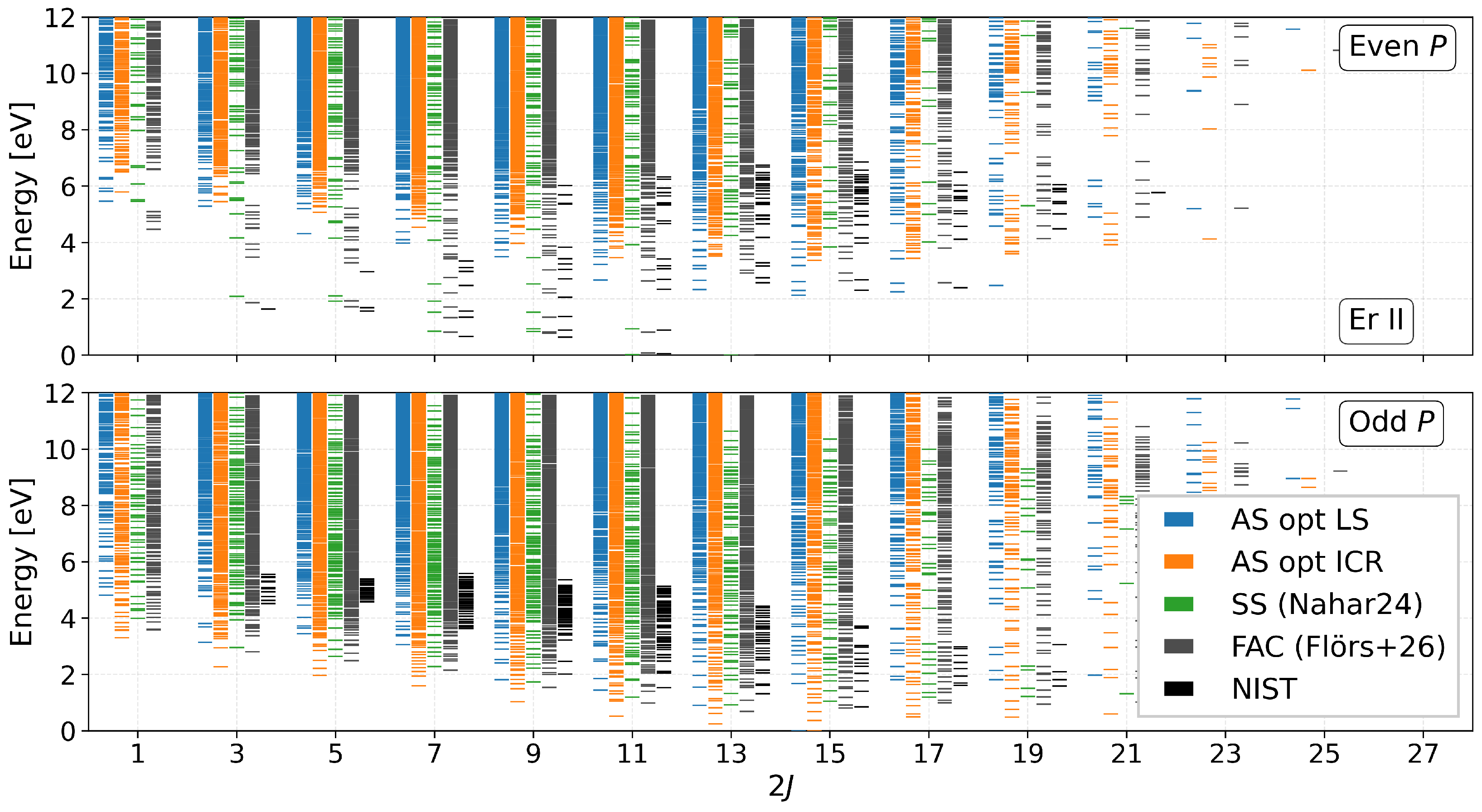
With the method described above, the atomic structure of elements can be calculated. A large number of AELs ( 10 4 per ion), and an even higher number of allowed (E1) transitions ( 10 6 per ion) were calculated in this work. Figure 1 shows the energy of the atomic levels of Er II (the choice of this ion was random and serves only as an example), calculated with AUTOSTRUCTURE (AS) [22], SUPERSTRUCTURE (SS) [26,34], and the Flexible Atomic Code (FAC) [33].
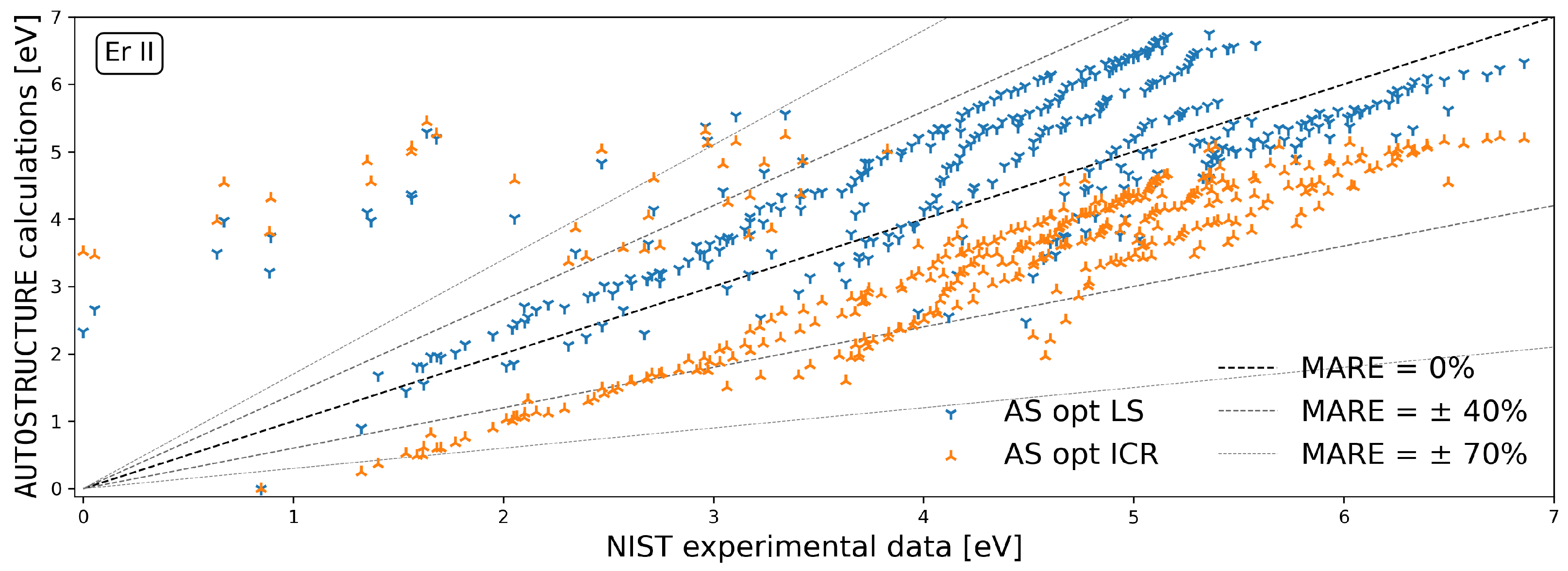
Figure 2 shows the agreement between the matched set of energy levels of Er II, calculated with both optimisation techniques used in AS. By inspection of Figure 1 and Figure 2, it is possible to understand that the AS theoretical calculations are, in some 2 J values, shifted from the experimental data: such is common in central potential atomic codes, specially when compared with experimental data; in other 2 J values there is not enough experimental data to draw conclusions.
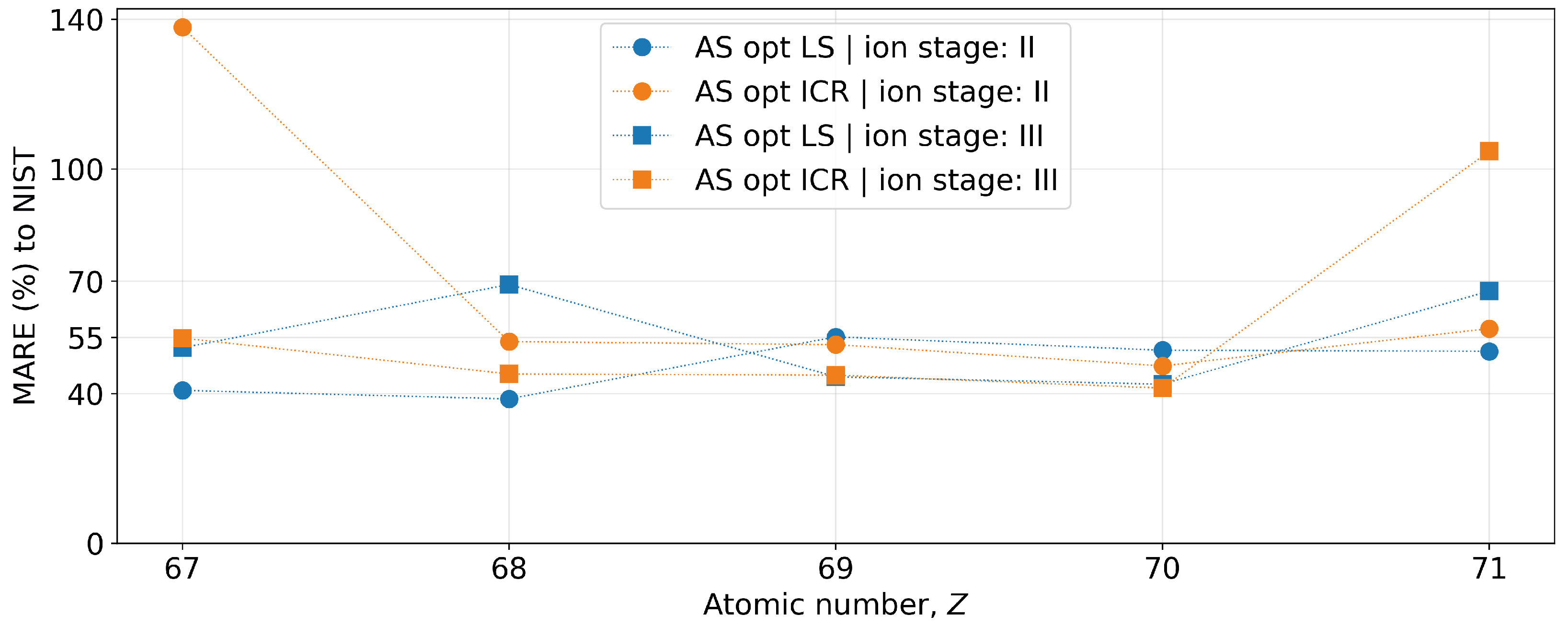
Extending the atomic structure calculation to the remaining ions at study, it is possible to compute a MARE to systematically evaluate the similarity between theoretical calculations and experimental data. In Figure 3 is shown the MARE of the AS calculations, with both optimisation techniques implemented, to the experimental data. The number of experimental AELs used in the MARE analysis can be found in Table 1. The average MARE for the singly ionised species is 58.7 % and for the doubly ionised species is 56.7 % ; it is worth noting that the AS opt ICR calculation for Ho II and the AS opt ICR calculation for Lu III are skewing these averages.
It is important to note that the configuration of the ground state calculated by AS is, in most cases, different from the configuration reported by NIST [18]: this can be seen in Figure 2, for the specific case of Er II, despite not being captured by the systematic MARE analysis presented in Figure 3. This is not only a labelling issue, since, in some cases, the parity of the ground state is different. This might be related to the optimisation techniques implemented in this work, since heavy elements, such as the lanthanides, are highly sensitive to the potential used, and, therefore, highly sensitive to the Thomas-Fermi scaling parameters [35]. Some of these issues had already been raised by N. Badnell [36].
In other optimisation procedures, such as the one implemented in Flörs et al. [23,37] experimental data is used, and it allows for a better agreement with the same experimental data. Therefore, there is a trade-off: requiring experimental data to optimise the central potential used and achieving results more similar to experimental data (such as Flörs et al. [23]); or performing an optimisation of the central potential without knowing the experimental values and having more discrepancies between datasets.
The AS code is a combination of SS with distorted wave for continuum wavefunctions. Even so, using SS’s Thomas-Fermi scaling parameters reported by Nahar [24], the set of atomic energy levels obtained with AS was not the same as in SS. In parallel, it is relevant to point out that, even when adopting the fractional occupation numbers indicated by Flörs et al. [23], the atomic level energies obtained using FAC’s potential in AS [25] differ from those reported by Flörs et al. with FAC.

4. Conclusions

This work provides a set of atomic energy levels (and E1 transition rates) for five singly and doubly ionised lanthanides (Ho, Er, Tm, Yb and Lu), calculated with the AUTOSTRUCTURE atomic code.
Despite AUTOSTRUCTURE’s coupling schemes options and non-relativistic Hamiltonian, this work shows that it provides reasonable atomic energy levels calculations for the ions studied, even though relativistic interactions in these systems are not negligible.
It was found the optimisation techniques implemented in AUTOSTRUCTURE have issues regarding the accurate identification of the ground state configurations.
Furthermore, given that optimising AUTOSTRUCTURE without experimental data proves to be sufficient for the theoretical calculations to generally agree with experimental result, this atomic code is an alternative to those already widely used in the literature.
In this fashion, AUTOSTRUCTURE is suited to large scale systematic calculations of heavy elements given its computational performance, not only regarding disk and memory management, but also in computing time. For example, comparing with FAC, a considerable reduction of these aspects was noted.
This work places significant emphasis on the optimisation of central potentials because, in addition to modifying the set of AELs, it also affects the wavefunctions of the atomic system. This will influence the results of all operators, not only those corresponding to the quantities previously mentioned, but other, for example, related to collisional processes.
Data calibration is fundamental for accurate line identification. It directly changes the calculated AELs to match experimental data, consequently modifying the transition’s wavelengths and transition’s rate of those AELs. However, data calibration will not be done in this work, being left for future work.
Regarding a direct comparison between atomic codes, it might be interesting to implement an optimisation procedure in AUTOSTRUCTURE with experimental data—such as the one implemented by Mendez [38] —and compare the resulting set of atomic energy levels.
Future work lies in extending the presented calculations to all lanthanides and actinides. It is also relevant to perform an analysis on allowed transitions, as well as calibrating the calculated data, when possible. It is also relevant to compute opacities for the lanthanides and actinides series, comparing them with the literature.

Author Contributions

By order of contribution. Conceptualization: J.M.P.M., J.M.S., R.F.d.S. and T.C.; Methodology: R.F.d.S. and T.C.; Formal analysis: T.C. and R.F.d.S.; Investigation: all; Validation: all; Writing, original draft: T.C.; Writing, review & editing: all; Visualization: T.C.; Supervision: J.M.P.M. and J.M.S.; Project administration: J.M.P.M. and J.M.S.; Funding acquisition: J.M.P.M. and J.M.S. All authors have read and agreed to the published version of the manuscript.

Funding

The authors acknowledge the support from FCT (Portugal) through project funding 2023.14470.PEX “Spectral Analysis and Radiative Data for Elemental Kilonovae Identification (SPARKLE)” [39]. RFS acknowledges the support from National funding by FCT (Portugal), through the individual research grant 2022.10009.BD.

Institutional Review Board Statement

Not applicable.

Informed Consent Statement

Not applicable.

Data Availability Statement

The novel AUTOSTRUCUTRE data presented in this work is available upon request, as well as a complete set of used configurations and optimised set of Thomas-Fermi scaling parameters.

Acknowledgments

The authors acknowledge Yuri Ralchenko, Alexander Kramida, Joseph N. Tan, Karen Olsen and the whole (previous) NIST atomic spectroscopy group for their long-standing community work, without which this study would not have been possible. The authors also thank Sultana Nahar for the insightful discussions throughout this work.

Conflicts of Interest

The authors declare no conflicts of interest.

References

  1. Abbott, B.P.; Abbott, R.; Abbott, T.D.; Acernese, F.; Ackley, K.; Adams, C.; Adams, T.; Addesso, P.; Adhikari, R.X.; Adya, V.B.; et al. Properties of the Binary Neutron Star Merger GW170817. Phys. Rev. X 2019, 9, 011001. [Google Scholar] [CrossRef]
  2. Abbott, B.P.; Abbott, R.; Abbott, T.D.; Acernese, F.; Ackley, K.; Adams, C.; Adams, T.; Addesso, P.; Adhikari, R.X.; Adya, V.B.; et al. GW170817: Observation of gravitational waves from a binary neutron star inspiral. Phys. Rev. Lett. 2017, 119, 161101. [Google Scholar] [CrossRef]
  3. Abbott, B.P.; Abbott, R.; Abbott, T.D.; Acernese, F.; Ackley, K.; Adams, C.; Adams, T.; Addesso, P.; Adhikari, R.X.; Adya, V.B.; et al. Multi-messenger Observations of a Binary Neutron Star Merger. Astrophys. J. Lett. 2017, 848, L12. [Google Scholar] [CrossRef]
  4. Abbott, B.P.; Abbott, R.; Abbott, T.D.; Acernese, F.; Ackley, K.; Adams, C.; Adams, T.; Addesso, P.; Adhikari, R.X.; Adya, V.B.; et al. Gravitational waves and gamma-rays from a binary neutron star merger: GW170817 and GRB 170817A. Astrophys. J. Lett. 2017, 848, L13. [Google Scholar] [CrossRef]
  5. Smartt, S.J.; Chen, T.W.; Jerkstrand, A.; Coughlin, M.; Kankare, E.; Sim, S.A.; Fraser, M.; Inserra, C.; Maguire, K.; Chambers, K.C.; et al. A kilonova as the electromagnetic counterpart to a gravitational-wave source. Nature 2017, 551, 75–79. [Google Scholar] [CrossRef] [PubMed]
  6. Metzger, B.D. Kilonovae. Living Rev. Relativ. 2019, 23, 1. [Google Scholar] [CrossRef]
  7. Sneppen, A.; Watson, D.; Damgaard, R.; Heintz, K.E.; Vieira, N.; Väisänen, P.; Mahoro, A. Emergence hour-by-hour of r-process features in the kilonova AT2017gfo. Astron. Astrophys. 2024, 690, A398. [Google Scholar] [CrossRef]
  8. Kasen, D.; Metzger, B.; Barnes, J.; Quataert, E.; Ramirez-Ruiz, E. Origin of the heavy elements in binary neutron-star mergers from a gravitational-wave event. Nature 2017, 551, 80–84. [Google Scholar] [CrossRef]
  9. Metzger, B.D.; Martínez-Pinedo, G.; Darbha, S.; Quataert, E.; Arcones, A.; Kasen, D.; Thomas, R.; Nugent, P.; Panov, I.V.; Zinner, N.T. Electromagnetic counterparts of compact object mergers powered by the radioactive decay of r-process nuclei. Mon. Not. R. Astron. Soc. 2010, 406, 2650–2662. [Google Scholar] [CrossRef]
  10. Watson, D.; Hansen, C.J.; Selsing, J.; Koch, A.; Malesani, D.B.; Andersen, A.C.; Fynbo, J.P.U.; Arcones, A.; Bauswein, A.; Covino, S.; et al. Identification of strontium in the merger of two neutron stars. Nature 2019, 574, 497–500. [Google Scholar] [CrossRef]
  11. Hotokezaka, K.; Tanaka, M.; Kato, D.; Gaigalas, G. Tellurium emission line in kilonova AT 2017gfo. Mon. Not. R. Astron. Soc. Lett. 2023, 526, L155–L159. [Google Scholar] [CrossRef]
  12. Domoto, N.; Tanaka, M.; Kato, D.; Kawaguchi, K.; Hotokezaka, K.; Wanajo, S. Lanthanide Features in Near-infrared Spectra of Kilonovae. Astrophys. J. 2022, 939, 8. [Google Scholar] [CrossRef]
  13. Kathirgamaraju, A.; Giannios, D.; Beniamini, P. Observable features of GW170817 kilonova afterglow. Mon. Not. R. Astron. Soc. 2019, 487, 3914–3921. [Google Scholar] [CrossRef]
  14. Gillanders, J.H.; Smartt, S.J.; Sim, S.A.; Bauswein, A.; Goriely, S. Modelling the spectra of the kilonova AT2017gfo–I. The photospheric epochs. Mon. Not. R. Astron. Soc. 2022, 515, 631–651. [Google Scholar] [CrossRef]
  15. Gillanders, J.H.; Sim, S.A.; Smartt, S.J.; Goriely, S.; Bauswein, A. Modelling the spectra of the kilonova AT2017gfo–II. Beyond the photospheric epochs. Mon. Not. R. Astron. Soc. 2023, 529, 2918–2945. [Google Scholar] [CrossRef]
  16. Gillanders, J.H.; Flörs, A.; da Silva, R.F. Improved lanthanide constraints for the kilonova AT 2017gfo. Mon. Not. R. Astron. Soc. 2026, stag748. [Google Scholar] [CrossRef]
  17. Pognan, Q.; Jerkstrand, A.; Grumer, J. On the validity of steady-state for nebular phase kilonovae. Mon. Not. R. Astron. Soc. 2021, 510, 3806–3837. [Google Scholar] [CrossRef]
  18. Kramida, A.; Ralchenko, Y.; Reader, J.; NIST ASD Team. NIST Atomic Spectra Database (ver. 5.12); National Institute of Standards and Technology: Gaithersburg, MD, USA, 2024. [Google Scholar] [CrossRef]
  19. Polat, R.; İçelli, O.; Yalçın, Z.; Pesen, E.; Orak, S. Measurement of K-shell absorption jump factors and jump ratios in some lanthanide elements using EDXRF technique. Ann. Nucl. Energy 2013, 54, 267–273. [Google Scholar] [CrossRef]
  20. Akman, F.; Durak, R.; Kaçal, M.R.; Turhan, M.F.; Akdemir, F. Determination of K-shell absorption jump factors and jump ratios for La2O3, Ce and Gd using two different methods. Radiat. Phys. Chem. 2015, 107, 75–81. [Google Scholar] [CrossRef]
  21. da Silva, A.R.; Smiljanic, R. Discovery of a pair of very metal-poor stars enriched in neutron-capture elements—The proto-disk r-II star BPS CS 29529-0089 and the Gaia-Sausage-Enceladus r-I star TYC 9219-2422-1. Astron. Astrophys. 2025, 696, A122. [Google Scholar] [CrossRef]
  22. Badnell, N.R. AUTOSTRUCTURE: General program for calculation of atomic and ionic properties. In Astrophysics Source Code Library, Record ascl:1612.014; ADS: Cambridge, MA, USA, 2016. [Google Scholar]
  23. Flörs, A.; da Silva, R.F.; Marques, J.P.; Sampaio, J.M.; Martínez-Pinedo, G. Calibrated lanthanide atomic data for kilonova radiative transfer: Atomic structure and opacities. Phys. Rev. D 2026, 113, 063041. [Google Scholar] [CrossRef]
  24. Nahar, S.N. Theoretical Spectra of Lanthanides for Kilonovae Events: Ho I-III, Er I-IV, Tm I-V, Yb I-VI, Lu I-VII. Atoms 2024, 12, 24. [Google Scholar] [CrossRef]
  25. Badnell, N.R.; Zhang, C.Y. A FAC potential for autostructure. Eur. Phys. J. D 2024, 78, 84. [Google Scholar] [CrossRef]
  26. Eissner, W.; Jones, M.; Nussbaumer, H. Techniques for the calculation of atomic structures and radiative data including relativistic corrections. Comput. Phys. Commun. 1974, 8, 270–306. [Google Scholar] [CrossRef]
  27. Bautista, M.A. Electronic correlations and polarizability of the Thomas–Fermi–Dirac–Amaldi potential: Applications to the singly ionized iron-peak species. J. Phys. B At. Mol. Opt. Phys. 2008, 41, 065701. [Google Scholar] [CrossRef]
  28. Burgess, A.; Mason, H.E.; Tully, J.A. Coronal Mg(9+)—Collisional excitation of the 2s-2p multiplet. Astron. Astrophys. 1989, 217, 319–328. [Google Scholar]
  29. Bluteau, M.M. Fundamental Atomic Data and Prototype Techniques for a Generalised Collisional-Radiative Model of Medium-Weight Elements in Fusion and Astrophysical Plasma. Ph.D. Thesis, University of Strathclyde, Glasgow, UK, 2018. [Google Scholar] [CrossRef]
  30. Cowan, R. The Theory of Atomic Structure and Spectra; Los Alamos Series in Basic and Applied Sciences; University of California Press: Berkeley, CA, USA, 1981. [Google Scholar] [CrossRef]
  31. Pradhan, A.K.; Nahar, S.N. Atomic Astrophysics and Spectroscopy; Cambridge University Press: Cambridge, UK, 2011. [Google Scholar] [CrossRef]
  32. Powell, M.J.D. An efficient method for finding the minimum of a function of several variables without calculating derivatives. Comput. J. 1964, 7, 155–162. [Google Scholar] [CrossRef]
  33. Gu, M.F. The flexible atomic code. Can. J. Phys. 2008, 86, 675–689. [Google Scholar] [CrossRef]
  34. Eissner, W.; Nussbaumer, H. A programme for calculating atomic structures. J. Phys. B At. Mol. Phys. 1969, 2, 1028. [Google Scholar] [CrossRef]
  35. Nahar, S. (Department of Astronomy, McPherson Lab, The Ohio State University, Columbus, OH, USA). Private communication, July 2025.
  36. Badnell, N.R. On the Use of Autostructure for (Near-and) Neutral Heavy Species. 2023. AS Working Note No. 1. Available online: https://amdpp.phys.strath.ac.uk/autos/default/DOCS/ (accessed on 1 March 2026).
  37. Ferreira da Silva, R.; Flörs, A.; Leitão, L.; Marques, J.P.; Martínez-Pinedo, G.; Sampaio, J.M. Systematic Bayesian optimization for atomic structure calculations of heavy elements. Phys. Rev. A 2025, 112, 012802. [Google Scholar] [CrossRef]
  38. Mendez, M.P.A. Optimización de Blancos Atómicos y Moleculares en Procesos Colisionales. Ph.D. Thesis, Universidad de Buenos Aires—Facultad de Ciencias Exactas y Naturales, Buenos Aires, Argentina, 2021. [Google Scholar]
  39. Spectral Analysis and Radiative Data for Elemental Kilonovae Identification (SPARKLE), 2025; This project has received funding from Fundação para a Ciência e a Tecnologia (FCT). [CrossRef]
Figure 1. Energy of the atomic levels for Er II, split in even (top) and odd (bottom) parity, for different theoretical calculations and experimental data. In blue and orange are this work’s theoretical calculations using AS with the two different techniques described in the main text; in green are the calculations from Nahar [24] using SS; in gray are the uncalibrated Flörs et al. [23] calculations using FAC; in black is the NIST Atomic Spectra Database [18] experimental data.
Psf 13 00003 g001
Figure 2. Correspondence between the calculated and experimental AELs for Er II. The pairing was done through the method described before Equation (6), including the ground states. In blue and orange are this work’s theoretical calculations using AS with the two different techniques described in the main text. Dashed lines show the mean absolute relative error ( MARE ) for the pairings.
Psf 13 00003 g002
Figure 3. Mean absolute relative error ( MARE ) calculated through Equation (6), between this work’s different theoretical calculations, with the optimisation techniques described in the main text (AS opt LS in blue and AS opt ICR in orange), and NIST experimental data [18], for different ionisation stages (II with circle markers and III with square markers). The number of levels included in the comparisons can be found in Table 1.
Psf 13 00003 g003
Table 1. Total number of matched levels ( N lev ) included in the mean absolute relative error (MARE) analysis, for each different ion studied and both optimisation techniques implemented. These are all levels available in NIST with an unambiguous J identification, excluding pairings involving the ground states.
N lev Ho 67 II Ho 67 III Er 68 II Er 68 III Tm 69 II Tm 69 III Yb 70 II Yb 70 III Lu 71 II Lu 71 III
AS opt LS4811935846359118338493626
AS opt ICR4711935847359118338493726
Disclaimer/Publisher’s Note: The statements, opinions and data contained in all publications are solely those of the individual author(s) and contributor(s) and not of MDPI and/or the editor(s). MDPI and/or the editor(s) disclaim responsibility for any injury to people or property resulting from any ideas, methods, instructions or products referred to in the content.