1. Introduction
Interactions of electrons with water and biomolecules are of special relevance in the context of radiotherapy, since high-energy radiation produces large numbers of low- and intermediate-energy secondary electrons, which are largely responsible for subsequent molecular damage [
1]. A complete characterization of electron-impact single ionization processes, known in the literature as (e, 2e), is achieved through the analysis of fully differential cross sections (FDCSs), which depend on all kinematic variables of the collision except for spin, therefore providing the most stringent test for theoretical descriptions. However, while highly accurate nonperturbative approaches have been successfully applied to simple atoms and small molecules [
2,
3], their extension to polyatomic and multielectron systems is severely limited by the rapid growth in computational complexity. As a consequence, theoretical studies of molecules such as H
2O and larger organic species have predominantly relied on perturbative frameworks. Among these, distorted-wave methods have become the standard tools for analyzing single ionization by electron impact, proving a robust capability to reproduce essential features of measured FDCSs over a broad range of kinematic conditions [
4,
5,
6,
7,
8,
9].
From an experimental point of view, highly differential cross section measurements have evolved over several decades, progressing from early studies that were limited to relative shapes [
10,
11] toward modern kinematically complete experiments capable of accessing large regions of phase space [
12,
13,
14,
15,
16]. Unfortunately, experimentally resolving the molecular orientation at the moment of the collision is still very challenging [
17], in contrast to predictions from perturbative models where the FDCS calculation for a particular orientation of the molecular target is more straightforward than averaging over all molecular orientations [
18].
In this work, we analyze the electron-impact single ionization of H
2O and the deoxyribose sugar molecular analogue C
4H
8O at intermediate-to-low impact energies. FDCSs are calculated by means of two theoretical approximations under the framework of the CDW-EIS model, which has previously shown good overall agreement with experimental data for water targets [
7]. Here, we provide a more detailed analysis of these theoretical approaches, already employed in Ref. [
18], by analyzing their differences at the continuum electron wave function level and focusing on the molecular orientation dependence of the FDCSs. In addition, we perform an average procedure to benchmark our results with recent experimental data obtained by means of the “Cold Target Recoil Ion Momentum Spectrometer” (COLTRIMS) technique [
15,
16]. This experimental method allows for the simultaneous detection of the three particles in the final state (two continuum electrons and the recoil ion with total charge +1). In this sense, the experimentalists can isolate single ionization events, with no contribution from multiple ionization.
Section 2 provides a concise overview of the theoretical methods adopted in the present study. The obtained results are presented and discussed in
Section 3. Unless explicitly indicated, all quantities are expressed in atomic units throughout this work.
2. Materials and Methods
The (e, 2e) collision process considered in this work is analyzed under the framework of the distorted wave formalism and the one active electron approximation, with its transition amplitude given by
which is the following version of the Gellman–Goldberger amplitude. Although the wave functions and perturbation operators in Equation (
1) were previously described in detail [
18], in what follows we will focus on the main differences between the two theoretical models employed in this work, which differ only in the final state of the collision. It is worth mentioning that for the initial wave function
, we consider the Eikonal Initial State (EIS) which retains the long-range Coulomb potential effects, and the post-collisional interaction (PCI) between the continuum particles is fully considered in both models.
The interaction of the continuum electrons with the residual molecular ion is described with distorted waves
, eigenvalues of the molecular anisotropic potential, which in this work we approximate by a single-centre potential
(
for the projectile and
for the secondary electron initially bound to the target). Hence, a partial wave expansion can be applied to these distorted waves which are then separated in a radial and an angular part as follows
where
, with
being the non-Coulombic phase shift in the radial waves (
for a pure Coulomb central potential) and
.
are the Legendre polynomials and the radial wave functions
satisfy the equation
At this point, the single-centre description of the final state of the collision will depend on the choice of
. In this work we perform two different single-centre approximations. First, we consider the molecular ion as a single-centre of charge
, therefore leading to the well known CDW-EIS model, where the radial wave functions are simply solutions to the pure Coulomb potential. A second choice consists of a spherical average (SA) of the anisotropic potential which provides an isotropic description of the molecular ion but retains some information of the spatial charge distribution, an approach which has already been applied in the context of ion collisions with H
2O [
19,
20]. In what follows we will refer to this model as SADW-EIS. The partial waves
are calculated with Salvat’s code [
21], which permits us to obtain the non-Coulombic phase shifts
as well. These phase shifts become negligible as
l increases, and due to the asymptotic limit of these potentials, the radial wave functions converge to the Coulombic ones. In this sense, the infinite partial waves can be accounted for by correcting only a few
l-values from the pure Coulomb case.
This strategy considerably reduces the numerical effort of calculating the transition amplitude of Equation (
1), which involves a six-dimensional numerical integration. Then, the FDCS for the electron-impact ionization of a molecule and for a particular orientation of the molecular axes defined by the set of Euler angles
is given by
where
represents the number of identical electrons in the molecular orbital to be ionized and
and
are the direct and exchange transition amplitudes, with
. In order to compare our results with experimental data we have to perform an average procedure by integrating over the three Euler angles
,
, and
to obtain the triple differential cross section (TDCS). We refer the reader to Ref. [
18] for more details about the evaluation of this integral.
3. Results and Discussion
In this section we present the calculated FDCS for the electron-impact single ionization of H2O and C4H8O (tetrahydrofuran or THF) by means of the two theoretical methods introduced in the previous sections: the CDW-EIS and the SADW-EIS. We analyze the emission of a 10 eV secondary electron in the final state with an angle with respect to the z axis and into the scattering plane , defined by the initial and final momenta of the projectile, with a projectile scattering angle of .
3.1. Single Ionization of H2O
The FDCSs of H
2O are calculated at an impact energy of 65 eV and represent the sum of the emission from the 1b
1 and 3a
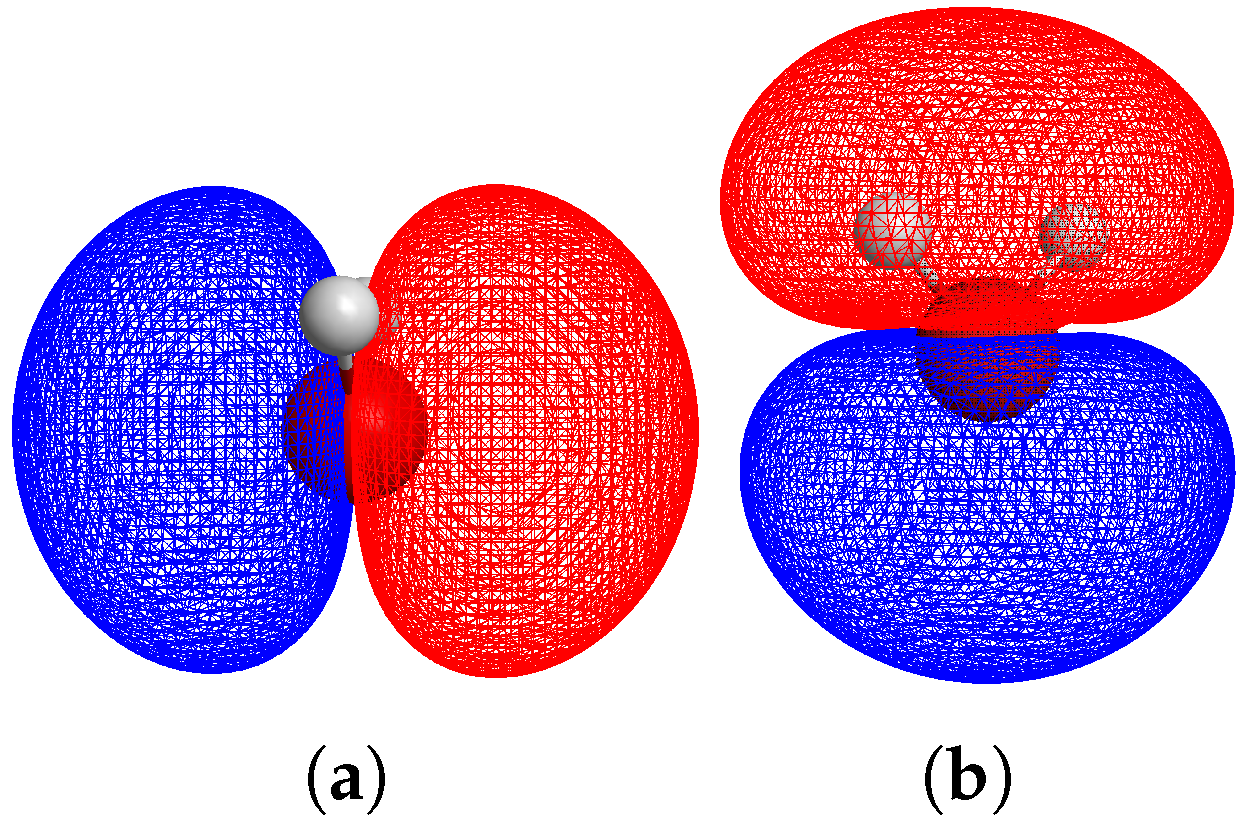
1 molecular orbitals. Their electronic densities are presented in
Figure 1, where it can be seen that they present two well defined lobes, which are characteristic of
p-type orbitals.
In
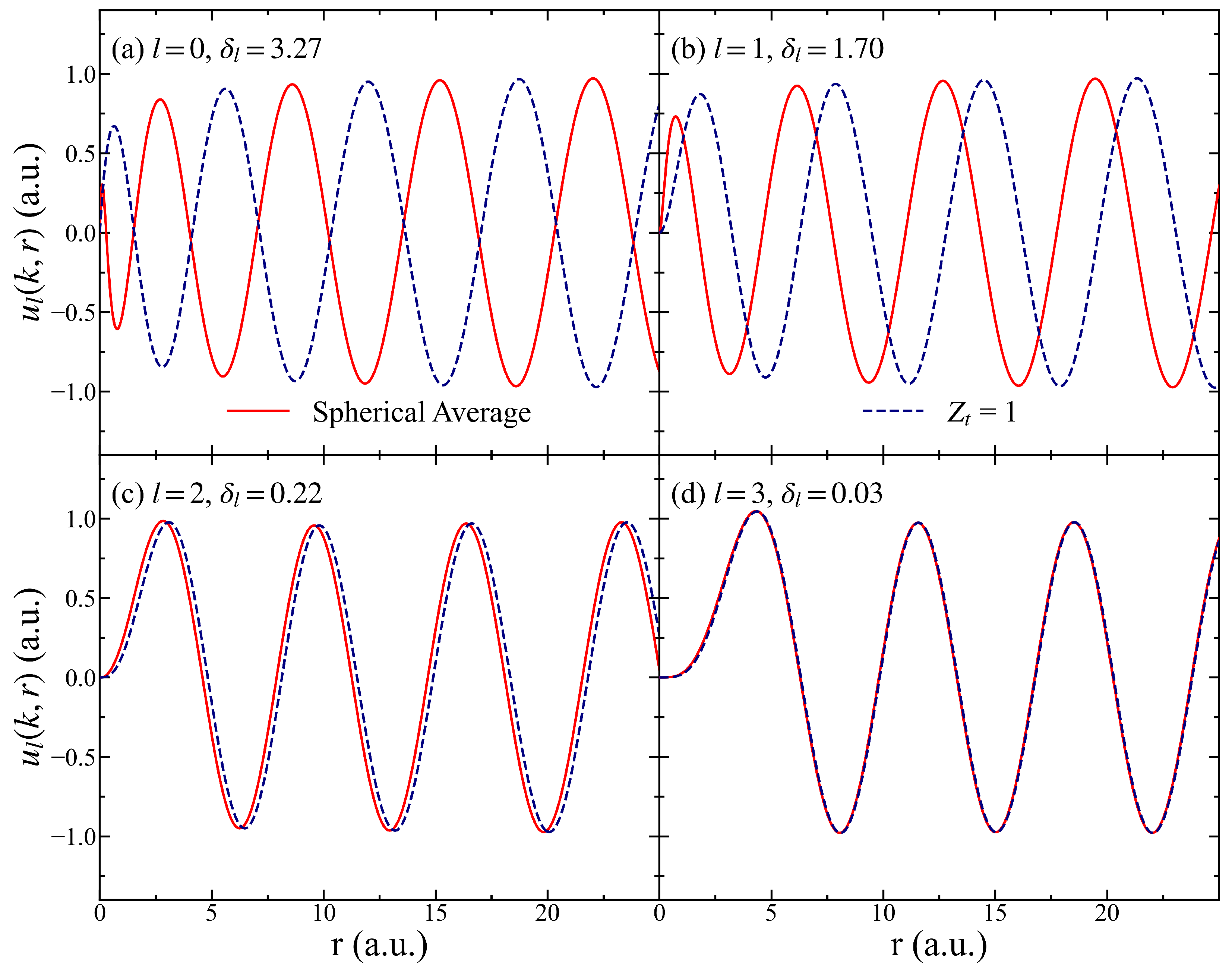
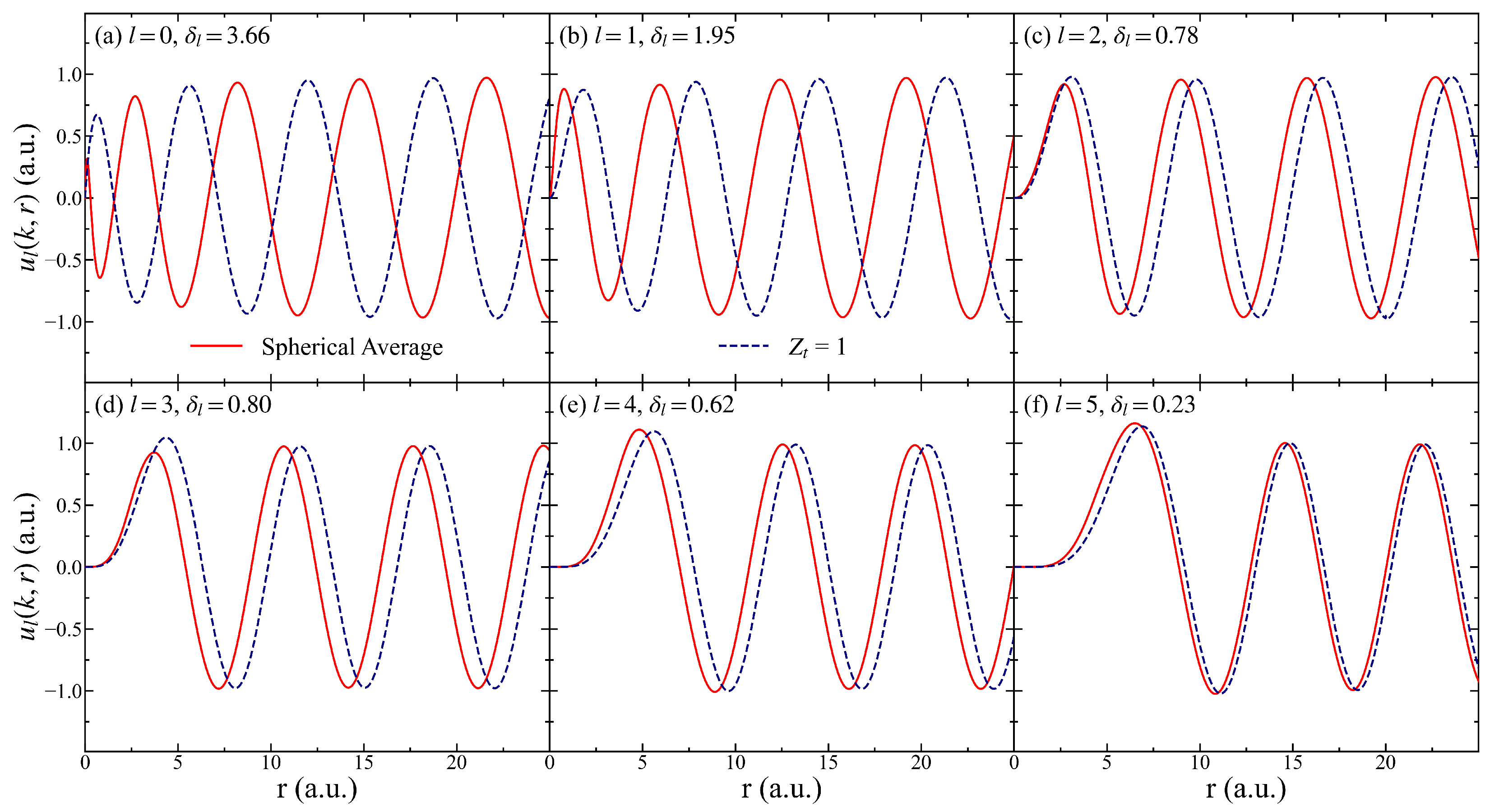
Figure 2 we present the partial waves
, solutions of Equation (
3) for the spherical average potential, together with the Coulombic ones corresponding to a centre of charge
, considering an electron emitted from the 1b
1 molecular orbital with an energy of 10 eV. From these, we observe how the two first partial waves (
and
) considerably differ from the case
, whereas for
, no discrepancies are observed and convergence is achieved. Therefore, it can be seen how the spherical average approximation only modifies the first partial waves of the secondary electron wave function. This is attributed to the centrifugal barrier imposed by the second term in Equation (
3) as
l increases.
The FDCSs for the single ionization of H
2O are presented in
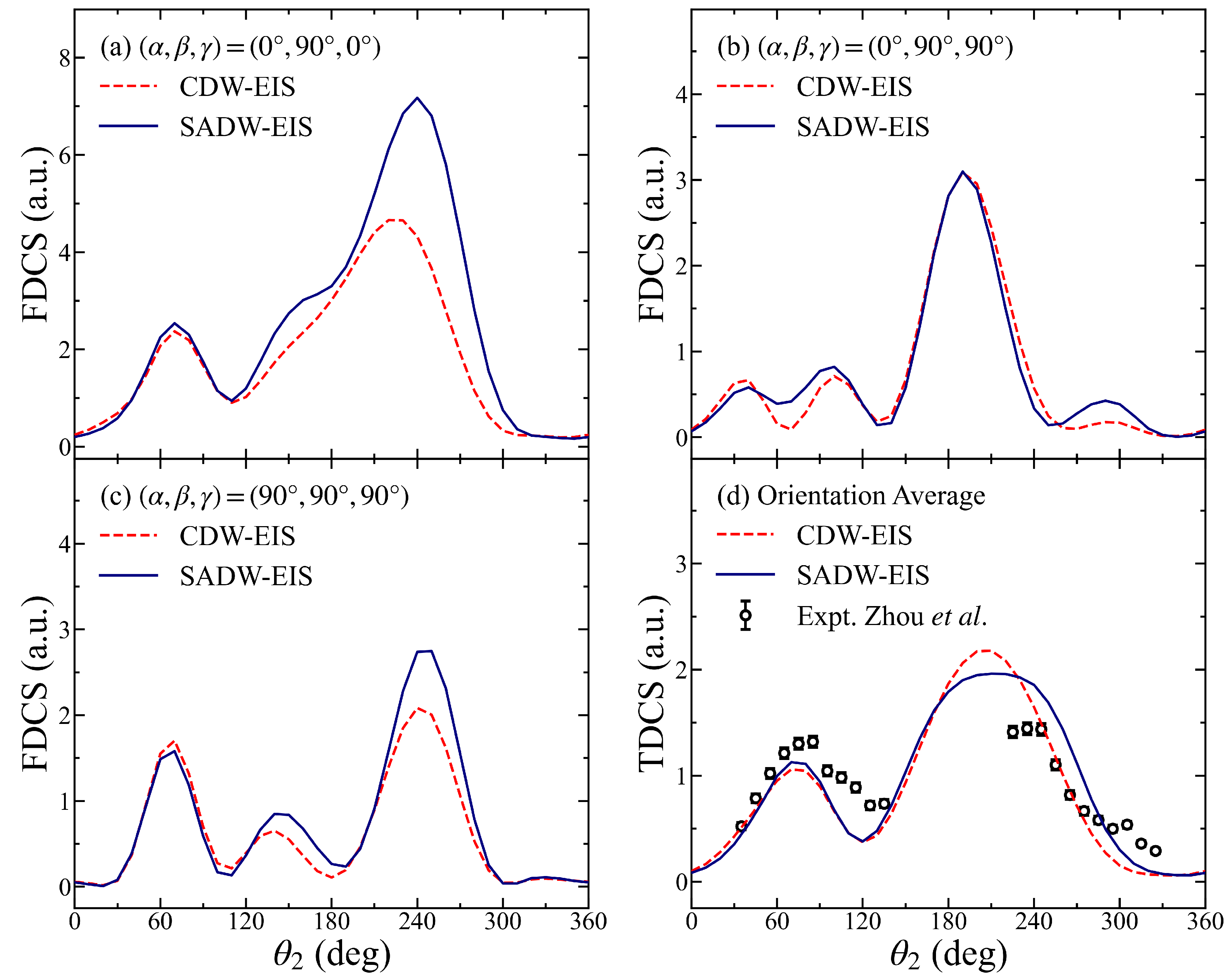
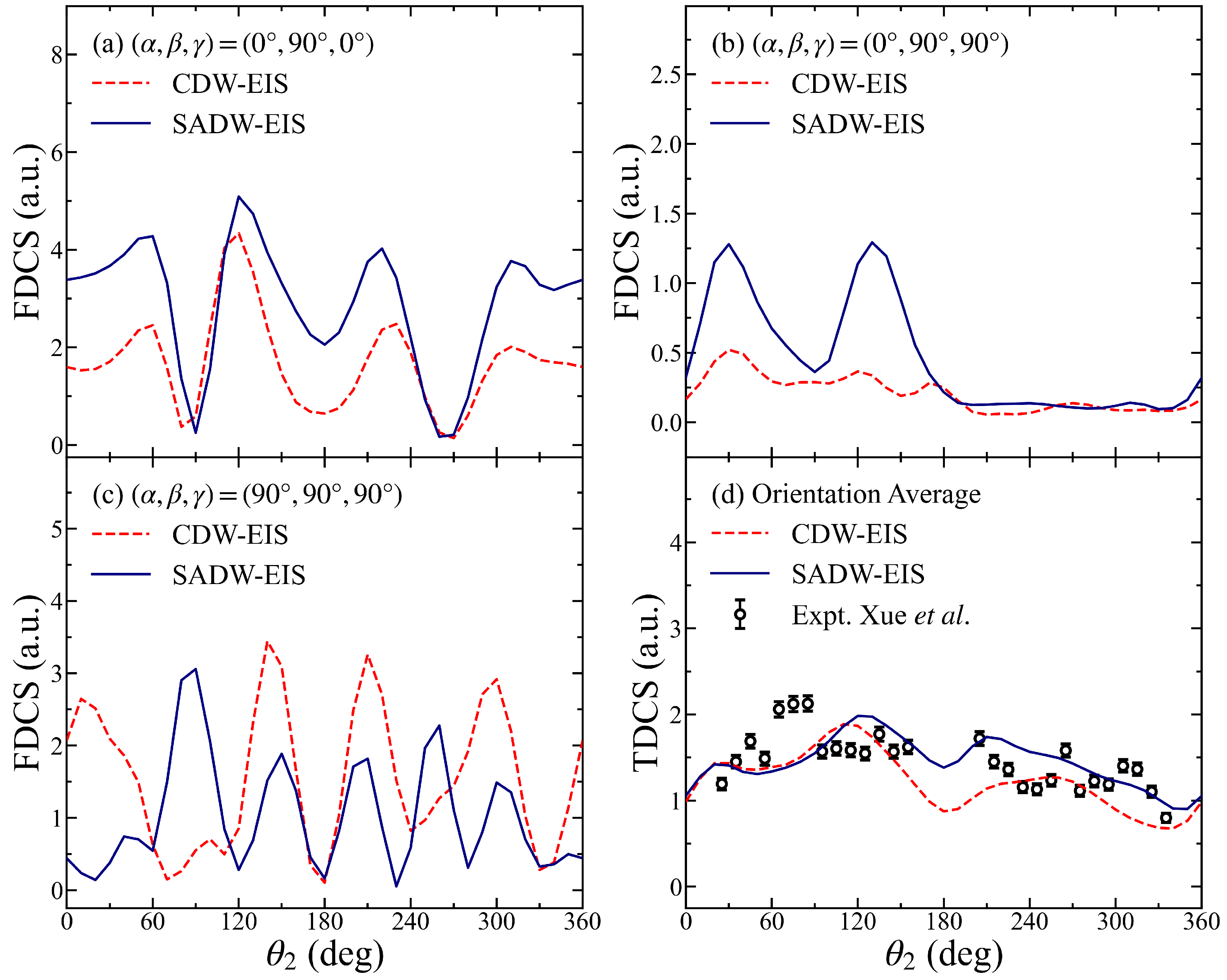
Figure 3 for three different molecular orientations of the target. In the first place, in
Figure 3a the orientation is defined by the set of Euler angles
. Considering emission into low
angles, which is known as the binary region, we observe that both models predict a single peak around 60°. Differences between them are observed for emission into large angles, known as the recoil region. There, the CDW-EIS model predicts a broad single peak, whereas the SADW-EIS model presents a shoulder around 180° and a much higher magnitude for the recoil peak. This leads to a higher recoil/binary ratio predicted by the SADW-EIS model, which implies a higher probability that the secondary electron is emitted backwards for this particular orientation.
Another orientation considered in this work is defined by the set of Euler angles
and is exhibited in
Figure 3b for the single ionization of H
2O. Here, we observe a two-peak binary structure predicted by both models but with a less deep minimum between the two maxima for the SADW-EIS method. This binary structure is characteristic of ionization of
p-type atomic orbitals and tends to show up as momentum transfer increases [
22], and, as can be seen in
Figure 1, both the 1b
1 and 3a
1 molecular orbitals are mostly 2p in nature. Therefore it is expected that some orientations present this binary structure. For the recoil region we observe a high recoil peak predicted by both models around 200° and a much lower one around 300°.
In
Figure 3c the molecular orientation considered is defined by
and again we observe that both models predict very similar structures. Two binary peaks are again predicted but this time with different magnitudes, while we observe a single narrow recoil peak. Once more, the SADW-EIS model predicts a higher magnitude as was seen for the previous orientations.
Finally, in
Figure 3d we present the TDCS obtained after analytically averaging over all molecular orientations. We benchmark with recent experimental data reported in Ref. [
15], which exhibit well defined binary and recoil structures. The binary region presents a single peak which is well reproduced by both models, suggesting that even though there are particular orientations where two binary peaks are predicted, this structure gets washed out when we average over all molecular orientations, in agreement with the experiment. Regarding the recoil region, we observe that both models slightly overestimate the experimental data with not many differences between them. Interestingly, the recoil magnitude predicted by the SADW-EIS model is lower, in contrast with panels (a), (b) and (c). This indicates that the FDCSs for the particular orientations shown here are not enough to make any conclusions about the orientations’ average TDCS. Therefore, in order to make predictions for non-oriented targets it seems to be unavoidable to perform this type of average.
3.2. Single Ionization of C4H8O
The FDCSs of THF are calculated at an impact energy of 250 eV and represent emissions from the 9b and 12a’ molecular orbitals of the C
2 and C
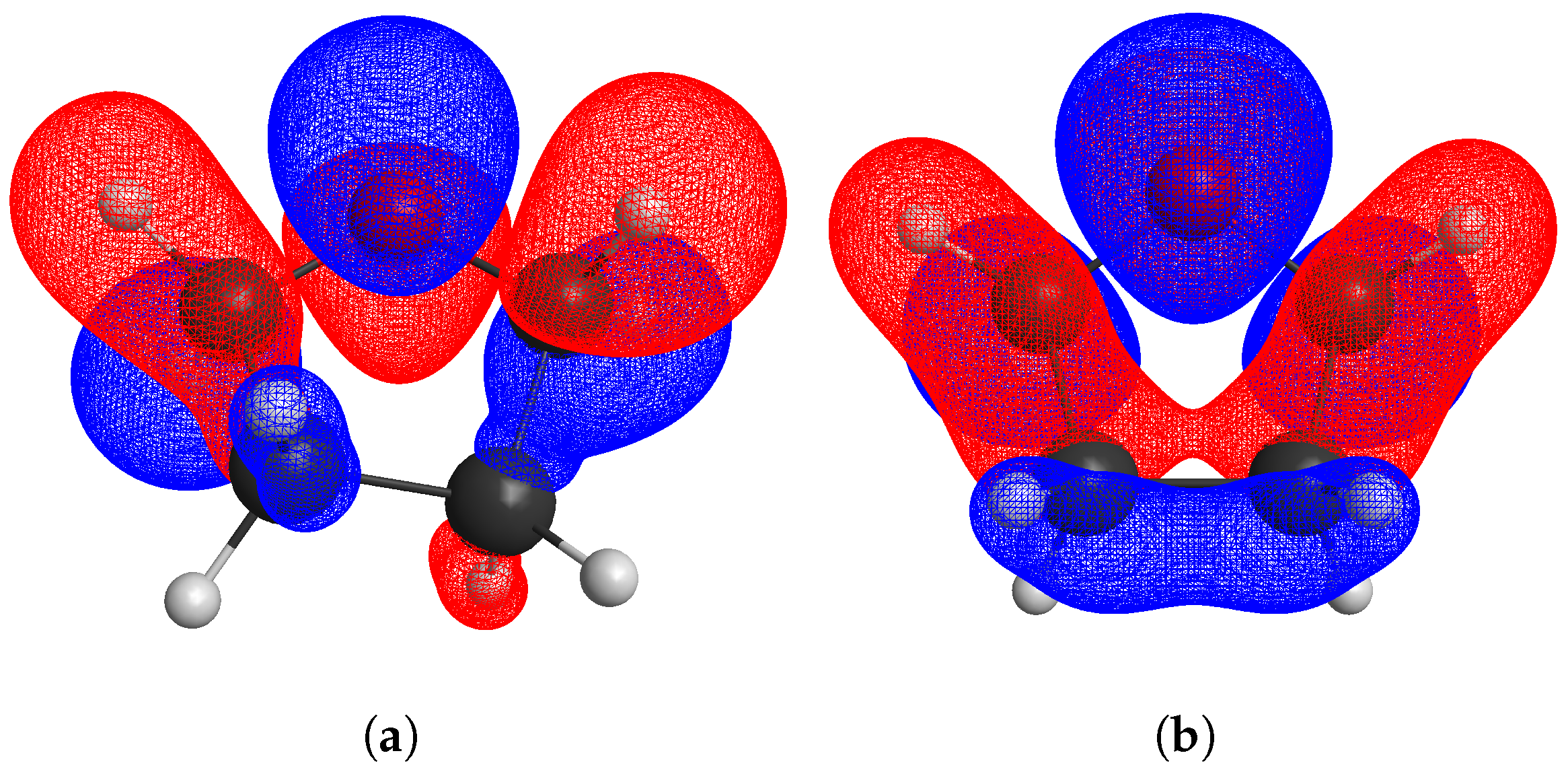
s conformers, respectively, in a 80%:20% proportion. Their electronic densities are presented in
Figure 4, where we observe that they exhibit a lone pair of
p-type lobes around the oxygen centre and much more complicated structures around the carbon and hydrogen atoms.
In
Figure 5 we present the partial waves considering an electron emitted from the 9b molecular orbital of the C
2 conformation with an energy of 10 eV. As for the case of H
2O, the first two partial waves (
and
) present great differences between considering a spherical average potential and a single centre of charge
. However, convergence as
l increases is reached for larger values, in comparison with
Figure 2. This can obey the fact that the spherical average potential reaches the asymptotical
charge at higher distances from the molecule due to its larger spatial extension.
The FDCSs for the single ionization of THF are presented in
Figure 6 for three different molecular orientations of the target. In panels (a), (b) and (c), the orientations are defined by the same set of Euler angles as in the case of H
2O, but we observe that in this case the structures predicted by the theoretical models are not so well defined. In panel (a) we observe four peaks with minima at values of
around 90°, 180° and 270°, a structure that curiously seems to be rather symmetric around 180°. This suggets, for this particular orientation, that binary and recoil emissions have similar probabilities with a higher magnitude predicted by the SADW-EIS model. In contrast, for the orientation shown in panel (b), we observe that this model exhibits a well defined two-peak binary structure with no evidence of recoil emission. For the last orientation considered, in panel (c), we observe a pretty much noisy structure predicted by both models with several peaks along the whole angular range, but with different positions and magnitudes.
In
Figure 6d we benchmark the TDCS obtained after averaging over all orientations with recent measurements from Ref. [
16]. The number of orientations that need to be considered to achieve convergence in this case is 1584. There, we observe that the experimental data do not clearly resolve the binary and recoil structures. The CDW-EIS and SADW-EIS models predict a two-peak binary structure, but seem to fail to reproduce a third peak suggested by the experiment at around 75°. Regarding the recoil region, the latter method improves the description of the recoil/binary relative magnitude, in contrast to the former model. In addition, the CDW-EIS method predicts a single broad recoil peak, whereas the SADW-EIS model suggests a series of local maxima, with decreasing magnitude as the secondary electron emission angle increases, which seems to be more in agreement with the experiment.
To summarize, in this work we have theoretically studied electron-impact ionization of H2O and THF at the fully differential level. Present results suggest that as the molecular complexity increases, non-oriented triple differential cross sections do not directly reflect the structures present in those obtained at particular orientations. This makes the task of performing an extensive averaging procedure unavoidable. Finally, we note that the results obtained by using two different representations for the molecular ion–electron interaction show differences that survive to this averaging procedure, thus indicating that non-oriented triple differential cross sections can be used to benchmark models in an overall way.