


Abstract
We present the development of two complementary amplifier architectures for axion haloscope experiments, based on two types of Josephson Parametric Amplifiers (JPAs). The first employs a multi-chip module of flux-driven JPAs in a parallel–series configuration, enabling near quantum-limited amplification over an extended tunable range of between 1.2 and 1.5 GHz. The second design features a lumped-element JPA, offering continuous tunability across a wide frequency range from 2.4 to 4 GHz. Both approaches demonstrate near-quantum-limited noise performance and are compatible with operation in cryogenic environments. These amplifiers significantly enhance the sensitivity and frequency coverage of axion search experiments, and also provide new opportunities for broadband quantum sensing applications.
1. Introduction
The axion is a hypothetical particle originally introduced to resolve the CP problem in quantum chromodynamics [1,2,3]. It is also a prominent candidate for cold dark matter [4,5,6]. Axion haloscope experiments seek to detect these particles by converting them into microwave photons in the presence of a strong magnetic field.
The conversion of axions into detectable microwave photons in a magnetic field is based on the inverse Primakoff effect, in which an axion couples to two photons through the interaction term [7]. In the presence of a strong static magnetic field, one of the photons is replaced by a virtual photon from the field, enabling the inverse Primakoff effect that mediates axion–photon conversion inside a resonant cavity. This process forms the fundamental detection principle of haloscope experiments and defines the dependence of the expected signal power on the magnetic field strength, cavity volume, and quality factor. A detailed discussion of these mechanisms and their role in modern axion searches can be found in Ref. [8], where new experimental approaches in the search for axion-like particles are reviewed in depth.
This process takes place in a high-Q tunable microwave cavity, where the expected signal manifests as a narrow excess in the noise spectrum [7].
The signal power resulting from axion–photon conversion is on the order of W [9], necessitating a readout system with ultra-low noise performance, ideally approaching or even exceeding the quantum limit. Additionally, the speed of axion mass scanning depends on the inverse square of the system noise temperature [10].
In the years 2021–2023 the Center for Axion and Precision Physics Research (CAPP) of the Institute for Basic Science conducted haloscope searches in the 1–2 GHz band using Josephson Parametric Amplifiers (JPAs), based on a quarter-wavelength coplanar-waveguide (CPW) transmission line terminated by a SQUID (CPW-JPA), with near-quantum-limited noise performance [11,12]. In the Main Axion Experiment (MAX) experiment, each JPA offered ∼60 MHz tunability via DC flux bias. The tunability was limited because part of the JPA inductance was defined by the geometrical inductance of the coplanar resonator of the JPA. For efficiency, the cavity and amplifier tunable range should fit together to reduce operation costs and dead time. To extend the tunable range of the amplifier, a parallel-JPA architecture [13] combining three JPAs with offset frequency ranges was developed. The Dark Matter Axion Group (DMAG), as a successor to CAPP, continues to improve the amplifier chain. Recently, we have developed two amplifiers, both of them with extended frequency ranges.
2. Materials and Methods
2.1. Multi-JPA Readout Based on Flux-Driven JPAs
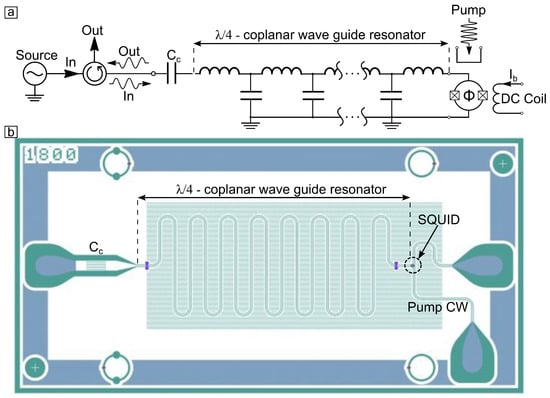
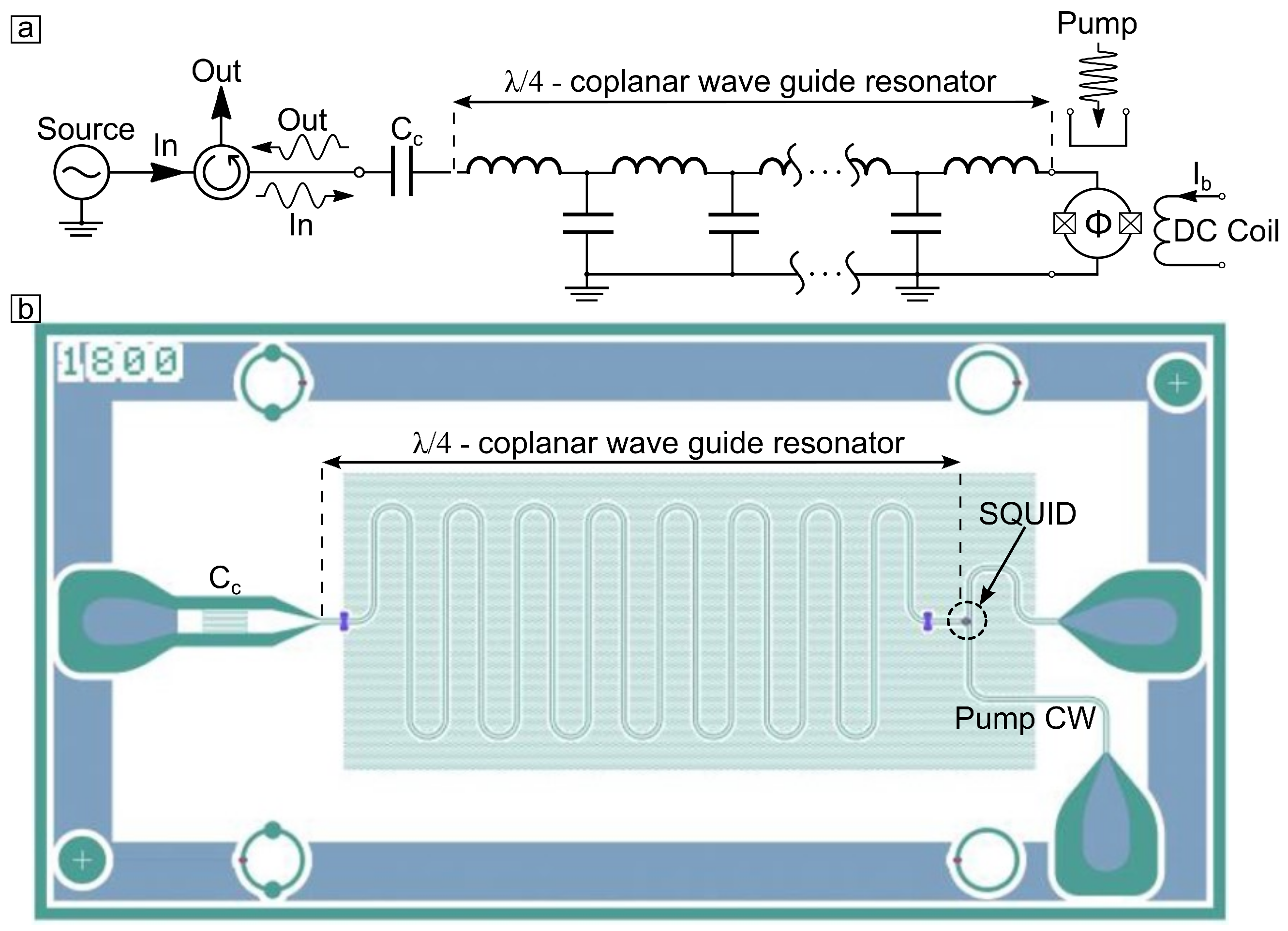
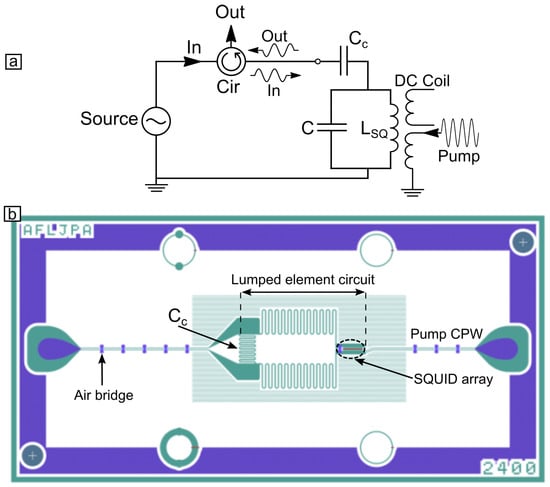
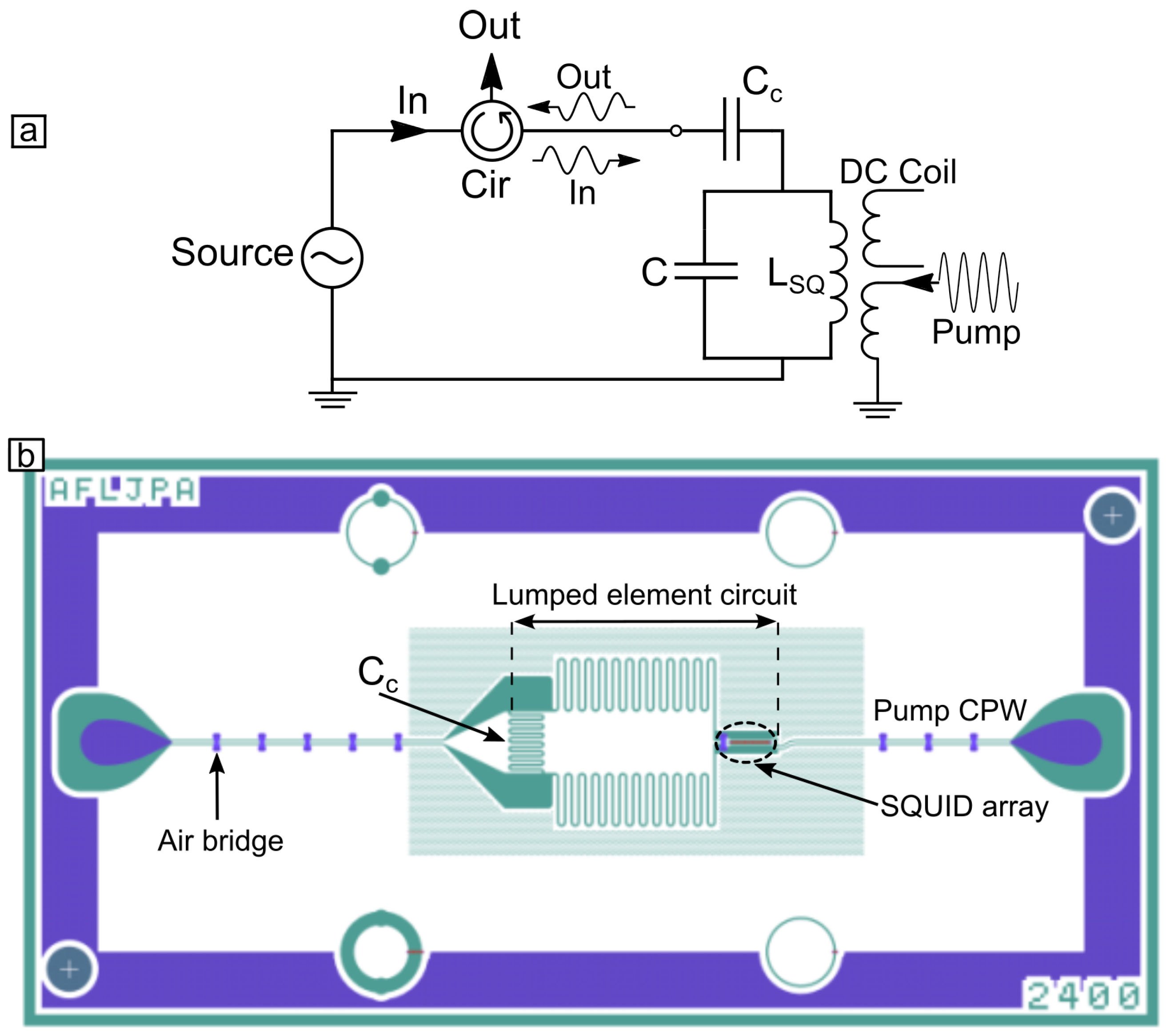
The core of the first readout system is based on CPW-JPAs [14], each consisting of a CPW niobium resonator terminated with a superconducting quantum interference device (SQUID) made from aluminum, as in our previous amplifiers [15]. The resonance frequency is tuned via a DC magnetic flux , which modulates the SQUID’s effective inductance. An RF pump is applied to induce parametric gain by modulating this nonlinear inductance (Figure 1a).
Figure 1.
(a) Electrical diagram of the amplifier based on a CPW-JPA. The signal source is connected to the port of a circulator, and the CPW-JPA is capacitively coupled to the signal line through to amplify the reflected signal. The device is pumped and flux-biased via a separate pump CPW line and a DC coil. (b) Chip layout of the fabricated CPW-JPA. The niobium coplanar resonator is terminated by an Al-based dc SQUID providing flux-tunable inductance, while the pump signal is coupled to the SQUID loop to modulate its inductance.
The CPW-JPAs operate in the three-wave mixing regime, with the pump frequency set close to twice the signal frequency and a pump power between and dBm. The SQUID sensitivity to the applied DC flux bias coil is approximately 200 . Under these conditions, each CPW-JPA exhibits a tunable range of 50–60 MHz and provides a stable gain of 20 dB or higher.
The CPW-JPAs exhibit very low noise performance approaching the quantum limit and show excellent fabrication reproducibility, though their individual tunability remains limited. In [13], we demonstrated that connecting multiple flux-driven JPAs with slightly different resonance frequencies in parallel can effectively extend the amplifier’s overall tuning range. In this configuration, only one JPA is active at a given time, selected by an appropriate DC flux bias and pump frequency, while the remaining JPAs behave as detuned passive resonators. When detuned from the pump, each JPA acts as a low-loss reflective element, contributing less than 0.2 dB to the total insertion loss [15]. The parallel connection therefore enables seamless switching between amplifiers without additional circuitry, significantly broadening the accessible frequency range. Using three CPW-JPAs, we were able to cover about half of the cavity’s total tuning range (150 MHz of the 300 MHz span). However, further increasing the number of parallel-connected JPAs is constrained by the available volume of the three-layer magnetic shield system [16], which limits each assembly to three devices.
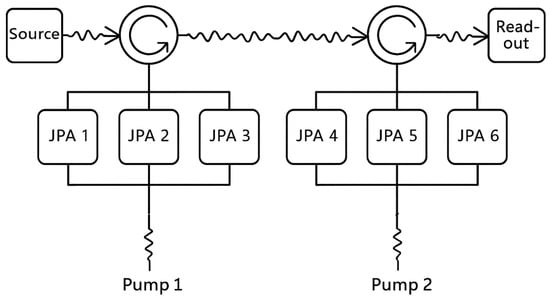
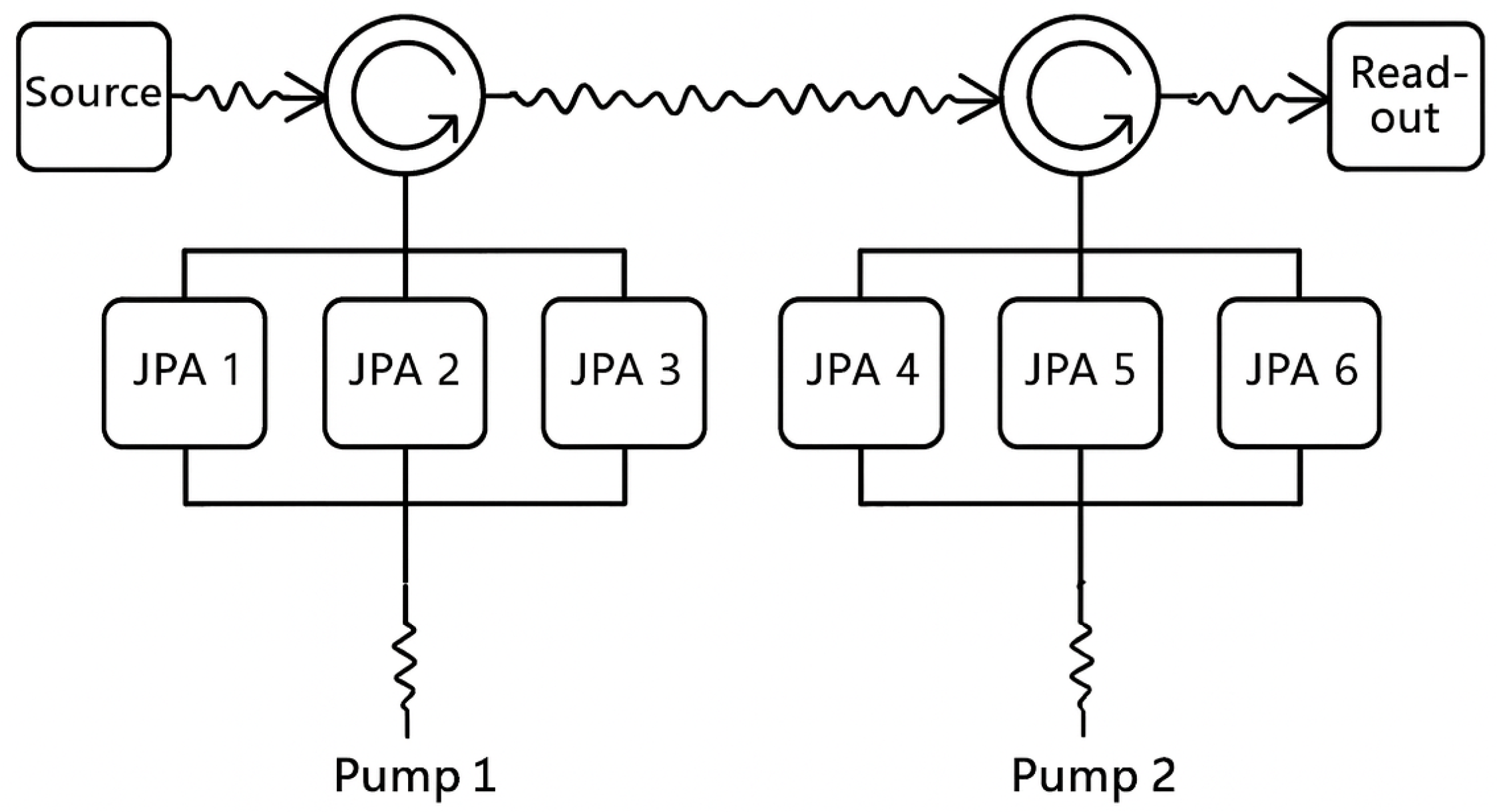
In the new configuration, we use two JPA assemblies, each housed inside an individual magnetic shield and containing a set of three CPW-JPAs connected in parallel. All six JPAs have slightly offset resonance frequencies, together covering the full tuning range of the haloscope cavity. The two assemblies are connected in series through an additional cryogenic circulator, as shown in Figure 2. In this configuration, only one JPA operates at a time, selected by the applied pump signal and the current through the corresponding DC flux coil. The second circulator introduces approximately 0.4 dB of additional loss, which insignificantly increases the system noise when one of the JPAs from the second set is active.
Figure 2.
Schematic of the serial–parallel configuration of six CPW-JPAs. The six CPW-JPAs are arranged in two sets, each containing three CPW-JPAs connected in parallel and sharing common signal input and pump lines. The input signal propagates from the signal source through cryogenic circulators 1 and 2 to the subsequent readout. Two superconducting coils (not shown here) are wound around each set to provide a DC magnetic flux bias.
2.2. Lumped-Element JPA (L-JPA)
In CPW-JPAs, the resonance frequency can be tuned only through the SQUID inductance, which contributes a small fraction (about 2%) of the total circuit inductance; therefore, the overall tunability is inherently limited. To overcome this limitation and expand the tunable frequency range of a single device, we developed lumped-element JPAs (L-JPAs). In this type of device (see, for example, Ref. [17]), the distributed capacitance and geometric inductance of the coplanar-waveguide structure are replaced with lumped-element interdigitated capacitors and a SQUID-based inductive element. In our implementation, a SQUID array () [18] serves as the inductive element, offering a larger inductance value required for resonators in the 1–2 GHz range. Replacing the geometrical inductance of the CPW with the tunable inductance of a SQUID array significantly increases the achievable tuning range, making our L-JPA suitable for broadband operation in axion haloscope experiments (Figure 3).
Figure 3.
(a) Schematic diagram of a L-JPA with a signal source, circulator (), capacitor (C), and inductor () components. The flux tunable inductance is performed from SQUID-array. (b) Design of a lumped-element JPA aiming at an operation frequency around 2.4 GHz.
3. Results
3.1. Multi-JPA Assembly (Run 7)
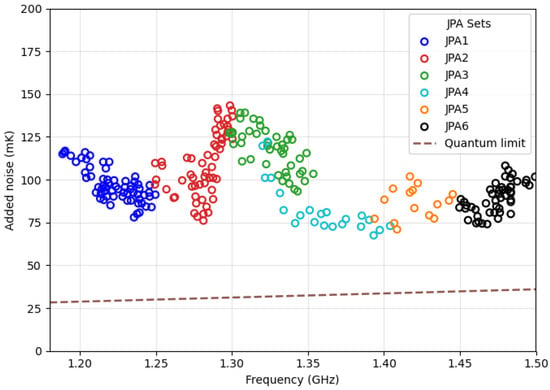
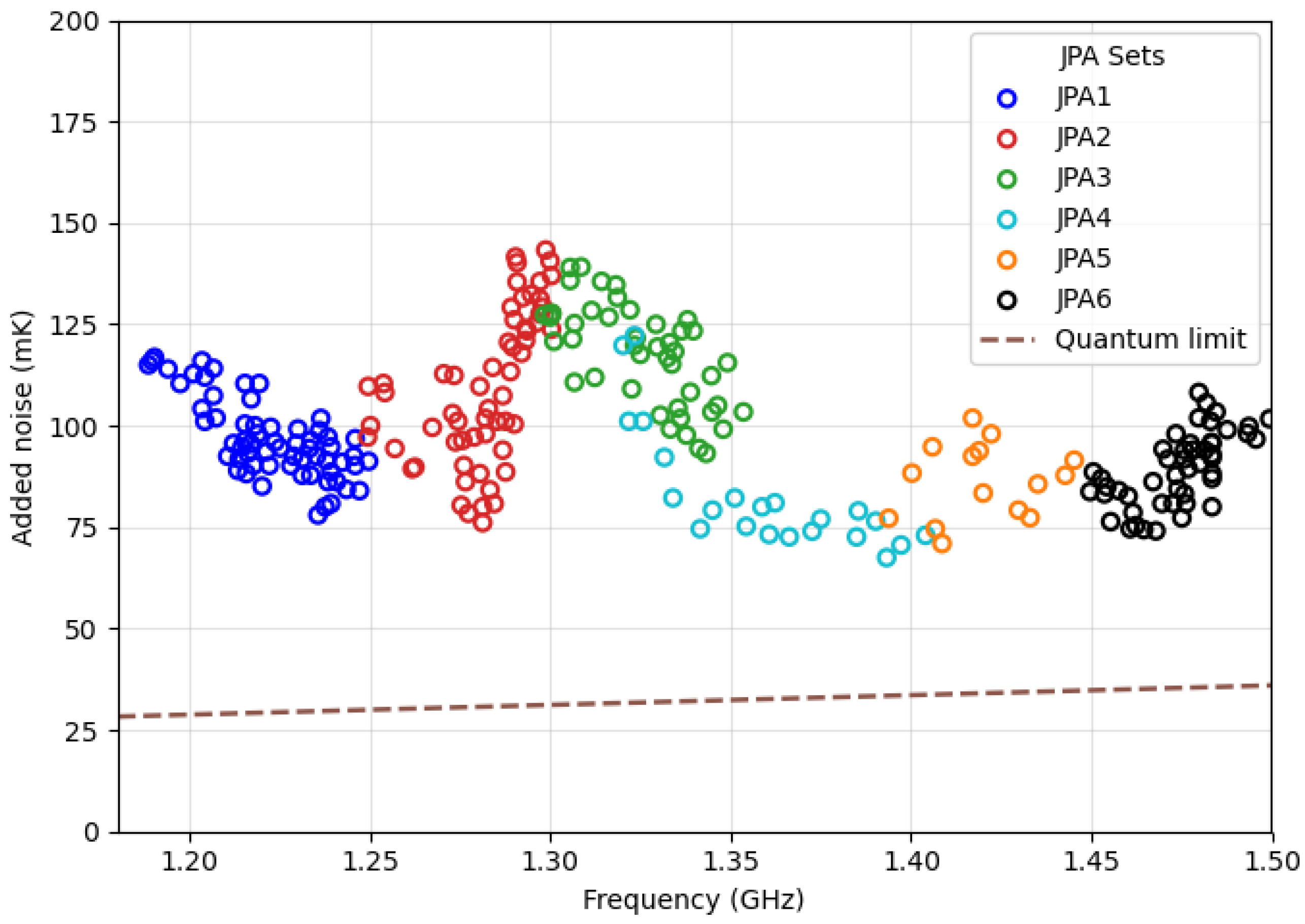
The amplifier covers the frequency range from 1.2 to 1.5 GHz with small gaps at a frequencies of 1.25 and 1.41 GHz. Each individual CPW-JPA exhibits an instantaneous bandwidth of about 200 kHz at 18 dB gain, and a tunable range of 50–60 MHz. The CPW-JPAs operate near the quantum-limited noise levels (1–3 quanta) and are cooled to base temperatures of 20–30 mK (Figure 4).
Figure 4.
Measured added noise temperature of the serial–parallel CPW-JPA assembly as a function of frequency, expressed for each of the JPAs: JPA1 (blue), JPA2 (red), JPA3 (green), JPA4 (cyan), JPA5 (orange), and JPA6 (black). Each point corresponds to the optimized pump power for the respective JPA bias point. The dashed brown line indicates the quantum-limit noise temperature for the amplifier, . The results demonstrate added noise below 0.15 K over of the tunable frequency range.
3.2. Lumped-Element JPA Performance
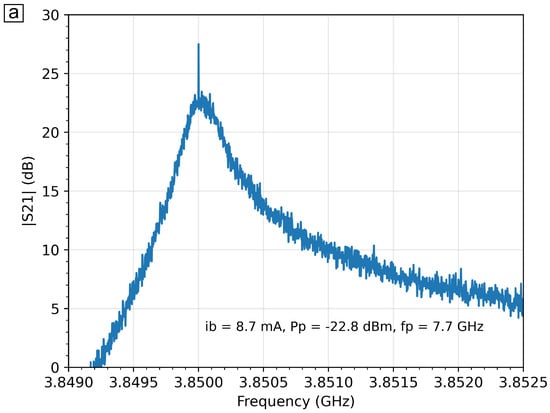
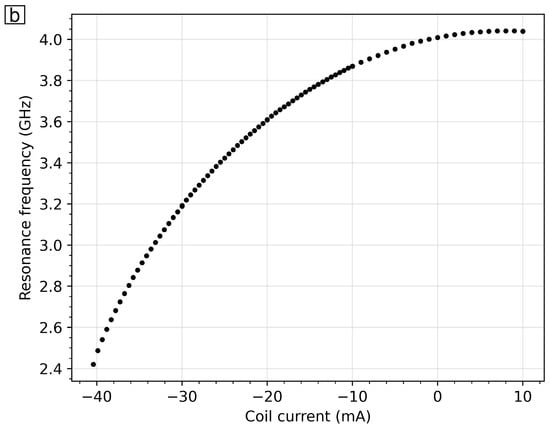
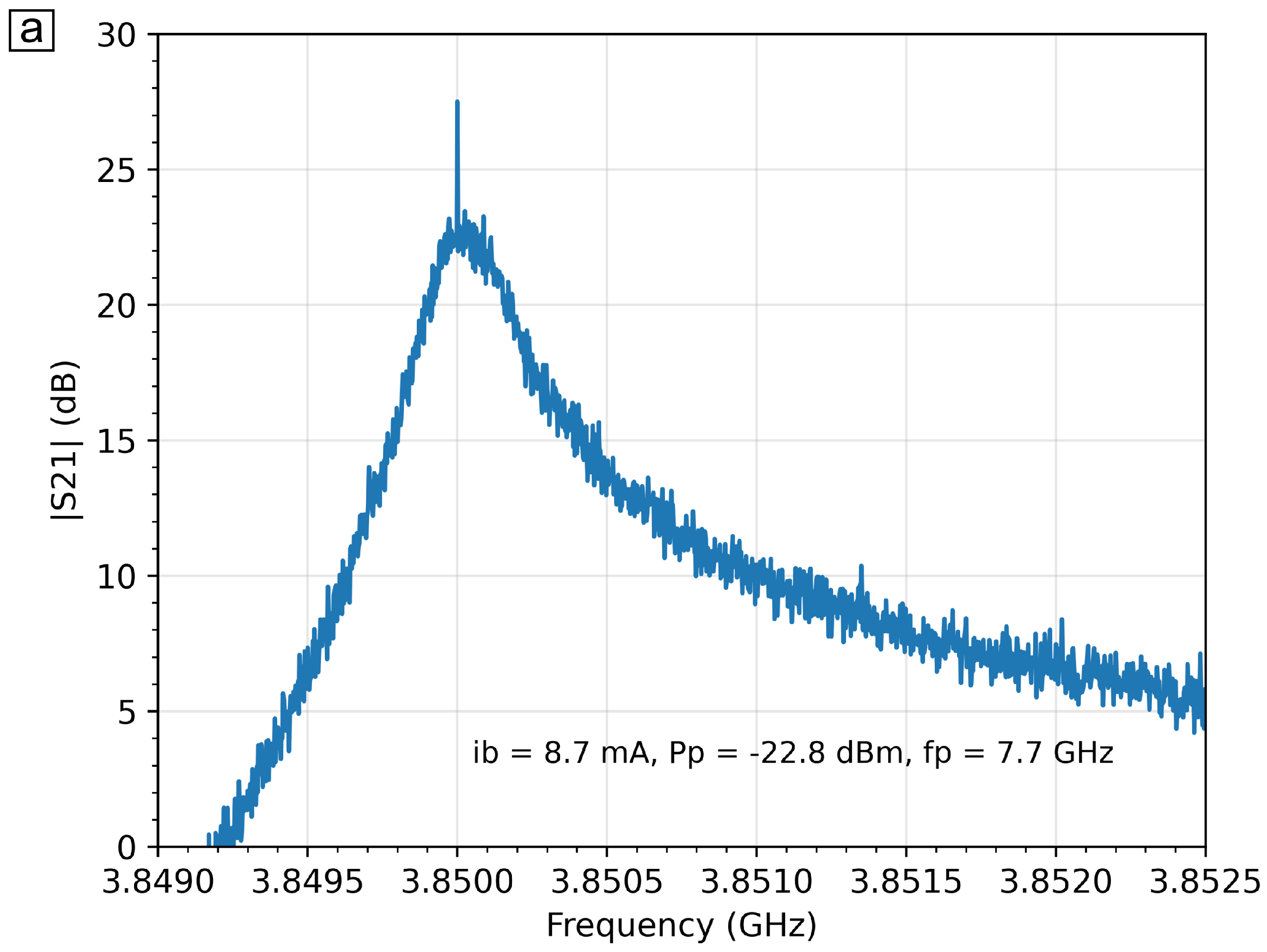
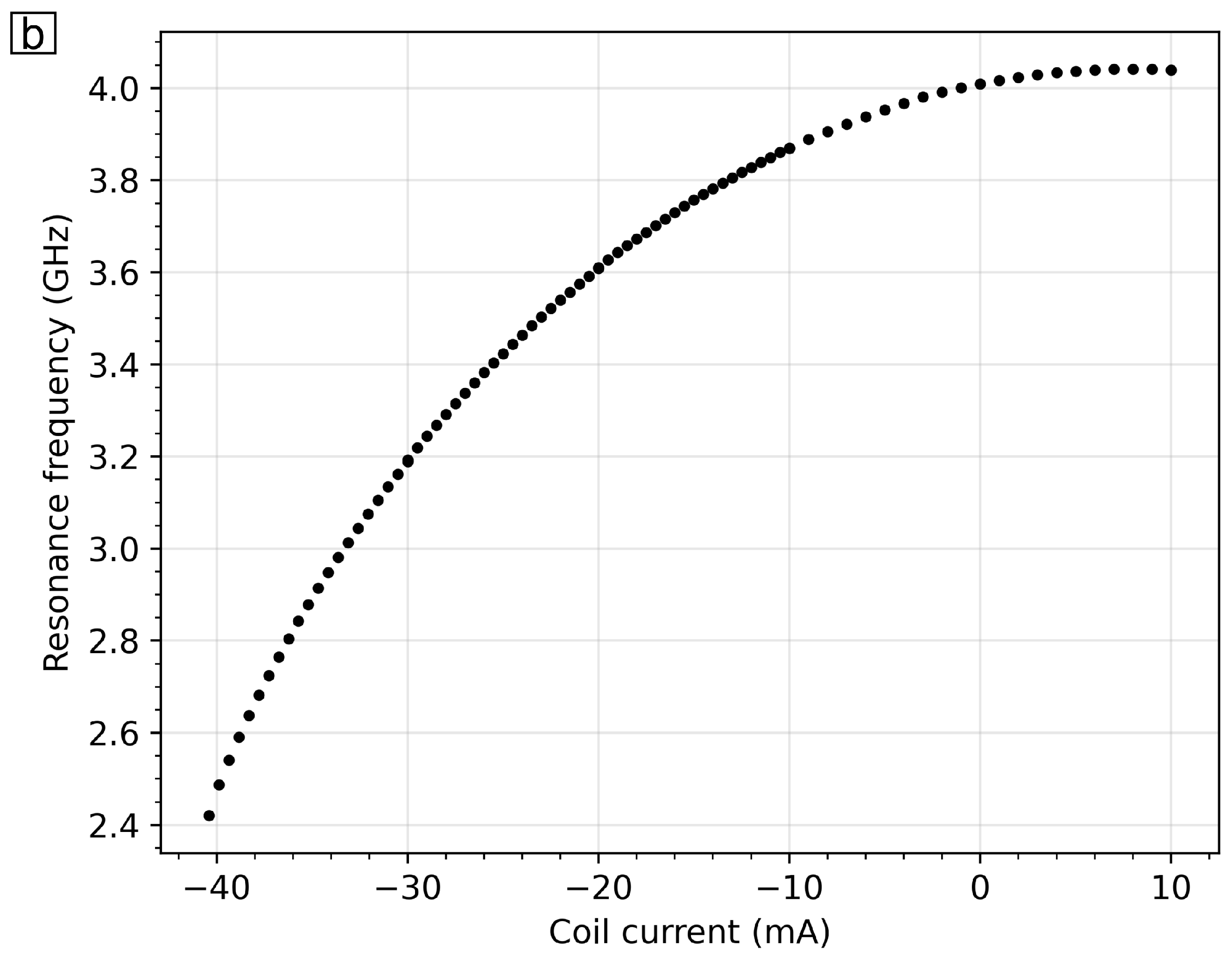
The L-JPA design achieves a tunable range exceeding 1.5 GHz at a gain of approximately 20 dB. At this gain level, the typical instantaneous bandwidth is 0.5 MHz. Measurements confirm efficient flux-to-frequency conversion and frequency-dependent gain profiles, with stable operation demonstrated over the 2.4–4 GHz range (Figure 5).
Figure 5.
Gain and tuning performance of the L-JPA. (a) Measured gain profile at a bias current mA, pump power dBm, and pump frequency GHz, showing a gain above dB at a resonance frequency of GHz with an instantaneous bandwidth of about 0.5 MHz. (b) Resonance-frequency tuning versus coil current, demonstrating a total tunable range of GHz from to GHz.
4. Discussion
Both JPA architectures demonstrated in this work offer a practical and efficient route to fit bandwidths of tunable haloscope cavities. The split-band preserves quantum-limited sensitivity while extending the operational bandwidth by a factor of approximately six. While the current implementation supports six JPAs operating in a mutually exclusive manner, the approach is inherently scalable. Additional JPAs can be added to further expand the tunable frequency range, provided that cross-talk and flux noise are adequately mitigated through careful layout and shielding.
The development of wideband L-JPAs complements this architecture. Unlike the JPA with a single SQUID and a CPW resonator, L-JPAs provide broader tunability and can be integrated into experiments targeting a wide axion mass range. Initial measurements suggest that their noise performance is already competitive, and future optimization could make them a standard tool for broadband quantum sensing.
These results pave the way for efficient, low-noise scanning over extended frequency ranges in axion search experiments, reducing the need for hardware replacement and thermal cycling.
In future work, we plan to present an extended version of this study including the results of modeling and a detailed discussion of the series–parallel JPA and L-JPA configurations, as well as their integration into haloscope systems.
Author Contributions
Conceptualization, S.V.U.; methodology, S.V.U. and A.F.v.L.; software, J.K. and S.A.; validation, S.V.U., A.F.v.L. and S.Y.; formal analysis, J.K., S.A. and B.I.I.; investigation, J.K., A.F.v.L., S.A., B.I.I., S.O. and M.K.; resources, Y.K.S., Y.N. and S.Y.; data curation, S.A., B.I.I. and M.K.; writing—original draft preparation, S.V.U.; writing—review and editing, S.V.U. and S.Y.; visualization, J.K., S.A., B.I.I. and M.K.; supervision, Y.N., Y.K.S., S.Y. and S.V.U.; project administration, S.V.U. and Y.K.S.; funding acquisition, Y.K.S., S.Y. and Y.N. All authors have read and agreed to the published version of the manuscript.
Funding
This work was supported in part by the Institute for Basic Science (IBS-R017-D1 and IBS-R040-C1), JST ERATO (Grant No. JPMJER1601) and JSPS KAKENHI (Grant No. 22H04937). Arjan F. van Loo was supported by a JSPS postdoctoral fellowship.
Institutional Review Board Statement
Not applicable. The study did not involve humans or animals.
Informed Consent Statement
Not applicable. The study did not involve humans.
Data Availability Statement
The data supporting the findings of this study are available from the corresponding author upon reasonable request.
Conflicts of Interest
The authors declare no conflicts of interest.
Abbreviations
The following abbreviations are used in this manuscript:
| CAPP | Center for Axion and Precision Physics Research |
| CPW | coplanar-waveguide |
| DMAG | Dark Matter Axion Group |
| JPA | Josephson parametric amplifier |
| L-JPA | Lumped-element Josephson parametric amplifier |
| SQUID | superconducting quantum interference device |
References
- Peccei, R.D.; Quinn, H.R. CP Conservation in the Presence of Pseudoparticles. Phys. Rev. Lett. 1977, 38, 1440–1443. [Google Scholar] [CrossRef] [Scilit]
- Weinberg, S. A new light boson? Phys. Rev. Lett. 1978, 40, 223–226. [Google Scholar] [CrossRef] [Scilit]
- Wilczek, F. Problem of strong P and T invariance in the presence of instantons. Phys. Rev. Lett. 1978, 40, 279–282. [Google Scholar] [CrossRef] [Scilit]
- Preskill, J.; Wise, M.B.; Wilczek, F. Cosmology of the invisible axion. Phys. Lett. B 1983, 120, 127–132. [Google Scholar] [CrossRef] [Scilit]
- Abbott, L.F.; Sikivie, P. A cosmological bound on the invisible axion. Phys. Lett. B 1983, 120, 133–136. [Google Scholar] [CrossRef] [Scilit]
- Dine, M.; Fischler, W. The not-so-harmless axion. Phys. Lett. B 1983, 120, 137–141. [Google Scholar] [CrossRef] [Scilit]
- Sikivie, P. Experimental Tests of the “Invisible” Axion. Phys. Rev. Lett. 1983, 51, 1415–1417. [Google Scholar] [CrossRef] [Scilit]
- Irastorza, I.G.; Redondo, J. New experimental approaches in the search for axion-like particles. Prog. Part. Nucl. Phys. 2018, 102, 89–159. [Google Scholar] [CrossRef] [Scilit]
- Hagmann, C.; Kinion, D.; Stoeffl, W.; van Bibber, K.; Daw, E.; Peng, H.; Rosenberg, L.J.; LaVeigne, J.; Sikivie, P.; Sullivan, N.; et al. Results from a high-sensitivity search for cosmic axions. Phys. Rev. Lett. 1998, 80, 2043. [Google Scholar] [CrossRef] [Scilit]
- Kim, D.; Jeong, J.; Youn, S.; Kim, Y.; Semertzidis, Y.K. Revisiting the detection rate for axion haloscopes. JCAP 2020, 3, 066. [Google Scholar] [CrossRef] [Scilit]
- Yi, A.K.; Ahn, S.; Kutlu, Ç.; Kim, J.; Ko, B.R.; Ivanov, B.I.; Byun, H.; van Loo, A.F.; Park, S.; Jeong, J.; et al. Axion Dark Matter Search around 4.55 μeV with Dine-Fischler-Srednicki-Zhitnitskii Sensitivity. Phys. Rev. Lett. 2023, 130, 071002. [Google Scholar] [CrossRef] [Scilit] [PubMed]
- Ahn, S.; Kim, J.; Ivanov, B.I.; Kwon, O.; Byun, H.; van Loo, A.F.; Par, S.; Jeong, J.; Lee, S.; Kim, J.; et al. Extensive Search for Axion Dark Matter over 1 GHz with CAPP’s Main Axion Experiment. Phys. Rev. X 2024, 14, 031023. [Google Scholar] [CrossRef] [Scilit]
- Uchaikin, S.V.; Kim, J.; Ivanov, B.I.; van Loo, A.F.; Nakamura, Y.; Ahn, S.; Oh, S.; Park, S.; Matlashov, A.; Chung, W.; et al. Semertzidis. Improving Amplification Bandwidth by Combining Josephson Parametric Amplifiers for Active Axion Search Experiments at IBS/CAPP. J. Low Temp. Phys. 2024, 216, 14–20. [Google Scholar] [CrossRef] [Scilit]
- Yamamoto, T.; Inomata, K.; Watanabe, M.; Matsuba, K.; Miyazaki, T.; Oliver, W.D.; Nakamura, Y.; Tsai, J.S. Flux-driven Josephson parametric amplifier. Appl. Phys. Lett. 2008, 93, 042510. [Google Scholar] [CrossRef] [Scilit]
- Kutlu, C.; van Loo, A.F.; Uchaikin, S.V.; Matlashov, A.N.; Lee, D.; Oh, S.; Kim, J.; Chung, W.; Nakamura, Y.; Semertzidis, Y.K. Characterization of a flux-driven Josephson parametric amplifier with near quantum-limited added noise for axion search experiments. Supercond. Sci. Technol. 2021, 34, 085013. [Google Scholar] [CrossRef] [Scilit]
- Uchaikin, S.V.; Kim, J.; Kutlu, C.; Ivanov, B.I.; Kim, J.; van Loo, A.F.; Nakamura, Y.; Ahn, S.; Oh, S.; Ko, M.; et al. Josephson parametric amplifier based quantum noise limited amplifier development for axion search experiments in CAPP. Front. Phys. 2024, 12, 1437680. [Google Scholar] [CrossRef] [Scilit]
- Mutus, J.Y.; White, T.C.; Jeffrey, E.; Sank, D.; Barends, R.; Bochmann, J.; Chen, Y.; Chen, Z.; Chiaro, B.; Dunsworth, A.; et al. Design and characterization of a lumped element single-ended superconducting microwave parametric amplifier with on-chip flux bias line. Appl. Phys. Lett. 2013, 103, 122602. [Google Scholar] [CrossRef] [Scilit]
- Planat, L.; Dassonneville, R.; Martínez, J.P.; Foroughi, F.; Buisson, O.; Hasch-Guichard, W.; Naud, C.; Vijay, R.; Murch, K.; Roch, N. Understanding the Saturation Power of Josephson Parametric Amplifiers Made from SQUID Arrays. Phys. Rev. Applied 2019, 11, 034014. [Google Scholar] [CrossRef] [Scilit]
Disclaimer/Publisher’s Note: The statements, opinions and data contained in all publications are solely those of the individual author(s) and contributor(s) and not of MDPI and/or the editor(s). MDPI and/or the editor(s) disclaim responsibility for any injury to people or property resulting from any ideas, methods, instructions or products referred to in the content. |
© 2025 by the authors. Licensee MDPI, Basel, Switzerland. This article is an open access article distributed under the terms and conditions of the Creative Commons Attribution (CC BY) license (https://creativecommons.org/licenses/by/4.0/).