
Abstract
Titanium dioxide (TiO2) nanoparticles (NPs) are useful as a potential photocatalyst for the degradation of dyes such as methyl orange, rhodamine B, and methylene blue (MB). Understanding the mechanism of photocatalysis and the factors influencing photocatalysis is important for engineering TiO2 NPs to achieve an unprecedented photocatalysis rate. For TiO2 NPs, their unique physicochemical qualities, such as small size, large surface area, optimum semiconductor bandgap, substantial oxidative potential, and outstanding chemical stability are factors which influence the MB degradation rate. The electron–hole pair separation in TiO2 NPs allows for photocatalysis, which is not possible in their bulk form. The formation of reactive oxygen species (ROS) via photoinduced generation of electron–hole pairs under light irradiation is the starting point of the mechanism of photocatalysis for TiO2 NPs. By generating ROS, TiO2 NPs catalyze the degradation of MB. The photocatalytic performance of TiO2 NPs is also different for different crystal phases, such as anatase, rutile, and brookite. The addition of metal or non-metal dopants into TiO2 NPs enhances photocatalysis by enhancing light absorption, which enhances the generation of electron–hole pairs and of ROS. This review article will explain the mechanism of photocatalysis, the parameters influencing photocatalytic activity, active sites and recombination rates, disadvantages, and strategies to overcome these challenges that can improve TiO2 NPs for a future wastewater treatment that is both efficient and sustainable.
1. Introduction
Photocatalysts have been extensively studied for their potential to convert solar energy and remove environmental pollutants [1]. TiO2 NPs have received particular attention because of their high oxidizing capacity under UV irradiation, as well as their superior chemical and thermal stability and environmental friendliness [2]. MB is one of the most widely used dyes for wood, silk, and cotton. It can cause methemoglobinemia, nausea, vomiting, excessive perspiration, mental confusion, and even permanent burns to the eyes of both humans and animals [3]. Most textile dyes are refractory to chemical oxidation and photocatalytically stable, making them impervious to decolorization using standard physicochemical and biological techniques. Using nano-semiconductors that possess high photocatalytic reactivity, such as TiO2, Fe2O3, ZnO, and CdS, offers a successful approach for dye removal [4]. TiO2 NPs have been regarded as the most promising photocatalyst for the degradation and elimination of various toxic organic contaminants [5]. Studies demonstrate that combining activated carbon (AC) with TiO2 enhances MB degradation due to the high porosity and self-photoactivity of the carbon support. The synergistic TiO2/AC composite effectively degrades organic dyes through simultaneous adsorption and photocatalytic oxidation [6].The photocatalytic process typically begins when incident UV radiation reaches oxide materials, promoting electron excitation from the filled valence band (VB) to the empty conduction band (CB) and generating electron (e−) and hole (h+) pairs on the photocatalyst surface [4]. Variables, including dye adsorption on the catalyst surface, surface area, bandgap energy, particle size, electron–hole recombination rate, and crystallinity, affect TiO2’s photocatalytic activity during the degradation process [7]. Diatomite’s porous structure combined with anatase–rutile TiO2 phases enhances MB degradation, achieving 80% efficiency in 270 min under natural sunlight [8]. The absorption spectra are significantly reduced with reaction time, and the color changes from blue to colorless. The reduction in absorption spectra is most likely caused by the degradation of MB. Advanced Oxidation Processes (AOPs) have been developed to handle organic pollutants. Strong redox reactions are the basis of these methods, which produce extremely reactive radicals that can degrade pollutants like MB without releasing more hazardous byproducts [9]. Ozonation [10], electrochemical oxidation/degradation [11], UV/H2O2 oxidation [12], heterogeneous photo-Fenton processes, catalytic oxidation, and photocatalytic degradation [9] are AOP techniques frequently utilized in MB photodegradation processes. This review article aims to explain why TiO2 NPs are a great photocatalyst that can effectively degrade MB using photocatalysis.
2. Materials and Methods
TiO2 NP synthesis starts with a titanium (Ti) salt, a solvent, and a reducing agent. The reducing agent can be NaOH, NaHCO3, chitosan, or any other compound which can reduce Ti salt to TiO2 NPs. Isopropanol (analytical grade) serves as the solvent [1,3].
2.1. Synthesis Methods
In the sol–gel process, titanium alkoxide precursors are mixed with alcohol solvents and are then hydrolyzed using acidified water to form a TiO2 NPs. With aging, the sol converts into a gel, which can be dried to produce xerogel in various forms [13,14]. Titanium isopropoxide (TIP) can be added to an acetic acid–ethanol mixture and stirred for 1 h before being transferred for solvothermal treatment at 180 °C for 24 h. The dried product is then finely ground and calcined at 550 °C and 950 °C to obtain the final TiO2 powder [15]. In a hydrothermal process, TIP is hydrolyzed in an acidic isopropanol–water mixture using nitric acid as the peptizing agent. Precursor solutions containing different TIP concentrations are stirred vigorously and then annealed at 60 °C for 8 h to form stable TiO2 colloidal NPs [16]. In green synthesis, fresh P. guajava leaves are washed, boiled in distilled water, and filtered to obtain an aqueous extract. A previous study synthesized TiO2 NPs by adding 20 mL of this extract to 80 mL of TiO(OH)2 (0.1 mM) and stirring at room temperature for 24 h. The reaction produced light green TiO2 NPs, whereas the individual extract and TiO(OH)2 showed no color change [17]. In top-down synthesis, GO/TiO2 nanocomposites can be prepared by dispersing 0.25 mg/mL of graphene oxide in water and mixing it with 100 mg of NH4TiOF3. The mixture can be processed following a procedure similar to that used for MWCNTs. The resulting precipitates are filtered, washed with water and ethanol, and dried in a vacuum oven at 60 °C for 12 h [18].
2.2. Photocatalytic Activity Test
Photocatalytic activity tests are performed under light, for example, UV light, visible light, or sunlight. The degradation reaction is run by introducing TiO2 NPs into the dye solution under stirring in a dark system to reach an absorption equilibrium. The system is then placed in a light system for degradation for a certain amount of time. Dye concentration at various time intervals can be measured by a UV–Vis spectrophotometer. If the concentration shows a significantly lower value after a time interval, it can be said that dye degradation is catalyzed by the NPs [1,3].
3. Photocatalytic Mechanism in TiO2
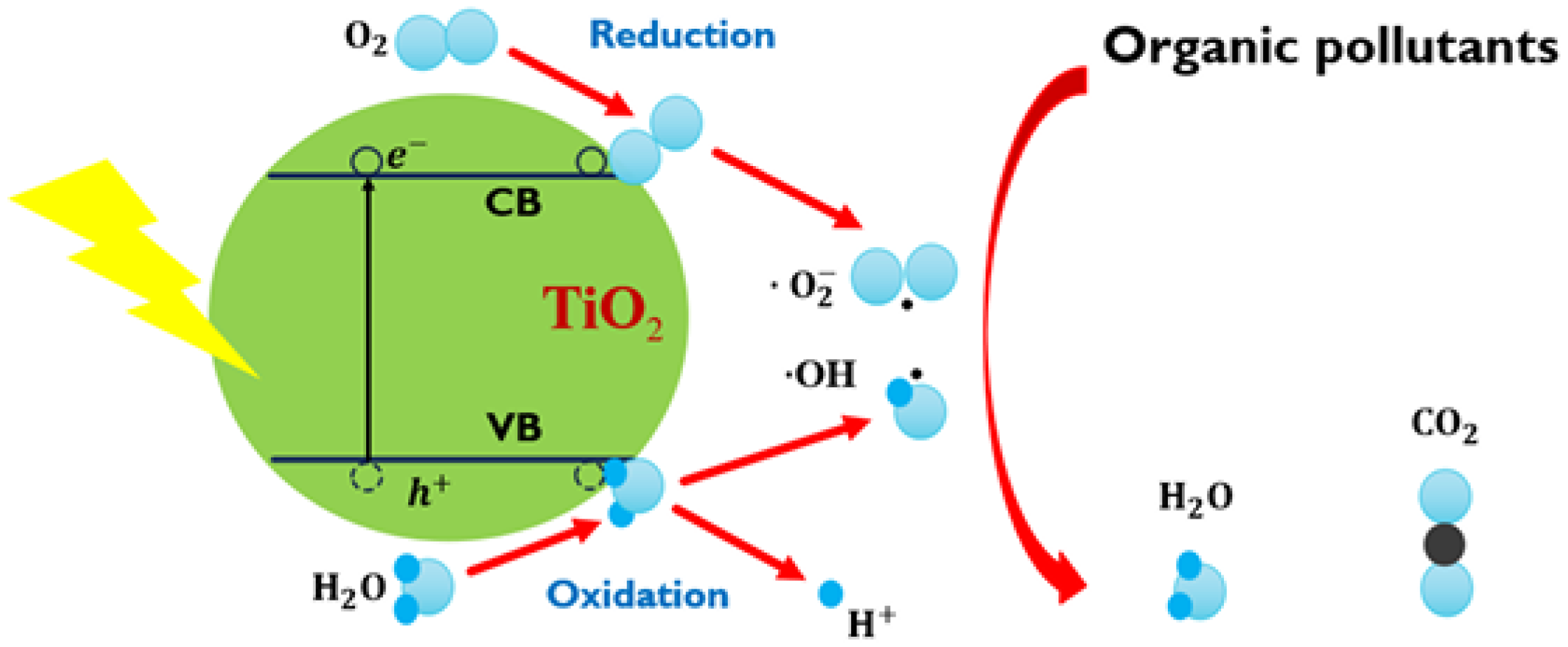
The semiconducting substance TiO2, sometimes referred to as titania, is a member of groups IV–VI of the periodic table. In nature, it exists in three primary polymorphs: brookite, rutile, and anatase [19]. TiO2 functions as an n-type semiconductor because of the oxygen vacancies present [20]. With bandgap energies of roughly 3.03 eV for the rutile phase and 3.2 eV for the anatase phase, TiO2 is a semiconductor with a wide bandgap [20]. Its electrical conductivity lies between that of an insulator and a conductor. Its conductivity is governed by its band structure, composed of a valence band (VB) and a conduction band (CB). The CB corresponds to the molecular LUMO, while the VB arises from interactions involving the HOMO [21]. While titanium 3d, 4s, and 4p orbitals make up the conduction band in TiO2, oxygen 2p orbitals make up most of the VB instead. Figure 1 shows the bandgap refers to the energy difference between the CB and VB [20]. In TiO2 NPs, the semiconductor takes up photons with energy at least as high as its bandgap. An electron from the VB is excited by this photon absorption and moves to the CB, creating an electron–hole pair (e−/h+). Redox reactions on the TiO2 surface can then involve the excited electron in the CB and the hole in the CB. In Equation (1), when TiO2 absorbs UV light (hν), an electron is promoted to the CB, leaving a hole in the VB. This creates a reactive pair (e− + h+), which triggers photocatalytic processes. This basic procedure can be illustrated as follows [22]:
TiO2 + hν → e− + h+
Figure 1.
Illustration of redox reactions taking place on TiO2’s surface during photocatalysis [21].
4. Electrons and Holes Participate in Redox Process
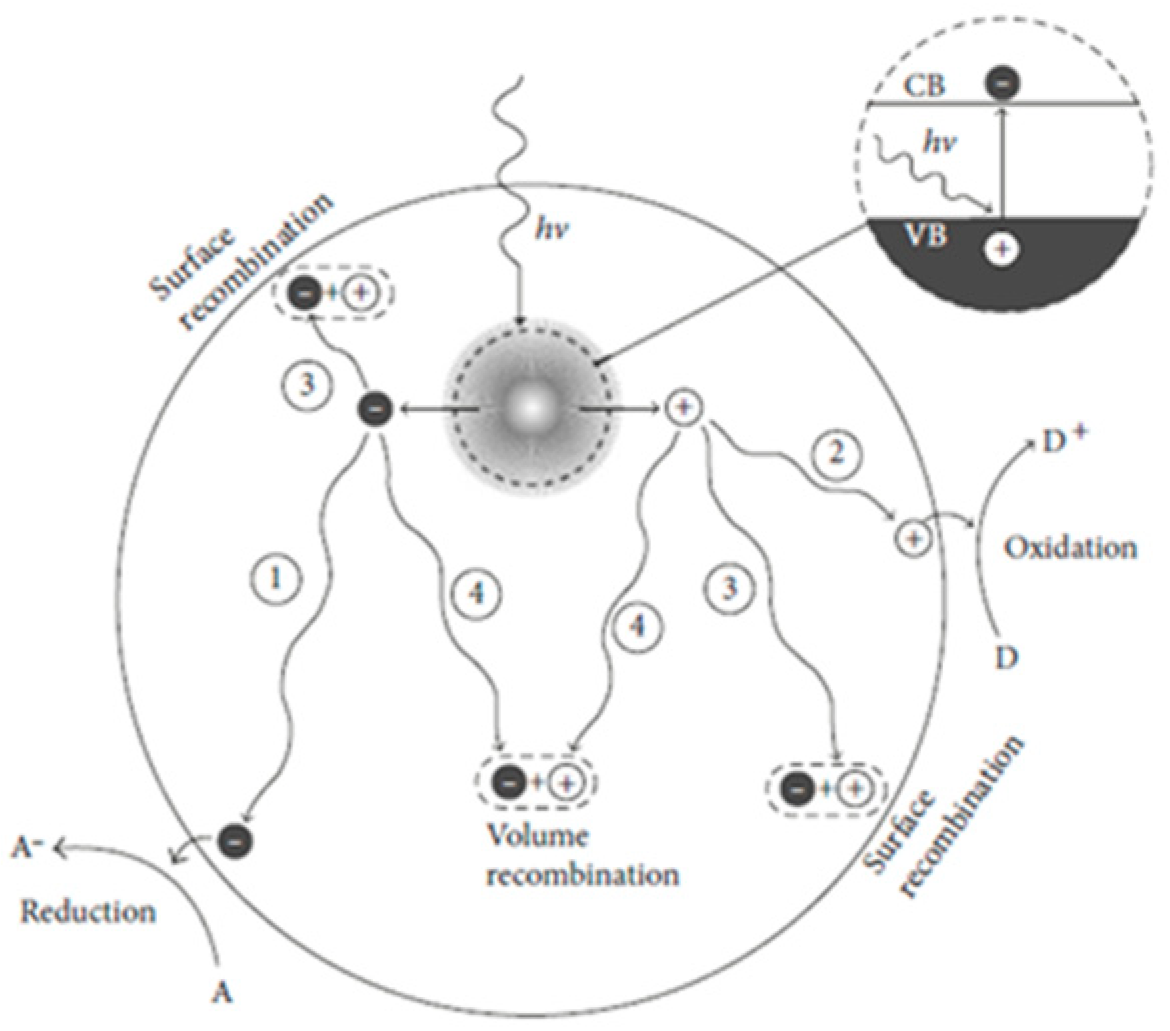
Photogenerated electrons and holes act as the primary charge carriers that initiate redox reactions leading to the mineralization of hazardous contaminants. These charge carriers, however, are also susceptible to recombination, which lowers the likelihood that electrons will reach the CB and drastically lowers the photocatalytic process’s overall efficiency [21]. Figure 2 presents the basic mechanism of TiO2 photocatalysis, which involves light absorption, charge separation, and surface reactions. When TiO2 absorbs photons with energy greater than its bandgap, electrons are excited from the VB to the CB, leaving holes in the VB. The separated charges can follow productive redox routes: in pathway 1, electrons migrate to the surface and reduce electron acceptors (A → A−), generating species such as superoxide radicals, and in pathway 2, holes oxidize electron donors (D → D+), leading to the formation of hydroxyl radicals from water. These radicals actively degrade pollutants like MB. However, electrons and holes may also recombine either at the surface (pathway 3) or within the bulk (pathway 4), lowering the overall photocatalytic efficiency. Therefore, enhancing charge separation and extending TiO2’s optical absorption toward the visible and infrared regions are essential for improved photocatalysis [22].
Figure 2.
Diagrammatic illustration of photocatalytic mechanism of TiO2 NPs using two different forms of recombination (A is electron acceptor, D is electron donor) [22].
Non-recombining electrons and holes can move to the surface of TiO2 and engage in redox reactions with molecules that have been adsorbed on the surface. In Equation (2), superoxide radicals (∙O2−) or hydroperoxide radicals (HO2∙) are produced when electrons (e−) in the CB engage in reduction processes with molecular oxygen (O2):
O2 + e− → ∙O2−
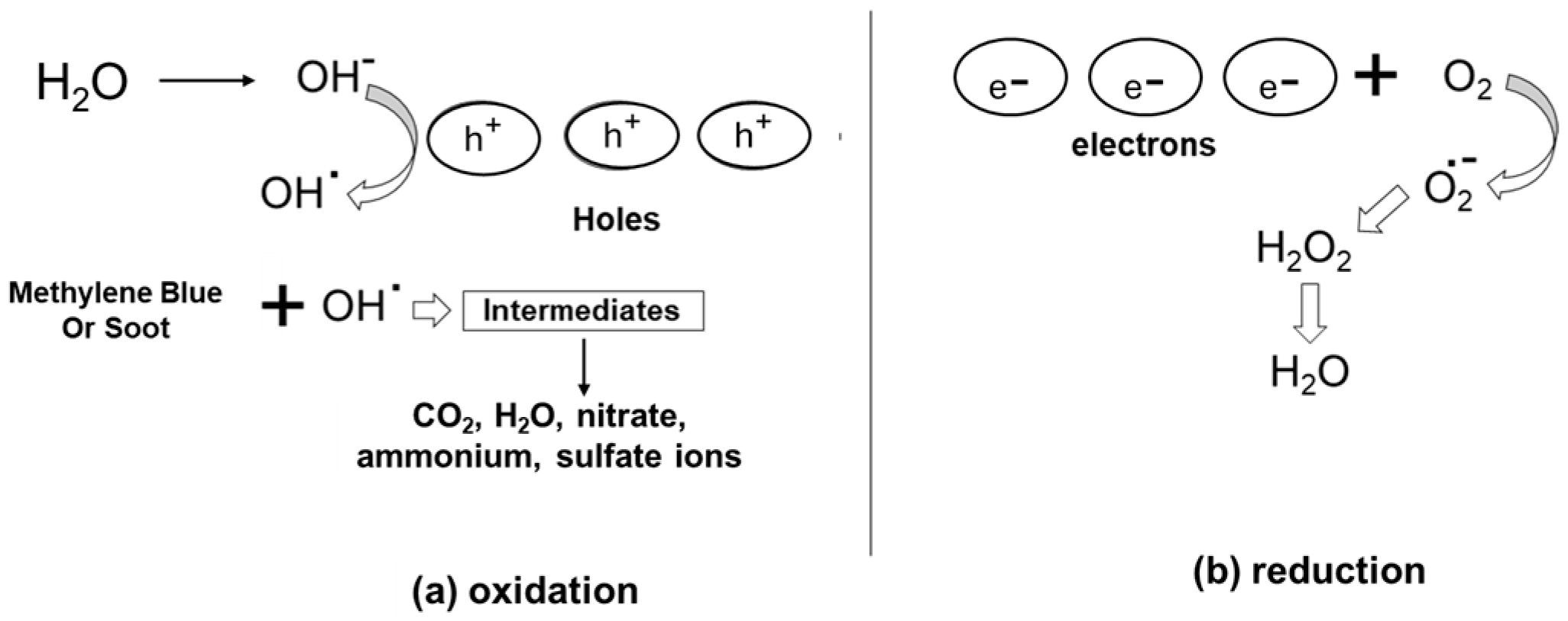
The VB’s photogenerated holes (h+) participate in oxidation processes with water molecules or surface-adsorbed hydroxyl ions, resulting in the production of extremely reactive hydroxyl radicals (∙OH) [21]. FeO4@TiO2 NPs effectively demonstrate this photocatalytic mechanism. When oxidant radicals recombine, H2O2 can be formed, while the photogenerated holes may either directly oxidize organic compounds or be trapped by electron donors. The superoxide radical anion can further react with the produced H2O2 to generate additional hydroxyl radicals. Under artificial sunlight irradiation, these ROS, including superoxide and hydroxyl radicals, degrade MB dye into non-toxic byproducts such as CO2, H2O, and mineral acids [23]. Figure 3 provides a graphical representation of these procedures, where (a) illustrates the oxidation process and (b) illustrates the reduction process. Together, the radicals HO2∙, ∙O2−, and ∙OH are known as ROS, and they play an essential role in the degradation of organic materials. The effectiveness of photocatalytic degradation is strongly influenced by both the properties of the semiconductor and the characteristics of the target organic pollutants [24].
Figure 3.
An illustration of how electrons can convert O2 to superoxide anion radicals and how holes convert H2O to hydroxyl radicals.
5. Parameters of TiO2 NPs Influencing Photocatalytic Activity
The photocatalytic efficiency of TiO2 NPs is strongly influenced by factors such as particle size, surface area, crystal phase, and charge carrier dynamics. Nanoscale TiO2 offers increased surface area, improved adsorption of dye molecules, and reduced electron–hole recombination, all of which enhance photocatalytic activity. Quantum confinement and optimized interactions with MB further improve charge separation and reactivity. Among TiO2 polymorphs, anatase shows the highest activity due to its favorable bandgap and superior charge carrier properties. Overall, the combined effects of small particle size, high surface area, and anatase composition significantly enhance the photocatalytic performance of TiO2-based materials [25]. These fundamental parameters are not independent but rather act synergistically to determine the overall photocatalytic efficiency of TiO2 systems [2]. Among its phases, anatase shows the highest activity due to its larger surface area, higher surface hydroxyl density, and more negative conduction band potential, all of which promote efficient charge separation and ROS formation. Mixed anatase–rutile systems also perform well because interfacial charge transfer reduces electron–hole recombination. In MB degradation, anatase achieves nearly full degradation within 1 h, while rutile reaches only about 85% after 4 h. Mixed-phase TiO2 shows intermediate activity, but its activity is higher than that of pure rutile, confirming that particle size and phase composition strongly influence photocatalytic efficiency [25,26].
6. Active Sites and Recombination Rates in TiO2 Photocatalysis
The photocatalytic efficiency of TiO2 depends on electron–hole recombination rates, surface area, and active site density. An initial increase in efficiency is attributed to a higher number of active sites and increased surface area, whereas excessive photocatalyst loading can reduce efficiency by promoting aggregation, increasing light scattering, and limiting light penetration [27]. Electron–hole recombination reduces photocatalyst activity, but decreasing TiO2 particle size shortens the distance charge carriers must travel to reach surface reaction sites, lowering recombination likelihood. A smaller particle size also increases the surface area, enhancing interactions between the photocatalyst and pollutant, which leads to higher photodegradation efficiency [25]. Electron–hole recombination, occurring in the bulk or on the surface, reduces photocatalytic efficiency because it happens much faster than charge carriers can reach the surface. Smaller particles (~10 nm) enhance carrier mobility and lower recombination, while impurities and lattice defects act as trapping centers that further affect recombination [2]. Photocatalytic efficiency is affected by pollutant concentrations and by the number of available active sites. In one study, the kinetic rate constant decreased from 0.05 to 0.009 min−1 when the concentration of bisphenol A (BPA) rose from 10 to 100 mg/L. The low availability of e− and h+ species, which generate ROS and degrade pollutants, may have been the cause of this decline. Frontistis et al. [27] observed similar results during the degradation of the endocrine disruptor BPA, explaining that the decrease in efficiency was due to limited active sites for pollutant and byproduct adsorption, as well as decreased production of oxidizing species caused by partial occupation of the photocatalyst surface [28]. To enhance MB degradation, the nitrogen content in 5%NT/TiO2 NPs gradually increased. MB degradation efficiency changed with N-doping level. After 150 min of visible light exposure, undoped TiO2 degraded only about 15% of MB, while 5%NT/TiO2 showed the highest activity, achieving nearly 56% degradation in the same period. [29].
7. Disadvantages of TiO2 as a Photocatalyst
Although TiO2 is the most widely used photocatalyst, its use has several drawbacks. These drawbacks include a wide bandgap energy that restricts light absorption to the ultraviolet region (wavelengths less than 390 nm) and the rapid recombination of photogenerated electron holes, which impacts quantum efficiency. As a result, this semiconductor has limits when used in photocatalytic processes in the visible light spectrum [22].
8. Improvements in TiO2 NPs’ Photocatalytic Activity
Extensive research has been conducted to extend the light absorption capabilities of TiO2 into the visible area to enhance its photocatalytic activity. Generally speaking, the strategies created for this purpose fall into two main categories: (i) bandgap engineering, which narrows the bandgap of TiO2 by using special synthesis techniques or by introducing foreign elements into its crystal structure, and (ii) surface sensitization, which is the use of visible light-active materials as sensitizers to improve light harvesting and encourage photoactivation of TiO2 under visible irradiation [30].
9. Strategies to Overcome Challenges
Photocatalytic dye degradation can be performed with both natural and artificial light, but artificial light is better because it stays the same and does not change with the weather [9]. Textile industries release a lot of MB dye into bodies of water, which is very toxic and can be bad for both people and microbes. MB is a major pollutant because it causes cancer, does not break down in the environment, and stays there for a long time. Also, using nanomaterials to clean water raises health and environmental issues. Long-term studies are necessary to evaluate the release of NPs into aquatic systems and their effects on human health and ecosystems [31]. To get more improved photocatalysis, TiO2 doped materials, composite of TiO2 NPs with CNT or nanocellulose can be used.
10. Conclusions
TiO2 NPs are widely recognized for their excellent photocatalytic ability to degrade MB. This efficiency comes from their suitable bandgap, large surface area, and strong generation of ROS under light irradiation. Their overall activity is strongly influenced by factors such as particle size, crystal phase, degree of crystallinity, and the rate of electron–hole recombination. Among the different polymorphs, anatase TiO2 typically shows the highest photocatalytic performance. A variety of synthesis methods—such as sol–gel, hydrothermal, green synthesis, and top-down approaches—enable precise control over the structural and optical properties of TiO2, leading to improved photocatalytic behavior. Additionally, modification strategies like metal or non-metal doping, mixed-phase TiO2, and surface sensitization can significantly enhance visible light absorption. Despite these advantages, TiO2 still faces challenges, including its wide bandgap and fast electron–hole recombination. Environmental concerns related to NP stability, recovery, and reuse are also important considerations.
Author Contributions
Conceptualization, A.I.H.; writing—original abstract, A.I.H.; writing—original draft (introduction), M.G.S.; writing—original draft (conclusion), M.R.R.N.; wrote—original draft (without abstract, introduction, conclusion), H.R.; writing—review, M.G.S.; writing—editing, M.R.R.N. All authors have read and agreed to the published version of the manuscript.
Funding
This research received no external funding.
Institutional Review Board Statement
Not applicable.
Informed Consent Statement
Not applicable.
Data Availability Statement
No new data were created or analyzed in this study. Data sharing is not applicable to this article.
Conflicts of Interest
The authors declare no conflicts of interest.
References
- Govindhan, P.; Pragathiswaran, C.; Chinnadurai, M. A Magnetic Fe3O4 Decorated TiO2 Nanoparticles Application for Photocatalytic Degradation of Methylene Blue (MB) under Direct Sunlight Irradiation. J. Mater. Sci. Mater. Electron. 2018, 29, 6458–6469. [Google Scholar] [CrossRef]
- Subhan, M.A.; Choudhury, K.P.; Neogi, N. Advances with molecular nanomaterials in industrial manufacturing applications. Nanomanufacturing 2021, 1, 75–97. [Google Scholar] [CrossRef]
- Abou-Gamra, Z.M.; Ahmed, M.A. Synthesis of Mesoporous TiO2–Curcumin Nanoparticles for Photocatalytic Degradation of Methylene Blue Dye. J. Photochem. Photobiol. B 2016, 160, 134–141. [Google Scholar] [CrossRef]
- Ahmed, M.A.; El-Katori, E.E.; Gharni, Z.H. Photocatalytic Degradation of Methylene Blue Dye Using Fe2O3/TiO2 Nanoparticles Prepared by Sol–Gel Method. J. Alloys Compd. 2013, 553, 19–29. [Google Scholar] [CrossRef]
- Kazemi, M.; Mohammadizadeh, M.R. Simultaneous Improvement of Photocatalytic and Superhydrophilicity Properties of Nano TiO2 Thin Films. Chem. Eng. Res. Des. 2012, 90, 1473–1479. [Google Scholar] [CrossRef]
- Suchak, N.M.; Deshpande, M.P.; Mistry, H.M.; Pandya, S.J.; Chaki, S.H.; Bhatt, S.V. Kinetic Study of Adsorption and Photocatalytic Degradation of Methylene Blue Dye Using TiO2 Nanoparticles with Activated Carbon. Phys. Scr. 2024, 99, 0659d6. [Google Scholar] [CrossRef]
- Wang, M.C.; Lin, H.J.; Yang, T.S. Characteristics and Optical Properties of Iron Ion (Fe3+)-Doped Titanium Oxide Thin Films Prepared by a Sol–Gel Spin Coating. J. Alloys Compd. 2009, 473, 394–400. [Google Scholar] [CrossRef]
- Coba, A.J.O.; Briceño, S.; Vizuete, K.; Debut, A.; González, G. Diatomite with TiO2 Nanoparticles for the Photocatalytic Degradation of Methylene Blue. Carbon Trends 2025, 19, 100488. [Google Scholar] [CrossRef]
- Khan, I.; Saeed, K.; Zekker, I.; Zhang, B.; Hendi, A.H.; Ahmad, A.; Ahmad, S.; Zada, N.; Ahmad, H.; Shah, L.A.; et al. Review on Methylene Blue: Its Properties, Uses, Toxicity and Photodegradation. Water 2022, 14, 242. [Google Scholar] [CrossRef]
- Reduction of Methylene Blue by Using Direct Continuous Ozone. J. Environ. Earth Sci. 2020, 10, 46–56. [CrossRef]
- Jawad, N.H.; Najim, S.T. Removal of Methylene Blue by Direct Electrochemical Oxidation Method Using a Graphite Anode. IOP Conf. Ser. Mater. Sci. Eng. 2018, 454, 012023. [Google Scholar] [CrossRef]
- Subhan, M.A.; Neogi, N.; Choudhury, K.P. Industrial Manufacturing Applications of Zinc Oxide Nanomaterials: A Comprehensive Study. Nanomanufacturing 2022, 2, 265–291. [Google Scholar] [CrossRef]
- Chang, C.; Rad, S.; Gan, L.; Li, Z.; Dai, J.; Shahab, A. Review of the Sol–Gel Method in Preparing Nano TiO2 for Advanced Oxidation Process. Nanotechnol. Rev. 2023, 12, 20230150. [Google Scholar] [CrossRef]
- Laghrib, S.; Gherdaoui, C.E.; Belgherbi, O.; Benaskeur, N.; Boudissa, M.; Kanagaraj , A.; Aouffa , N. Photocatalytic Degradation of Methylene Blue Using TiO2 Nanoparticles Synthesized via the Sol–Gel Method in Acidic and Neutral Media. React. Kinet. Mech. Catal. 2025, 138, 1725–1745. [Google Scholar] [CrossRef]
- Dastan, D.; Chaure, N.; Kartha, M. Surfactants Assisted Solvothermal Derived Titania Nanoparticles: Synthesis and Simulation. J. Mater. Sci. Mater. Electron. 2017, 28, 7784–7796. [Google Scholar] [CrossRef]
- Mathew, S.; Kumar Prasad, A.; Benoy, T.; Rakesh, P.P.; Hari, M.; Libish, T.M.; Radhakrishnan, P.; Nampoori, V.P.N.; Vallabhan, C.P.G. UV-Visible Photoluminescence of TiO2 Nanoparticles Prepared by Hydrothermal Method. J. Fluoresc. 2012, 22, 1563–1569. [Google Scholar] [CrossRef]
- Santhoshkumar, T.; Rahuman, A.A.; Jayaseelan, C.; Rajakumar, G.; Marimuthu, S.; Kirthi, A.V.; Velayutham, K.; Thomas, J.; Venkatesan, J.; Kim, S.-K. Green Synthesis of Titanium Dioxide Nanoparticles Using Psidium Guajava Extract and Its Antibacterial and Antioxidant Properties. Asian Pac. J. Trop. Med. 2014, 7, 968–976. [Google Scholar] [CrossRef]
- Lee, H.-K.; Okada, T.; Fujiwara, T.; Lee, S.-W. Top-Down Synthesis and Deposition of Highly Porous TiO2 Nanoparticles from NH4TiOF3 Single Crystals on Multi-Walled Carbon Nanotubes and Graphene Oxides. Mater. Des. 2016, 108, 269–276. [Google Scholar] [CrossRef]
- Haggerty, J.E.S.; Schelhas, L.T.; Kitchaev, D.A.; Mangum, J.S.; Garten, L.M.; Sun, W.; Stone, K.H.; Perkins, J.D.; Toney, M.F.; Ceder, G.; et al. High-Fraction Brookite Films from Amorphous Precursors. Sci. Rep. 2017, 7, 15232. [Google Scholar] [CrossRef]
- Wisitsoraat, A.; Tuantranont, A.; Comini, E.; Sberveglieri, G.; Wlodarski, W. Characterization of N-Type and p-Type Semiconductor Gas Sensors Based on NiOx Doped TiO2 Thin Films. Thin Solid Films 2009, 517, 2775–2780. [Google Scholar] [CrossRef]
- Banerjee, S.; Pillai, S.C.; Falaras, P.; O’Shea, K.E.; Byrne, J.A.; Dionysiou, D.D. New Insights into the Mechanism of Visible Light Photocatalysis. J. Phys. Chem. Lett. 2014, 5, 2543–2554. [Google Scholar] [CrossRef]
- Yan, X.; Li, Y.; Xia, T. Black Titanium Dioxide Nanomaterials in Photocatalysis. Int. J. Photoenergy 2017, 2017, 1–16. [Google Scholar] [CrossRef]
- Jahurul Islam, M.; Amaranatha Reddy, D.; Han, N.S.; Choi, J.; Song, J.K.; Kim, T.K. An Oxygen-Vacancy Rich 3D Novel Hierarchical MoS2/BiOI/AgI Ternary Nanocomposite: Enhanced Photocatalytic Activity through Photogenerated Electron Shuttling in a Z-Scheme Manner. Phys. Chem. Chem. Phys. 2016, 18, 24984–24993. [Google Scholar] [CrossRef]
- Paz, C.V.; Ung, F.; Zárate, J.; Cortés, J.A. Evaluation of Surface Phenomena Involved in Photocatalytic Degradation of Acid Blue 9 by TiO2 Catalysts of Single and Mixed Phase—A Theoretical and Experimental Study. Appl. Surf. Sci. 2020, 508, 145114. [Google Scholar] [CrossRef]
- Dariani, R.S.; Esmaeili, A.; Mortezaali, A.; Dehghanpour, S. Photocatalytic Reaction and Degradation of Methylene Blue on TiO2 Nano-Sized Particles. Optik 2016, 127, 7143–7154. [Google Scholar] [CrossRef]
- Tayade, R.J.; Surolia, P.K.; Kulkarni, R.G.; Jasra, R.V. Photocatalytic Degradation of Dyes and Organic Contaminants in Water Using Nanocrystalline Anatase and Rutile TiO2. Sci. Technol. Adv. Mater. 2007, 8, 455–462. [Google Scholar] [CrossRef]
- Dianati, R.A.; Mengelizadeh, N.; Zazouli, M.A.; Yazdani Cherati, J.; Balarak, D.; Ashrafi, S. Photocatalytic Degradation of Bisphenol A by GO-TiO2 Nanocomposite under Ultraviolet Light: Synthesis, Effect of Parameters and Mineralisation. Int. J. Environ. Anal. Chem. 2024, 104, 5065–5082. [Google Scholar] [CrossRef]
- Behnajady, M.; Modirshahla, N.; Hamzavi, R. Kinetic Study on Photocatalytic Degradation of C.I. Acid Yellow 23 by ZnO Photocatalyst. J. Hazard. Mater. 2006, 133, 226–232. [Google Scholar] [CrossRef] [PubMed]
- Li, D.; Calebe, V.C.; Li, Y.; Liu, H.; Lei, Y. Interstitial N-Doped TiO2 for Photocatalytic Methylene Blue Degradation under Visible Light Irradiation. Catalysts 2024, 14, 681. [Google Scholar] [CrossRef]
- Ma, Y.; Wang, X.; Jia, Y.; Chen, X.; Han, H.; Li, C. Titanium Dioxide-Based Nanomaterials for Photocatalytic Fuel Generations. Chem. Rev. 2014, 114, 9987–10043. [Google Scholar] [CrossRef]
- Carmona-Carmona, A.J.; Mora, E.S.; Flores, J.I.P.; Márquez-Beltrán, C.; Castañeda-Antonio, M.D.; González-Reyna, M.A.; Barrera, M.C.; Misaghian, K.; Lugo, J.E.; Toledo-Solano, M. Photocatalytic Degradation of Methylene Blue by Magnetic Opal/Fe3O4 Colloidal Crystals under Visible Light Irradiation. Photochem 2023, 3, 390–407. [Google Scholar] [CrossRef]
Disclaimer/Publisher’s Note: The statements, opinions and data contained in all publications are solely those of the individual author(s) and contributor(s) and not of MDPI and/or the editor(s). MDPI and/or the editor(s) disclaim responsibility for any injury to people or property resulting from any ideas, methods, instructions or products referred to in the content. |
© 2025 by the authors. Licensee MDPI, Basel, Switzerland. This article is an open access article distributed under the terms and conditions of the Creative Commons Attribution (CC BY) license (https://creativecommons.org/licenses/by/4.0/).