Proceeding Paper

Retrieving Canopy Chlorophyll Content from Sentinel-2 Imagery Using Google Earth Engine †

by
Tarun Teja Kondraju
*,
Rabi N. Sahoo
,
Rajan G. Rejith
,
Amrita Bhandari
,
Rajeev Ranjan
,
Devanakonda V. S. C. Reddy
and
Selvaprakash Ramalingam
Division of Agricultural Physics, ICAR—Indian Agricultural Research Institute, New Delhi 110012, India
*
Author to whom correspondence should be addressed.
Presented at the 3rd International Online Conference on Agriculture (IOCAG 2025), 22–24 October 2025; Available online: https://sciforum.net/event/IOCAG2025.
Biol. Life Sci. Forum 2025, 54(1), 13; https://doi.org/10.3390/blsf2025054013
Published: 2 February 2026
(This article belongs to the Proceedings of The 3rd International Online Conference on Agriculture)

Abstract

Google Earth Engine (GEE) has revolutionised remote sensing. The GEE cloud platform lets users quickly analyse large satellite imagery datasets with custom programmes, enhancing global-scale analysis. Crop condition monitoring using GEE would greatly help in decision-making and precision agriculture. Estimating canopy chlorophyll content (CCC) is an effective way to monitor crops using remote sensing because leaf chlorophyll is a key indicator. A hybrid model that combines radiative transfer models (RTMs), such as PROSAIL, with Gaussian Process Regression (GPR) can effectively estimate crop biophysical parameters using remote sensing images. GPR has proven to be one of the best methods for this purpose. This study aimed to develop a hybrid model to estimate CCC from S2 imagery and transfer it to the GEE platform for efficient data processing. In this work, the CCC (g/cm2) data from the S2 biophysical processor toolbox for the S2 imagery of the ICAR-Indian Agricultural Research Institute (IARI) on 23 February 2023 were used as observation data to train the hybrid algorithm. The hybrid model was successfully validated against the 155 input data with an R2 of 0.94, RMSE of 10.02, and NRMSE of 5.04%. The model was integrated into GEE to successfully generate a CCC-estimated map of IARI using S2 imagery from 23 February 2023. An R2 value of 0.96 was observed when GEE-estimated CCC values were compared against CCC values estimated locally. This establishes that the GEE-based CCC estimation with the PROSAIL + GPR hybrid model is an effective and accurate method for monitoring vegetation and crop conditions over large areas and extended periods.

1. Introduction

Remote sensing has become an indispensable tool for monitoring vegetation biophysical and biochemical properties at multiple spatial and temporal scales. Chlorophyll, one of the most fundamental plant pigments, plays a central role in photosynthesis and is therefore strongly linked to photosynthetic capacity, nutrient status, and overall crop health. As such, canopy chlorophyll content has emerged as a reliable proxy indicator of vegetation vigour, stress, and productivity and, therefore, is highly valuable for precision agriculture and crop monitoring applications [1,2,3,4]. Accurate retrieval of CCC from satellite observations enables timely decision-making for irrigation scheduling, nutrient management, and stress detection, thereby improving yield and resource-use efficiency [5,6,7].
The Sentinel-2 mission, with its multispectral sensors covering narrow red-edge and visible-to-near-infrared bands, has been highly effective for estimating canopy chlorophyll due to its sensitivity to variations in leaf pigments and canopy structural attributes [8,9,10,11]. Many studies have demonstrated the utility of S2 bands and derived vegetation indices for estimating chlorophyll concentration, LAI, and other physiological parameters across a wide range of crops and natural vegetation systems [12,13,14,15].
However, purely empirical or statistical approaches often fail to generalise across diverging environments, canopy structures, and observation conditions. Therefore, hybrid modelling approaches that combine physically based radiative transfer models (RTMs) with machine learning algorithms have attracted increasing attention. The PROSAIL model, which integrates PROSPECT (leaf optical properties) and SAIL (canopy reflectance), is among the most robust RTMs for simulating canopy reflectance and retrieving biophysical parameters [16,17,18]. Machine learning models trained on PROSAIL-generated synthetic datasets can effectively integrate RTM physics and data-driven algorithms, a combination that has demonstrated excellent performance in biophysical parameter estimation [19,20,21].
GPR has become one of the most powerful nonparametric regression methods for remote sensing retrieval, owing to its ability to model nonlinear relationships and quantify predictive uncertainties [22,23,24]. When combined with RTM simulations, GPR has shown excellent performance in estimating chlorophyll content, LAI, and other relevant canopy traits under a variety of sensor types and vegetation conditions [25,26,27]. The hybrid PROSAIL + GPR framework is thus particularly suitable for large-scale operational monitoring of CCC.
Cloud-based platforms such as GEE have furthered this capability for large-scale remote sensing analyses by providing access to satellite archives at petabyte scale and high-performance cloud computing infrastructure [28,29,30]. Hybrid biophysical models integrated into GEE can enable near-real-time, automated retrieval of vegetation biophysical parameters over large regions without requiring local storage or computationally intensive resources. The advanced application of RTM-ML retrieval frameworks within GEE represents a significant step toward scalable and accessible precision agriculture systems.
Against this background, the development and operationalisation of a hybrid PROSAIL-GPR model for CCC retrieval from Sentinel-2 imagery on the GEE platform bear great promise for agricultural monitoring. This study seeks to (i) construct a robust hybrid PROSAIL + GPR model trained on Sentinel-2-derived CCC data, (ii) validate its performance based on ground-based or processor-derived observations, and (iii) integrate the model within GEE to generate high-resolution CCC maps for efficient vegetation monitoring at scale.

2. Methodology

2.1. Study Area

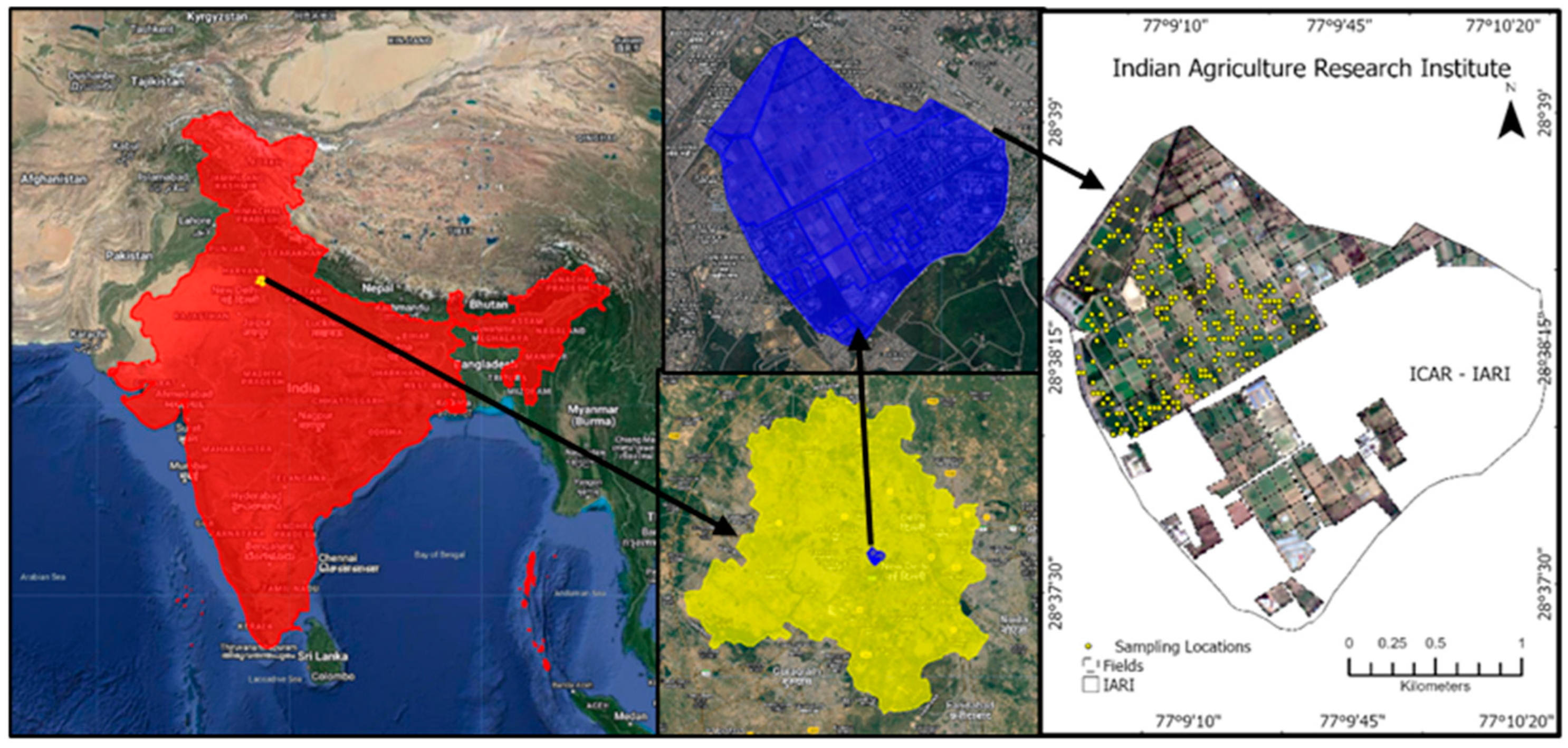
The field experiments were conducted at the ICAR–Indian Agricultural Research Institute (IARI), New Delhi, India, situated between 28.08 and 28.09° N latitude and 77.16–77.19° E longitude. Founded in 1905, IARI, popularly known as the “Pusa Institute”, is India’s most prominent agricultural research institute and a leader in crop improvement and agricultural technology. The institute maintains expansive experimental farms, research plots, and controlled-environment facilities that support multidisciplinary studies in plant physiology, agronomy, soil science, and remote sensing. Its semi-arid subtropical climate, characterised by hot summers, cool winters, and monsoon-dominated rainfall, provides representative cropping conditions for northern India. The diversity of these well-managed agricultural fields has made IARI an ideal site for validating remote sensing-based retrievals of canopy chlorophyll content (CCC) and assessing the performance of hybrid PROSAIL–GPR modelling using Sentinel-2 imagery. Figure 1 shows the location of IARI in India.

2.2. Data Acquisition and Pre-Processing

Sentinel-2 Level-2A imagery (atmospherically corrected and subset to the study area) covering the ICAR-Indian Agricultural Research Institute (IARI), New Delhi, was downloaded for 23 February 2023. Invalid pixels contaminated by clouds or shadows were excluded using the Sentinel-2 quality assurance mask. The CCC estimated from the biophysical processor of the SNAP software (version 13) from ESA was used as observation data for model development. The CCC values estimated from the Sentinel-2 biophysical processor were used to train and validate the hybrid model. A total of 155 samples representing spatially distributed CCC values across the study area were extracted to develop the training dataset. Figure 1 depicts the locations of the sampling points (155) in the IARI fields (yellow dots on the satellite image).

2.3. Generating a Synthetic Reflectance Dataset Using PROSAIL

To develop a physically informed training dataset, the PROSAIL radiative transfer model was employed to simulate canopy reflectance across the spectral configuration of Sentinel-2. This couples the PROSPECT leaf optical properties model with the SAIL canopy bidirectional reflectance model, thereby enabling realistic simulation of canopy response under changing biophysical conditions. Model input parameters, namely leaf chlorophyll content, leaf area index, canopy structure coefficients, and soil background reflectance, were varied over their natural range to create a synthetic dataset representative of diverse vegetation conditions. To simulate Sentinel-2 spectral characteristics, the reflectance spectra were convolved with the spectral response functions of Sentinel-2. Table 1 lists all parameters that were used to generate simulated data with PROSAIL.

2.4. Hybrid Model Development Using Gaussian Process Regression

A GPR model was trained using PROSAIL-generated synthetic reflectance as predictors and corresponding CCC values as targets. GPR was chosen for its ability to model nonlinear relationships and to provide stable predictions with small training datasets. The model hyperparameters were optimised via cross-validation to achieve optimal generalisation performance. After training, the hybrid PROSAIL + GPR model was validated on 155 CCC samples extracted from Sentinel-2 processor outputs. Model accuracy was quantified by the coefficient of determination (R2), RMSE, and NRMSE.

2.5. Implementation of the Hybrid Model in Google Earth Engine

The optimised hybrid model was then deployed within GEE to operationalise large-scale CCC retrieval. The GPR model’s coefficients and kernel functions were implemented in JavaScript within the GEE environment. Sentinel-2 imagery for 23 February 2023 was ingested into GEE, and surface reflectance bands relevant to chlorophyll estimation (visible, near-infrared, and red-edge) served as inputs to the hybrid model. GEE processed the imagery on the cloud to generate a spatially continuous CCC estimation map of the IARI. The CCC values derived using GEE were exported for comparison with locally estimated CCC values generated outside GEE.

2.6. Validation of GEE-Based CCC Estimates

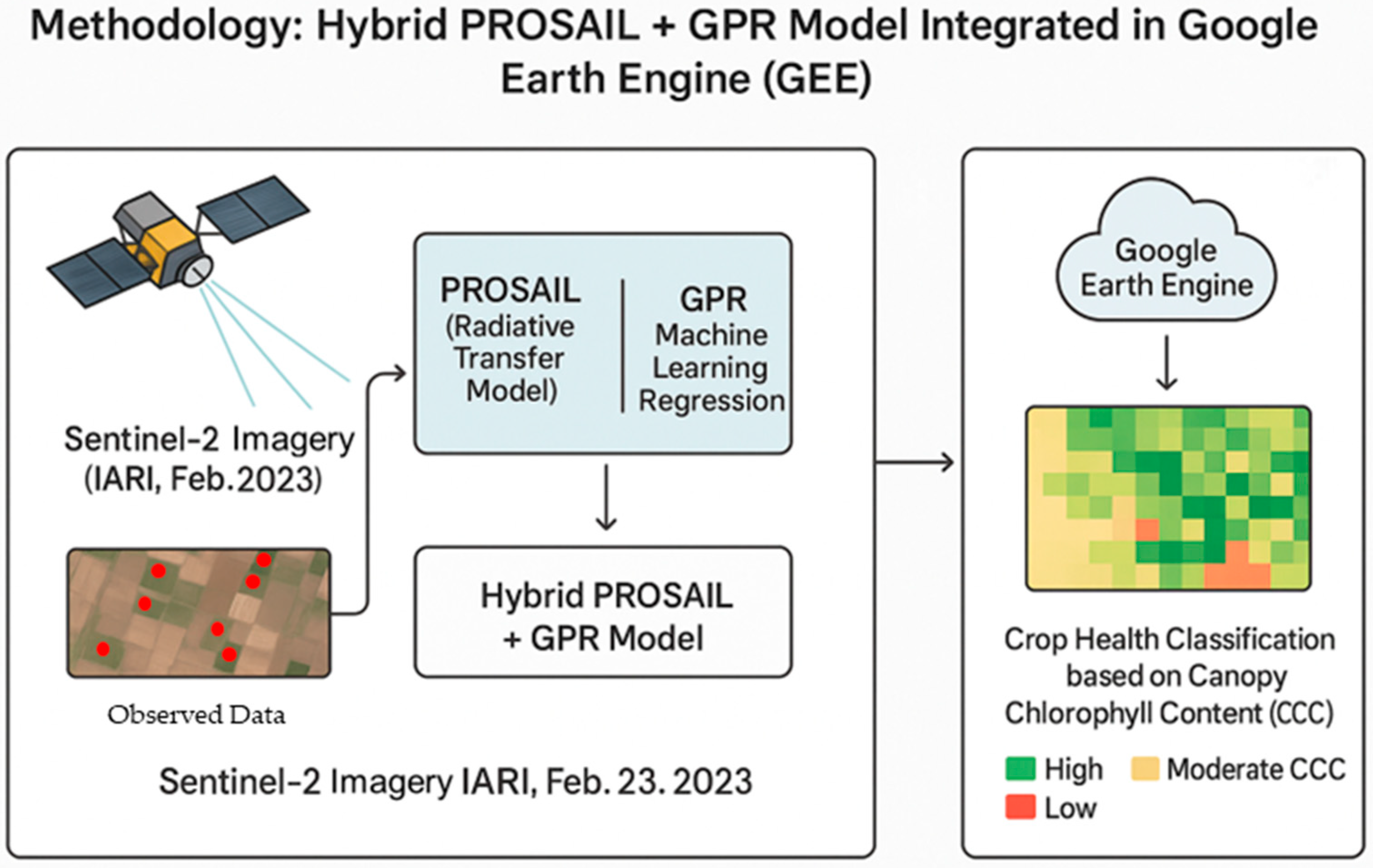
The correctness of the GEE implementation was evaluated by comparing CCC values estimated within GEE with CCC predicted by the hybrid PROSAIL + GPR model executed locally. A one-to-one comparison of these two outputs yielded an R2 of 0.96, indicating excellent agreement. This confirmed that the hybrid model had been successfully implemented in GEE and was reliable for large-scale vegetation monitoring. Figure 2 presents the schema of estimating CCC data from Sentinel-2 Level-2A data using the PROSAIL–Gaussian Process Regression (GPR) hybrid approach.

3. Results

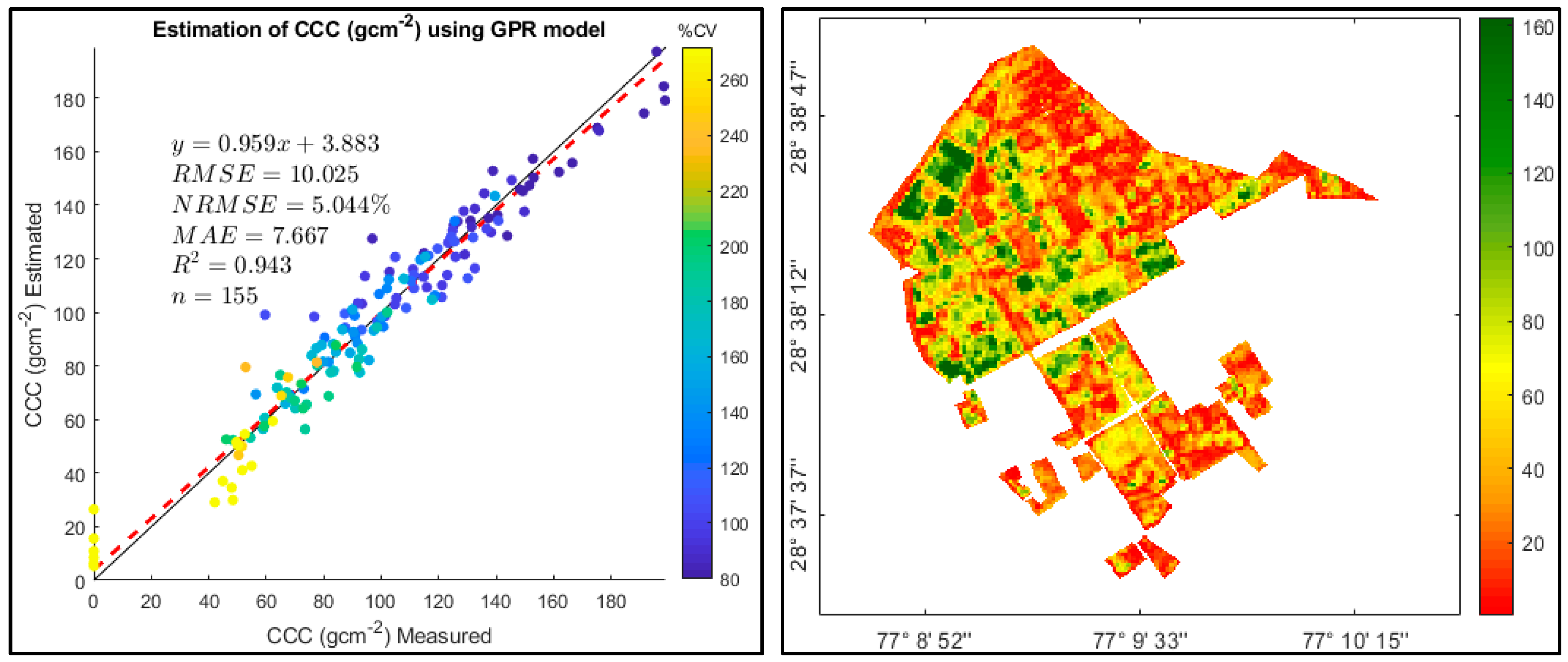
Figure 3 (left panel) shows the scatter plot of the measured versus estimated CCC in g cm−2. The graph clearly shows a 1:1 line in black and a dotted red regression line. The graph also shows the coefficient of variation (%CV), a statistical measure showing relative variability, calculated as the ratio of the Standard Deviation to the Mean, often expressed as a percentage (CV = σ/μ ×100). It is a unitless, relative measure that allows comparison of datasets with different units or scales, indicating dispersion around the mean; a higher CV indicates greater variability. From Figure 3, the %CV of the estimated points ranges from purple to yellow as the error increases. The hybrid PROSAIL + GPR model performed exceptionally in estimating CCC from Sentinel-2 reflectance data. Using 155 reference CCC samples derived from the Sentinel-2 biophysical processor, the model returned a high coefficient of determination (R2 = 0.94), an RMSE of 10.02 g/cm2, and an NRMSE of 5.04%. These accuracy metrics indicate that the model captured both the magnitude and variability of CCC across IARI study fields with minimal error. As shown in the validation scatter plot, there is a dense clustering of points near the 1:1 line, indicating strong agreement between the predicted and reference CCC values and confirming the reliability of the hybrid model for pixel-level retrievals.
This trained hybrid model was then applied locally to the Sentinel-2 image of 23 February 2023 to obtain a detailed spatial distribution of CCC across the agricultural fields. Figure 3 (right) shows the estimated CCC map of the IARI as observed on the 23 February 2023. The figure shows CCC maps classified into various colours from dark green to red based on the estimated CCC values. The dark green colour depicts high canopy chlorophyll content, followed by light green and yellow in descending order. The red colour indicates cropless fields, barren land, buildings, and other features that are commonly observed during the middle of the growing season at the IARI. Mapping at an acceptable resolution also revealed heterogeneity within individual fields, thereby resolving subtle physiological variations that might otherwise have remained elusive at larger scales. Hence, the visual comparison demonstrates that the hybrid model effectively translates spectral information into physiologically meaningful indicators of crop status.
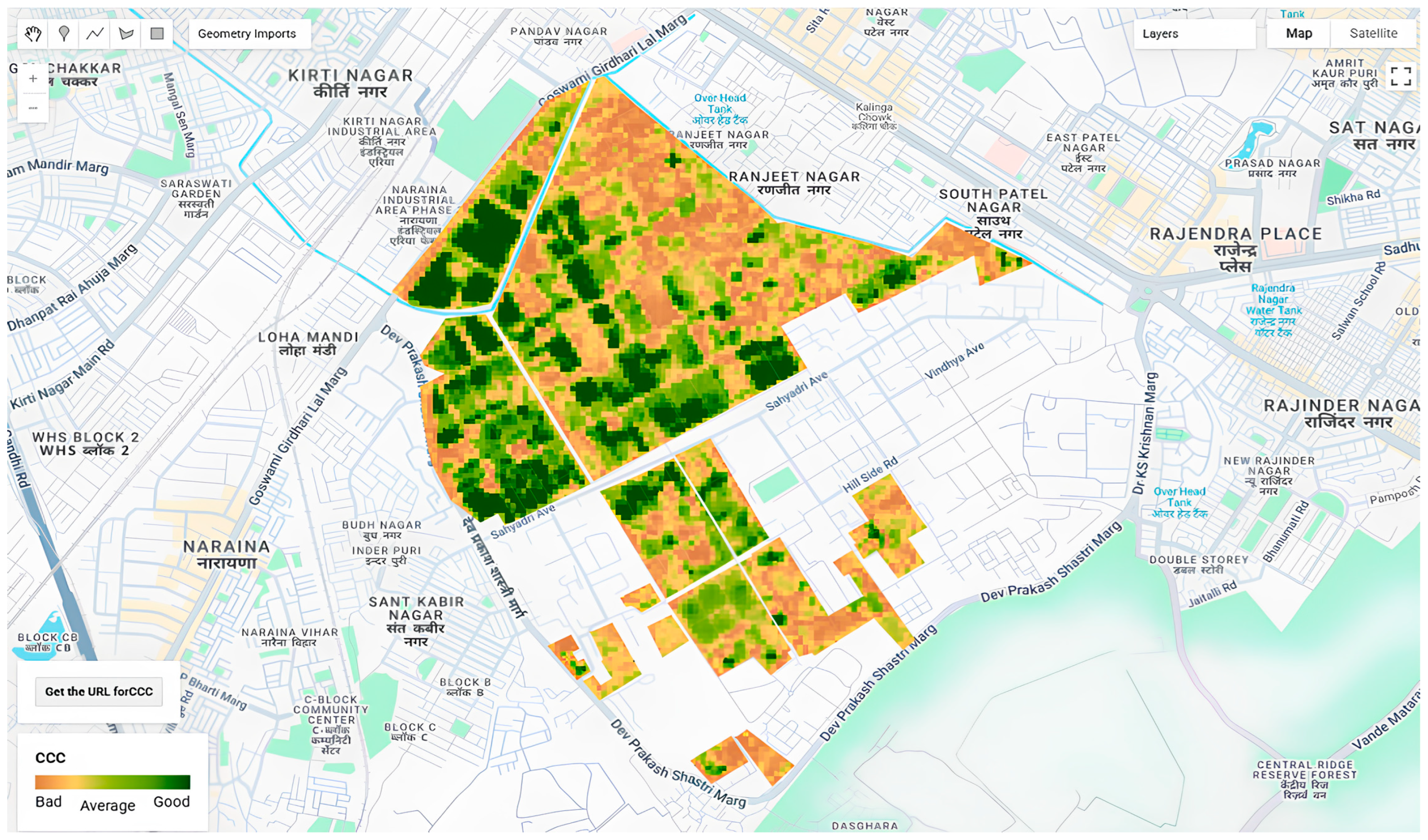
The model was executed on the GEE platform to enable operational scalability. GEE-based execution yielded a CCC map that was very similar to that derived from local processing. Figure 4 shows the GEE-based CCC estimated map overlaid on a Google map within the GEE JavaScript Application Programming Interface (API) environment. Here, too, the CCC map was classified using dark green to light brown colour shades based on the estimated CCC values. Higher CCC values are indicated by dark green, followed by lighter green shades. Fallow lands, built-up areas, and barren lands are identified by light brown colour. A quantitative comparison of the estimated CCC values from GEE and those obtained by the locally executed hybrid model showed excellent correspondence (R2 = 0.96). This near-perfect correspondence confirms that the model parameters and regression functions were correctly transferred to the GEE environment and that cloud-based implementation preserved the predictive behaviour of the original algorithm. Consistency of estimates at the local and GEE levels highlighted the robustness of the hybrid modelling framework, thereby enabling its applicability in large-scale or repeated monitoring settings.
The overall results suggest that the CCC estimates from the hybrid PROSAIL + GPR approach are highly accurate and that integrating it into GEE enables automated, efficient, and spatially explicit monitoring across large agricultural landscapes. Such high predictive accuracy, realistic spatial representation of crop conditions, and successful deployment in a cloud-based system make the method valuable for real-time crop health assessment, precision agriculture applications, and scalable vegetation monitoring frameworks.

4. Discussion

These findings highlight that the hybrid PROSAIL + GPR modelling framework provides a robust and accurate approach for retrieving CCC from Sentinel-2 and that its integration into GEE enables efficient and scalable operational deployment. The high retrieval accuracy, both locally (R2 = 0.94) and in the GEE implementation (R2 = 0.96), underscores the strong synergies among radiative transfer modelling, machine learning, and cloud-based geospatial processing. These results are consistent with several decades of research emphasising the importance of chlorophyll-related spectral features as well as new avenues offered by physically informed models to enhance vegetation biophysical parameter estimation.
Chlorophyll has a substantial impact on the reflectance of leaves and canopies, particularly in the visible and red-edge regions of the spectrum. Pioneering work demonstrated that chlorophyll estimation from reflectance is feasible, as chlorophyll absorption dominates the green, red, and red-edge reflectance features of vegetation [1,2,3,4]. The Sentinel-2 mission was explicitly designed to improve retrievals of chlorophyll, LAI, and related traits through its strategically positioned red-edge bands [8,9,10,11]. These bands capture subtle variations in pigment concentration and canopy structure that traditional broadband sensors frequently fail to detect. Our results confirm previous reports, demonstrating that Sentinel-2 spectral information is sufficiently sensitive to chlorophyll dynamics to enable high-accuracy CCC predictions.
They often rely on empirical methods that are intrinsically site-, crop-, and illumination geometry-dependent [12,13,14]. Physical RTMs, such as PROSPECT [16] and SAIL [18], overcome such limitations by modelling canopy reflectance across a wide range of biophysical configurations. By integrating PROSPECT and SAIL, PROSAIL [17] has been widely applied to retrieve chlorophyll and LAI from multispectral and hyperspectral remote sensing data [15,19,20,21]. Here, we validate these findings by demonstrating that PROSAIL-generated synthetic datasets can effectively support machine learning-based retrieval of CCC in agriculture. The strong agreement between PROSAIL-based predictions and Sentinel-2 biophysical processor outputs confirms that the simulated reflectances capture the biophysical variability present in real crop canopies.
The choice of GPR as the inversion technique was particularly effective. GPR has been widely recognised as a strong nonparametric Bayesian method capable of modelling nonlinear relationships while providing uncertainty estimates [22,23]. Previous studies utilising GPR for chlorophyll estimation from Sentinel-2 and hyperspectral sensors have also reported excellent retrieval accuracy [24,26,27]. Our results align with those in these studies, showing that meaningful relationships can be learned by GPR from PROSAIL-simulated datasets and subsequently translated into accurate canopy-level predictions. The strong generalisation performance inherent in GPR, even with moderate-sized training samples, further supports its suitability for operational vegetation monitoring workflows.
However, it should be noted that the CCC reference data used to train and validate the model were derived from the Sentinel-2 biophysical processor rather than from in situ chlorophyll measurements. This means that the current validation is more between two models than from the ground truth. Although the Sentinel-2 biophysical processor is based on physical principles and is well established, uncertainties in the processed data could affect subsequent modelling steps. The primary purpose of this study is to demonstrate the technical and operational feasibility of the PROSAIL-GPR joint inverse model implemented in Google Earth Engine. Future work will focus on the simultaneous measurement of chlorophyll concentrations and/or hyperspectral data from drones to validate results and improve physical certainty.
The greater variability observed at low CCC values is consistent with conditions in which crop density is low, and more soil background is exposed. When soil reflectance becomes a dominant component of the mixed pixel, the canopy reflectance signal is partially masked, weakening the spectral relationship between chlorophyll content and reflectance. This soil–vegetation interaction is well documented as a challenge for pigment retrieval, as background brightness can distort physiologically meaningful spectral features and increase estimation uncertainty (e.g., [12,13,14]). Consequently, the PROSAIL–GPR model exhibits a higher %CV under these conditions, indicating reduced sensitivity to chlorophyll variations when vegetation cover is low. Addressing soil background effects through soil-adjusted indices, multi-temporal modelling, or improved PROSAIL parameterisation could further enhance model stability in sparse canopy conditions.
Despite the fact that soil reflectance and the fraction of vegetation cover are accounted for in the PROSAIL model, a higher degree of uncertainty exists in the case of a sparsely covered area. Solutions aimed at the suppression of the soil background effect could potentially include the following options: the utilisation of soil-corrected vegetation indices, the imposition of stronger constraints in the brightness parameters related to soil reflectance in the PROSAIL model, and the employment of a temporal model that makes use of the fact that certain plants obey the principles of phenology.
The successful integration of the hybrid model within the GEE platform is considered a breakthrough toward operational applicability for CCC retrieval. GEE provides access to satellite archives at the planetary scale, ample computational resources, and a programmable environment for large-area, repeated monitoring [28,29,30]. In the present study, we deploy the PROSAIL + GPR model within GEE, thereby demonstrating our ability to automatically generate CCC maps over crop fields without imposing local storage constraints or requiring high-performance computing. The near-perfect agreement (R2 = 0.96) between GEE-derived CCC estimates and locally generated estimates confirms that the model’s performance remains stable across different computational environments. This is consistent with recent studies advocating cloud-native geospatial analytics to enable sustainable agricultural monitoring at regional to global scales [28,29,30].
It is worth noting that this study targets a single location (ICAR-IARI, New Delhi) and a single acquisition date (23 February 2023). This approach has been chosen for proof of concept to demonstrate that a hybrid PROSAIL-GPR approach can be used within the GEE platform for a controlled experiment. The mention of “large-scale and long-term monitoring” in the study context refers to the scalability of the approach, rather than the scale of experimentation in this study setting; this will be demonstrated through further experimentation that covers a range of seasons, crop types, and agro-ecological zones.
The spatial pattern in the CCC maps also reveals additional agronomic information. There should be variability across fields, as chlorophyll content is influenced by nutrient availability, crop phenology, water stress, and management practices. Chlorophyll-related spectral features have been shown to detect stress earlier than structural vegetation indices such as NDVI [3,5,14], further supporting the utility of CCC for precision agriculture applications. Thus, the heterogeneity at an excellent scale captured in our maps not only supports model accuracy but also suggests its potential utility for nitrogen management, irrigation scheduling, and early stress detection.
Despite this promising performance, a few limitations must be recognised. First, the simulated PROSAIL model assumes a simplified canopy structure and homogeneous vegetation layers, which may not fully represent ground conditions [17,21]. Although GPR can alleviate some of these difficulties by learning nonlinear relationships from the full spectrum, incorporating multi-angular observations or coupling PROSAIL with SVAT models may yield further improvements.
The key PROSAIL inputs, such as LAI and Cab, were discretised at a fine resolution because this discretisation ensures dense sampling of the biophysical parameter space and supports the smooth interpolation properties of Gaussian Process Regression. This strategy indeed reinforces regression stability and reduces extrapolation errors, but may introduce redundancy and uneven sample densities in the simulated dataset. A formal global sensitivity analysis and an adaptive sampling strategy will be used to optimise the parameter distributions while maintaining predictive performance, and will be pursued in future work.
Second, because ground-measured chlorophyll data were unavailable, the training dataset was derived from CCC estimates produced by the Sentinel-2 biophysical processor. The use of processor outputs in many applications introduces uncertainty into model training. For future refinements, field spectrometer measurements or hyperspectral UAV data can be integrated into the calibration process. Third, while GEE operates at a scale suitable for chlorophyll retrieval, long-term operational applications may require incorporating spectral indices, temporal smoothing, or data fusion from multiple sensors to account for atmospheric variability and seasonal dynamics.
Nevertheless, the high accuracy reported in this work shows that hybrid RTM–machine learning strategies represent a promising avenue toward scalable vegetation monitoring. By combining physical modelling, statistical learning, and cloud computing, the PROSAIL + GPR + GEE approach bridges the gap between research-grade retrieval methods and real-world agricultural applications. This aligns with current trends in remote sensing, in which hybrid models and cloud-native platforms are increasingly recognised as key enablers of timely, spatially detailed crop monitoring [25,26,27,28,29,30]. Because the presented methodology is well-suited to straightforward extension to other biophysical parameters, crop types, and geographic regions, it has the potential to serve as a core element of next-generation precision agriculture systems.

5. Conclusions

This study demonstrates that a hybrid PROSAIL–Gaussian Process Regression framework can reliably estimate canopy chlorophyll content (CCC) from Sentinel-2 imagery and that its deployment within Google Earth Engine (GEE) enables efficient large-scale operational monitoring. The high accuracy achieved in both local (R2 = 0.94) and cloud-based (R2 = 0.96) implementations confirms the strength of combining physically based radiative transfer simulations with machine learning to capture the nonlinear spectral–biophysical relationships governing chlorophyll dynamics. The resulting CCC maps effectively represented spatial variability across the study fields, reflecting fundamental differences in crop growth and stress conditions. The successful translation of the model to GEE highlights its scalability and suitability for routine agricultural monitoring without reliance on local computational resources. Overall, the findings establish the hybrid PROSAIL + GPR + GEE approach as a robust, accurate, and operationally viable method for precision agriculture applications, with strong potential for extension to multi-temporal monitoring, multi-sensor fusion, and integration into decision-support systems.

Author Contributions

Conceptualisation, T.T.K.; methodology, T.T.K.; software, R.N.S.; validation, T.T.K. and R.R.; formal analysis, T.T.K. and R.R.; investigation, R.G.R.; resources, T.T.K., R.G.R., and A.B.; data curation, R.G.R., A.B., D.V.S.C.R., and S.R.; writing—original draft preparation, T.T.K.; writing—review and editing, T.T.K. and R.N.S.; visualisation, T.T.K.; supervision, R.N.S.; project administration, R.N.S.; funding acquisition, R.N.S. All authors have read and agreed to the published version of the manuscript.

Funding

The results summarised in the manuscript were achieved as a part of the research project “Network Program on Precision Agriculture (NePPA)”, which is funded by the Indian Council of Agricultural Research (ICAR), India, and is hereby duly acknowledged.

Institutional Review Board Statement

Not applicable.

Informed Consent Statement

Not applicable.

Data Availability Statement

Data would be made available on request.

Conflicts of Interest

The authors declare no conflict of interest.

References

  1. Gitelson, A.A.; Merzlyak, M.N. Quantitative estimation of chlorophyll-a using reflectance spectra: Experiments with autumn chestnut and maple leaves. Remote Sens. Environ. 1998, 63, 253–272. [Google Scholar] [CrossRef]
  2. Curran, P.J. Remote sensing of foliar chemistry. Remote Sens. Environ. 1989, 30, 271–278. [Google Scholar] [CrossRef]
  3. Zarco-Tejada, P.J.; Miller, J.R.; Mohammed, G.H.; Noland, T.L.; Sampson, P.H. Vegetation stress detection through chlorophyll a + b estimation and fluorescence effects on hyperspectral imagery. J. Environ. Qual. 2002, 31, 1433–1441. [Google Scholar] [CrossRef] [PubMed]
  4. Daughtry, C.S.T.; Walthall, C.L.; Kim, M.S.; de Colstoun, E.B.; McMurtrey, J.E. Estimating corn leaf chlorophyll concentration from leaf and canopy reflectance. Remote Sens. Environ. 2000, 74, 229–239. [Google Scholar] [CrossRef]
  5. Haboudane, D.; Miller, J.R.; Pattey, E.; Zarco-Tejada, P.J.; Strachan, I.B. Hyperspectral vegetation indices and novel algorithms for predicting green LAI of crop canopies: Modeling and validation in the context of precision agriculture. Remote Sens. Environ. 2004, 90, 337–352. [Google Scholar] [CrossRef]
  6. Jacquemoud, S.; Verhoef, W.; Baret, F.; Bacour, C.; Zarco-Tejada, P.J.; Asner, G.P.; François, C.; Ustin, S.L. PROSPECT + SAIL models: A review of use for vegetation characterization. Remote Sens. Environ. 2009, 113, S56–S66. [Google Scholar] [CrossRef]
  7. Croft, H.; Chen, J.M.; Luo, X.; Bartlett, P.; Chen, B.; Staebler, R.M. Leaf chlorophyll content as a proxy for leaf photosynthetic capacity. Glob. Change Biol. 2017, 23, 3513–3524. [Google Scholar] [CrossRef]
  8. Drusch, M.; Del Bello, U.; Carlier, S.; Colin, O.; Fernandez, V.; Gascon, F.; Hoersch, B.; Isola, C.; Laberinti, P.; Martimort, P.; et al. Sentinel-2: ESA’s optical high-resolution mission for GMES operational services. Remote Sens. Environ. 2012, 120, 25–36. [Google Scholar] [CrossRef]
  9. Delegido, J.; Verrelst, J.; Alonso, L.; Moreno, J. Evaluation of sentinel-2 red-edge bands for empirical estimation of green LAI and chlorophyll content. Remote Sens. 2011, 115, 311–317. [Google Scholar] [CrossRef]
  10. Clevers, J.G.P.W.; Gitelson, A.A. Remote estimation of crop and grass chlorophyll and LAI using red-edge bands on Sentinel-2 and 3. Int. J. Appl. Earth Obs. Geoinf. 2013, 23, 344–351. [Google Scholar]
  11. Verrelst, J.; Camps-Valls, G.; Muñoz-Marí, J.; Rivera, J.P.; Veroustraete, F.; Clevers, J.G.P.W.; Moreno, J. Optical remote sensing and the retrieval of terrestrial vegetation bio-geophysical properties: A review. IEEE Trans. Geosci. Remote Sens. 2015, 53, 3510–3524. [Google Scholar] [CrossRef]
  12. Nguy-Robertson, A.L.; Peng, Y.; Gitelson, A.A.; Arkebauer, T.J.; Pimstein, A.; Herrmann, I.; Karnieli, A.; Rundquist, D.C.; Bonfil, D.J. Estimating green LAI in four crops: Potential of determining optimal spectral bands for a universal algorithm. Agric. For. Meteorol. 2014, 192–193, 140–148. [Google Scholar] [CrossRef]
  13. Colombo, R.; Bellingeri, D.; Fasolini, D.; Marino, C.M. Retrieval of leaf area index in different vegetation types using high-resolution satellite data. Remote Sens. Environ. 2003, 86, 120–131. [Google Scholar] [CrossRef]
  14. Rouse, J.W.; Haas, R.H.; Schell, J.A.; Deering, D.W. Monitoring Vegetation Systems in the Great Plains with ERTS. In Proceedings of the 3rd Earth Resources Technology Satellite-1 Symposium (ERTS-1), Washington, DC, USA, 10–14 December 1973. [Google Scholar]
  15. Filella, I.; Peñuelas, J. The red edge position and shape as indicators of plant chlorophyll content, biomass and hydric status. Int. J. Remote Sens. 1994, 15, 1459–1470. [Google Scholar] [CrossRef]
  16. Jacquemoud, S.; Baret, F. PROSPECT: A model of leaf optical properties spectra. Remote Sens. Environ. 1990, 34, 75–91. [Google Scholar] [CrossRef]
  17. Liang, L.; Qin, Z.; Zhao, S.; Di, L.; Zhang, C.; Deng, M.; Lin, H.; Zhang, L.; Wang, L.; Liu, Z. Estimating crop chlorophyll content with hyperspectral vegetation indices and the hybrid inversion method. Int. J. Remote Sens. 2016, 37, 2923–2949. [Google Scholar] [CrossRef]
  18. Verhoef, W. Light scattering by leaf layers with application to canopy reflectance modeling: The SAIL model. Remote Sens. Environ. 1984, 14, 75–94. [Google Scholar] [CrossRef]
  19. Rivera, J.P.; Verrelst, J.; Delegido, J.; Veroustraete, F.; Moreno, J. On the Semi-Automatic Retrieval of Biophysical Parameters Based on Spectral Index Optimization. Remote Sens. 2014, 6, 4927–4951. [Google Scholar] [CrossRef]
  20. Verrelst, J.; Rivera, J.P.; Alonso, L.; Moreno, J. ARTMO: An Automated Radiative Transfer Models Operator toolbox for automated retrieval of biophysical parameters through model inversion. In Proceedings of the 7th EARSeL SIG-Imaging Spectroscopy Workshop, Edinburgh, UK, 11–13 April 2011. [Google Scholar]
  21. Berger, K.; Verrelst, J.; Féret, J.-B.; Hank, T.; Wocher, M.; Mauser, W.; Camps-Valls, G. Retrieval of aboveground crop nitrogen content with a hybrid machine learning method. Int. J. Appl. Earth Obs. Geoinf. 2020, 92, 102174. [Google Scholar] [CrossRef] [PubMed]
  22. Rasmussen, C.E.; Williams, C.K.I. Gaussian Processes for Machine Learning; MIT Press: Cambridge, MA, USA, 2006. [Google Scholar]
  23. Camps-Valls, G.; Bruzzone, L. Kernel-based methods for hyperspectral image classification. IEEE Trans. Geosci. Remote Sens. 2005, 43, 1351–1362. [Google Scholar] [CrossRef]
  24. Verrelst, J.; Rivera, J.P.; Moreno, J.; Camps-Valls, G. Gaussian processes uncertainty estimates in experimental Sentinel-2 LAI and leaf chlorophyll content retrieval. ISPRS J. Photogramm. Remote Sens. 2013, 86, 157–167. [Google Scholar] [CrossRef]
  25. Upreti, D.; Huang, W.; Kong, W.; Pascucci, S.; Pignatti, S.; Zhou, X.; Ye, H.; Casa, R. A Comparison of Hybrid Machine Learning Algorithms for the Retrieval of Wheat Biophysical Variables from Sentinel-2. Remote Sens. 2019, 11, 481. [Google Scholar] [CrossRef]
  26. Caicedo, J.P.R.; Verrelst, J.; Verrelst, J.; Moreno, J.; Camps-Valls, G. Toward a semiautomatic machine learning retrieval of biophysical parameters. IEEE J. Sel. Top. Appl. Earth Obs. Remote Sens. 2014, 7, 1249–1259. [Google Scholar] [CrossRef]
  27. Xu, M.; Liu, R.; Chen, J.M.; Liu, Y.; Shang, R.; Ju, W.; Wu, C.; Huang, W. Retrieving leaf chlorophyll content using a matrix-based vegetation index combination approach. Remote Sens. Environ. 2019, 224, 60–73. [Google Scholar] [CrossRef]
  28. Gorelick, N.; Hancher, M.; Dixon, M.; Ilyushchenko, S.; Thau, D.; Moore, R. Google Earth Engine: Planetary-scale geospatial analysis for everyone. Remote Sens. Environ. 2017, 202, 18–27. [Google Scholar] [CrossRef]
  29. Amani, M.; Ghorbanian, A.; Ahmadi, S.A.; Kakooei, M.; Moghimi, A.; Mirmazloumi, S.M.; Moghaddam, S.H.A.; Mahdavi, S.; Ghahremanloo, M.; Parsian, S.; et al. Google earth engine cloud computing platform for remote sensing big data applications: A comprehensive review. IEEE J. Sel. Top. Appl. Earth Obs. Remote Sens. 2020, 13, 5326–5350. [Google Scholar] [CrossRef]
  30. Mutanga, O.; Kumar, L. Google Earth Engine Applications. Remote Sens. 2019, 11, 591. [Google Scholar] [CrossRef]
  31. Sahoo, R.N.; Kondraju, T.; Rejith, R.G.; Verrelst, J.; Ranjan, R.; Gakhar, S.; Chinnusamy, V. Monitoring cropland LAI using Gaussian Process Regression and Sentinel-2 surface reflectance data in Google Earth Engine. Int. J. Remote Sens. 2024, 45, 5008–5027. [Google Scholar] [CrossRef]
Figure 1. Shows the location of the ICAR-Indian Agricultural Research Institute in India. Along with the positions of field sample collection points (yellow dots on the satellite image) (image taken from [31]).
Blsf 54 00013 g001
Figure 2. The overall picture of the steps followed in the current study.
Blsf 54 00013 g002
Figure 3. Scatter plot of the measured vs. estimated CCC in gcm−2 (left). The scatter plot presents a 1:1 line in black and a dotted red regression line. The statistical parameters are displayed on the graph. The figure also presents the estimated CCC map of the IARI (right) as observed on the 23 February 2023. The dark green colour depicts high canopy chlorophyll content, followed by light green and yellow in descending order. The red colour indicates cropless fields, barren land, buildings, and other features.
Blsf 54 00013 g003
Figure 4. Estimated CCC map using the GEE cloud platform for IARI dated 23 February 2023. The dark green colour indicates high CCC, followed by light green shades in descending order. The light brown colour indicates areas without crops, buildings, or other features.
Blsf 54 00013 g004
Table 1. The parameters used in setting up the PROSAIL model for generating the simulated leaf reflectance spectra (table taken from [31]).
S. No.VariablesAbbreviationUnitValues (Steps)
Leaf Model: PROSPECT-4
1Leaf structure parameterNNo Dimension1.3–2.5 (0.25)
2Equivalent water thicknessCwcm0.002–0.05 (0.005)
3Leaf chlorophyll contentCabµgcm−25–75 (0.2)
4Dry matter contentCmgcm−20.001–0.03 (0.002)
Canopy Model: 4-SAIL
5Leaf area indexLAIm2m−20.1–7 (0.01)
6Average leaf angleanglDegree40–70 (10)
7Fraction of diffuse incoming solar radiationskylNo Dimension0.05
8Soil brightness coefficientpsoilNo Dimension0–1 (0.1)
9Hot-spot size parameterhspotmm−10.01
10Solar zenith anglettsDegree20–30(5)
11Sensor zenith anglettoDegree0
12Vegetation cover fractionVcNo Dimension0.05–1 (0.1)
13Relative azimuthpsiDegree0
Disclaimer/Publisher’s Note: The statements, opinions and data contained in all publications are solely those of the individual author(s) and contributor(s) and not of MDPI and/or the editor(s). MDPI and/or the editor(s) disclaim responsibility for any injury to people or property resulting from any ideas, methods, instructions or products referred to in the content.