
Out-of-School Suspensions, Academic Achievement, and Juvenile Justice System Involvement Among African American and Indigenous Children

Abstract
1. Introduction
1.1. Black and Indigenous Children: U.S. Historical and Contemporary Contexts
1.2. Intersecting Social and System Contexts
1.3. Development Context of Early OSS
1.4. The Current Study
2. Materials and Methods
2.1. Data Source
2.2. Study Sample
2.3. Measures
2.4. Statistical Analyses
3. Results
3.1. Descriptive Statistics
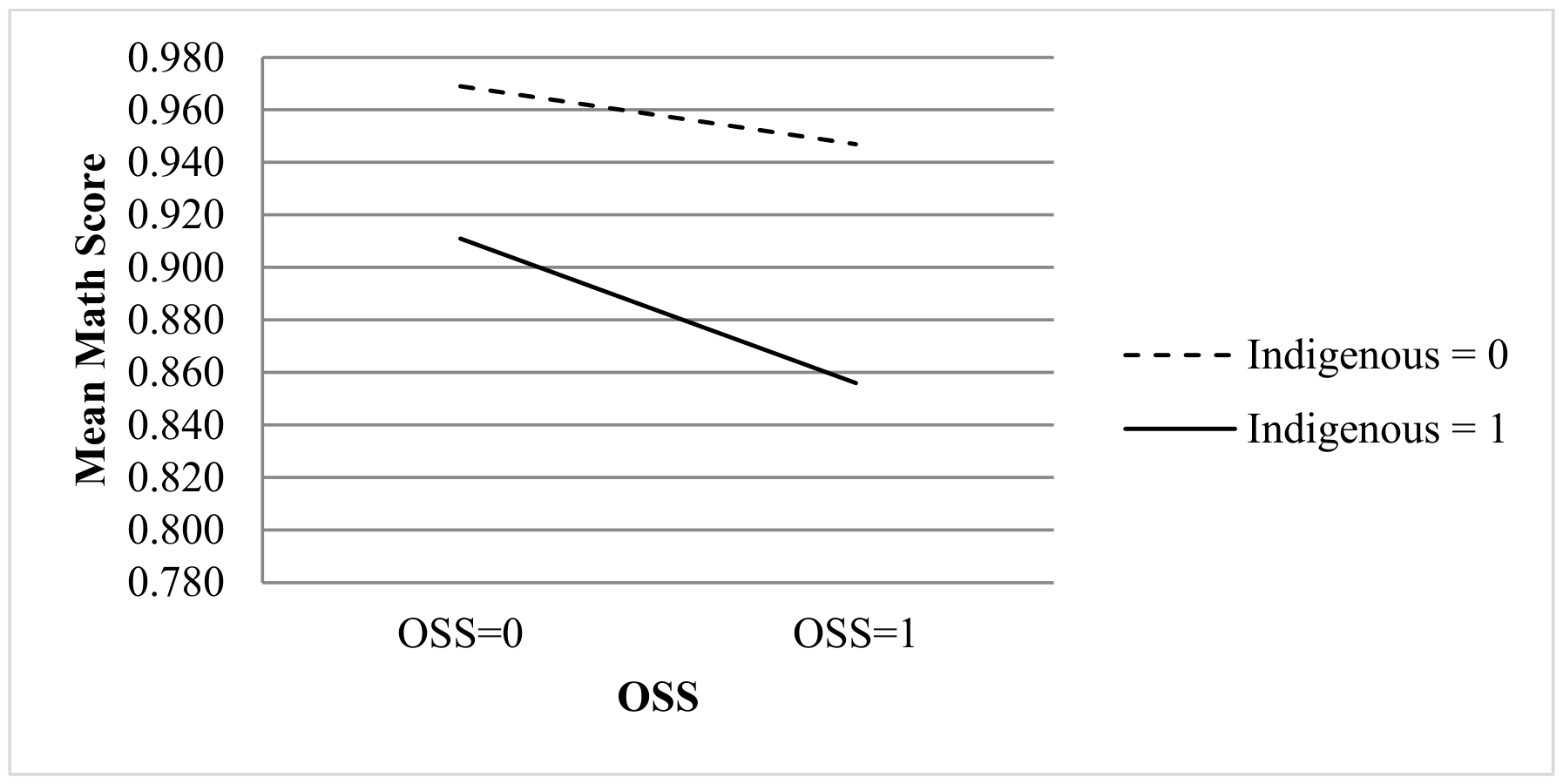
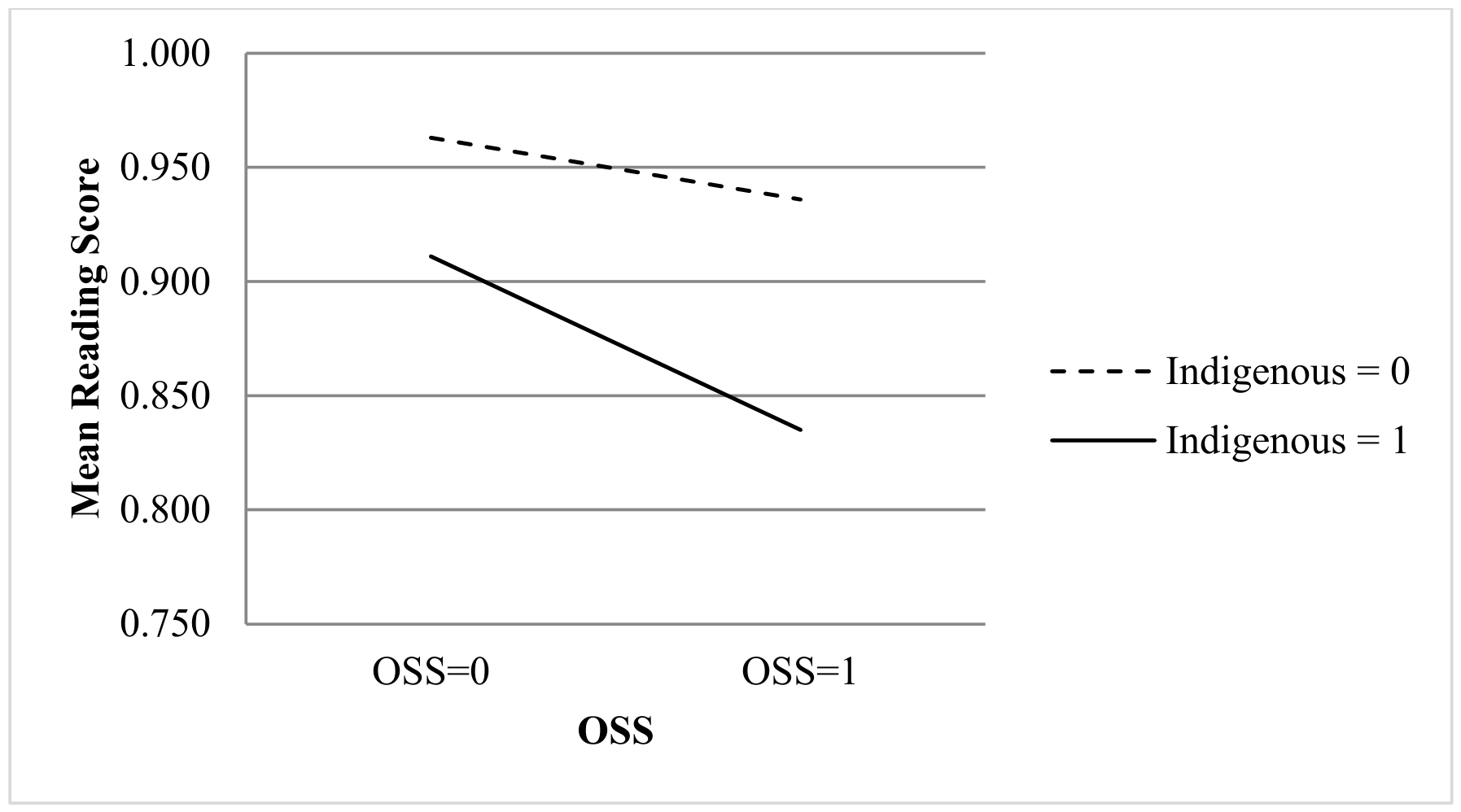
3.2. Results from Linear Regression Models for Academic Achievement
4. Discussion
4.1. Limitations
4.2. Implications for Policy and Practice
Author Contributions
Funding
Institutional Review Board Statement
Informed Consent Statement
Data Availability Statement
Acknowledgments
Conflicts of Interest
References
- Adams, D. W. (2020). Education for extinction: American Indians and the boarding school experience, 1875–1928. Revised and expanded. University Press of Kansas. [Google Scholar]
- Anderson, S., & Romm, K. (2020). Absenteeism across the early elementary grades: The role of time, gender, and socioeconomic status. The Elementary School Journal, 121(2), 179–196. [Google Scholar]
- Annamma, S. A. (2017). The pedagogy of pathologization: Disabled girls of color in the school-prison nexus. Routledge. [Google Scholar]
- Arcia, E. (2006). Achievement and enrollment status of suspended students: Outcomes in a large, multicultural school district. Education and Urban Society, 38(3), 359–369. [Google Scholar]
- Balfanz, R., Byrnes, V., & Fox, J. H. (2015). Sent home and put off track: The antecedents, disproportionalities, and consequences of being suspended in the 9th grade. In D. Losen (Ed.), Closing the school discipline gap: Equitable remedies for excessive exclusion (pp. 17–30). Teachers College Press. [Google Scholar]
- Barrett, N., McEachin, A., Mills, J. N., & Valant, J. (2017). Disparities in student discipline by race and family income (EdWorkingPaper No.19-53). Education Research Alliance for New Orleans. [Google Scholar]
- Battiste, M. (2009). Naturalizing indigenous knowledge in Eurocentric education. Canadian Journal of Native Education, 32(1), 1. [Google Scholar] [CrossRef]
- Bécares, L., & Priest, N. (2015). Understanding the influence of race/ethnicity, gender, and class on inequalities in academic and non-academic outcomes among eighth-grade students: Findings from an intersectionality approach. PLoS ONE, 10(10), e0141363. [Google Scholar] [CrossRef] [Scilit] [PubMed]
- Bradshaw, C. P., Mitchell, M. M., & Leaf, P. J. (2010). Examining the effects of schoolwide positive behavioral interventions and supports on student outcomes: Results from a randomized controlled effectiveness trial in elementary schools. Journal of Positive Behavior Interventions, 12(3), 133–148. [Google Scholar]
- Brave Heart, M. Y. H., Chase, J., Elkins, J., & Altschul, D. B. (2011). Historical trauma among indigenous peoples of the Americas: Concepts, research, and clinical considerations. Journal of Psychoactive Drugs, 43(4), 282–290. [Google Scholar] [CrossRef] [Scilit] [PubMed]
- Camacho, K. A., & Krezmien, M. P. (2019). Individual-and school-level factors contributing to disproportionate suspension rates: A multilevel analysis of one state. Journal of Emotional and Behavioral Disorders, 27(4), 209–220. [Google Scholar] [CrossRef] [Scilit]
- Child, B. J. (1998). Boarding school seasons: American Indian families, 1900–1940. U of Nebraska Press. [Google Scholar]
- Cho, M. (2020). Cultural variations in understanding risks for delinquency among maltreated children from the perspectives of US and Korean professionals. Children and Youth Services Review, 116, 105117. [Google Scholar] [CrossRef] [Scilit]
- Cho, M., Haight, W., Choi, W. S., Hong, S., & Piescher, K. (2019). A prospective, longitudinal study of risk factors for early onset of delinquency among maltreated youth. Children and Youth Services Review, 102, 222–230. [Google Scholar] [CrossRef] [Scilit]
- Cho, M., & Lee, C. H. (2022). Childhood maltreatment and repeat offending in juvenile delinquents: A propensity score matched-control study. Youth & Society, 54(7), 1178–1199. [Google Scholar] [CrossRef] [Scilit]
- Cho, M., Yoon, Y. J., Flanagan, S. K., & Haight, W. (2023). Students’ risks for out-of-school suspensions: Indigenous heritage and child protective services involvement. Child Maltreatment, 28(4), 563–575. [Google Scholar] [CrossRef] [Scilit] [PubMed]
- Clark, M. D., Petras, H., Kellam, S. G., Ialongo, N., & Poduska, J. M. (2003). Who’s most at risk for school removal and later juvenile delinquency? Effects of early risk factors, gender, school/community poverty, and their impact on more distal outcomes. Women & Criminal Justice, 14(2–3), 89–116. [Google Scholar]
- Curran, F. C. (2016). Estimating the effect of state zero tolerance laws on exclusionary discipline, racial discipline gaps, and student behavior. Educational Evaluation and Policy Analysis, 38(4), 647–668. [Google Scholar] [CrossRef] [Scilit]
- Davison, M., Penner, A. M., Penner, E. K., Pharris-Ciurej, N., Porter, S. R., Rose, E. K., Shem-Tov, Y., & Yoo, P. (2022). School discipline and racial disparities in early adulthood. Educational Researcher, 51(3), 231–234. [Google Scholar] [CrossRef] [Scilit] [PubMed]
- Degroote, E., & Van Houtte, M. (2022). Sense of futility as subject of disciplinary action: Do students with negative attitudes toward the educational system get disciplined more often? Behavioral Disorders, 47(3), 155–165. [Google Scholar] [CrossRef] [Scilit]
- Dettlaff, G. J., & Boyd, B. L. (2020). Racial disproportionality and disparity in school discipline: Intersectionality and the experiences of indigenous students. Journal of Child and Family Studies, 29(11), 3096–3105. [Google Scholar]
- Dutil, S. (2020). Dismantling the school-to-prison pipeline: A trauma-informed, critical race perspective on school discipline. Children & Schools, 42(3), 171–178. [Google Scholar] [CrossRef] [Scilit]
- Fluke, J. D., Chabot, M., Fallon, B., MacLaurin, B., & Blackstock, C. (2010). Placement decisions and disparities among aboriginal groups: An application of the decision-making ecology through multi-level analysis. Child Abuse & Neglect, 34(1), 57–69. [Google Scholar] [CrossRef] [Scilit] [PubMed]
- Gage, N. A., Whitford, D. K., Katsiyannis, A., Adams, S., & Jasper, A. (2019). National analysis of the disciplinary exclusion of black students with and without disabilities. Journal of Child and Family Studies, 28, 1754–1764. [Google Scholar] [CrossRef] [Scilit]
- Gentle-Genitty, C., Taylor, J., & Renguette, C. (2020). A change in the frame: From absenteeism to attendance. Frontiers in Education, 4, 161. [Google Scholar] [CrossRef] [Scilit]
- Gibson, P., Haight, W., Cho, M., Nashandi, N. J., & Yoon, Y. J. (2019). A mixed methods study of black girls’ vulnerability to out-of-school suspensions: The intersection of race and gender. Children and Youth Services Review, 102, 169–176. [Google Scholar] [CrossRef] [Scilit]
- Gion, C., McIntosh, K., & Smolkowski, K. (2018). Examination of American Indian/Alaska native school discipline disproportionality using the vulnerable decision points approach. Behavioral Disorders, 44(1), 40–52. [Google Scholar] [CrossRef] [Scilit]
- Girvan, E. J., Gion, C., McIntosh, K., & Smolkowski, K. (2017). The relative contribution of subjective office referrals to racial disproportionality in school discipline. School Psychology Quarterly, 32(3), 392. [Google Scholar] [CrossRef] [Scilit] [PubMed]
- Glennon, T. (2015). The developmental perspective and intersectionality. Temple Law Review, 88, 929. [Google Scholar]
- Gregory, A., Cornell, D., & Fan, X. (2011). The relationship of school structure and support to suspension rates for black and white high school students. American Educational Research Journal, 48(4), 904–934. [Google Scholar] [CrossRef] [Scilit]
- Haight, W., & Gibson, P. (2016). Out-of-school suspension of African American youth and progressive education alternatives. In Encyclopedia of social work. Oxford University Press. [Google Scholar]
- Haight, W., Gibson, P. A., Kayama, M., Marshall, J. M., & Wilson, R. (2014). An ecological-systems inquiry into racial disproportionalities in out-of-school suspensions from youth, caregiver and educator perspectives. Children and Youth Services Review, 46, 128–138. [Google Scholar] [CrossRef] [Scilit]
- Haight, W., Kayama, M., & Gibson, P. A. (2016). Out-of-school suspensions of black youths: Culture, ability, disability, gender, and perspective. Social Work, 61(3), 235–243. [Google Scholar] [CrossRef] [Scilit] [PubMed]
- Haight, W., Waubanascum, C., Glesener, D., & Marsalis, S. (2018). A scoping study of indigenous child welfare: The long emergency and preparations for the next seven generations. Children and Youth Services Review, 93, 397–410. [Google Scholar] [CrossRef] [Scilit]
- Hemphill, S. A., Plenty, S. M., Herrenkohl, T. I., Toumbourou, J. W., & Catalano, R. F. (2014). Student and school factors associated with school suspension: A multilevel analysis of students in Victoria, Australia and Washington State, United States. Children and Youth Services Review, 36, 187–194. [Google Scholar] [CrossRef] [Scilit] [PubMed]
- Hill, R. B. (2007). An analysis of racial/ethnic disproportionality and disparity at the national, state, and county levels. Available online: https://racialequity.issuelab.org/resources/8256/8256.pdf (accessed on 26 March 2024).
- Hinshaw, S. P. (1992). Externalizing behavior problems and academic underachievement in childhood and adolescence: Causal relationships and underlying mechanisms. Psychological Bulletin, 111(1), 127. [Google Scholar] [CrossRef] [Scilit] [PubMed]
- Hirschfield, P. J. (2018). The role of schools in sustaining juvenile justice system inequality. The Future of Children, 28(1), 11–36. [Google Scholar] [CrossRef] [Scilit]
- Hogan, P. T., & Siu, S. F. (1988). Minority children and the child welfare system: An historical perspective. Social Work, 33(6), 493–498. [Google Scholar] [CrossRef] [Scilit]
- Horejsi, C., Craig, B. H. R., & Pablo, J. (1992). Reactions by native American parents to child protection agencies: Cultural and community factors. Child Welfare, 71, 329–342. [Google Scholar] [PubMed]
- Hughes, T. L., Hess, R., Jones, J., & Worrell, F. C. (2020). From traditional practice to tiered comprehensive services for all: Developing a responsive school culture for the future. School Psychology, 35(6), 428. [Google Scholar] [CrossRef] [Scilit] [PubMed]
- Hunter, K., Francis, B., & Fitzpatrick, C. (2023). Care experience, ethnicity and youth justice involvement: Key trends and policy implications. Administrative Data Research UK. Available online: https://cyc-net.org/pdf/Policy-briefing-Katie-Hunter.pdf (accessed on 26 March 2024).
- Jacobsen, W. C. (2020). School punishment and interpersonal exclusion: Rejection, withdrawal, and separation from friends. Criminology, 58(1), 35–69. [Google Scholar] [CrossRef] [Scilit] [PubMed]
- Kinsler, J. (2013). School discipline: A source or salve for the racial achievement gap? International Economic Review, 54(1), 355–383. [Google Scholar] [CrossRef] [Scilit]
- Kothari, B. H., Godlewski, B., McBeath, B., McGee, M., Waid, J., Lipscomb, S., & Bank, L. (2018). A longitudinal analysis of school discipline events among youth in foster care. Children and Youth Services Review, 93, 117–125. [Google Scholar] [CrossRef] [Scilit] [PubMed]
- Kurlychek, M. C., & Johnson, B. D. (2019). Cumulative disadvantage in the American criminal justice system. Annual Review of Criminology, 2(1), 291–319. [Google Scholar] [CrossRef] [Scilit]
- Lane, K. L., Carter, E. W., Pierson, M. R., & Glaeser, B. C. (2006). Academic, social, and behavioral characteristics of high school students with emotional disturbances or learning disabilities. Journal of Emotional and Behavioral Disorders, 14(2), 108–117. [Google Scholar] [CrossRef] [Scilit]
- Liu, J., Penner, E. K., & Gao, W. (2023). Troublemakers? The role of frequent teacher referrers in expanding racial disciplinary disproportionalities. Educational Researcher, 52(8), 469–481. [Google Scholar] [CrossRef] [Scilit]
- Loeber, R., & Farrington, D. P. (2000). Young children who commit crime: Epidemiology, developmental origins, risk factors, early interventions, and policy implications. Development and Psychopathology, 12(4), 737–762. [Google Scholar] [CrossRef] [Scilit] [PubMed]
- Lomawaima, K. T. (2002). American Indian education: By Indians versus for Indians. In A companion to American Indian history (pp. 422–440). Blackwell Publishers. [Google Scholar]
- Maguire-Jack, K., Lanier, P., Johnson-Motoyama, M., Welch, H., & Dineen, M. (2015). Geographic variation in racial disparities in child maltreatment: The influence of county poverty and population density. Child Abuse & Neglect, 47, 1–13. [Google Scholar] [CrossRef] [Scilit] [PubMed]
- Marcoulides, K. M., & Raykov, T. (2019). Evaluation of variance inflation factors in regression models using latent variable modeling methods. Educational and Psychological Measurement, 79(5), 874–882. [Google Scholar] [CrossRef] [Scilit] [PubMed]
- McAra, L., & McVie, S. (2010). Youth crime and justice: Key messages from the Edinburgh study of youth transitions and crime. Criminology & Criminal Justice, 10(2), 179–209. [Google Scholar] [CrossRef] [Scilit]
- McAra, L., & McVie, S. (2016). Understanding youth violence: The mediating effects of gender, poverty and vulnerability. Journal of Criminal Justice, 45, 71–77. [Google Scholar] [CrossRef] [Scilit]
- McElderry, C. G., & Cheng, T. C. (2014). Understanding the discipline gap from an ecological perspective. Children & Schools, 36(4), 241–249. [Google Scholar] [CrossRef] [Scilit]
- Mendez, L. M. R., & Knoff, H. M. (2003). Who gets suspended from school and why: A demographic analysis of schools and disciplinary infractions in a large school district. Education and Treatment of Children, 26, 30–51. [Google Scholar]
- Mendoza, M., Blake, J. J., Marchbanks, M. P., III, & Ragan, K. (2020). Race, gender, and disability and the risk for juvenile justice contact. The Journal of Special Education, 53(4), 226–235. [Google Scholar] [CrossRef] [Scilit]
- Mittleman, J. (2018). A downward spiral? Childhood suspension and the path to juvenile arrest. Sociology of Education, 91(3), 183–204. [Google Scholar] [CrossRef] [Scilit]
- Morris, E. W., & Perry, B. L. (2016). The punishment gap: School suspension and racial disparities in achievement. Social Problems, 63(1), 68–86. [Google Scholar] [CrossRef] [Scilit]
- Morris, M. (2016). Pushout: The criminalization of black girls in schools. The New Press. [Google Scholar]
- Mowen, T., & Brent, J. (2016). School discipline as a turning point: The cumulative effect of suspension on arrest. Journal of Research in Crime and Delinquency, 53(5), 628–653. [Google Scholar]
- National Education Association. (2022). Report of the NEA task force on safe, just, and equitable schools. Available online: https://www.nea.org/sites/default/files/2022-06/Report%20of%20the%20NEA%20Task%20Force%20on%20Safe%2C%20Just%2C%20and%20Equitable%20Schools_2022_1.pdf (accessed on 1 September 2026).
- Neal, L. V. I., McCray, A. D., Webb-Johnson, G., & Bridgest, S. T. (2003). The effects of African American movement styles on teacher’s perceptions and reactions. The Journal of Special Education, 37(1), 49–57. [Google Scholar] [CrossRef] [Scilit]
- Nicholson-Crotty, S., Birchmeier, Z., & Valentine, D. (2009). Exploring the impact of school discipline on racial disproportion in the juvenile justice system. Social Science Quarterly, 90(4), 1003–1018. [Google Scholar] [CrossRef] [Scilit]
- Noltemeyer, A. L., Ward, R. M., & Mcloughlin, C. (2015). Relationship between school suspension and student outcomes: A meta-analysis. School Psychology Review, 44(2), 224–240. [Google Scholar] [CrossRef] [Scilit]
- Novak, A., & Fagan, A. (2022). Expanding research on the school-to-prison pipeline: Examining the relationships between suspension, expulsion, and recidivism among justice-involved youth. Crime & Delinquency, 68(1), 3–27. [Google Scholar] [CrossRef] [Scilit]
- Petras, H., Masyn, K. E., Buckley, J. A., Ialongo, N. S., & Kellam, S. (2011). Who is most at risk for school removal? A multilevel discrete-time survival analysis of individual-and context-level influences. Journal of Educational Psychology, 103(1), 223. [Google Scholar] [CrossRef] [Scilit]
- R Core Team. (2017). R: A language and environment for statistical computing (Version 3.4.2) [Computer software]. R Foundation for Statistical Computing. Available online: https://www.r-project.org/?utm_source=chatgpt.com (accessed on 26 March 2024).
- Rios, V. M. (2011). Punished: Policing the lives of black and Latino boys. New York University Press. [Google Scholar]
- Rolf, L., & Farrington, D. P. (2019). Young children who commit crime: Epidemiology, developmental origins, risk factors, early interventions, and policy implications. In Clinical forensic psychology and law (pp. 335–360). Routledge. [Google Scholar]
- Rosenbaum, J. (2020). Educational and criminal justice outcomes 12 years after school suspension. Youth & Society, 52(4), 515–547. [Google Scholar] [CrossRef] [Scilit] [PubMed]
- Ryan, J. P., Marshall, J. M., Herz, D., & Hernandez, P. M. (2008). Juvenile delinquency in child welfare: Investigating group home effects. Children and Youth Services Review, 30(9), 1088–1099. [Google Scholar] [CrossRef] [Scilit]
- Ryan, J. P., & Testa, M. F. (2005). Child maltreatment and juvenile delinquency: Investigating the role of placement and placement instability. Children and Youth Services Review, 27, 227–249. [Google Scholar] [CrossRef] [Scilit]
- Scherr, T. G. (2007). Educational experiences of children in foster care: Meta-analyses of special education, retention, and discipline rates. School Psychology International, 28(4), 419–436. [Google Scholar]
- Shooter, W., Hernandez, J., Mackay, D., & McIlvenna, M. (2023). The relationship of intergenerational poverty and exclusionary school discipline. Psychology in the Schools, 60(6), 1760–1780. [Google Scholar] [CrossRef] [Scilit]
- Singer, J. (2023). The effect of suspensions on student attendance in a high-absenteeism urban district. Urban Education, 60(2), 628–659. [Google Scholar] [CrossRef] [Scilit]
- Skiba, R. J., Arredondo, M. I., & Williams, N. T. (2014a). More than a metaphor: The contribution of exclusionary discipline to a school-to-prison pipeline. Equity & Excellence in Education, 47(4), 546–564. [Google Scholar] [CrossRef] [Scilit]
- Skiba, R. J., Chung, C. G., Trachok, M., Baker, T. L., Sheya, A., & Hughes, R. L. (2014b). Parsing disciplinary disproportionality: Contributions of infraction, student, and school characteristics to out-of-school suspension and expulsion. American Educational Research Journal, 51(4), 640–670. [Google Scholar]
- Smith Brice, T. (2017). Child welfare practice: An African-centered approach. Journal of Human Behavior in the Social Environment, 27(1–2), 81–91. [Google Scholar] [CrossRef] [Scilit]
- Sobti, N., & Welsh, R. O. (2023). Adding color to my tears: Toward a theoretical framework for antiblackness in school discipline. Educational Researcher, 52(8), 500–511. [Google Scholar] [CrossRef] [Scilit]
- Sullivan, A. L., Van Norman, E. R., & Klingbeil, D. A. (2014). Exclusionary discipline of students with disabilities: Student and school characteristics predicting suspension. Remedial and Special Education, 35(4), 199–210. [Google Scholar]
- Theriot, M. T., Craun, S. W., & Dupper, D. R. (2010). Multilevel evaluation of factors predicting school exclusion among middle and high school students. Children and Youth Services Review, 32(1), 13–19. [Google Scholar] [CrossRef] [Scilit]
- U.S. Department of Education, Office of Special Education and Rehabilitative Services. (2022). Questions and answers: Addressing the needs of children with disabilities and IDEA’s discipline provisions. Available online: https://sites.ed.gov/idea/files/qa-addressing-the-needs-of-children-with-disabilities-and-idea-discipline-provisions.pdf (accessed on 26 March 2024).
- U.S. Government Accountability Office. (2018). K-12 education: Discipline disparities for black students, boys, and students with disabilities. Report to congressional requesters. U.S. Government Accountability Office.
- van den Brink, Y., & Lanskey, C. (2025). Inequality, cumulative disadvantage and youth justice: Towards an analytical framework for understanding and addressing inequalities in youth justice decision-making. International Journal of Law, Crime and Justice, 80, 100725. [Google Scholar] [CrossRef] [Scilit]
- Vizenor, G. R. (1999). Manifest manners: Narratives on postindian survivance. U of Nebraska Press. [Google Scholar]
- Wagner, M., Kutash, K., Duchnowski, A. J., Epstein, M. H., & Sumi, W. C. (2005). The children and youth we serve: A national picture of the characteristics of students with emotional disturbances receiving special education. Journal of Emotional and Behavioral Disorders, 13(2), 79–96. [Google Scholar]
- Whitford, D. K., Gage, N. A., Katsiyannis, A., Counts, J., Rapa, L. J., & McWhorter, A. (2019). The exclusionary discipline of American Indian and Alaska Native (AI/AN) students with and without disabilities: A Civil Rights Data Collection (CRDC) national analysis. Journal of Child and Family Studies, 28, 3327–3337. [Google Scholar] [CrossRef] [Scilit]
- Williams-Butler, A., Golden, K. E., Mendez, A., & Stevens, B. (2020). Intersectionality and child welfare policy. Child Welfare, 98(4), 75–96. [Google Scholar]
- Wright, J. P., Morgan, M. A., Coyne, M. A., Beaver, K. M., & Barnes, J. C. (2014). Prior problem behavior accounts for the racial gap in school suspensions. Journal of Criminal Justice, 42(3), 257–266. [Google Scholar] [CrossRef] [Scilit]
- Yang, M. Y., Harmeyer, E., Chen, Z., & Lofaso, B. M. (2018). Predictors of early elementary school suspension by gender: A longitudinal multilevel analysis. Children and Youth Services Review, 93, 331–338. [Google Scholar] [CrossRef] [Scilit]



| Entire Sample | Total | White n = 41,829 (74.8%) | Black n = 5018 (9%) | Latinx n = 3597 (6.4%) | Asian n = 3215 (5.7%) | Indigenous n = 1265 (2.3%) |
|---|---|---|---|---|---|---|
| Gender: female | 26,799 (48.8%) | 20,325 (48.6%) | 2463 (49.1%) | 1732 (48.2%) | 1635 (50.9%) | 644 (50.9%) |
| OSS 1 | 1510 (2.7%) | 636 (1.5%) | 624 (12.4%) | 101 (2.8%) | 52 (1.6%) | 97 (7.7%) |
| CPS 2 | 116 (0.2%) | 56 (0.1%) | 38 (0.8%) | 6 (0.2%) | 1 (0.03%) | 15 (1.2%) |
| Congregate Care | 350 (0.6%) | 152 (0.4%) | 123 (2.5%) | 28 (0.8%) | 14 (0.4%) | 33 (2.6%) |
| FRL 3 | 19,916 (35.6%) | 9444 (22.6%) | 3650 (72.7%) | 2400 (66.7%) | 1367 (42.5%) | 932 (73.7%) |
| EBD 4 | 7598 (13.6%) | 5199 (12.4%) | 722 (14.4%) | 433 (12.0%) | 242 (7.5%) | 273 (21.6%) |
| Attendance Rate | M = 0.80 SD = 0.33 | M = 0.85 SD = 0.29 | M = 0.68 SD = 0.38 | M = 0.66 SD = 0.40 | M = 0.80 SD = 0.34 | M = 0.73 SD = 0.34 |
| Base Model | Interaction Effects | |||||||||
|---|---|---|---|---|---|---|---|---|---|---|
| Variables | β | SE | T | p-Value | 95%CI | β | SE | T | p-Value | 95%CI |
| OSS 1 | −4.37 | 1.12 | −3.90 | <0.001 | −6.56, −2.17 | −1.20 | 2.18 | −0.55 | 0.58 | −5.50, 3.10 |
| Indigenous (ref. White) | −4.64 | 1.07 | −4.32 | <0.001 | −6.76, −2.52 | −3.77 | 1.13 | −3.33 | <0.001 | −5.01, −2.53 |
| Black | −5.19 | 0.90 | −5.78 | <0.001 | −6.97, −3.41 | −4.95 | 0.97 | −5.10 | <0.001 | −6.86, −3.04 |
| Latinx | −3.88 | 1.40 | −2.78 | 0.006 | −6.64, −1.12 | −3.78 | 1.40 | −2.71 | 0.007 | −6.52, −1.04 |
| Asian | −3.22 | 2.09 | −1.54 | 0.12 | −7.34, 0.09 | −3.41 | 2.09 | −1.63 | 0.10 | −7.54, 0.72 |
| Female | 0.36 | 0.72 | 0.50 | 0.62 | −0.99, 1.71 | 0.54 | 0.72 | 0.74 | 0.46 | −0.87, 1.95 |
| Congregate care | −2.74 | 0.83 | −3.31 | <0.001 | −4.38, −1.10 | −2.19 | 0.88 | −2.49 | 0.01 | −3.93, −0.45 |
| CPS 2 | 1.95 | 1.26 | 1.54 | 0.13 | −0.55, 4.45 | 1.39 | 1.38 | 1.01 | 0.31 | −0.11, 2.89 |
| FRL 3 | −1.59 | 0.44 | −3.65 | <0.001 | −2.45, −0.73 | −1.54 | 0.44 | −3.51 | <0.001 | −2.40, −0.68 |
| EBD 4 | −0.35 | 0.08 | −4.12 | <0.001 | −0.51, −0.19 | −0.36 | 0.09 | −4.03 | <0.001 | −0.54, −0.18 |
| Attendance Rate | −5.60 | 0.97 | 5.76 | <0.001 | −7.51, −3.69 | 5.59 | 0.97 | 5.76 | <0.001 | 3.68, 7.50 |
| OSS * CPS | 2.93 | 3.45 | 0.85 | 0.40 | −3.27, 8.13 | |||||
| OSS * Congregate care | −4.39 | 2.54 | −1.73 | 0.08 | −9.36, 0.58 | |||||
| OSS * Indigenous | −8.62 | 3.32 | −2.60 | 0.01 | −15.17, −2.07 | |||||
| OSS * Black | −3.08 | 2.50 | −1.23 | 0.22 | −7.98, 1.82 | |||||
| OSS * EBD | 0.05 | 0.26 | 0.20 | 0.84 | −0.46, 0.56 | |||||
| Model Diagnostics | RSE = 11.75 on 1118 df R2 = 0.14 | RSE = 11.75 on 16 and 1118 df R2 = 0.14 | ||||||||
| Base Model | Interaction Effects | |||||||||
|---|---|---|---|---|---|---|---|---|---|---|
| Variables | β | SE | T | p-Value | 95% CI | β | SE | T | p-Value | 95% CI |
| OSS 1 | −3.14 | 1.18 | −2.51 | 0.01 | −5.47, −0.81 | −1.65 | 2.50 | 0.66 | 0.51 | −6.58, 3.28 |
| Indigenous (ref. White) | −5.25 | 1.25 | −4.35 | <0.001 | −7.72, −2.78 | −4.41 | 1.27 | −3.47 | <0.001 | −6.90, −1.92 |
| Black | −5.23 | 1.21 | −5.20 | <0.001 | −7.62, −2.84 | −4.80 | 1.09 | −4.42 | <0.001 | −6.94, −2.66 |
| Latinx | −5.34 | 1.01 | −3.42 | <0.001 | −7.17, −3.29 | −5.25 | 1.56 | −3.37 | <0.001 | −8.31, −2.19 |
| Asian | −6.00 | 1.56 | −2.52 | 0.01 | −8.47, −3.53 | −6.33 | 2.39 | −2.66 | 0.008 | −10.04, −2.62 |
| Female | 2.39 | 2.38 | 2.97 | 0.003 | −1.32, 6.10 | 2.54 | 0.81 | 3.15 | 0.002 | 0.95, 4.13 |
| Congregate care | −1.81 | 0.80 | −1.95 | 0.05 | −3.55, −0.07 | −1.60 | 1.00 | −1.61 | 0.11 | −3.54, 0.34 |
| CPS 2 | 0.26 | 0.93 | 0.19 | 0.85 | −1.56, 2.08 | −0.09 | 1.53 | −0.06 | 0.95 | −3.11, 2.93 |
| FRL 3 | −1.86 | 1.39 | −3.79 | <0.001 | −4.60, 0.88 | −1.82 | 0.49 | −3.71 | <0.001 | −2.79, −0.85 |
| EBD 4 | −0.44 | 0.49 | −4.58 | <0.001 | −1.40, 0.52 | −0.41 | 0.10 | −4.04 | <0.001 | −0.60, −0.22 |
| Attendance Rate | 6.41 | 1.10 | 5.85 | <0.001 | 4.26, 8.56 | 6.31 | 1.10 | 5.76 | <0.001 | 4.16, 8.46 |
| OSS * CPS | 2.02 | 3.71 | 0.54 | 0.59 | −4.29, 8.33 | |||||
| OSS * Congregate | −1.79 | 2.81 | −0.64 | 0.52 | −6.35, 2.77 | |||||
| OSS * Indigenous | −9.13 | 3.86 | −2.37 | 0.02 | −16.80, −1.45 | |||||
| OSS * Black | −4.85 | 2.77 | −1.75 | 0.08 | −10.32, 0.62 | |||||
| OSS * EBD | −0.32 | 0.30 | −1.08 | 0.28 | −0.90, 0.26 | |||||
| Model Diagnostics | RSE = 13.19 on 1116 df R2 = 0.13 | RSE = 11.27 on 16 and 1111 df R2 = 0.14 | ||||||||
| Base Model | Interaction Effects | |||||||
|---|---|---|---|---|---|---|---|---|
| Variables | β | OR (95% CI) | Z | p-Value | β | OR (95% CI) | Z | p-Value |
| OSS 1 | 0.77 | 2.15 (1.24, 3.67) | 2.78 | 0.005 | −1.26 | 0.28 (0.03, 1.59) | −1.28 | 0.20 |
| Indigenous (ref. White) | 1.22 | 3.38 (1.58, 7.27) | 3.15 | 0.002 | 1.26 | 3.52 (1.58, 7.83) | 3.11 | 0.002 |
| Black | 1.60 | 4.94 (2.68, 9.55) | 4.96 | <0.001 | 1.31 | 3.71 (1.85, 7.67) | 3.64 | <0.001 |
| Latinx | 0.33 | 1.39 (0.31, 4.38) | 0.50 | 0.62 | 0.23 | 1.26 (0.28, 3.98) | 0.35 | 0.73 |
| Asian | 0.12 | 1.13 (0.06, 6.01) | 0.11 | 0.91 | 0.21 | 1.24 (0.07, 6.56) | 0.20 | 0.84 |
| Female | −0.78 | 0.46 (0.27, 0.76) | −2.92 | 0.003 | −0.82 | 0.44 (0.26, 0.75) | −2.99 | 0.003 |
| Congregate care | 0.35 | 1.42 (0.84, 2.36) | 1.33 | 0.18 | 0.15 | 1.16 (0.60, 2.13) | 0.45 | 0.65 |
| CPS 2 | 0.09 | 1.09 (0.48, 2.23) | 0.23 | 0.82 | 0.25 | 1.29 (0.47, 2.97) | 0.55 | 0.58 |
| FRL 3 | 0.29 | 1.34 (0.95, 1.97) | 1.58 | 0.11 | 0.31 | 1.36 (0.96, 2.02) | 1.66 | 0.10 |
| EBD 4 | 0.15 | 1.01 (0.96, 1.06) | 0.55 | 0.58 | −0.02 | 0.98 (0.90, 1.05) | −0.45 | 0.65 |
| Attendance Rate | −0.15 | 0.86 (0.46, 1.62) | −0.48 | 0.63 | −0.20 | 0.82 (0.44, 1.57) | −0.61 | 0.54 |
| OSS * CPS | −0.28 | 0.76 (0.12, 4.14) | −0.32 | 0.75 | ||||
| OSS * Congregate | 0.87 | 2.38 (0.72, 7.99) | 1.42 | 0.16 | ||||
| OSS * Indigenous | 0.22 | 1.24 (0.12, 13.39) | 0.19 | 0.85 | ||||
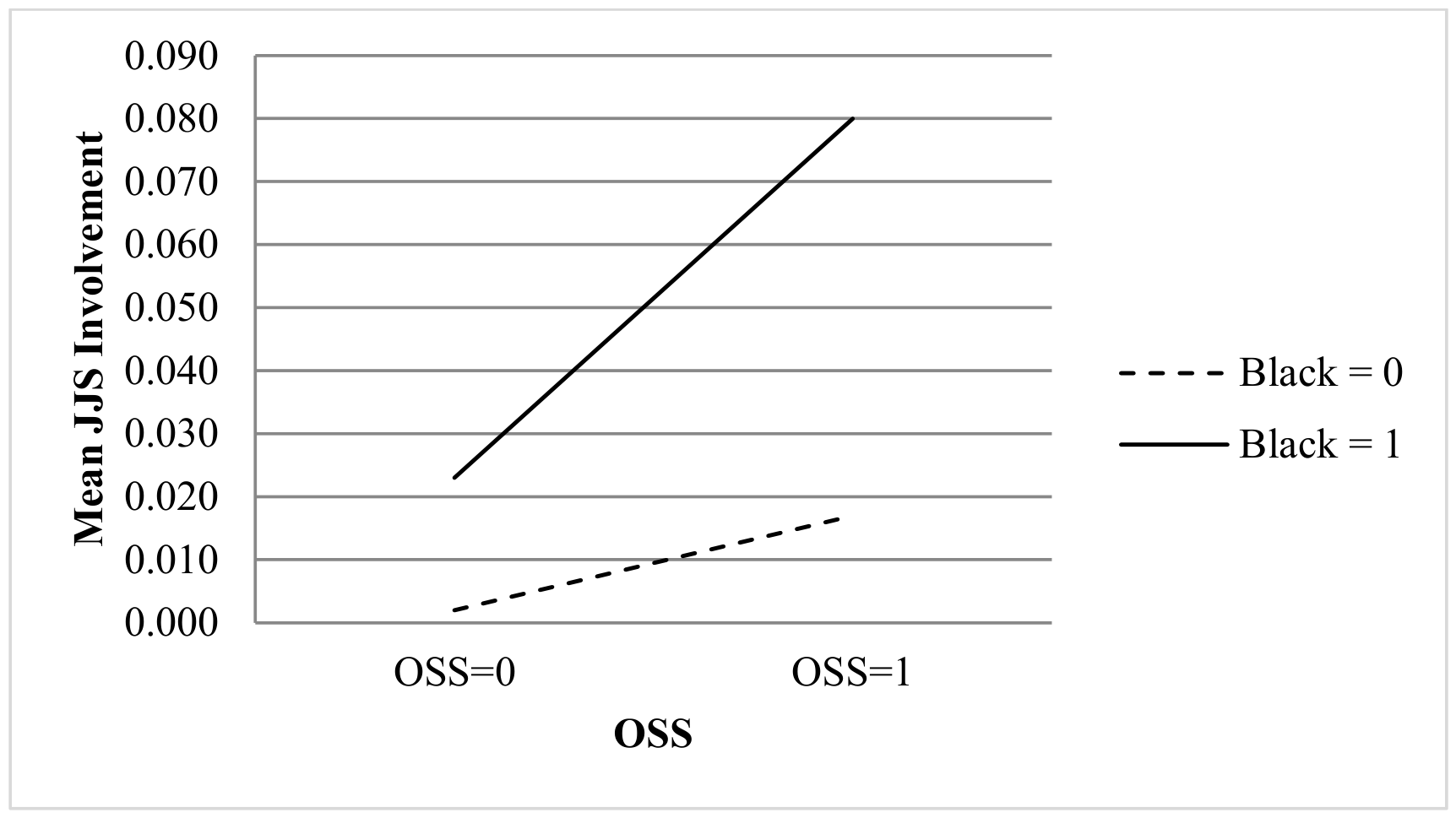
| OSS * Black | 2.10 | 8.17 (1.16, 6.92) | 1.90 | 0.01 | ||||
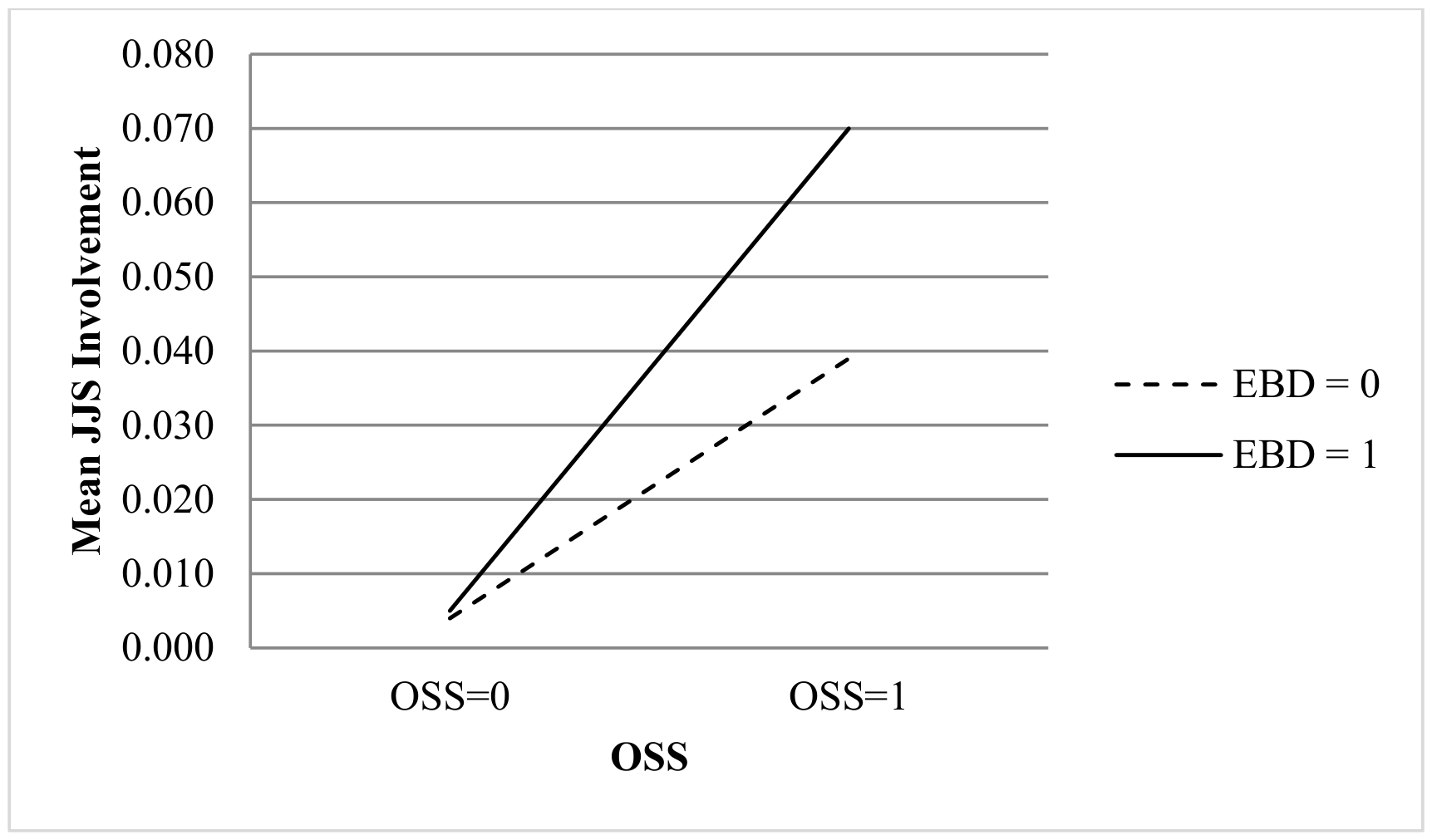
| OSS * EBD | 0.16 | 1.17 (1.02, 1.36) | 2.10 | 0.04 | ||||
| Model Diagnostics | Residual Deviance = 516.64 on 1247 df AIC = 540.64 | Residual Deviance = 504.72 on 1242 df AIC = 538.72 | ||||||
Disclaimer/Publisher’s Note: The statements, opinions and data contained in all publications are solely those of the individual author(s) and contributor(s) and not of MDPI and/or the editor(s). MDPI and/or the editor(s) disclaim responsibility for any injury to people or property resulting from any ideas, methods, instructions or products referred to in the content. |
© 2026 by the authors. Licensee MDPI, Basel, Switzerland. This article is an open access article distributed under the terms and conditions of the Creative Commons Attribution (CC BY) license.
Share and Cite
Cho, M.; Flnanagan, S.; Haight, W. Out-of-School Suspensions, Academic Achievement, and Juvenile Justice System Involvement Among African American and Indigenous Children. Youth 2026, 6, 127. https://doi.org/10.3390/youth6030127
Cho M, Flnanagan S, Haight W. Out-of-School Suspensions, Academic Achievement, and Juvenile Justice System Involvement Among African American and Indigenous Children. Youth. 2026; 6(3):127. https://doi.org/10.3390/youth6030127
Chicago/Turabian StyleCho, Minhae, Shelby Flnanagan, and Wendy Haight. 2026. "Out-of-School Suspensions, Academic Achievement, and Juvenile Justice System Involvement Among African American and Indigenous Children" Youth 6, no. 3: 127. https://doi.org/10.3390/youth6030127
APA StyleCho, M., Flnanagan, S., & Haight, W. (2026). Out-of-School Suspensions, Academic Achievement, and Juvenile Justice System Involvement Among African American and Indigenous Children. Youth, 6(3), 127. https://doi.org/10.3390/youth6030127