2. Towards Framing Indigenous Youth Leadership
This article is grounded in a decolonial approach that understands the ongoing process of undoing dominant frameworks and remaking as part of addressing the historical legacy of colonialism (
Calderon, 2016). In this context, decolonization can be described as a way of ‘restoring’ what has been taken or undermined through colonial systems, whether it be ceremonies, governance structures, languages, or cultural knowledges and stories, as well as ways of thinking and creating new knowledges (
Windchief & San Pedro, 2019). The process is inherently disruptive and unsettling, giving space for Indigenous peoples to reframe, share, and validate their own narratives, knowledges and perspectives (
Absolon, 2022;
Smith, 2021). It entails a re-questioning of how knowledge is organized, legitimized and upheld as truth (
Tuck & Yang, 2012).
This shift is part of broader movements of resurgence, where knowledge is understood as rooted in land, culture, and practice (
Simpson, 2017). Within this framing, decolonial approaches are not only critical, as they focus also on the restoration and renewal of Indigenous ways of knowing and being. For instance,
Ullrich (
2019) contends that adopting an Indigenous connectedness framework can support a restoration of knowledges and practices, thereby contributing to the wellbeing of children and youth. Similarly,
Ansloos (
2017) proposes an approach to psychology grounded in traditions of nonviolence as a decolonial process of Indigenous identity revitalization.
Indigenous leadership has been known to be grounded within Nations’ specific worldviews and systems, where leaders were recognized by their qualities, responsibilities, and relationships (
Gladstone & Pigeon, 2017;
Sioui, 2011). Colonial and assimilationist legislations such as the implementation of the reserve system and the Indian Act (1876), forced relocations and the residential school system, disrupted these practices by imposing colonial governance structures, such as elected band councils, onto First Nations communities. Today, these institutions represent only one expression of Indigenous leadership.
Contemporary studies describe Indigenous leadership in terms of a relational and collective process that develops through reciprocity and shared responsibility (
Gram-Hanssen, 2021). Across many Indigenous worldviews, leadership is sustained through these interconnected relationships with people, culture, land, and community, with cultural teachings and ceremonies providing a concrete foundation for leadership to emerge (
Gladstone & Pigeon, 2017;
Simpson, 2017;
Young, 2006) within everyday relational spaces (
Maracle et al., 2020). As such, Maracle reflects on learning at her grandmother’s kitchen table, the stories, care, and intergenerational teachings that nurtured her sense of home while reinforcing the idea that “leaders should seek to protect the community circle by building environments where individuals […] can feel like they belong while sharing their gifts for the benefit of all” (p. 286).
Amongst these contributions, limited attention has been paid to how Indigenous youth themselves make sense of and define leadership (
Tiernan, 2025). The focus has largely been on leadership development programs, with an emphasis on capacity-building.
Walsh and Black (
2023), for example, examine Indigenous youth leadership through the lens of empowerment, highlighting the ways in which leadership development initiatives and programs focus on strengthening individual competencies such as confidence and self-development, while encouraging mobilization and participation. They question whether these forms of empowerment translate into broader forms of agency within existing social and structural conditions. Thus, conventional approaches tend to position leadership as a personal trait to be developed, with little consideration for context or for Indigenous models or styles of leadership grounded in Indigenous worldviews (
Lickers, 2016) and Indigenous youth’s perspectives and holistic wellbeing (
McGregor et al., 2024).
Indigenous youth are key actors in decolonization movements, through their involvement in activism, community initiatives, and collective action (
Friedel, 2015;
Smith, 2021;
Tuck & Yang, 2014;
Wilkes, 2006). These forms of engagement reflect a leadership rooted in a desire to effect change and challenge power dynamics. Many young people describe a sense of responsibility stemming from a growing collective awareness, leading them to assert, and defend their rights. However, despite their commitments and aspirations, the voices and perspectives of Indigenous youth are often eclipsed or ignored (
Blanchet-Cohen et al., 2023). Thus, this points to the importance of creating spaces for young people, while also recognizing and validating their experiences, realities, and roles in shaping how concepts like leadership are embodied, lived, and expressed.
In this paper, we consider relationality as offering another way of observing leadership. As
Wilson (
2001) explains, Indigenous ways of thinking unfold in “being accountable to all [our] relations” (p. 177). While Wilson is not writing specifically about leadership, this perspective helps us understand how we come into being in relation to others, and how this relational grounding can inform Indigenous leadership.
Simpson (
2013), through poetry, similarly illustrates forms of action that are driven by an ongoing commitment to doing and caring: “she never asked for recognition, because she wasn’t doing it to be recognized […] she just kept on lighting that seventh fire every time it went out. She just kept making things a little better, until they were” (p. 16). Her poem points to leadership as something that takes form through action, responsibility, and care for the collective, not an individual possession. Accountability is tied to relationships with community and land, and to the way someone relates, listens, and responds to others over time and space.
3. Background and Methods
Indigenous methodologies emphasize that knowledges transpire through relationships, lived experience, and environmental, and social contexts (
Kovach, 2021). Upholding responsibility, reciprocity, and care are integral to the research itself (
Wilson, 2008). In this sense, our research process was part of the activities of the Chair’s Youth advisory committee, which brings together youth aged 20–35 from different Nations in Québec to share their lived experiences, cultural knowledges, and personal journeys, and to help inform on the research priorities. In Québec, young people below 35 years old represent over 50% of the province’s Indigenous population, comprised of 11 Nations, including Inuit (
Ministère du Conseil Exécutif, 2025). The YRC is a platform of researchers and youth organizations that networks and carries out research to inform Québec’s youth policies since 2018. The Indigenous stream has an established YAC which the year this study draws upon was composed of 12 youth from 5 Nations (Wendat, Atikamekw, Anishnaabe, Innu and Inuit) and varying profiles, with some living in urban areas, others in their community, some students, others working in varying fields, and some parents.
In the past, we have created, with the support of a graphic facilitator, a visual illustration on key concepts, such as wellbeing (
Boivin et al., 2023) and youth engagement (
Ibarra-Lemay et al., 2024). This participatory process has been found to be transformative where youth can meaningfully contribute to the creation of knowledge in ways that feel empowering (
Blanchet-Cohen et al., 2021). It is noteworthy that the focus on leadership emerged from a dialogue and co-creative process, rather than externally imposed or predefined. This included inspiring conversations, one of which referenced the diversity of roles, and contributions of the collective, instead of the conventional importance given to outspoken figures of leadership.
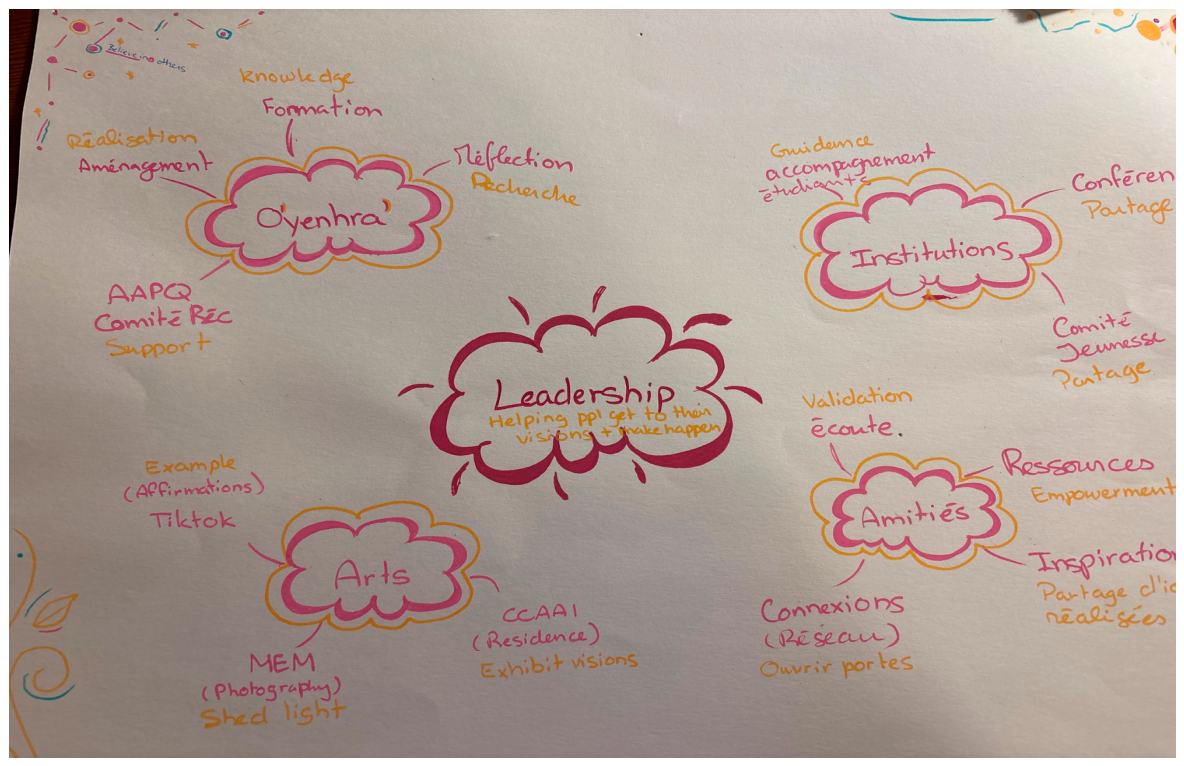
Several activities took place for dialogue, reflection, and collective meaning-making of leadership. There was an initial retreat where YAC members first explored their own interpretations of leadership through personal reflections, group discussions, individual drawings (see
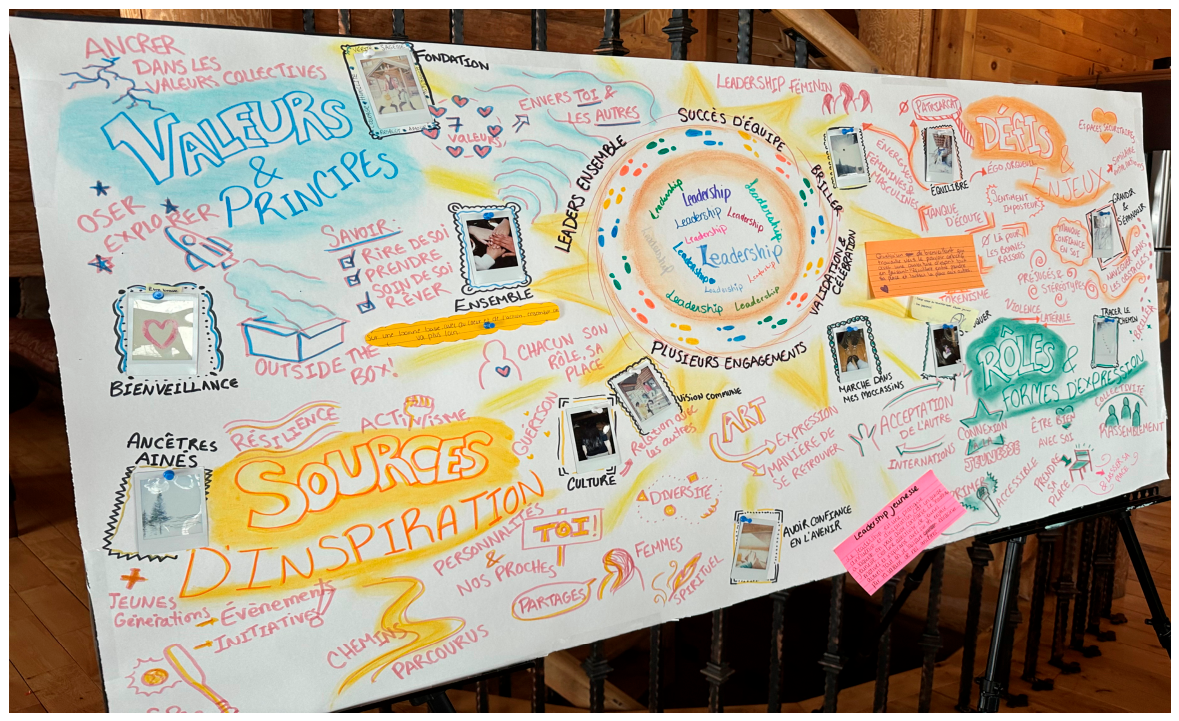
Figure 1), and a photo activity, where in teams they captured what leadership meant to them. There was also a world café activity to explore leadership around the themes of values and principles, roles and forms of expression, challenges and obstacles, and sources of inspiration that informed a collective board (see
Figure 2). At the retreat, participants decided to create podcast episodes, to further explore the different forms of leadership through conversations with a leader who inspires them (see
https://chairejeunesse.ca/jeunes-autochtones/, accessed on 15 July 2026). The podcast was an opportunity for youth to unpack varying models of leadership (i.e., other young people, allies, Elders), further exemplifying the varying roles, responsibilities, values, and learnings found within leadership.
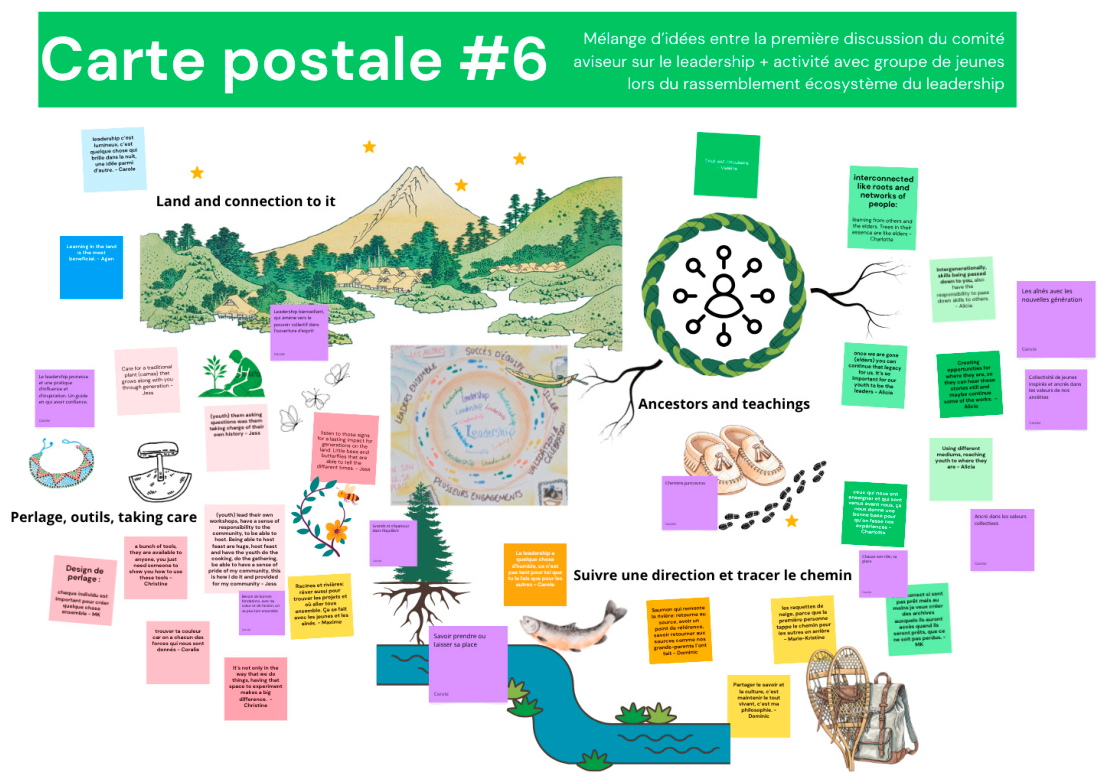
Several months later, an Indigenous Youth Leadership Gathering was held. During this event, there were presentations around the different forms and expressions of leadership. Youth also came together to participate in a creative workshop which focused on the ways in which they envision leadership in their personal lives and within their environments. These exchanges were visually coded (see
Figure 3), bringing forth metaphors and themes, consolidating the reflections gathered throughout the year, and informing the creation of the final visual illustration. In all activities, participants completed a consent form following the protocol at Concordia University. They were informed that their contributions would be recorded and could inform academic articles.
This article draws on the transcripts from the activities, including the YAC retreat, podcast conversations, presentations, and the participatory activity at the leadership gathering. The visual illustration (see
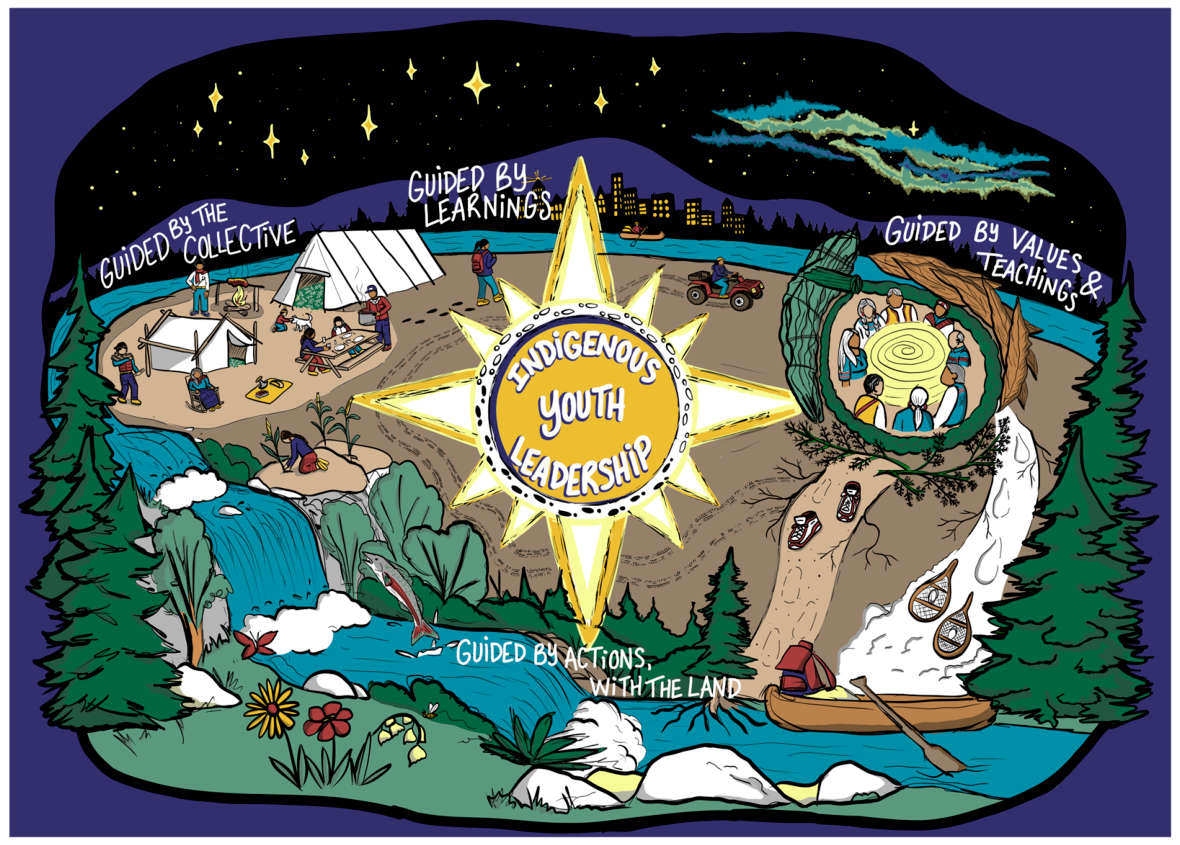
Figure 4) in the format of a ‘postcard’, co-created with the YAC by team member Carole, serves as both a synthesis of participants’ perspectives and a framework for the analysis that follows. The article was co-authored by the youth advisory coordinating team. Véronique is a Wendat researcher and PhD student, Alicia is a Kanien’kehà:ka and Chilean youth researcher and PhD student, Carole is an Innu graphic facilitator and MA student, and Natasha is an aspiring ally, professor and co-chair of the YRC. The research was carried out in French, the colonial language in Québec, and the citations and the postcard were translated into English for the purpose of this article.
4. Relational Leadership
A dominant understanding that emerged through our discussion and the postcard, is that Indigenous youth leadership is relational. Thus, the visual (see
Figure 4) that was created as a result of the process, outlined above by team graphic facilitator Carole, reflects a symbolic representation of leadership as interconnected, bringing together individual, collective, cultural, and environmental dimensions. These elements are held in relation to one another, where each depends on and informs the others. Leadership emerges throughout these connections.
Rather than describing leadership in terms of individual capacity, knowledge, or experience, participants most often begin by speaking about relationships and responsibility, whether it be towards others, community, culture or land. In this context, the youth speak of leadership as something one does in relation to others as opposed to identifying themselves as leaders. Here, relationality operates as a guiding thread that runs across the different dimensions of leadership represented in the postcard, defining how they are understood, lived and expressed.
This way of understanding leadership echoes in how participants describe their own roles and experiences. As such, Y1, during the Indigenous Youth Leadership Gathering, shares “I’m not a person who goes out into the spotlight. I’m more in the background, supporting the people in my community… I like to listen.”
1 Through sharing pieces of himself, Y1 brings focus on forms of leadership grounded in being present, while listening and caring for his fellow community members. This contrasts with a more conventional definition that associates leadership with status, authority, or being at the forefront.
Within this relational framing, leadership is developed through actions taken that centre others rather than the individual. Participants consistently describe leadership as the ability to recognize, nurture, and amplify the strengths of others, in ways that reflect a continual accountability towards these relationships. As Y2 notes, “a leader is someone who helps others shine,” while Y3 emphasizes the importance of believing “in the abilities of others, [and rising] with others.” Several youth point to leadership as something that evolves over time, through experience and discovery. Y4 speaks to leadership as something that “comes from within” but brings people toward a shared goal, while Y23 reflects on how leadership can begin early in life through guidance, care, and support. These reflections reinforce the fact that leadership is not a fixed role, but a process embedded in relationality.
Leadership involves helping peers discover their own potential, imagine their own visions, and move towards them, as Y5 explains. It also involves creating and holding space for other peoples’ ideas, and at times carrying them forward. In this way, leadership is about fostering a space where relationships can help others grow, act, and lead in turn, and not about directing or managing others. There is a general appreciation of leadership rooted in relationships, responsibility, and accountability, and this relational understanding forms the basis of the visual representation introduced above.
In the sections that follow, we return to the postcard to explore these dimensions more closely, with a focus on its collective nature, the values that guide youth, the forms of action it takes, and the ways leadership is nourished and encouraged. This analysis leads to a more comprehensive discussion of what these perspectives reveal about Indigenous leadership.
4.1. Guided by the Collective
In the postcard, the collective dimension of leadership is visually represented through a space of gathering, where each person occupies a role that contributes to a shared purpose. The scene evokes a moment of preparation, in this case of a feast, where leadership is not centralized, but distributed across responsibilities. For example, one person tends to the fire, another prepares food, or cares for Elders, while others gather, organize and support. Leadership is not embodied by one person but emerges through the collective coordination of these varied roles, each contributing to the wellbeing of the group.
Youth descriptions of leadership mirror this collective dynamic. As Y6 explains, creating spaces where young people can host, cook, and organize community feasts is a way of providing for community and building a sense of responsibility and belonging: “Let [youth] feel that it isn’t something to pull away from, a lot of it is wanting to have a sense of love for where you are from, or wherever you call your home.” Her emphasis on culture, home, familiar faces, and trust, further reflects how leadership is sustained collectively rather than temporarily or individually. Leadership is embodied in everyday practices such as gardening, cooking, storytelling, and gathering. These activities become central sites where youth step into roles that matter, contributing to something larger than themselves.
This collective orientation is also expressed in how youth describe leadership as something that is shared and carried together. As one participant reflects, “we aren’t doing this alone… we are often leaders together,” pointing to a mutual responsibility across the group and where each person contributes in their own way. As Y5 and Y12 indicate, leadership is defined as “someone caring who works towards collective power with an open mind,” emphasizing the importance of unity and collaboration. Nonetheless, it is important to acknowledge that shared experiences of struggle also create pathways for connection. During one youth retreat, some expressed feeling seen through the common challenges that they face, as youth relate to one another even in times of hardship, fostering awareness, empathy, and solidarity. These connections become important sources of support, reminding youth that while parts of the journey may feel isolating, they are not alone in what they are experiencing.
Likewise, Y7, Y8, and Y9 describe leadership as “a practice of influence and inspiration. It [manifests itself through] trusted guidance. Youth leadership is a collective of motivated and inspiring young people focused on current issues, while allowing themselves to be rooted in the values of [their] ancestors.” From this perspective, participants are expressing a shared leadership that is impactful, relevant, adaptable, and intergenerational. These aspects are depicted by all the people contributing to the image of the feast.
This is further emphasized in the diverse roles and forms of leadership. As Y7 explains, “it’s not just the people in front who are leaders,” but also those who work behind the scenes, take on different roles and remain engaged in their communities. This expands how leadership is recognized by making space for a diversity of leadership styles. As Y10 shared, some youth lead in “quieter ways”, showing that leadership can take multiple forms within a group. This challenges narrow definitions of leadership and leaves room for different expressions, whether visible or more subtle. It also speaks to the importance of creating inclusive spaces where a diversity of leadership styles can emerge and be valued. In this sense, leadership becomes plural and expansive as Y7 demonstrates: “everyone is a leader in their own way, in a collective.” Y11 adds to this collective understanding by explaining that leadership is not held through one complete “shift”, but shared through everyone doing their part: “Everyone takes a little bit of a lead, you know […] I like it when everyone does their part, not to influence others, it just makes a difference. It’s a big movement. And I like having that idea and trying to work on it so that it happens more often.”
The image of the circle at the centre of the visual creation becomes especially important in bringing these perspectives together. To “have the collective and the community within oneself,” as Y12 describes, is to recognize that everyone has a place within a collective, where “each individual is important to create something together” (Y22). Y1’s reference to the Innu word mamu further anchors this idea of moving and working together. Mamu means together in the language, and through its usage, Y1 demonstrates that the collective is not abstract within an Indigenous perspective; it is lived through relationships, through shared effort, and through a commitment to a common vision.
However, youth acknowledge that moving collectively requires continuous work that demands trust, courage, and patience. Y8 describes leadership as being “sometimes difficult” and pictures it as a dance like that of the tewegan: moving slowly to the sounds of the drum, in rhythm with others, learning to trust fellow leaders while finding one’s own limits. This metaphor reflects the careful coordination seen in the feast preparation, each action attuned to the whole.
Ultimately, youth situate leadership within collective ways of being. Y21’s perspective deepens this notion through the metaphor of the salmon: “The salmon goes up the river […] it returns to its source with determination, strength, passion, collectively.” Here, leadership is imagined as movement within a shared current, not as an individual stream. The salmon does not travel alone; it moves with others, guided by a common direction and purpose. Sharing knowledges, space, and responsibilities are reciprocal, ensuring that the collective remains at the centre.
4.2. Guided by Values and Teachings
In the visual creation, the Elders’ circle portrays a type of leadership that is grounded in the teachings of the four medicines and oriented toward the East, the place of beginnings, renewal, and vision. Within this space, values are not intangible principles but rather they are living teachings, carried through ceremony, language, and relationships. The circle holds multiple generations at once: youth who are learning, adults who are practising, and Elders who are guiding. It also gestures forward, reminding us that youth will one day become Elders themselves, carrying these teachings into the future.
Beyond the core values identified by the participants—kindness, care, courage, passion, and vulnerability—there is a strong emphasis on Indigenous teachings. These are understood as essential, shaped through upbringing, identity, peer influences, and the transmission of cultural knowledge. The participants’ perspectives point to the deep connection between leadership and ways of being grounded in specific cultural contexts. One youth described how traditional teachings from their Nation shaped their understanding of governance “I believe they are all interconnected—the 4 stages of life—mental, physical, spiritual, [emotional]. Learning our traditional ways was important in governance and the traditional teachings changed the way I look at the world and lead.” Indigenous youth leadership is formed through this unique context.
A strong sense of responsibility for future generations also appears as central, reflecting a key aspect of relational leadership. As Y12 shares, leadership involves “having a vision for the next 7 generations,” situating decision-making through an intergenerational lens. This vision also implies ensuring that actions taken today are aligned with the wellbeing of those yet to come. For many participants, these values are also inseparable from their Nations and cultural identities. As Y13 notes, “it’s important to carry values that reflect your Nation.” Another brings this perspective forward by stating that “a vision grounded in the right values” (Y14) must uphold the integrity of one’s community.
Still, as Y10 explains, leadership must remain rooted in cultural teachings and values, while being expressed in new, contemporary, and innovative ways: “My grandfather taught me something before he passed […] He said that we must change with the world. Otherwise, we’re going to be left behind. Which meant, we hold on to our values, yes. But we also learn new ways of doing.” This balance between cultural continuity and adaptation appears crucial. She further stresses the importance of ensuring that children speak Inuktitut, identifying four Inuit values that illustrate how leadership is informed by culture and language. The four guiding values translated into English—living in harmony, being inclusive, working collaboratively, and making decisions by consensus—further demonstrate how traditional teachings shape contemporary practices of leadership in meaningful and evolving ways.
Leadership, subsequently, becomes a process of learning and becoming, where individuals draw from ancestral knowledges, while also actively contributing to their renewal.
4.3. Guided by Action with the Land
The visual brings leadership into motion across the land, walking on foot, moving with snowshoes to pat down, and set the trail ahead, navigating by canoe while following the current, or travelling off-road by ATV to create new paths. Each mode of movement reflects a different way of engaging with the land, sometimes following what has been laid down by past generations, sometimes using contemporary means. Leadership is also represented by the roles taken while on the land: guiding, observing, preparing, and supporting. Together, these images ground leadership in action, showing how it is lived, practised, and embodied through effort and in relationship with the land.
Youth emphasize this distinction clearly, insisting on the importance of action over words. As Y15 and Y14 both express, leadership is meaningful “when actions follow words.” This insistence reflects a broader understanding that leadership is not defined by intention alone, but by what is carried out in practice. Y9’s take on leadership as, “coming together to take action,” further emphasizes leadership as an active process rooted in mobilizing, doing, and moving collectively.
The canoe in the visual offers another way to understand this lived dimension of leadership. Movement on the water requires attentiveness, balance, and the ability to respond to changing conditions. As reflected by one youth, even when “you are in action in a canoe […] you can still have obstacles.” Leadership, then, is not about certainty or control, but about navigating challenges as they arise, in relation with the environment and with others. It requires adaptability, awareness, and trust in the process.
For many participants, the land itself is a teacher in this process. Y16 speaks to the importance of learning through the land and community as a way of coming to know oneself more deeply: “you can learn about yourself, learn who you really are. Learning on the land is the most beneficial.” This learning is experiential and takes shape in being present on the land and engaging with it directly. As such, the young person tending to the soil and growing corn in the visual reflects a leadership rooted in the land, where caring for and creating with the soil contributes to nourishing others.
Y6’s perspective extends this idea of action into practices of care with the land. They describe leadership through the cultivation of camus, a traditional plant from their home territory, highlighting intergenerational learning and sensitivity to environmental rhythms. To lead, in this sense, is to observe, to listen, and to respond, to understand seasonal changes, to notice the signals carried by bees and butterflies, and to act in ways that sustain the land for future generations. These actions may appear small, but they are rooted in a long-term relationship with the land.
4.4. Guided by Learnings
The visual evokes learning throughout different spaces: a youth navigating on canoe towards the city, the one stepping back after the feast, or the singular tracks on the trail. All of these represent youth stepping into their own roles, creating space within their community, but also sometimes needing to learn elsewhere and to return with new knowledges. This reflects both the act of taking space, claiming one’s voice, and creating space for others to enter, grow and be recognized. As such, young people spoke about the courage to step forward, but also the responsibility of opening pathways for those who have yet to come. Y17 highlights this idea when she mentions that “even if you come from a small community, you can always do something big.” Extending this perspective, Y5 and Y12 in one activity took a photo of a book to capture another dimension of leadership. They described the book as a symbol—one that reflects the importance of seeking knowledge and engaging in ongoing learning. In this sense, “learning and cultivating” represents a way of growing to support, guide, and contribute to others, particularly other youth.
Youth narratives reveal that this process is not without its challenges. As Y14 shares, “it’s not easy being a voice for people when you are young,” pointing to the weight of representation and the difficulty of being taken seriously. In this context, taking space as a young leader often involves navigating doubt, both from others and from within. Y18, for instance, speaks about the need to “manage on your own,” needing to rely solely on yourself at times to navigate challenges. She further emphasizes that “there isn’t always someone who will be there to accompany you.” In turn, these experiences highlight a tension found within leadership by youth. While it is relational, there are parts of the journey that must be walked alone.
Leadership also involves confronting and transforming inherited difficulties. Y14 shares that “breaking cycles of trauma […] takes courage,” further emphasizing that, for youth to take on their roles as leaders, coming to terms with intergenerational histories may be part of the process. Inner strength is entailed to be able to tackle the broader collective process of healing and change. This may require youth experimenting and recognizing that learning involves trial and error. “Leave room for mistakes” reflects Y19 when asked what she would have liked to hear as a younger youth navigating spaces. Leadership is rarely linear. Strengthening this notion, Y20 captures this idea when she speaks on her experience with learning to use an ulu for the first time, realizing that “there is no wrong way to do something.” Thus, having spaces where youth can try and learn without judgment is part of building confidence and developing leadership, while also giving them the time to gather their own strength, at their pace, and on their own terms.
Leadership often requires moving beyond one’s comfort zone. One youth, Y18, expressed the importance of “coming out of your shell,” highlighting the personal growth and courage needed. Importantly, taking space is not only about external recognition, but about internal change, growing confidence, trusting one’s voice, and being willing to try, even in uncertainty. At the same time, leadership can go unseen, as there are youth who are leaders, but who just do not know it yet. In many ways, leadership is a process of discovery, one that unfolds over time. Attesting to youth’s potential to be strong leaders, Y8 asserts that “we are capable of doing more,” a recognition that young people can and do carry the capacity to lead in meaningful ways.
5. Discussion
What the participants bring forth in the above comments and illustration is a definition of leadership that is rooted in the collective, guided by core values, and cultural teachings, and strengthened through a diversity of experiences of learnings. For Indigenous youth, leadership is intricately relational, which is consistent with studies about Indigenous leadership. Rather than an individual attribute, it is lived as a shared process, where the leadership of one is made possible by the leadership of others. Specific to youth is that they develop their identity and more at the beginning of that never-ending process of embodying and expressing their own leadership within many different spaces. As Y22 illustrates through the image of snowshoeing, the first person “pat[s] down the path” to create a clearer one for those who follow. This gesture is both physical and tangible: grounded in action, where the land is a teacher. But it is also symbolic: leadership as effort, as care, and as a commitment and responsibility to easing the way for others.
Participants underline that anyone can be leader in their own way, depending on where and how they choose to show up. They do not point to a singular style or status but instead, focus on the roles they can play in contributing to their community. In this context, leadership is not about standing apart and building individual recognition but about engaging with others and collaborating to a shared movement. It involves acknowledging that each person has a place, while also creating space for others to step into their own forms of leadership. This also means allowing space for learning, for making mistakes, and for growing through experiences. Leadership emerges through personal growth, challenges, and movement. When
Maracle et al. (
2020) talk about learning how to be a good leader as a girl, she speaks of Indigenous leadership as a “fourfold practice” (p. 286) that includes active listening, stories shared by role-models, experiential learning and embodying these teachings every day. Through these conversations, youth demonstrate that they thrive to bring life to their leadership similarly, while bringing forward new forms of expressions.
For youth, leadership takes shape through genuine intentions and actions that take various forms. This resonates with
Lickers (
2018), who suggests that when youth are given opportunities to learn through doing, where knowledge is shared and where they can try, reflect, and try again, they become more engaged and invested. But the kind of spaces and the conditions that would allow youth to better engage with Indigenous leadership teachings and practices are not always in place. This gap highlights that the ways of embodying leadership described by youth are not often supported or nurtured within existing structures.
This understanding aligns with a decolonial approach that emphasizes the ongoing efforts required to create and maintain such spaces. Decolonization calls for decentering the individual in rethinking how leadership is valued and enacted. As
Tuck and Yang (
2012) reminds us, “decolonization is accountable to Indigenous sovereignty and futurity” (p. 35). Actions are tied to community and responsibility.
This vision is best captured in the words of
Simpson (
2013), in her poetry:
“she just carefully planted those seeds.
she just kept picking up those pieces.
she just kept visiting those old ones.
she just kept speaking her language and sitting with her mother”.
(p. 16)
Leadership is ultimately defined by the ongoing work of care, persistence, and connection, a practice that finds meaning within relationships and actions, and towards collective futures.
An important aspect mentioned by the youth throughout the reflections is that leadership needs to be supported by cultural teachings. The visual illustrates this with the Elders as a source of leadership. This resonates with
Friedel’s (
2015) work, which shows how movements such as Idle No More took root through intergenerational practices like the round dance. She explains that “the winter round dance, or whikihtowin, is a ceremonial event […] that allows communities to begin new initiatives, process grieving, undertake healing, give thanks, honour individuals, and engage in social interaction” (p. 884). The image of the feast in our visual also reflects this relational and cultural grounding, where gathering, sharing, and being together create the conditions through which leadership emerges and take forms, where responsibility and roles are learned and defined, and where individuals take the time to do things in a good way (
Wilson, 2008).
Much like decolonization, Indigenous leadership is a never-ending process needing continual introspection and necessary changes, and the way youth engage with their own leadership varies depending on many variables such as the time, the place, the people around, the needs of the community, and the youth’s own capacity. It lives in both the seen and unseen moments, in relation with others and in the quiet but important work sometimes carried alone. Through these layered experiences, leadership is not only practised, but cultivated over time, for those who walk alongside and for future generations to come. In this way, Indigenous youth leadership is not a straight path to success, as it mirrors a more circular journey.
Indigenous youth leadership calls for a holistic approach, one that is grounded in the land, and cultural teachings, and enacted through relationships. This is particularly important to nurture as socialization processes and structures can shape, and at times impede, Indigenous youth in their ability to embody and express leadership (
Lickers, 2016;
McGregor et al., 2024). Indigenous youth are often more affected by social exclusion, which can limit access to spaces where leadership can be practised and celebrated. Given this, creating diverse spaces of experimentation becomes essential as they can offer “youth a solid foundation that includes teachings of their own Indigenous ways of knowing” (
Lickers, 2018, p. 1). Enhancing Indigenous youth leadership requires also listening to the visions of youth themselves. This includes fostering environments that support their wellbeing through land-based activities, interactive workshops, counselling, and other forms of support (
McGregor et al., 2024).
Finally, throughout the visual, and what stands out while viewing it, is that there is no clear beginning or end. And so, it illustrates the circularity of the participants’ definition of leadership, without them naming it that way. Leadership entails a continual revisiting of what grounds youth, while also recognizing that no matter where they may begin within the cycle, they are not fixed in time to that space and can come back and move within it depending on what their journey requires.