1. Introduction
Residential buildings remain a primary consumer of global energy. In both temperate and cold climates, space heating constitutes a dominant load, while in many hot regions, space heating is a seasonal but still important requirement [
1,
2,
3]. Even though decarbonization strategies often prioritize active systems and renewable supply, the building envelope and the configuration of passive solar elements continue to shape heating demand through clearly identifiable mechanisms [
4]. Specifically, they govern transmission heat-loss pathways, determine the availability of useful solar gains, and influence the timing and magnitude of indoor heat deficits. Decisions made in early design stages, such as decisions on orientation, window ratio, glazing choice, and the incorporation of thermal mass, are therefore crucial for residential prototypes, as they can establish heating demand characteristics that tend to persist over the service life of a dwelling [
5,
6,
7]. This dependence encourages strategies that focus on strong passive solutions during the design phase rather than relying on corrective measures later.
A persistent methodological challenge arises from the nonlinear interaction of passive design variables. For example, increasing the window-to-wall ratio may improve winter solar gains in heating-dominated climates, but it can also increase transmission losses if the glazing performance is insufficient or if the orientation does not align with seasonal solar paths [
7]. Thermal mass offers another example of a methodological challenge. While it can dampen temperature swings and improve heat retention, its effectiveness depends on solar availability, internal gains, and the timing of heat delivery [
8]. These complex relationships imply much broader design options than those that can be explored by manual testing, especially when focusing only on heating demand and considering multiple climates within one analysis.
In response, simulation-based optimization has become increasingly common. Evolutionary methods, including genetic algorithms, are frequently applied to navigate high-dimensional design spaces and to identify high-performing configurations under constraints [
9]. At the same time, surrogate modeling and machine learning approaches have been introduced to reduce computational cost and to support broader exploration, including early-stage analysis under uncertainty [
10,
11]. These methodological developments are especially relevant to passive solar design, where solution landscapes often contain multiple local optima and strong variable coupling [
4,
12]. Optimization tools can reveal viable combinations that would otherwise remain untested.
Despite this progress, there are two limitations of recent work that have motivated the present study. First, many optimization studies frame heating performance as one element within a multi-objective formulation that also includes cooling, cost, comfort indices, or carbon metrics [
13,
14]. Such approaches are valuable, yet they can obscure the specific contribution of solar-responsive passive decisions to reductions in heating load. Improvements may instead be driven by changes in HVAC efficiency, operational control, or objective weighting rather than by envelope behavior itself. Second, cross-climatic comparisons are often difficult to interpret. In studies, building forms, internal gains, occupancy assumptions, or system definitions are frequently modified under different climates, which limits causal inference regarding how passive optimization logic depends on climate alone [
1,
2].
This study addresses these limitations through a deliberately bounded research question: to what extent can annual residential heating demand be reduced through AI-guided optimization of passive and solar-responsive design variables when conditions related to building geometry and comfort are constant and cooling is excluded? Artificial intelligence is implemented here for an evolutionary search (NSGA-II) rather than data-trained prediction [
15]. Candidate envelope configurations are generated as a population and evaluated using full EnergyPlus 9.4 simulations, with annual heating load as the fitness score. The algorithm then iteratively improves solutions across generations through selection, crossover, and mutation. No surrogate or machine-learning predictor is trained; all results are derived from direct dynamic simulation. The analysis is structured around a standardized residential prototype simulated across three climatic contexts that represent hot and dry, temperate, and cold and humid conditions. The optimization objective is defined as the minimization of annual heating load, expressed in kilowatt-hours, using an ideal-load representation [
16]. This formulation isolates envelope-driven demand rather than system efficiency effects. Heating load serves as a direct and interpretable indicator of passive performance in early-stage design assessments because it reflects the combined outcome of transmission losses, infiltration, and useful solar gains.
A further motivation concerns the gap between simulation-based expectations of passive solar performance and the outcomes observed in practice. Conceptual evidence suggests that discrepancies often emerge when design assumptions diverge from operational realities [
4]. While post-occupancy validation lies outside the scope of the present work, this study addresses a related concern by making all modeling and optimization assumptions explicit and consistent across climates. This transparency enables the results to be interpreted as conditional on clearly stated boundaries. It also supports replication and serves as a basis for extensions that include uncertain occupancy, adaptive comfort models, or calibrated data.
This study makes two principal contributions. First, it introduces a controlled cross-climatic experimental framework that isolates passive and solar-responsive envelope logic under a fixed geometry, standardized operational conditions, and a single heating-focused objective. By holding comfort assumptions and HVAC representation constant, the framework enables direct comparison of envelope-driven heating behavior across distinct climatic regimes. Second, this study translates optimization outcomes into interpretable climate-specific design logic, identifying which variable classes dominate heating reduction in each climate and explaining these patterns in thermodynamic terms. The contribution, therefore, lies in experimental framing, cross-context comparability, and physical interpretation rather than in the development of a new optimization algorithm.
The remaining sections of the paper are organized as follows:
Section 2 reviews recent work on AI-assisted passive optimization and solar-responsive envelope design, positioning the present study relative to existing approaches and identified gaps.
Section 3 describes the simulation model, climatic datasets, optimization formulation, and reproducibility provisions.
Section 4 reports baseline and optimized results for Riyadh, Barcelona, and Toronto, followed by a cross-climate comparison.
Section 5 discusses climate-dependent optimization logic and its implications for early-stage residential design.
Section 6 concludes with a succinct statement of this study’s contributions and limitations and outlines directions for further research.
2. Background and Related Work
In this section, prior work on passive and solar-responsive design, AI-based optimization in building energy research, and approaches that focus specifically on heating demand across climates is reviewed. The review is structured to identify methodological trends and recurring limitations that motivate the present study.
2.1. Passive and Solar-Responsive Designs as Variables of Heating Demand
Passive design strategies have long been recognized as key determinants of residential heating demand. Their influence operates primarily through transmission losses, infiltration behavior, and the availability of useful solar gains [
1,
8]. Envelope configuration, glazing performance, building orientation, and the presence of thermal mass together shape the balance between heat loss and heat acquisition during the heating season [
4,
5]. In low-rise residential typologies, particularly in cold and temperate climates, these factors often exert a stronger influence on heating demand than system efficiency because surface area-to-volume ratios are relatively high [
3].
Recent comparative studies confirm that decisions related to solar-responsive envelope design can significantly reduce heating demand when they are aligned with local climatic conditions [
6,
7]. Examples include orienting glazing to the south, optimizing window-to-wall ratios, and using high-performance glazing systems. The literature also stresses that these strategies only work in certain situations. Increasing the amount of glass may help winter solar gains, but it can also be counterproductive if the losses from transmission are greater than the gains or if the orientation does not match the seasonal solar paths [
7]. This conditional behavior complicates rule-based passive design approaches and motivates the use of computational exploration.
Thermal mass exhibits a similar climate-sensitive role. In cold climates, heavyweight constructions can lead to improved heat retention and dampened indoor temperature fluctuations, which reduces heating peaks and annual demand [
2,
8]. In hot and dry climates, thermal mass is more frequently discussed in relation to cooling performance. Its contribution to winter heating remains less explored, despite the fact that heating demand is not negligible [
9]. Taken together, the literature indicates that passive heating optimization cannot be performed by relying on isolated parameter adjustments. Instead, it requires consideration of interactions among multiple envelope-related variables [
17,
18].
2.2. Evolutionary and AI-Based Optimization in Building Energy Design
To address the nonlinear and high-dimensional nature of passive design problems, evolutionary optimization methods have been widely adopted in building energy research. Genetic algorithms and related evolutionary techniques are particularly well suited to this context because they do not rely on gradient information and can explore complex design spaces characterized by strong variable coupling and multiple local optima [
9,
11]. Recent systematic reviews confirm the continued expansion of AI-driven multi-objective optimization in building energy retrofit and design decision support, highlighting the integration of evolutionary search with energy, cost, and resilience objectives [
19].
Within building performance applications, evolutionary algorithms are commonly integrated with dynamic simulation engines to evaluate large numbers of design alternatives under physically consistent conditions. Recent studies demonstrate that GA- and NSGA-II-based optimization frameworks remain actively used for envelope design, early-stage decision support, and energy-demand reduction across different climatic contexts, particularly when multiple design variables interact in nonlinear ways [
19,
20]. These approaches are often described as AI-assisted because they employ intelligent search and selection mechanisms to guide exploration of the design space, even though they do not rely on predictive learning or data-driven inference.
More recent AI-based optimization research has also expanded toward hybrid frameworks that combine evolutionary searches with surrogate modeling or machine learning approximations in order to reduce computational cost [
10]. While such approaches can enable broader exploration, they introduce additional modeling layers and assumptions that may obscure the direct relationship between design variables and physical performance outcomes. As a result, several authors continue to emphasize the value of direct evolutionary optimization coupled with full dynamic simulation when interpretability and methodological transparency are priorities, particularly in early-stage building design [
21]. Recent multidimensional AI-assisted optimization studies further demonstrate the integration of evolutionary search with advanced control and predictive modeling techniques to enhance thermal and energy performance [
22]. Despite their methodological maturity, many evolutionary optimization studies adopt multi-objective formulations that combine heating, cooling, cost, emissions, and comfort metrics within a single problem [
13,
14]. While these formulations are valuable for holistic assessment, they can complicate interpretation by making it difficult to isolate the specific contribution of envelope-level and solar-responsive design variables to heating demand reductions. In such cases, improvements in heating performance may arise indirectly from system efficiency, control strategies, or objective weighting rather than from passive design behavior itself.
Taking these findings together, the recent literature confirms that evolutionary optimization remains a current and methodologically robust AI-based approach to performing energy analysis. However, it also highlights the importance of clearly defining optimization objectives and analytical boundaries when the research aim is to understand climate-dependent passive design logic rather than to pursue generalized multi-criteria optimality.
2.3. Optimization Focused on Heating and the Role of Objective Definition
Recent studies have increasingly addressed heating demand as a primary or dominant optimization objective. Studies conducted in cold climates show that optimizations aimed at reducing heating demand tend to prioritize high-performance glazing, reduced infiltration, and increased thermal mass. Solar gains play a complementary role that depends on orientation and shading control [
3,
23]. These findings suggest that heating demand follows a different hierarchy of governing variables than cooling demand, even when both occur within the same building. Multi-climatic envelope optimization studies further confirm that design-variable sensitivity varies significantly across climate zones, even under comparable objective formulations [
24].
However, most research centered on heating is specific to a certain climate. Few studies adopt a unified framework that enables direct cross-climatic comparison. When multiple climates are considered, changes in building form, occupancy assumptions, or HVAC representations often accompany climate variations. Such changes limit causal inference regarding whether differences in optimized solutions arise from climatic drivers or from modeling inconsistencies [
1,
2].
Another methodological issue concerns the representation of HVAC systems. A number of studies include detailed heating system models, which can make it hard to observe effects at the envelope level. In such cases, reductions in heating demand may be conflated with system efficiency improvements or control logic adjustments. In response, some authors advocate for the use of ideal-load- or demand-based representations for evaluating passive performance rather than system design [
25]. This approach allows for clearer attribution of results to envelope- and solar-responsive variables.
2.4. Cross-Climatic Comparisons and the Adaptability of Optimization Logic
Cross-climatic studies provide insight into the transferability of passive design strategies. Comparative research indicates that optimized envelope variables do not scale uniformly with climatic severity. Window areas that perform well in temperate climates may prove excessive in cold climates unless they are paired with advanced glazing and carefully selected orientations [
7,
23]. Similarly, strategies that are effective in hot and dry regions during winter can differ fundamentally from those applied in temperate zones, even when solar availability appears comparable [
9].
AI-based optimization provides a means to uncover how designs perform in different climates by obtaining solutions from performance-driven searches rather than prescriptive assumptions. Nevertheless, the literature shows that relatively few studies have analyzed why optimized solutions diverge across climates in physical terms. Aspects such as the relative contribution of solar gains, the dominance of transmission losses, or the stabilizing role of thermal mass are often only implied [
4]. Without such interpretation, optimization results risk being treated as black-box outputs rather than as sources of transferable design knowledge.
Recent analyses further highlight the gap between simulation-based passive solar predictions and realized building performance. These research investigations emphasize the value of transparent assumptions and cautious framing of conclusions [
4]. Although this does not mean that optimization-based research is invalid, it reinforces the importance of clearly bounded claims and reproducible modeling choices.
2.5. Identified Research Gap and Positioning of the Present Study
The reviewed body of related work contains three inter-related gaps:
Studies that focus only on heating optimization that isolate passive and solar-responsive effects without conflating them with cooling performance or HVAC efficiency remain limited;
Cross-climatic comparisons are often undermined by inconsistent modeling assumptions, which restrict the ability to attribute differences in optimized solutions to climate alone;
While AI-guided optimization is widely applied, fewer studies translate optimization outcomes into interpretable, climate-specific design logic that is relevant to early-stage residential design.
By applying a consistent AI-guided optimization framework to a standardized residential prototype across three distinct climate zones, the present study addresses these gaps. A single objective focused on annual heating load is used throughout. The analysis enables direct comparison of optimization outcomes and supports interpretation of climate-driven design tendencies by maintaining constant geometry, comfort parameters, and HVAC representation. By prioritizing passive and solar-responsive strategies across different climatic contexts, this study provides insight into the climate-dependent hierarchy of heating-demand drivers, clarifying whether reductions are primarily governed by solar aperture and orientation, by transmission-loss suppression through glazing and envelope construction, or by thermal-mass effects on heat storage and release under fixed geometry and standardized comfort assumptions.
3. Methodology
This section describes the framework and methodology used to evaluate the impact of passive and solar-responsive design strategies on residential space heating demand. The approach combines dynamic building energy simulations with AI-guided evolutionary optimization under a deliberately constrained set of assumptions. The methodology prioritizes transparency and cross-climatic comparability, ensuring that differences in performance outcomes arise from climate-driven design responses rather than changes in geometry, comfort criteria, or HVAC representation. The following subsections describe the research design, case study selection, model definition, optimization formulation, and analytical boundaries.
3.1. Overall Research Design
This study employs a simulation-based AI-guided evolutionary optimization framework to evaluate the potential of passive and solar-responsive design strategies to reduce space heating demand in residential buildings across distinct climate zones. The methodological framework is intentionally constrained in order to isolate envelope-driven effects and enable cross-climatic comparison under consistent assumptions.
The research methodology follows a sequential structure. It begins with the definition of a standardized residential prototype, followed by climate-specific baseline simulation. AI-guided parametric optimization is then performed using a single objective focused on heating demand. The final stage consists of comparative analysis and interpretation of optimized solutions across the selected climates. Throughout all stages, building geometry, occupancy assumptions, comfort setpoints, and HVAC representation are constant. Climate is treated as the sole external differentiating variable.
3.2. Case Study Locations and Climate Data
Three cities were selected to represent distinct residential heating contexts spanning a broad climatic gradient. Riyadh (Saudi Arabia) represents a hot desert climate characterized by high annual solar radiation and limited winter heating demand, while Barcelona (Spain) reflects a temperate Mediterranean climate with moderate seasonal heating requirements and Toronto (Canada) represents a cold and humid continental climate with prolonged and energy-intensive winter conditions. The climatic classifications and heating-relevant indicators for the selected cities are summarized in
Table 1.
Climatic classification is reported using both the Köppen and ASHRAE climate zoning systems to ensure international comparability. In addition to categorical classifications, heating-relevant quantitative indicators are provided, including heating degree days (HDD18, base temperature 18 °C), annual mean air temperature, and global horizontal irradiance (GHI). HDD18 serves as an indicator of climatic heating severity, while GHI reflects the availability of passive solar gains. Together, these metrics form the boundary conditions under which the heating-focused optimization was conducted.
Hourly EnergyPlus Weather (EPW) files were used for all simulations [
26]. Each model was simulated over a full annual period from 1 January to 31 December in order to capture seasonal heating dynamics.
3.3. Residential Prototype Definition
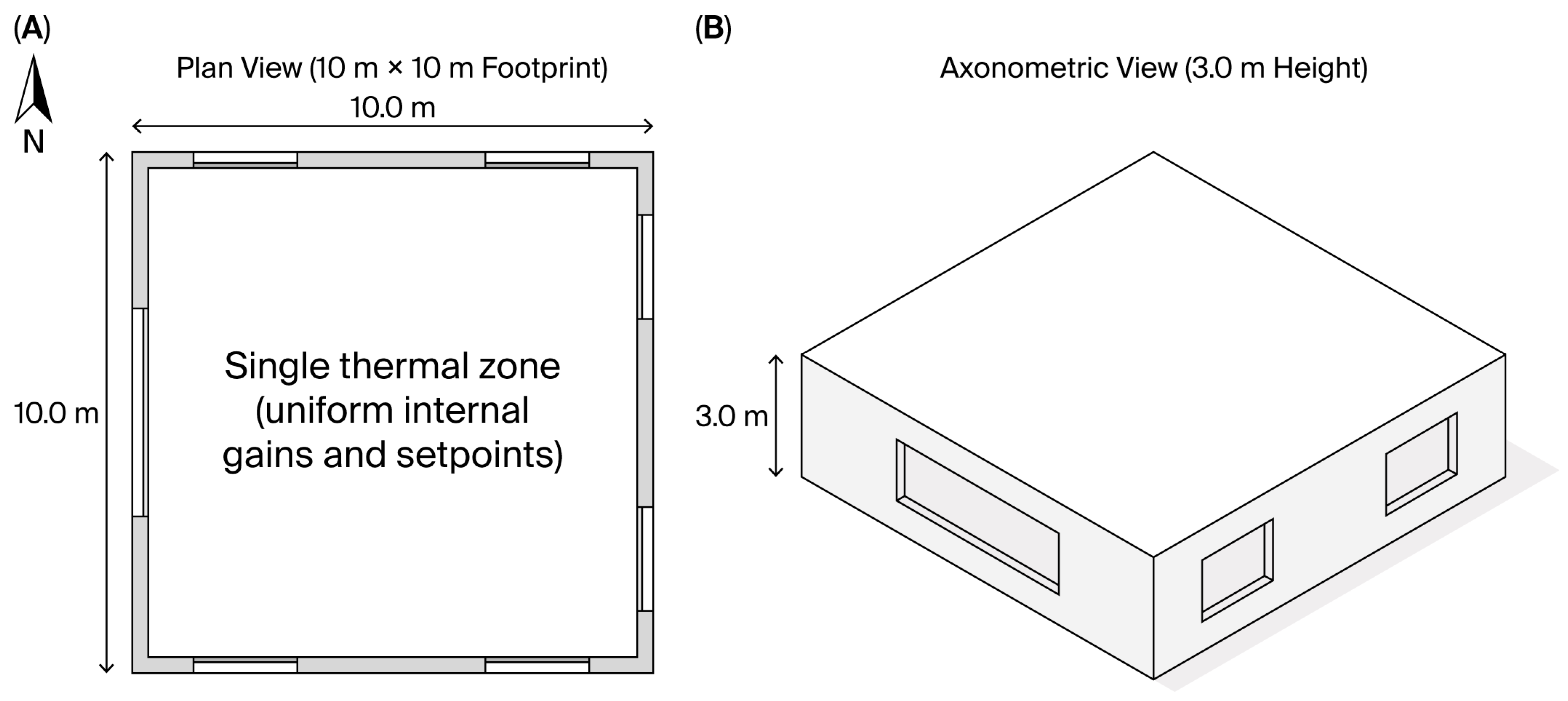
A standardized single-story residential archetype was defined to represent a compact, detached, low-rise housing form frequently employed in simulation-based residential energy studies while minimizing geometric complexity. The building has a square plan measuring 10 m × 10 m, corresponding to a gross floor area of 100 m2 and a conditioned floor area of 94.2 m2. The story height is 3.0 m, resulting in a conditioned volume of 282.6 m3. The model was intentionally simplified as a single thermal zone to support controlled cross-climatic inference. While real dwellings have multi-room layouts, internal zoning effects can introduce additional degrees of freedom that obscure the relative influence of envelope configuration and solar-responsive parameters. By maintaining a fixed geometry and uniform thermal zone, performance differences arise exclusively from variations in façade configuration, glazing performance, thermal mass, orientation, and other optimized envelope variables.
The present abstraction therefore isolates envelope-level heating mechanisms rather than occupant-specific operational variability. The results should be interpreted as transferable design logic for early-stage residential envelope optimization rather than calibrated predictions for a specific as-built dwelling. The prototype geometry and spatial configuration are illustrated in
Figure 1.
3.4. Envelope Construction and Airtightness Assumptions
Baseline envelope constructions were defined to represent energy-code-compliant residential assemblies commonly used in contemporary low-rise housing. The objective was not to reproduce region-specific construction traditions, but to establish a consistent and realistic reference condition against which the effects of passive and solar-responsive optimization could be evaluated across different climates. The external wall assembly corresponds to a lightweight, code-compliant construction with a thermal transmittance (U-value) of 0.354 W/m2·K. The roof is modeled as a lightweight flat roof with a U-value of 0.346 W/m2·K, while the ground floor is represented by a lightweight slab-on-grade construction with a U-value of 0.314 W/m2·K. These envelope properties were applied uniformly across all climate cases to ensure that observed performance differences arise from climatic drivers and optimized design variables rather than baseline construction inconsistencies.
Airtightness was represented using a constant infiltration rate of 0.7 air changes per hour, applied continuously throughout the year and across all simulations. By fixing infiltration assumptions, the influences of envelope configuration and solar-responsive parameters on heating demand are isolated, avoiding confounding effects associated with variable air leakage behavior. This approach supports controlled cross-climatic comparison and aligns with the study’s focus on envelope-driven heating performance rather than operational variability.
Operational conditions were defined using standardized residential activity templates and held constant across all optimization runs. Occupancy was modeled using the TM59_DoubleBedroom residential profile, with a density of 0.0229 people/m2 and corresponding residential schedules. Internal gains from lighting were modeled at 5.0 W/m2 using a residential lighting schedule (TM59_Default_Light). Clothing insulation levels were set to 1.0 clo in winter and 0.5 clo in summer. Thermal comfort setpoints and operational schedules were fixed across all simulations and were not treated as optimization variables, ensuring that performance differences arise exclusively from envelope configuration and solar-responsive strategies rather than behavioral or schedule variability.
3.5. Glazing and Window Configuration (Baseline)
The baseline glazing configuration was defined to represent a conservative residential condition with limited intentional exploitation of solar gains. Clear single glazing with a nominal thickness of 6 mm was used throughout the dwelling. The window-to-wall ratio was set to 20%, with windows distributed uniformly across all façades.
No external shading devices or internal blinds were incorporated in the baseline model. This configuration establishes a neutral reference condition in which solar access is neither maximized nor deliberately restricted. As such, it provides a clear baseline against which the effects of optimized glazing performance, window area, orientation, and shading strategies can be evaluated. Window dimensions and placement were kept constant in the baseline model and only modified within the bounds defined by the optimization variables. This approach ensures that the changes in heating demand observed in the optimized solutions can be attributed to controlled design decisions rather than inconsistencies in baseline fenestration definitions.
3.6. HVAC Representation and Comfort Conditions
To isolate heating demand that is solely attributable to the building envelope and passive design decisions, an ideal-load, heating-only HVAC representation was employed in this study. In this approach, the thermal energy required to maintain indoor comfort is calculated without modeling system efficiency, distribution losses, or control strategies. By decoupling heating demand from HVAC system performance, envelope heat transfer, infiltration losses, and useful solar gains are explicitly focused on.
Heating operation was enabled throughout the simulations, while cooling systems were intentionally disabled in all cases to maintain a strictly heating-focused analytical scope. Indoor thermal comfort was represented using fixed temperature setpoints, with an occupied heating setpoint of 21 °C and an unoccupied setback temperature of 16 °C. These values were applied consistently across all climate cases to support controlled cross-climatic comparison. Heating energy was expressed in terms of delivered thermal demand rather than final system energy consumption. Electricity was used as a reference energy carrier, with a seasonal coefficient of performance (COP) of 1.0 applied to the ideal-loads model. This representation avoids conflating envelope-driven heating demand with assumptions about system efficiency or fuel type, ensuring that the reported reductions reflect passive and solar-responsive performance rather than technological substitutions.
3.7. Optimization Problem Formulation
The optimization problem was formulated as a single objective: the minimization of annual residential space heating load, expressed in kilowatt-hours (kWh). This objective reflects the combined effects of envelope heat transfer, infiltration losses, and useful solar gains, while remaining independent of HVAC system efficiency. By adopting a heating-demand-based objective, envelope-driven performance is isolated and direct interpretation of passive and solar-responsive design behavior is supported.
Design variables were selected to represent parameters that can be adjusted during early design stages and that directly influence heating demand. The window-to-wall ratio was allowed to vary between 20% and 80%, enabling the optimization to explore different degrees of solar aperture. The complete set of optimization variables, bounds, and encoding strategies is summarized in
Table 2. Building orientation was treated as a continuous variable between 0° and 355°, evaluated at 5° increments, while glazing configuration was defined as a discrete variable, including single, double, and triple glazing options, with either clear air-filled assemblies or Low-E coated argon-filled configurations. Low-E configurations included a single low-emissivity coating and argon-filled cavities, while clear glazing options were modeled as air-filled assemblies without coatings. Envelope thermal mass was represented through categorical choices for external wall, roof, and ground floor constructions, classified as lightweight, medium-weight, or heavyweight assemblies. These options capture differences in thermal storage capacity without introducing geometric complexity. Solar control strategies were represented through optional external horizontal overhangs with depths ranging from 0.5 m to 2.0 m, as well as the absence of shading. Internal window controls were modeled through the presence or absence of low-reflective and reflective blinds. All design variables were evaluated simultaneously within the evolutionary optimization process, allowing interactions among geometry, glazing performance, thermal mass, and solar control to emerge from performance-driven searches rather than from prescriptive assumptions. This formulation enables exploration of a high-dimensional design space while maintaining transparency and relevance to early-stage residential design decisions. The parametric space was explored using mixed-variable sampling, where continuous variables were searched within bounded ranges and all categorical/discrete variables were evaluated using the explicit discrete levels listed in
Table 2.
3.8. Optimization Procedure
Simulations were performed in DesignBuilder (Version 7.3.1.003; DesignBuilder Software Ltd., Stroud, UK), utilizing the EnergyPlus 9.4 calculation engine (U.S. Department of Energy, Washington, DC, USA). Optimization was implemented using the integrated NSGA-II evolutionary algorithm, executed in single-objective mode to minimize annual heating demand (kWh/yr). In this study, artificial intelligence is operationalized specifically as evolutionary search using NSGA-II rather than as data-driven machine learning or surrogate prediction. The optimization process was population-based and generational. For each climate case, an initial population of 20 candidate envelope configurations was generated and iteratively evolved over five to six generations, with a maximum population size of 50. Across the three climates, between 96 and 112 candidate solutions were evaluated per run (e.g., 105 simulations in the Toronto case over six generations). Continuous variables were bounded by the ranges summarized in
Table 2 and encoded within the NSGA-II evolutionary operators, while categorical variables (glazing configuration, envelope mass class, and blind type) were treated as discrete selections. Building rotation was discretized at 5° increments to stabilize the search space and ensure reproducible angular evaluation.
Candidate solutions were not produced through exhaustive parametric enumeration. Instead, they were adaptively generated and refined through fitness-based selection, crossover, and mutation. For every candidate configuration, a full annual dynamic simulation was executed in EnergyPlus, and the resulting annual heating load was used directly as the fitness value. Because fitness evaluation relied on deterministic physical simulation, performance ranking reflects building physics rather than statistical approximation. No surrogate models or data-trained predictive algorithms were employed. Artificial intelligence was implemented in the form of evolutionary search, enabling structured exploration of a high-dimensional design space while maintaining full simulation fidelity. A random sampling benchmark (
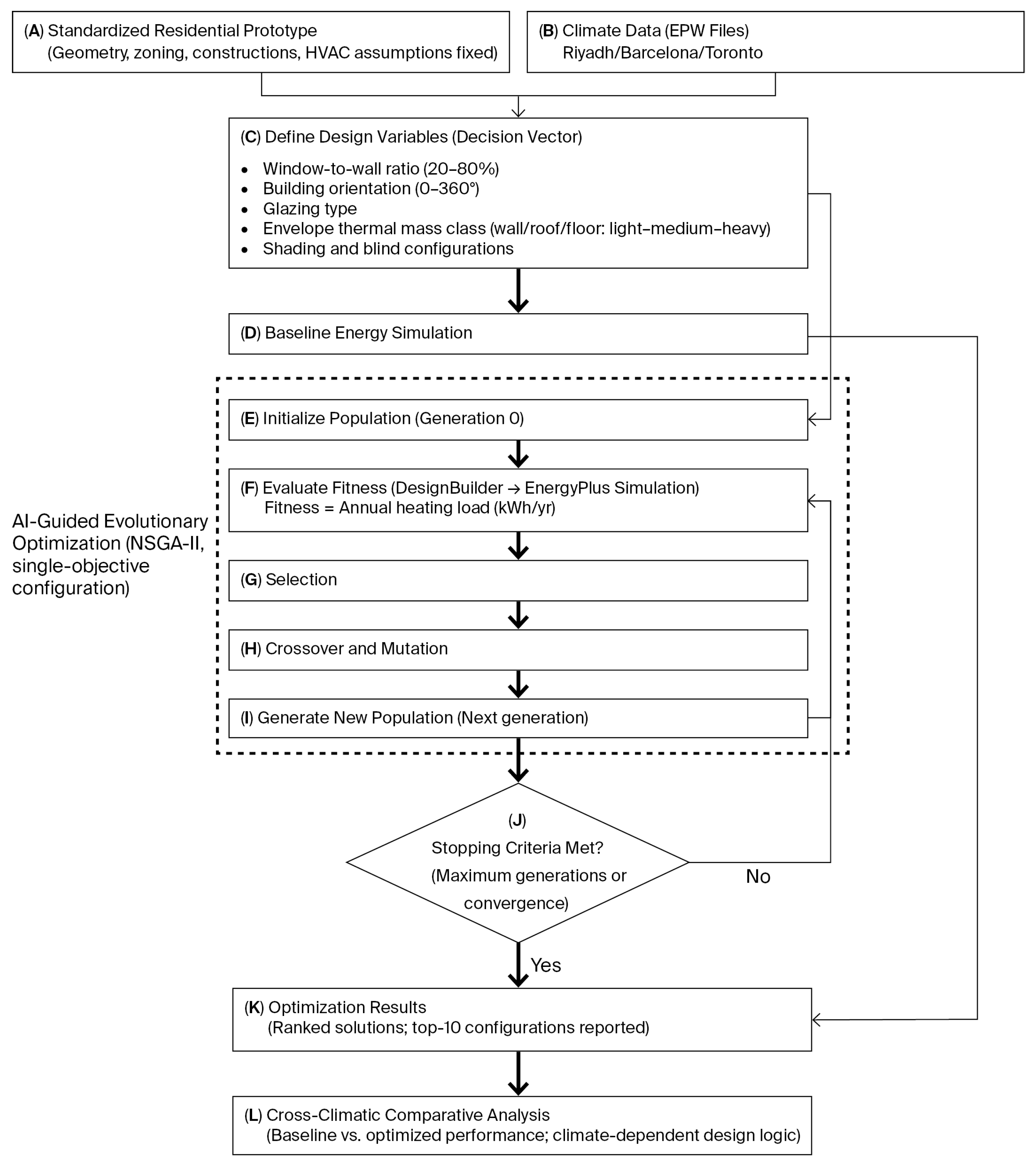
n = 100) was used to evaluate search effectiveness within the defined design space. Random exploration yielded a minimum annual heating load of 9854 kWh, whereas NSGA-II optimization achieved 9611 kWh under identical constraints. The evolutionary search therefore demonstrated improved convergence toward low-heating envelope configurations within a controlled experimental framework. The methodological workflow is illustrated in
Figure 2.
3.9. Scope and Limitations
Cooling, domestic hot water, equipment loads, and occupant adaptive behaviors were deliberately excluded from the methodology. Internal gains were maintained constant and identical across climates. The residential prototype does not represent regional construction practices in detail but serves as a controlled comparative model. Accordingly, the results should be interpreted as relative performance improvements under standardized conditions rather than as predictions of absolute real-world energy use.
4. Results
This section presents baseline heating performance and AI-guided evolutionary optimization outcomes for the three selected climatic contexts. The results are first reported for each climate individually, combining narrative interpretation with key quantitative indicators, followed by a consolidated cross-climatic comparison. This structure is intended to emphasize interpretability while avoiding repetition and maintaining analytical clarity.
4.1. Hot and Dry Climate: Riyadh
The Riyadh case represents a hot and dry climate with limited but non-zero winter heating demand. The results illustrate how passive and solar-responsive variables behave when solar availability is high and heating demand is short in duration.
4.1.1. Baseline Heating Performance in Riyadh
Under baseline conditions, the Riyadh residential prototype exhibits very low annual heating demand, reflecting the mild severity and limited duration of winter conditions. The simulated annual space heating load is 989 kWh, corresponding to a heating energy use of approximately 10.5 kWh/m2·yr. Peak heating demand occurs during brief winter periods and remains modest in magnitude compared to the other climates examined. Despite the low baseline demand, heating requirements are not eliminated entirely, indicating that envelope configuration and solar access continue to influence winter comfort even in predominantly cooling-oriented regions.
4.1.2. Optimized Heating Performance in Riyadh
AI-guided evolutionary optimization yields a substantial reduction in heating demand. The best-performing solution reduces the annual heating load to approximately 38.8 kWh, representing a reduction of about 95.9% relative to the baseline. This near-elimination of heating demand is achieved exclusively through passive and solar-responsive design adjustments, without changes to HVAC efficiency or operational assumptions.
Across the highest-performing solutions, the optimization consistently favors increased window-to-wall ratios and orientations that maximize winter solar exposure. High-performance glazing configurations are selected, while shading devices and internal blinds are systematically excluded. These patterns indicate that, under hot and dry winter conditions, maximizing solar gains dominates the optimization logic. Transmission losses remain secondary when cooling is excluded from the objective function. Representative high-performing solutions are presented in
Table 3.
4.2. Temperate Climate: Barcelona
The Barcelona case represents a temperate climate characterized by a distinct heating season of moderate severity. The results highlight the balance between solar utilization and transmission loss control under these conditions.
4.2.1. Baseline Heating Performance in Barcelona
In the Barcelona case, the baseline heating demand is substantially higher than in Riyadh, reflecting cooler winter temperatures and a longer heating season. The annual heating load of the baseline model is 5652 kWh, corresponding to a heating energy use of approximately 60.0 kWh/m2·yr. Heating demand is distributed across a broader portion of the year, increasing the importance of envelope thermal performance and heat retention relative to the hot and dry case.
4.2.2. Optimized Heating Performance in Barcelona
Optimization reduces the annual heating demand to 1987.95 kWh, corresponding to a reduction of approximately 64.8% relative to baseline performance. Although the relative reduction is smaller than in Riyadh, the absolute energy savings are substantial. Unlike the hot and dry case, for Barcelona, optimizations consistently favor glazing performance rather than geometric solar amplification alone. High window-to-wall ratios are retained in top-performing solutions only when paired with triple Low-E argon-filled glazing. Orientation continues to influence performance, but its effect is moderated by the dominant role of transmission loss suppression. Representative optimized solutions for the temperate climate case are summarized in
Table 4.
4.3. Cold and Humid Climate: Toronto
The Toronto case represents a cold and humid climate with prolonged and heating-dominated winter conditions. This case provides the most stringent test of passive and solar-responsive optimization strategies.
4.3.1. Baseline Heating Performance in Toronto
The Toronto baseline exhibits the highest heating demand among the three cases. The annual heating demand reaches 16,903.94 kWh, corresponding to a heating energy use of approximately 179.4 kWh/m2·yr. Heating demand persists for extended periods throughout the year, and peak loads are significantly higher than those in the other climates. This baseline is a challenging reference condition against which the effectiveness of passive optimization strategies in cold climates can be evaluated.
4.3.2. Optimized Heating Performance in Toronto
Optimization reduces the annual heating demand to 9611.69 kWh, corresponding to a reduction of approximately 43.1%. Although the relative reduction is smaller than those observed for warmer climates, the absolute energy savings are considerable. Optimized solutions consistently feature high-performance glazing combined with heavyweight envelope constructions and limited solar control through short overhangs. Window-to-wall ratios remain moderate, reflecting the need to balance useful solar gains against elevated transmission losses during prolonged cold periods. Representative optimized solutions for the cold and humid climate case are reported in
Table 5.
4.4. Cross-Climatic Comparison
To enable a consolidated comparison of heating performance across the three climatic contexts,
Table 6 summarizes the baseline annual heating demand, best optimized outcomes, and relative reductions achieved through AI-guided evolutionary optimization. In addition to reporting the single best-performing solution for each climate, the table provides an overview of performance ranges among high-performing solutions, supporting interpretation of result robustness beyond isolated optima.
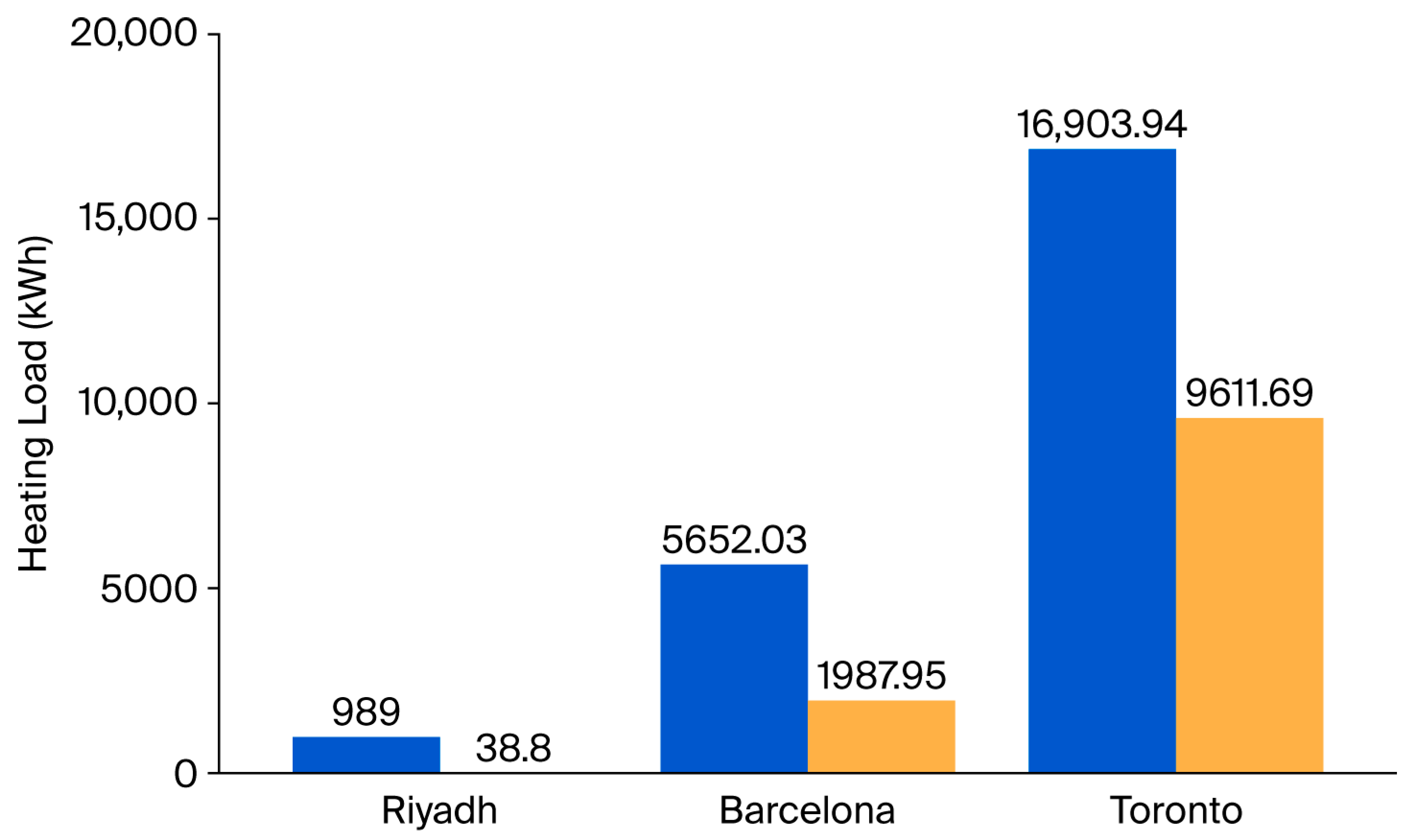
The comparison reveals clear climate-dependent differences in both absolute and relative heating reductions. The hot and dry Riyadh case exhibits the largest relative reduction, reflecting the amplification of winter solar gains on a low baseline heating demand. In contrast, the temperate Barcelona case demonstrates substantial reductions driven by a balance between improved glazing performance and controlled solar access. More constrained relative reductions are achieved for the cold and humid Toronto case, governed primarily by transmission loss control and thermal mass rather than solar amplification alone. These numerical trends are visualized in
Figure 3, which illustrates baseline and optimized annual heating demands across the three climates. This figure highlights that passive optimization does not scale uniformly with climatic severity. Instead, through optimization, design priorities are reorganized according to the dominant physical mechanisms governing heating demand in each context, emphasizing solar utilization in mild winters, envelope efficiency in temperate conditions, and loss mitigation in colder climates.
Additional comparative insight is provided in
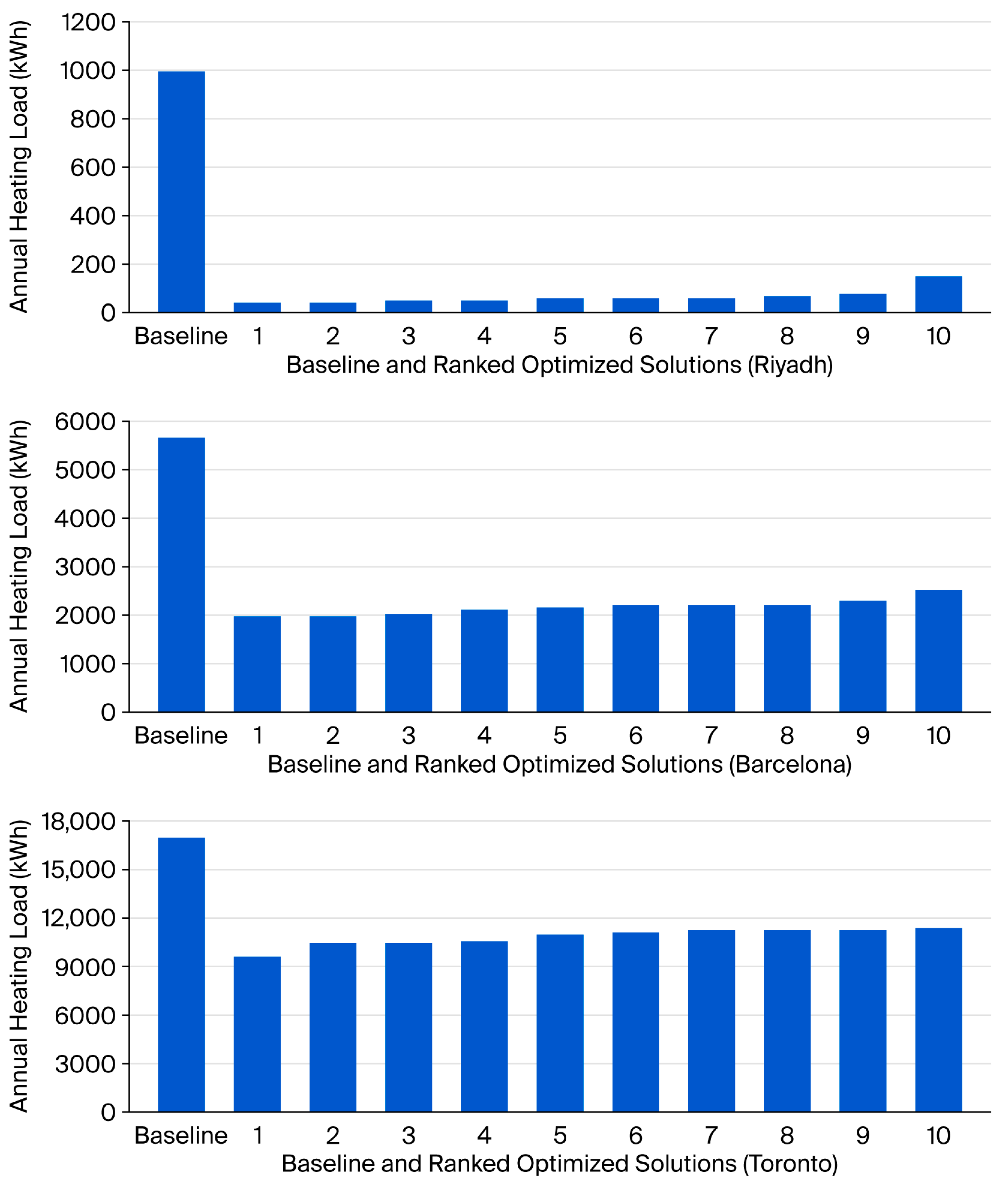
Figure 4, which illustrates baseline heating demands alongside those of the top ten optimized solutions for each climate case. The figure highlights not only the magnitude of reductions relative to baseline but also the performance dispersion among high-ranking solutions. For Riyadh, there is a steep reduction gradient between the baseline and optimized cases, while for Barcelona and Toronto there are narrower but stable optimization bands, indicating consistent solution clusters rather than isolated optima.
Although internal blind types were included as optimization variables, the top-ranked solutions reported in
Table 3,
Table 4 and
Table 5 consistently retain no internal blinds. This outcome reflects the heating-focused formulation of the study. In EnergyPlus, internal blinds primarily function as optical modifiers that reduce transmitted solar radiation, thereby limiting useful passive winter gains. While they may provide modest reductions in night-time heat losses, their overall influence remains secondary compared to glazing performance, orientation, and envelope construction. Consequently, the evolutionary search converged toward configurations that preserve unobstructed solar access under heating-dominated boundary conditions.
4.5. Robustness and Sensitivity Considerations
To evaluate the robustness of the optimization outcomes, a structured sensitivity analysis was conducted on the best-performing solution identified for each climate case. The objective was not to quantify absolute predictive uncertainty, but to test whether the observed climate-specific optimization logic remained stable under moderate variations in key modeling assumptions.
First, infiltration sensitivity was assessed by varying the baseline air change rate (0.7 ACH) by ±20% (0.56 ACH and 0.84 ACH). For the optimized solutions in Riyadh, Barcelona, and Toronto, this perturbation resulted in heating load variations ranging between 6% and 10% relative to the original optimized values. Importantly, the ranking of the top-performing solutions and the dominant envelope strategies remained unchanged across all three climates.
Second, comfort sensitivity was examined by adjusting the occupied heating setpoint by ±1 °C around the baseline value of 21 °C. This variation produced heating load changes between 8% and 12%, consistent with the expected thermodynamic sensitivity to setpoint variation. However, no shifts were observed in the qualitative hierarchy of optimized variables, including window-to-wall ratio ranges, glazing selections, or thermal masses.
Finally, the solution-space stability was evaluated by analyzing the distribution of the top ten optimized configurations per climate. For all three cases, the heating demand of the top ten solutions remained within a 5–15% band relative to the best-performing configuration. This indicates that the reported results do not represent isolated optima but rather stable performance regions within the explored design space.
Taken together, these tests indicate that the identified climate-dependent optimization logic is robust to moderate variations in infiltration and comfort assumptions. The findings should therefore be interpreted as structurally stable envelope-driven tendencies under heating-focused boundary conditions rather than outcomes dependent on narrowly calibrated parameters.
5. Discussion
In this section, the optimization outcomes are interpreted by examining how dominant passive design variables and their interactions vary across climatic contexts. Rather than reiterating the numerical results, the discussion focuses on the physical mechanisms and design logic that emerged from the AI-guided evolutionary search. Emphasis is placed on explaining why distinct combinations of solar utilization, envelope performance, and thermal storage are favored in different climates and on clarifying the applicability and limitations of the findings.
5.1. Climate-Dependent Optimization Logic
The results demonstrate that AI-guided passive optimization does not converge toward a single universal design solution. Instead, it produces climate-specific optimization logic shaped by the interaction between solar availability, transmission losses, and the severity and duration of the heating season. This outcome aligns with previous research showing that the effectiveness of passive strategies is inherently context-dependent [
1,
4,
8].
In the hot and dry Riyadh case, optimization nearly eliminates heating demand by maximizing winter solar gains through increased window-to-wall ratios and favorable orientations. The magnitude of this reduction reflects the combination of a low baseline heating demand and unconstrained solar amplification under a heating-only objective, rather than a generalizable expectation for real-world residential operation. When cooling requirements, summer overheating risk, or seasonal comfort constraints are reintroduced, the extent of solar amplification that would be feasible is expected to narrow. Nevertheless, the results highlight how responsive a low baseline heating demand can be to envelope configuration and orientation when cooling constraints are deliberately removed. Comparable tendencies have been reported in arid-climate studies, in which winter heating demand could be minimized through solar exposure despite a cooling-dominated annual profile [
9,
27].
By contrast, the temperate Barcelona case reveals a different hierarchy of influential variables. Although an increased glazing area remains beneficial, optimization shifts toward improving glazing performance rather than maximizing solar aperture alone. The repeated selection of triple Low-E argon-filled glazing indicates that limiting transmission losses while preserving useful solar gains is critical under moderate heating conditions. This behavior is consistent with studies showing that, in temperate climates, envelope efficiency is prioritized over geometric solar amplification in heating optimizations [
6,
28]. Orientation remains relevant but plays a secondary role compared to the thermal quality of the glazing system.
The cold and humid Toronto case reinforces this progression. Optimization converges toward solutions that combine high-performance glazing with substantial thermal mass and controlled solar admission through limited overhangs. Unlike the hot and dry context, unrestricted solar amplification is not optimal because increasing the glazing area without sufficient thermal resistance elevates heat losses during prolonged cold periods. The presence of short overhangs among top-performing solutions reflects a balance between capturing winter solar gains and limiting losses during shoulder seasons. Similar findings have been documented in cold-climate studies, in which heating demand is governed primarily by loss reduction and heat storage capacity rather than solar gain alone [
2,
3,
23].
5.2. Role of Window-to-Wall Ratio and Glazing Performance
Across all climates, window-related parameters emerged as central to heating optimization, although their functional role varies significantly by context. In Riyadh, higher window-to-wall ratios primarily function as improved solar collectors. In Barcelona and Toronto, windows act as thermally regulated apertures whose effectiveness depends on advanced glazing performance rather than area alone [
29].
These findings reinforce the recent literature indicating that the window-to-wall ratio should not be treated as a monotonic design variable. Its optimal value depends on the glazing quality, climatic severity, and the balance between solar gains and transmission losses [
7,
30]. AI-guided optimization is particularly effective in resolving this dependency because the window area, orientation, and glazing type are evaluated simultaneously rather than independently [
10,
11]. As a result, oversimplified optimization outcomes, such as universally minimizing the window area or maximizing solar exposure across all climates, are avoided.
5.3. Thermal Mass as a Climate-Selective Strategy
Thermal mass emerges as a decisive variable primarily in the cold and humid climate case. Heavyweight walls and ground floors are consistently selected, reflecting the stabilizing influence of thermal mass on indoor temperatures and its capacity to retain solar and internal gains over extended heating periods [
2,
3]. In temperate and hot and dry climates, thermal mass plays a more limited role, suggesting that its contribution to heating demand reductions depends on both the heating season duration and the availability of recoverable gains.
These observations align with earlier findings that varying the thermal mass yields diminishing returns in climates characterized by short or intermittent heating seasons [
8,
9]. The optimization outcomes therefore reinforce the view that thermal mass should be applied selectively as a climate-responsive strategy rather than a universally effective passive heating solution.
5.4. Implications for AI-Guided Early-Stage Design
From a methodological perspective, this study demonstrates the value of heating-focused, single-objective optimization for analyzing passive design behavior. By excluding cooling and HVAC efficiency from the optimization objective, the evolutionary search isolates envelope-driven trade-offs that are often obscured in multi-objective formulations [
13,
14]. This approach is particularly relevant during early design stages, when decisions regarding orientation, glazing, and construction systems precede mechanical system specification [
25].
At the same time, the results must be interpreted within the limits of the modeling assumptions. The ideal-load heating representation isolates demand but does not capture system constraints, occupant-driven adaptation, or operational control strategies. As emphasized in recent analyses, simulation-based predictions of passive solar performance require cautious interpretation when extrapolated to real-world operation [
4]. Nevertheless, the controlled nature of the framework strengthens internal validity and supports meaningful comparative insights across climates. Accordingly, the reported reductions should be interpreted as heating-specific performance outcomes rather than indicators of whole-year energy balance or operational energy use.
5.5. Comparison with Prior AI-Based Optimization Studies
Previous AI-assisted optimization studies in the building energy sector have predominantly adopted multi-objective formulations that combine heating and cooling demands with additional criteria such as thermal comfort, cost, or emissions [
13,
20]. These approaches are valuable for holistic performance assessment; however, they often make it difficult to isolate the specific contribution of passive and solar-responsive envelope decisions to reductions in heating demand. In many cases, improvements in heating performance are intertwined with HVAC system efficiency, control strategies, or objective weighting rather than envelope-driven behavior alone.
By contrast, the present study adopts a deliberately constrained optimization formulation focused exclusively on annual space heating demand. Building geometry, comfort conditions, and HVAC representation are kept constant across all climate cases, and cooling is intentionally excluded. This structure enables direct cross-climatic comparison of optimization outcomes and supports clearer interpretation of how evolutionary searches reorganize passive design priorities under different climatic drivers.
The contribution of this work lies in clarifying the climate-dependent logic revealed by AI-guided evolutionary optimization when envelope behavior is examined in isolation, rather than proposing a new optimization algorithm. As such, this study complements existing multi-objective frameworks by providing targeted insights into heating-focused passive design during early design stages, where envelope decisions precede system specifications.
To contextualize this positioning,
Table 7 compares the present framework with representative AI-assisted envelope optimization studies cited in this paper. The comparison is structured at the level of problem formulation, objective definition, climate scope, and geometric control, rather than numerical performance outcomes, because the published studies differ in boundary conditions, HVAC representation, and optimization criteria.
As shown in
Table 7, prior studies typically integrated multi-objective formulations, surrogate modeling, or variable-geometry exploration. While these approaches expand the solution space, they can reduce the direct interpretability of envelope-driven heating behavior across climates. The present framework instead prioritizes controlled experimental framing, fixed geometry, and cross-context comparability, enabling clearer thermodynamic interpretation of heating-driven envelope behavior.
5.6. Limitations and Transferability
The findings are specific to the standardized residential prototype, fixed comfort criteria, and modeling assumptions adopted in this study. Absolute heating loads will vary with building form, occupancy behavior, and regional construction practices. However, the relative trends revealed that solar amplification during hot and dry winters, transmission loss control through advanced glazing in temperate climates, and the combined use of thermal mass and controlled solar admission in cold climates are likely transferable to similar low-rise residential typologies [
1,
23].
Future research could extend this framework by incorporating stochastic occupancy profiles, adaptive comfort models, or calibrated post-occupancy data. Reintroducing cooling as a secondary objective would enable investigation of seasonal trade-offs under more comprehensive performance criteria and further support the application of AI-guided optimization in real-world design decision-making.
6. Conclusions
This study investigated the potential of using AI-guided evolutionary optimization to reduce residential space heating demand across distinct climate zones by isolating envelope and solar-responsive design variables under standardized conditions. Using a consistent single-story residential prototype and a single-objective optimization framework focused on annual heating load, this analysis compared outcomes for a hot and dry climate (Riyadh), a temperate climate (Barcelona), and a cold and humid climate (Toronto).
The results confirm that passive and solar-responsive design strategies can deliver substantial reductions in residential heating demand across all the examined climates, although both the magnitude of the reductions and the underlying physical drivers vary significantly by climatic context. In the hot and dry case, winter heating demand was nearly eliminated through solar amplification enabled by a favorable orientation, an increased glazing area, and minimal solar restriction. In the temperate case, performance was primarily optimized by reducing transmission loss through high-performance glazing combined with moderated solar apertures. In the cold and humid case, meaningful reductions were achieved through a balanced strategy integrating advanced glazing, increased thermal mass, and controlled solar admission, reflecting the physical limits of passive heating under prolonged cold conditions.
A central contribution of this work lies in demonstrating that AI-guided optimization does not converge toward uniform passive design solutions. Instead, it reveals climate-specific hierarchies of influential design variables that emerge from performance-driven evolutionary searches. By constraining the objective function to annual heating demand and deliberately excluding cooling and HVAC system efficiency effects, the individual effect of envelope-level decisions on heating performance is clarified. This approach enhances interpretability and demonstrates the value of demand-based optimization for supporting early-stage residential design decisions.
The findings also highlight the continued relevance of passive and solar-responsive design in contemporary residential architectures. Even in climates with severe heating requirements, envelope optimization achieved heating demand reductions exceeding 40% without reliance on active system upgrades. These results suggest that integrating AI-guided passive optimization into early design workflows can lead to more climate-responsive and energy-efficient residential buildings before mechanical systems or advanced technologies are introduced.
This study is subject to several limitations. The results are based on a simplified residential prototype, fixed comfort parameters, and an ideal-load representation of heating demand. Occupant behavior, adaptive comfort, and construction variability were not modeled. Accordingly, the reported reductions should be interpreted as conditional on the stated assumptions and as indicators of relative performance rather than absolute predictions of real-world energy use.
Future research may extend this framework by incorporating adaptive comfort models, stochastic occupancy profiles, and combined heating–cooling objectives, as well as by validating optimization outcomes against measured performance data. Within its defined scope, however, this study provides clear evidence that AI-guided evolutionary optimization offers a robust, transparent, and interpretable approach for reducing residential heating demand across diverse climatic contexts.