Article

Optimizing Industrial Energy Saving with On-Site Photovoltaics: A Zero Feed-In Case Study in Greece


by
Nick Pelekas
1,
Stefanos Keskinis
2,3,*,
Ioannis E. Kosmadakis
2 and
Costas Elmasides
2,*
1
School of Science and Technology, International Hellenic University, 54644 Thessaloniki, Greece
2
Department of Environmental Engineering, Democritus University of Thrace, 67132 Xanthi, Greece
3
Department of Maintenance at Thermal Power Plant, Power Public Corporation S.A., 69132 Komotini, Greece
*
Authors to whom correspondence should be addressed.
Solar 2026, 6(2), 12; https://doi.org/10.3390/solar6020012
Submission received: 10 December 2025 / Revised: 10 February 2026 / Accepted: 14 February 2026 / Published: 1 March 2026

Abstract

This paper investigates the integration of on-site photovoltaic (PV) systems in the industrial sector under a zero feed-in configuration, where all generated electricity is consumed locally without export to the grid. The analysis follows the current Greek regulatory framework and uses real operating data from an insulation materials manufacturing plant. Twelve months of measured electricity demand were combined with Typical Meteorological Year (TMY) solar data to simulate PV systems of 500, 1000, 1500, and 2000 kWp. Annual PV production ranges from approximately 739 MWh (500 kWp) to 2970 MWh (2000 kWp), and it is all fully self-consumed by the factory due to its high and continuous load. However, given the plant’s large annual electricity use, the PV systems offset 1.0–2.8% of total consumption. The avoided grid purchases correspond to 40–160 MWh/year of net energy savings, delivering positive Net Present Value (NPV) when electricity tariffs exceed EUR 0.15/kWh. The results confirm that zero feed-in PV deployment is technically feasible and economically attractive for industrial facilities facing high electricity prices, while also enhancing sustainability by reducing dependency on the public grid.

1. Introduction

Industrial facilities are among the most electricity-intensive actors in modern economies, where competitiveness increasingly depends on reducing operating costs while meeting stricter decarbonization targets. In the European Union and other major manufacturing regions, electricity expenditures can represent a material share of total production costs—especially in energy-intensive subsectors such as metals, chemicals, and building materials—making industrial consumers particularly exposed to price volatility and regulatory pressure [1,2,3,4].
Photovoltaic (PV) generation is a mature and scalable option to reduce grid electricity purchases and associated emissions in industrial settings [5,6]. Most behind-the-meter PV deployments have historically been supported by export-enabled arrangements (net-metering, feed-in tariffs, or net-billing), where part of the economic value may arise from selling surplus electricity to the public grid. However, an increasing number of jurisdictions now require or encourage “zero feed-in” (strict non-export) operation to mitigate distribution network congestion and reverse power flow under high renewable penetration [7,8,9,10,11]. Under a zero feed-in configuration, PV electricity must be consumed on-site at every time step; any potential export must be prevented through certified export-limiting control (curtailment and/or disconnection). This constraint fundamentally changes both system operation and economics: (i) export revenues are eliminated, (ii) compliance may induce curtailment risk in low-load periods, and (iii) the investment value depends almost entirely on load–PV coincidence and the detailed structure of the industrial tariff (energy charges, regulated fees, and demand/peak components).
The literature on PV self-consumption is extensive, but it remains uneven with respect to large industrial consumers operating under strict non-export rules. Many studies focus on residential/commercial buildings or consider industrial sites under export-allowed schemes; others rely on stylized load assumptions or simplified billing models, or do not explicitly enforce the non-export constraint at each time step [12,13,14,15,16,17,18,19,20,21,22,23,24,25,26,27,28,29,30,31,32,33,34,35]. Consequently, there is limited evidence quantifying techno-economic performance for industrial zero feed-in PV under real, high-resolution demand measurements and multi-component industrial tariffs—particularly within the current Greek regulatory framework [36,37,38,39,40,41,42,43]. To address this, and following the reviewers’ recommendations, this revised manuscript introduces a dedicated literature review (Section 2) that critically synthesizes prior work and positions the present contribution.
This study evaluates the technical and economic performance of on-site PV under strict zero feed-in operation for a real insulation materials manufacturing facility in Greece. One year of measured 15 min electricity demand is combined with site-specific Typical Meteorological Year (TMY) solar data to simulate PV capacities of 500, 1000, 1500, and 2000 kWp. The analysis quantifies the following: (i) self-consumed PV energy (with explicit non-export enforcement), (ii) peak demand reduction effects, (iii) avoided electricity purchases under the full industrial tariff structure, and (iv) long-term profitability using Net Present Value (NPV) and related indicators under relevant electricity price and discount rate scenarios.
The main contributions of this study are as follows:
  • A real-data-driven assessment of industrial PV under strict non-export (zero feed-in) constraints in Greece.
  • Tariff-consistent techno-economic evaluation (energy, regulated charges, and demand/peak effects) without export revenue.
  • Scalable comparison across four PV sizes, highlighting how load–PV coincidence drives savings and (where applicable) curtailment risk.
  • Policy-relevant insight for deploying behind-the-meter PV in grid-congested areas while maintaining non-export compliance.
The findings demonstrate the viability and scalability of zero feed-in PV systems as a cost-effective strategy for industrial decarbonization and energy cost reduction.
Unlike conventional self-consumption studies, where surplus exports are implicitly or explicitly allowed, the present work focuses on a strict non-export operational regime, in which any grid injection is prohibited at every time step. This distinction is critical, as it fundamentally alters system sizing logic, operational behavior, and economic value streams.

1.1. Research Gap and Novelty

PV self-consumption has been widely investigated, yet strict zero feed-in industrial operation is still underrepresented relative to export-enabled paradigms. Existing studies often: (i) allow export through net-metering/net-billing, (ii) use aggregated or synthetic load profiles rather than high-resolution measured industrial demand, and/or (iii) simplify tariff modeling by omitting demand/peak charges and regulated fees. In a strict non-export setting, these simplifications can materially bias both technical conclusions (self-consumption vs. curtailment) and economic outcomes (savings vs. NPV/LCOE).
The novelty of this work lies in three main aspects:
  • Industrial-scale, measurement-driven modeling: twelve months of 15 min factory load data are used to represent realistic operational variability.
  • Strict non-export enforcement: self-consumed PV is computed explicitly as P PV ,   used t = min P PV t ,   P Load t , eliminating implicit export assumptions.
  • Tariff-consistent profitability under Greek conditions: the economic analysis reflects industrial billing structure without export remuneration, enabling a realistic feasibility assessment and sensitivity to electricity price and discount rate.
Although the analysis is demonstrated through a single industrial case study, the proposed methodology is not site-specific. The modeling framework is based on transferable inputs—measured load profiles, TMY-based solar resource data, and standard PV performance modeling—and a constraint-based formulation of zero feed-in operation. By substituting local meteorological data, electricity tariffs, and industrial demand profiles, the same approach can be readily applied to other industrial facilities, climatic zones, and regulatory environments where export-limited PV operation is required. Therefore, while absolute numerical results are location-dependent, the methodological insights regarding load–PV coincidence, self-consumption behavior, and economic drivers remain broadly applicable.
Accordingly, the framework can be directly applied to industrial sectors with different demand characteristics—such as continuous-process industries, batch-production facilities, or seasonally driven manufacturing—by substituting the corresponding measured load profiles.

1.2. Structure of the Paper

Section 2 provides a dedicated literature review and then describes the Greek regulatory framework for zero feed-in operation, the solar resource and PV modeling approach based on TMY data and detailed simulation, the industrial tariff structure, and the economic evaluation framework. Section 3 presents and discusses the results, including PV yields, net-load impacts, peak-demand effects, self-consumption performance, and techno-economic outcomes across PV capacities and price/discount scenarios. Section 4 concludes the paper, highlights limitations and practical implications, and outlines directions for future work (e.g., storage integration, reliability/availability modeling, and multi-site validation).

2. Literature Review

2.1. PV Self-Consumption: Mismatch, Metrics, and Operational Drivers

Photovoltaic self-consumption has been widely studied as a pathway to reduce electricity purchases and emissions, primarily in the residential and commercial sectors where behind-the-meter generation is increasingly common. A foundational finding across this literature is that PV value is governed less by annual energy yield and more by the temporal coincidence between PV production and on-site demand (the “mismatch” problem). Reviews and methodological studies have established core performance metrics—such as self-consumption and self-sufficiency rates—and have shown how these metrics depend on load shape, climate, and control strategies [5]. Demand-side flexibility (e.g., appliance scheduling) is frequently proposed to increase PV utilization by shifting consumption into PV hours, thereby reducing exports and curtailment needs [6].
A clear strength of this strand is its detailed treatment of time-resolution effects and end-use behavior, as well as the development of standardized indicators for comparing systems across climates and tariff regimes [5,6]. However, two limitations are particularly relevant to industrial zero feed-in applications. First, many studies assume export is allowed (net-metering/net-billing), so PV surplus can be injected into the grid, which changes both operational constraints and economic value streams. Second, tariff treatment is often simplified relative to industrial billing (e.g., energy-only prices or basic time-of-use), which can underrepresent the importance of demand/peak components and regulated charges that frequently dominate industrial cost structures.

2.2. Industrial PV Self-Consumption: Load Characteristics and Tariff Realism

Industrial facilities differ fundamentally from residential/commercial buildings because they often exhibit high and continuous demand, driven by production schedules, process loads, and auxiliary systems. This can increase PV self-consumption even without storage, because daytime PV output is more likely to be absorbed internally. Several studies have explored PV self-consumption opportunities in industrial contexts, including industrial process applications such as cooling and refrigeration, where PV can align with daytime thermal loads [13]. Other works analyze PV investments at the scale of industrial parks and manufacturing enterprises, emphasizing that economic performance depends strongly on the site’s demand profile and on how tariffs are modeled [31,44,45,46,47,48,49,50,51,52,53,54,55,56,57,58].
A key strength of industrial-focused studies is the recognition that high daytime demand can yield near-complete PV utilization under many conditions, leading to robust bill savings and favorable NPV/payback outcomes when electricity prices are elevated [31]. Additionally, recent work has highlighted the emerging role of flexibility (“prosumer-to-flexumer” transitions), where industrial energy management and process flexibility can further increase the value of behind-the-meter resources [22].
Nevertheless, limitations persist. First, many industrial analyses still treat export implicitly as permissible or assume simplified billing, which can overstate benefits in jurisdictions where export is constrained. Second, load data are frequently aggregated (monthly or hourly) rather than measured at high resolution, which can blur peak-demand effects and distort the estimated load–PV coincidence that drives self-consumption. Third, only a subset of studies explicitly accounts for demand charges and regulated fees, despite their importance for industrial customers—particularly in countries where grid charges and regulated levies are substantial. Greek industrial contexts have been studied with respect to storage value and industrial energy management, indicating the relevance of tariff structure and operational constraints, but strict non-export PV case studies remain limited [2].

2.3. Export Constraints and “Zero Feed-In”: Control, Curtailment, and Hosting-Capacity Motivations

Export-limited and zero-export operation has become increasingly important as distribution networks face congestion and hosting-capacity limitations. Export constraints are discussed in the literature as a pragmatic mechanism to enable additional renewable capacity while mitigating reverse power flow and voltage issues [7]. In strict non-export operation, compliance is achieved through export-limiting control (e.g., power-flow sensors and plant controllers commanding curtailment or disconnection), and system performance must be evaluated under the constraint that exported energy is always zero.
Recent work has addressed sizing PV for self-consumption “without surpluses” using on-site measurements, demonstrating the value of data-driven sizing when export is not permitted [8]. Related studies have examined how grid limitations interact with storage and self-consumption indices, showing that export restrictions can reshape optimal sizing and operation [32].
This strand’s main strength is its explicit recognition that export limitations are not a minor assumption but a defining operational regime, which can introduce curtailment and affects both system design and performance metrics. However, two gaps remain for large industrial zero feed-in assessments: (i) many export-limited studies focus on residential/commercial scales rather than energy-intensive industrial loads, and (ii) economic evaluation is often not fully aligned with multi-component industrial tariffs, where demand/peak charges and regulated fees can materially influence savings beyond simple energy-volume reduction.

2.4. Techno-Economic Evaluation Under Industrial Tariffs: NPV/LCOE Use and Remaining Gaps

NPV and LCOE are widely used to evaluate PV investments, but results are highly sensitive to assumptions about discount rate, degradation, O&M costs, and—crucially—how electricity prices and tariffs are represented [59,60,61,62,63,64,65,66]. In industrial settings, the relevant “avoided cost” is not always the simple energy price (EUR/kWh); it can include regulated fees and demand-related components that depend on peak import levels and power-factor considerations. Studies evaluating PV self-consumption under industrial electricity tariffs underline that tariff realism can significantly change the estimated value of PV and the interpretation of cost-effectiveness [31].
A recurring methodological weakness in parts of the literature is that export revenue is either included by default (net-metering/net-billing) or not explicitly ruled out, which can blur the distinction between conventional self-consumption systems and strict zero feed-in schemes. Furthermore, when strict non-export is modeled, some studies do not clearly document the enforcement logic at each time step or the associated curtailment behavior, limiting reproducibility and comparability across studies.
Taken together, prior work establishes that PV self-consumption value depends on load–PV coincidence, PV yield/loss modeling, and tariff structure; export constraints add an additional layer of operational realism that can materially change both energy and economic outcomes [7,8,32]. However, evidence remains limited for industrial-scale facilities under strict zero feed-in rules using measured high-resolution demand, coupled with detailed tariff-consistent cash-flow accounting under specific national regulatory frameworks such as Greece [2,7,11]. These gaps motivate the present study, which combines measured 15 min industrial load data with TMY-based PV simulation and strict non-export enforcement, and evaluates savings and profitability under Greek industrial tariff conditions without export remuneration.
Table 1 summarizes and compares representative PV self-consumption studies with the present work in terms of application scale, data resolution, export assumptions, tariff modeling detail, and key performance indicators, explicitly highlighting the methodological gap addressed by this study.

3. Materials and Methods

3.1. Regulatory Framework for Zero Feed-In Operation

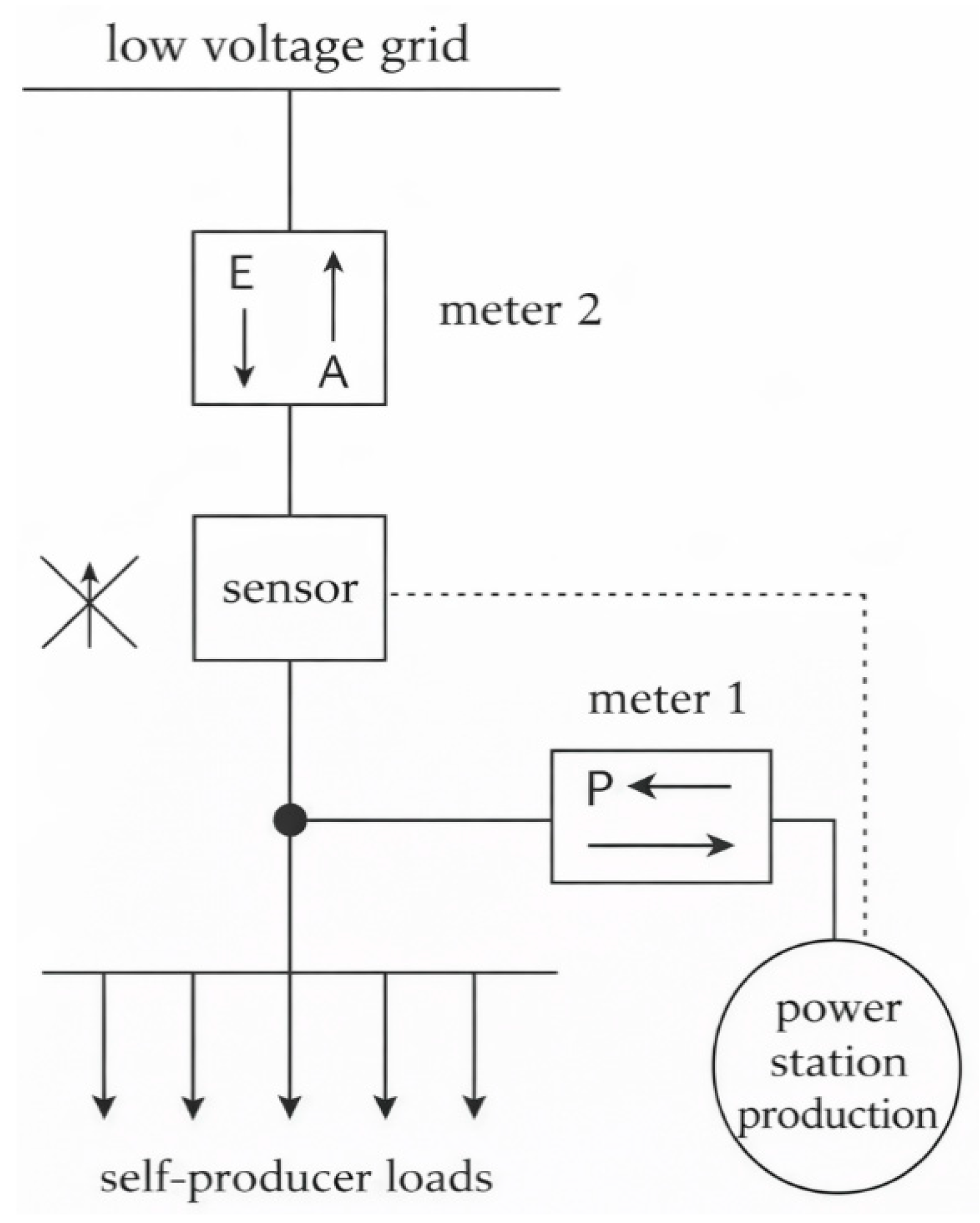
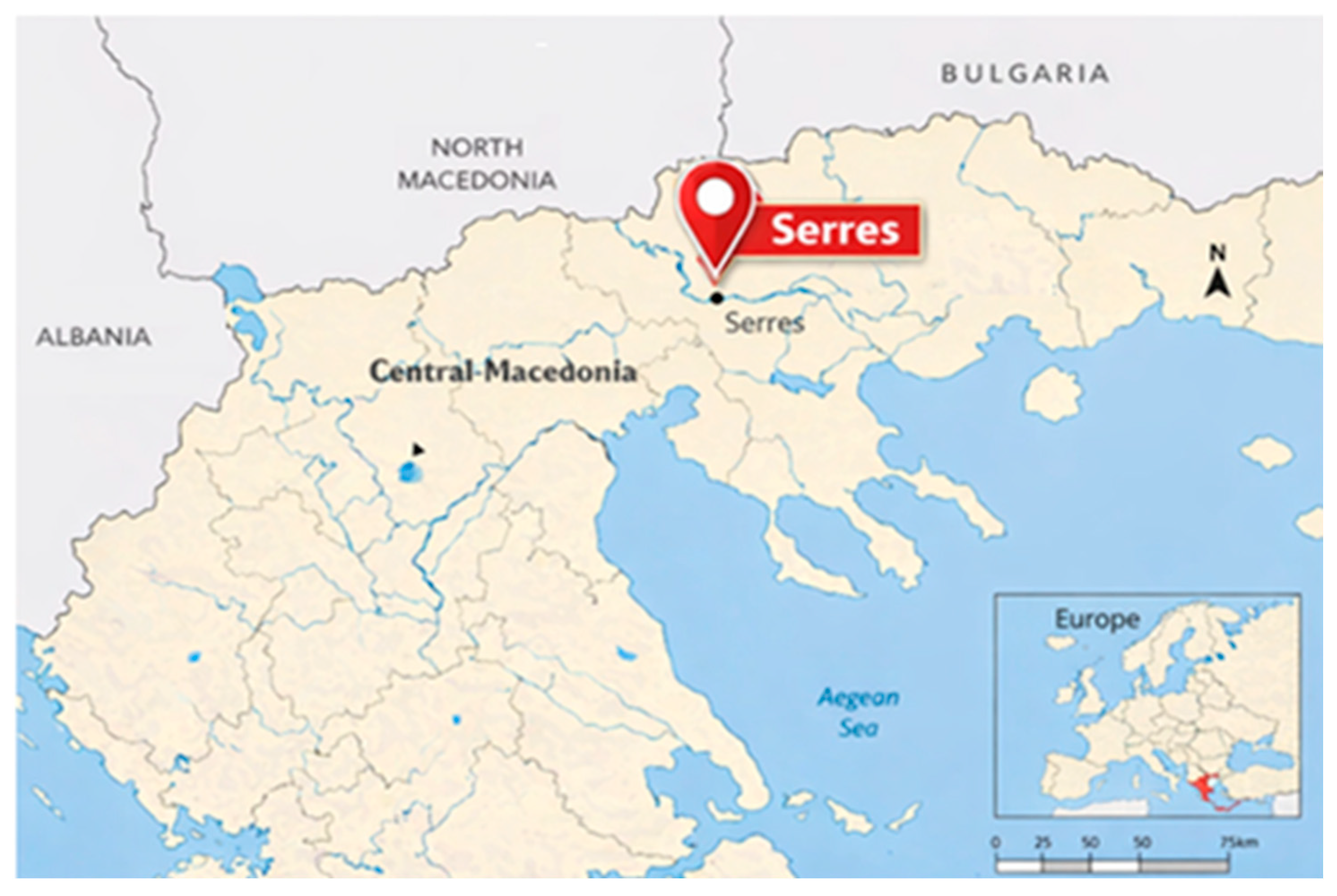
The adoption of zero feed-in photovoltaic systems has increased significantly in recent years, driven by the need to mitigate grid congestion, avoid reverse power flow and enable renewable energy deployment in areas with limited hosting capacity [44]. Figure 1 illustrates the zero feed-in connection concept and situates the examined industrial facility within its broader geographic context in Northern Greece (Serres region), providing a schematic overview of the regulatory and spatial setting of the case study. In Greece, the regulatory framework governing zero feed-in installations is defined and supervised by the Hellenic Electricity Distribution Network Operator (HEDNO). According to national rules, a zero feed-in PV system must ensure that no electrical energy is injected into the public grid at any time, regardless of operating conditions, load variations, or solar availability [11].
To comply with this requirement, the self-producer is obligated to install a certified energy-flow direction sensor at the point of common coupling. This device continuously monitors the power exchange between the internal installation and the Low Voltage (LV) or Medium Voltage (MV) distribution network. When the sensor detects potential export conditions—caused by high PV production or reduced facility consumption—it issues a control signal to the PV plant’s management system, commanding curtailment or complete disconnection of the generating units. This mechanism guarantees compliance with the non-export constraint and prevents reverse power flow toward the grid [11].
The implementation of the zero feed-in scheme also requires the use of two metering devices, as defined by HEDNO [11]:
  • Meter 2, installed and owned by the grid operator, records the bidirectional energy exchange between the facility and the public grid.
  • Meter 1, installed and owned by the self-producer, measures the output of the PV station and forms part of the internal installation.
The technical documentation submitted during the application process must demonstrate the effectiveness of the non-injection mechanism, including electrical diagrams, protection settings, and manufacturer specifications for the direction sensor and the PV control system. HEDNO verifies compliance during commissioning and reserves the right to disable the installation if exports toward the grid are detected during operation [11].
This regulatory structure enables the connection of PV stations even in saturated networks, where hosting capacity limitations would otherwise prevent new renewable installations. However, it cannot be applied in cases where saturation results from short-circuit power constraints at upstream HV/MV substations. Overall, the zero feed-in framework promotes the safe integration of behind-the-meter renewable generation while safeguarding grid reliability [11].
Figure 1 situates the examined industrial facility within its broader geographic context, indicating its location in Northern Greece (Serres region). The site was selected as a representative example of an energy-intensive manufacturing facility operating under the Greek zero feed-in regulatory framework. To further ground the analysis in real-world conditions, representative photograph of the site is provided in Appendix A.
Figure 1 and Appendix A collectively illustrate the typical industrial scale and rooftop context relevant for on-site PV deployment, indicating the location and configuration of the photovoltaic installation without disclosing sensitive or proprietary information. It is noted that Figure 1 serves exclusively as a schematic reference figure, illustrating the zero feed-in connection concept and the spatial context of the case study. It is not intended to represent operational results or time-series data, which are presented in subsequent figures.

3.2. Solar Resource, PV Modeling, and Energy Simulation Method

The photovoltaic production was simulated using TMY data and a detailed performance model representative of commercial industrial-scale PV systems. Hourly solar irradiance, ambient temperature, and wind speed data were obtained from the PVGIS database for the geographical location of the industrial facility. These data provide a statistically representative annual climate profile, derived from long-term measurements over a period of 10–15 years [45,46].
PV generation was modeled using the System Advisor Model (SAM), developed by the National Renewable Energy Laboratory (NREL). SAM performs time-step simulations of PV output by calculating plane-of-array (POA) irradiance, module temperature, inverter behavior, and all major system losses. The model incorporates optical losses (soiling, reflection), thermal losses, inverter clipping, and DC/AC conversion efficiency, producing an hourly (Δt = 1 h) electricity generation profile for one year [47].
Table 2 summarizes the main technical assumptions and configuration parameters used in the PV simulations, ensuring transparency and reproducibility across the examined system sizes. Based on the simulated annual energy yield and the nominal installed capacity, the resulting performance ratio (PR) of the PV systems ranges between 0.78 and 0.81 across the examined scenarios. These values are consistent with typical performance ratios reported for fixed-tilt industrial rooftop PV installations operating under Mediterranean climatic conditions.
The electricity demand profiles used throughout the analysis are based on one full year of measured factory load data with a 15 min resolution, recorded at the point of common coupling of the facility. These measurements directly form the basis of the consumer load curves presented in Figure 2, Figure 3, Figure 4 and Figure 5.
The examined industrial facility presents suitable conditions for rooftop photovoltaic installation. The factory consists of large, flat industrial rooftops with sufficient unobstructed surface area and structural characteristics compatible with the deployment of industrial-scale PV systems. Consequently, all PV scenarios examined in this study are assumed to be rooftop-mounted.
No ground-mounted PV installation was considered, as the available surrounding land is either limited or allocated to industrial operations, logistics, and access requirements. Focusing on rooftop deployment ensures realistic system sizing, avoids land use conflicts, and reflects common practice for industrial self-consumption projects under the Greek regulatory framework.
For each PV size considered (500, 1000, 1500, and 2000 kWp), the number of required modules, inverter sizing, and DC/AC ratio were selected based on commercially available equipment from manufacturer datasheets. All simulations assumed fixed-tilt PV arrays, an azimuth aligned with true south, and a module degradation rate of 0.5% per year [48]. To ensure comparability across systems, design assumptions—such as shading-free installation conditions, wiring losses, and inverter efficiencies—were kept constant for all capacities.
The annual energy yield for each scenario was computed after applying all modeled losses and degradation adjustments. Since this study examines a zero feed-in configuration, only the PV energy that is instantaneously consumed by the factory load profile is considered. No exports to the public grid are allowed, and therefore no revenue from external electricity sales is included in the simulation. The resulting hourly profiles of self-consumed PV energy are then used in the economic analysis presented in Section 3.4.
Table 3 summarizes the key technical and economic assumptions used in the modeling framework, enhancing transparency and ensuring reproducibility of the results.
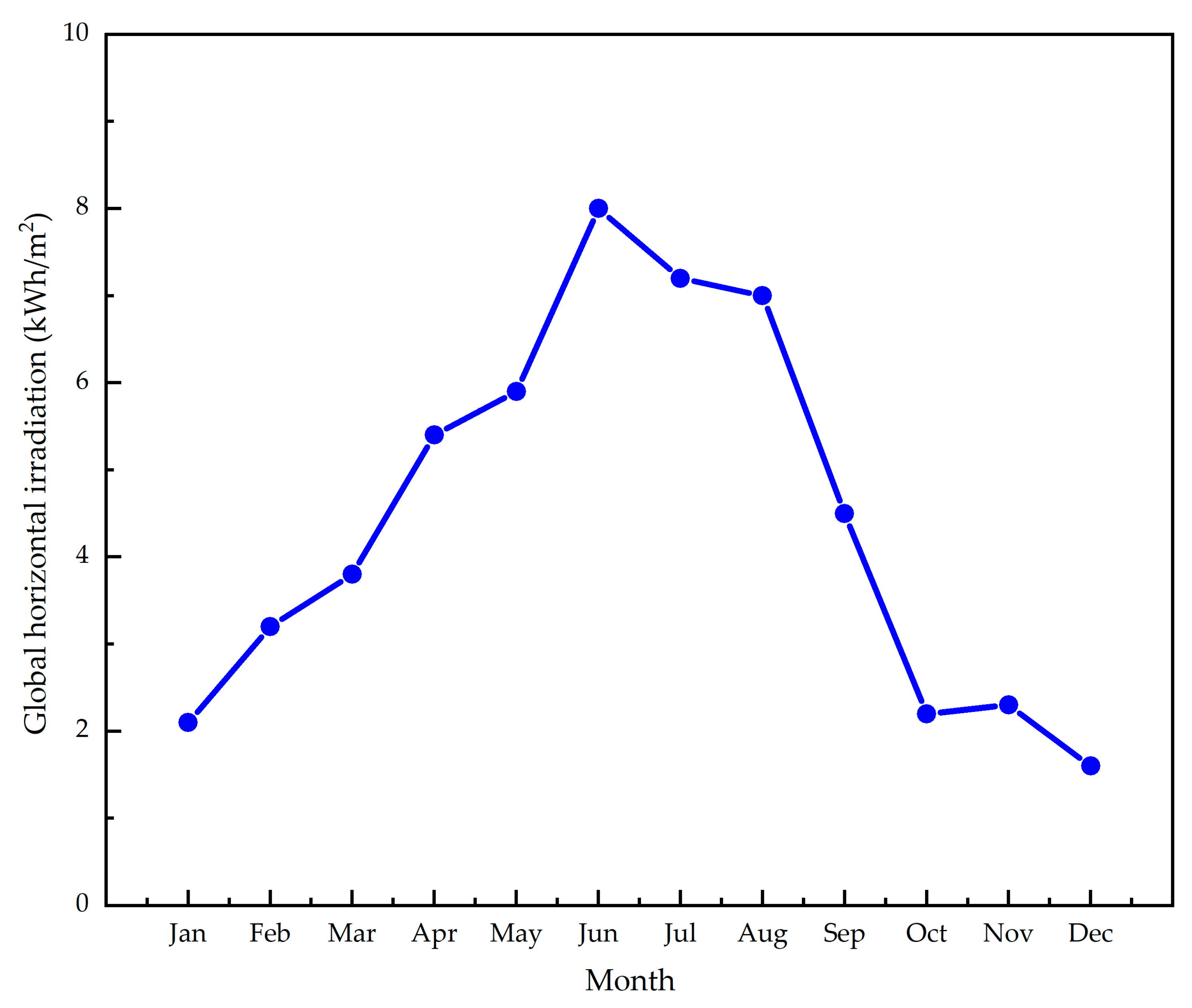
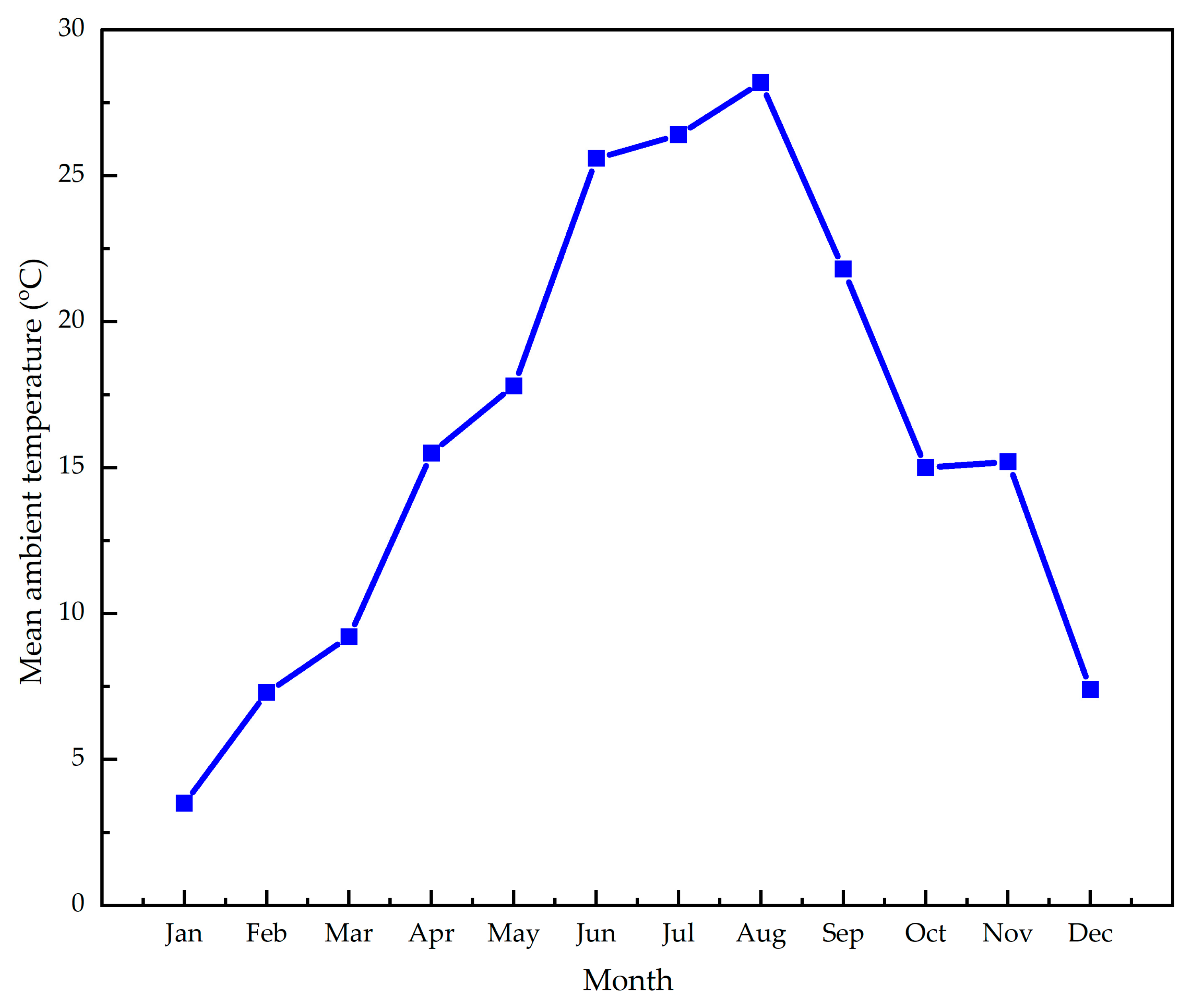
To fully document the climatic inputs used in the PV simulations, a complete year of Typical Meteorological Year (TMY) data was employed, including global horizontal irradiance (GHI) and ambient air temperature at 2 m height (T2m), as provided by the PVGIS database. For transparency and reproducibility, Appendix B presents representative graphical summaries of the solar and thermal resource at the study location, including monthly average values of GHI and T2m, as well as indicative short-term daily profiles illustrating typical diurnal variability. These climatic data constitute the basis of the PV energy yield simulations performed with the SAM model.

Model Verification and Result Reliability

The reliability of the modeling framework is ensured through the use of measured industrial demand data, physically constrained PV simulation, and systematic consistency checks. The electricity demand profiles are based on one full year of 15 min measurements recorded at the point of common coupling, ensuring that all simulated load curves reflect real operational behavior.
Photovoltaic generation is modeled using the NREL System Advisor Model (SAM), which has been extensively validated in the literature for commercial and industrial PV applications. The model incorporates site-specific TMY meteorological inputs and detailed loss mechanisms, resulting in physically consistent hourly PV output profiles.
The zero feed-in condition is enforced explicitly at each simulation step by limiting usable PV power to the instantaneous factory demand. This guarantees strict compliance with the non-export constraint and preserves energy balance integrity.
Additional verification checks confirmed that PV generation never exceeds load under zero feed-in operation, that monthly and annual energy balances are consistent with time-series integration, and that economic indicators scale monotonically with PV capacity and electricity price. These checks support the robustness and reproducibility of the modeling results.

3.3. Industrial Electricity Tariff Structure and Cost Calculation Method

The industrial electricity cost in Greece consists of the energy charge and a set of regulated charges defined by the national tariff structure. For this study, the cost of electrical energy consumed by the factory was computed using measured power data recorded at 15 min intervals (Δt = 0.25 h). The total monthly electricity cost is expressed as follows.
C t o t = C e l + C r e g + C P U C + C t a x
The value Ctot in Equation (1) represents the total electricity cost for the billing period (in EUR), which is calculated from the sum of the energy charge Cel, the total regulated network-related charges Creg, the public utility and service charges CPUC, and lastly, all the electricity-related taxes and levies Ctax. All these variables are calculated in EUR.

3.3.1. Energy Charge

Supplementary to Equation (1), the energy charge component Cel is calculated based on the measured active power demand of the facility, recorded at 15 min intervals, as follows:
C e l = C e n i = 1 n P e l , i Δ t  
Here, the Cen is the unit electricity energy price, calculated in EUR/kWh, in relation to the aggregate of the measured active power during time interval i, in kW, with a time-step duration Δ t , of 0.25 h. Finally, n holds for the total number of 15 min intervals within the billing period.
Daily Energy Planning (DEP) constitutes the model for the organization of the wholesale market through which all the electricity that will be produced, consumed, and transported the next day in Greece is traded. This model is characterized by several technical elements, and the determination of the value is the result of algorithmic application (objective function optimization), and requires the introduction of many parameters, which are either set regularly or controlled by the competent authorities.

3.3.2. Regulated Charges

Regulated charges include the transmission system fee, distribution network fee, and other grid-imposed levies. They depend on the plant’s contracted power and monthly energy consumption given by the following equation:
C r e g = C T S + C D S + C o t h e r s
Here, the CTS is the transmission system charge added with the distribution system charge CDS and other additional regulated charges imposed by the tariff Cothers.
The transmission fee is
Where P pg is the peak recorded demand (kVA).
The distribution fee is
C D S = C f c P p g + E e l C v c 1 c o s φ
In accordance with Equation (3), the distribution network charge CDS is calculated by the fixed capacity charge Cfc, in units EUR/kVA or EUR/kW, multiplied by the peak recorded demand during the billing period Ppg, in units kVA or kW respectively. Additionally, the imported electrical energy from the grid Eel is added, in kWh, and multiplied by the volumetric distribution charge, in EUR/kWh, divided by the power factor of the installation, shown as cosφ. The factor 1/cosφ accounts for power-factor-related tariff adjustments, when applicable.

3.3.3. Public Utility and Environmental Charges

Public utility services and environmental taxes are proportional to imported energy.
C P U C = E e l C v s
Here, the public utility service charges CPUC are obtained by the multiplication of the imported electrical energy Eel, measured in kWh, by the corresponding unit service charge Cvs, in units EUR/kWh.
C t a x = E e l C g p + E e l P t e C c t
Finally, following Equation (1), the total electricity-related taxes are a result given by Equation (6), where we calculate the imported electrical energy Eel, in kWh, by the general electricity tax coefficient Cgp, in EUR/kWh. To this are added the imported electrical energy Eel with a binary or scaling factor indicating the applicability of a specific tax Pte and the unit charge of the corresponding tax Cct, measured in EUR/kWh.

3.3.4. Cost Under Zero Feed-In PV Operation

After integrating on-site PV generation, the net imported energy becomes
P n e t , i = P e l , i P p v , i
where Pnet,i represents the net imported power from the grid at time step i in kW, deriving from the subtraction of the measured active power demand of the factory at time step i Pel,i, in kW, and the photovoltaic power utilized at time step i Ppv,I (kW).
Under strict zero feed-in operation, P net , i 0 at all time steps.
Thus, the modified energy charge is
C e l , n e w = C e n i = 1 n P n e t , i Δ t
where the energy charge after PV integration, shown as Cel,new, arises from the unit electricity price Cen, in units of EUR/kWh, multiplied by the summation of the net imported power at time step i Pnet,i, in kW, in accordance with the simulation time step duration Δt, calculated in h. Here, n is the total number of time steps within the billing period.
This allows direct comparison of monthly costs before and after PV integration.

3.4. Economic Evaluation Framework

The economic feasibility of the zero feed-in photovoltaic systems was assessed using a discounted cash-flow (DCF) approach. Since all PV electricity is consumed internally and no energy is exported to the grid, the economic benefit arises exclusively from avoided electricity purchases. For each PV system size, annual cash flows were computed based on the reduction in imported electricity and the corresponding reduction in regulated and environmental charges defined in Section 2.3 [49,50,51].

3.4.1. Annual Cost Savings and Energy Cost Reduction

Annual monetary savings ( S annual ) were calculated as
S a n n u a l = C t o t , b a s e l i n e C t o t , P V
Here, Sannual is a result from the Ctot,baseline, which represents the annual electricity cost without PV minus the annual cost after integrating the PV system Ctot,PV, using the modified consumption described in Equation (8).
Because the configuration is zero feed-in, PV electricity contributes only when the factory load is simultaneously higher than PV output. Therefore, all simulated PV production is classified as self-consumed energy.
For each scenario, the facility’s monthly and annual electricity expenditures were recalculated by subtracting the PV energy that is instantaneously self-consumed. The monthly economic gain is computed as
Savings m = E PV , used , m C elec , m
where EPV,used,m represents the PV energy self-consumed during month m and the electricity purchase price, shown as Celec,m, calculated in EUR/kWh.
The seasonal behavior of PV generation drives corresponding seasonal variations in cost reduction: savings peak during spring and summer, while winter months yield lower financial benefit. As expected, larger PV capacities yield proportionally higher monthly and annual savings.

3.4.2. Investment Cost

The initial PV investment cost ( C inv ) is
C i n v = P P V C c a p e x
Here, PPV represents the installed PV capacity, measured in kWp, and Ccapex shows the specific installation cost, in units EUR/kWp, including modules, inverters, mounting structures, cabling, and installation.
The annual operating and maintenance cost is modeled as
C O & M = C i n v r O & M
where the annual operation and maintenance cost CO&M, measured in EUR/year, derive from the multiplication of the initial investment cost Cinv, in EUR, and rO&M, being the annual O&M rate.

3.4.3. Net Present Value (NPV)

The Net Present Value of each PV system size was evaluated over a 25-year project lifetime. The NPV is calculated as [52,53,54,55].
N P V = C inv + t = 1 25 S annual C O & M 1 + r t
Following the Equations (10)–(12) the Net Present Value (NPV) is calculated, using a discount rate r, while the Sannual and CO&M are assumed constant in real terms. A PV degradation is also incorporated through a 0.75 lifetime energy correction factor (Section 2.1).
A system is considered economically viable when the Net Present Value is positive.

3.4.4. Simple Payback Period (SPB)

The simple payback period is computed as [56,57].
S P B = C i n v S a n n u a l
Here the simple payback period SPB, which is shown in years, originates from the division of initial investment cost Cinv from Equation (11), in EUR, with the annual monetary savings Sannual from Equation (10), which is in units EUR/year.
Although SPB does not account for discounting or degradation, it provides a practical indicator for industrial investors.

3.4.5. Levelized Cost of Energy (LCOE)

L C O E = C inv + t = 1 25 C O & M 1 + r t t = 1 25 E P V , t 1 + r t
Furthermore, the levelized cost of energy LCOE is shown in EUR/kWh, using the variables computed in Equations (11) and (12), while implementing the real discount rate r, and the project year index t. Additionally, the annual PV electricity generation in year t accounting for degradation EPV,t is also calculated in units kWh/year. The project lifetime is assumed to be 25 years.
The LCOE enables comparison between the cost of PV-generated electricity and the effective cost of grid electricity (EUR/kWh) under industrial electricity tariffs and behind-the-meter applications [56,57,58,59,60,61]. However, recent studies have highlighted that LCOE alone may not fully capture the economic value of behind-the-meter PV systems operating under multi-component industrial tariffs, motivating the complementary use of NPV-based indicators in the present work [61].

3.4.6. Detailed Cash-Flow Formulation

The NPV of each PV sizing scenario was calculated using [61,62,63,64].
N P V = C A P E X 0 + t = 1 N C F t 1 + r t
Here, CAPEX0 represents the initial capital expenditure for PV procurement, installation and export-limiting equipment, while following Equation (15), the project lifetime N is assumed as 25 years, utilizing the real discount rate r and the net annual cash flow CFt, calculated in years.
Annual cash flow C F t consists of
C F t = S t e n + S t c a p + S t r e g O & M t
Following on from Equation (16), in order to calculate the net annual cash flow, we firstly need to know the savings from avoided energy purchases St(en), which are calculated in Equation (18), as follows:
S t e n = m = 1 12 E P V , u s e d , m C e n , m
In Equation (18), we assume that EPV,used,m equals the min (EPV,m,Eload,m), and following from Equation (17), reduced demand charges due to lower peak load during billing windows St(cap) are required, along with the avoided kWh-dependent regulated charges St(reg). The annual operation and maintenance costs, on the other hand, are assumed as a fixed percentage of CAPEX0 and subject to annual escalation. Further, PV degradation is applied at d = 0.5% per year, and electricity price escalation is set to 2% annually in the baseline case.

3.4.7. Environmental CO2 Emissions Reduction from Avoided Grid Electricity

In addition to economic benefits, zero feed-in photovoltaic operation contributes to measurable reductions in greenhouse gas emissions by displacing electricity that would otherwise be imported from the grid. The annual CO2 emissions avoided by the PV system are estimated based on the amount of self-consumed PV energy and the average grid emission factor.
The avoided CO2 emissions are calculated as
C O a v o i d e d 2 = E P V , u s e d EF g r i d
where the annual self-consumed PV energy EPV,used, in kWh, is multiplied by the average CO2 emission factor of the Greek electricity mix, measured in kg CO2/kWh.
For Greece, a representative grid emission factor in the range of 0.40–0.45 kg CO2/kWh is commonly reported in recent national and European statistics. Applying this factor, the examined PV systems yield substantial annual CO2 savings, increasing proportionally with PV capacity and self-consumed energy.
The results indicate that larger PV installations deliver significantly higher emissions reductions, reinforcing the environmental value of industrial-scale zero feed-in PV deployment. These avoided emissions directly support industrial decarbonization objectives and complement the economic benefits discussed in Section 4.8.

4. Results and Discussion

4.1. Solar Resource and PV Energy Generation Profiles

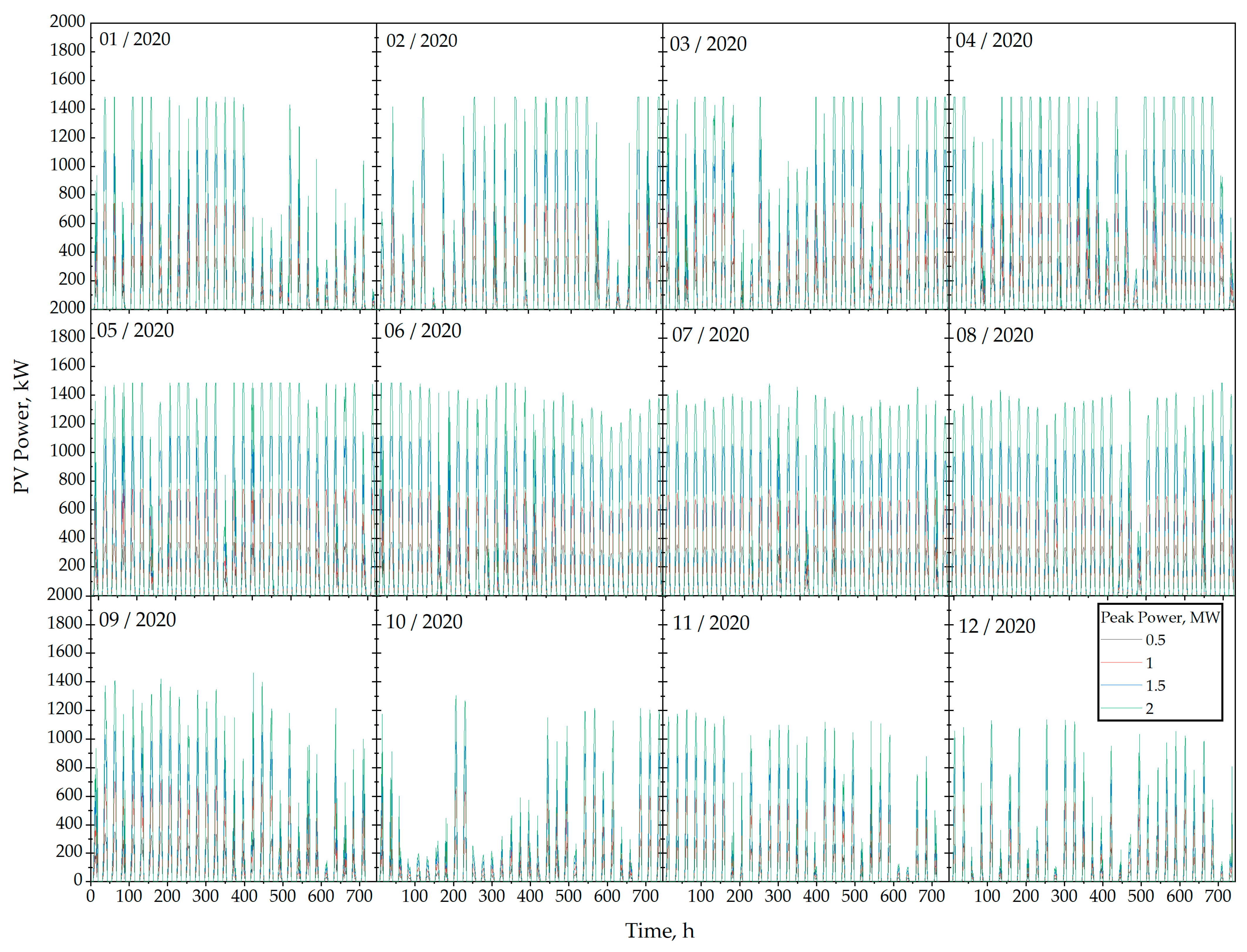
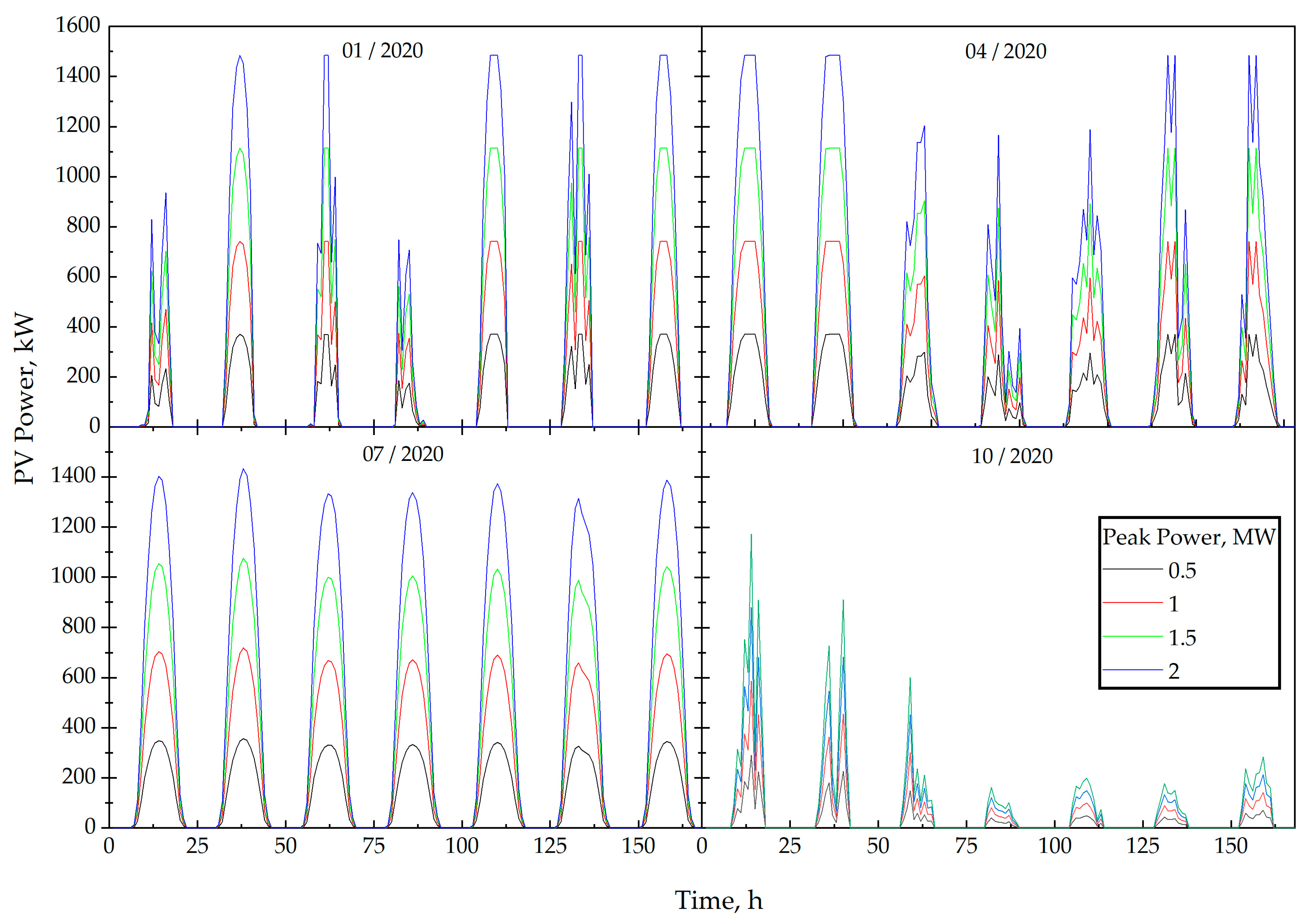
Figure 2 presents the hourly PV power output for the four simulated PV capacities (500, 1000, 1500, and 2000 kWp) using TMY irradiance data for the site. The simulation step is 1 h, based on PVGIS meteorological inputs. As expected, PV generation exhibits a clear seasonal pattern, with higher outputs during the summer months due to increased irradiance levels and reduced cloud cover.
Figure 3 further illustrates this behavior by depicting the first week of four representative months (January, April, July, and October). The difference between the scenarios becomes more pronounced during periods of high irradiance, where larger PV plants reach their nominal peak values, especially in July.
Table 4 summarizes the monthly energy yield for each PV capacity. The seasonal distribution aligns with typical Mediterranean climatic conditions: energy production is lower in winter (4–6% of annual yield per month) and significantly higher from May to September (10–11%). This seasonal trend also reflects the influence of module operating temperature, which approaches the optimal range (≈25 °C) during late spring and early autumn.

4.2. Impact of Factory-Connected Photovoltaics on the Consumption Profile

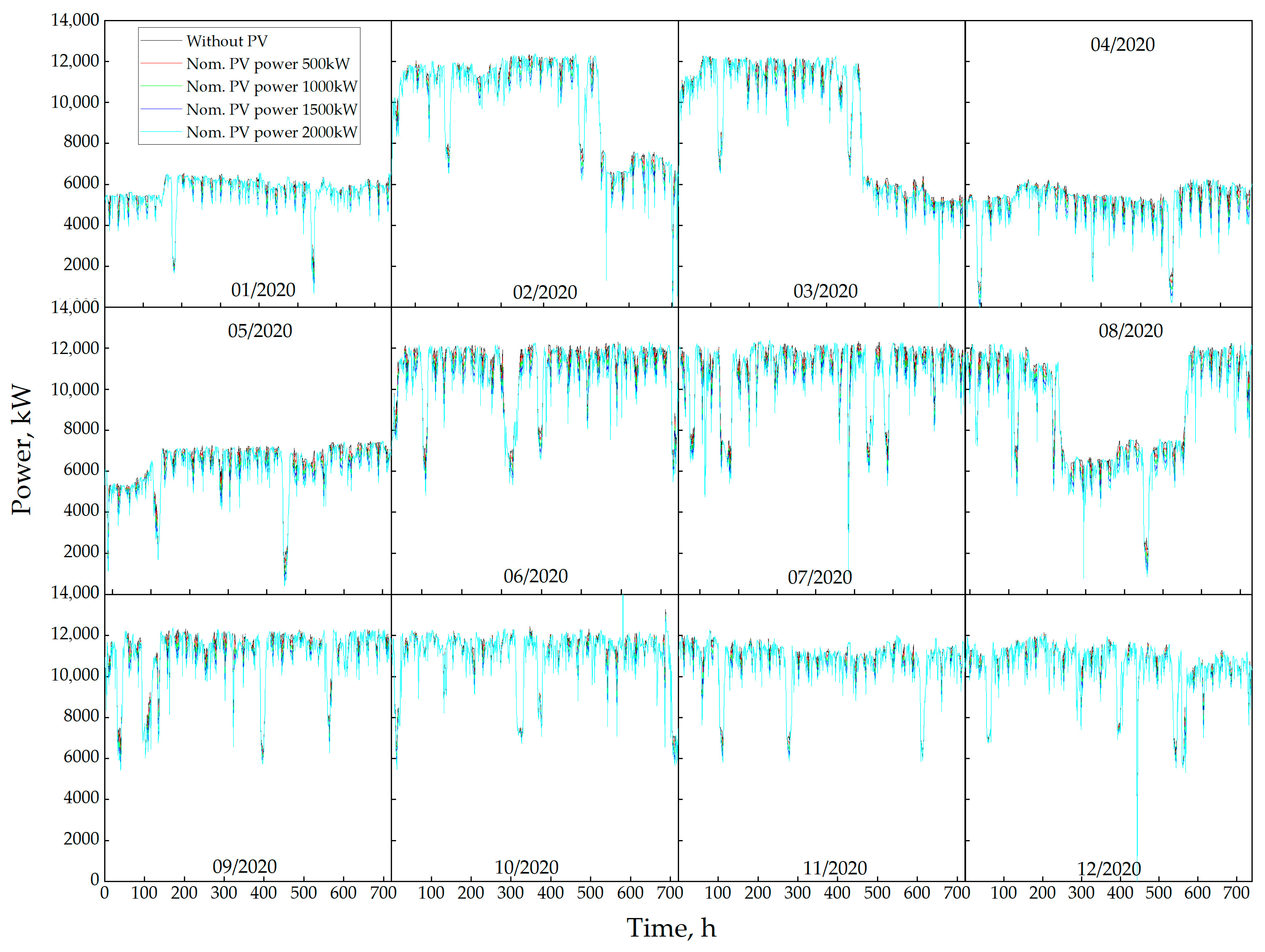
The direct integration of PV production into the factory’s electrical network modifies the facility’s net load profile, as shown in Figure 4. Since this study assumes a zero feed-in configuration, the entire PV output is self-consumed by the factory. Consequently, the PV contribution always remains lower than the factory’s instantaneous demand, ensuring full absorption of the generated energy throughout the year.
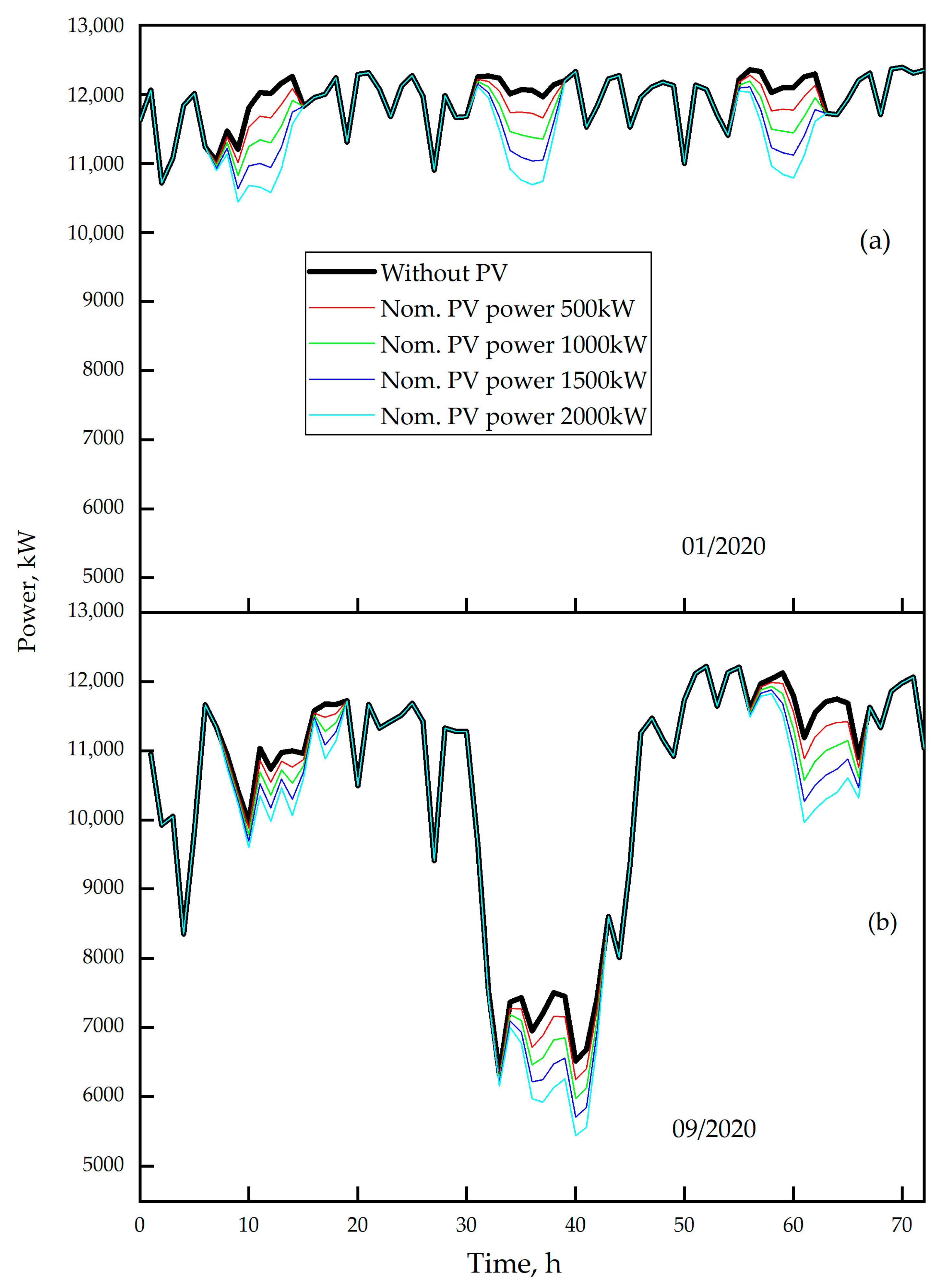
Figure 5 provides a detailed view of the interaction between PV generation and factory demand for selected winter and summer days. During daylight hours, PV reduces the factory’s net load, with the magnitude of the reduction depending on the installed capacity and solar availability. At night, the consumption profile remains unchanged across all scenarios, as expected.
Figure 5 illustrates the simultaneous evolution of the industrial electricity demand and the PV generation profile over a representative period, plotted on a common time axis. This joint visualization enables direct assessment of load–PV coincidence under strict zero feed-in operation.
The most notable effect occurs during peak demand periods (11:00–14:00), where PV generation significantly reduces the required grid power. This reduction directly impacts the following:
  • Peak power charges (lower kVA billing).
  • Total purchased energy (kWh reduction).
  • Transmission and distribution charges.
  • Air-pollutant fees and taxes.
Table 5 quantifies these benefits by comparing monthly peak power and energy consumption values before and after PV integration. Across all months, both peak demand and total energy purchased decrease proportionally to the PV capacity installed. Even with the smallest system (500 kWp), measurable reductions are observed.

4.3. Annual Energy Savings Analysis

The direct integration of PV [65,66,67] into the facility’s electrical system reduced annual grid electricity purchases across all scenarios (Table 6). The total annual energy savings relative to the no-PV baseline are depicted in Table 6.

4.4. Seasonal Performance

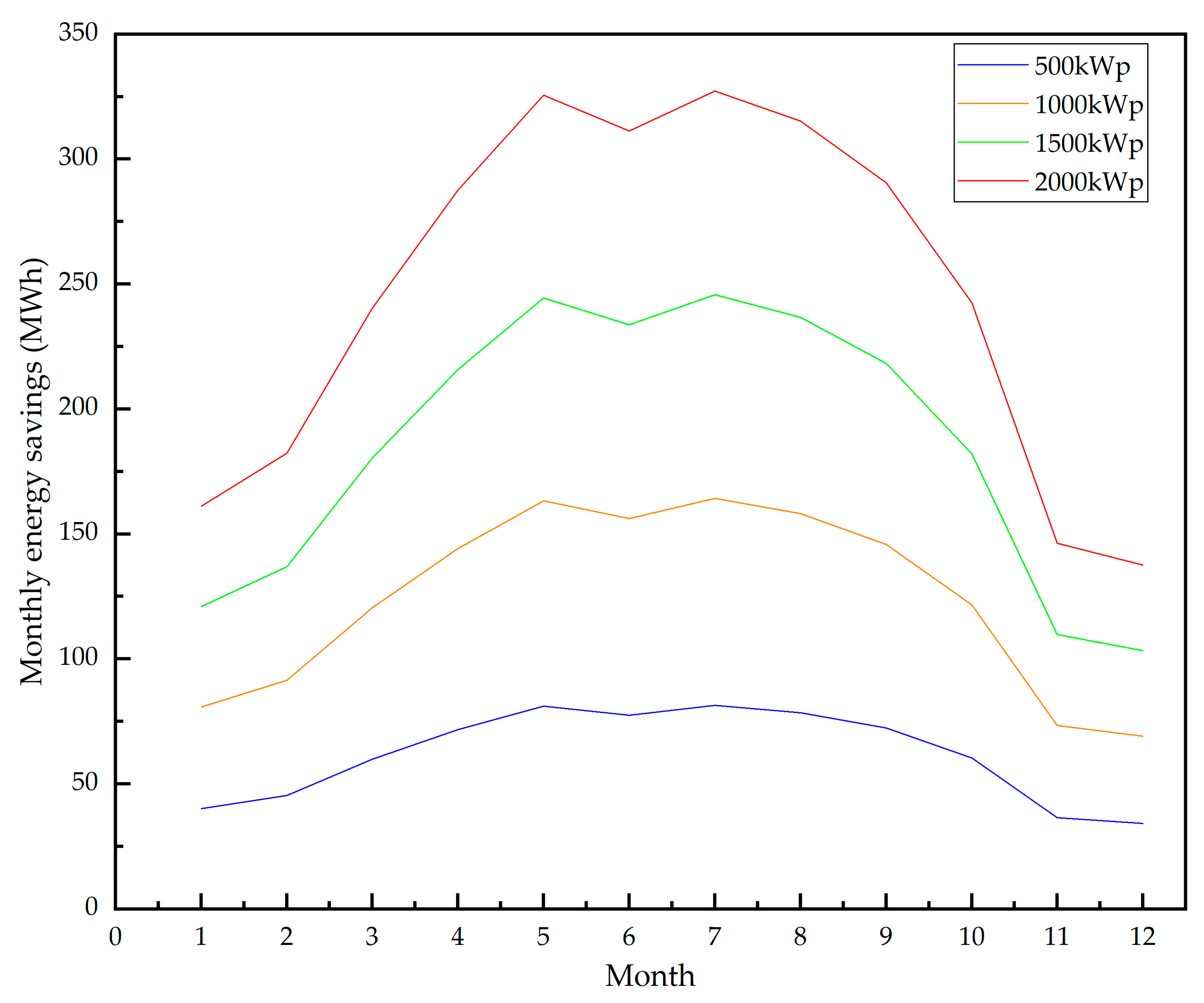
To assess seasonal patterns, monthly savings were calculated as the difference between baseline grid consumption and post-PV consumption. Figure 6 shows that savings are highest during the summer months (June–August), when solar resource availability peaks.
The PV generation profiles in Figure 6, derived from Table 6, confirm this seasonal behavior and illustrate how output scales with installed capacity.

4.5. Relationship Between PV Generation and Savings

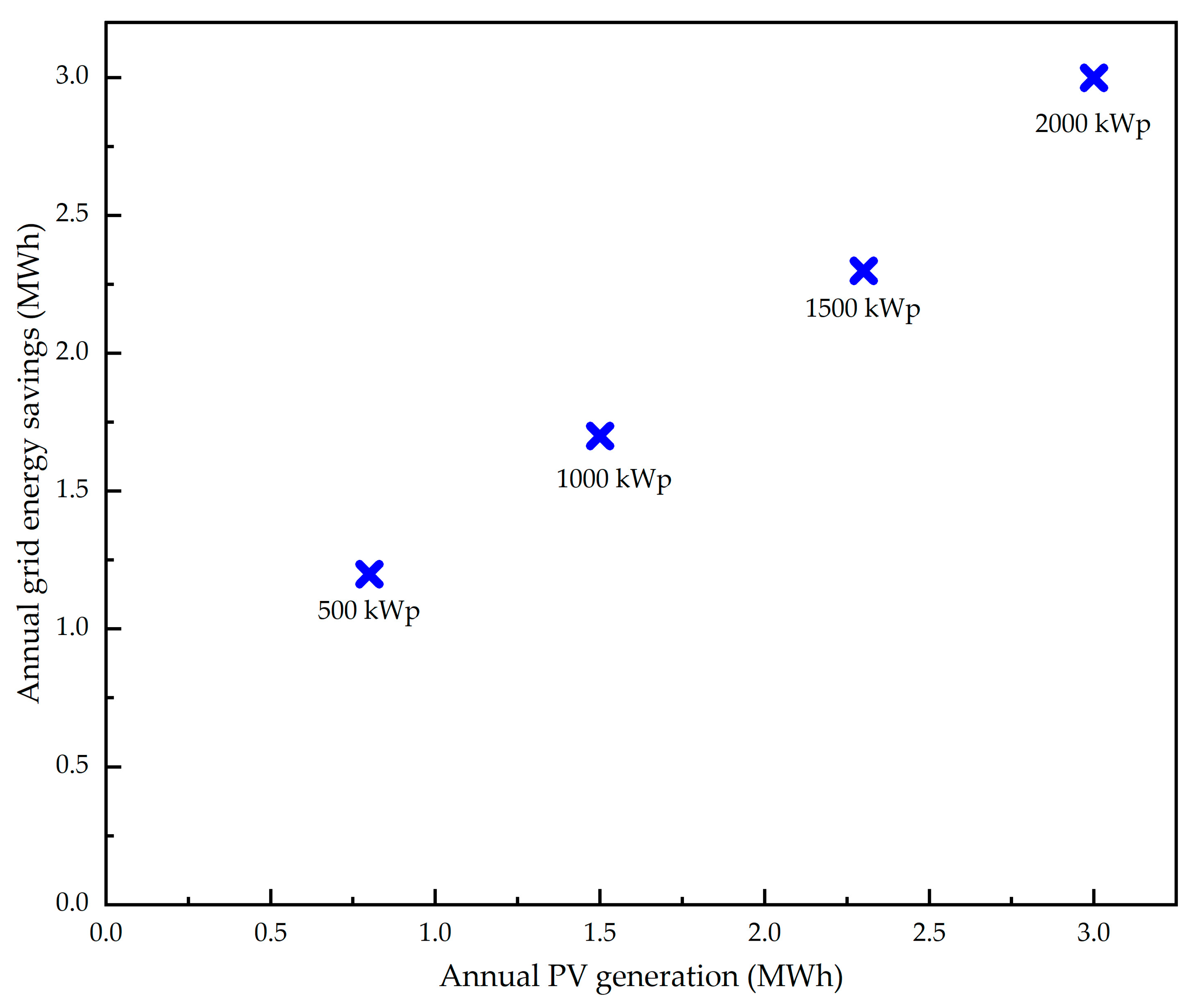
The strong correlation between annual PV generation and annual grid savings is depicted in Figure 7. The slope is close to unity, indicating that nearly all PV energy is self-consumed in each scenario, consistent with the facility’s high daytime demand.

4.6. Relative Contribution to Energy Needs

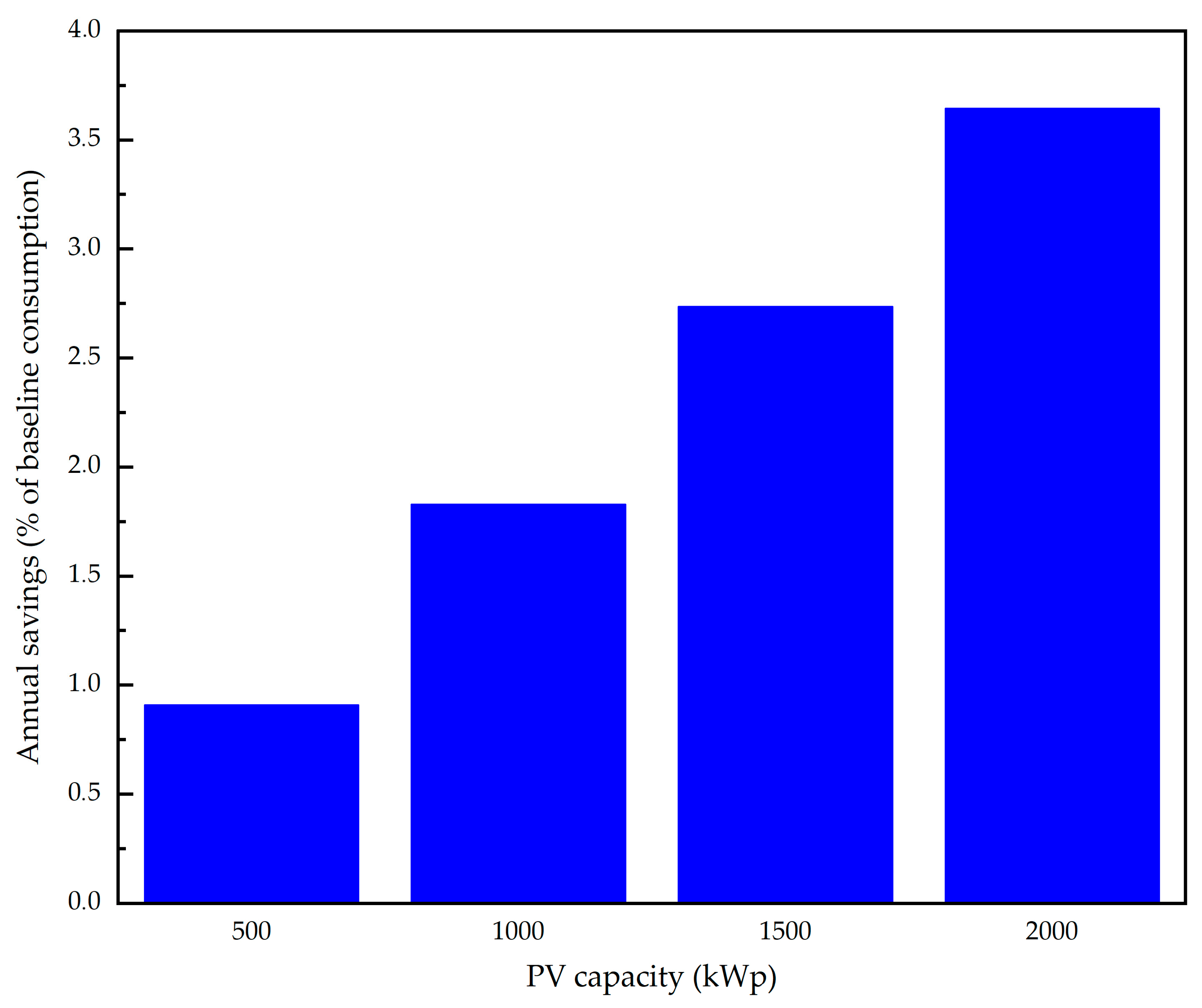
The percentage of baseline electricity consumption offset by PV is shown in Figure 8. Even at 2000 kWp, the PV system offsets less than 3% of the annual facility demand, reflecting the plant’s large and continuous load profile.

4.7. Cost Analysis Under Zero Feed-In Operation

This section examines the economic performance of the four PV sizing scenarios (500, 1000, 1500 and 2000 kWp) under zero feed-in operation, where all produced PV energy is directly consumed by the industrial facility. The financial benefit stems exclusively from avoided grid electricity purchases, and not from selling energy to the utility network.

4.7.1. Impact of Electricity Price Levels

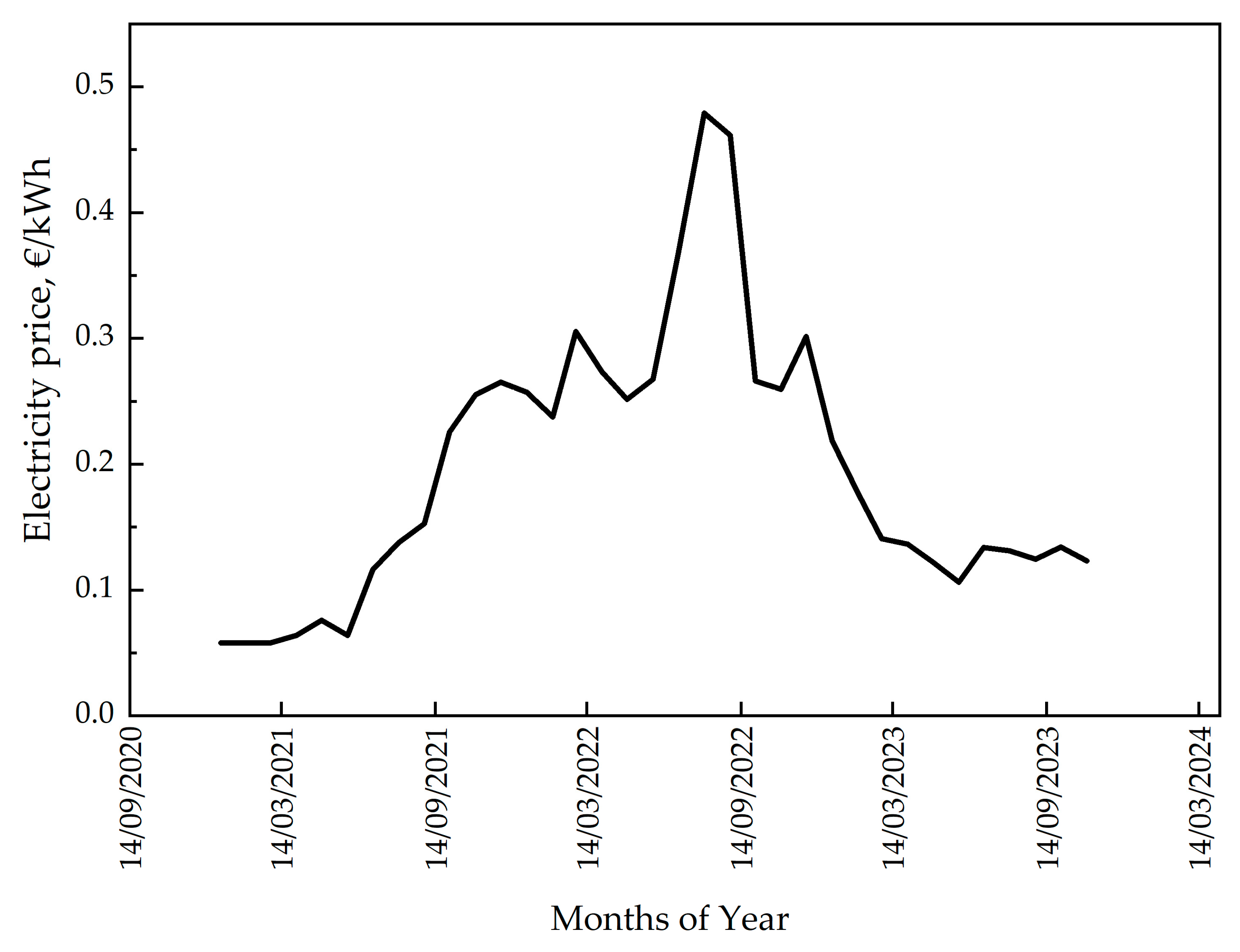
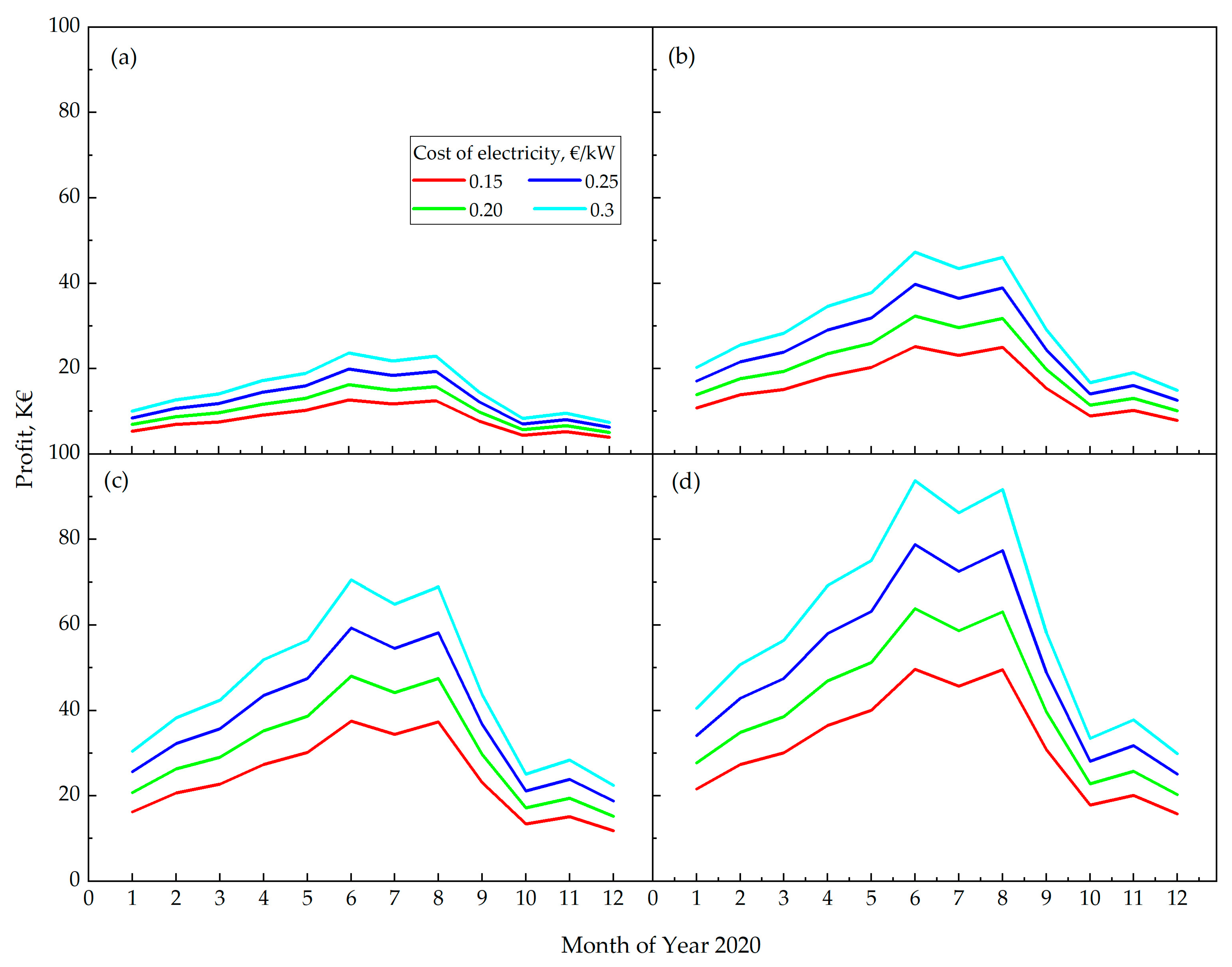
Because the financial benefit of zero feed-in PV operation depends strongly on the grid purchase price, this analysis considers several representative electricity price scenarios (0.15–0.30 EUR/kWh). These values reflect the most frequently observed price range during the 2020–2024 period, shown in Figure 9.
Although the economic analysis is based on deterministic electricity price scenarios, the selected price range (0.15–0.30 EUR/kWh) implicitly captures the impact of recent price volatility observed in the Greek and European electricity markets. As illustrated in Figure 9, industrial electricity prices exhibited pronounced fluctuations during the 2021–2023 period, driven by fuel price volatility, geopolitical instability, and wholesale market dynamics.
The sensitivity of economic outcomes to electricity price levels is explicitly analyzed in this study, demonstrating that Net Present Value (NPV) and annual savings scale monotonically with the assumed tariff. This behavior indicates that the main conclusions regarding the economic viability of zero feed-in PV systems remain robust across a wide range of plausible price conditions.
While stochastic price modeling or probabilistic scenarios could provide additional insight into short-term volatility effects, such approaches are beyond the scope of the present study and are identified as a promising direction for future research.
Higher electricity prices amplify the benefit of PV generation. For all PV capacities, profits scale approximately linearly with the electricity price, with the 2000 kWp system delivering the highest monthly and annual cost reductions.
The sharp increase observed in 2022 is mainly attributed to the European energy crisis, driven by natural gas price volatility, reduced supply following the Russia–Ukraine conflict, and increased wholesale electricity market prices. As shown in Figure 9, electricity prices experienced an unprecedented increase in 2022, primarily due to the European energy crisis, which was driven by the surge in natural gas prices, geopolitical instability, and reduced energy supply. This period provides a realistic and policy-relevant context for evaluating the economic robustness of zero feed-in PV investments.

4.7.2. Annual Profitability Trends

Figure 10 summarizes the annual profit across all scenarios and price assumptions in four subfigures (a)–(d). At 0.15 EUR/kWh, the annual savings remain modest, whereas prices at or above 0.20–0.25 EUR/kWh lead to substantial financial benefits. This behavior is consistent with empirical industrial electricity price indices, which showed a sharp rise during 2021–2023, significantly improving the economic attractiveness of onsite PV systems.

4.7.3. Interpretation Within the Zero Feed-In Framework

The economic evaluation highlights several important characteristics of zero feed-in operation:
  • Profit is driven entirely by self-consumption, not export revenue.
  • Higher PV capacities are always more profitable, provided the facility load is sufficiently high to absorb all PV production.
  • Electricity price volatility is a dominant factor in determining economic performance.
  • No regulatory, tariff-based, or market remuneration mechanisms are involved, simplifying the economic assessment relative to grid-export systems.
  • Under strict zero feed-in operation, PV curtailment may occur whenever instantaneous PV generation exceeds the facility’s electricity demand. In the examined industrial facility, such events are inherently limited due to the large and continuous load profile. Curtailment is observed only during short periods of low industrial activity coinciding with high solar irradiance, mainly in spring and summer months. Even for the largest PV capacity (2000 kWp), the energy curtailed represents a negligible fraction of annual PV production, confirming that system performance is primarily governed by load–PV coincidence rather than export limitations.
In addition to economic and operational considerations, the practical implementation of large-scale rooftop PV systems is subject to physical and technical constraints. The examined PV capacities (up to 2000 kWp) are representative of large industrial facilities with extended roof surfaces, such as insulation materials manufacturing plants, warehouses, and heavy industrial buildings.
Available rooftop area constitutes a primary constraint, as larger PV capacities require sufficient unobstructed surface and appropriate structural characteristics. In practice, PV sizing must account for roof geometry, shading conditions, and allowable mechanical loads. The selected capacity range reflects realistic upper bounds for industrial rooftops of comparable scale.
Inverter sizing and DC/AC ratio also play a critical role in system design. The adopted DC/AC ratio of 1.1 represents a common industrial practice that balances inverter utilization and clipping losses, while ensuring compliance with zero feed-in control requirements. More aggressive oversizing strategies could increase curtailment under strict non-export operation and are therefore not pursued in this study.
Finally, grid interconnection constraints may limit the maximum admissible installed capacity, even under zero feed-in conditions. Although no exports are allowed, distribution system operators typically impose technical limits related to protection settings, short-circuit levels, and connection agreements. These constraints further justify the consideration of PV capacities up to 2000 kWp as realistic and policy-relevant upper bounds rather than theoretical maxima.
Overall, while site-specific engineering assessments are required for final system deployment, the examined capacity range and design assumptions reflect practical and transferable conditions for large industrial rooftop PV installations operating under strict zero feed-in regimes.

4.7.4. Summary

The results indicate that industrial PV systems operating under zero feed-in conditions can deliver significant and stable economic benefits, especially during periods of elevated electricity prices. Larger installations consistently outperform smaller ones due to the high and continuous nature of the facility’s load, which ensures that nearly all PV energy is self-consumed.

4.8. Sensitivity Analysis of Net Present Value (NPV) with Respect to Discount Rate

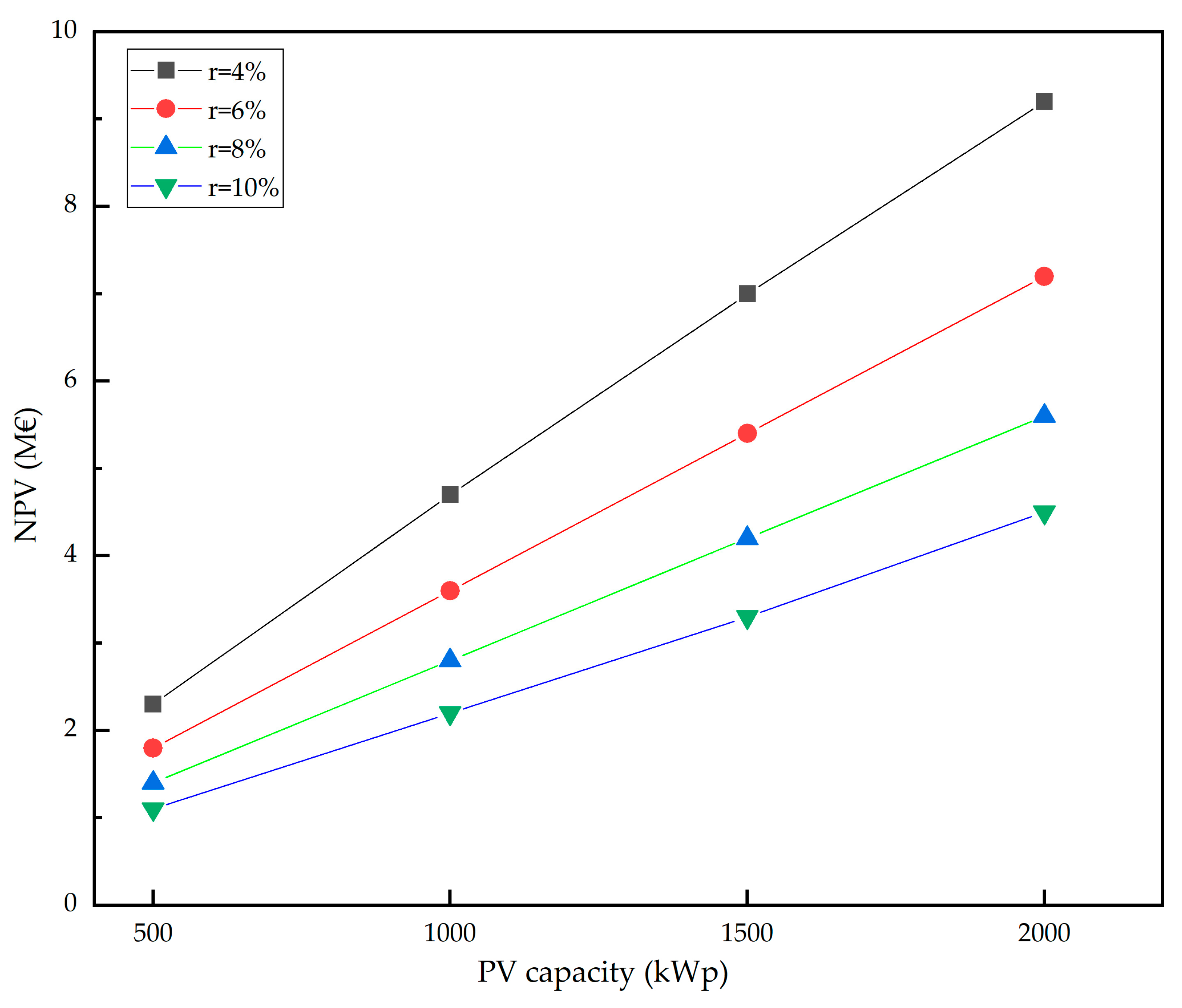
To further assess the robustness of the economic performance of the examined PV sizing scenarios, a sensitivity analysis was carried out by varying the real discount rate r between 4%, 6%, 8%, and 10%. Figure 11 presents the resulting Net Present Value (NPV) for all four PV capacities (500, 1000, 1500, and 2000 kWp), illustrating how changes in the discount rate affect the long-term economic attractiveness of the investment.
These results demonstrate a strong and nearly linear relationship between PV system size and NPV across all discount rate assumptions. Larger PV plants consistently exhibit higher NPVs due to the proportional increase in self-consumed PV energy and annual monetary savings. At the same time, as the discount rate increases, the present value of future savings decreases, lowering the NPV curves for all sizing options.
Despite this expected downward shift, all PV capacities maintain positive NPV values, even under the most conservative assumption of r = 10 % . This finding confirms that the zero feed-in industrial PV investment remains economically viable under a wide range of financial conditions, highlighting its resilience to capital cost uncertainty and macroeconomic fluctuations. Moreover, the divergence between the NPV curves becomes more pronounced at larger system sizes, indicating that higher-capacity PV installations benefit more strongly from low to moderate discount rates.
Overall, this sensitivity analysis reinforces the conclusion that zero feed-in PV deployment in energy-intensive industries is a financially robust strategy, especially in environments where electricity purchase prices remain elevated or exhibit high volatility.

5. Conclusions

This study investigated the technical and economic feasibility of industrial-scale photovoltaic (PV) systems operating under a strict zero feed-in configuration, using real demand data from an insulation materials manufacturing facility in Greece. Four PV capacities (500–2000 kWp) were evaluated using Typical Meteorological Year (TMY) data and detailed performance modeling, combined with high-resolution (15 min) measured load data and tariff-consistent economic assessment.
The results demonstrate that, due to the high and continuous nature of the industrial load, all examined PV systems achieve full self-consumption without exports, fully complying with the zero feed-in regulatory requirement. Annual PV generation ranges from 739 MWh to 2.97 GWh, corresponding to a 1.0–2.8% coverage of the facility’s total electricity demand. Despite this relatively modest share, the resulting reduction in imported grid energy (40–160 MWh/year) leads to measurable cost savings, particularly through avoided energy charges and demand-related components.
The techno-economic analysis confirms that zero feed-in PV installations become economically viable for industrial consumers when electricity tariffs exceed approximately EUR 0.15/kWh. All examined PV capacities achieve positive Net Present Value (NPV) under current price conditions, with larger systems yielding proportionally higher absolute savings. The sensitivity analysis further shows that the investment remains robust across a wide range of discount rate assumptions, highlighting the resilience of industrial self-consumption PV under volatile energy-price environments.
From a power-system perspective, zero feed-in operation eliminates reverse power flow and mitigates distribution network congestion, enabling PV deployment even in areas with limited hosting capacity. This makes the zero feed-in framework a practical and grid-compatible pathway for industrial decarbonization.
Several limitations of the present study should be acknowledged. First, the analysis focuses on a single industrial facility and assumes nominal equipment availability and deterministic operating conditions. While this approach ensures transparency and reproducibility, real-world factors such as component outages, control failures, or operational disturbances may affect annual energy yield and economic performance. Second, the assessment does not include energy storage, demand-side flexibility, or stochastic price evolution, which could further enhance PV utilization and system value.
Future research should extend the proposed framework to multiple industrial sites and climatic regions, incorporate stochastic modeling of equipment availability and failures, and evaluate the integration of battery energy storage and flexible load management. Additional work may also examine long-term policy impacts and the effects of dynamic tariff structures on industrial zero feed-in PV deployment. Overall, the findings confirm that zero feed-in photovoltaic systems represent a reliable, scalable, and economically attractive solution for energy-intensive industries seeking to reduce electricity costs and emissions under constrained grid conditions.

Author Contributions

Conceptualization, N.P. and S.K.; methodology, N.P. and C.E.; validation, N.P., S.K. and I.E.K.; formal analysis, N.P., S.K. and I.E.K.; investigation, N.P. and C.E.; resources, N.P.; data curation, N.P.; writing—original draft preparation, N.P. and S.K.; writing—review and editing, N.P., S.K., C.E. and I.E.K.; visualization, N.P. and S.K.; supervision, C.E. All authors have read and agreed to the published version of the manuscript.

Funding

This research received no external funding.

Data Availability Statement

The data presented in this study is available at reasonable request from the corresponding authors. The data is not publicly available due to confidentiality and privacy restrictions.

Conflicts of Interest

Author Stefanos Keskinis was employed by Department of Maintenance at Thermal Power Plant, Power Public Corporation S.A. The remaining authors declare that the research was conducted in the absence of any commercial or financial relationships that could be construed as a potential conflict of interest.

Abbreviations

The following abbreviations are used in this manuscript:
PVPhotovoltaic
TMYTypical Meteorological Year
NPVNet Present Value
LCOELevelized Cost of Energy
HEDNOHellenic Electricity Distribution Network Operator
LVLow Voltage
MVMedium Voltage
HVHigh Voltage
PVGISPhotovoltaic Geographical Information System
SAMSystem Advisor Model
NRELNational Renewable Energy Laboratory
PRPerformance Ratio
POAPlane-of-Array
DCDirect Current
ACAlternating Current
DEPDaily Energy Planning
RESRenewable Energy Sources
DCFDiscounted Cash-Flow
SPBSimple Payback Period
CAPEXCapital Expenditure
CFCash Flow

Appendix A

Figure A1. Representative views of the facility territory considered in this study in Serres, Greece.
Solar 06 00012 g0a1

Appendix B

Figure A2. Monthly average global horizontal irradiance (GHI) based on PVGIS Typical Meteorological Year (TMY) data for the Serres region, Greece.
Solar 06 00012 g0a2
Figure A3. Monthly average ambient temperature (TMY).
Solar 06 00012 g0a3

References

  1. Al-Rasheedi, M.; Gueymard, C.A.; Al-Khayat, M.; Ismail, A.; Lee, J.A.; Al-Duaj, H. Performance evaluation of a utility-scale dual-technology photovoltaic power plant at the Shagaya Renewable Energy Park in Kuwait. Renew. Sustain. Energy Rev. 2020, 133, 110139. [Google Scholar] [CrossRef]
  2. Abdullah, G.; Nishimura, H. Techno-Economic Performance Analysis of a 40.1 kWp Grid-Connected Photovoltaic (GCPV) System after Eight Years of Energy Generation: A Case Study for Tochigi, Japan. Sustainability 2021, 13, 7680. [Google Scholar] [CrossRef]
  3. Miserocchi, L.; Franco, A. Techno-Economic Assessment of Electrification and Hydrogen Pathways for Optimal Solar Integration in the Glass Industry. Solar 2025, 5, 35. [Google Scholar] [CrossRef]
  4. Lombardi, P.A. Technical and Economic Approaches to Design Net-Zero Energy Factories: A Case Study of a German Carpentry Factory. Sustainability 2025, 17, 7891. [Google Scholar] [CrossRef]
  5. Tu, R.; Guo, Z.; Liu, L.; Wang, S.; Yang, X. Reviews of Photovoltaic and Energy Storage Systems in Buildings for Sustainable Power Generation and Utilization from Perspectives of System Integration and Optimization. Energies 2025, 18, 2683. [Google Scholar] [CrossRef]
  6. Fernández Bandera, C.; Bastos Porsani, G.; Fernández-Vigil Iglesias, M. A demand side management approach to increase self-consumption in buildings. Build. Simul. 2023, 16, 317–335. [Google Scholar] [CrossRef]
  7. Chatzistylianos, E.S.; Psarros, G.N.; Papathanassiou, S.A. Export Constraints Applicable to Renewable Generation to Enhance Grid Hosting Capacity. Energies 2024, 17, 2588. [Google Scholar] [CrossRef]
  8. Garabitos Lara, E.; Vallejo Díaz, A. Sizing of Photovoltaic Systems for Self-Consumption without Surpluses through On-Site Measurements: Case Study of the Dominican Republic. Renew. Energy 2024, 236, 121422. [Google Scholar] [CrossRef]
  9. Meteocontrol GmbH. Zero Feed-In Solutions for PV Systems: Technical Description and Operational Principles. Available online: https://www.meteocontrol.com/en/scada-plant-control/solutions/zero-feed-in (accessed on 25 November 2025).
  10. Clou Global. Zero Feed-In vs. Net Metering: Understanding the Operational and Regulatory Differences. Available online: https://clouglobal.com/zero-feed-in-vs-net-metering-understanding-the-differences (accessed on 25 November 2025).
  11. Hellenic Electricity Distribution Network Operator (HEDNO). Zero Feed-In Requirements for PV Self-Producers and Virtual Net-Metering Schemes. Available online: https://deddie.gr (accessed on 25 November 2025).
  12. Pitt, J.; Nolden, C. Post-Subsidy Solar PV Business Models to Tackle Fuel Poverty in Multi-Occupancy Social Housing. Energies 2020, 13, 4852. [Google Scholar] [CrossRef]
  13. Martínez-Calahorro, A.J.; Jiménez-Castillo, G.; Rus-Casas, C.; Gómez-Vidal, P.; Muñoz-Rodríguez, F.J. Photovoltaic Self-Consumption in Industrial Cooling and Refrigeration. Electronics 2020, 9, 2204. [Google Scholar] [CrossRef]
  14. Talavera, D.L.; Muñoz-Rodriguez, F.J.; Jimenez-Castillo, G.; Rus-Casas, C. A New Approach to Sizing the Photovoltaic Generator in Self-Consumption Systems Based on Cost–Competitiveness, Maximizing Direct Self-Consumption. Renew. Energy 2019, 130, 1021–1035. [Google Scholar] [CrossRef]
  15. Alqahtani, N.; Balta-Ozkan, N. Assessment of Rooftop Solar Power Generation to Meet Residential Loads in the City of Neom, Saudi Arabia. Energies 2021, 14, 3805. [Google Scholar] [CrossRef]
  16. Nematirad, R.; Pahwa, A.; Natarajan, B. A Novel Statistical Framework for Optimal Sizing of Grid-Connected Photovoltaic–Battery Systems for Peak Demand Reduction to Flatten Daily Load Profiles. Solar 2024, 4, 179–208. [Google Scholar] [CrossRef]
  17. Al Khafaf, N.; Rezaei, A.A.; Moradi Amani, A.; Jalili, M.; McGrath, B.; Meegahapola, L.; Vahidnia, A. Impact of Battery Storage on Residential Energy Consumption: An Australian Case Study Based on Smart Meter Data. Renew. Energy 2022, 182, 390–400. [Google Scholar] [CrossRef]
  18. Kim, H.; Jeong, S.; Kim, J.; Kim, J. Analysis of load matching and grid interaction of a zero energy building. J. Korean Sol. Energy Soc. 2022, 42, 33–45. [Google Scholar] [CrossRef]
  19. Sánchez-Jiménez, J.L.; Muñoz-Rodríguez, F.J.; Jiménez-Castillo, G.; Martinez-Calahorro, A.J.; Rus-Casas, C. Analysis of Different Scenarios to Include PV Rooftop Systems with Battery Energy Storage Systems in Olive Mills. Energies 2024, 17, 144. [Google Scholar] [CrossRef]
  20. Vidal, H.; Rivera, M.; Wheeler, P.; Vicencio, N. The Analysis Performance of a Grid-Connected 8.2 KWp Photovoltaic System in the Patagonia Region. Sustainability 2020, 12, 9227. [Google Scholar] [CrossRef]
  21. Serrano Guardiola, D. Photovoltaic Installation Project for Self-Consumption on Industrial Roof. Master’s Thesis, Universitat Politècnica de València, Valencia, Spain, 2022. [Google Scholar]
  22. Fleschutz, M.; Bohlayer, M.; Braun, M.; Murphy, M.D. From Prosumer to Flexumer: Case Study on the Value of Flexibility in Decarbonizing the Multi-Energy System of a Manufacturing Company. Appl. Energy 2023, 347, 121430. [Google Scholar] [CrossRef]
  23. Miranda, M.T.; Sepúlveda, F.J.; Fernández, A.; Arranz, J.I.; Montero, I. Analysis of Photovoltaic Self-Consumption as a Function of the Demand Profile in Detached Houses. Energy Build. 2024, 316, 114375. [Google Scholar] [CrossRef]
  24. Milenov, V.; Zarkov, Z. Modeling of Photovoltaic Systems for Self-Consumption. In Proceedings of the 15th Electrical Engineering Faculty Conference (BulEF), Varna, Bulgaria, 16–19 September 2023; pp. 1–6. [Google Scholar] [CrossRef]
  25. Šriupša, L.; Vaitkūnas, M.; Baronas, A.; Dosinas, J. Analysis of Self-Generated PV Energy Consumption Profiles in Prosumers Microgrid. Int. J. Sustain. Energy 2023, 42, 1583–1602. [Google Scholar] [CrossRef]
  26. Kim, D.; Jang, Y.; Choi, Y. Improved Metrics for Evaluating Self-Consumption and Self-Sufficiency Rates in ESS-Integrated Renewable Energy Systems. Renew. Energy 2025, 247, 123059. [Google Scholar] [CrossRef]
  27. Babaei, A.; Nasr Esfahani, A. A Review of Photovoltaic Waste Management from a Sustainable Perspective. Electricity 2024, 5, 734–750. [Google Scholar] [CrossRef]
  28. Hughes, K.M.; Phillips, C.C. A Quantitative Analysis of the Need for High Conversion Efficiency PV Technologies in Carbon Mitigation Strategies. Solar 2024, 4, 209–221. [Google Scholar] [CrossRef]
  29. Roodneshin, M.; Alcojor, A.M.; Masseck, T. Spatial Strategies for the Renewable Energy Transition: Integrating Solar Photovoltaics into Barcelona’s Urban Morphology. Solar 2025, 5, 34. [Google Scholar] [CrossRef]
  30. Murat Ates, A.; Singh, H. Rooftop Solar Photovoltaic (PV) Plant–One Year Measured Performance and Simulations. J. King Saud Univ. Sci. 2021, 33, 101361. [Google Scholar] [CrossRef]
  31. Bibiloni-Mulet, P.A.; Moià-Pol, A.; Vidal-Noguera, J.; Alonso, I.; Martínez-Moll, V.; Díaz Torres, Y.; Canals, V.; Mas, B.; Mulet-Forteza, C. Zero Emissions Analysis for a Hybrid System with Photovoltaic and Thermal Energy in the Balearic Islands University. Solar 2025, 5, 31. [Google Scholar] [CrossRef]
  32. Peña-Becerra, C.A.; Pacheco-Cano, W.A.; Aragones-Vargas, D.F.; Irizarry-Rivera, A.; Castro-Sitiriche, M. Barrio-Level Assessment of Solar Rooftop Energy and Initial Insights into Energy Inequalities in Puerto Rico. Solar 2025, 5, 28. [Google Scholar] [CrossRef]
  33. Sørensen, R.; Mihet-Popa, L. Comparative Evaluation of Traditional and Advanced Algorithms for Photovoltaic Systems in Partial Shading Conditions. Solar 2024, 4, 572–594. [Google Scholar] [CrossRef]
  34. Maghalseh, M.; Iqteit, N.; Alqadi, H.; Ajib, S. Investigation of Grid-Tied Photovoltaic Power Plant on Medium-Voltage Feeder: Palestine Polytechnic University Case Study. Solar 2025, 5, 1. [Google Scholar] [CrossRef]
  35. Sekyere, C.K.; Davis, F.; Opoku, R.; Otoo, E.; Takyi, G.; Atepor, L. Performance evaluation of a 20 MW grid-coupled solar park located in the southern oceanic environment of Ghana. Clean. Eng. Technol. 2021, 5, 100273. [Google Scholar] [CrossRef]
  36. Pedrero, J.; Hernández, P.; Martínez, Á. Economic Evaluation of PV Installations for Self-Consumption in Industrial Parks. Energies 2021, 14, 728. [Google Scholar] [CrossRef]
  37. Ciocia, A.; Amato, A.; Di Leo, P.; Fichera, S.; Malgaroli, G.; Spertino, F.; Tzanova, S. Self-Consumption and Self-Sufficiency in Photovoltaic Systems: Effect of Grid Limitation and Storage Installation. Energies 2021, 14, 1591. [Google Scholar] [CrossRef]
  38. Christopoulos, K.; Stefanidi, I.; Kavadias, K.; Zafirakis, D. Self-Consumption and Market Integration Balance Analysis for RES–Battery Electricity Prosumers in Greece. Environ. Sci. Proc. 2023, 26, 182. [Google Scholar] [CrossRef]
  39. Keskinis, S.; Elmasides, C.; Kosmadakis, I.E.; Raptis, I.; Tsikalakis, A. Techno-Economic Photovoltaic-Battery Energy Storage System Microgrids with Diesel Backup Generator: A Case Study in Industrial Loads in Germany Comparing Load-Following and Cycle-Charging Control. Energies 2025, 18, 6463. [Google Scholar] [CrossRef]
  40. Sánchez-Jiménez, J.L.; Jiménez-Castillo, G.; Rus-Casas, C.; Martínez-Calahorro, A.J.; Muñoz-Rodriguez, F.J. Performance Evaluation of Photovoltaic Self-Consumption Systems on Industrial Rooftops under Continental Mediterranean Climate Conditions with Multi-String Inverter Topology. Energy Rep. 2025, 14, 1020–1042. [Google Scholar] [CrossRef]
  41. Gusmedi, H.; Zebua, O.; Khairan, A.G.; Samosir, A.S. Maximizing Self-Consumption in Industrial Hybrid PV Systems: A Case Study on Indonesia’s Energy Policies. Nanotechnol. Percept. 2024, 20, 36–49. [Google Scholar] [CrossRef]
  42. Kosmadakis, I.E.; Elmasides, C.; Koulinas, G.; Tsagarakis, K.P. Energy Unit Cost Assessment of Six Photovoltaic-Battery Configurations. Renew. Energy 2021, 173, 24–41. [Google Scholar] [CrossRef]
  43. Meo, N. Self-Consumption Photovoltaic Plant: Project Verdeto 127.68 kWp. Master’s Thesis, Politecnico di Milano, Milan, Italy, 2023. Available online: https://hdl.handle.net/10589/205916 (accessed on 25 November 2025).
  44. Parhamfar, M.; Zabihi, A. Comprehensive design of a 100-kilowatt solar power plant with bifacial technology in PVsyst for Arak, Iran. Sol. Energy Adv. 2025, 5, 100092. [Google Scholar] [CrossRef]
  45. Gilman, P.; Dobos, A.; DiOrio, N.; Freeman, J.; Janzou, S.; Ryberg, D. System Advisor Model (SAM) Photovoltaic Model Technical Reference Update; National Renewable Energy Laboratory: Golden, CO, USA, 2018. [Google Scholar]
  46. Photovoltaic Geographical Information System. Available online: https://re.jrc.ec.europa.eu/pvg_tools/en/tools.html (accessed on 25 November 2025).
  47. System Advisor Model; Version 2017.9.5 (SAM 2017.9.5); National Renewable Energy Laboratory: Golden, CO, USA, 2017. Available online: https://sam.nrel.gov/download (accessed on 25 November 2025).
  48. Al Mahdi, H.; Leahy, P.G.; Alghoul, M.; Morrison, A.P. A Review of Photovoltaic Module Failure and Degradation Mecha-nisms: Causes and Detection Techniques. Solar 2024, 4, 43–82. [Google Scholar] [CrossRef]
  49. Ciambellini, G.; D’Adamo, I.; Gastaldi, M.; Smol, M. Sustainability and competitiveness: Economic analysis of a photovoltaic plant with storage in an Italian textile company. Innov. Green Dev. 2025, 4, 100209. [Google Scholar] [CrossRef]
  50. Yakubu, R.O.; Ijeoma, M.W.; Yusuf, H.; Abdulazeez, A.A.; Acheampong, P.; Carbajales-Dale, M. Performance Analysis of a 50 MW Solar PV Installation at BUI Power Authority: A Comparative Study between Sunny and Overcast Days. Electricity 2024, 5, 546–561. [Google Scholar] [CrossRef]
  51. Ewart, M.; Santos, J.; Pacheco, A.; Monteiro, J.; Sequeira, C. On a new method to design solar photovoltaic systems in renewable energy communities: The case of Culatra Island (Ria Formosa, Portugal). Energy 2023, 285, 129257. [Google Scholar] [CrossRef]
  52. Jiménez Borges, R.; Castillo Alvarez, Y.; Iturralde Carrera, L.A.; Garduño Aparicio, M.; Rodríguez Pérez, B.; Rodríguez-Reséndiz, J. Methodological Framework for the Integrated Technical, Economic, and Environmental Evaluation of Solar Photovoltaic Systems in Agroindustrial Environments. Technologies 2025, 13, 360. [Google Scholar] [CrossRef]
  53. Mathew, M.; Hossain, M.S.; Saha, S.; Mondal, S.; Haque, M.E. Sizing approaches for solar photovoltaic-based microgrids: A comprehensive review. IET Energy Syst. Integr. 2022, 4, 1–27. [Google Scholar] [CrossRef]
  54. Butturi, M.A.; Gamberini, R. Urban–industrial symbiosis to support sustainable energy transition. Int. J. Energy Prod. Manag. 2020, 5, 355–366. [Google Scholar] [CrossRef]
  55. Álvaro, D.; Arranz, R.; Aguado, J.A. Sizing and operation of hybrid energy storage systems to perform ramp-rate control in PV power plants. Int. J. Electr. Power Energy Syst. 2019, 107, 589–596. [Google Scholar] [CrossRef]
  56. Fuster-Palop, E.; Vargas-Salgado, C.; Ferri-Revert, J.C.; Payá, J. Performance analysis and modelling of a 50 MW grid-connected photovoltaic plant in Spain after 12 years of operation. Renew. Sustain. Energy Rev. 2022, 170, 112968. [Google Scholar] [CrossRef]
  57. Veerendra Kumar, D.J.; Deville, L.; Ritter, K.A., III; Raush, J.R.; Ferdowsi, F.; Gottumukkala, R.; Chambers, T.L. Performance Evaluation of 1.1 MW Grid-Connected Solar Photovoltaic Power Plant in Louisiana. Energies 2022, 15, 3420. [Google Scholar] [CrossRef]
  58. Kosmadakis, I.E.; Elmasides, C. A Sizing Method for PV–Battery–Generator Systems for Off-Grid Applications Based on the LCOE. Energies 2021, 14, 1988. [Google Scholar] [CrossRef]
  59. International Energy Agency (IEA). Levelised Cost of Electricity (LCOE) Calculator. Available online: https://www.iea.org/data-and-statistics/data-tools/levelised-cost-of-electricity-calculator?utm_ (accessed on 25 November 2025).
  60. Cristea, M.; Cristea, C.; Tîrnovan, R.-A.; Șerban, F.M. Levelized Cost of Energy (LCOE) of Different Photovoltaic Technolo-gies. Appl. Sci. 2025, 15, 6710. [Google Scholar] [CrossRef]
  61. Manzolini, G.; Gentile, G.; Pilotti, L.; Martelli, E.; Picotti, G.; Binotti, M.; Cholette, M.E. Limitations of using LCOE as economic indicator for solar power plants. Renew. Sustain. Energy Rev. 2025, 209, 115087. [Google Scholar] [CrossRef]
  62. Rodriguez-Ossorio, J.R.; Gonzalez-Martinez, A.; de Simon-Martin, M.; Diez-Suarez, A.M.; Colmenar-Santos, A.; Rosales-Asensio, E. Levelized cost of electricity for the deployment of solar photovoltaic plants: The region of León (Spain) as case study. Energy Rep. 2021, 7, 199–203. [Google Scholar] [CrossRef]
  63. Campana, P.E.; Cioccolanti, L.; François, B.; Jurasz, J.; Zhang, Y.; Varini, M.; Stridh, B.; Yan, J. Li-ion batteries for peak shaving, price arbitrage, and photovoltaic self-consumption in commercial buildings: A Monte Carlo Analysis. Energy Convers. Manag. 2021, 234, 113889. [Google Scholar] [CrossRef]
  64. Yu, H.J.J. System contributions of residential battery systems: New perspectives on PV self-consumption. Energy Econ. 2021, 96, 105151. [Google Scholar] [CrossRef]
  65. Pontes Luz, G.; Amaro e Silva, R. Modeling Energy Communities with Collective Photovoltaic Self-Consumption: Synergies between a Small City and a Winery in Portugal. Energies 2021, 14, 323. [Google Scholar] [CrossRef]
  66. Khezri, R.; Mahmoudi, A.; Haque, M.H. Optimal Capacity of Solar PV and Battery Storage for Australian Grid-Connected Households. IEEE Trans. Ind. Appl. 2020, 56, 5319–5329. [Google Scholar] [CrossRef]
  67. Ayadi, O.; Rinchi, B.; Alnaser, S.; Haj-Ahmed, M. Transition towards a sustainable campus: Design, implementation, and performance of a 16 MWp solar photovoltaic system. Case Stud. Therm. Eng. 2025, 68, 105907. [Google Scholar] [CrossRef]
Figure 1. Zero feed-in diagram.
Solar 06 00012 g001
Figure 2. Representative daily load profile of the facility. The demand remains high and continuous throughout the day, enabling effective self-consumption of PV generation and minimizing curtailment.
Solar 06 00012 g002
Figure 3. Daily PV power production profile. The noon peak reflects solar irradiance conditions and the installed capacity, explaining the higher energy yields during clear-sky periods.
Solar 06 00012 g003
Figure 4. Effect of the photovoltaic systems on the power consumption profile of the plant.
Solar 06 00012 g004
Figure 5. Optimization results for (a) January days and (b) September days, showing the relationship between system sizing parameters and reliability. Increasing PV and storage capacity reduces unmet load and improves system adequacy.
Solar 06 00012 g005
Figure 6. Monthly and annual energy savings for four PV system sizes. Savings increase approximately linearly with installed capacity, confirming that higher PV penetration directly reduces grid purchases.
Solar 06 00012 g006
Figure 7. Correlation between PV generation and energy savings.
Solar 06 00012 g007
Figure 8. Relative annual energy savings as a percentage of baseline consumption.
Solar 06 00012 g008
Figure 9. Electricity cost appreciation for the year 2021–2023.
Solar 06 00012 g009
Figure 10. Monthly profit (EUR/kW) of the factory-connected PV system for four installed capacities and different electricity prices: (a) 500 kWp, (b) 1000 kWp, (c) 1500 kWp, and (d) 2000 kWp.
Solar 06 00012 g010
Figure 11. Sensitivity of Net Present Value (NPV) to the discount rate. Higher discount rates significantly reduce project profitability, highlighting the strong dependence of economic feasibility on financing assumptions.
Solar 06 00012 g011
Table 1. Comparison of representative PV self-consumption studies and the present work.
StudyApplication/ScaleData ResolutionExport AllowedZero Feed-In Explicitly EnforcedTariff Modeling DetailKey KPIsMain Limitation Relative to This Work
[14]Residential/small
commercial
Hourly (synthetic)Yes (net billing)NoEnergy-onlySelf-consumption rate, IRRExport revenue assumed; no strict non-export
[12]Residential/social housingAggregatedYesNoSimplified tariffsNPV, business
models
Not industrial; no operational constraint
[13]Industrial coolingHourlyYesNoEnergy charge onlyEnergy savingsNo demand charges; export
allowed
[36]Industrial parksMonthly/hourlyYesNoPartial tariff modelingNPV, paybackNon-export not enforced
[37]Residential–commercialHourlyLimitedPartiallySimplifiedSelf-consumption, self-sufficiencyGrid limitation ≠ strict zero feed-in
[38]Greek prosumersHourlyYesNoMarket-orientedMarket balance
indices
Not industrial; export assumed
[8]Commercial/institutionalMeasuredNoYesEnergy-onlyPV sizing metricsNo demand charges; non-
industrial
[40]Industrial rooftopsHourlyYesNoEnergy-focusedPerformance ratiosNo non-export constraint
[41]Industrial hybrid PVHourlyYesNoSimplifiedEnergy savingsPolicy-specific; export
assumed
This workIndustrial manufacturing facility (Greece)15 min measured load + TMY PVNoYes (strict zero feed-in)Full industrial tariff (energy, regulated fees, demand charges)Self-consumed energy, peak reduction, NPV, LCOE
Table 2. Summary of simulated PV system configurations and key technical parameters.
ParameterValue
PV capacities (kWp)500, 1000, 1500, 2000
PV technologyMonocrystalline silicon modules
MountingFixed-tilt rooftop system
Tilt angle25°
Azimuth180° (south-facing)
DC/AC ratio1.1
Inverter efficiency98%
Annual degradation rate0.5%/year
Feed-in to gridStrictly prohibited (zero feed-in)
Performance ratio (PR)0.78–0.81
Meteorological inputPVGIS Typical Meteorological Year (TMY), Serres, Greece (41.09° N, 23.55° E)
PV simulation tool/time stepNREL SAM, Δt = 1 h
Load data time stepMeasured factory demand, Δt = 15 min
Loss modeling (summary)Standard PV loss components modeled in SAM (e.g., optical/thermal/electrical); availability assumed 100% in baseline
Table 3. Key modeling and economic assumptions adopted in the analysis.
ParameterValueNotes
Project lifetime25 yearsTypical for industrial PV systems
PV degradation rate0.5% per yearManufacturer-consistent
Discount rate (real)6% (baseline)Sensitivity: 4–10%
O&M cost1.5% of CAPEX per yearPreventive maintenance
Electricity price escalation2% per yearConservative assumption
Feed-in tariff0 EUR/kWhStrict zero feed-in
System availability100% (baseline)Discussed as limitation
Table 4. Total energy produced per month by the different PV stations (kWh).
PV Energy Generation (kWh)
PV Peak Power (MWp)0.5Percentage of Power Contribution per Month1Percentage of Power Contribution per Month1.5Percentage of Power Contribution per Month2Percentage of Power Contribution per Month
Month (2020)January40.25%815%1215%161.25%
February45.56%91.56%1376%182.46%
March608%120.58%180.58%240.48%
April7210%144.110%215.810%287.510%
May81.111%163.311%244.411%325.611%
June77.510%156.210%233.710%311.210%
July81.511%164.211%245.711%327.211%
August78.511%158.211%236.711%315.211%
September72.410%14610%218.210%290.610%
October60.48%121.68%182.18%242.58%
November36.45%73.45%109.85%146.35%
December34.35%69.15%103.45%137.65%
Total739.8100%1489.1100%2228.3100%2967.7100%
Table 5. Comparison and highlighting of the values that are affected by the contribution of the PV scenarios to the energy requirements of the plant.
Without PV500 kWp1000 kWp1500 kWp2000 kWp
MonthPeak Power, MWEnergy Consumed, MWhPeak Power, ΜWEnergy Consumed, ΜWhPeak Power, ΜWEnergy Consumed, ΜWhPeak Power, ΜWEnergy Consumed, ΜWhPeak Power, ΜWEnergy Consumed, ΜWh
16.642696.342296.441886.341486.34108
212.3673612.2669012.16644126599126553
312.3685712679711.9673611.9667611.96617
46.23785637135.836405.635695.33497
57.447657.346847.346027.245207.14439
612.3796412788612780811.9773011.87653
712.3821512813412805111.9796911.97888
812.1675011.8667211.6659211.5651411.56435
912.38093128021127947127875127802
1012.3831112825111.9818911.9812911.88068
1112782911.8779311.8775611.7771911.77683
1212786711.8783311.7779611.7776111.77726
Table 6. Annual energy savings for different PV system sizes.
PV Capacity (kWp)Annual Energy Savings (MWh)
50040.18
100080.36
1500120.54
2000160.72
Disclaimer/Publisher’s Note: The statements, opinions and data contained in all publications are solely those of the individual author(s) and contributor(s) and not of MDPI and/or the editor(s). MDPI and/or the editor(s) disclaim responsibility for any injury to people or property resulting from any ideas, methods, instructions or products referred to in the content.