Article

Evaluation of the Seasonal Variation in the Proximal Composition and Biological Performance of the Pacific Oyster Magallana gigas


by
Felipe de Jesús Reynaga-Franco
,
José Pablo Vega-Camarena
,
Jaime Edzael Mendivil-Mendoza
,
Nahomy López-Ramírez
,
Alejandro García-Ramírez
,
Martina Hilda Gracia-Valenzuela
,
Joe Luis Arias-Moscoso
and
Francisco Cadena-Cadena
*
Departamento de Ingenierías, Instituto Tecnológico del Valle del Yaqui, Tecnológico Nacional de México, Bácum 85276, Mexico
*
Author to whom correspondence should be addressed.
Hydrobiology 2026, 5(2), 13; https://doi.org/10.3390/hydrobiology5020013
Submission received: 23 March 2026 / Revised: 29 April 2026 / Accepted: 15 May 2026 / Published: 19 May 2026

Abstract

The physiological performance of the Pacific oyster Magallana gigas in subtropical lagoon systems is shaped by the interaction between environmental variability, reproductive dynamics, and oxidative stress. This study quantified monthly changes in the growth and proximate composition of oysters cultivated in Estero La Cruz, Sonora, and evaluated their relationship with temperature and chlorophyll-a as proxies for thermal stress and trophic availability. Shell growth was continuous, while somatic biomass increased markedly during winter, indicating high thermal tolerance and metabolic flexibility. Proximate composition showed pronounced seasonal oscillations, with energy reserves accumulating during periods of high primary productivity and declining sharply in December, coinciding with peak gametogenic activity. Antioxidant enzyme activities (SOD, CAT, GPx) increased toward winter, reflecting elevated oxidative stress. Correlation and regression analyses revealed consistent relationships among environmental variables and biological responses, identifying temperature as the main factor associated with growth variability. Overall, these results demonstrate a strong coupling between environmental forcing, energy allocation, and oxidative stress, providing an integrative framework for understanding oyster performance and supporting aquaculture management in subtropical coastal systems.

1. Introduction

Oyster aquaculture represents a major component of global marine production, reaching approximately 7.07 million tonnes in 2024 and 7.53 million tonnes in 2025, reflecting sustained growth [1,2]. Among cultivated species, the Pacific oyster, Magallana gigas, is the most widely farmed bivalve worldwide due to its rapid growth, broad environmental tolerance, and high adaptive capacity. These characteristics have enabled its introduction to over 60 countries. The Pacific oyster is widely recognized as being important for food security and coastal development; however, climate-driven changes in temperature and oceanographic conditions may compromise its physiological performance and production stability [3].
In coastal ecosystems, filter-feeding organisms are exposed to environmental fluctuations that act as physiological stressors; seasonal changes in temperature, salinity, food availability, and water quality can alter essential metabolic processes such as filtration efficiency and energy allocation [4]; in bivalves, these variations are reflected in indicators such as survival, somatic growth, and proximate composition, which allow for the evaluation of their ecophysiological response to changing conditions [5,6]. In estuarine environments, where environmental variability is particularly marked, these responses often exhibit defined seasonal patterns [7].
In Mexico, M. gigas has been cultivated for more than four decades, with significant advances in various regions of the Pacific, where its production represents a relevant economic activity for coastal communities [8]; among these areas, Estero La Cruz, in Sonora, stands out for its productivity and for the environmental conditions that favor the cultivation of bivalve mollusks; like most of the lagoon systems of the Gulf of California, this coastal area presents pronounced thermal fluctuations, productivity pulses and variations in water quality that can significantly influence the physiology, growth and proximate composition of the cultured organisms [9].
Water temperature is a primary driver of physiological performance in Magallana gigas, directly influencing metabolic rate, filtration activity, and energy allocation. Experimental and field studies have demonstrated that elevated temperatures increase metabolic demand and oxidative stress while reducing growth efficiency, whereas moderate temperatures promote somatic growth and energy storage [10,11].
Prolonged exposure to temperatures above optimal thresholds (>30 °C) has been associated with reduced feeding efficiency, impaired growth, and increased physiological stress in bivalves. In addition, temperature variability can alter biochemical composition, particularly lipid and glycogen reserves, which are mobilized in response to environmental stress and reproductive processes. This relationship is particularly relevant in subtropical environments, where seasonal thermal variability strongly modulates growth performance and physiological condition.
From a physiological perspective, proximate composition, including proteins, lipids, and carbohydrates, is a key indicator of the nutritional and energetic status of bivalve mollusks; these components vary depending on food availability, temperature, reproductive status, and environmental stress, and participate in essential processes such as settlement, attachment, and reproduction [10]; particularly in Pacific oyster, lipids have been documented to decrease during periods of heat stress or low food availability [11], while protein levels may reflect tissue maintenance and repair processes [12]; although this is a multifactorial phenomenon, the reproductive cycle has been identified as the main source of variation in biochemical composition [13] because during gametogenesis, bivalves mobilize energy reserves, primarily lipids and carbohydrates, for gonadal development, causing marked fluctuations in their proximate composition.
Food availability not only regulates growth and biochemical reserves but also plays a key role in reproductive dynamics in bivalves. In Magallana gigas, trophic conditions directly influence gonadal development and gametogenesis, as the accumulation of energy reserves—particularly lipids and glycogen—is essential to support reproductive processes [13,14,15]. It has also been reported that environmental conditions, including food availability, may influence sex allocation in this species, given the higher energetic cost associated with oogenesis compared to spermatogenesis [16,17,18]. However, sex determination was not evaluated in the present study.
Instead, the observed seasonal fluctuations in biochemical reserves are consistent with shifts in reproductive activity driven by changes in trophic availability. In Estero La Cruz, previous studies have shown that environmental variability significantly influences the growth and condition of the Pacific oyster [14]; however, an integrated assessment of how monthly fluctuations in stressors such as temperature and food availability are simultaneously related to the growth and proximate composition of M. gigas farmed in coastal lagoons of the Gulf of California has not yet been conducted.
Environmental variability plays a critical role in shaping oyster performance and aquaculture productivity, as socioecological factors influence the growth, physiological condition, and overall yield of M. gigas across different regions [15,16].
The aim of this study was to evaluate seasonal variation in the growth, biochemical composition, and antioxidant responses of M. gigas cultivated under subtropical conditions. We specifically assessed whether environmental variability, particularly temperature and chlorophyll-a, is associated with changes in growth performance, energy reserve dynamics, and oxidative stress responses. This approach allows testing the extent to which seasonal environmental fluctuations influence physiological condition and nutritional quality in oysters.

2. Materials and Methods

2.1. Experimental Cultivation

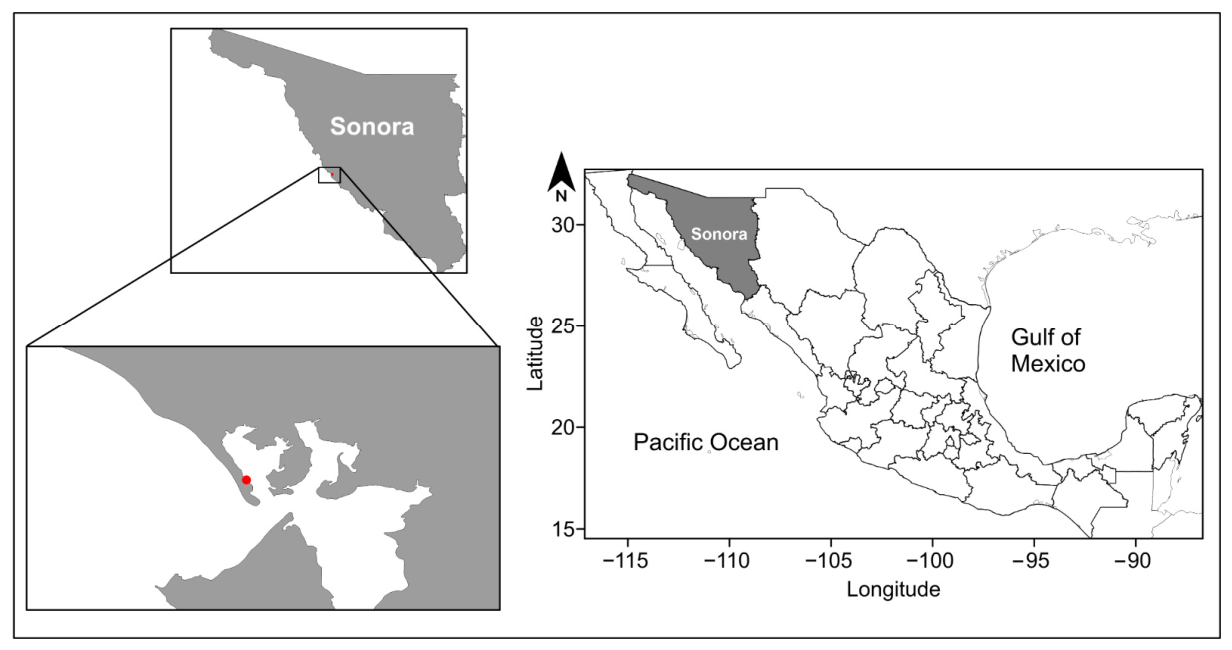
The experimental cultivation was carried out in Estero La Cruz, Sonora, Mexico (28°47′58.0″ N, 111°54′55.5″ W), one of the main oyster farming areas of the country (Figure 1). The study was initiated with oyster larvae in April, which were subsequently reared under field conditions; at the beginning of the experimental period, individuals corresponded to early juvenile stages, with an initial shell height of approximately 5 mm. The cultivation began with planting on 18 April 2023, and concluded on 11 December 2023. A total of 10,000 spats of Pacific oyster, obtained from a local supplier, were used under a box suspension cultivation system; maintenance and cleaning of the organisms were carried out monthly. The study area exhibits marked seasonal environmental variability typical of subtropical coastal lagoons in northwestern Mexico. During spring (April–June), moderate temperatures and increased primary productivity favor food availability for filter-feeding organisms. Summer (July–September) is characterized by elevated temperatures (>30 °C), which may impose thermal stress and reduce growth efficiency. In autumn (October–November), environmental conditions transition toward lower temperatures and moderate productivity. Winter (December–February) is defined by cooler temperatures (16–18 °C) and reduced trophic availability, conditions that can influence metabolic efficiency and reproductive processes. Overall, these seasonal fluctuations in temperature and food availability are characteristic of the environmental conditions in which the organisms were cultivated [17].

2.2. Evaluation of Biological Performance: Growth and Total Weight

Monthly sampling was conducted in both areas. In each sampling, 50 organisms were randomly selected, washed with distilled water, dried, and measured for height and length using a Fisherbrand S90 digital caliper (Thermo Fisher Scientific, Waltham, MA, USA). Total weight was obtained using a precision balance.

2.3. Water Parameters

Chlorophyll-a and sea surface temperature were obtained from satellite images (MODIS-Aqua, Terra, VIIRS, SeaWiFS, and OLCI) with a 1 km resolution, provided by Mati Kahru (SIO).

2.4. Proximal Chemical Analysis of M. gigas

The proximate chemical analysis of oysters was carried out following the methods established by the Association of Official Analytical Chemists (Gaithersburg, MD, USA, 2005): 950.46, 925.23, 920.153, 981.1, and 991.36, corresponding to moisture, solids, ash, protein, and fat, respectively.
Each month, a total of 50 oysters were collected. From these, 30 individuals were randomly selected and pooled to obtain a composite sample for proximate and biochemical analyses.
All analyses were performed in triplicate, referring to three independent analytical determinations of the same homogenized sample (technical replicates).
All biochemical and glycogen analyses were performed using whole soft-body homogenates, including mantle, gills, digestive gland, and gonadal tissues. All tissue samples were processed immediately after dissection to prevent enzymatic activity and ensure the integrity of biochemical measurements. Results are expressed as percentages [19].

2.5. Glycogen Determination

Glycogen content was determined using the phenol–sulfuric acid colorimetric method. The tissue was homogenized and subjected to acid digestion. Subsequently, phenol and concentrated sulfuric acid were added, generating a colorimetric reaction that was read at 490 nm. The results are expressed as mg of glycogen per gram of wet weight [18].

2.6. Preparation of Enzymatic Extracts

One gram of soft tissue samples was processed for antioxidant enzyme analysis. The tissue was homogenized in cold phosphate buffer (0.1 M, pH 7.00) at a 1:9 (w/v) ratio under refrigeration (4 °C). The homogenate was centrifuged at 10,000× g for 15 min at 4 °C. The resulting supernatant was collected and used as an enzyme extract for subsequent assays. Protein concentration was determined using the Bradford method, with bovine serum albumin (BSA) as the standard [19].

2.6.1. Determination of Superoxide Dismutase (SOD)

SOD activity was determined using the method of Marklund and Marklund [20,21]. This method is based on the participation of the superoxide anion radical in the auto-oxidation of pyrogallol. A pyrogallol solution in HCl was prepared and incubated at 40 °C. A 200 µL volume of a Tris-EDTA-HCl mixture was added to a 50 µL aliquot of the sample, and the absorbance was measured at 420 nm using a spectrophotometer. The pyrogallol solution was then added, and the increase in absorbance was recorded every 30 s for 3 min. The reagent blank was prepared in the same way, replacing the sample with double-distilled water.

2.6.2. Catalase (CAT) Activity

Catalase activity was assessed by monitoring the decomposition of hydrogen peroxide (H2O2). The reaction mixture consisted of a phosphate buffer (0.10 M, pH 7.00) and H2O2, with a final concentration of 10–30 mM. The reaction was initiated by adding the enzyme extract.
The decrease in absorbance was recorded at 240 nm for 1–2 min. CAT activity was calculated using the molar extinction coefficient of H2O2 (ε = 39.40 M−1 cm−1) and expressed as µmol of H2O2 decomposed per minute per mg of protein [20,21].

2.6.3. Glutathione Peroxidase (GPx) Activity

GPx activity was determined using the method of Beutler et al. [22]. This enzyme catalyzes the degradation of tert-butyl hydroperoxide (t-BOOH) in the presence of reduced glutathione (GSH), which is consumed during the reaction. The remaining GSH was quantified using 5,5-dithiobis-(2-nitrobenzoic acid) (DTNB). The reaction mixture consisted of 1 mL of GSH in PBS (400 mmol, pH 7.00), EDTA (4 mmol), 0.5% sodium azide (1 mmol), 250 µL of sample, and double-distilled water to make a final volume of 4 mL.
The mixture was then incubated at 37 °C for 5 min. Then, 1 mL of pre-heated t-BOOH (1.25 mmol) was added, and incubation continued for an additional 4 min. At the end of this period, 1 mL of the mixture was taken, and 4 mL of phosphoric acid was added.
The mixture was centrifuged at 2000× g for 10 min at room temperature. A 2 mL volume of the supernatant was recovered, and 2 mL of Na2HPO4 (400 mmol) and 1 mL of DTNB reagent were added. Finally, the absorbance was measured at 412 nm.
Blanks and standards were prepared following the same procedure. GSH-Px activity is expressed as U/mg of protein [23].

2.7. Statistical Analysis

All trials were performed in triplicate and results are expressed as mean ± SD. Before analysis, normality and homogeneity of variance were verified. One-way ANOVA was used to assess temporal differences across discrete monthly sampling points, and Tukey’s HSD test (p < 0.05) was applied for post hoc comparisons. Although environmental variables are continuous, monthly grouping allowed the identification of seasonal patterns associated with ecological phases. Environmental parameters were additionally analyzed using descriptive statistics. These analyses were performed using IBM SPSS Statistics for Windows (version 22).
To further explore relationships among environmental variables, growth, biochemical composition, and antioxidant responses, Pearson correlation analyses and multiple linear regression were conducted using R software version 4.5.3 (R Core Team, 2026). Shell height was used as a representative growth parameter due to its strong positive correlation with other morphometric variables (shell length and total weight), reflecting overall somatic growth. This approach allowed the use of a single response variable in regression analyses, avoiding redundancy and overparameterization given the limited number of observations. Due to the limited number of observations, these analyses were interpreted as indicative trends.

3. Results

3.1. Biological Performance of M. gigas

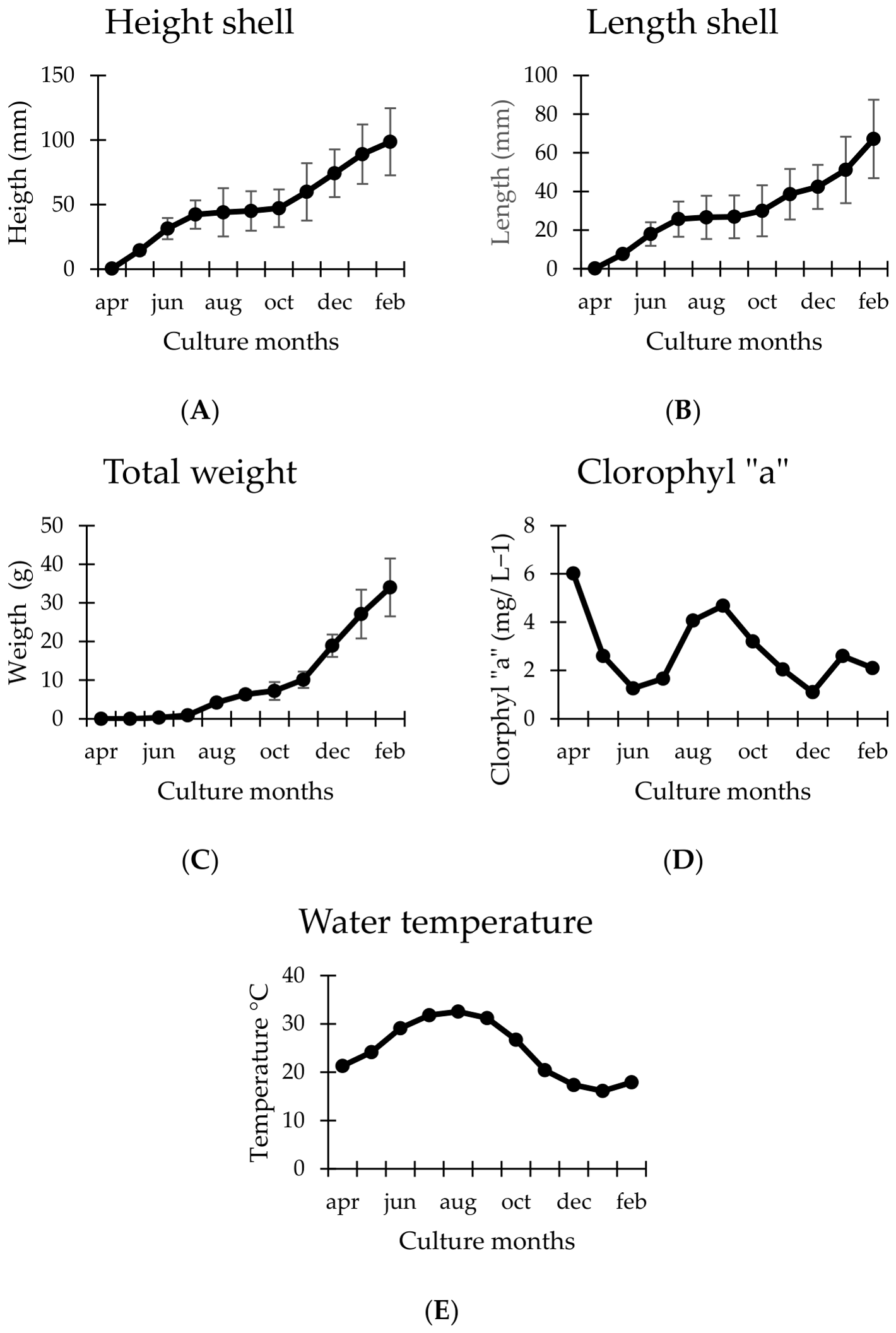
Throughout the culture period, shell height and length, as well as total weight, showed progressive and sustained growth. Shell height increased continuously, reaching 45–50 mm by September–October, followed by a more pronounced growth phase between November and February, reaching an average height of 98.70 ± 26.00 mm (Figure 2A). Length exhibited a similar trend: it gradually increased to 25–30 mm during August–September, and then accelerated in October, reaching an average length of 67.20 ± 20 mm in February (Figure 2B).
Total weight showed two clearly differentiated stages. During the first few months (April–July), the values remained practically stable, fluctuating between 0 and 2 g with marginal increases; from August onwards, a more evident increase was observed, with records of 5 to 10 g, followed by a phase of exponential growth between November and February, when the organisms reached an average weight of 34 ± 7.50 g at the end of the evaluated period.

3.2. Environmental Conditions

Chlorophyll “a” concentration exhibited a fluctuating dynamic with a bimodal pattern. The maximum value was recorded in April (6.00 mg L−1), followed by a sharp decline in May (2.60 mg L−1) and June (1.20 mg L−1). From July (1.60 mg L−1) onward, a gradual recovery was observed, with a notable increase in August (4.00 mg L−1) and a second relative peak in September (4.60–4.80 mg L−1). Subsequently, concentrations decreased in October (3.10 mg L−1) and November (2.00 mg L−1), reaching the minimum value for the period in December (1.00–1.10 mg L−1); a moderate recovery was recorded in January (2.50 mg L−1), followed by a slight decrease in February (2.00 mg L−1). This bimodal pattern showed peaks during spring and late summer, while the lowest values were concentrated at the beginning of summer and during winter.
The water temperature showed a well-defined seasonal pattern, with values of 21 °C in April that gradually increased to 32–33 °C in August. From that point, the temperature decreased steadily throughout the autumn and winter, reaching 16–18 °C in December and January, with a slight recovery towards February.

3.3. Proximate Composition (%)

The proximate composition of M. gigas showed relevant temporal variations in protein, lipids, carbohydrates, and glycogen (Table 1). Protein content reached its maximum value in September (13.80 ± 0.73%), while the lowest concentration was recorded in December (7.80 ± 1.04%), significantly lower than in most of the months evaluated, except for February (9.60 ± 0.64%).
Lipids showed a similar trend: the highest levels were observed in September (2.40 ± 0.33%), followed by a progressive decrease until December (1.30 ± 0.24%), with significant differences between the two values.
In the case of carbohydrates, the pattern was comparable to that of lipids. The maximum value was recorded in September (5.60 ± 0.41%), significantly higher than the minimum observed in December (3.90 ± 0.35%).
Glycogen content also showed a similar pattern. The highest concentration occurred in September (38.50 ± 2.04%), while the lowest was in December (18.30 ± 1.88%). A significant increase was observed in February compared to December, reaching 29.60 ± 2.12%.
In contrast to the organic components, the ash content showed the opposite trend, increasing from 2.20 ± 0.33% in September to a maximum of 2.80 ± 0.41% in December, before decreasing slightly in January (2.70 ± 0.22%) and February (2.60 ± 0.36%). No significant differences were detected between the months analyzed. Moisture content exhibited a behavior inversely related to the energy components, increasing progressively from 76 ± 0.89% in September to a maximum of 84.20 ± 1.39% in December, and subsequently decreasing to 82 ± 1.22% in January and 79.30 ± 1.9% in February. Significant differences were observed between the three months mentioned. Overall, the results show a general reduction in energy components (protein, lipids, carbohydrates, and glycogen) during December, coinciding with the peak increase in moisture content. This pattern suggests a mobilization of the body’s energy reserves during this period.

3.4. Seasonal Dynamics of the Antioxidant System in M. gigas

The antioxidant enzymes (SOD, CAT, and GPx) showed a defined seasonal pattern: a progressive increase in their activity between September and December, followed by a partial decrease in January and February, without returning to baseline levels. SOD increased significantly from 22.50 ± 2.44 to 38.6 ± 3.75 U mg−1 protein in December (p < 0.05), subsequently decreasing to 29.40 ± 2.77 in February, although remaining above the baseline value. CAT increased from 9.80 ± 1.06 to 18.70 ± 2.20 µmol H2O2 min−1 mg−1 protein in December (p < 0.05), subsequently decreasing to 13.20 ± 1.38 in February. GPx showed a significant increase from 6.20 ± 0.97 to 12.50 ± 2.04 nmol NADPH min−1 mg−1 protein in December (p < 0.05), followed by a reduction to 8.70 ± 1.38 in February. Overall, the results demonstrate a peak in antioxidant activity in December with statistically significant differences compared to September, followed by a partial reduction in winter. This pattern suggests an adaptive physiological response to seasonal environmental stressors. The seasonal variation in antioxidant enzyme activity is summarized in Table 2.

3.5. Monthly Variation in Gonadal Biochemical Composition

The biochemical composition of M. gigas gonads showed monthly variations during the period September–February (Table 3). Particularly the lipid content reached its highest value in September (4.60 ± 1.31%) and gradually decreased to its minimum in December (2.20 ± 0.98%), with no significant differences between months.
Carbohydrates showed a similar pattern, with the maximum value in September (3.9 ± 0.88%), significantly higher than that observed in December (2.10 ± 0.73%). Gonadal glycogen showed the most marked variation: it decreased from its maximum value in September (28.40 ± 5.23 mg g−1) to its minimum in December (12.30 ± 5.14 mg g−1), with significant differences between the two months. Subsequently, a significant increase was recorded in February (23.6 ± 5.32 mg g−1) compared to the minimum value in December.
Protein content also varied throughout the period. The highest value was recorded in September (12.80 ± 1.10%), followed by October (12.10%) and November (10.40%). A notable decrease was observed in December (6.20%), followed by increases in January (9.50%) and February (11.30%).
Overall, the results show a decrease in biochemical components in December, followed by an increase in subsequent months. This pattern is consistently observed in lipids, carbohydrates, glycogen, and proteins.

3.6. Relationships Among Environmental Variables and Biological Responses

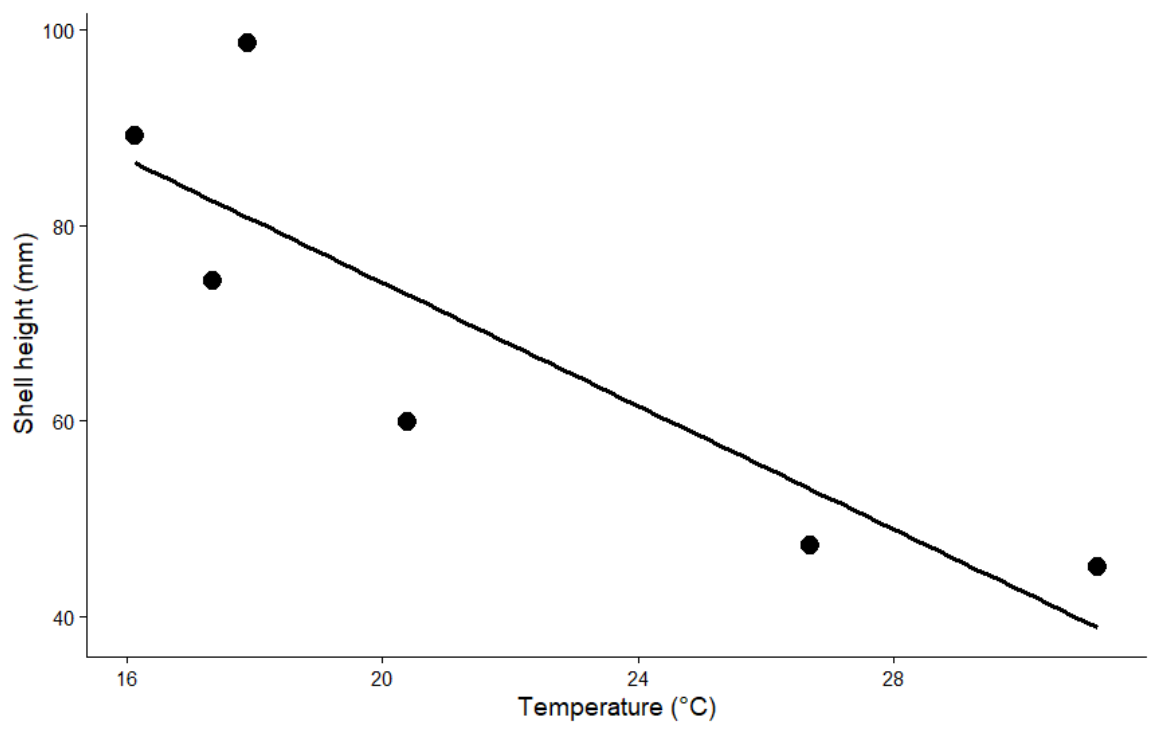
To further explore the relationships among environmental variables and biological responses, correlation analyses were performed. Temperature showed a negative correlation with shell height (r = −0.86, p = 0.028), indicating reduced growth under higher thermal conditions (Figure 3). Similarly, antioxidant activity (SOD) was negatively associated with temperature (r = −0.88, p = 0.021).
Multiple linear regression analysis indicated that temperature and chlorophyll-a jointly explained a substantial proportion of the variability in shell height (R2 = 0.83). Temperature exhibited a negative effect (β = −5.05, p = 0.064), whereas chlorophyll-a showed a positive but non-significant association (β = 10.76, p = 0.301) (Table 4). The overall model showed marginal significance (p = 0.071).

4. Discussion

The progressive growth observed in M. gigas reflects an ecophysiological response closely linked to the environmental variability of the cultivation area. However, it is important to note that the organisms used in this study were initially at the spat stage and underwent significant ontogenetic development throughout the experimental period. Therefore, the observed changes in growth and biochemical composition reflect not only environmental variability and reproductive dynamics but also age-related physiological processes. Consequently, direct extrapolation of these results to fully mature adult populations should be made with caution. This consideration is particularly relevant when interpreting seasonal biochemical variability, as ontogenetic and environmental effects may overlap.
The observed growth patterns are consistent with previous studies indicating that morphometric relationships in M. gigas, such as length–weight dynamics, reflect not only size increase but also changes in physiological condition and energy allocation [24]. This highlights that seasonal variation in growth may be associated with shifts in metabolic activity and resource availability.
The sustained increase in shell height and length, with a marked acceleration between November and February, coincided with the transition to more moderate temperatures and reduced heat stress, a pattern commonly reported for populations cultivated under subtropical conditions [14,25]; during summer, when temperatures reached 32–33 °C, somatic growth remained limited, suggesting that a greater proportion of energy was allocated to metabolic maintenance; this behavior has been widely documented in bivalves exposed to warm conditions, where elevated basal metabolic costs reduce feed conversion efficiency and, consequently, net growth [26,27,28].
This interpretation is further supported by the negative relationship observed between temperature and shell growth, as indicated by correlation and regression analyses, where temperature emerged as the main factor associated with growth variability.
Unlike strictly temperate species that reduce activity during winter, M. gigas maintained active growth even at 16–18 °C, demonstrating its high thermal tolerance and metabolic plasticity [29]; total weight exhibited two clearly differentiated phases: an initial stagnation period (April–July) followed by an exponential increase beginning in August; this transition coincided with the second chlorophyll “a” pulse recorded in August–September, suggesting that food availability played a determining role in growth recovery [25,30].
However, regression results indicated that chlorophyll-a had a weaker and non-significant effect on shell growth compared to temperature, suggesting that food availability may primarily influence energy storage rather than directly driving somatic growth.
The bimodal chlorophyll “a” dynamics, with peaks in spring and late summer, are characteristic of subtropical lagoon systems and have been associated with variations in primary productivity driven by changes in temperature, water-column stability, and nutrient availability [31]; in this study, the late-summer chlorophyll peak appears to have been particularly relevant in promoting somatic growth and reserve accumulation prior to winter; fluctuations in food availability are closely related to reproductive events in bivalves. During gametogenesis, energy reserves are mobilized toward gonadal development, and after spawning, decreases in body weight and changes in proximate composition may occur [32]; previous studies have shown that M. gigas exhibits increases in lipids and carbohydrates during gonadal maturation, followed by abrupt declines after spawning [30]; although reproductive status was not directly assessed here, the decline in chlorophyll in June and the thermal minimum in December may correspond to phases of reserve mobilization and depletion, respectively, helping to explain some of the physiological variability observed.
The seasonal variability recorded in this study is consistent with the environmental dynamics widely described for coastal lagoons in the Gulf of California, which are characterized by strong thermal gradients, productivity pulses, and fluctuations in surface energy balance modulated by regional atmospheric and oceanic processes; recent studies have shown that turbulent heat fluxes in these systems can generate abrupt changes in water temperature, affecting water-column stability and nutrient availability [33]; likewise, seasonal variability in nutrient inputs and net ecosystem metabolism can modify primary productivity and, consequently, food availability for filter-feeding organisms [34]; these processes largely explain the chlorophyll pulses observed in this study and their relationship with oyster growth.
The ecological dynamics of Gulf of California lagoons are strongly influenced by seasonal changes in hydrodynamics, temperature, and nutrient availability, factors that affect not only bivalves but also fish communities and other benthic organisms [35]; this environmental variability, considered a defining feature of the region’s lagoon systems, generates physiological stress scenarios that require high ecophysiological plasticity from cultured organisms; in this context, M. gigas has proven to be a particularly resilient species, capable of maintaining acceptable growth rates even under fluctuating environmental conditions [36]; although this study focused on natural environmental variables, the interaction between environmental variability and human activities in coastal areas can also influence water quality and ecological stability [37]; anthropogenic pressures may amplify environmental stressors and affect the physiology of cultured organisms [38], making their consideration relevant for interpreting the patterns observed.
During the experimental cultivation period, chlorophyll dynamics exhibited a clear bimodal pattern typical of subtropical lagoon systems, determining food availability for filter-feeding organisms [39]; in this study, the increase in energy reserves in September coincided with one of these peaks, suggesting efficient trophic conversion; in species such as Arctica islandica and Mytilus galloprovincialis, a direct relationship between phytoplankton availability and tissue glycogen content has been documented [40,41], consistent with the patterns observed here.
The marked decrease in protein, lipids, carbohydrates, and glycogen in December represents a critical point in the physiological cycle; the simultaneous reduction in these components indicates intense energy mobilization, characteristic of the spawning phase in marine bivalves [42]; in Meretrix petechialis, for example, carbohydrate content decreases after spawning, accompanied by muscle alterations associated with oxidative stress [43]; with respect to M. gigas, the reduction in protein was particularly pronounced in gonadal tissue, suggesting a high-intensity reproductive event.
Glycogen, the main rapidly mobilized energy reserve, decreased by nearly 50% between September and December, confirming its use during gametogenesis and metabolic maintenance under less favorable environmental conditions; similar patterns have been described in Patinopecten yessoensis during mass spawning events associated with abrupt temperature changes [44]; the simultaneous decrease in somatic and gonadal tissues suggests a coordinated transfer of energy to reproductive tissues, followed by its consumption during gamete release.
The increase in moisture and ash content in December reinforces the interpretation of energy depletion; in bivalves, a relative increase in moisture reflects a reduction in the organic fraction rather than an absolute gain in water [45], a biological pattern described in Solen marginatus during periods of environmental stress or after spawning [46].
These seasonal changes in biochemical composition are consistent with previous studies indicating that the nutritional quality of M. gigas is highly variable and influenced by environmental conditions and physiological state [47]. Fluctuations in glycogen and lipid reserves reflect shifts in energy allocation, which directly affect the nutritional value of oysters.
Gonadal biochemical composition exhibited even more pronounced variations than total tissue; the decrease in gonadal protein from 12.81% to 6.20% between September and December indicates substantial mobilization of structural resources, like that observed in M. petechialis after intense reproductive events [48]; the recovery recorded in January and February suggests the onset of a new accumulation cycle, consistent with the iteroparous reproductive pattern of the Pacific oyster.
One of the most relevant findings of this study was the dynamics of the antioxidant system. SOD, CAT, and GPx activities increased progressively, reaching their highest values in December, indicating elevated production of reactive oxygen species (ROS) during the period of greatest physiological demand; final gonadal maturation and gamete release increase cellular respiration and, consequently, ROS generation [49]. The observed negative association between temperature and antioxidant activity further supports the role of environmental stressors in modulating oxidative responses.
Spawning represents a phase of increased physiological vulnerability, as energy reallocation toward reproduction constrains the capacity to cope with additional stressors [50,51]. In this context, the coincidence between minimum energy reserves and maximum antioxidant activity indicates that December was a period of elevated metabolic demand, likely driven by the combined effects of reproductive effort and seasonal thermal transitions. The observed antioxidant response is therefore interpreted as a generalized reaction to oxidative stress associated with these factors. The subsequent decline in antioxidant activity during January and February suggests physiological stabilization, accompanied by energy recovery and accelerated somatic growth, reflecting a high degree of resilience.
This sequence of energy accumulation during periods of high trophic availability (September), and mobilization during spawning and thermal transition (November–December), followed by recovery and renewed growth (January–February), aligns with patterns reported for cultivated M. gigas in Asia and Europe [52,53]. More broadly, the results highlight the central role of environmental variability in shaping oyster physiological performance in subtropical lagoon systems. The integration of growth, biochemical composition, and antioxidant responses reveals a tightly coupled relationship between trophic availability, thermal fluctuations, and energy allocation, where environmental pulses trigger coordinated metabolic and protective responses. Unlike previous studies that have addressed growth, biochemical composition, or oxidative stress independently, the present study integrates these components within a single ecophysiological framework under natural seasonal conditions. This integrative approach allows for a more comprehensive understanding of how environmental variability simultaneously influences energy allocation, somatic growth, and physiological stress responses in M. gigas. By linking environmental drivers with coordinated biological responses, this study provides a functional perspective that extends beyond descriptive patterns and contributes to a more mechanistic interpretation of oyster performance in subtropical lagoon systems.
These findings provide a functional framework for understanding seasonal physiological dynamics beyond isolated variables, offering a mechanistic perspective on how multiple environmental drivers interact to regulate biological performance. From an applied standpoint, aligning aquaculture practices with these seasonal patterns, particularly optimizing stocking density and harvest timing according to periods of maximum growth and energy reserve accumulation, may enhance production efficiency, product quality, and system resilience. Overall, this study contributes to a more integrated understanding of oyster performance under fluctuating natural conditions, supporting the development of more adaptive and sustainable aquaculture strategies in dynamic coastal environments.

5. Conclusions

This study shows that the physiological performance of M. gigas in a subtropical lagoon is tightly regulated by seasonal environmental variability and reproductive dynamics. Energy reserves accumulated during periods of high trophic availability are rapidly mobilized during spawning and thermal transition, leading to marked depletion of biochemical components and a concurrent increase in antioxidant activity, indicative of elevated metabolic stress. The subsequent recovery of energy reserves and accelerated winter growth demonstrate a high degree of physiological resilience.
Importantly, the integration of growth, biochemical composition, and antioxidant responses within a single analytical framework revealed consistent relationships among environmental drivers and biological responses, highlighting temperature as a primary factor associated with growth variability.
Overall, these results reveal a strong coupling between environmental forcing, energy allocation, and oxidative stress, providing a mechanistic basis for understanding oyster performance under natural seasonal conditions. This integrative perspective extends beyond descriptive approaches and contributes to improved decision-making in aquaculture management in highly variable coastal systems.

Author Contributions

Conceptualization, F.d.J.R.-F. and F.C.-C.; methodology F.C.-C., J.P.V.-C., N.L.-R., J.L.A.-M. and F.d.J.R.-F.; data curation, A.G.-R., J.L.A.-M., and M.H.G.-V.; formal analysis, F.C.-C., J.E.M.-M. and F.d.J.R.-F.; investigation, F.C.-C., N.L.-R., and F.d.J.R.-F.; writing—original draft preparation, F.d.J.R.-F. and F.C.-C.; writing—review and editing, J.P.V.-C., A.G.-R., M.H.G.-V., and J.E.M.-M. All authors have read and agreed to the published version of the manuscript.

Funding

This research was funded by Tecnológico Nacional de México, project 18379.23-P, “Evaluación de la variación estacional de la composición proximal y desempeño biológico del ostión Crassostrea gigas”.

Data Availability Statement

The data presented in this study are available from the corresponding author upon reasonable request.

Acknowledgments

We would like to thank Carlos Estrada for his invaluable support in the experimental cultivation and sample collection.

Conflicts of Interest

The authors declare no conflicts of interest.

References

  1. FAO. El Estado Mundial de la Pesca y Acuicultura. Available online: https://www.fao.org/publications/fao-flagship-publications/the-state-of-world-fisheries-and-aquaculture/es (accessed on 18 April 2026).
  2. Abarca, A.; Lira, G.; Bakit, J. Pacific oyster (Crassostrea gigas) aquaculture production in Chile: A review. Lat. Am. J. Aquat. Res. 2025, 53, 39–55. [Google Scholar] [CrossRef]
  3. Palmer, S.C.J.; Barillé, L.; Kay, S.; Ciavatta, S.; Buck, B.; Gernez, P. Pacific oyster (Crassostrea gigas) growth modelling and indicators for offshore aquaculture in Europe under climate change uncertainty. Aquaculture 2021, 532, 736116. [Google Scholar] [CrossRef]
  4. Xing, Z.; Gao, L.; Liu, R.; Yang, Q.; Li, Q.; Wang, L.; Song, L. The oxidative stress of the Pacific oyster Crassostrea gigas under high-temperature stress. Aquaculture 2023, 577, 739998. [Google Scholar] [CrossRef]
  5. Sun, Y. Changes in major nutrients and physiology of bivalve mollusks under ocean warming and potential mitigation strategies. Crit. Rev. Food Sci. Nutr. 2026, 66, 2352–2366. [Google Scholar] [CrossRef]
  6. Le, T.N.P.; Vu, S.V.; Ugalde, S.C.; Subramanian, S.; Gilmour, A.; Dove, M.; Vu, I.V.; Geist, J.; Tran, T.N.T.; Gondro, C. The genetics and breeding of the Portuguese oyster, Crassostrea angulata: Lessons, experiences, and challenges in Vietnam. Front. Mar. Sci. 2023, 10, 1161009. [Google Scholar] [CrossRef]
  7. Arrieche, D.; Acosta, V.; Pérez-Blanco, L.J.; Zapata-Vívenes, E.; Romero-Fereira, P.; Lodeiros, C. Biochemical composition of the Atlantic pearl oyster Pinctada imbricata (Bivalvia: Pteriidae) in suspended culture: Influence of environmental factors. Rev. De Biol. Mar. Y Oceanogr. 2023, 58, 1–9. [Google Scholar] [CrossRef]
  8. Chávez-Villalba, J. Cultivo de ostión Crassostrea gigas: Análisis de 40 años de actividades en México. Hidrobiológica 2014, 24, 175–190. [Google Scholar]
  9. Samperio-Ramos, G.; Vidal-Nieves, C.; García-Esquivel, Z.; Herzka, S.Z.; Sandoval-Gil, J.M.; Camacho-Ibar, V.F. Environmental influence on feeding and biodeposition rates of Pacific oysters (Crassostrea gigas) throughout its culture cycle in a coastal lagoon with upwelling influence. Estuaries Coasts 2024, 47, 1282–1298. [Google Scholar] [CrossRef]
  10. Rato, A.; Joaquim, S.; Matias, D.; Hubbard, P.C. The roles of chemical cues in the life cycle of bivalves: Spawning, settlement, and metamorphosis. Rev. Aquac. 2025, 17, e13007. [Google Scholar] [CrossRef]
  11. Cao, X.; Song, Y.; Fan, X.; Peng, L.; Meng, N.; Zeng, J.; Li, Z.; Xue, C.; Xu, J. Low temperature, high salinity depuration enhances Pacific oyster (Crassostrea gigas) lipid nutrition during anhydrous living-preservation: Lipidomic insights based on RPLC–Q-TOF-MS/MS. Food Chem. 2025, 479, 143805. [Google Scholar] [CrossRef]
  12. Hu, Y.; Xu, C.; Li, Q. Effects of temperature and salinity on growth, survival, physiological, and immunological responses of adult Iwagaki oyster (Crassostrea nippona). Aquac. Int. 2025, 33, 435. [Google Scholar] [CrossRef]
  13. Fu, J.; Zhang, E.; Yu, W.; Wang, W.; Sun, Y.; Dong, L.; Zhang, Y.; Sun, G.; Li, Z.; Luo, Q. Comparative analysis of the biochemical composition, amino acid, and fatty acid contents of diploid, triploid, and tetraploid Crassostrea gigas. Molecules 2024, 29, 2671. [Google Scholar] [CrossRef]
  14. Reynaga-Franco, F.D.J.; Chávez-Villalba, J.; Barraza-Guardado, R.H.; Alcántara-Razo, E.; Arreola-Lizárraga, J.A.; Castro-Longoria, R.; Grijalva-Chon, J.M. Influencia de la variabilidad ambiental de la Laguna la Cruz (Sonora) en el crecimiento y condición del ostión del Pacífico Crassostrea gigas. Biotecnia 2019, 21, 62–70. [Google Scholar]
  15. Martínez-García, M.F.; Ruesink, J.L.; Grijalva-Chon, J.M.; Lodeiros, C.; Arreola-Lizárraga, J.A.; de la Re-Vega, E.; Varela-Romero, A.; Chávez-Villalba, J. Socioecological factors related to aquaculture introductions and production of Pacific oysters (Crassostrea gigas) worldwide. Rev. Aquac. 2022, 14, 613–629. [Google Scholar]
  16. Hünicken, L.A.; González, R.; Landete, D.; Barrena, M.A.; Saad, J.F.; Narvarte, M.A. Distribución, Abundancia y Estructura de Tamaño de la Ostra Cóncava del Pacífico, Magallana gigas, en el Norte de la Patagonia; FAO: Rome, Italy, 2025. [Google Scholar]
  17. INEGI. Aspectos Geográficos de Sonora: Compendio 2022; Instituto Nacional de Estadística y Geografía: Aguascalientes, Mexico, 2023; pp. 1–46.
  18. Schaubroeck, K.J.; Leitner, B.P.; Perry, R.J. An optimized method for tissue glycogen quantification. Physiol. Rep. 2022, 10, e15195. [Google Scholar] [CrossRef]
  19. Marklund, S.; Marklund, G. Involvement of the superoxide anion radical in the autoxidation of pyrogallol and a convenient assay for superoxide dismutase. Eur. J. Biochem. 1974, 47, 469–474. [Google Scholar] [CrossRef] [PubMed]
  20. Goth, L. A simple method for determination of serum catalase activity and revision of reference range. Clin. Chim. Acta 1991, 196, 143–151. [Google Scholar] [CrossRef]
  21. Iwase, T.; Tajima, A.; Sugimoto, S.; Okuda, K.-I.; Hironaka, I.; Kamata, Y.; Takada, K.; Mizunoe, Y. A simple assay for measuring catalase activity: A visual approach. Sci. Rep. 2013, 3, 3081. [Google Scholar] [CrossRef]
  22. Beutler, E.; Duron, O.; Kelly, B.M. Improved method for determination of blood glutathione. J. Lab. Clin. Med. 1963, 61, 882–888. [Google Scholar]
  23. Gallardo, J.M. Evaluación del sistema antioxidante en el semen normal. Rev. De Investig. Clínica 2007, 59, 32–41. [Google Scholar]
  24. Wicaksono, A.; Wijayanto, D.; Kurohman, F. Length-weight relationship of the Pacific oyster (Magallana gigas (Thunberg, 1793)) in Sakoshi Bay, Japan. AACL Bioflux 2026, 19, 629–640. [Google Scholar]
  25. Treviño, L.; Lodeiros, C.; Vélez-Falcones, J.; Chávez-Alcivar, C.; Isea-León, F.; Bermúdez-Medranda, A.E.; Vélez-Chica, J.C.; Cruz-Quintana, Y.; Leal, D.; Santana-Piñeros, A.M. Suspended culture evaluation of Pacific oyster Crassostrea gigas in a tropical estuary. Aquac. Res. 2020, 51, 2052–2061. [Google Scholar] [CrossRef]
  26. Nielsen, M.; Hansen, B.W.; Vismann, B. Feeding traits of the European flat oyster, Ostrea edulis, and the invasive Pacific oyster, Crassostrea gigas. Mar. Biol. 2017, 164, 6. [Google Scholar] [CrossRef]
  27. Reynaga-Franco, F.d.J.; Grijalva-Chon, J.M.; Castro-Longoria, R.; Barraza-Guardado, R.H.; Arreola-Lizárraga, J.A.; Chávez-Villalba, J. Biological performance of Crassostrea gigas stocks produced at different hatcheries and cultivated under same environmental conditions. Aquac. Res. 2019, 50, 621–633. [Google Scholar] [CrossRef]
  28. Rodríguez-Jaramillo, C.; Ibarra, A.M.; Soudant, P.; Palacios, E. Comparison of quantitative gonad maturation scales in a temperate oyster (Crassostrea gigas) and a sub-tropical oyster (Crassostrea corteziensis). Invertebr. Reprod. Dev. 2017, 61, 147–156. [Google Scholar] [CrossRef]
  29. Dridi, S.; Romdhane, M.S.; Elcafsi, M.h. Seasonal variation in weight and biochemical composition of the Pacific oyster, Crassostrea gigas in relation to the gametogenic cycle and environmental conditions of the Bizert lagoon, Tunisia. Aquaculture 2007, 263, 238–248. [Google Scholar] [CrossRef]
  30. Galhanas, D.C.; Mata, A.M.T.; Simões, M.; Silva, M.M.; Salgado, R. Modelling the effects of temperature and chlorophyll on growth and survival of the oyster Crassostrea gigas in two different cultivation systems. Aquac. Eng. 2026, 113, 102696. [Google Scholar] [CrossRef]
  31. López Martínez, J.; Farach Espinoza, E.B.; Herrera Cervantes, H.; García Morales, R. Long-term variability in sea surface temperature and chlorophyll a concentration in the Gulf of California. Remote Sens. 2023, 15, 4088. [Google Scholar] [CrossRef]
  32. Enríquez-Díaz, M.; Pouvreau, S.; Chávez-Villalba, J.; Le Pennec, M. Gametogenesis, reproductive investment, and spawning behavior of the Pacific giant oyster Crassostrea gigas: Evidence of an environment-dependent strategy. Aquac. Int. 2009, 17, 491–506. [Google Scholar] [CrossRef]
  33. Benítez-Valenzuela, L.I.; Sánchez-Mejía, Z.M.; Yepez, E.A. Semiarid coastal ecosystems—Atmospheric interactions: A seasonal analysis of turbulence and stability. Meteorology 2025, 4, 2. [Google Scholar] [CrossRef]
  34. Medina-Galván, J.; Osuna-Martínez, C.C.; Padilla-Arredondo, G.; Frías-Espericueta, M.G.; Barraza-Guardado, R.H.; León-Cañedo, J.A.; Arreola-Lizárraga, J.A. Estado trófico, dinámica de nutrientes y metabolismo neto de una laguna costera subtropical (Golfo de California) receptora de aguas residuales. Rev. Int. Contam. Ambient. 2022, 38, 429–443. [Google Scholar] [CrossRef]
  35. Padilla-Serrato, J.; López-Martínez, J.; Rodríguez-Romero, J.; Acevedo-Cervante, A.; Galván-Magaña, F.; Lluch-Cota, D. Changes in fish community structures in a coastal lagoon in the Gulf of California, México. Rev. De Biol. Mar. Y Oceanogr. 2017, 52, 567–579. [Google Scholar] [CrossRef]
  36. Hu, Y.; Li, Q.; Xu, C.; Liu, S.; Kong, L.; Yu, H. A Comparative Study on the Difference in Temperature and Salinity Tolerance of Crassostrea nippona and C. gigas Spat. J. Mar. Sci. Eng. 2023, 11, 284. [Google Scholar] [CrossRef]
  37. Day, J.W.; Rivera-Arriaga, E.; del Carmen Peña-Puch, A.; Hunter, R.G. Sustainability of Gulf of Mexico coastal estuaries and lagoons: Interactions with hydrocarbon production—A review with a look to the future. Sustainability 2024, 16, 8601. [Google Scholar] [CrossRef]
  38. Gadelha, J.R.; Rocha, A.C.; Camacho, C.; Eljarrat, E.; Peris, A.; Aminot, Y.; Readman, J.W.; Boti, V.; Nannou, C.; Kapsi, M. Persistent and emerging pollutants assessment on aquaculture oysters (Crassostrea gigas) from NW Portuguese coast (Ria De Aveiro). Sci. Total Environ. 2019, 666, 731–742. [Google Scholar] [CrossRef]
  39. Thibodeau, P.S.; Puggioni, G.; Strock, J.; Borkman, D.G.; Rynearson, T.A. Long-term declines in chlorophyll a and variable phenology revealed by a 60-year estuarine plankton time series. Proc. Natl. Acad. Sci. USA 2024, 121, e2311086121. [Google Scholar] [CrossRef]
  40. Matras, U.; Salter, I.; Larsen, K.M.H.; Gaard, E.; Steingrund, P. Relationship between plankton dynamics and growth of the long-lived clam Arctica islandica on the Faroe shelf. Front. Mar. Sci. 2022, 9, 822343. [Google Scholar] [CrossRef]
  41. Matias, A.M.; Joaquim, S.; Rato, A.; Moura, P.; Gaspar, M.B.; Baptista, T.; Soares, F.; Matias, D. Reproductive performance of the mussel Mytilus galloprovincialis (Lamarck, 1819) cultivated in two areas of southern Portugal. Aquac. Int. 2025, 33, 493. [Google Scholar] [CrossRef]
  42. Mredul, M.M.H.; Sokolov, E.P.; Kong, H.; Sokolova, I.M. Spawning acts as a metabolic stressor enhanced by hypoxia and independent of sex in a broadcast marine spawner. Sci. Total Environ. 2024, 909, 168419. [Google Scholar] [CrossRef]
  43. Wang, J.; Zhan, Y.; Sun, H.; Fu, X.; Kong, Q.; Zhu, C.; Mou, H. Regulation of Virulence Factors Expression During the Intestinal Colonization of Vibrio parahaemolyticus. Foodborne Pathog. Dis. 2022, 19, 169–178. [Google Scholar] [CrossRef]
  44. Yang, C.; Wang, X.; Zhou, K.; Jiang, D.; Shan, Y.; Wang, L.; Song, L. Effect of high temperature stress on glycogen metabolism in gills of Yesso scallop Patinopecten yessoensis. Fish Shellfish Immunol. 2023, 138, 108786. [Google Scholar] [CrossRef] [PubMed]
  45. Mann, R. A comparison of morphometric, biochemical, and physiological indexes of condition in marine bivalve mollusks. In Energy and Environmental Stress in Aquatic Systems (D.O.E. Symposium Series Conf.-771114); Thorp, J.H., Gibbons, J.W., Eds.; National Technical Information Service: Springfield, VA, USA, 1978; pp. 484–497. [Google Scholar]
  46. Doukilo, I.; Belhsen, O.K.; Hmimid, F.; Idhalla, M.; Manchih, K.; Mouttaki, B.; Errhif, A. Seasonal changes in reproductive biology and biochemical composition of the grooved razor shell Solen marginatus (Bivalvia: Solenidae) from Oualidia Lagoon, Morocco. Reg. Stud. Mar. Sci. 2022, 54, 102474. [Google Scholar] [CrossRef]
  47. Negara, B.F.S.P.; Mohibbullah, M.D.; Sohn, J.-H.; Kim, J.-S.; Choi, J.-S. Nutritional value and potential bioactivities of Pacific oyster (Crassostrea gigas). Int. J. Food Sci. Technol. 2022, 57, 5732–5749. [Google Scholar] [CrossRef]
  48. Wang, D.; Liu, B. Proteomics reveals the changes in energy metabolism associated with reproduction in the clam Meretrix petechialis. Comp. Biochem. Physiol. Part D Genom. Proteom. 2022, 41, 100954. [Google Scholar] [CrossRef] [PubMed]
  49. Zheng, X.; Li, X.; Qi, R.; Li, Z.; Liao, Q.; Pan, L. Mechanism of reproductive toxicity of BHT on male Ruditapes philippinarum: Epigenetic—Testis development and oxidative damage—Cell death. Aquat. Toxicol. 2025, 289, 107590. [Google Scholar] [CrossRef]
  50. Wang, D.; Liu, B. Transcriptomic analysis reveals the immune changes associated with reproduction in the clam Meretrix petechialis. Fish Shellfish Immunol. 2021, 108, 24–31. [Google Scholar] [CrossRef]
  51. Martins, S.; Ferreira, C.; Mateus, A.P.; Santos, C.P.; Fonseca, J.; Rosa, R.; Power, D.M. Immunological resilience of a temperate catshark to a simulated marine heatwave. J. Exp. Biol. 2024, 227, jeb247684. [Google Scholar] [CrossRef]
  52. Cho, I.K.; Seo, B.-S.; Hwang, S.-Y.; Lee, Y.-I.; Moon, J.-S.; Park, S.-J.; Lee, H.-J.; Hur, Y.B.; Choi, Y.H. The annual reproductive cycle, proximate composition, fatty acid and amino acid content of Pacific oyster, Crassostrea gigas (Magallana gigas), in Gadeok-do, Korea. Dev. Reprod. 2023, 27, 101. [Google Scholar] [CrossRef] [PubMed]
  53. Barman, A.C.; Wong, N.L.W.S.; Abd Karim, M.M. Reproductive cycle of the oyster Crassostrea (Magallana) saidii (Wong and Sigwart, 2021) from Southeast Asia. Aquac. Fish. 2024, 9, 653–662. [Google Scholar] [CrossRef]
Figure 1. Location of the experimental cultivation area in Estero La Cruz, Sonora, Mexico. The red dot indicates the oyster cultivation site.
Hydrobiology 05 00013 g001
Figure 2. Seasonal variation in growth parameters and environmental variables of Magallana gigas cultivated in Estero La Cruz, Sonora, Mexico, during the experimental period. (A) Shell height (mm); (B) shell length (mm); (C) total weight (g); (D) chlorophyll-a concentration (mg L−1); and (E) water temperature (°C). Values in growth parameters are expressed as mean ± SD. Chlorophyll-a data were obtained from satellite-derived observations; therefore, no replication or error bars are presented.
Hydrobiology 05 00013 g002
Figure 3. Relationship between water temperature (°C) and shell height (mm) of M. gigas during the study period. Each point represents the monthly mean value. The linear regression model indicates a negative relationship between temperature and shell growth, suggesting reduced growth performance under higher thermal conditions. This pattern is consistent with the observed seasonal dynamics, where increased temperatures were associated with lower somatic growth and changes in physiological responses. Results should be interpreted as indicative trends due to the limited number of observations (n = 6).
Hydrobiology 05 00013 g003
Table 1. Proximate composition of M. gigas (%). Values are expressed as mean ± SD of triplicate analytical determinations (technical replicates) from pooled samples of 30 oysters per month. Each month represents an independent sampling point. Different superscript letters indicate significant differences among months (Tukey’s HSD, p < 0.05).
MonthProtein (%)Lipids (%)Carbohydrates (%)Ash (%)Moisture (%)Glycogen (mg g−1)
September13.80 ± 0.73 c2.40 ± 0.33 b5.60 ± 0.41 b2.20 ± 0.33 a76.00 ± 0.89 a38.50 ± 2.04 d
October13.20 ± 0.81 c2.20 ± 0.41 ab5.30 ± 0.58 ab2.30 ± 0.24 a77.00 ± 1.22 ab35.20 ± 1.80 d
November11.00 ± 0.40 bc1.80 ± 0.17 ab4.60 ± 0.42 ab2.50 ± 0.29 a80.10 ± 1.38 bc26.70 ± 1.65 bc
December7.80 ± 1.04 a1.30 ± 0.24 a3.90 ± 0.35 a2.80 ± 0.41 a84.20 ± 1.39 cd18.30 ± 1.88 a
January9.60 ± 0.64 ab1.50 ± 0.45 ab4.20 ± 0.78 ab2.70 ± 0.22 a82.00 ± 1.22 d22.90 ± 2.25 ab
February11.50 ± 0.78 bc1.80 ± 0.16 ab4.80 ± 0.67 ab2.60 ± 0.36 a79.30 ± 1.90 bc29.60 ± 2.12 c
Table 2. Antioxidant enzyme activity in M. gigas. Values are expressed as mean ± SD of triplicate analytical determinations (technical replicates) from pooled samples of 30 oysters per month. Different superscript letters indicate significant differences among months (Tukey’s HSD, p < 0.05).
MonthSOD U mg−1 ProteinCAT µmol H2O2 min−1 mg−1 ProteinGPx nmol NADPH min−1 mg−1 Protein
September22.50 ± 2.44 a9.80 ± 1.06 a6.20 ± 0.97 a
October24.10 ± 2.12 ab10.40 ± 1.14 a6.60 ± 0.81 a
November31.80 ± 3.11 bc14.90 ± 1.95 abc9.30 ± 1.46 ab
December38.60 ± 3.75 c18.70 ± 2.20 c12.50 ± 2.04 b
January34.20 ± 3.02 c16.10 ± 1.71 bc10.80 ± 1.46 ab
February29.40 ± 2.77 abc13.20 ± 1.38 ab8.70 ± 1.38 ab
Table 3. Gonadal biochemical composition (lipids, carbohydrates, glycogen, and protein) of M. gigas across months. Values are expressed as mean ± SD of triplicate analytical determinations (technical replicates) from pooled samples of 30 oysters per month. Each month represents an independent sampling point. Different superscript letters indicate significant differences among months (Tukey’s HSD, p < 0.05).
MonthGonadal Lipids (%)Gonadal Carbohydrates (%)Gonadal Glycogen (mg g−1 )Gonadal Protein (%)
September4.60 ± 1.31a3.90 ± 0.88 b28.40 ± 5.23 d12.80 ± 1.10 b
October4.20 ± 1.14 a3.60 ± 0.90 ab26.10 ± 4.98 cd12.10 ± 1.08 b
November3.10 ± 1.06 a2.80 ± 0.51 ab19.70 ± 4.65 abc10.40 ± 1.80 b
December2.20 ± 0.98 a2.10 ± 0.73 a12.3 ± 50.14 a6.20 ± 0.97 a
January2.80 ± 0.98 a2.40 ± 0.62 ab17.90 ± 4.82 ab9.50 ± 1.44 ab
February3.70 ± 1.22 a3.20 ± 0.98 ab23.60 ± 5.32 bcd11.30 ± 1.06 b
Table 4. Multiple linear regression analysis explaining variation in shell height (R2 = 0.83; Adjusted R2 = 0.71; F(2,3) = 7.21; p = 0.071; n = 6).
VariableEstimate (β)Std. Errort-Valuep-Value
Intercept149.9622.116.780.006
Temperature−5.051.76−2.870.064
Chlorophyll-a10.768.641.250.301
Note: Results are interpreted as indicative trends due to the limited number of observations.
Disclaimer/Publisher’s Note: The statements, opinions and data contained in all publications are solely those of the individual author(s) and contributor(s) and not of MDPI and/or the editor(s). MDPI and/or the editor(s) disclaim responsibility for any injury to people or property resulting from any ideas, methods, instructions or products referred to in the content.