Article

Thermal Optimization of Magneto-Nanofluid Convection in Wavy Circular Enclosure Using Response Surface Method


1
Mathematics Center of the Porto University (CMUP), Department of Mathematics, Science Faculty, University of Porto, 4169-007 Porto, Portugal
2
Department of Mathematics, Gopalganj Science and Technology University, Gopalganj 8100, Bangladesh
3
SIT Technologies, 16145 Genoa, Italy
*
Author to whom correspondence should be addressed.
AppliedMath 2026, 6(6), 96; https://doi.org/10.3390/appliedmath6060096 (registering DOI)
Submission received: 12 May 2026 / Revised: 1 June 2026 / Accepted: 5 June 2026 / Published: 11 June 2026
(This article belongs to the Section Computational and Numerical Mathematics)

Abstract

This study investigates the thermal optimization of unsteady nanofluid natural convection within a quarter-circular domain with an inner wavy boundary under inclined periodic magnetic forcing. A combined finite-element method (FEM) and central composite design-based response surface methodology (RSM) is employed for optimizing both the geometric configuration and the parametric setting. For the geometric optimization, we find that the wavy-wall amplitude is the key parameter to determine the optimal configuration, followed by the inner radius and undulation number. The parametric analysis shows that strong magnetic effects suppress convection, while increasing the Rayleigh number and the nanoparticle volume fraction significantly enhances heat transport. Additionally, rising magnetic field wavelength and/or inclination angle result in a reduction in heat transmission under strong magnetic intensity. A statistical quadratic correlation equation with the help of the RSM method between Rayleigh number, Hartmann number, and nanoparticle volume fraction, and the mean Nusselt number is formulated, which gives a good match with numerical FEM analysis results in which about 99% of the variation in the response variable is predicted (R2 = 0.9975). The results obtained in this study offer valuable information along with computational efficiency in predicting the behavior of such advanced thermal systems.

1. Introduction

Thermal efficiency and optimum use of energy are ongoing challenges in thermal engineering, including heat exchangers, nuclear cooling, magnetohydrodynamic (MHD) power generators, and electronic thermal management [1,2]. Yang et al. [3,4] demonstrated that nano-additives significantly enhance heat transfer in nanofluids. The results highlight the efficiency of enhancement depending on the type and concentration of nanoparticles, and on flow conditions. Although there is considerable development of nanofluids for enhancing natural convection [5], there is still no adequate optimization of these parameters in magneto-convection within an irregular enclosure.
In recent years, there is an increasing need for nanofluid applications because of their enhanced thermal properties [6]. Esfe et al. [7] found that the thermal conductivity and viscosity of nanofluids increase as the nanoparticle concentration increases. Empirical relationships for effective thermal conductivity and viscosity were provided by Corcione [8], which are regarded as benchmarks. Islam et al. [9] found that heat transfer enhances about 20% for 1% Cu nanoparticle concentration in H2O. Mozafary et al. [10] found that Brownian effects result in higher heat transport in nanofluids.
Figuring out the optimal wavy geometry is a significant challenge in thermal engineering [11]. Kumar and Panday [12] explored the idea that convective heat transport rises with wall amplitude. Shutaywi and Shah [13] explored the hydrothermal behavior of nanoparticles in a wavy domain and found that stronger buoyancy forces cause higher convective flows. Fereidooni et al. [14] found that the heat transport rate decreases in nanofluid free convection as the wall amplitude increases. Chattopadhyay et al. [15] analyzed the thermal behavior of the ferrofluid in a wavy domain. Heat transfer optimization research works by Hatami et al. [16] and Zarei et al. [17] focused on waviness amplitude, wavelength, and nanoparticle concentration.
The MHD effect has been widely studied owing to its applicability in energy generation devices, material processing industries, and heat management [18,19,20]. Al-Balushi et al. [21] demonstrated that magnetic fields influence convection strength. Biswas et al. [22,23] found that, although waviness at the surface improves thermal behavior, higher magnetic forces weaken fluid flow. Reddy and Panda [24] reported that increasing the Hartmann number decreases heat transfer due to magnetic damping. Mandal et al. [25] found that heat transfer rises with buoyancy effects, while magnetic effects suppress convective transport. Sivaraj et al. [26] reported that the convective transport in a wavy enclosure reduces with an increase in undulation and magnetic effects. Abdulkadhim et al. [27] studied the coupled effect of wall waviness and magnetic fields in heat transfer.
The response surface methodology (RSM) with finite elements has turned out to be an effective method to optimize heat transport without excessive computational cost [28,29,30]. The effectiveness of applying RSM to optimize thermal systems employing nanofluids was established by Pordanjani et al. [31] and Mehmood et al. [32]. Islam et al. [33] recently used RSM to optimize magneto-nanofluid flow and underscored the accuracy of the model. Alipour et al. [34], Rana et al. [35], and Khalil et al. [36] studied RMS optimization procedures to optimize the thermal transfer. However, no previous study has attempted to explore the combined geometrical and parametric optimizations of the convective flow of nanofluids within an irregular circle subjected to an inclined periodic magnetic field—an issue that this study intends to tackle.
Despite considerable research on magneto-nanofluid natural convection under nonuniform magnetic forcing with wavy geometries, the coupled effect of periodic inclined magnetic forcing and irregular circular geometry with wavy boundaries on the convective flow has not been systematically investigated. The identified gaps provide the rationale behind conducting the current study. Previous studies concerning the wavy boundary approach have focused solely on geometries such as a rectangle or a trapezoid; in contrast, quarter-circle geometry, along with the inner wavy wall, yields a distinct flow and thermal behavior which cannot be deduced from the previous findings. Only a limited number of studies on non-uniform magnetic force distribution have been carried out under simple geometries, not under the consideration of a wavy boundary. The combination of spatially periodic Lorentz force distribution and wavy boundaries creates a flow behavior that has never been studied before. Although there are several studies on RSM optimization for nanofluids, none of the prior works considered the simultaneous optimization of geometric configurations and physical properties of Ra, Ha, and ϕ.
In particular, the study focuses on the unsteady flow of a copper–water nanofluid in a circular geometry with an inner wavy boundary under the action of inclined periodic magnetic forcing in space. The simulation is conducted using the Galerkin finite-element method (FEM), while the central composite design (CCD)-based RSM is used for optimizing the mean Nusselt number. The key objectives of this research include:
  • to obtain optimal geometric configurations based on the wall amplitude, the number of undulations, and the inner radius, that maximize convective thermal transport;
  • to investigate the impact of the key physical parameters such as Ra, Ha, and ϕ;
  • to combine RSM with FEM to formulate and validate a quadratic correlation between average Nusselt number and the controlling physical parameters, to facilitate rapid design evaluation without conducting multiple full-field simulations;
  • to analyze the significance of all governing factors and their interaction through analysis of variance (ANOVA), identifying the critical controlling factors that influence thermal behavior;
  • to analyze the effect of the spatial periodicity of the magnetic field and its angle of inclination on convection heat transfer processes.
The results derived from this study are beneficial in designing optimized advanced thermal systems, especially when magneto-convection occurs in irregular geometries.

2. Mathematical Modeling

Consider a viscous, incompressible, and time-dependent 2D free convection of nanofluid (Cu-H2O) in an inner circular undulating domain, where the nanoparticles are evenly distributed throughout the base liquid. We assume thermal equilibrium and thermal slip between the liquid and the nanoparticles. The domain’s bottom wall is denoted as the x-axis, while the y-axis is the left vertical wall. Each wall is regarded as a no-slip, fixed, solid wall. The inner heated and outer cold walls provide a temperature difference that facilitates natural convection, where the inner wavy wall’s temperature is Th, and the outer circular wall’s temperature is Tc. The remaining boundaries are considered insulating. In addition, certain thermophysical properties of the nanofluid remain constant, but its physical properties (e.g., density) vary. The physical characteristics of liquids and nanoparticles are given in Table 1. Additionally, g = (0, −g) is the gravitational acceleration that operates in the negative y-axis. In Figure 1, the schematic geometry of the flow domain is displayed.
The radius of the outer circular boundary is considered as fixed at r = r o u t , and the inner circular wall is assumed as a wavy boundary through the following function, as shown in Figure 1:
r = r i n + A cos ( N ξ )
where r i n and r represent the base radius and true radius, respectively, A is the wave amplitude, N is the undulation number, and ξ represents a counterclockwise rotational angle.
An external non-uniform magnetic field (without an electric field E = 0) results in the magnetic Lorentz force, a sinusoidal function in the rotated coordinates ( x ,   y ) , is given by B = ( B 0 s i n ( π y λ 0 ) ,   0 ) . The resulting Lorentz force per unit volume ( F m ) is given by [37]:
σ n f ( u × B ) × B = F m = ( 0 ,   σ n f   B 0 2   s i n 2 ( π y λ 0 ) v )
where B0 and λ0 are the strength and half-wavelength (spatial period) of the sinusoidal variation of MF, respectively, and σ n f is the nanofluid’s electric conductivity. The transformation of the coordinate system reads:
( x ,   y ) = ( x   c o s γ + y   s i n γ ,   x   s i n γ + y   c o s γ )
The transformation also applies to the rotated velocity components ( u ,   v ) . Consequently, the magnetic field can be revised in terms of the x- and y-coordinates as follows, where γ is the counterclockwise angle of inclination:
B = ( B 0 s i n ( π λ 0 ( y   c o s γ x   s i n γ ) ) c o s γ ,     B 0 s i n ( π λ 0 ( y   c o s γ x   s i n γ ) ) s i n γ )
The volumetric Lorentz force in this rotated coordinate system becomes:
σ n f ( u × B ) × B = F m = σ n f   B 0 2   ( s i n 2 ( π λ 0 ( y   c o s γ x   s i n γ ) ) ( v   s i n γ   c o s γ u   s i n 2 γ ) ,     s i n 2 ( π λ 0 ( y   c o s γ x   s i n γ ) ) ( u   s i n γ   c o s γ v   c o s 2 γ ) )
These equations quantify the Lorentz force’s dependence on magnetic field strength, half-wavelength, and angle of inclination.
Table 1. Properties of the base fluid and solid nanoparticles [38].
Base Fluid/
Nanoparticles
cp
[J kg−1K−1]
ρ
[kg m−3]
k
[W m−1K−1]
μ
[Pa s]
β × 10−5
[K−1]
σ
[S m−1]
Pr (Prandtl)
Water (H2O)4179997.10.6130.001003215.50 × 10−66.84
Copper (Cu)3858933400-1.675.96 × 107-
The following governing equations correspond to the mathematical framework for analyzing the problem:
· u = 0
ρ n f ( u t + ( u · ) u ) = p + μ n f 2 u ( ρ β ) n f   ( T T c ) g + F m
T t + ( u · ) T = α n f 2 T + Q
where u , p, T are the velocity, pressure, and temperature fields, respectively, β n f represents the thermal expansion coefficient, α n f is the thermal diffusivity of the nanofluid, ρ n f stands for mass density, μ n f for dynamic viscosity, and Q (=0) indicates the absence of any heat source or sink.
The transformation of the nonlinear governing Equations (6)–(8) into their non-dimensional forms (9)–(12) reads:
U X + V Y = 0
U τ + U U X + V U Y = ρ b f ρ n f   P X + P r ν n f ν b f ( 2 U X 2 + 2 U Y 2 ) + P r   H a 2 ρ b f ρ n f σ n f σ b f s i n 2 ( π λ ( Y   c o s γ X   s i n γ ) ) ( V   s i n γ   c o s γ U   s i n 2 γ )
V τ + U V X + V V Y = ρ b f ρ n f   P Y + P r ν n f ν b f ( 2 V X 2 + 2 V Y 2 ) + β n f β b f R a Pr θ + P r   H a 2 ρ b f ρ n f σ n f σ b f s i n 2 ( π λ ( Y   c o s γ X   s i n γ ) ) ( U   s i n γ   c o s γ V   c o s 2 γ )
θ τ + U θ X + V θ Y = α n f α b f ( 2 θ X 2 + 2 θ Y 2 )
where the non-dimensional variables are X =   x L , Y =   y L , U =   u L α b f , V =   v L α b f , θ =   T T c T h T c , P =   p L 2 ρ b f   α b f 2 , τ = t α b f L 2 , λ =   λ 0 L , P r   = ν b f α b f (Prandtl number), R a = g   β b f   ( T h     T c )   L 3 ν b f   α b f (Rayleigh number), and H a =   B 0 L σ b f μ b f (Hartmann number). The geometric parameters A and rin are also nondimensionalized with L = 2rout.

2.1. Initial and Boundary Conditions

The following is a list of the non-dimensional initial and boundary conditions:
For τ = 0 , the whole domain:
U = 0 , V = 0 , θ = 0
For τ > 0 , the non-dimensional boundary conditions:
At the outer circular wall:
U = 0 , V = 0 , θ = 0
At the inner wavy wall:
U = 0 , V = 0 , θ = 1
At the horizontal wall:
U = 0 , V = 0 , θ Y = 0
At the vertical wall:
U = 0 , V = 0 , θ X = 0

2.2. Thermal and Physical Properties of Nanofluids

The optimization of a nanofluid’s thermal efficiency largely depends on its thermophysical characteristics. These properties are critical in determining the nanofluid’s thermal capabilities and overall performance in various applications. The thermophysical properties of nanofluids are chosen as follows (see [8,21,38,39]):
μ n f =   μ b f ( 1 + 1 ( 1 ϕ ) 2.5 )
ρ n f = ( 1 ϕ ) ρ b f + ϕ ρ s p
α n f = k n f / ( ρ c p ) n f
( ρ c p ) n f = ( 1 ϕ ) ( ρ c p ) b f + ϕ ( ρ c p ) s p
( ρ β ) n f = ( 1 ϕ ) ( ρ β ) b f + ϕ ( ρ β ) s p
k n f k b f = k s p + ( n 1 ) k b f ( n 1 ) ( k b f k s p ) ϕ k s p + ( n 1 ) k b f + ( k b f k s p ) ϕ
σ n f = σ s p + 2 σ b f 2 ( σ b f σ s p ) ϕ σ s p + 2 σ b f + ( σ b f σ s p ) ϕ σ b f
The average Nusselt number can be written as follows:
N u a v = ( k n f k b f ) 2 π | 0 π / 2 θ s d ξ |
where s represents the direction normal to the boundary surface.

3. Computational Procedure

The Galerkin-type FEM is used for solving the nonlinear problem (see [38]). In FEM, the domain space is discretized into finite elements (non-uniform triangular meshes). Six nodes are employed for the finite-element equations, where all nodes are connected to temperature and velocity, and only the corner nodes are related to the pressure. Then, the Galerkin weighted residual technique is employed to convert the governing partial differential equations into a system of integral equations. To solve these integral equations, Gauss’s quadrature technique is applied. The non-linear algebraic equations are then modified by applying boundary conditions. Finally, these non-linear algebraic problems are solved using the Newton–Raphson iteration with the convergence criterion | Γ q + 1 Γ q | 10 6 , where Γ is a set of subordinate variables (U, V, θ) and q is the iteration number.
The time-consuming statistical RSM is used for determining both geometric and parametric optimizations. In this study, the CCD-based RSM is employed for both irregular geometric optimization and parametric optimization of the response function (Nuav). First, the optimal irregular geometric configuration is investigated by varying r i n , A, and N while keeping the other parameters fixed. Then, using this specific optimal geometric configuration, a correlation is proposed between the response function (Nuav) and various physical factors (Ra, Ha, and ϕ).

Grid Sensitivity Test and Code Validity

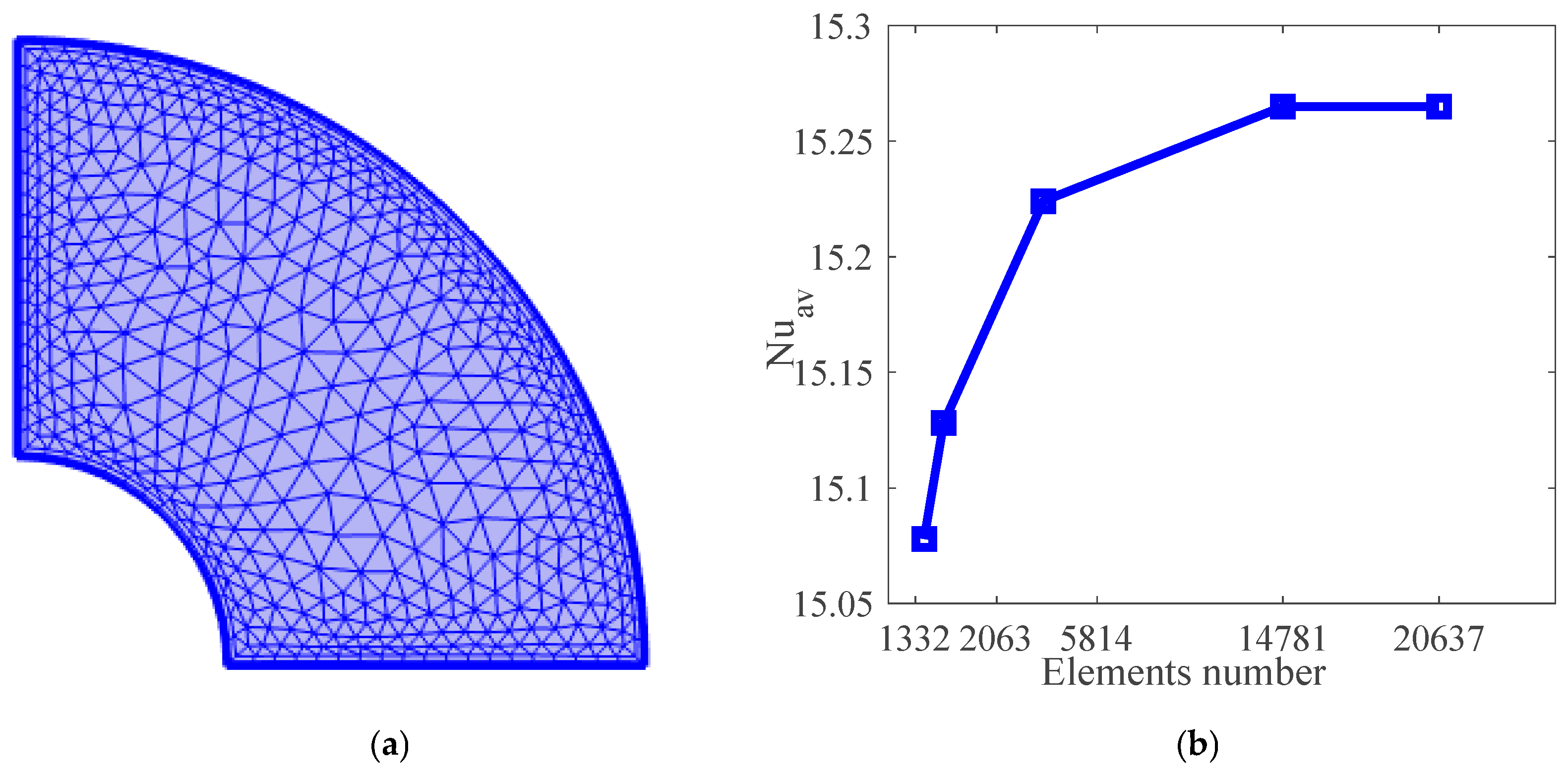
To ensure grid independence, a comprehensive grid sensitivity test is performed with Ra = 105, Ha = 20, ϕ = 0.04, Pr = 6.84, dsp = 10 nm, γ = π/2, and n = 3 (spherical shape). At τ = 2, the solution reaches a steady state, so this time is chosen and fixed for all computations. Five different mesh configurations are examined: uniform (1332 elements and 716 nodes), fine (2063 elements and 1094 nodes), finer (5814 elements and 3041 nodes), extra-fine (14,781 elements and 7648 nodes), and extremely fine (20,637 elements and 10,576 nodes), as is shown in Figure 2. The results for the extra-fine mesh show a minor difference compared to the extremely fine mesh. Moreover, the comparisons of the current study with those of Al-Weheibi et al. [40], as shown in Table 2, provide a high degree of confidence in the accuracy of the current code.
All numerical simulations are conducted using COMSOL Multiphysics 6.2 running on a laptop CPU of eight cores with 8 GB RAM. When considering the extra-fine mesh employed in the simulation runs, the Newton–Raphson solver requires approximately 6–11 iterations, depending on governing parameters. With the extra-fine mesh configuration (14,781 elements), the average computation time per simulation is order 25–35 min.

4. Result and Discussion

The optimization of the thermal transport for unsteady 2D convection of a nanofluid inside the wavy irregular geometry is performed, considering inclined periodic magnetic effects. The study examines various factors, including inner radius (0.2 ≤ r i n ≤ 0.3), undulation number (4 ≤ N ≤ 12), wave amplitude (0.05 ≤ A ≤ 0.1), MF’s half-wavelength (0 ≤ λ ≤ 1), and tilt angle of MF (0 ≤ γ ≤ π/2). The other factors include Ra (104Ra ≤ 106), Ha (0 ≤ Ha ≤ 50), ϕ (0 ≤ ϕ ≤ 0.05), and dsp (10 nm ≤ dsp ≤ 100 nm). Although the steady-state solution depends on these various conditions, it is set at time τ = 2 for all calculations after varying all possible conditions to certify consistency and reliability in the outcomes.
For both geometric and parametric optimization, CCD-based RSM was employed. Initially, it focuses on geometry regarding the factors r i n , A and N, determining the most effective wavy geometric configuration for maximizing thermal transport. The study then examines the impacts of various factors (Ra, Ha, and ϕ) for determining the optimal thermal transmission using the previously found optimal geometric configuration. The response function (average Nusselt number) is significantly impacted by several key variables that are determined by this thorough analysis. ANOVA is used for determining the significance of the model and the interactions of the parameters.

4.1. Optimization for Geometric Configurations

To confirm the validity and reliability of statistical analyses and to accurately interpret the outcomes of ANOVA, to ascertain whether the dataset is normally (or Gaussian) distributed, normality tests are commonly utilized. These methods may generate biased and inaccurate outcomes if the data significantly deviates from normality. When the data are normally distributed, there are well-defined properties for estimating parameters and calculating confidence intervals. The estimation’s precision and dependability may be impacted by the departures from normality.
Since there are fewer than 50 observations, the Shapiro–Wilk test is used to investigate the normality. From Table 3, the p-value is 0.3051, above the significance level (α = 0.05). Since the p-value is higher than the α-value, the null hypothesis (H0) is not rejected, i.e., the dataset is distributed normally. This means there is an insignificant statistical discrepancy between the sample dataset and the normal distribution. Moreover, the test statistic W = 0.9456, which usually ranges between 0 and 1 and is close to 1 in this case, indicates stronger evidence in favor of the null hypothesis, suggesting a normal distribution.
For the analysis of CCD, 15 different irregular geometries are investigated as presented in Table 3. These geometries are varied by adjusting A, N, and rin, while all other parameters are kept fixed. By varying them in the ranges 4 ≤ N ≤ 12, 0.05 ≤ A ≤ 0.1, and 0.2 ≤ rin ≤ 0.3, the response function (Nuav) is computed when Ra = 106, Ha = 20, ϕ = 0.04, dsp = 10 nm, n = 3, Pr = 6.84, γ = π/2, λ = 0.5. Table 3 illustrates that Nuav rises remarkably with A, while only slightly with N. These outcomes depict that wave amplitude plays a more significant role in thermal transport compared to the undulation number. Therefore, in designing the irregular domain with a wavy wall for obtaining optimal thermal transport, the wave amplitude of the wall is a factor to be prioritized.
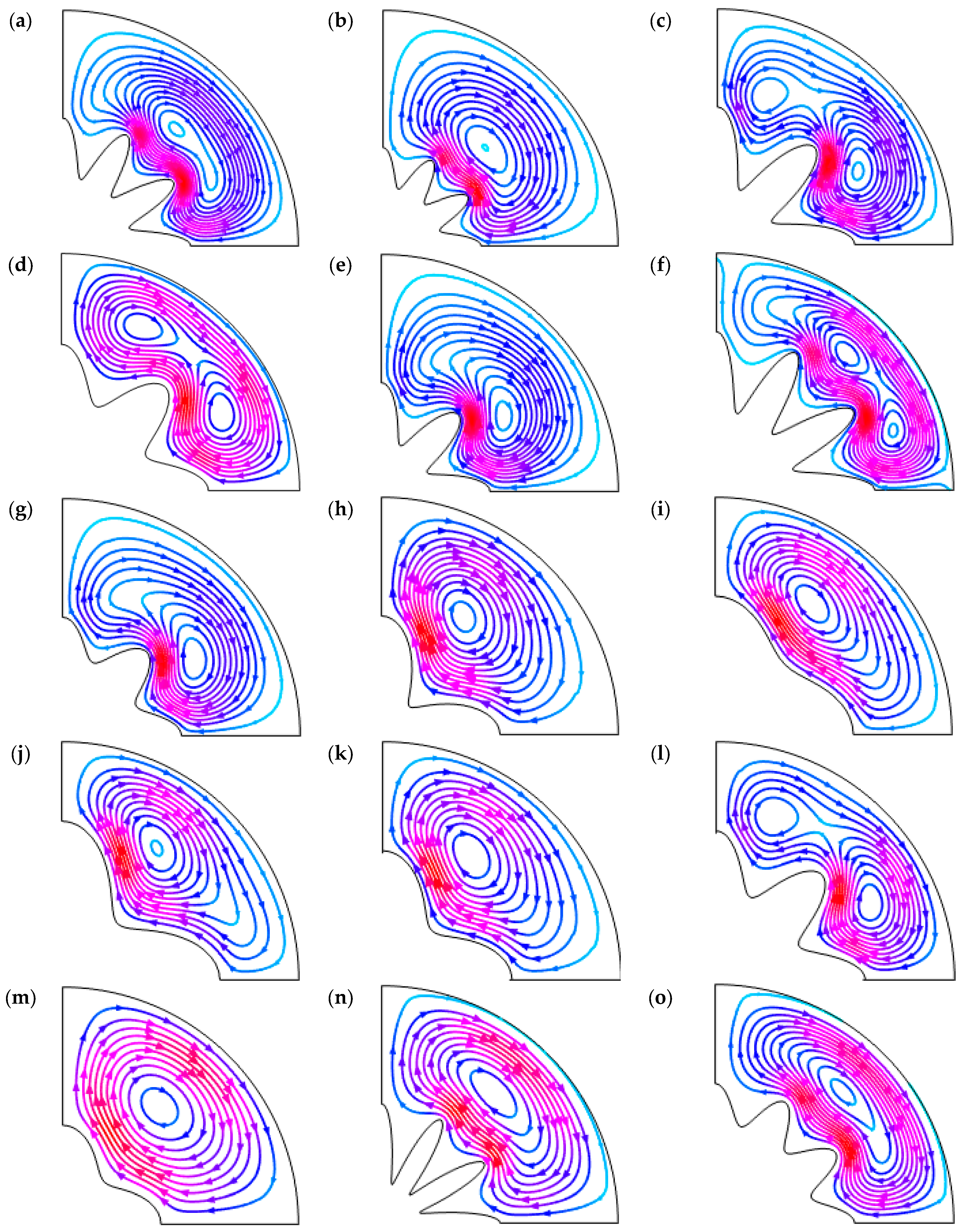
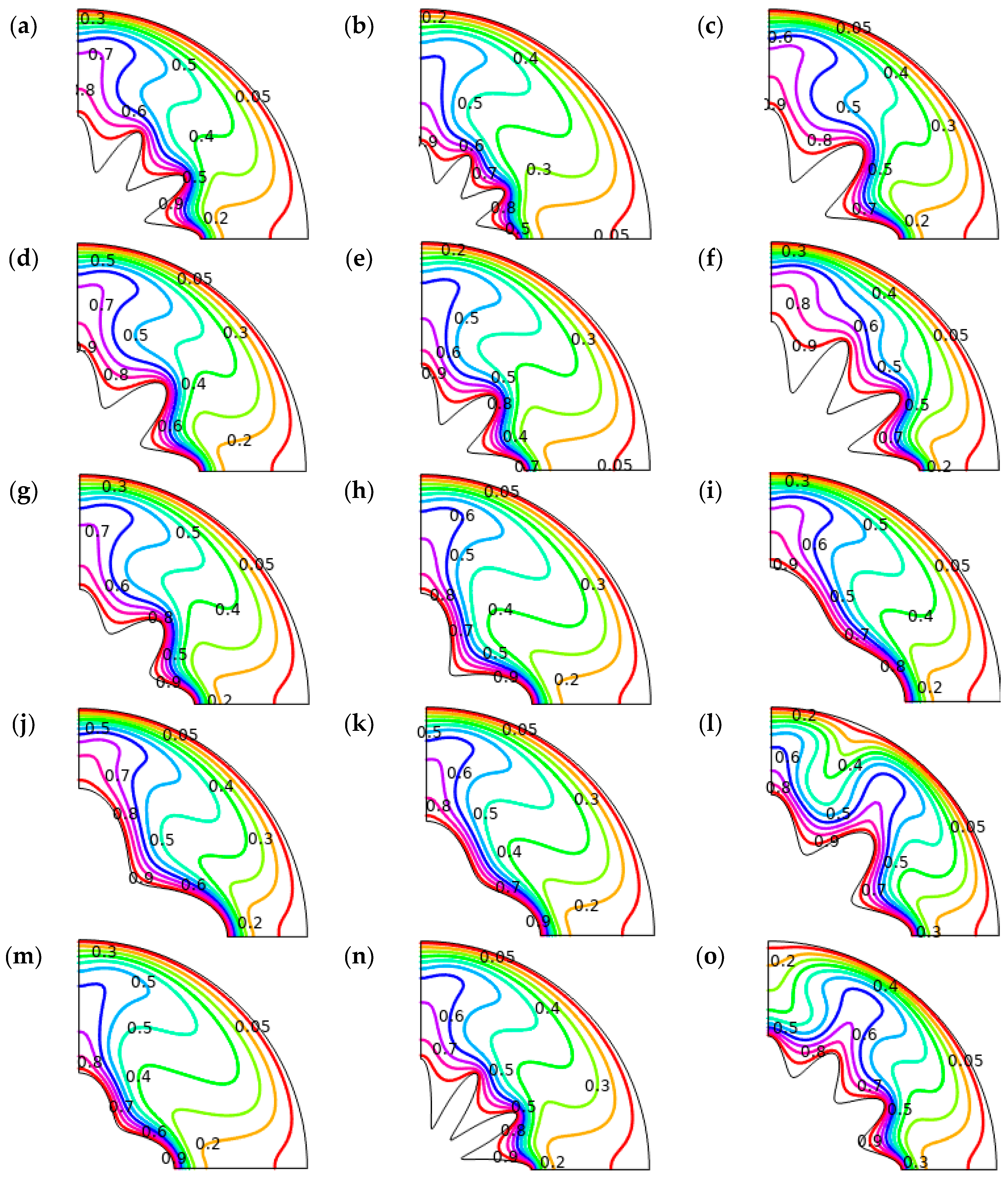
Figure 3 and Figure 4 illustrate the variation in the streamline and isothermal contours, respectively, for the CDD-based 15 different cases of geometric variations. In Figure 3, as A, N, and rin vary, the streamline characteristics alter and become irregular. In addition, a clockwise circulating flow within the enclosure is seen for all cases. The nanofluid generates irregular streamlines, resulting in enhanced heat transfer. The isothermal lines are significantly modified by altering rin, A, and N, as shown in Figure 4. The isothermal contours also turn more chaotic with increasing A. Compared to a straight wall, the heat transport increases due to the augmented surface area, which permits further interaction between the molecules of the nanoparticles and the wavy wall. The flow may create additional vortices because of the wavy boundary. In addition to boosting thermal convection, vortices can boost mixing. This can make it a topic of interest in various engineering applications where the effectiveness of thermal transport is crucial.
Table 4 represents an ANOVA to determine the model significance and geometric optimization with respect to Nuav. According to the results in Table 4, the F-value of 111.03 specifies the model’s significance. This F-value has a 0.01% probability of being caused by noise. The variation between the adjusted R2 of 0.9939 and the expected R2 of 0.9735 is less than 0.2, indicating a satisfactory agreement. Adequate precision is used to calculate the signal-to-noise ratio, which ideally should be higher than 4. In this study, the ratio of 68.366 denotes a sufficient signal. The results of “R2” and (adjusted) “Adj R2” values, which are 0.9968 and 0.9939, respectively, confirm the model’s validity and importance. As expected, the R2 of 99.68% for Nuav is higher, representing the model’s suitability for determining Nuav in good agreement with the experiment. These findings demonstrate that more than 99% of the response’s variability can be evaluated by the model.
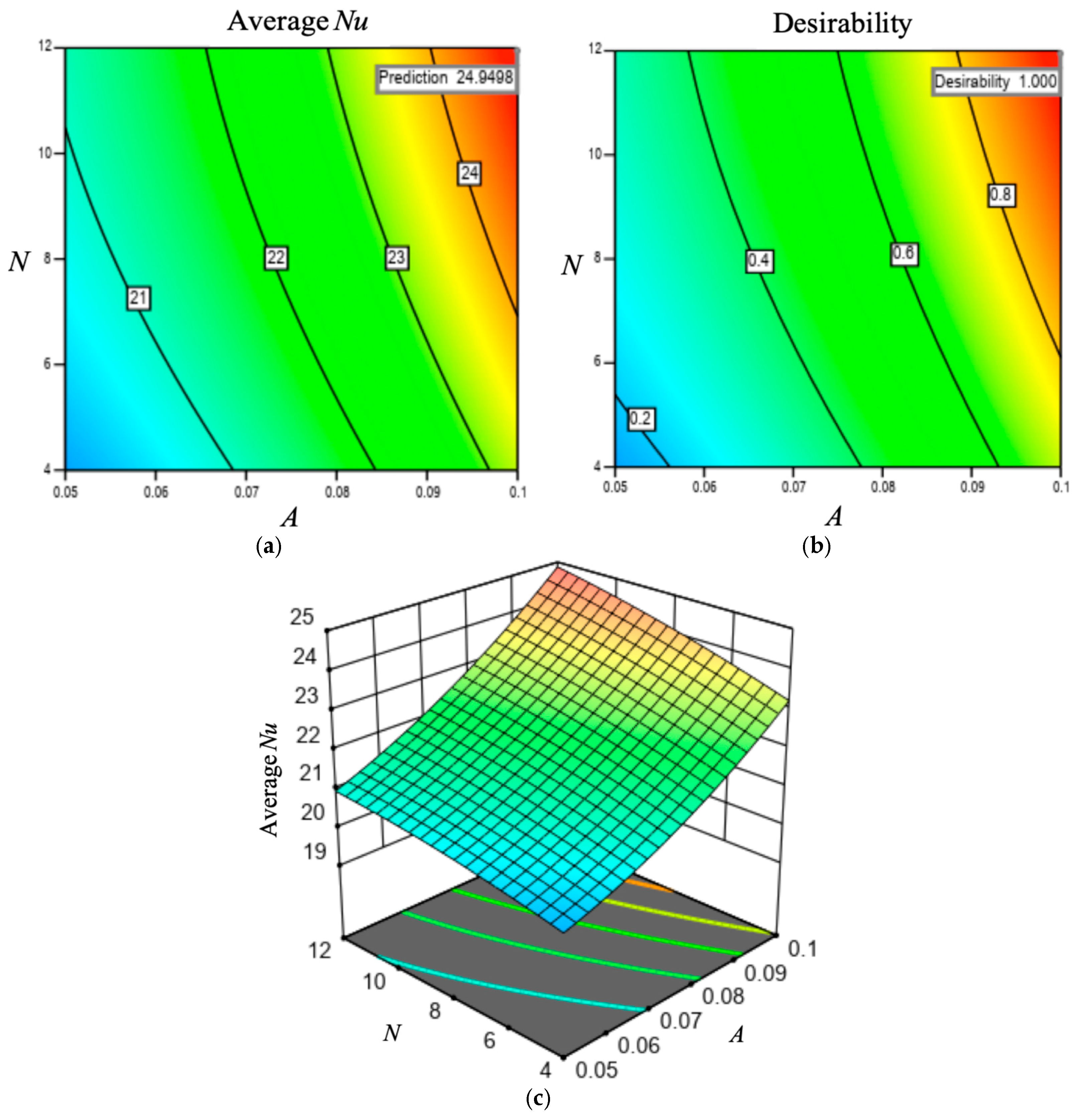
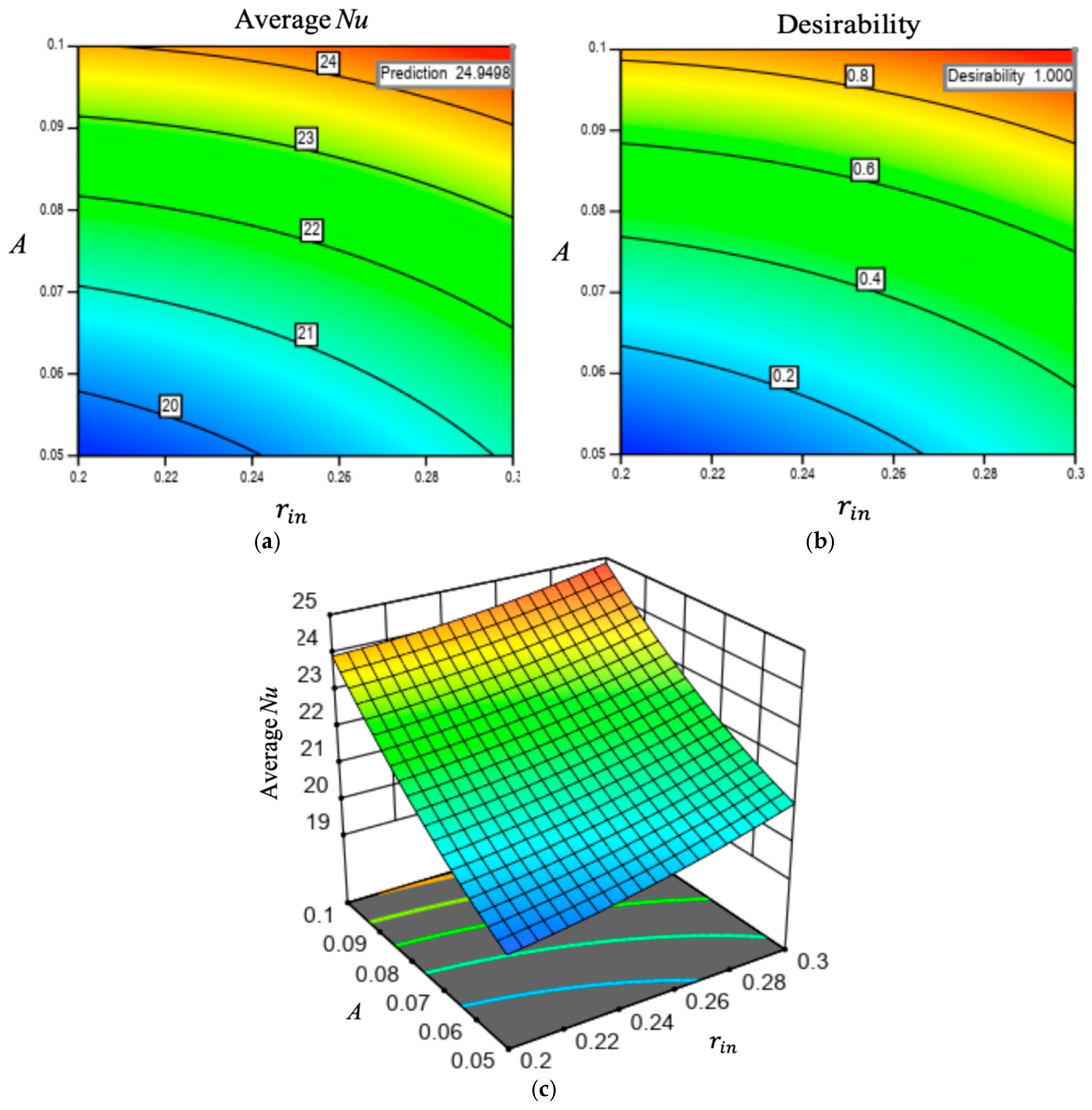
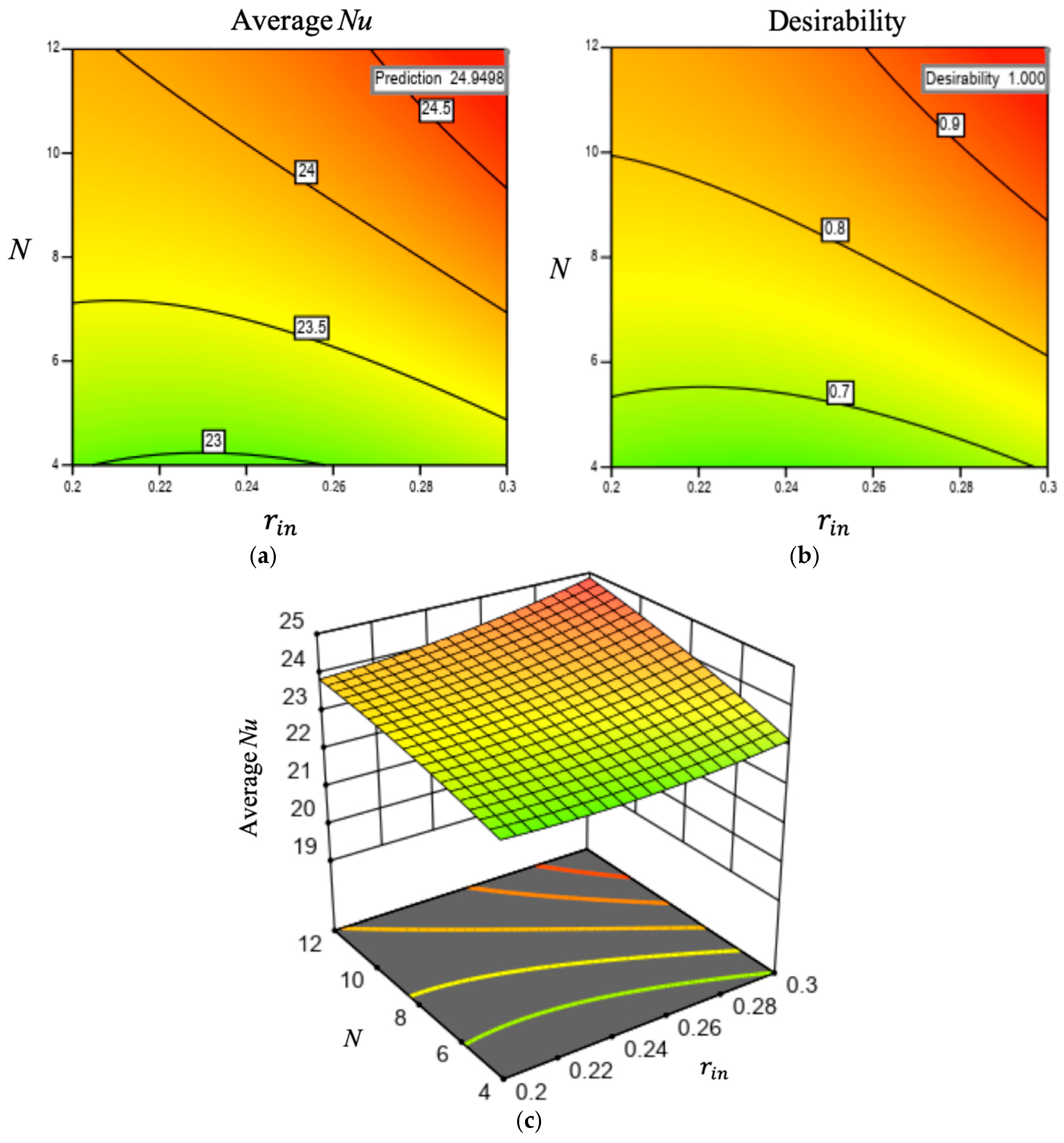
A quadratic equation for the response variable Nuav with respect to the inputs A, N, and r i n can be found using the RSM. The values for A (=0.1), N (=12), and r i n (=0.3) (normalized by outer diameter) clearly represent the optimal setting of thermal performance. Figure 5, Figure 6 and Figure 7 exhibit the contour plots (2D and 3D) and the Desirability function with respect to N, A, and r i n when Ra = 106, Ha = 20, ϕ = 0.04, dsp = 10 nm, n = 3, Pr = 6.84, γ = π/2, and λ = 0.5. When undulations occur on the boundary, they create vortices and enhance fluid mixing adjacent to the solid surface. This increased mixing leads to higher temperature transport rates, as it brings static fluid into contact more frequently, thereby enhancing heat exchange. As the surface is wavy, it effectively exposes more surface area to the surrounding liquid, allowing greater temperature transport between the solid surface and the liquid. This increased surface area facilitates more efficient heat transport, resulting in higher Nuav. Waves may hinder the development of stagnant fluid layers and facilitate more effective heat transfer from the surface by disrupting the boundary layer. Consequently, there is less thermal resistance at the liquid–solid interface, which increases convective thermal transport and ultimately results in larger Nuav. As a result, rises in wave amplitude and undulation improve boundary-layer dynamics, increase surface area for heat transfer, and enhance fluid mixing, all of which lead to higher convective heat transfer rates and, ultimately, higher Nuav. Additionally, these figures demonstrate that Nuav rises more noticeably with the wave amplitude than with respect to the inner radius and undulation number.
A unit value of the Desirability for both the undulation number and wave amplitude implies that the system is operating at an ideal (or perfect) level with respect to these parameters, leading to efficient and optimal thermal transport, and meeting the system’s desired objectives with precision. When the Desirability function reaches a maximum value of 1.0, it indicates that the specific combination of parameters has been perfectly tuned to enhance the system’s thermal effectiveness. According to the Desirability function presented in Figure 5b, Figure 6b and Figure 7b, the optimal situation (or maximum Desirability) is found at A = 0.1, N = 12, and r i n = 0.3. These values correspond to the highest observed Nuav, indicating that they represent the effective configuration for enhancing thermal transport. So, this configuration is selected as the optimal case for heat transfer based on Nuav.
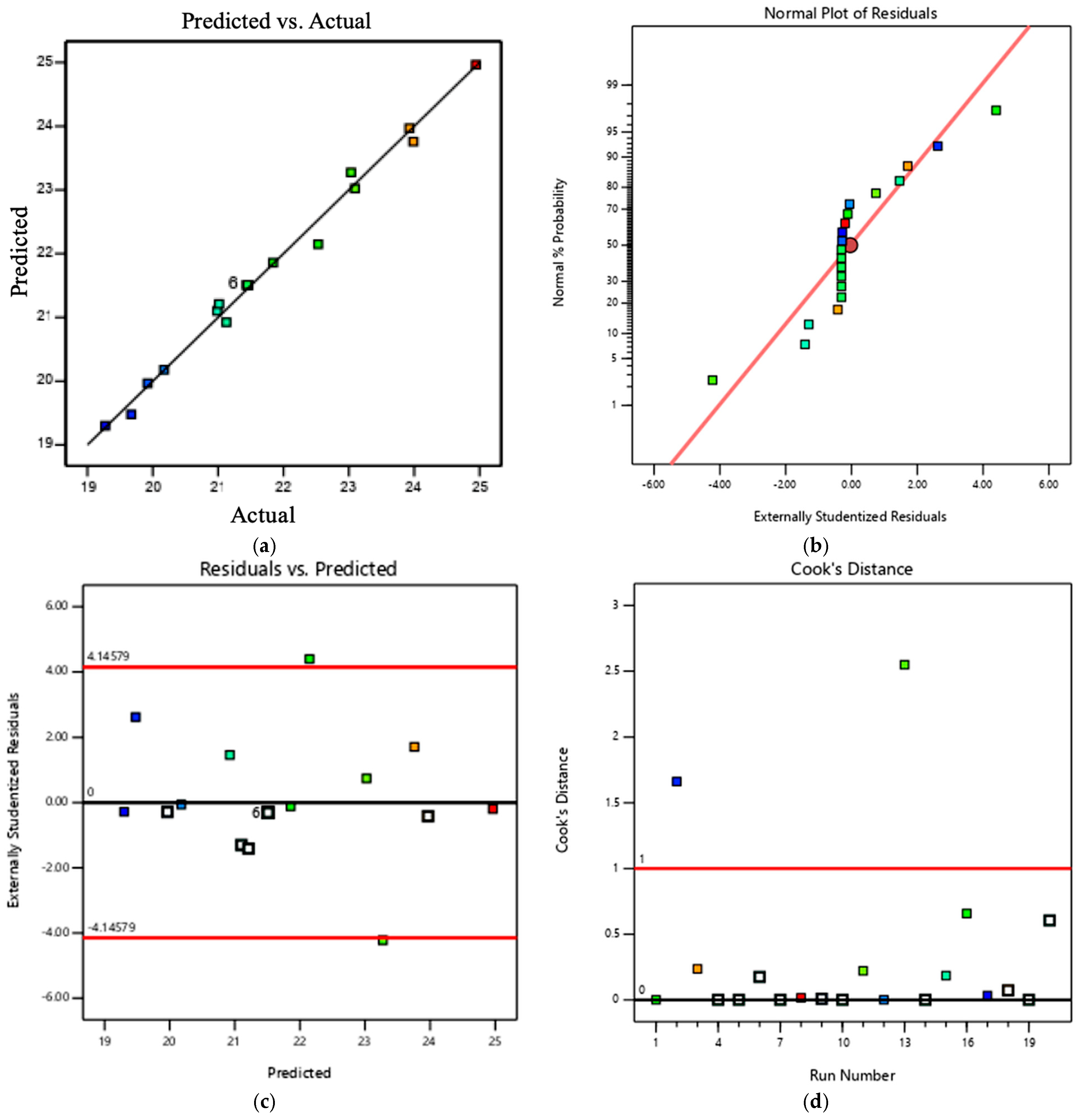
Figure 8 shows the statistical diagnostic graphs employed to assess the accuracy of the RSM approach based on the CCD design for the geometry optimization regarding Nuav as a function of A, N, and rin. As indicated in Figure 8a, the predicted vs. actual graph compares the estimated values of average Nu using the proposed quadratic RSM approach with the simulated values using FEM modeling. The points lie close to the 45° reference line without any curvature or deviation, meaning that the fitted model does not suffer from either overfitting or underfitting problems. It should be noted that the very high R2 coefficient equal to 0.9968 shown in Table 4 validates the above-mentioned conclusion.
The graph of the normal probability plot of residuals is illustrated in Figure 8b. The plot shows how the residuals lie close to the line that represents the theoretical normal values throughout the entire probability interval without any deviation towards either tail. The normality and independence of the errors can be proven by the W statistic of the Shapiro–Wilk test (W = 0.9456, p = 0.3051 > α = 0.05).
In Figure 8c, the plot of residuals against predicted values is uniformly distributed without any trends or periodic distribution between the limits −4.14579 and +4.14579 through the entire range of the predicted responses, which confirms that the assumptions of homogeneity and independence of errors are met, and the model of quadratic polynomial form suits the data set.
Figure 8d shows Cook’s distance in every experiment. This is done to see whether there is an observation that influences the value of the regression coefficient. All observations are within the cut-off point of 1.0. Also, none of them exceeds 4/(lh − 1), which equals 4/10 when l = 20 and h = 9. The only experiment where Cook’s distance is higher than in the other experiments, at about 2.5, is experiment 13.

4.2. Optimization for Physical Parameters

RSM enables us to simulate and understand the complex interrelationships among factors to optimize thermal performance in nanofluid-based arrangements. For the optimization of thermal transport with respect to the M = 3 input variables (Ra, Ha, and ϕ), RSM allows us to identify statistical correlations between them and the output response or performance indicator, such as Nuav. This research also illustrates how these three factors influence the response function in an optimal geometric configuration. To achieve this, a second-order approach is considered, which significantly improves the optimization process. Accordingly, a quadratic polynomial model is proposed as follows:
z =   a 0 + i = 1 M a i w i + i = 1 M a i i w i 2 + i = 1 M j = i + 1 M a i j w i w j  
where z is the output function, a0 is the intercept term, ai and aii are the linear and quadratic regression coefficients of the i-th factor, respectively, and aij are those for the cross terms of the i-th and j-th factors.
For the parametric optimization, the average Nusselt number is assumed as the response function (z), and the corresponding input variables wi (i = 1, 2, 3) are Ra, Ha, and ϕ. Our main purpose is to find a constrained optimal thermal correlation among these factors. The values of the factors are constrained to 0 H a 50 , 10 4 R a 10 6 , and 0 ϕ 0.05 , when A = 0.1, N = 12, rin = 0.3, dsp = 10 nm, Pr = 6.84, n = 3, γ = π/6, and λ = 0.5.
To guarantee numerical stability and trustworthy regression performance, all input factors are normalized before constructing the model. For RSM-based optimization, significant differences in the magnitude and units of variables can result in numerical instability, bias in parameter estimation, and the predominance of variables with larger ranges (e.g., Ra). While increasing resilience to outliers and high-magnitude values, rescaling reduces overflow, underflow, and precision loss. Additionally, it guarantees that Ha, Ra, and ϕ contribute proportionately to the response. Moreover, the use of new variables assuming only small values justifies our truncated Taylor expansion (22). The rescaling
R a = L o g 10 ( R a ) 4 1 ,   H a = H a 100 ,         ϕ = 10   ϕ
is utilized to ensure that all the factors are of the same order, with values ranging from 0 to 0.5.
The following RSM regression model is created to investigate the relationship between the rescaled inputs and the response factor:
N u a v =   a 0 + a 1   R a + a 2 H a + a 3 ϕ + a 12 R a · H a + a 13 R a · ϕ + a 23 H a · ϕ + a 11 R a 2 + a 22 H a 2 + a 33   ϕ 2
This model estimates and maximizes convective heat transfer efficiency in the nanofluid environment.
The experimental settings for Nuav response as a function of Ra′, Ha′, and ϕ′, with all other parameters kept constant, are illustrated in Table 5. To assess the dataset’s normality, the Shapiro–Wilk test is employed. The null hypothesis (H0) is assumed for a significance level of α = 0.05, assuming that the data are normally distributed, because the p-value (0.1654) is over α. This suggests that any deviation from the norm is not statistically significant. The test statistic W = 0.9315 by the Shapiro–Wilk test is in the 95% region of acceptance: [0.9044, 1]. The test statistic ranges between 0 and 1, with values closer to 1 indicating stronger evidence in favor of the null hypothesis (i.e., the data come from a normal distribution). In our case, W = 0.9315 (~1) indicates that the assumption of normally distributed data is consistent. The output value 29.685 is furthest from the rest of the responses, but not a significant outlier, as Grubbs’ test for outliers reveals a p-value of 1.9727, which is greater than α. Consequently, the results shown in Table 5 are consistent with a normal distribution.
Table 6 represents an ANOVA that evaluates the model’s significance and optimization of the physical parameters Ra′, Ha′, and ϕ′ in relation to Nuav. In an ANOVA, the number of independent data points required to compute the mean squares for evaluating the statistically significant differences between the groups is known as the degrees of freedom (DFs). Model terms and residual error are the two sources of variance that are quantified by the sum of squares (SS). The F-value is determined as the ratio of model mean square to residual mean square, and the mean square values are produced by dividing SS by the matching DF. The likelihood of observing such an F-statistic under the null hypothesis that the related term has no significant effect is represented by the p-value. In this analysis, the regression model for Nuav is statistically significant, with an SS of 539.22 and an F-value of 273.42, indicating a chance of less than 0.01% that the observed effect is attributable to random noise. Statistical significance occurs when p-values are less than 0.05 for model terms.
Table 6 shows a comparatively significant Adj. SSs (adjusted sums of squares) of 60.01, which demonstrates the robustness of the model. The R2 and adjusted R2 values, 0.9975 and 0.9953, respectively, provide more evidence of the model’s relevance and correctness. According to the statistical analysis, the model accurately predicts the response function (Nuav), as demonstrated by the high R2 value (99.75%). Furthermore, the model’s consistency with experimental data is confirmed by the adjusted R2 (R2-adj) value of 0.9953 and the predicted R2 of 0.9764, which show that the model can explain over 99% of the response variability. The model’s dependability in explaining the observed data is demonstrated by its high degree of accuracy.
The model terms Ra′, Ha′, ϕ′, Ra · Ha′, and Ra2 are statistically significant (p < 0.05), as highlighted in Table 6, indicating their effect on the response function (Nuav). Additionally, as shown in Table 7, the confidence interval coefficients from the regression analysis are used to refine the significant model terms found in Table 6. This improvement guarantees the accuracy and consistency of the model’s predictive power, improving comprehension of how these variables affect the response variable.
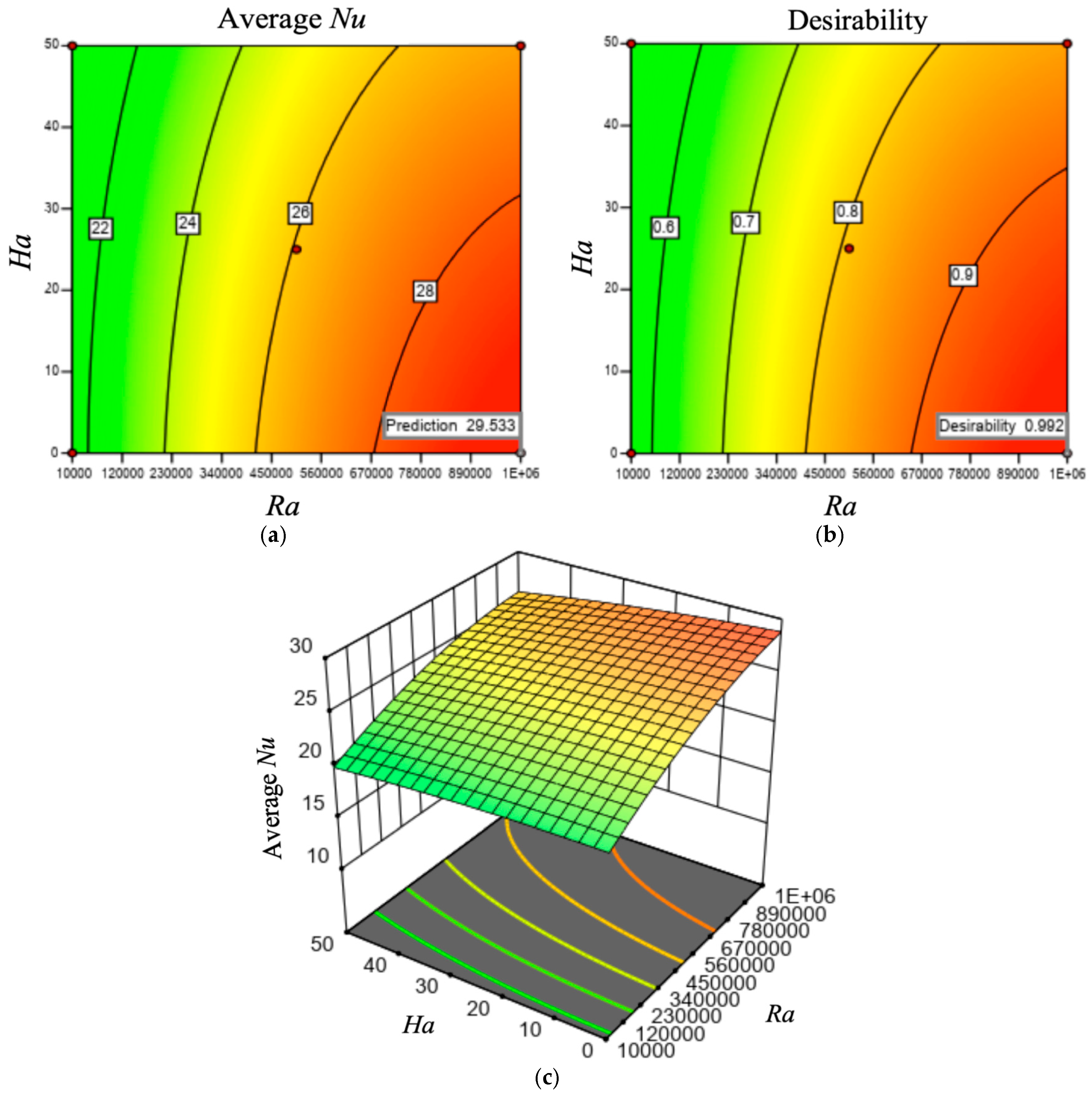
In the RSM framework, a response surface plot illustrates the relationship between various factors and the response function. Figure 9 shows how Nuav varies as a function of Ha and Ra, namely: (a) two-dimensional contour plot, (b) Desirability at the optimum point, and (c) three-dimensional response surface. The findings show that Nuav rises with Ra and reduces with Ha.
The positive correlation between Nuav and Ra indicates the simultaneous enhancement of buoyancy-driven convection. As Ra increases, buoyant effects progressively dominate viscous forces, leading to intensified convection currents inside the liquid domain. In heat transfer applications, a higher Ra usually means that there is a greater thermal difference between the warmed and cooled regions of the liquid. This increased temperature difference induces stronger buoyancy-driven flow patterns and therefore accelerates the thermal transfer. Convection leads the fluid to interact more strongly, thereby accelerating heat transfer rates. This improvement in fluid circulation facilitates mixing, consistently delivering cooler fluid to the hot surface and accelerating thermal energy removal. As a result, the convective heat transfer rate escalates, leading to higher Nuav. The observed increase in Nuav with Ra therefore demonstrates the enhancement of natural convection and thermal transport efficiency.
However, when Ha rises, the magnetic forces become more powerful in comparison to the viscous forces. The Lorentz force generated by the applied magnetic field surpasses viscous forces for a sufficiently high Ha. This magnetic dampening mitigates fluid motion, diminishes velocity gradients, and attenuates convective circulation inside the nanofluid. Consequently, heat transfer is hindered because heat is primarily transferred through fluid motion (convection). With reduced fluid motion, there are fewer opportunities for heat to be transported away from the hot regions, thus decreasing the overall thermal transport. Therefore, as Ha increases, the dominance of magnetic forces over viscous forces tends to suppress fluid motion, thereby lowering heat transfer rates.
In fluid dynamics, the Desirability function serves as a multi-response optimization tool to evaluate overall system performance based on various governing factors. It is used to find an optimal balance between conflicting factors. A higher Nuav indicates that improved heat transmission is a target in the current investigation. This amplification is pursued under an inclined periodic magnetic effect, defined by Ha. The Desirability function is constructed to maximize Nuav, and this corresponds to concurrently minimizing Ha and maximizing Ra within permissible physical constraints. Usually, Desirability ranges between 0 and 1, where 1 indicates the most desirable condition, and 0 indicates the least desirable. In this study, achieving a high Desirability of 0.992 for Ra, Ha and ϕ indicates that the outcomes under these conditions are extremely close to the optimal state, demonstrating excellent thermal performance and operational effectiveness, and that the characteristics in the nanofluid system are highly desirable or very close to the desired optimum thermal management.
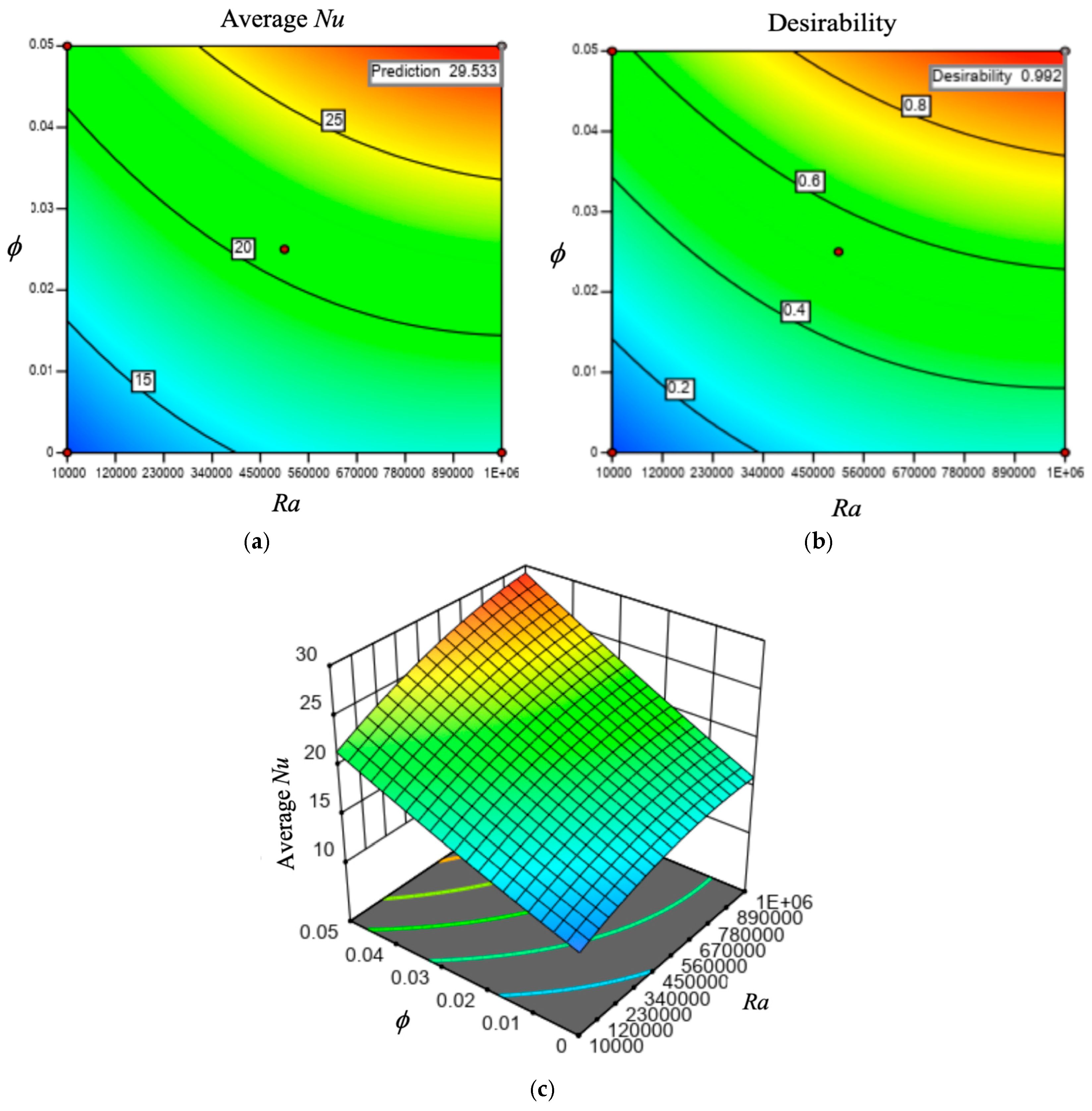
Figure 10 shows the output Nuav as a function of Ra and ϕ, represented by: (a) two-dimensional contour plots, (b) Desirability at the optimum point, and (c) three-dimensional surface plot. Typically, the study focuses on the enhancement of thermal convection that is caused by additional nanoparticles under the influence of buoyancy forces. The effect of nanoparticles on Nuav with respect to Ra depends on their modification of the effective thermophysical properties of the nanofluids. As Ra increases, the buoyancy forces become dominant, leading to stronger convective circulation and enhanced heat transport. Additional nanoparticles enhance this thermal transfer due to their higher thermal conductivity and large surface area, where natural convection is significant.
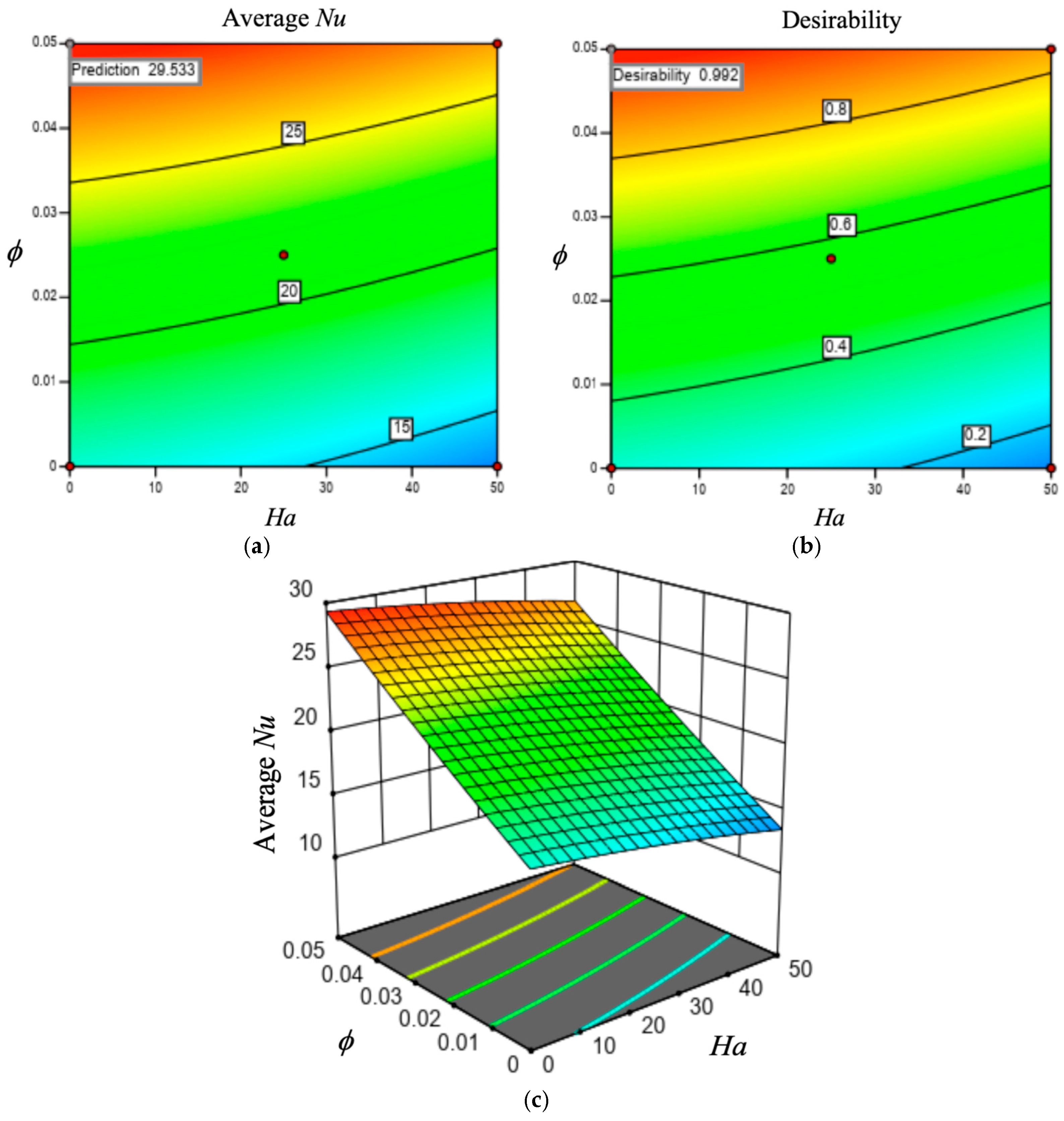
Figure 11 shows Nuav as a response function of Ha and ϕ, presented by: (a) two-dimensional contour plots, (b) Desirability at the optimum point, and (c) three-dimensional surface plots. The graph demonstrates that Nuav increases dramatically with increasing ϕ , while it reduces with increasing Ha. A higher nanoparticle volume fraction results in a more noticeable and faster rise in the rate of heat transport. The magnetic effect has the potential to create a changed physical environment that may impact on all chemical and physical processes. Magnetic fields drive electric currents in a moving electrically conductive fluid, which then alters the magnetic field and produces forces inside the liquid. As a result, the Lorentz force opposes fluid motion, hinders transfer of heat, and suppresses liquid flow, which lowers fluid velocity and convection intensities. This phenomenon changes with additional nanoparticles depending on their interaction with the magnetic field, and on how they affect the suspension viscosity and effective electrical conductivity. Thus, the influence of ϕ on Nuav in relation to Ha is contingent upon the interrelated effects of magnetic damping, property alterations generated by nanoparticles, and convective transport processes. In some situations, connections between particles and magnetic fields may encourage directional alignment or anisotropic transport effects, which could improve heat transmission along particular directions.
The concept of Desirability provides a framework for optimization in CCD. A position that maximizes such a function is discovered through numerical optimization. One key feature of this procedure is the ability to adjust the desired outcome by modifying the importance or weight of the various factors. A single Desirability function is created by combining all the goals for various responses and factors. The weight of the goal can be adjusted by its characteristics. The intended ranges for all responses (Di) are reflected in the Desirability function:
D   =   ( D 1 · D 2 ·   · D m ) 1 m = ( i = 1 m D i ) 1 m  
where m (in this study, m = 1) is the number of response functions in the experiment. The overall function is 0 if any response or factor is outside the Desirability range. Every response requires a low and high value to assign each target to optimize simultaneously.
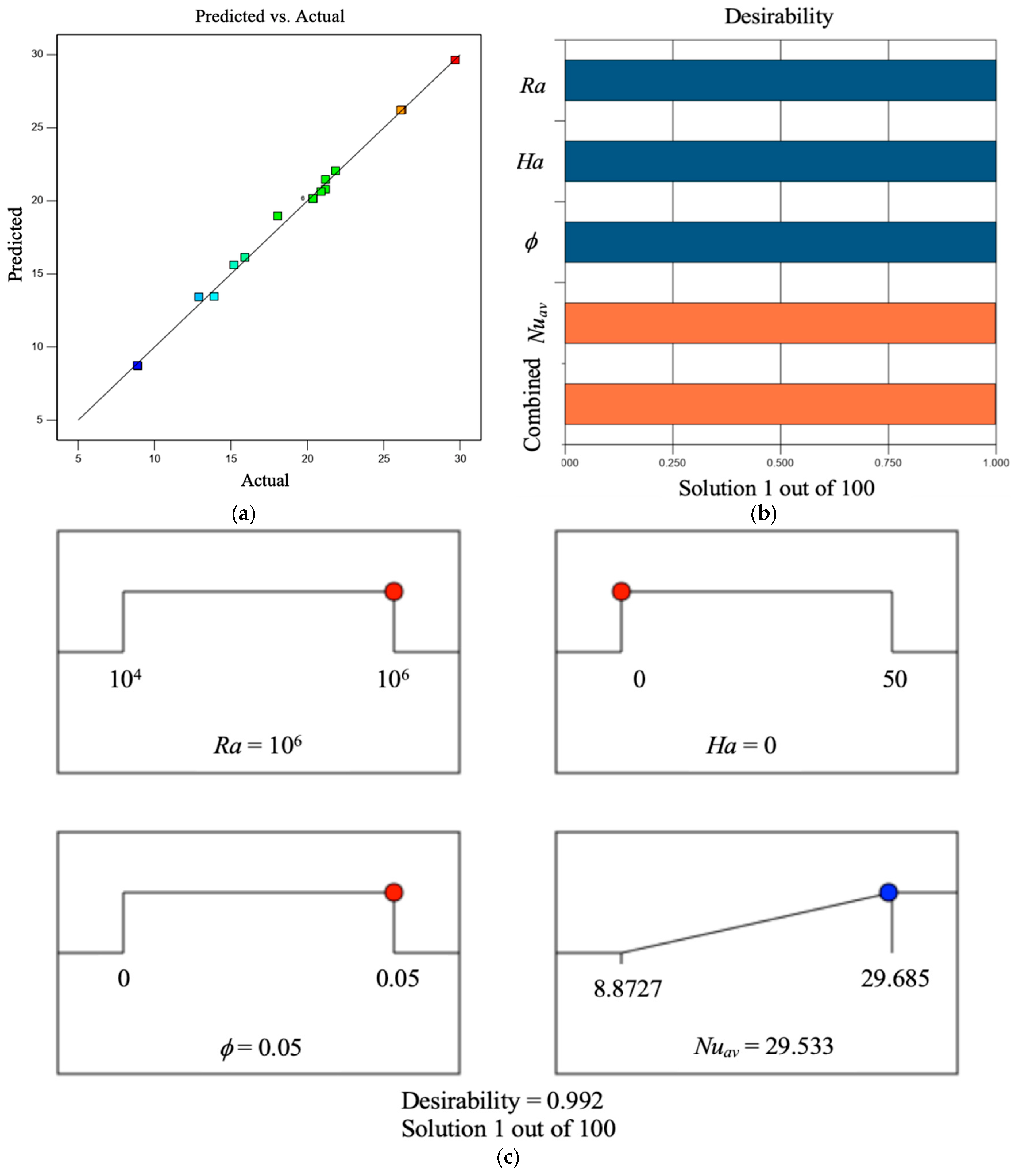
Figure 12 represents: (a) outcomes for Nuav comparing predicted and input data, (b) a bar graph demonstrating the optimal solution, and (c) the Desirability ramp of Nuav. A comparison of the expected and real data for Nuav is exhibited in Figure 12a. This type of diagram should display a random scatter around a 45° line passing through the center of each data point over the entire data range. It is observed that the predicted outcomes roughly match the slope of the line, demonstrating that the model’s accuracy level is acceptable. The RSM generates scattering outcomes that satisfactorily accord, denoting that the CCD model can predict the heat transmission rate with extreme precision.
Figure 12b represents the bar chart of the Desirability function, which is used to find the optimal combination of the design parameters. The combined Desirability of all input factors (Ra, Ha, and ϕ), as well as of the response Nuav, reaches the maximum value of 1.0, indicating optimal conditions within the investigated parameter space. This confirms that the chosen parameters yield the optimal thermal performance within the range investigated in this study.
The maximal solution of the optimization is displayed in Figure 12c. The variables are chosen in the range of values for Ra′ (with Ra varying from 104 to 106), Ha′ (with Ha between 0 and 50), and ϕ′ (with 0  ϕ  0.05). The objective of this procedure is to use Nuav to get the optimal thermal transport, obtained with Ra′ = 0.5 (maximum Ra), Ha′ = 0 (absence of MHD effects), and ϕ′ = 0.5 (5% nanoparticle concentration), and involves searching through 20 beginning points (Table 5) in the response variations. In this study, the Desirability is 0.992, and Nuav is at 29.65 under the prescribed conditions of the factors.
Table 7 presents the estimated regression coefficients of the RSM model along with standard error, t-statistics, and 95% CI. The outcomes depict that the linear component of the two variables Ra′ and Ha′ does not have a statistically significant (p > 0.05) impact on the fitting model, indicating that their direct linear impacts on the response function (Nuav) are insignificant. On the other hand, the linear term ϕ′ is endowed with a strong influence and is statistically significant on the response. A similar conclusion holds among some of the interaction terms; the interactions Ra · ϕ′ and Ha · ϕ′ do not contribute significantly, while only Ra · Ha′ plays an important role. Similarly, only R a 2 is statistically significant among the quadratic terms, ϕ 2 and H a 2 are not.
Statistically insignificant coefficients in regression analysis, which are usually shown by large p-values, show that there is not enough evidence to demonstrate a nonzero effect from the relevant predictors. Weak physical influence, multicollinearity across predictors, or a small sample size could be the cause of the lack of significance seen for some terms. It should be mentioned that the p-values listed in Table 6 and Table 7 are not directly comparable because they relate to distinct statistical measures.
The relationship between the response function and the significant rescaled factors is illustrated by the modified RSM model, which is stated as:
N u a v =   8.61321 + 28.0410 ϕ 11.442 R a · H a + 30.06188 R a 2
Therefore, going back to the original variables using (23), the fitting model becomes:
N u a v =   38.67509 15.03094 L o g 10 ( R a ) + 0.11442   H a + 280.41 ϕ 0.02861 H a · L o g 10 ( R a ) + 1.87887 ( L o g 10 ( R a ) ) 2
The actual parameter values are predicted to be found within a probabilistic range established by the CI displayed in Table 7. More accuracy in parameter estimation is shown by smaller intervals. The study’s relatively low 95% confidence intervals indicate that the fitted model accurately captures the underlying relationship between the response function (Nuav) and its controlling parameters, and that the estimated coefficients are reliable.
The value of the intercept (8.61321) corresponds to Nuav at the lowest values of all the parameters investigated here (Ra = 104, Ha = 0, ϕ = 0). Among all linear coefficients, the highest value is that corresponding to ϕ′ (28.041), which implies that nanoparticle concentration has the most pronounced single-parameter effect on thermal performance, and it is indeed the case according to the ANOVA test with an F-value of 212.42 for ϕ′ (see Table 6). The physically meaningful value of the coefficient of interaction R a · H a is negative (−11.442), which means that an increase in the value of the Lorentz force counteracts convection in terms of reducing the magnitude of its buoyancy component. Thus, as Ra grows, fluid motion gets stronger, therefore becoming increasingly vulnerable to the Lorentz force action; that is why the negative coefficient implies that the higher Ra is partly offset by high Ha. A positive value of the quadratic term R a 2 (30.062) is related to the increasing effect of buoyancy in accelerating natural convection when Ra is high. Quadratic coefficients for H a 2 and ϕ 2 are not statistically significant (p > 0.05).
Table 8 shows a comparison between the real and estimated values of Nuav for different combinations of Ra, Ha, and ϕ. The relative error for each run indicates the accuracy of the model used to estimate these values. The errors are generally small (except runs 5 and 12), indicating a good fit between real and estimated values. The predicted minor errors in the maximum cases in Table 8 prove that the correlation is valid.

4.3. Effects of Non-Uniform Inclined Periodic Magnetic Field

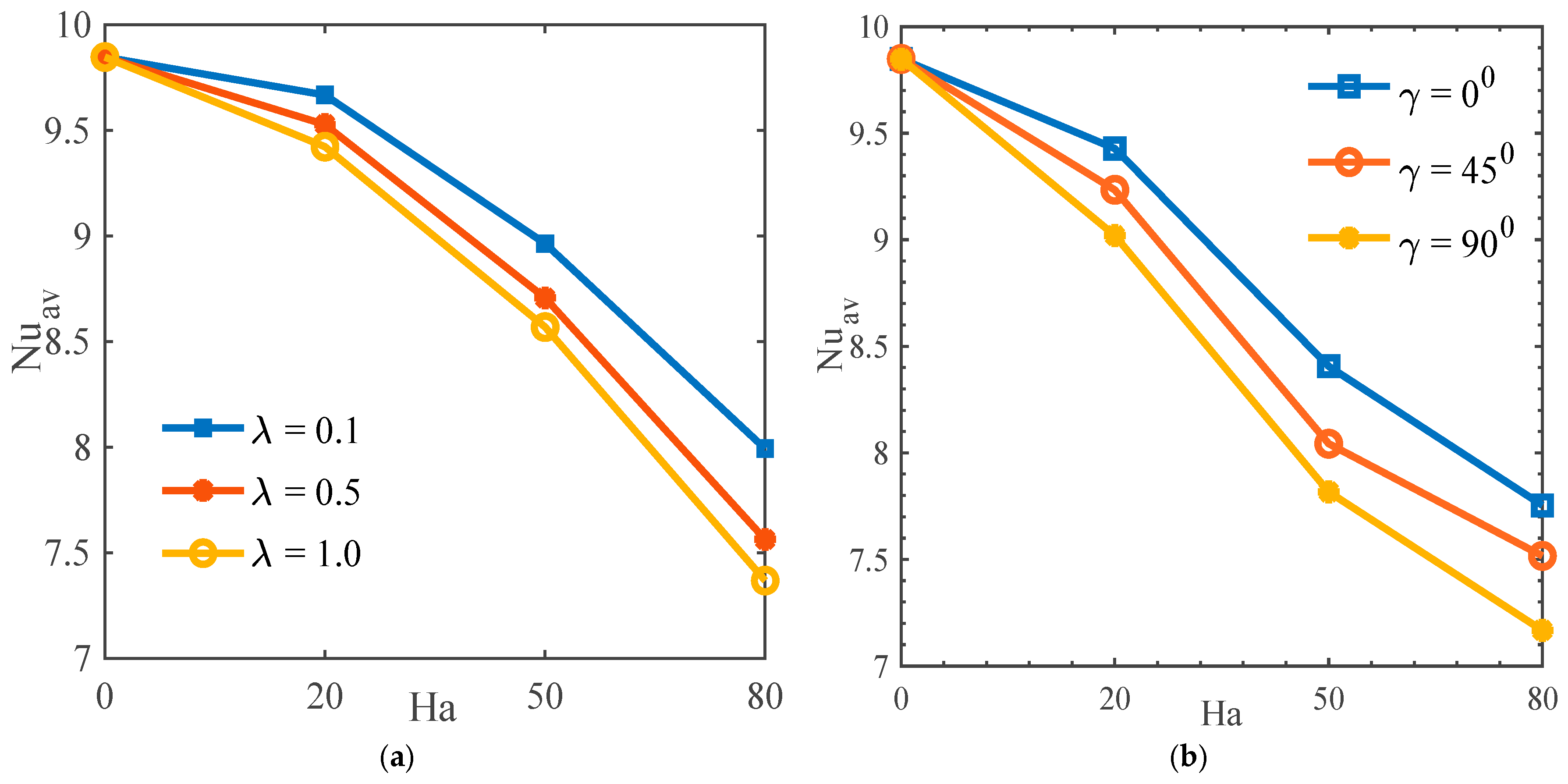
Figure 13a,b illustrates the output Nuav for various wavelengths and inclinations of the magnetic field, respectively, when R a = 10 5 , ϕ = 0.05 , A = 0.1, N = 12, r i n = 0.3 , dsp = 10 nm, Pr = 6.84, and n = 3. The figures depict that both the tilting angle and the spatial period of the MF have a decreasing effect on the Nusselt number. Specifically, as the inclination of the MF or the half-wavelength changes, there is a noticeable reduction in the Nu (average). This suggests that both the spatial arrangement and the orientation of the MF have a significant influence on convective heat transport in the nanofluid. When combined with Ha, the period of the MF affects the conducting fluid’s flow dynamics. The fluid may experience additional electromagnetic forces because of the MF, which may reduce the flow rate. Additionally, a Lorentz force created by an inclined MF mitigates convection triggered by natural buoyancy. This resistance to convection motion reduces the fluid’s capacity to mix and transfer heat efficiently, resulting in a lower Nuav and reduced temperature transport efficiency.
Optimizing hydromagnetic systems—which depend on interactions between conductive fluids and magnetic fields—such as MHD power generators and pumps requires an understanding of how inclined and periodic MF affect fluid flow. The applied MF creates electric currents in applications such as MHD power generation, which have a significant impact on fluid dynamics and overall efficiency. The MF’s inclination and periodicity characteristics are essential for regulating flow behavior and improving energy conversion or pumping efficiency. As a result, examining these magnetic field configurations allows MHD systems to be fine-tuned, improving their effectiveness, dependability, and efficiency under a variety of circumstances.

5. Conclusions

This work presents a comprehensive numerical and statistical investigation of the time-dependent nanofluid natural convection inside a quarter-circular domain with an inner wavy boundary, incorporating inclined periodic MHD influences. A combined FEM-RSM framework is employed for the analysis of both optimal geometric configurations and parametric optimization of thermal transport. To validate the model’s significance, ANOVA analysis is also performed to determine the statistical relevance of the different factors, ensuring that the optimization outcomes are robust and meaningful. The findings demonstrate that geometric configuration and physical parameters play significant influence on nanofluid buoyancy-driven convection within complex enclosures. In addition, this combined numerical–statistical approach ensures computational efficiency and reliability for various thermal management and fluid-dynamics applications, while enabling the determination of optimal wavy geometric configurations and related parametric conditions.
The following findings are derived from the current study.
  • The optimal geometric configuration is achieved at A = 0.1 (wavy-wall amplitude), N = 12 (undulation number), and r i n = 0.3 (inner radius), yielding optimal thermal performance.
  • The wavy-wall amplitude has a major effect on heat transport among the geometric features, followed by the inner radius and undulation number. An increase in A from 0.05 to 0.1 increases the heat transfer rate by up to 25%.
  • The parametric optimal thermal efficiency occurs for Ra = 106, Ha = 0, and ϕ = 0.05, resulting in an average Nusselt number of 29.533 and Desirability of 0.992.
  • In the ANOVA analysis, nanoparticle volume fraction shows a key impact on thermal performance. An additional 1% nanoparticle concentration causes an increase in heat transfer of about 17% (at Ra = 106, and Ha = 0).
  • An increase in Ra and ϕ increases heat transfer due to a rise in the strength of buoyancy-driven convection and enhanced thermophysical properties.
  • An increase in Ha decreases convective motions through magnetic damping, causing a reduction in heat transfer of about 15% (Ha varies from 0 to 50).
  • The spatial periodicity of the magnetic field and its inclination significantly impact thermal transport. An increase in the magnetic field’s inclination angle, or a reduction in its wavelength, decreases thermal transport efficiency.
  • RSM-based quadratic correlations for Nu (average), using Ra, Ha, and ϕ, are obtained and verified against FEM results, with an R2 value of 0.9975 and relative errors not exceeding 7%.
The present study is limited to a single-phase nanofluid model without viscous dissipation or thermal radiation. Future developments of this paper include two-phase flow phenomena, thermophoretic effect, Brownian motion, entropy generation, experimental verification, multi-objective optimization analysis, and numerical and physical stability checks. The combined FEM-RSM may further be generalized to other practical magneto-thermal engineering problems.

Author Contributions

T.I.: Conceptualization, Methodology, Software, Investigation, Writing—original draft; S.G.: Resources, Supervision, Writing—review and editing; M.M.A.: Resources, Supervision, Writing—review and editing. All authors have read and agreed to the published version of the manuscript.

Funding

This work was partially supported by CMUP—Centro de Matemática da Universidade do Porto, member of LASI, which is financed by national funds through FCT—Fundação para a Ciência e a Tecnologia, I.P., under the project with reference: UID/00144/2025, doi: https://doi.org/10.54499/UID/00144/2025, and project REFARMING—NORTE2030-FEDER 02719900, co-funded by the European Union through the NORTE 2030 Regional Programme, under Portugal 2030. TI also wishes to thank the grant with reference UI/BD/153761/2022 through FCT.

Data Availability Statement

The original contributions presented in this study are included in the article. Further inquiries can be directed to the corresponding author.

Acknowledgments

TI thanks the support of the Department of Mathematics, Gopalganj Science and Technology University, Bangladesh.

Conflicts of Interest

Author Marco Martins Afonso is employed by SIT Technologies. The remaining authors declare that the research was conducted in the absence of any commercial or financial relationships that could be construed as a potential conflict of interest.

Nomenclature

Latin Greek
a0, ai, aijRegression coefficients and interceptαThermal diffusivity [m2s−1]
AWave amplitude for wall [m]βThermal expansion coefficient [K−1]
B0Magnitude of magnetic field [kg s−2A−1]γInclined angle of the magnetic field
cpSpecific heat at constant pressure [m2s−2K−1] ΓSubordinate variables
dDiameter [m]θNon-dimensional temperature
DDesirabilityκBBoltzmann constant [kg m2s−2K−1]
EElectric field [kg m s−3A−1]λ0Magnetic field wavelength [m]
FmElectromagnetic force [kg m2s−2]λNondimensional MF spatial period
gGravitational acceleration [m s−2]μDynamic viscosity [kg m−1s−1]
kThermal conductivity [kg m s−3K−1] νKinematic viscosity [m2s−1]
LReference length [m]ρMass density [kg m−3]
mResponse numberσElectric conductivity [kg−1m−3s3A2]
MNumber of input factorsτDimensionless time
nNanoparticles′ shape factorϕVolume fraction of nanoparticles
NWall undulation numberξRotational angle of inner/outer wall
pDimensional pressure [kg m−1s−2]
PDimensionless pressureSubscripts
qIterations numberhHot surface
QHeat source/sink [K s−1]cCold surface
rWall radius [m]nfNanofluid
sWall-normal coordinatebfBase fluid
TFluid temperature [K]spSolid particle
tDimensional time [s]avAverage
u, vDimensional velocity components [m s−1]inInner wall
U, VDimensionless velocity componentsoutOuter wall
u′, vRotated velocity components [m s−1]
wInput variablesNondimensional numbers
x, yDimensional coordinates [m]HaHartmann
X, YDimensionless coordinatesNuNusselt
x′, yRotated coordinates [m]PrPrandtl
zResponse function (output)RaRayleigh

References

  1. Mahian, O.; Kolsi, L.; Amani, M.; Estellé, P.; Ahmadi, G.; Kleinstreuer, C.; Marshall, J.S.; Siavashi, M.; Taylor, R.A.; Niazmand, H.; et al. Recent advances in modeling and simulation of nanofluid flows-Part I: Fundamentals and theory. Phys. Rep. 2019, 790, 1–48. [Google Scholar] [CrossRef]
  2. Induranga, A.; Galpaya, C.; Vithanage, V.; Indupama, A.; Maduwantha, K.; Gunawardana, N.; Wijesekara, D.; Amarasinghe, P.; Nilmalgoda, H.; Gunasena, K.; et al. Nanofluids for Heat Transfer: Advances in Thermo-Physical Properties, Theoretical Insights, and Engineering Applications. Energies 2025, 18, 1935. [Google Scholar] [CrossRef]
  3. Yang, Z.; Yi, S.; Li, J.; Ding, S. Thermal and force simulation modelling of graphene oxide nanosheets as cutting fluid additives during Ti-6Al-4V drilling process. Int. J. Therm. Sci. 2025, 210, 109608. [Google Scholar] [CrossRef]
  4. Yang, Z.; Wang, Z.; Li, J.; Ding, S.; Yi, S. Tribological and machining performance of novel DE@Mo2CTx MXene bio-microcapsule nanofluids in machining of magnesium alloys. Tribol. Int. 2025, 211, 110828. [Google Scholar] [CrossRef]
  5. Hanif, H.; Mahat, R. Heat transfer enhancement in a square cavity using ternary nanofluid. Phys. Fluids 2025, 37, 083132. [Google Scholar] [CrossRef]
  6. Alipour, N.; Jafari, B.; Hosseinzadeh, K. Thermal analysis and optimization approach for ternary nanofluid flow in a novel porous cavity by considering nanoparticle shape factor. Heliyon 2023, 9, e22257. [Google Scholar] [CrossRef]
  7. Hemmat Esfe, M.; Alirezaie, A.; Rejvani, M. An applicable study on the thermal conductivity of SWCNT-MgO hybrid nanofluid and price-performance analysis for energy management. Appl. Therm. Eng. 2017, 111, 1202–1210. [Google Scholar] [CrossRef]
  8. Corcione, M. Empirical correlating equations for predicting the effective thermal conductivity and dynamic viscosity of nanofluids. Energy Convers. Manag. 2011, 52, 789–793. [Google Scholar] [CrossRef]
  9. Islam, T.; Alam, M.N.; Niazai, S.; Khan, I.; Fayz-Al-Asad, M.; Alqahtani, S. Heat generation/absorption effect on natural convective heat transfer in a wavy triangular cavity filled with nanofluid. Sci. Rep. 2023, 13, 21171. [Google Scholar] [CrossRef]
  10. Mozafary, B.; Akbar, A.; Arani, A.; Sheikhzadeh Nooshabadi, G.A.; Salimi, M. Brownian motion models effect on the nanofluid fluid flow and heat transfer in the natural, mixed, and forced convection. J. Therm. Eng. 2024, 10, 88–100. [Google Scholar] [CrossRef]
  11. Abdelmalek, Z.; Tayebi, T.; Dogonchi, A.S.; Chamkha, A.J.; Ganji, D.D.; Tlili, I. Role of various configurations of a wavy circular heater on convective heat transfer within an enclosure filled with nanofluid. Int. Commun. Heat Mass Transf. 2020, 113, 104525. [Google Scholar] [CrossRef]
  12. Kumar, P.; Pandey, K.M. Numerical investigation of thermo-hydraulic transport characteristics of two-dimensional, steady flow through partially porous wavy channel. Numer. Heat Transf. Part A Appl. 2022, 81, 31–47. [Google Scholar] [CrossRef]
  13. Shutaywi, M.; Shah, Z. Mathematical Modeling and numerical simulation for nanofluid flow with entropy optimization. Case Stud. Therm. Eng. 2021, 26, 101198. [Google Scholar] [CrossRef]
  14. Fereidooni, J. The effect of fins and wavy geometry on natural convection heat transfer of TiO2–water nanofluid in trash bin-shaped cavity. Eur. Phys. J. Spec. Top. 2022, 231, 2713–2731. [Google Scholar] [CrossRef]
  15. Chattopadhyay, A.; Goswami, K.D.; Pandit, S.K.; Hansda, S. Hydrothermal characteristics of ferrofluid in a wavy chamber with magnetic field-dependent viscosity: Effects of moving walls. J. Magn. Magn. Mater. 2024, 591, 171655. [Google Scholar] [CrossRef]
  16. Hatami, M.; Song, D.; Jing, D. Optimization of a circular-wavy cavity filled by nanofluid under the natural convection heat transfer condition. Int. J. Heat Mass Transf. 2016, 98, 758–767. [Google Scholar] [CrossRef]
  17. Zarei, M.S.; Khalil Abad, A.T.; Hekmatifar, M.; Toghraie, D. Heat transfer in a square cavity filled by nanofluid with sinusoidal wavy walls at different wavelengths and amplitudes. Case Stud. Therm. Eng. 2022, 34, 101970. [Google Scholar] [CrossRef]
  18. Giwa, S.O.; Sharifpur, M.; Meyer, J.P. Experimental investigation into heat transfer performance of water-based magnetic hybrid nanofluids in a rectangular cavity exposed to magnetic excitation. Int. Commun. Heat Mass Transf. 2020, 116, 104698. [Google Scholar] [CrossRef]
  19. Alazzam, A.; Qasem, N.A.A.; Aissa, A.; Abid, M.S.; Guedri, K.; Younis, O. Natural convection characteristics of nano-encapsulated phase change materials in a rectangular wavy enclosure with heating element and under an external magnetic field. J. Energy Storage 2023, 57, 106213. [Google Scholar] [CrossRef]
  20. Mourad, A.; Aissa, A.; Mebarek-Oudina, F.; Jamshed, W.; Ahmed, W.; Ali, H.M.; Rashad, A.M. Galerkin finite element analysis of thermal aspects of FeO-MWCNT/water hybrid nanofluid filled in wavy enclosure with uniform magnetic field effect. Int. Commun. Heat Mass Transf. 2021, 126, 105461. [Google Scholar] [CrossRef]
  21. Al-Balushi, L.M.; Uddin, M.J.; Rahman, M.M. Natural convective heat transfer in a square enclosure utilizing magnetic nanoparticles. Propuls. Power Res. 2019, 8, 194–209. [Google Scholar] [CrossRef]
  22. Biswas, N.; Mandal, D.K.; Manna, N.K.; Gorla, R.S.R.; Chamkha, A.J. Magnetohydrodynamic thermal characteristics of water-based hybrid nanofluid-filled non-Darcian porous wavy enclosure: Effect of undulation. Int. J. Numer. Methods Heat Fluid Flow 2022, 32, 1742–1777. [Google Scholar] [CrossRef]
  23. Biswas, N.; Manna, N.K.; Chamkha, A.J.; Mandal, D.K. Effect of surface waviness on MHD thermo-gravitational convection of Cu−Al2O3−water hybrid nanofluid in a porous oblique enclosure. Phys. Scr. 2021, 96, 105002. [Google Scholar] [CrossRef]
  24. Suresh Reddy, E.; Panda, S. Heat transfer of MHD natural convection Casson nanofluid flows in a wavy trapezoidal enclosure. Eur. Phys. J. Spec. Top. 2022, 231, 2733–2747. [Google Scholar] [CrossRef]
  25. Mandal, D.K.; Biswas, N.; Manna, N.K.; Gorla, R.S.R.; Chamkha, A.J. Magneto-hydrothermal performance of hybrid nanofluid flow through a non-Darcian porous complex wavy enclosure. Eur. Phys. J. Spec. Top. 2022, 231, 2695–2712. [Google Scholar] [CrossRef]
  26. Sivaraj, C.; Gowtham, S.; Elango, M.; Sheremet, M.A. Analysis of thermo-magnetic convection and entropy generation of Al2O3-water nanofluid in a partially heated wavy electronic cabinet. Int. Commun. Heat Mass Transf. 2022, 133, 105955. [Google Scholar] [CrossRef]
  27. Abdulkadhim, A.; Abed, I.M.; Said, N.M. MHD thermogravitational heat transfer within complex enclosure considering the influence of different wavy patterns. J. Therm. Anal. Calorim. 2022, 147, 13977–13997. [Google Scholar] [CrossRef]
  28. Alhadri, M.; Raza, J.; Yashkun, U.; Lund, L.A.; Maatki, C.; Ullah Khan, S.; Kolsi, L. Response surface methodology (RSM) and artificial neural network (ANN) simulations for thermal flow hybrid nanofluid flow with Darcy-Forchheimer effects. J. Indian Chem. Soc. 2022, 99, 100607. [Google Scholar] [CrossRef]
  29. Islam, T.; Gama, S.; Martins Afonso, M. Advanced machine learning analysis of bioconvection in nanofluid with oxytactic microorganisms in a porous wavy enclosure under inclined periodic magnetic effects. Phys. Fluids 2025, 37, 082070. [Google Scholar] [CrossRef]
  30. Islam, T. Response surface method and finite element-based investigation of uniform/nonuniform hydromagnetic convection of nanofluids inside a quarter-circular enclosure. Numer. Heat Transf. Part B Fundam. 2024, 86, 1887–1909. [Google Scholar] [CrossRef]
  31. Pordanjani, A.H.; Vahedi, S.M.; Rikhtegar, F.; Wongwises, S. Optimization and sensitivity analysis of magneto-hydrodynamic natural convection nanofluid flow inside a square enclosure using response surface methodology. J. Therm. Anal. Calorim. 2019, 135, 1031–1045. [Google Scholar] [CrossRef]
  32. Mehmood, T.; Ramzan, M.; Howari, F.; Kadry, S.; Chu, Y.-M. Application of response surface methodology on the nanofluid flow over a rotating disk with autocatalytic chemical reaction and entropy generation optimization. Sci. Rep. 2021, 11, 4021. [Google Scholar] [CrossRef]
  33. Islam, T.; Gama, S.; Martins Afonso, M. Artificial Neural Network and Response Surface Methodology-Driven Optimization of Cu–Al2O3/Water Hybrid Nanofluid Flow in a Wavy Enclosure with Inclined Periodic Magnetohydrodynamic Effects. Mathematics 2025, 13, 78. [Google Scholar] [CrossRef]
  34. Alipour, N.; Jafari, B.; Hosseinzadeh, K. Optimization of wavy trapezoidal porous cavity containing mixture hybrid nanofluid (water/ethylene glycol Go–Al2O3) by response surface method. Sci. Rep. 2023, 13, 1635. [Google Scholar] [CrossRef] [PubMed]
  35. Rana, P.; Ma, J.; Zhang, Y.; Gupta, G. FEM simulation and optimization for thermal performance of a hybrid magneto-nanofluid in an inclined free convective energy system. Alex. Eng. J. 2023, 70, 45–59. [Google Scholar] [CrossRef]
  36. Khalil, W.H.; Azzawi, I.D.J.; Al-damook, A. The optimisation of MHD free convection inside porous trapezoidal cavity with the wavy bottom wall using response surface method. Int. Commun. Heat Mass Transf. 2022, 134, 106035. [Google Scholar] [CrossRef]
  37. Izadi, M.; Sheremet, M.A.; Mehryan, S.A.M. Natural convection of a hybrid nanofluid affected by an inclined periodic magnetic field within a porous medium. Chin. J. Phys. 2020, 65, 447–458. [Google Scholar] [CrossRef]
  38. Al-Kalbani, K.S.; Rahman, M.M. Convective Heat Transfer in the Flow of a Nanofluid in an Inclined Square Enclosure. J. Eng. Phys. Thermophys. 2019, 92, 1150–1170. [Google Scholar] [CrossRef]
  39. Islam, T.; Parveen, N.; Nasrin, R. Mathematical modeling of unsteady flow with uniform/non-uniform temperature and magnetic intensity in a half-moon shaped domain. Heliyon 2022, 8, e09015. [Google Scholar] [CrossRef]
  40. Al-Weheibi, S.M.; Rahman, M.M.; Alam, M.S.; Vajravelu, K. Numerical simulation of natural convection heat transfer in a trapezoidal enclosure filled with nanoparticles. Int. J. Mech. Sci. 2017, 131–132, 599–612. [Google Scholar] [CrossRef]
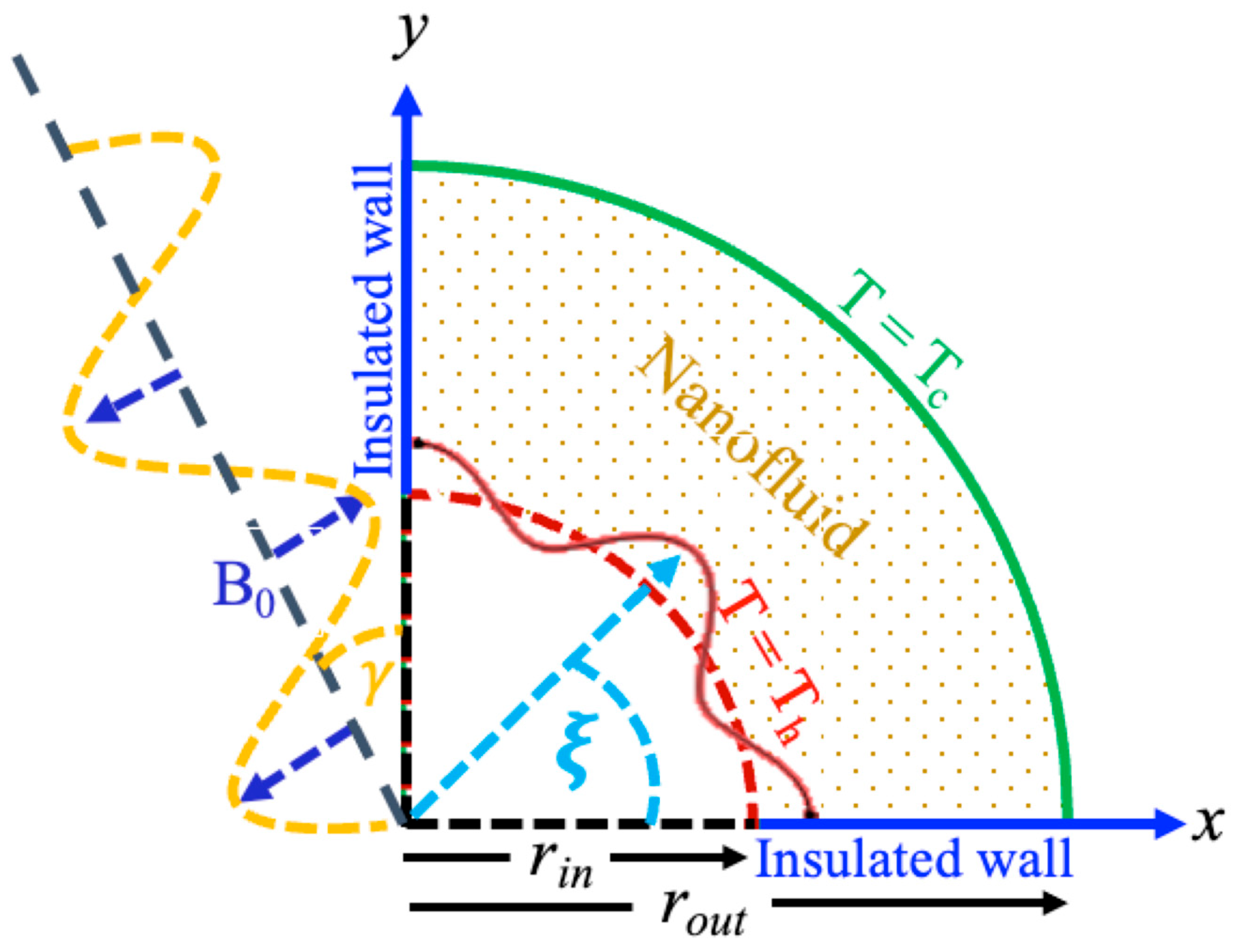
Figure 1. Flow domain with an inner wavy wall.
Appliedmath 06 00096 g001
Figure 2. (a) Domain discretization; (b) convergence of Nuav for different number of elements.
Appliedmath 06 00096 g002
Figure 3. Streamline contours for the CCD-based geometric configurations listed in Table 3 with different values of N, A, and rin. Figures (ao) represent Cases 1–15 in Table 3, respectively.
Appliedmath 06 00096 g003
Figure 4. Isothermal contours for the CCD-based geometric configurations listed in Table 3 with different values of N, A, and rin. Figures (ao) represent Cases 1–15 in Table 3, respectively.
Appliedmath 06 00096 g004
Figure 5. Effects on the Nusselt number (average) for amplitude (A) and undulation number (N): (a) two-dimensional contour plots, (b) Desirability at optimum point, and (c) three-dimensional surface plot.
Appliedmath 06 00096 g005
Figure 6. Effects on the Nusselt number (average) for amplitude (A) and inner radius (rin): (a) two-dimensional contour plot, (b) Desirability at optimum point, and (c) three-dimensional surface plot.
Appliedmath 06 00096 g006
Figure 7. Effects on the Nusselt number (average) for undulation number (N) and inner radius (rin): (a) two-dimensional contour plot, (b) Desirability at optimum point, and (c) three-dimensional surface plot.
Appliedmath 06 00096 g007
Figure 8. (a) Outcomes for the Nusselt number (average) comparing predicted and real data, (b) residual normal probability plot, (c) residual vs. predicted values, and (d) Cook’s distance plot.
Appliedmath 06 00096 g008
Figure 9. Visualization of the Nusselt number (average) vs. Hartmann (Ha) and Rayleigh numbers (Ra): (a) 2D contour plots, (b) Desirability at optimum point, and (c) 3D surface plot.
Appliedmath 06 00096 g009
Figure 10. Visualization of the Nusselt number (average) vs. ϕ and Ra: (a) 2D contour plots, (b) Desirability at optimum point, and (c) 3D surface plot.
Appliedmath 06 00096 g010
Figure 11. Visualization of the Nusselt number (average) vs. ϕ and Ha: (a) 2D contour plots, (b) Desirability at optimum point, and (c) 3D surface plot.
Appliedmath 06 00096 g011
Figure 12. (a) Outcomes for Nusselt number (average) comparing predicted and real data, (b) a bar graph of the optimal solution, and (c) Desirability ramp.
Appliedmath 06 00096 g012
Figure 13. Variation of Nuav with Ha at R a = 10 5 , ϕ = 0.05 , A = 0.1, N = 12, r i n   = 0.3 , dsp = 10 nm, Pr = 6.84, and n = 3, for different: (a) half-wavelength at γ = 0o, and (b) inclination angle at λ = 0.5.
Appliedmath 06 00096 g013
Table 2. Comparison of the current results with [40] for different Ra (at ϕ = 0.05) and ϕ (at Ra = 105), when n = 3 and Ha = 0.
Average Nusselt Number
RaWeheibi
et al. [40]
Present StudyRelative Error (‰) ϕWeheibi
et al. [40]
Present
Study
Relative Error (‰)
1042.233502.242133.86 0.024.907594.914541.42
1055.078245.105495.37 0.055.078245.105495.37
1069.824899.837261.25 0.105.350635.382455.35
Table 3. Variation of the Nusselt number (average) in various cases (CCD-based).
Case NumberrinANNuav
10.250.0751221.840
20.200.051219.672
30.250.1823.987
40.250.075821.449
50.200.075821.014
60.300.11224.945
70.250.05819.922
80.200.1423.094
90.300.05420.173
100.300.1423.034
110.250.075421.126
120.300.075822.530
130.200.05419.273
140.200.11223.927
150.300.051220.985
Table 4. ANOVA for the CCD-based various geometric configurations.
SourceSum of SquaresDFMean SquareF-Valuep-ValueComments
Model41.9194.66111.03<0.0001significant
rin2.2012.2052.37<0.0001significant
A35.96135.96857.19<0.0001significant
N2.1812.1851.97<0.0001significant
rin ∙ A0.196910.19694.690.0555insignificant
rin ∙ N0.277910.27796.620.0277significant
AN0.293810.29387.000.0245significant
rin20.078510.07851.870.2013insignificant
A20.339710.33978.100.0174significant
N20.039610.03960.94480.3540insignificant
Residual0.4195100.0419
Lack of Fit0.419550.0839
Pure Error0.000050.0000
Cor Total42.3319
Here, R2 is 0.9968, predicted R2 is 0.9735, adjusted R2 is 0.9939, and Adeq precision is 68.3659.
Table 5. Levels of input factors (Ra, Ha, and ϕ) with rescaling factors (Ra′, Ha′, and ϕ′) and response function Nusselt number (average).
RunRaRaHaHaϕϕNuav
11.0 × 104000008.9016
25.05 × 1050.426500.50.0250.2518.069
31.0 × 1040250.250.0250.2515.194
41.0 × 1060.5500.50.0500.526.199
51.0 × 1040000.0500.521.190
65.05 × 1050.426250.250.0500.526.114
71.0 × 1060.5000.0500.529.685
81.0 × 1060.5250.250.0250.2521.857
95.05 × 1050.426250.250012.894
105.05 × 1050.426000.0250.2520.901
115.05 × 1050.426250.250.0250.2520.368
121.0 × 1040505008.8727
135.05 × 1050.426250.250.0250.2520.368
141.0 × 1040500.50.0500.521.187
155.05 × 1050.426250.250.0250.2520.368
165.05 × 1050.426250.250.0250.2520.368
175.05 × 1050.426250.250.0250.2520.368
181.0 × 1060.5000.000015.917
195.05 × 1050.426250.250.0250.2520.368
201.0 × 1060.5500.50013.899
Table 6. CCD-based ANOVA for parametric optimization.
SourceSum of SquaresDFMean SquareF-Valuep-ValueComment
Model540.06960.01445.07<0.0001significant
Ra3.1513.1523.390.0007significant
Ha7.2117.2153.47<0.0001significant
ϕ28.64128.64212.42<0.0001significant
Ra · Ha4.5014.5033.340.0002significant
Ra · ϕ0.358810.35882.660.1339insignificant
Ha · ϕ0.260010.26001.930.1951insignificant
Ra22.1912.1916.220.0024significant
Ha20.345910.34592.570.1403insignificant
ϕ20.309910.30992.300.1605insignificant
Residual1.35100.1348
Lack of Fit1.3550.2697
Pure Error0.000050.0000
Corr Total541.4119
Here, R2 is 0.9975, predicted R2 is 0.9764, adjusted R2 is 0.9953, and Adeq precision is 80.71.
Table 7. Confidence interval (CI) of model factors (here, t* is the critical value from t-distribution).
FactorsCoefficients
Estimate
Standard
Error
t*p-ValueLower
95%
Upper
95%
Intercept8.613210.3363725.606641.89 × 10−107.863749.36268
Ra−0.093853.66599−0.02560.980079−8.262208.07449
Ha3.473921.985551.74960.110753−0.950177.89800
ϕ28.040971.9855514.122516.23 × 10−823.6168932.46505
Ra′· Ha−11.4421.98150−5.774390.000179−15.8571−7.02692
Ra′ · ϕ3.232361.981501.631270.133886−1.182717.64743
Ha · ϕ−2.88422.07713−1.388550.195118−7.512321.74392
Ra230.061887.465204.026930.00241113.4283746.6954
Ha2−5.674693.54276−1.601770.140288−13.568452.21906
ϕ2−5.370693.54276−1.515960.160482−13.264452.52306
Table 8. Comparison of actual values (FEM outcomes) with fitting values (RSM outcomes).
RunRaHaϕFEM Prediction (Nuav)RSM Estimation
(Nuav)
Relative
Error (%)
Frequency
11.0 × 104008.90168.6133−3.241
25.05 × 105500.02518.06918.90164.611
31.0 × 104250.02515.19415.62302.821
41.0 × 106500.05026.19927.28734.151
51.0 × 10400.05021.19022.63386.811
65.05 × 105250.05026.11426.86602.881
71.0 × 10600.05029.68530.14931.561
81.0 × 106250.02521.85721.7080−0.681
95.05 × 10525012.89412.8455−0.381
105.05 × 10500.02520.90121.07450.831
111.0 × 1045008.87278.6122−2.941
121.0 × 104500.05021.18722.63286.821
131.0 × 1060015.91716.12881.331
141.0 × 10650013.89913.2668−4.551
155.05 × 105250.02520.36819.8557−2.526
161.0 × 105500.0521.832122.08651.171
171.0 × 106100.0324.754624.1692−2.361
Disclaimer/Publisher’s Note: The statements, opinions and data contained in all publications are solely those of the individual author(s) and contributor(s) and not of MDPI and/or the editor(s). MDPI and/or the editor(s) disclaim responsibility for any injury to people or property resulting from any ideas, methods, instructions or products referred to in the content.