
Article

Stability Analysis of Rössler Chaotic Attractor via the Nabla Discrete Fractional Operator: Existence, Uniqueness, Ulam–Hyers Stability, and Numerical Simulation

1
Department of Mathematics, College of Engineering and Technology, SRM Institute of Science and Technology, Kattankulathur 603203, Tamil Nadu, India
2
Department of Mathematics and Statistics, School of Applied Science and Humanities, Vignan’s Foundation for Science, Technology and Research, Vadlamudi, Guntur 522213, Andhra Pradesh, India
*
Authors to whom correspondence should be addressed.
AppliedMath 2026, 6(5), 67; https://doi.org/10.3390/appliedmath6050067
Submission received: 21 March 2026 / Revised: 18 April 2026 / Accepted: 24 April 2026 / Published: 29 April 2026

Abstract

This research presents a fractional-order formulation and mathematical analysis of the Rössler chaotic attractor. By utilizing the Nabla discrete Atangana–Baleanu fractional difference derivative in the Caputo sense, the classical integer-order attractor is extended into the fractional domain. The existence and uniqueness of solutions for the resulting fractional system are established via the fixed-point theorem, thereby ensuring that the recommended attractor is well-posed. Furthermore, the Ulam–Hyers stability is investigated within the Nabla discrete Atangana–Baleanu fractional difference derivative in the Caputo sense framework. For numerical investigations, an Euler numerical scheme adapted to the fractional difference derivative is developed and implemented, yielding high-quality phase portraits of a chaotic attractor. The results highlight the effectiveness of fractional-order modeling and numerical methods in capturing the dynamics and stability of the Rössler chaotic system.

1. Introduction

Chaos theory has emerged as a fundamental area of study within fractional calculus, a development significantly inspired by Rössler’s pioneering work in 1976 [1]. The rich interplay between nonlinear dynamics and fractional-order systems has since stimulated extensive research, leading to the exploration of numerous chaotic models, including Chua’s circuit [2], Chen’s system [3], Hyperjerk systems [4], the Duffing oscillator [5], Jafari’s chaotic systems [6], Pham chaotic systems [7], autonomous chaotic systems [8,9], financial chaotic systems [10], and switching chaotic systems [11]. Among these diverse models, the Rössler system retains its status as a quintessential benchmark. Its enduring relevance stems from a compelling combination of mathematical elegance and profound dynamical complexity, particularly its distinctive spiral-type chaos. This simplicity and depth have cemented its role as an essential tool for probing core principles in nonlinear dynamics.
Building on this historical foundation, fractional calculus, with its non-integer order derivatives and integrals, has emerged as a powerful tool for modeling systems with memory effects and non-local interactions. Unlike classical integer-order derivatives, fractional derivatives incorporate the history of the system, making them particularly suitable for biological systems where past states influence current dynamics [12]. The Atangana–Baleanu–Caputo fractional derivative has gained prominence due to its non-singular kernel and ability to capture both power-law and exponential decay memory effects [13]. This derivative has been successfully applied to various epidemiological models, providing more accurate descriptions of disease transmission dynamics [14,15].
The stability analysis is crucial for ensuring the reliability of mathematical models in predicting disease dynamics. Ulam–Hyers stability, originating from the works of Ulam [16] and Hyers [17], examines how small perturbations in model equations affect solutions. A system is Ulam–Hyers stable if for every approximate solution satisfying the equations within a small error, there exists an exact solution close to it. This type of stability is particularly important in biological modeling, where parameters are often estimated with uncertainty.
Chaotic attractors are very useful for understanding attractor behavior; thus, few studies have focused on the mathematical formulation of the 4D hyperchaotic financial attractors. The chaotic attractor was presented in [18], extending the previous literature to the average profit margin. In recent years, numerous hyperchaotic systems have been studied across various scientific fields, including artificial neural networks [19,20], cryptology [21], and electronic circuit implementation [22,23]. Recent research has developed the Nabla fractional difference framework using the Caputo derivative. The study by [24] explored a glucose–insulin regulatory problem formulation using this approach, and the same framework was used to develop mathematical models for the COVID-19 infection problem, examining existence and uniqueness conditions via the fixed-point approach. Luo et al. [25] analyzed existence and uniqueness via Krasnoselskii’s fixed-point methods for fractional Nabla discrete equations. The authors of [26] explored the chaotic behavior of economic problems; Wang et al. [27] examined a fractional financial time-delayed problem; chaos control for fractional financial problems was addressed in [28]; and the hyperchaotic financial attractor was developed in [29]. Furthermore, the approach in [30] provides an explicit reformulation strategy for discrete fractional relaxation equations that informs the analysis herein.
This study addresses a critical research gap in the analysis of fractional chaotic attractors by investigating the Rössler chaotic attractor within the Atangana–Baleanu–Caputo fractional framework. Unlike existing studies, this work integrates fractional modeling with Ulam–Hyers stability analysis, establishing the existence and uniqueness of solutions via Banach fixed-point theory to ensure mathematical validity. Furthermore, the Ulam–Hyers stability is rigorously examined within the same fractional framework. A comprehensive three-dimensional structure of the fractional Rössler system is formulated and analyzed under varying parameters and fractional orders. To support the theoretical findings, an Euler-type numerical scheme is developed to obtain approximate solutions and to explore the dynamical behavior of the system. Overall, the results provide new theoretical and numerical insights into the stability and dynamics of fractional chaotic attractors.
This research work consists of six sections as follows: The first provides an overview of the Rössler chaotic attractor and a review of related literature. The second presents the essential definitions and existing results. The third proposes and formulates the fractional Rössler attractor. The fourth establishes existence and uniqueness criteria using a fixed-point approach. The fifth investigates the Ulam–Hyers stability result. The sixth applies the chaotic system to simulated Rössler data using Euler’s numerical algorithm. Finally, we end the paper in the sixth by describing some conclusions.

2. Some Essential Results

This section provides some essential concepts for the recommended method techniques needed in depth in this study, as described in the existing literature. Here, t τ 1 0 N a b l a ABC denotes the fractional difference of the Atangana–Baleanu discrete Nabla in the Caputo sense of fractional order ( τ 1 ) .
Definition 1 
([24,31]). Let a function z : N x = { x , x + 1 , x + 2 , } R (left type) and z : N y = { y , y 1 , y + 2 , } R (right type) be the 0 < τ 1 < 1 order sum of order z defined by
τ 1 x z ( t ) = 1 Γ ( τ 1 ) u = x + 1 t ( t σ ( u ) ) 1 τ 1 ¯ z ( u ) , t N x + 1 ,
and
y τ 1 z ( t ) = 1 Γ ( τ 1 ) u = t y 1 ( σ ( t ) u ) 1 τ 1 ¯ z ( u ) , t N y 1 ,
where σ ( t ) = t 1 is a backward jump operator. The Nabla rising factorial (Nabla fractional power) is defined for real 0 < τ 1 < 1 and integers t u as
( t σ ( u ) ) 1 τ 1 ¯ = Γ ( t u + 2 τ 1 ) Γ ( t u + 2 ) ,
where σ ( u ) = u 1 . This notation is specific to discrete fractional calculus and is distinct from the standard real-valued power ( t u ) 1 τ 1 ; both coincide only when τ 1 is a non-integer.
Definition 2 
([24,31]). Let a function z be defined on N x (left type) and N y (right type); the τ 1 order Atangana–Baleanu–Caputo discrete Nabla fractional difference framework is defined as
t τ 1 x N a b l a ABC z ( t ) = Z ( τ 1 ) Γ ( 1 τ 1 ) u = x + 1 t u z ( u ) E τ 1 ¯ τ 1 1 τ 1 , t σ ( u ) , τ 1 0 , 1 2 ,
y τ 1 N a b l a ABC z ( t ) = Z ( τ 1 ) Γ ( 1 τ 1 ) u = t y 1 ( u z ) ( u ) E τ 1 ¯ τ 1 1 τ 1 , t σ ( u ) , τ 1 0 , 1 2 ,
in N x , N y the order Riemann-Liouville discrete Nabla fractional difference framework is defined as
τ 1 x N a b l a ABR z ( t ) = Z ( τ 1 ) Γ ( 1 τ 1 ) t u = x + 1 t z ( u ) E τ 1 ¯ τ 1 1 τ 1 , t σ ( u ) , τ 1 0 , 1 2 ,
y τ 1 N a b l a ABR z ( t ) = Z ( τ 1 ) Γ ( 1 τ 1 ) t u = t y 1 z ( u ) E τ 1 ¯ τ 1 1 τ 1 , t σ ( u ) , τ 1 0 , 1 2 ,
where the normalization function Z ( τ 1 ) in the Atangana–Baleanu kernel satisfies Z ( 0 ) = Z ( 1 ) = 1 . Throughout this paper, the standard convention Z ( τ 1 ) = 1 for all τ 1 ( 0 , 1 ) is adopted, consistent with [24,31]. This ensures that the fractional derivative reduces to the classical first-order derivative as τ 1 1 and to the identity operator as τ 1 0 . The symbols τ 1 x N a b l a ABC , τ 1 x N a b l a ABR , y τ 1 N a b l a ABC , and y τ 1 N a b l a ABR denote the Atangana–Baleanu–Caputo discrete Nabla fractional difference framework (left type and right type) and the right and left Atangana–Baleanu (Riemann–Liouville) discrete Nabla fractional difference framework (left type and right type).
Definition 3 
([24,31]). Let a function z be defined on the Atangana–Baleanu–Caputo discrete Nabla fractional difference framework (left type and right type) is given by
τ 1 x N a b l a ABC z ( t ) = 1 τ 1 Z ( τ 1 ) z ( t ) + τ 1 Z ( τ 1 ) τ 1 x z ( t ) , τ 1 0 , 1 2 ,
and
y τ 1 N a b l a ABC z ( t ) = 1 τ 1 Z ( τ 1 ) z ( t ) + τ 1 Z ( τ 1 ) y τ 1 z ( t ) , τ 1 0 , 1 2 .
The one-parameter Mittag–Leffler function is defined by the convergent series
E τ 1 ( z ) = k = 0 z k Γ ( τ 1 k + 1 ) , τ 1 > 0 , z R .
In the discrete Nabla setting, the relevant evaluation is E τ 1 ¯ τ 1 1 τ 1 , t σ ( u ) , where σ ( u ) = u 1 . For further details on the discrete Mittag–Leffler function, see [24,31].
Definition 4 
([24,31]). The fractional sum associated with τ 1 x N a b l a ABC z ( t ) by
τ 1 x N a b l a AB z ( t ) = 1 τ 1 Z ( τ 1 ) z ( t ) + τ 1 Z ( τ 1 ) τ 1 x z ( t ) ,
where 0 < τ 1 < 1 .
Lemma 1 
(Integral inversion, [24,31]). Let 0 < τ 1 < 1 and suppose z : N q + 1 R satisfies
t τ 1 0 N a b l a ABC z ( t ) = z ( t ) , t N q + 1 .
Applying the Nabla Atangana–Baleanu fractional sum (Definition 4) to both sides yields the equivalent Volterra-type summation equation
z ( t ) = z ( 0 ) + 1 τ 1 Z ( τ 1 ) z ( t ) + τ 1 Z ( τ 1 ) Γ ( τ 1 ) u = q + 1 t ( t σ ( u ) ) τ 1 1 ¯ z ( u ) .
Lemma 2 
(Boundedness of the Nabla kernel). For τ 1 ( 0 , 1 ) and integers t u q + 1 , the Nabla kernel ( t σ ( u ) ) τ 1 1 ¯ is non-negative. Moreover, for any finite terminal time T, there exists a constant M τ 1 > 0 such that
u = q + 1 t ( t σ ( u ) ) τ 1 1 ¯ M τ 1 , t { q + 1 , , T } .

3. Formulation of the Problem with the Effects of Rössler Chaotic Attractor

The classical Rössler system [1] is formulated using the Atangana–Baleanu–Caputo fractional form. The system is presented as
d P d t = Q ( t ) R ( t ) , d Q d t = P ( t ) + α Q ( t ) , d R d t = β + R ( t ) ( P ( t ) γ ) .
Here, the parameter α governs the coupling between P and Q; β is a constant forcing term in the R; and γ is the threshold parameter controlling the onset of chaotic behavior. In system (1), t is the independent time variable, and P ( t ) , Q ( t ) , R ( t ) are the state variables.
Consider the following discrete Nabla fractional difference Atangana–Baleanu–Caputo sense of the Rössler chaotic attractor:
t τ 1 0 N a b l a ABC P ( t ) = Q ( t ) R ( t ) , t τ 1 0 N a b l a ABC Q ( t ) = P ( t ) + α Q ( t ) , t τ 1 0 N a b l a ABC R ( t ) = β + R ( t ) ( P ( t ) γ ) .
Here, the initial conditions are P ( 0 ) = P 0 , Q ( 0 ) = Q 0 , and R ( 0 ) = R 0 . The chaotic system is described using the Nabla fractional difference: Atangana–Baleanu–Caputo sense form, represented by t τ 1 0 N a b l a ABC of order τ 1 .

4. Main Results

To examine the solution for existence and uniqueness conditions derived from the fixed-point techniques for the 3D financial hyperchaotic attractor. Applying the Nabla fractional difference framework based on the Atangana–Baleanu–Caputo sense of the integral term (as defined in Definition 4) to both sides of attractor (2), we obtain the following result:
H 1 t , P , Q , R = Q R , H 2 t , P , Q , R = P + α Q , H 3 t , P , Q , R = β + R ( P γ ) .
Based on the above-mentioned three equations, our projected attractor (2) can be expressed as:
t τ 1 0 N a b l a ABC ( J ( t ) ) = H ( t , J ( t ) ) , t [ 0 , T ] , 0 < τ 1 1 , J ( 0 ) = J 0 ,
where
J ( t ) = : P ( t ) , Q ( t ) , R ( t ) ,         J 0 = : P ( 0 ) , Q ( 0 ) , R ( 0 ) ,
and
H ( t , J ( t ) ) = : H 1 ( t , P ( t ) , Q ( t ) , R ( t ) ) , H 2 ( t , P ( t ) , Q ( t ) , R ( t ) ) , H 3 ( t , P ( t ) , Q ( t ) , R ( t ) ) .
Applying the fractional integral term from Definition 4 and utilizing Lemma 1 to Equation (3) yields the following result:
J ( t ) = J ( 0 ) + 1 τ 1 Z ( τ 1 ) H ( t , J ( t ) ) + τ 1 Z ( τ 1 ) Γ ( τ 1 ) u = q + 1 t ( t σ ( u ) ) τ 1 1 ¯ H ( u , J ( u ) ) .

4.1. Existence of a Solution

In this subsection, it is necessary to examine the solution of the existence criteria for the Nabla fractional difference framework for the 3D Rössler chaotic attractor, which we expressed below:
P ( t ) P ( 0 ) = 1 τ 1 Z ( τ 1 ) [ Q ( t ) R ( t ) ] + τ 1 Z ( τ 1 ) Γ ( τ 1 ) u = q + 1 t ( t σ ( u ) ) τ 1 1 ¯ [ Q ( u ) R ( u ) ] ,
Q ( t ) Q ( 0 ) = 1 τ 1 Z ( τ 1 ) [ P ( t ) + α Q ( t ) ] + τ 1 Z ( τ 1 ) Γ ( τ 1 ) u = q + 1 t ( t σ ( u ) ) τ 1 1 ¯ [ P ( u ) + α Q ( u ) ] ,
R ( t ) R ( 0 ) = 1 τ 1 Z ( τ 1 ) [ β + R ( t ) ( P ( t ) γ ) ] + τ 1 Z ( τ 1 ) Γ ( τ 1 ) u = q + 1 t ( t σ ( u ) ) τ 1 1 ¯ [ β + R ( u ) ( P ( u ) γ ) ] .
By employing the Atangana–Baleanu fractional integral derivative to solve the projected model, we define functions H i , for i = 1 , 2 , 3 or i N 1 3 , as follows:
P ( t ) P ( 0 ) = 1 τ 1 Z ( τ 1 ) H 1 ( t , P , Q , R ) + τ 1 Z ( τ 1 ) Γ ( τ 1 ) u = q + 1 t ( t σ ( u ) ) τ 1 1 ¯ H 1 ( u , P , Q , R ) , Q ( t ) Q ( 0 ) = 1 τ 1 Z ( τ 1 ) H 2 ( t , P , Q , R ) + τ 1 Z ( τ 1 ) Γ ( τ 1 ) u = q + 1 t ( t σ ( u ) ) τ 1 1 ¯ H 2 ( u , P , Q , R ) , R ( t ) R ( 0 ) = 1 τ 1 Z ( τ 1 ) H 3 ( t , P , Q , R ) + τ 1 Z ( τ 1 ) Γ ( τ 1 ) u = q + 1 t ( t σ ( u ) ) τ 1 1 ¯ H 3 ( u , P , Q , R ) ,
where,
H 1 ( t , P , Q , R ) = Q ( t ) R ( t ) , H 2 ( t , P , Q , R ) = P ( t ) + α Q ( t ) , H 3 ( t , P , Q , R ) = β + R ( t ) ( P ( t ) γ ) .
Theorem 1. 
The kernels H i , for i N 1 3 , satisfy the Lipschitz criterion. If the subsequent respective conditions 0 Ψ i < 1 , i N 1 3 are satisfied.
Proof. 
Considering the kernel
H 1 ( t , P , Q , R ) = Q R .
We define two sets of functions ( P , Q , R ) and ( P 1 , Q 1 , R 1 ) ; then, we have
H 1 ( t , P , Q , R ) H 1 ( t , P 1 , Q 1 , R 1 ) = ( Q R ) ( Q 1 R 1 ) , Q 1 Q + R 1 R .
Since H 1 is independent of P, the Lipschitz condition for H 1 involves only Q and R. Assuming Q and R are bounded, we find a constant Ψ 1 such that
H 1 ( t , P , Q , R ) H 1 ( t , P 1 , Q 1 , R 1 ) Ψ 1 Q Q 1 + R R 1 .
For H 2 ( t , P , Q , R ) = P ( t ) + α Q ( t ) :
H 2 ( t , P , Q , R ) H 2 ( t , P 1 , Q 1 , R 1 ) P P 1 + | α | Q Q 1 ( 1 + | α | ) P P 1 + Q Q 1 ,
so Ψ 2 = 1 + | α | . For H 3 ( t , P , Q , R ) = β + R ( t ) ( P ( t ) γ ) , assuming P M P and R M R :
H 3 ( t , P , Q , R ) H 3 ( t , P 1 , Q 1 , R 1 ) ( M R + M P ) P P 1 + R R 1 ,
so Ψ 3 = M R + M P . Similarly, we can get for H 2 and H 3 as follows:
H 2 ( t , P , Q , R ) H 2 ( t , P 1 , Q 1 , R 1 ) Ψ 2 P P 1 + Q Q 1 + R R 1 , H 3 ( t , P , Q , R ) H 3 ( t , P 1 , Q 1 , R 1 ) Ψ 3 P P 1 + Q Q 1 + R R 1 .
From (6) and (7), we find that the kernels H 1 , H 2 , and H 3 satisfy the Lipschitz condition. Furthermore, if 0 Ψ i < 1 then the kernel H i for i = 1 , 2 , 3 is a contraction. Utilizing the above kernels, one can rewrite the Equation (2) as
P ( t ) = P ( 0 ) + 1 τ 1 Z ( τ 1 ) H 1 ( t , P , Q , R ) + τ 1 Z ( τ 1 ) Γ ( τ 1 ) u = q + 1 t ( t σ ( u ) ) τ 1 1 ¯ H 1 ( u , P , Q , R ) , Q ( t ) = Q ( 0 ) + 1 τ 1 Z ( τ 1 ) H 2 ( t , P , Q , R ) + τ 1 Z ( τ 1 ) Γ ( τ 1 ) u = q + 1 t ( t σ ( u ) ) τ 1 1 ¯ H 2 ( u , P , Q , R ) , R ( t ) = R ( 0 ) + 1 τ 1 Z ( τ 1 ) H 3 ( t , P , Q , R ) + τ 1 Z ( τ 1 ) Γ ( τ 1 ) u = q + 1 t ( t σ ( u ) ) τ 1 1 ¯ H 3 ( u , P , Q , R ) .
Now, we get the recursive formula as follows:
P n ( t ) = P n ( 0 ) + 1 τ 1 Z ( τ 1 ) H 1 ( t , P n 1 , Q n 1 , R n 1 ) + τ 1 Z ( τ 1 ) Γ ( τ 1 ) u = q + 1 t ( t σ ( u ) ) τ 1 1 ¯ H 1 ( u , P n 1 , Q n 1 , R n 1 ) , Q n ( t ) = Q n ( 0 ) + 1 τ 1 Z ( τ 1 ) H 2 ( t , P n 1 , Q n 1 , R n 1 ) + τ 1 Z ( τ 1 ) Γ ( τ 1 ) u = q + 1 t ( t σ ( u ) ) τ 1 1 ¯ H 2 ( u , P n 1 , Q n 1 , R n 1 ) , R n ( t ) = R n ( 0 ) + 1 τ 1 Z ( τ 1 ) H 3 ( t , P n 1 , Q n 1 , R n 1 ) + τ 1 Z ( τ 1 ) Γ ( τ 1 ) u = q + 1 t ( t σ ( u ) ) τ 1 1 ¯ H 3 ( u , P n 1 , Q n 1 , R n 1 ) .
We can introduce a new expression to represent the difference between successive terms as follows:
D n P ( t ) = P n ( t ) P n 1 ( t ) = ( 1 τ 1 ) ( H 1 ( t , P n 1 , Q n 1 , R n 1 ) H 1 ( t , P n 2 , Q n 2 , R n 2 ) ) Z ( τ 1 ) + τ 1 Z ( τ 1 ) Γ ( τ 1 ) u = q + 1 t ( t σ ( u ) ) τ 1 1 ¯ ( H 1 ( u , P n 1 , Q n 1 , R n 1 ) H 1 ( u , P n 2 , Q n 2 , R n 2 ) ) ,
D n Q ( t ) = Q n ( t ) Q n 1 ( t ) = ( 1 τ 1 ) ( H 2 ( t , P n 1 , Q n 1 , R n 1 ) H 2 ( t , P n 2 , Q n 2 , R n 2 ) ) Z ( τ 1 ) + τ 1 Z ( τ 1 ) Γ ( τ 1 ) u = q + 1 t ( t σ ( u ) ) τ 1 1 ¯ ( H 2 ( u , P n 1 , Q n 1 , R n 1 ) H 2 ( u , P n 2 , Q n 2 , R n 2 ) ) ,
D n R ( t ) = R n ( t ) R n 1 ( t ) = ( 1 τ 1 ) ( H 3 ( t , P n 1 , Q n 1 , R n 1 ) H 3 ( t , P n 2 , Q n 2 , R n 2 ) ) Z ( τ 1 ) + τ 1 Z ( τ 1 ) Γ ( τ 1 ) u = q + 1 t ( t σ ( u ) ) τ 1 1 ¯ ( H 3 ( u , P n 1 , Q n 1 , R n 1 ) H 3 ( u , P n 2 , Q n 2 , R n 2 ) ) .
Then,
P n ( t ) = i = 0 n D i P , Q n ( t ) = i = 0 n D i Q , R n ( t ) = i = 0 n D i R .
Taking the norm for both sides of (10) and using the Lipschitz conditions, we obtain
P D n ( 1 τ 1 ) Ψ 1 Z ( τ 1 ) P D n 1 + τ 1 Ψ 1 Z ( τ 1 ) Γ ( τ 1 ) u = q + 1 t ( t σ ( u ) ) τ 1 1 ¯ P D n 1 ,
Q D n ( 1 τ 1 ) Ψ 2 Z ( τ 1 ) Q D n 1 + τ 1 Ψ 2 Z ( τ 1 ) Γ ( τ 1 ) u = q + 1 t ( t σ ( u ) ) τ 1 1 ¯ Q D n 1 ,
R D n ( 1 τ 1 ) Ψ 3 Z ( τ 1 ) R D n 1 + τ 1 Ψ 3 Z ( τ 1 ) Γ ( τ 1 ) u = q + 1 t ( t σ ( u ) ) τ 1 1 ¯ R D n 1 .
By using the recursive method with the above inequalities, we get
P D n 1 τ 1 Z ( τ 1 ) + τ 1 Ψ 1 Z ( τ 1 ) Γ ( τ 1 ) n P 0 Ψ 1 n , Q D n 1 τ 1 Z ( τ 1 ) + τ 1 Ψ 1 Z ( τ 1 ) Γ ( τ 1 ) n Q 0 Ψ 2 n , R D n 1 τ 1 Z ( τ 1 ) + τ 1 Ψ 1 Z ( τ 1 ) Γ ( τ 1 ) n R 0 Ψ 3 n .
Remark 1. 
Kernels H 1 and H 2 are linear, and their well-posedness follows from linear theory [25]. In contrast, H 3 = β + R ( P γ ) is nonlinear due to the bilinear term R P , so Banach’s contraction principle provides the natural analysis framework. The Lipschitz constants Ψ i and contraction parameters λ i derived here are directly used in Section 5 to obtain explicit Ulam–Hyers stability constants K i . This unified fixed-point approach yields rigorous, quantitative stability bounds for the full coupled system.
Theorem 2. 
The Rössler chaotic system (2) has a solution provided that the following condition holds true:
Δ = max Ψ i < 1 , i = 1 , 2 , 3 .
Proof. 
Set λ i : = 1 τ 1 Z ( τ 1 ) + τ 1 Z ( τ 1 ) Γ ( τ 1 ) Ψ i . By (12), D n P λ 1 n P 0 . Since λ 1 < 1 by hypothesis, the series n = 0 D n P P 0 / ( 1 λ 1 ) converges absolutely by the geometric series test. Its limit P ( t ) = n = 0 D n P is well-defined and satisfies (8), proving existence. Identical arguments apply to Q and R.
From (8) and (9), we assume
P ( t ) = P n ( t ) , Q ( t ) = Q n ( t ) , R ( t ) = R n ( t ) .
We define the functions
Q n P ( t ) = P ( t ) P n ( t ) , Q n Q ( t ) = Q ( t ) Q n ( t ) , Q n R ( t ) = R ( t ) R n ( t ) .
Now, we show that Q n P , Q n Q , Q n R 0 as n .
Q n P 1 τ 1 Z ( τ 1 ) H 1 ( t , P n 1 , Q n 1 , R n 1 ) H 1 ( t , P n 2 , Q n 2 , R n 2 ) + τ 1 Z ( τ 1 ) Γ ( τ 1 ) u = q + 1 t ( t σ ( u ) ) τ 1 1 ¯ H 1 ( u , P n 1 , Q n 1 , R n 1 ) H 1 ( u , P n 2 , Q n 2 , R n 2 ) , 1 τ 1 Z ( τ 1 ) Ψ 1 P P n 1 + τ 1 Z ( τ 1 ) Γ ( τ 1 ) Ψ 1 P P n 1 .
This implies
Q n P 1 τ 1 Z ( τ 1 ) + τ 1 Z ( τ 1 ) Γ ( τ 1 ) Ψ 1 P P n 1 .
With help of (12), we obtain
Q n P Ψ 1 n + 1 1 τ 1 Z ( τ 1 ) + τ 1 Z ( τ 1 ) Γ ( τ 1 ) n + 1 .
Similarly, using the same technique, we have
Q n Q Ψ 2 n + 1 1 τ 1 Z ( τ 1 ) + τ 1 Z ( τ 1 ) Γ ( τ 1 ) n + 1 , Q n R Ψ 3 n + 1 1 τ 1 Z ( τ 1 ) + τ 1 Z ( τ 1 ) Γ ( τ 1 ) n + 1 .
Thus, from the above three functions, we find that Q n P , Q n Q , Q n R 0 as n , which completes the proof. □

4.2. Uniqueness of a Solution

In this subsection, it is necessary to examine the solution of the uniqueness criteria for the Nabla fractional difference framework for the 3D Rössler chaotic attractor, which we expressed below:
Theorem 3. 
There is a unique solution for the Rössler chaotic system (2) provided that
λ i : = 1 τ 1 Z ( τ 1 ) + τ 1 Z ( τ 1 ) Γ ( τ 1 ) Ψ i 1 < 0 ,
holds for i = 1 , 2 , 3 .
Proof. 
Suppose ( P , Q , R ) and ( P 1 , Q 1 , R 1 ) are both solutions of the integral system (5), then we have
P 1 ( t ) = 1 τ 1 Z ( τ 1 ) H 1 ( t , P 1 , Q 1 , R 1 ) + τ 1 Z ( τ 1 ) Γ ( τ 1 ) u = q + 1 t ( t σ ( u ) ) τ 1 1 ¯ H 1 ( u , P 1 , Q 1 , R 1 ) .
Taking the norm of the difference of the two P and applying the triangle inequality gives
P P 1 1 τ 1 Z ( τ 1 ) H 1 ( t , P , Q , R ) H 1 ( t , P 1 , Q 1 , R 1 ) + τ 1 Z ( τ 1 ) Γ ( τ 1 ) u = q + 1 t ( t σ ( u ) ) τ 1 1 ¯ H 1 ( u , P , Q , R ) H 1 ( u , P 1 , Q 1 , R 1 ) , 1 τ 1 Z ( τ 1 ) Ψ 1 P P 1 + τ 1 Z ( τ 1 ) Γ ( τ 1 ) Ψ 1 P P 1 ,
and so
1 τ 1 Z ( τ 1 ) + τ 1 Z ( τ 1 ) Γ ( τ 1 ) Ψ 1 1 P P 1 0 .
Equation (14) holds true if and only if
P P 1 = 0 .
Hence,
P ( t ) = P 1 ( t ) .
Similarly, employing the same procedure with Q ( t ) and R ( t ) , we obtain
Q ( t ) = Q 1 ( t ) , R ( t ) = R 1 ( t ) .
As a result, the solution for the system (2) is unique. □

5. Stability Analysis of the Projected Model

To establish the stability analysis of the projected model. The following definition is provided from [25] and adapted for the mentioned technique.
Definition 5. 
The Rössler chaotic system (2) is Ulam–Hyers stable if there exist positive constants K i > 0 , i = 1 , 2 , 3 such that for all ε i > 0 , i = 1 , 2 , 3 , satisfying
P ( t ) 1 τ 1 Z ( τ 1 ) H 1 ( t , P , Q , R ) + τ 1 Z ( τ 1 ) Γ ( τ 1 ) u = q + 1 t ( t σ ( u ) ) τ 1 1 ¯ H 1 ( u , P , Q , R ) ε 1 , Q ( t ) 1 τ 1 Z ( τ 1 ) H 2 ( t , P , Q , R ) + τ 1 Z ( τ 1 ) Γ ( τ 1 ) u = q + 1 t ( t σ ( u ) ) τ 1 1 ¯ H 2 ( u , P , Q , R ) ε 2 , R ( t ) 1 τ 1 Z ( τ 1 ) H 3 ( t , P , Q , R ) + τ 1 Z ( τ 1 ) Γ ( τ 1 ) u = q + 1 t ( t σ ( u ) ) τ 1 1 ¯ H 3 ( u , P , Q , R ) ε 3 ,
there exists a solution P 1 ( t ) , Q 1 ( t ) , R 1 ( t ) of the system (2), such that
P P 1 K 1 ε 1 , Q Q 1 K 2 ε 2 , R R 1 K 3 ε 3 .
Remark 2. 
Assume that, if a continuous function h 1 exists such that the function J ( t ) is a solution of the first inequality (15),
  • | h 1 ( t ) | < E 1 , and
  • t τ 1 0 N a b l a ABC J ( t ) = H ( t , J ( t ) ) + h 1 ( t ) .
Theorem 4. 
The Atangana–Baleanu Nabla fractional difference in the Caputo sense model (2) is Ulam–Hyers stable.
Proof. 
By Definitions (5) and (8), let us consider ( P ( t ) , Q ( t ) , R ( t ) ) to be the exact solution of (8) and ( P 1 ( t ) , Q 1 ( t ) , R 1 ( t ) ) to be an approximate solution satisfying (16). Then, applying the triangle inequality, we have
P ( t ) P 1 ( t ) 1 τ 1 Z ( τ 1 ) H 1 ( t , P , Q , R ) H 1 ( t , P 1 , Q 1 , R 1 ) + τ 1 Z ( τ 1 ) Γ ( τ 1 ) u = q + 1 t ( t σ ( u ) ) τ 1 1 ¯ H 1 ( u , P , Q , R ) H 1 ( u , P 1 , Q 1 , R 1 ) , 1 τ 1 Z ( τ 1 ) Ψ 1 P P 1 + τ 1 Z ( τ 1 ) Γ ( τ 1 ) Ψ 1 P P 1 .
Applying the Lipschitz condition (Theorem 1):
P ( t ) P 1 ( t ) 1 τ 1 Z ( τ 1 ) + τ 1 Z ( τ 1 ) Γ ( τ 1 ) Ψ 1 P P 1 .
Taking ε 1 = Ψ 1 and K 1 = 1 τ 1 Z ( τ 1 ) + τ 1 Z ( τ 1 ) Γ ( τ 1 ) , this implies
P P 1 ε 1 K 1 .
Now, applying a similar approach, we have
Q Q 1 ε 2 K 2 , R R 1 ε 3 K 3 .
Hence, by (17) and (18), the integral Equation (8) is Ulam–Hyers stable. As a result, the system (2) is Ulam–Hyers stable. □

6. Numerical Simulation Test

6.1. Numerical Method

In this section, we present a numerical simulation for solving the system (2). We use an iterative numerical method to simulate the system described by the following Nabla fractional-order differential equation:
t τ 1 0 ABC y ( x ) = H ( t , y ( t ) ) .
Applying the basic concept of the Nabla fractional-order integral form, we derive
y ( t ) = y ( 0 ) + 1 τ 1 Z ( τ 1 ) y ( t ) + τ 1 Z ( τ 1 ) Γ ( τ 1 ) u = q + 1 t ( t σ ( u ) ) τ 1 1 ¯ H ( u , y ( u ) ) .
Equation (20) can be reformulated to obtain an iterative scheme. For our specific system, we write the integral form directly:
P ( t ) = P ( 0 ) + 1 τ 1 Z ( τ 1 ) H 1 ( t , P , Q , R ) + τ 1 Z ( τ 1 ) Γ ( τ 1 ) u = q + 1 t ( t σ ( u ) ) τ 1 1 ¯ H 1 ( u , P , Q , R ) , Q ( t ) = Q ( 0 ) + 1 τ 1 Z ( τ 1 ) H 2 ( t , P , Q , R ) + τ 1 Z ( τ 1 ) Γ ( τ 1 ) u = q + 1 t ( t σ ( u ) ) τ 1 1 ¯ H 2 ( u , P , Q , R ) , R ( t ) = R ( 0 ) + 1 τ 1 Z ( τ 1 ) H 3 ( t , P , Q , R ) + τ 1 Z ( τ 1 ) Γ ( τ 1 ) u = q + 1 t ( t σ ( u ) ) τ 1 1 ¯ H 3 ( u , P , Q , R ) .
The following iterative scheme is formulated:
P n ( t ) = P n ( 0 ) + 1 τ 1 Z ( τ 1 ) H 1 ( t , P n 1 , Q n 1 , R n 1 ) + τ 1 Z ( τ 1 ) Γ ( τ 1 ) u = q + 1 t ( t σ ( u ) ) τ 1 1 ¯ H 1 ( u , P n 1 , Q n 1 , R n 1 ) , Q n ( t ) = Q n ( 0 ) + 1 τ 1 Z ( τ 1 ) H 2 ( t , P n 1 , Q n 1 , R n 1 ) + τ 1 Z ( τ 1 ) Γ ( τ 1 ) u = q + 1 t ( t σ ( u ) ) τ 1 1 ¯ H 2 ( u , P n 1 , Q n 1 , R n 1 ) , R n ( t ) = R n ( 0 ) + 1 τ 1 Z ( τ 1 ) H 3 ( t , P n 1 , Q n 1 , R n 1 ) + τ 1 Z ( τ 1 ) Γ ( τ 1 ) u = q + 1 t ( t σ ( u ) ) τ 1 1 ¯ H 3 ( u , P n 1 , Q n 1 , R n 1 ) .

6.2. Result and Discussion

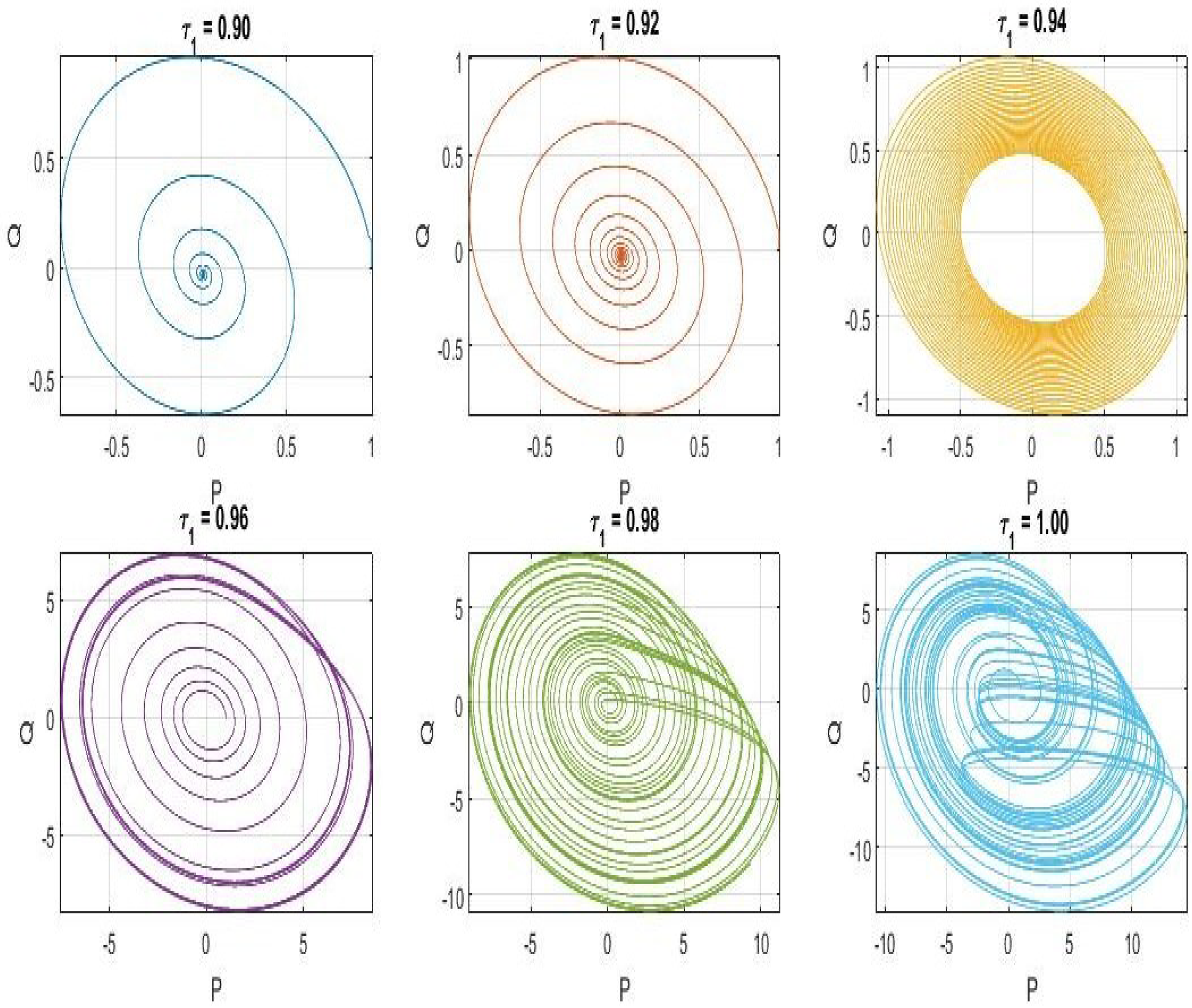
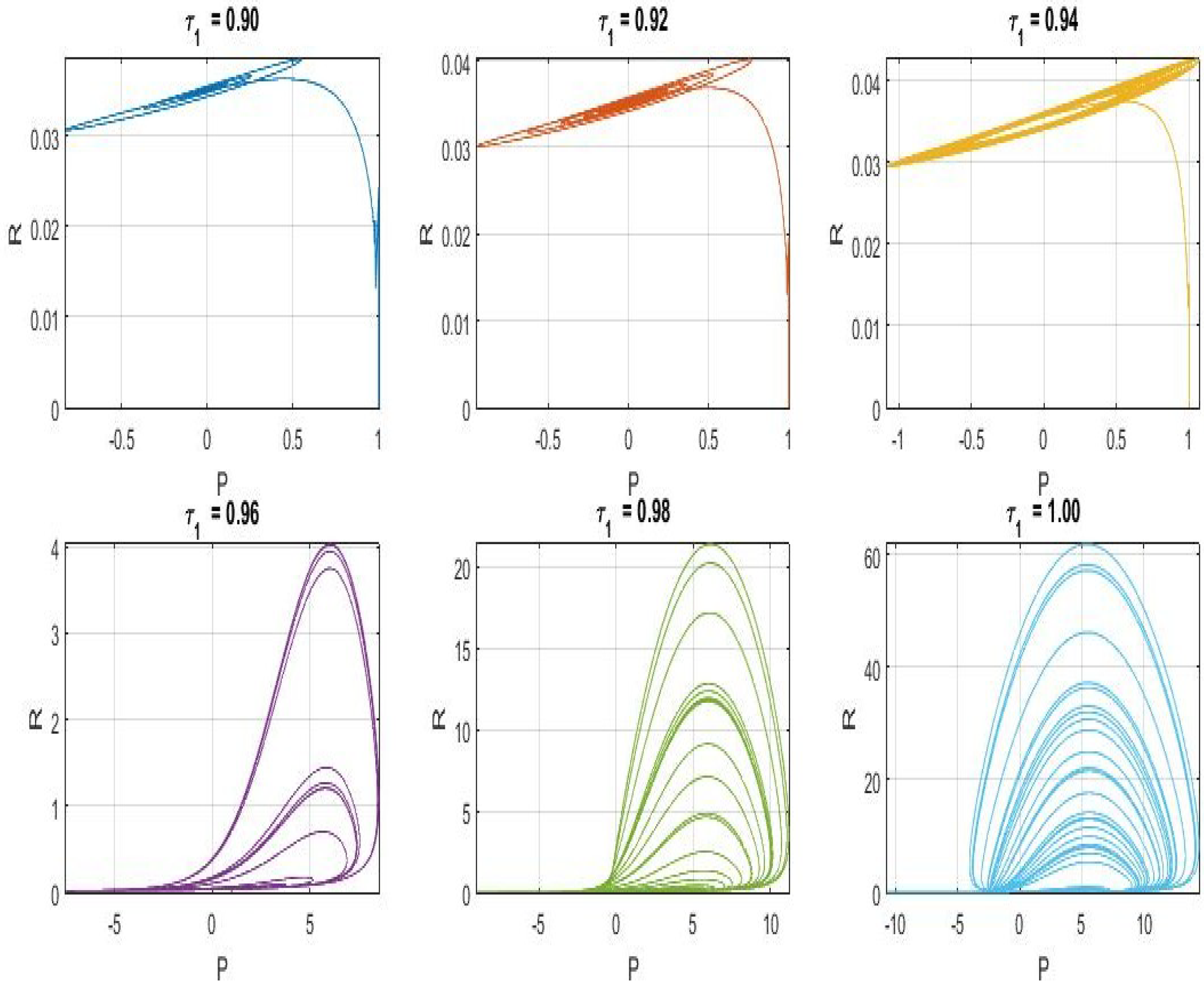
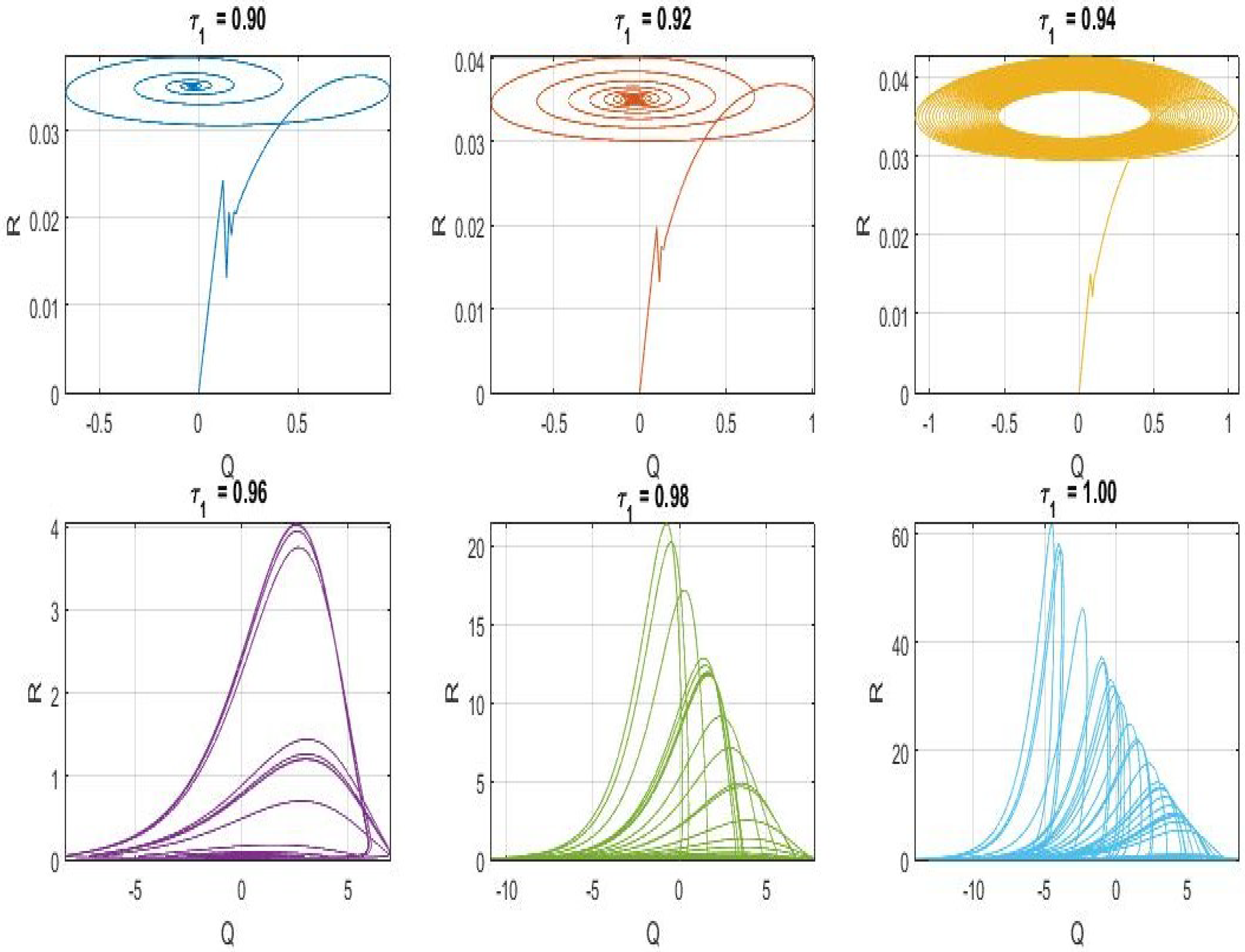
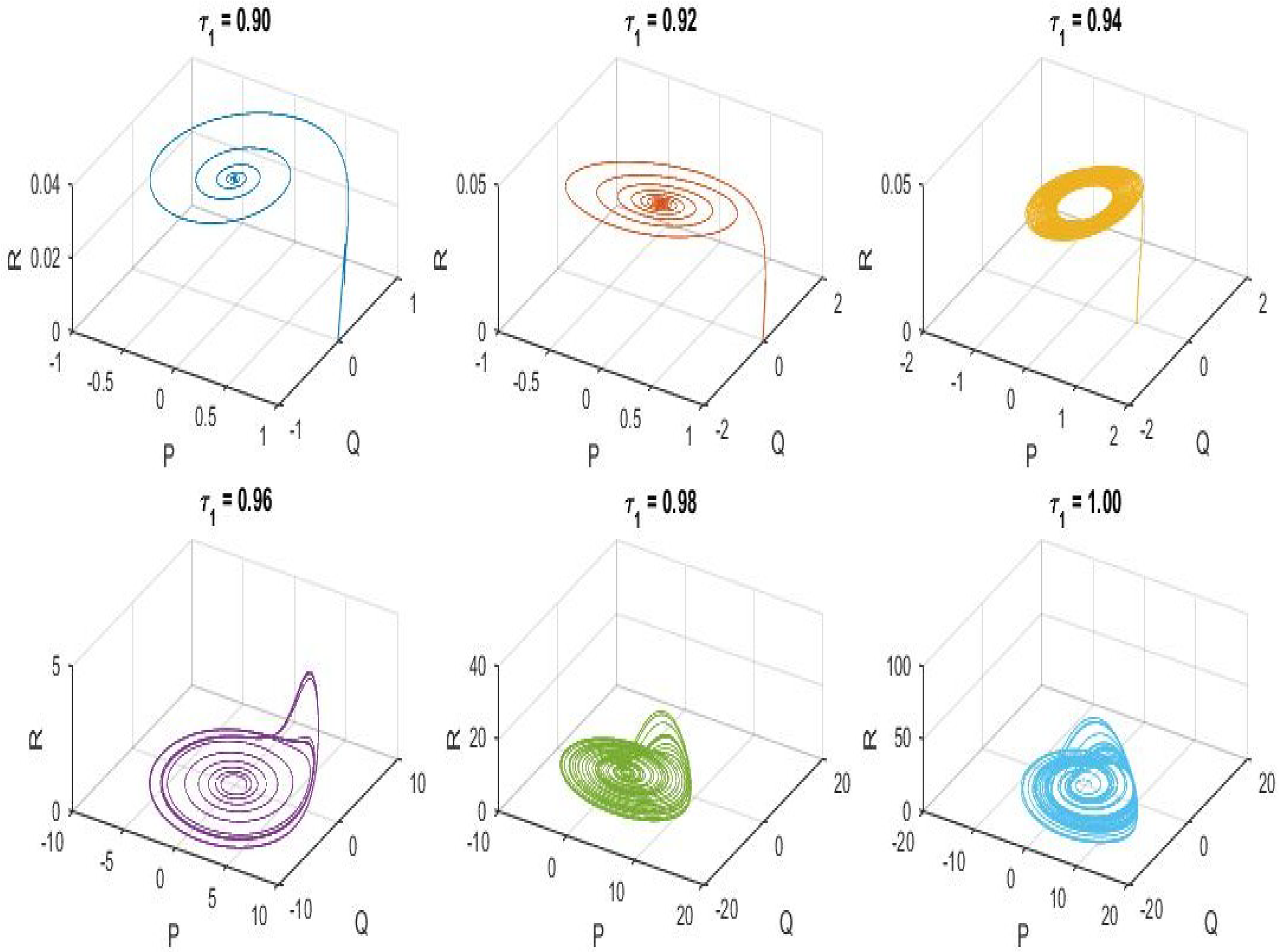
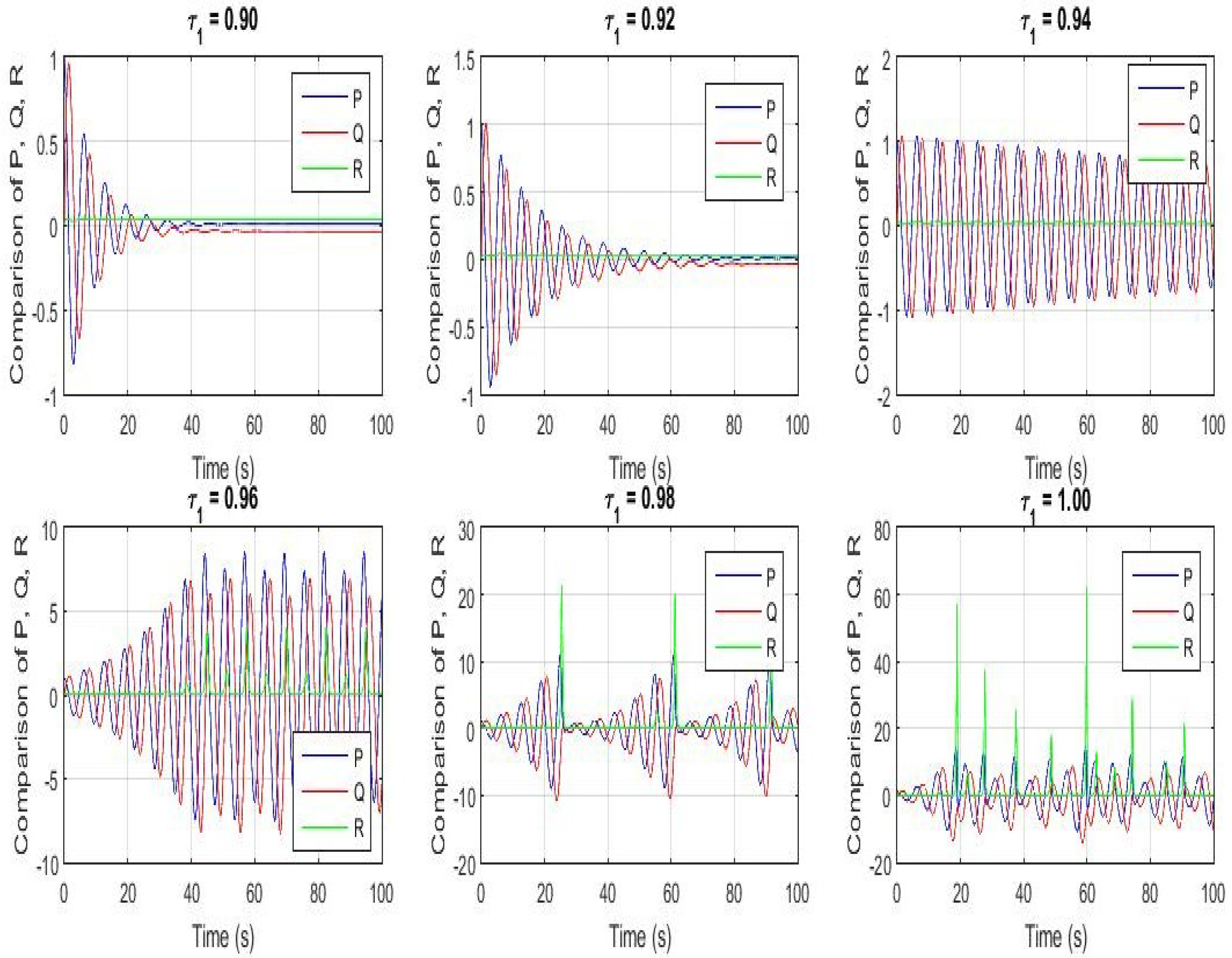
In Figure 1, Figure 2, Figure 3, Figure 4 and Figure 5, we present the numerical simulations for the Atangana–Baleanu–Caputo fractional form. The time simulation was conducted for t = 200 s, with a step size of h = 0.01 and fractional orders of τ 1 = 0.90 , 0.92 , 0.94 , 0.96 , 0.98 , 1.00 , with initial values ( P ( 0 ) ; Q ( 0 ) ; R ( 0 ) ) = ( 1 ; 0 ; 0 ) . The Rössler chaotic system parameters set α = 0.3 , β = 0.2 , and γ = 5.7 correspond to the classical benchmark values introduced by Rössler [1] and widely adopted in the chaotic attractor literature [8,32]. The graphs illustrate the 2 D and 3 D Rössler chaotic behavior with P, Q, and R in the chaotic problem. Furthermore, the relationship between the time-varying waveform of t and P, Q, and R for the orders of τ 1 is shown.
Figure 1, Figure 2 and Figure 3 depict 2D-phase plot comparisons of P vs. Q, P vs. R, and Q vs. R. These plots reveal the chaotic attractor across fractional orders. Figure 4 displays 3D phase portraits of the chaotic attractor dynamics between P, Q, and R. Finally, Figure 5 presents 2D time-series plots of the three state variables P, Q, and R as functions of time t. These plots illustrate the attractor time evolution of the chaotic attractor for the fractional order τ 1 = 0.90 , 0.92 , 0.94 , 0.96 , 0.98 , 1.00 case, highlighting their comparative behavior.

7. Conclusions

In this study, a fractional Rössler chaotic attractor was investigated within the Atangana–Baleanu–Caputo framework, with particular focus on Ulam–Hyers stability analysis. The existence and uniqueness of solutions were established by applying Banach fixed-point theory, thereby ensuring the mathematical well-posedness of the recommended chaotic attractor. A numerical approximation solution was obtained using an Euler-type scheme, enabling an in-depth investigation of the system dynamics under varying parameter conditions, particularly the influence of different fractional order τ 1 values. The results demonstrate the sensitivity and rich behavior of the attractor. This work advances fractional chaotic systems and can be extended in future research to time-delay, stochastic hyperchaotic, and fuzzy fractional Nabla difference models, thereby broadening its applicability across science and engineering.

Author Contributions

Conceptualization, A.S.; methodology, B.D., K.G. and A.S.; software, A.S.; validation, B.D., K.G. and A.S.; formal analysis, A.S.; investigation, B.D., K.G. and A.S.; resources, A.S.; writing—original draft preparation, B.D., K.G. and A.S.; writing—review and editing, B.D., K.G. and A.S.; visualization, A.S.; supervision, K.G. and A.S.; project administration, A.S.; funding acquisition, A.S. All authors have read and agreed to the published version of the manuscript.

Funding

This research received no external funding.

Data Availability Statement

No new data were created or analyzed in this study. Data sharing is not applicable to this article.

Acknowledgments

The authors express their sincere thanks for the valuable comments and constructive suggestions provided by the editor and the anonymous reviewers, which significantly contributed to improving the presentation and overall quality of this research work.

Conflicts of Interest

The authors declare no conflicts of interest.

References

  1. Rössler, O.E. An equation for continuous chaos. Phys. Lett. A 1976, 57, 397–398. [Google Scholar] [CrossRef]
  2. Hartley, T.T.; Lorenzo, C.F.; Qammer, H.K. Chaos in a fractional order Chua’s system. IEEE Trans. Circuits Syst. I Fundam. Theory Appl. 1995, 42, 485–490. [Google Scholar] [CrossRef]
  3. Chen, G.; Ueta, T. Yet another chaotic attractor. Int. J. Bifurc. Chaos 1999, 9, 1465–1466. [Google Scholar] [CrossRef]
  4. Chlouverakis, K.E.; Sprott, J. Chaotic hyperjerk systems. Chaos Solitons Fractals 2006, 28, 739–746. [Google Scholar] [CrossRef]
  5. Ge, Z.M.; Ou, C.Y. Chaos in a fractional order modified Duffing system. Chaos Solitons Fractals 2007, 34, 262–291. [Google Scholar] [CrossRef]
  6. Jafari, S.; Sprott, J. Simple chaotic flows with a line equilibrium. Chaos Solitons Fractals 2013, 57, 79–84. [Google Scholar] [CrossRef]
  7. Pham, V.T.; Volos, C.; Jafari, S.; Wei, Z.; Wang, X. Constructing a novel no-equilibrium chaotic system. Int. J. Bifurc. Chaos 2014, 24, 1450073. [Google Scholar] [CrossRef]
  8. Akgul, A.; Moroz, I.; Pehlivan, I.; Vaidyanathan, S. A new four-scroll chaotic attractor and its engineering applications. Optik 2016, 127, 5491–5499. [Google Scholar] [CrossRef]
  9. Boulaaras, S.; Sriramulu, S.; Selvam, A.; Allahem, A.; Alharbi, A.; Radwan, T. Chaos and stability analysis of the nonlinear fractional-order autonomous system. Alex. Eng. J. 2025, 118, 278–291. [Google Scholar] [CrossRef]
  10. Hajipour, A.; Tavakoli, H. Analysis and circuit simulation of a novel nonlinear fractional incommensurate order financial system. Optik 2016, 127, 10643–10652. [Google Scholar] [CrossRef]
  11. Zambrano-Serrano, E.; Campos-Cantón, E.; Muñoz-Pacheco, J.M. Strange attractors generated by a fractional order swittng system and its topological horseshoe. Nonlinear Dyn. 2016, 83, 1629–1641. [Google Scholar] [CrossRef]
  12. Ganji, R.M.; Jafari, H.; Baleanu, D. A new approach for solving multi variable orders differential equations with Mittag-Leffler kernel. Chaos Solitons Fractals 2020, 130, 109405. [Google Scholar] [CrossRef]
  13. Atangana, A.; Baleanu, D. New fractional derivatives with nonlocal and non-singular kernel: Theory and application to heat transfer model. Therm. Sci. 2016, 20, 763–769. [Google Scholar] [CrossRef]
  14. Yang, X.J. General Fractional Derivatives: Theory, Methods and Applications; CRC Press: Boca Raton, FL, USA; Taylor and Francis Group: Abingdon, UK, 2019. [Google Scholar]
  15. Doha, E.H.; Abdelkawy, M.A.; Amin, A.Z.M.; Baleanu, D. Spectral technique for solving variable-order fractional volterra integro-differential equations. Numer. Methods Partial Differ. Equ. 2018, 34, 1659–1677. [Google Scholar] [CrossRef]
  16. Ulam, S.M. Problem in Modern Mathematics; John Wiley and Sons: New York, NY, USA, 1964. [Google Scholar]
  17. Hyers, D.H. On the stability of the linear functional equation. Proc. Natl. Acad. Sci. USA 1941, 27, 222–224. [Google Scholar] [CrossRef] [PubMed]
  18. Yu, H.; Cai, G.; Li, Y. Dynamic analysis and control of a new hyperchaotic finance system. Nonlinear Dyn. 2012, 67, 2171–2182. [Google Scholar] [CrossRef]
  19. Vaidyanathan, S.; Pehlivan, I.; Dolvis, L.G.; Jacques, K.; Alcin, M.; Tuna, M.; Koyuncu, I. A novel ANN-based four-dimensional two-disk hyperchaotic dynamical system, bifurcation analysis, circuit realisation and FPGA-based TRNG implementation. Int. J. Comput. Appl. Technol. 2020, 62, 20–35. [Google Scholar] [CrossRef]
  20. Tuna, M.; Karthikeyan, A.; Rajagopal, K.; Alcin, M.; Koyuncu, I. Hyperjerk multiscroll oscillators with megastability: Analysis, FPGA implementation and a novel ANN-ring-based true random number generator. AEU-Int. J. Electron. Commun. 2019, 112, 152941. [Google Scholar] [CrossRef]
  21. Çavuşoğlu, Ü.; Akgül, A.; Zengin, A.; Pehlivan, I. The design and implementation of hybrid RSA algorithm using a novel chaos based RNG. Chaos Solitons Fractals 2017, 104, 655–667. [Google Scholar] [CrossRef]
  22. Kai, G.; Zhang, W.; Wei, Z.C.; Wang, J.F.; Akgul, A. Hopf bifurcation, positively invariant set, and physical realization of a new four-dimensional hyperchaotic financial system. Math. Probl. Eng. 2017, 2017, 2490580. [Google Scholar] [CrossRef]
  23. Li, C.; Akgul, A.; Sprott, J.C.; Iu, H.H.; Thio, W.J.-C. A symmetric pair of hyperchaotic attractors. Int. J. Circuit Theory Appl. 2018, 46, 2434–2443. [Google Scholar] [CrossRef]
  24. Narayanan, G.; Ali, M.S.; Rajchakit, G.; Jirawattanapanit, A.; Priya, B. Stability analysis for Nabla discrete fractional-order of glucose-insulin regulatory system on diabetes mellitus with Mittag-Leffler kernel. Biomed. Signal Process. Control 2023, 80, 104295. [Google Scholar] [CrossRef]
  25. Luo, D.; Abdeljawad, T.; Luo, Z. Ulam-Hyers stability results for a novel nonlinear Nabla Caputo fractional variable-order difference system. Turk. J. Math. 2021, 45, 456–470. [Google Scholar] [CrossRef]
  26. Chian, A.C.L.; Rempel, E.L.; Rogers, C. Complex economic dynamics: Chaotic saddle, crisis and intermittency. Chaos Solitons Fractals 2006, 29, 1194–1218. [Google Scholar] [CrossRef]
  27. Wang, Z.; Huang, X.; Shi, G. Analysis of nonlinear dynamics and chaos in a fractional order financial system with time delay. Comput. Math. Appl. 2011, 62, 1531–1539. [Google Scholar] [CrossRef]
  28. Elouahab, M.S.A.; Hamri, N.E.; Wang, J. Chaos control of a fractional-order financial system. Math. Probl. Eng. 2010, 18, 270646. [Google Scholar] [CrossRef]
  29. Johansyah, M.D.; Sambas, A.; Qureshi, S.; Zheng, S.; Elhameed, T.M.A.; Vaidyanathan, S.; Sulaiman, I.M. Investigation of the hyperchaos and control in the fractional order financial system with profit margin. Partial Differ. Equ. Appl. Math. 2024, 9, 100612. [Google Scholar] [CrossRef]
  30. Salahshour, S.; Ahmadian, A.; Baleanu, D. Pathological study on uncertain numbers and proposed solutions for discrete fuzzy fractional order calculus. Open Phys. 2023, 21, 20230135. [Google Scholar]
  31. Khan, A.; Alshehri, H.M.; Abdeljawad, T.; Al-Mdallal, Q.M.; Khan, H. Stability analysis of fractional Nabla difference COVID-19 model. Results Phys. 2021, 22, 103888. [Google Scholar] [CrossRef]
  32. Selvam, A.; Boulaaras, S.; Sabarinathan, S.; Radwan, T. Nonlinear fractional order financial system: Chaotic behavior and Ulam-Hyers stability. Fractals 2025, 33, 2540082. [Google Scholar] [CrossRef]
Figure 1. Two-dimensional plane (P-Q) of the Rössler attractor with parameters ( α = 0.3 , β = 0.2 , γ = 5.7 ) and initial conditions ( P , Q , R ) ( 0 ) = ( 1 , 0 , 0 ) for varying fractional orders τ 1 = 0.90 , 0.92 , 0.94 , 0.96 , 0.98 , 1.00 .
Appliedmath 06 00067 g001
Figure 2. Two-dimensional plane (P-R) of the Rössler attractor with parameters ( α = 0.3 , β = 0.2 , γ = 5.7 ) and initial conditions ( P , Q , R ) ( 0 ) = ( 1 , 0 , 0 ) for varying fractional orders τ 1 = 0.90 , 0.92 , 0.94 , 0.96 , 0.98 , 1.00 .
Appliedmath 06 00067 g002
Figure 3. Two-dimensional plane (Q-R) of the Rössler attractor with parameters ( α = 0.3 , β = 0.2 , γ = 5.7 ) and initial conditions ( P , Q , R ) ( 0 ) = ( 1 , 0 , 0 ) for varying fractional orders τ 1 = 0.90 , 0.92 , 0.94 , 0.96 , 0.98 , 1.00 .
Appliedmath 06 00067 g003
Figure 4. Three-dimensional phase ( P , Q , R ) space of the Rössler chaotic attractor with parameters ( α = 0.3 , β = 0.2 , γ = 5.7 ) and initial conditions ( P , Q , R ) ( 0 ) = ( 1 , 0 , 0 ) for varying fractional orders τ 1 = 0.90 , 0.92 , 0.94 , 0.96 , 0.98 , 1.00 .
Appliedmath 06 00067 g004
Figure 5. Time evolution of P, Q, R 2D plane of the Rössler attractor ( α = 0.3 , β = 0.2 , γ = 5.7 ), and initial conditions ( P , Q , R ) ( 0 ) = ( 1 , 0 , 0 ) for varying fractional orders τ 1 = 0.90 , 0.92 , 0.94 , 0.96 , 0.98 , 1.00 .
Appliedmath 06 00067 g005
Disclaimer/Publisher’s Note: The statements, opinions and data contained in all publications are solely those of the individual author(s) and contributor(s) and not of MDPI and/or the editor(s). MDPI and/or the editor(s) disclaim responsibility for any injury to people or property resulting from any ideas, methods, instructions or products referred to in the content.