Article

Interconnections Between Financial Markets and Crypto-Asset Markets


by
Senne Aerts
1,
Eleonora Iachini
2,
Urszula Kochanska
1,
Eleni Koutrouli
3 and
Polychronis Manousopoulos
3,*
1
European Central Bank, Sonnemannstrasse 22, 60314 Frankfurt am Main, Germany
2
Banca d’Italia, Via Nazionale 91, 00184 Roma, Italy
3
Bank of Greece, 21 Eleftherios Venizelos Avenue, 10250 Athens, Greece
*
Author to whom correspondence should be addressed.
AppliedMath 2026, 6(4), 57; https://doi.org/10.3390/appliedmath6040057
Submission received: 30 January 2026 / Revised: 16 March 2026 / Accepted: 19 March 2026 / Published: 8 April 2026
(This article belongs to the Section Probabilistic & Statistical Mathematics)

Abstract

Crypto-asset markets have been rapidly evolving during the past years, being under the spotlight of a diverse set of actors in the financial ecosystem, including investors, financial institutions, regulators and academics. Their potential interconnections with the traditional financial markets are important, and identifying them can provide useful insight in a diversity of areas such as risk contagion and mitigation, price formation, portfolio management and regulatory framework design. In order to identify such interconnections, various lines of research are followed. Specifically, the correlation between prominent stock market indices and crypto-assets from 2018 to 2025 is examined, while their volatility is also evaluated. Furthermore, the relevant effect of news, events and announcements is explored. The results are based on both daily and high-frequency datasets, with the use of the latter focusing on intra-day variation. The analysis of the results identifies existing interconnections between 2020 and 2025, as well as the important respective impact of news and announcements. An additional generic outcome is the usefulness of high-frequency datasets in the crypto-asset context. The conclusions are useful for all actors in the financial ecosystem. Future work can focus on the extension of the research to additional markets or crypto-assets.

1. Introduction

Crypto-asset markets have been rapidly evolving during the past years, being under the spotlight of a diverse set of actors in the financial ecosystem. This set includes investors, financial institutions, regulators, academics and developers, each viewing crypto-asset markets from a different perspective, such as opportunity for profit, means for extending market share, potential threat to financial stability or subject of scientific research. The total market capitalization of crypto-assets surpassed US$4 trillion after mid-2025 as a result of a multi-year upward trend, while it remained around US$3 trillion at the end of the year, as described in the ECB Financial Stability Review (F.S.R. November 2025, accessed on 16 March 2026). Indeed, it remained at a high level despite the significant drop of Bitcoin’s price in November 2025 and the subsequent concerns that it raised.
The increasing market capitalization of crypto-assets, along with the offering of new crypto-based financial products and services, has sparked a growing interest in the crypto-ecosystem, which has thus gained a wider audience, including investors and stakeholders from traditional finance. Although speculative motives have prevailed in many cases, there has also been a genuine interest in innovation and the potential unique benefits of Distributed Ledger Technology (DLT) platforms, signifying a long-term perspective from a part of the traditional financial market participants. Additionally, the advancements in the regulatory field, such as the Markets in Crypto-Assets Regulation (MiCAR) in the EU or the Guiding and Establishing National Innovation for U.S. Stablecoins Act (GENIUS Act) in the U.S., have set the rules for a potentially wider future adoption of crypto-assets and the related products and services.
Against this background, the potential interconnections of the crypto-asset markets with the traditional financial markets are particularly important. The identification and interpretation of such interconnections is thus crucial and can provide useful insight in a diversity of areas. Risk contagion and mitigation is one of the most important topics, especially considering the increased volatility of the crypto-asset markets along with their ability to transmit spillovers to the traditional financial markets [1,2,3,4,5,6]. Portfolio management, especially diversification and rebalancing, can also benefit from identifying the existence and evolution of such interconnections along with their effect on price formation [7,8,9,10,11]. Moreover, the design of regulatory frameworks can be supported by the understanding of such potential interconnections and their implications for financial stability [12,13,14,15,16,17,18,19].
Motivated by the continuous growth of the crypto-asset markets in terms of both capitalization and attracted interest, as well as by the implications highlighted in the aforementioned studies, the present work focuses on the identification of the interconnections between the traditional financial markets and the crypto-asset markets. For this purpose, various lines of research are followed, shedding light on different aspects of their linkages, since there can be multiple dimensions of interconnection, transmission channels and causes [20].
Specifically, the correlation between major stock market indices and crypto-assets is evaluated in order to detect their potential co-movements. Moreover, their volatility is examined in order to determine whether calm or turbulent market conditions lead to different interconnection patterns or spillovers. Finally, the relevant effect of news, events and announcements is explored to evaluate the magnitude of their impact as well as to detect potential asymmetry of positive and negative information. In all of the research lines, the use of large datasets combined with the diversity of calculations, including intra-day ones, allows for a rich set of results and their reliable analysis. The contribution of the present work is the exploration of topics that are not covered in the literature or are only partially examined, offering up-to-date results along with their interpretation.
The paper is structured as follows. Section 2 presents the datasets used in the analysis. Section 3 contains the results and analysis of the correlations between major stock market indices and crypto-assets, while Section 4 examines the volatility of both of them. Section 5 focuses on the effect of news and announcements on the correlations and the volatility. Finally, Section 6 summarizes the conclusions and indicates areas of future work, suggesting potential extensions to both the data and the methodology.

2. Datasets

The datasets used for the analysis include time series of major stock market indices and crypto-assets, namely 3 U.S. and 2 EU equity indices (Table 1), along with 2 crypto-assets (Table 2). Their selection has been made so as to form an adequate sample that will produce meaningful results. The selected equity indices provide a representative view of the stock markets in major global economies, and are especially interesting because of the regulatory frameworks that have evolved in the respective areas. In the case of the EU, unified indices were picked over country-level indices, since the latter are highly correlated with each other and, moreover, focus on the whole European economy. The selected crypto-assets have an aggregate market cap share between 46% and 90%, approximately, during the sample period (https://www.coingecko.com/, accessed on 16 March 2026). The time series consists of prices, while returns and log returns are subsequently calculated.
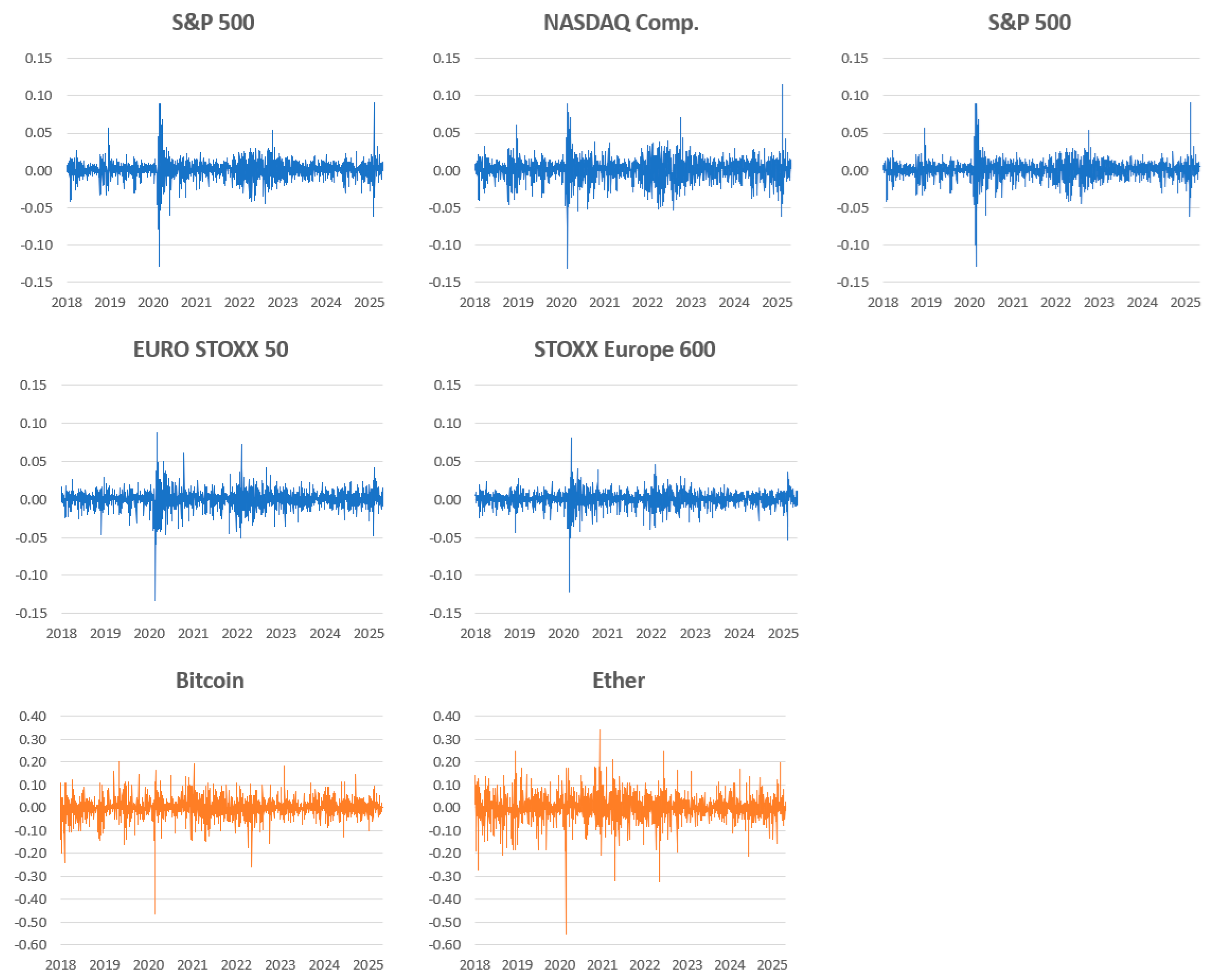
All datasets cover a 7.5-year period, spanning from January 2018 to June 2025, while only dates that are common to all time series were included. The selection of 2018 as the starting year of the dataset is based on the fact that the total crypto-asset market capitalization rose for the first time (a) above US$100 billion in mid-2017, and (b) above US$500 billion at the end of 2017 [12], thus rendering earlier data questionable in terms of usefulness for the purposes of the present work. The analysis employs both daily and high-frequency datasets, the latter being motivated by the continuous operation (24/7) of the crypto-asset markets. Specifically, the daily dataset (Data obtained from https://www.nasdaq.com/ and https://fred.stlouisfed.org/ (NASDAQ, S&P 500, DJIA), https://www.stoxx.com/ and https://www.investing.com/ (EURO STOXX 50, STOXX Europe 600), https://coinmarketcap.com/ (BTC/ETH)) consists of daily open/close/high/low prices for the equity indices and crypto-assets, while the high-frequency dataset (Data obtained from CryptoCompare (ECB private dataset)) includes minute-level data of the crypto-assets and allows us to compute open/close/high/low prices within a specific interval of the day and not solely for the whole 24 h. In this way, the attention is restricted to crypto-asset trading activity within the trading hours of the stock markets, which is especially useful when calculating statistics, such as correlation, that combine both a crypto-asset and an equity index. The daily dataset (closing prices and log returns of the equity indices and crypto-assets) is presented in Figure 1 and Figure 2.

3. Correlation of the Traditional Financial Markets and the Crypto-Asset Markets

The first step in the analysis consists of identifying the potential co-movements of the traditional financial markets and the crypto-asset markets by examining both the existence of such a linkage as well as its evolution over time. In order to achieve this, the Pearson correlation coefficient between the daily/weekly log returns of the equity indices and the crypto-assets is calculated (the differences between the correlations of returns and the respective correlations of log returns are insignificant and, therefore, the presentation will focus only on the latter). For the calculations presented in this work, StataNow/MP 18.5, Excel 2024 and custom software developed by the authors were used. Both fixed window and rolling window calculations for various window lengths have been included, namely quarter/semi-annual/annual windows, as well as a total window spanning the whole length of the datasets.

3.1. Results from the Daily Dataset

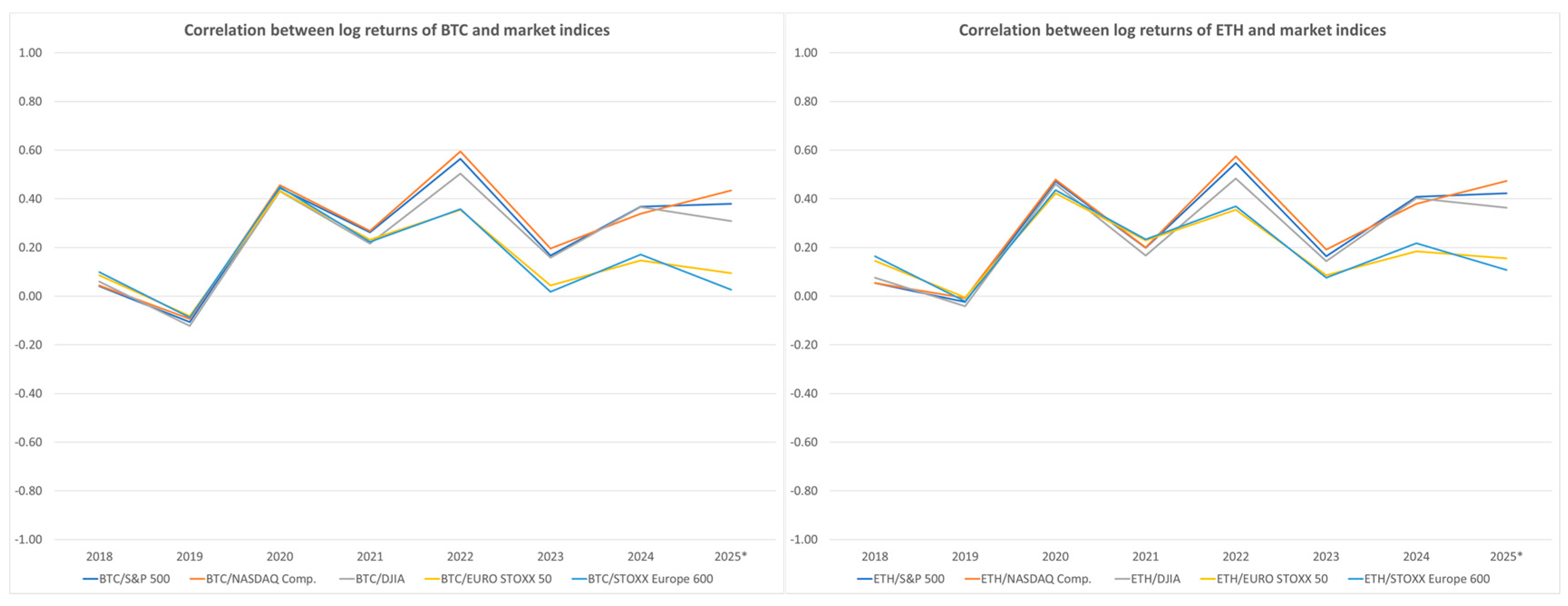
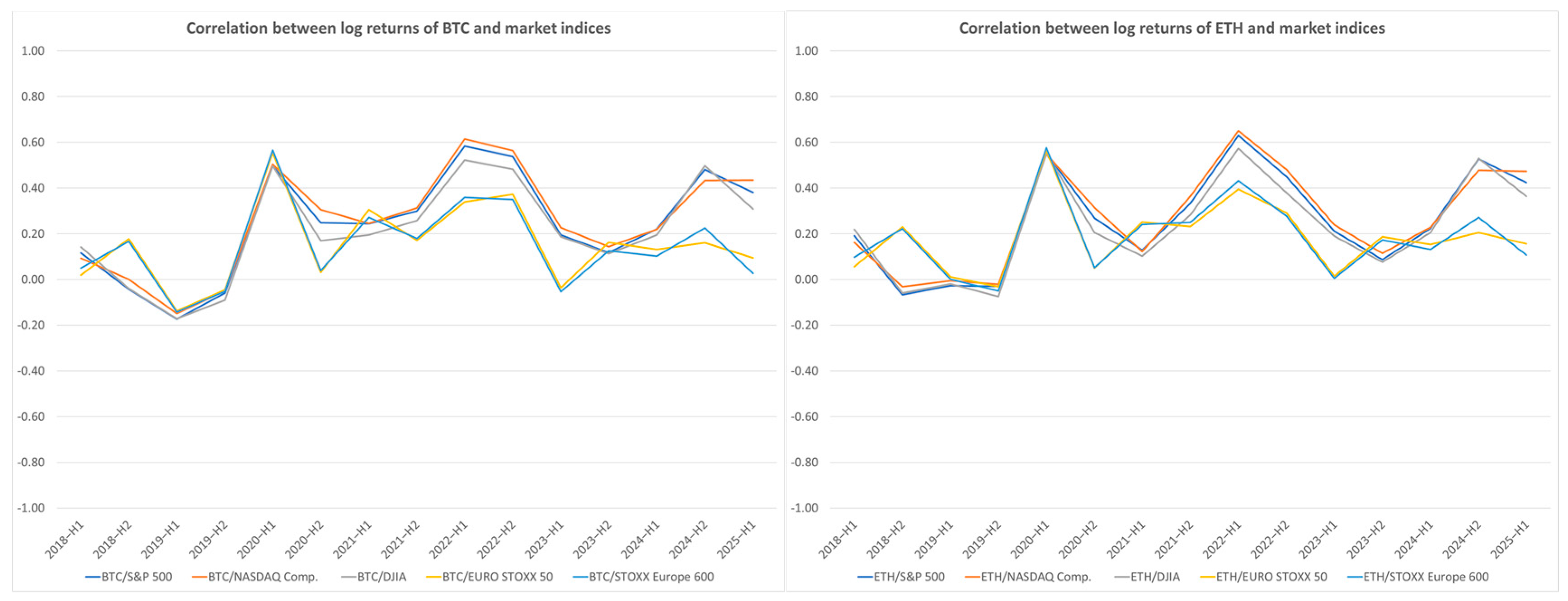
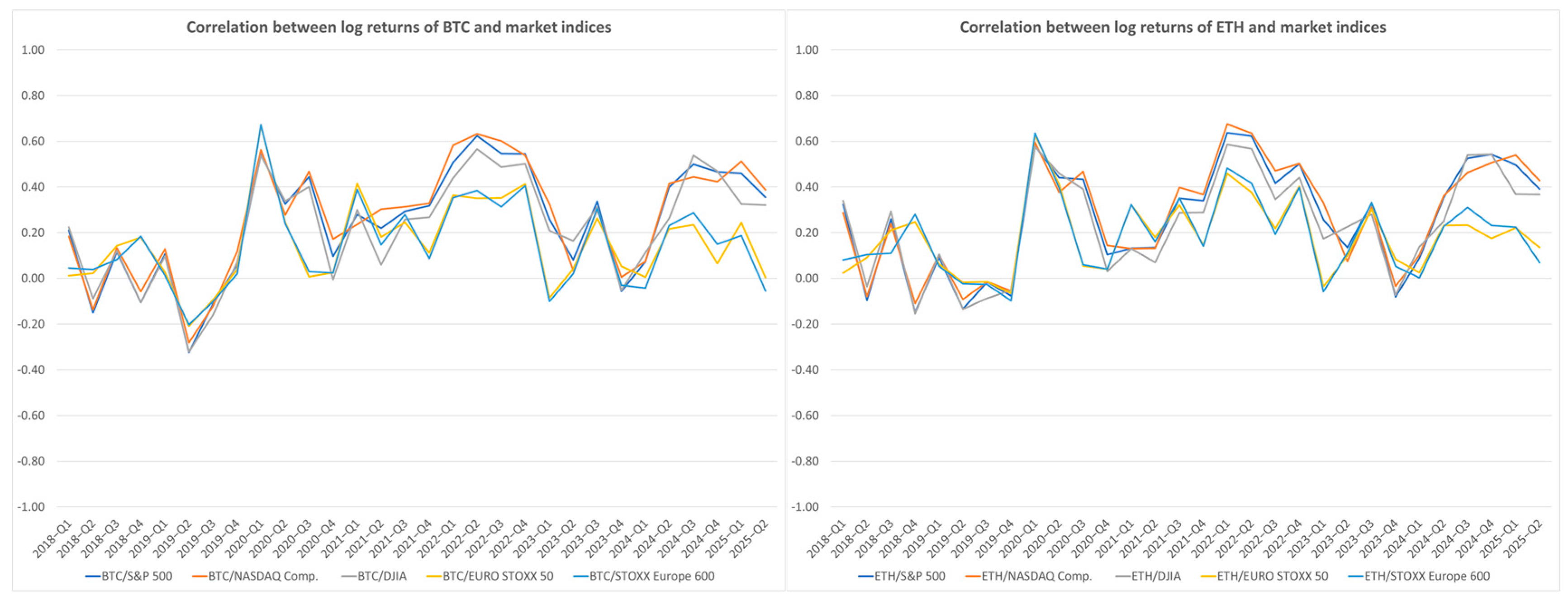
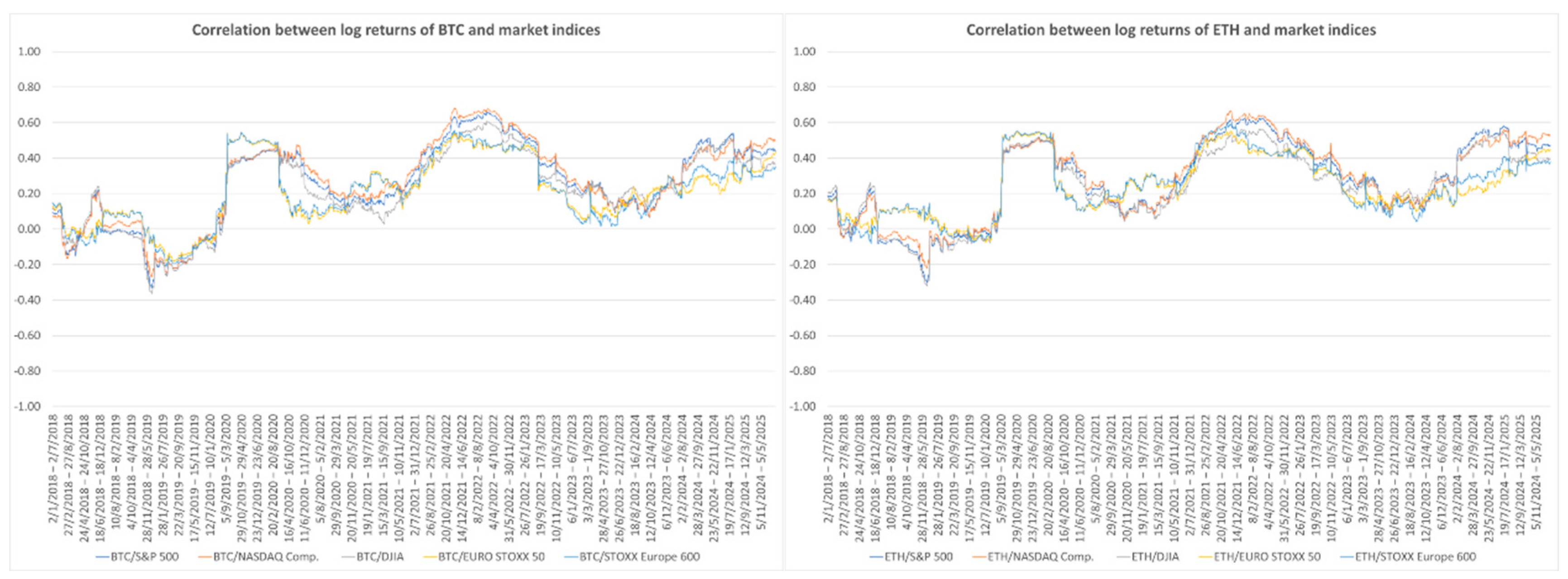
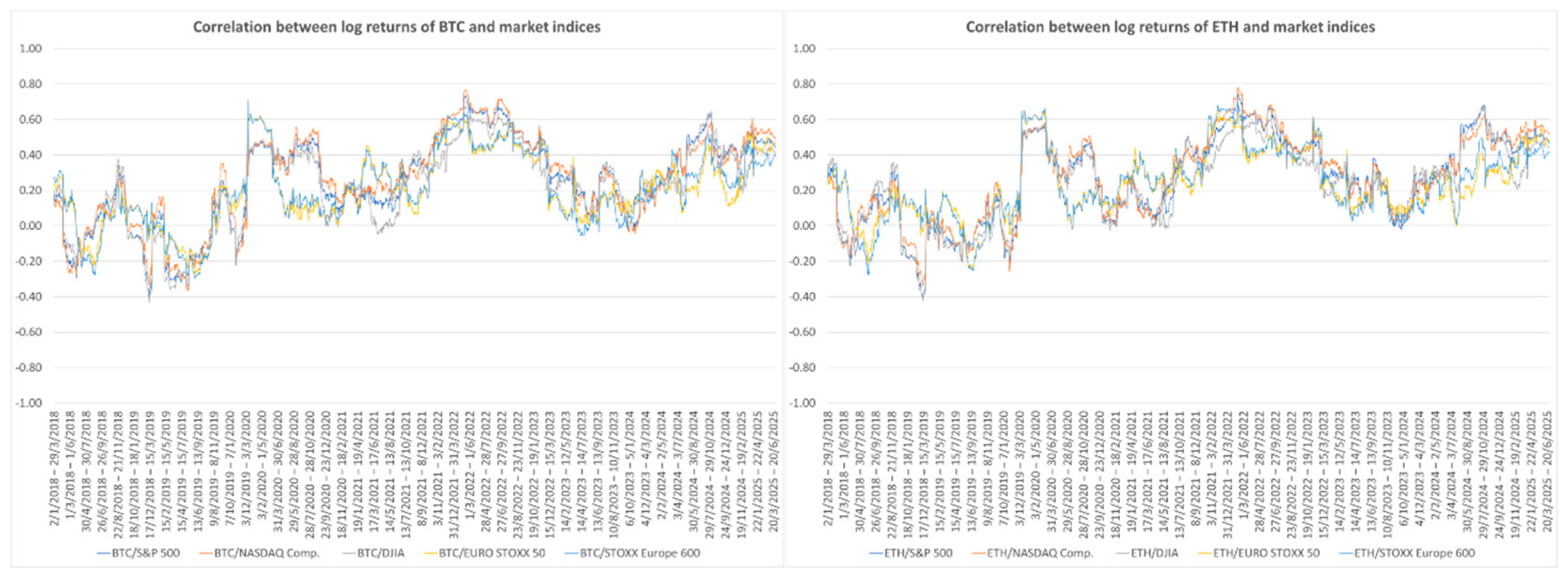
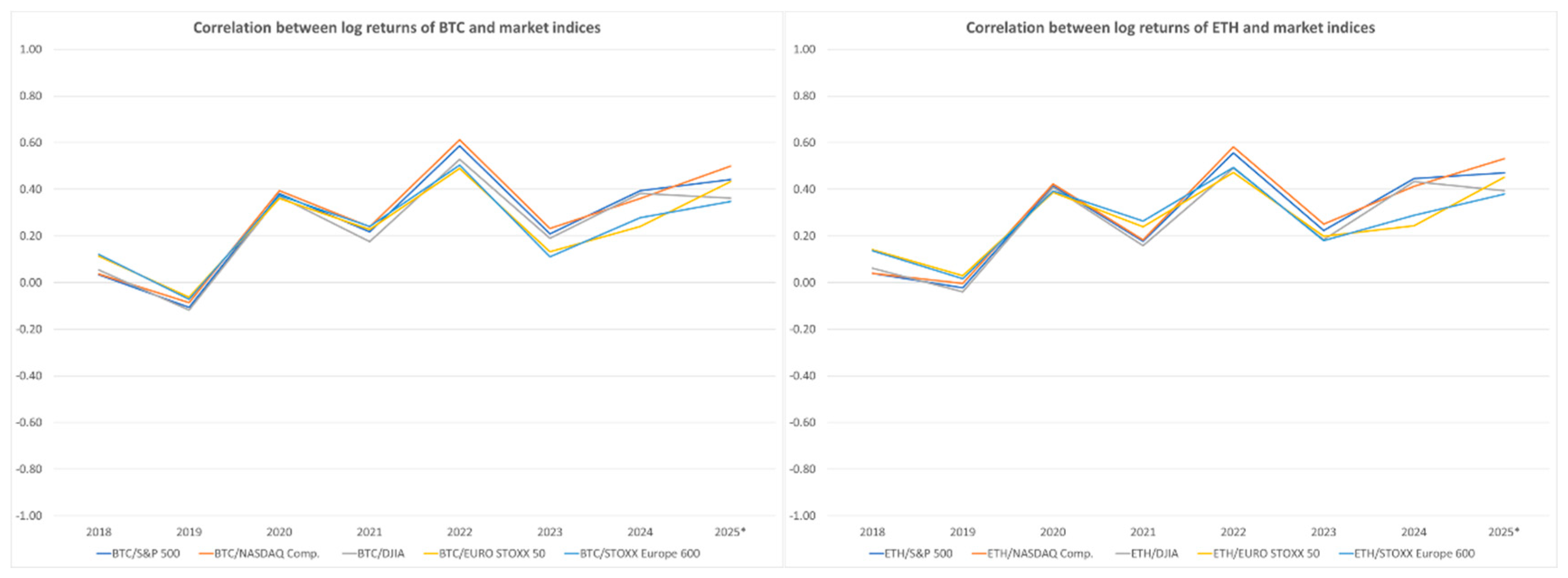
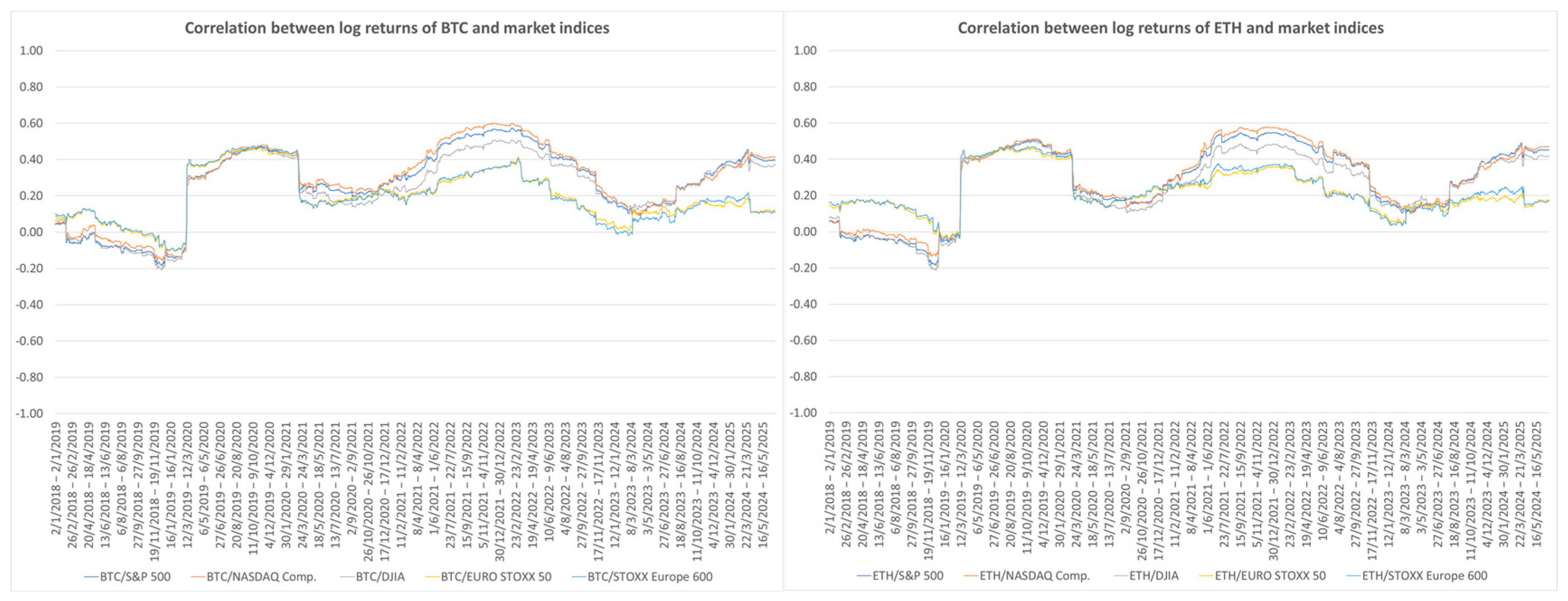
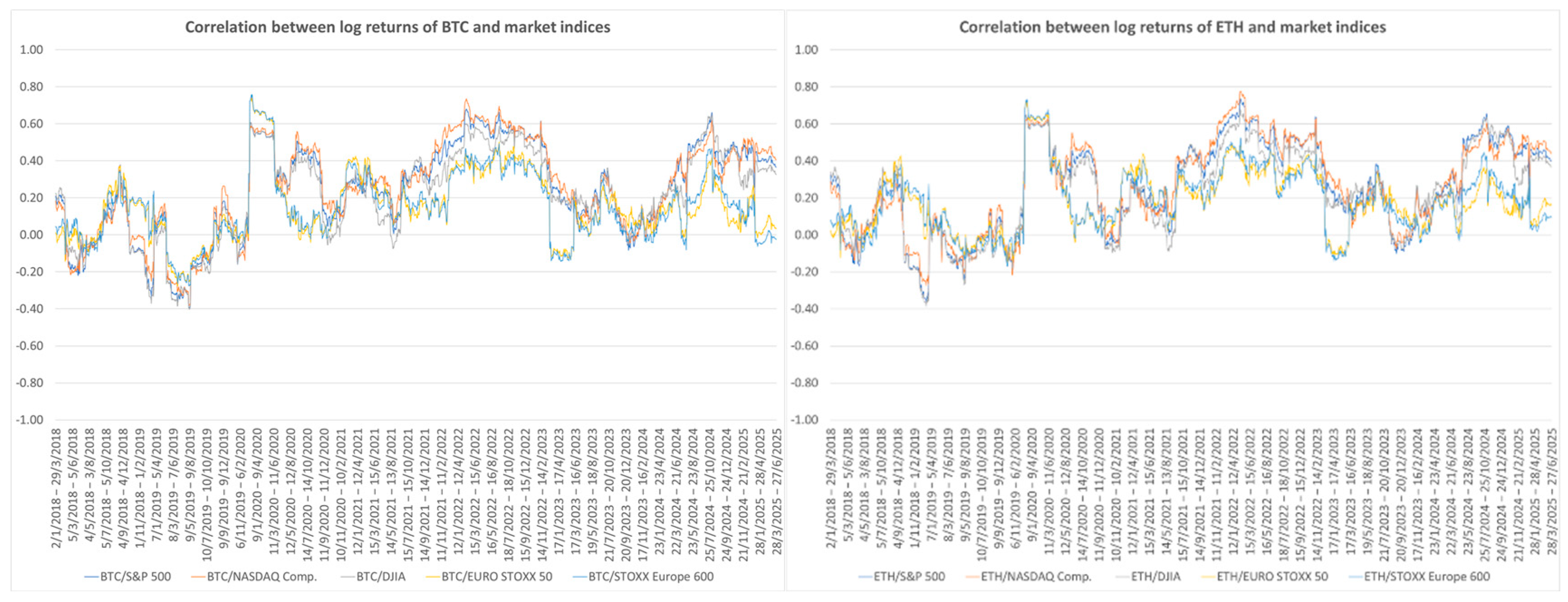
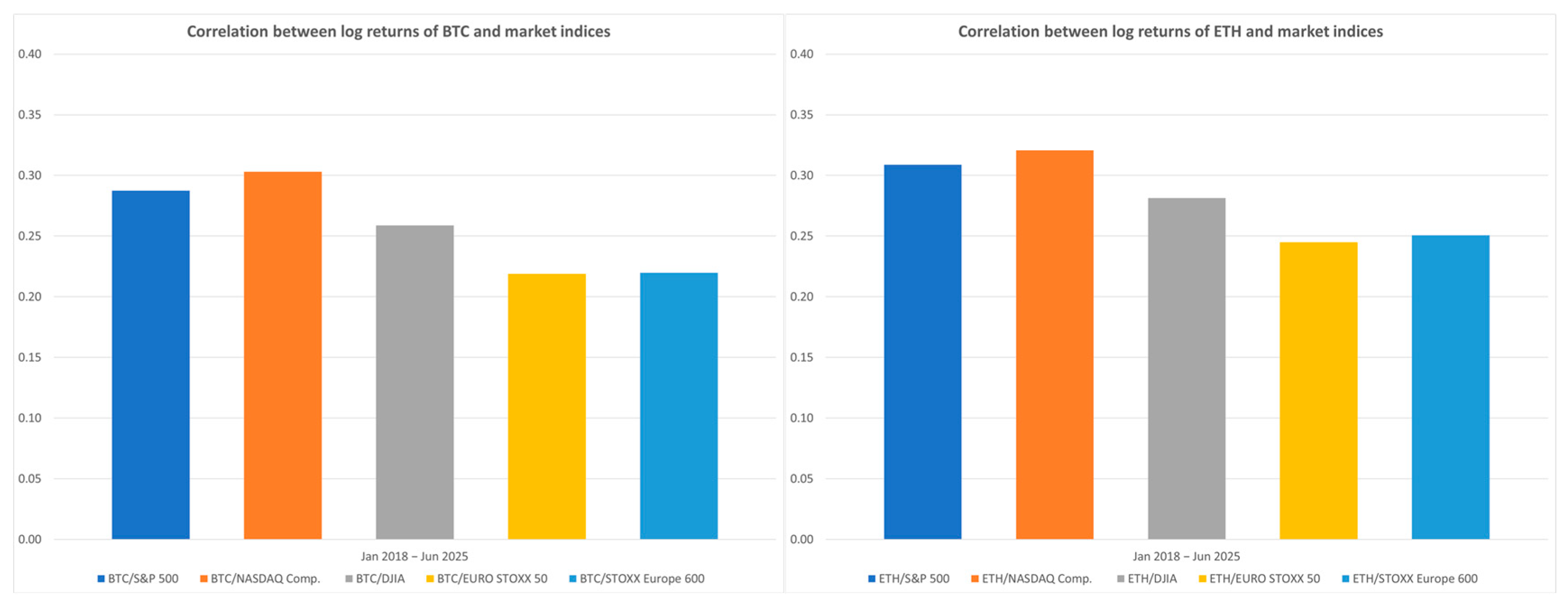
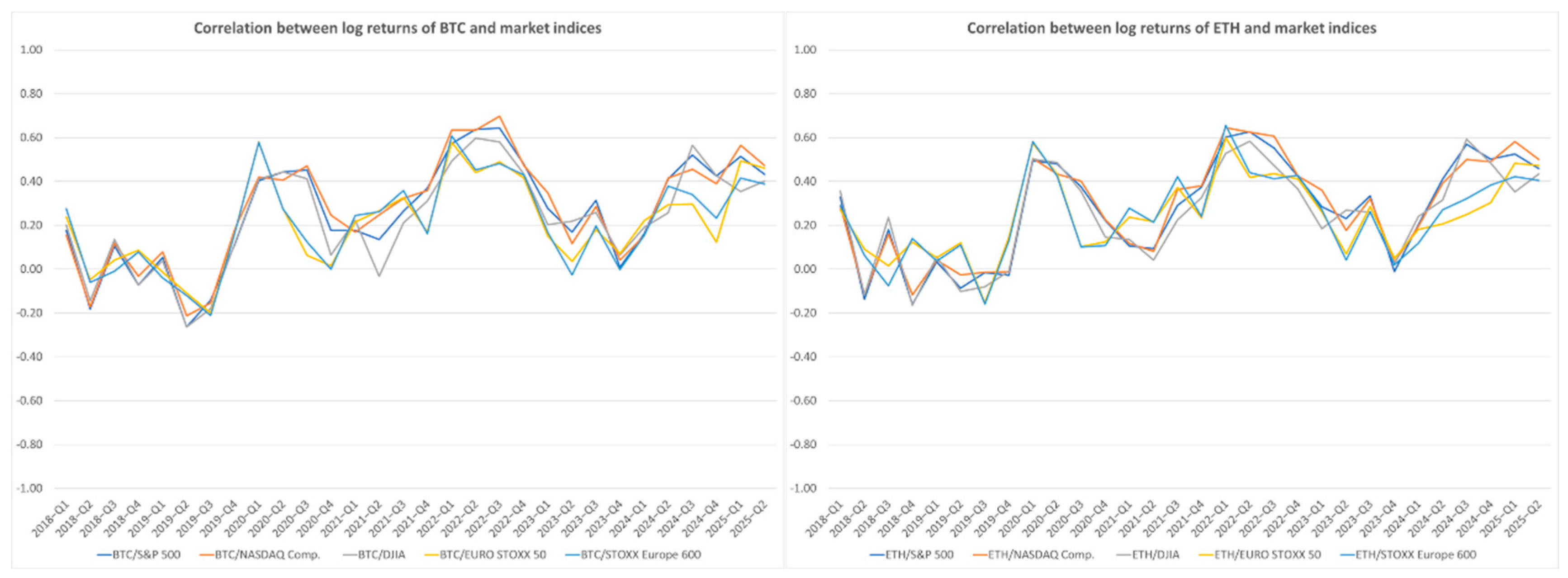
The first set of results is produced using the daily dataset, and it consists of the correlations of the daily log returns between each equity index and each crypto-asset. Specifically, the rolling window calculations are presented in Appendix A, Figure A1, Figure A2 and Figure A3, while the fixed window calculations are presented in Appendix A, Figure A4, Figure A5, Figure A6 and Figure A7 and Appendix B, Table A1, Table A2, Table A3 and Table A4. The first conclusion that can be drawn from the results is that both Bitcoin and Ether present similar behaviour with respect to their correlation to the equity indices. This is expected to some degree, since they have a high correlation of their own log returns—the correlation of the daily log returns of Bitcoin and Ether is approximately 0.81 for the whole span of the dataset—but it also indicates that they generally had a similar treatment from investors who were also involved in the traditional financial markets. Focusing on the main research question, the results indicate that (a) until 2020, the crypto-assets exhibit no noteworthy correlation to the equity indices, (b) starting from 2020, the crypto-assets exhibit moderate correlation to the equity indices; however, this varies considerably over time—it is worth mentioning that the correlation of traditional asset classes has also been shown to vary over time [21,22]. The increased correlation of the traditional financial markets and the crypto-asset markets since 2020 has also been reported in the literature (see [23,24]), as well as the inexistent or insignificant correlation previously (see [25,26]).
Concerning the evolution of the correlations, starting from 2020, three peaks can be identified in the figures. The first peak is centred around 2020 and can be associated with the COVID-19 pandemic with a high degree of confidence. Indeed, the COVID-19 pandemic had a significant impact on both the financial markets globally as well as the crypto-asset markets (e.g., [27,28,29,30,31,32]), and this has also contributed to the observed increase in the correlations, at least in terms of the underlying volatility. Considering that this peak signifies the start of a long period (up to the present) of non-negligible correlation between the log returns of the equity indices and the crypto-assets, it is also an indication that the COVID-19 pandemic and the associated lockdowns sparked a wider interest and adoption of the crypto-assets that has since remained. Although this cannot be considered the sole factor for the appearance and increase in the aforementioned correlation, it is evident that it contributed to it. Indeed, the lockdowns reinforced the digital finance ecosystem [33,34,35], while the overall financial uncertainty brought alternative investment products, such as crypto-assets, to the attention of a wider audience, thus increasing their adoption [36,37] and leading to the considerable increase in crypto-asset market cap starting from 2020. For example, the Bitcoin market cap more than quadrupled within 2020, rising from US$130 billion to US$536 billion approximately (https://www.coingecko.com/), while it reached US$2.1 trillion at the end of the dataset (30 June 2025) after a multi-year increasing trend.
The second peak is centred around 2022, which was a hard year for both the crypto-asset markets as well as the stock markets, which experienced decreased prices along with increased volatility. For example, Bitcoin and Ether lost more than 65% of their value during the “crypto winter” of 2022, while the stock markets also experienced significant decline in the first three quarters of 2022. This can be attributed to a variety of reasons, including macroeconomic ones, such as the inflation surge and the subsequent monetary tightening by the central banks [38,39,40,41], as well as global geopolitical ones, such as the Russia–Ukraine war and the subsequent supply chain disruptions [42,43,44]. This peak is probably an indication that crypto-assets were not considered by the investors as a safe haven during this turbulent period, which also exhibits the highest correlations for the whole dataset. The third peak (it should more precisely be described as an increasing trend, since it is not yet known if the maximum has been reached) is present at the most recent part of the dataset, centred around 2024, with 2023 being a turning point in its formation. It is interesting that this peak coincides with the period of the 2024 U.S. presidential election, while it is higher for the U.S. equity indices. A potential interpretation would be that the anticipation of the election and, finally, the eventual election of an openly pro-crypto U.S. president has reinforced the co-movements of the crypto-asset markets and the traditional financial markets, an aspect also highlighted in the next section examining the effect of U.S. administration announcements. It is worth mentioning that previous U.S. presidential elections have been shown to have an impact on the financial markets (e.g., [45,46]).
A final conclusion from the first set of results is that the EU equity indices present in general lower correlation to the crypto-assets than the U.S. indices. This is especially evident after 2021, when the respective correlations start to diverge. An interesting exception exists in the second and third quarters of 2023, when all the correlations were similar, a time interval that coincides with the publication and entry into force of the MICA regulation in the EU.

3.2. Results from the High-Frequency Dataset

For more elaborate analysis, a second set of results is produced using a high-frequency dataset of the crypto-assets, which contains minute-level data. The motivation for this is based on the continuous operation (24/7) of the crypto-asset markets in contrast to the limited operation (in terms of days and hours) of the traditional financial markets. Specifically, the attention is restricted to crypto-asset trading activity within the trading hours of the stock markets, and thus correlations are calculated using prices/returns of each equity index/crypto-asset pair that have exactly the same time reference. The high-frequency dataset allows the computation of open/close/high/low prices within a specific interval of the day and not solely for the whole 24 h, and, therefore, enables the aforementioned approach. In other words, for each crypto-asset, the calculations use data only within the trading hours of the respective equity index against which the correlation is calculated.
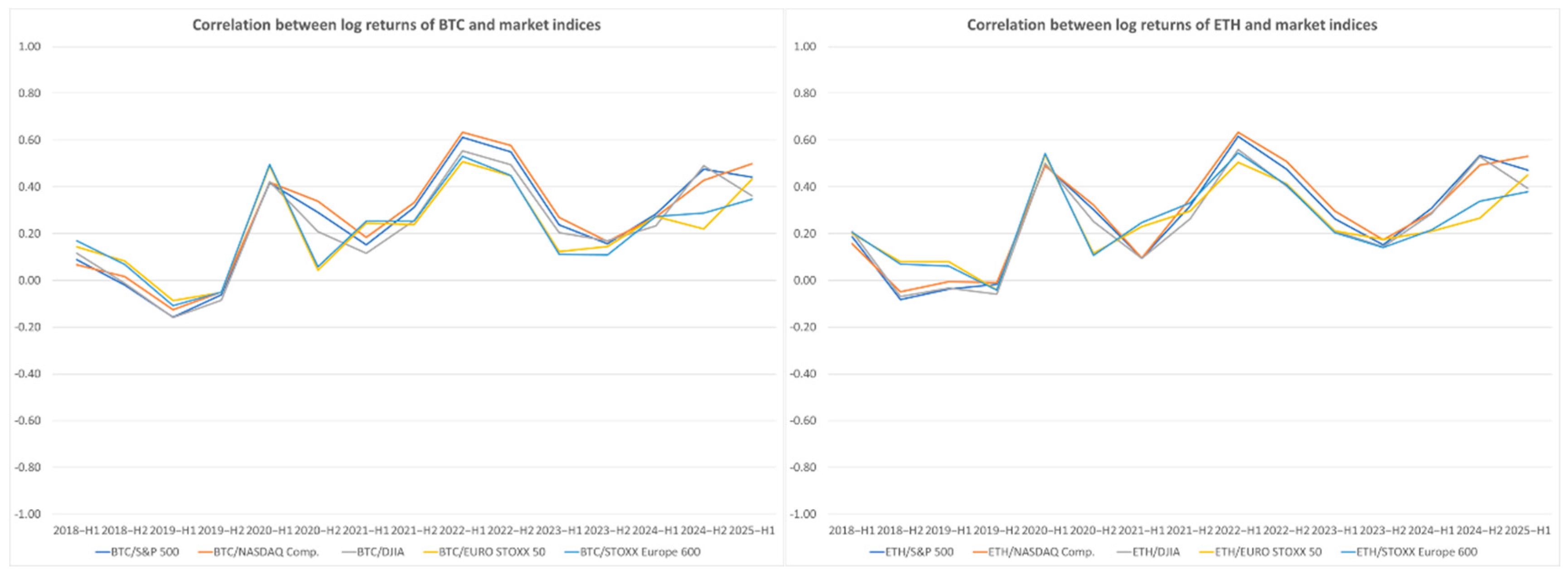
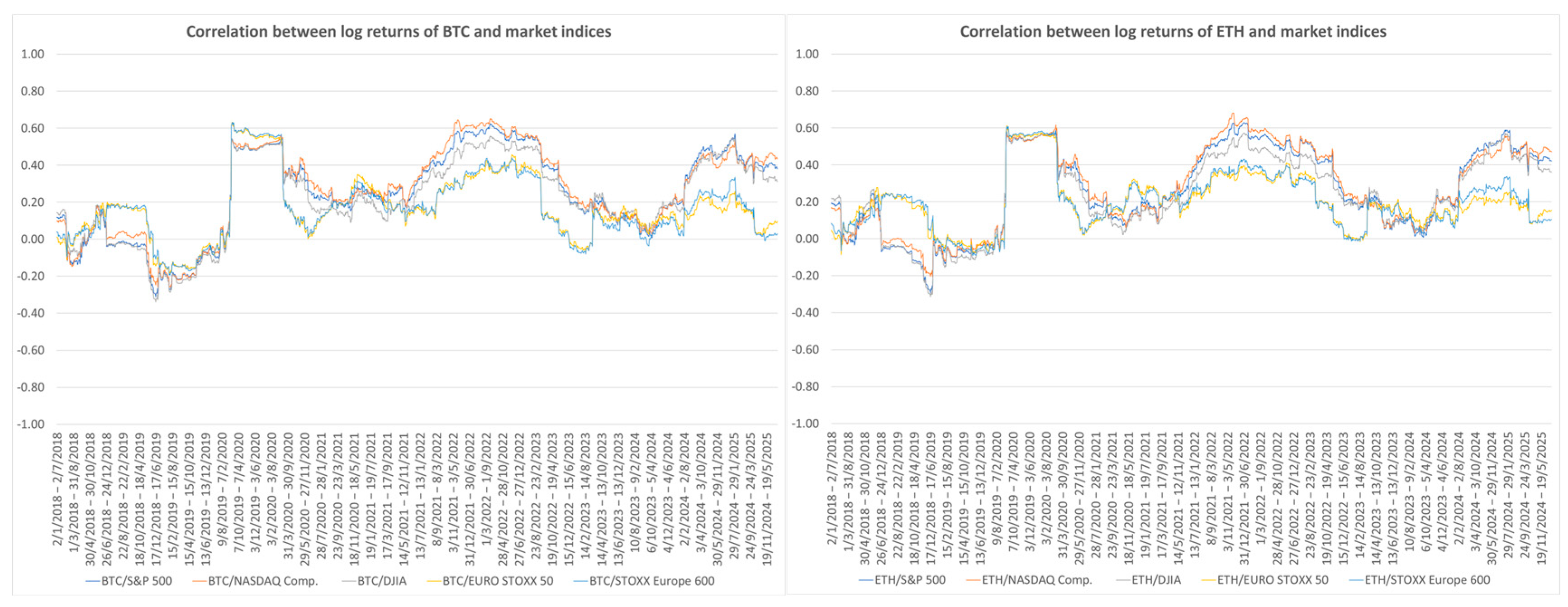
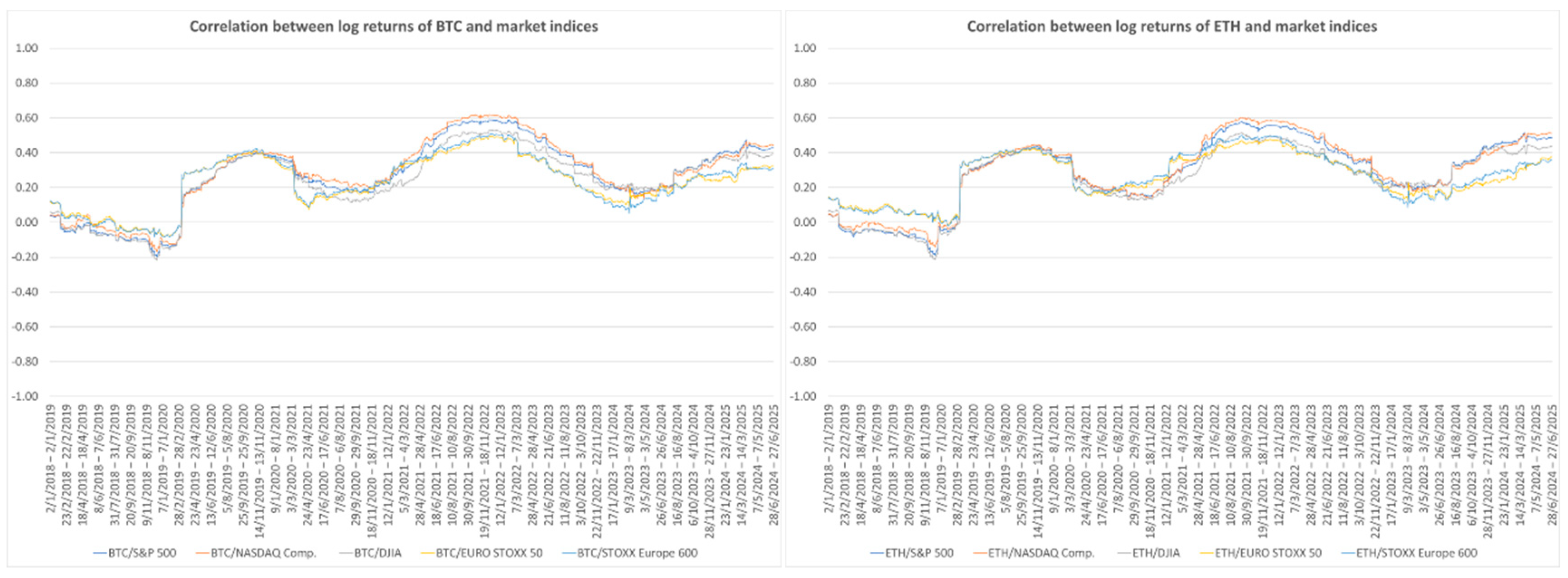
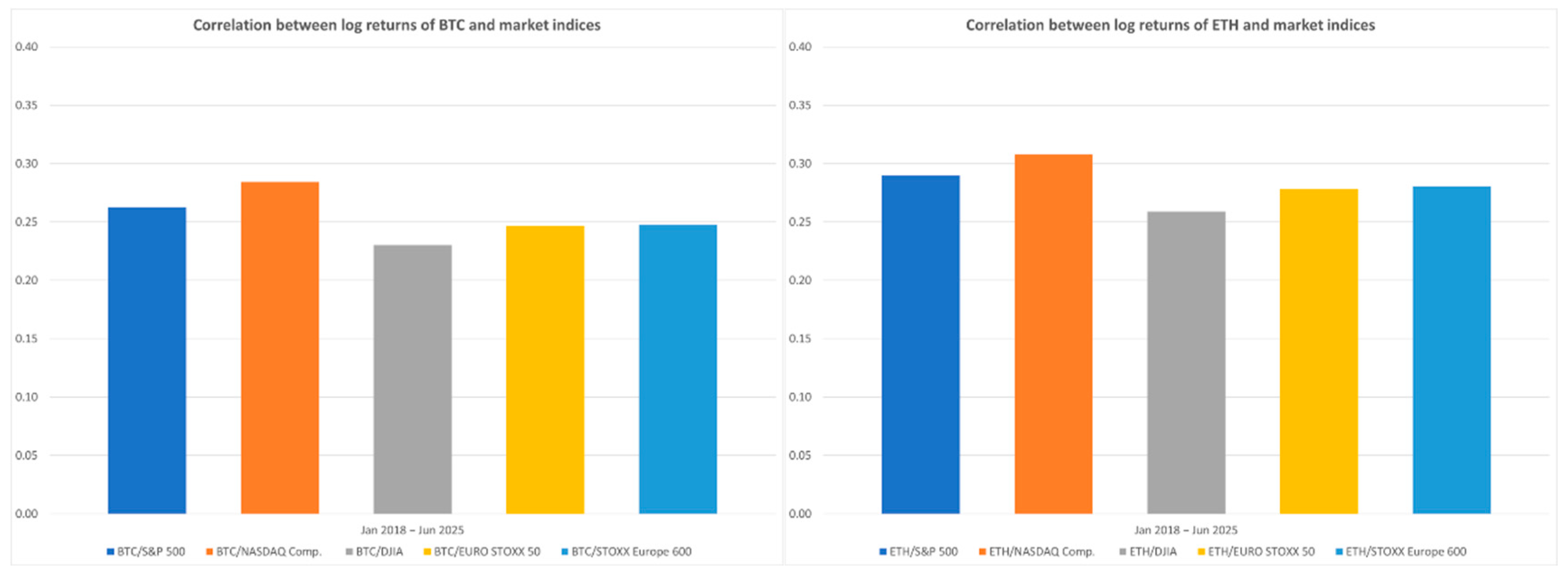
The second set of results is produced using the high-frequency dataset as described above, and it consists of the correlations of the daily log returns between each equity index and each crypto-asset. Specifically, the rolling window calculations are presented in Appendix A, Figure A8, Figure A9 and Figure A10, while the fixed window calculations are presented in Appendix A, Figure A11, Figure A12, Figure A13 and Figure A14 and Appendix B, Table A5, Table A6, Table A7 and Table A8.
This set of results is very similar to the first one, and the same conclusions are drawn here as well. For example, Bitcoin and Ether present similar behaviour, while moderate correlation is present starting from 2020, with the same variation and peaks, and accepting the same interpretation. However, there is one noteworthy difference. Specifically, although the EU equity indices have, in general, lower correlation to the crypto-assets than the U.S. indices, as seen previously, in the second set of results, their difference is smaller than in the first one. For example, the average difference in the correlations of the pairs BTC/S&P 500 and BTC/EURO STOXX 50 in the second set of results is approximately 63.2% of the respective average difference in the first set of results. It is important that this decrease in the difference between the U.S. and EU equity indices is consistent after 2021, which is the starting point of the divergence of the correlations, and is mostly due to the increased correlations between the EU equity indices and the crypto-assets calculated from the high-frequency dataset. Considering additionally that the daily dataset is more aligned to the trading hours of the U.S. stock markets, the conclusion is that the results indicate actual interconnections between the traditional financial markets and the crypto-asset markets, since the conclusions drawn from the daily dataset are verified and reinforced by the more time-specific results of the high-frequency dataset.

3.3. Results for Weekly Returns

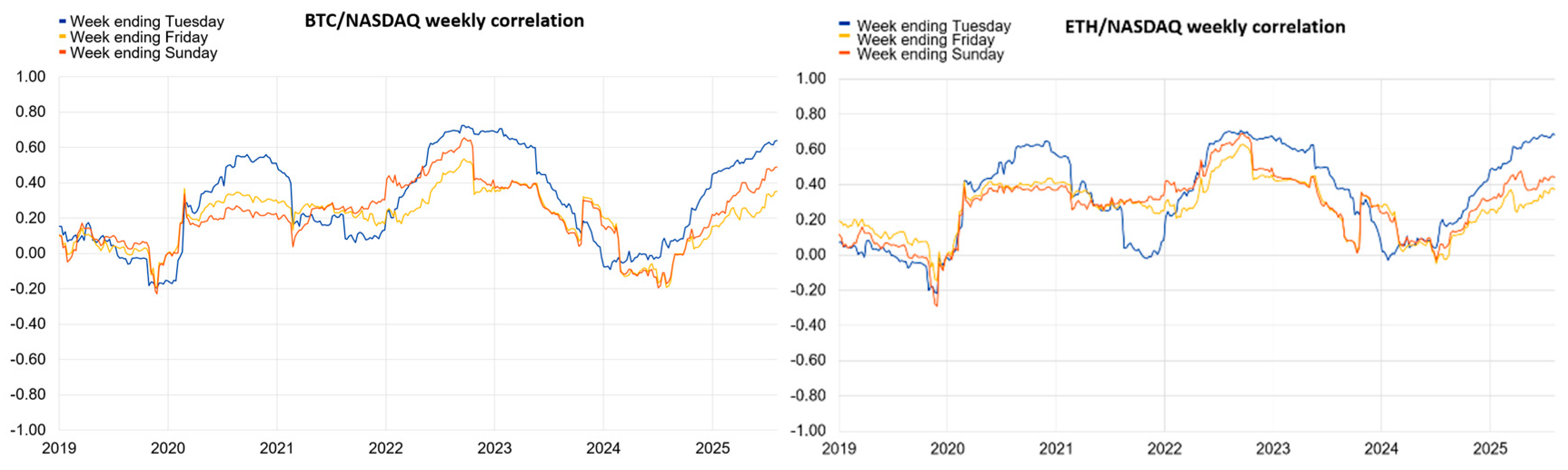
In addition to the correlation of the daily log returns presented above, the correlation of weekly returns is also examined, in order to identify potential day-of-week patterns. The motivation stems from the fact that the crypto-asset markets operate continuously (24/7), while the stock markets operate within specific hours from Monday to Friday. A relevant illustrative example is presented in Figure A15, where the correlations of the weekly log returns of BTC and ETH with NASDAQ are depicted. In each case, three cases of weekly log returns are included for three different days of the week, respectively. In general, the correlation of the weekly returns follows similar patterns, as in the case of the correlation of the daily returns. However, there are considerable differences depending on the day of the week selected as the basis for calculating the weekly returns. In this example, using Tuesday as a basis results in the highest correlations as well as more similar patterns to the correlations of the daily returns. This is most likely due to “weekend effects” appearing when using Friday or Monday as a basis, given that crypto-asset markets operate on weekends while traditional financial markets do not. This argument is also reinforced by the fact that when only the correlations of crypto-asset returns are calculated (i.e., 24/7 market operation for both correlated assets), the results are similar when using either daily or weekly returns [47], i.e., no “weekend effects” are present in this case.

4. Volatility of the Traditional Financial Markets and the Crypto-Asset Markets

The second step in the analysis consists of examining the volatility of the traditional financial markets and the crypto-asset markets, since their evolution in each case can provide additional insight into the potential interconnections and, moreover, reinforce the analysis of the correlations (in the previous section) and the news/announcements impact (in the next section). Indeed, crypto-asset volatility is an active research area (see [48] for an extensive review of the relevant literature). For the analysis, two measures of volatility are calculated, the standard historical volatility as well as the Rogers–Satchell volatility [49], using the same datasets and methodology as in the case of the correlations. In both cases, fixed window and rolling window calculations for various window lengths have been included, namely quarter/semi-annual/annual windows, as well as a total window spanning the whole length of the datasets.

4.1. Historical Volatility

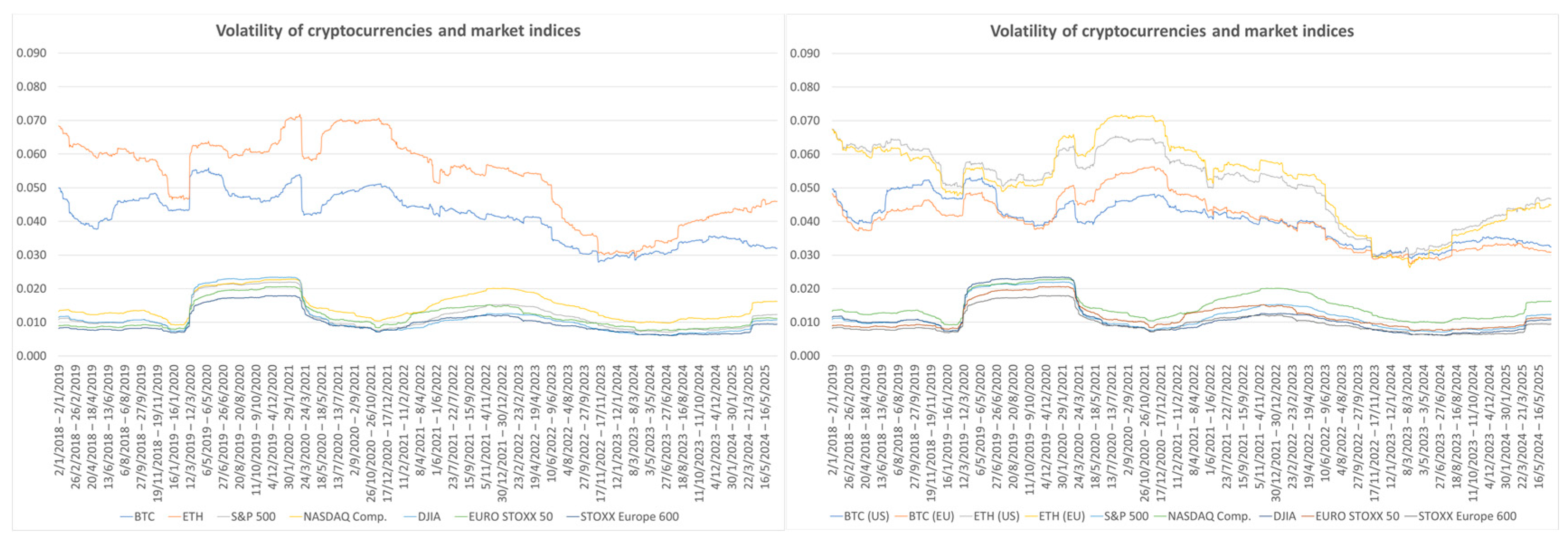
The first set of results consists of the standard historical volatility, calculated as the standard deviation of daily log returns, using both the daily dataset and the high-frequency dataset. In the case of the latter, two volatility values for each crypto-asset were calculated by restricting the calculations within the trading hours of the U.S. and EU equity indices, respectively. The results are presented in Appendix C, Figure A16, Figure A17, Figure A18 and Figure A19.
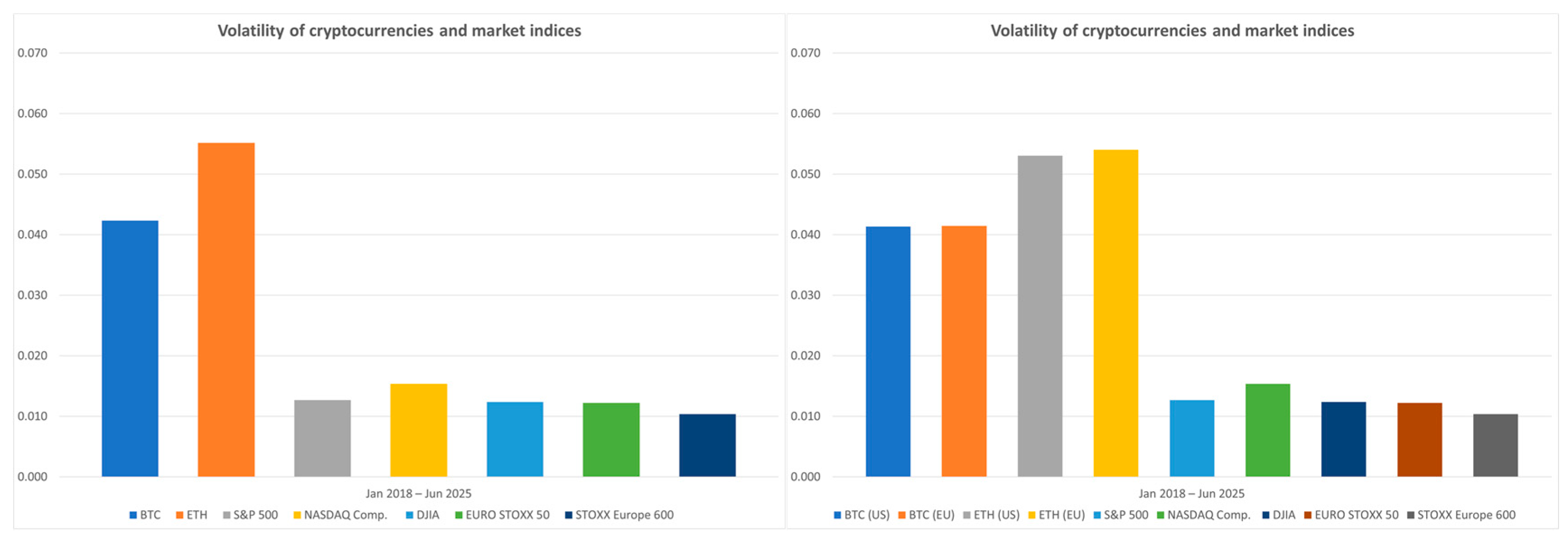
The first expected finding is that the volatility of crypto-assets is considerably higher than that of the equity indices throughout the whole span of the datasets. This is a well-known property of crypto-assets, which is frequently discussed in the literature [48], often being a major source of concern for their risk as well as their suitability for various use cases, such as payments [50], at least for those not classified as stablecoins. However, it is noteworthy that the volatility of the crypto-assets presents a general decreasing trend, being after 2023 at lower levels than before, a fact that has also attracted public interest and occasionally appeared in the media (see, for example, https://uk.finance.yahoo.com/news/bitcoins-volatility-continue-decline-adoption-095312388.html and https://cryptoslate.com/bitcoin-turned-less-volatile-than-nvidia-as-institutional-rails-absorbed-570-billion-in-swings-during-a-boring-year/, accessed on 16 March 2026).
Moreover, the volatility of Ether is higher than the volatility of Bitcoin, often by a considerable margin, although they follow similar patterns. Considering that Bitcoin and Ether present a high correlation of their daily returns throughout the dataset, as previously mentioned, a primary explanation would be that Bitcoin’s greater market depth results in smaller sensitivity to external news or changes in investor sentiment. Moreover, the wider ecosystem of the smart-contract-enabled Ethereum blockchain, in contrast to the single-purpose Bitcoin blockchain, may be susceptible to greater risks. Finally, their divergence in volatility at the most recent part of the datasets has also been attributed to increased institutional interest and trader preference for Ether (https://www.coindesk.com/markets/2025/06/10/ether-more-favored-by-traders-as-volatility-against-bitcoin-hits-highest-since-ftx-crash, accessed on 16 March 2026).
An additional finding revealed in the results of the high-frequency dataset is that the volatility of crypto-assets varies depending on the time window used, i.e., if U.S. or EU stock market trading hours are used. This will be further elaborated below.

4.2. Rogers–Satchell Volatility

In addition to the historical volatility presented previously, the Rogers–Satchell volatility estimator [49] is also used. This is a range-based volatility estimator using the open/close/high/low prices of an asset and is more efficient than a simple close-to-close estimator, especially in cases of non-zero drift [51,52]. Moreover, it has been successfully used in the crypto-asset context [53]. Specifically, the Rogers–Satchell volatility for an N-day window is calculated as:
σ R S = 1 N i = 1 N ln H i C i ln H i O i + ln L i C i ln L i O
where O i , C i , H i , L i are respectively the open, close, high, and low prices of the asset on day i .
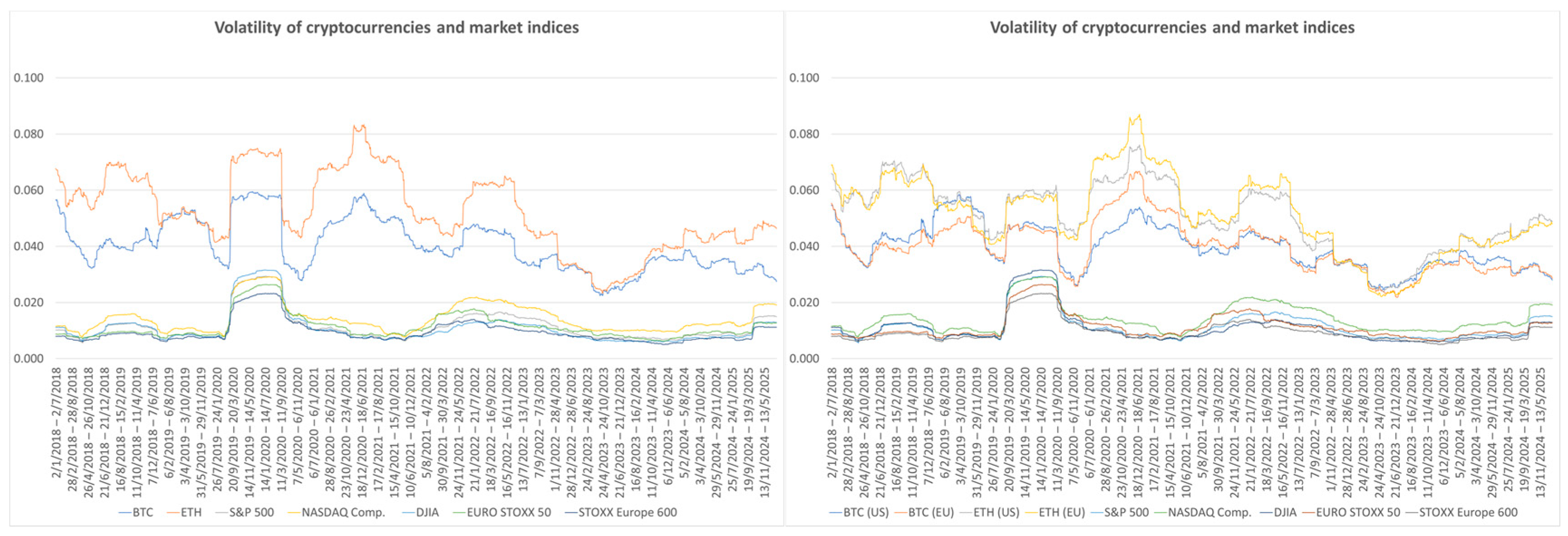
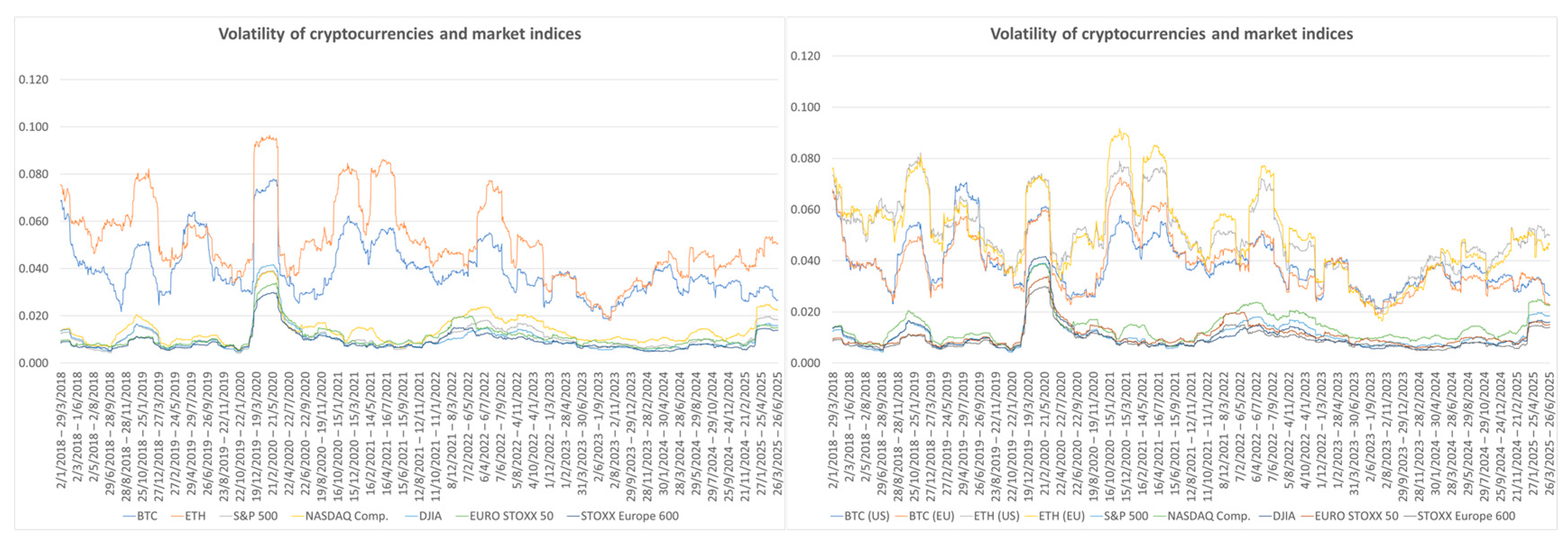
The second set of results contains the Rogers–Satchell volatility of the crypto-assets calculated using both the daily dataset and the high-frequency dataset. In the case of the latter, two volatility values for each crypto-asset are calculated as previously, by restricting the calculations within the trading hours of the U.S. and EU equity indices, respectively. The results are presented in Appendix C, Figure A20, Figure A21, Figure A22 and Figure A23. In addition, in this set of results, the evolution of volatility follows similar patterns as previously, while similar conclusions hold, e.g., about the higher volatility of Ether compared to Bitcoin.
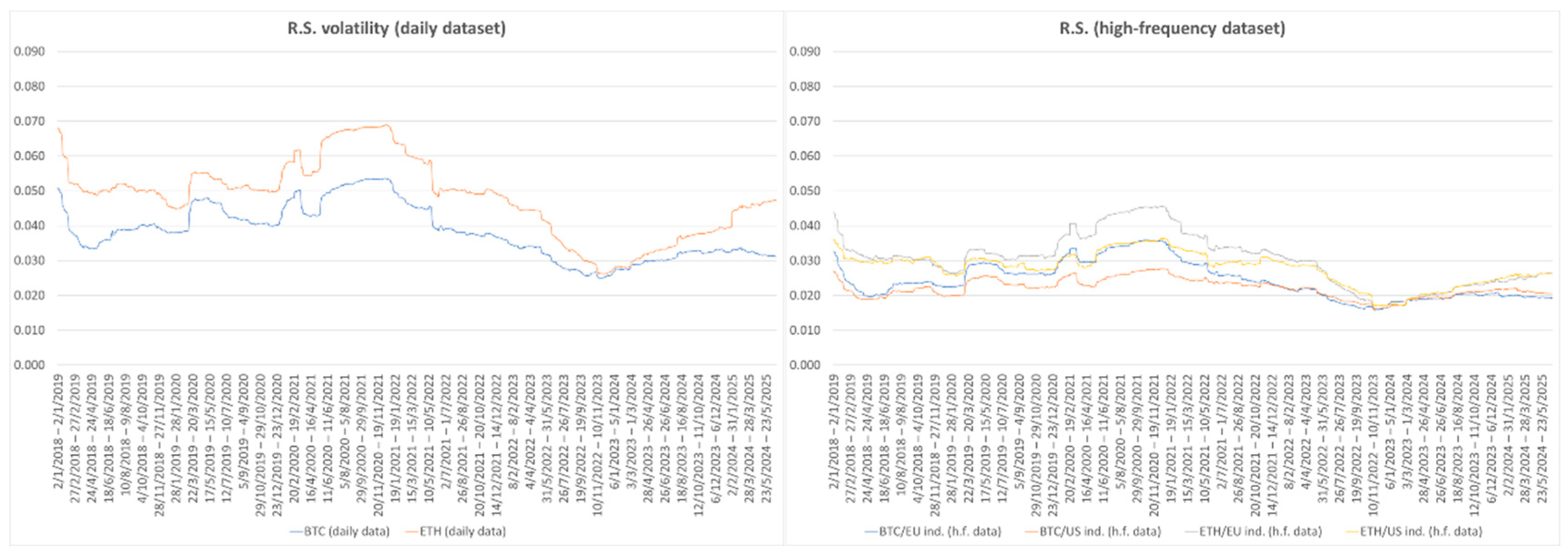
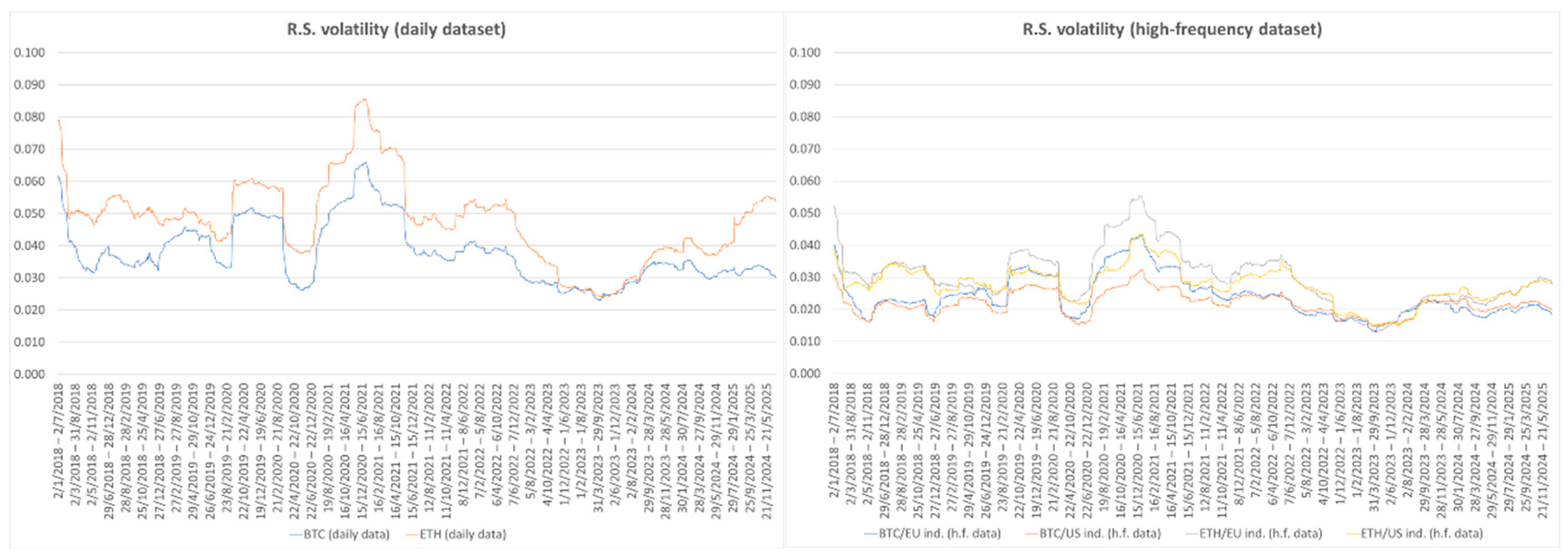
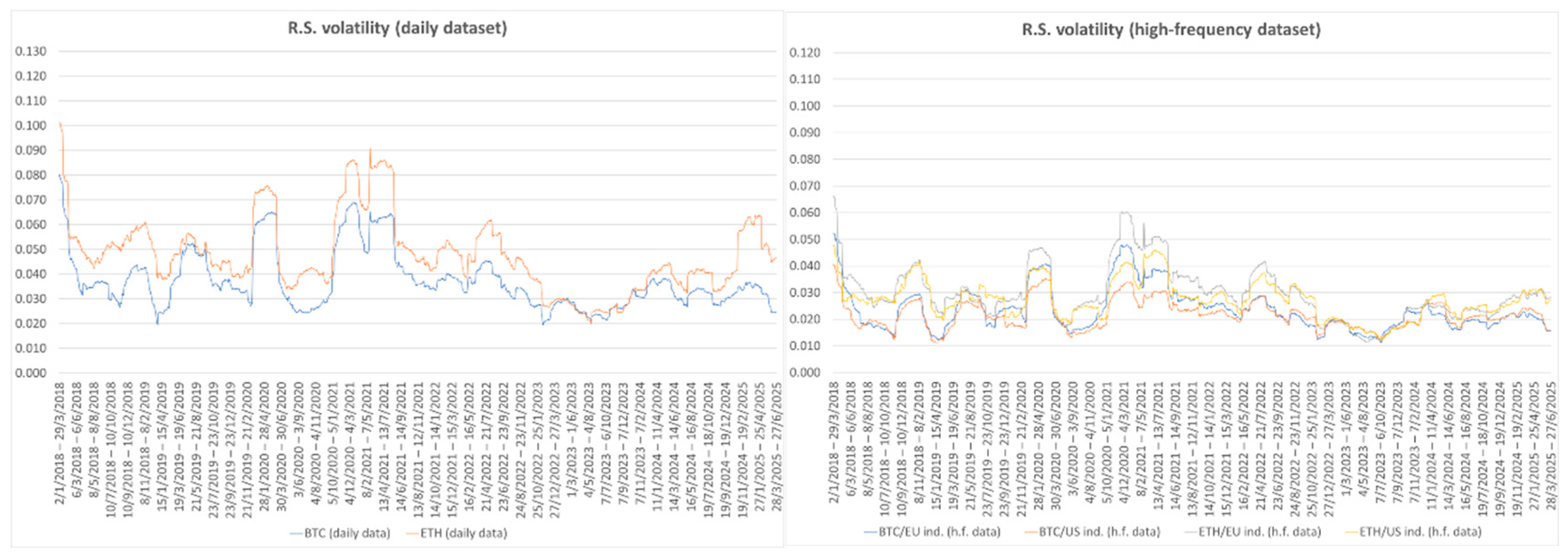
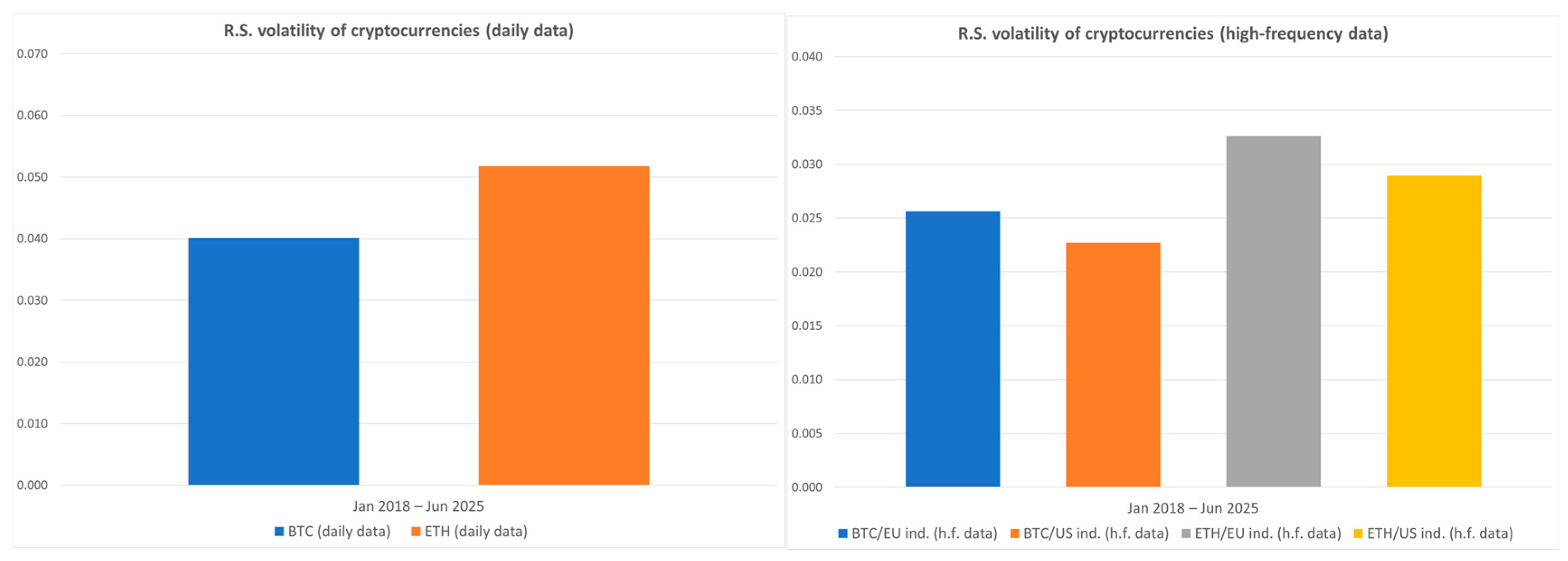
Furthermore, the more efficient Rogers–Satchell volatility estimator—as a range-based estimator compared to a close-to-close estimator—allows for two interesting observations. The first one is that the volatility of both crypto-assets differs depending on the time window used, i.e., if U.S. or EU stock market trading hours are used. For the whole span of the dataset, the volatility of both Bitcoin and Ether within the trading hours of the EU stock markets is approximately 13% higher than the respective volatility within the trading hours of the U.S. stock markets (Figure A23). In more detail, the rolling window results (Figure A20, Figure A21 and Figure A22) reveal that, starting from 2018 until the end of 2022 approximately, the crypto-asset volatility within the trading hours of the EU stock markets was higher than the respective volatility within the trading hours of the U.S. stock markets, sometimes by a considerable margin, while starting from 2023 and beyond this difference was nonexistent or reversed. Considering that this turning point roughly coincides with the publication and entry into force of the MICA regulation in the EU, an interesting research question would be how the MICA regulation has affected the behaviour of investors participating simultaneously in the EU stock markets and the crypto-asset markets.
The second observation is that the volatility of crypto-assets within the whole 24 h (calculated from the daily dataset, left graphs in Figure A20, Figure A21 and Figure A22) is greater than the respective volatility within the trading hours of the EU/U.S. stock markets (calculated from the high-frequency dataset, right graphs in Figure A20, Figure A21 and Figure A22), often by a considerable margin. This is descriptive of the investor behaviour outside the EU/U.S. stock market trading hours and is worth further examination, ideally by using geographical information of the relevant crypto-asset trades.

4.3. Volatility and Correlation

An additional question that arises in this context refers to the effect of volatility on the observed correlations. Indeed, it has been indicated in the literature (e.g., [54,55]) that during periods of elevated volatility, there are also observed elevated correlations between asset prices and returns, without there necessarily being an increased interconnection between the assets, but rather being, up to some degree, a statistical idiosyncrasy. The analysis indicates that although variations in the volatility explain a part of the variation in the correlations, the increased interconnection of traditional financial markets and crypto-asset markets after 2020 is indeed evident and not merely a statistical illusion. Specifically, although there are periods of simultaneously increased volatility and correlation in the results (most notably during the COVID-19 pandemic), there are also intervals of increased volatility but decreased or constant correlation and vice versa; moreover, the volatilities of the equity indices and crypto-assets are not always simultaneously increasing or decreasing. Further elaboration of this research question is planned in future work.

5. Impact of News and Announcements

The third step in the analysis consists of identifying the potential impact of news, events and announcements on the returns and the volatility. In order to understand the transmission channels between traditional financial markets and crypto-asset markets, it is essential to examine how these markets react to exogenous shocks. This will not only provide additional insight into the examined markets but, moreover, identify the potential existence of another subtle dimension of interconnection. Specifically, the identification of similar reactions of the traditional financial markets and the crypto-asset markets to the same stimuli will enhance the understanding of their interconnections. In previous research [20], the factors and the various types of events that may affect crypto-asset price dynamics were examined. Here, it is extended by employing two different methodologies. First, the Sign Bias Test of Engle and Ng [56] is used in order to detect potential asymmetry in the impact of positive and negative news on the crypto-asset returns and volatility. Moreover, the impact of the U.S. administration announcements on crypto-asset volatility is explored, focusing on the eventful first half of 2025.

5.1. Sign Bias Test

In the aforementioned context, identifying the presence, sign, and magnitude of asymmetric reactions is particularly relevant, as volatility asymmetries can amplify or attenuate spillover risks and ultimately shape the likelihood of systemic repercussions. As shown in the previous section and also highlighted in existing research, crypto-asset markets may exhibit volatility patterns significantly different from those observed in traditional financial markets. Several studies document an asymmetry of the opposite sign compared to equity or bond markets, suggesting that crypto-asset volatility may respond more strongly to positive than negative price movements, or vice versa, depending on market conditions and asset characteristics. Furthermore, the responsiveness of crypto-assets to news and information shocks has been shown to differ from that of conventional asset classes, with only limited exceptions reported in the literature.
The literature on crypto-asset markets identifies three closely intertwined strands: volatility asymmetry, news and sentiment shocks, and spillovers to traditional markets. First, volatility asymmetry in crypto-assets differs from the classic equity leverage effect, according to which negative returns increase volatility more than positive ones. For Bitcoin and other major crypto assets, several studies document an “inverted” asymmetry, with positive shocks associated with higher conditional variance [57]. In this context, systematic comparisons between asymmetric GARCH specifications indicate that models such as EGARCH and TGARCH robustly capture the dynamics of Bitcoin and altcoins, with evidence of cross-asset heterogeneity [58,59]. Further contributions exploit state-dependent approaches (e.g., ST-GARCH) to model regime amplification during rallies, confirming the association between positive returns and increased conditional variance [60].
Second, news and sentiment shocks exert a pronounced and persistent influence on crypto-asset volatility. A large body of evidence shows that the magnitude and tone of information—particularly regulatory announcements, technology-related news, and adoption signals—drive asymmetric volatility responses across major crypto assets. A comprehensive analysis based on over one thousand categorized news sources documents that regulatory news has statistically significant and broad effects on conditional volatility across Bitcoin, Ethereum, XRP, and others [61]. This aligns with earlier research showing that attention-based measures, such as Google Trends and Wikipedia signals, have predictive power for price dynamics and momentum cycles [62,63]. Positive news, such as technological upgrades or institutional adoption, tends to generate smoother upward adjustments, whereas negative news (exchange hacks, enforcement actions) induces immediate selloffs and persistent uncertainty [64]. During systemic stress episodes like COVID-19, asymmetric causality tests confirm that spikes in uncertainty indices trigger negative shocks to crypto returns, undermining the safe-haven narrative [29,65].
Third, recent macrofinancial contributions document a growing integration between crypto-assets and traditional financial markets. Connectivity and spillover measures based on DCC-GARCH and network variance decompositions show that Bitcoin and Ethereum often act as volatility transmitters within the crypto-asset network, with rapid and persistent spillovers to conventional assets [66,67,68,69]. In terms of financial stability, international authorities warn that crypto-asset turbulence may spill over into traditional finance under stress, requiring prudential safeguards and stress tests that integrate specific regimes and asymmetric responses [70,71,72].
Overall, three methodological and policy implications emerge. At the econometric level, empirical models should include asymmetric volatility specifications (EGARCH, TGARCH, and ST-GARCH) and state-dependent frameworks (Markov-switching, quantile methods), complemented by dynamic dependence models (DCC-GARCH) and connectivity measures to quantify spillovers between assets [58,68,69,73]. At the shock identification level, strategies should explicitly model information and sentiment channels [62,63], distinguishing between regulatory/technological announcements and uncertainty shocks [64,65]. From a regulatory and risk management perspective, the findings indicate that crypto-asset markets transmit shocks to traditional finance and are sensitive to macroeconomic tightening, justifying prudential supervision and scenario-based stress testing with crypto-asset-specific regimes and volatility asymmetries [70,71,72].
Motivated by the above, the presence and relative magnitude of volatility asymmetry in the two crypto-assets of the datasets, Bitcoin and Ether, are investigated. The analysis is based on the Sign Bias Test proposed by Engle and Ng [56]. This diagnostic tool is widely used in volatility modelling to detect whether “good news” (positive shocks) and “bad news” (negative shocks) exert different effects on volatility, an aspect that standard GARCH models may fail to capture. Complementing this evidence, t-tests on the estimated coefficients are conducted to assess whether the magnitude of any detected asymmetric reactions is statistically significant. This combined approach allows us not only to identify the existence of asymmetry but also to quantify its economic significance.
The Sign Bias Test (SBT) is based on the following regression:
v t 2 = a +   b 1 S t 1 +   b 2 S t 1 ε t 1   +   b 3 S t 1 + ε t 1   +   β _ z _ 0 t *   +   e t
where v t 2 is the squared normalized residual corresponding to observation t ; S t 1 is a dummy equal to 1 when ε t 1 is negative and zero otherwise, and S t 1 + is defined as ( 1 S t 1 ); ε t 1 is the lagged residual; a ,   b 1 ,   b 2 , and b 3 are constant coefficients; β _ is a vector of constant coefficients, and z _ 0 t * is a vector of explanatory variables; and e t is the error term. The t-statistics for b 1 ,   b 2 , and b 3 are the sign bias, the negative size bias, and the positive size bias test statistics, respectively.
To the end of the analysis, SBT is applied to the daily returns of Bitcoin and Ether, with the primary goal of evaluating how these two variables react to “news” (statistically speaking). The results are presented in Appendix D. After verifying stationarity with the ADF test (Table A9), an AR(2) model is estimated based on AIC and extracts residuals as proxies for unexpected returns and volatility (“news”). Specifically, let y_t be an observed real-time series. A second-order autoregressive model, AR(2), is defined as:
y t = μ + φ 1 y t 1 + φ 2 y t 2 + ε t ,
where µ is a constant (drift), φ 1 and φ 2 are the autoregressive parameters, and ε t is the error term, which is distributed according to the standard hypothesis ε t i . i . d . ( 0 ,   σ 2 ). No additional diagnostic tests on residuals (e.g., normality or autocorrelation) were performed, as the primary goal was to assess asymmetry in responses rather than model adequacy. Then the residuals from the AR model are extracted, which represent the unexpected part of returns (i.e., “news”), taking the square of the residuals as a proxy for volatility. The SBT is performed by regressing the squared residuals on dummy variables indicating whether the lagged residual was negative (“bad news”) or positive (“good news”).
The results indicate that returns and volatility respond more strongly to positive shocks than to negative ones, although the difference between the estimated coefficients is relatively small (Table A10). To test whether the difference between positive and negative shocks is statistically significant, a two-sample t-test on the estimated residuals from the SBT regression is conducted. The results confirm that these differences are statistically significant, indicating that the asymmetric response is not due to random variation (Table A11).
Evidence in the literature shows that the impact of news on volatility is not constant, but can vary over time due to structural changes, macroeconomic conditions, or geopolitical events [56]. To capture the potential temporal variation in the asymmetric impact of news on returns and volatility, the sample is segmented into annual subsamples, and SBT is applied separately for each year, rather than introducing multiple dummy variables for different shocks. This approach allows us to examine whether the magnitude or statistical significance of the coefficients b 1 ,   b 2 , and b 3 varies over time, thus revealing potential changes in market responsiveness to positive versus negative shocks, as well as the magnitude of such shocks. This approach allows us to identify years in which the response to positive and negative shocks differs significantly and to interpret these patterns in relation to key events.
The results confirm that the responsiveness of crypto-asset returns and volatility varies over time, with alternating positive and negative shocks depending on the year (Table A12). The observed changes in asymmetry over the years may reflect the influence of major events affecting the crypto-asset market. Table A13 provides an overview of the major events that may have influenced the crypto-asset market during the sample period. These events are grouped into three categories—macroeconomic, political, and idiosyncratic shocks—following the classification proposed in [74]. This categorization facilitates the interpretation of the time-varying asymmetries identified through the annual Sign Bias Test. The link between annual asymmetry patterns and major events suggests that political shocks (e.g., increased geopolitical tensions, trade conflicts) tend to be associated with negative size dominance (NSBT), while idiosyncratic crypto events (e.g., adoption, technology upgrades) more frequently align with positive size dominance (PSBT). Macroeconomic shocks exhibit heterogeneous outcomes, with the initial COVID-19 period consistent with negative size dominance and subsequent phases characterized by increased liquidity and risk appetite consistent with responses to positive shocks [75]. Additionally, an interesting finding in the results, which will be further explored, is a clear decreasing trend of the asymmetry in the case of Bitcoin volatility.
The results also highlight some differences between the two crypto-assets. In 2018 and in 2024, there exists opposite sign dominance characterized by different magnitudes. Although they present a high correlation of returns, Bitcoin and Ether are fundamentally different assets, each designed with a different rationale, which influences how they react to different news and events. Bitcoin is often perceived by investors as a secure digital store of value, similar to decentralized “digital gold” or an inflation hedge. Its value proposition is mostly based on scarcity (a predetermined maximum supply of 21 million coins) and security. Therefore, Bitcoin’s price movements are strongly influenced by macroeconomic news (inflation data, interest rates) and regulatory developments regarding its status as a mature financial asset (e.g., the approval of U.S. spot ETFs). On the other hand, Ether is the native coin of a global, programmable computing platform that powers decentralized applications (dApps), decentralized finance (DeFi), and non-fungible tokens (NFTs). Its value is mostly tied to the utility of its network and influences its sensitivity to news. Ether reacts significantly to ecosystem-specific news, such as major network upgrades (e.g., the “Merge” and the Dencun upgrade), activity levels in DeFi protocols, and overall dApp usage.
These differences in focus may lead to different reactions. For example, a headline about a new government regulation of commodity futures could have a more significant impact on Bitcoin than on Ether. Conversely, news of a major technological breakthrough in scalability solutions (e.g., sharding) would likely cause Ether to react more positively and independently than Bitcoin. Ultimately, while Bitcoin reacts primarily like a macro asset, Ether behaves more like a growth stock tied to the performance and utility of its underlying technology platform.

5.2. Impact of U.S. Administration Announcements

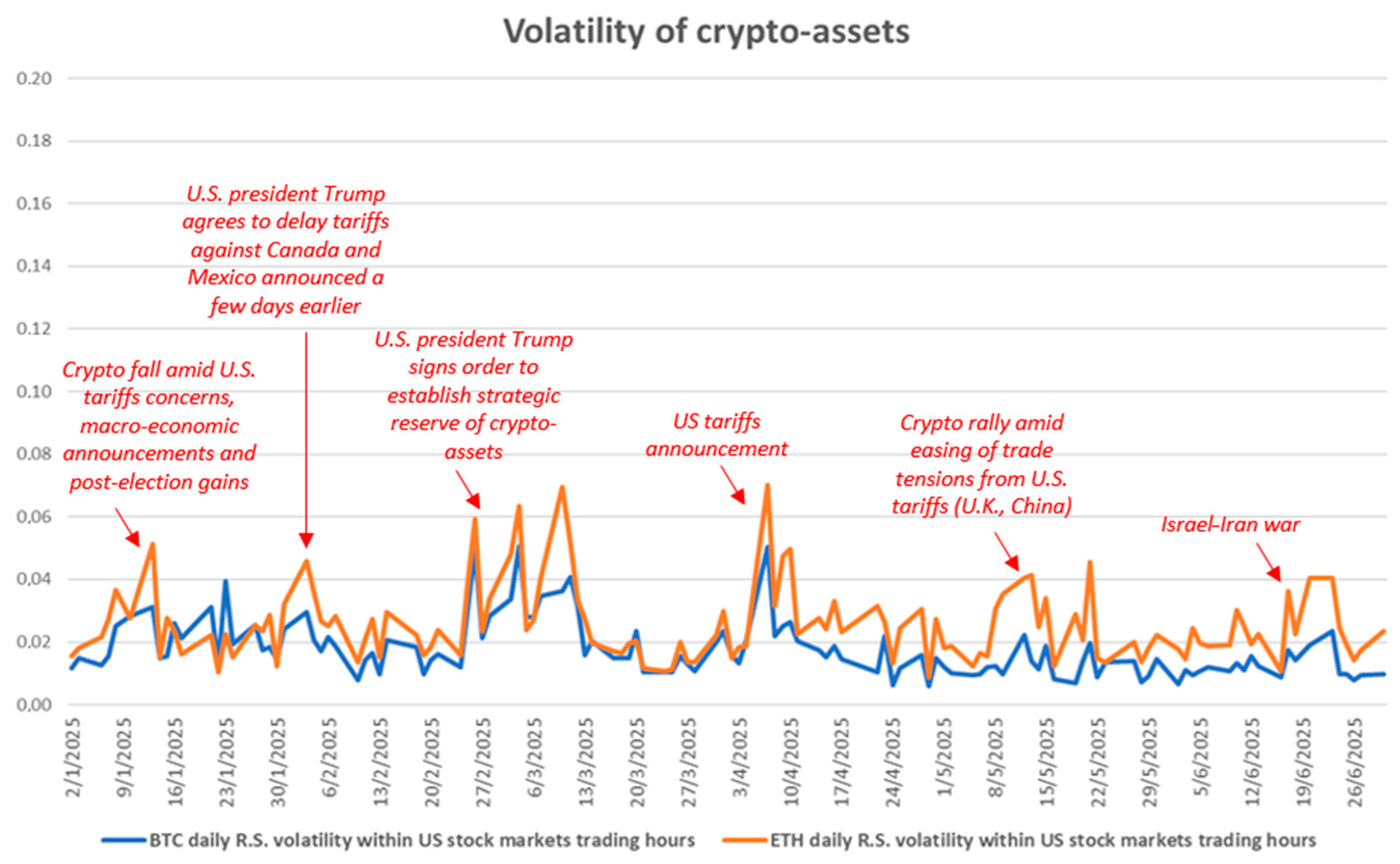
In the context of the impact of the news and announcements on the markets, a specific test case which pertains to the respective effect of the U.S. administration announcements, including both crypto-related ones as well as non-crypto-related (e.g., tariff-related) ones, is additionally examined. In Section 3.1, the interesting pattern in the evolution of the correlation between the traditional financial markets and the crypto-asset markets during a period around the 2024 U.S. presidential election was highlighted. Moreover, the fact that the new U.S. president then was, and still is, openly in favour of the crypto-assets poses the question as to how his announcements were received by the crypto-asset markets and if there is a measurable impact on them. For example, recent research has shown that the tariff announcement of April 2025 affected the demand for USD-pegged stablecoins, especially in countries facing a higher impact from the tariffs [76]. In this context, the evolution of the daily volatility within the first six months of 2025 is examined, an interesting and eventful period in terms of the U.S. administration. The results are presented in Figure A24 and Figure A25, which depict the daily Rogers–Satchell volatility of Bitcoin and Ether from January to June 2025, calculated for the whole day and the U.S. stock market trading hours, respectively. In both figures, volatility peaks at/around the same dates can be identified, all of which coincide with important U.S. administration announcements and developments, not only crypto-related ones but also economic-related ones, such as announcements referring to tariffs. There is also a short period of successive peaks that coincide with the Israel–Iran war. A substantial remark to be made here is that stimuli, which can have a significant impact on traditional financial markets, such as the U.S. tariff announcements or important geopolitical events, are shown to simultaneously have a significant impact, in terms of volatility, on the crypto-asset markets as well. This indicates an additional dimension of interconnection; these markets may not only affect each other, but they also react similarly to the same external stimuli, such as geopolitical events or macroeconomic and policy announcements.

6. Conclusions and Further Work

In the present work, the existence of potential interconnections between the traditional financial markets and the crypto-asset markets was explored, motivated by the considerable growth and the increasing adoption of the latter during the last few years. The identification and interpretation of such linkages and transmission channels is important and helpful in a diversity of areas, such as risk management, portfolio management and regulatory framework design. In the analysis, both daily and high-frequency datasets were used, the latter being motivated by the continuous (24/7) operation of the crypto-asset markets, which consisted of prominent stock market indices and crypto-assets and covered a 7.5-year period, spanning from January 2018 to June 2025.
First, the correlation of daily returns between five major U.S./EU equity indices (S&P 500, NASDAQ Composite, Dow Jones Industrial Average, EURO STOXX 50, STOXX Europe 600) and the two largest, in terms of market cap, crypto-assets (Bitcoin and Ether) was examined using fixed window and rolling window calculations for various window lengths. The results showed moderate correlation starting from 2020, while no noteworthy correlation existed before then. Moreover, the evolution of the correlation was examined, identifying considerable variability after 2020, which can be interpreted, at least partly, as the effect of significant global events, including geopolitical and macroeconomic ones, such as the COVID-19 pandemic, the monetary tightening of 2022 and the U.S. presidential election of 2024. Moreover, the variation in market volatility, often aligned with the same events, contributed to the variations in the correlation, but only to a certain degree and not totally. Additional relevant findings include the similar behaviour of Bitcoin and Ether with respect to their correlation to the equity indices, as well as relatively higher correlation of the crypto-assets to the U.S. equity indices than the EU equity indices. Finally, “day of week” differences for the correlation of weekly returns were detected, most likely explained by “weekend effects”, since crypto-asset markets operate on weekends while traditional financial markets do not.
Furthermore, the volatility of the traditional financial markets and the crypto-asset markets was examined in order to achieve additional insight into their potential interconnections and reinforce the analysis of the other lines of research. First, the well-known finding that the volatility of crypto-assets is considerably higher than that of the equity indices was verified; however, a general decreasing trend that has led to lower volatility levels after 2023 was detected. Moreover, Ether presented considerably higher volatility than Bitcoin, primarily explained by the latter’s greater market depth. Furthermore, the use of the high-frequency dataset allowed the detection of intraday variations in the volatility. Specifically, the crypto-asset volatility within the trading hours of the EU stock markets is higher than the respective volatility within the trading hours of the U.S. stock markets until the end of 2022, while this difference disappears afterwards. Additionally, a considerable part of the 24 h volatility of the crypto-assets was found to be due to trading activity outside the trading hours of the EU/U.S. stock markets, which is descriptive of the relevant investor behaviour.
Finally, the potential impact of news, events and announcements on the returns and the volatility was examined, since the reaction of markets to external stimuli can enhance the understanding of their transmission channels and interconnections. First, the Sign Bias Test of Engle and Ng was used in order to detect potential asymmetry in the effect of positive and negative “news” on the volatility and returns of the crypto-assets, identifying indeed an asymmetry in favour of the positive “news”, which was also shown to be statistically significant using a t-test. Additionally, the evolution of this asymmetry was examined, identifying considerable variation per year, which can be attributed to major geopolitical, macroeconomic or idiosyncratic events, detecting also a decreasing trend of the asymmetry in the case of Bitcoin’s volatility. Furthermore, a specific test case focusing on the U.S. administration announcements within the eventful first half of 2025 was examined. Specifically, a significant impact of these announcements, including crypto-related ones and tariff-related ones, on the daily volatility of the crypto-assets was detected, thus identifying external stimuli that have a considerable impact on both the crypto-asset markets and the traditional financial markets.
A more generic contribution of the present work concerns the usefulness of high-frequency datasets in the crypto-asset context. The analysis has shown that their use is indeed meaningful and can provide additional insight. From a qualitative point of view, both the daily and high-frequency datasets produced similar results and led to the same conclusions with respect to the interconnections of the traditional financial markets and the crypto-asset markets. From a quantitative point of view, however, there were differences which, albeit small, may not be negligible in the context of specific applications, such as portfolio rebalancing. Most importantly, the high-frequency dataset allowed us to restrict attention to the trading hours of the stock markets and detect noteworthy intraday variations, potentially relevant to investor behaviour either during or outside these hours.
Conclusively, the analysis identified existing interconnections between the crypto-asset markets and the traditional financial markets, appearing after 2020 and remaining since then. Considering the increasing adoption of crypto-assets and the growth of their ecosystem, as well as the emergence and evolution of the relevant regulatory frameworks, these interconnections are expected to continue to exist, and even probably strengthen, in the future. Therefore, their study, analysis and interpretation are crucial and can contribute to the enhancement of the stability, integrity and efficiency of the financial system.
Our research can be beneficial to various actors of the financial ecosystem. Regulatory authorities can be supported by the identification of transmission channels of risks that threaten financial stability, enabling them to design appropriate regulatory frameworks and develop relevant early-warning indicators. On the other hand, investors can benefit from understanding the market co-movements and price formation mechanisms, and thus make more efficient investment decisions, for example, regarding portfolio diversification or rebalancing.
Future work will focus on (a) the geographical extension of the equity indices dataset, e.g., including stock markets from Asia or emerging economies; (b) the extension of the crypto-asset dataset, e.g., including stablecoins or crypto-asset derivatives; (c) the employment of additional statistical or econometric methods; (d) the development of a systematic framework for identifying events that impact the correlations and the volatility.

Author Contributions

Conceptualization, Methodology, Validation, Formal analysis, Investigation, Data curation, Writing—original draft, Writing—review and editing: All authors. All authors have read and agreed to the published version of the manuscript.

Funding

This research received no external funding.

Data Availability Statement

The raw data supporting the conclusions of this article will be made available by the authors upon request.

Acknowledgments

The research presented in this paper is part of the work carried out by the authors in the context of the Crypto-Assets Monitoring Expert Group (CAMEG) of the Eurosystem Innov8 Forum (2025). The authors would like to thank all members of CAMEG for their useful feedback, and especially Maha Abbassi and John Theal for their participation in and contribution to the respective CAMEG workstream.

Conflicts of Interest

The authors declare no conflicts of interest.

Disclaimer

The views expressed in this paper are solely those of the authors and do not represent the views of the institutions to which these authors are affiliated.

Appendix A. Correlation/Figures

Figure A1. Correlation of daily log returns (annual rolling window)/daily dataset.
Appliedmath 06 00057 g0a1
Figure A2. Correlation of daily log returns (semi-annual rolling window)/daily dataset.
Appliedmath 06 00057 g0a2
Figure A3. Correlation of daily log returns (quarter rolling window)/daily dataset.
Appliedmath 06 00057 g0a3
Figure A4. Correlation of daily log returns (total fixed window)/daily dataset.
Appliedmath 06 00057 g0a4
Figure A5. Correlation of daily log returns (annual fixed window)/daily dataset/* until 30 June 2025.
Appliedmath 06 00057 g0a5
Figure A6. Correlation of daily log returns (semi-annual fixed window)/daily dataset.
Appliedmath 06 00057 g0a6
Figure A7. Correlation of daily log returns (quarter fixed window)/daily dataset.
Appliedmath 06 00057 g0a7
Figure A8. Correlation of daily log returns (annual rolling window)/high-frequency dataset.
Appliedmath 06 00057 g0a8
Figure A9. Correlation of daily log returns (semi-annual rolling window)/high-frequency dataset.
Appliedmath 06 00057 g0a9
Figure A10. Correlation of daily log returns (quarter rolling window)/high-frequency dataset.
Appliedmath 06 00057 g0a10
Figure A11. Correlation of daily log returns (total fixed window)/high-frequency dataset.
Appliedmath 06 00057 g0a11
Figure A12. Correlation of daily log returns (annual fixed window)/high-frequency dataset/* until 30 June 2025.
Appliedmath 06 00057 g0a12
Figure A13. Correlation of daily log returns (semi-annual fixed window)/high-frequency dataset.
Appliedmath 06 00057 g0a13
Figure A14. Correlation of daily log returns (quarter fixed window)/high-frequency dataset.
Appliedmath 06 00057 g0a14
Figure A15. Correlation of weekly log returns (annual rolling window)/high-frequency dataset (the x-axis shows the rolling window end date).
Appliedmath 06 00057 g0a15

Appendix B. Correlation/Tables

Table A1. Correlation of daily log returns (total fixed window)/daily dataset.
BTC/S&P 500BTC/NASDAQ Comp.BTC/DJIABTC/EURO STOXX 50BTC/STOXX Europe 600
January 2018–
June 2025
0.287470.302880.258830.218820.21976
ETH/S&P 500ETH/NASDAQ Comp.ETH/DJIAETH/EURO STOXX 50ETH/STOXX Europe 600
January 2018–
June 2025
0.308810.320590.281430.244820.25076
Table A2. Correlation of daily log returns (annual fixed window)/daily dataset/* until 30 June 2025.
BTC/S&P 500BTC/NASDAQ Comp.BTC/DJIABTC/EURO STOXX 50BTC/STOXX Europe 600
20180.041830.044450.060570.086170.09904
2019−0.10655−0.09348−0.12207−0.08119−0.08695
20200.445340.456500.431910.432380.44927
20210.262340.268500.215960.232550.22344
20220.564430.595070.504520.354750.35841
20230.166940.196600.158680.043970.01843
20240.368120.339780.366830.146250.17110
2025*0.380240.434170.309030.094510.02752
ETH/S&P 500ETH/NASDAQ Comp.ETH/DJIAETH/EURO STOXX 50ETH/STOXX Europe 600
20180.053960.054090.075610.146050.16363
2019−0.02304−0.00768−0.04117−0.00431−0.02089
20200.472440.479690.460980.422400.43629
20210.198540.199650.167200.228710.23370
20220.547660.575200.484190.355220.36982
20230.164030.191890.144150.086520.07540
20240.409020.379970.402170.184850.21757
2025 *0.423290.473450.363460.155980.10744
Table A3. Correlation of daily log returns (semi-annual fixed window)/daily dataset.
BTC/S&P 500BTC/NASDAQ Comp.BTC/DJIABTC/EURO STOXX 50BTC/STOXX Europe 600
2018−H10.116810.092640.142000.018840.04958
2018−H2−0.041680.00152−0.039610.178350.16745
2019−H1−0.17307−0.14857−0.17111−0.13726−0.14281
2019−H2−0.05880−0.05036−0.08918−0.04473−0.05196
2020−H10.498220.504050.497030.554050.56550
2020−H20.249050.305630.169690.031130.03958
2021−H10.243720.245350.194920.305970.27210
2021−H20.299450.312970.257250.171610.17876
2022−H10.584660.614280.522350.339900.35857
2022−H20.537550.564030.482580.373200.34939
2023−H10.194830.226260.18743−0.03534−0.05315
2023−H20.117810.143730.113630.163000.12565
2024−H10.221620.219780.194020.131010.10264
2024−H20.480950.433930.497470.160280.22480
2025−H10.380240.434170.309030.094510.02752
ETH/S&P 500ETH/NASDAQ Comp.ETH/DJIAETH/EURO STOXX 50ETH/STOXX Europe 600
2018−H10.191780.162780.219450.055800.09776
2018−H2−0.06708−0.03181−0.058920.230110.22249
2019−H1−0.02700−0.00475−0.019600.012090.00017
2019−H2−0.03001−0.02120−0.07501−0.03124−0.05012
2020−H10.551000.549220.551580.565550.57646
2020−H20.268440.314310.205110.049960.05227
2021−H10.128260.122350.102790.251860.24043
2021−H20.333230.363180.281640.231130.25036
2022−H10.629370.649650.573840.394450.43134
2022−H20.449530.480400.379040.292110.27792
2023−H10.211580.240030.189350.014740.00587
2023−H20.087410.113970.075800.186920.17299
2024−H10.223290.227920.205220.152540.13119
2024−H20.527370.478460.530640.204710.27175
2025−H10.423290.473450.363460.155980.10744
Table A4. Correlation of daily log returns (quarter fixed window)/daily dataset.
BTC/S&P 500BTC/NASDAQ Comp.BTC/DJIABTC/EURO STOXX 50BTC/STOXX Europe 600
2018−Q10.210520.183970.224750.011400.04584
2018−Q2−0.15027−0.13667−0.088500.022170.04013
2018−Q30.116730.134040.120620.142880.08191
2018−Q4−0.10512−0.05694−0.105390.178940.18413
2019−Q10.107960.128290.098460.026970.01373
2019−Q2−0.32374−0.28012−0.32049−0.20818−0.20273
2019−Q3−0.10977−0.12045−0.15901−0.09275−0.10020
2019−Q40.057220.117180.069860.038510.01973
2020−Q10.542860.563750.538600.669060.67171
2020−Q20.325190.278530.338300.245400.23900
2020−Q30.443950.467240.401430.007690.03087
2020−Q40.096370.17221−0.005530.025400.02364
2021−Q10.279470.237090.299450.414810.38868
2021−Q20.219310.302500.060090.180490.14670
2021−Q30.293530.313150.257540.245860.27987
2021−Q40.318160.329640.266760.112390.08750
2022−Q10.508250.583800.439500.364760.35443
2022−Q20.623990.632660.566760.349840.38447
2022−Q30.546200.601440.486960.351470.31382
2022−Q40.545370.537830.502280.413930.40532
2023−Q10.257510.325400.20815−0.08499−0.10121
2023−Q20.081380.033510.164370.042290.02121
2023−Q30.336260.300930.311800.262490.30645
2023−Q4−0.055520.00549−0.050750.05310−0.02960
2024−Q10.073090.075150.112690.00548−0.04232
2024−Q20.400260.414810.263560.216250.23196
2024−Q30.499470.444080.538880.234550.28755
2024−Q40.466830.423170.469930.065010.15096
2025−Q10.460290.512630.325460.244460.18722
2025−Q20.354950.387960.321640.00373−0.05387
ETH/S&P 500ETH/NASDAQ Comp.ETH/DJIAETH/EURO STOXX 50ETH/STOXX Europe 600
2018−Q10.324270.287530.340500.023550.08093
2018−Q2−0.09602−0.07957−0.036000.091320.10436
2018−Q30.259240.239710.294380.210810.10962
2018−Q4−0.14842−0.10944−0.154300.247340.28163
2019−Q10.091970.102700.105050.062330.05307
2019−Q2−0.13270−0.09071−0.13452−0.01719−0.02322
2019−Q3−0.01606−0.01388−0.08720−0.01518−0.02631
2019−Q4−0.07603−0.05512−0.05163−0.06505−0.09794
2020−Q10.579010.595000.575390.626690.63608
2020−Q20.442000.376540.460370.412210.39716
2020−Q30.433250.467940.390190.055060.05926
2020−Q40.104190.143570.031400.040930.04077
2021−Q10.131750.130460.130610.323000.32217
2021−Q20.135660.131160.069660.179130.16094
2021−Q30.350240.398680.288010.320940.35224
2021−Q40.339920.368140.289610.147750.14077
2022−Q10.636720.675910.586100.459280.48365
2022−Q20.623100.635650.567180.377000.41717
2022−Q30.417310.470440.345980.218210.19422
2022−Q40.501380.503100.442060.402350.39887
2023−Q10.256600.330190.17293−0.03556−0.05681
2023−Q20.135040.074840.225870.099420.11157
2023−Q30.329160.312510.280570.302740.33252
2023−Q4−0.08099−0.03489−0.073460.084810.05261
2024−Q10.089060.102080.137850.026140.00295
2024−Q20.354200.361830.250240.232250.22697
2024−Q30.525680.462880.539380.233150.31111
2024−Q40.543510.506430.543400.174770.23210
2025−Q10.496990.539570.369530.221360.22457
2025−Q20.391010.427470.367810.135730.06928
Table A5. Correlation of daily log returns (total fixed window)/high-frequency dataset.
BTC/S&P 500BTC/NASDAQ Comp.BTC/DJIABTC/EURO STOXX 50BTC/STOXX Europe 600
January 2018–
June 2025
0.262520.284340.230140.246660.24760
ETH/S&P 500ETH/NASDAQ Comp.ETH/DJIAETH/EURO STOXX 50ETH/STOXX Europe 600
January 2018–
June 2025
0.289760.307560.258810.278210.28037
Table A6. Correlation of daily log returns (annual fixed window)/high-frequency dataset/* until 30 June 2025.
BTC/S&P 500BTC/NASDAQ Comp.BTC/DJIABTC/EURO STOXX 50BTC/STOXX Europe 600
20180.034550.037540.054650.114190.12013
2019−0.10563−0.08640−0.11839−0.06220−0.07102
20200.380490.394530.368790.361480.37394
20210.217450.239770.175410.227570.24142
20220.586000.612510.528620.489700.50418
20230.208520.231960.189860.132040.11038
20240.393560.360340.382410.241090.27808
2025 *0.441830.499630.362170.433130.34738
ETH/S&P 500ETH/NASDAQ Comp.ETH/DJIAETH/EURO STOXX 50ETH/STOXX Europe 600
20180.039620.039270.061360.140810.13723
2019−0.02275−0.00284−0.039230.029160.01672
20200.414940.422630.408750.386640.39199
20210.177870.182770.159090.238820.26425
20220.556090.582200.491580.472190.49397
20230.223290.251460.185100.198200.18018
20240.446030.413220.432990.243080.28854
2025 *0.471370.530940.394170.451350.37905
Table A7. Correlation of daily log returns (semi-annual fixed window)/high-frequency dataset.
BTC/S&P 500BTC/NASDAQ Comp.BTC/DJIABTC/EURO STOXX 50BTC/STOXX Europe 600
2018−H10.089240.066590.115530.143660.16907
2018−H2−0.019290.01677−0.012800.083470.06782
2019−H1−0.15697−0.12476−0.15860−0.08667−0.10803
2019−H2−0.06121−0.05039−0.08505−0.05201−0.04957
2020−H10.417470.419310.422880.490700.49622
2020−H20.291340.339190.208040.044090.05833
2021−H10.151850.183630.115440.245330.25290
2021−H20.312290.332360.256770.238400.25307
2022−H10.611740.634150.554400.507550.53082
2022−H20.550330.577870.494340.446800.44893
2023−H10.237500.269300.203690.123990.11153
2023−H20.157040.166370.169670.145690.10931
2024−H10.283200.271110.233330.273400.27358
2024−H20.476620.428710.491180.220870.28848
2025−H10.441830.499630.362170.433130.34738
ETH/S&P 500ETH/NASDAQ Comp.ETH/DJIAETH/EURO STOXX 50ETH/STOXX Europe 600
2018−H10.186610.156310.209100.200000.20588
2018−H2−0.08254−0.04815−0.069620.080570.06979
2019−H1−0.03734−0.00507−0.032980.079350.06157
2019−H2−0.01637−0.00994−0.05822−0.04048−0.04215
2020−H10.492770.489490.501080.534780.54240
2020−H20.301930.322120.252370.116780.10679
2021−H10.096590.095990.094270.230650.24796
2021−H20.317960.351670.263070.296740.33156
2022−H10.616960.633430.559850.504870.54573
2022−H20.476330.509430.404230.413590.40861
2023−H10.264200.296470.211400.210990.20463
2023−H20.151910.173470.143530.175370.13998
2024−H10.309060.290220.285230.209860.21584
2024−H20.533360.492760.530220.265840.33824
2025−H10.471370.530940.394170.451350.37905
Table A8. Correlation of daily log returns (quarter fixed window)/high-frequency dataset.
BTC/S&P 500BTC/NASDAQ Comp.BTC/DJIABTC/EURO STOXX 50BTC/STOXX Europe 600
2018−Q10.176520.154350.201250.238760.27576
2018−Q2−0.18267−0.17348−0.14499−0.04894−0.06017
2018−Q30.105340.118690.135300.04105−0.01033
2018−Q4−0.07303−0.03248−0.072970.085130.07832
2019−Q10.053160.078730.03840−0.01463−0.03997
2019−Q2−0.26338−0.21238−0.26324−0.10948−0.12074
2019−Q3−0.14242−0.15398−0.18123−0.20131−0.21178
2019−Q40.113390.182270.117290.169570.16587
2020−Q10.403640.419560.410760.579990.57907
2020−Q20.442990.405910.442970.275510.27298
2020−Q30.452070.470780.411640.063010.12356
2020−Q40.176420.245100.063710.01457−0.00037
2021−Q10.177110.168230.223410.215820.24428
2021−Q20.135400.24811−0.033510.265700.26165
2021−Q30.264950.322910.210820.326270.35782
2021−Q40.368860.359040.311230.169090.16057
2022−Q10.572170.633720.492900.578180.60709
2022−Q20.637180.634300.596560.440470.45271
2022−Q30.642490.696500.580660.489420.48120
2022−Q40.478390.472140.432990.414610.42922
2023−Q10.277060.347390.203380.150330.16769
2023−Q20.168340.116220.217400.03501−0.02634
2023−Q30.313100.285710.257630.178980.19657
2023−Q40.009290.041460.064710.07022−0.00175
2024−Q10.161770.152070.190140.220560.15378
2024−Q20.410080.415550.257150.293950.37888
2024−Q30.519500.455940.565070.296630.33972
2024−Q40.424840.389410.425430.122990.23180
2025−Q10.513790.564690.354430.494360.41511
2025−Q20.432620.471700.400700.459880.38729
ETH/S&P 500ETH/NASDAQ Comp.ETH/DJIAETH/EURO STOXX 50ETH/STOXX Europe 600
2018−Q10.329350.289530.356920.269960.29095
2018−Q2−0.13796−0.11353−0.119160.090210.06282
2018−Q30.179110.159670.235860.01430−0.07627
2018−Q4−0.16149−0.11825−0.165980.122290.14032
2019−Q10.033190.040840.056700.051590.03687
2019−Q2−0.08603−0.02700−0.101440.119590.11015
2019−Q3−0.01571−0.01405−0.08131−0.15365−0.15843
2019−Q4−0.02760−0.01273−0.009270.146000.12855
2020−Q10.493360.504110.502220.574220.58163
2020−Q20.479720.434420.486490.433650.42527
2020−Q30.374730.400750.355160.101910.10107
2020−Q40.221120.224410.146050.124450.10748
2021−Q10.105340.117250.134770.237250.27862
2021−Q20.093670.080550.041740.216580.21377
2021−Q30.290690.363480.223620.372390.42076
2021−Q40.373920.380570.326300.232840.24028
2022−Q10.601690.645350.527940.599150.65496
2022−Q20.626200.623990.582550.418860.44065
2022−Q30.552160.605880.472380.435810.41214
2022−Q40.422590.425110.364780.410340.42716
2023−Q10.285040.359460.184110.259720.27090
2023−Q20.230710.175820.268720.068520.04089
2023−Q30.334120.321320.259450.286230.26337
2023−Q4−0.011300.029490.023990.048660.01950
2024−Q10.203400.195690.239590.180940.11740
2024−Q20.411020.391860.314510.206370.27094
2024−Q30.569370.500430.592600.249250.32174
2024−Q40.501030.489650.484850.303380.38253
2025−Q10.524950.581700.352520.483770.42197
2025−Q20.458540.500010.434300.471700.40432

Appendix C. Volatility/Figures

Figure A16. Historical volatility/annual rolling window/daily dataset (left)—high-frequency dataset (right).
Appliedmath 06 00057 g0a16
Figure A17. Historical volatility/semi-annual rolling window/daily dataset (left)—high-frequency dataset (right).
Appliedmath 06 00057 g0a17
Figure A18. Historical volatility/quarter rolling window/daily dataset (left)—high-frequency dataset (right).
Appliedmath 06 00057 g0a18
Figure A19. Historical volatility/total fixed window/daily dataset (left)—high-frequency dataset (right).
Appliedmath 06 00057 g0a19
Figure A20. Rogers–Satchell volatility/annual rolling window/daily dataset (left)—high-frequency dataset (right).
Appliedmath 06 00057 g0a20
Figure A21. Rogers–Satchell volatility/semi-annual rolling window/daily dataset (left)—high-frequency dataset (right).
Appliedmath 06 00057 g0a21
Figure A22. Rogers–Satchell volatility/quarter rolling window/daily dataset (left)—high-frequency dataset (right).
Appliedmath 06 00057 g0a22
Figure A23. Rogers–Satchell volatility/total fixed window/daily dataset (left)—high-frequency dataset (right).
Appliedmath 06 00057 g0a23

Appendix D. Sign Bias Test/Tables

Table A9. ADF test. The tag (US) or (EU) clarifies the time interval of data (U.S./EU stock market trading hours).
Variable (with Lags)Test Statistic—Z(t)Dickey–Fuller Critical ValueMacKinnon Approximate p-Value for Z(t)
1%5%10%
BTC (US) return (2 lags)−23.662−3.43−2.86−2.570.0000
ETH (US) return (2 lags)−23.530−3.43−2.86−2.570.0000
BTC (EU) return (2 lags)−2.961−3.43−2.86−2.570.0387
ETH (EU) return (5 lags)−3.106−3.43−2.86−2.570.0261
H0: Random walk without drift, d = 0
Table A10. Sign Bias Test: The table reports coefficients (b) and standard errors obtained by regressing the squared residual on all errors (SBT), positive errors (PSBT) and negative errors (NSBT). The test is calculated considering prices and log returns. The tag (US) or (EU) clarifies the time interval of data (U.S./EU stock market trading hours). Significance levels: ** p < 0.01, *** p < 0.001.
BTC (US) ReturnETH (US) ReturnBTC (EU) VolatilityETH (EU) Volatility
b/seb/seb/seb/se
SBT0.0000.001 **0.000 ***0.000 ***
(0.000)(0.000)(0.000)(0.000)
NSBT−0.126 ***−0.152 ***−0.006 ***−0.009 ***
(0.002)(0.003)(0.000)(0.000)
PSBT0.129 ***0.171 ***0.017 ***0.013 ***
(0.002)(0.003)(0.000)(0.000)
constant−0.002 ***−0.004 ***−0.000 ***−0.000 ***
(0.000)(0.000)(0.000)(0.000)
Number of obs186818681807.0001807.000
AIC−18,033−16,092−36,240−36,507
BIC−18,010.5−16,070.3−36,218.0−36,485.5
Table A11. Two-sample t-test with equal variances. The tag (US) or (EU) clarifies the time interval of data (U.S./EU stock market trading hours). Significance levels: *** p < 0.001.
Returns
BTC (US) ReturnETH (US) Return
VariableObsMean/seMean/se
PSBT18680.01421830.018505
(0.0005993)(0.0007729)
NSBT18680.0142178−0.0185083
(0.000577)(0.0007299)
Combined37360.000.00
Diff 0.0284361 ***0.0349291 ***
Volatility
BTC (US) volatilityETH (US) volatility
VariableObsMean/seMean/se
PSBT18070.00026930.0003432
(0.0000239)(0.0000279)
NSBT1807−0.0002809−0.000354
(0.0000175)(0.0000243)
Combined3614−0.00000581−0.0000054
Diff 0.0005502 ***0.0006972 ***
Table A12. Sign Bias Test: Results by year. The tag (US) or (EU) clarifies the time interval of data (U.S./EU stock market trading hours). Significance levels: * p < 0.05, ** p < 0.01, *** p < 0.001.
BTC (US) Return
20182019202020212022202320242025
b/seb/seb/seb/seb/seb/seb/seb/se
SBT−0.0000.001−0.001 *0.001 *−0.001 *0.001 ***0.000−0.000 *
(0.000)(0.000)(0.000)(0.000)(0.000)(0.000)(0.000)(0.000)
NSBT−0.132 ***−0.135 ***−0.165 ***−0.108 ***−0.125 ***−0.066 ***−0.092 ***−0.080 ***
(0.005)(0.007)(0.006)(0.006)(0.004)(0.008)(0.004)(0.003)
PSBT0.126 ***0.160 ***0.118 ***0.138 ***0.094 ***0.138 ***0.093 ***0.061 ***
(0.005)(0.005)(0.006)(0.005)(0.005)(0.005)(0.004)(0.004)
constant−0.002 ***−0.002 ***−0.002 ***−0.003 ***−0.001 ***−0.002 ***−0.001 ***−0.001 ***
(0.000)(0.000)(0.000)(0.000)(0.000)(0.000)(0.000)(0.000)
Number of obs248250251251250247250121
AIC−2389−2302−2376−2469−2562−2499−2747−1496
BIC−2375.3−2287.9−2362.0−2455.1−2548.1−2484.8−2732.9−1485.0
ETH (US) return
20182019202020212022202320242025
b/seb/seb/seb/seb/seb/seb/seb/se
SBT0.002 **0.000−0.0010.003 ***−0.001 **0.001 ***−0.000−0.000
(0.001)(0.000)(0.001)(0.001)(0.000)(0.000)(0.000)(0.001)
NSBT−0.151 ***−0.141 ***−0.190 ***−0.150 ***−0.165 ***−0.062 ***−0.124 ***−0.147 ***
(0.007)(0.005)(0.007)(0.011)(0.006)(0.005)(0.005)(0.008)
PSBT0.195 ***0.149 ***0.154 ***0.242 ***0.128 ***0.115 ***0.109 ***0.134 ***
(0.007)(0.005)(0.007)(0.009)(0.007)(0.004)(0.005)(0.008)
constant−0.005 ***−0.002 ***−0.003 ***−0.007 ***−0.002 ***−0.002 ***−0.002 ***−0.003 ***
(0.000)(0.000)(0.000)(0.001)(0.000)(0.000)(0.000)(0.000)
Number of obs248250251251250247250121
AIC−2096−2337−2166−1970−2262−2660−2517−1155
BIC−2081.9−2322.8−2151.5−1956.4−2247.5−2646.4−2502.6−1143.7
BTC (EU) volatility
20182019202020212022202320242025
b/seb/seb/seb/seb/seb/seb/seb/se
SBT0.000 ***0.000 **0.0000.0000.000−0.0000.000−0.000 **
(0.000)(0.000)(0.000)(0.000)(0.000)(0.000)(0.000)(0.000)
NSBT−0.005 ***−0.003 ***−0.006 ***−0.008 ***−0.007 ***−0.007 ***−0.004 ***−0.003 ***
(0.001)(0.000)(0.000)(0.000)(0.000)(0.000)(0.000)(0.000)
PSBT0.014 ***0.007 ***0.009 ***0.011 ***0.008 ***0.006 ***0.004 ***0.002 ***
(0.000)(0.000)(0.000)(0.000)(0.000)(0.000)(0.000)(0.000)
constant−0.000 ***−0.000 ***−0.000 ***−0.000 ***−0.000 ***−0.000 ***−0.000 ***−0.000 **
(0.000)(0.000)(0.000)(0.000)(0.000)(0.000)(0.000)(0.000)
Number of obs189250251251250247250119
AIC−4006−5678−5458−5330−5537−5676−6073−3094
BIC−3993.0−5664.2−5443.6−5316.1−5523.2−5661.6−6059.3−3083.0
ETH (EU) volatility
20182019202020212022202320242025
b/seb/seb/seb/seb/seb/seb/seb/se
SBT0.000−0.000 ***−0.000−0.0000.000−0.000 ***−0.0000.000
(0.000)(0.000)(0.000)(0.000)(0.000)(0.000)(0.000)(0.000)
NSBT−0.007 ***−0.007 ***−0.012 ***−0.007 ***−0.011 ***−0.012 ***−0.007 ***−0.007 ***
(0.000)(0.000)(0.001)(0.000)(0.000)(0.000)(0.000)(0.000)
PSBT0.010 ***0.004 ***0.011 ***0.007 ***0.013 ***0.004 ***0.006 ***0.007 ***
(0.000)(0.000)(0.000)(0.000)(0.000)(0.001)(0.000)(0.000)
constant−0.000 ***−0.000**−0.000 ***−0.000 ***−0.000 ***−0.000 *−0.000 ***−0.000 ***
(0.000)(0.000)(0.000)(0.000)(0.000)(0.000)(0.000)(0.000)
Number of obs189250251251250247250119
AIC−4035−5468−5131−5506−5134−5367−5785−2675
BIC−4022.3−5453.5−5116.8−5492.3−5120.0−5352.6−5771.1−2663.7
Table A13. Major events affecting the crypto-market.
YearEventShock Type
2018The spectre of recessionMacroeconomic
2019U.S.–China Trade War, BrexitPolitical
2020COVID-19Macroeconomic
2021Boom, Crash, China ban, El Salvador adoption, SEC ETF approvalIdiosyncratic
2022War in Ukraine, Crypto asset crash (FTX and LUNA)Political/Idiosyncratic
2023Reducing inflation and interest rates, Ethereum Shanghai upgradeMacroeconomic/Idiosyncratic
2024Rising geopolitical tensions and weak economic growthPolitical/Macroeconomic
2025Rising geopolitical tensions and U.S. trade warPolitical

Appendix E. U.S. Administration Announcements/Figures
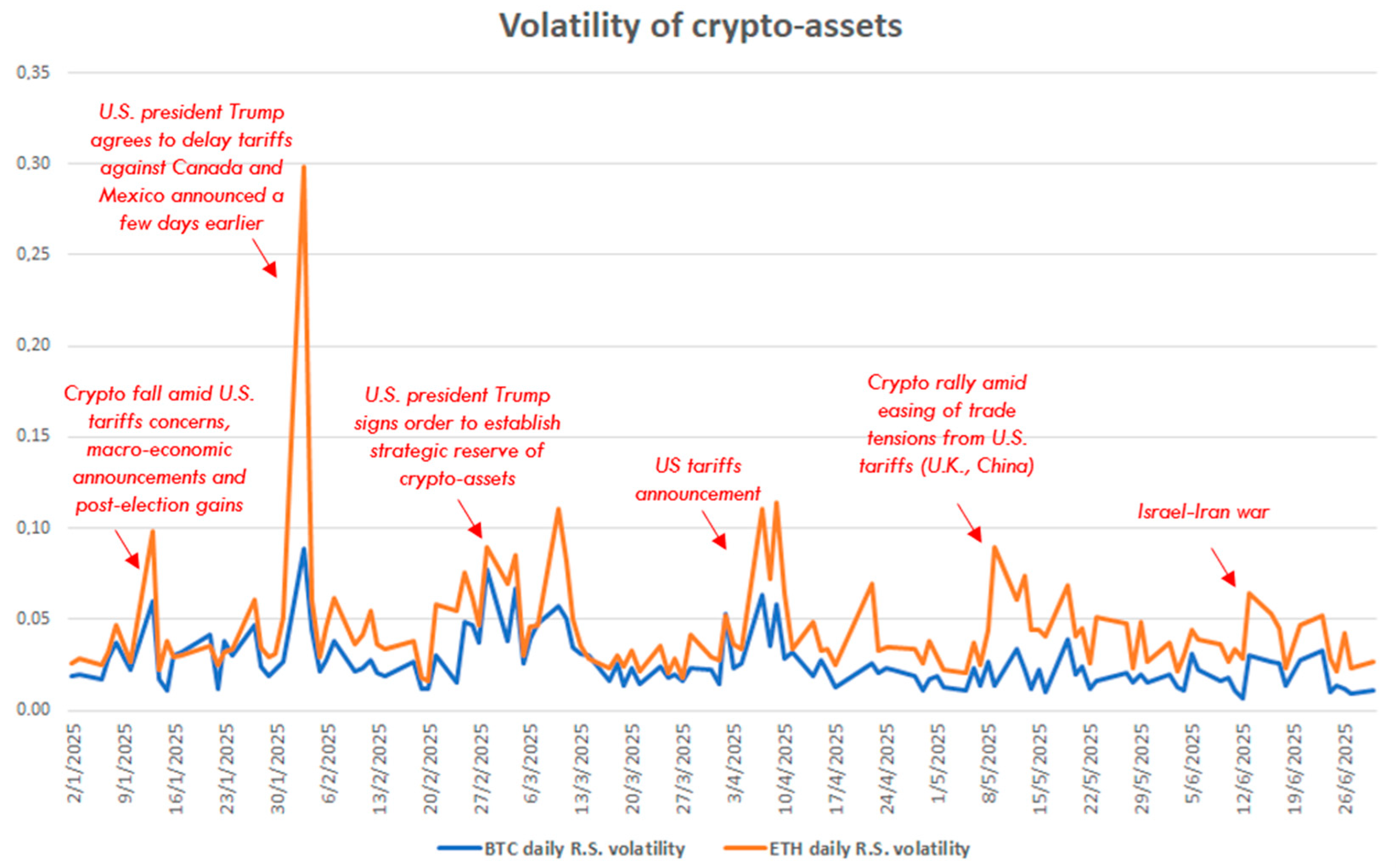
Figure A24. Daily Rogers–Satchell volatility in the first half of 2025 and relevant U.S. administration announcements (calculated from the daily dataset).
Appliedmath 06 00057 g0a24
Figure A25. Daily Rogers–Satchell volatility within the U.S. stock market trading hours in the first half of 2025 and relevant U.S. administration announcements (calculated from the high-frequency dataset).
Appliedmath 06 00057 g0a25

References

  1. Hsu, S.H.; Sheu, C.; Yoon, J. Risk spillovers between cryptocurrencies and traditional currencies and gold under different global economic conditions. N. Am. J. Econ. Financ. 2021, 57, 101443. [Google Scholar] [CrossRef]
  2. Dai, P.F.; Goodell, J.W.; Huynh, L.D.T.; Liu, Z.; Corbet, S. Understanding the transmission of crash risk between cryptocurrency and equity markets. Financ. Rev. 2023, 58, 539–573. [Google Scholar] [CrossRef]
  3. Iyer, R.; Popescu, A. New Evidence on Spillovers Between Crypto Assets and Financial Markets; International Monetary Fund Working Paper, WP/23/213; International Monetary Fund: Washington, DC, USA, 2023. [Google Scholar]
  4. Ibrahim, B.A.; Elamer, A.A.; Alasker, T.H.; Mohamed, M.A.; Abdou, H.A. Volatility contagion between cryptocurrencies, gold and stock markets pre-and-during COVID-19: Evidence using DCC-GARCH and cascade-correlation network. Financ. Innov. 2024, 10, 104. [Google Scholar] [CrossRef]
  5. Zhang, X.; Chen, Z.; Wang, S. A study of the impact of cryptocurrency price volatility on the stock and gold markets. Financ. Res. Lett. 2024, 69, 106114. [Google Scholar] [CrossRef]
  6. Vuković, D.B.; Frömmel, M.; Vigne, S.A.; Zinovev, V. Spillovers between cryptocurrencies and financial markets in a global framework. J. Int. Money Financ. 2025, 150, 103235. [Google Scholar] [CrossRef]
  7. Goodell, J.W.; Goutte, S. Diversifying equity with cryptocurrencies during COVID-19. Int. Rev. Financ. Anal. 2021, 76, 101781. [Google Scholar] [CrossRef]
  8. Gambarelli, L.; Marchi, G.; Muzzioli, S. Hedging effectiveness of cryptocurrencies in the European stock market. J. Int. Financ. Mark. Inst. Money 2023, 84, 101757. [Google Scholar] [CrossRef]
  9. Huang, L. The relationship between cryptocurrencies and convention financial market: Dynamic causality test and time-varying influence. Int. Rev. Econ. Financ. 2024, 91, 811–826. [Google Scholar] [CrossRef]
  10. Hsu, S.-H.; Cheng, P.-K.; Yang, Y. Diversification, hedging, and safe-haven characteristics of cryptocurrencies: A structural change approach. Int. Rev. Financ. Anal. 2024, 93, 103211. [Google Scholar] [CrossRef]
  11. Liu, K.; Manahov, V.; Stafylas, D. A Note on the Relationship Between Stock Market Volatility and Cryptocurrencies: New Evidence from China–US Trade Frictions. J. Futures Mark. 2025, 45, 2232–2261. [Google Scholar] [CrossRef]
  12. ECB Crypto-Assets Task Force. Crypto-Assets: Implications for Financial Stability, Monetary Policy, and Payments and Market Infrastructures; European Central Bank Occasional Paper Series; ECB Crypto-Assets Task Force: Frankfurt am Main, Germany, 2019; Volume 223. [Google Scholar]
  13. Hermans, L.; Ianiro, A.; Kochanska, U.; Törmälehto, V.-M.; van der Kraaij, A.; Vendrell Simón, J.M. Decrypting Financial Stability Risks in Crypto-Asset Markets; ECB Financial Stability Review; European Central Bank: Frankfurt am Main, Germany, 2022. [Google Scholar]
  14. Financial Policy Committee. Financial Stability in Focus: Cryptoassets and Decentralised Finance; Bank of England Financial Policy Committee: London, UK, 2022. [Google Scholar]
  15. Financial Stability Board. The Financial Stability Risks of Decentralised Finance; Financial Stability Board: Basel, Switzerland, 2023. [Google Scholar]
  16. Financial Stability Board. The Financial Stability Implications of Multifunction Crypto-Asset Intermediaries; Financial Stability Board: Basel, Switzerland, 2023. [Google Scholar]
  17. Määttä, I.; Nurminen, J.; Räsänen, T. Instability in Crypto-Asset Markets is a Reminder of the Risks and Underlines the Need for Regulation; Bank of Finland Bulletin: Helsinki, Finland, 2024. [Google Scholar]
  18. Joebges, H.; Herr, H.; Kellermann, C. Crypto assets as a threat to financial market stability. Eurasian Econ. Rev. 2025, 15, 473–502. [Google Scholar] [CrossRef]
  19. Financial Stability Board. Thematic Review on FSB Global Regulatory Framework for Crypto-Asset Activities; Financial Stability Board: Basel, Switzerland, 2025. [Google Scholar]
  20. Koutrouli, E.; Manousopoulos, P.; Theal, J.; Tresso, L. Crypto Asset Markets vs. Financial Markets: Event Identification, Latest Insights and Analyses. AppliedMath 2025, 5, 36. [Google Scholar] [CrossRef]
  21. Andersson, M.; Krylova, E.; Vähämaa, S. Why does the correlation between stock and bond returns vary over time? Appl. Financ. Econ. 2008, 18, 139–151. [Google Scholar] [CrossRef]
  22. Papadamou, S.; Fassas, A.P.; Kenourgios, D.; Dimitrios, D. Flight-to-quality between global stock and bond markets in the COVID era. Financ. Res. Lett. 2021, 38, 101852. [Google Scholar] [CrossRef] [PubMed]
  23. Wang, P.; Liu, X.; Wu, S. Dynamic linkage between bitcoin and traditional financial assets: A comparative analysis of different time frequencies. Entropy 2022, 24, 1565. [Google Scholar] [CrossRef]
  24. Abdelkafi, I.; Romdhane, Y.B.; Loukil, S. Has COVID-19 changed the correlation between cryptocurrencies and stock markets? Eur. J. Gov. Econ. 2023, 12, 139–156. [Google Scholar] [CrossRef]
  25. Baur, D.G.; Hong, K.; Lee, A.D. Bitcoin: Medium of exchange or speculative assets? J. Int. Financ. Mark. Inst. Money 2018, 54, 177–189. [Google Scholar] [CrossRef]
  26. Corbet, S.; Meegan, A.; Larkin, C.; Lucey, B.; Yarovaya, L. Exploring the dynamic relationships between cryptocurrencies and other financial assets. Econ. Lett. 2018, 165, 28–34. [Google Scholar] [CrossRef]
  27. Corbet, S.; Larkin, C.; Lucey, B. The contagion effects of the COVID-19 pandemic: Evidence from gold and cryptocurrencies. Financ. Res. Lett. 2020, 35, 101554. [Google Scholar] [CrossRef]
  28. Zhang, D.; Hu, M.; Ji, Q. Financial markets under the global pandemic of COVID-19. Financ. Res. Lett. 2020, 36, 101528. [Google Scholar] [CrossRef]
  29. Goodell, J.W.; Goutte, S. Co-movement of COVID-19 and Bitcoin: Evidence from wavelet coherence analysis. Financ. Res. Lett. 2021, 38, 101625. [Google Scholar] [CrossRef] [PubMed]
  30. Gormsen, N.J.; Koijen, R.S.J. Financial Markets and the COVID-19 Pandemic. Annu. Rev. Financ. Econ. 2023, 15, 69–89. [Google Scholar] [CrossRef]
  31. Hoang, L.T.; Baur, D.G. Cryptocurrencies are not immune to coronavirus: Evidence from investor fear. Int. Rev. Econ. Financ. 2023, 88, 1444–1463. [Google Scholar] [CrossRef]
  32. Zhu, M.; Wen, S.; Song, Y. Impact of COVID-19 on jump occurrence in capital markets. Humanit. Soc. Sci. Commun. 2024, 11, 820. [Google Scholar] [CrossRef]
  33. Fu, J.; Mishra, M. Fintech in the time of COVID-19: Technological adoption during crises. J. Financ. Intermediat. 2022, 50, 00945. [Google Scholar] [CrossRef]
  34. Vilhena, S.P.; Navas, R. The impact of COVID-19 on digital banking. J. Entrep. Res. 2023, 1, 21–42. [Google Scholar] [CrossRef]
  35. Mihai, F.; Iordache, D.-M.; Aleca, O.E. The Impact of the COVID Pandemic on Banking Digitalization: An Analysis of Digital Payments and Digital Bank Revenues. Proc. Int. Conf. Bus. Excell. Sciendo 2025, 19, 367–379. [Google Scholar] [CrossRef]
  36. Ghosh, M.; Banerjee, M. Evaluation of Crypto Assets and Their Adoption in the Business World: A Global Perspective of the COVID-19 Pandemic. In Digital Innovation for Pandemics; Auerbach Publications: Boca Raton, FL, USA, 2022. [Google Scholar]
  37. Ballis, A.; Karagiorgis, A.; Anastasiou, D.; Kallandranis, C. Cryptocurrency dynamics during global crises: Insights from Bitcoin’s interplay with traditional markets. Int. Rev. Econ. Financ. 2025, 103, 104512. [Google Scholar] [CrossRef]
  38. Chiang, T.C.; Chen, P.-Y. Inflation risk and stock returns: Evidence from US aggregate and sectoral markets. N. Am. J. Econ. Financ. 2023, 68, 101986. [Google Scholar] [CrossRef]
  39. Abid, I. Rising Rates, Rising Risks? Unpacking the U.S. Stock Market Response to Inflation and Fed Hikes (2015–2025). FinTech 2025, 4, 57. [Google Scholar] [CrossRef]
  40. Ahmadian-Yazdi, F.; Sokhanvar, A.; Roudari, S.; Tiwari, A.K. Dynamics of the relationship between stock markets and exchange rates during quantitative easing and tightening. Financ. Innov. 2025, 11, 51. [Google Scholar] [CrossRef]
  41. Thorbecke, W. The Impact of Inflation on the U.S. Stock Market After the COVID-19 Pandemic. Int. J. Financ. Stud. 2025, 13, 9. [Google Scholar] [CrossRef]
  42. Izzeldin, M.; Muradoğlu, Y.G.; Pappas, V.; Petropoulou, A.; Sivaprasad, S. The impact of the Russian-Ukrainian war on global financial markets. Int. Rev. Financ. Anal. 2023, 87, 102598. [Google Scholar] [CrossRef]
  43. Assaf, R.; Gupta, D.; Kumar, R. The price of war: Effect of the Russia-Ukraine war on the global financial market. J. Econ. Asymmetries 2023, 28, e00328. [Google Scholar] [CrossRef]
  44. Federle, J.; Meier, A.; Müller, G.J.; Sehn, V. Proximity to War: The Stock Market Response to the Russian Invasion of Ukraine. J. Money Credit. Bank. 2024. [Google Scholar] [CrossRef]
  45. Shaikh, I. The 2016 U.S. presidential election and the Stock, FX and VIX markets. N. Am. J. Econ. Financ. 2017, 42, 546–563. [Google Scholar] [CrossRef]
  46. Yavas, B.F.; Dedi, L.; Škrinjarić, T. Did equity returns and volatilities change after the 2016 Trump election victory? Int. J. Financ. Econ. 2022, 27, 1291–1308. [Google Scholar] [CrossRef]
  47. Lahajnar, S.; Rozanec, A. The correlation strength of the most important cryptocurrencies in the bull and bear market. Invest. Manag. Financ. Innov. 2020, 17, 67–81. [Google Scholar] [CrossRef]
  48. Ahmed, M.S.; El-Masry, A.A.; Al-Maghyereh, A.I.; Kumar, S. Cryptocurrency volatility: A review, synthesis, and research agenda. Res. Int. Bus. Financ. 2024, 71, 102472. [Google Scholar] [CrossRef]
  49. Rogers, L.; Satchell, S. Estimating Variance from High, Low and Closing Prices. Ann. Appl. Probab. 1991, 1, 504–512. [Google Scholar] [CrossRef]
  50. Koutrouli, E.; Manousopoulos, P. Exploring the Use of Crypto-Assets for Payments. FinTech 2025, 4, 15. [Google Scholar] [CrossRef]
  51. Rogers, L.; Satchell, S.; Yoon, Y. Estimating the Volatility of Stock Prices: A Comparison of Methods That Use High and Low Prices. Appl. Financ. Econ. 1994, 4, 241–247. [Google Scholar] [CrossRef]
  52. Yang, D.; Zhang, Q. Drift-Independent Volatility Estimation Based on High, Low, Open, and Close Prices. J. Bus. 2000, 73, 477–492. [Google Scholar] [CrossRef]
  53. Grobys, K.; Junttila, J.; Kolari, J.W.; Sapkota, N. On the stability of stablecoins. J. Empir. Financ. 2021, 64, 207–223. [Google Scholar] [CrossRef]
  54. Loretan, M.; English, W.B. Evaluating Correlation Breakdowns During Periods of Market Volatility; International Finance Discussion Papers; Board of Governors of the Federal Reserve System: Washington, DC, USA, 2000; Volume 658. [Google Scholar]
  55. Loretan, M.; English, W.B. Evaluating Changes in Correlations During Periods of High Market Volatility; BIS Quarterly Review; Bank for International Settlements: Basel, Switzerland, 2000; pp. 29–36. [Google Scholar]
  56. Engle, R.F.; Ng, V.K. Measuring and Testing the Impact of News on Volatility. J. Financ. 1993, 48, 1749–1778. [Google Scholar] [CrossRef]
  57. Baur, D.G.; Dimpfl, T. Asymmetric volatility in crypto assets. Econ. Lett. 2018, 173, 148–151. [Google Scholar] [CrossRef]
  58. Katsiampa, P. Volatility estimation for Bitcoin: A comparison of GARCH models. Econ. Lett. 2017, 158, 3–6. [Google Scholar] [CrossRef]
  59. Dyhrberg, A.H. Bitcoin, gold and dollar—A GARCH volatility analysis. Financ. Res. Lett. 2016, 16, 85–92. [Google Scholar] [CrossRef]
  60. Cheikh, B.N.; Zaied, Y.B.; Chevallier, J. Asymmetric volatility in crypto-asset markets: A smooth transition GARCH approach. Financ. Res. Lett. 2020, 35, 101293. [Google Scholar] [CrossRef]
  61. Cankaya, S.; Aykac, E.A.; Findikci, M. News Sentiment and Crypto-asset Volatility. In Blockchain Economics and Financial Market Innovation; Umit, H., Ed.; Springer: Berlin/Heidelberg, Germany, 2019; pp. 115–140. [Google Scholar]
  62. Kristoufek, L. Bitcoin meets Google Trends and Wikipedia. Sci. Rep. 2013, 3, 3415. [Google Scholar] [CrossRef]
  63. Garcia, D.; Tessone, C.J.; Mavrodiev, P.; Perony, N. The digital traces of bubbles: Feedback cycles between socio-economic signals in the Bitcoin economy. J. R. Soc. Interface 2014, 11, 20140623. [Google Scholar] [CrossRef] [PubMed]
  64. Smales, L.A. Bitcoin as a safe haven: Is it even worth considering? Financ. Res. Lett. 2019, 30, 385–393. [Google Scholar] [CrossRef]
  65. Conlon, T.; McGee, R. Safe haven or risky hazard? Bitcoin during the Covid-19 bear market. Financ. Res. Lett. 2020, 35, 101607. [Google Scholar] [CrossRef] [PubMed]
  66. Katsiampa, P.; Corbet, S.; Lucey, B. Volatility spillover effects in leading crypto assets: A BEKK-MGARCH analysis. Financ. Res. Lett. 2019, 29, 68–74. [Google Scholar] [CrossRef]
  67. Yarovaya, L.; Brzeszczyński, J.; Goodell, J.W.; Lucey, B.; Lau, C.K.M. Financial contagion: Information transmission mechanism during the COVID-19 pandemic. J. Int. Financ. Mark. Inst. Money 2022, 79, 101589. [Google Scholar] [CrossRef]
  68. Diebold, F.X.; Yilmaz, K. Better to give than to receive: Predictive directional measurement of volatility spillovers. Int. J. Forecast. 2012, 28, 57–66. [Google Scholar] [CrossRef]
  69. Diebold, F.X.; Yilmaz, K. On the network topology of variance decompositions: Measuring the connectedness of financial firms. J. Econom. 2014, 182, 119–134. [Google Scholar] [CrossRef]
  70. Financial Stability Board. Assessment of Risks to Financial Stability from Crypto-Assets; Financial Stability Board: Basel, Switzerland, 2022. [Google Scholar]
  71. International Monetary Fund. The Crypto Ecosystem and Financial Stability Challenges; IMF Global Financial Stability Report; International Monetary Fund: Washington, DC, USA, 2021. [Google Scholar]
  72. European Systemic Risk Board. Crypto-Assets and DeFi. Systemic Implications and Policy Options; European Systemic Risk Board: Frankfurt am Main, Germany, 2023. [Google Scholar]
  73. Engle, R.F. Dynamic conditional correlation—A simple class of multivariate GARCH models. J. Bus. Econ. Stat. 2002, 20, 339–350. [Google Scholar] [CrossRef]
  74. Polyzos, E.; Youssef, L. Investigating the impact of global events on cryptocurrency performance: A big data event study approach. J. Int. Money Financ. 2025, 157, 103375. [Google Scholar] [CrossRef]
  75. Katsiampa, P.; Yarovaya, L.; Zięba, D. High-frequency connectedness between Bitcoin and other top-traded crypto assets during the COVID-19 crisis. J. Int. Financ. Mark. Inst. Money 2022, 79, 101578. [Google Scholar] [CrossRef]
  76. Divakaruni, A.; Zimmerman, P. Tariffs, Stablecoins, and the Demand for Dollars; Federal Reserve Bank of Cleveland Working Paper Series, Working Paper No. 25-21; Federal Reserve Bank of Cleveland: Cleveland, OH, USA, 2025. [Google Scholar]
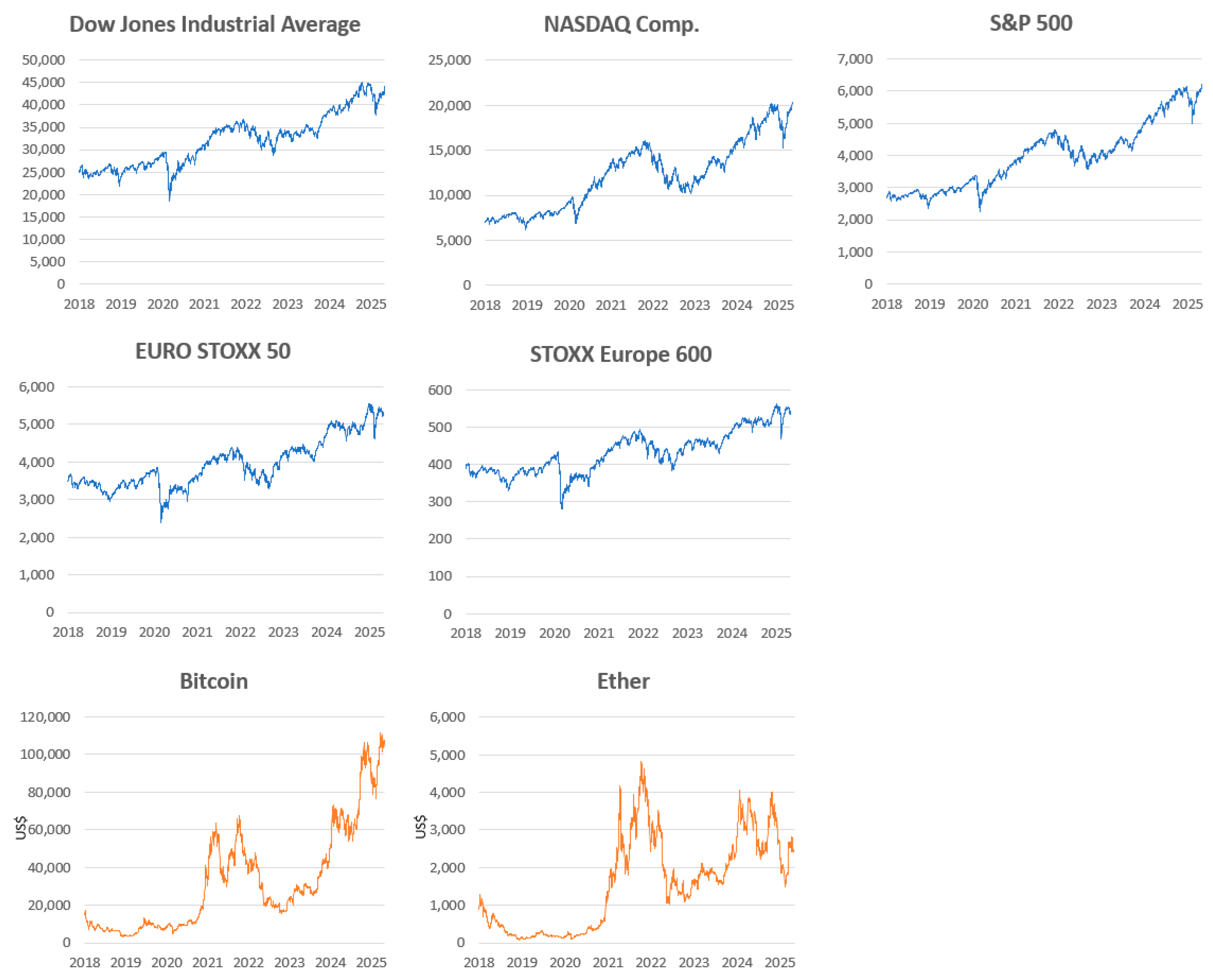
Figure 1. Daily closing prices of equity indices and crypto-assets.
Appliedmath 06 00057 g001
Figure 2. Daily log returns of equity indices and crypto-assets.
Appliedmath 06 00057 g002
Table 1. Market indices of the dataset (* U.S./** EU).
Market IndexDescription
Dow Jones Industrial Average *Price-weighted index of 30 prominent U.S. stocks
NASDAQ Composite *Market capitalization-weighted index of more than 2500 stocks listed on the NASDAQ stock exchange
S&P 500 *Market capitalization-weighted index of 500 prominent U.S. stocks
EURO STOXX 50 **Market capitalization-weighted index of 50 prominent Eurozone stocks
STOXX Europe 600 **Market capitalization-weighted index of the 600 largest European companies
Table 2. Crypto-assets of the dataset.
Crypto-AssetDescription
Bitcoin (BTC)The first decentralized crypto-asset
Ether (ETH)Native crypto-asset of the Ethereum blockchain
Disclaimer/Publisher’s Note: The statements, opinions and data contained in all publications are solely those of the individual author(s) and contributor(s) and not of MDPI and/or the editor(s). MDPI and/or the editor(s) disclaim responsibility for any injury to people or property resulting from any ideas, methods, instructions or products referred to in the content.