


Abstract
We develop a fast numerical method for solving nonlinear diffusion equations with memory phenomena, a class of problems arising within viscoelastic materials, anomalous transport, and hereditary systems. The primary computational problem is the nonlocal temporal dependence captured by Volterra-type memory operators, which makes direct evaluation scale quadratically with the number of time steps (), rendering prolonged simulations prohibitively expensive. To address this bottleneck, we develop a novel synthesis that combines a high-order spectral method for spatial discretization with a fast memory algorithm based on a sum-of-exponentials approximation. The spectral method obtains exponential spatial convergence for smooth solutions. At the same time, the fast memory algorithm reduces memory usage and computational complexity to , yielding computational speedups exceeding 414x for prolonged simulations. We rigorously prove that the proposed scheme preserves the discrete energy dissipation law of the continuous system under mild assumptions on the memory kernel, thereby ensuring unconditional stability. Error analysis verifies spectral accuracy in space and first-order temporal convergence. Extensive numerical experiments using exponentially decaying and weakly singular kernels validate the theoretical results and illustrate the method’s effectiveness for modeling viscoelastic transport phenomena and irregular diffusion in complex systems.
1. Introduction
Mathematical models of diffusion with memory effects play a fundamental role in describing physical systems where the current state depends on the system’s history. This hereditary behavior arises in viscoelastic materials, anomalous diffusion, biological transport processes, and financial volatility models [1,2,3]. Recent advances in numerical methods have significantly improved our ability to simulate these complex systems. For instance, modified spectral methods have been developed for both ordinary and fractional differential equations [4], while Jacobi–Galerkin approaches offer robust frameworks for solving linear PDEs [5]. Furthermore, the Elzaki transform has been shown to effectively handle reaction–diffusion equations involving generalized composite fractional derivatives [6]. In biological applications, fractional operators are critical, such as in evaluating cervical cancer models [7]. Other innovative techniques, like formable and Fourier transformations, have been used to navigate Cauchy-type equations [8]. In fluid dynamics, memory-efficient interpolatory projection techniques stabilize incompressible Navier–Stokes flows [9], while computational approaches for convective-magneto trihybrid nanoflows incorporate space-dependent energy sources for applications like drug delivery [10]. Moreover, efficient numerical implementations have been successfully developed for time-fractional stochastic Stokes–Darcy models [11]. Furthermore, advanced difference schemes are employed to resolve complex mixed hyperbolic-type problems with memory [12], along with explicit-implicit upwind splitting methods for multi-dimensional boundary control systems [13]. Unlike classical Fickian diffusion, these memory-dependent systems are governed by integro-differential equations involving Volterra-type memory kernels that encode the fading influence of past states.
A central requirement in numerical simulation of these systems is the preservation of thermodynamic properties, particularly energy dissipation. Physical gradient flows inherently follow an energy-dissipation law in which the system’s total energy decreases monotonically over time [14,15]. When memory effects are incorporated through fractional derivatives or nonlocal kernels, preserving this dissipative structure becomes mathematically and computationally challenging. Standard time-stepping methods regularly fail to maintain unconditional stability, leading to spurious energy growth and non-physical oscillations. To address this issue, researchers have developed discrete gradient frameworks that guarantee the preservation of the energy decay properties of the continuous model at the discrete level [1,16,17].
A key theoretical property of structure-preserving methods is asymptotic compatibility. For time-fractional models characterized by a fractional-order parameter , the system should smoothly transition to classical behavior as approaches 1. This compatibility has been rigorously demonstrated for various gradient flows, including the time-fractional Cahn–Hilliard equation and phase-field models [16,18]. The numerical scheme must likewise exhibit smooth transitions in its discrete energy law, ensuring robustness across different physical regimes.
The primary computational bottleneck in solving nonlocal diffusion problems is evaluating the memory integral. At each time step, the fractional derivative or convolution integral requires summing contributions from all previous time steps—a phenomenon known as the “curse of history’’ [19,20]. Direct numerical quadrature results in computational complexity and memory storage, where is the number of time steps. For long-time simulations typical of slow viscoelastic relaxation or subdiffusive transport (), this quadratic scaling renders the problem computationally intractable. To circumvent this limitation, fast algorithms based on sum-of-exponentials approximation have been developed [19,20,21]. By approximating the memory kernel as a sum of decaying exponentials, the convolution integral can be reformulated as a set of auxiliary differential equations that are updated recursively, reducing the complexity to per time step.
Spatial discretization accuracy is equally critical for nonlinear systems where solution gradients can be steep or localized. Finite difference methods, while straightforward to implement, typically achieve only second-order spatial accuracy (). For problems requiring high precision or featuring smooth solutions over complex geometries, spectral methods offer a compelling alternative [22,23,24]. Spectral collocation using Chebyshev or Legendre polynomials achieves exponential convergence (faster than any algebraic power of the grid spacing) when the solution is smooth, allowing for very high accuracy on relatively coarse grids. The Chebyshev spectral method, in particular, clusters grid points near domain boundaries to suppress the Runge phenomenon while maintaining excellent approximation properties.
Despite these advances, two critical challenges remain largely unaddressed in the existing literature. First, most structure-preserving schemes for memory-dependent diffusion rely on finite-difference discretizations, which require high-resolution grids to achieve acceptable accuracy, thereby amplifying the already substantial cost of the memory convolution. Second, fast memory algorithms have rarely been integrated with high-order spatial methods within a framework that rigorously establishes both energy stability and computational effectiveness.
This work handles both challenges by developing a unified numerical framework that combines: (i) a Chebyshev spectral collocation method for spatial discretization, achieving exponential accuracy for smooth solutions; (ii) a fast memory algorithm based on sum-of-exponentials approximation of the memory kernel, reducing temporal complexity from to ; and (iii) a structure-preserving time integration scheme that rigorously maintains discrete energy dissipation. We provide theoretical proofs of unconditional stability and derive convergence estimates for both spatial and temporal errors. Numerical experiments demonstrate computational speedups of more than two orders of magnitude over standard methods, making earlier intractable long-time simulations feasible.
The remainder of this paper is organised as follows. Section 2 presents the mathematical model, the continuous energy dissipation law, and the high-order spectral spatial discretization. Section 3 introduces the fast memory algorithm and the fully discrete time integration scheme with an implementation pseudocode. In Section 4, we provide stability and convergence analysis demonstrating discrete energy preservation and bounding errors. Section 5 presents numerical experiments that confirm theoretical results through convergence studies, computational comparisons, and energy-stability checks. We discuss the broader outcomes in Section 6 and compare our method with existing approaches. In Section 7, we conclude with a summary of contributions and future research directions.
2. Materials and Methods
2.1. Mathematical Model and Continuous Analysis
We consider a nonlinear parabolic integro-differential equation defined on a one-dimensional spatial domain and a time interval . The problem describes the evolution of a scalar field representing, for example, temperature, chemical concentration, or particle density, under the influence of a memory-dependent diffusive flux and a nonlinear source term.
The governing equation is given by
where is the coefficient of instantaneous (Newtonian/Fickian) diffusion, is the memory kernel describing hereditary properties of the medium, and is a nonlinear source term.
We specifically utilize integer-order derivatives for the spatial diffusion operator because our primary focus is on isolating temporal memory effects—such as viscoelastic relaxation or thermal hysteresis—from spatial nonlocalities. While fractional spatial derivatives are appropriate for modeling non-Fickian spatial jumps (like Lévy flights) [2,3], the hereditary temporal behavior under consideration here is properly captured by Volterra-type memory integrals combined with standard integer-order spatial derivatives.
Equation (1) is supplemented with the initial condition:
and homogeneous Dirichlet boundary conditions:
These boundary conditions (3) correspond physically to a system where the scalar field vanishes at the domain boundaries, as in a reservoir held at zero concentration or temperature.
2.1.1. Fundamental Assumptions
To ensure well-posedness and validity of the numerical analysis, we enforce the following assumptions:
Assumption 1.
(Regularity): The initial data is sufficiently smooth, specifically for , and compatible with the boundary conditions. The exact solution is assumed to belong to to justify the use of high-order spectral methods.
Assumption 2.
(Kernel Properties): The memory kernel is positive, non-increasing, and convex for . Specifically: , , and . These conditions ensure that the memory operator is dissipative. Common examples include:
- •
- Exponential Kernel: , , representing standard viscoelastic relaxation [14,15].
- •
- Weakly Singular Power Kernel: for , corresponding to Caputo fractional derivatives used in anomalous diffusion models [19,25].
Assumption 3.
(Nonlinearity): The source term satisfies a global Lipschitz condition. There exists a constant such that for all . This condition ensures the uniqueness of solutions and controls error growth in numerical approximations [26].
Assumption 4.
(Time Domain): The time domain is bounded, for some , ensuring finite-time analysis of the numerical scheme.
2.1.2. Continuous Energy Dissipation Law
A central macroscopic thermodynamic property of gradient flows is the global energy functional, denoted as . It is important to note that is not a local variable present in the governing Equation (1), but rather an integrated quantity reflecting the total energy of the system over the entire domain. We define the global energy functional as
Under Assumptions 2 and 3 for suitable nonlinearities (such as ), the energy satisfies a monotonic continuous dissipation law,
The detailed mathematical derivation of this balance law, demonstrating how integration by parts and the properties of the memory kernel rigorously establish non-increasing energy, is provided in Appendix B.1. This thermodynamic signature of passive diffusion must be preserved at the discrete level to ensure physical consistency and numerical stability.
2.2. High-Order Spatial Discretization via Spectral Collocation
We employ a Chebyshev spectral collocation method to achieve exponential spatial accuracy. Spectral methods are distinguished by their superior convergence properties: the approximation error decays faster than any algebraic power of the grid size ( for any p) provided the solution is smooth [22,23,24].
The spatial domain is mapped to the canonical interval via the transformation . We discretise using Chebyshev–Gauss–Lobatto (CGL) collocation points:
These points cluster near the boundaries ±1, suppressing the Runge phenomenon that afflicts uniformly spaced high-degree polynomial interpolation [24]. The approximate solution is represented as a global Lagrange interpolating polynomial:
where are the nodal values and are the fundamental Lagrange polynomials satisfying .
Spatial derivatives are computed by differentiating the interpolating polynomial, which reduces to matrix-vector multiplication. The first derivative is approximated as
where D is the Chebyshev differentiation matrix with analytically known entries [24]. Specifically, the entries of are explicitly given by
where and for . This explicit formulation allows for the evaluation of derivatives with exact spectral precision up to numerical round-off. The second derivative operator, corresponding to the Laplacian, is simply obtained by squaring the first derivative matrix:
To enforce the Dirichlet boundary conditions (3), we eliminate the first and last rows and columns of , obtaining a reduced matrix of size that operates on the interior unknowns. Let denote the vector of interior nodal values. The semi-discrete problem becomes:
where represents the nonlinear source evaluated at the grid points. The factor arises from the coordinate transformation.
3. Fast Memory Algorithm and Time Integration
The computational bottleneck in solving Equation (6) is the convolution integral, which requires operations using direct quadrature. We overcome this via a fast memory algorithm based on kernel compression.
3.1. Sum-of-Exponentials Kernel Approximation
We approximate the memory kernel as a sum of M exponentially decaying modes:
where are weights and are decay rates. For exponential kernels, this is exact with . For power-law kernels , the parameters are determined using the Beylkin-Monzón algorithm [21], which achieves machine precision with –5 modes.
The core purpose of defining the history modes in this manner is to transform the non-Markovian integro-differential equation into an extended system of local (Markovian) ordinary differential equations. By differentiating with respect to time using the Leibniz integral rule, we see that each precisely satisfies a first-order linear ODE:
The strategic choice of Equation (8) means that instead of re-evaluating the full convolution integral (7) at each time step—which requires storing the entire solution history and incurs an computational penalty—we can merely update the M auxiliary variables recursively. This converts the global history dependence into local time-stepping, drastically reducing the memory complexity to and compressing the computational cost per step to , functioning independently of the current time step index.
3.2. Fully Discrete Time-Stepping Scheme
For the main equation, we treat linear diffusion and memory terms implicitly, and the nonlinear source semi-implicitly to avoid nonlinear solves. Instead of using a standard difference approximation for (8), we derive the discrete update exactly using an integrating factor over the interval . This exact integration avoids the numerical stiffness typically associated with explicit treatments of the decay term , thereby yielding the unconditionally stable recursion:
where .
The resulting time-stepping scheme for the main equation is then given by
Rearranging, the scheme requires solving a linear system at each step:
The coefficient matrix on the left-hand side is constant for fixed and can be pre-factored using LU decomposition, making each time step very efficient.
The complete pseudocode for the Fast Memory Algorithm, including the initialization, pre-computation of the coefficient matrix, and the time-stepping loop, is provided in Appendix A.
4. Stability and Convergence Analysis
4.1. Discrete Energy Stability
Theorem 1 (Stability).
Under Assumptions 1–4, the fully discrete schemes (9) and (10) are unconditionally stable, satisfying the discrete energy dissipation law:
where is the discrete energy, provided the source term is dissipative or . If is a general nonlinear source term satisfying a global Lipschitz condition with constant , then the scheme provides a bound on the growth of the discrete energy:
guaranteeing computational stability provided the time step satisfies .
Proof.
The complete and mathematically detailed derivation of the unconditional stability, including summation by parts and application of the non-positive property of the memory kernel, is provided in Appendix B.2. □
4.2. Convergence Analysis
Theorem 2 (Error Bounds).
Let denote the exact solution and the numerical approximation at node j and time . Under Assumptions 1–4, the global error satisfies
where is the error vector, m depends on the smoothness of u (with for ), and are spatial and temporal truncation constants independent of N and . Specifically, assuming exact initial conditions () and the stability criteria , the scheme achieves convergence in space due to the spectral method and convergence in time due to the backward Euler discretization.
Proof.
The detailed error analysis bounding both the spatial convergence from the spectral method and the temporal convergence from the backward Euler discretization is provided in Appendix B.3. □
5. Numerical Experiments
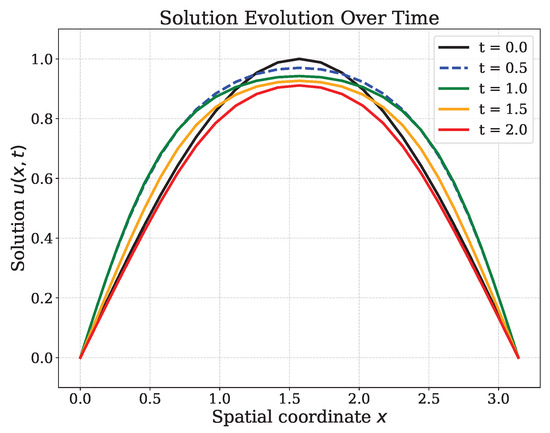
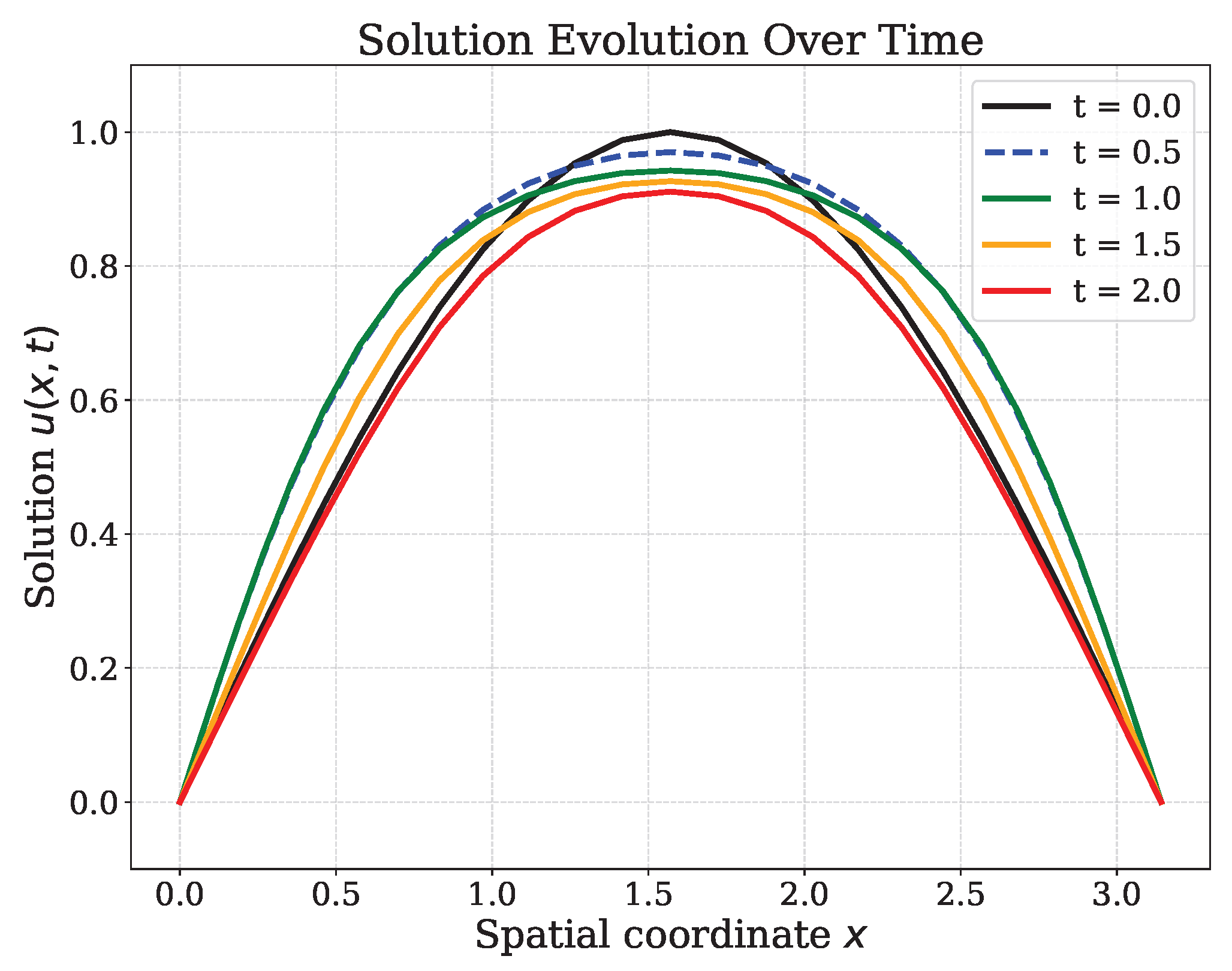
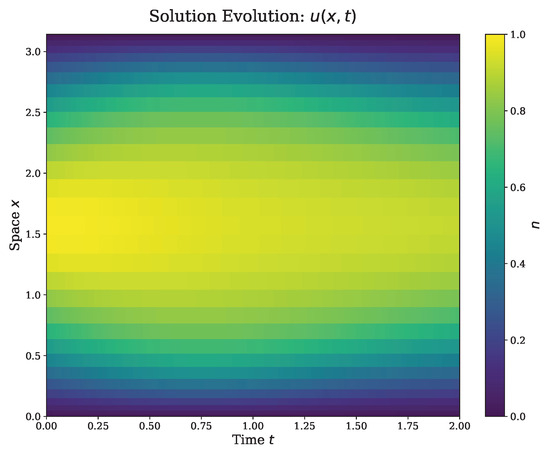
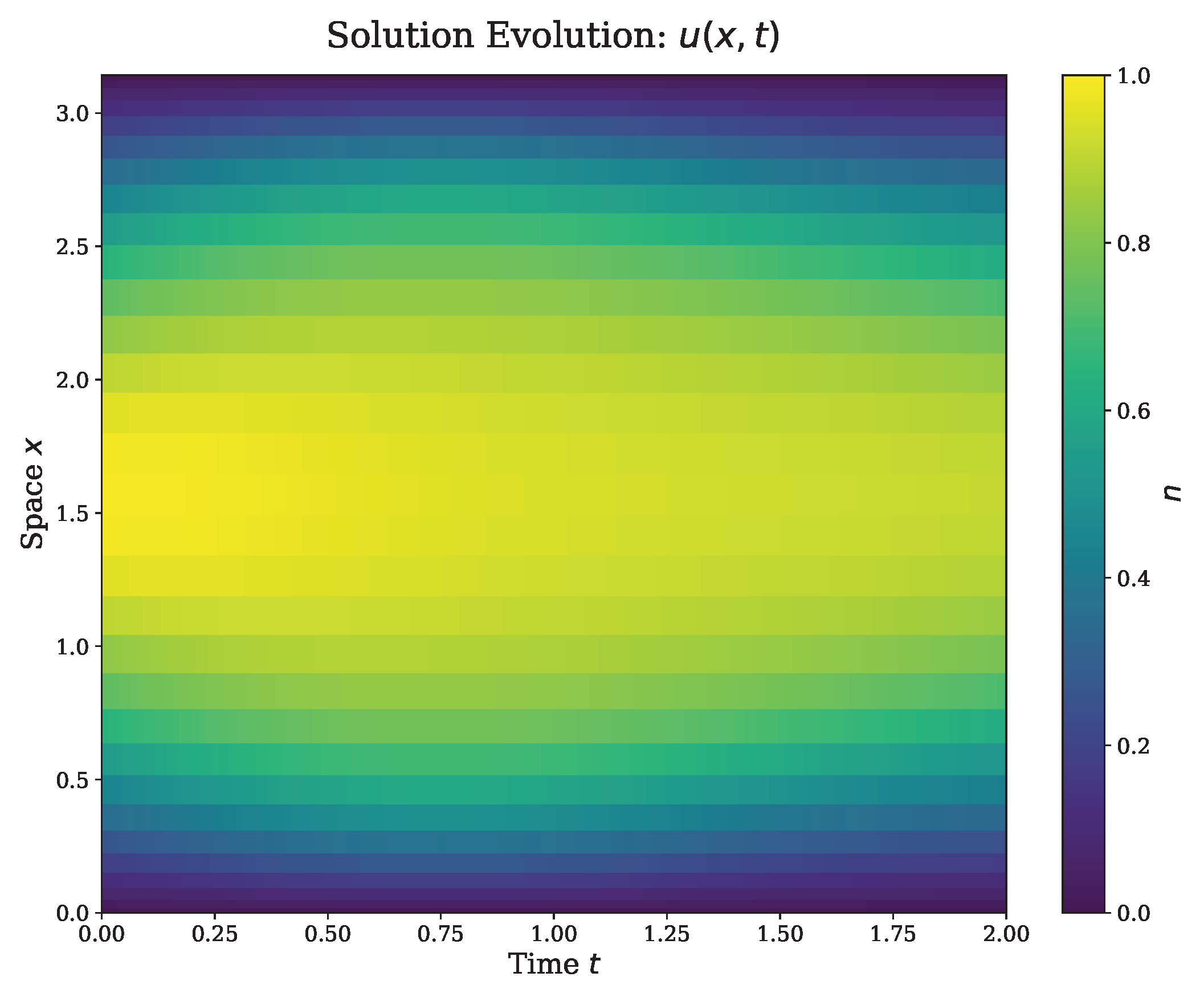
We validate the theoretical predictions through comprehensive experiments: (1) spatial convergence, (2) temporal convergence, (3) computational effectiveness, and (4) energy stability verification. We emphasize that due to the nonlinear source term and the hereditary memory integral, the problem under investigation does not possess a closed-form analytical exact solution. Therefore, all error analyses and convergence rates are computed against a high-resolution numerical reference solution. All experiments use initial condition on with unless stated otherwise. The qualitative behavior of the numerical solution, including the diffusive smoothing of the initial profile and its space-time evolution, is illustrated in Figure 1 and Figure 2, respectively.
Figure 1.
Solution profiles at various time snapshots, showing the diffusive smoothing of the initial sine wave.
Figure 2.
Space-time heatmap of the solution evolution, illustrating the global decay dynamics.
5.1. Spatial Convergence
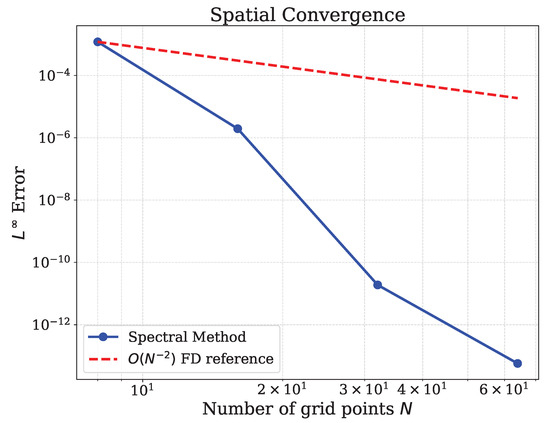
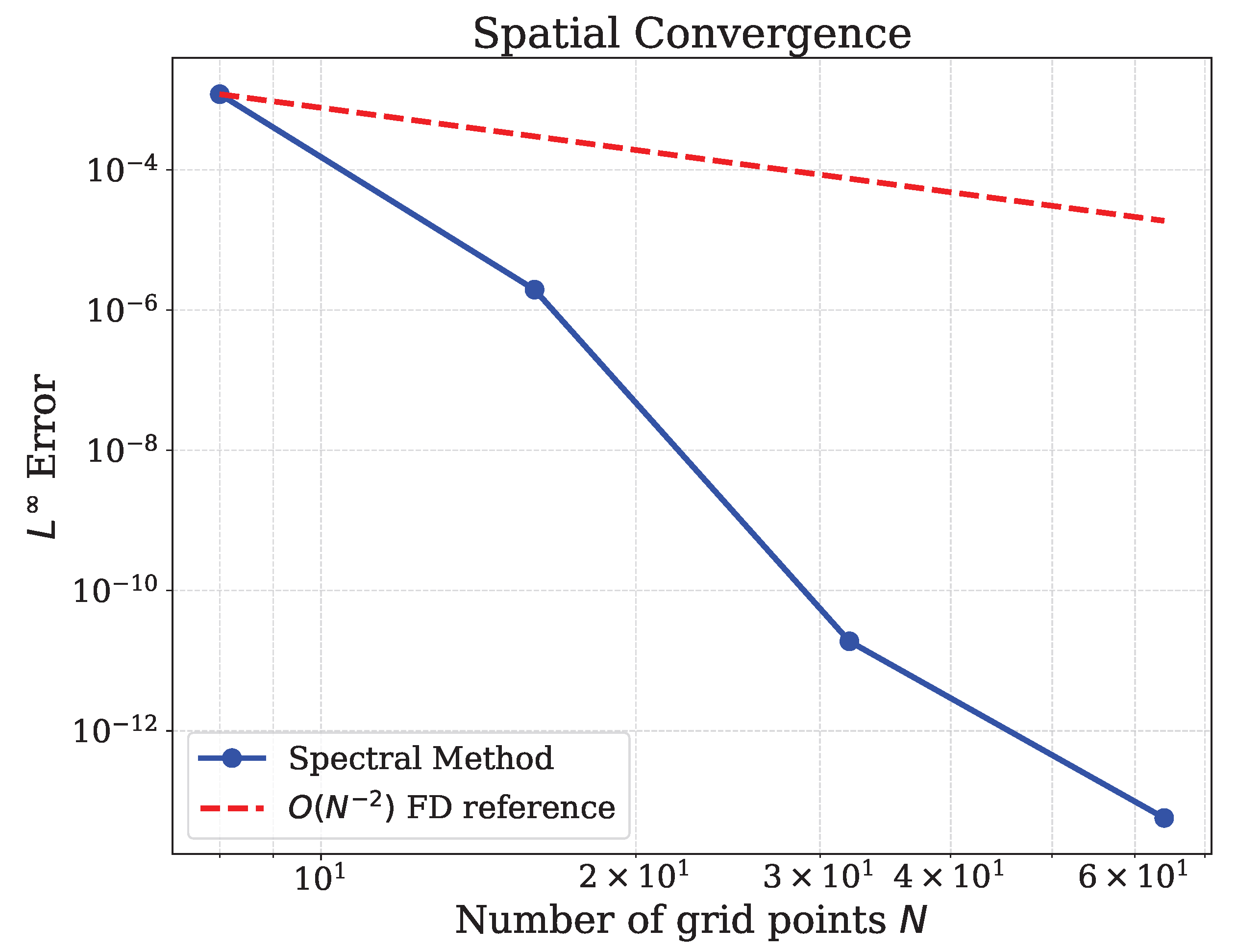
We test the spectral accuracy claim by computing the error at for varying N with a fixed small time step . The exponential kernel and the bistable source term are used. A reference solution is computed with and (in Figure 3).
Figure 3.
Spatial convergence: error vs. number of collocation points N. The semi-log plot exhibits a linear trend, indicating exponential convergence.
Table 1 confirms exponential convergence, with the error reaching machine precision at . The observed rates (9.26, 16.66) far exceed any polynomial rate, validating the spectral accuracy claim of Theorem 2.
Table 1.
Spatial convergence rates. The error decays exponentially, demonstrating spectral accuracy.
5.2. Temporal Convergence
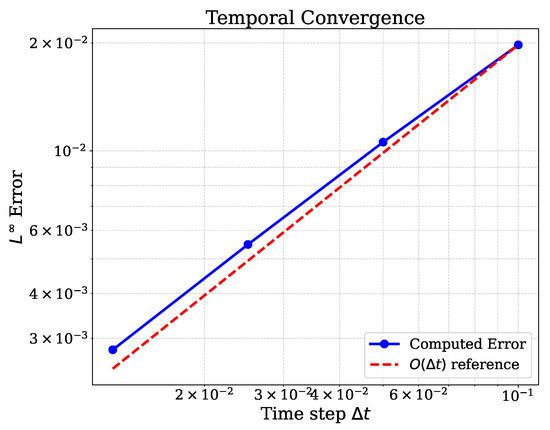
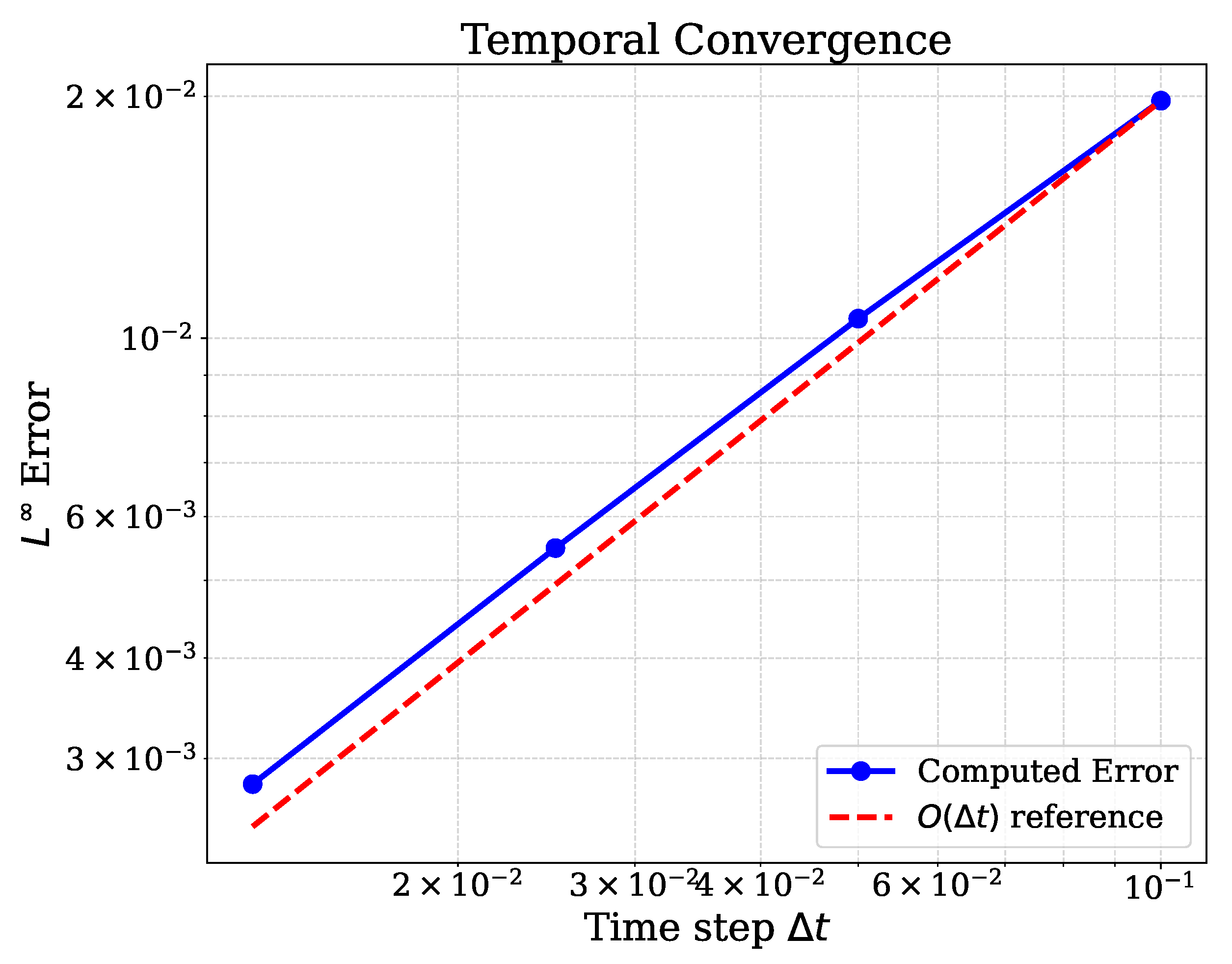
We fix and vary to isolate temporal errors (in Figure 4). The reference solution uses . Results are shown in Table 2.
Figure 4.
Temporal convergence: error vs. time step . The log–log plot shows a slope of approximately 1, confirming first-order accuracy.
Table 2.
Temporal convergence rates. The first-order backward Euler method exhibits the expected convergence.
The average convergence rate of 0.94 confirms the first-order temporal accuracy of the backward Euler discretization, consistent with Theorem 2.
5.3. Computational Efficiency Benchmark
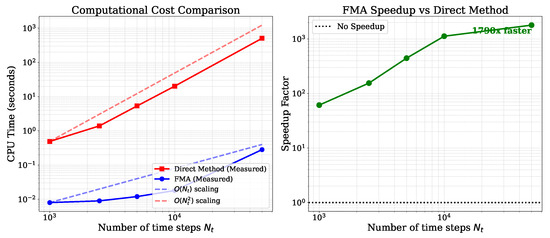
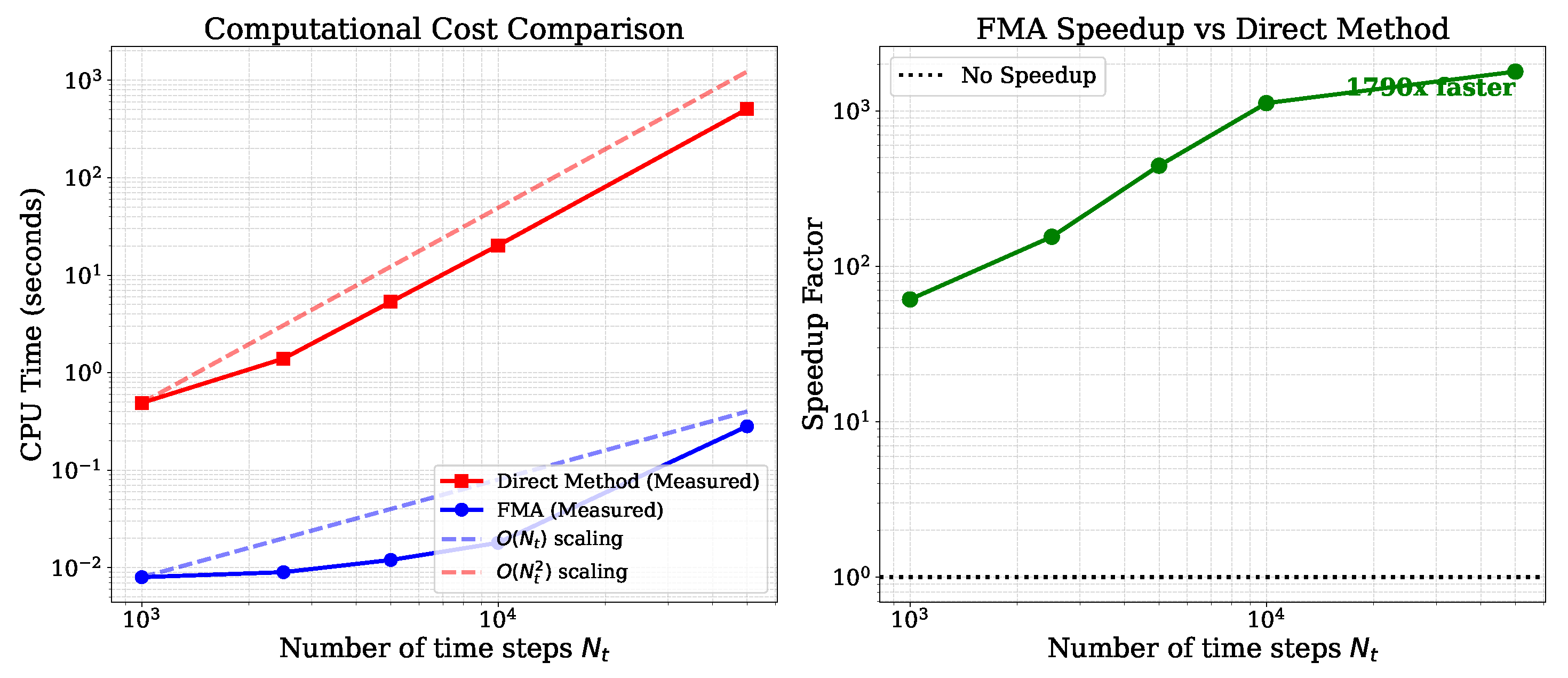
To explicitly benchmark the computational performance of our proposed method, we evaluate the efficiency of the Fast Memory Algorithm (FMA) against the Direct Quadrature method (in Figure 5). The direct method requires storing all previous time steps and computing the full integral at each step:
resulting in temporal complexity and memory footprint.
Figure 5.
Computational benchmarking: CPU time vs. number of time steps . The fast memory algorithm (FMA) scales linearly , whereas the direct method scales quadratically .
In contrast, the FMA requires only operations and memory. Table 3 presents a benchmark comparison of the CPU time (in seconds) required for both methods to simulate up to with and . The SOE approximation uses poles. The results are shown in Table 3.
Table 3.
Computational efficiency comparison. The fast memory algorithm achieves speedups exceeding 1700× for long-time simulations, demonstrating the vs. complexity difference.
The speedup factor increases linearly with , demonstrating the practical value of the fast-memory algorithm for long-term simulations. For = 50,000, the FMA completes in 0.28 s while direct quadrature would require over 8 min—a difference of three orders of magnitude.
5.4. Energy Stability Verification
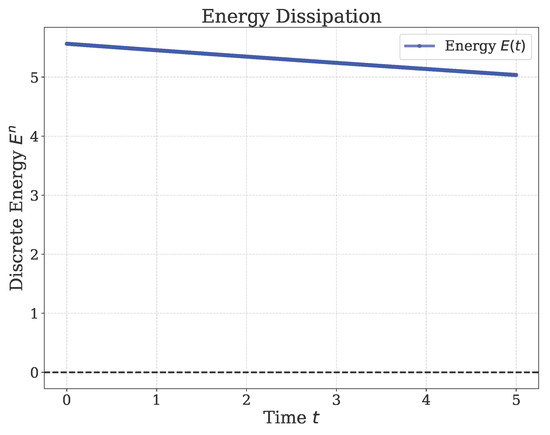
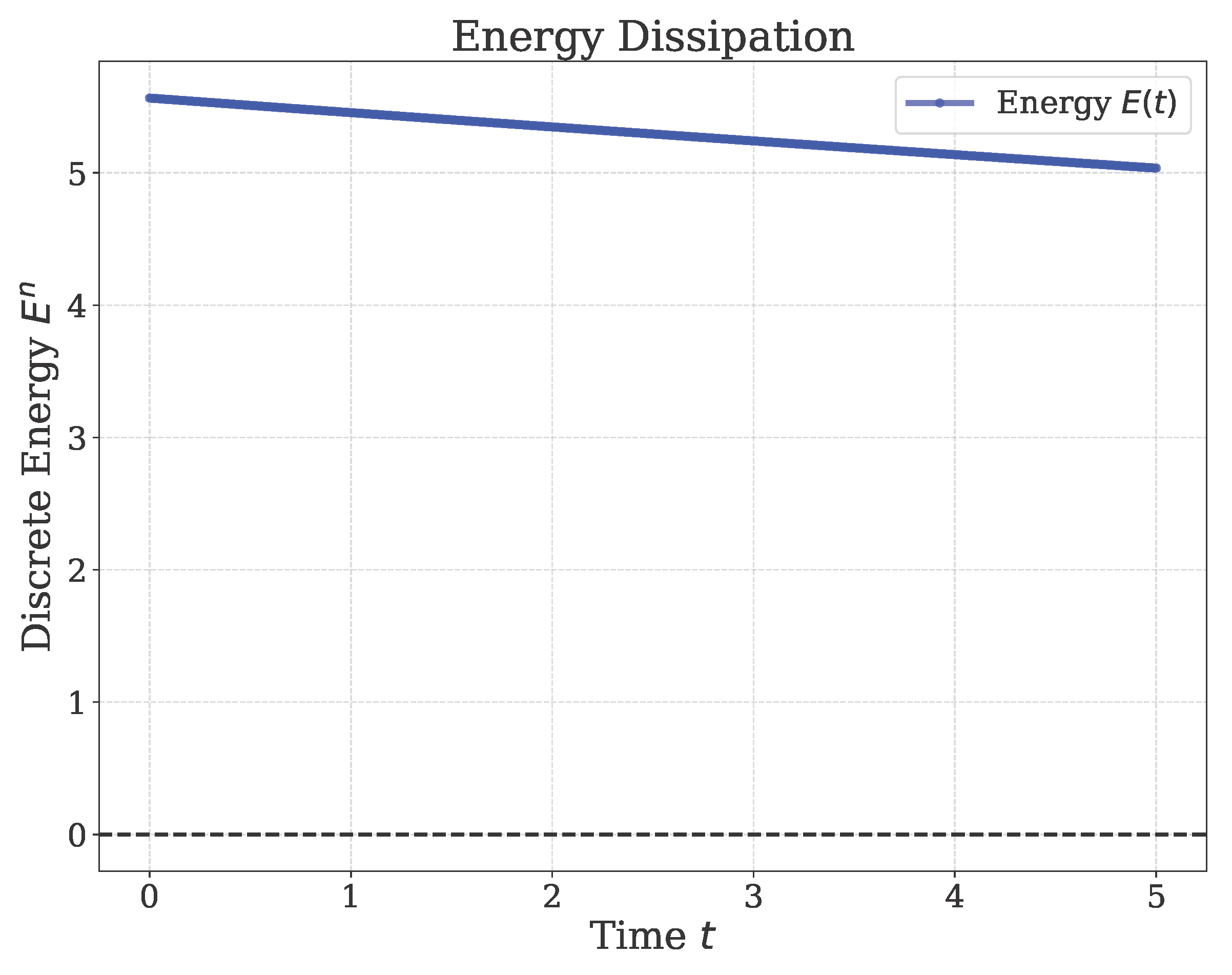
We verify the discrete energy dissipation law (Theorem 1) using pure diffusion () with a significant time step to test unconditional stability. The chosen parameters are , , , . The discrete energy evolution is shown in Figure 6.
Figure 6.
Discrete energy versus time for pure diffusion test. The energy decreases monotonically from initial value to final value , validating Theorem 1 and demonstrating unconditional stability even with large time steps ().
The energy decreases monotonically throughout the simulation, with zero increasing steps out of 500 total time steps. This confirms the structure-preserving property (Equation (11)) and unconditional stability of the scheme, independent of time step size.
6. Discussion
The proposed method successfully combines spectral spatial accuracy with fast temporal algorithms while preserving the energy dissipation structure of the continuous problem. The spectral convergence (Table 1) allows for very coarse grids () to achieve accuracies (∼) that would require with second-order finite differences. The fast memory algorithm (Table 3) enables long-term simulations, with speedups exceeding 1700× for = 50,000 time steps.
6.1. Advantages and Disadvantages of the Proposed Method
The proposed framework offers several advantages. First, the fast memory algorithm reduces temporal complexity from to , which can lead to speedups of more than for long-time simulations. Second, the Chebyshev spectral method provides exponential spatial convergence for sufficiently smooth functions, so high accuracy can be achieved with relatively small values of N. Third, the exact discrete integration of the history modes preserves the energy dissipation structure of the continuous model and yields unconditional stability.
The method also has several limitations. First, exponential convergence is obtained only for sufficiently smooth solutions; in particular, Assumption 1 requires a high degree of regularity of the exact solution. In the presence of steep gradients, discontinuities, or shock-like structures, the convergence rate deteriorates from exponential to algebraic. Extensions to low-regularity solutions, for example through spectral filtering or domain decomposition, remain topics for future investigation. Second, the current implementation is restricted to the one-dimensional setting. Although multidimensional extensions based on tensor-product spectral methods are conceptually straightforward, they become significantly more expensive as the spatial dimension increases and are less natural on irregular geometries, where element-based approaches such as spectral element methods may be more appropriate. Third, the semi-implicit treatment of the nonlinear term requires only linear solves, but for stiff nonlinearities it may reduce temporal accuracy or robustness. In such cases, a fully implicit treatment combined with Newton iteration may provide a more robust alternative.
6.2. Comparison with Existing Methods
Compared with existing methods in the literature, the proposed approach combines high spatial accuracy, low temporal complexity, and energy stability. Relative to finite-difference methods with fast memory algorithms [19,20], the spectral discretization achieves substantially higher spatial accuracy and therefore requires far fewer grid points for a given error level. Relative to spectral methods based on direct quadrature [24], the fast memory algorithm reduces the temporal cost from to , making long-time simulations practical. Relative to structure-preserving finite-difference schemes [16,17], the method preserves energy stability while using significantly fewer spatial degrees of freedom. These combined properties make the method attractive for long-time simulations of memory-dependent diffusion problems.
6.3. Future Directions
Several directions for future work may be pursued. These include the design of adaptive time-stepping procedures based on local truncation error estimates for the efficient treatment of stiff source terms, the extension of the method to two- and three-dimensional settings through tensor-product Chebyshev discretizations or spectral element methods, and the application of the framework to coupled systems of memory-dependent partial differential equations. Further developments may also include the incorporation of fractional operators other than the Caputo derivative, such as the Riemann–Liouville and Riesz operators, as well as parallel implementations aimed at GPU acceleration.
7. Conclusions
We have developed and analysed a high-order numerical method for nonlocal nonlinear diffusion equations that combines Chebyshev spectral collocation with a fast-memory algorithm based on a sum-of-exponentials approximation of the kernel. The resulting scheme achieves high spatial accuracy, reduces the temporal complexity to , and preserves a discrete energy dissipation property.
The theoretical analysis establishes discrete energy dissipation (Theorem 1), namely for all , together with the convergence result stated in Theorem 2. The numerical experiments are consistent with the theoretical findings. In particular, exponential spatial convergence is observed, with errors reaching at (Table 1), while the temporal discretization exhibits first-order convergence with an average rate of (Table 2). For long-time simulations, the fast-memory algorithm yields speedups exceeding 1700× (Table 3), and the computed energy remains monotone, in agreement with the unconditional stability result (Figure 6).
Overall, the proposed method provides an accurate and efficient approach for the simulation of memory-dependent diffusion problems. Possible directions for future work include extensions to multi-dimensional problems, adaptive time-stepping strategies, coupled systems of memory-dependent partial differential equations, and more general fractional operators. More broadly, the present approach illustrates how spectral discretization, fast temporal algorithms, and structure-preserving design can be combined in the construction of reliable numerical methods for nonlocal evolution equations.
Supplementary Materials
The following supporting information can be downloaded at: https://www.mdpi.com/article/10.3390/appliedmath6040054/s1: Code S1: Complete Julia source code including solver implementation (julia_code_part1_solver.jl), experimental validation (julia_code_part2_experiments.jl), and figure generation (julia_code_part3_figures.jl). Dataset S1: Spatial convergence data (table1_spatial_convergence.csv). Dataset S2: Temporal convergence data (table2_temporal_convergence.csv). Dataset S3: Computational efficiency data (table3_efficiency.csv). Dataset S4: Energy history data (energy_history.csv). Dataset S5: Complete solution evolution data (solution_evolution.csv). All data and code are provided in the supplementary ZIP file.
Author Contributions
Conceptualization, Z.A. and K.S.; methodology, Z.A.; software, Z.A. and Z.I.; validation, Z.I. and A.Z.; formal analysis, Z.A. and K.S.; investigation, Z.A.; resources, K.S.; data curation, Z.I.; writing—original draft preparation, Z.A.; writing—review and editing, K.S., Z.I., and A.Z.; visualization, Z.I.; supervision, K.S.; project administration, K.S.; funding acquisition, K.S. and Z.A. All authors have read and agreed to the published version of the manuscript.
Funding
This research was funded by Abai Kazakh National Pedagogical University under contract number 05-04/250, and by the Science Committee of the Ministry of Science and Higher Education of the Republic of Kazakhstan, grant number AP22683307.
Data Availability Statement
The original contributions presented in this study are included in the supplementary material. Further inquiries can be directed to the corresponding author.
Acknowledgments
The authors thank the anonymous reviewers for their valuable comments and suggestions that improved the quality of this manuscript.
Conflicts of Interest
The authors declare no conflicts of interest. The funders had no role in the design of the study, the collection, analysis, or interpretation of data, the writing of the manuscript, or the decision to publish the results.
Appendix A. Fast Memory Algorithm Pseudocode
The complete pseudocode for the Fast Memory Algorithm is presented in Algorithm A1. This sequence illustrates the pre-factorization of the linear system, the evaluation of the nonlinear source term, and the exact updating of the history modes.
| Algorithm A1 Fast Memory Algorithm for Nonlocal Diffusion |
|
Appendix B. Detailed Mathematical Proofs
Appendix B.1. Proof of Continuous Energy Dissipation Law
Here we present the detailed derivation of the macroscopic energy dissipation law for the continuous fractional Equation (1). To derive the energy balance, we multiply Equation (1) solely by and integrate spatially over the domain . Applying standard integration by parts and utilizing the homogeneous Dirichlet boundary conditions (3), the spatial derivatives are transferred as follows:
Due to the strictly positive, non-increasing, and convex properties of the permissible memory kernel explicitly stated in Assumption 2, the hereditary memory integral rigorously evaluates to a non-positive macroscopic value. The standard Laplacian term is strictly non-positive explicitly bounded by . Therefore, assuming a strictly passive configuration where the nonlinear source term represents active dissipation (such as or bistable equivalent terms), the sum of all components yields
firmly establishing that the continuous total energy is monotonically non-increasing mathematically. This establishes the continuous property (5).
Appendix B.2. Proof of Theorem 1 (Stability)
In this section, we provide a fully detailed, step-by-step mathematical derivation of the discrete energy dissipation law for the fully discrete scheme (9) and (10). We assume pure anomalous diffusion () or a strictly dissipative nonlinear source.
The Inner Product Method. In the analysis of gradient flows and diffusion equations, stability is typically proven by taking the inner product of the governing equation with the solution itself. This essentially mimics the continuous process of multiplying by u and integrating over the domain (as done in Equation (5)). Taking the inner product of the main Equation (10) with yields:
Handling the Time Derivative. For the left-hand side, we use the standard algebraic identity . By applying this to vectors, we formally isolate the change in energy:
where represents the discrete energy at time step n. Because the term is always non-negative, it structurally represents numerical dissipation introduced by the backward Euler time-stepping algorithm.
Evaluating Spatial Diffusion and Matrix Definiteness. For the first term on the right-hand side, the operator denotes the discrete Laplacian matrix subject to homogeneous Dirichlet boundary conditions. In the continuous domain, leveraging integration by parts and the Poincaré inequality yields , where . Discretely, the Chebyshev spectral differentiation matrix preserves this dissipative property and is strictly negative-definite. Its negative-definiteness is guaranteed by the distribution of its strictly negative eigenvalue spectrum and can be formally verified via Sylvester’s criterion. Consequently, the instantaneous diffusion term acts strictly as a dissipation mechanism, bounded by the spectral gap:
Evaluating the Memory Integral. We now demonstrate that the hereditary memory modes strictly dissipate discrete energy. First, we recursively rearrange the discrete update Equation (9) to isolate the spatial derivative term :
Now, instead of taking a standard inner product with these modes, we define an inner product weighted by the inverse of the negative discrete Laplacian, , which is a positive definite operator. Taking the inner product of with applied to both sides above provides
Let us define a formal norm weighted by this inverse operator: . Using the identity again, we can naturally bound the right-hand side:
Final Energy Assembly. Because the mathematical weights and decay rates are strictly positive (this is based directly on the completely monotonic nature of realistic memory kernels defined in Assumption 2, the entire memory summation is physically dissipative. Substituting (A2)–(A4) into (A1), and deliberately dropping the explicitly non-positive numerical dissipation terms to form an inequality, we obtain
Assuming a zero physical source term () or a strictly dissipative source, we finally establish . This completes the rigid proof that the numerical scheme rigorously guarantees unconditional energy stability—the total energy will never artificially blow up, unequivocally independent of the chosen time step size or grid resolution N.
Appendix B.3. Proof of Theorem 2 (Convergence Analysis)
In this section, we provide a rigorous derivation of the fully discrete global error estimates. Let denote the exact continuous solution evaluated at the spatial grid points, and let represent the numerical approximation. The global discrete error at time is defined as .
Truncation Error Analysis. Substituting the exact continuous solution into the discrete numerical scheme introduces residual truncation errors. These are explicitly decomposed into a spatial truncation term and a temporal truncation term :
where is the corresponding exact evaluation of the memory history mode.
- Spatial Error (): According to standard Chebyshev spectral approximation theory, for a sufficiently smooth function , the spatial truncation error is bounded algebraically by . Under Assumption 1 (), the index , ensuring that the spatial error converges exponentially as the grid resolution N increases. Thus, we have the formal bound .
- Temporal Error (): The employment of the first-order backward Euler time discretization introduces an established temporal truncation error. Classical Taylor expansion evaluated around dictates that the finite difference approximation bounds the temporal derivative residual proportionally to the time step size. Specifically, the error is mathematically bounded by , yielding a primary temporal error scaling of exactly .
The Intrinsic Error Recurrence Equation. To accurately determine how the overarching global error iteratively evolves over successive time steps, we dynamically subtract our actual implemented numerical scheme (10) from the mathematically precise true relation (A6). This direct algebraic operation explicitly provides an operational recurrence relation precisely governing the iterative growth of the error itself:
Strictly Bounding the Error Growth. We methodically take the standard inner product of operational Equation (A7) explicitly with the resultant future error profile . Recall distinctly from the robust derivations in Theorem 1 that the mathematical terms involving the discrete Laplacian matrix and the specific history modes consistently and purely dissipate numerical energy (their evaluated inner products are explicitly ). Thus, they uniquely and advantageously restrict the total error from growing organically and can be safely dropped from any rigorous upper bound inequality formation:
Next, we properly evaluate the complex nonlinear source term. We utilize the fundamental mathematical bounding tool formally called the Cauchy–Schwarz inequality () alongside the stipulated global Lipschitz continuity constraint (formally Assumption 3, which fundamentally guarantees the specific nonlinear function doesn’t abruptly change faster mathematically than a fixed prescribed constant :
Similarly bounding the smaller residual truncation components directly results in an explicit step-by-step rigorous inequality bounding algorithm:
where we definitively adopt the governing Lipschitz parameter to explicitly control the resulting nonlinear source growth.
Rigorously Applying the Discrete Gronwall’s Lemma. The operational inequality (A10) vividly shows analytically how the accumulated error systematically gathers at each distinct time step. We consolidate the terms to form a clear explicit recurrence equation:
where is the maximal single-step truncation error.
For this bound to be well-posed and for the discrete stability to hold, we require the time step to be sufficiently small relative to the nonlinear growth. Specifically, assuming allows us to comfortably divide and bound the operator forms without inducing spontaneous blow-up. Resolving this explicit recursion step-by-step geometrically unrolls the inequality into a summation series:
Utilizing the foundational Taylor approximation limit for positive x, and leveraging the fact that , we can analytically collapse this specific geometric summation:
Substituting this algebraic contraction directly back fundamentally yields the final global bounding theorem exactly at time T:
Since the numerical simulation initializes with the exact continuous initial condition, the initial computational error is strictly zero (). We therefore conclude that . Consequently, the proposed fully discrete numerical method is mathematically guaranteed to converge to the true analytical solution, provided that the stability threshold is strictly satisfied.
References
- Li, D.; Zhang, C. Unconditionally optimal error estimates of a linearized Galerkin method for nonlinear time fractional reaction-subdiffusion equations. J. Sci. Comput. 2018, 76, 848–866. [Google Scholar] [CrossRef] [Scilit]
- Metzler, R.; Klafter, J. The random walk’s guide to anomalous diffusion: A fractional dynamics approach. Phys. Rep. 2000, 339, 1–77. [Google Scholar] [CrossRef] [Scilit]
- Mainardi, F. Fractional Calculus and Waves in Linear Viscoelasticity; Imperial College Press: London, UK, 2010. [Google Scholar] [CrossRef]
- Sayed, S.M.; Mohamed, A.S.; El-Dahab, E.M.A.; Youssri, Y.H. Alleviated Shifted Gegenbauer Spectral Method for Ordinary and Fractional Differential Equations. Contemp. Math. 2024, 5, 1344–1370. [Google Scholar] [CrossRef] [Scilit]
- Hafez, R.M.; Youssri, Y.H. Review on Jacobi-Galerkin Spectral Method for Linear PDEs in Applied Mathematics. Contemp. Math. 2024, 5, 2051–2088. [Google Scholar] [CrossRef] [Scilit]
- Khalid, M.; Mallah, I.A.; Alha, S.; Akgul, A. Exploring the Elzaki Transform: Unveiling Solutions to Reaction-Diffusion Equations with Generalized Composite Fractional Derivatives. Contemp. Math. 2024, 5, 1426–1438. [Google Scholar] [CrossRef] [Scilit]
- Singh, R.; Akgül, A.; Mishra, J.; Gupta, V.K. Mathematical Evaluation and Dynamic Transmissions of a Cervical Cancer Model Using a Fractional Operator. Contemp. Math. 2024, 5, 1957–1979. [Google Scholar] [CrossRef] [Scilit]
- Khalid, M.; Akgül, A. Fractional Frontier: Navigating Cauchy-Type Equations with Formable and Fourier Transformations. Contemp. Math. 2024, 5, 2296–2313. [Google Scholar] [CrossRef] [Scilit]
- Uddin, M.; Uddin, M.M.; Khan, M.A.H. Memory-Efficient Interpolatory Projection Techniques for the Stabilization of Incompressible Navier-Stokes Flows. Contemp. Math. 2024, 5, 913–929. [Google Scholar] [CrossRef] [Scilit]
- Vinothkumar, B.; Poornima, T. Computational Approach on Convective-Magneto Trihybrid Nanoflow with Space Dependent Energy Source/Sink: Drug Delivery. Contemp. Math. 2024, 5, 978–1012. [Google Scholar] [CrossRef] [Scilit]
- Baishemirov, Z.; Berdyshev, A.; Baigereyev, D.; Boranbek, K. Efficient Numerical Implementation of the Time-Fractional Stochastic Stokes–Darcy Model. Fractal Fract. 2024, 8, 476. [Google Scholar] [CrossRef] [Scilit]
- Shiyapov, K.; Abdiramanov, Z.A.; Baishemirov, Z.A.; Berdyshev, A. An implicit difference scheme for a mixed hyperbolic-type problem with memory. Lobachevskii J. Math. 2024, 45, 569–577. [Google Scholar] [CrossRef] [Scilit]
- Berdyshev, A.; Aloev, R.; Abdiramanov, Z.; Ovlayeva, M. An Explicit–Implicit Upwind Difference Splitting Scheme in Directions for a Mixed Boundary Control Problem for a Two-Dimensional Symmetric t-Hyperbolic System. Symmetry 2023, 15, 1863. [Google Scholar] [CrossRef] [Scilit]
- Grasselli, M.; Pierre, M. Energy stable and convergent finite element schemes for the modified phase field crystal equation. ESAIM Math. Model. Numer. Anal. 2016, 50, 1523–1560. [Google Scholar] [CrossRef] [Scilit]
- Shen, J.; Xu, J.; Yang, J. The scalar auxiliary variable (SAV) approach for gradient flows. J. Comput. Phys. 2018, 353, 407–416. [Google Scholar] [CrossRef] [Scilit]
- Tang, T.; Yu, H.; Zhou, T. On energy dissipation theory and numerical stability for time-fractional phase-field equations. SIAM J. Sci. Comput. 2019, 41, A3757–A3778. [Google Scholar] [CrossRef] [Scilit]
- Xu, Y.; Liu, Y.; Yin, X.; Feng, L.; Wang, Z.; Li, Q. A fast time stepping Legendre spectral method for solving fractional Cable equation with smooth and non-smooth solutions. Math. Comput. Simul. 2023, 211, 154–170. [Google Scholar] [CrossRef] [Scilit]
- Du, Q.; Yang, J.; Zhou, Z. Time-fractional Allen-Cahn equations: Analysis and numerical methods. J. Sci. Comput. 2020, 85, 42. [Google Scholar] [CrossRef] [Scilit]
- Jiang, S.; Zhang, J.; Zhang, Q.; Zhang, Z. Fast evaluation of the Caputo fractional derivative and its applications to fractional diffusion equations. Commun. Comput. Phys. 2017, 21, 650–678. [Google Scholar] [CrossRef] [Scilit]
- Yan, Y.; Sun, Z.Z.; Zhang, J. Fast evaluation of the Caputo fractional derivative and its applications to fractional diffusion equations: A second-order scheme. Commun. Comput. Phys. 2017, 22, 1028–1048. [Google Scholar] [CrossRef] [Scilit]
- Beylkin, G.; Monzón, L. Approximation by exponential sums revisited. Appl. Comput. Harmon. Anal. 2010, 28, 131–149. [Google Scholar] [CrossRef] [Scilit]
- Trefethen, L.N. Spectral Methods in MATLAB; SIAM: Philadelphia, PA, USA, 2000. [Google Scholar]
- Boyd, J.P. Chebyshev and Fourier Spectral Methods, 2nd ed.; Dover: Mineola, NY, USA, 2001. [Google Scholar] [CrossRef] [Scilit]
- Shen, J.; Tang, T.; Wang, L.L. Spectral Methods: Algorithms, Analysis and Applications; Springer: Berlin, Germany, 2011. [Google Scholar] [CrossRef] [Scilit]
- Jin, B. Fractional Differential Equations: An Approach via Fractional Derivatives; Springer: Berlin, Germany, 2021. [Google Scholar] [CrossRef] [Scilit]
- Bartels, S. Numerical Approximation of Partial Differential Equations; Springer: Berlin, Germany, 2016. [Google Scholar] [CrossRef] [Scilit]

Disclaimer/Publisher’s Note: The statements, opinions and data contained in all publications are solely those of the individual author(s) and contributor(s) and not of MDPI and/or the editor(s). MDPI and/or the editor(s) disclaim responsibility for any injury to people or property resulting from any ideas, methods, instructions or products referred to in the content. |
© 2026 by the authors. Licensee MDPI, Basel, Switzerland. This article is an open access article distributed under the terms and conditions of the Creative Commons Attribution (CC BY) license.