1. Introduction
A significant advancement in the study of numerical methods was the advent of modern computers, which revolutionized the process of function evaluation and numerical computation. The early reliance on manual or mechanical calculation methods gave way to automated and highly precise computational techniques. Over time, the integration of computers and specialized software applications into numerical methods has become a fundamental component of modern numerical analysis. This transformation enabled researchers to handle complex mathematical problems that were previously intractable due to computational limitations. The development of powerful computing tools such as MATLAB R2024b has further accelerated this progress. These tools offer exceptional speed, reliability, and flexibility in performing numerical experiments and data analysis. They also allow for easy visualization and simulation, enhancing the interpretation of results and theoretical understanding. Furthermore, advancements in hardware and parallel computing have greatly improved the efficiency and scalability of numerical algorithms. Overall, the combination of advanced computational resources and sophisticated numerical techniques has elevated numerical analysis into a central discipline in scientific and engineering research.
In recent years, several optimal block techniques have been proposed in the literature for the solutions of both first- and higher-order ordinary differential equations. These methods aim to improve efficiency and reliability in the numerical integration of such problems. However, only a limited number of these approaches are considered suitable for practical applications due to restrictions in their accuracy and convergence properties. This shortcoming has motivated the present study to explore new strategies that enhance the performance of block methods. In particular, our focus is on reducing the number of functional evaluations (FEs), which directly contributes to lowering the overall computational cost. To achieve this, a refined formulation of a single-step block method available in the literature is developed and analyzed. The proposed approach demonstrates improved efficiency while maintaining a desirable balance between accuracy, stability, and computational economy. Building on this foundation, the present research focuses on the application of the hybrid block method for solving first-order ordinary differential equations of the following form:
In this formulation is a continuous function that governs the rate of change of the dependent variable with respect to the independent variable . It is further assumed that satisfies the Lipschitz condition, ensuring the existence and uniqueness of the exact solution within the given interval. The hybrid block method has the advantages of implicit schemes, enabling efficient and accurate approximation of the solution at multiple points within each subinterval. This study aims to establish the efficiency, accuracy, and stability characteristics of the proposed hybrid block method when applied to general first-order ODEs.
The solution of Equation (1) has been extensively discussed by various researchers; among them [
1,
2,
3,
4,
5,
6,
7,
8], there has been growing emphasis on the development of single-step hybrid block methods. Their studies reveal a growing emphasis on the development of single-step hybrid block methods due to their accuracy and efficiency. These methods have been particularly recognized for their ability to handle both stiff and non-stiff problems with improved stability properties. As a result, they continue to attract significant attention in numerical analysis and applied scientific computing. Ref. [
9] presents the solution and stability analysis of ordinary and partial differential equations with boundary value problems, examining periodic stability using Euler’s scheme and finite difference methods for PDEs, supported by numerical examples demonstrating higher accuracy than existing approaches. Ref. [
10] provides a comprehensive analytical and computational investigation of second-order ODEs in modeling animal avoidance behavior, establishing the existence, uniqueness, and stability of solutions and validating numerical methods like Euler and RK4 through error analysis on a mass-spring-damper system. A simple approach for constructing a general class of A-stable explicit second-order one-step methods for stiff problems, inspired by Mickens’ nonstandard finite difference methodology, was presented [
11]. A fourth-order accurate and efficient predictor–corrector method for solving initial value problems of ordinary differential equations was introduced, which was developed through integral transformation and numerical quadrature techniques [
12]. A predictor–corrector scheme based on a semi-open and closed-Cotes quadrature process for solving initial value problems of ordinary differential equations was also proposed [
13]. A third-order, three-stage Trigonometrically Fitted Improved Runge–Kutta (TFIRK3 (3)) method for solving oscillatory ordinary differential equations was developed [
14]. Finally, an examination of the Runge–Kutta and multi-step methods for solving initial-value problems highlighted their strengths and limitations and recommended the development of hybrid methods that combine the properties of both classes [
15].
In his work, ref. [
16] presented a comprehensive treatment of computational methods in ODEs, emphasizing the practical aspects of stability, convergence, and error control in linear multi-step and one-step schemes. Ref. [
17] focused specifically on a special stability problem for linear multi-step methods. Ref. [
18] introduced a four-dimensional hyperchaotic financial system that integrates exchange rate dynamics with interest rate, investment demand, and price index; analyzes its stability and chaotic properties; and proposes synchronization controllers to effectively suppress chaos and restore financial stability for potential policy applications. Ref. [
19] developed and analyzed a predator–prey model incorporating asymmetric dispersal and the fear effect, demonstrating how prey dispersal and predator-induced fear influence equilibrium stability, bifurcation behavior, and population survival and offering key insights for species conservation and habitat management. Ref. [
20] investigated the (2+1)-dimensional CDGKS-like equation using a bilinear neural network method to construct generalized, classical, and novel analytical lump solutions, revealing new wave dynamics and providing an effective framework for analyzing nonlinear evolution equations in physics and engineering.
This study presents a novel single-step hybrid block method incorporating three intra-step points that is specifically designed to achieve fifth-order accuracy in solving first-order ordinary differential equations. The method ensures A-stability, consistency, and convergence, making it both theoretically sound and computationally efficient. It offers an effective balance between accuracy and computational cost, providing a reliable tool for solving a wide range of problems in applied sciences. The primary objective of this research was to develop and analyze a three-point hybrid block method suitable for stiff differential equations, which often pose challenges to traditional numerical approaches. Through rigorous theoretical analysis, the method was proven to satisfy essential numerical properties such as zero-stability and absolute stability. Numerical experiments further confirmed its superior performance in terms of accuracy and efficiency when compared with existing schemes. The proposed approach significantly reduces computational effort while maintaining high precision. This makes it particularly advantageous for large-scale or real-time simulations in scientific and engineering applications. Overall, the study contributes a robust and advanced numerical technique to the ongoing development of efficient solvers for stiff ordinary differential equations.
2. Materials and Methods
In this section, we present the development of an implicit three-point hybrid block method designed for the numerical solution of Equation (1). The construction of this method begins by assuming that the underlying differential equation takes the general form expressed in Equation (1). By incorporating intra-step points into the formulation, the method generates multiple solution values within a single computational step, thereby enhancing both efficiency and accuracy. The implicit nature of the scheme provides improved stability, making it suitable for handling problems that often arise in practical applications. Furthermore, interpolation techniques are employed to approximate terms not explicitly defined at the grid points, ensuring a more precise representation of the solution.
2.1. Specification of the Method
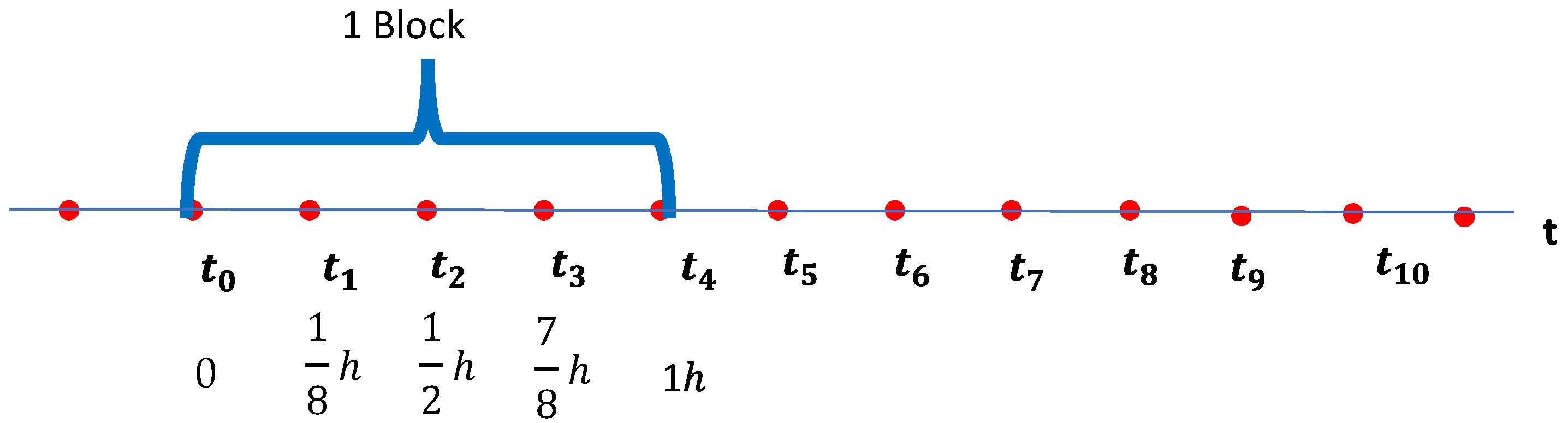
The method under consideration is specified as a single-step hybrid block method with three intra-step points. This formulation is designed to generate approximate solutions at multiple points within a single step, thereby combining efficiency with enhanced accuracy. By employing intra-step interpolation, the method is able to achieve a higher order of accuracy compared to conventional single-step approaches. Its implicit nature ensures improved stability properties, making it particularly suitable for first-order differential equations. The three-point block structure also allows for parallel computation of solution values, which is advantageous in large-scale numerical simulations. Overall, this specification provides a reliable and efficient framework for solving first-order ordinary differential equations with both stability and precision. The selected three intra-step points, which form the basis of the proposed method, are illustrated in
Figure 1 below.
Assume
to denote a partition of the interval [a, b] into a finite number of equally spaced points. The points are defined by
represents the uniform step size, which determines the distance between consecutive mesh points. This uniform partition provides a discrete framework for approximating the continuous behavior of the exact solution
over the interval
. Within each subinterval
, the continuous function
is not known exactly, but it can be approximated using an appropriate numerical representation. Typically, this approximation is expressed in terms of known function values and their derivatives at selected grid points within the subinterval. Hence, over
, the exact solution
is assumed to be approximated by a suitable interpolating function.
This is under the condition that
represent the real and unknown coefficients to be determined. This polynomial expression can be viewed as a general fifth-degree equation in the variable
. By differentiating Equation (2) with respect to
, we obtain its first derivative as
As is customary,
are approximations for the exact values
and
, respectively. In order to determine the coefficients
ai, we impose the following conditions:
Therein,
are internal step points. Our choice for the intra points is
To generate the hybrid collocation points, we consider arbitrary collocation points, evaluating Equation (3) at point
and (4) at
. Thus, we get the following system below:
And by defining
as the row
i of the inverse matrix, we get
which must be solved to obtain the coefficients
,
j = 0, 1, … , 5. We substitute back into Equation (3), and after doing the change of variable
, the approximate solution
takes the following form:
Finally, we get the final form of Equation (6) as defined below:
With these equations, we have the following:
Now, in order to obtain the main method, we evaluate
at the values
to get the following block hybrid method:
The implicit Equation (7) can be solved using two alternative approaches. The first approach makes use of fixed-point iteration, which is applicable when the necessary convergence condition is fulfilled.
The second approach employs the Jacobi iteration method, which proceeds as follows: beginning with an initial guess
, successive approximations are generated according to the iterative scheme.
The final solution is obtained as
and subject to the stopping criterion
. By introducing the step-size transformation
, the following transformation is obtained with
For
, we get
Hence, the truncation error is expressed as
,
Obviously, we find that
Thus,
And it is defined such that
By applying the Lambert formulae [
16], the linear multistep method is obtained in the following form:
By using
we get
2.2. Order and Error Constant of the Method
In this section, we discuss the fundamental properties of Equation (11). To investigate the order of accuracy, we adopt a standard approach by defining the local truncation error and applying the linear difference operators as outlined below.
Therein,
are the corresponding coefficients as given in system (11). We assume that
is sufficiently differentiable and expand
about
using Taylor series. By collecting the coefficients of
, the expressions for the local truncation error at each grid point can be derived using the following formula:
Consequently, from the results obtained above, the proposed method is determined to be of order five. The corresponding vector of error constants is expressed as
Local Truncation Error Theorem
Theorem 1.
If the functionis sufficiently differentiable on , and the coefficients.
Then, the local truncation error
can be expressed as
2.3. Consistency
Definition 1.
According to [16], a linear multi-step method (LMM) is said to be consistent if its order satisfies. Since the proposed method has order, it follows from Definition 1 that, when applied to the block method (11), the newly developed scheme is consistent. Consistency Theorem
Theorem 2.
A numerical method is said to be consistent with the differential equation if the local truncation error (LTE) tends to zero as the step size .
Proof. If the block method is written as
then the method is consistent if
□
2.4. Zero Stability
For the purpose of stability analysis, the hybrid block method given in Equation (11) can be rearranged and expressed in the following matrix form:
Definition 2.
A linear multi-step method is said to be zero-stable if no root of its first characteristic polynomialhas a modulus greater than one; furthermore, the roots are simple when they lie on the unit circle. For convergence, a linear multi-step method must satisfy both zero stability and consistency [16]. Since the proposed block method yields roots such that, it follows that the scheme is zero-stable. To further examine its linear stability, the method is applied to the standard test problem. Substituting
in
we obtain
yields
This leads to the relation
. The behavior of the numerical solution
will depend on the eigenvalues of
. The stability matrix
has eigenvalues
, for which the dominant eigenvalue
is expressed in the following rational form:
We choose
and obtain
Therefore, the numerical solution is stable provided that
Alternatively, it can be expressed in norm form as follows:
Stability Theorem
Theorem 3.
A linear multi-step or block method is zero-stable if small perturbations in the initial values do not cause unbounded growth in the subsequent numerical solution as.
2.5. Convergence Theorem
Theorem 4.
Ref. [21] Consistency and zero stability are sufficient conditions for a linear multi-step method to be convergent. Since consistency and zero stability of the proposed method are established, the new developed method (10) is convergent. 2.6. Stability Region
Definition 3.
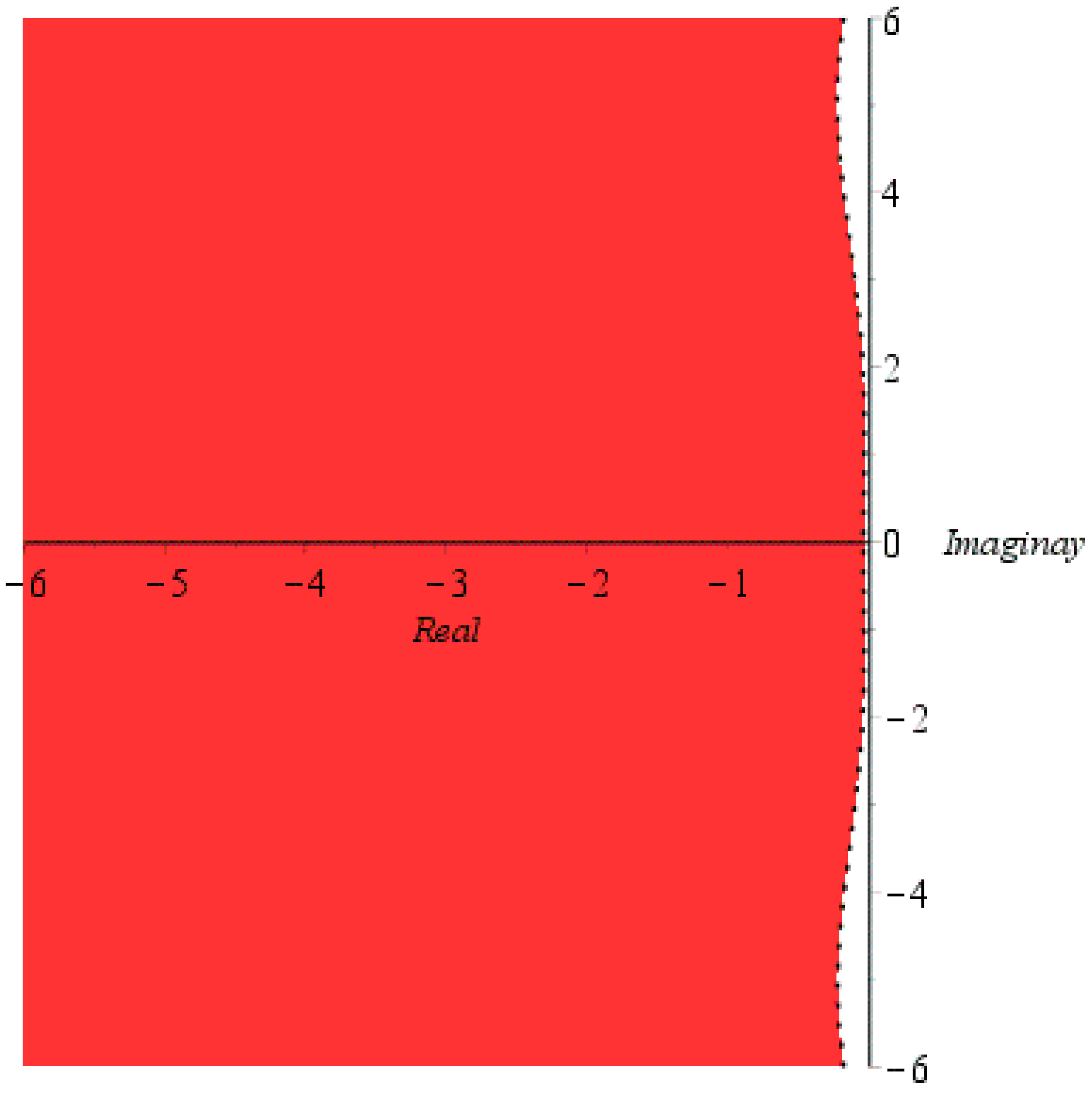
Following [17], a block hybrid method is said to be A-stable if the entire left half of the complex plane lies within its region of absolute stability. According to this definition, the proposed block method is A-stable, as demonstrated by the stability region shown in Figure 2. The concept of A-stability is crucial in the analysis of numerical methods for solving stiff ordinary differential equations (ODEs). According to Definition 3, a block hybrid method is said to be A-stable if its region of absolute stability completely contains the left half of the complex plane, meaning that for any test equation of the form
Using the Maple 2015 software package, the stability regions of the developed block method were constructed and analyzed through their corresponding stability polynomials. In particular, for the block method with three intra-step points, the symbolic form of the stability polynomial was derived by formulating the system matrices and substituting the test equation . The matrices represent the coefficients of the block method and play a crucial role in defining its numerical properties. Specifically, contain the identity and shift matrices that link the current and next steps, while contain the weights associated with the derivative evaluations within the block.
The matrices
were constructed such that
denotes the step size of integration. The stability matrix
was then formed to examine the amplification factor of the numerical method. The eigenvalues of
, denoted as
, determine the stability behavior of the method, particularly the fourth eigenvalue.
To visualize the stability region, was replaced with the complex variable , where represent the real and imaginary axes, respectively. The condition defines the region of absolute stability, which was plotted using the implicit plot command in Maple over the range .
Let real and imaginary.
Then, implicit plot ().
3. Numerical Results
In this section, the performance of the proposed method is evaluated by applying it to selected first-order ordinary differential equations. Numerical experiments are implemented in MATLAB R2024b, for which several test problems are considered to highlight the efficiency, accuracy, and robustness of the scheme. The results obtained in
Table 1,
Table 2 and
Table 3 are compared with existing methods [
6,
22,
23] in order to validate the effectiveness of the proposed approach.
Problem 1
Consider the following stiff differential equation taken from [
24]:
Problem 2
Consider the following nonlinear stiff differential equation taken from [
25]:
Problem 3
The SIR model taken from [
26] is an epidemiological model that computes the theoretical number of people infected with a contagious illness in a closed population over time. The name of this class of models derives from the fact that they involve coupled equations relating the number of susceptible people
S(t), number of people infected
I(t), and the number of people who have recovered
R(t). The model is defined as Y =
S +
I +
R. The evolution equation is given as
Table 1.
Comparison of the absolute error and CPU time for Problem 1.
Table 1.
Comparison of the absolute error and CPU time for Problem 1.
| Method | Error | CPU Time |
|---|
| Proposed method | | 0.1072 |
| [6] | | 0.1495 |
| [22] | | 0.1154 |
| [23] | | 0.1351 |
| Proposed method | | 0.0878 |
| [6] | | 0.1259 |
| [22] | | 0.1498 |
| [23] | | 0.0997 |
| Proposed method | | 0.0797 |
| [6] | | 0.1101 |
| [22] | | 0.1030 |
| [23] | | 0.1045 |
Table 2.
Comparison between the absolute error and CPU time for Problem 2.
Table 2.
Comparison between the absolute error and CPU time for Problem 2.
| Method | Error | CPU Time |
|---|
| Proposed method | | 0.12509 |
| [6] | | 0.14009 |
| [22] | | 0.13380 |
| [23] | | 0.14269 |
| Proposed method | | 0.082858 |
| [6] | | 0.093061 |
| [22] | | 0.095866 |
| [23] | | 0.098530 |
| Proposed method | | 0.088952 |
| [6] | | 0.096342 |
| [22] | | 0.096005 |
| [23] | | 0.091575 |
Table 3.
Comparison between our method and other established methods for Problem 3.
Table 3.
Comparison between our method and other established methods for Problem 3.
| Method | Error | CPU Time |
|---|
| NANNM [27] | | 0.1466 |
| OHBM5A [28] | | 0.1423 |
| Proposed HBM | | 08423 |
| NANNM [27] | | 0.0464 |
| OHBM5A [23] | | 0.0585 |
| Proposed HBM | | 0.0284 |
Discussion of Result
We have derived a single-step hybrid block method for the numerical solution of first-order ordinary differential equations within a multi-step framework. The method has been shown to be zero-stable, consistent, and therefore convergent. To evaluate its effectiveness, two test problems were solved in MATLAB R2024b using various step sizes
, and the results demonstrated the accuracy and efficiency of the proposed scheme. A comparative analysis with the methods of [
6,
22,
23] was carried out in terms of absolute error and CPU time for different values of
. In addition, comparisons were made between our method and two established methods: the New Adaptive Nonlinear Numerical Method (NANNM) [
27] and the Optimized Hybrid Block Method with fifth-order, adaptive, and fixed step size (OHBM5A) [
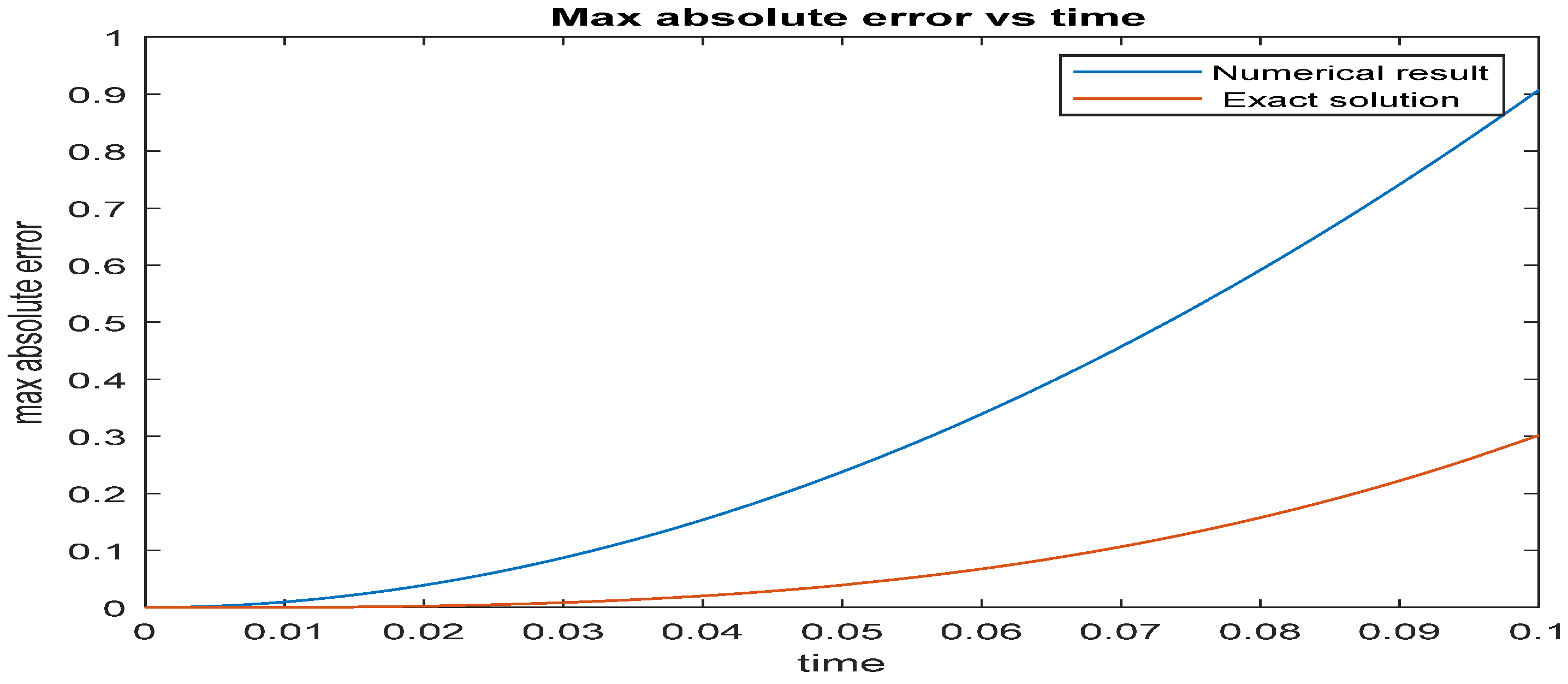
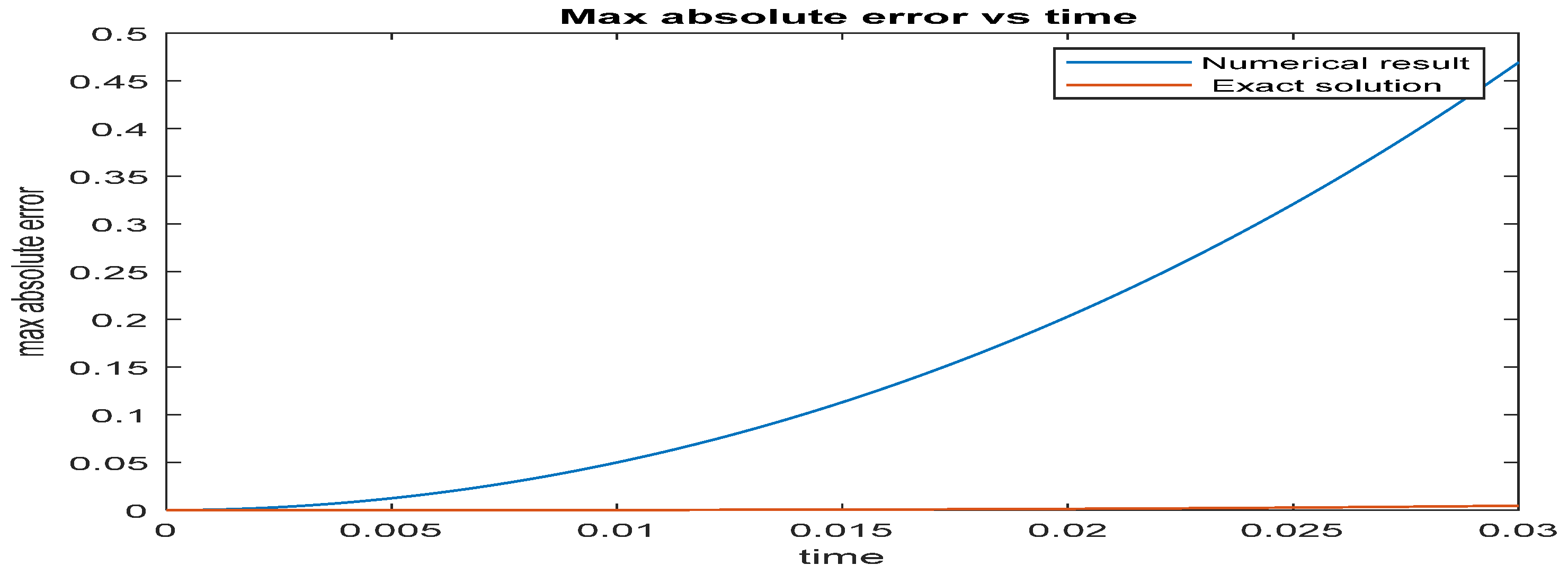
28]. The plots of absolute error against computational time for Problems 1–3 are presented in
Figure 3,
Figure 4,
Figure 5 and
Figure 6, which reveal that the proposed hybrid block method consistently outperforms existing approaches by producing smaller absolute errors. These findings confirm that the newly developed method competes favorably with current methods, offering both improved accuracy and computational efficiency.
4. Conclusions
In conclusion, this study has successfully developed a single-step hybrid block method for the numerical solutions of first-order ordinary differential equations, exhibiting outstanding performance in terms of accuracy, efficiency, and stability. The results obtained from various numerical experiments confirm that the method maintains high precision even with larger step sizes, demonstrating its robustness and reliability. When compared with existing techniques, the proposed method consistently yields smaller absolute errors and requires less computational time, establishing its superiority in both accuracy and cost-effectiveness. This enhanced performance underscores its potential as a valuable numerical tool for complex problems encountered in applied sciences and engineering. Moreover, its simple structure and adaptability make it suitable for implementation in high-performance and parallel computing environments. The findings of this research provide a solid foundation for further advancements in block methods and their applications to a broader class of differential equations. Future studies may extend this approach to higher-order systems or partial differential equations, thereby enhancing its scope, flexibility, and impact in scientific computation.