
Interaction of Albacarcin V and Related Polyketides with the Actin-Binding Protein EPLIN: A Molecular Docking Study


Abstract
1. Introduction
2. Materials and Methods
2.1. Molecular Structures and Software
2.2. Molecular Docking Analysis
3. Results
3.1. Compounds Selection
3.2. Molecular Modeling Analysis
- (i)
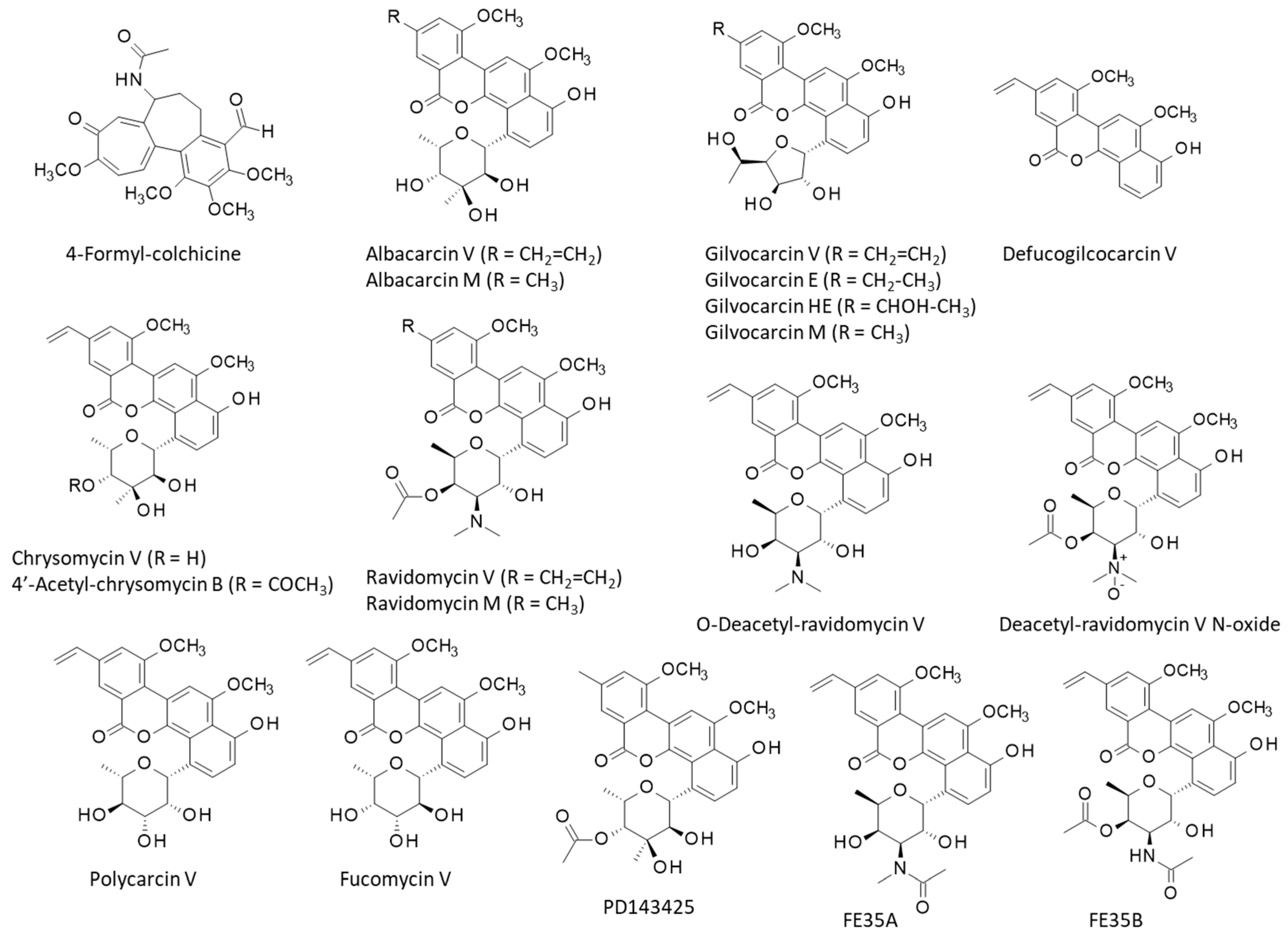
- The drug glycosyl moiety plays a significant role in the protein interaction. The gilvocarcin V aglycone (defucogilvocarcin) binds much less efficiently to EPLIN compared to gilvocarcin V. The 4-fucofuranosyl moiety of gilvocarcin V contributes to the interaction with the protein. In all cases, the glycosyl residue attached to the tetracyclic unit is engaged in one or two H-bonds with the protein.
- (ii)
- The nature of the glycosyl residues influences significantly protein binding. In this respect, it is interesting to compare binding of the three compounds gilvocarcin V, chrysomycin V and polycarcin V, which only differ by their glycosyl residue. They share the same 6H-benzo[d]naphtho [1,2-b]pyran-6-one core but a distinct C-glycosyl residue. Gilvocarcin has a furanosyl residue with an E conformation [39]. Polycarcin presents an α-L-rhamnopyranosyl moiety instead of the D-fucofuranose of gilvocarcin. The methyl-pentose unit of polycarcin is replaced with a 3,5-dimethylpentose in the chrysomycins [40]. The best results were obtained with chrysomycin V (also known as chrysomycin A). This observation opens the door to the testing of analogues, such as 4′-acetylated chrysomycin A/B derivatives which have shown high cytotoxicity toward cancer cells [41].
- (iii)
- At first sight, an acetyl group on the glycosyl residue does not seem to be a detrimental element for EPLIN binding. Compound PD143425, which is a 4′-acetyl derivative of albacarcin M, showed a good binding to the protein model 1, a little better compared to albacarcin M.
- (iv)
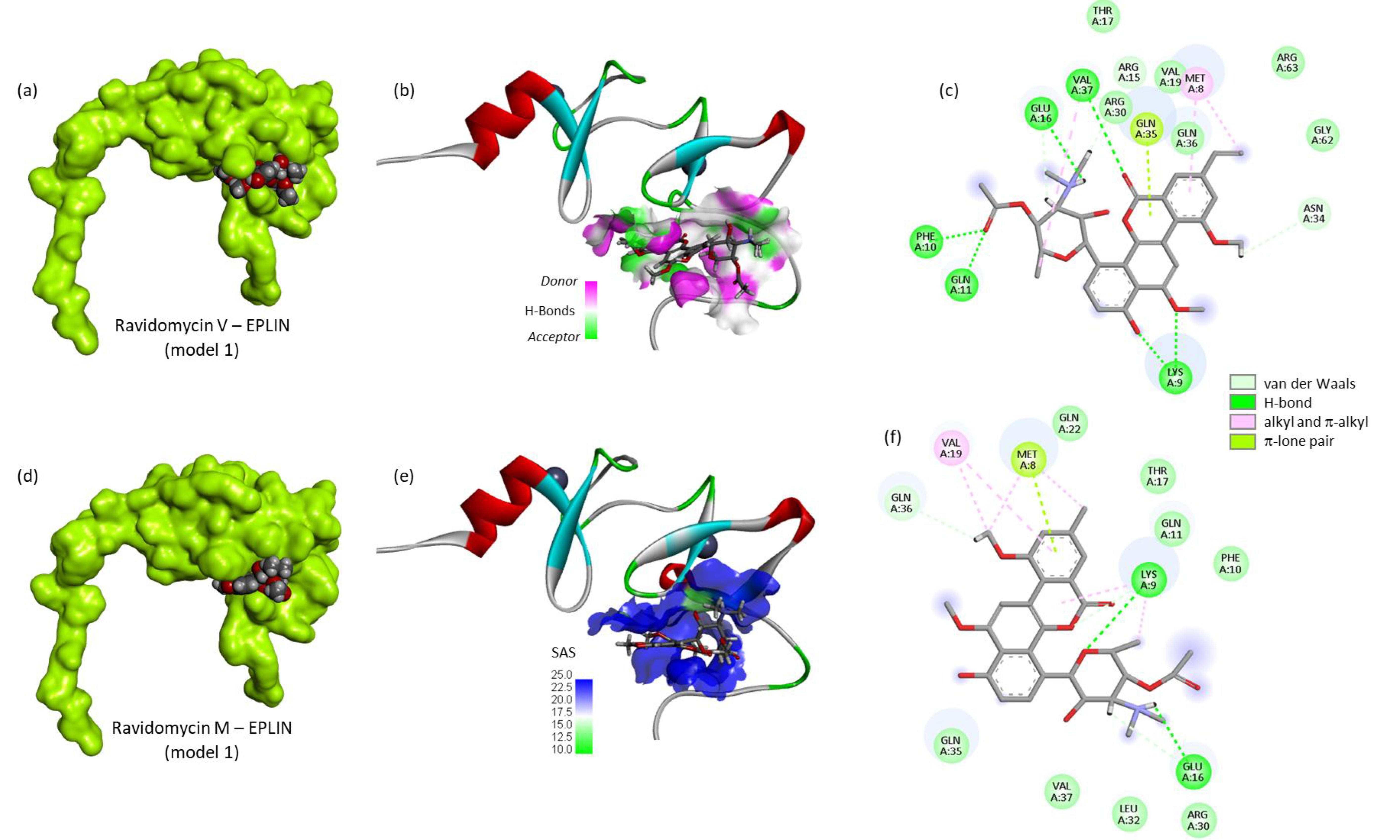
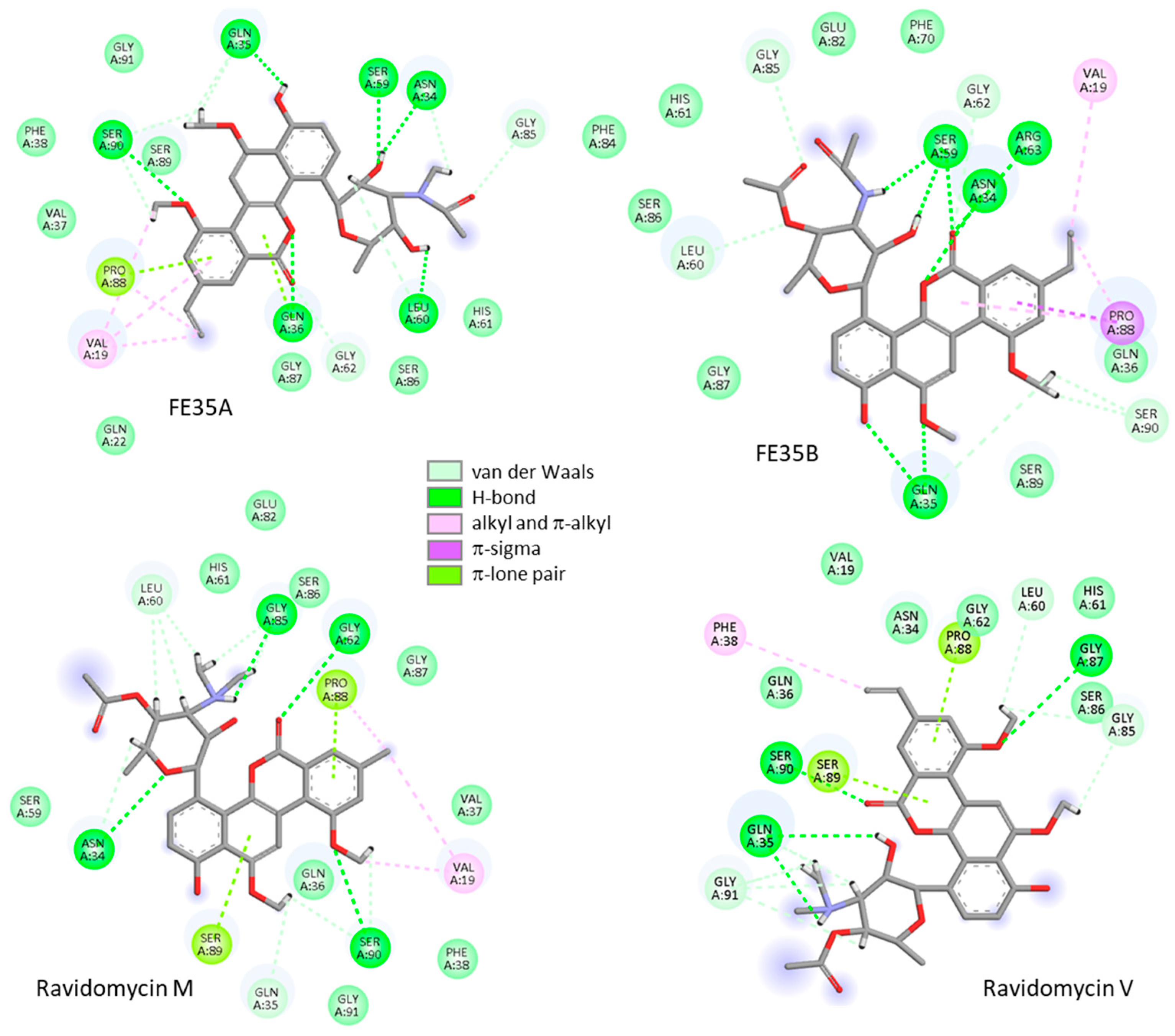
- The replacement of the vinyl group on the antibiotics with a methyl group (V vs. M series) is often, but not always, unfavorable to protein interaction. With model 1, albacarcin V was found to be a better binder compared to albacarcin M, and the same trend was observed with ravidomycin V vs. M. But the reverse situation was found with model 10. In fact, the comparison of gilvocarcins V (vinyl), M (methyl), E (ethyl), HE (hydroxyethyl) suggests that the substituent at this position is not a major determinant to the protein interaction. However, it can help to have an ethyl or vinyl group at this position. The vinyl group of FE35A-B is implicated in an alkyl interaction with residue Val19 and the same interaction was observed in the case of albacarcin V, but no such interaction occurred in the case of albacarcin M (Figure 5).
- (v)
- The comparison of deacetyl-ravidomycin V and its N-oxide derivative suggests that the incorporation of a NO group on glycosyl residue can contribute to the protein interaction. With a single N-oxide compound in this series, no definitive conclusion can be drawn at present. However, the fact that compounds FE35A-B also present good binding characteristics reinforces this observation. FE35A, with an amino-acetyl group on the sugar residue, binds equally well to models 1 and 10 of EPLIN.
- (vi)
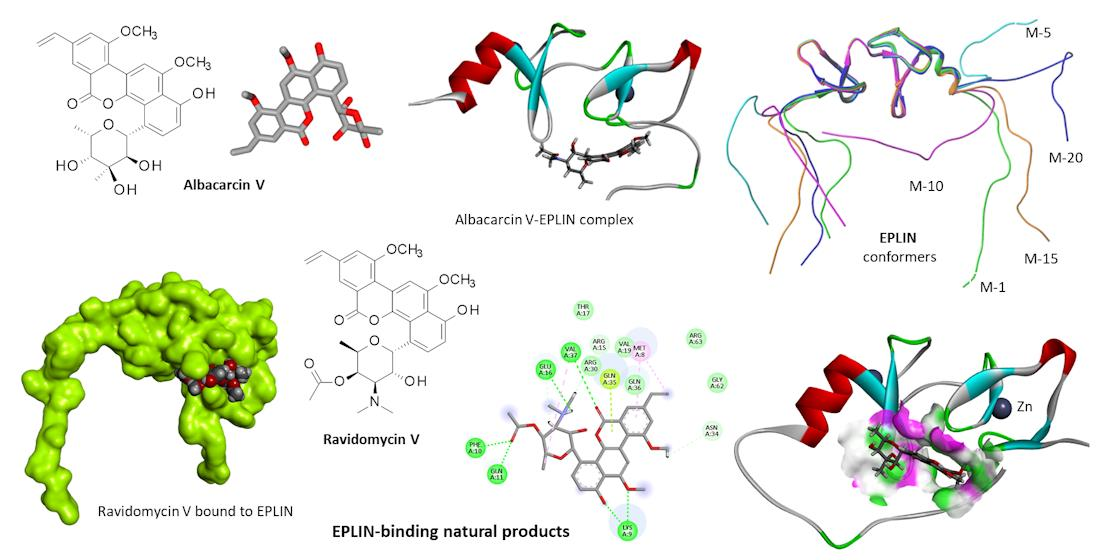
- The presence of an amino sugar residue, as in the ravidomycin series, is a favorable element for drug binding to EPLIN (Figure 6). A significantly distinct binding behavior was observed with ravidomycin V vs. M with model 1 but globally the two compounds gave good results with the two protein conformers. The ravidomycin V-EPLIN model 1 recapitulates well the key binding elements: (a) a contribution of the vinyl unit (alkyl interaction with Met8), (b) importance of the O-acetyl on the sugar residue (two adjacent H-bonds to Ph10 and Gln11), (c) major role of the dimethylamino sugar residue (H-bond to Glu16), (d) contribution of the phenol-OH (H-bond to Val37). Altogether, these multiple interactions confer a high stability to the ravidomycin V-EPLIN complex.
4. Discussion
5. Conclusions
Author Contributions
Funding
Institutional Review Board Statement
Informed Consent Statement
Data Availability Statement
Conflicts of Interest
Abbreviations
| EPLIN | epithelial protein lost in neoplasm |
| LIM | lin-11, isl-1, and mec-3 |
| LIMA1 | Lim domain and actin-binding protein 1 |
| MM/GBSA | Molecular Mechanics/Generalized Born Surface Area |
References
- Taha, M.; Aldirawi, M.; März, S.; Seebach, J.; Odenthal-Schnittler, M.; Bondareva, O.; Bojovic, V.; Schmandra, T.; Wirth, B.; Mietkowska, M.; et al. EPLIN-α and -β Isoforms Modulate Endothelial Cell Dynamics through a Spatiotemporally Differentiated Interaction with Actin. Cell Rep. 2019, 29, 1010–1026. [Google Scholar] [CrossRef] [PubMed]
- Chen, S.; Maul, R.S.; Kim, H.R.; Chang, D.D. Characterization of the human EPLIN (Epithelial Protein Lost in Neoplasm) gene reveals distinct promoters for the two EPLIN isoforms. Gene 2000, 248, 69–76. [Google Scholar] [CrossRef]
- Aldirawi, M.; Ghanbari, P.; Mietkowska, M.; März, S.; Odenthal-Schnittler, M.; Franz, J.; Wegner, J.; Currie, S.; Kipcke, J.P.; Taha, M.; et al. A specific role for endothelial EPLIN-isoform-regulated actin dynamics in neutrophil transmigration. Sci. Rep. 2025, 15, 15698. [Google Scholar] [CrossRef]
- Song, Y.; Maul, R.S.; Gerbin, C.S.; Chang, D.D. Inhibition of anchorage-independent growth of transformed NIH3T3 cells by epithelial protein lost in neoplasm (EPLIN) requires localization of EPLIN to actin cytoskeleton. Mol. Biol. Cell 2002, 13, 1408–1416. [Google Scholar] [CrossRef]
- Maul, R.S.; Sachi Gerbin, C.; Chang, D.D. Characterization of mouse epithelial protein lost in neoplasm (EPLIN) and comparison of mammalian and zebrafish EPLIN. Gene 2001, 262, 155–160. [Google Scholar] [CrossRef]
- Maul, R.S.; Chang, D.D. EPLIN, epithelial protein lost in neoplasm. Oncogene 1999, 18, 7838–7841. [Google Scholar] [CrossRef]
- Li, D.; Neo, S.P.; Gunaratne, J.; Sabapathy, K. EPLIN-β is a novel substrate of ornithine decarboxylase antizyme 1 and mediates cellular migration. J. Cell Sci. 2023, 136, jcs260427. [Google Scholar] [CrossRef]
- Karaköse, E.; Geiger, T.; Flynn, K.; Lorenz-Baath, K.; Zent, R.; Mann, M.; Fässler, R. The focal adhesion protein PINCH-1 associates with EPLIN at integrin adhesion sites. J. Cell Sci. 2015, 128, 1023–1033. [Google Scholar] [CrossRef]
- Chervin-Pétinot, A.; Courçon, M.; Almagro, S.; Nicolas, A.; Grichine, A.; Grunwald, D.; Prandini, M.H.; Huber, P.; Gulino-Debrac, D. Epithelial protein lost in neoplasm (EPLIN) interacts with α-catenin and actin filaments in endothelial cells and stabilizes vascular capillary network in vitro. J. Biol. Chem. 2012, 287, 7556–7572. [Google Scholar] [CrossRef] [PubMed]
- Wu, D. Epithelial protein lost in neoplasm (EPLIN): Beyond a tumor suppressor. Genes Dis. 2017, 4, 100–107. [Google Scholar] [CrossRef] [PubMed]
- Zeng, J.; Jiang, W.G.; Sanders, A.J. Epithelial Protein Lost in Neoplasm, EPLIN, the Cellular and Molecular Prospects in Cancers. Biomolecules 2021, 11, 1038. [Google Scholar] [CrossRef] [PubMed]
- Lindell, E.; Zhang, X. Exploring the Enigma: The Role of the Epithelial Protein Lost in Neoplasm in Normal Physiology and Cancer Pathogenesis. Int. J. Mol. Sci. 2024, 25, 4970. [Google Scholar] [CrossRef]
- Zeng, J.; Sanders, A.J.; Ye, L.; Hargest, R.; Ruge, F.; Jiang, W.G. EPLIN, a Putative Tumour Suppressor in Colorectal Cancer, Implications in Drug Resistance. Int. J. Mol. Sci. 2022, 23, 15232. [Google Scholar] [CrossRef]
- Wu, D.; Osunkoya, A.O.; Kucuk, O. Epithelial protein lost in neoplasm (EPLIN) and prostate cancer: Lessons learned from the ARCaP model. Am. J. Clin. Exp. Urol. 2021, 9, 264–276. [Google Scholar]
- Collins, R.J.; Morgan, L.D.; Owen, S.; Ruge, F.; Jiang, W.G.; Sanders, A.J. Mechanistic insights of epithelial protein lost in neoplasm in prostate cancer metastasis. Int. J. Cancer. 2018, 143, 2537–2550. [Google Scholar] [CrossRef]
- Sanders, A.J.; Martin, T.A.; Ye, L.; Mason, M.D.; Jiang, W.G. EPLIN is a negative regulator of prostate cancer growth and invasion. J. Urol. 2011, 186, 295–301. [Google Scholar] [CrossRef] [PubMed]
- Gong, W.; Zeng, J.; Ji, J.; Jia, Y.; Jia, S.; Sanders, A.J.; Jiang, W.G. EPLIN Expression in Gastric Cancer and Impact on Prognosis and Chemoresistance. Biomolecules 2021, 11, 547. [Google Scholar] [CrossRef] [PubMed]
- Jäntti, N.Z.; Moreno-Layseca, P.; Chastney, M.R.; Dibus, M.; Conway, J.R.W.; Leppänen, V.M.; Hamidi, H.; Eylmann, K.; Oliveira-Ferrer, L.; Veltel, S.; et al. EPLINα controls integrin recycling from Rab21 endosomes to drive breast cancer cell migration. Dev. Cell 2025, 60, 3018–3033. [Google Scholar] [CrossRef]
- Zeng, J.; Wang, C.; Ruge, F.; Ji, E.K.; Martin, T.A.; Sanders, A.J.; Jia, S.; Hao, C.; Jiang, W.G. EPLIN, a prospective oncogenic molecule with contribution to growth, migration and drug resistance in pancreatic cancer. Sci. Rep. 2024, 14, 30850. [Google Scholar] [CrossRef]
- Liu, R.; Martin, T.A.; Jordan, N.J.; Ruge, F.; Ye, L.; Jiang, W.G. Epithelial protein lost in neoplasm-α (EPLIN-α) is a potential prognostic marker for the progression of epithelial ovarian cancer. Int. J. Oncol. 2016, 48, 2488–2496. [Google Scholar] [CrossRef]
- Obulkasim, H.; Adili, A.; Liu, Y.; Duan, S. Expression and molecular insights of lima1 in cholangiocarcinoma. Cell Adh. Migr. 2024, 18, 4–17. [Google Scholar] [CrossRef]
- Lindell, E.; Guo, J.; Zhao, M.; Rameika, N.; Lu, X.; Wacker, T.; Zhong, L.; Bergström, T.; Svanberg, S.; Chowdhury, A.I.; et al. Identification of a small molecule targeting EPLIN as a novel strategy for the treatment of pediatric neuroblastoma and medulloblastoma. Cell Death Dis. 2025, 16, 554. [Google Scholar] [CrossRef]
- Collins, R.J.; Jiang, W.G.; Hargest, R.; Mason, M.D.; Sanders, A.J. EPLIN: A fundamental actin regulator in cancer metastasis? Cancer Metastasis Rev. 2015, 34, 753–764. [Google Scholar] [CrossRef]
- Krahulcová, L.; Lindell, E.; Lu, X.; Conejeros Monsalve, J.J.; Haraldsson, M.; Li, Z.; Chen, X.; Aune, G.; Zhao, M.; Tong, L.; et al. Albacarcin V adds EPLIN as a novel and promising target for the treatment of female cancers and pediatric medulloblastoma. Biochem. Pharmacol. 2026, 244, 117625. [Google Scholar] [CrossRef]
- Jorgensen, W.L.; Tirado-Rives, J. Molecular modeling of organic and biomolecular systems using BOSS and MCPRO. J. Comput. Chem. 2005, 26, 1689–1700. [Google Scholar] [CrossRef]
- Ye, B.; Tian, W.; Wang, B.; Liang, J. CASTpFold: Computed Atlas of Surface Topography of the universe of protein Folds. Nucleic Acids Res. 2024, 52, W194–W199. [Google Scholar] [CrossRef]
- Zhao, J.; Cao, Y.; Zhang, L. Exploring the computational methods for protein-ligand binding site prediction. Comput. Struct. Biotechnol. J. 2020, 18, 417–426. [Google Scholar] [CrossRef] [PubMed]
- Huang, B.; Schroeder, M. LIGSITEcsc: Predicting ligand binding sites using the Connolly surface and degree of conservation. BMC Struct. Biol. 2006, 6, 19. [Google Scholar] [CrossRef] [PubMed]
- Jones, G.; Willett, P.; Glen, R.C.; Leach, A.R.; Taylor, R. Development and validation of a genetic algorithm for flexible docking. J. Mol. Biol. 1997, 267, 727–748. [Google Scholar] [CrossRef] [PubMed]
- Lagant, P.; Nolde, D.; Stote, R.; Vergoten, G.; Karplus, M. Increasing normal modes analysis accuracy: The SPASIBA spectroscopic force field introduced into the CHARMM program. J. Phys. Chem. A 2004, 108, 4019–4029. [Google Scholar] [CrossRef]
- Vergoten, G.; Mazur, I.; Lagant, P.; Michalski, J.C.; Zanetta, J.P. The SPASIBA force field as an essential tool for studying the structure and dynamics of saccharides. Biochimie 2003, 85, 65–73. [Google Scholar] [CrossRef]
- Jorgensen, W.L.; Tirado-Rives, J. Monte Carlo versus Molecular Dynamics for conformational sampling. J. Phys. Chem. 1996, 100, 14508–14513. [Google Scholar] [CrossRef]
- Meziane-Tani, M.; Lagant, P.; Semmoud, A.; Vergoten, G. The SPASIBA force field for chondroitin sulfate: Vibrational analysis of D-glucuronic and N-acetyl-D-galactosamine 4-sulfate sodium salts. J. Phys. Chem. A 2006, 110, 11359–11370. [Google Scholar] [CrossRef]
- Yue, Z.; Wu, F.; Guo, F.; Park, J.; Wang, J.; Zhang, L.; Liao, D.; Li, W.; Schärer, O.D.; Lei, X. Polycarcin V induces DNA-damage response and enables the profiling of DNA-binding proteins. Natl. Sci. Rev. 2022, 9, nwac046. [Google Scholar] [CrossRef]
- Park, K.J.; Maier, S.; Zhang, C.; Dixon, S.A.H.; Rusch, D.B.; Pupo, M.T.; Angus, S.P.; Gerdt, J.P. Ravidomycin Analogs from Streptomyces sp. Exhibit Altered Antimicrobial and Cytotoxic Selectivity. J. Nat. Prod. 2023, 86, 1968–1979. [Google Scholar] [CrossRef] [PubMed]
- Yamashita, N.; Shin-ya, K.; Furihata, K.; Hayakawa, Y.; Seto, H. New ravidomycin analogues, FE35A and FE35B, apoptosis inducers produced by Streptomyces rochei. J. Antibiot. 1998, 51, 1105–1108. [Google Scholar] [CrossRef] [PubMed][Green Version]
- Liu, H.S.; Chen, H.R.; Huang, S.S.; Li, Z.H.; Wang, C.Y.; Zhang, H. Bioactive Angucyclines/Angucyclinones Discovered from 1965 to 2023. Mar Drugs 2025, 23, 25. [Google Scholar] [CrossRef]
- Xu, X.; Huang, X.; Xu, W. Marine actinomycetes-derived angucyclines and angucyclinones with biosynthesis and activity--past 10 years (2014–2023). Eur. J. Med. Chem. 2025, 283, 117161. [Google Scholar] [CrossRef] [PubMed]
- Hirayama, N.; Takahashi, K.; Shirahata, K.; Ohashi, Y.; Sasada, Y. Crystal and molecular structure of antibiotic gilvocarcin M. Bull. Chem. Soc. Jpn. 1981, 54, 1338–1342. [Google Scholar] [CrossRef]
- Weiss, U.; Yoshihira, K.; Highet, R.J.; White, R.J.; Wei, T.T. The chemistry of the antibiotics chrysomycin A and B. Antitumor activity of chrysomycin A. J. Antibiot. 1982, 35, 1194–1201. [Google Scholar] [CrossRef]
- Wada, S.I.; Sawa, R.; Iwanami, F.; Nagayoshi, M.; Kubota, Y.; Iijima, K.; Hayashi, C.; Shibuya, Y.; Hatano, M.; Igarashi, M.; et al. Structures and biological activities of novel 4′-acetylated analogs of chrysomycins A and B. J. Antibiot. 2017, 70, 1078–1082, Corrigendum in J. Antibiot. 2017, 70, 1150.. [Google Scholar] [CrossRef]
- Wang, X.; Zhang, C.; Song, H.; Yuan, J.; Zhang, X.; Yuan, Y.; Zhang, L.; He, J. Characterization of LIMA1 and its emerging roles and potential therapeutic prospects in cancers. Front. Oncol. 2023, 13, 1115943. [Google Scholar] [CrossRef] [PubMed]
- Zhang, C.; Wang, X.; Song, H.; Yuan, J.; Zhang, X.; Yuan, Y.; Wang, Z.; Lei, Z.; He, J. M6A modification-mediated LIMA1 promotes the progression of hepatocellular carcinoma through the wnt-βcatenin/Hippo pathway. Cell Biol. Toxicol. 2024, 41, 9. [Google Scholar] [CrossRef]
- Lv, Z.; Zhao, S.; Wu, H. LIMA1 inhibits cisplatin resistance and malignant biological behavior of bladder cancer cells by suppressing the Wnt/β-catenin pathway. BMC Med. Genom. 2025, 18, 78. [Google Scholar]
- Chen, Y.; Wang, Z.; Sun, Y.; Li, X.; Wang, Y.; Liu, S. Inhibition of Breast Cancer Bone Metastasis by LRP5-Overexpressing Osteocytes via the LIMA1/MYO5B Signaling Axis. Int. J. Mol. Sci. 2026, 27, 777. [Google Scholar] [CrossRef]
- Le May, C.; Ducheix, S.; Cariou, B.; Rimbert, A. From Genetic Findings to new Intestinal Molecular Targets in Lipid Metabolism. Curr. Atheroscler. Rep. 2025, 27, 26. [Google Scholar] [CrossRef]
- Liu, Z.; Fan, K.; Abudukeremu, A.; Gao, M.; Tan, X.; Mao, X.; Li, X.; Ma, W.; Ma, X.; Li, C.; et al. LIMA1 links the E3 ubiquitin ligase RNF40 to lipid metabolism. Cell Death Discov. 2024, 10, 298. [Google Scholar] [CrossRef]
- Li, S.; Yang, F.; Cheng, F.; Zhu, L.; Yan, Y. Lipotoxic hepatocyte derived LIMA1 enriched small extracellular vesicles promote hepatic stellate cells activation via inhibiting mitophagy. Cell. Mol. Biol. Lett. 2024, 29, 82. [Google Scholar] [CrossRef] [PubMed]
- Yang, F.; Chen, Y.; Zheng, G.; Gu, K.; Fan, L.; Li, T.; Zhu, L.; Yan, Y. LIMA1 O-GlcNAcylation Promotes Hepatic Lipid Deposition through Inducing Β-catenin-Regulated FASn Expression in Metabolic Dysfunction-Associated Steatotic Liver Disease. Adv. Sci. 2025, 12, e2415941. [Google Scholar] [CrossRef] [PubMed]
- Luna-Nophal, A.; Díaz-Castillo, F.; Izquierdo-Sánchez, V.; Velázquez-Fernández, J.B.; Orozco-Morales, M.; Lara-Mejía, L.; Bernáldez-Sarabia, J.; Sánchez-Campos, N.; Arrieta, O.; Díaz-Chávez, J.; et al. Preclinical Efficacy and Proteomic Prediction of Molecular Targets for s-cal14.1b and s-cal14.2b Conotoxins with Antitumor Capacity in Xenografts of Malignant Pleural Mesothelioma. Mar. Drugs 2025, 23, 32. [Google Scholar] [CrossRef]
- Liu, W.; Hong, B.; Wang, J.; Lei, X. New Strategies in the Efficient Total Syntheses of Polycyclic Natural Products. Acc. Chem. Res. 2020, 53, 2569–2586. [Google Scholar] [CrossRef]
- James, C.A.; Snieckus, V. Combined directed remote metalation− transition metal catalyzed cross coupling strategies: The total synthesis of the aglycones of the gilvocarcins V, M, and E and arnottin I. J. Org. Chem. 2009, 74, 4080–4093. [Google Scholar] [CrossRef]
- Macdonald, S.J.; McKenzie, T.C.; Hassen, W.D. Synthesis of the aglycones of the ravidomycin family of antibiotics. J. Chem. Soc. Chem. Commun. 1987, 20, 1528–1530. [Google Scholar] [CrossRef]
- Jung, M.E.; Jung, Y.H. Total synthesis of the aglycone of the 8-methyl benzonaphthopyrone antibiotics, gilvocarcin M, virenomycin M, and albacarcin M. Tetrahedron lett. 1988, 29, 2517–2520. [Google Scholar] [CrossRef]
- Hart, D.J.; Merriman, G.H. A new synthesis of defucogilvocarcin M. Tetrahedron lett. 1989, 30, 5093–5096. [Google Scholar] [CrossRef]
- Wu, F.; Zhang, J.; Song, F.; Wang, S.; Guo, H.; Wei, Q.; Dai, H.; Chen, X.; Xia, X.; Liu, X.; et al. Chrysomycin A Derivatives for the Treatment of Multi-Drug-Resistant Tuberculosis. ACS Cent. Sci. 2020, 6, 928–938. [Google Scholar] [CrossRef] [PubMed]
- Sehgal, S.N.; Czerkawski, H.; Kudelski, A.; Pandev, K.; Saucier, R.; Vézina, C. Ravidomycin (AY-25, 545), a new antitumor antibiotic. J. Antibiot. 1983, 36, 355–361. [Google Scholar] [CrossRef]
- Kharel, M.K.; Nybo, S.E.; Shepherd, M.D.; Rohr, J. Cloning and characterization of the ravidomycin and chrysomycin biosynthetic gene clusters. Chembiochem 2010, 11, 523–532. [Google Scholar] [CrossRef] [PubMed]
- Kharel, M.K.; Pahari, P.; Lian, H.; Rohr, J. Enzymatic total synthesis of rabelomycin, an angucycline group antibiotic. Org. Lett. 2010, 12, 2814–2817. [Google Scholar] [CrossRef]
- Futagami, S.; Ohashi, Y.; Imura, K.; Hosoya, T.; Ohmori, K.; Matsumoto, T.; Suzuki, K. Total synthesis of ravidomycin: Revision of absolute and relative stereochemistry. Tetrahedron Lett. 2000, 41, 1063–1067. [Google Scholar] [CrossRef]
- Rakhit, S.; Eng, C.; Baker, H.; Singh, K. Chemical modification of ravidomycin and evaluation of biological activities of its derivatives. J. Antibiot. 1983, 36, 1490–1494. [Google Scholar] [CrossRef]
- Hsu, D.S.; Matsumoto, T.; Suzuki, K. Efficient synthetic route to ravidosamine derivatives. Synlett 2005, 5, 801–804. [Google Scholar] [CrossRef]
- Lorico, A.; Long, B.H. Biochemical characterisation of elsamicin and other coumarin-related antitumour agents as potent inhibitors of human topoisomerase II. Eur. J. Cancer 1993, 29, 1985–1991. [Google Scholar] [CrossRef]
- Singh, K. Studies on the mechanism of action of ravidomycin (AY-25,545). J. Antibiot. 1984, 37, 71–73. [Google Scholar] [CrossRef][Green Version]
- Greenstein, M.; Monji, T.; Yeung, R.; Maiese, W.M.; White, R.J. Light-dependent activity of the antitumor antibiotics ravidomycin and desacetylravidomycin. Antimicrob. Agents Chemother. 1986, 29, 861–866. [Google Scholar] [CrossRef] [PubMed]
- Wei, T.T.; Byrne, K.M.; Warnick-Pickle, D.; Greenstein, M. Studies on the mechanism of action of gilvocarcin V and chrysomycin A. J. Antibiot. 1982, 35, 545–548. [Google Scholar] [CrossRef]
- Zhang, J.; Liu, P.; Chen, J.; Yao, D.; Liu, Q.; Zhang, J.; Zhang, H.W.; Leung, E.L.; Yao, X.J.; Liu, L. Upgrade of chrysomycin A as a novel topoisomerase II inhibitor to curb KRAS-mutant lung adenocarcinoma progression. Pharmacol. Res. 2023, 187, 106565. [Google Scholar] [CrossRef] [PubMed]
- Matsumoto, A.; Hanawalt, P.C. Histone H3 and heat shock protein GRP78 are selectively cross-linked to DNA by photoactivated gilvocarcin V in human fibroblasts. Cancer Res. 2000, 60, 3921–3926. [Google Scholar] [PubMed]
- Yang, Y.; Li, W.; Zhao, Y.; Sun, M.; Xing, F.; Yang, J.; Zhou, Y. GRP78 in Glioma Progression and Therapy: Implications for Targeted Approaches. Biomedicines 2025, 13, 382. [Google Scholar] [CrossRef]
- Bailly, C.; Waring, M.J. Pharmacological effectors of GRP78 chaperone in cancers. Biochem. Pharmacol. 2019, 163, 269–278. [Google Scholar] [CrossRef]
- Liu, D.N.; Liu, M.; Zhang, S.S.; Shang, Y.F.; Song, F.H.; Zhang, H.W.; Du, G.H.; Wang, Y.H. Chrysomycin A Inhibits the Proliferation, Migration and Invasion of U251 and U87-MG Glioblastoma Cells to Exert Its Anti-Cancer Effects. Molecules 2022, 27, 6148. [Google Scholar] [CrossRef] [PubMed]
- Liu, D.N.; Zhang, W.F.; Feng, W.D.; Xu, S.; Feng, D.H.; Song, F.H.; Zhang, H.W.; Fang, L.H.; Du, G.H.; Wang, Y.H. Chrysomycin A Reshapes Metabolism and Increases Oxidative Stress to Hinder Glioblastoma Progression. Mar. Drugs 2024, 22, 391. [Google Scholar] [CrossRef] [PubMed]
- Arai, M.; Tomoda, H.; Matsumoto, A.; Takahashi, Y.; Woodruff, B.H.; Ishiguro, N.; Kobayashi, S.; Omura, S. Deacetylravidomycin M, a new inhibitor of IL-4 signal transduction, produced by Streptomyces sp. WK-6326. I. Taxonomy, fermentation, isolation and biological activities. J. Antibiot. 2001, 54, 554–561. [Google Scholar] [CrossRef] [PubMed]
- Arai, M.; Tomoda, H.; Tabata, N.; Ishiguro, N.; Kobayashi, S.; Omura, S. Deacetylravidomycin M, a new inhibitor of IL-4 signal transduction, produced by Streptomyces sp. WK-6326. II. Structure elucidation. J. Antibiot. 2001, 54, 562–566. [Google Scholar] [CrossRef][Green Version]
- Srinivasan, S.; Kharel, M.; Rohr, J.; Chendil, D. A novel EGFR/Neu targeting anticancer drug 4′-hydroxygilvocarcin V. Cancer Res. 2007, 67, 4847. [Google Scholar]
- Liu, D.N.; Liu, M.; Zhang, S.S.; Shang, Y.F.; Zhang, W.F.; Song, F.H.; Zhang, H.W.; Du, G.H.; Wang, Y.H. Chrysomycin A Regulates Proliferation and Apoptosis of Neuroglioma Cells via the Akt/GSK-3β Signaling Pathway In Vivo and In Vitro. Mar. Drugs 2023, 21, 329. [Google Scholar] [CrossRef]
- Jia, J.; Zheng, M.; Zhang, C.; Li, B.; Lu, C.; Bai, Y.; Tong, Q.; Hang, X.; Ge, Y.; Zeng, L.; et al. Killing of Staphylococcus aureus persisters by a multitarget natural product chrysomycin A. Sci. Adv. 2023, 9, eadg5995. [Google Scholar] [CrossRef]




| Compounds (CID) * | EPLIN—Model 1 | EPLIN—Model 10 | ||
|---|---|---|---|---|
| ΔE | ΔG | ΔE | ΔG | |
| Albacarcin V (122815) | −76.40 | −41.30 | −53.20 | −46.20 |
| Albacarcin M (174343) | −66.20 | −24.30 | −68.00 | −46.20 |
| Gilvocarcin V (11027418) | −72.80 | −25.40 | −69.10 | −25.40 |
| Gilvocarcin M (10917833) | −70.00 | −31.40 | −70.00 | −49.30 |
| Gilvocarcin E (133570) | −75.40 | −46.10 | −58.70 | −39.40 |
| Gilvocarcin HE (71477114) | −70.70 | −44.50 | −62.80 | −38.00 |
| Defucogilvocarcin V (133386) | −55.00 | −31.10 | −42.30 | −39.70 |
| Chrysomycin V (21120197) | −78.70 | −37.00 | −64.90 | −34.60 |
| 4′-Acetylchrysomycin B (139589471) | −68.25 | −34.10 | −60.90 | −47.60 |
| Ravidomycin V (102515418) | −82.80 | −34.50 | −83.90 | −30.50 |
| Ravidomycin M (102515079) | −72.85 | −42.65 | −84.00 | −32.70 |
| O-Deacetyl-ravidomycin V (90476999) | −61.50 | −41.60 | −65.20 | −37.10 |
| Deacetyl-ravidomycin V N-oxide (133983) | −78.70 | −42.80 | −63.00 | −44.60 |
| Polycarcin V (25111944) | −68.15 | −44.50 | −67.40 | −51.35 |
| Fucomycin V [35] | −57.80 | −46.80 | −61.20 | −23.30 |
| PD143425 (163021450) | −71.50 | −44.10 | −64.90 | −42.80 |
| FE35A | −73.25 | −43.80 | −73.90 | −44.50 |
| FE35B | −78.50 | −30.70 | −68.00 | −32.30 |
| 4-Formyl-colchicine (100064) | −64.20 | −42.44 | −62.90 | −38.50 |
| Compounds | Model 1 | Model 5 | Model 10 | Model 15 | Model 20 | |||||
|---|---|---|---|---|---|---|---|---|---|---|
| ΔE | ΔG | ΔE | ΔG | ΔE | ΔG | ΔE | ΔG | ΔE | ΔG | |
| Ravidomycin V | −82.80 | −34.50 | −66.90 | −29.10 | −83.90 | −30.50 | −55.75 | −39.60 | −82.50 | −34.80 |
| Ravidomycin M | −72.85 | −42.65 | −49.40 | −25.70 | −84.00 | −32.70 | −56.80 | −27.40 | −69.00 | −20.50 |
Disclaimer/Publisher’s Note: The statements, opinions and data contained in all publications are solely those of the individual author(s) and contributor(s) and not of MDPI and/or the editor(s). MDPI and/or the editor(s) disclaim responsibility for any injury to people or property resulting from any ideas, methods, instructions or products referred to in the content. |
© 2026 by the authors. Licensee MDPI, Basel, Switzerland. This article is an open access article distributed under the terms and conditions of the Creative Commons Attribution (CC BY) license.
Share and Cite
Vergoten, G.; Bailly, C. Interaction of Albacarcin V and Related Polyketides with the Actin-Binding Protein EPLIN: A Molecular Docking Study. Future Pharmacol. 2026, 6, 20. https://doi.org/10.3390/futurepharmacol6020020
Vergoten G, Bailly C. Interaction of Albacarcin V and Related Polyketides with the Actin-Binding Protein EPLIN: A Molecular Docking Study. Future Pharmacology. 2026; 6(2):20. https://doi.org/10.3390/futurepharmacol6020020
Chicago/Turabian StyleVergoten, Gérard, and Christian Bailly. 2026. "Interaction of Albacarcin V and Related Polyketides with the Actin-Binding Protein EPLIN: A Molecular Docking Study" Future Pharmacology 6, no. 2: 20. https://doi.org/10.3390/futurepharmacol6020020
APA StyleVergoten, G., & Bailly, C. (2026). Interaction of Albacarcin V and Related Polyketides with the Actin-Binding Protein EPLIN: A Molecular Docking Study. Future Pharmacology, 6(2), 20. https://doi.org/10.3390/futurepharmacol6020020