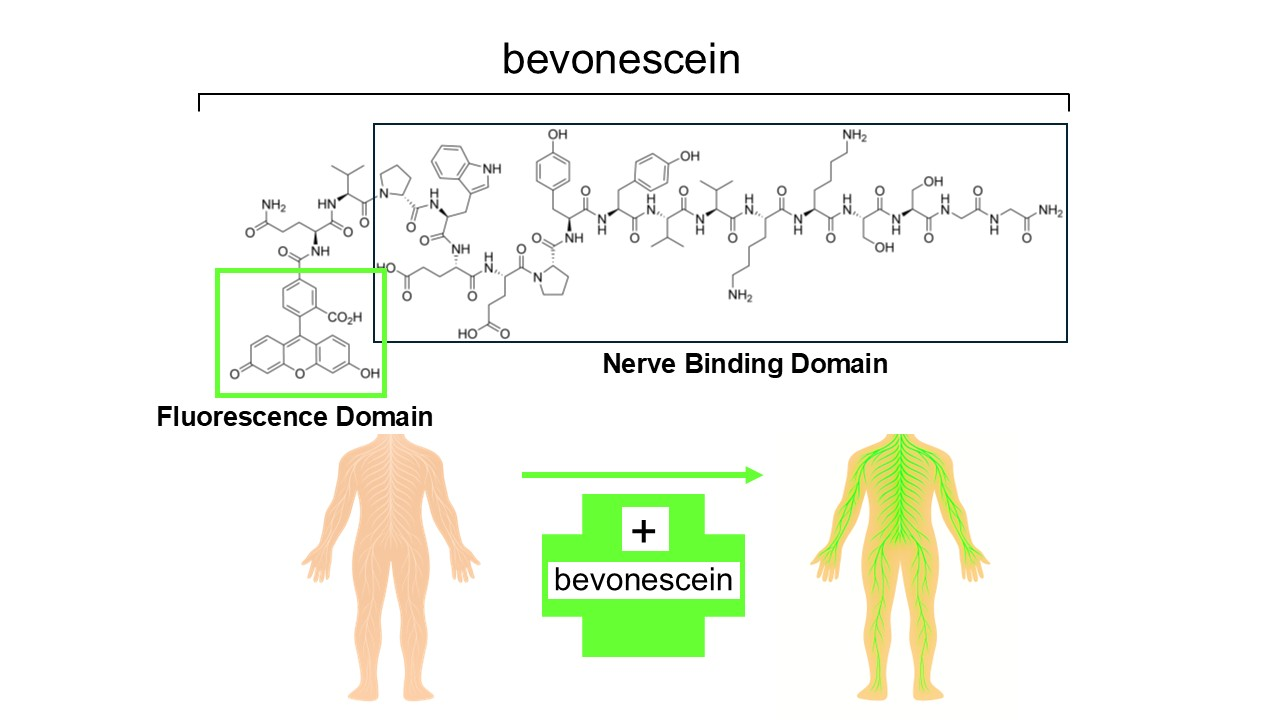

Bevonescein—A Peptide Dye Conjugate for Visualization of Peripheral Nerves in Patients During Surgery

Abstract
1. Introduction
2. Materials and Methods
2.1. Human Tissue Samples
2.2. Peptide Preparation
2.3. Ex Vivo Nerve Binding Assay
2.4. Imaging and Analysis
2.5. Statistical Analysis
3. Results
4. Discussion
Supplementary Materials
Author Contributions
Funding
Institutional Review Board Statement
Informed Consent Statement
Data Availability Statement
Acknowledgments
Conflicts of Interest
References
- Burke, S.; Shorten, G.D. When pain after surgery doesn’t go away. Biochem. Soc. Trans. 2009, 37, 318–322. [Google Scholar] [CrossRef]
- Tewari, A.; Peabody, J.; Fischer, M.; Sarle, R.; Vallancien, G.; Delmas, V.; Hassan, M.; Bansal, A.; Hemal, A.; Guillonneau, B.; et al. An operative and anatomic study to help in nerve sparing during laparoscopic and robotic radical prostatectomy. Eur. Urol. 2003, 43, 444–454. [Google Scholar] [CrossRef]
- Schilling, P.L.; Dimick, J.B.; Birkmeyer, J.D. Prioritizing quality improvement in general surgery. J. Am. Coll. Surg. 2008, 207, 698–704. [Google Scholar] [CrossRef] [PubMed]
- Giglia, M.D.; Stein, S.L. Overlooked Long-Term Complications of Colorectal Surgery. Clin. Colon. Rectal Surg. 2019, 32, 204–211. [Google Scholar] [CrossRef] [PubMed]
- Selzman, A.A.; Spirnak, J.P. Iatrogenic ureteral injuries: A 20-year experience in treating 165 injuries. J. Urol. 1996, 155, 878–881. [Google Scholar] [CrossRef] [PubMed]
- Dowling, R.A.; Corriere, J.N., Jr.; Sandler, C.M. Iatrogenic ureteral injury. J. Urol. 1986, 135, 912–915. [Google Scholar] [CrossRef]
- Higgins, C.C. Ureteral injuries during surgery. A review of 87 cases. JAMA 1967, 199, 82–88. [Google Scholar] [CrossRef]
- Neuman, M.; Eidelman, A.; Langer, R.; Golan, A.; Bukovsky, I.; Caspi, E. Iatrogenic injuries to the ureter during gynecologic and obstetric operations. Surg. Gynecol. Obstet. 1991, 173, 268–272. [Google Scholar]
- Crawford, K.L.; Lee, Y.J.; Hom, M.; Rosenthal, E.L.; Orosco, R.K.; Nguyen, Q.T. Identification of Degenerated Murine Facial Nerves With Fluorescence Labeling After Transection Injury. Otolaryngol. Head Neck Surg. 2023, 169, 234–242. [Google Scholar] [CrossRef]
- Crawford, K.L.; Berman, E.; Whitney, M.A.; Adams, S.; Orosco, R.K.; Nguyen, Q.T. Intraoperative Real-Time Fluorescence Labeling of Degenerated Facial Nerves with Bevonescein. Plast. Reconstr. Surg. 2025, 157, 103–109. [Google Scholar] [CrossRef]
- Lee, Y.J.; Orosco, R.K.; Bouvet, M.; Richmon, J.D.; Berman, B.J.; Crawford, K.L.; Hom, M.; Nguyen, Q.T.; Rosenthal, E.L. Intraoperative nerve-specific fluorescence visualization in head and neck surgery: A Phase 1 trial. Nat. Commun. 2025, 16, 6060. [Google Scholar] [CrossRef]
- Gantz, B.J. Intraoperative facial nerve monitoring. Am. J. Otol. 1985, 6, 58–61. [Google Scholar]
- Miller, M.; Spiegel, J. Identification and monitoring of the recurrent laryngeal nerve during thyroidectomy. Surg. Oncol. Clin. North Am. 2008, 17, 121–144. [Google Scholar] [CrossRef] [PubMed]
- Davis, W.E.; Rea, J.L.; Templer, J. Recurrent laryngeal nerve localization using a microlaryngeal electrode. Otolaryngol. Head Neck Surg. 1979, 87, 330–333. [Google Scholar] [PubMed]
- Chang, S.H.; Park, Y.G.; Kim, D.H.; Yoon, S.Y. Monitoring of Motor and Somatosensory Evoked Potentials During Spine Surgery: Intraoperative Changes and Postoperative Outcomes. Ann. Rehabil. Med. 2016, 40, 470–480. [Google Scholar] [CrossRef]
- Dikmen, P.Y.; Oge, A.E. Diagnostic use of dermatomal somatosensory-evoked potentials in spinal disorders: Case series. J. Spinal Cord. Med. 2013, 36, 672–678. [Google Scholar] [CrossRef][Green Version]
- Jung, J.Y. Intraoperative Nerve Monitoring in Thyroid Surgery: A Comprehensive Review of Technical Principles, Anesthetic Considerations, and Clinical Applications. J. Clin. Med. 2025, 14, 3259. [Google Scholar] [CrossRef]
- Chitchian, S.; Weldon, T.; Fiddy, M.; Fried, N. Combined image-processing algorithms for improved optical coherence tomography of prostate nerves. J. Biomed. Opt. 2010, 15, 046014. [Google Scholar] [CrossRef]
- Zhivov, A.; Blum, M.; Guthoff, R.; Stachs, O. Real-time mapping of the subepithelial nerve plexus by in vivo confocal laser scanning microscopy. Br. J. Ophthalmol. 2010, 94, 1133–1135. [Google Scholar] [CrossRef]
- Chin, K.; Engelsman, A.F.; Chin, P.T.K.; Meijer, S.L.; Strackee, S.D.; Oostra, R.J.; van Gulik, T.M. Evaluation of collimated polarized light imaging for real-time intraoperative selective nerve identification in the human hand. Biomed. Opt. Express 2017, 8, 4122–4134. [Google Scholar] [CrossRef]
- Köbbert, C.; Apps, R.; Bechmann, I.; Lanciego, J.L.; Mey, J.; Thanos, S. Current concepts in neuroanatomical tracing. Prog. Neurobiol. 2000, 62, 327–351. [Google Scholar] [CrossRef] [PubMed]
- Richmond, F.J.; Gladdy, R.; Creasy, J.L.; Kitamura, S.; Smits, E.; Thomson, D.B. Efficacy of seven retrograde tracers, compared in multiple-labelling studies of feline motoneurones. J. Neurosci. Methods 1994, 53, 35–46. [Google Scholar] [CrossRef] [PubMed]
- O’Malley, M.R.; Wittkopf, J.E.; Cutler, J.L.; Labadie, R.F.; Hackett, T.A.; Haynes, D.S. Fluorescent retrograde axonal tracing of the facial nerve. Laryngoscope 2006, 116, 1792–1797. [Google Scholar] [CrossRef]
- Marangos, N.; Illing, R.; Krüger, J.; Laszig, R. In vivo visualization of the cochlear nerve and nuclei with fluorescent axonal tracers. Hear. Res. 2001, 162, 48–52. [Google Scholar] [CrossRef]
- Boyette, L.B.; Reardon, M.A.; Mirelman, A.J.; Kirkley, T.D.; Lysiak, J.J.; Tuttle, J.B.; Steers, W.D. Fiberoptic imaging of cavernous nerves in vivo. J. Urol. 2007, 178, 2694–2700. [Google Scholar] [CrossRef]
- Gibbs-Strauss, S.L.; Nasr, K.A.; Fish, K.M.; Khullar, O.; Ashitate, Y.; Siclovan, T.M.; Johnson, B.F.; Barnhardt, N.E.; Tan Hehir, C.A.; Frangioni, J.V. Nerve-highlighting fluorescent contrast agents for image-guided surgery. Mol. Imaging 2011, 10, 91–101. [Google Scholar]
- Massaad, C.A.; Zhang, G.; Pillai, L.; Azhdarinia, A.; Liu, W.; Sheikh, K.A. Fluorescently-tagged anti-ganglioside antibody selectively identifies peripheral nerve in living animals. Sci. Rep. 2015, 5, 15766. [Google Scholar] [CrossRef]
- Cotero, V.E.; Kimm, S.Y.; Siclovan, T.M.; Zhang, R.; Kim, E.M.; Matsumoto, K.; Gondo, T.; Scardino, P.T.; Yazdanfar, S.; Laudone, V.P.; et al. Improved Intraoperative Visualization of Nerves through a Myelin-Binding Fluorophore and Dual-Mode Laparoscopic Imaging. PLoS ONE 2015, 10, e0130276. [Google Scholar] [CrossRef]
- Cotero, V.E.; Siclovan, T.; Zhang, R.; Carter, R.L.; Bajaj, A.; LaPlante, N.E.; Kim, E.; Gray, D.; Staudinger, V.P.; Yazdanfar, S.; et al. Intraoperative fluorescence imaging of peripheral and central nerves through a myelin-selective contrast agent. Mol. Imaging Biol. 2012, 14, 708–717. [Google Scholar] [CrossRef]
- Gibbs, S.L.; Xie, Y.; Goodwill, H.L.; Nasr, K.A.; Ashitate, Y.; Madigan, V.J.; Siclovan, T.M.; Zavodszky, M.; Tan Hehir, C.A.; Frangioni, J.V. Structure-activity relationship of nerve-highlighting fluorophores. PLoS ONE 2013, 8, e73493. [Google Scholar] [CrossRef]
- Gray, D.; Kim, E.; Cotero, V.; Staudinger, P.; Yazdanfar, S.; Hehir, C.T. Compact Fluorescence and White Light Imaging System for Intraoperative Visualization of Nerves. In Proceedings of the Volume 8207, Photonic Therapeutics and Diagnostics VIII, San Francisco, CA, USA, 21–24 January 2012; p. 8207. [Google Scholar] [CrossRef]
- Hackman, K.M.; Doddapaneni, B.S.; Barth, C.W.; Wierzbicki, I.H.; Alani, A.W.; Gibbs, S.L. Polymeric Micelles as Carriers for Nerve-Highlighting Fluorescent Probe Delivery. Mol. Pharm. 2015, 12, 4386–4394. [Google Scholar] [CrossRef] [PubMed]
- Wang, C.; Wu, C.; Popescu, D.C.; Zhu, J.; Macklin, W.B.; Miller, R.H.; Wang, Y. Longitudinal near-infrared imaging of myelination. J. Neurosci. 2011, 31, 2382–2390. [Google Scholar] [CrossRef] [PubMed][Green Version]
- Barth, C.W.; Gibbs, S.L. Direct Administration of Nerve-Specific Contrast to Improve Nerve Sparing Radical Prostatectomy. Theranostics 2017, 7, 573–593. [Google Scholar] [CrossRef] [PubMed]
- Barth, C.W.; Shah, V.M.; Wang, L.G.; Antaris, A.L.; Klaassen, A.; Sorger, J.; Rao, D.A.; Kerr, D.A.; Henderson, E.R.; Alani, A.W.G.; et al. Clinically translatable formulation strategies for systemic administration of nerve-specific probes. Adv. Ther. 2021, 4, 2100002. [Google Scholar] [CrossRef]
- Hebert, K.A.; Bateman, L.; Parker, D.; Nunziata, J.; Paydarfar, J.A.; Hong, J.; Kerr, D.A.; Zanazzi, G.J.; Barth, C.W.; Wang, L.; et al. First demonstration of a novel nerve-targeting fluorophore in a cohort of ex vivo human tissues. In Proceedings of the Volume 12361, Molecular-Guided Surgery: Molecules, Devices, and Applications IX, San Francisco, CA, USA, 28–29 January 2023; p. 123610D. [Google Scholar] [CrossRef]
- Wang, L.G.; Montano, A.R.; Masillati, A.M.; Jones, J.A.; Barth, C.W.; Combs, J.R.; Kumarapeli, S.U.; Shams, N.A.; van den Berg, N.S.; Antaris, A.L.; et al. Nerve Visualization using Phenoxazine-Based Near-Infrared Fluorophores to Guide Prostatectomy. Adv. Mater. 2024, 36, e2304724. [Google Scholar] [CrossRef]
- Wang, L.G.; Gibbs, S.L. Improving precision surgery: A review of current intraoperative nerve tissue fluorescence imaging. Curr. Opin. Chem. Biol. 2023, 76, 102361. [Google Scholar] [CrossRef]
- Hingorani, D.V.; Whitney, M.A.; Friedman, B.; Kwon, J.K.; Crisp, J.L.; Xiong, Q.; Gross, L.; Kane, C.J.; Tsien, R.Y.; Nguyen, Q.T. Nerve-targeted probes for fluorescence-guided intraoperative imaging. Theranostics 2018, 8, 4226–4237. [Google Scholar] [CrossRef]
- Steier, L. Reveal: Fluorescence Enhanced Theragnosis by Designs for Vision. Eur. J. Dent. 2020, 14, 186–188. [Google Scholar] [CrossRef]
- The Jamovi Project. Jamovi, Version 2.6; Jamovi: Sydney, Australia, 2024. Available online: https://www.jamovi.org (accessed on 29 January 2026).
- R Core Team R. A Language and Environment for Statistical Computing, Version 4.5.2, Linux Distributions. 2024. Available online: https://cran.r-project.org (accessed on 29 January 2026).
- Fox, J.; Weisberg, S. An R Companion to Applied Regression, Version 3.1-5, 3rd ed.; Sage: Thousand Oaks, CA, USA, 2019; Available online: https://CRAN.R-project.org/package=car (accessed on 29 January 2026).
- Lenth, R. Emmeans: Estimated Marginal Means, aka Least-Squares Means, [R-Package]. 2025. Available online: https://cran.r-project.org/package=emmeans (accessed on 29 January 2026).


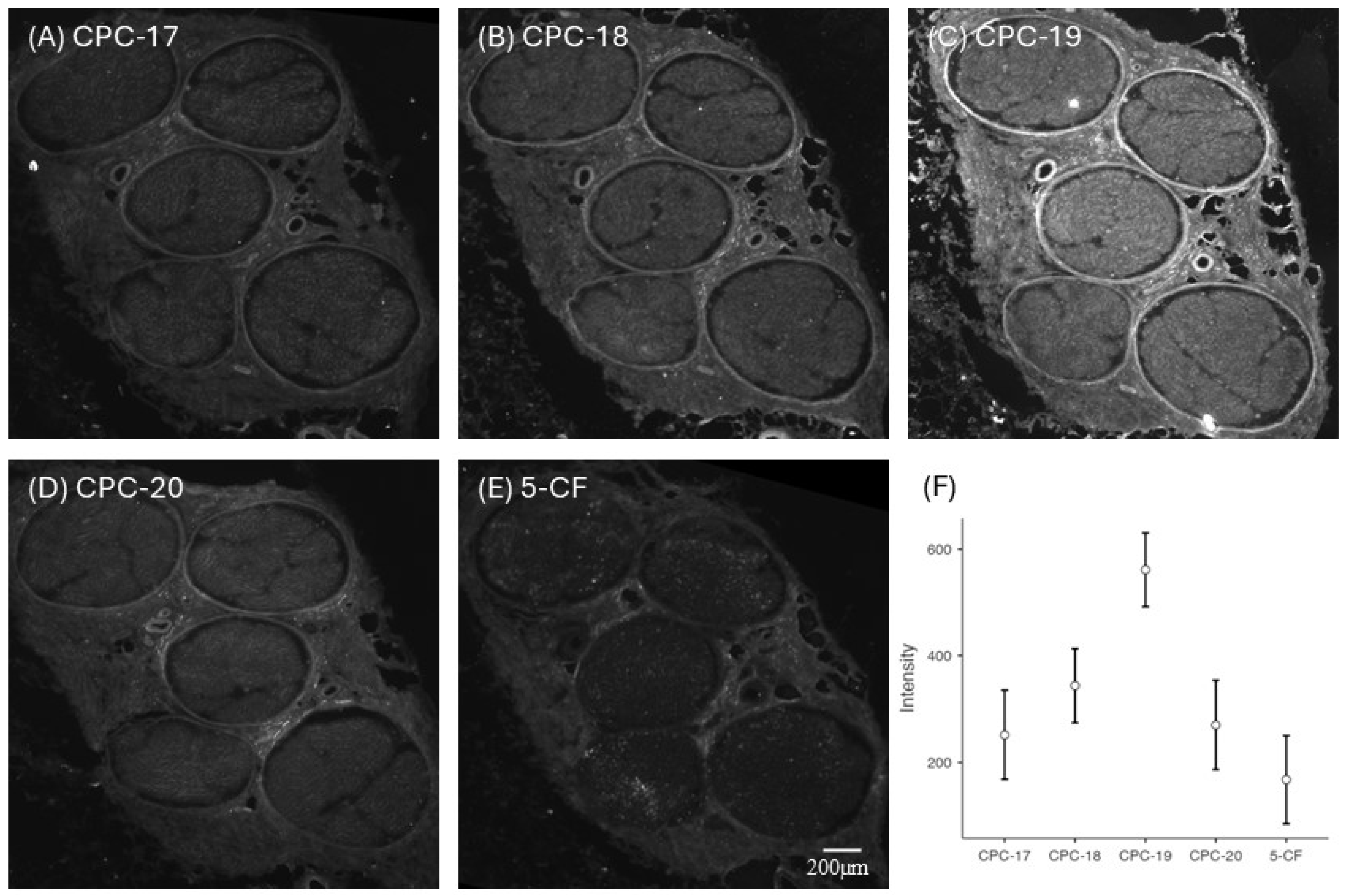
| Compound ID | Peptide ID | Peptide Sequence | Molecular Weight |
|---|---|---|---|
| CPC-17 | 5-FAM-HNP401 | NH2-SGQVPWEEPYYVVKKSSGG-CONH2 | 2480.1 |
| CPC-18 | HNP401-K-(5-FAM)-CONH2 | Acetyl-SGQVPWEEPYYVVKKSSGGK-CONH2 | 2624.8 Purity = 96.2% |
| CPC-19 (bevonescein) | 5-FAM-(N2)-HNP401-CONH2 | NH2-QVPWEEPYYVVKKSSGG-CONH2 | 2310.5 Purity = 97.2% |
| CPC-20 | (N2)-HNP401-K-(5-FAM)-CONH2 | Acetyl-QVPWEEPYYVVKKSSGGK-CONH2 | 2454.6 Purity = 97.0% |
Disclaimer/Publisher’s Note: The statements, opinions and data contained in all publications are solely those of the individual author(s) and contributor(s) and not of MDPI and/or the editor(s). MDPI and/or the editor(s) disclaim responsibility for any injury to people or property resulting from any ideas, methods, instructions or products referred to in the content. |
© 2026 by the authors. Licensee MDPI, Basel, Switzerland. This article is an open access article distributed under the terms and conditions of the Creative Commons Attribution (CC BY) license.
Share and Cite
Whitney, M.A.; Crisp, J.L. Bevonescein—A Peptide Dye Conjugate for Visualization of Peripheral Nerves in Patients During Surgery. Future Pharmacol. 2026, 6, 13. https://doi.org/10.3390/futurepharmacol6010013
Whitney MA, Crisp JL. Bevonescein—A Peptide Dye Conjugate for Visualization of Peripheral Nerves in Patients During Surgery. Future Pharmacology. 2026; 6(1):13. https://doi.org/10.3390/futurepharmacol6010013
Chicago/Turabian StyleWhitney, Michael A., and Jessica L. Crisp. 2026. "Bevonescein—A Peptide Dye Conjugate for Visualization of Peripheral Nerves in Patients During Surgery" Future Pharmacology 6, no. 1: 13. https://doi.org/10.3390/futurepharmacol6010013
APA StyleWhitney, M. A., & Crisp, J. L. (2026). Bevonescein—A Peptide Dye Conjugate for Visualization of Peripheral Nerves in Patients During Surgery. Future Pharmacology, 6(1), 13. https://doi.org/10.3390/futurepharmacol6010013