
Methemoglobin Activity Might Explain Rapid Increase in Oxygen Saturation Among COVID-19 Patients Healed with Chlorine Dioxide Gas in Solution

 , and
, and
Abstract
1. Introduction
2. Materials and Methods Section Transcribed from Part of the Protocol Used with COVID-19 Patients in the Mexican Case [Reference [31]]
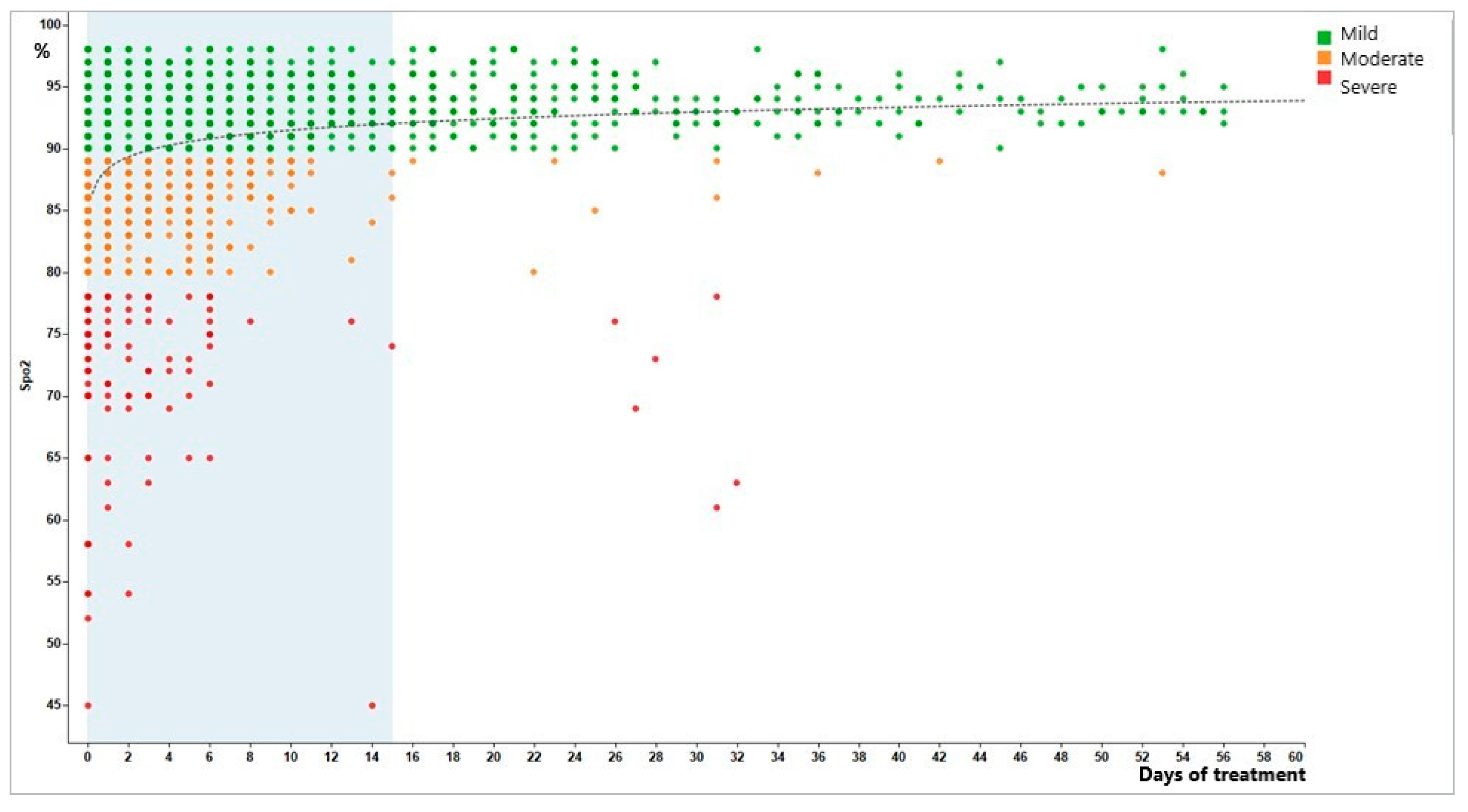
3. Results Transcription, Concerning the Observed Oxygen Saturation in Patients of the Mexican Case [Reference [31]
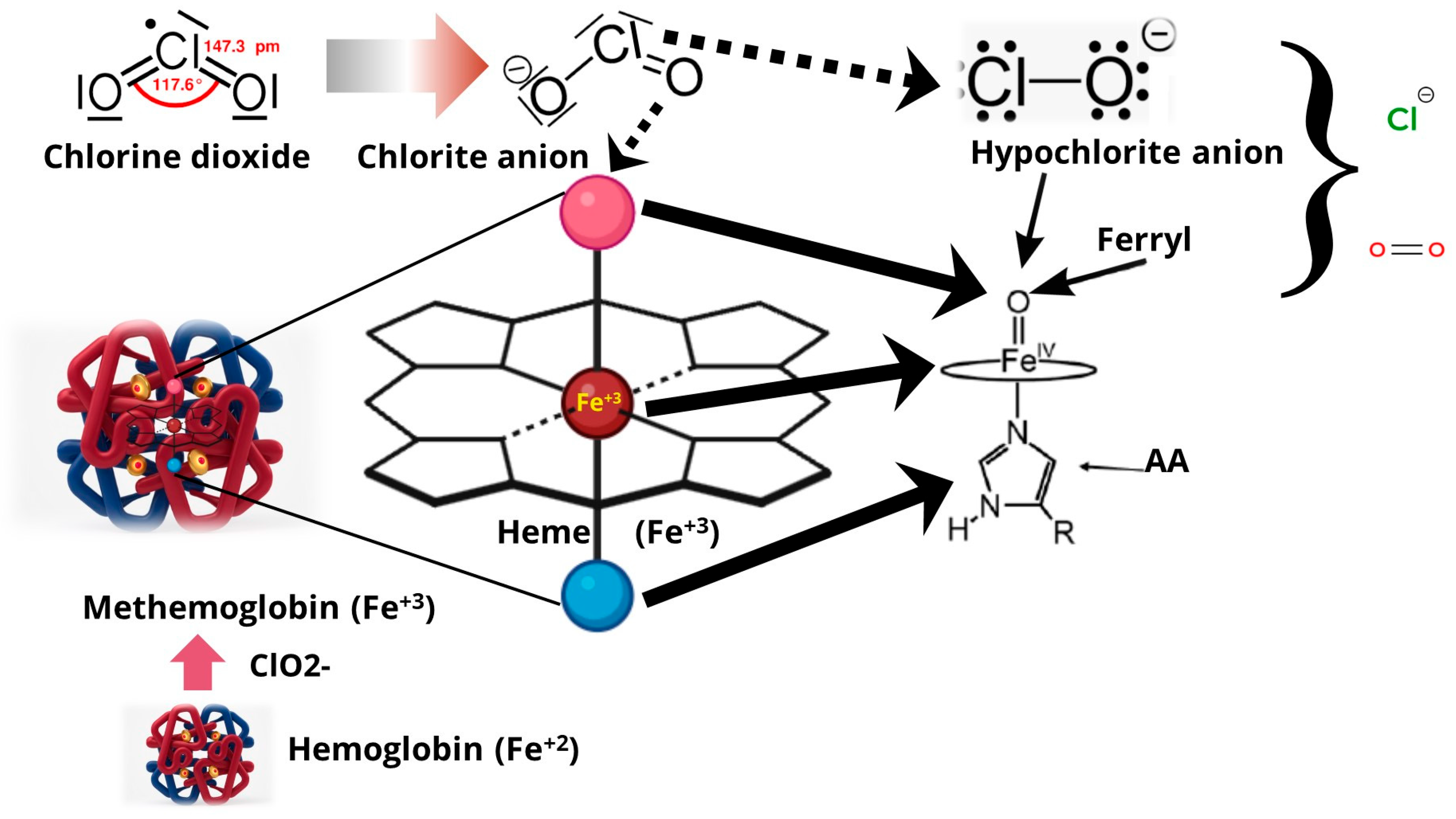
4. Discussion Aimed at Proposing a Better Understanding of the Oxygen Saturation Increase Observed in Patients of the Mexican Case

5. Conclusions
Supplementary Materials
Author Contributions
Funding
Institutional Review Board Statement
Informed Consent Statement
Data Availability Statement
Acknowledgments
Conflicts of Interest
Abbreviations
| CDS | Chlorine Dioxide in Solution |
| HBOT | Hyperbaric Oxygen Treatment |
References
- Helou, M.; Mahdi, A.; Abou Fayad, A.; Sleiman, A.; Matar, G.M.; Zoghbi, S.; Madani, T.; Husni, R. Antimicrobial effects of chlorine dioxide in a hospital setting. Sci. Rep. 2013, 13, 22866. [Google Scholar] [CrossRef] [Scilit]
- US-EPA. U.S. Environmental Protection Agency. Toxicological Review of Chlorine Dioxide and Chlorite. 2000. Available online: https://cfpub.epa.gov/ncea/iris/iris_documents/documents/toxreviews/0496tr.pdf (accessed on 11 May 2026).
- Michael, G.E.; Miday, R.K.; Bercz, J.P.; Miller, R.G.; Greathouse, D.G.; Kraemer, D.F.; Lucas, J.B. Chlorine Dioxide Water Disinfection: A Prospective Epidemiology Study. Arch. Environ. Health Int. J. 1981, 36, 20–27. [Google Scholar] [CrossRef] [Scilit] [PubMed]
- Pichert, A.; Arnhold, J. Interaction of the chlorite-based drug WF10 and chlorite with hemoglobin, methemoglobin and ferryl hemoglobin. Arch. Biochem. Biophys. 2015, 585, 82–89. [Google Scholar] [CrossRef] [Scilit]
- Condori Macuri, R.M.; Alzamora-Gonzales, L.; Colona-Vallejos, E.H.; Cruz Riquelme, R.T.; Pecho Chávez, L.I.; Cisneros Gutierrez, J.O.; Montejo Anlas, V.A. Synergistic Anticancer Activity of Fucoidan from Lessonia trabeculata Combined with Chemotherapeutic Agents in 4T1 Breast Spheroids. Mar. Drugs 2025, 23, 451. [Google Scholar] [CrossRef] [Scilit]
- Rattan, S.I.S. Hormesis in aging. Ageing Res. Rev. 2008, 7, 63–78. [Google Scholar] [CrossRef] [Scilit]
- Callisperis, P.; Franco-Paredes, C.; Liester, M.B. Necrotizing Fasciitis treatment with chlorine dioxide: A case report in patient. Cureus 2025, 17, e88800. [Google Scholar] [CrossRef] [Scilit]
- Callisperis, P.; Pineda Aquino, R.; Raj Kota, S.; Vargas, M.; Rodriguez, N.; Liester, M. Chlorine dioxide treatment for diabetic foot ulcers: Three case studies. Int. J. Med. Med. Sci. 2024, 16, 44–49. [Google Scholar] [CrossRef]
- Rubio-Casillas, A.; Campras-Madrid, P. Farmacocinética y farmacodinamia del dióxido de cloro. e-CUCBA 2021, 8, 21–35. [Google Scholar] [CrossRef] [Scilit]
- Schempp, H.; Reim, M.; Dornisch, K.; Elstner, E. Chlorite-hemoprotein interaction as key role for the pharmacological activity of the chlorite-based drug WF10. Drug Res. 2001, 51, 3–11. [Google Scholar] [CrossRef] [Scilit] [PubMed]
- Jang, J.S.; Piao, S.; Cha, Y.N.; Kim, C. Taurine Chloramine Activates Nrf2, Increases HO-1 Expression and Protects Cells from Death Caused by Hydrogen Peroxide. J. Clin. Biochem. Nutr. 2009, 45, 37–43. [Google Scholar] [CrossRef] [Scilit]
- Woods, C.G.; Fu, J.; Xue, P.; Hou, Y.; Pluta, L.J.; Yang, L.; Zhang, Q.; Thomas, R.S.; Andersen, M.E.; Pi, J. Dose-dependent transitions in Nrf2-mediated adaptive response and related stress responses to hypochlorous acid in mouse macrophages. Toxicol. Appl. Pharmacol. 2009, 238, 27–36. [Google Scholar] [CrossRef] [Scilit]
- Hoang, C.; Nguyen, A.K.; Nguyen, T.Q.; Fang, W.; Han, B.; Hoang, B.X.; Tran, H.D. Application of Dimethyl sulfoxide as a therapeutic agent and drug vehicle for eye diseases. J. Ocul. Pharmacol. Ther. 2021, 37, 441–451. [Google Scholar] [CrossRef] [Scilit]
- Schwartz, L. Chlorine dioxide as a possible adjunct to metabolic treatment. J. Cancer Treat. Diagn. 2017, 1, 6–10. [Google Scholar] [CrossRef] [Scilit]
- Kim, Y.; Kumar, S.; Cheon, W.; Eo, H.; Kwon, H.; Jeon, Y.; Jung, Y.; Kim, W. Anticancer and antiviral activity by inducing active oxygen production of chlorine dioxide. J. Appl. Biol. Chem. 2016, 59, 31–36. [Google Scholar] [CrossRef] [Scilit]
- Aparicio-Alonso, M.; Torres-Solórzano, V. Case Report: Compassionate application of chlorine dioxide-based solution in a patient with metastatic prostate cancer. Salud Cienc. Tecnol. 2024, 4, 699. [Google Scholar] [CrossRef] [Scilit]
- Ogata, N.; Shibata, T. Protective effect of low-concentration chlorine dioxide gas against influenza A virus infection. J. Gen. Virol. 2008, 89, 60–67. [Google Scholar] [CrossRef] [Scilit] [PubMed]
- Sanekata, T.; Fukuda, T.; Miura, T.; Morino, H.; Lee, C.; Maeda, K.; Araki, K.; Otake, T.; Kawahata, T.; Shibata, T. Evaluation of the antiviral activity of chlorine dioxide and sodium hypochlorite against feline calicivirus, human influenza virus, measles virus, canine distemper virus, human herpesvirus, human adenovirus, canine adenovirus and canine parvovirus. Biocontrol Sci. 2010, 15, 45–49. [Google Scholar] [CrossRef] [Scilit] [PubMed]
- Miura, T.; Shibata, T. Antiviral Effect of Chlorine Dioxide against Influenza Virus and Its Application for Infection Control. Open Antimicrob. Agents J. 2010, 2, 71–78. [Google Scholar] [CrossRef] [Scilit]
- Ogata, N. Denaturation of protein by chlorine dioxide: Oxidative modification of tryptophan and tyrosine residues. Biochemistry 2007, 46, 4898–4911. [Google Scholar] [CrossRef] [Scilit]
- Ogata, N. Inactivation of influenza virus haemagglutin in by chlorine dioxide: Oxidation of the conserved tryptophan 153 residue in the receptor binding site. J. Gen. Virol. 2012, 93, 2558–2563. [Google Scholar] [CrossRef] [Scilit]
- Abdel-Rahman, M.S.; Couri, D.; Bull, R.J. Metabolism and pharmacokinetics of alternate drinking water disinfectants. Environ. Health Perspect. 1982, 46, 19–23. [Google Scholar] [CrossRef]
- Hati, S.; Bhattacharyya, S. Impact of Thiol-Disulfide Balance on the Binding of Covid-19 Spike Protein with Angiotensin-Converting Enzyme 2 Receptor. ACS Omega 2020, 5, 16292–16298. [Google Scholar] [CrossRef] [Scilit]
- Zambrano-Estrada, X.; Domínguez-Sánchez, C.; Banuet-Martínez, M.; Guerrero de la Rosa, F.; García-Gasca, T.; Acevedo-Whitehouse, K. Evaluation of the antiviral effect of chlorine dioxide (ClO2) using a vertebrate model inoculated with avian coronavirus. biorXiv 2020. [Google Scholar] [CrossRef] [Scilit]
- Raffanti, S.P.; Schaffner, W.; Federspiel, C.F.; Blackwell, R.B.; Ching, O.A.; Kühne, F.W. Randomized, double-blind, placebo-controlled trial of the immune modulator WF10 in patients with advanced AIDS. Infection 1998, 26, 202–207. [Google Scholar] [CrossRef] [Scilit]
- Tao, Y.; Queen, K.; Paden, C.R.; Zhang, J.; Li, Y.; Uehara, A.; Lu, X.; Lynch, B.; Sakthivel, S.K.K.; Whitaker, B.L.; et al. Severe Acute Respiratory Syndrome Coronavirus 2 Isolate 2019-n CoV/USAIL1/2020, Complete Genome. NCBI GenBank. 2020. Available online: https://www.ncbi.nlm.nih.gov/nucleotide/MN988713.1 (accessed on 11 May 2026).
- Insignares-Carrione, E.; Bolano-Gómez, B.; Kalcker, A.L. Chlorine Dioxide in COVID-19: Hypothesis about the Possible Mechanism of Molecular Action in SARSCoV-2. J. Mol. Genet. Med. 2020, 14, 1–8. Available online: https://drinsignaresbolano.com/wp-content/uploads/2025/05/Chlorine_Dioxide_in_COVID_19_Hypothesis.pdf (accessed on 6 May 2026).
- Antiviral/Antibiotic Treatments on Water, Plants and Animal Care by Clodos Technology. Available online: www.clodos.com (accessed on 11 May 2026).
- Insignares-Carrione, E.; Bolano Gómez, B.; Andrade, Y.; Callisperis, P.; Suxo, A.M.; Ajata San Martine, A.B.; Ostria Gonzalez, C. Determination of the Effectiveness of Chlorine Dioxide in the Treatment of COVID 19. J. Mol. Genet. Med. 2021, 15, S1–S11. [Google Scholar] [CrossRef]
- Martinez, E.A. A New Perspective for Prevention and to Cure COVID-19 Patients: Encouraging Medical Teams to Contact Healed People Treated with Chlorine Dioxide in Solution (CDS). Integr. J. Med. Sci. 2020, 7, 229. [Google Scholar] [CrossRef] [Scilit]
- Aparicio-Alonso, M.; Domínguez-Sánchez, C.A.; Banuet-Martínez, M. Chlorine Dioxide as an Alternative Treatment for COVID-19. J. Infect. Dis. Ther. 2021, 9, 477–484. Available online: https://www.omicsonline.org/open-access/chlorine-dioxide-as-an-alternative-treatment-for-covid19.pdf (accessed on 6 May 2026).
- David, S.R.; Sawal, N.S.; Bin Hamzah, M.N.; Rajabalaya, R. The blood blues: A review on methemoglobinemia. J. Pharmacol. Pharmacother. 2018, 9, 1–5. [Google Scholar] [CrossRef] [Scilit]
- Schaffner, I.; Hofbauer, S.; Krutzler, M.; Pirker, K.F.; Furtmüller, P.G.; Obinger, C. Mechanism of chlorite degradation to chloride and dioxygen by the enzyme chlorite dismutase. Arch. Biochem. Biophys. 2015, 574, 18–26. [Google Scholar] [CrossRef] [Scilit] [PubMed]
- Premont, R.T.; Reynolds, J.D.; Zhang, R.; Stamler, J.S. Role of Nitric Oxide Carried by Hemoglobin in Cardiovascular Physiology Developments on a Three-Gas Respiratory Cycle. Circ. Res. 2020, 126, 129–158. [Google Scholar] [CrossRef] [Scilit]
- Elstner, E.F. Heme activated oxydations using the chlorine-oxygen complex “TCDO” (Oxyferin)-an overview. J. Biosci. 1988, 43, 893–902. [Google Scholar] [CrossRef] [Scilit]
- da Veiga Moreira, J.; Nleme, N.; Schwartz, L.; Leclerc-Desaulniers, K.; Carmona, E.; Mes-Masson, A.-M.; Jolicoeur, M. Methylene Blue Metabolic Therapy Restrains In Vivo Ovarian Tumor Growth. Cancers 2024, 16, 355. [Google Scholar] [CrossRef] [Scilit] [PubMed]
- Cañeque, T.; Baron, L.; Müller, S.; Baron, L.; Müller, S.; Carmona, A.; Colombeau, L.; Versini, A.; Solier, S.; Gaillet, C.; et al. Activation of lysosomal iron triggers ferroptosis in cancer. Nature 2025, 642, 492–500. [Google Scholar] [CrossRef] [Scilit]
- Cai, T. Hyperbaric oxygen therapy as an adjunt treatment for glioma and brain metastasis: A literature review. Med. Gas Res. 2025, 15, 420–426. [Google Scholar] [CrossRef] [Scilit] [PubMed]
- Hinz, J.; Kuhne, F.W.; Stahl, K.W. Local Tetrachlorodecaoxide treatment to improve oxygen supply to non-healing wounds. Lancet 1984, 324, 630. [Google Scholar] [CrossRef] [Scilit]
- Dang, S. Efficacy of Hyperbaric Oxygen Therapy on Diabetic Foot Ulcer Healing. PA Dep. J. Med. Sci. 2025. Available online: https://digitalcommons.gardner-webb.edu/pa-department-journal-of-medical-science/14 (accessed on 11 May 2026).
- Rydberg, P.; Sigfridsson, E.; Ryde, U. On the role of the axial ligand in heme proteins: A theoretical study. J. Biol. Inorg. Chem. 2004, 9, 203–223. [Google Scholar] [CrossRef] [Scilit]
- Zubieta-Calleja, G.; Montelongo, F.d.J.; Romo Sanchez, M.G.; Samaja, M.; Zubieta-DeUrioste, N. The Failure of Pulmonary Oxygen Exchange in Severe Viral Lung Disease: Pneumolysis. Oxygen 2026, 6, 7. [Google Scholar] [CrossRef] [Scilit]


| COVID-19 Severity | ||||||
| Mild | Moderate | Severe | ||||
| SpO2 (%) | ≥95 | 90–94 | <90 | |||
| n | % | n | % | n | % | |
| Patients | 776 | 68.31 | 109 | 9.59 | 251 | 22.09 |
| Sex | ||||||
| Male | 351 | 45.23 | 49 | 44.95 | 151 | 60.16 |
| Female | 375 | 48.32 | 60 | 55.05 | 90 | 35.86 |
| Other | 50 | 6.44 | 0 | 0.00 | 10 | 3.98 |
| Age | ||||||
| 0–9 | 29 | 3.74 | 0 | 0.00 | 1 | 0.40 |
| 10–19 | 48 | 6.18 | 5 | 4.59 | 0 | 0.00 |
| 20–29 | 38 | 4.90 | 6 | 5.50 | 6 | 2.39 |
| 30–39 | 49 | 6.31 | 7 | 6.42 | 9 | 3.58 |
| 40–49 | 80 | 10.31 | 18 | 16.51 | 13 | 5.18 |
| 50–59 | 64 | 8.25 | 19 | 17.43 | 42 | 16.73 |
| 60–69 | 41 | 5.28 | 10 | 9.17 | 23 | 9.16 |
| >70 | 31 | 3.99 | 12 | 11.01 | 33 | 13.15 |
| No info | 396 | 51.03 | 32 | 29.36 | 24 | 42.63 |
| Mild | Moderate | Severe | ||||
| Days of symptoms | 2.52–3.33 a | 7.89–12.21 bc | 6.73–9.95 bc | |||
| Duration of treatment | 14.86–15.69 a | 17.19–21.95 b | 14.41–17.73 c | |||
| ClO2 dose (mg/kg) | 0.87–0.94 a | 1.16–1.33 b | 1.98–2.18 c | |||
| ClO2 per day (ml) | 20.43–21.93 a | 27.17–30.97 b | 46.33–50.89 c | |||
| Total ClO2 (ml) | 309.83–337.38 a | 518.77–619.19 b | 733.67–828.79 b | |||
Disclaimer/Publisher’s Note: The statements, opinions and data contained in all publications are solely those of the individual author(s) and contributor(s) and not of MDPI and/or the editor(s). MDPI and/or the editor(s) disclaim responsibility for any injury to people or property resulting from any ideas, methods, instructions or products referred to in the content. |
© 2026 by the authors. Licensee MDPI, Basel, Switzerland. This article is an open access article distributed under the terms and conditions of the Creative Commons Attribution (CC BY) license.
Share and Cite
Martinez Mosqueira, E.A.; Martinez, P.; Aparicio-Alonso, M.; Vega-Galvez, A. Methemoglobin Activity Might Explain Rapid Increase in Oxygen Saturation Among COVID-19 Patients Healed with Chlorine Dioxide Gas in Solution. Oxygen 2026, 6, 12. https://doi.org/10.3390/oxygen6020012
Martinez Mosqueira EA, Martinez P, Aparicio-Alonso M, Vega-Galvez A. Methemoglobin Activity Might Explain Rapid Increase in Oxygen Saturation Among COVID-19 Patients Healed with Chlorine Dioxide Gas in Solution. Oxygen. 2026; 6(2):12. https://doi.org/10.3390/oxygen6020012
Chicago/Turabian StyleMartinez Mosqueira, Enrique A., Pierrick Martinez, Manuel Aparicio-Alonso, and Antonio Vega-Galvez. 2026. "Methemoglobin Activity Might Explain Rapid Increase in Oxygen Saturation Among COVID-19 Patients Healed with Chlorine Dioxide Gas in Solution" Oxygen 6, no. 2: 12. https://doi.org/10.3390/oxygen6020012
APA StyleMartinez Mosqueira, E. A., Martinez, P., Aparicio-Alonso, M., & Vega-Galvez, A. (2026). Methemoglobin Activity Might Explain Rapid Increase in Oxygen Saturation Among COVID-19 Patients Healed with Chlorine Dioxide Gas in Solution. Oxygen, 6(2), 12. https://doi.org/10.3390/oxygen6020012