
Systematic Review

Phylogeography of Halophytes Across Saline Landscapes: A Systematic Review of Coastal–Inland Connectivity and Genetic Differentiation
by
Nomcebo Mngomezulu
and
Dimitri Veldkornet
*
Department of Plant Sciences, Faculty of Natural and Agricultural Sciences, University of the Free State, P.O. Box 339, Bloemfontein 9300, South Africa
*
Author to whom correspondence should be addressed.
Coasts 2026, 6(3), 32; https://doi.org/10.3390/coasts6030032
Submission received: 30 April 2026 / Revised: 10 June 2026 / Accepted: 23 June 2026 / Published: 2 August 2026

Abstract

Saline habitats, which include both coastal and inland, host specialised halophytic communities that can withstand high salinity. Coastal communities are shaped by tidal inundation and marine connectivity, whereas inland saline habitats are driven by evaporation, groundwater salinisation, and greater landscape isolation. These contrasting hydrological and environmental variables likely drive divergent patterns of genetic diversity, influencing local adaptation, connectivity, and evolutionary divergence, which is important for understanding species persistence and guiding conservation of saline ecosystems under environmental change. This systematic review brings together phylogeographic studies on halophytic species from both environments to uncover global drivers of genetic difference. A systematic search of Web of Science, Scopus, and PubMed was done, and 20 studies were identified focusing on key genera including Salicornia, Sarcocornia, Suaeda, and Triglochin. Distinct genetic clades were often associated with habitat type or geographic region, indicating repeated divergence linked to coastal–inland environmental gradients. Genetic differentiation between coastal and inland halophyte populations is primarily driven by habitat fragmentation, restricted gene flow, historical refugia and recolonisation, salinity-mediated adaptation, and differences in dispersal capacity. As a result, coastal populations are generally more genetically connected, whereas inland populations tend to be more isolated, structured, and evolutionarily divergent. The data also showed a strong regional bias; while research is well established in Europe, Asia, and North America, African inland saline ecosystems are critically understudied. We conclude that habitat connectivity and dispersal pathways are the primary determinants of halophyte genetic structure. Future research must integrate ecological niche modelling and landscape genetics to resolve the evolutionary dynamics of these taxa, particularly in under-sampled regions such as southern Africa, to support effective conservation of saline biodiversity. However, the synthesis is constrained by the small number of eligible studies (n = 23) and their uneven geographic distribution, with limited representation from Africa, South America, and Australia, which restricts the ability to draw fully global conclusions. Recognising and protecting these systems is essential for safeguarding global saline biodiversity.

1. Introduction

Saline ecosystems, including coastal salt marshes and inland salt pans, are globally significant habitats that support halophytic vegetation adapted to extreme salinity [1,2,3,4]. These ecosystems provide essential services such as nutrient cycling [5,6], carbon sequestration [7,8], shoreline stabilization [9,10], and support for biodiversity [11]. Despite their shared ecological importance, coastal and inland saline systems differ fundamentally in connectivity, evolutionary pressures, and conservation challenges, shaping distinct phylogeographic outcomes.
Coastal salt marshes typically form in intertidal zones through tidal inundation and sediment deposition, with hydrological connectivity driven by ocean currents [12,13,14,15]. This connectivity facilitates strong gene flow among populations, often maintaining high genetic diversity and reducing divergence. In contrast, inland saline habitats, referred to as pans [16] or sabkhas [17,18,19] or playas [19,20], arise through evaporation, groundwater salinization, or geological salt deposits [16,17]. It has been suggested that their fragmented and isolated nature restricts dispersal, leading to weaker gene flow, bottlenecks, and founder effects that promote genetic differentiation. A schematic representation of gene flow and divergence (Figure 1) illustrates these contrasting dynamics, highlighting how ecological context drives evolutionary trajectories. These contrasting evolutionary outcomes are especially relevant in halophytes, a group of plants that has repeatedly evolved the capacity to survive in saline environments across diverse habitats.
Halophytes are defined as salt-tolerant plants that occur naturally in saline environments and are able to complete their life cycle at salinity levels exceeding 200 mM [21]. Despite comprising approximately only 1% of global plant diversity [22], over 2500 halophytic species have been documented in the eHALOPH database (V7.1, https://ehaloph.uc.pt), reflecting a diverse array of adaptations to saline soils [2]. These halophytes exemplify convergent adaptation to salinity. Early definitions distinguished halophytes from glycophytes as discrete ecological groups [2]. Later classifications recognised obligate, facultative, and other functional categories of salt-tolerant plants [21,23,24,25]. Contemporary perspectives, however, view salinity tolerance as a continuum rather than a strict dichotomy, with species ranging from highly salt-sensitive glycophytes to euhalophytes capable of withstanding repeated exposure to seawater [2,21,23]. This conceptual shift highlights the diverse physiological mechanisms and multiple evolutionary pathways through which plants have adapted to saline environments [26,27]. However, the phylogeographic consequences of these adaptations may differ among saline environments. Coastal salt marshes are characterised by pronounced environmental gradients in tidal inundation, salinity, sediment dynamics, redox potential, and oxygen availability, all of which can promote localised adaptation and population differentiation despite ongoing connectivity. For example, genetic and epigenetic variation has been shown to occur across environmental gradients within coastal salt marsh species, highlighting the importance of local environmental filtering in shaping population structure [28]. Inland saline habitats, by contrast, are typically more spatially isolated and fragmented, potentially increasing the influence of restricted dispersal, reduced gene flow, and demographic processes such as bottlenecks and founder effects on patterns of genetic differentiation. Collectively, these processes suggest that coastal and inland halophyte populations may experience different evolutionary trajectories. Coastal populations are often shaped by the interaction between environmental heterogeneity and connectivity, whereas inland populations may be more strongly influenced by habitat isolation, reduced gene flow, and population fragmentation.
Historically, both coastal and inland saline systems have been shaped by sea-level fluctuations, glacial cycles, and episodes of marine transgression and regression, which alternately created dispersal corridors, refugia, and isolated habitat patches. In coastal systems, these processes often promoted regional connectivity and recolonisation, whereas in inland saline systems, they more frequently contributed to habitat isolation, fragmentation, reduced gene flow, bottlenecks, and founder effects [29]. Collectively, these processes suggest that inland halophyte populations may exhibit greater population differentiation, reduced gene flow, and more geographically structured genetic variation than coastal populations.
Understanding gene flow, phylogeography, and population divergence in halophytes is heavily reliant on the molecular markers used (Figure 1). A variety of markers have been utilized, each representing a particular feature of genetic variation. Organelle markers, such as chloroplast DNA (cpDNA), are widely used for reconstructing historical lineage divergence and seed-mediated dispersal due to their uniparental inheritance and low mutation rates [30,31]. Nuclear markers, such as internal transcribed spacer (ITS) regions, can improve phylogenetic resolution, although they are restricted by paralogy and variability [32]. Highly polymorphic markers such as simple sequence repeats (SSRs) or microsatellites and amplified fragment length polymorphisms (AFLPs) have been widely used to assess fine-scale population structure and contemporary gene flow. However, it should be noted that AFLPs may have reproducibility issues, whereas SSRs require species-specific development [31,33].
More recently, single-nucleotide polymorphisms (SNPs) generated by next-generation sequencing have enabled high-resolution analyses of both neutral and adaptive variation across genomes, but their use is uneven due to higher costs, computational demands, and limited standardization [34]. As a result, changes in marker selection among studies affect estimates of haplotype diversity, population structure (e.g., F_ST), and gene flow, making direct comparisons difficult. This stresses the importance of better methodological consistency, or integrative approaches that include various marker systems, in improving the robustness and comparability of phylogeographic and population genetic inferences in halophytes.
Globally, coastal salt marshes have received far greater scientific attention than inland saline habitats, with extensive research documenting their ecological functions, ecosystem services, and genetic diversity, particularly in Europe, North America, and Asia [35,36]. As a result, despite increasing threats from mining, agriculture, groundwater depletion, and climate-driven aridity, inland systems such as salt pans, saline wetlands, and ephemeral saline depressions remain comparatively poorly understood [17]. This is especially evident in Africa, where major gaps persist in our understanding of the ecology, connectivity, and phylogeography of inland halophyte populations [26,37].
Given these contrasts, a systematic synthesis of phylogeographic studies is urgently needed. This review aims to evaluate genetic diversity patterns, compare coastal and inland halophyte populations, and identify key drivers of divergence. The main research questions addressed in this review are:
  • Which molecular markers and genetic diversity metrics are most frequently used in phylogeographic studies of halophytes?
  • How does research effort vary?
  • How does genetic and haplotype diversity differ between coastal and inland halophyte populations across regions?
  • How do phylogeographic patterns differ between coastal salt marshes and inland saline plant populations?
  • What are the main drivers of genetic differentiation in halophytes across coastal and inland environments?
  • What major knowledge gaps remain in the phylogeography of halophytes, particularly in understudied inland saline ecosystems and African regions?

2. Materials and Methods

2.1. Literature Search Strategy

A systematic literature search was conducted using four major scientific databases: Web of Science, Scopus, PubMed (NCBI), and Google Scholar. To ensure reproducibility and methodological transparency, Boolean search strings were applied across databases.
The following core search structure was used: (“halophyte*” OR “salt marsh plant*” OR “saline plant*” OR “coastal halophyte*”) AND (“phylogeography*” OR “population genetic*” OR “genetic diversity*” OR “gene flow*”) AND (“salt marsh*” OR “saline wetland*” OR “salt pan*” OR “inland saline habitat*” OR estuary OR “sabkha*” OR “playas*”). Additional searches in Google Scholar included phrases such as “halophyte phylogeography”, “salt marsh genetic diversity”, and “coastal vs. inland saline plants genetics”. The first 200 results sorted by relevance were screened. The first 200 results sorted by relevance were screened, and we justify this choice as a reproducible and pragmatic approach. Furthermore, citation tracking contributed additional records.
To minimise the risk of omitting relevant halophytic taxa and associated molecular studies, an additional targeted search was conducted using the eHALOPH database (version 7.10; accessed 29 May 2026; https://ehaloph.uc.pt). eHALOPH is a curated global database of halophytes and other salt-tolerant plants. The database provides taxonomic information, habitat descriptions, salinity tolerance records, geographic distributions, and associated literature references for more than 2500 halophytic and salt-tolerant plant species worldwide.
The keyword “DNA” was used within the eHALOPH reference database to identify species for which molecular genetic studies had been reported. This search returned 136 halophytic species. For each species, the associated reference list was examined individually to identify studies involving phylogenetics, phylogeography, population genetics, genetic diversity, haplotype analyses, DNA barcoding, or other molecular marker approaches. References identified through eHALOPH were subsequently screened against the predefined inclusion and exclusion criteria used in this review.
Particular attention was given to studies explicitly comparing coastal and inland saline populations or investigating genetic connectivity between these habitat types. Although numerous molecular studies were identified, many focused exclusively on phylogenetic relationships, taxonomic revision, phylogenomic, species delimitation, or population genetic analyses restricted to either coastal or inland habitats. These studies were excluded when they did not examine phylogeographic patterns, population differentiation, or connectivity across both coastal and inland saline environments. Eleven additional eligible studies were identified through the eHALOPH screening process beyond those included in the final synthesis, and four were included. The inclusion of eHALOPH as a supplementary search resource broadened the taxonomic scope of the review and provided an independent assessment of the completeness of the literature search [38].

2.2. Time Range

The literature search included studies published between 1985 and 2025, capturing both early phylogeographic studies using classical molecular markers and more recent research using genomic approaches.

2.3. Inclusion and Exclusion Criteria

Studies were included if they investigated halophytic plant species using molecular approaches to address phylogenetics (including taxonomic revisions), genetic diversity, population genetics, or phylogeography (Figure 2). Eligible studies had to include populations occurring in both coastal and inland saline habitats, or explicitly compare genetic patterns, evolutionary relationships, or connectivity between these habitat types. Studies were also required to employ molecular genetic markers (e.g., chloroplast DNA, ITS, microsatellites, AFLP, SNPs, or genomic datasets) and provide sufficient methodological information for interpretation.
Studies were excluded if they focused exclusively on non-halophytic species, lacked genetic, phylogenetic, or phylogeographic data, or examined only fauna or microbial systems. Importantly, studies that investigated only coastal salt marshes or only inland saline habitats in isolation, without any comparative or integrative relevance to both habitat types, were excluded. Studies were also excluded if they lacked sufficient methodological detail, were purely ecological without a genetic component, or were duplicate, non-peer-reviewed, or inaccessible records.

2.4. Study Selection (Preferred Reporting Items for Systematic Reviews and Meta-Analyses Approach)

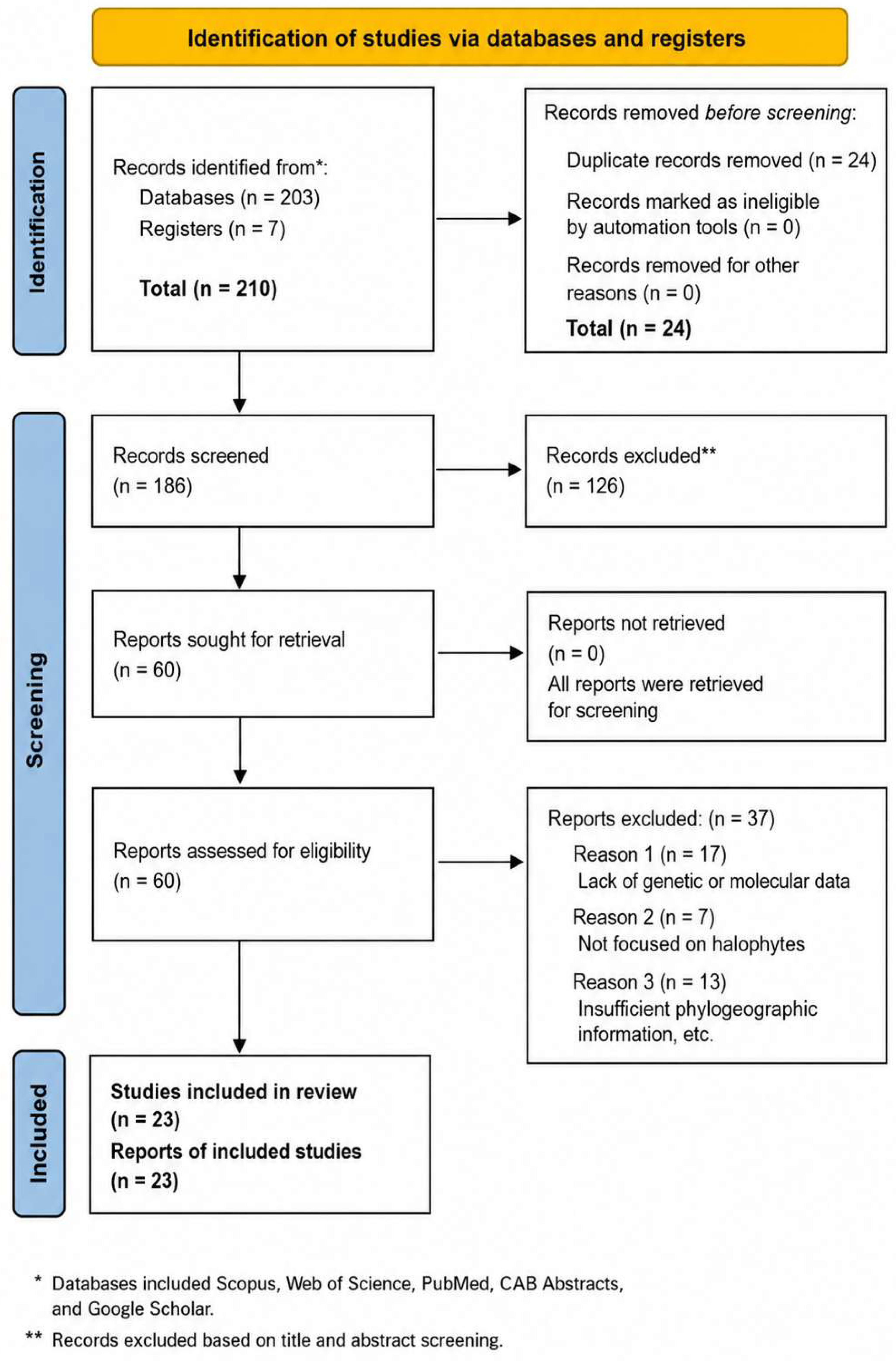
A PRISMA-based screening process was used to identify relevant studies (Figure 2). A total of 210 records were identified through database searching and citation tracking. After removing duplicates (n = 24), 186 studies were screened based on titles and abstracts. Of these, 126 were excluded. Full-text assessment was conducted on 60 studies, of which 37 were excluded due to a lack of genetic data or relevance. A total of 23 studies were included in the final synthesis. The systematic literature review followed PRISMA-informed reporting approaches where applicable. A completed PRISMA checklist based on the MDPI reporting template is provided as Supplementary Materials (Tables S1 and S2). To improve methodological transparency and reproducibility, the review was retrospectively registered on the Open Science Framework (OSF) before manuscript submission (Registration: https://osf.io/vq7js/—accessed on 29 May 2026).

2.5. Data Extraction and Analysis

From each study, the following information was extracted: Taxon studied, Geographic region, Habitat type (coastal or inland), Molecular markers used, Genetic diversity metrics, and key phylogeographic findings. Extracted data were synthesized to identify patterns in genetic diversity, phylogeographic structure, and environmental drivers. Where possible, results were summarized quantitatively to improve analytical depth. The frequency of reported drivers was calculated as the number of studies included, identifying a given mechanism divided by the total number of studies included in the review (n = 23). Because individual studies often identified multiple drivers, percentages are not mutually exclusive and may sum to more than 100%.

3. Results

3.1. Molecular Markers and Research Coverage

3.1.1. Molecular Markers and Genetic Diversity Metrics Used in Phylogeographic Studies of Halophytes

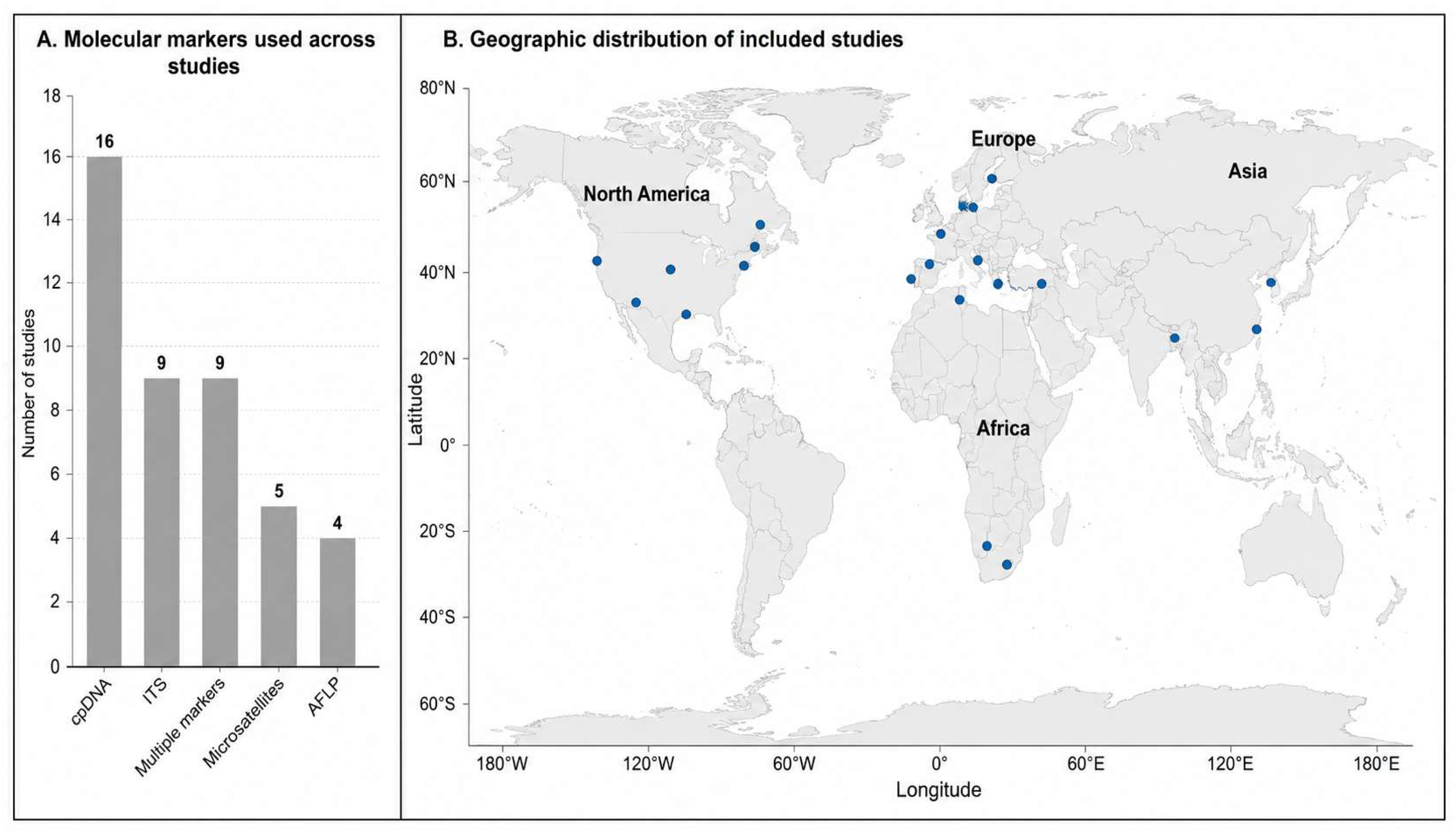
A total of 23 studies were included in the final synthesis, encompassing a range of halophytic plant taxa distributed across coastal and inland saline environments (Figure 3). These studies applied diverse molecular approaches, including chloroplast DNA (cpDNA), internal transcribed spacer (ITS) regions, amplified fragment length polymorphisms (AFLP), microsatellites (SSR), and single-nucleotide polymorphisms (SNPs), reflecting variation in analytical resolution and study objectives. From a methodological perspective, four main marker types were most commonly used (Figure 3A). Chloroplast DNA (cpDNA) was the most frequently applied marker (45%), followed closely by ITS regions (40%). Microsatellites (20%) and AFLPs (15%) were less commonly used but provided higher-resolution insights into population structure. Specifically, 6 out of the 23 studies used a combination of cpDNA and nuclear markers (e.g., ITS, SSR, or SNPs), allowing for more robust inference of both maternal lineage structure and biparental gene flow. Combined markers were used in 30% of the studies. These studies consistently reported patterns of genetic diversity (He) and haplotype diversity (Hd) that varied with habitat type. Most studies (88.9%) reported at least one measure of genetic diversity. Only a minority of studies (33%) consistently reported both haplotype diversity and genetic diversity metrics, indicating low consistency in the joint reporting of key phylogeographic parameters.

3.1.2. Research Coverage and Geographic Distribution

A clear geographic bias was evident across the dataset (Figure 3B). Most studies were conducted in Europe, particularly in Central and Mediterranean regions, with additional contributions from Asia and North America. In contrast, African systems accounted for fewer than 15% of the included studies, with representation largely limited to South Africa, Namibia, and Tunisia. Within the studies meeting the inclusion criteria, research was concentrated in Europe and parts of Asia, whereas comparatively few studies explicitly examined coastal–inland connectivity in Africa, South America, and Australia.
Collectively, these studies demonstrate that halophytes frequently exhibit strong genetic structuring across coastal and inland habitats. Patterns range from phylogeographic differentiation among regional lineages (Atriplex halimus), habitat-associated divergence (Suaeda salsa, Sesuvium portulacastrum), and ecological specialisation along salinity or tidal gradients (Salicornia spp., Spartina alterniflora, Borrichia frutescens), to historical connectivity across broader geographic regions (Hordeum marinum). These findings suggest that both environmental filtering and historical dispersal processes have played important roles in shaping the evolutionary diversification of halophytes.

3.1.3. Patterns of Genetic and Haplotype Diversity in Coastal and Inland Halophytes

Patterns of genetic diversity and population differentiation varied among taxa but showed several recurring trends (Table 1). Coastal populations of Suaeda maritima, Spergularia media, Phragmites australis, and Suaeda spp. generally exhibited higher genetic and haplotype diversity than inland populations. In contrast, inland populations frequently showed lower genetic diversity and greater population differentiation, with distinct genetic clusters reported for Suaeda maritima and Spergularia media.
Several taxa exhibited clear phylogeographic separation between coastal and inland populations. For example, Suaeda salsa contained distinct coastal and inland haplotypes and evidence of ecotype differentiation, while Salicornia persica showed strong differentiation among inland populations, with approximately 55% of genetic variation occurring among populations. Similarly, studies of Phragmites australis and Suaeda spp. reported higher genetic diversity in coastal populations and greater genetic structuring among inland populations.
Other studies highlighted the complexity of genetic patterns across saline habitats. Zostera marina exhibited high genotypic diversity and strong microsatellite structuring in coastal populations, whereas studies incorporating multiple halophytic taxa reported high levels of polymorphism and interspecific genetic variation across coastal and inland environments. Collectively, these studies demonstrate substantial variation in genetic diversity and phylogeographic structure among halophyte taxa occupying coastal and inland saline habitats.

3.2. Phylogeographic Patterns in Coastal Salt Marshes and Inland Saline Plant Populations

Phylogenetic and phylogeographic studies revealed a range of evolutionary patterns across coastal and inland saline habitats (Table 2). Several taxa exhibited geographically structured lineages associated with habitat type or region. In Sarcocornia (≡Salicornia), coastal and inland populations formed distinct phylogenetic clades, indicating the presence of separate evolutionary lineages. Similarly, studies of Salicornia identified clades associated with tidal, supratidal, and inland habitats, with evidence for cryptic taxa and ecological differentiation.
Geographic structuring was also evident in Triglochin maritima, where two major genetic groups were identified, corresponding broadly to Atlantic populations and North Sea/Baltic–inland populations. In Cuscuta pacifica and C. salina, closely related sister taxa exhibited a parapatric distribution associated with coastal and inland habitat specialisation. Molecular phylogenetic analyses of Suaeda subgenus Brezia similarly revealed differentiation associated with habitat type and separate coastal and inland colonisation histories.
At broader taxonomic scales, studies of the Salicornioideae subfamily showed contrasting phylogeographic patterns between coastal and inland lineages, with coastal taxa generally exhibiting greater dispersal and inland taxa displaying more restricted distributions. Ruppia species exhibited particularly complex phylogeographic patterns characterised by hybridisation, habitat-linked divergence, and varying levels of connectivity among populations.
Not all studies reported habitat-associated phylogeographic structure. Analyses of multiple Egyptian halophytic taxa indicated that genetic clustering corresponded more closely with taxonomic relationships than with habitat type. Likewise, studies incorporating multiple halophytic taxa identified genetic discontinuities between coastal and inland populations, although these patterns were frequently associated with historical recolonisation processes and refugial dynamics. Overall, the studies included in this review demonstrate that phylogeographic structure in halophytes is often associated with habitat type, geography, and historical biogeographic processes, although the strength and nature of these patterns vary among taxa.

3.3. Drivers of Genetic Differentiation in Coastal and Inland Halophytes

A range of historical, ecological, demographic, and evolutionary processes were identified as drivers of genetic differentiation between coastal and inland halophyte populations (Table 3). Salinity-mediated ecological selection and habitat shifts associated with environmental gradients were among the most frequently reported mechanisms, each identified in approximately 15% of the included studies. Habitat fragmentation, dispersal capacity, allopatric speciation, hybridisation and polyploidy, and restricted gene flow were each reported in approximately 10% of studies.
Less frequently reported drivers included historical refugia, founder effects and bottlenecks, and anthropogenic influences, each occurring in approximately 5% of studies. Several studies identified multiple interacting drivers, indicating that genetic differentiation is rarely attributable to a single process. Habitat fragmentation and restricted gene flow were commonly associated with increased population differentiation in inland habitats, whereas differences in dispersal capacity were frequently linked to contrasting patterns of connectivity between coastal and inland populations. Historical processes, including refugial persistence and postglacial recolonisation, were also reported to contribute to contemporary phylogeographic structure.
Overall, the studies indicate that genetic differentiation between coastal and inland halophyte populations is shaped by a combination of ecological selection, historical biogeographic processes, habitat connectivity, and evolutionary divergence, with multiple drivers often operating simultaneously within the same taxonomic group.

3.4. Case Study

Evidence from different regions reveals that some halophytic plant taxa occur in both coastal and inland saline environments; nevertheless, specific comparative insights are best shown through targeted case studies. A particularly informative example is offered by phylogeographic and population genetic studies on Triglochin maritima, which have been widely explored in Europe utilizing chloroplast DNA (cpDNA) and nuclear markers [52]. These studies showed a strong distinction between inland and coastal populations, with inland populations frequently having lower haplotype diversity but higher genetic structure, indicating isolation in glacial refugia and limited contemporaneous gene flow [52]. Coastal populations, on the other hand, have increased haplotype sharing and lower differentiation, indicating better connection and postglacial recolonization dynamics [52]. This case study, therefore, provides a well-supported example of how historical processes and habitat connectivity interact to shape contrasting phylogeographic patterns between coastal and inland halophyte populations.
Molecular studies of African halophytes like Salicornia, mainly based on DNA barcoding markers (such as ITS and plastid regions), have shown cryptic diversity and ecological differentiation across coastal salt marshes and inland saline systems [53,54]. These patterns are similar but less well resolved. While these studies demonstrate genetic divergence between habitat types, they generally report lesser resolution in haplotype structure and population-level indices compared to European Triglochin datasets, mostly due to variations in marker choice and sampling intensity [52]. Furthermore, inland populations in South African systems exhibit signs of fragmentation and decreased gene flow [58], similar to patterns seen in European systems, while coastal populations tend to show greater genetic connectivity, possibly due to hydrochory and waterbird-mediated dispersal [52].
The strength of inference regarding genetic differentiation, such as estimates of haplotype diversity, population structure (e.g., F_ST), and gene flow, depends heavily on the molecular markers used, despite the fact that consistent ecological and evolutionary processes function across regions. While research in African systems that depend on barcoding markers may underestimate fine-scale population differentiation, high-resolution markers utilized in European studies allow for more detailed detection of phylogeographic structure.
In Asia, particularly China and East Asia, halophyte research is also relatively well developed and increasingly incorporates modern molecular techniques such as DNA barcoding and phylogenomic approaches. Studies have highlighted the importance of inland and coastal saline habitats for halophyte diversity, particularly within families such as Chenopodiaceae and Poaceae, where species distribution patterns reflect both environmental adaptation and geographic structuring [44]. In addition, phylogeographic analyses in Korea and Japan, such as those on Suaeda malacosperma, reveal distinct genetic clusters shaped by historical range shifts and post-glacial gene flow via land bridge [64]. While slightly less extensive than Europe in terms of long-term phylogeographic synthesis, Asian studies are rapidly expanding and increasingly contribute high-resolution insights into halophyte evolution. In contrast, African halophyte systems remain comparatively underrepresented in the global literature, despite their ecological importance. In South Africa, genera such as Salicornia and Sarcocornia exhibit significant ecological and morphological diversification across coastal salt marshes and inland saline environments. However, available studies are fewer and often focus on taxonomic clarification or ecological distribution rather than large-scale phylogeographic reconstruction. Nonetheless, existing research has documented the presence of cryptic diversity and rapid diversification within these taxa [53,56], suggesting that African systems may hold substantial but still underexplored evolutionary signal.

4. Discussion

This systematic literature review demonstrates that genetic diversity and phylogeographic structure in halophytic plant species are shaped by a combination of ecological connectivity, dispersal processes, and historical environmental change. Across the reviewed studies, a clear geographical pattern emerges in terms of research intensity, with most genetic and phylogeographic work concentrated in Europe and parts of Asia, while Africa and other southern Hemisphere regions remain comparatively underrepresented.

4.1. Which Molecular Markers and Genetic Diversity Metrics Are Most Frequently Used in Phylogeographic Studies of Halophytes?

Phylogeographic studies of halophytes have depended on a reasonably uniform set of molecular markers and genetic diversity indices, while their use varies according to study objectives and technical improvements [65]. Markers, particularly chloroplast DNA (cpDNA), are ideal for reconstructing historical lineage divergence and seed-mediated dispersal pathways, as demonstrated in studies on Triglochin maritima and Salicornioideae [29,30,66]. These datasets are often analyzed using haplotype-based metrics such as haplotype diversity (Hd) and nucleotide diversity (π), which are effective for detecting phylogeographic structure and historical isolation [30,66]. Nuclear ribosomal markers, specifically internal transcribed spacer (ITS) sections, are also frequently utilized to supplement cpDNA by providing biparental perspectives; however, their resolution at the population level may be limited by paralogy [65,67].
Although their use in halophyte systems is still relatively restricted and uneven across regions, single-nucleotide polymorphisms (SNPs) derived from next-generation sequencing techniques have more recently provided genome-wide resolution of both neutral and adaptive variation, enabling more reliable inference of population structure and selection [53]. The most often published metrics in halophyte phylogeographic research are still cpDNA-based haplotype analysis and F-statistics, especially F_ST. However, as the reviewed literature reflects, variation in marker choice and analytical approaches complicates direct comparisons among studies. In order to improve inference of gene flow, historical processes, and adaptive differentiation in coastal and inland saline environments, there is a need for greater methodological consistency or integrative approaches that combine multiple marker systems.
Direct comparisons of genetic diversity indices across halophyte studies must be interpreted with caution because the included research employed a wide range of molecular markers, each with distinct inheritance patterns, mutation rates, and analytical resolution. As summarised in Table 1, RAPDs revealed high intrapopulational diversity in Atriplex halimus [47], rDNA variants highlighted tidal gradient structuring in Salicornia spp. [48], AFLPs and MS-AFLPs demonstrated strong epigenetic differentiation in Spartina alterniflora and Borrichia frutescens [29], cpSSR markers captured phylogeographic disjunctions in Hordeum marinum and H. gussoneanum [49], and RAPDs/ITS revealed ecological differentiation in Sesuvium portulacastrum [50]. These examples illustrate that while broad qualitative patterns of connectivity and divergence can be identified, quantitative comparisons of heterozygosity (He) or haplotype diversity (Hd) across marker systems are not directly comparable. This limitation has been noted in similar reviews of non-halophytic plants, which emphasise methodological heterogeneity and call for greater standardisation and genomic approaches in future phylogeographic research.

4.2. How Does Research Effort Vary?

Geographical disparities are evident in halophyte phylogeography research effort and methodological techniques, with Europe being the most well-studied region, followed by portions of Asia, while Africa and other places continue to be relatively underrepresented. Dense sampling designs, wide geographic coverage, and the use of several, frequently high-resolution molecular markers (such as cpDNA in conjunction with SSRs or SNPs) are characteristics of European studies that allow for the precise reconstruction of historical processes like glacial refugia, postglacial recolonization, and fine-scale population structure [29,30].
On the other hand, Asian research, especially from China, has grown quickly but frequently focuses on species identification, salinity-driven adaptation, and distribution patterns. It often uses DNA barcoding markers (such as ITS and plastid regions) and more restricted population-level sampling, which can limit phylogeographic inference [53]. Despite evidence of similar ecological processes like habitat fragmentation and dispersal limitation, African studies are still scarce and are typically characterized by smaller sample sizes, fewer loci, and a reliance on lower-resolution markers, leading to more fragmented insights into genetic diversity and connectivity [67]. The need for more balanced sampling and the adoption of integrative, standardized molecular approaches across regions is highlighted by these regional differences in research intensity and methodological resolution, which restrict cross-regional comparability and contribute to a bias toward well-studied temperate systems.

4.3. How Does Genetic and Haplotype Diversity Differ Between Coastal and Inland Halophyte Populations?

Across all regions, a consistent pattern emerges in which coastal populations exhibit higher genetic and haplotype diversity, whereas inland populations show reduced diversity and increased genetic structuring. European research provides compelling evidence for this pattern, especially in species like Suaeda maritima and Spergularia media, where inland populations exhibit distinct signs of genetic bottlenecks, decreased diversity, and greater differentiation [40,41]. Similarly, studies conducted in Asia, such as those on Suaeda salsa and multi-species datasets from China, show that coastal populations have higher haplotype richness than their inland equivalents [42,44].
Coastal communities, on the other hand, tend to have more within-population genetic variety due to increased connectivity; however, the underlying determinants of this trend differ by region. In Europe, coastal halophytes have a high genetic diversity due to postglacial recolonisation, secondary contact across lineages, and successful dispersal pathways such as hydrochory, which increase gene flow and haplotype mixing [29,30]. Environmental factors, most particularly salinity, dominate the shaping of genetic diversity throughout Asia, with local adaptation contributing to population differences even where migration is allowed [53].
Although evidence is limited in African systems, genetic diversity appears to be influenced by a combination of habitat fragmentation, episodic connectivity, and biotic dispersal mechanisms such as waterbird-mediated transport, which allows for long-distance gene flow between otherwise isolated saline habitats [68,69]. However, the scarcity of studies and the limited use of standardised genetic diversity metrics like haplotype diversity (Hd) and anticipated heterozygosity (H_E) make regional comparisons difficult. As a result, while roughly similar drivers such as dispersal, environmental selection, and historical processes exist across regions, their relative relevance and detectability vary, resulting in stronger and more resolved inferences in Europe and parts of Asia than in Africa.

4.4. What Phylogenetic and Phylogeographic Patterns Distinguish Coastal and Inland Halophyte Populations, and How Consistent Are These Patterns?

Phylogenetic and phylogeographic investigations demonstrate distinct geographic patterns in halophyte populations, which frequently correspond to coastal and inland environments. In Europe, the best evidence for such structuring is found, with well-defined lineages reported in genera such as Triglochin and Salicornia, which are frequently related to postglacial recolonization processes and refugial dynamics [54,55,57]. During the Pleistocene glaciations, ice sheets blanketed most of northern and central Europe, forcing halophytic species to southern refugia (such as the Iberian, Mediterranean, and Black Sea regions) [40,41,57].
Due to limited gene exchange and long-term separate lineage evolution, this geographic isolation caused population divergence [57]. These refugial populations spread northward during glacial retreat, creating secondary contact zones where different lineages interacted and occasionally intermingled [57]. Considerable phylogeographic splits were produced by these cycles of isolation and expansion, which frequently manifested as discrete haplotype groups and strong population heterogeneity between regions [57]. While interior populations remained more isolated, maintaining traces of past fragmentation and divergence, recolonization pathways promoted increased connectedness and haplotype sharing in coastal systems [40,41]. Consequently, European halophytes frequently exhibit strong genetic structuring shaped by glacial history, making this region one of the clearest examples of how past climatic events have driven phylogeographic differentiation between coastal and inland populations.
Asian studies also reveal extensive phylogeographic structuring, particularly in genera like Suaeda, where lineage divergence has been heavily impacted by historical climatic changes and changing environmental conditions [42,44]. In contrast to Europe, where glaciation was the primary driver, phylogeographic patterns in Asia are more intimately tied to monsoonal dynamics, aridification cycles, and sea-level variations, which repeatedly altered the breadth and connectivity of coastal and interior saline habitats [42]. For example, variations in the East Asian monsoon and the growth and contraction of inland deserts and saline basins resulted in alternating periods of population isolation and connection, fostering both divergence and secondary contact across lineages [42,44]. The distribution of salt marshes and tidal flats in coastal areas was impacted by Quaternary sea-level fluctuations, which shaped genetic connections and dispersal routes [16]. Even though these processes have produced distinct phylogeographic groupings and evidence of salinity-driven adaptation, many Asian studies are still regionally focused and frequently rely on lower-resolution markers and fewer taxa than European datasets, which may make it more difficult to find broader comparative patterns and deeper historical structure [41,42].
In contrast, phylogeographic evidence from coastal and inland saline habitats in Africa is limited. Existing research suggests the existence of genetic divergence and possibly cryptic variation [54], but a lack of thorough sampling and high-resolution genomic data limits the ability to reconstruct detailed evolutionary histories. Nonetheless, Southern African paleoenvironmental dynamics are vital for understanding these patterns. Unlike the Northern Hemisphere, this region did not experience substantial glaciation; instead, long-term climate variability, particularly variations in aridity, rainfall regimes, and sea-level fluctuations, may have shaped the distribution and interconnection of coastal and inland saline systems.
Increased aridity likely contributed to the expansion of inland salt pans and habitat fragmentation, but wetter periods may have improved system connectedness. Furthermore, biotic dispersal, particularly via migratory waterbirds, is seen as a critical mechanism for facilitating long-distance gene flow between otherwise isolated saline habitats, allowing propagules to migrate between coastal and inland environments [67]. This combination of climatic variability and episodic dispersal is likely to have influenced genetic structure in ways distinct from glaciation-driven systems, but the scarcity of region-specific phylogeographic studies limits robust inference, highlighting a significant gap in understanding halophyte evolution in Southern Hemisphere ecosystems [67]. Others, such as Ruppia, have a high phylogeographic complexity due to hybridisation and introgression [31], demonstrating that evolutionary processes can differ significantly between taxa.

4.5. What Are the Primary Drivers of Genetic Differentiation Between Coastal and Inland Halophyte Populations, and How Consistently Are These Drivers Supported Across Studies?

The primary drivers of genetic differentiation include restricted gene flow, historical processes, environmental selection, and habitat fragmentation, although their relative importance varies across studies. Habitat fragmentation and restricted gene flow operate primarily through the physical isolation of populations in inland saline systems, where discontinuous habitats such as salt pans and inland depressions limit dispersal and reduce pollen and seed exchange. This results in increased genetic structuring and reduced connectivity, particularly evident in European studies of Suaeda maritima and Spergularia media, which show strong population differentiation and limited gene flow among isolated sites [40,41]. While direct measurements of dispersal limitation are restricted to a subset of studies, broader support is inferred from consistent patterns of elevated inland genetic structure across taxa.
Historical processes, including glacial refugia and postglacial recolonisation, act through long-term spatial isolation followed by range expansion, leading to founder effects, lineage sorting, and secondary contact zones. These mechanisms are especially well resolved in European systems due to detailed palaeoclimatic history, providing a clear framework for interpreting phylogeographic breaks [57], whereas in Asian systems, similar processes are inferred but with lower temporal resolution. Environmental selection, particularly along salinity gradients, drives genetic differentiation through differential survival and reproduction of genotypes adapted to varying osmotic and ionic conditions. This form of selection can generate divergence even in the presence of gene flow, as demonstrated in Arabidopsis, Salicornia, and Suaeda, where salinity tolerance correlates with population genetic structure across regions [42].
Additional mechanisms such as dispersal limitation, hybridisation, and polyploidy further shape genetic patterns. Dispersal limitation reduces effective gene flow between coastal and inland habitats due to barriers to seed and pollen movement, whereas coastal systems often maintain higher connectivity through water-mediated dispersal [31,60]. In some taxa, hybridisation and polyploidy generate additional genetic diversity by increasing allelic variation and facilitating lineage diversification [60]. Collectively, these processes interact to produce the observed spatial genetic structure, with inland populations generally exhibiting stronger differentiation than coastal populations due to reduced connectivity and stronger environmental filtering [31].

4.6. How Does Geographic Research Bias Influence Current Understanding of Halophyte Phylogeography?

The literature has a clear regional bias, with Europe and Asia dominating phylogeographic research while Africa and other Southern Hemisphere regions remain comparatively underrepresented. The majority of published studies originate from European and Asian systems and frequently employ more advanced molecular approaches, including multi-locus datasets and next-generation sequencing (NGS) techniques, which provide higher-resolution insights into population structure, gene flow, and evolutionary history. In contrast, African halophyte research remains more limited in scope, although this is beginning to change [68]. In South Africa, recent applications of NGS-based approaches (e.g., RAD-seq and genome-wide SNP analyses) are emerging, particularly in biodiversity and conservation genomics, demonstrating increasing capacity to resolve fine-scale population structure in both terrestrial and coastal systems. However, these approaches have not yet been widely applied to inland saline systems such as salt pans, which remain largely underexplored despite their ecological and evolutionary significance.
This imbalance is not solely explained by economic constraints but also reflects differences in research focus and historical scientific priorities. Much of the existing halophyte phylogeographic work in Africa has concentrated on coastal salt marshes, with studies on taxa such as Juncus, Zostera, Triglochin and Salicornia [69,70,71,72] primarily focusing on estuarine and intertidal systems, while largely excluding inland saline environments. As a result, inland salt pans and ephemeral saline systems remain poorly integrated into broader phylogeographic frameworks, despite their potential to provide key insights into isolation, adaptation, and dispersal processes. This creates a significant knowledge gap, particularly in regions such as southern Africa, where coastal and inland systems occur in proximity but are rarely studied together within a unified evolutionary context.
While economic disparities in research output (e.g., GDP-linked productivity patterns) have been shown to contribute to global scientific asymmetries [73], in the context of halophyte phylogeography, the issue is also driven by limited thematic integration and uneven sampling priorities. Consequently, biodiversity-rich regions such as southern Africa are not only undersampled but also underutilised in terms of their comparative evolutionary potential. The emerging use of NGS technologies in South African research highlights a clear opportunity to bridge this gap, particularly by integrating coastal and inland saline systems within a single phylogeographic framework.
Overall, this study demonstrates that while broad patterns of coastal–inland genetic differentiation are globally consistent, the strength, resolution, and interpretability of these patterns are strongly influenced by regional research effort and methodological investment. European and Asian systems therefore provide the most detailed evolutionary reconstructions, whereas Africa, South America, and Australia remain important frontiers for halophyte phylogeographic research. Although recent studies from Australia have begun to address broader evolutionary questions using high-resolution phylogenomic approaches, such as the reconstruction of diversification patterns in Tecticornia and related Salicornieae lineages [74], population-level studies explicitly comparing coastal and inland saline populations remain comparatively scarce.
Lastly, while habitat fragmentation, restricted gene flow, historical refugia, salinity-mediated selection, and dispersal capacity emerged as the most frequently reported drivers of genetic differentiation in the studies reviewed, the evolutionary dynamics of halophyte populations are likely influenced by a broader suite of interacting factors. Species age and evolutionary history may determine the time available for lineage divergence and the accumulation of genetic variation [75,76], while geographic range size can influence both population connectivity and opportunities for local adaptation [77,78]. Differences in sampling extent and geographic coverage among studies may also affect the detection of genetic structure and phylogeographic patterns. Furthermore, population size and demographic processes, including population expansion, contraction, bottlenecks, and extinction–recolonisation dynamics, can strongly influence levels of genetic diversity within and among populations [79,80]. Historical climatic fluctuations and postglacial recolonisation events have similarly been shown to shape contemporary patterns of genetic structure across many plant taxa [80]. The direction and magnitude of dispersal between coastal and inland habitats may further influence connectivity and divergence, particularly where past shifts in habitat distribution have facilitated range expansion or secondary contact among populations. Consequently, the drivers identified in this review should be viewed as the most frequently reported mechanisms within the available literature rather than an exhaustive explanation of the processes governing halophyte genetic diversity and phylogeographic structure. Addressing this imbalance through increased geographic coverage, integration of inland salt pan systems, and wider adoption of genomic tools is essential for achieving a more complete and representative global understanding of halophyte evolutionary ecology.

5. Conclusions

This systematic literature review shows that halophytic plant species’ genetic diversity and phylogeographic structure are influenced by a consistent set of ecological and evolutionary processes, including habitat fragmentation, dispersal limitation, environmental selection, and historical climatic change. Across the research examined, a consistent trend emerges that coastal populations have more genetic and haplotype diversity and greater connectedness, whereas inland populations have lower diversity, stronger genetic structuring, and greater population isolation. These patterns are congruent with theoretical predictions of gene flow and drift in fragmented landscapes, and they are observed across multiple taxa and locations.
However, the intensity and resolution of these conclusions are not universally applicable. The existing understanding of halophyte genetic diversity is spatially skewed, with the majority of high-resolution phylogenetic research focusing on Europe and parts of Asia. These areas benefit from long-term research investments, intense sampling, and the use of modern genetic technologies, which enable thorough reconstruction of population structure and evolutionary history. African saline environments, including inland salt pans and estuary systems, are considerably underrepresented, with current studies frequently limited in taxonomic coverage and methodological resolution. As a result, Northern Hemisphere datasets have a disproportionate influence on worldwide halophyte phylogeography.
It is therefore recommended that future research prioritise (i) increased geographic coverage of underrepresented regions, particularly African, South American and Australian inland saline systems, (ii) the integration of coastal and inland habitats within unified phylogeographic frameworks, and (iii) broader adoption of high-resolution genomic approaches (e.g., SNP-based and next-generation sequencing methods) to improve comparability across regions and taxa. Importantly, future studies should not only expand sampling due to financial or logistical capacity, but also strategically address underexplored systems, such as inland salt pans in southern Africa. These systems have been historically overlooked despite their high potential for resolving key questions in dispersal, isolation, and adaptation. Strengthening research in these systems, particularly through emerging genomic capacity in regions such as South Africa, will be essential for achieving a more balanced and globally representative understanding of halophyte evolutionary ecology in a changing climate. Inland saline ecosystems, though globally understudied, hold significant conservation importance. Their unique genetic lineages and adaptive strategies are critical for maintaining biodiversity under increasing anthropogenic pressures and climate-driven aridity. Recognising and protecting these systems is essential for safeguarding global saline biodiversity.

Supplementary Materials

The following supporting information can be downloaded at: https://www.mdpi.com/article/10.3390/coasts6030032/s1, Table S1: Summary of studies screened for eligibility during the systematic review, indicating studies included in the final synthesis and those excluded according to the predefined eligibility criteria, with the included studies highlighted. Table S2: Characteristics of the 23 phylogeographic studies included in the systematic review, summarising the study region, halophyte taxon, habitat type, molecular markers, sample size, and principal findings related to genetic diversity, phylogeographic structure, and drivers of genetic differentiation.

Author Contributions

D.V.: Writing—review and editing, Writing—original draft, Visualization, Validation, Supervision, Software, Resources, Project administration, Methodology, Investigation, Funding acquisition, Formal analysis, Data curation, Conceptualization. N.M.: Writing—review and editing, Writing—original draft, Visualization, Validation, Project administration, Methodology, Investigation, Formal analysis, Data curation, Conceptualization. All authors have read and agreed to the published version of the manuscript.

Funding

This research received no external funding.

Data Availability Statement

The original contributions presented in this study are included in the article. Further inquiries can be directed to the corresponding author.

Acknowledgments

The funders had no role in the study design, collection or analysis of the data, the writing of the manuscript or the decision to publish. During the preparation of Figure 1, the authors used ChatGPT 5.5 (OpenAI, San Francisco, CA, USA) for the purposes of Figure 1’s concept and graphical design. The authors have reviewed and edited the output and take full responsibility for the content of this publication. You can find further information at the link https://www.mdpi.com/ethics#_bookmark3, accessed on 22 June 2026.

Conflicts of Interest

The authors declare no conflicts of interest.

References

  1. Adams, J.; Bandeira, S. Salt Marshes; Nairobi Convention: Nairobi, Kenya, 1995. [Google Scholar]
  2. Chapman, V.J. The new perspective in the halophytes. Q. Rev. Biol. 1942, 17, 291–311. [Google Scholar] [CrossRef] [Scilit]
  3. Mcowen, C.J.; Weatherdon, L.V.; Van Bochove, J.W.; Sullivan, E.; Blyth, S.; Zockler, C.; Stanwell-Smith, D.; Kingston, N.; Martin, C.S.; Spalding, M.; et al. A global map of saltmarshes. Biodivers. Data J. 2017, 5, e11764. [Google Scholar] [CrossRef] [Scilit]
  4. Sharma, L.K.; Naik, R. Saline wetland ecosystems. In Conservation of Saline Wetland Ecosystems: An Initiative Towards UN Decade of Ecological Restoration; Springer Nature: Singapore, 2024; pp. 33–75. [Google Scholar]
  5. Bowen, J.L.; Spivak, A.C.; Bernhard, A.E.; Fulweiler, R.W.; Giblin, A.E. Salt marsh nitrogen cycling: Where land meets sea. Trends Microbiol. 2024, 32, 565–576. [Google Scholar] [PubMed]
  6. Vernberg, F.J. Salt-marsh processes: A review. Environ. Toxicol. Chem. Int. J. 1993, 12, 2167–2195. [Google Scholar] [CrossRef]
  7. Chmura, G.L.; Anisfeld, S.C.; Cahoon, D.R.; Lynch, J.C. Global carbon sequestration in tidal, saline wetland soils. Glob. Biogeochem. Cycles 2003, 17, 1111–1132. [Google Scholar] [CrossRef] [Scilit]
  8. Raw, J.L.; Van Niekerk, L.; Chauke, O.; Mbatha, H.; Riddin, T.; Adams, J.B. Blue carbon sinks in South Africa and the need for restoration to enhance carbon sequestration. Sci. Total Environ. 2023, 859, 160142. [Google Scholar] [CrossRef] [Scilit] [PubMed]
  9. Frey, R.W.; Basan, P.B. Coastal salt marshes. In Coastal Sedimentary Environments; Springer: New York, NY, USA, 1985; pp. 225–301. [Google Scholar]
  10. Sarika, M.; Zikos, A. Coastal salt marshes: Structure and function of plant communities. In Handbook of Halophytes: From Molecules to Ecosystems Towards Biosaline Agriculture; Springer International Publishing: Cham, Switzerland, 2020; pp. 1–39. [Google Scholar]
  11. Mngomezulu, N.T.; Peer, N.; Rajkaran, A.; Veldkornet, D.A. Physico-chemical variables influencing the distribution and abundance of macroinvertebrates in salt marsh habitats of the Berg River Estuary, South Africa. Afr. J. Mar. Sci. 2026, 48, 61–78. [Google Scholar] [CrossRef] [Scilit]
  12. Eleuterius, L.N.; Eleuterius, C.K. Tide levels and salt marsh zonation. Bull. Mar. Sci. 1979, 29, 394–400. [Google Scholar]
  13. Hu, J.; Yan, J.; Bian, Z.; Gong, Z.; Zhu, D. Multiscale Structural Patterns of Intertidal Salt Marsh Vegetation in Estuarine Wetlands and Its Interactions with Tidal Creeks. J. Mar. Sci. Eng. 2025, 13, 946. [Google Scholar] [CrossRef] [Scilit]
  14. Pennings, S.C.; Bertness, M.D. Salt marsh communities. Mar. Community Ecol. 2001, 11, 289–316. [Google Scholar]
  15. Teixeira, A.; Duarte, B.; Caçador, I. Salt marshes and biodiversity. In Sabkha Ecosystems: Volume IV: Cash Crop Halophyte and Biodiversity Conservation; Springer: Dordrecht, The Netherlands, 2014; pp. 283–298. [Google Scholar]
  16. Mucina, L.; Rutherford, M.C.; Powrie, L.W.; Gerber, J.; Bezuidenhout, H.; Sieben, E.J.; Cilliers, S.S.; du Preez, P.J.; Manning, J.C.; Hoare, D.B.; et al. Inland azonal vegetation. In The Vegetation of South Africa, Lesotho and Swaziland; South African National Biodiversity Institute: Pretoria, South Africa, 2006; Volume 19, pp. 630–631. [Google Scholar]
  17. Rodríguez-Valera, F. Introduction to saline environments. In The Biology of Halophilic Bacteria; CRC Press: Boca Raton, FL, USA, 2020; pp. 1–23. [Google Scholar]
  18. Ghazanfar, S.A.; Böer, B.; Al Khulaidi, A.W.; El-Keblawy, A.; Alateeqi, S. Plants of Sabkha ecosystems of the Arabian Peninsula. In Sabkha Ecosystems: Volume VI: Asia/Pacific; Springer International Publishing: Cham, Switzerland, 2019; pp. 55–80. [Google Scholar]
  19. Mucina, L.; Adams, J.B.; Knevel, I.C.; Rutherford, M.C.; Powrie, L.W.; Bolton, J.J.; van der Merwe, J.H.; Anderson, R.J.; Bornman, T.G.; le Roux, A.; et al. Coastal vegetation of South Africa. In The Vegetation of South Africa, Lesotho and Swaziland; South African National Biodiversity Institute: Pretoria, South Africa, 2006; pp. 658–697. [Google Scholar]
  20. Kawshani, G.; Vanderklift, M.A.; Worthington, T.A.; Navarro, A.; Deeks, E.; Wickramaratne, C.; Fernando, A.; Wijenayake, K.; Premakantha, T.; de Silva, D.S.M.; et al. A call for unified definitions and classifications for saltmarshes for accurate mapping of extent: A case study from Sri Lanka. Preprint 2026. [Google Scholar] [CrossRef] [Scilit] [PubMed]
  21. Flowers, T.J.; Yeo, A.R. Ion relations of plants under drought and salinity. Aust. J. Plant Physiol. 1986, 13, 75–91. [Google Scholar] [CrossRef] [Scilit]
  22. Kumari, A.; Das, P.; Parida, A.K.; Agarwal, P.K. Proteomics, metabolomics, and ionomics perspectives of salinity tolerance in halophytes. Front. Plant Sci. 2015, 6, 537. [Google Scholar] [CrossRef] [Scilit] [PubMed]
  23. Flowers, T.J.; Colmer, T.D. Plant salt tolerance: Adaptations in halophytes. Ann. Bot. 2015, 115, 327–331. [Google Scholar] [CrossRef] [Scilit] [PubMed]
  24. Flowers, T.J.; Colmer, T.D. Salinity tolerance in halophytes. New Phytol. 2008, 179, 945–963. [Google Scholar] [CrossRef] [Scilit] [PubMed]
  25. Mohamed, R.A.Z.; Khalil, W.; Zaghloul, M. Exploring the Physiological and Molecular Mechanisms of Halophytes’ Adaptation to High Salinity Environments: Implications for Enhancing Plant Salinity Tolerance. Catrina: Int. J. Environ. Sci. 2023, 28, 93–107. [Google Scholar] [CrossRef] [Scilit]
  26. Mann, A.; Lata, C.; Kumar, N.; Kumar, A.; Kumar, A.; Sheoran, P. Halophytes as new model plant species for salt tolerance strategies. Front. Plant Sci. 2023, 14, 1137211. [Google Scholar] [CrossRef] [Scilit] [PubMed]
  27. Weber, D.J. Adaptive mechanisms of halophytes in desert regions. In Salinity and Water Stress: Improving Crop Efficiency; Springer: Dordrecht, The Netherlands, 2009; pp. 179–185. [Google Scholar]
  28. Foust, C.M.; Preite, V.; Schrey, A.W.; Alvarez, M.; Robertson, M.H.; Verhoeven, K.J.F.; Richards, C.L. Genetic and epigenetic differences associated with environmental gradients in replicate populations of two salt marsh perennials. Mol. Ecol. 2016, 25, 1639–1652. [Google Scholar] [CrossRef] [Scilit] [PubMed]
  29. Weising, K.; Freitag, H. Phylogeography of halophytes from European coastal and inland habitats. Zool. Anz. 2007, 246, 279–292. [Google Scholar] [CrossRef] [Scilit]
  30. Kadereit, J.W.; Arafeh, R.; Somogyi, G.; Westberg, E. Terrestrial growth and marine dispersal? Comparative phylogeography of five coastal plant species at a European scale. Taxon 2005, 54, 861–876. [Google Scholar] [CrossRef] [Scilit]
  31. Triest, L.; Beirinckx, L.; Sierens, T. Lagoons and saltwater wetlands gaining diversity: A molecular approach revealing cryptic lineages of Ruppia. Aquat. Conserv. Mar. Freshw. Ecosyst. 2018, 28, 370–382. [Google Scholar]
  32. Álvarez, I.J.F.W.; Wendel, J.F. Ribosomal ITS sequences and plant phylogenetic inference. Mol. Phylogenet. Evol. 2003, 29, 417–434. [Google Scholar] [CrossRef] [Scilit] [PubMed]
  33. Sunnucks, P. Efficient genetic markers for population biology. Trends Ecol. Evol. 2000, 15, 199–203. [Google Scholar] [CrossRef] [Scilit] [PubMed]
  34. Jw, D. Genome-wide genetic marker discovery and genotyping using next-generation sequencing. Nat. Genet 2011, 12, 499–510. [Google Scholar] [CrossRef] [Scilit]
  35. Adams, J.B. Salt marsh at the tip of Africa: Patterns, processes and changes in response to climate change. Estuar. Coast. Shelf Sci. 2020, 237, 106650. [Google Scholar] [CrossRef] [Scilit]
  36. Tabot, P.T.; Adams, J.B. South African salt marshes: Ecophysiology and ecology in the context of climate change. In Halophytes and Climate Change: Adaptive Mechanisms and Potential Uses; CABI Publishing: Wallingford, UK, 2019; pp. 69–88. [Google Scholar]
  37. Hayder, Z.; Gaied, R.B.; Tlili, A.; Sbissi, I.; Tarhouni, M. Phylogenetic and morphological studies of Sarcocornia and Salicornia (Chenopodiaceae) with the first record of two species new for Tunisia. Genet. Resour. Crop Evol. 2023, 70, 717–729. [Google Scholar]
  38. Flowers, T.J. eHALOPH: A Database of Halophytes and Other Salt-Tolerant Plants. Version 7.10. 2026. Available online: https://ehaloph.uc.pt (accessed on 29 May 2026).
  39. Prinz, K.; Hensen, I.; Schie, S.; Debener, T.; Weising, K. Microsatellite markers for the tetraploid halophyte Suaeda maritima (Chenopodiaceae) and cross-species amplification in related taxa. Mol. Ecol. Resour. 2009, 9, 1247–1249. [Google Scholar] [CrossRef] [Scilit] [PubMed]
  40. Prinz, K.; Weising, K.; Hensen, I. Habitat fragmentation and recent bottlenecks influence genetic diversity and differentiation of the Central European halophyte Suaeda maritima. Am. J. Bot. 2013, 100, 2210–2218. [Google Scholar] [CrossRef] [Scilit] [PubMed]
  41. Prinz, K.; Weising, K.; Hensen, I. Genetic structure of coastal and inland populations of Spergularia media (Caryophyllaceae) in Central Europe. Conserv. Genet. 2010, 11, 2169–2177. [Google Scholar] [CrossRef] [Scilit]
  42. Wang, Z.; Pan, J.; Gao, T.; Wang, Q.; Zhou, D.; Dong, X.; Yang, H.; Zhang, X. Ecological differentiation of the halophyte Suaeda salsa under different habitat conditions. Preprint 2023. [Google Scholar] [CrossRef] [Scilit] [PubMed]
  43. Zhang, X.; Bai, L.; Esfandani-Bozchaloyi, S. Population differentiation and gene flow of Salicornia persica. Caryologia 2022, 75, 33–43. [Google Scholar] [CrossRef] [Scilit]
  44. Yao, P.C.; Gao, H.Y.; Wei, Y.N.; Zhang, J.H.; Chen, X.Y.; Li, H.Q. Evaluating sampling strategy for DNA barcoding study of coastal and inland halo-tolerant Poaceae and Chenopodiaceae. PLoS ONE 2017, 12, e0185311. [Google Scholar] [CrossRef] [Scilit] [PubMed]
  45. Reusch, T.B. Microsatellites reveal high population connectivity in eelgrass (Zostera marina) in two contrasting coastal areas. Limnol. Oceanogr. 2002, 47, 78–85. [Google Scholar] [CrossRef] [Scilit]
  46. Aly, S.; Fouad, N.; Mohamed, H.M.; Abdel-Hamid, A.; Saad, M.E. Molecular characterization of some Egyptian halophytes. S. Afr. J. Bot. 2025, 180, 265–273. [Google Scholar] [CrossRef] [Scilit]
  47. Ortiz-Dorda, J.; Martínez-Mora, C.; Correal, E.; Simón, B.; Cenis, J.L. Genetic structure of Atriplex halimus populations in the Mediterranean Basin. Ann. Bot. 2005, 95, 827–834. [Google Scholar] [CrossRef] [Scilit] [PubMed]
  48. Noble, S.M.; Davy, A.J.; Oliver, R.P. Ribosomal DNA variation and population differentiation in Salicornia L. New Phytol. 1992, 122, 553–565. [Google Scholar] [CrossRef] [Scilit] [PubMed]
  49. Jakob, S.S.; Ihlow, A.; Blattner, F.R. Combined ecological niche modelling and molecular phylogeography revealed the evolutionary history of Hordeum marinum (Poaceae)—Niche differentiation, loss of genetic diversity, and speciation in Mediterranean Quaternary refugia. Mol. Ecol. 2007, 16, 1713–1727. [Google Scholar] [CrossRef] [Scilit] [PubMed]
  50. Lokhande, V.H.; Nikam, T.D.; Suprasanna, P. Sesuvium portulacastrum (L.) L. a promising halophyte: Cultivation, utilization and distribution in India. Genet. Resour. Crop Evol. 2009, 56, 741–747. [Google Scholar] [CrossRef] [Scilit]
  51. De la Fuente, V.; Rufo, L.; Rodríguez, N.; Sánchez-Mata, D.; Franco, A.; Amils, R. A study of Sarcocornia A.J. Scott (Chenopodiaceae) from western Mediterranean Europe. Plant Biosyst. 2016, 150, 343–356. [Google Scholar]
  52. Glenn, E.P.; Brown, J.J.; Blumwald, E. Salt tolerance and crop potential of halophytes. Crit. Rev. Plant Sci. 1999, 18, 227–255. [Google Scholar] [CrossRef]
  53. Steffen, S.; Ball, P.; Mucina, L.; Kadereit, G. Phylogeny, biogeography and ecological diversification of Sarcocornia (Salicornioideae, Amaranthaceae). Ann. Bot. 2015, 115, 353–368. [Google Scholar] [CrossRef] [Scilit] [PubMed]
  54. Kadereit, G.; Piirainen, M.; Lambinon, J.; Vanderpoorten, A. Cryptic taxa should have names: Reflections in the glasswort genus Salicornia (Amaranthaceae). Taxon 2012, 61, 1227–1239. [Google Scholar] [CrossRef] [Scilit]
  55. Piirainen, M.; Liebisch, O.; Kadereit, G. Phylogeny, biogeography, systematics and taxonomy of Salicornioideae (Amaranthaceae/Chenopodiaceae)—A cosmopolitan hygrohalophyte lineage dating back to the Oligocene. Taxon 2017, 66, 109–132. [Google Scholar] [CrossRef] [Scilit]
  56. Slenzka, A.; Mucina, L.; Kadereit, G. Salicornia (Amaranthaceae) in South Africa and Namibia: Rapid spread and ecological diversification of cryptic species. Bot. J. Linn. Soc. 2013, 172, 175–186. [Google Scholar] [CrossRef] [Scilit]
  57. Lambracht, E.; Westberg, E.; Kadereit, J.W. Phylogeographic evidence for the postglacial colonization of the North and Baltic Sea coasts from inland glacial refugia by Triglochin maritima L. Flora 2007, 202, 79–88. [Google Scholar] [CrossRef] [Scilit]
  58. Costea, M.; Wright, M.A.; Stefanović, S. Untangling the systematics of salt marsh dodders: Cuscuta pacifica a new segregate species from Cuscuta salina (Convolvulaceae). Syst. Bot. 2009, 34, 787–795. [Google Scholar] [CrossRef] [Scilit]
  59. Brandt, R.; Lomonosova, M.; Weising, K.; Wagner, N.; Freitag, H. Phylogeny and biogeography of Suaeda subg. Brezia (Chenopodiaceae/Amaranthaceae) in the Americas. Plant Syst. Evol. 2015, 301, 2351–2375. [Google Scholar] [CrossRef] [Scilit]
  60. Kadereit, G.; Mucina, L.; Freitag, H. Phylogeny of Salicornioideae (Chenopodiaceae): Diversification, biogeography, and evolutionary trends in leaf and flower morphology. Taxon 2006, 55, 617–642. [Google Scholar] [CrossRef] [Scilit]
  61. Martínez-Garrido, J.; Serrão, E.A.; Engelen, A.H.; Cox, C.J.; García-Murillo, P.; González-Wangüemert, M. Multilocus genetic analyses provide insight into speciation and hybridization in aquatic grasses, genus Ruppia. Biol. J. Linn. Soc. 2016, 117, 177–191. [Google Scholar]
  62. Prinz, K.; Weising, K.; Hensen, I. Genetic structure of coastal and inland populations of the annual halophyte Suaeda maritima in Central Europe inferred from AFLP markers. Plant Biol. 2009, 11, 812–820. [Google Scholar] [CrossRef] [Scilit] [PubMed]
  63. Von Mering, S.; Kadereit, J.W. Phylogeny, biogeography and evolution of Triglochin (Juncaginaceae): Morphological diversification linked to habitat shifts rather than genetic diversification. Mol. Phylogenet. Evol. 2015, 83, 200–212. [Google Scholar] [CrossRef] [Scilit] [PubMed]
  64. Park, J.S.; Takayama, K.; Suyama, Y.; Choi, B.H. Distinct phylogeographic structure of the halophyte Suaeda malacosperma (Chenopodiaceae/Amaranthaceae), endemic to Korea–Japan region, influenced by historical range shift dynamics. Plant Syst. Evol. 2019, 305, 193–203. [Google Scholar] [CrossRef] [Scilit]
  65. Kadereit, G.; Ball, P.; Beer, S.; Mucina, L.; Sokoloff, D.; Teege, P.; Yaprak, A.E.; Freitag, H. A taxonomic nightmare comes true: Phylogeny and biogeography of glassworts (Salicornia L., Chenopodiaceae). Taxon 2007, 56, 1143–1170. [Google Scholar] [CrossRef] [Scilit]
  66. Ford, B.A.; Ball, P.W. A reevaluation of the Triglochin maritimum complex (Juncaginaceae) in eastern and central North America and Europe. Rhodora 1988, 90, 313–337. [Google Scholar]
  67. Triest, L.; Sierens, T. Is the genetic structure of Mediterranean Ruppia shaped by bird-mediated dispersal or sea currents? Aquat. Bot. 2013, 104, 176–184. [Google Scholar] [CrossRef] [Scilit]
  68. Green, A.J.; Soons, M.; Brochet, A.L.; Kleyheeg, E. Dispersal of plants by waterbirds. In Why Birds Matter: Avian Ecological Function and Ecosystem Services; University of Chicago Press: Chicago, IL, USA, 2016; p. 147. [Google Scholar]
  69. Potts, A.J.; Veldkornet, D.A.; Adams, J.B. A phylogeographic break in a South African coastal saltmarsh macrophyte, Juncus kraussii. S. Afr. J. Bot. 2016, 107, 80–83. [Google Scholar] [CrossRef] [Scilit]
  70. Adams, J.B. Distribution and status of Zostera capensis in South African estuaries—A review. S. Afr. J. Bot. 2016, 107, 63–73. [Google Scholar] [CrossRef] [Scilit]
  71. Phair, N.L.; Toonen, R.J.; Knapp, I.; Von der Heyden, S. Shared genomic outliers across two divergent population clusters of a highly threatened seagrass. PeerJ 2019, 7, e6806. [Google Scholar] [CrossRef] [Scilit] [PubMed]
  72. Brown, C.E.; Veldkornet, D.A.; Boatwright, J.S.; Engelbrecht, A.; Rajkaran, A. The phylogeography and genetic diversity of the salt marsh species Salicornia tegetaria (S. Steffen, L. Mucina and G. Kadereit) Piirainen and G. Kadereit, endemic to South Africa, Namibia and Mozambique. S. Afr. J. Bot. 2019, 123, 270–277. [Google Scholar] [CrossRef] [Scilit]
  73. Beheregaray, L.B. Twenty years of phylogeography: The state of the field and the challenges for the Southern Hemisphere. Mol. Ecol. 2008, 17, 3754–3774. [Google Scholar] [CrossRef] [Scilit] [PubMed]
  74. Žerdoner Čalasan, A.; Morales-Briones, D.F.; Kadereit, G.; Shepherd, K.A. Evolutionary history of Australian samphires (Salicornieae, Amaranthaceae). Ann. Bot. 2026, 137, 247–266. [Google Scholar] [CrossRef] [Scilit] [PubMed] [PubMed Central]
  75. Avise, J.C. Phylogeography: The History and Formation of Species; Harvard University Press: Cambridge, MA, USA, 2000. [Google Scholar]
  76. Excoffier, L.; Foll, M.; Petit, R.J. Genetic consequences of range expansions. Annu. Rev. Ecol. Evol. Syst. 2009, 40, 481–501. [Google Scholar] [CrossRef] [Scilit]
  77. Frankham, R.; Ballou, J.D.; Briscoe, D.A. Introduction to Conservation Genetics, 2nd ed.; Cambridge University Press: Cambridge, UK, 2010. [Google Scholar]
  78. Hamrick, J.L.; Godt, M.J.W. Effects of life history traits on genetic diversity in plant species. Philos. Trans. R. Soc. B 1996, 351, 1291–1298. [Google Scholar] [CrossRef] [Scilit]
  79. Hewitt, G.M. The genetic legacy of the Quaternary ice ages. Nature 2000, 405, 907–913. [Google Scholar] [CrossRef] [Scilit] [PubMed]
  80. Hewitt, G.M. Genetic consequences of climatic oscillations in the Quaternary. Philos. Trans. R. Soc. B 2004, 359, 183–195. [Google Scholar] [CrossRef] [Scilit]
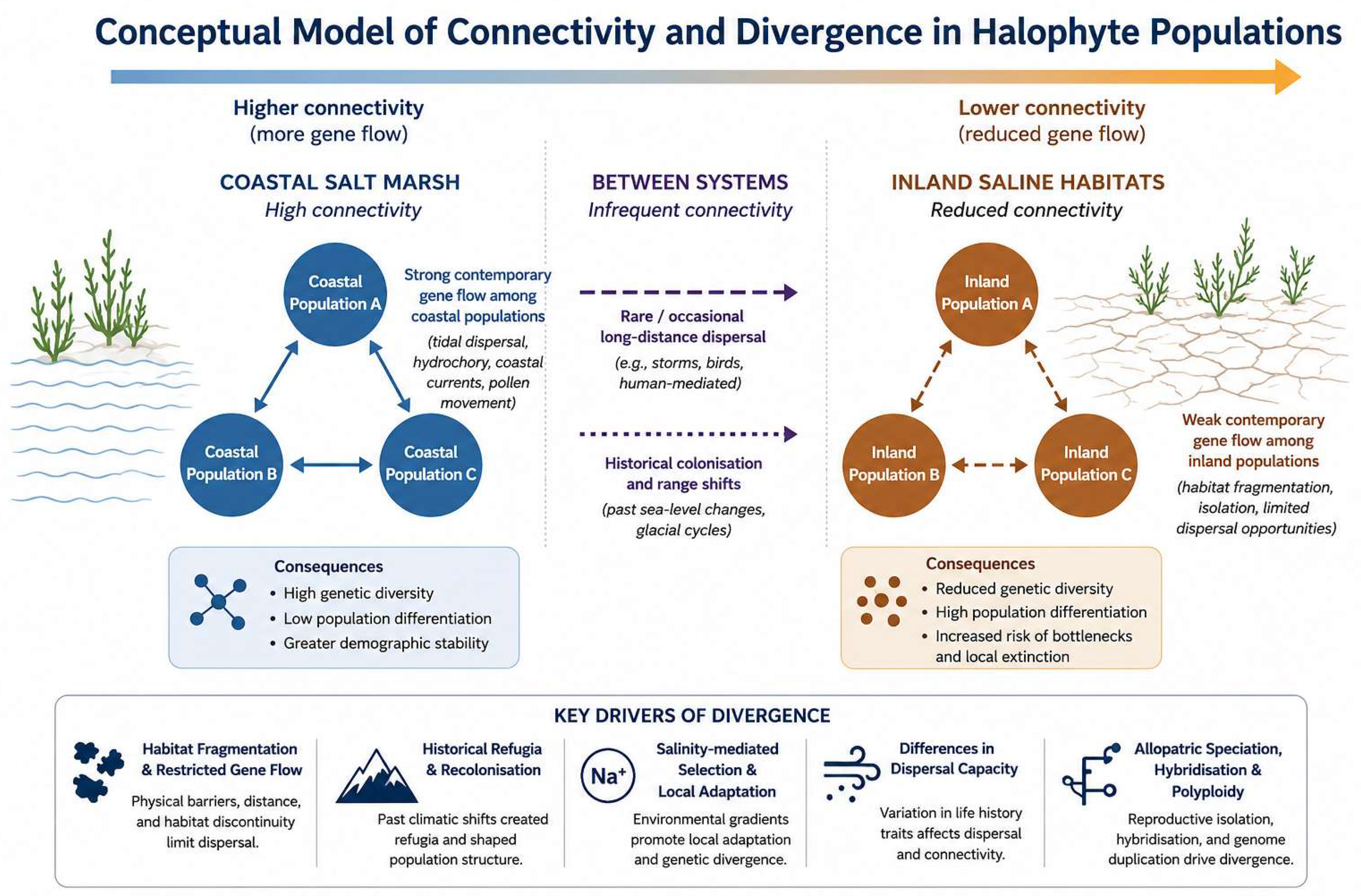
Figure 1. Conceptual model of connectivity and divergence in coastal and inland halophyte populations. Coastal salt marsh populations are typically connected by hydrological and biological dispersal pathways, including tidal transport, hydrochory (water-mediated dispersal), ornithochory (bird-mediated dispersal), and pollen movement, resulting in relatively high levels of contemporary gene flow, greater genetic diversity, and lower population differentiation. In contrast, inland saline habitats are often spatially isolated and fragmented, reducing dispersal opportunities and contemporary connectivity among populations. Restricted gene flow in inland systems can increase population differentiation and contribute to demographic processes such as genetic drift, bottlenecks, founder effects, and localised adaptation. Dashed arrows represent infrequent long-distance dispersal events and historical connectivity associated with past sea-level fluctuations, glacial cycles, marine transgressions and regressions, and range shifts, which may have facilitated colonisation between coastal and inland saline environments. Together, these processes influence the phylogeographic structure of halophyte populations by shaping patterns of genetic diversity, connectivity, divergence, and evolutionary change across saline landscapes. Figure concept and graphical design were generated with assistance from ChatGPT 5.5 (OpenAI, San Francisco, CA, USA) and refined by the authors.
Coasts 06 00032 g001
Figure 2. PRISMA flow diagram illustrates the study selection process for the systematic literature review. Records were identified through database searches and citation tracking, screened based on titles and abstracts, and assessed for eligibility using predefined inclusion criteria. A total of 23 studies were included in the final synthesis.
Coasts 06 00032 g002
Figure 3. Global distribution and molecular approaches used in phylogeographic studies of halophytes across coastal and inland saline environments. (A) Geographic locations of the 23 studies included in this systematic review, showing a concentration of research in Europe, with additional studies in Asia, North America, and limited representation from Africa. Points indicate approximate study locations and are slightly jittered to improve visibility. (B) Frequency of molecular markers used across the included studies, with chloroplast DNA (cpDNA) and internal transcribed spacer (ITS) regions being the most commonly applied, followed by microsatellites and amplified fragment length polymorphisms (AFLP). Together, these panels illustrate both the geographical bias and methodological trends in halophyte phylogeographic research.
Coasts 06 00032 g003
Table 1. Genetic Diversity Patterns of Halophytes in Coastal vs. Inland Habitats. (NR refers to Not Reported).
TaxonHabitat TypeGenetic Diversity (He/% Variation)Haplotype Diversity (Hd)NotesCitation
Suaeda maritimaCoastalHigh (He ≈ 0.70–0.85)High (Hd ≈ 0.80–0.95)Most variation within populations[39,40]
Suaeda maritimaInlandLower (He ≈ 0.40–0.60)Moderate–low (Hd ≈ 0.50–0.70)Strong population differentiation[41]
Spergularia mediaCoastalModerate (He ≈ 0.50–0.70)Moderate–highLess fragmented populations[42]
Spergularia mediaInlandLow (He < 0.50)LowDistinct genetic subclusters[42]
Suaeda salsaCoastalModerate–high (NR exact)High (distinct haplotypes)Phylogenetic distinction from the inland[43]
Suaeda salsaInlandHigh intraspecific variationHighEcotype differentiation[43]
Salicornia persicaInland~55% variation among populationsNRStrong differentiation[44]
Phragmites australisCoastalHigher genetic diversity (NR exact)Higher HdCoastal populations more diverse[44]
Phragmites australisInlandLower genetic diversityLower HdReduced diversity inland[44]
Suaeda spp.CoastalHigher diversityHigher HdCoastal sampling increases richness[44]
Suaeda spp.InlandLower diversityLower HdGreater structuring inland[44]
Zostera marinaCoastalHigh genotypic diversity (clonal richness R high)NRStrong microsatellite structuring[45]
Multiple halophytic taxaCoastal & InlandHigh polymorphism (ISSR/AFLP)NRHigh interspecific variation[46]
Atriplex halimusCoastal & InlandAMOVA: 54.36% variance between two genetic groups; high intrapopulational diversity (301/306 unique haplotypes)NRHigh intrapopulational diversity; two major genetic groups (G1 Iberian/France vs. G2 southern/eastern Mediterranean)[47]
Salicornia spp.Coastal & InlandrDNA variants (10.5 kb vs. 12 kb) structured by tidal inundation gradientNRGenetic differentiation along tidal gradient; upper vs. lower marsh taxa monomorphic for different rDNA variants; evidence of predominant inbreeding[48]
Spartina alternifloraCoastalAFLP haplotype diversity ≈ 0.317–0.412Epigenotype diversity ≈ 0.372High genetic diversity; epigenetic variation strongly correlated with habitat salinity gradients[28]
Borrichia frutescensInlandAFLP haplotype diversity ≈ 0.249–0.316Epigenotype diversity ≈ 0.301High genetic diversity; epigenetic variation strongly correlated with habitat salinity gradients[28]
Hordeum marinumCoastalcpSSR haplotypes (6 detected); nucleotide diversity high in Iberian PeninsulaNRIberian populations retain higher diversity; connectivity with Central Mediterranean populations[49]
Hordeum gussoneanumInlandChloroplast variation absent within cytotypesNRTetraploid cytotype shows ecological shift to inland mountainous habitats; reduced connectivity with diploid progenitor[49]
Sesuvium portulacastrumCoastal & InlandRAPD polymorphism ≈ 39.25%; ITS ≈ 37.5%; Ac markers ≈ 66.7%NRHigh intra-specific diversity; coastal vs. inland clones show ecological and anthropogenic differentiation[50]
Table 2. Phylogenetic/Phylogeographic Structure of Halophytes in different regions. Taxonomic note: Sarcocornia is currently treated as part of Salicornia following molecular phylogenetic evidence [48]. Historical species names used in the original studies are retained in the table where appropriate and indicated as Sarcocornia (≡Salicornia).
TaxonRegionsPhylogenetic/Phylogeographic PatternNotesCitation
Sarcocornia (≡Salicornia)Coastal & InlandDistinct phylogenetic clades associated with geographyCoastal and inland populations form separate lineages[37,51,52,53]
SalicorniaCoastal & InlandClades correspond to tidal, supratidal, inland habitatsCryptic taxa identified; ecological differentiation[54,55,56]
Triglochin maritimaCoastal & InlandTwo major genetic groups (Atlantic vs. North Sea/Baltic & inland)Coastal populations originated from inland refugia[57]
Cuscuta pacifica/C. salinaCoastal & InlandSister species, parapatric distributionCoastal vs. inland habitat specialization[58]
Suaeda subg. BreziaCoastal & InlandMolecular phylogeny shows differentiation by habitatCoastal vs. inland colonization events[59]
Salicornioideae (subfamily)Coastal & InlandCoastal lineages show higher dispersal; inland lineages more restrictedSalt tolerance evolved in coastal habitats[55,60]
Ruppia spp.Coastal & InlandHigh phylogeographic complexity with hybridisation and habitat-linked divergenceCoastal populations more connected; inland taxa show ecological specialization[29,31,61]
Multiple halophytic taxa/Multiple halophytesCoastal & InlandGenetic discontinuities between coastal and inland populationsPatterns linked to postglacial recolonisation and refugia[29]
Egyptian halophytic taxa Mixed halophytes (Egypt)Coastal & InlandGenetic clustering reflects taxonomic relationships rather than habitatSuggests phylogeny may override environmental separation[46]
Table 3. Drivers of Differentiation Between Coastal and Inland Halophytes.
DriverEffect/MechanismExample/NotesCitation
Ecological driversSalinity gradients; habitat fragmentation; dispersal limitationSuaeda, Salicornia
Supported in ~50% of studies; strongest in inland systems
[40,42,44]
Historical driversGlacial refugia; postglacial recolonisation; marine transgression/regressionTriglochin maritima, Salicornioideae
Strong evidence in European datasets; moderate elsewhere
[55,57,60]
Evolutionary driversHybridisation; polyploidy; allopatric speciation; introgressionRuppia, Salicornia, Suaeda
Documented in ~30% of studies; often taxon-specific
[31,61]
Habitat fragmentationIncreased genetic differentiation in isolated inland populationsInland Suaeda maritima, Spergularia media[40,41]
Historical refugiaInland sites acted as refugia or steppingstones for recolonizationTriglochin maritima postglacial colonization[57]
Founder effects/bottlenecksReduced diversity, distinct subclusters in inland populationsInland Suaeda maritima, Baltic Sea populations[40]
Dispersal capacityCoastal populations show higher connectivity and shared haplotypesSalicornioideae, Ruppia[31,60]
Allopatric speciationIsolation in inland habitats produces distinct lineagesSalicornia persica, Cuscuta spp.[43,58]
Anthropogenic influencesCreation of inland saline sites sometimes mimics natural refugiaSuaeda maritima inland populations[62]
Habitat shifts/environmental gradientsDrives morphological/ecological diversificationTriglochin, Sarcocornia (Sarcocornia (≡Salicornia)), Ruppia[31,63]
Hybridisation & polyploidyIncreases genetic complexity and promotes lineage divergenceHigh genetic diversity and cryptic lineages in Ruppia[31,61]
Restricted gene flowLimits connectivity between inland populations, increasing differentiationInland salt marsh populations show reduced connectivity[40,41]
Disclaimer/Publisher’s Note: The statements, opinions and data contained in all publications are solely those of the individual author(s) and contributor(s) and not of MDPI and/or the editor(s). MDPI and/or the editor(s) disclaim responsibility for any injury to people or property resulting from any ideas, methods, instructions or products referred to in the content.