1. Introduction
Coastal lagoons are key wintering habitats for waterbirds, particularly waders, which depend on shallow tidal habitats, exposed mudflats, saltmarsh edges and high-tide roosting sites to meet their energetic requirements during the non-breeding season [
1,
2,
3]. In the Mediterranean region, these systems play a crucial role within migratory flyways, functioning both as wintering grounds and as stopover sites linking breeding areas in northern Europe and Asia with southern wintering quarters [
4,
5]. For waders, this role is especially important because their abundance and distribution are closely linked to the availability of intertidal feeding areas, benthic prey resources, tidal exposure, and safe roosting sites.
The Venice Lagoon is the largest lagoon system in the Mediterranean basin, covering approximately 550 km
2 and hosting a highly heterogeneous mosaic of habitats, including tidal flats, salt marshes, shallow subtidal areas, and managed fish farms [
6]. This environmental diversity supports large and diverse assemblages of wintering waterbirds and makes the lagoon a site of international importance along the African–Eurasian flyway [
7,
8]. Within this broader waterbird assemblage, waders represent an ecologically informative group because they are more directly associated with intertidal and shallow-water habitats than many other waterbird taxa, and because their winter distribution may respond rapidly to changes in roost availability, hydrodynamics, sediment dynamics, and prey accessibility.
Over recent decades, coastal lagoons have undergone substantial environmental changes driven by both anthropogenic and natural factors. In the Venice Lagoon, these include dredging activities, alterations in sediment dynamics and hydrodynamics, and large-scale infrastructural interventions [
9,
10]. Other relevant processes include erosion and reshaping of tidal flats and saltmarshes, changes in the extent and elevation of intertidal habitats, and the progressive reorganization of lagoon morphology. At broader spatial scales, climate change and the associated sea level rise are increasingly affecting waterbird populations, with documented shifts in wintering distributions and abundance patterns across Europe [
11,
12]. For waders, broad-scale climatic drivers interact with local lagoon processes because the availability of exposed tidal flats and suitable high-tide roosts can strongly influence winter distribution and local carrying capacity.
Long-term monitoring datasets are essential to understand how these drivers interact in shaping community dynamics. Multi-decadal time series allow the evaluation not only of changes in total abundance, but also of shifts in community structure, species dominance, and functional composition [
13,
14]. In many systems, community-level responses to environmental change are not evenly distributed across species but are instead driven by a limited number of dominant taxa, leading to increased unevenness without necessarily affecting species richness [
13,
15]. This issue is particularly relevant for wintering waders, because their assemblages are often numerically dominated by a few highly gregarious species, while less abundant species may contribute disproportionately to richness, compositional turnover and functional diversity. Therefore, total abundance alone may provide an incomplete or even misleading picture of ecological change.
At the same time, synthetic indicators such as the Community Temperature Index (CTI) have become widely used to quantify climate-driven changes in species assemblages by integrating species-specific thermal affinities [
12,
16]. CTI has been successfully applied to European bird communities, including waterbirds, revealing consistent warming signals over recent decades [
12,
17]. However, recent studies have emphasized that community-weighted indices may be strongly influenced by dominant species, potentially biasing their interpretation if species-specific contributions are not explicitly accounted for [
18,
19]. Wader assemblages provide a useful case for testing this problem, because apparent thermal signals may be confounded with changes in the abundance of one or a few dominant species. Distinguishing abundance-weighted CTI from presence–absence CTI and testing sensitivity to individual species is therefore necessary before interpreting CTI trends as evidence of community-wide thermophilization.
Waders are particularly suitable for investigating these processes, as their ecology is tightly linked to habitat availability, tidal dynamics and benthic prey distribution. Their high mobility makes them sensitive to both local environmental conditions and large-scale climatic variability [
1,
3]. In Mediterranean coastal lagoons, environmental drivers such as sediment dynamics, hydrodynamic processes, and tidal exposure strongly influence habitat configuration and benthic productivity, which in turn shape waterbird assemblages. These local processes interact with broader climatic drivers, leading to complex and multi-scale patterns of community reorganization [
20,
21,
22].
Despite the importance of the Venice Lagoon and the ecosystem services it provides [
23], no studies have explicitly addressed long-term changes in wintering wader assemblages at the community level, combining abundance trends, diversity metrics, and climate-related indicators. A recent broader analysis of wintering waterbirds in the Venice Lagoon over the same general period described long-term trends, spatial patterns, and community-level responses for the entire waterbird assemblage [
8]. The present study has a different and more focused aim. Rather than repeating that broader assessment, we concentrate on waders as an ecologically coherent group with stronger dependence on intertidal habitats, benthic prey, and high-tide roosting sites. This taxonomic focus allows us to address questions that could not be fully resolved in the whole-waterbird analysis: whether the increase in wader abundance is accompanied by changes in dominance and evenness; whether compositional reorganization persists after accounting for the overwhelming numerical role of Dunlin
Calidris alpina; whether spatial changes among lagoon macro-areas reflect a broad redistribution of the assemblage or are mainly driven by the dominant species; and whether CTI trends represent a community-wide thermal signal or a dominance-sensitive abundance effect.
The present study therefore analyses a 30-year International Waterbird Census dataset for wintering waders in the Venice Lagoon from 1993 to 2022, excluding 2021 when no count was carried out. Specifically, we aim to:
quantify long-term trends in total abundance and species-specific populations;
describe changes in community structure, including species richness, diversity, evenness and dominance;
test whether assemblage composition differs among approximately decadal periods using abundance-based multivariate analyses, both including and excluding Dunlin;
assess changes in the spatial distribution of counted birds among lagoon macro-areas, distinguishing absolute counts from proportional use and testing the influence of Dunlin;
evaluate temporal trends in CTI using abundance-weighted, presence–absence and leave-one-species-out approaches;
investigate differences among eco-functional guilds.
2. Materials and Methods
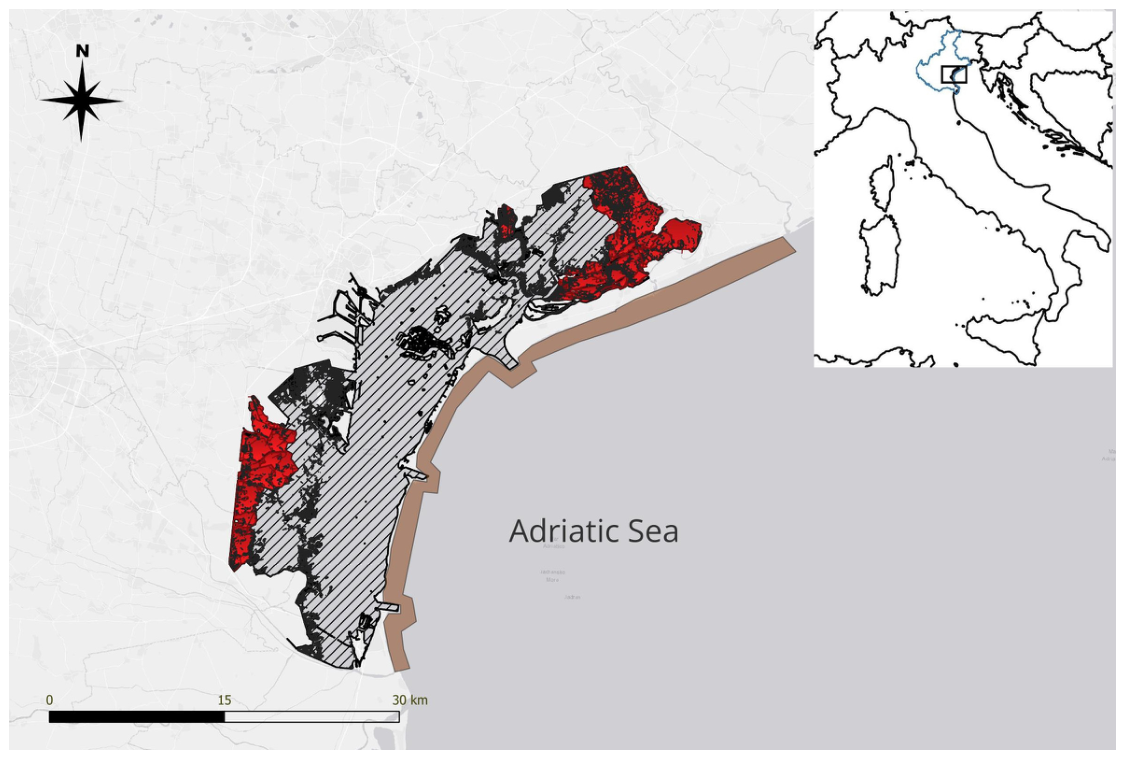
The Venice Lagoon is the largest coastal lagoon in the Mediterranean Sea, covering approximately 550 km
2 along the northern Adriatic coast of Italy (45°25′ N, 12°18′ E;
Figure 1). It extends for 50 km from the Piave River in the north to the Brenta River in the south and is separated from the Adriatic Sea by two barrier islands and two narrow peninsulas. The lagoon is connected to the sea through three inlets (Lido, Malamocco, and Chioggia), which regulate tidal exchange and the hydrodynamic regime [
9]. Tidal amplitude can reach up to 1 m, the highest in the Mediterranean [
24], generating vast intertidal areas that represent key foraging habitats for waders and other waterbirds. The climate is temperate sub-continental, with a marked marine influence. Mean annual air temperature is between 10 and 14 °C, with mild winters and warm summers; annual precipitation ranges between 800 and 1100 mm [
25]. The Venice Lagoon is a highly heterogeneous system, comprising a mosaic of deep channels, shallow open waters, tidal flats (
velme in Italian), salt marshes (
barene), fish farms (
valli da pesca), and reclaimed areas. This environmental heterogeneity supports a diverse waterbird community, with habitat use strongly influenced by tidal dynamics, water depth, and food availability. In particular, waders are closely associated with intertidal habitats, where sediment characteristics and tidal exposure determine the availability of benthic prey.
For analytical purposes, during the International Waterbird Census (IWC, see below) surveys the lagoon was subdivided into four major macro-areas reflecting differences in hydrology, management regime, and ecological function (
Figure 1):
(1) Fish farms. Approximately 20 privately owned fish farms, covering 9600 ha, are located along the lagoon margins [
26]. These are hydraulically regulated systems, largely disconnected from natural tidal exchange and where water levels are actively managed. During winter, site managers often provide supplementary food (e.g., rice, grain, millet) to attract and maintain high densities of waterbirds, particularly game species. These areas therefore offer stable, shallow habitats with high food availability and relatively low disturbance, supporting very high densities of wintering waterbirds. However, they generally play a secondary role for waders, which are less dependent on artificial food provisioning and more closely linked to natural foraging habitats and exposed muddy substrates.
(2) open lagoon. This includes all areas directly connected to tidal exchange with the Adriatic Sea and comprises deep channels, shallow waters, tidal flats (approximately 4000 ha), natural salt marshes (approximately 3600 ha), and artificial salt marshes created from dredged sediments (approximately 1400 ha [
27]). These habitats represent the core wintering environment for waders, providing extensive foraging grounds associated with intertidal exposure and benthic productivity. The availability and spatial distribution of tidal flats are therefore key drivers of wader abundance and distribution. Each winter, in the Open lagoon between ten and twenty traditional roosts, located on artificial saltmarshes and natural saltmarshes, are used by waders during high tides.
(3) Coastal littoral zone. This macro-area includes sandy beaches and nearshore marine waters, defined as those within approximately 1 km from the coastline. One coastal infrastructure, a breakwater, provides an additional roosting site for waterbirds, including waders, during high-tide periods [
28]. Nevertheless, the coastal zone supports low densities compared to the open lagoon.
(4) Minor wetlands. This category includes small and heterogeneous habitats such as treatment wetlands, freshwater ponds within industrial areas, drainage basins, and reclaimed lands. Although limited in extent, these sites can locally support certain wader species, especially those less strictly dependent on intertidal environments, and may function as supplementary feeding or resting areas.
2.1. Climate Data
Winter temperature trends were assessed using mean seasonal air temperature calculated for each winter between 1992/93 and 2021/22. Following standard practice [
17], winter temperature was defined as the average of the mean monthly temperatures for November, December, and January. Data were obtained from the meteorological station of Tessera Airport, located at the edge of the Venice Lagoon.
2.2. Waterbird Counts
Wintering waterbird data were collected within the framework of the International Waterbird Census, implemented in the Venice Lagoon by Associazione Faunisti Veneti through the national monitoring scheme coordinated by ISPRA, the Italian Institute for Environmental Protection and Research [
7,
29]. Counts have been conducted annually since 1993 in mid-January by trained volunteers, following standardized protocols that ensure comparability across years and sites. The entire lagoon was surveyed over three consecutive days and divided into approximately 50 survey units, each covered by teams of two to three observers using a combination of ground-based and boat-based surveys. All fish farms were surveyed on the same day during non-hunting periods, while open lagoon counts were conducted in a single day during high or rising tides to maximize detection of roosting birds. The coastal strip was surveyed on foot. No surveys were conducted in 2021 due to COVID-19 restrictions; therefore, the dataset includes 29 annual counts between 1993 and 2022, with 28 species recorded in at least one winter (see
Table S1).
Waterbird count data derived from large-scale monitoring schemes such as the IWC are inherently affected by multiple sources of uncertainty, particularly in complex coastal systems such as lagoons. In these environments, counts involve large and spatially dispersed aggregations, making accurate enumeration challenging. Potential sources of bias include imperfect detectability, variation in observer experience, differences in survey conditions, such as visibility, weather, and water level, and estimation errors in large flocks. Detectability may also vary among habitats and species. Although detailed metadata on observer identity and effort were not systematically archived for the entire study period, the survey design, spatial coverage, and counting protocols remained consistent over time, as coordinated within the national IWC framework. This consistency supports the use of the dataset for long-term trend analyses despite the inherent limitations discussed above. Standardized protocols, repeated coverage of the same count units and coordinated surveys are designed to minimize variability and ensure temporal consistency, although they do not fully eliminate all sources of error. Nevertheless, we acknowledge that inaccuracies in absolute counts may occur, particularly for highly gregarious species such as waders or under suboptimal survey conditions. Despite these limitations, the consistency of methods through time makes IWC data well suited for detecting medium- to long-term changes in waterbird populations [
30]. Accordingly, emphasis was placed not only on absolute counts but also on relative patterns, proportional use of macro-areas, community metrics and sensitivity analyses designed to identify whether aggregate results were driven by dominant species.
2.3. Data Aggregation and Community Metrics
Analyses were conducted at three levels: (i) lagoon-wide totals, obtained by summing counts across all macro-areas (see
Table S1); (ii) macro-area totals, including fish farms, open lagoon, coastal littoral zone and minor wetlands (see
Table S2); and (iii) species- and guild-level datasets. For each year, total abundance was calculated both including all species and excluding Dunlin, the numerically dominant species in the assemblage. This allowed us to distinguish overall temporal patterns from those strongly influenced by the dominant taxon.
Species were assigned to three eco-functional guilds based on foraging behaviour and habitat use, following established classifications for shorebirds [
1,
31] (see
Table S1). The first group, “Probing benthic feeders”, includes species that extract invertebrates from soft sediments using tactile foraging, typically in intertidal mudflats. The second group, “Surface/visual feeders”, comprises species that capture prey at or near the sediment surface, relying primarily on visual detection. The third group includes “Non-benthic and generalist feeders”, which exploit prey in shallow water or show flexible and opportunistic feeding strategies across different microhabitats. This classification reflects major ecological differences in feeding strategy and habitat dependence among waders, particularly in relation to sediment characteristics, water depth and tidal exposure, and provides a functional framework for interpreting patterns of abundance and community change.
Community structure was described using species richness and the Shannon diversity index. Interannual similarity between consecutive winters was quantified using the Jaccard index (presence–absence) and the Bray–Curtis index (abundance-based) [
32]. In response to the strong numerical dominance of Dunlin, additional community metrics were calculated for each sampled winter: Pielou’s evenness, Simpson dominance, Berger–Parker dominance index and the annual proportion of total abundance represented by Dunlin. Pielou’s evenness was used to assess how evenly individuals were distributed among species, while Berger–Parker dominance provided a direct measure of the proportional contribution of the most abundant species. These indices were used to test whether the assemblage became more or less dominated over time, rather than inferring structural change only from species richness or Shannon diversity.
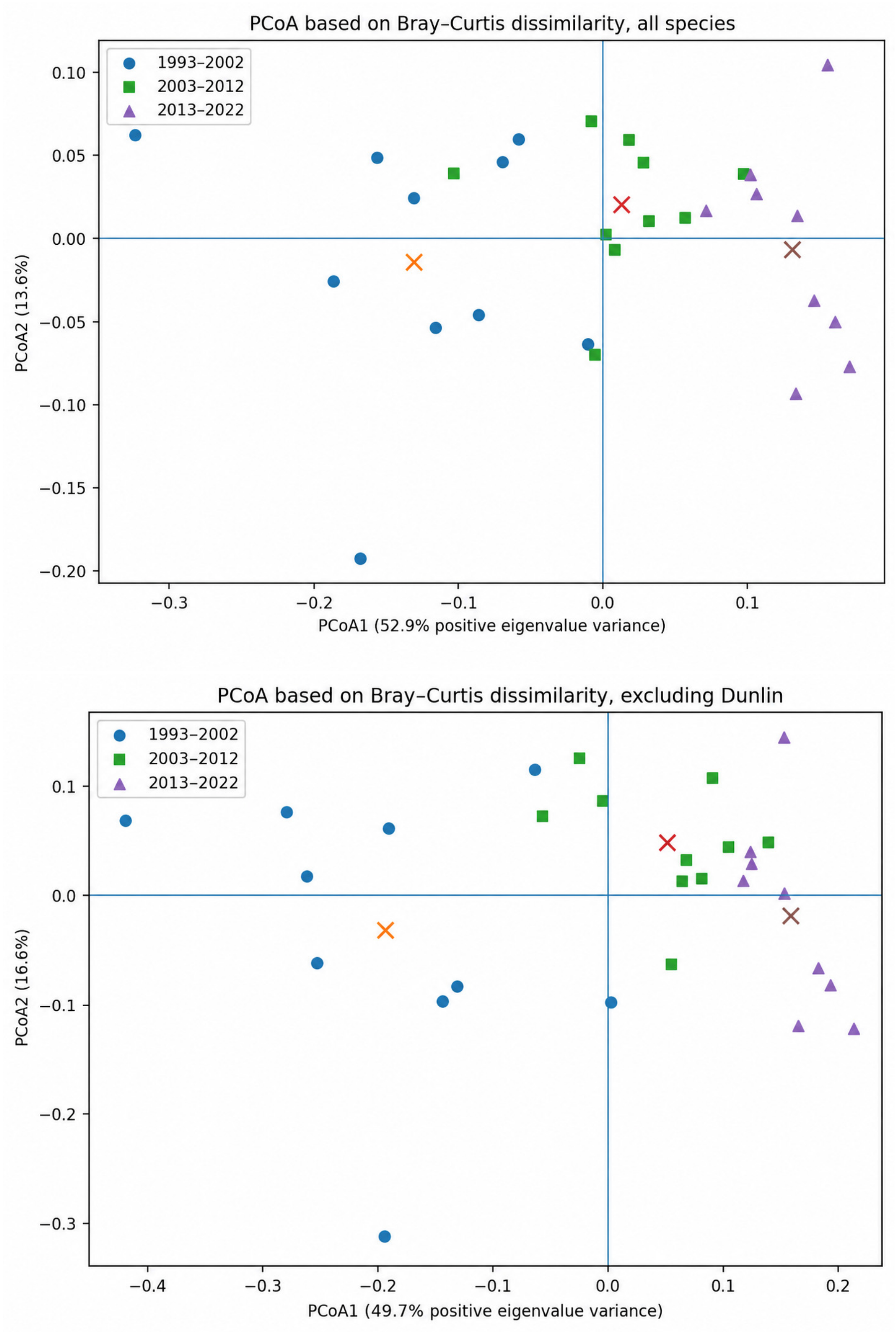
To assess changes in assemblage composition, abundance-based multivariate analyses were carried out using Bray–Curtis dissimilarities calculated from square-root-transformed annual species abundances. Square-root transformation was used to reduce the influence of extremely abundant species while retaining abundance information. Principal Coordinates Analysis (PCoA) was used to visualize compositional differences among years. Analyses were performed both including all species and excluding Dunlin, in order to test whether compositional change persisted after removing the dominant species.
Years were grouped a priori into three approximately decadal periods: 1993–2002, 2003–2012 and 2013–2022. These periods were defined to obtain time windows of comparable length across the 30-year monitoring series and to reduce the influence of single anomalous years, which may be common in wintering wader counts because of weather, tidal conditions and temporary redistribution of large flocks. The year 2021 was excluded because no IWC count was carried out. Differences in assemblage composition among periods were tested using PERMANOVA with 9999 permutations. When the overall PERMANOVA was significant, pairwise PERMANOVA comparisons among periods were inspected as post hoc exploratory tests.
2.4. Trend Analysis
Trends were estimated using TRIM v. 3.54 (Trends and Indices for Monitoring data) [
33], based on log-linear Poisson regression models specifically developed for time-series count data with missing values. Standard TRIM settings were applied, including correction for overdispersion and serial correlation. TRIM was used for count-based time series, namely total abundance, total abundance excluding Dunlin, species-level counts and eco-functional guild totals. These variables represent annual count series and are therefore suitable for log-linear trend modelling within the TRIM framework. Species recorded in fewer than 10 winters were excluded from species-level trend analyses, resulting in a subset of 19 species. Trends for these species were estimated for both the full period (1993–2022) and the most recent decade (2012–2022), always excluding 2021, to assess temporal consistency. The absence of data for 2021 was handled within the TRIM framework, which explicitly accounts for missing values in the time series. Given the length of the dataset and the magnitude of observed trends, the absence of a single year is unlikely to substantially influence the results. For count-based time series analyzed with TRIM, we estimated annual indices relative to a reference year, overall log-linear trends and trend classifications. Community metrics, annual macro-area proportions and CTI values were not analyzed with TRIM because they are aggregate, derived or proportional metrics rather than raw count series; their temporal patterns were assessed using linear regression models as described below.
Trend classifications were done according to standard TRIM categories (strong increase, moderate increase, stable, uncertain, moderate decline, steep decline). The distinction between “stable” and “uncertain” follows the standard TRIM classification rules: a trend is classified as stable only when the confidence interval around the multiplicative slope is sufficiently narrow and remains within the predefined stability interval, whereas uncertain trends have confidence intervals that are too wide to assign a reliable direction or stability class. Thus, TRIM classifications depend not only on the estimated annual change but also on its uncertainty. TRIM results are reported with annual percentage change, standard error, p-value, number of winters in which the species was recorded, and trend classification.
2.5. Species Temperature Index (STI) and Community Temperature Index (CTI)
Species thermal affinities were quantified using the Species Temperature Index (STI), defined as the mean January temperature across the non-breeding distribution of each species. STI values (see
Table S1) were derived from published datasets based on the intersection of species distribution maps with long-term climatic data (baseline 1950–2000: [
16,
34,
35]). From the overall pool of 28 species, two were excluded due to the lack of available STI values.
The Community Temperature Index (CTI) was calculated annually as the abundance-weighted mean of STI values as follows:
CTIy = [Σ (n
iy × STIi)]/[Σ n
iy], for i = 1,…,S
y., where n
iy is the abundance of species i in year y, STI
i is the Species Temperature Index of species i, and S
y is the number of species with available STI values recorded in year y. For the presence–absence CTI, n
iy was set to 1 for each species recorded in year y. The year 2021 was excluded from all CTI calculations (see
Table S3).
To assess the robustness of CTI trends to species dominance, we recalculated CTI after excluding the most abundant species, Dunlin, which accounts for a large proportion of total abundance and strongly influences community-level metrics. In addition, we calculated a presence–absence CTI, in which all species recorded in a given winter contributed equally regardless of abundance. This metric was used to distinguish changes in the thermal composition of the species list from changes in the thermal composition of individuals. Presence–absence CTI was also recalculated after excluding Dunlin.
Finally, a leave-one-species-out sensitivity analysis was performed by recalculating the abundance-weighted CTI after removing each species in turn. For each reduced assemblage, we estimated the CTI temporal trend and compared the resulting slope and significance with those obtained from the full assemblage. This procedure allowed us to identify species exerting disproportionate influence on the estimated CTI trend and to evaluate whether the apparent thermal signal was broadly distributed across species or mainly driven by a few taxa.
2.6. Statistical Analyses
Temporal trends in climate variables, community metrics, macro-area proportions and CTI values were assessed using linear regression models with year as a continuous predictor (PAST software v. 5.2: [
36]). Linear regressions were used for continuous or derived variables, including winter temperature, species richness, diversity and dominance indices, annual macro-area proportions, abundance-weighted CTI and presence–absence CTI. Total abundance, species-level counts, and eco-functional guild totals were analyzed with TRIM as count-based time series (see above). Principal Coordinates Analysis (PCoA) and PERMANOVA were also performed in PAST v. 5.2. Multivariate analyses were based on Bray–Curtis dissimilarities calculated from square-root-transformed abundance data. Differences in assemblage composition among periods were tested using one-way PERMANOVA with 9999 permutations. When the overall PERMANOVA was significant, pairwise PERMANOVA comparisons among periods were inspected as post hoc exploratory tests. Because macro-area patterns may be affected by changes in total abundance, spatial analyses were carried out both on absolute annual counts and on the annual proportion of the total assemblage recorded in each macro-area. Proportions were calculated separately for the whole assemblage, for Dunlin alone, and for all species excluding Dunlin. This allowed us to test whether changes in macro-area use reflected a broad redistribution of the assemblage or were mainly driven by the dominant species. All analyses excluded 2021 because no IWC count was conducted in that year. Species names follow the updated English and scientific nomenclature adopted in the
Supplementary Material.
4. Discussion
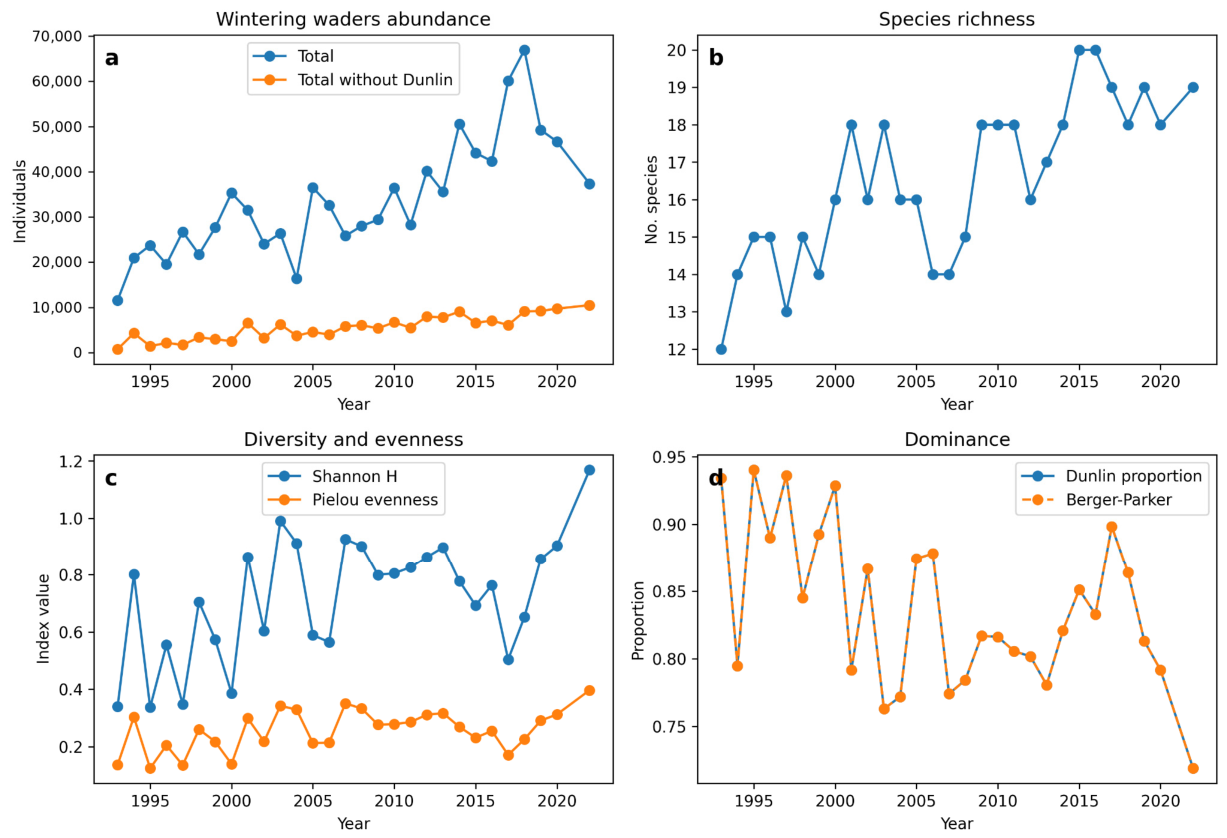
The analysis of a 30-year time series (1993–2022) reveals that the wintering wader assemblage of the Venice Lagoon is characterized by a combination of increasing abundance, persistent numerical dominance by Dunlin, and measurable compositional reorganization. Total abundance increased significantly, and this increase was not restricted to Dunlin, although this species remained by far the dominant component of the assemblage. Species-level trends also showed a prevalence of increases, with only one species showing a significant decline. Shannon diversity and Pielou’s evenness increased, while Berger–Parker dominance and the annual proportional contribution of Dunlin declined slightly but significantly. The main community-level pattern is therefore not of increasing dominance, but increasing abundance combined with persistent dominance and significant compositional reorganization.
Total abundance of waders increased significantly over the study period (+3.5% yr
−1), while species richness increased over time. This pattern—increasing richness and abundance, together with persistent dominance by a single species—is consistent with findings from long-term ecological studies showing that local biodiversity often remains relatively constant despite substantial changes in community structure [
13,
14,
15]. In the Venice Lagoon, however, this apparent stability masks a clear reorganization of the assemblage, driven primarily by changes in relative abundance rather than by species turnover. More precisely, the analyses indicate that abundance, diversity, dominance and composition followed partly different trajectories. Total abundance suggests a positive demographic trend, richness and evenness do not indicate progressive simplification, while the Bray–Curtis multivariate analyses reveal significant temporal reorganization of species composition.
A key result of this study is the persistently high dominance of Dunlin. This species accounted for a very large proportion of total individuals over the whole study period and largely shaped interannual variation in total abundance. This pattern indicates that the assemblage was highly uneven throughout the study period, but not that it became progressively more dominated. This distinction is important because it separates dominance as a structural property of the assemblage from temporal increase in dominance. High dominance by a few abundant shorebird species is common in large coastal wetlands, where extensive intertidal flats and shallow soft-bottom habitats can support large aggregations of gregarious benthic feeders [
1,
3,
37]. The Venice Lagoon fits this general pattern, but the persistence of high Dunlin dominance makes the assemblage particularly sensitive to changes in the abundance and distribution of this single species. Similar total abundance trends may therefore have different ecological meanings depending on whether they reflect a broad increase across species or the numerical response of one dominant taxon.
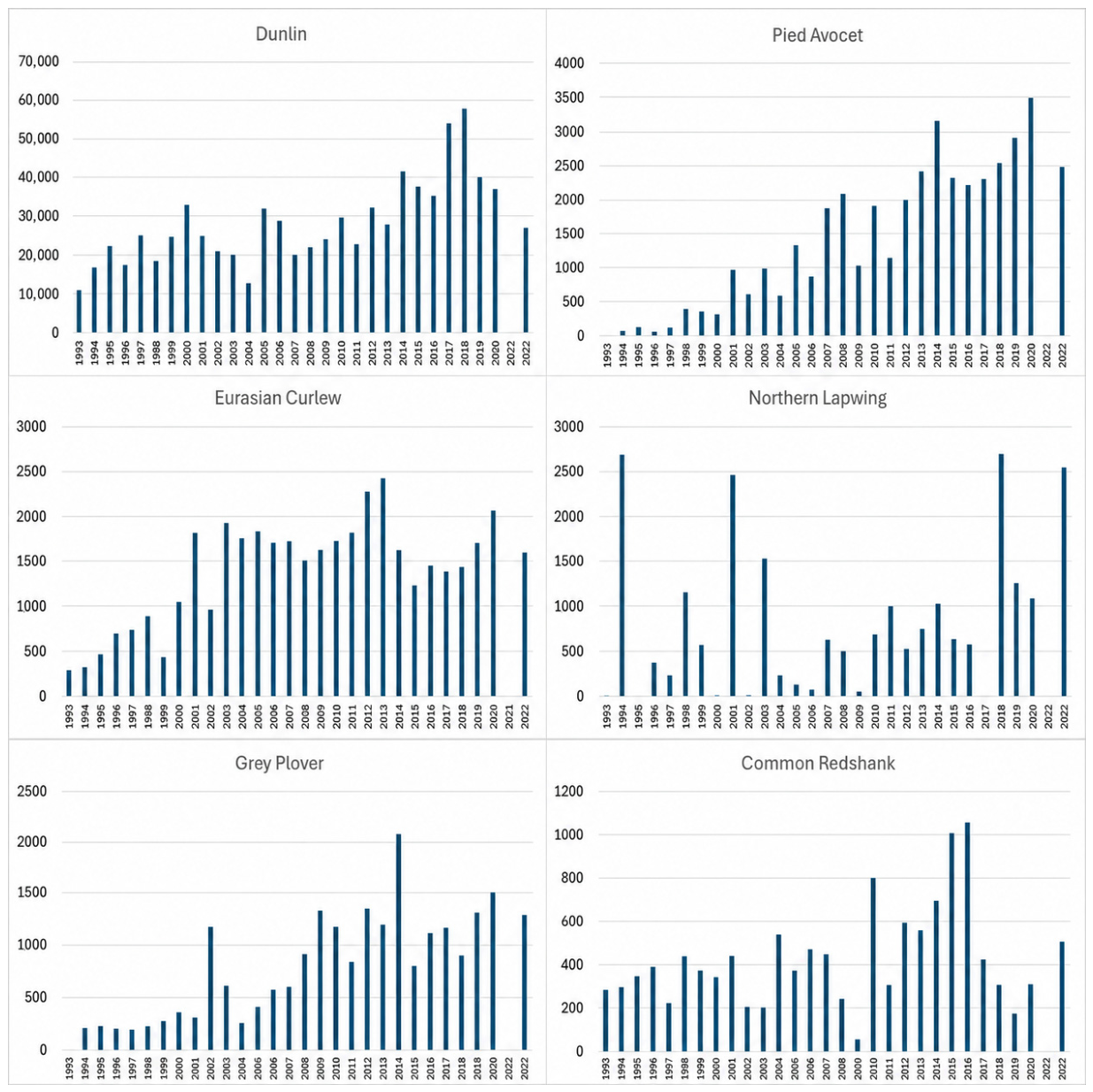
The species-level analyses further support this interpretation. Although several species exhibited positive trends, the overall increase in abundance was not entirely dependent on Dunlin, as total abundance also increased when this species was excluded. This finding reflects a general ecological principle: community-level trends often emerge from asynchronous dynamics among species, rather than from uniform responses across the assemblage, as also shown in other ecological systems [
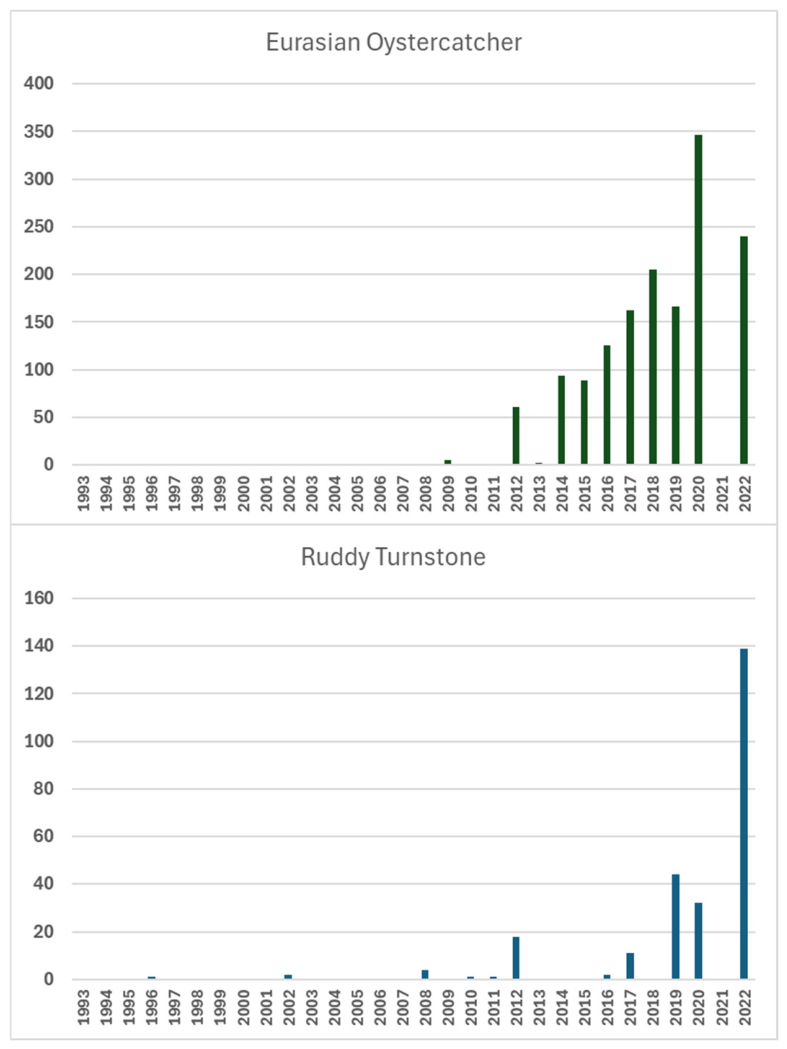
15]. Several species increased significantly, including both abundant taxa and species that were rare or nearly absent in the early part of the series. In particular, Eurasian Oystercatcher and Ruddy Turnstone increased from very low numbers to several hundred wintering individuals. These patterns suggest that part of the observed reorganization involved changes in the status of species that were formerly scarce in the lagoon. By contrast, other species showed uncertain trends, reflecting either limited sample size, high interannual variability or genuinely weak directional change. This heterogeneity supports the need to interpret the assemblage through species-specific trajectories rather than through total abundance alone.
The multivariate analyses provide stronger evidence for long-term community reorganization than univariate diversity metrics alone. PCoA and PERMANOVA based on Bray–Curtis dissimilarities showed significant compositional differences among the three approximately decadal periods, both including all species and after excluding Dunlin. This result indicates that assemblage reorganization was not merely an artefact of changing Dunlin abundance. Rather, it reflected the combined dynamics of dominant, subdominant and formerly scarce species. Thus, the community changed markedly, but the change cannot be summarized simply as increasing dominance or structural simplification.
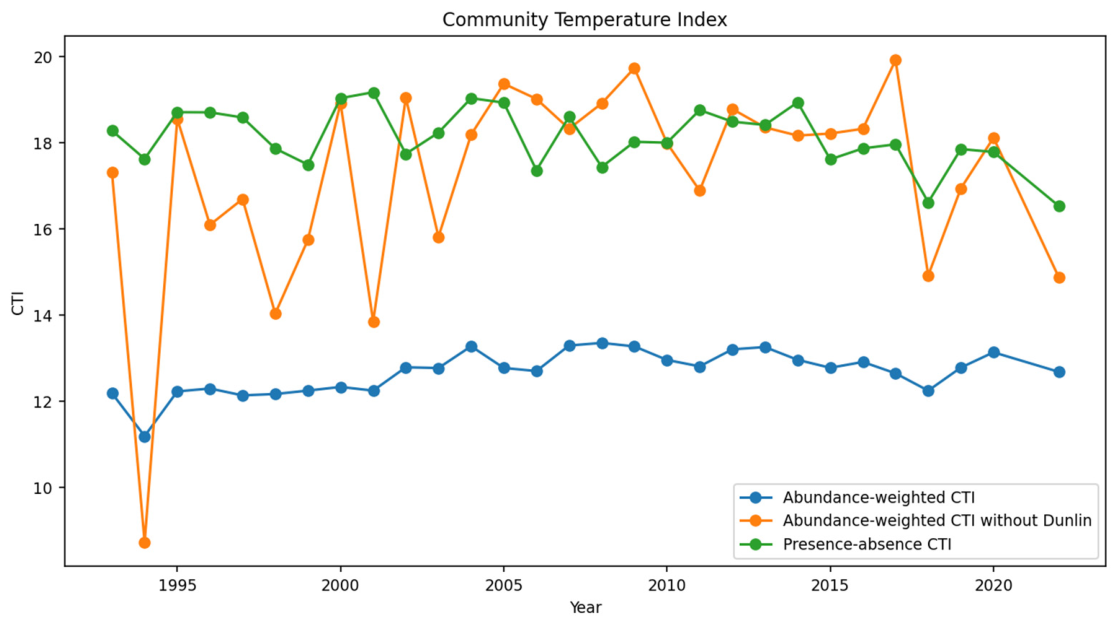
The analysis of the Community Temperature Index (CTI) provides additional insight into the drivers of community change. The significant increase in CTI observed over the study period could initially be interpreted as an abundance-weighted shift towards species with higher thermal affinities, but our analyses show that this interpretation must be treated with caution. The biological magnitude of the abundance-weighted CTI increase was modest relative to the range of STI values among the analyzed species. Moreover, the trend was not robust to the exclusion of Dunlin, and the presence–absence CTI showed the opposite pattern, declining over time. Thus, the thermal composition of individuals and the thermal composition of the species list did not show the same temporal signal.
However, the sensitivity analysis clearly demonstrates that this apparent thermophilization is not robust to the removal of the dominant species Dunlin. When this species is excluded, the CTI trend becomes non-significant, indicating that the observed increase is largely driven by abundance structure and by the dynamics of one or a few influential species rather than by a coherent community-wide response. The strong interannual variability observed in CTI after exclusion of Dunlin, including abrupt changes such as the marked decrease between 1993 and 1994 driven by fluctuations in Northern Lapwing further highlights the sensitivity of the index to changes in the relative abundance of individual species.
These results are consistent with previous studies showing that community-weighted indicators, such as the CTI, can be strongly driven by dominant species and by covariation among species traits, potentially biassing their interpretation and leading to overestimation of climate-driven change when species-specific contributions are not explicitly disentangled [
19,
22,
38]. From an ecological perspective, this finding is particularly relevant for wader assemblages, which are often highly uneven and dominated by a few numerically abundant species [
39,
40]. In such systems, changes in dominance structure can strongly affect synthetic indicators such as CTI, potentially obscuring underlying ecological processes. The Venice Lagoon thus represents a clear example of how community-level metrics must be interpreted in the context of species-specific dynamics. The leave-one-species-out analysis further supports this interpretation. Removal of Dunlin made the abundance-weighted CTI trend non-significant, and removal of Pied Avocet also strongly reduced the trend. This does not make CTI uninformative; rather, it shows that CTI must be interpreted together with dominance structure and species-level sensitivity tests. In highly uneven communities such as wintering waders, statistically significant community-weighted indicators may be ecologically ambiguous unless the contribution of dominant species is explicitly evaluated.
Functional patterns provide further insight into these dynamics. Probing benthic feeders dominated the assemblage and showed a significant positive trend, confirming the central role of intertidal habitats in supporting wintering waders in the Venice Lagoon. Surface/visual feeders and non-benthic/generalist feeders also increased significantly, although they represented much smaller proportions of the assemblage and showed greater interannual variability. This pattern indicates that the overall increase was not restricted to a single functional group, but the assemblage remained strongly structured around species exploiting benthic resources in exposed or shallow sediments. Because benthic feeders depend on invertebrates associated with tidal flats and shallow soft-bottom habitats, their abundance is closely linked to benthic productivity, sediment characteristics and the availability and duration of tidal-flat exposure. Similar relationships between wader abundance, benthic resources and habitat availability have been documented in other wetland systems [
1,
41]. However, guild-level increases should be interpreted cautiously. They do not necessarily imply a uniform improvement of habitat conditions across the lagoon, because guilds include species with different habitat requirements, detectability and spatial distribution. They indicate that the overall increase was shared by broad functional groups, but not that all ecological processes acted uniformly.
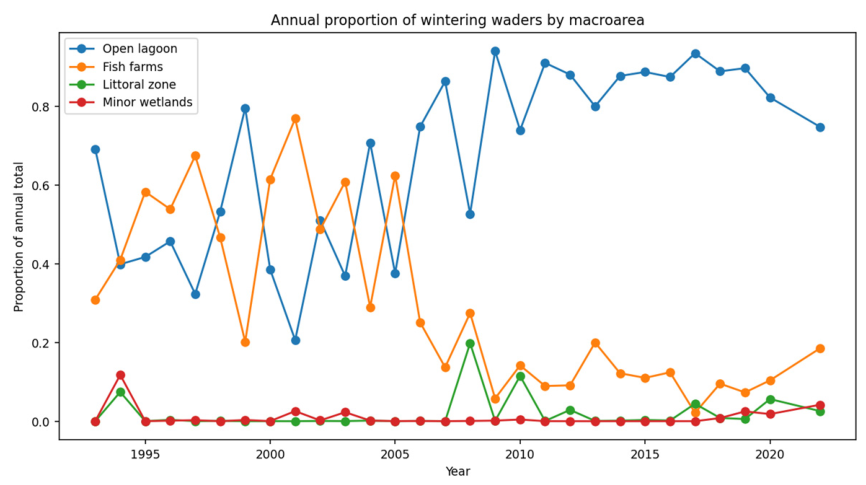
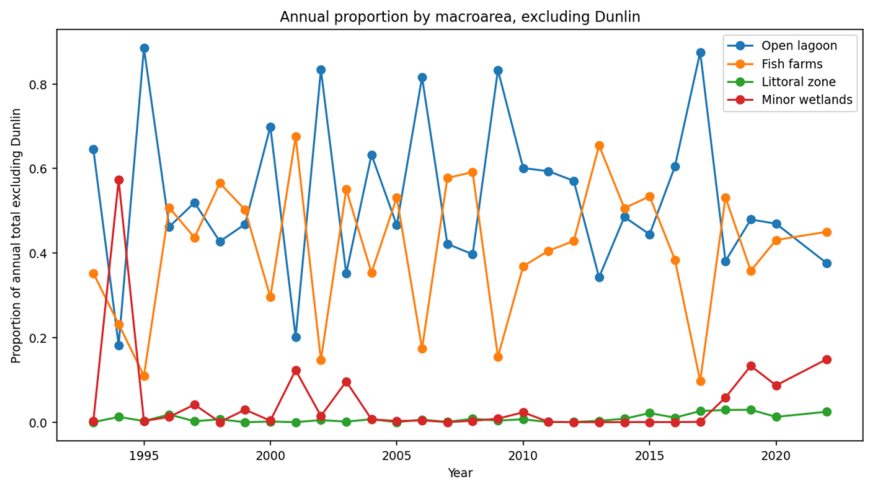
The spatial analysis supports this interpretation, revealing a strong increase in the proportion of counted waders recorded in the open lagoon and a corresponding decline in Fish farms. However, the revised proportional analyses show that this pattern was largely driven by Dunlin. When Dunlin was excluded, the non-Dunlin component did not show a comparable increase in proportional use of the open lagoon or decline in Fish farms. Therefore, the apparent assemblage-level redistribution towards the open lagoon should not be interpreted as a generalized spatial shift in all waders, but as a dominance-sensitive pattern mainly reflecting the redistribution of the most abundant species.
In contrast, other waterbird groups, such as dabbling ducks, often benefit from managed wetlands and artificial habitats. In Mediterranean systems such as the Camargue, water management and habitat configuration have been shown to strongly influence waterbird distribution, with managed wetlands favouring certain guilds over others [
42]. This comparison highlights that different components of the waterbird community may respond differently to the same wetland mosaic. Fish farms and other managed wetlands can be very important for wintering waterbirds, especially for ducks and other groups that benefit from water-level management, reduced disturbance and artificial or semi-natural food resources [
20,
21,
26,
42]. Waders, however, are generally more directly linked to exposed mudflats, shallow waters and benthic prey resources, and are therefore expected to respond differently from the whole waterbird assemblage. The decline in the proportional importance of Fish farms for counted waders should therefore not be interpreted as a general decline in the conservation value of these managed habitats, but as a taxon-specific pattern within a broader wetland mosaic.
Although the present data do not allow us to identify the mechanisms underlying the observed spatial redistribution, the future availability of intertidal habitats remains a key conservation issue. In the Venice Lagoon, the observed deepening of tidal flats [
43] and the projected sea-level rise for the northern Adriatic, approximately +22 cm by 2050 [
9], may reduce both the extent and the exposure time of tidal flats, with potentially negative consequences for wintering waders. This is particularly relevant because the open lagoon includes extensive tidal flats and saltmarsh roosts, and because waders depend on the combined availability of feeding areas and safe high-tide roosting sites. Therefore, even if the apparent increase in the proportional use of the open lagoon was largely Dunlin-driven, maintaining the morphological and functional integrity of intertidal habitats remains essential for the long-term conservation of the wader assemblage.
This interpretation must nevertheless remain cautious because the IWC surveys in the open lagoon were carried out during high or rising tide to maximize detection of roosting birds. As a consequence, the spatial data describe the distribution of counted birds among macro-areas during standardized winter surveys, but they do not directly distinguish between foraging habitat selection, roosting distribution, and detectability. The open lagoon includes extensive tidal flats and roosts, and is undoubtedly central for wintering waders, but the present data are better suited to documenting changes in counted distribution than to identifying the precise ecological mechanisms underlying those changes. This limitation is consistent with previous methodological work showing that tidal stage and bird movements may affect estimates of tidal-flat use by waders [
2].
Large-scale climatic forcing may also contribute to the observed patterns. Waders are highly mobile and respond to both local habitat conditions and broader flyway-scale processes. Changes in winter severity and temperature gradients across Europe can influence distribution patterns and site selection, leading to interannual variability superimposed on longer-term trends [
37,
44]. The relative contribution of local habitat changes and large-scale climatic drivers cannot be fully disentangled in the present study, as both processes likely act simultaneously and interactively in shaping the observed patterns. However, the revised CTI results indicate that the Venice Lagoon data do not provide strong evidence of a clear community-wide thermophilization of wintering waders. Rather, they show that an apparent abundance-weighted thermal signal can be produced by changes in the relative abundance of dominant or influential species.
The marked increase observed in the Venice Lagoon during the last 15 years for two species, Eurasian Oystercatcher and Ruddy Turnstone, may however reflect partially different mechanisms. In the case of Eurasian Oystercatcher, breeding populations have increased locally during the last decade [
45], and some individuals may currently remain in the lagoon throughout the year, wintering close to their breeding sites. Because ringing activity on this species in the Venice Lagoon has been extremely limited, this hypothesis cannot presently be verified. More generally, the species has shown increasing wintering numbers in Italy, with a strong increase reported for 2009–2018 [
7]. This national pattern is consistent with, but does not prove, the local increase observed in the Venice Lagoon.
For Ruddy Turnstone, the increase as a wintering species appears to have started more recently, both in the Venice Lagoon and more broadly in Italy. National winter counts increased from 27 individuals in 1991–1995 to 134 in 2001–2005 and 218 in 2006–2010 [
46]. In the Venice Lagoon, its increasing abundance may partly reflect the large availability of hard substrates, such as gabions and containment poles associated with artificial saltmarshes, which are regularly used by the species as feeding substrates (pers. obs.). These two species illustrate that part of the long-term reorganization involved taxa that were formerly scarce or irregular in the lagoon. Their trajectories reinforce the need to interpret the assemblage through species-specific patterns rather than through total abundance alone.
The comparison with our broader wintering waterbird analysis of the Venice Lagoon [
8] is useful in this respect. The present study does not simply reproduce the broader waterbird assessment, but refines it for a more ecologically coherent and habitat-dependent group. Waders show particularly strong dependence on intertidal and shallow-water systems, and their assemblage is characterized by extreme dominance by Dunlin. This makes them especially suitable for evaluating whether aggregate trends, spatial patterns and CTI values are robust community signals or are driven by one or a few numerically dominant species. The wader-focused analysis therefore adds information that was not fully visible at the scale of the whole waterbird assemblage [
8]: significant compositional turnover despite persistent dominance, a spatial pattern largely driven by Dunlin, and a weak thermal signal that disappears when dominance effects are controlled.
Several limitations must be considered. IWC data are collected over large and complex wetland systems and may be affected by imperfect detectability, variation in counting conditions and estimation errors in large flocks. These issues are particularly relevant for highly gregarious species such as Dunlin. The absence of detailed observer-level and survey-condition metadata for the whole time series prevents formal modelling of detectability. Nevertheless, the long-term consistency of the survey design, the repeated coverage of the same count units and the standardized national IWC framework support the use of the dataset for detecting medium- to long-term changes [
30]. Our analyses partly address these limitations by complementing absolute counts with proportional spatial metrics, diversity and dominance indices, multivariate analyses, and sensitivity tests excluding Dunlin. However, they cannot fully separate changes in abundance from changes in detectability, roosting distribution, or short-term tidal conditions.
From a conservation and monitoring perspective, the results highlight the need to integrate total abundance, species-specific trends, and community-level metrics. The increase in wintering waders is a positive signal for the lagoon, but it should not be interpreted as evidence that all components of the assemblage are responding in the same way or that all habitats have improved uniformly. The strong role of Dunlin means that management conclusions based only on total abundance may obscure divergent trends among less abundant species and among macro-areas. Maintaining the ecological functions of the open lagoon, including tidal flats and high-tide roosts, remains essential, but the role of Fish farms, Littoral zone and Minor wetlands should not be dismissed, because they may support particular species or provide complementary functions under specific conditions.
Overall, the results of this study support a more nuanced conclusion. Wintering waders in the Venice Lagoon increased markedly over three decades and underwent significant compositional reorganization. The assemblage remained strongly dominated by Dunlin but did not become progressively more dominated; community composition changed significantly even after excluding Dunlin; the apparent spatial redistribution towards the open lagoon was largely Dunlin-driven; and the abundance-weighted CTI increase was weak, species-sensitive and not supported by presence–absence CTI. The main ecological message is therefore one of abundance increase, persistent dominance, species-specific reorganization, and dominance-sensitive spatial and thermal indicators.
These findings have important implications for the interpretation of long-term monitoring data. In particular, they highlight that: (i) increasing or stable richness alone does not necessarily describe the direction of community change; (ii) community-level indicators such as CTI must be interpreted in the context of assemblage dominance structure; and (iii) species-level and functional approaches are essential for disentangling the mechanisms underlying community change.
More broadly, the Venice Lagoon appears to follow patterns observed in other European and Mediterranean wetlands, where climate-driven redistribution, habitat configuration and trophic structure interact to shape long-term waterbird assemblages. Future research should aim to further disentangle these drivers by integrating long-term ecological datasets with detailed information on habitat dynamics, hydrology, benthic productivity and tidal-flat availability. For waders in particular, future work should also distinguish more explicitly between foraging distribution and high-tide roosting distribution, because both components are essential to understand how lagoon-scale environmental change affects wintering assemblages.